

Ever wondered what's inside every living thing on Earth? All... Show more
 English Literature
 Sociology
Sign up to see the contentIt's free!
Access to all documents
Improve your grades
Join milions of students
Knowunity AI
Subjects
Triangle Congruence and Similarity Theorems
Triangle Properties and Classification
Linear Equations and Graphs
Geometric Angle Relationships
Trigonometric Functions and Identities
Equation Solving Techniques
Circle Geometry Fundamentals
Division Operations and Methods
Basic Differentiation Rules
Exponent and Logarithm Properties
Show all topics
Human Organ Systems
Reproductive Cell Cycles
Biological Sciences Subdisciplines
Cellular Energy Metabolism
Autotrophic Energy Processes
Inheritance Patterns and Principles
Biomolecular Structure and Organization
Cell Cycle and Division Mechanics
Cellular Organization and Development
Biological Structural Organization
Show all topics
Chemical Sciences and Applications
Atomic Structure and Composition
Molecular Electron Structure Representation
Atomic Electron Behavior
Matter Properties and Water
Mole Concept and Calculations
Gas Laws and Behavior
Periodic Table Organization
Chemical Thermodynamics Fundamentals
Chemical Bond Types and Properties
Show all topics
European Renaissance and Enlightenment
European Cultural Movements 800-1920
American Revolution Era 1763-1797
American Civil War 1861-1865
Global Imperial Systems
Mongol and Chinese Dynasties
U.S. Presidents and World Leaders
Historical Sources and Documentation
World Wars Era and Impact
World Religious Systems
Show all topics
Classic and Contemporary Novels
Literary Character Analysis
Rhetorical Theory and Practice
Classic Literary Narratives
Reading Analysis and Interpretation
Narrative Structure and Techniques
English Language Components
Influential English-Language Authors
Basic Sentence Structure
Narrative Voice and Perspective
Show all topics
840
•
Updated Mar 15, 2026
•
Ever wondered what's inside every living thing on Earth? All... Show more
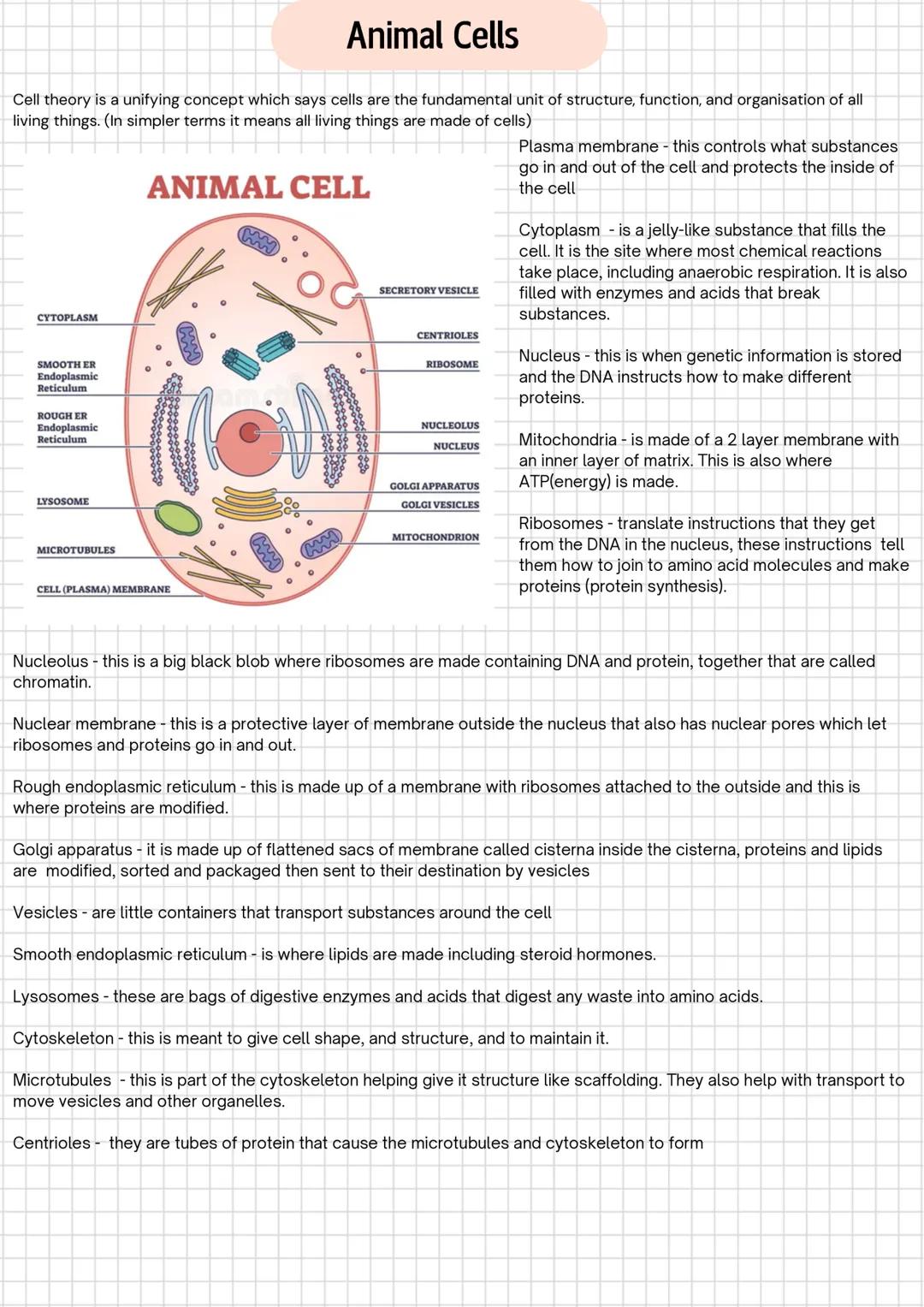
Think of animal cells as incredibly organised microscopic factories where hundreds of processes happen simultaneously. Cell theory tells us that cells are the fundamental units of all living things - basically, if it's alive, it's made of cells!
The nucleus acts like the cell's control centre, storing all the genetic information (DNA) that tells the cell how to make proteins. It's surrounded by a protective nuclear membrane with tiny pores that let important molecules pass through. Inside, you'll find the nucleolus, which looks like a dark blob and is where ribosomes are manufactured.
Mitochondria are often called the powerhouses of the cell because they produce ATP - the energy currency that keeps everything running. Meanwhile, ribosomes work like tiny protein-making machines, reading instructions from DNA to build the proteins your body needs.
The endoplasmic reticulum comes in two types: rough ER (covered in ribosomes) modifies proteins, whilst smooth ER makes lipids including hormones. The Golgi apparatus then packages and ships these products around the cell using little transport containers called vesicles. Lysosomes act as the cell's recycling centres, breaking down waste with powerful digestive enzymes.
Quick Tip: Remember that the cytoplasm is the jelly-like substance filling the cell where most chemical reactions happen - it's like the cell's workshop floor where everything comes together!
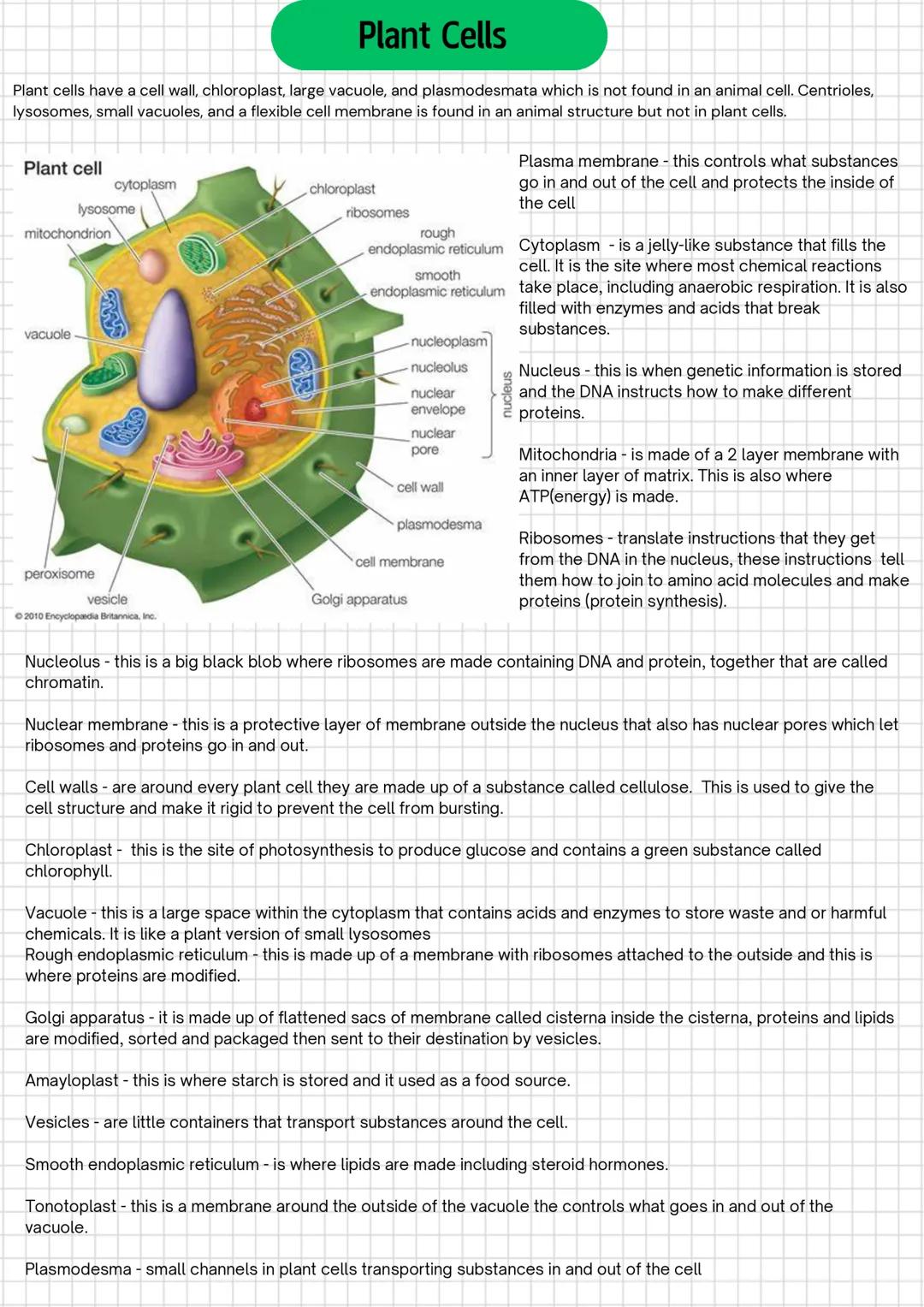
Plant cells share many features with animal cells but have some brilliant extra components that make them uniquely suited for life as a plant. The most obvious difference is the rigid cell wall made of cellulose, which gives plants their structure and prevents the cells from bursting.
Chloroplasts are the real stars of plant cells - these green organelles contain chlorophyll and carry out photosynthesis, converting sunlight into glucose. This is why plants don't need to hunt for food like animals do! You'll also notice that plant cells have one massive vacuole instead of lots of small ones, which stores water and helps maintain the plant's shape.
The tonoplast is the membrane surrounding this large vacuole, controlling what goes in and out. Amyloplasts store starch as a food reserve, whilst plasmodesmata are tiny channels connecting neighbouring plant cells, allowing them to share resources and communicate.
Interestingly, plant cells don't have centrioles or lysosomes like animal cells do. Instead, their large vacuole handles waste storage, and they use different mechanisms for cell division. This shows how evolution has created different solutions for similar cellular challenges.
Remember: Plant cells are essentially animal cells with a green upgrade package - they've got everything animals have plus the extra kit needed for photosynthesis and structural support!
Our AI Companion is a student-focused AI tool that offers more than just answers. Built on millions of Knowunity resources, it provides relevant information, personalised study plans, quizzes, and content directly in the chat, adapting to your individual learning journey.
You can download the app from Google Play Store and Apple App Store.
That's right! Enjoy free access to study content, connect with fellow students, and get instant help – all at your fingertips.
App Store
Google Play
The app is very easy to use and well designed. I have found everything I was looking for so far and have been able to learn a lot from the presentations! I will definitely use the app for a class assignment! And of course it also helps a lot as an inspiration.
Stefan S
iOS user
This app is really great. There are so many study notes and help [...]. My problem subject is French, for example, and the app has so many options for help. Thanks to this app, I have improved my French. I would recommend it to anyone.
Samantha Klich
Android user
Wow, I am really amazed. I just tried the app because I've seen it advertised many times and was absolutely stunned. This app is THE HELP you want for school and above all, it offers so many things, such as workouts and fact sheets, which have been VERY helpful to me personally.
Anna
iOS user
Best app on earth! no words because it’s too good
Thomas R
iOS user
Just amazing. Let's me revise 10x better, this app is a quick 10/10. I highly recommend it to anyone. I can watch and search for notes. I can save them in the subject folder. I can revise it any time when I come back. If you haven't tried this app, you're really missing out.
Basil
Android user
This app has made me feel so much more confident in my exam prep, not only through boosting my own self confidence through the features that allow you to connect with others and feel less alone, but also through the way the app itself is centred around making you feel better. It is easy to navigate, fun to use, and helpful to anyone struggling in absolutely any way.
David K
iOS user
The app's just great! All I have to do is enter the topic in the search bar and I get the response real fast. I don't have to watch 10 YouTube videos to understand something, so I'm saving my time. Highly recommended!
Sudenaz Ocak
Android user
In school I was really bad at maths but thanks to the app, I am doing better now. I am so grateful that you made the app.
Greenlight Bonnie
Android user
very reliable app to help and grow your ideas of Maths, English and other related topics in your works. please use this app if your struggling in areas, this app is key for that. wish I'd of done a review before. and it's also free so don't worry about that.
Rohan U
Android user
I know a lot of apps use fake accounts to boost their reviews but this app deserves it all. Originally I was getting 4 in my English exams and this time I got a grade 7. I didn’t even know about this app three days until the exam and it has helped A LOT. Please actually trust me and use it as I’m sure you too will see developments.
Xander S
iOS user
THE QUIZES AND FLASHCARDS ARE SO USEFUL AND I LOVE Knowunity AI. IT ALSO IS LITREALLY LIKE CHATGPT BUT SMARTER!! HELPED ME WITH MY MASCARA PROBLEMS TOO!! AS WELL AS MY REAL SUBJECTS ! DUHHH 😍😁😲🤑💗✨🎀😮
Elisha
iOS user
This apps acc the goat. I find revision so boring but this app makes it so easy to organize it all and then you can ask the freeeee ai to test yourself so good and you can easily upload your own stuff. highly recommend as someone taking mocks now
Paul T
iOS user
The app is very easy to use and well designed. I have found everything I was looking for so far and have been able to learn a lot from the presentations! I will definitely use the app for a class assignment! And of course it also helps a lot as an inspiration.
Stefan S
iOS user
This app is really great. There are so many study notes and help [...]. My problem subject is French, for example, and the app has so many options for help. Thanks to this app, I have improved my French. I would recommend it to anyone.
Samantha Klich
Android user
Wow, I am really amazed. I just tried the app because I've seen it advertised many times and was absolutely stunned. This app is THE HELP you want for school and above all, it offers so many things, such as workouts and fact sheets, which have been VERY helpful to me personally.
Anna
iOS user
Best app on earth! no words because it’s too good
Thomas R
iOS user
Just amazing. Let's me revise 10x better, this app is a quick 10/10. I highly recommend it to anyone. I can watch and search for notes. I can save them in the subject folder. I can revise it any time when I come back. If you haven't tried this app, you're really missing out.
Basil
Android user
This app has made me feel so much more confident in my exam prep, not only through boosting my own self confidence through the features that allow you to connect with others and feel less alone, but also through the way the app itself is centred around making you feel better. It is easy to navigate, fun to use, and helpful to anyone struggling in absolutely any way.
David K
iOS user
The app's just great! All I have to do is enter the topic in the search bar and I get the response real fast. I don't have to watch 10 YouTube videos to understand something, so I'm saving my time. Highly recommended!
Sudenaz Ocak
Android user
In school I was really bad at maths but thanks to the app, I am doing better now. I am so grateful that you made the app.
Greenlight Bonnie
Android user
very reliable app to help and grow your ideas of Maths, English and other related topics in your works. please use this app if your struggling in areas, this app is key for that. wish I'd of done a review before. and it's also free so don't worry about that.
Rohan U
Android user
I know a lot of apps use fake accounts to boost their reviews but this app deserves it all. Originally I was getting 4 in my English exams and this time I got a grade 7. I didn’t even know about this app three days until the exam and it has helped A LOT. Please actually trust me and use it as I’m sure you too will see developments.
Xander S
iOS user
THE QUIZES AND FLASHCARDS ARE SO USEFUL AND I LOVE Knowunity AI. IT ALSO IS LITREALLY LIKE CHATGPT BUT SMARTER!! HELPED ME WITH MY MASCARA PROBLEMS TOO!! AS WELL AS MY REAL SUBJECTS ! DUHHH 😍😁😲🤑💗✨🎀😮
Elisha
iOS user
This apps acc the goat. I find revision so boring but this app makes it so easy to organize it all and then you can ask the freeeee ai to test yourself so good and you can easily upload your own stuff. highly recommend as someone taking mocks now
Paul T
iOS user
Ever wondered what's inside every living thing on Earth? All living organisms - from your pet dog to the massive oak tree in your garden - are built from tiny building blocks called cells. Understanding animal and plant cells is... Show more
Access to all documents
Improve your grades
Join milions of students
Think of animal cells as incredibly organised microscopic factories where hundreds of processes happen simultaneously. Cell theory tells us that cells are the fundamental units of all living things - basically, if it's alive, it's made of cells!
The nucleus acts like the cell's control centre, storing all the genetic information (DNA) that tells the cell how to make proteins. It's surrounded by a protective nuclear membrane with tiny pores that let important molecules pass through. Inside, you'll find the nucleolus, which looks like a dark blob and is where ribosomes are manufactured.
Mitochondria are often called the powerhouses of the cell because they produce ATP - the energy currency that keeps everything running. Meanwhile, ribosomes work like tiny protein-making machines, reading instructions from DNA to build the proteins your body needs.
The endoplasmic reticulum comes in two types: rough ER (covered in ribosomes) modifies proteins, whilst smooth ER makes lipids including hormones. The Golgi apparatus then packages and ships these products around the cell using little transport containers called vesicles. Lysosomes act as the cell's recycling centres, breaking down waste with powerful digestive enzymes.
Quick Tip: Remember that the cytoplasm is the jelly-like substance filling the cell where most chemical reactions happen - it's like the cell's workshop floor where everything comes together!
Access to all documents
Improve your grades
Join milions of students
Plant cells share many features with animal cells but have some brilliant extra components that make them uniquely suited for life as a plant. The most obvious difference is the rigid cell wall made of cellulose, which gives plants their structure and prevents the cells from bursting.
Chloroplasts are the real stars of plant cells - these green organelles contain chlorophyll and carry out photosynthesis, converting sunlight into glucose. This is why plants don't need to hunt for food like animals do! You'll also notice that plant cells have one massive vacuole instead of lots of small ones, which stores water and helps maintain the plant's shape.
The tonoplast is the membrane surrounding this large vacuole, controlling what goes in and out. Amyloplasts store starch as a food reserve, whilst plasmodesmata are tiny channels connecting neighbouring plant cells, allowing them to share resources and communicate.
Interestingly, plant cells don't have centrioles or lysosomes like animal cells do. Instead, their large vacuole handles waste storage, and they use different mechanisms for cell division. This shows how evolution has created different solutions for similar cellular challenges.
Remember: Plant cells are essentially animal cells with a green upgrade package - they've got everything animals have plus the extra kit needed for photosynthesis and structural support!
Our AI Companion is a student-focused AI tool that offers more than just answers. Built on millions of Knowunity resources, it provides relevant information, personalised study plans, quizzes, and content directly in the chat, adapting to your individual learning journey.
You can download the app from Google Play Store and Apple App Store.
That's right! Enjoy free access to study content, connect with fellow students, and get instant help – all at your fingertips.
11
Smart Tools NEW
Transform this note into: ✓ 50+ Practice Questions ✓ Interactive Flashcards ✓ Full Mock Exam ✓ Essay Outlines
Explore the intricate structures and functions of eukaryotic cells, including organelles like the nucleus, mitochondria, and chloroplasts. This summary covers key concepts in cellular biology, microscopy techniques, and the differences between prokaryotic and eukaryotic cells. Ideal for students studying cell biology and related fields.
 Biology
Explore the essentials of microscopy, including types of microscopes, magnification, and resolution. This summary covers the history of light and electron microscopes, detailing their functions and applications in scientific observation. Ideal for students seeking a clear understanding of microscopy concepts.
BiologyMaster the essential steps for using a microscope effectively in Year 7 science. This guide covers key components such as the ocular lens, objective lenses, and stage controls, along with detailed instructions for focusing and magnification adjustments. Ideal for students preparing for exams or practical assessments.
BiologyExplore the various types of microscopes including Optical, Transmission Electron Microscopes (TEMs), and Scanning Electron Microscopes (SEMs). This summary covers key concepts such as magnification, resolution, and the advantages and disadvantages of each microscope type. Ideal for A-level biology students studying cell structure and microscopy techniques.
BiologyExplore the fundamentals of microscopy, including the use of light and electron microscopes, specimen preparation, viewing techniques, and magnification calculations. This practical guide covers essential skills for studying cells and sub-cellular structures, making it ideal for biology students. Includes step-by-step instructions and examples for effective scientific drawing and measurement conversions.
BiologyExplore essential microscopy techniques, including slide preparation, staining methods, and the development of cell theory. This summary covers key historical milestones, types of microscopes, and practical applications in biology, making it ideal for A Level Biology students. Understand how to differentiate between cell types and the significance of staining in microscopy.
BiologyApp Store
Google Play
The app is very easy to use and well designed. I have found everything I was looking for so far and have been able to learn a lot from the presentations! I will definitely use the app for a class assignment! And of course it also helps a lot as an inspiration.
Stefan S
iOS user
This app is really great. There are so many study notes and help [...]. My problem subject is French, for example, and the app has so many options for help. Thanks to this app, I have improved my French. I would recommend it to anyone.
Samantha Klich
Android user
Wow, I am really amazed. I just tried the app because I've seen it advertised many times and was absolutely stunned. This app is THE HELP you want for school and above all, it offers so many things, such as workouts and fact sheets, which have been VERY helpful to me personally.
Anna
iOS user
Best app on earth! no words because it’s too good
Thomas R
iOS user
Just amazing. Let's me revise 10x better, this app is a quick 10/10. I highly recommend it to anyone. I can watch and search for notes. I can save them in the subject folder. I can revise it any time when I come back. If you haven't tried this app, you're really missing out.
Basil
Android user
This app has made me feel so much more confident in my exam prep, not only through boosting my own self confidence through the features that allow you to connect with others and feel less alone, but also through the way the app itself is centred around making you feel better. It is easy to navigate, fun to use, and helpful to anyone struggling in absolutely any way.
David K
iOS user
The app's just great! All I have to do is enter the topic in the search bar and I get the response real fast. I don't have to watch 10 YouTube videos to understand something, so I'm saving my time. Highly recommended!
Sudenaz Ocak
Android user
In school I was really bad at maths but thanks to the app, I am doing better now. I am so grateful that you made the app.
Greenlight Bonnie
Android user
very reliable app to help and grow your ideas of Maths, English and other related topics in your works. please use this app if your struggling in areas, this app is key for that. wish I'd of done a review before. and it's also free so don't worry about that.
Rohan U
Android user
I know a lot of apps use fake accounts to boost their reviews but this app deserves it all. Originally I was getting 4 in my English exams and this time I got a grade 7. I didn’t even know about this app three days until the exam and it has helped A LOT. Please actually trust me and use it as I’m sure you too will see developments.
Xander S
iOS user
THE QUIZES AND FLASHCARDS ARE SO USEFUL AND I LOVE Knowunity AI. IT ALSO IS LITREALLY LIKE CHATGPT BUT SMARTER!! HELPED ME WITH MY MASCARA PROBLEMS TOO!! AS WELL AS MY REAL SUBJECTS ! DUHHH 😍😁😲🤑💗✨🎀😮
Elisha
iOS user
This apps acc the goat. I find revision so boring but this app makes it so easy to organize it all and then you can ask the freeeee ai to test yourself so good and you can easily upload your own stuff. highly recommend as someone taking mocks now
Paul T
iOS user
The app is very easy to use and well designed. I have found everything I was looking for so far and have been able to learn a lot from the presentations! I will definitely use the app for a class assignment! And of course it also helps a lot as an inspiration.
Stefan S
iOS user
This app is really great. There are so many study notes and help [...]. My problem subject is French, for example, and the app has so many options for help. Thanks to this app, I have improved my French. I would recommend it to anyone.
Samantha Klich
Android user
Wow, I am really amazed. I just tried the app because I've seen it advertised many times and was absolutely stunned. This app is THE HELP you want for school and above all, it offers so many things, such as workouts and fact sheets, which have been VERY helpful to me personally.
Anna
iOS user
Best app on earth! no words because it’s too good
Thomas R
iOS user
Just amazing. Let's me revise 10x better, this app is a quick 10/10. I highly recommend it to anyone. I can watch and search for notes. I can save them in the subject folder. I can revise it any time when I come back. If you haven't tried this app, you're really missing out.
Basil
Android user
This app has made me feel so much more confident in my exam prep, not only through boosting my own self confidence through the features that allow you to connect with others and feel less alone, but also through the way the app itself is centred around making you feel better. It is easy to navigate, fun to use, and helpful to anyone struggling in absolutely any way.
David K
iOS user
The app's just great! All I have to do is enter the topic in the search bar and I get the response real fast. I don't have to watch 10 YouTube videos to understand something, so I'm saving my time. Highly recommended!
Sudenaz Ocak
Android user
In school I was really bad at maths but thanks to the app, I am doing better now. I am so grateful that you made the app.
Greenlight Bonnie
Android user
very reliable app to help and grow your ideas of Maths, English and other related topics in your works. please use this app if your struggling in areas, this app is key for that. wish I'd of done a review before. and it's also free so don't worry about that.
Rohan U
Android user
I know a lot of apps use fake accounts to boost their reviews but this app deserves it all. Originally I was getting 4 in my English exams and this time I got a grade 7. I didn’t even know about this app three days until the exam and it has helped A LOT. Please actually trust me and use it as I’m sure you too will see developments.
Xander S
iOS user
THE QUIZES AND FLASHCARDS ARE SO USEFUL AND I LOVE Knowunity AI. IT ALSO IS LITREALLY LIKE CHATGPT BUT SMARTER!! HELPED ME WITH MY MASCARA PROBLEMS TOO!! AS WELL AS MY REAL SUBJECTS ! DUHHH 😍😁😲🤑💗✨🎀😮
Elisha
iOS user
This apps acc the goat. I find revision so boring but this app makes it so easy to organize it all and then you can ask the freeeee ai to test yourself so good and you can easily upload your own stuff. highly recommend as someone taking mocks now
Paul T
iOS user