
Ever wondered why you might wear something you don't really... Show more
 English Literature
 Sociology
 Biology
Sign up to see the contentIt's free!
Access to all documents
Improve your grades
Join milions of students
By signing up you accept Terms of Service and Privacy Policy
Subjects
Classic Dramatic Literature
Modern Lyric Poetry
Influential English-Language Authors
Classic and Contemporary Novels
Literary Character Analysis
Romantic and Love Poetry
Reading Analysis and Interpretation
Evidence Analysis and Integration
Author's Stylistic Elements
Figurative Language and Rhetoric
Show all topics
Human Organ Systems
Cellular Organization and Development
Biomolecular Structure and Organization
Enzyme Structure and Regulation
Cellular Organization Types
Biological Homeostatic Processes
Cellular Membrane Structure
Autotrophic Energy Processes
Environmental Sustainability and Impact
Neural Communication Systems
Show all topics
Social Sciences Research & Practice
Social Structure and Mobility
Classic Social Influence Experiments
Social Systems Theories
Family and Relationship Dynamics
Memory Systems and Processes
Neural Bases of Behavior
Social Influence and Attraction
Psychotherapeutic Approaches
Human Agency and Responsibility
Show all topics
Chemical Sciences and Applications
Chemical Bond Types and Properties
Organic Functional Groups
Atomic Structure and Composition
Chromatographic Separation Principles
Chemical Compound Classifications
Electrochemical Cell Systems
Periodic Table Organization
Chemical Reaction Kinetics
Chemical Equation Conservation
Show all topics
Nazi Germany and Holocaust 1933-1945
World Wars and Peace Treaties
European Monarchs and Statesmen
Cold War Global Tensions
Medieval Institutions and Systems
European Renaissance and Enlightenment
Modern Global Environmental-Health Challenges
Modern Military Conflicts
Medieval Migration and Invasions
World Wars Era and Impact
Show all topics
552
•
Updated 28 Feb 2026
•

s
@s16
Ever wondered why you might wear something you don't really... Show more
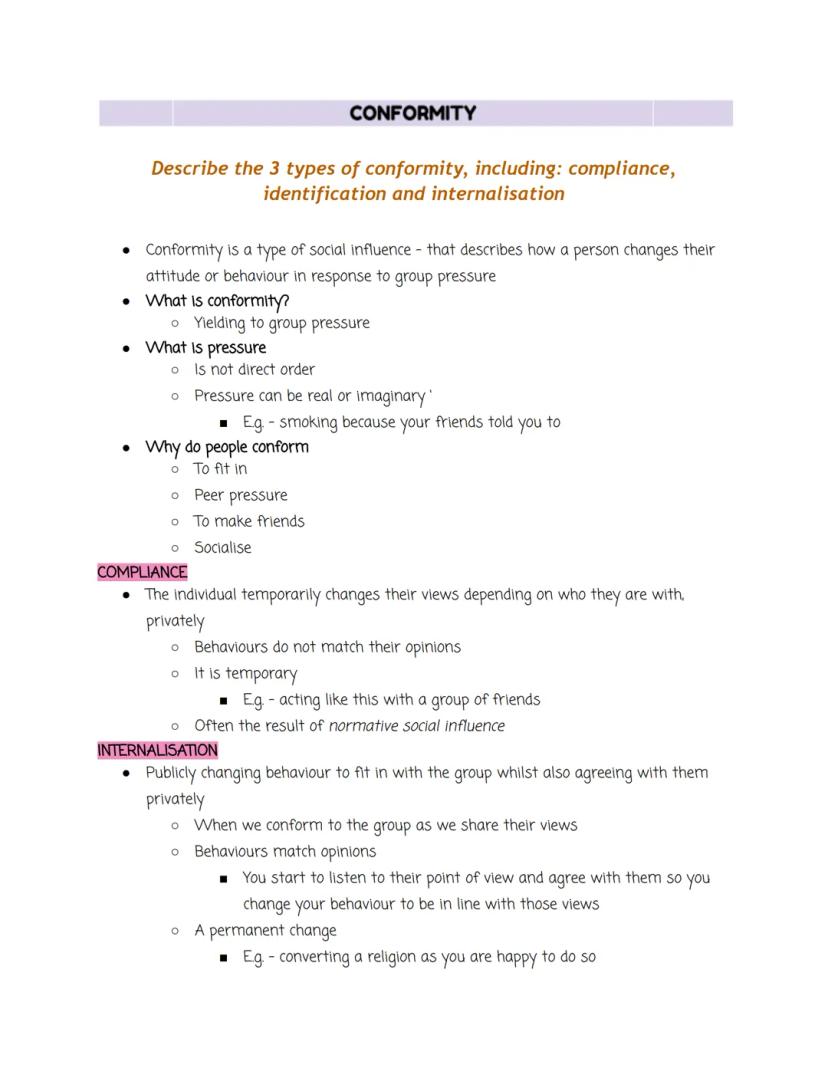

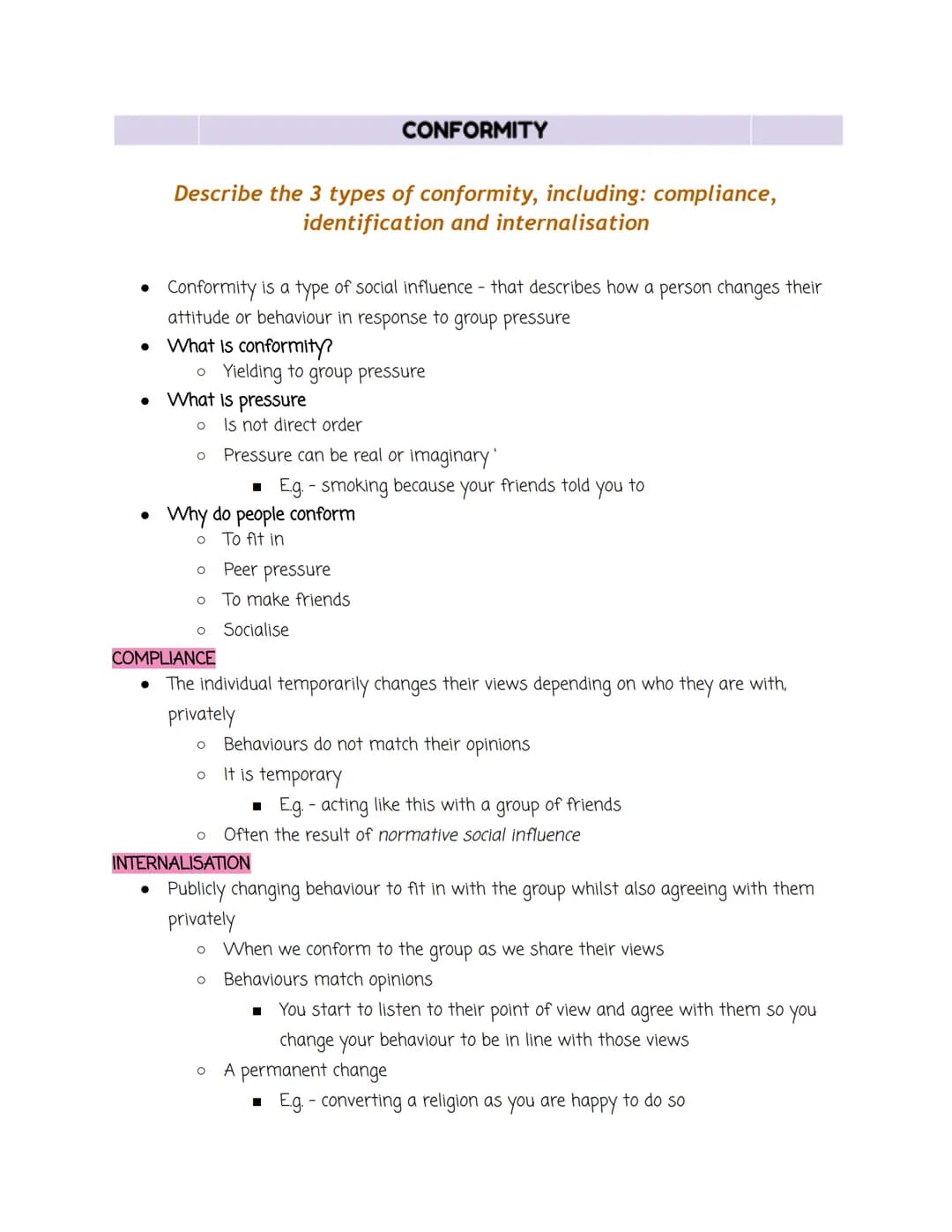
Conformity happens when you change your attitude or behaviour because of group pressure - and this pressure doesn't have to be direct orders from anyone. It could be real pressure (like mates actually telling you to do something) or imaginary pressure (like thinking everyone expects you to act a certain way). People conform to fit in, make friends, or simply to socialise without standing out.
Compliance is the most temporary type of conformity. You publicly go along with the group whilst privately disagreeing with them - basically acting one way on the outside while thinking something completely different inside. For example, laughing at jokes you don't find funny just to fit in with a particular group of friends.
Internalisation is the complete opposite - you genuinely agree with the group both publicly and privately. This means your behaviour actually matches your real opinions because you've genuinely changed your mind. This type of conformity is permanent, like converting to a new religion because you truly believe in it, not just to please others.
Remember: Compliance is fake agreement (temporary), whilst internalisation is real agreement (permanent).
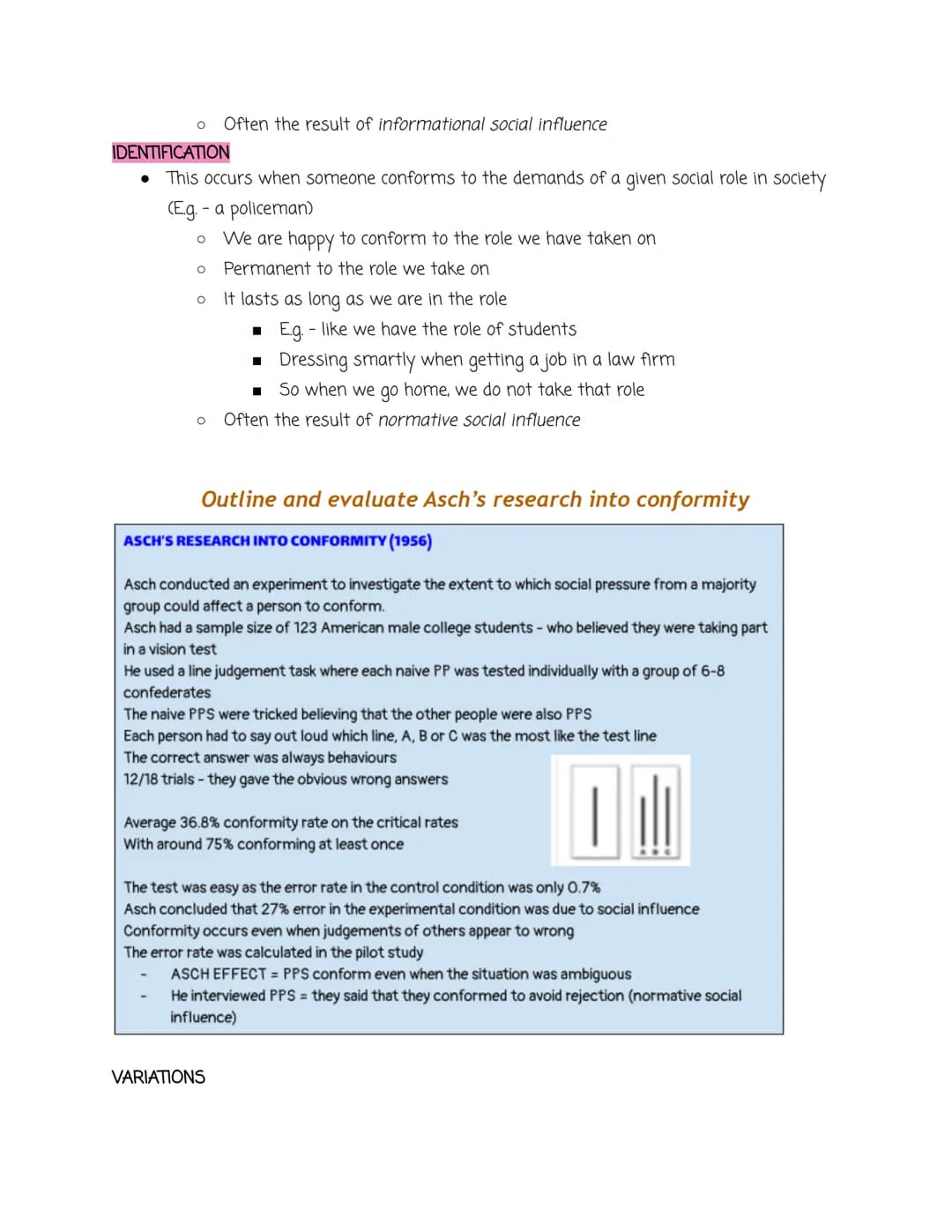
Identification occurs when you conform to fit a specific social role, like dressing professionally when you get a job at a law firm. Unlike the other types, this conformity only lasts as long as you're in that particular role - you don't take it home with you. It's permanent whilst you're in the role but disappears when you leave it.
Asch's 1956 experiment remains one of psychology's most famous studies on conformity. He tested 123 American male college students who thought they were doing a simple vision test. Each participant sat with 6-8 people who were actually working with Asch (called confederates) and had to identify which line matched a test line - the answer was always obvious.
The shocking results showed that people conformed 36.8% of the time on average, with about 75% conforming at least once. Since the task was dead easy (only 0.7% got it wrong in normal conditions), Asch concluded that social pressure was causing people to give obviously wrong answers just to fit in.
Key insight: People will conform even when they know the group is wrong - that's the power of social influence!
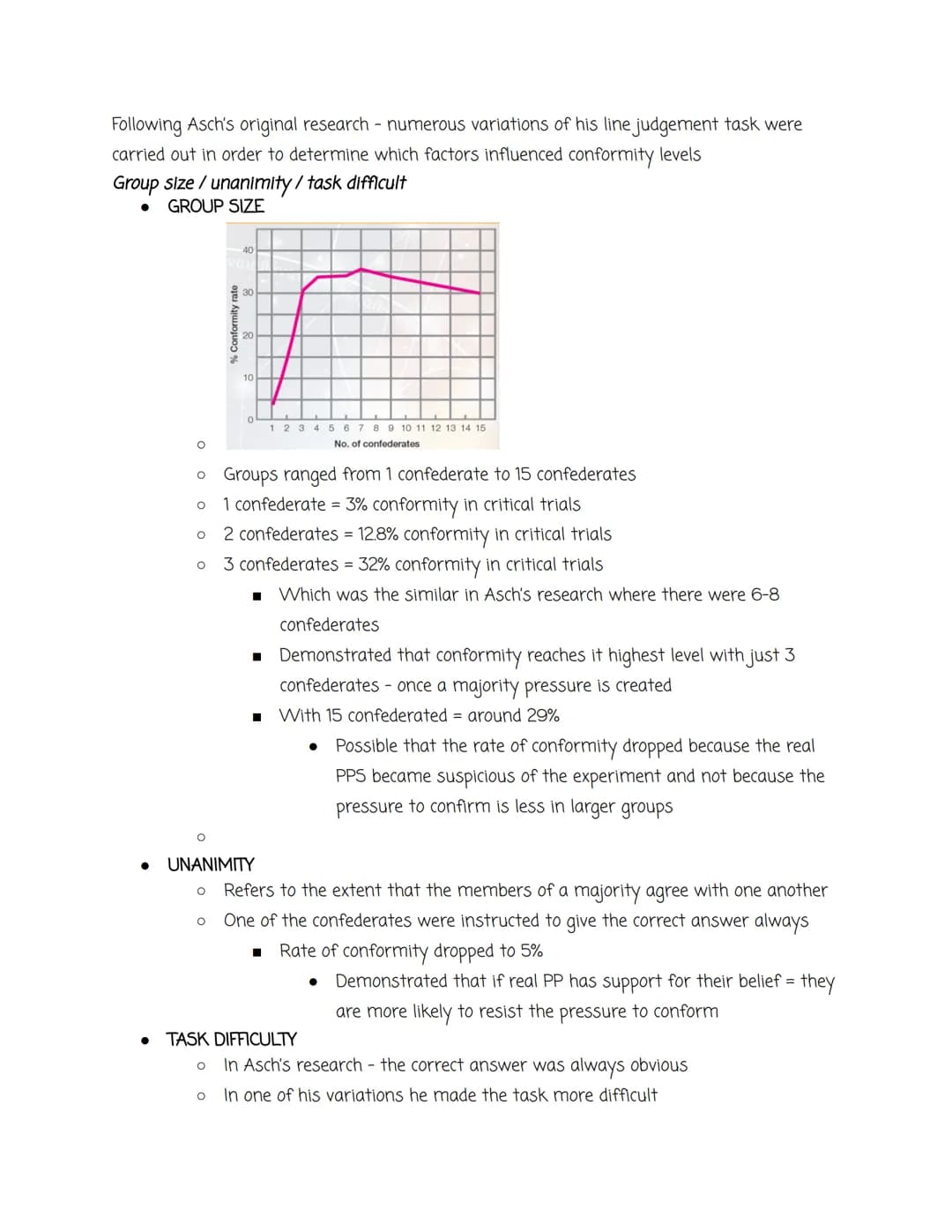
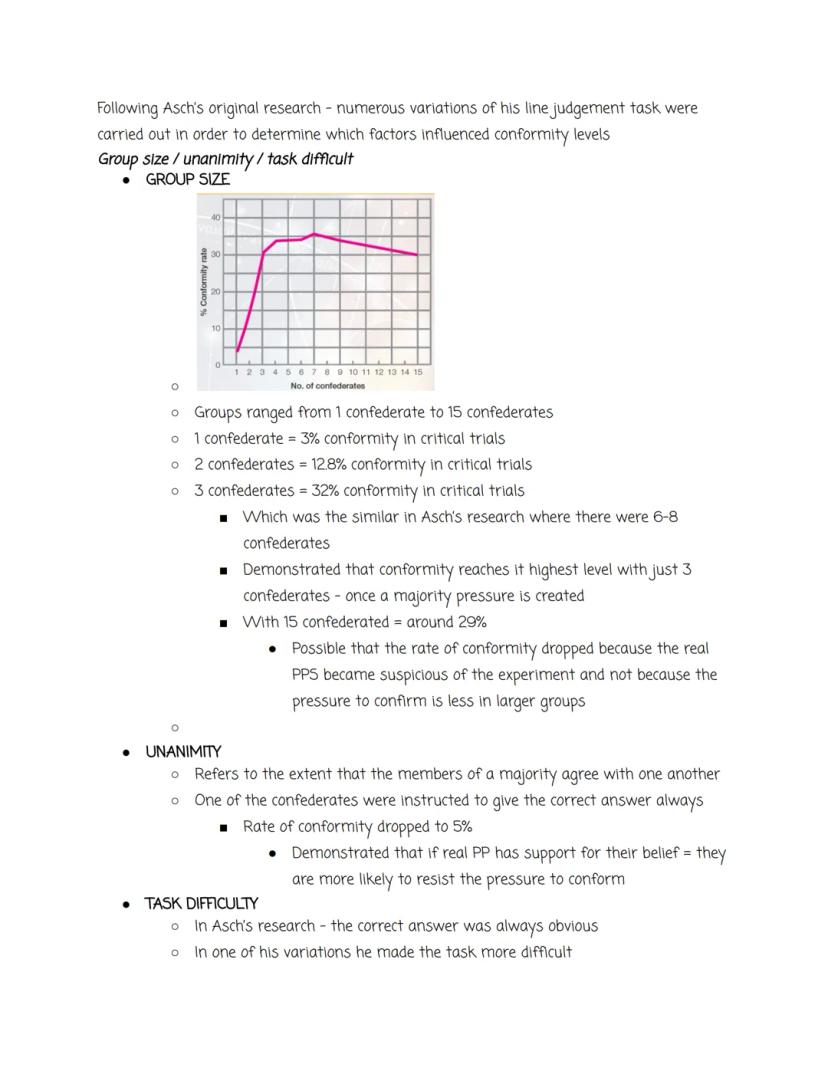
Asch's follow-up studies revealed exactly what makes people more or less likely to conform. Group size matters, but not in the way you might expect. With just one person giving wrong answers, conformity was only 3%. Two people pushed it to 12.8%, and three people created the magic number with 32% conformity - the same level found with larger groups.
Surprisingly, having 15 people didn't increase conformity much beyond three people. This suggests that once you create majority pressure with three people, adding more doesn't make much difference (though some participants might have become suspicious with really large groups).
Unanimity - whether everyone agrees - proved crucial. When just one confederate gave the correct answer, conformity dropped dramatically to only 5%. This shows that having even one person support your view makes it much easier to resist group pressure.
Task difficulty also played a major role. When Asch made the lines closer in length (making the task more ambiguous), conformity rates increased. People look to others for guidance when they're genuinely unsure, which makes perfect sense in everyday situations.
Pro tip: Remember that just one ally can dramatically reduce your likelihood of conforming - find your support person!
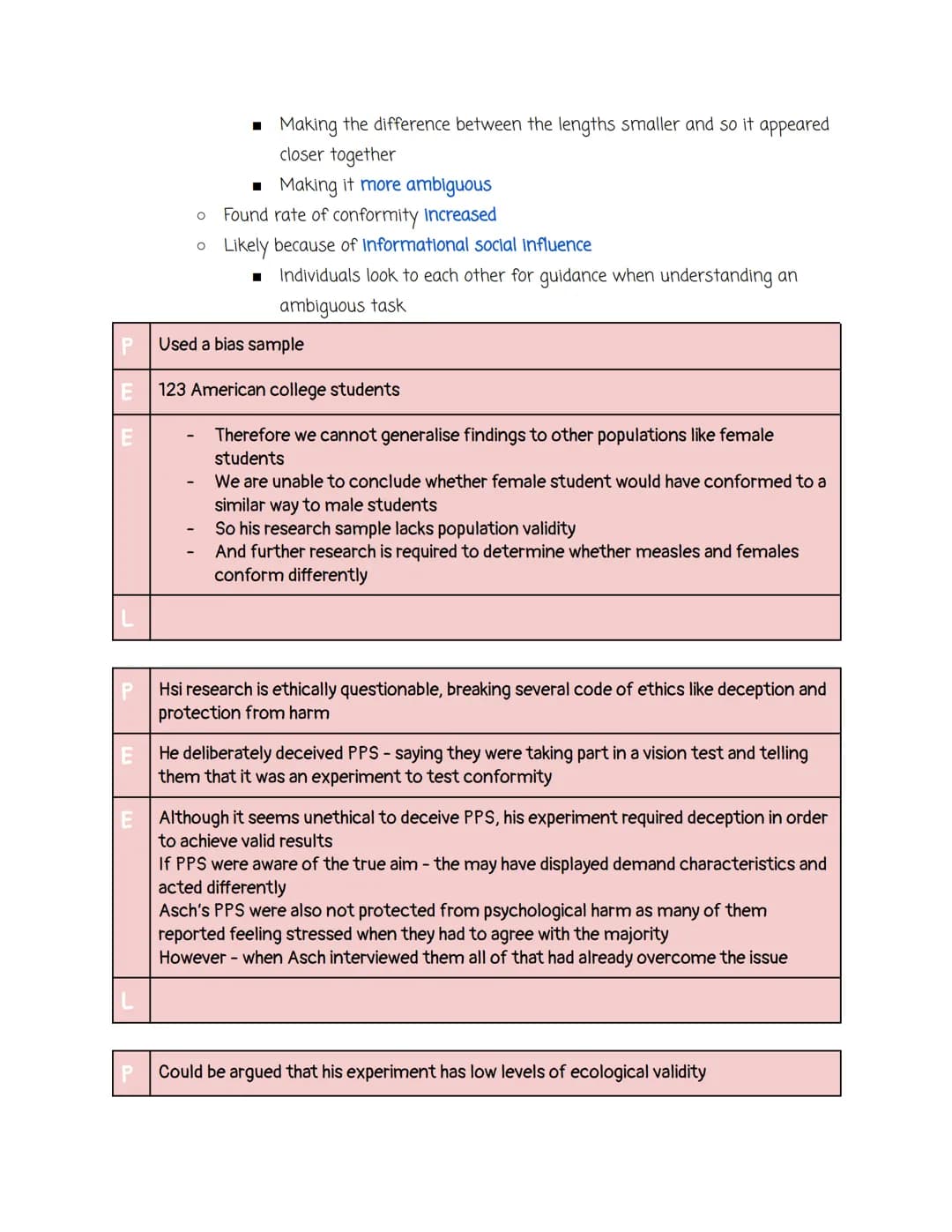
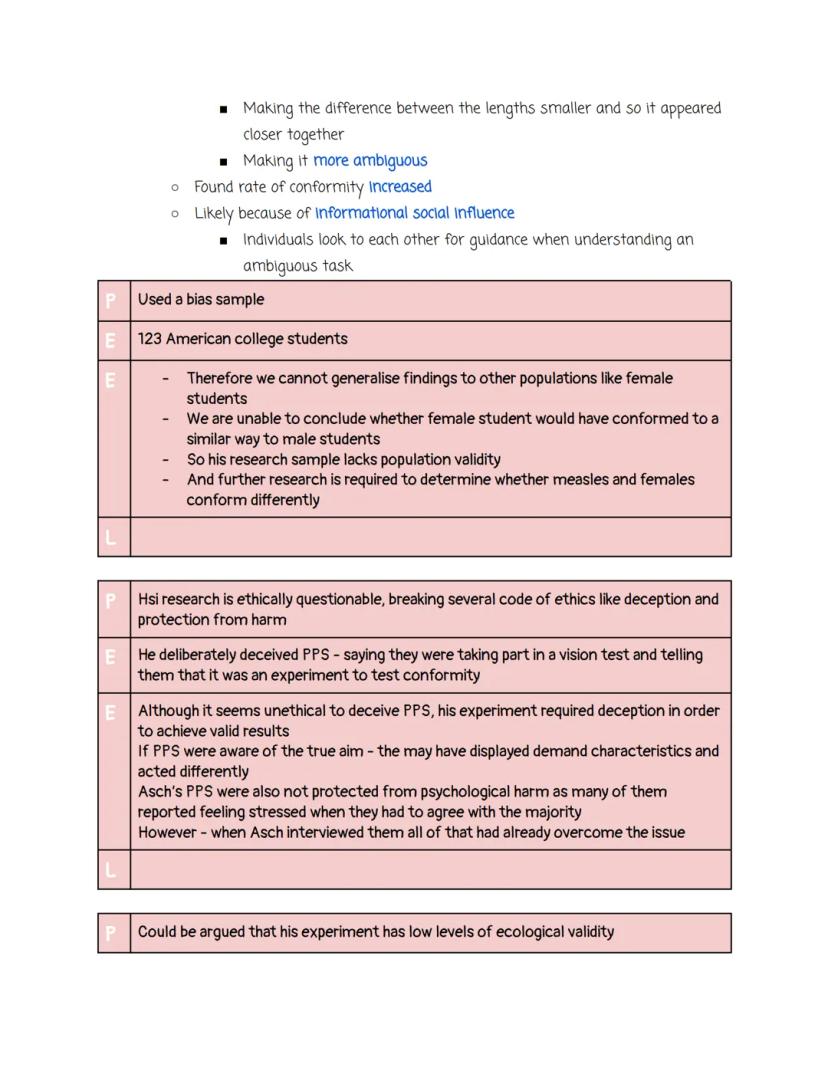
Asch's research faces significant criticism for using a biased sample of 123 American male college students. This means we can't confidently say that women, older people, or people from different cultures would behave the same way. The lack of population validity is a major weakness that limits how widely we can apply these findings.
The study also raises ethical concerns that would be problematic today. Participants were deliberately deceived about the experiment's true purpose and experienced psychological stress when forced to choose between their own judgement and group pressure. However, Asch argued this deception was necessary - if people knew the real aim, they might have acted differently (demand characteristics).
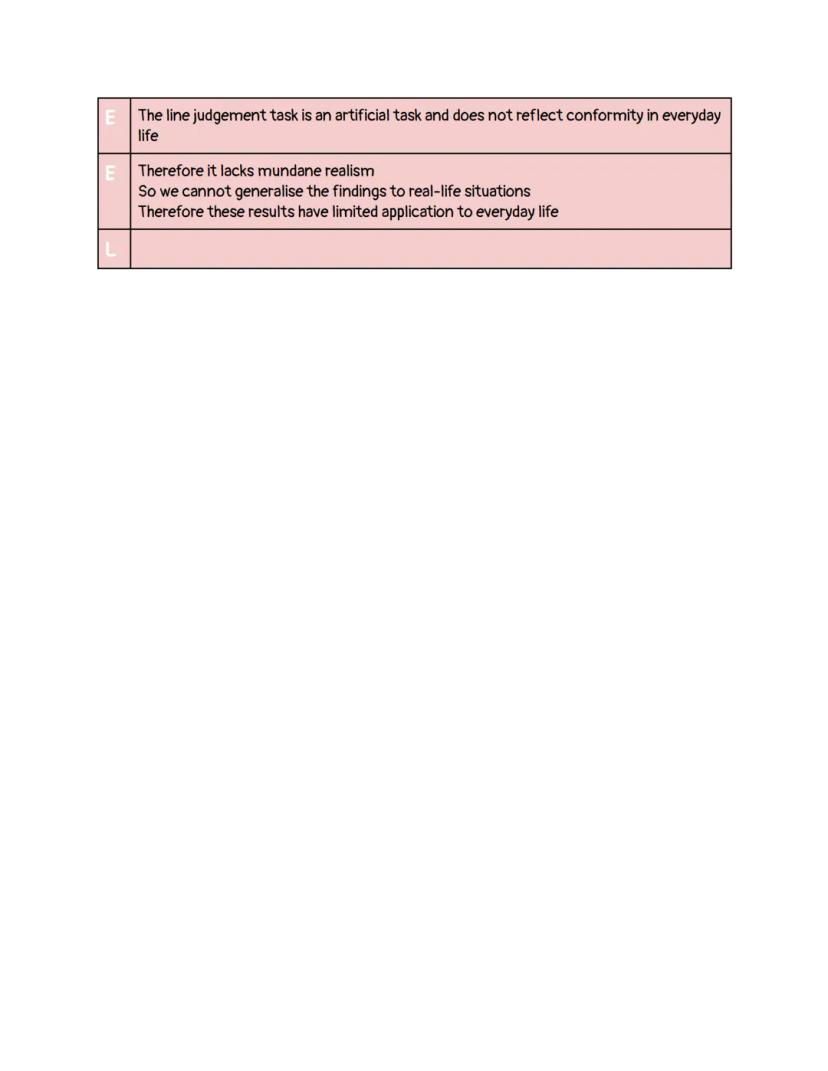
The biggest criticism concerns ecological validity - how well the experiment reflects real life. The line judgement task is completely artificial and doesn't represent the types of conformity situations you face daily. This lack of mundane realism means we should be cautious about applying these results to genuine everyday conformity situations.
Critical thinking: Always question whether psychology experiments actually reflect real-world behaviour - lab conditions can be very different from daily life!
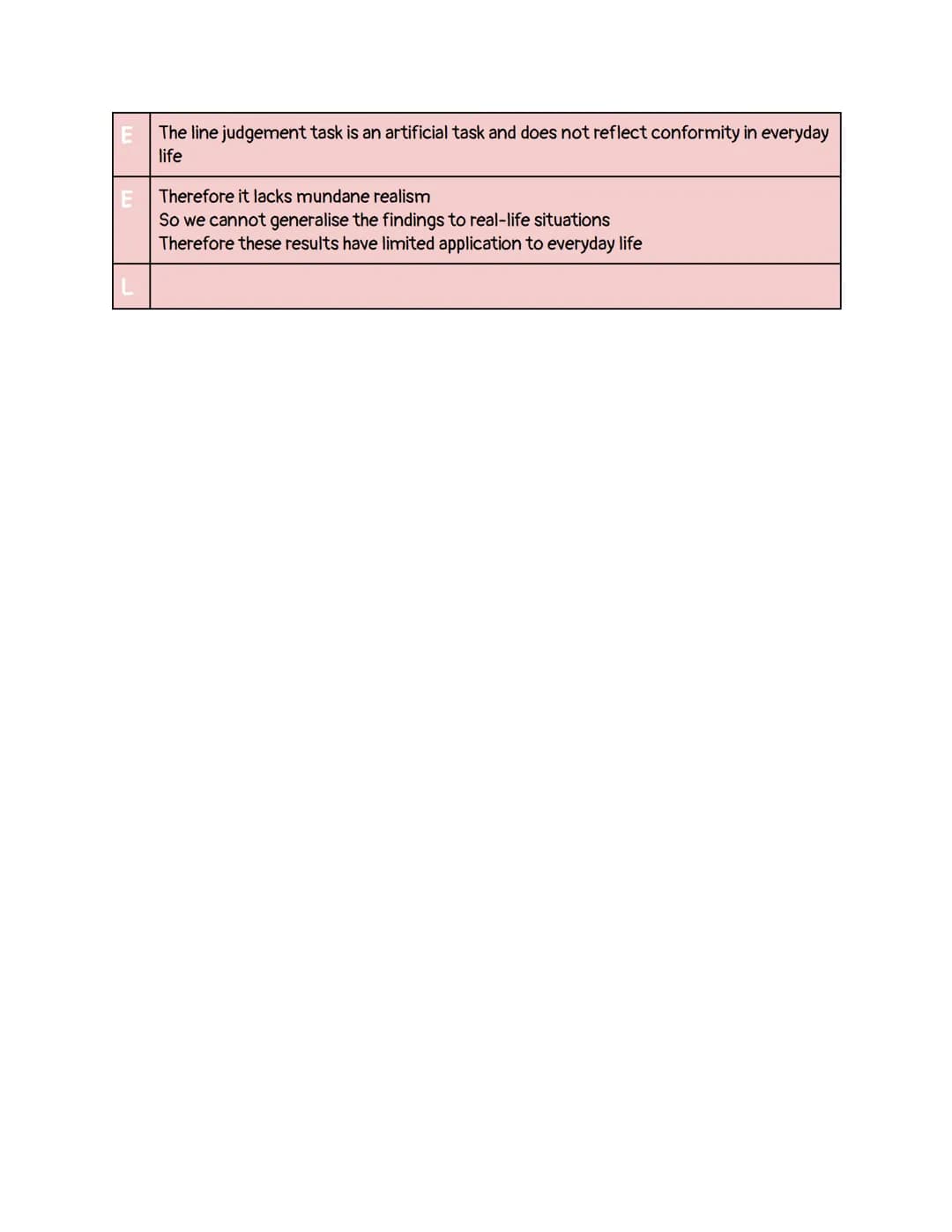
The artificial nature of Asch's line task means his findings have limited application to everyday life. Choosing between obviously different line lengths isn't comparable to real conformity situations like peer pressure around fashion, music choices, or more serious decisions about behaviour.
However, the core principles still apply - group size, unanimity, and task difficulty do influence how likely we are to conform in various situations. The key is understanding that conformity works differently depending on whether we're dealing with clear-cut situations (like Asch's lines) or ambiguous real-world scenarios where we genuinely need guidance from others.
Modern research has expanded on Asch's work to examine conformity in more realistic settings, showing that while his basic findings hold true, the strength of conformity varies greatly depending on cultural background, gender, and the specific situation involved.
Takeaway: Use Asch's principles as a starting point, but remember that real-world conformity is far more complex than laboratory experiments suggest.
Our AI Companion is a student-focused AI tool that offers more than just answers. Built on millions of Knowunity resources, it provides relevant information, personalised study plans, quizzes, and content directly in the chat, adapting to your individual learning journey.
You can download the app from Google Play Store and Apple App Store.
That's right! Enjoy free access to study content, connect with fellow students, and get instant help – all at your fingertips.
App Store
Google Play
The app is very easy to use and well designed. I have found everything I was looking for so far and have been able to learn a lot from the presentations! I will definitely use the app for a class assignment! And of course it also helps a lot as an inspiration.
Stefan S
iOS user
This app is really great. There are so many study notes and help [...]. My problem subject is French, for example, and the app has so many options for help. Thanks to this app, I have improved my French. I would recommend it to anyone.
Samantha Klich
Android user
Wow, I am really amazed. I just tried the app because I've seen it advertised many times and was absolutely stunned. This app is THE HELP you want for school and above all, it offers so many things, such as workouts and fact sheets, which have been VERY helpful to me personally.
Anna
iOS user
Best app on earth! no words because it’s too good
Thomas R
iOS user
Just amazing. Let's me revise 10x better, this app is a quick 10/10. I highly recommend it to anyone. I can watch and search for notes. I can save them in the subject folder. I can revise it any time when I come back. If you haven't tried this app, you're really missing out.
Basil
Android user
This app has made me feel so much more confident in my exam prep, not only through boosting my own self confidence through the features that allow you to connect with others and feel less alone, but also through the way the app itself is centred around making you feel better. It is easy to navigate, fun to use, and helpful to anyone struggling in absolutely any way.
David K
iOS user
The app's just great! All I have to do is enter the topic in the search bar and I get the response real fast. I don't have to watch 10 YouTube videos to understand something, so I'm saving my time. Highly recommended!
Sudenaz Ocak
Android user
In school I was really bad at maths but thanks to the app, I am doing better now. I am so grateful that you made the app.
Greenlight Bonnie
Android user
very reliable app to help and grow your ideas of Maths, English and other related topics in your works. please use this app if your struggling in areas, this app is key for that. wish I'd of done a review before. and it's also free so don't worry about that.
Rohan U
Android user
I know a lot of apps use fake accounts to boost their reviews but this app deserves it all. Originally I was getting 4 in my English exams and this time I got a grade 7. I didn’t even know about this app three days until the exam and it has helped A LOT. Please actually trust me and use it as I’m sure you too will see developments.
Xander S
iOS user
THE QUIZES AND FLASHCARDS ARE SO USEFUL AND I LOVE Knowunity AI. IT ALSO IS LITREALLY LIKE CHATGPT BUT SMARTER!! HELPED ME WITH MY MASCARA PROBLEMS TOO!! AS WELL AS MY REAL SUBJECTS ! DUHHH 😍😁😲🤑💗✨🎀😮
Elisha
iOS user
This apps acc the goat. I find revision so boring but this app makes it so easy to organize it all and then you can ask the freeeee ai to test yourself so good and you can easily upload your own stuff. highly recommend as someone taking mocks now
Paul T
iOS user
The app is very easy to use and well designed. I have found everything I was looking for so far and have been able to learn a lot from the presentations! I will definitely use the app for a class assignment! And of course it also helps a lot as an inspiration.
Stefan S
iOS user
This app is really great. There are so many study notes and help [...]. My problem subject is French, for example, and the app has so many options for help. Thanks to this app, I have improved my French. I would recommend it to anyone.
Samantha Klich
Android user
Wow, I am really amazed. I just tried the app because I've seen it advertised many times and was absolutely stunned. This app is THE HELP you want for school and above all, it offers so many things, such as workouts and fact sheets, which have been VERY helpful to me personally.
Anna
iOS user
Best app on earth! no words because it’s too good
Thomas R
iOS user
Just amazing. Let's me revise 10x better, this app is a quick 10/10. I highly recommend it to anyone. I can watch and search for notes. I can save them in the subject folder. I can revise it any time when I come back. If you haven't tried this app, you're really missing out.
Basil
Android user
This app has made me feel so much more confident in my exam prep, not only through boosting my own self confidence through the features that allow you to connect with others and feel less alone, but also through the way the app itself is centred around making you feel better. It is easy to navigate, fun to use, and helpful to anyone struggling in absolutely any way.
David K
iOS user
The app's just great! All I have to do is enter the topic in the search bar and I get the response real fast. I don't have to watch 10 YouTube videos to understand something, so I'm saving my time. Highly recommended!
Sudenaz Ocak
Android user
In school I was really bad at maths but thanks to the app, I am doing better now. I am so grateful that you made the app.
Greenlight Bonnie
Android user
very reliable app to help and grow your ideas of Maths, English and other related topics in your works. please use this app if your struggling in areas, this app is key for that. wish I'd of done a review before. and it's also free so don't worry about that.
Rohan U
Android user
I know a lot of apps use fake accounts to boost their reviews but this app deserves it all. Originally I was getting 4 in my English exams and this time I got a grade 7. I didn’t even know about this app three days until the exam and it has helped A LOT. Please actually trust me and use it as I’m sure you too will see developments.
Xander S
iOS user
THE QUIZES AND FLASHCARDS ARE SO USEFUL AND I LOVE Knowunity AI. IT ALSO IS LITREALLY LIKE CHATGPT BUT SMARTER!! HELPED ME WITH MY MASCARA PROBLEMS TOO!! AS WELL AS MY REAL SUBJECTS ! DUHHH 😍😁😲🤑💗✨🎀😮
Elisha
iOS user
This apps acc the goat. I find revision so boring but this app makes it so easy to organize it all and then you can ask the freeeee ai to test yourself so good and you can easily upload your own stuff. highly recommend as someone taking mocks now
Paul T
iOS user
s
@s16
Ever wondered why you might wear something you don't really like just because your mates are wearing it? That's conformity in action - basically when we change our behaviour or attitudes because of group pressure. Understanding the different types of... Show more
Access to all documents
Improve your grades
Join milions of students
By signing up you accept Terms of Service and Privacy Policy
Conformity happens when you change your attitude or behaviour because of group pressure - and this pressure doesn't have to be direct orders from anyone. It could be real pressure (like mates actually telling you to do something) or imaginary pressure (like thinking everyone expects you to act a certain way). People conform to fit in, make friends, or simply to socialise without standing out.
Compliance is the most temporary type of conformity. You publicly go along with the group whilst privately disagreeing with them - basically acting one way on the outside while thinking something completely different inside. For example, laughing at jokes you don't find funny just to fit in with a particular group of friends.
Internalisation is the complete opposite - you genuinely agree with the group both publicly and privately. This means your behaviour actually matches your real opinions because you've genuinely changed your mind. This type of conformity is permanent, like converting to a new religion because you truly believe in it, not just to please others.
Remember: Compliance is fake agreement (temporary), whilst internalisation is real agreement (permanent).
Access to all documents
Improve your grades
Join milions of students
By signing up you accept Terms of Service and Privacy Policy
Identification occurs when you conform to fit a specific social role, like dressing professionally when you get a job at a law firm. Unlike the other types, this conformity only lasts as long as you're in that particular role - you don't take it home with you. It's permanent whilst you're in the role but disappears when you leave it.
Asch's 1956 experiment remains one of psychology's most famous studies on conformity. He tested 123 American male college students who thought they were doing a simple vision test. Each participant sat with 6-8 people who were actually working with Asch (called confederates) and had to identify which line matched a test line - the answer was always obvious.
The shocking results showed that people conformed 36.8% of the time on average, with about 75% conforming at least once. Since the task was dead easy (only 0.7% got it wrong in normal conditions), Asch concluded that social pressure was causing people to give obviously wrong answers just to fit in.
Key insight: People will conform even when they know the group is wrong - that's the power of social influence!
Access to all documents
Improve your grades
Join milions of students
By signing up you accept Terms of Service and Privacy Policy
Asch's follow-up studies revealed exactly what makes people more or less likely to conform. Group size matters, but not in the way you might expect. With just one person giving wrong answers, conformity was only 3%. Two people pushed it to 12.8%, and three people created the magic number with 32% conformity - the same level found with larger groups.
Surprisingly, having 15 people didn't increase conformity much beyond three people. This suggests that once you create majority pressure with three people, adding more doesn't make much difference (though some participants might have become suspicious with really large groups).
Unanimity - whether everyone agrees - proved crucial. When just one confederate gave the correct answer, conformity dropped dramatically to only 5%. This shows that having even one person support your view makes it much easier to resist group pressure.
Task difficulty also played a major role. When Asch made the lines closer in length (making the task more ambiguous), conformity rates increased. People look to others for guidance when they're genuinely unsure, which makes perfect sense in everyday situations.
Pro tip: Remember that just one ally can dramatically reduce your likelihood of conforming - find your support person!
Access to all documents
Improve your grades
Join milions of students
By signing up you accept Terms of Service and Privacy Policy
Asch's research faces significant criticism for using a biased sample of 123 American male college students. This means we can't confidently say that women, older people, or people from different cultures would behave the same way. The lack of population validity is a major weakness that limits how widely we can apply these findings.
The study also raises ethical concerns that would be problematic today. Participants were deliberately deceived about the experiment's true purpose and experienced psychological stress when forced to choose between their own judgement and group pressure. However, Asch argued this deception was necessary - if people knew the real aim, they might have acted differently (demand characteristics).
The biggest criticism concerns ecological validity - how well the experiment reflects real life. The line judgement task is completely artificial and doesn't represent the types of conformity situations you face daily. This lack of mundane realism means we should be cautious about applying these results to genuine everyday conformity situations.
Critical thinking: Always question whether psychology experiments actually reflect real-world behaviour - lab conditions can be very different from daily life!
Access to all documents
Improve your grades
Join milions of students
By signing up you accept Terms of Service and Privacy Policy
The artificial nature of Asch's line task means his findings have limited application to everyday life. Choosing between obviously different line lengths isn't comparable to real conformity situations like peer pressure around fashion, music choices, or more serious decisions about behaviour.
However, the core principles still apply - group size, unanimity, and task difficulty do influence how likely we are to conform in various situations. The key is understanding that conformity works differently depending on whether we're dealing with clear-cut situations (like Asch's lines) or ambiguous real-world scenarios where we genuinely need guidance from others.
Modern research has expanded on Asch's work to examine conformity in more realistic settings, showing that while his basic findings hold true, the strength of conformity varies greatly depending on cultural background, gender, and the specific situation involved.
Takeaway: Use Asch's principles as a starting point, but remember that real-world conformity is far more complex than laboratory experiments suggest.
Our AI Companion is a student-focused AI tool that offers more than just answers. Built on millions of Knowunity resources, it provides relevant information, personalised study plans, quizzes, and content directly in the chat, adapting to your individual learning journey.
You can download the app from Google Play Store and Apple App Store.
That's right! Enjoy free access to study content, connect with fellow students, and get instant help – all at your fingertips.
9
Smart Tools NEW
Transform this note into: ✓ 50+ Practice Questions ✓ Interactive Flashcards ✓ Full Mock Exam ✓ Essay Outlines
Explore the key concepts of conformity, including types (compliance, identification, internalization) and explanations (normative and informational social influence). This summary covers pivotal studies by Asch and Jenness, evaluating their methodologies and findings, and discusses the implications of social influence in psychology. Ideal for students studying social psychology.
 Psychology
Explore the mechanisms of minority influence in driving social change, including key concepts such as the snowball effect, deeper processing, and the role of disobedience. This summary covers essential research findings and evaluations, making it a valuable resource for psychology students studying social influence. Type: Summary.
PsychologyExplore the key findings and evaluations of Burger's (2009) replication of Milgram's obedience experiment. This study note includes a detailed analysis of ethical considerations, participant screening, and the impact of model refusal on obedience levels. Ideal for essay preparation and understanding contemporary psychological research.
PsychologyApp Store
Google Play
The app is very easy to use and well designed. I have found everything I was looking for so far and have been able to learn a lot from the presentations! I will definitely use the app for a class assignment! And of course it also helps a lot as an inspiration.
Stefan S
iOS user
This app is really great. There are so many study notes and help [...]. My problem subject is French, for example, and the app has so many options for help. Thanks to this app, I have improved my French. I would recommend it to anyone.
Samantha Klich
Android user
Wow, I am really amazed. I just tried the app because I've seen it advertised many times and was absolutely stunned. This app is THE HELP you want for school and above all, it offers so many things, such as workouts and fact sheets, which have been VERY helpful to me personally.
Anna
iOS user
Best app on earth! no words because it’s too good
Thomas R
iOS user
Just amazing. Let's me revise 10x better, this app is a quick 10/10. I highly recommend it to anyone. I can watch and search for notes. I can save them in the subject folder. I can revise it any time when I come back. If you haven't tried this app, you're really missing out.
Basil
Android user
This app has made me feel so much more confident in my exam prep, not only through boosting my own self confidence through the features that allow you to connect with others and feel less alone, but also through the way the app itself is centred around making you feel better. It is easy to navigate, fun to use, and helpful to anyone struggling in absolutely any way.
David K
iOS user
The app's just great! All I have to do is enter the topic in the search bar and I get the response real fast. I don't have to watch 10 YouTube videos to understand something, so I'm saving my time. Highly recommended!
Sudenaz Ocak
Android user
In school I was really bad at maths but thanks to the app, I am doing better now. I am so grateful that you made the app.
Greenlight Bonnie
Android user
very reliable app to help and grow your ideas of Maths, English and other related topics in your works. please use this app if your struggling in areas, this app is key for that. wish I'd of done a review before. and it's also free so don't worry about that.
Rohan U
Android user
I know a lot of apps use fake accounts to boost their reviews but this app deserves it all. Originally I was getting 4 in my English exams and this time I got a grade 7. I didn’t even know about this app three days until the exam and it has helped A LOT. Please actually trust me and use it as I’m sure you too will see developments.
Xander S
iOS user
THE QUIZES AND FLASHCARDS ARE SO USEFUL AND I LOVE Knowunity AI. IT ALSO IS LITREALLY LIKE CHATGPT BUT SMARTER!! HELPED ME WITH MY MASCARA PROBLEMS TOO!! AS WELL AS MY REAL SUBJECTS ! DUHHH 😍😁😲🤑💗✨🎀😮
Elisha
iOS user
This apps acc the goat. I find revision so boring but this app makes it so easy to organize it all and then you can ask the freeeee ai to test yourself so good and you can easily upload your own stuff. highly recommend as someone taking mocks now
Paul T
iOS user
The app is very easy to use and well designed. I have found everything I was looking for so far and have been able to learn a lot from the presentations! I will definitely use the app for a class assignment! And of course it also helps a lot as an inspiration.
Stefan S
iOS user
This app is really great. There are so many study notes and help [...]. My problem subject is French, for example, and the app has so many options for help. Thanks to this app, I have improved my French. I would recommend it to anyone.
Samantha Klich
Android user
Wow, I am really amazed. I just tried the app because I've seen it advertised many times and was absolutely stunned. This app is THE HELP you want for school and above all, it offers so many things, such as workouts and fact sheets, which have been VERY helpful to me personally.
Anna
iOS user
Best app on earth! no words because it’s too good
Thomas R
iOS user
Just amazing. Let's me revise 10x better, this app is a quick 10/10. I highly recommend it to anyone. I can watch and search for notes. I can save them in the subject folder. I can revise it any time when I come back. If you haven't tried this app, you're really missing out.
Basil
Android user
This app has made me feel so much more confident in my exam prep, not only through boosting my own self confidence through the features that allow you to connect with others and feel less alone, but also through the way the app itself is centred around making you feel better. It is easy to navigate, fun to use, and helpful to anyone struggling in absolutely any way.
David K
iOS user
The app's just great! All I have to do is enter the topic in the search bar and I get the response real fast. I don't have to watch 10 YouTube videos to understand something, so I'm saving my time. Highly recommended!
Sudenaz Ocak
Android user
In school I was really bad at maths but thanks to the app, I am doing better now. I am so grateful that you made the app.
Greenlight Bonnie
Android user
very reliable app to help and grow your ideas of Maths, English and other related topics in your works. please use this app if your struggling in areas, this app is key for that. wish I'd of done a review before. and it's also free so don't worry about that.
Rohan U
Android user
I know a lot of apps use fake accounts to boost their reviews but this app deserves it all. Originally I was getting 4 in my English exams and this time I got a grade 7. I didn’t even know about this app three days until the exam and it has helped A LOT. Please actually trust me and use it as I’m sure you too will see developments.
Xander S
iOS user
THE QUIZES AND FLASHCARDS ARE SO USEFUL AND I LOVE Knowunity AI. IT ALSO IS LITREALLY LIKE CHATGPT BUT SMARTER!! HELPED ME WITH MY MASCARA PROBLEMS TOO!! AS WELL AS MY REAL SUBJECTS ! DUHHH 😍😁😲🤑💗✨🎀😮
Elisha
iOS user
This apps acc the goat. I find revision so boring but this app makes it so easy to organize it all and then you can ask the freeeee ai to test yourself so good and you can easily upload your own stuff. highly recommend as someone taking mocks now
Paul T
iOS user