
Ever wondered how atoms work and why some materials are... Show more
 Sociology
 English Literature
 Biology
Sign up to see the contentIt's free!
Access to all documents
Improve your grades
Join milions of students
Knowunity AI
Subjects
Triangle Congruence and Similarity Theorems
Triangle Properties and Classification
Linear Equations and Graphs
Geometric Angle Relationships
Trigonometric Functions and Identities
Equation Solving Techniques
Circle Geometry Fundamentals
Division Operations and Methods
Basic Differentiation Rules
Exponent and Logarithm Properties
Show all topics
Human Organ Systems
Reproductive Cell Cycles
Biological Sciences Subdisciplines
Cellular Energy Metabolism
Autotrophic Energy Processes
Inheritance Patterns and Principles
Biomolecular Structure and Organization
Cell Cycle and Division Mechanics
Cellular Organization and Development
Biological Structural Organization
Show all topics
Chemical Sciences and Applications
Atomic Structure and Composition
Molecular Electron Structure Representation
Atomic Electron Behavior
Matter Properties and Water
Mole Concept and Calculations
Gas Laws and Behavior
Periodic Table Organization
Chemical Thermodynamics Fundamentals
Chemical Bond Types and Properties
Show all topics
European Renaissance and Enlightenment
European Cultural Movements 800-1920
American Revolution Era 1763-1797
American Civil War 1861-1865
Global Imperial Systems
Mongol and Chinese Dynasties
U.S. Presidents and World Leaders
Historical Sources and Documentation
World Wars Era and Impact
World Religious Systems
Show all topics
Classic and Contemporary Novels
Literary Character Analysis
Rhetorical Theory and Practice
Classic Literary Narratives
Reading Analysis and Interpretation
Narrative Structure and Techniques
English Language Components
Influential English-Language Authors
Basic Sentence Structure
Narrative Voice and Perspective
Show all topics
439
•
Updated Apr 15, 2026
•
kkm_
@kkm_
Ever wondered how atoms work and why some materials are... Show more
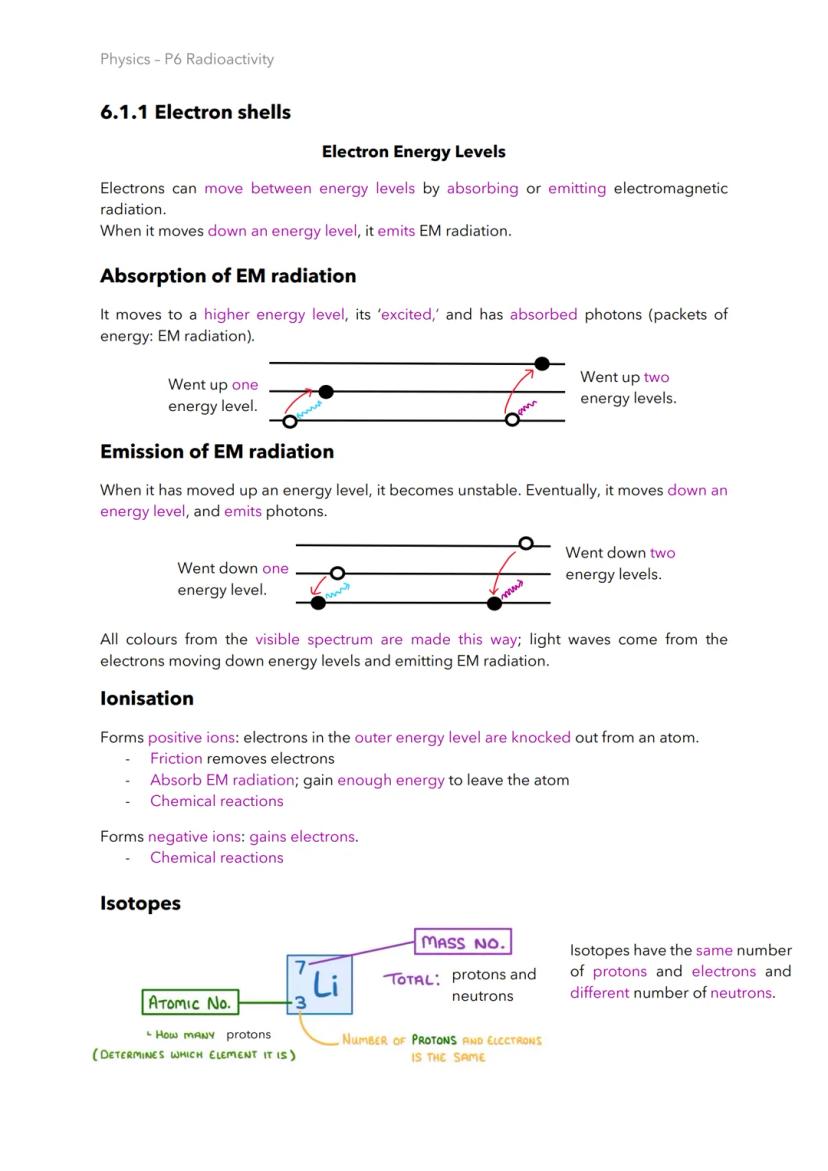
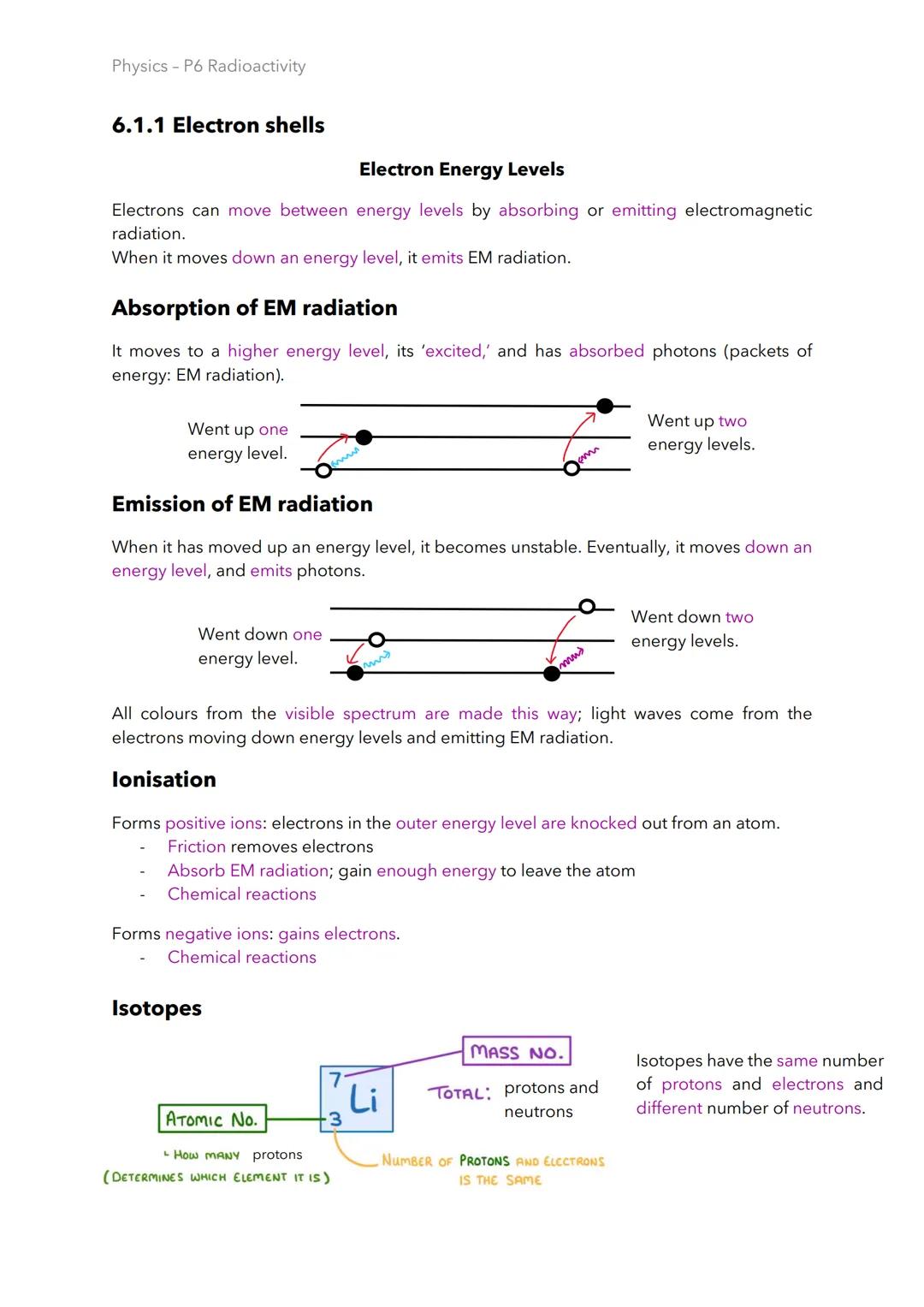
Your phone screen, fireworks, and even the sun all produce light the same way - through electrons jumping between energy levels. When electrons absorb energy (like from heat or electricity), they get excited and move to higher energy levels.
But here's the thing - electrons don't like staying excited for long. They quickly drop back down and release that energy as electromagnetic radiation, which includes visible light. That's literally how every colour you see is created!
Ionisation happens when electrons get knocked completely out of their atoms. This can occur through friction (like rubbing a balloon on your hair), chemical reactions, or absorbing enough electromagnetic radiation. When atoms lose electrons, they become positive ions; when they gain electrons, they become negative ions.
Isotopes are atoms of the same element that have different numbers of neutrons. They still have the same number of protons and electrons, which means they're the same element, but the extra or fewer neutrons can make them behave quite differently.
Quick Tip: Remember that the atomic number tells you how many protons an atom has, and this determines what element it is. The mass number is the total of protons plus neutrons.
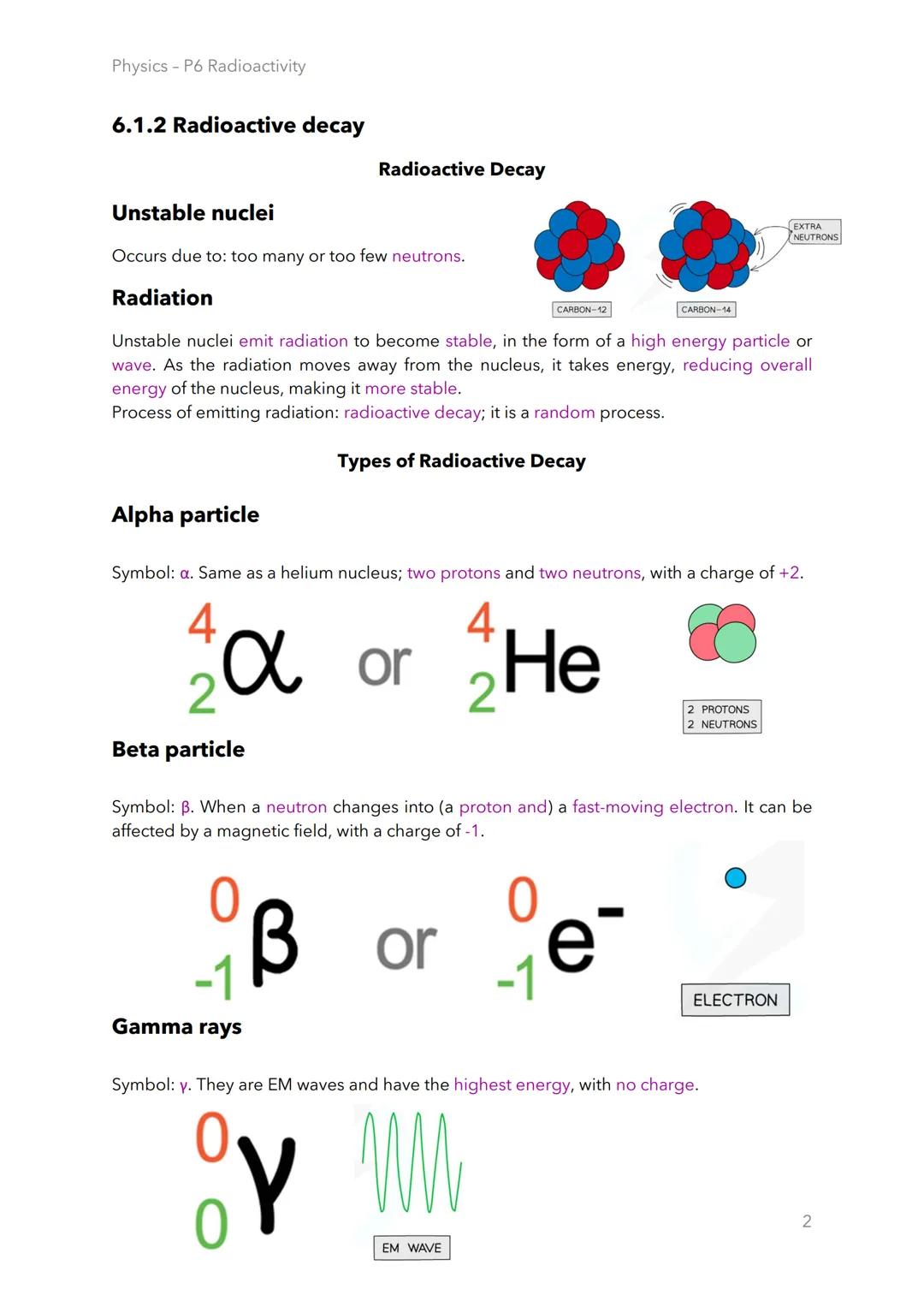
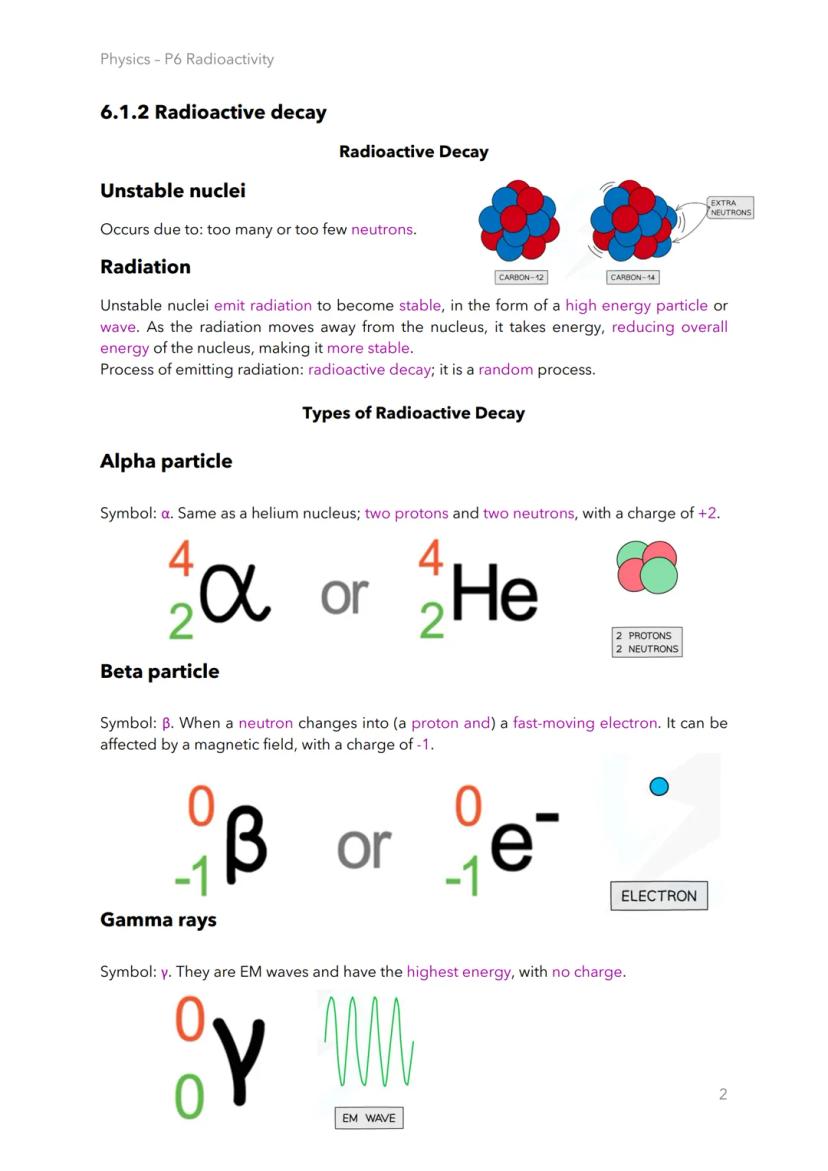
Some atomic nuclei are like unstable buildings - they have too many or too few neutrons and desperately want to become stable. Radioactive decay is nature's way of fixing this problem by shooting out high-energy particles or waves.
This process is completely random - you can't predict when any particular nucleus will decay. However, the radiation that gets emitted takes energy away from the nucleus, making it more stable overall.
There are four main types of radiation you need to know. Alpha particles are basically helium nuclei with a +2 charge. Beta particles are fast-moving electrons created when a neutron transforms into a proton. Gamma rays are electromagnetic waves with massive amounts of energy but no charge.
Neutron emission also occurs when nuclei have way too many neutrons and need to get rid of some to become stable.
Key Point: Radioactive decay is random for individual atoms, but predictable for large groups of atoms - this is what makes half-life calculations possible.
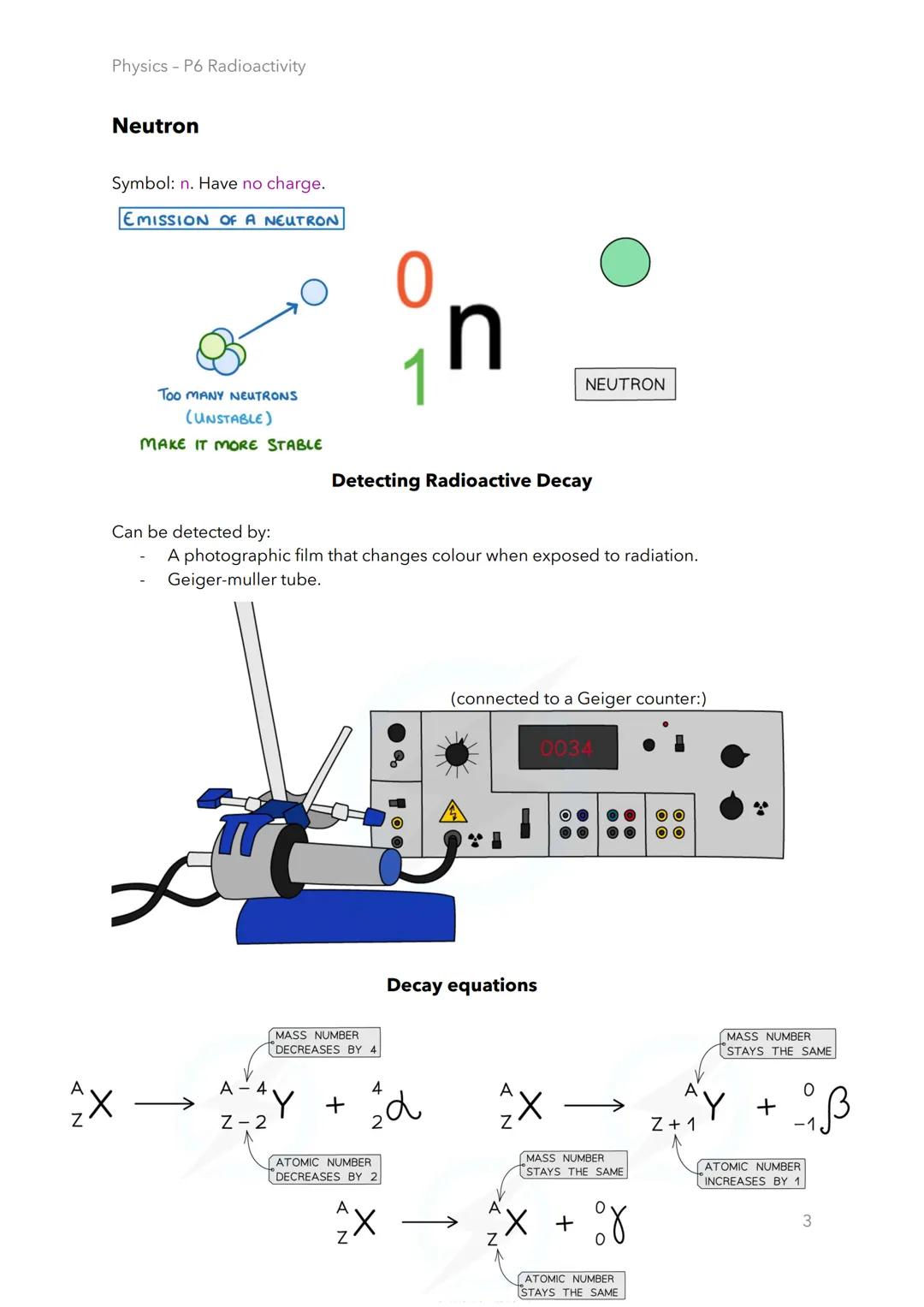
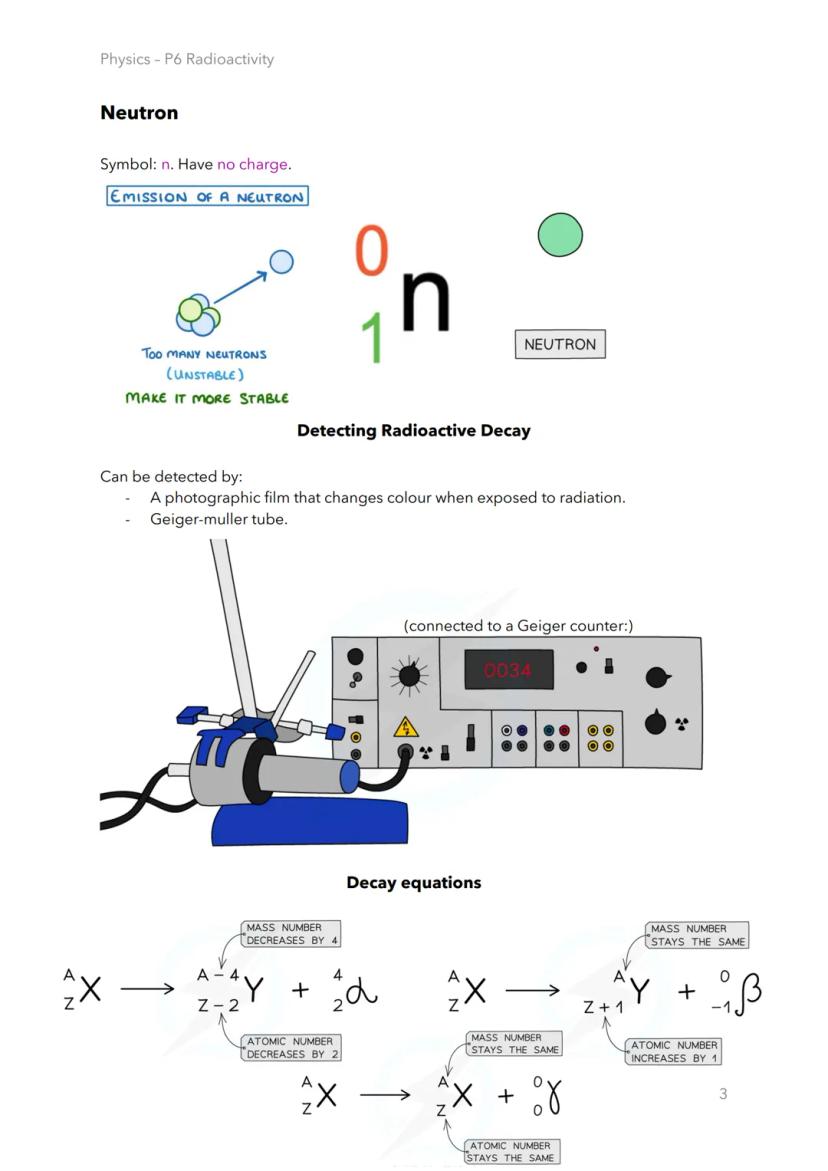
Scientists can detect radioactive decay using photographic film (which changes colour when exposed to radiation) or a Geiger-Muller tube connected to a Geiger counter that clicks when radiation hits it.
Decay equations help us track what happens during radioactive decay. In alpha decay, both the mass number decreases by 4 and the atomic number decreases by 2, creating a completely new element.
For beta decay, the mass number stays the same but the atomic number increases by 1 (because a neutron became a proton), again forming a new element. The electron gets shot out of the nucleus.
Gamma decay is different - it doesn't change the mass or atomic number at all. The nucleus just releases excess energy as gamma rays to become less energetic and more stable.
Remember: Alpha and beta decay create new elements, but gamma decay just makes the same nucleus less energetic.
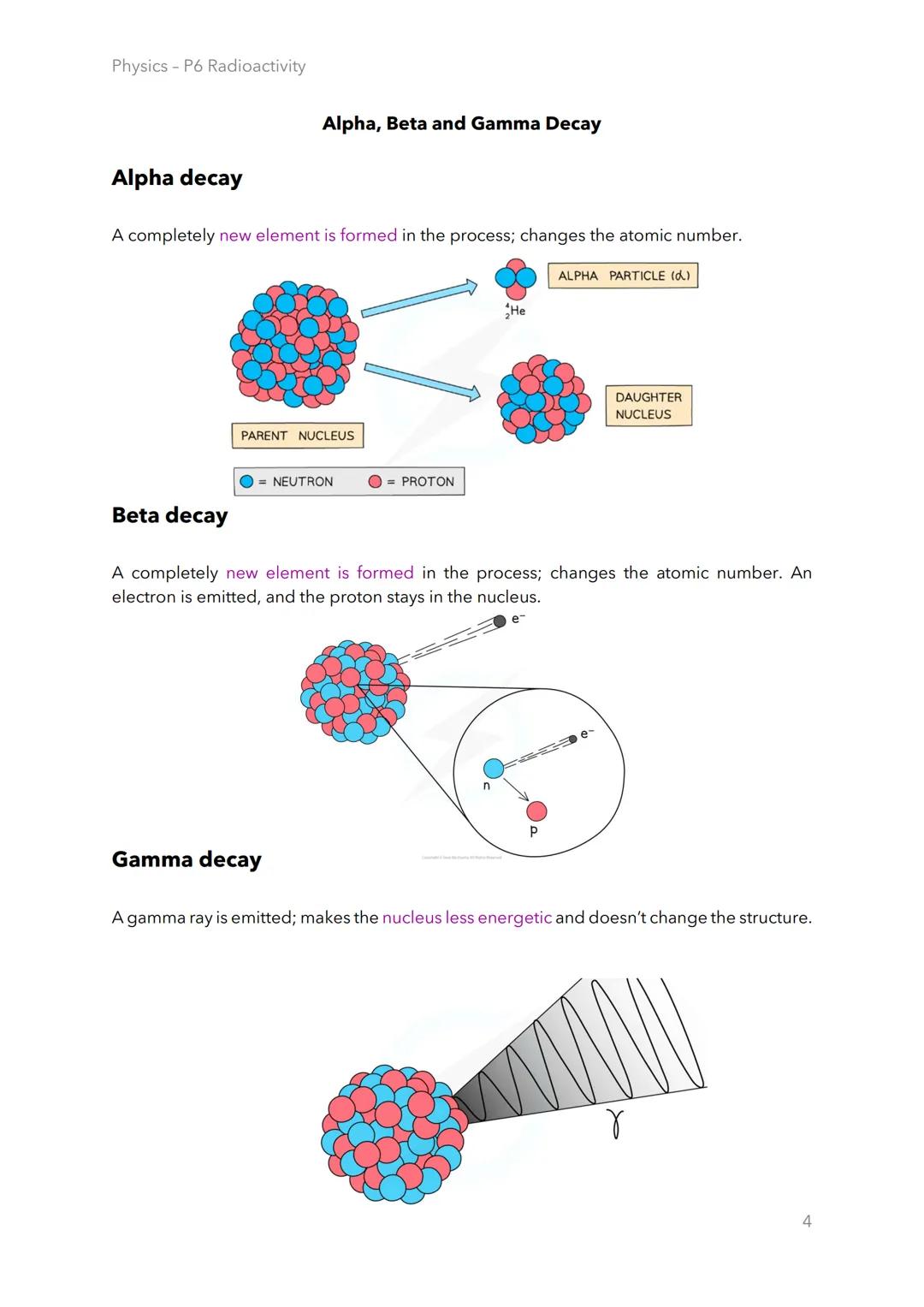
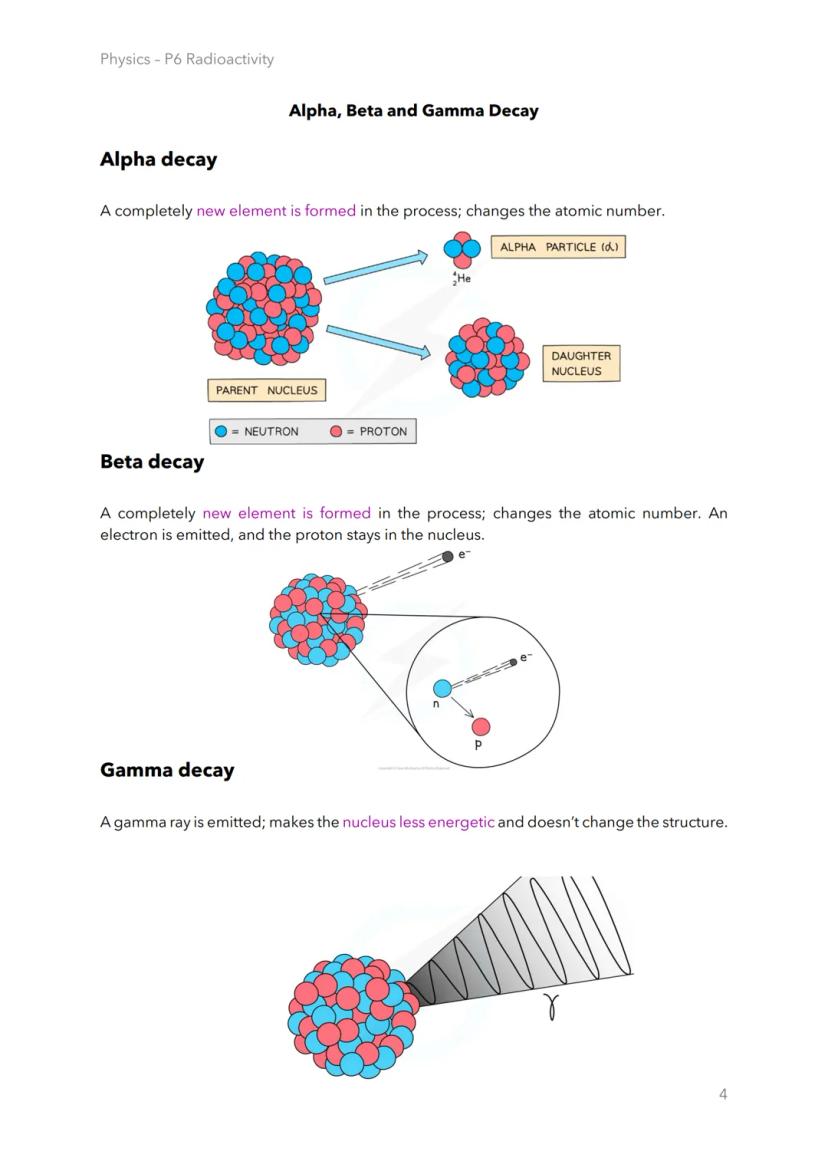
Alpha decay happens when an unstable nucleus ejects an alpha particle (helium nucleus). This creates a completely new element because the atomic number changes. Think of it like the nucleus throwing out a chunk of itself to become more stable.
Beta decay occurs when a neutron inside the nucleus transforms into a proton and an electron. The electron gets ejected as a beta particle, while the proton remains in the nucleus. This also creates a new element since the atomic number increases by one.
Gamma decay is the simplest type - the nucleus just releases excess energy as gamma rays without changing its structure at all. It's like the nucleus letting out a sigh of relief to become less energetic.
Each type of decay serves the same purpose: making unstable nuclei more stable. The nucleus will keep decaying until it reaches a stable configuration.
Fun Fact: Some radioactive elements go through multiple decay steps, creating a whole chain of different elements before finally becoming stable.
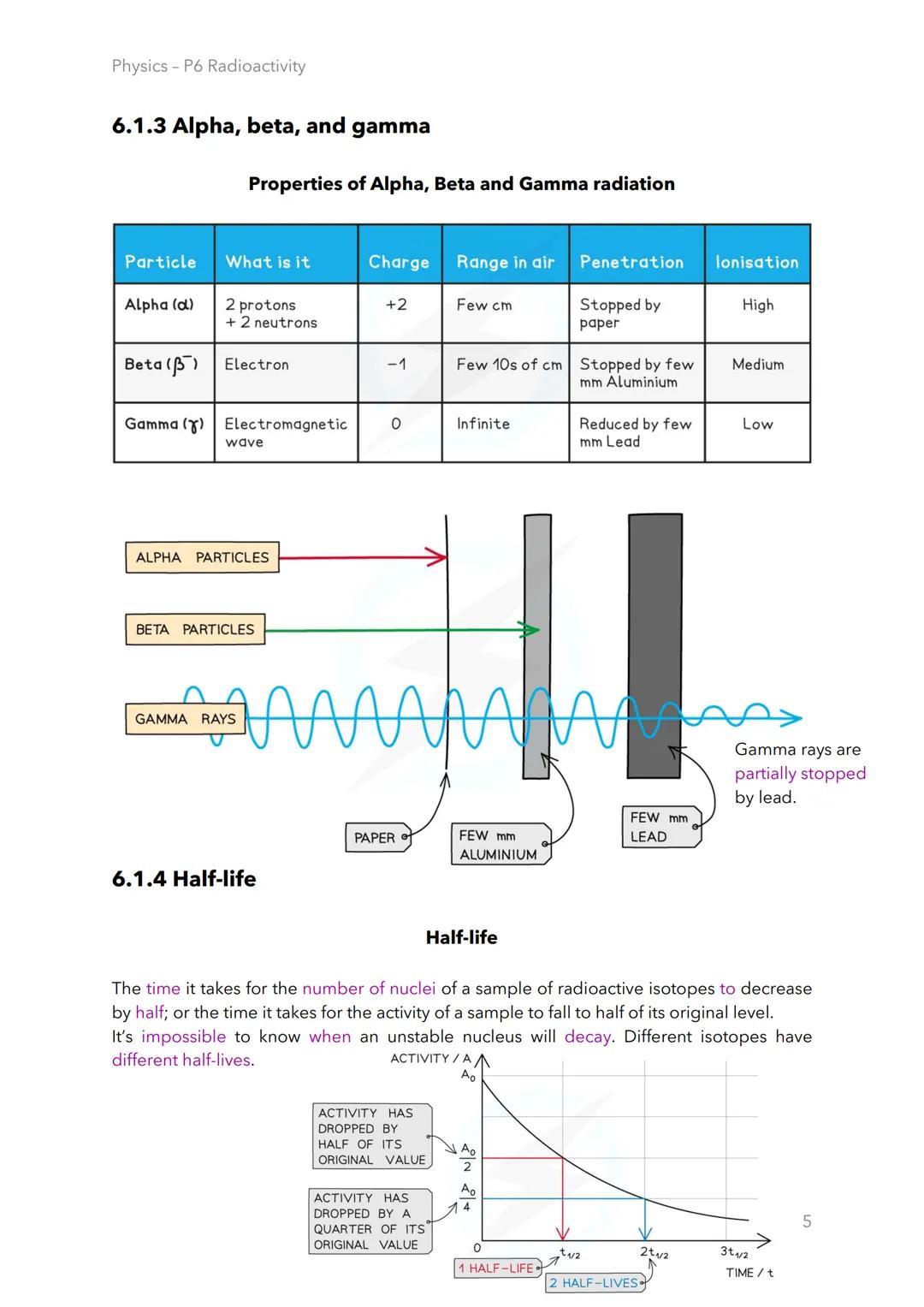
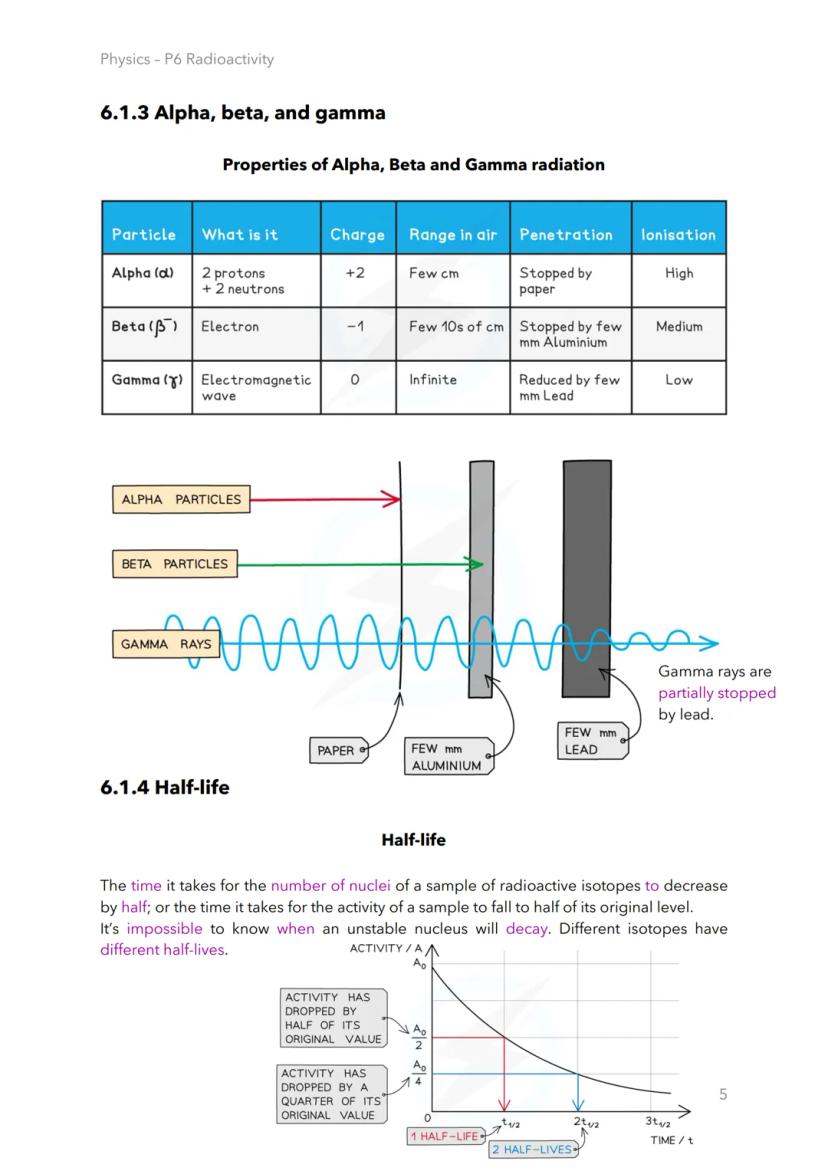
Different types of radiation have vastly different penetration abilities. Alpha particles are stopped by paper, beta particles need a few millimetres of aluminium, while gamma rays require several millimetres of lead to reduce their intensity.
Alpha radiation has the highest ionisation power but the shortest range. Beta radiation sits in the middle for both properties. Gamma radiation has the lowest ionisation but can travel infinite distances in air.
Half-life is the time it takes for half the radioactive nuclei in a sample to decay. It's also the time for the activity (rate of decay) to drop to half its original value. Different isotopes have wildly different half-lives - from fractions of seconds to billions of years.
The brilliant thing about half-life is that it's constant for each isotope. After one half-life, you're left with 50% of the original sample. After two half-lives, you have 25%. After three half-lives, just 12.5% remains.
Exam Tip: Half-life graphs always show the characteristic curved decay pattern - never a straight line.
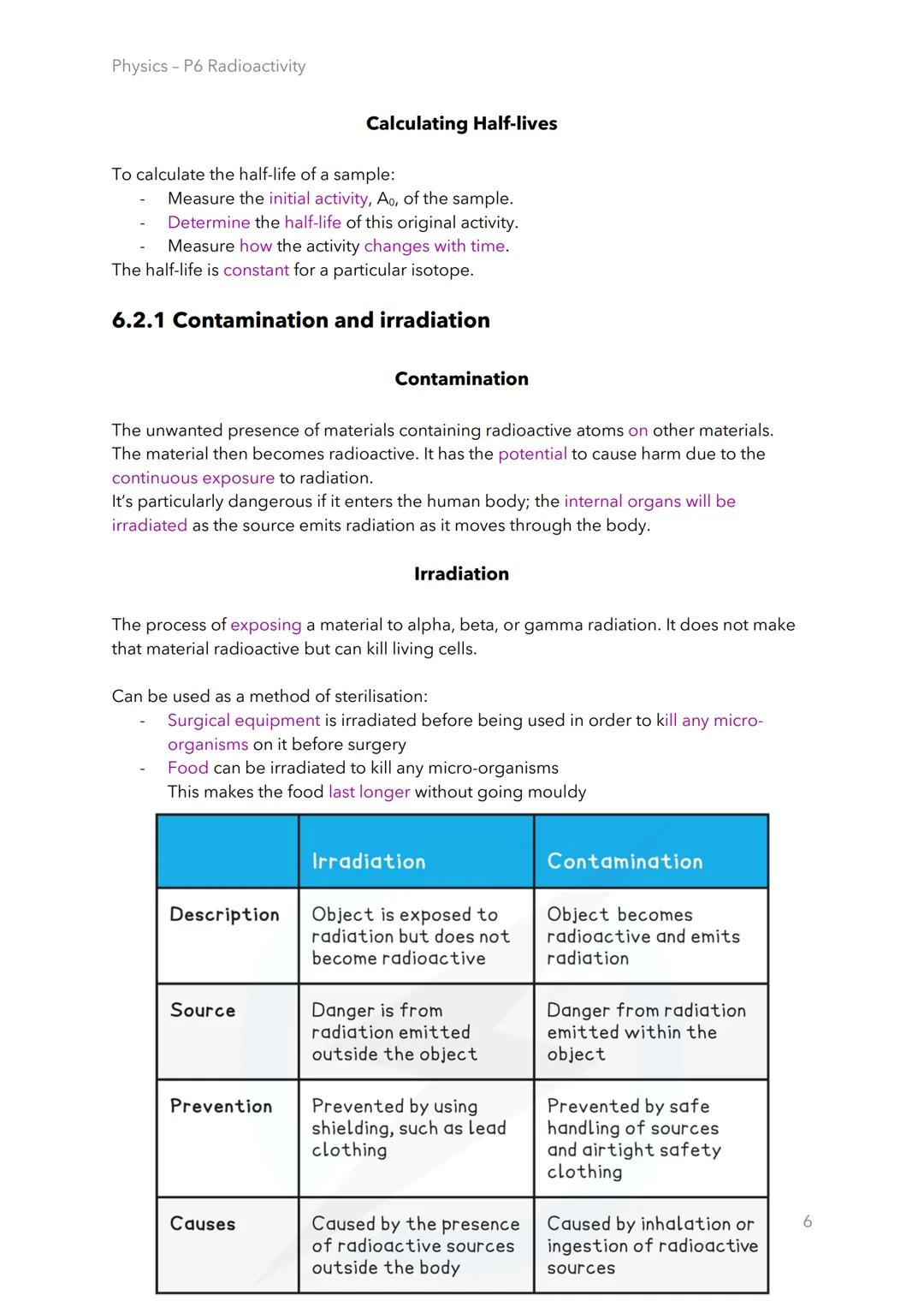
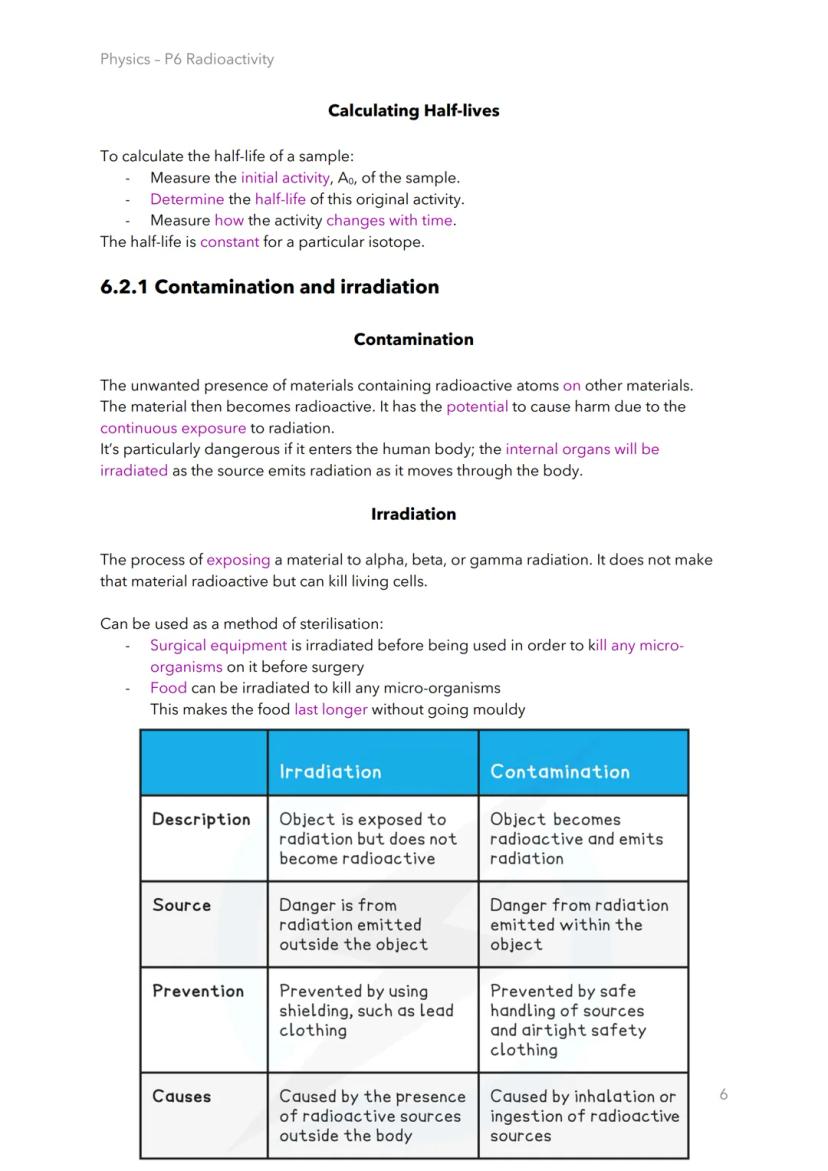
Contamination and irradiation sound similar but are completely different dangers. Contamination occurs when radioactive materials get onto or into other objects, making them radioactive too. This is particularly nasty if radioactive substances get inside your body.
Irradiation means exposing something to radiation without making it radioactive. It's actually useful for sterilisation - hospitals irradiate surgical equipment to kill germs, and food companies irradiate products to make them last longer.
The key difference is that contamination makes objects radioactive themselves, while irradiation just exposes them to radiation from external sources. Contamination is prevented by safe handling and protective clothing, whilst irradiation is controlled using shielding like lead aprons.
Both can be dangerous, but contamination is often worse because the radioactive source stays with you, continuously emitting radiation. With irradiation, you can simply move away from the source.
Safety Note: Always remember - contamination means the object becomes radioactive, irradiation means it's just exposed to radiation.
Our AI Companion is a student-focused AI tool that offers more than just answers. Built on millions of Knowunity resources, it provides relevant information, personalised study plans, quizzes, and content directly in the chat, adapting to your individual learning journey.
You can download the app from Google Play Store and Apple App Store.
That's right! Enjoy free access to study content, connect with fellow students, and get instant help – all at your fingertips.
App Store
Google Play
The app is very easy to use and well designed. I have found everything I was looking for so far and have been able to learn a lot from the presentations! I will definitely use the app for a class assignment! And of course it also helps a lot as an inspiration.
Stefan S
iOS user
This app is really great. There are so many study notes and help [...]. My problem subject is French, for example, and the app has so many options for help. Thanks to this app, I have improved my French. I would recommend it to anyone.
Samantha Klich
Android user
Wow, I am really amazed. I just tried the app because I've seen it advertised many times and was absolutely stunned. This app is THE HELP you want for school and above all, it offers so many things, such as workouts and fact sheets, which have been VERY helpful to me personally.
Anna
iOS user
Best app on earth! no words because it’s too good
Thomas R
iOS user
Just amazing. Let's me revise 10x better, this app is a quick 10/10. I highly recommend it to anyone. I can watch and search for notes. I can save them in the subject folder. I can revise it any time when I come back. If you haven't tried this app, you're really missing out.
Basil
Android user
This app has made me feel so much more confident in my exam prep, not only through boosting my own self confidence through the features that allow you to connect with others and feel less alone, but also through the way the app itself is centred around making you feel better. It is easy to navigate, fun to use, and helpful to anyone struggling in absolutely any way.
David K
iOS user
The app's just great! All I have to do is enter the topic in the search bar and I get the response real fast. I don't have to watch 10 YouTube videos to understand something, so I'm saving my time. Highly recommended!
Sudenaz Ocak
Android user
In school I was really bad at maths but thanks to the app, I am doing better now. I am so grateful that you made the app.
Greenlight Bonnie
Android user
very reliable app to help and grow your ideas of Maths, English and other related topics in your works. please use this app if your struggling in areas, this app is key for that. wish I'd of done a review before. and it's also free so don't worry about that.
Rohan U
Android user
I know a lot of apps use fake accounts to boost their reviews but this app deserves it all. Originally I was getting 4 in my English exams and this time I got a grade 7. I didn’t even know about this app three days until the exam and it has helped A LOT. Please actually trust me and use it as I’m sure you too will see developments.
Xander S
iOS user
THE QUIZES AND FLASHCARDS ARE SO USEFUL AND I LOVE Knowunity AI. IT ALSO IS LITREALLY LIKE CHATGPT BUT SMARTER!! HELPED ME WITH MY MASCARA PROBLEMS TOO!! AS WELL AS MY REAL SUBJECTS ! DUHHH 😍😁😲🤑💗✨🎀😮
Elisha
iOS user
This apps acc the goat. I find revision so boring but this app makes it so easy to organize it all and then you can ask the freeeee ai to test yourself so good and you can easily upload your own stuff. highly recommend as someone taking mocks now
Paul T
iOS user
The app is very easy to use and well designed. I have found everything I was looking for so far and have been able to learn a lot from the presentations! I will definitely use the app for a class assignment! And of course it also helps a lot as an inspiration.
Stefan S
iOS user
This app is really great. There are so many study notes and help [...]. My problem subject is French, for example, and the app has so many options for help. Thanks to this app, I have improved my French. I would recommend it to anyone.
Samantha Klich
Android user
Wow, I am really amazed. I just tried the app because I've seen it advertised many times and was absolutely stunned. This app is THE HELP you want for school and above all, it offers so many things, such as workouts and fact sheets, which have been VERY helpful to me personally.
Anna
iOS user
Best app on earth! no words because it’s too good
Thomas R
iOS user
Just amazing. Let's me revise 10x better, this app is a quick 10/10. I highly recommend it to anyone. I can watch and search for notes. I can save them in the subject folder. I can revise it any time when I come back. If you haven't tried this app, you're really missing out.
Basil
Android user
This app has made me feel so much more confident in my exam prep, not only through boosting my own self confidence through the features that allow you to connect with others and feel less alone, but also through the way the app itself is centred around making you feel better. It is easy to navigate, fun to use, and helpful to anyone struggling in absolutely any way.
David K
iOS user
The app's just great! All I have to do is enter the topic in the search bar and I get the response real fast. I don't have to watch 10 YouTube videos to understand something, so I'm saving my time. Highly recommended!
Sudenaz Ocak
Android user
In school I was really bad at maths but thanks to the app, I am doing better now. I am so grateful that you made the app.
Greenlight Bonnie
Android user
very reliable app to help and grow your ideas of Maths, English and other related topics in your works. please use this app if your struggling in areas, this app is key for that. wish I'd of done a review before. and it's also free so don't worry about that.
Rohan U
Android user
I know a lot of apps use fake accounts to boost their reviews but this app deserves it all. Originally I was getting 4 in my English exams and this time I got a grade 7. I didn’t even know about this app three days until the exam and it has helped A LOT. Please actually trust me and use it as I’m sure you too will see developments.
Xander S
iOS user
THE QUIZES AND FLASHCARDS ARE SO USEFUL AND I LOVE Knowunity AI. IT ALSO IS LITREALLY LIKE CHATGPT BUT SMARTER!! HELPED ME WITH MY MASCARA PROBLEMS TOO!! AS WELL AS MY REAL SUBJECTS ! DUHHH 😍😁😲🤑💗✨🎀😮
Elisha
iOS user
This apps acc the goat. I find revision so boring but this app makes it so easy to organize it all and then you can ask the freeeee ai to test yourself so good and you can easily upload your own stuff. highly recommend as someone taking mocks now
Paul T
iOS user
kkm_
@kkm_
Ever wondered how atoms work and why some materials are radioactive? This physics topic covers everything from how electrons dance between energy levels to why certain atomic nuclei are unstable and emit dangerous radiation.
Access to all documents
Improve your grades
Join milions of students
Your phone screen, fireworks, and even the sun all produce light the same way - through electrons jumping between energy levels. When electrons absorb energy (like from heat or electricity), they get excited and move to higher energy levels.
But here's the thing - electrons don't like staying excited for long. They quickly drop back down and release that energy as electromagnetic radiation, which includes visible light. That's literally how every colour you see is created!
Ionisation happens when electrons get knocked completely out of their atoms. This can occur through friction (like rubbing a balloon on your hair), chemical reactions, or absorbing enough electromagnetic radiation. When atoms lose electrons, they become positive ions; when they gain electrons, they become negative ions.
Isotopes are atoms of the same element that have different numbers of neutrons. They still have the same number of protons and electrons, which means they're the same element, but the extra or fewer neutrons can make them behave quite differently.
Quick Tip: Remember that the atomic number tells you how many protons an atom has, and this determines what element it is. The mass number is the total of protons plus neutrons.
Access to all documents
Improve your grades
Join milions of students
Some atomic nuclei are like unstable buildings - they have too many or too few neutrons and desperately want to become stable. Radioactive decay is nature's way of fixing this problem by shooting out high-energy particles or waves.
This process is completely random - you can't predict when any particular nucleus will decay. However, the radiation that gets emitted takes energy away from the nucleus, making it more stable overall.
There are four main types of radiation you need to know. Alpha particles are basically helium nuclei with a +2 charge. Beta particles are fast-moving electrons created when a neutron transforms into a proton. Gamma rays are electromagnetic waves with massive amounts of energy but no charge.
Neutron emission also occurs when nuclei have way too many neutrons and need to get rid of some to become stable.
Key Point: Radioactive decay is random for individual atoms, but predictable for large groups of atoms - this is what makes half-life calculations possible.
Access to all documents
Improve your grades
Join milions of students
Scientists can detect radioactive decay using photographic film (which changes colour when exposed to radiation) or a Geiger-Muller tube connected to a Geiger counter that clicks when radiation hits it.
Decay equations help us track what happens during radioactive decay. In alpha decay, both the mass number decreases by 4 and the atomic number decreases by 2, creating a completely new element.
For beta decay, the mass number stays the same but the atomic number increases by 1 (because a neutron became a proton), again forming a new element. The electron gets shot out of the nucleus.
Gamma decay is different - it doesn't change the mass or atomic number at all. The nucleus just releases excess energy as gamma rays to become less energetic and more stable.
Remember: Alpha and beta decay create new elements, but gamma decay just makes the same nucleus less energetic.
Access to all documents
Improve your grades
Join milions of students
Alpha decay happens when an unstable nucleus ejects an alpha particle (helium nucleus). This creates a completely new element because the atomic number changes. Think of it like the nucleus throwing out a chunk of itself to become more stable.
Beta decay occurs when a neutron inside the nucleus transforms into a proton and an electron. The electron gets ejected as a beta particle, while the proton remains in the nucleus. This also creates a new element since the atomic number increases by one.
Gamma decay is the simplest type - the nucleus just releases excess energy as gamma rays without changing its structure at all. It's like the nucleus letting out a sigh of relief to become less energetic.
Each type of decay serves the same purpose: making unstable nuclei more stable. The nucleus will keep decaying until it reaches a stable configuration.
Fun Fact: Some radioactive elements go through multiple decay steps, creating a whole chain of different elements before finally becoming stable.
Access to all documents
Improve your grades
Join milions of students
Different types of radiation have vastly different penetration abilities. Alpha particles are stopped by paper, beta particles need a few millimetres of aluminium, while gamma rays require several millimetres of lead to reduce their intensity.
Alpha radiation has the highest ionisation power but the shortest range. Beta radiation sits in the middle for both properties. Gamma radiation has the lowest ionisation but can travel infinite distances in air.
Half-life is the time it takes for half the radioactive nuclei in a sample to decay. It's also the time for the activity (rate of decay) to drop to half its original value. Different isotopes have wildly different half-lives - from fractions of seconds to billions of years.
The brilliant thing about half-life is that it's constant for each isotope. After one half-life, you're left with 50% of the original sample. After two half-lives, you have 25%. After three half-lives, just 12.5% remains.
Exam Tip: Half-life graphs always show the characteristic curved decay pattern - never a straight line.
Access to all documents
Improve your grades
Join milions of students
Contamination and irradiation sound similar but are completely different dangers. Contamination occurs when radioactive materials get onto or into other objects, making them radioactive too. This is particularly nasty if radioactive substances get inside your body.
Irradiation means exposing something to radiation without making it radioactive. It's actually useful for sterilisation - hospitals irradiate surgical equipment to kill germs, and food companies irradiate products to make them last longer.
The key difference is that contamination makes objects radioactive themselves, while irradiation just exposes them to radiation from external sources. Contamination is prevented by safe handling and protective clothing, whilst irradiation is controlled using shielding like lead aprons.
Both can be dangerous, but contamination is often worse because the radioactive source stays with you, continuously emitting radiation. With irradiation, you can simply move away from the source.
Safety Note: Always remember - contamination means the object becomes radioactive, irradiation means it's just exposed to radiation.
Our AI Companion is a student-focused AI tool that offers more than just answers. Built on millions of Knowunity resources, it provides relevant information, personalised study plans, quizzes, and content directly in the chat, adapting to your individual learning journey.
You can download the app from Google Play Store and Apple App Store.
That's right! Enjoy free access to study content, connect with fellow students, and get instant help – all at your fingertips.
7
Smart Tools NEW
Transform this note into: ✓ 50+ Practice Questions ✓ Interactive Flashcards ✓ Full Mock Exam ✓ Essay Outlines
Explore the fundamentals of nuclear decay, atomic structure, and radiation types in this comprehensive summary. Key concepts include activity measurement, half-life, radioactive decay, fission, fusion, and the historical development of atomic models. Ideal for AQA students preparing for exams.
 Physics
Explore the evolution of atomic theory, from early concepts by Democritus to modern atomic models. Understand key principles such as atomic structure, periodic table development, and the role of isotopes. This summary covers essential topics including energy forms, oxidation states, and the contributions of notable scientists like Dalton, Thompson, and Bohr. Ideal for students studying chemistry and physics.
PhysicsExplore the fundamentals of atomic structure and nuclear radiation in this comprehensive study resource. Covering key concepts such as isotopes, radioactive decay, nuclear fission, and the historical development of atomic models, this summary is designed for GCSE Physics students preparing for AQA Higher Triple exams. Enhance your understanding of protons, neutrons, and the properties of alpha, beta, and gamma radiation.
PhysicsExplore the fundamentals of atomic structure, including key concepts such as nuclear fission, fusion, radioactive decay, and the properties of subatomic particles. This comprehensive resource includes past exam questions and mark schemes to help you identify and strengthen your understanding of atomic theory and its applications in physics.
PhysicsExplore the principles of conduction and convection in liquids and gases. This summary covers thermal conductivity, energy transfer, and the behavior of particles during heating and cooling. Ideal for GCSE Physics students seeking to understand how heat moves through different states of matter.
PhysicsExplore the principles of gas laws, energy transfer, and the properties of matter in this comprehensive study resource. This material covers key concepts such as pressure, temperature, density, specific heat capacity, and phase changes, along with practical experiments and calculations. Ideal for AQA Higher Physics students preparing for exams.
PhysicsApp Store
Google Play
The app is very easy to use and well designed. I have found everything I was looking for so far and have been able to learn a lot from the presentations! I will definitely use the app for a class assignment! And of course it also helps a lot as an inspiration.
Stefan S
iOS user
This app is really great. There are so many study notes and help [...]. My problem subject is French, for example, and the app has so many options for help. Thanks to this app, I have improved my French. I would recommend it to anyone.
Samantha Klich
Android user
Wow, I am really amazed. I just tried the app because I've seen it advertised many times and was absolutely stunned. This app is THE HELP you want for school and above all, it offers so many things, such as workouts and fact sheets, which have been VERY helpful to me personally.
Anna
iOS user
Best app on earth! no words because it’s too good
Thomas R
iOS user
Just amazing. Let's me revise 10x better, this app is a quick 10/10. I highly recommend it to anyone. I can watch and search for notes. I can save them in the subject folder. I can revise it any time when I come back. If you haven't tried this app, you're really missing out.
Basil
Android user
This app has made me feel so much more confident in my exam prep, not only through boosting my own self confidence through the features that allow you to connect with others and feel less alone, but also through the way the app itself is centred around making you feel better. It is easy to navigate, fun to use, and helpful to anyone struggling in absolutely any way.
David K
iOS user
The app's just great! All I have to do is enter the topic in the search bar and I get the response real fast. I don't have to watch 10 YouTube videos to understand something, so I'm saving my time. Highly recommended!
Sudenaz Ocak
Android user
In school I was really bad at maths but thanks to the app, I am doing better now. I am so grateful that you made the app.
Greenlight Bonnie
Android user
very reliable app to help and grow your ideas of Maths, English and other related topics in your works. please use this app if your struggling in areas, this app is key for that. wish I'd of done a review before. and it's also free so don't worry about that.
Rohan U
Android user
I know a lot of apps use fake accounts to boost their reviews but this app deserves it all. Originally I was getting 4 in my English exams and this time I got a grade 7. I didn’t even know about this app three days until the exam and it has helped A LOT. Please actually trust me and use it as I’m sure you too will see developments.
Xander S
iOS user
THE QUIZES AND FLASHCARDS ARE SO USEFUL AND I LOVE Knowunity AI. IT ALSO IS LITREALLY LIKE CHATGPT BUT SMARTER!! HELPED ME WITH MY MASCARA PROBLEMS TOO!! AS WELL AS MY REAL SUBJECTS ! DUHHH 😍😁😲🤑💗✨🎀😮
Elisha
iOS user
This apps acc the goat. I find revision so boring but this app makes it so easy to organize it all and then you can ask the freeeee ai to test yourself so good and you can easily upload your own stuff. highly recommend as someone taking mocks now
Paul T
iOS user
The app is very easy to use and well designed. I have found everything I was looking for so far and have been able to learn a lot from the presentations! I will definitely use the app for a class assignment! And of course it also helps a lot as an inspiration.
Stefan S
iOS user
This app is really great. There are so many study notes and help [...]. My problem subject is French, for example, and the app has so many options for help. Thanks to this app, I have improved my French. I would recommend it to anyone.
Samantha Klich
Android user
Wow, I am really amazed. I just tried the app because I've seen it advertised many times and was absolutely stunned. This app is THE HELP you want for school and above all, it offers so many things, such as workouts and fact sheets, which have been VERY helpful to me personally.
Anna
iOS user
Best app on earth! no words because it’s too good
Thomas R
iOS user
Just amazing. Let's me revise 10x better, this app is a quick 10/10. I highly recommend it to anyone. I can watch and search for notes. I can save them in the subject folder. I can revise it any time when I come back. If you haven't tried this app, you're really missing out.
Basil
Android user
This app has made me feel so much more confident in my exam prep, not only through boosting my own self confidence through the features that allow you to connect with others and feel less alone, but also through the way the app itself is centred around making you feel better. It is easy to navigate, fun to use, and helpful to anyone struggling in absolutely any way.
David K
iOS user
The app's just great! All I have to do is enter the topic in the search bar and I get the response real fast. I don't have to watch 10 YouTube videos to understand something, so I'm saving my time. Highly recommended!
Sudenaz Ocak
Android user
In school I was really bad at maths but thanks to the app, I am doing better now. I am so grateful that you made the app.
Greenlight Bonnie
Android user
very reliable app to help and grow your ideas of Maths, English and other related topics in your works. please use this app if your struggling in areas, this app is key for that. wish I'd of done a review before. and it's also free so don't worry about that.
Rohan U
Android user
I know a lot of apps use fake accounts to boost their reviews but this app deserves it all. Originally I was getting 4 in my English exams and this time I got a grade 7. I didn’t even know about this app three days until the exam and it has helped A LOT. Please actually trust me and use it as I’m sure you too will see developments.
Xander S
iOS user
THE QUIZES AND FLASHCARDS ARE SO USEFUL AND I LOVE Knowunity AI. IT ALSO IS LITREALLY LIKE CHATGPT BUT SMARTER!! HELPED ME WITH MY MASCARA PROBLEMS TOO!! AS WELL AS MY REAL SUBJECTS ! DUHHH 😍😁😲🤑💗✨🎀😮
Elisha
iOS user
This apps acc the goat. I find revision so boring but this app makes it so easy to organize it all and then you can ask the freeeee ai to test yourself so good and you can easily upload your own stuff. highly recommend as someone taking mocks now
Paul T
iOS user