
The Hungarian Uprising of 1956was a significant event that...
 History356 views·Updated 5 Jul 2026·1 page
Why the Hungarian Uprising 1956 Happened and What It Changed
E
Eloise Mayo@eloisemayo_seek
1
of 1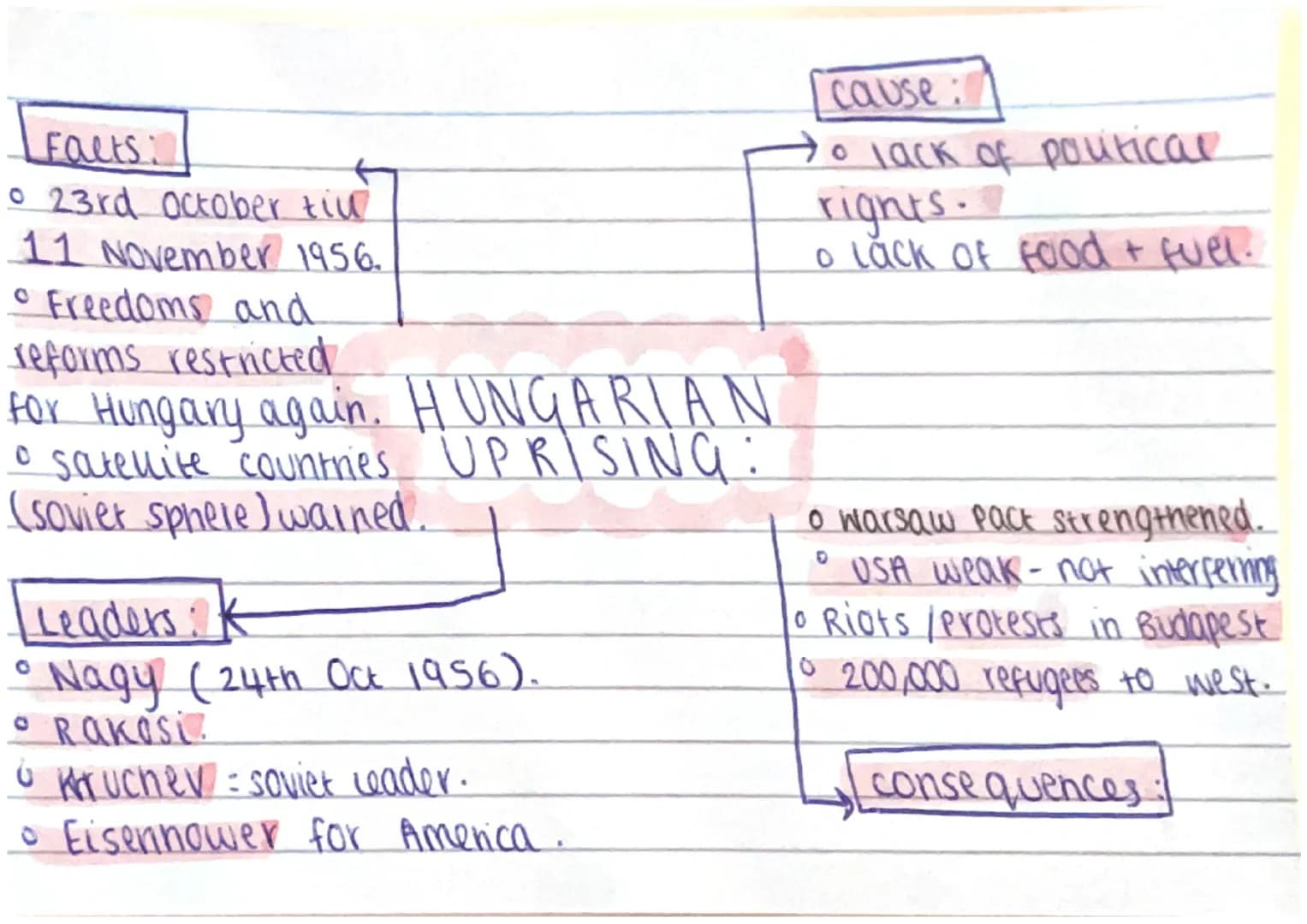
Hungarian Uprising of 1956: A Turning Point in Cold War History
The Hungarian Uprising of 1956 was a pivotal moment in the Cold War era, challenging Soviet control and revealing the tensions within the Eastern Bloc. This event, which took place from October 23 to November 11, 1956, had profound implications for Hungary, the Soviet Union, and the broader geopolitical landscape.
Highlight: The uprising lasted for 19 days, from October 23 to November 11, 1956, marking a brief but intense period of rebellion against Soviet control.
The uprising was led by Imre Nagy, who assumed the role of Prime Minister on October 24, 1956. Other key figures involved were Mátyás Rákosi, the previous Hungarian leader, Nikita Khrushchev as the Soviet leader, and Dwight D. Eisenhower as the American President.
Vocabulary: Satellite countries - nations under the political and economic influence of a more powerful country, in this case, referring to countries within the Soviet sphere of influence.
The causes of the Hungarian Revolution 1956 were multifaceted:
- A lack of political rights and freedoms under Soviet control
- Economic hardships, including shortages of food and fuel
- Growing discontent with Soviet domination and a desire for greater autonomy
The uprising manifested through large-scale riots and protests in Budapest, with citizens demanding reforms and an end to Soviet control.
Example: The protests in Budapest saw thousands of Hungarians taking to the streets, tearing down Soviet symbols, and calling for democratic reforms.
The Soviet response to the Hungarian Uprising was swift and forceful. The rebellion was ultimately suppressed, leading to severe consequences:
- Freedoms and reforms in Hungary were once again restricted
- The Warsaw Pact, the collective defense treaty between the Soviet Union and other Eastern European nations, was strengthened
- Other satellite countries were warned against similar uprisings
Definition: The Warsaw Pact was a collective defense treaty established in 1955 between the Soviet Union and seven other Eastern European countries, serving as a counterbalance to NATO.
The Hungarian Uprising 1956 impact was significant and far-reaching:
- Approximately 200,000 Hungarian refugees fled to the West, creating a humanitarian crisis
- The United States' non-intervention highlighted the limitations of its containment policy and the realities of Cold War power dynamics
- The Soviet Union's brutal suppression of the uprising damaged its international reputation and exposed the fragility of its control over Eastern Europe
Quote: "The Hungarian Uprising of 1956 was a watershed moment in Cold War history, exposing the cracks in Soviet dominance and the limitations of Western support for anti-communist movements behind the Iron Curtain."
In conclusion, the Hungarian Uprising of 1956, though ultimately unsuccessful in achieving its immediate goals, had a lasting impact on Cold War politics, Soviet-satellite relations, and the struggle for freedom and democracy in Eastern Europe.
We thought you’d never ask...
Our AI Companion is a student-focused AI tool that offers more than just answers. Built on millions of Knowunity resources, it provides relevant information, personalised study plans, quizzes, and content directly in the chat, adapting to your individual learning journey.
You can download the app from Google Play Store and Apple App Store.
That's right! Enjoy free access to study content, connect with fellow students, and get instant help – all at your fingertips.
Similar content
 World History
Most popular content in History
9HistoryCold War Mindmaps Overview
Explore comprehensive mindmaps covering key events and concepts of the Cold War, including the Cuban Missile Crisis, Gorbachev's reforms, and the end of the Cold War. Ideal for Edexcel GCSE History students seeking to enhance their understanding of superpower relations and significant historical events in Europe. This resource provides a visual summary to aid in revision and retention.
119,771195
W
HistoryWeimar Constitution
GCSE history Weimar and Nazi Germany - the Weimar Constitution
99924
HistoryEvolution of Medicine
Explore the comprehensive timeline of medical advancements from medieval practices to modern healthcare. This revision resource covers key topics such as the Great Plague, Germ Theory, the development of antibiotics, and the evolution of public health reforms. Ideal for Edexcel GCSE History students seeking a thorough understanding of the progression of medical knowledge and practices.
1116,245719
HistoryElizabethan Conspiracies & Conflicts
Explore the key conspiracies and conflicts during Elizabeth I's reign, including the Ridolfi and Throckmorton plots, the Spanish Armada, and the impact of the Religious Settlement. This comprehensive revision guide covers essential topics for GCSE History, focusing on the political, religious, and social challenges faced by Elizabethan England.
105,219336
M
Historymedicine through time
this is a history test most for yearr 10/11s to get you ready for exams!
104390
HistoryElizabethan Governance & Challenges
Explore the complexities of Elizabeth I's reign with this comprehensive mindmap covering key topics such as the structure of Tudor government, the religious settlement, challenges from Mary Queen of Scots, and the impact of exploration. Ideal for Edexcel GCSE History students, this resource provides a clear overview of Elizabethan politics, foreign policy, and societal issues, helping you to understand the era's significant events and figures.
117,924408
HistoryAnglo-Saxon & Norman England Overview
Explore the key events and societal changes in Anglo-Saxon and Norman England (c. 1060-1088). This comprehensive summary covers the feudal system, the role of the Church, significant battles, and the impact of William the Conqueror's reign. Ideal for history revision and exam preparation.
112,41178
1
History10 Question Elizabeth Quiz for Mocks
Explore the lives and legacies of influential leaders who shaped the course of history through their revolutionary actions.
114953
HistoryWeimar Republic Overview
Explore the key events and challenges of the Weimar Republic (1918-1929), including the November Revolution, Treaty of Versailles, economic crises, and the rise of political extremism. This summary covers the establishment of the Weimar Constitution, the impact of hyperinflation, and the cultural developments during the Golden Twenties. Ideal for students studying Weimar Germany and its historical significance.
111,99540
Most popular content
9 Sociology
Sociology of Education Overview
Explore comprehensive A-Level Sociology notes on the education system, covering key theories, policies, and sociological perspectives. This resource includes insights on marketisation, gender roles, cultural deprivation, and educational inequalities, providing a thorough understanding of how education shapes social stratification and individual achievement. Ideal for exam preparation and in-depth study.
12102,8973,041
SociologySociology of Families: Comprehensive Revision
Dive into an extensive overview of family dynamics, perspectives, and patterns in sociology. This resource covers key concepts such as family diversity, gender roles, marriage, and the impact of social policies on family structures. Perfect for A-Level Sociology students preparing for Paper 2.
1273,6872,307
CriminologyCriminology: Crime & Punishment Overview
Comprehensive mindmaps covering key concepts in the Crime and Punishment topic for WJEC Criminology Unit 4. This resource includes detailed insights into the Criminal Justice System, crime prevention strategies, sentencing models, and the roles of various agencies. Ideal for A-Level revision, ensuring you grasp essential theories and legislative processes to excel in your exams.
1254,8751,059
SociologyComprehensive Crime & Deviance Overview
Explore an extensive revision of crime and deviance topics, including theories, types of crime, and the impact of media. This resource covers key concepts such as Marxism, functionalism, gender and crime, and the influence of globalization on criminal behavior. Ideal for students seeking a thorough understanding of criminology and its various theories. Type: Full Topic Revision.
1251,6611,399
C
 Biology
Cell Biology and Cell structure
cell structures
93,2570
CriminologyWJEC Unit 4 Criminology
Criminology unit 4 detailed revision note
127,156125
 English Literature
An Inspector Calls: Character Insights
Explore in-depth analysis and key quotes for characters in J.B. Priestley's 'An Inspector Calls'. This resource covers Gerald Croft, Inspector Goole, Sheila Birling, Mrs. Birling, Eric Birling, and Eva Smith, focusing on themes of class, gender roles, and social responsibility. Ideal for students aiming for Grade 8 and above.
1025,437907
CriminologyCriminology Theories Overview
Explore key criminology theories and their implications on crime and deviance. This comprehensive summary covers biological, psychological, and sociological perspectives, including labelling theory, right realism, and the impact of social campaigns on policy development. Ideal for A-Level criminology students seeking to understand the complexities of criminal behaviour and the factors influencing crime prevention strategies.
129,764210
SociologySociological Theories Overview
Comprehensive revision of key sociological theories including Functionalism, Marxism, Feminism, and Interpretivism. Explore concepts like value freedom, identity formation, and the critique of social control. Ideal for AQA A-Level Sociology students preparing for exams. This summary covers essential theories and their implications in sociology, providing a clear understanding of each perspective.
1231,460846
Students love us — and so will you.
4.6/5App Store
4.7/5Google Play
The app is very easy to use and well designed. I have found everything I was looking for so far and have been able to learn a lot from the presentations! I will definitely use the app for a class assignment! And of course it also helps a lot as an inspiration.
Stefan SiOS user
This app is really great. There are so many study notes and help [...]. My problem subject is French, for example, and the app has so many options for help. Thanks to this app, I have improved my French. I would recommend it to anyone.
Samantha KlichAndroid user
Wow, I am really amazed. I just tried the app because I've seen it advertised many times and was absolutely stunned. This app is THE HELP you want for school and above all, it offers so many things, such as workouts and fact sheets, which have been VERY helpful to me personally.
AnnaiOS user
History356 views·Updated 5 Jul 2026·1 pageWhy the Hungarian Uprising 1956 Happened and What It Changed
E
Eloise Mayo@eloisemayo_seek
The Hungarian Uprising of 1956was a significant event that shook the Soviet bloc and had far-reaching consequences. This brief but intense period of rebellion against Soviet control in Hungary lasted from October 23 to November 11, 1956. The uprising...
1
of 1
Sign up to see the content. It's free!
- Access to all documents
- Improve your grades
- Join milions of students
By signing up you accept Terms of Service and Privacy Policy
Hungarian Uprising of 1956: A Turning Point in Cold War History
The Hungarian Uprising of 1956 was a pivotal moment in the Cold War era, challenging Soviet control and revealing the tensions within the Eastern Bloc. This event, which took place from October 23 to November 11, 1956, had profound implications for Hungary, the Soviet Union, and the broader geopolitical landscape.
Highlight: The uprising lasted for 19 days, from October 23 to November 11, 1956, marking a brief but intense period of rebellion against Soviet control.
The uprising was led by Imre Nagy, who assumed the role of Prime Minister on October 24, 1956. Other key figures involved were Mátyás Rákosi, the previous Hungarian leader, Nikita Khrushchev as the Soviet leader, and Dwight D. Eisenhower as the American President.
Vocabulary: Satellite countries - nations under the political and economic influence of a more powerful country, in this case, referring to countries within the Soviet sphere of influence.
The causes of the Hungarian Revolution 1956 were multifaceted:
- A lack of political rights and freedoms under Soviet control
- Economic hardships, including shortages of food and fuel
- Growing discontent with Soviet domination and a desire for greater autonomy
The uprising manifested through large-scale riots and protests in Budapest, with citizens demanding reforms and an end to Soviet control.
Example: The protests in Budapest saw thousands of Hungarians taking to the streets, tearing down Soviet symbols, and calling for democratic reforms.
The Soviet response to the Hungarian Uprising was swift and forceful. The rebellion was ultimately suppressed, leading to severe consequences:
- Freedoms and reforms in Hungary were once again restricted
- The Warsaw Pact, the collective defense treaty between the Soviet Union and other Eastern European nations, was strengthened
- Other satellite countries were warned against similar uprisings
Definition: The Warsaw Pact was a collective defense treaty established in 1955 between the Soviet Union and seven other Eastern European countries, serving as a counterbalance to NATO.
The Hungarian Uprising 1956 impact was significant and far-reaching:
- Approximately 200,000 Hungarian refugees fled to the West, creating a humanitarian crisis
- The United States' non-intervention highlighted the limitations of its containment policy and the realities of Cold War power dynamics
- The Soviet Union's brutal suppression of the uprising damaged its international reputation and exposed the fragility of its control over Eastern Europe
Quote: "The Hungarian Uprising of 1956 was a watershed moment in Cold War history, exposing the cracks in Soviet dominance and the limitations of Western support for anti-communist movements behind the Iron Curtain."
In conclusion, the Hungarian Uprising of 1956, though ultimately unsuccessful in achieving its immediate goals, had a lasting impact on Cold War politics, Soviet-satellite relations, and the struggle for freedom and democracy in Eastern Europe.
We thought you’d never ask...
Our AI Companion is a student-focused AI tool that offers more than just answers. Built on millions of Knowunity resources, it provides relevant information, personalised study plans, quizzes, and content directly in the chat, adapting to your individual learning journey.
You can download the app from Google Play Store and Apple App Store.
That's right! Enjoy free access to study content, connect with fellow students, and get instant help – all at your fingertips.
Similar content
Most popular content in History
9HistoryCold War Mindmaps Overview
Explore comprehensive mindmaps covering key events and concepts of the Cold War, including the Cuban Missile Crisis, Gorbachev's reforms, and the end of the Cold War. Ideal for Edexcel GCSE History students seeking to enhance their understanding of superpower relations and significant historical events in Europe. This resource provides a visual summary to aid in revision and retention.
119,771195
W
HistoryWeimar Constitution
GCSE history Weimar and Nazi Germany - the Weimar Constitution
99924
HistoryEvolution of Medicine
Explore the comprehensive timeline of medical advancements from medieval practices to modern healthcare. This revision resource covers key topics such as the Great Plague, Germ Theory, the development of antibiotics, and the evolution of public health reforms. Ideal for Edexcel GCSE History students seeking a thorough understanding of the progression of medical knowledge and practices.
1116,245719
HistoryElizabethan Conspiracies & Conflicts
Explore the key conspiracies and conflicts during Elizabeth I's reign, including the Ridolfi and Throckmorton plots, the Spanish Armada, and the impact of the Religious Settlement. This comprehensive revision guide covers essential topics for GCSE History, focusing on the political, religious, and social challenges faced by Elizabethan England.
105,219336
M
Historymedicine through time
this is a history test most for yearr 10/11s to get you ready for exams!
104390
HistoryElizabethan Governance & Challenges
Explore the complexities of Elizabeth I's reign with this comprehensive mindmap covering key topics such as the structure of Tudor government, the religious settlement, challenges from Mary Queen of Scots, and the impact of exploration. Ideal for Edexcel GCSE History students, this resource provides a clear overview of Elizabethan politics, foreign policy, and societal issues, helping you to understand the era's significant events and figures.
117,924408
HistoryAnglo-Saxon & Norman England Overview
Explore the key events and societal changes in Anglo-Saxon and Norman England (c. 1060-1088). This comprehensive summary covers the feudal system, the role of the Church, significant battles, and the impact of William the Conqueror's reign. Ideal for history revision and exam preparation.
112,41178
1
History10 Question Elizabeth Quiz for Mocks
Explore the lives and legacies of influential leaders who shaped the course of history through their revolutionary actions.
114953
HistoryWeimar Republic Overview
Explore the key events and challenges of the Weimar Republic (1918-1929), including the November Revolution, Treaty of Versailles, economic crises, and the rise of political extremism. This summary covers the establishment of the Weimar Constitution, the impact of hyperinflation, and the cultural developments during the Golden Twenties. Ideal for students studying Weimar Germany and its historical significance.
111,99540
Most popular content
9SociologySociology of Education Overview
Explore comprehensive A-Level Sociology notes on the education system, covering key theories, policies, and sociological perspectives. This resource includes insights on marketisation, gender roles, cultural deprivation, and educational inequalities, providing a thorough understanding of how education shapes social stratification and individual achievement. Ideal for exam preparation and in-depth study.
12102,8973,041
SociologySociology of Families: Comprehensive Revision
Dive into an extensive overview of family dynamics, perspectives, and patterns in sociology. This resource covers key concepts such as family diversity, gender roles, marriage, and the impact of social policies on family structures. Perfect for A-Level Sociology students preparing for Paper 2.
1273,6872,307
CriminologyCriminology: Crime & Punishment Overview
Comprehensive mindmaps covering key concepts in the Crime and Punishment topic for WJEC Criminology Unit 4. This resource includes detailed insights into the Criminal Justice System, crime prevention strategies, sentencing models, and the roles of various agencies. Ideal for A-Level revision, ensuring you grasp essential theories and legislative processes to excel in your exams.
1254,8751,059
SociologyComprehensive Crime & Deviance Overview
Explore an extensive revision of crime and deviance topics, including theories, types of crime, and the impact of media. This resource covers key concepts such as Marxism, functionalism, gender and crime, and the influence of globalization on criminal behavior. Ideal for students seeking a thorough understanding of criminology and its various theories. Type: Full Topic Revision.
1251,6611,399
C
BiologyCell Biology and Cell structure
cell structures
93,2570
CriminologyWJEC Unit 4 Criminology
Criminology unit 4 detailed revision note
127,156125
English LiteratureAn Inspector Calls: Character Insights
Explore in-depth analysis and key quotes for characters in J.B. Priestley's 'An Inspector Calls'. This resource covers Gerald Croft, Inspector Goole, Sheila Birling, Mrs. Birling, Eric Birling, and Eva Smith, focusing on themes of class, gender roles, and social responsibility. Ideal for students aiming for Grade 8 and above.
1025,437907
CriminologyCriminology Theories Overview
Explore key criminology theories and their implications on crime and deviance. This comprehensive summary covers biological, psychological, and sociological perspectives, including labelling theory, right realism, and the impact of social campaigns on policy development. Ideal for A-Level criminology students seeking to understand the complexities of criminal behaviour and the factors influencing crime prevention strategies.
129,764210
SociologySociological Theories Overview
Comprehensive revision of key sociological theories including Functionalism, Marxism, Feminism, and Interpretivism. Explore concepts like value freedom, identity formation, and the critique of social control. Ideal for AQA A-Level Sociology students preparing for exams. This summary covers essential theories and their implications in sociology, providing a clear understanding of each perspective.
1231,460846
Students love us — and so will you.
4.6/5App Store
4.7/5Google Play
The app is very easy to use and well designed. I have found everything I was looking for so far and have been able to learn a lot from the presentations! I will definitely use the app for a class assignment! And of course it also helps a lot as an inspiration.
Stefan SiOS user
This app is really great. There are so many study notes and help [...]. My problem subject is French, for example, and the app has so many options for help. Thanks to this app, I have improved my French. I would recommend it to anyone.
Samantha KlichAndroid user
Wow, I am really amazed. I just tried the app because I've seen it advertised many times and was absolutely stunned. This app is THE HELP you want for school and above all, it offers so many things, such as workouts and fact sheets, which have been VERY helpful to me personally.
AnnaiOS user