
Chemical equilibrium is the fascinating state in a reversible reaction... Show more
 AP Chemistry62 views·Updated Jun 3, 2026·1 page
Understanding Reversible Reactions, Chemical Equilibrium, and Constants

AT@at_13
1
of 1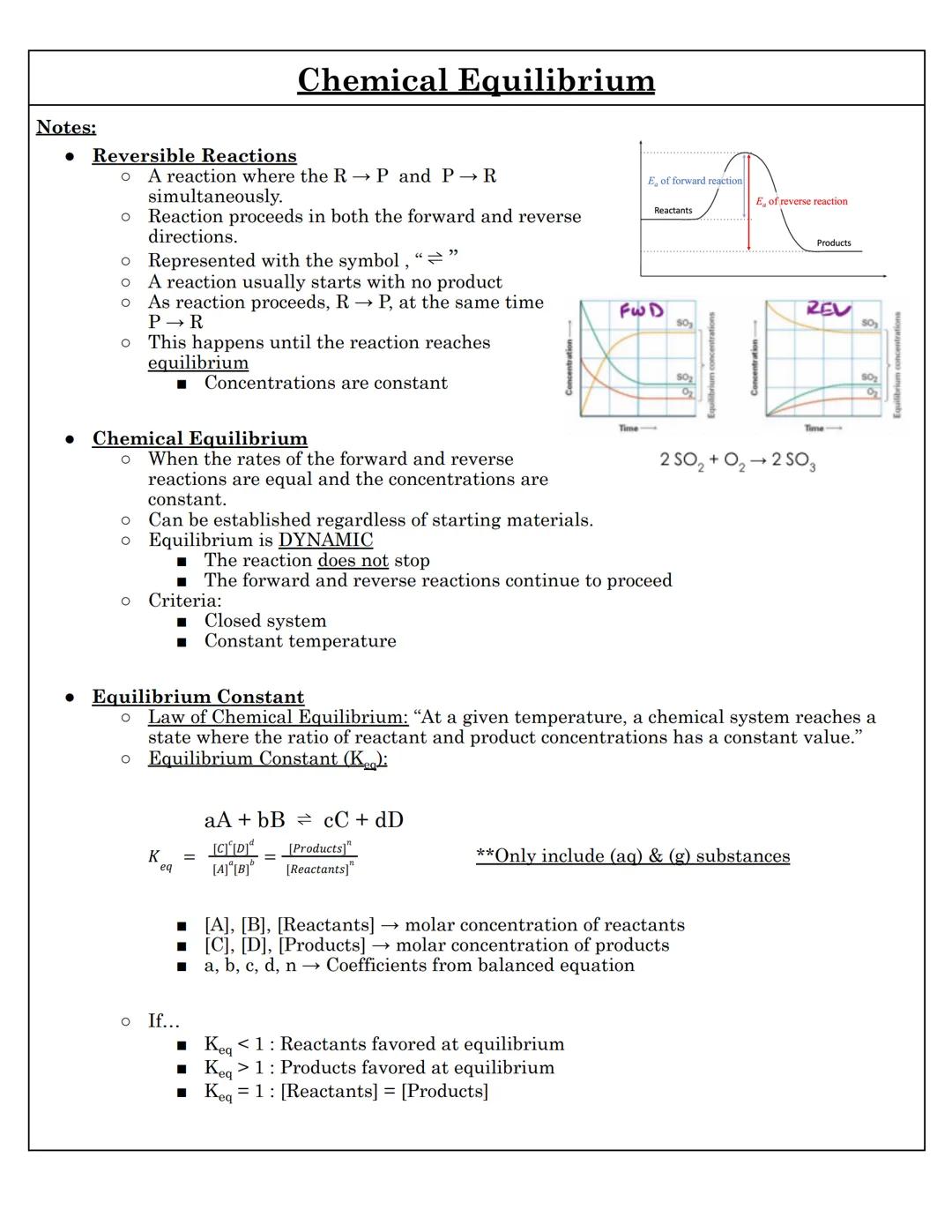
Chemical Equilibrium Fundamentals
Ever wondered why some chemical reactions seem to stop before they're finished? That's chemical equilibrium in action! In reversible reactions, substances can transform from reactants to products and back again simultaneously. These reactions are written with a special double arrow symbol (⇌).
When a reaction reaches chemical equilibrium, something remarkable happens - the rates of the forward and reverse reactions become equal, and the concentrations of all substances remain constant. This doesn't mean the reaction stops! Equilibrium is dynamic, meaning molecules are still actively converting back and forth - they're just doing so at matched rates in a closed system at constant temperature.
The equilibrium constant (Kₑq) gives us a mathematical way to describe this balance. It's expressed as the concentration of products raised to their coefficients, divided by the concentration of reactants raised to their coefficients: Kₑq = [Products]^n/[Reactants]^n. Only aqueous and gaseous substances are included in this calculation.
💡 The value of Kₑq instantly tells you which side "wins" in a reaction: if Kₑq > 1, products are favored; if Kₑq < 1, reactants are favored; if Kₑq = 1, both sides are equally represented.
We thought you’d never ask...
What is the Knowunity AI companion?
Our AI Companion is a student-focused AI tool that offers more than just answers. Built on millions of Knowunity resources, it provides relevant information, personalised study plans, quizzes, and content directly in the chat, adapting to your individual learning journey.
Where can I download the Knowunity app?
You can download the app from Google Play Store and Apple App Store.
Is Knowunity really free of charge?
That's right! Enjoy free access to study content, connect with fellow students, and get instant help – all at your fingertips.
Similar content
Most popular content in AP Chemistry
9Most popular content
9Can't find what you're looking for? Explore other subjects.
Students love us — and so will you.
4.6/5App Store
4.7/5Google Play
The app is very easy to use and well designed. I have found everything I was looking for so far and have been able to learn a lot from the presentations! I will definitely use the app for a class assignment! And of course it also helps a lot as an inspiration.
Stefan SiOS user
This app is really great. There are so many study notes and help [...]. My problem subject is French, for example, and the app has so many options for help. Thanks to this app, I have improved my French. I would recommend it to anyone.
Samantha KlichAndroid user
Wow, I am really amazed. I just tried the app because I've seen it advertised many times and was absolutely stunned. This app is THE HELP you want for school and above all, it offers so many things, such as workouts and fact sheets, which have been VERY helpful to me personally.
AnnaiOS user
AP Chemistry62 views·Updated Jun 3, 2026·1 pageUnderstanding Reversible Reactions, Chemical Equilibrium, and Constants
AT@at_13
Chemical equilibrium is the fascinating state in a reversible reaction where forward and backward reactions occur at the same rate, keeping concentrations constant. Understanding this concept is essential for predicting how chemical reactions behave and why some reactions don't go... Show more
1
of 1Sign up to see the content. It's free!
- Access to all documents
- Improve your grades
- Join milions of students
Chemical Equilibrium Fundamentals
Ever wondered why some chemical reactions seem to stop before they're finished? That's chemical equilibrium in action! In reversible reactions, substances can transform from reactants to products and back again simultaneously. These reactions are written with a special double arrow symbol (⇌).
When a reaction reaches chemical equilibrium, something remarkable happens - the rates of the forward and reverse reactions become equal, and the concentrations of all substances remain constant. This doesn't mean the reaction stops! Equilibrium is dynamic, meaning molecules are still actively converting back and forth - they're just doing so at matched rates in a closed system at constant temperature.
The equilibrium constant (Kₑq) gives us a mathematical way to describe this balance. It's expressed as the concentration of products raised to their coefficients, divided by the concentration of reactants raised to their coefficients: Kₑq = [Products]^n/[Reactants]^n. Only aqueous and gaseous substances are included in this calculation.
💡 The value of Kₑq instantly tells you which side "wins" in a reaction: if Kₑq > 1, products are favored; if Kₑq < 1, reactants are favored; if Kₑq = 1, both sides are equally represented.
We thought you’d never ask...
What is the Knowunity AI companion?
Our AI Companion is a student-focused AI tool that offers more than just answers. Built on millions of Knowunity resources, it provides relevant information, personalised study plans, quizzes, and content directly in the chat, adapting to your individual learning journey.
Where can I download the Knowunity app?
You can download the app from Google Play Store and Apple App Store.
Is Knowunity really free of charge?
That's right! Enjoy free access to study content, connect with fellow students, and get instant help – all at your fingertips.
Similar content
Most popular content in AP Chemistry
9Most popular content
9Can't find what you're looking for? Explore other subjects.
Students love us — and so will you.
4.6/5App Store
4.7/5Google Play
The app is very easy to use and well designed. I have found everything I was looking for so far and have been able to learn a lot from the presentations! I will definitely use the app for a class assignment! And of course it also helps a lot as an inspiration.
Stefan SiOS user
This app is really great. There are so many study notes and help [...]. My problem subject is French, for example, and the app has so many options for help. Thanks to this app, I have improved my French. I would recommend it to anyone.
Samantha KlichAndroid user
Wow, I am really amazed. I just tried the app because I've seen it advertised many times and was absolutely stunned. This app is THE HELP you want for school and above all, it offers so many things, such as workouts and fact sheets, which have been VERY helpful to me personally.
AnnaiOS user