

Chemistry is all about understanding how atoms connect and interact... Show more
 Algebra
 Biology
Sign up to see the contentIt's free!
Access to all documents
Improve your grades
Join milions of students
Knowunity AI
Subjects
Triangle Congruence and Similarity Theorems
Triangle Properties and Classification
Linear Equations and Graphs
Geometric Angle Relationships
Trigonometric Functions and Identities
Equation Solving Techniques
Circle Geometry Fundamentals
Division Operations and Methods
Basic Differentiation Rules
Exponent and Logarithm Properties
Show all topics
Human Organ Systems
Reproductive Cell Cycles
Biological Sciences Subdisciplines
Cellular Energy Metabolism
Autotrophic Energy Processes
Inheritance Patterns and Principles
Biomolecular Structure and Organization
Cell Cycle and Division Mechanics
Cellular Organization and Development
Biological Structural Organization
Show all topics
Chemical Sciences and Applications
Atomic Structure and Composition
Molecular Electron Structure Representation
Atomic Electron Behavior
Matter Properties and Water
Mole Concept and Calculations
Gas Laws and Behavior
Periodic Table Organization
Chemical Thermodynamics Fundamentals
Chemical Bond Types and Properties
Show all topics
European Renaissance and Enlightenment
European Cultural Movements 800-1920
American Revolution Era 1763-1797
American Civil War 1861-1865
Global Imperial Systems
Mongol and Chinese Dynasties
U.S. Presidents and World Leaders
Historical Sources and Documentation
World Wars Era and Impact
World Religious Systems
Show all topics
Classic and Contemporary Novels
Literary Character Analysis
Rhetorical Theory and Practice
Classic Literary Narratives
Reading Analysis and Interpretation
Narrative Structure and Techniques
English Language Components
Influential English-Language Authors
Basic Sentence Structure
Narrative Voice and Perspective
Show all topics
180
•
Updated Apr 1, 2026
•
Chemistry is all about understanding how atoms connect and interact... Show more
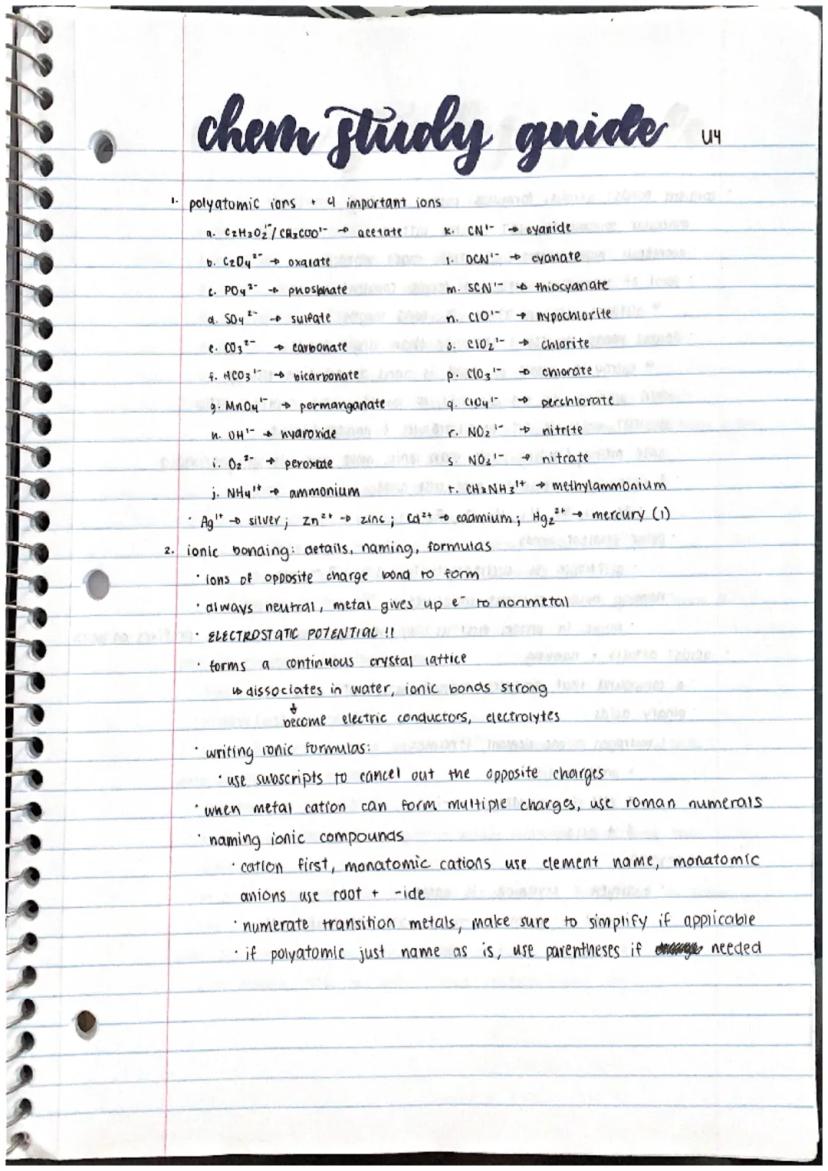
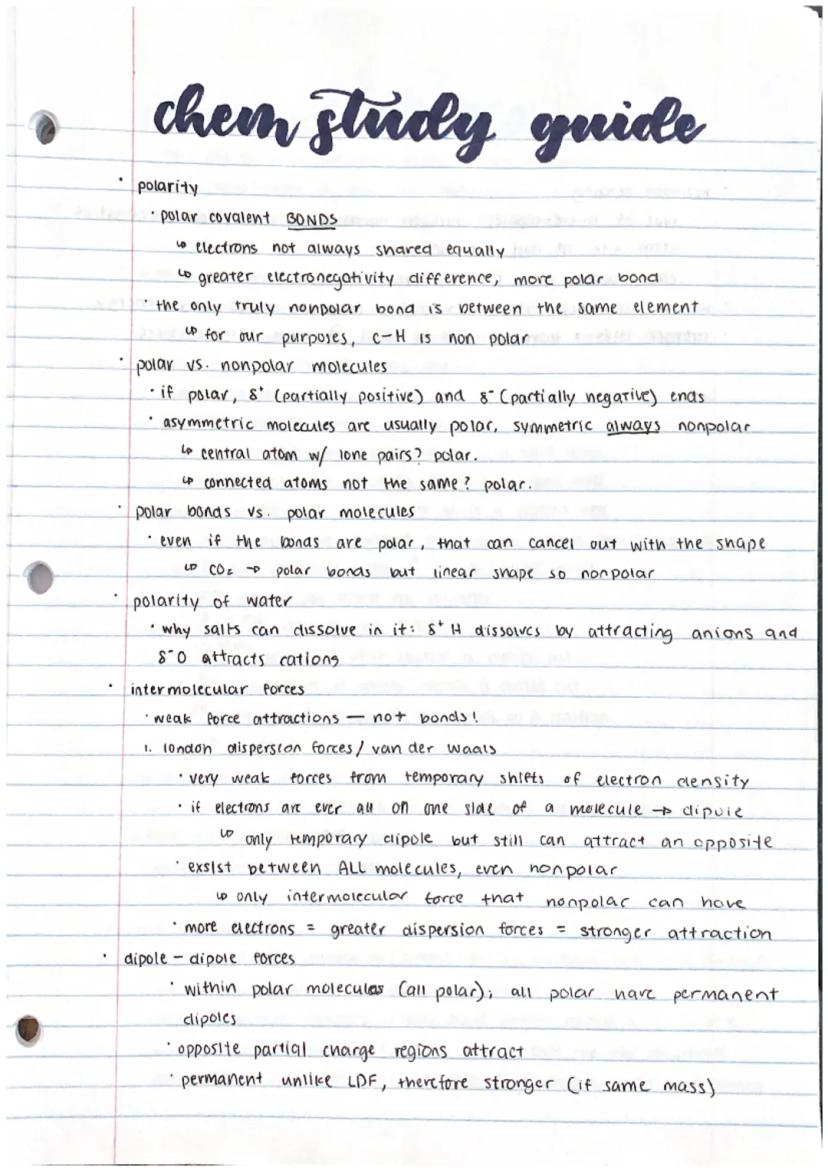
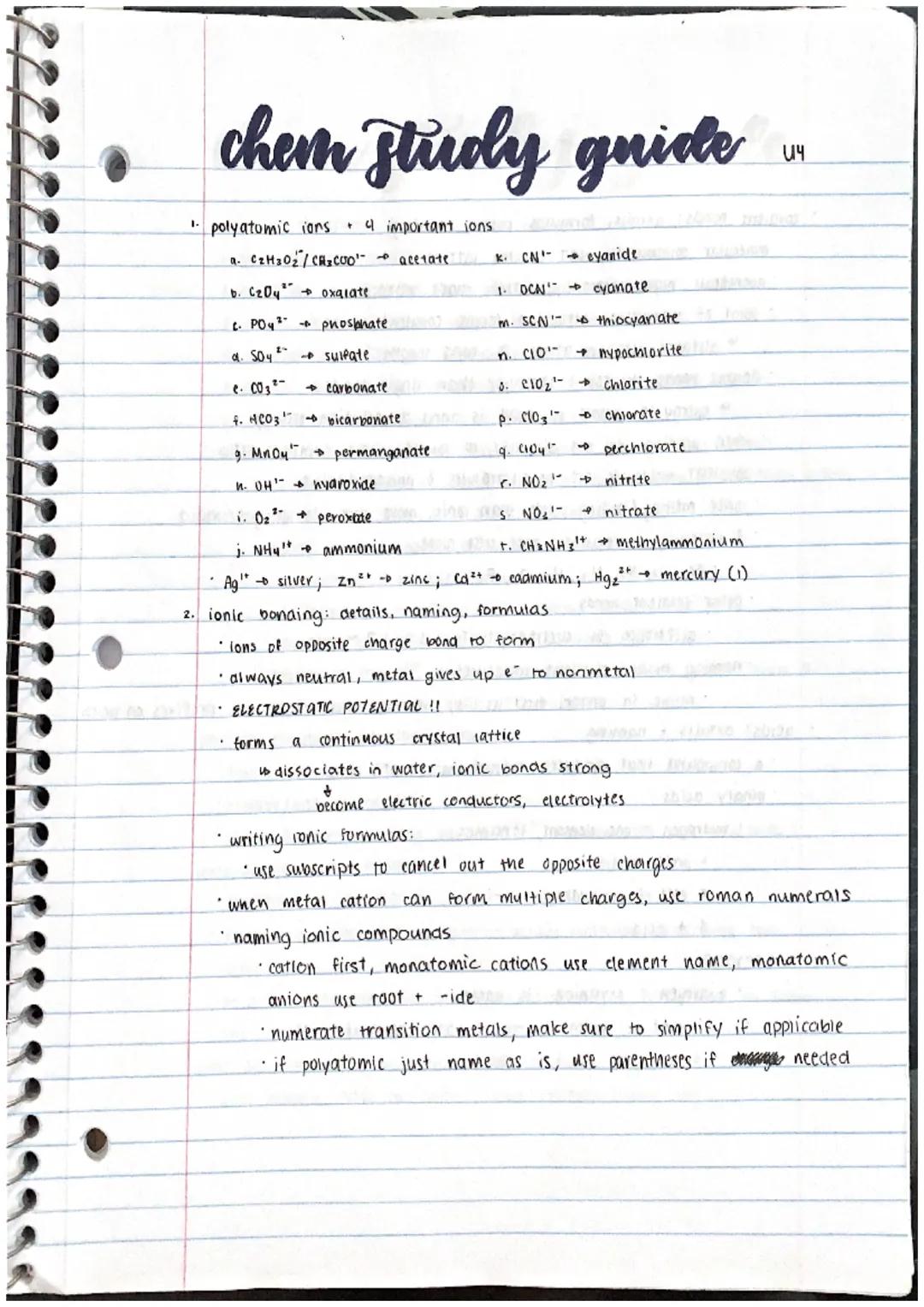
Polyatomic ions are charged groups of atoms that act as a single unit in chemical reactions. Important examples include acetate (C₂H₃O₂⁻), oxalate (C₂O₄²⁻), phosphate (PO₄³⁻), and sulfate (SO₄²⁻). These ions play crucial roles in many chemical processes and compounds.
Ionic bonds form when metals transfer electrons to non-metals, creating oppositely charged ions that attract each other. This creates a crystal lattice structure rather than individual molecules. Ionic compounds are electrically neutral overall, with the positive and negative charges balancing each other perfectly.
When writing ionic formulas, use subscripts to balance the charges. For transition metals that can form multiple charges, use Roman numerals to indicate the charge (like iron(II) or iron(III)). When naming ionic compounds, list the cation first, followed by the anion - monatomic anions typically end with "-ide."
Remember this! Ionic compounds dissolve in water to form electrolytes that conduct electricity, while their strong bonds give them high melting and boiling points.
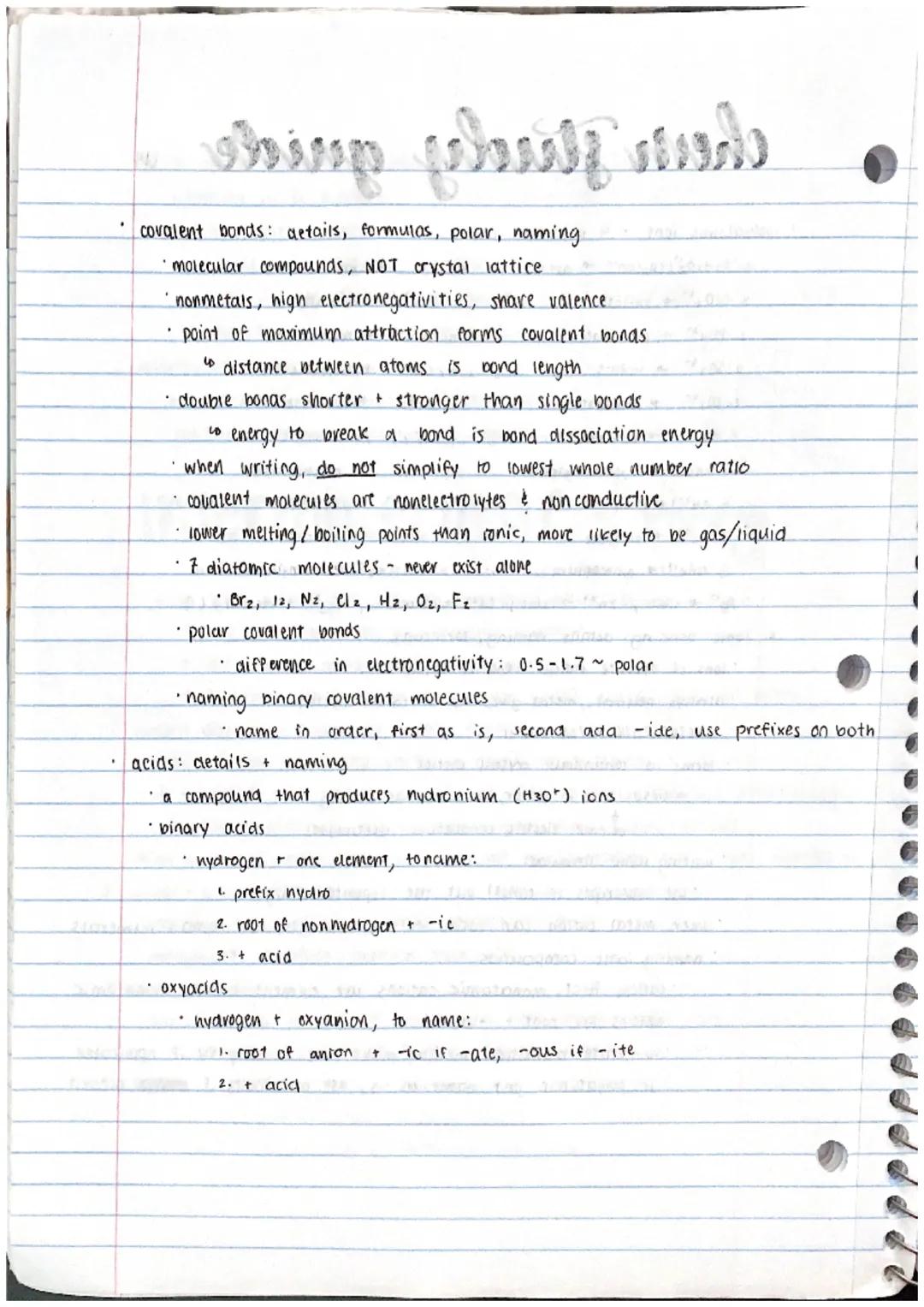
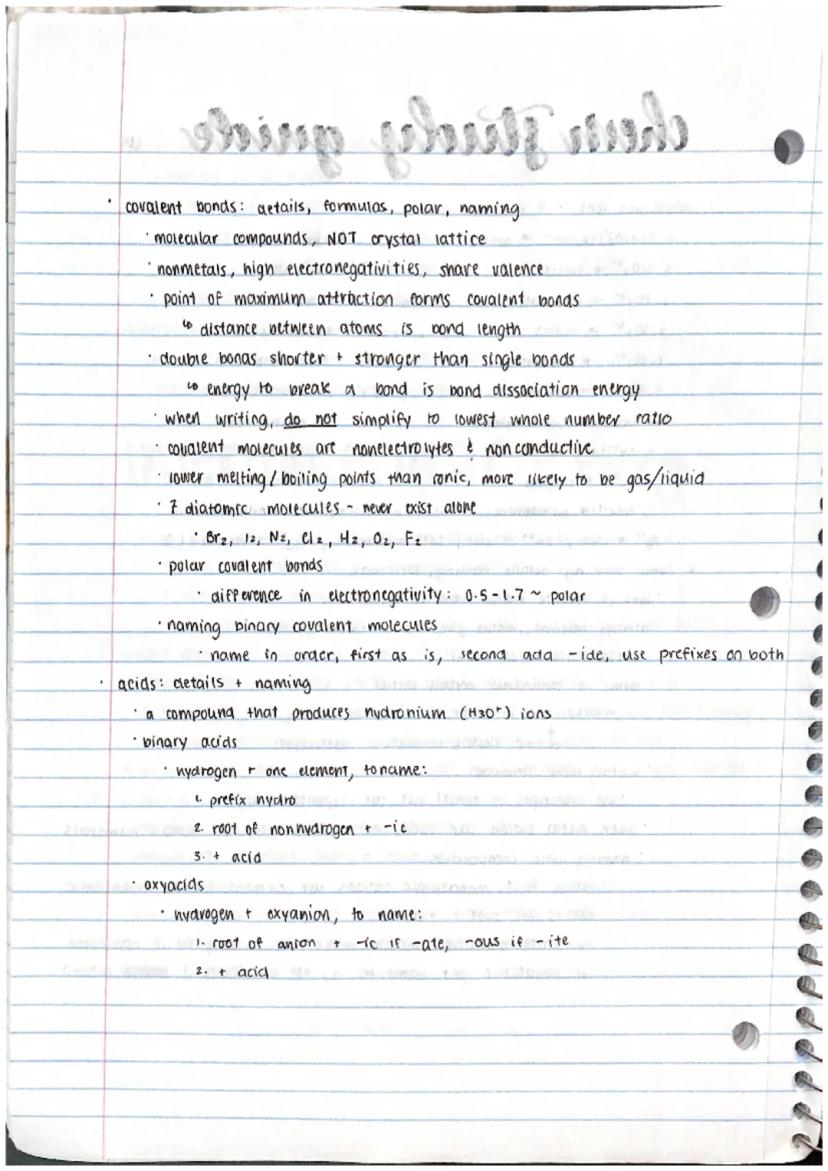
Unlike ionic compounds, covalent bonds form when non-metals share electrons rather than transferring them. This creates molecular compounds with distinct individual molecules instead of a continuous crystal lattice. The point where attraction is strongest between atoms forms the covalent bond.
Covalent bonds vary in strength - double bonds are shorter and stronger than single bonds. The energy required to break a bond is called bond dissociation energy. Remember that when writing formulas for covalent compounds, you don't simplify to the lowest whole number ratio like you do with ionic compounds.
Seven elements exist naturally as diatomic molecules: hydrogen (H₂), nitrogen (N₂), oxygen (O₂), fluorine (F₂), chlorine (Cl₂), bromine (Br₂), and iodine (I₂). These elements never exist as single atoms under normal conditions.
Quick tip! When naming binary covalent compounds, name the first element as is, add the suffix "-ide" to the second element, and use prefixes to indicate the number of each atom.
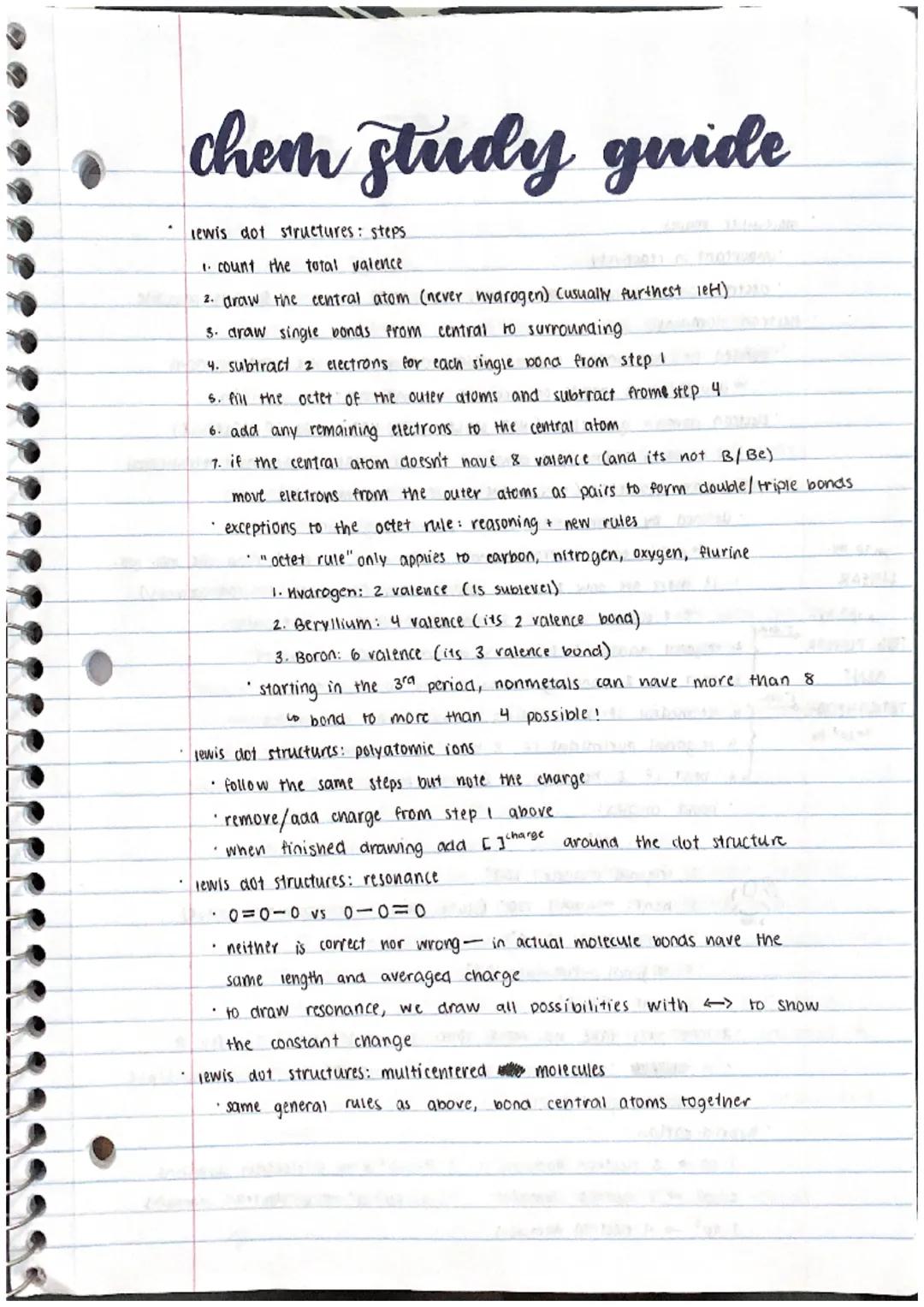
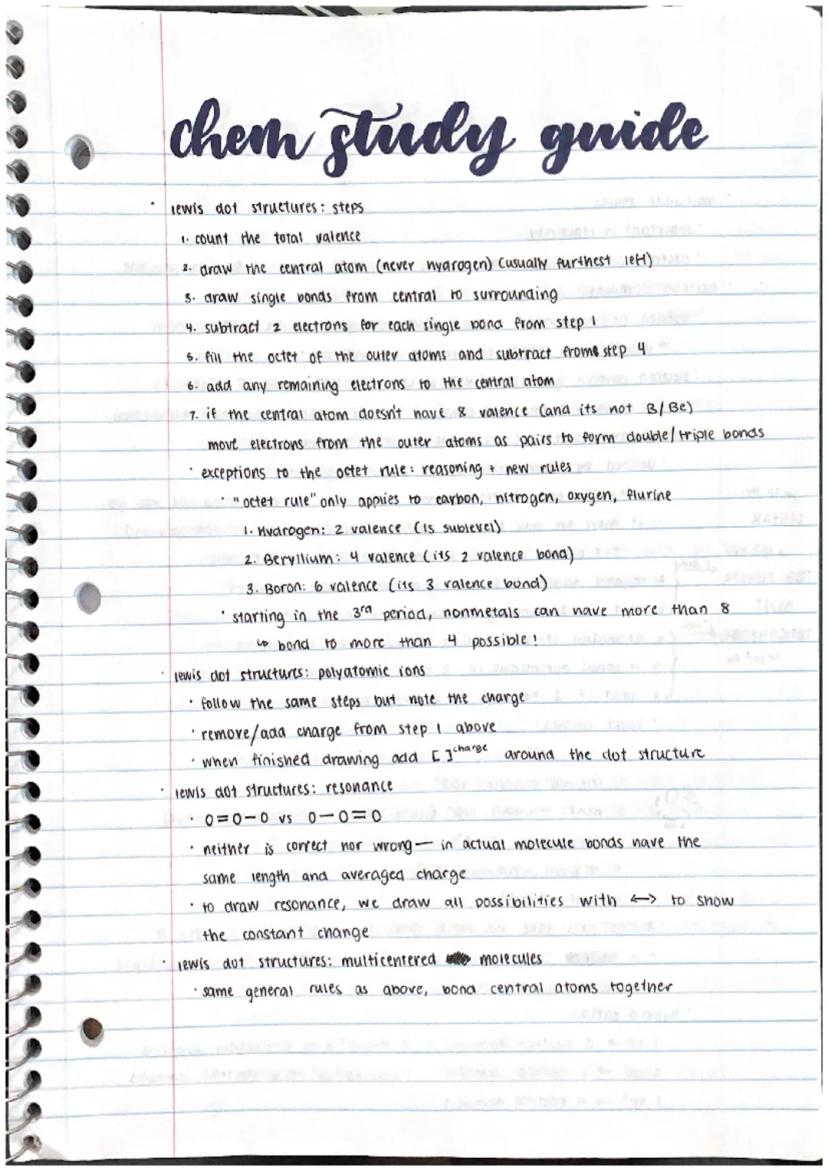
Lewis dot structures show how atoms share electrons in molecules. To draw them, start by counting the total valence electrons and identifying the central atom (usually the least electronegative, never hydrogen). Draw single bonds from the central atom to surrounding atoms, then distribute remaining electrons to satisfy the octet rule.
If the central atom doesn't have eight valence electrons (and it's not boron or beryllium, which are exceptions), move electron pairs from outer atoms to form double or triple bonds. Remember that the octet rule mainly applies to carbon, nitrogen, oxygen, and fluorine - elements in Period 3 and beyond can have expanded octets.
For polyatomic ions, follow the same steps but adjust the total electron count based on the charge (add electrons for negative ions, subtract for positive). When drawing the final structure, place brackets around it with the charge indicated.
Important concept! Some molecules show resonance, where electrons can be drawn in different but equally valid arrangements. We represent this with double-headed arrows between possible structures, but in reality, the bonds have intermediate character between these forms.
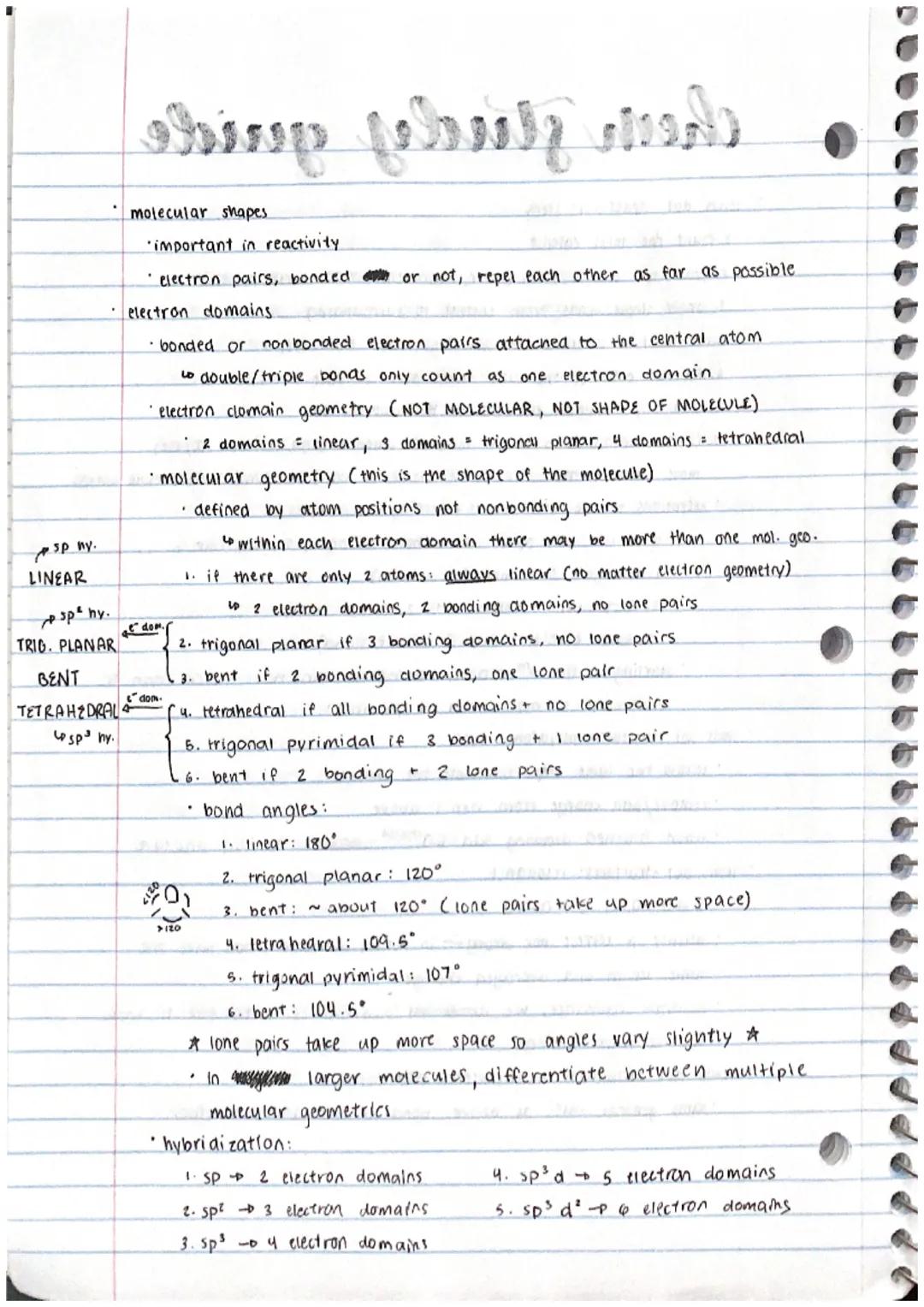
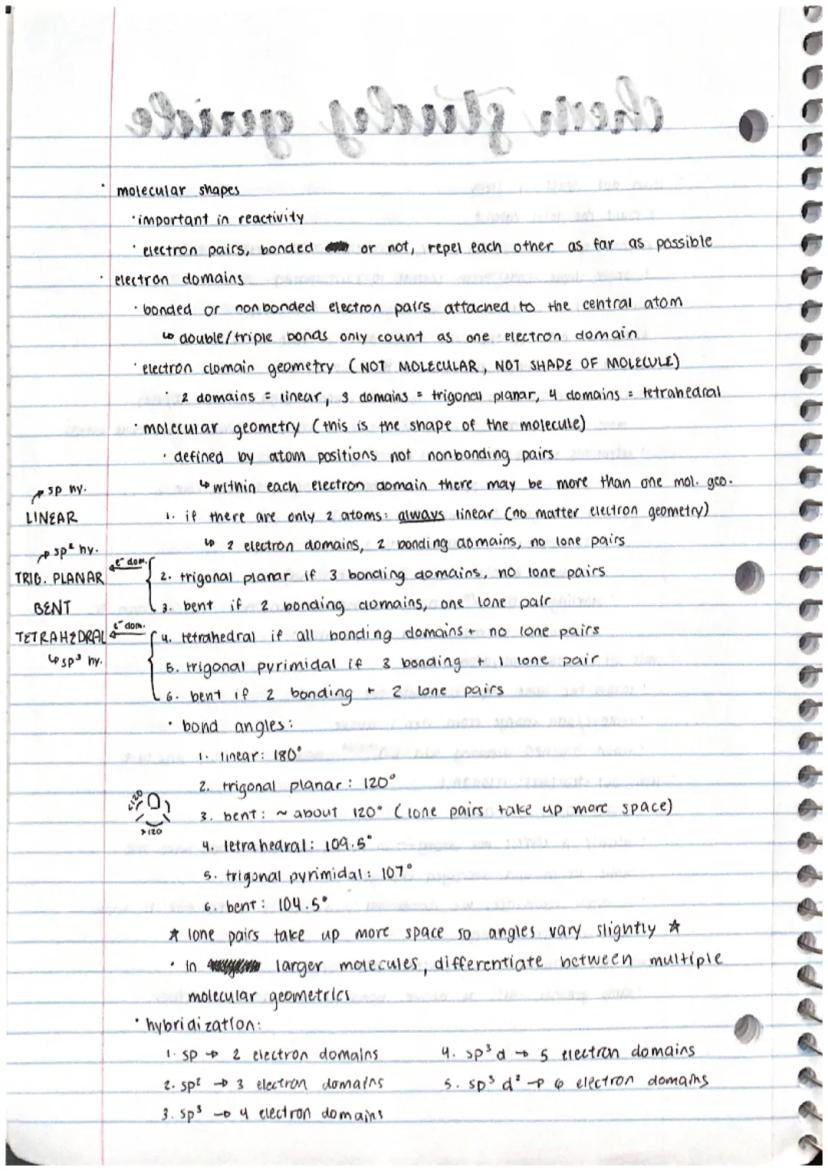
The shape of a molecule dramatically affects its reactivity. According to the VSEPR theory (Valence Shell Electron Pair Repulsion), electron pairs around a central atom repel each other and arrange themselves to minimize repulsion.
Electron domains include both bonded pairs and lone pairs. The number of domains determines the electron domain geometry: 2 domains form linear arrangements, 3 domains create trigonal planar shapes, and 4 domains make tetrahedral arrangements.
However, the actual molecular geometry is determined only by the positions of atoms, not lone pairs. For instance, with 4 electron domains where 1 is a lone pair, the molecular geometry is trigonal pyramidal (like ammonia, NH₃), with bond angles of about 107° rather than the ideal 109.5° of a perfect tetrahedron.
Visualize this! Hybridization explains the observed molecular shapes: sp hybridization creates linear molecules, sp² gives trigonal planar shapes, and sp³ forms tetrahedral arrangements. The type of hybridization corresponds directly to the number of electron domains.
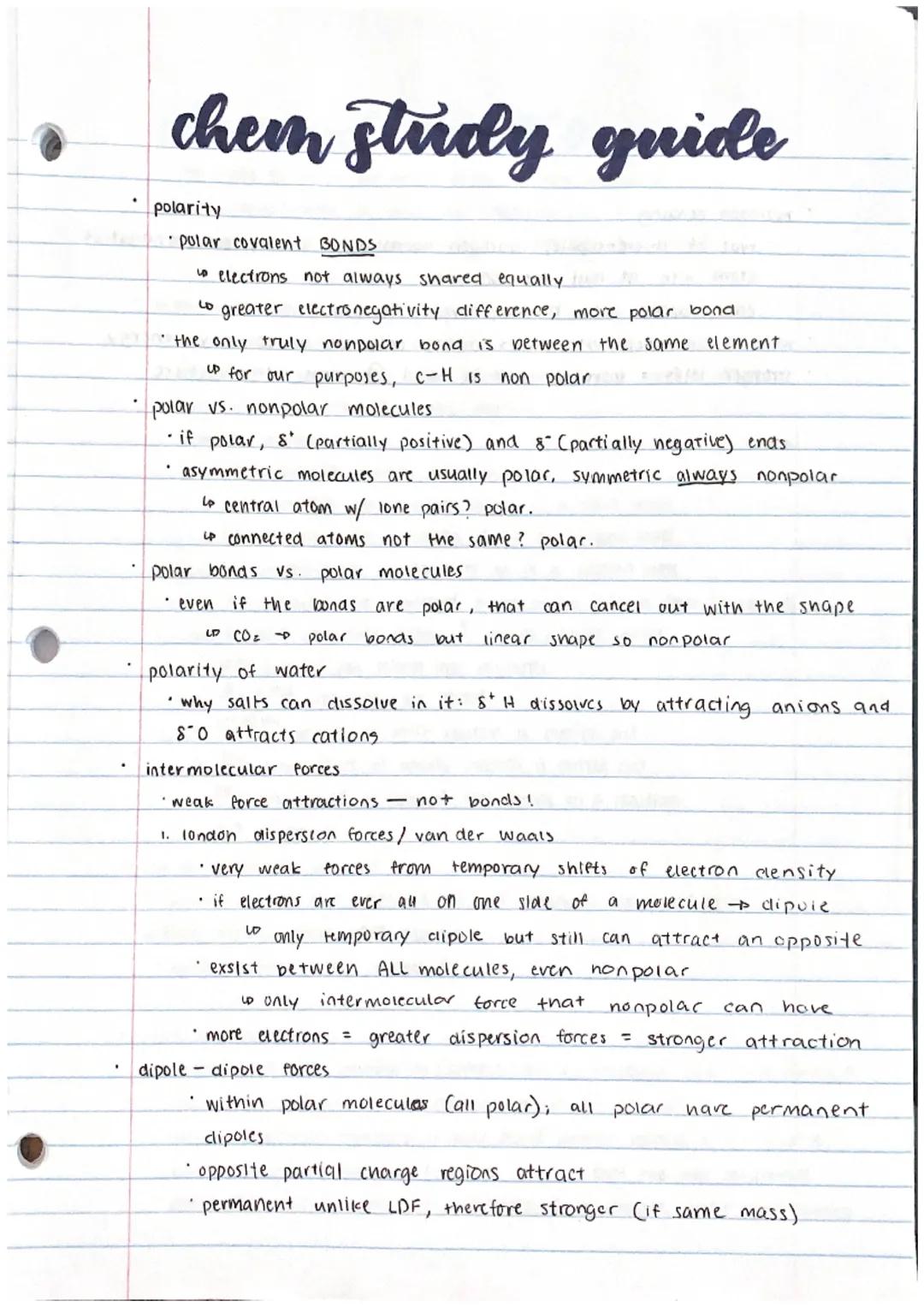
Molecules can be polar or nonpolar depending on both bond polarity and molecular shape. In polar covalent bonds, electrons are shared unequally between atoms with different electronegativities, creating partial positive (δ+) and partial negative (δ-) charges.
However, a molecule with polar bonds can still be nonpolar overall if its shape is symmetrical. For example, carbon dioxide has polar C=O bonds, but its linear shape means these polarities cancel out. Generally, asymmetric molecules with lone pairs on the central atom tend to be polar.
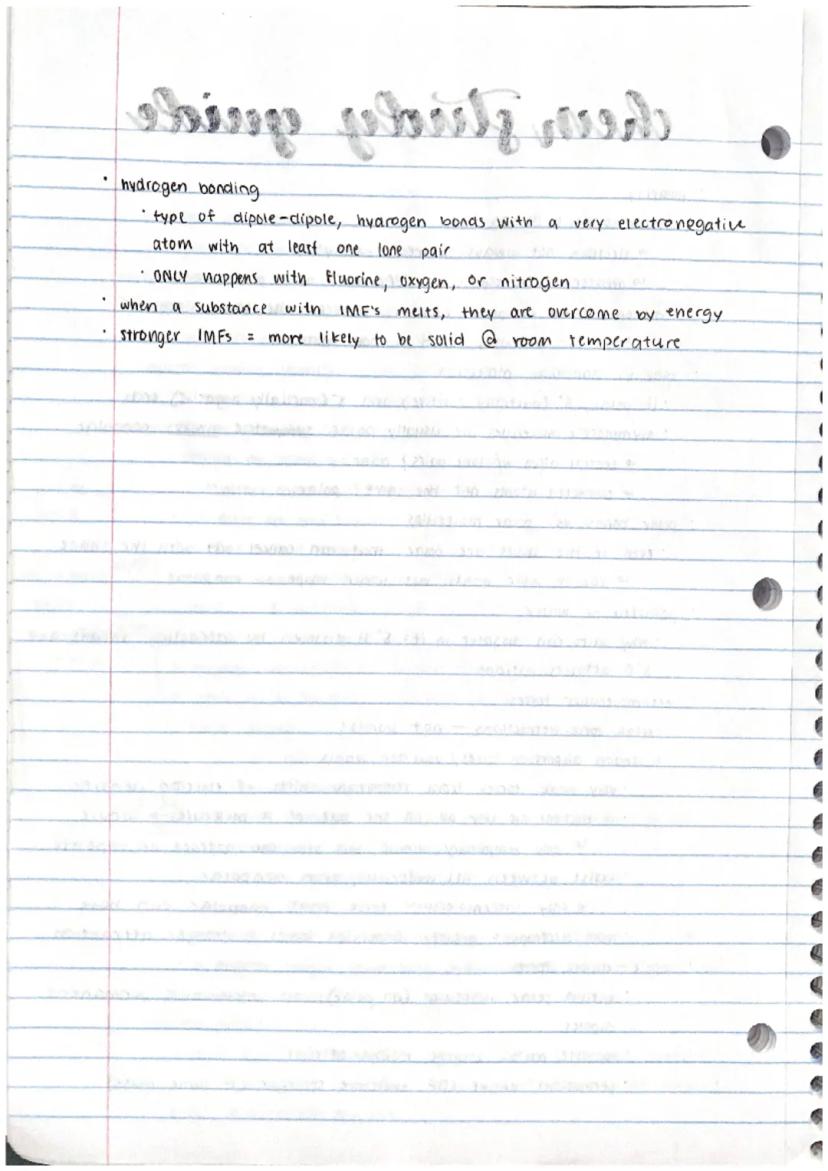
Intermolecular forces are attractions between molecules (not chemical bonds). The weakest are London dispersion forces (temporary attractions due to electron movement), which exist between all molecules but are strongest in larger molecules with more electrons.
Real-world application! Water's polarity explains why it's such a good solvent. Its partially negative oxygen attracts positive ions, while its partially positive hydrogens attract negative ions, allowing ionic compounds to dissolve easily.
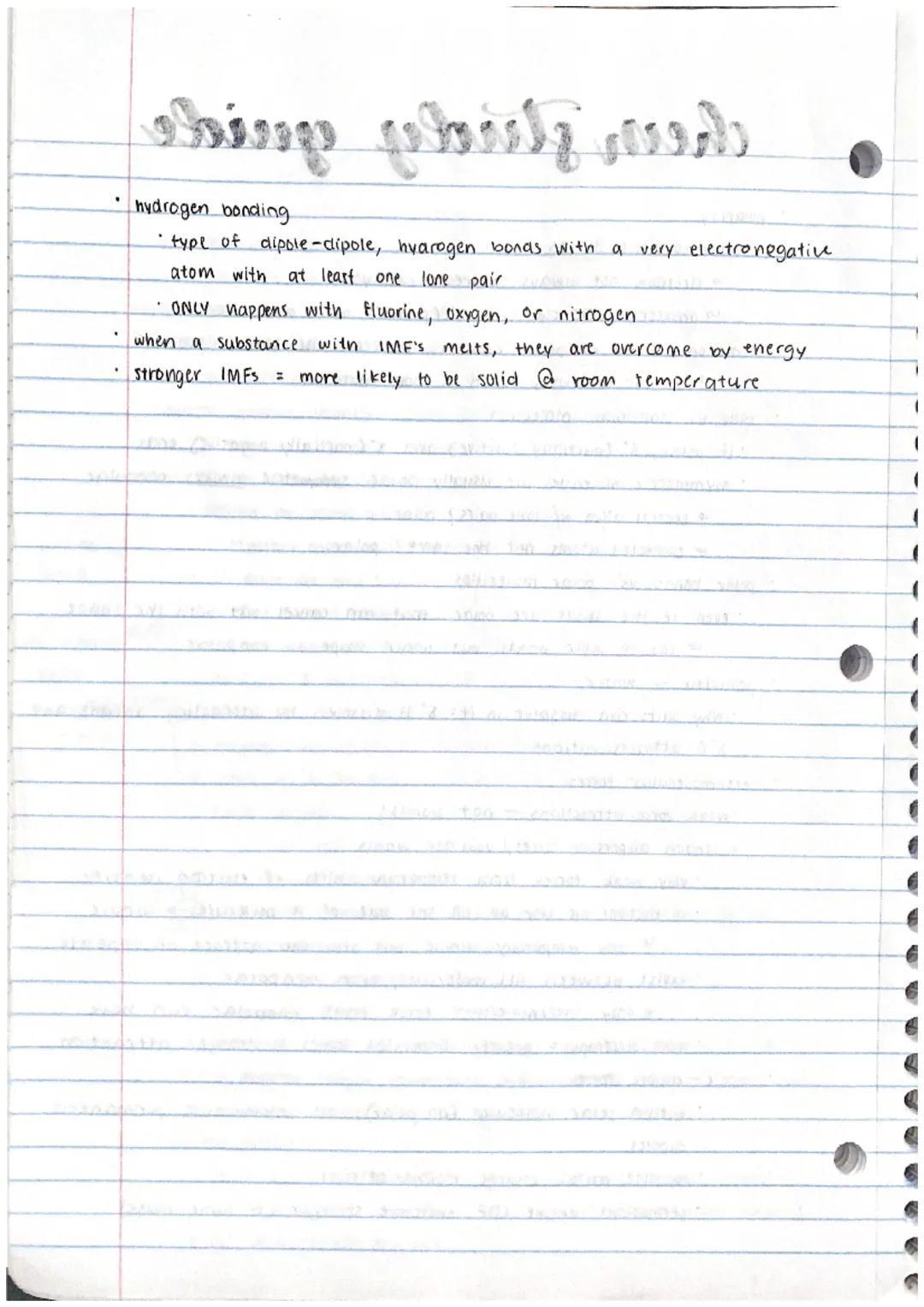
Hydrogen bonding is an exceptionally strong type of dipole-dipole interaction that occurs when hydrogen is bonded to highly electronegative elements with lone pairs - specifically fluorine, oxygen, or nitrogen. This creates a particularly strong attraction between molecules.
These powerful intermolecular forces explain water's unusually high boiling point compared to similarly sized molecules. Hydrogen bonds are also crucial for biological structures like DNA and proteins, where they help maintain specific shapes.
The strength of intermolecular forces directly affects physical properties. Substances with stronger intermolecular forces generally have higher melting and boiling points because more energy is required to overcome these attractions. At room temperature, compounds with very strong intermolecular forces are typically solids, while those with weaker forces exist as liquids or gases.
Connect the dots! When a substance melts or boils, it's not breaking chemical bonds but overcoming intermolecular forces. The stronger these forces, the more heat energy required for phase changes.
Our AI Companion is a student-focused AI tool that offers more than just answers. Built on millions of Knowunity resources, it provides relevant information, personalised study plans, quizzes, and content directly in the chat, adapting to your individual learning journey.
You can download the app from Google Play Store and Apple App Store.
That's right! Enjoy free access to study content, connect with fellow students, and get instant help – all at your fingertips.
Study notes on chemical nomenclature of chemistry
 AP Chemistry
App Store
Google Play
The app is very easy to use and well designed. I have found everything I was looking for so far and have been able to learn a lot from the presentations! I will definitely use the app for a class assignment! And of course it also helps a lot as an inspiration.
Stefan S
iOS user
This app is really great. There are so many study notes and help [...]. My problem subject is French, for example, and the app has so many options for help. Thanks to this app, I have improved my French. I would recommend it to anyone.
Samantha Klich
Android user
Wow, I am really amazed. I just tried the app because I've seen it advertised many times and was absolutely stunned. This app is THE HELP you want for school and above all, it offers so many things, such as workouts and fact sheets, which have been VERY helpful to me personally.
Anna
iOS user
Best app on earth! no words because it’s too good
Thomas R
iOS user
Just amazing. Let's me revise 10x better, this app is a quick 10/10. I highly recommend it to anyone. I can watch and search for notes. I can save them in the subject folder. I can revise it any time when I come back. If you haven't tried this app, you're really missing out.
Basil
Android user
This app has made me feel so much more confident in my exam prep, not only through boosting my own self confidence through the features that allow you to connect with others and feel less alone, but also through the way the app itself is centred around making you feel better. It is easy to navigate, fun to use, and helpful to anyone struggling in absolutely any way.
David K
iOS user
The app's just great! All I have to do is enter the topic in the search bar and I get the response real fast. I don't have to watch 10 YouTube videos to understand something, so I'm saving my time. Highly recommended!
Sudenaz Ocak
Android user
In school I was really bad at maths but thanks to the app, I am doing better now. I am so grateful that you made the app.
Greenlight Bonnie
Android user
very reliable app to help and grow your ideas of Maths, English and other related topics in your works. please use this app if your struggling in areas, this app is key for that. wish I'd of done a review before. and it's also free so don't worry about that.
Rohan U
Android user
I know a lot of apps use fake accounts to boost their reviews but this app deserves it all. Originally I was getting 4 in my English exams and this time I got a grade 7. I didn’t even know about this app three days until the exam and it has helped A LOT. Please actually trust me and use it as I’m sure you too will see developments.
Xander S
iOS user
THE QUIZES AND FLASHCARDS ARE SO USEFUL AND I LOVE Knowunity AI. IT ALSO IS LITREALLY LIKE CHATGPT BUT SMARTER!! HELPED ME WITH MY MASCARA PROBLEMS TOO!! AS WELL AS MY REAL SUBJECTS ! DUHHH 😍😁😲🤑💗✨🎀😮
Elisha
iOS user
This apps acc the goat. I find revision so boring but this app makes it so easy to organize it all and then you can ask the freeeee ai to test yourself so good and you can easily upload your own stuff. highly recommend as someone taking mocks now
Paul T
iOS user
The app is very easy to use and well designed. I have found everything I was looking for so far and have been able to learn a lot from the presentations! I will definitely use the app for a class assignment! And of course it also helps a lot as an inspiration.
Stefan S
iOS user
This app is really great. There are so many study notes and help [...]. My problem subject is French, for example, and the app has so many options for help. Thanks to this app, I have improved my French. I would recommend it to anyone.
Samantha Klich
Android user
Wow, I am really amazed. I just tried the app because I've seen it advertised many times and was absolutely stunned. This app is THE HELP you want for school and above all, it offers so many things, such as workouts and fact sheets, which have been VERY helpful to me personally.
Anna
iOS user
Best app on earth! no words because it’s too good
Thomas R
iOS user
Just amazing. Let's me revise 10x better, this app is a quick 10/10. I highly recommend it to anyone. I can watch and search for notes. I can save them in the subject folder. I can revise it any time when I come back. If you haven't tried this app, you're really missing out.
Basil
Android user
This app has made me feel so much more confident in my exam prep, not only through boosting my own self confidence through the features that allow you to connect with others and feel less alone, but also through the way the app itself is centred around making you feel better. It is easy to navigate, fun to use, and helpful to anyone struggling in absolutely any way.
David K
iOS user
The app's just great! All I have to do is enter the topic in the search bar and I get the response real fast. I don't have to watch 10 YouTube videos to understand something, so I'm saving my time. Highly recommended!
Sudenaz Ocak
Android user
In school I was really bad at maths but thanks to the app, I am doing better now. I am so grateful that you made the app.
Greenlight Bonnie
Android user
very reliable app to help and grow your ideas of Maths, English and other related topics in your works. please use this app if your struggling in areas, this app is key for that. wish I'd of done a review before. and it's also free so don't worry about that.
Rohan U
Android user
I know a lot of apps use fake accounts to boost their reviews but this app deserves it all. Originally I was getting 4 in my English exams and this time I got a grade 7. I didn’t even know about this app three days until the exam and it has helped A LOT. Please actually trust me and use it as I’m sure you too will see developments.
Xander S
iOS user
THE QUIZES AND FLASHCARDS ARE SO USEFUL AND I LOVE Knowunity AI. IT ALSO IS LITREALLY LIKE CHATGPT BUT SMARTER!! HELPED ME WITH MY MASCARA PROBLEMS TOO!! AS WELL AS MY REAL SUBJECTS ! DUHHH 😍😁😲🤑💗✨🎀😮
Elisha
iOS user
This apps acc the goat. I find revision so boring but this app makes it so easy to organize it all and then you can ask the freeeee ai to test yourself so good and you can easily upload your own stuff. highly recommend as someone taking mocks now
Paul T
iOS user
Chemistry is all about understanding how atoms connect and interact with each other. This guide covers essential chemical bonding concepts including ionic and covalent bonds, molecular structures, and the forces that hold molecules together. These fundamental principles explain how and... Show more
Access to all documents
Improve your grades
Join milions of students
Polyatomic ions are charged groups of atoms that act as a single unit in chemical reactions. Important examples include acetate (C₂H₃O₂⁻), oxalate (C₂O₄²⁻), phosphate (PO₄³⁻), and sulfate (SO₄²⁻). These ions play crucial roles in many chemical processes and compounds.
Ionic bonds form when metals transfer electrons to non-metals, creating oppositely charged ions that attract each other. This creates a crystal lattice structure rather than individual molecules. Ionic compounds are electrically neutral overall, with the positive and negative charges balancing each other perfectly.
When writing ionic formulas, use subscripts to balance the charges. For transition metals that can form multiple charges, use Roman numerals to indicate the charge (like iron(II) or iron(III)). When naming ionic compounds, list the cation first, followed by the anion - monatomic anions typically end with "-ide."
Remember this! Ionic compounds dissolve in water to form electrolytes that conduct electricity, while their strong bonds give them high melting and boiling points.
Access to all documents
Improve your grades
Join milions of students
Unlike ionic compounds, covalent bonds form when non-metals share electrons rather than transferring them. This creates molecular compounds with distinct individual molecules instead of a continuous crystal lattice. The point where attraction is strongest between atoms forms the covalent bond.
Covalent bonds vary in strength - double bonds are shorter and stronger than single bonds. The energy required to break a bond is called bond dissociation energy. Remember that when writing formulas for covalent compounds, you don't simplify to the lowest whole number ratio like you do with ionic compounds.
Seven elements exist naturally as diatomic molecules: hydrogen (H₂), nitrogen (N₂), oxygen (O₂), fluorine (F₂), chlorine (Cl₂), bromine (Br₂), and iodine (I₂). These elements never exist as single atoms under normal conditions.
Quick tip! When naming binary covalent compounds, name the first element as is, add the suffix "-ide" to the second element, and use prefixes to indicate the number of each atom.
Access to all documents
Improve your grades
Join milions of students
Lewis dot structures show how atoms share electrons in molecules. To draw them, start by counting the total valence electrons and identifying the central atom (usually the least electronegative, never hydrogen). Draw single bonds from the central atom to surrounding atoms, then distribute remaining electrons to satisfy the octet rule.
If the central atom doesn't have eight valence electrons (and it's not boron or beryllium, which are exceptions), move electron pairs from outer atoms to form double or triple bonds. Remember that the octet rule mainly applies to carbon, nitrogen, oxygen, and fluorine - elements in Period 3 and beyond can have expanded octets.
For polyatomic ions, follow the same steps but adjust the total electron count based on the charge (add electrons for negative ions, subtract for positive). When drawing the final structure, place brackets around it with the charge indicated.
Important concept! Some molecules show resonance, where electrons can be drawn in different but equally valid arrangements. We represent this with double-headed arrows between possible structures, but in reality, the bonds have intermediate character between these forms.
Access to all documents
Improve your grades
Join milions of students
The shape of a molecule dramatically affects its reactivity. According to the VSEPR theory (Valence Shell Electron Pair Repulsion), electron pairs around a central atom repel each other and arrange themselves to minimize repulsion.
Electron domains include both bonded pairs and lone pairs. The number of domains determines the electron domain geometry: 2 domains form linear arrangements, 3 domains create trigonal planar shapes, and 4 domains make tetrahedral arrangements.
However, the actual molecular geometry is determined only by the positions of atoms, not lone pairs. For instance, with 4 electron domains where 1 is a lone pair, the molecular geometry is trigonal pyramidal (like ammonia, NH₃), with bond angles of about 107° rather than the ideal 109.5° of a perfect tetrahedron.
Visualize this! Hybridization explains the observed molecular shapes: sp hybridization creates linear molecules, sp² gives trigonal planar shapes, and sp³ forms tetrahedral arrangements. The type of hybridization corresponds directly to the number of electron domains.
Access to all documents
Improve your grades
Join milions of students
Molecules can be polar or nonpolar depending on both bond polarity and molecular shape. In polar covalent bonds, electrons are shared unequally between atoms with different electronegativities, creating partial positive (δ+) and partial negative (δ-) charges.
However, a molecule with polar bonds can still be nonpolar overall if its shape is symmetrical. For example, carbon dioxide has polar C=O bonds, but its linear shape means these polarities cancel out. Generally, asymmetric molecules with lone pairs on the central atom tend to be polar.
Intermolecular forces are attractions between molecules (not chemical bonds). The weakest are London dispersion forces (temporary attractions due to electron movement), which exist between all molecules but are strongest in larger molecules with more electrons.
Real-world application! Water's polarity explains why it's such a good solvent. Its partially negative oxygen attracts positive ions, while its partially positive hydrogens attract negative ions, allowing ionic compounds to dissolve easily.
Access to all documents
Improve your grades
Join milions of students
Hydrogen bonding is an exceptionally strong type of dipole-dipole interaction that occurs when hydrogen is bonded to highly electronegative elements with lone pairs - specifically fluorine, oxygen, or nitrogen. This creates a particularly strong attraction between molecules.
These powerful intermolecular forces explain water's unusually high boiling point compared to similarly sized molecules. Hydrogen bonds are also crucial for biological structures like DNA and proteins, where they help maintain specific shapes.
The strength of intermolecular forces directly affects physical properties. Substances with stronger intermolecular forces generally have higher melting and boiling points because more energy is required to overcome these attractions. At room temperature, compounds with very strong intermolecular forces are typically solids, while those with weaker forces exist as liquids or gases.
Connect the dots! When a substance melts or boils, it's not breaking chemical bonds but overcoming intermolecular forces. The stronger these forces, the more heat energy required for phase changes.
Our AI Companion is a student-focused AI tool that offers more than just answers. Built on millions of Knowunity resources, it provides relevant information, personalised study plans, quizzes, and content directly in the chat, adapting to your individual learning journey.
You can download the app from Google Play Store and Apple App Store.
That's right! Enjoy free access to study content, connect with fellow students, and get instant help – all at your fingertips.
3
Smart Tools NEW
Transform this note into: ✓ 50+ Practice Questions ✓ Interactive Flashcards ✓ Full Mock Exam ✓ Essay Outlines
single/double/triple bond, compounds, ionic/covalent/metallic properties, lewis structure, polarity, shape, polar molecule v polar bond, coordinate covalent bonding
ChemistryThis is a reviewer on Benzene & Aromatic Compounds including the Typical uses of benzene and Aromatic compounds and Rules in Naming
ChemistryHandwritten notes based on the information in Unit 9: Covalent Bonding from CK-12 Chemistry for High School
ChemistryIntroduces organic chemistry and explains the functional groups
ChemistryOrganic Chemistry 2310
ChemistryAlkanes-Definition and Explanation. Types of Alkanes and General Formula of Alkanes
AP ChemistryStudy notes on chemical nomenclature of chemistry
AP ChemistryApp Store
Google Play
The app is very easy to use and well designed. I have found everything I was looking for so far and have been able to learn a lot from the presentations! I will definitely use the app for a class assignment! And of course it also helps a lot as an inspiration.
Stefan S
iOS user
This app is really great. There are so many study notes and help [...]. My problem subject is French, for example, and the app has so many options for help. Thanks to this app, I have improved my French. I would recommend it to anyone.
Samantha Klich
Android user
Wow, I am really amazed. I just tried the app because I've seen it advertised many times and was absolutely stunned. This app is THE HELP you want for school and above all, it offers so many things, such as workouts and fact sheets, which have been VERY helpful to me personally.
Anna
iOS user
Best app on earth! no words because it’s too good
Thomas R
iOS user
Just amazing. Let's me revise 10x better, this app is a quick 10/10. I highly recommend it to anyone. I can watch and search for notes. I can save them in the subject folder. I can revise it any time when I come back. If you haven't tried this app, you're really missing out.
Basil
Android user
This app has made me feel so much more confident in my exam prep, not only through boosting my own self confidence through the features that allow you to connect with others and feel less alone, but also through the way the app itself is centred around making you feel better. It is easy to navigate, fun to use, and helpful to anyone struggling in absolutely any way.
David K
iOS user
The app's just great! All I have to do is enter the topic in the search bar and I get the response real fast. I don't have to watch 10 YouTube videos to understand something, so I'm saving my time. Highly recommended!
Sudenaz Ocak
Android user
In school I was really bad at maths but thanks to the app, I am doing better now. I am so grateful that you made the app.
Greenlight Bonnie
Android user
very reliable app to help and grow your ideas of Maths, English and other related topics in your works. please use this app if your struggling in areas, this app is key for that. wish I'd of done a review before. and it's also free so don't worry about that.
Rohan U
Android user
I know a lot of apps use fake accounts to boost their reviews but this app deserves it all. Originally I was getting 4 in my English exams and this time I got a grade 7. I didn’t even know about this app three days until the exam and it has helped A LOT. Please actually trust me and use it as I’m sure you too will see developments.
Xander S
iOS user
THE QUIZES AND FLASHCARDS ARE SO USEFUL AND I LOVE Knowunity AI. IT ALSO IS LITREALLY LIKE CHATGPT BUT SMARTER!! HELPED ME WITH MY MASCARA PROBLEMS TOO!! AS WELL AS MY REAL SUBJECTS ! DUHHH 😍😁😲🤑💗✨🎀😮
Elisha
iOS user
This apps acc the goat. I find revision so boring but this app makes it so easy to organize it all and then you can ask the freeeee ai to test yourself so good and you can easily upload your own stuff. highly recommend as someone taking mocks now
Paul T
iOS user
The app is very easy to use and well designed. I have found everything I was looking for so far and have been able to learn a lot from the presentations! I will definitely use the app for a class assignment! And of course it also helps a lot as an inspiration.
Stefan S
iOS user
This app is really great. There are so many study notes and help [...]. My problem subject is French, for example, and the app has so many options for help. Thanks to this app, I have improved my French. I would recommend it to anyone.
Samantha Klich
Android user
Wow, I am really amazed. I just tried the app because I've seen it advertised many times and was absolutely stunned. This app is THE HELP you want for school and above all, it offers so many things, such as workouts and fact sheets, which have been VERY helpful to me personally.
Anna
iOS user
Best app on earth! no words because it’s too good
Thomas R
iOS user
Just amazing. Let's me revise 10x better, this app is a quick 10/10. I highly recommend it to anyone. I can watch and search for notes. I can save them in the subject folder. I can revise it any time when I come back. If you haven't tried this app, you're really missing out.
Basil
Android user
This app has made me feel so much more confident in my exam prep, not only through boosting my own self confidence through the features that allow you to connect with others and feel less alone, but also through the way the app itself is centred around making you feel better. It is easy to navigate, fun to use, and helpful to anyone struggling in absolutely any way.
David K
iOS user
The app's just great! All I have to do is enter the topic in the search bar and I get the response real fast. I don't have to watch 10 YouTube videos to understand something, so I'm saving my time. Highly recommended!
Sudenaz Ocak
Android user
In school I was really bad at maths but thanks to the app, I am doing better now. I am so grateful that you made the app.
Greenlight Bonnie
Android user
very reliable app to help and grow your ideas of Maths, English and other related topics in your works. please use this app if your struggling in areas, this app is key for that. wish I'd of done a review before. and it's also free so don't worry about that.
Rohan U
Android user
I know a lot of apps use fake accounts to boost their reviews but this app deserves it all. Originally I was getting 4 in my English exams and this time I got a grade 7. I didn’t even know about this app three days until the exam and it has helped A LOT. Please actually trust me and use it as I’m sure you too will see developments.
Xander S
iOS user
THE QUIZES AND FLASHCARDS ARE SO USEFUL AND I LOVE Knowunity AI. IT ALSO IS LITREALLY LIKE CHATGPT BUT SMARTER!! HELPED ME WITH MY MASCARA PROBLEMS TOO!! AS WELL AS MY REAL SUBJECTS ! DUHHH 😍😁😲🤑💗✨🎀😮
Elisha
iOS user
This apps acc the goat. I find revision so boring but this app makes it so easy to organize it all and then you can ask the freeeee ai to test yourself so good and you can easily upload your own stuff. highly recommend as someone taking mocks now
Paul T
iOS user