
Mathematical Induction and Proof Methods- A comprehensive guide covering... Show more
 Further Maths42 views·Updated May 28, 2026·8 pages
Easy Steps to Learn Proof by Induction for Natural Numbers
A
Ann@ann_jznv
1 / 8
1
of 8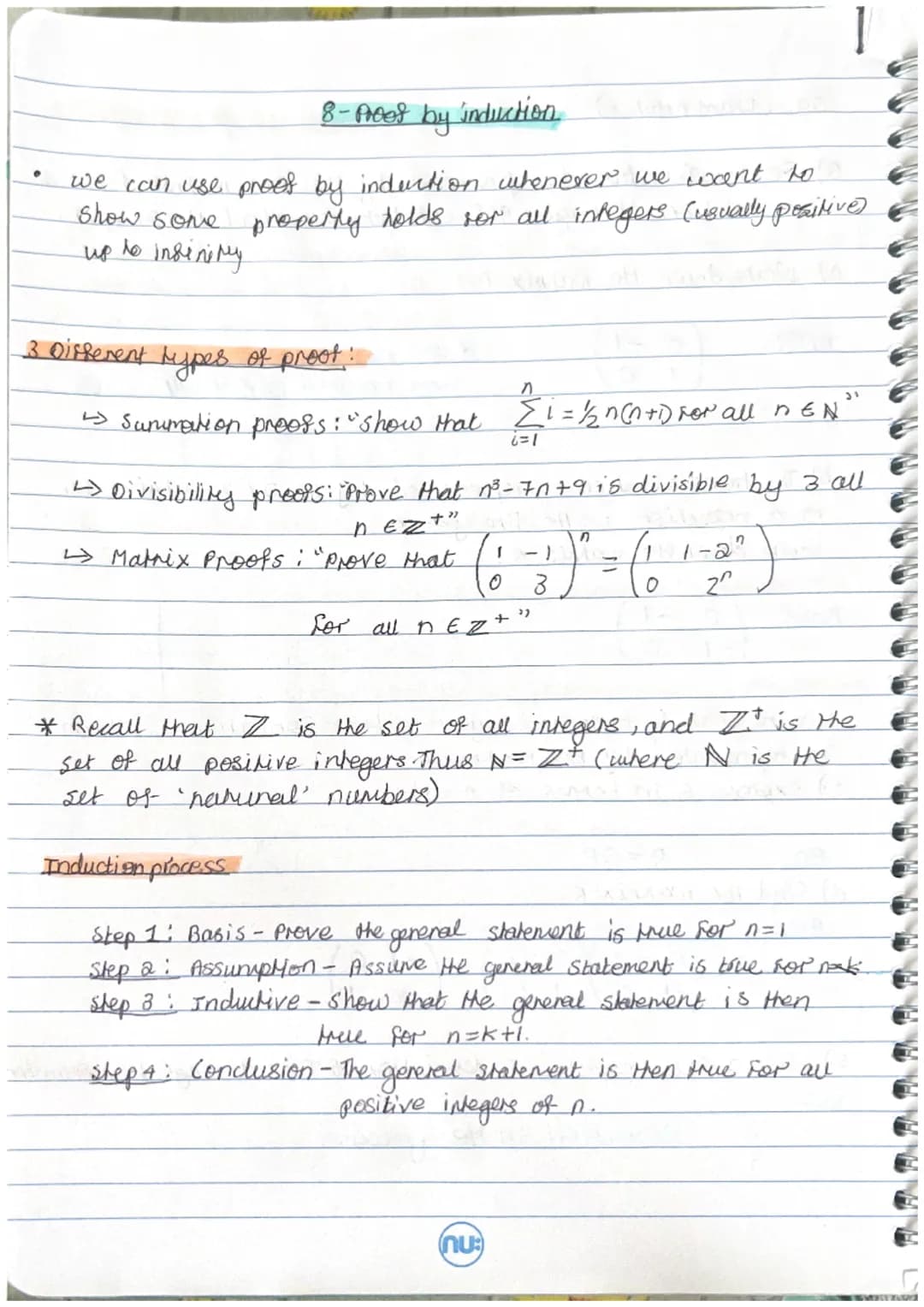
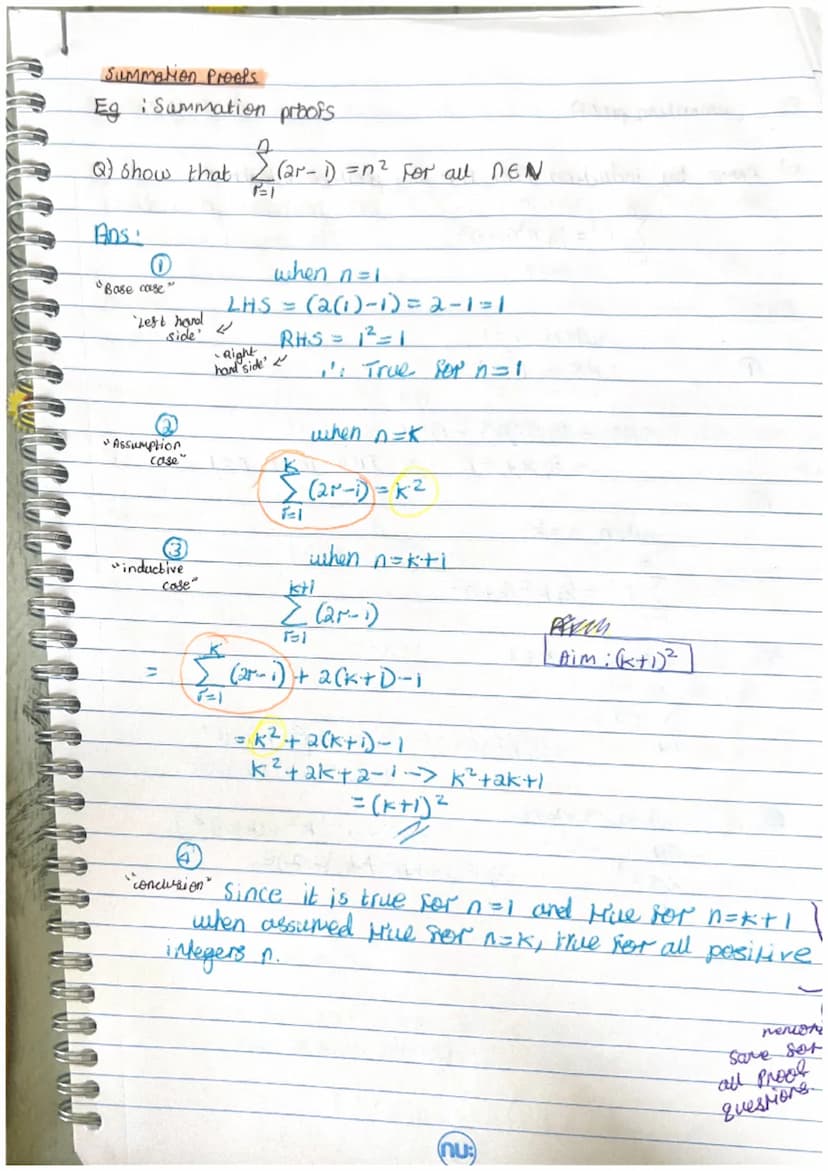
Page 2: Summation Proofs
This page demonstrates a detailed example of summation proofs using induction to prove that the sum of equals n² for all positive integers.
Example: The proof shows how to verify that Σ = n² from r=1 to n
Highlight: The solution follows the standard induction steps:
- Base case verification for n=1
- Assumption for n=k
- Inductive step proving n=k+1
- Final conclusion
Definition: The left-hand side (LHS) represents the summation while the right-hand side (RHS) represents the simplified form.
2
of 8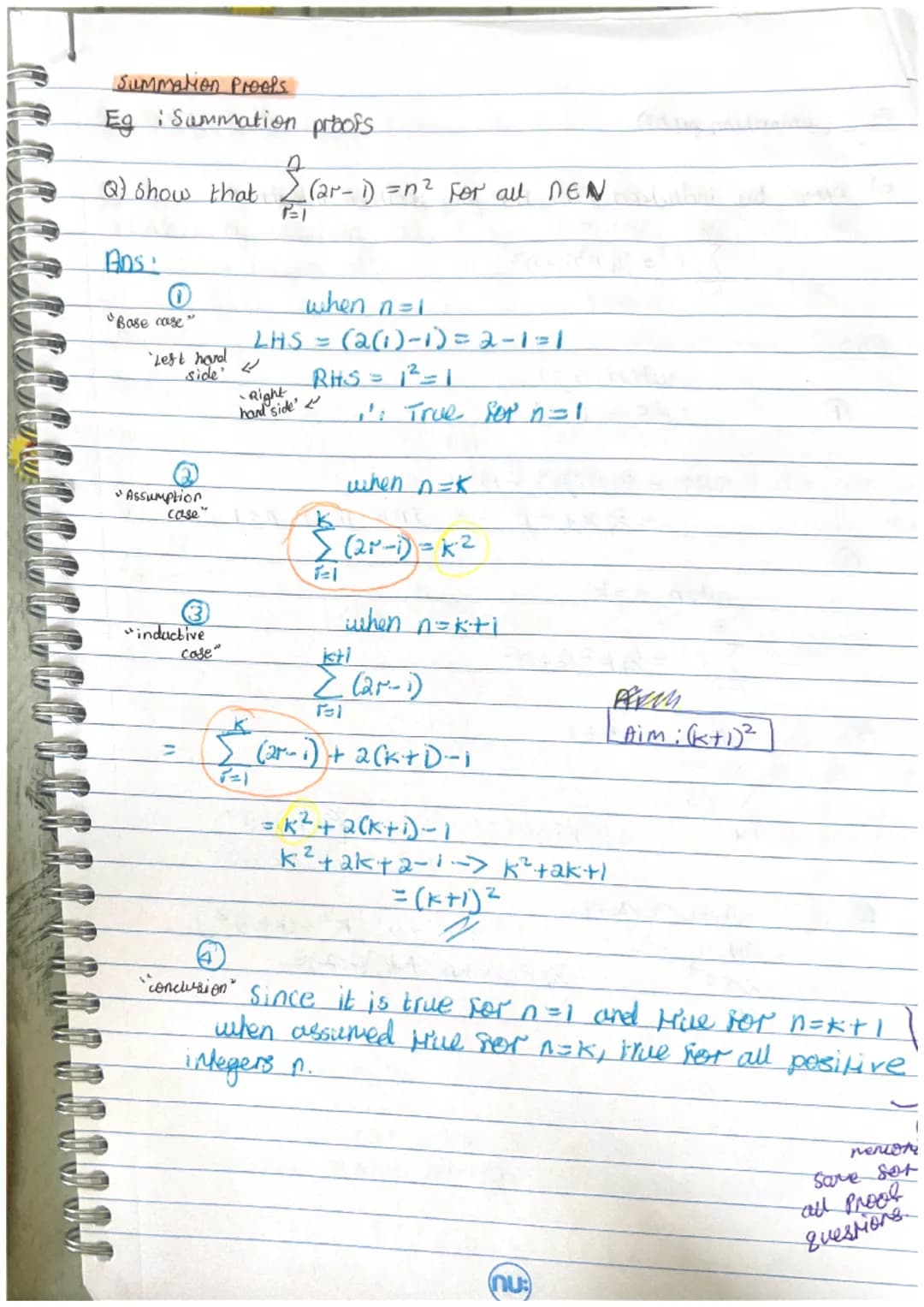
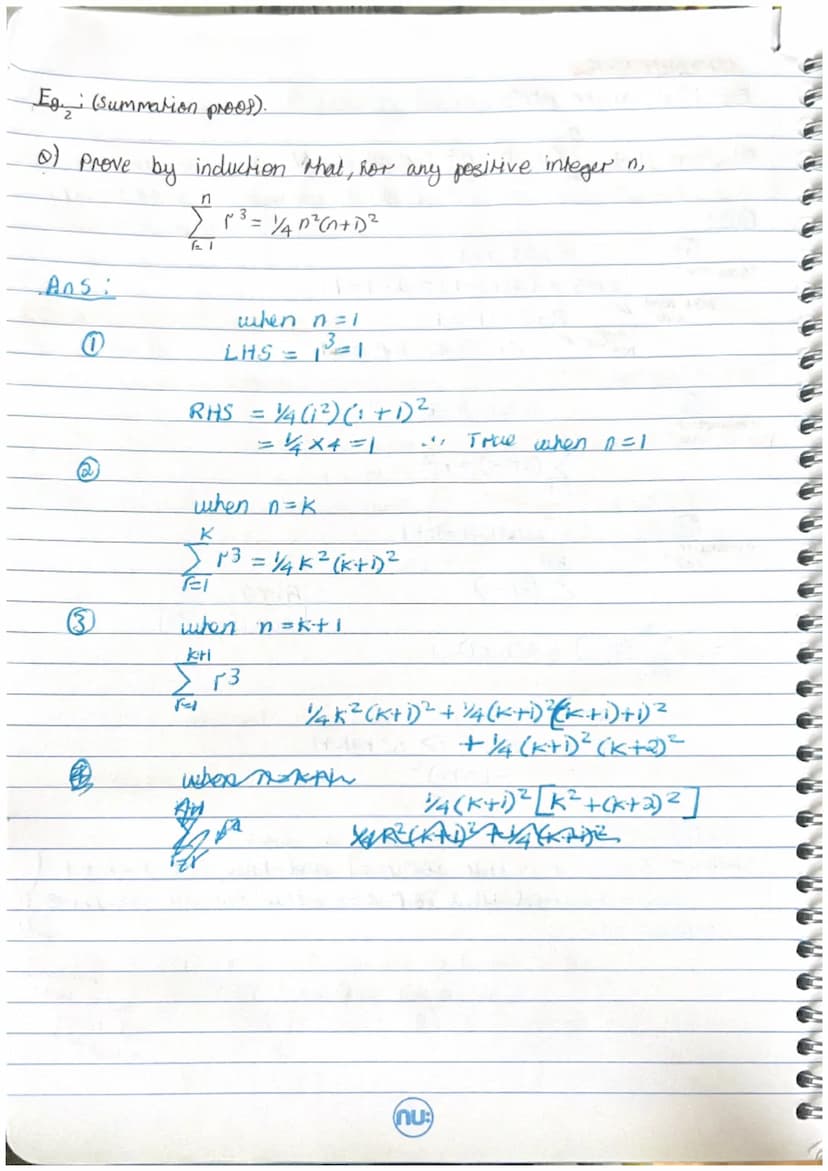
Page 3: Advanced Summation Proofs
This page explores a more complex summation proof involving cubic terms and demonstrates how to prove that the sum of cubes equals a quarter of n²².
Example: Proves that Σr³ = ¼n²² for r=1 to n
Highlight: The solution requires careful algebraic manipulation and understanding of polynomial expressions.
3
of 8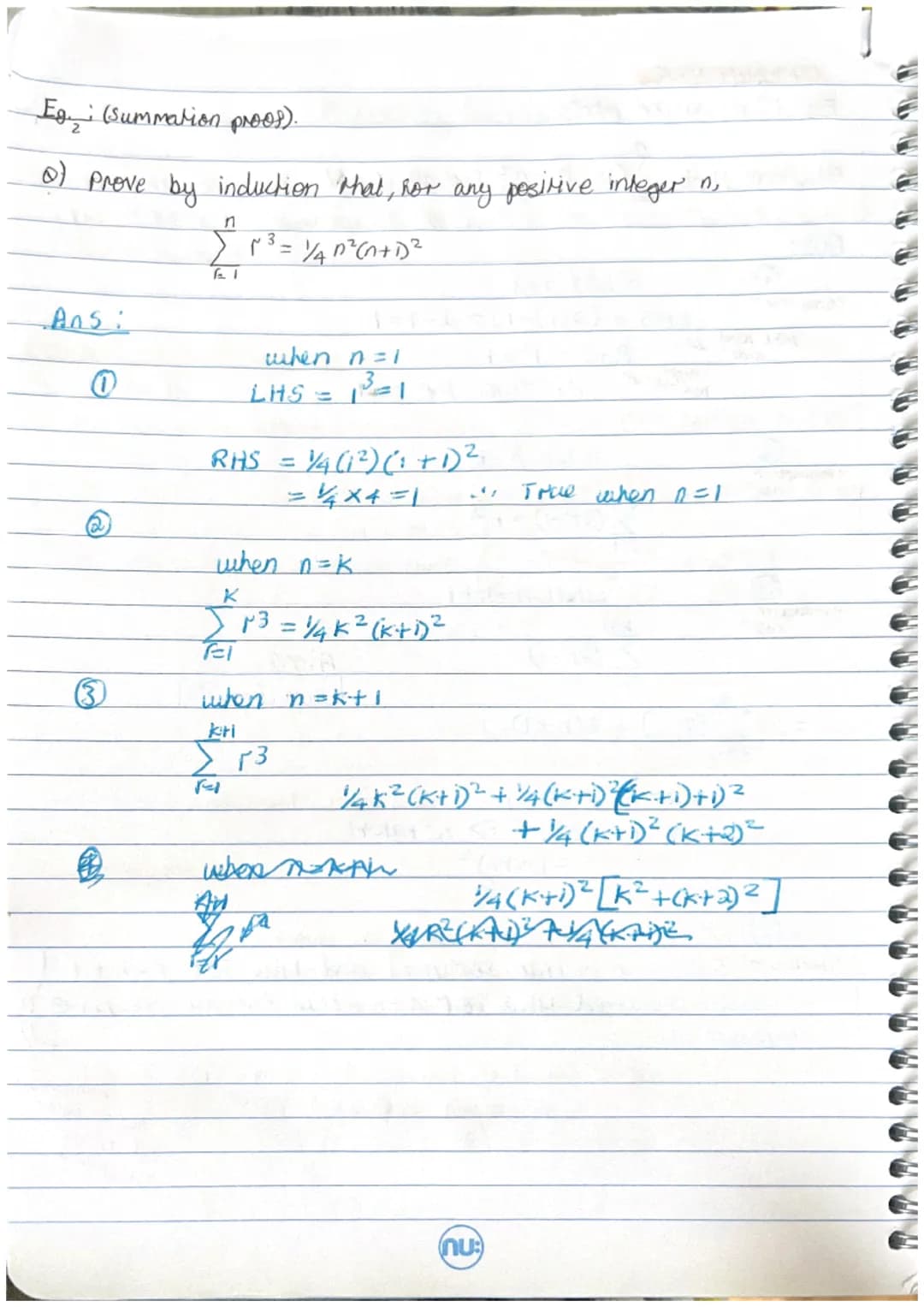
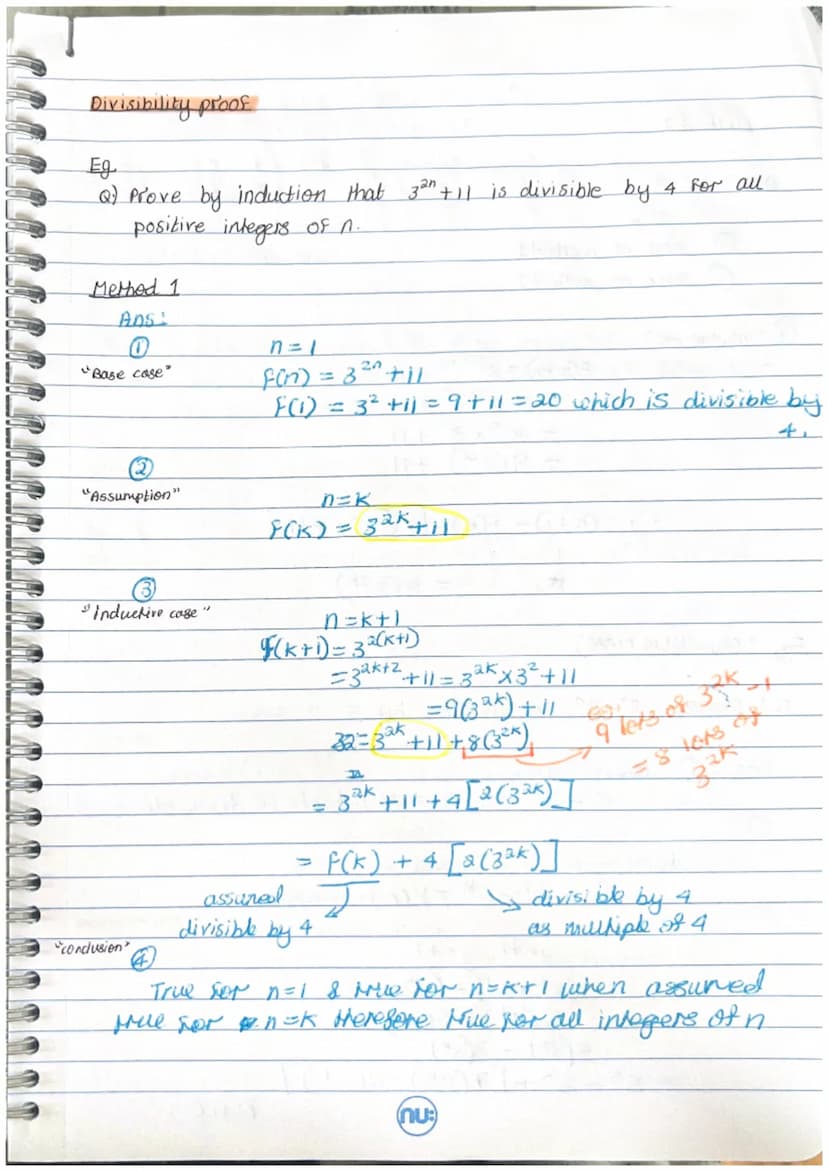
Page 4: Divisibility Proofs - Method 1
This page introduces divisibility proofs using induction, specifically proving that 3²ⁿ+11 is divisible by 4 for all positive integers.
Definition: A divisibility proof shows that one expression is always divisible by another number.
Example: Proves 3²ⁿ+11 is divisible by 4 using the first method.
Highlight: The proof demonstrates how to handle exponential expressions in induction.
4
of 8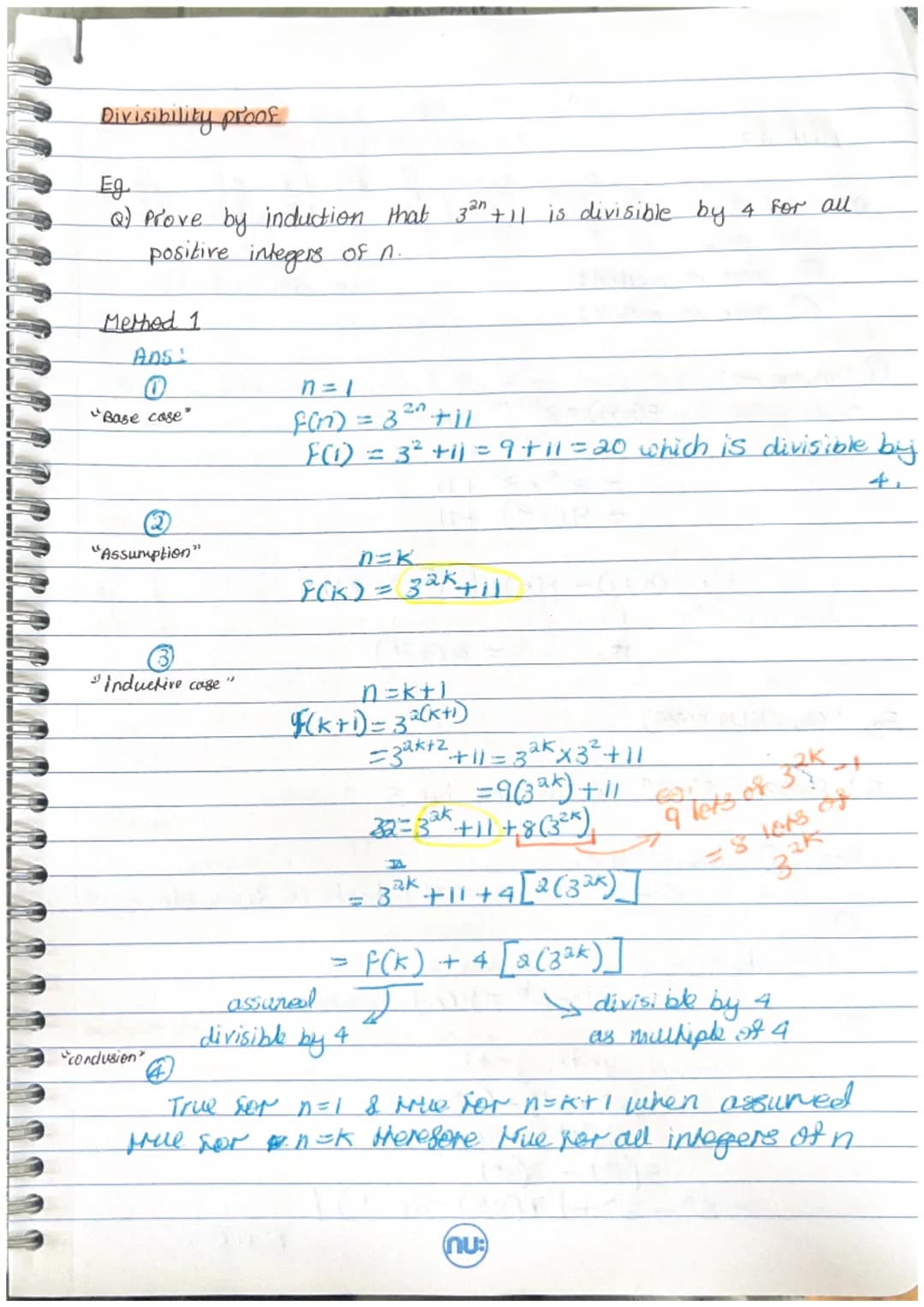
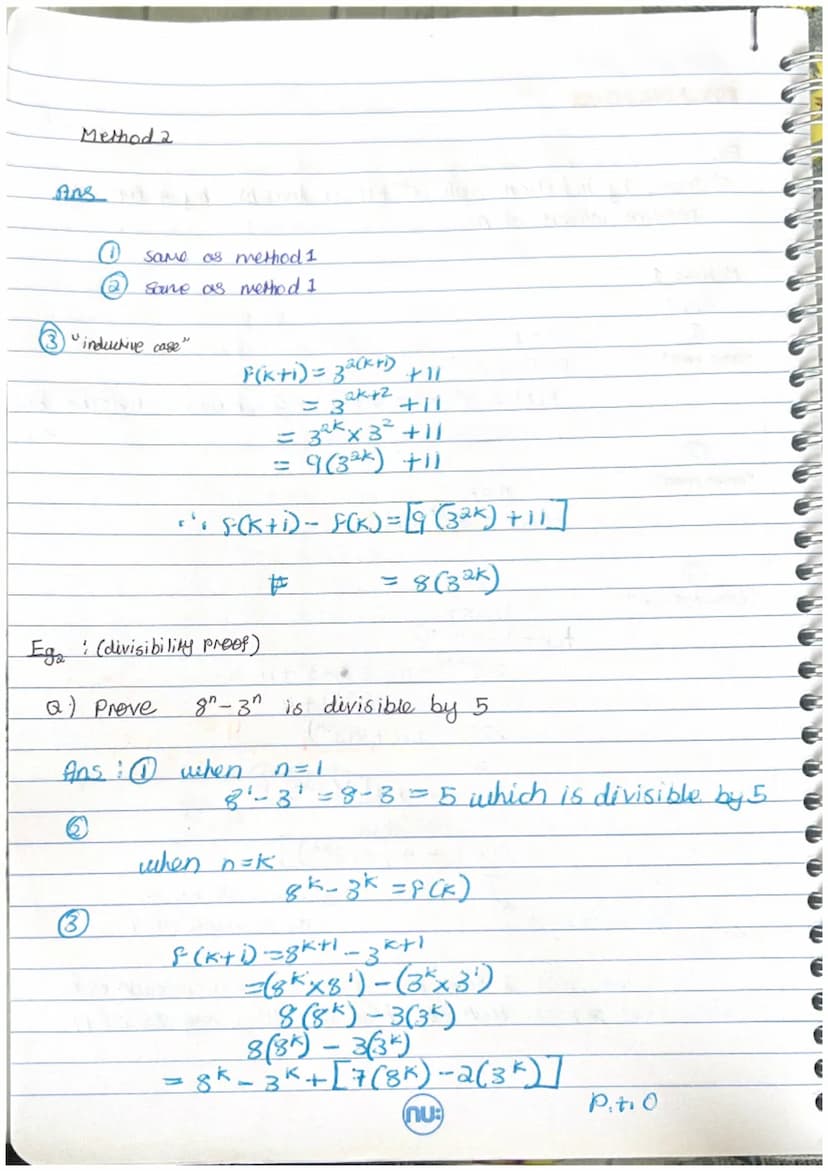
Page 5: Divisibility Proofs - Method 2
This page presents an alternative approach to the divisibility proof from page 4 and introduces a new example involving powers of 8 and 3.
Example: Shows how 8ⁿ-3ⁿ is divisible by 5 for all positive integers n.
Highlight: The second method often provides a more elegant solution by focusing on the difference between consecutive terms.
5
of 8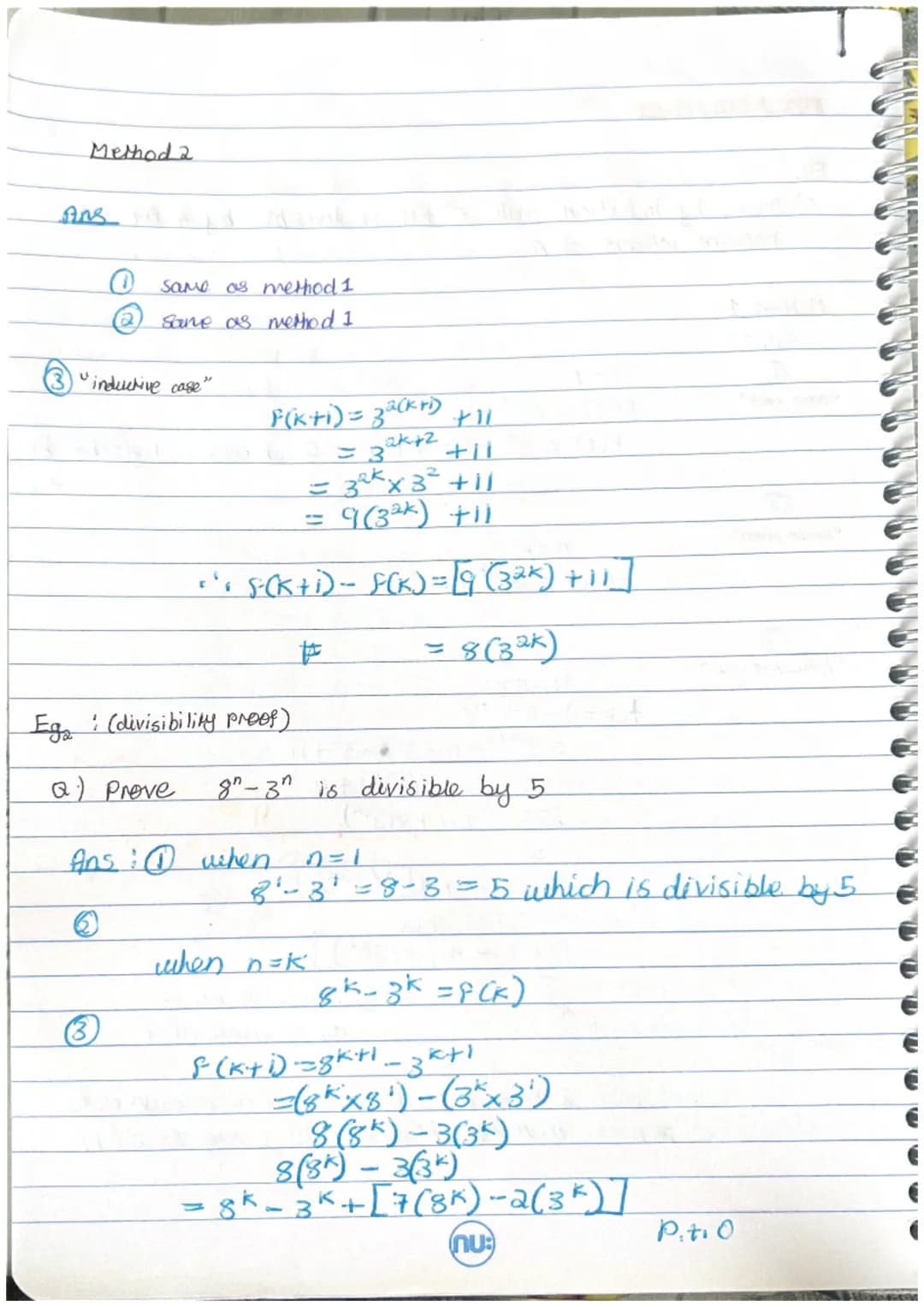
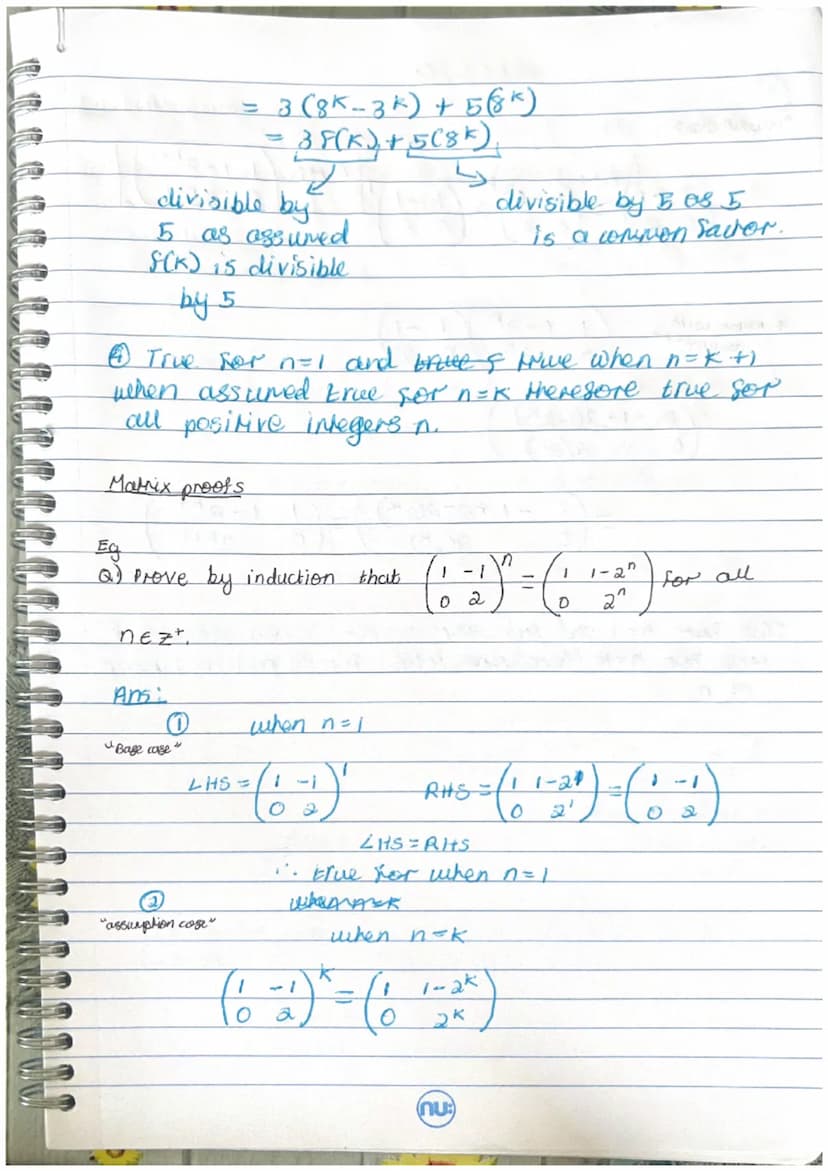
Page 6: Matrix Proofs - Part 1
This page introduces matrix proofs using induction, showing how to prove properties of matrix powers.
Definition: Matrix proofs involve proving statements about matrices raised to different powers.
Example: Proves a specific matrix equality using induction.
Highlight: Matrix proofs require understanding of matrix multiplication and properties.
6
of 8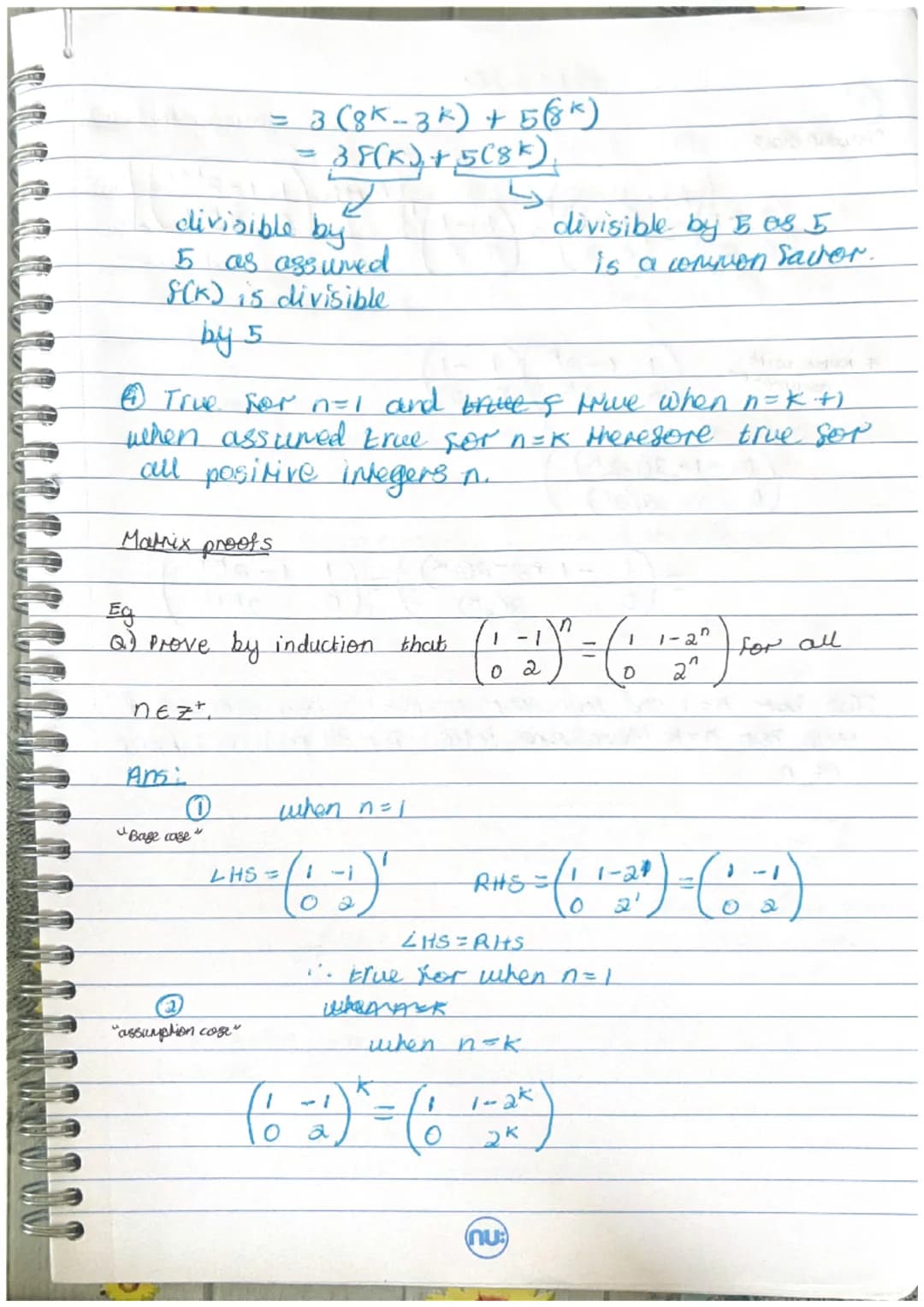
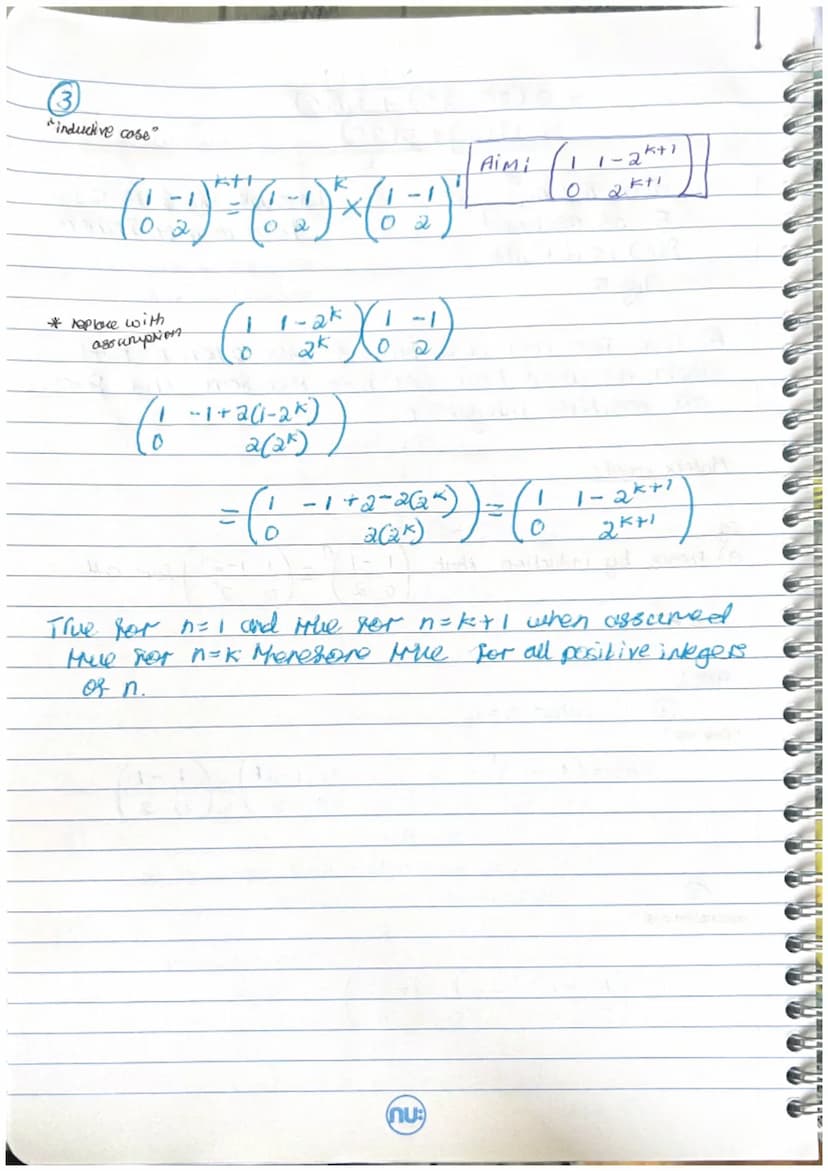
Page 7: Matrix Proofs - Continuation
This page continues the matrix proof example, completing the inductive step and conclusion.
Highlight: The solution demonstrates careful matrix multiplication and algebraic manipulation.
Example: Shows the completion of the matrix proof from page 6.
7
of 8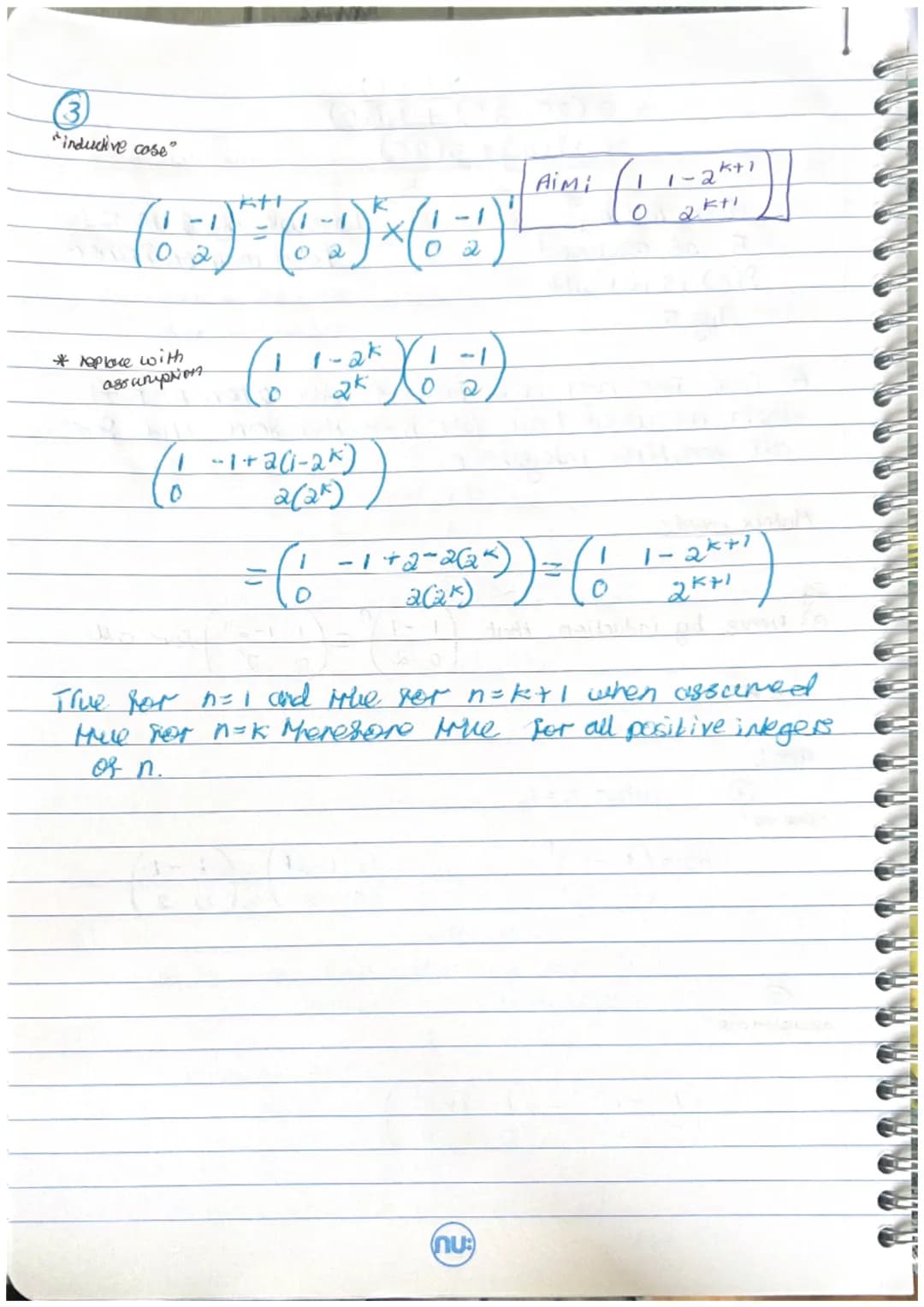
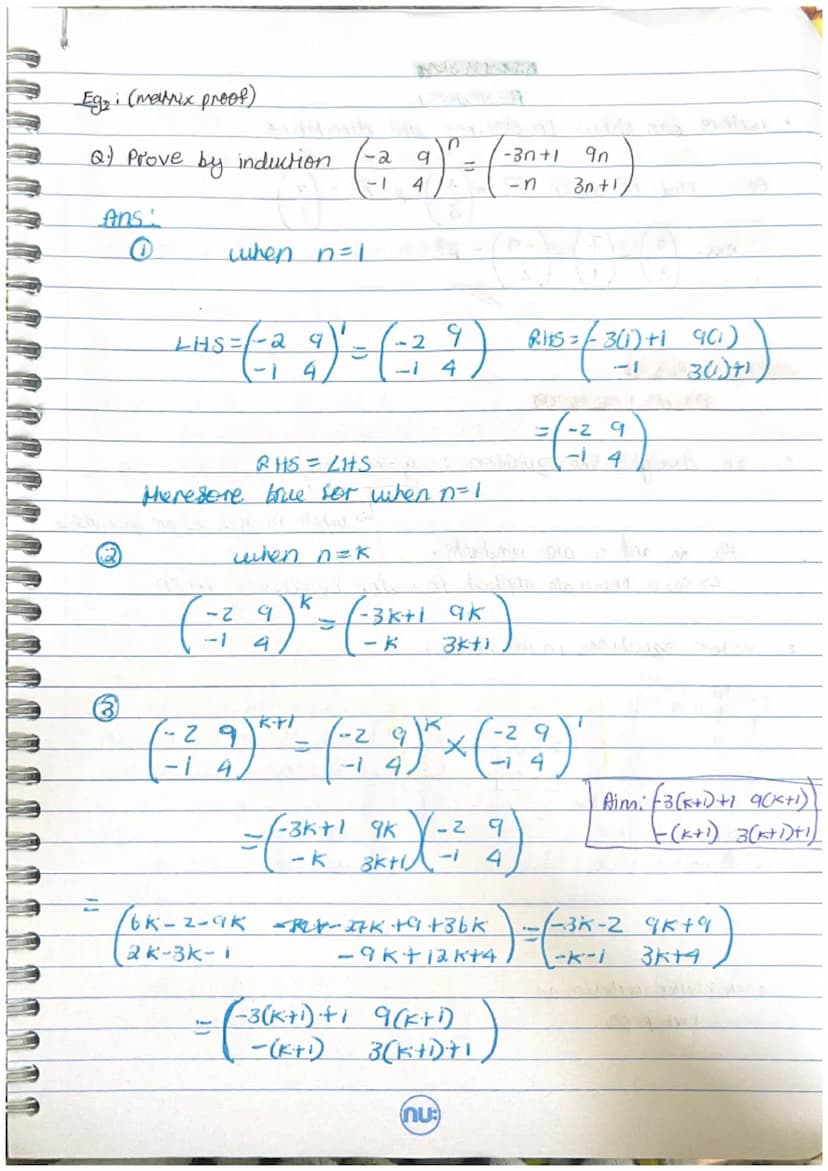
Page 8: Advanced Matrix Proofs
This page presents another matrix proof example with more complex matrices and relationships.
Example: Demonstrates a proof involving 2x2 matrices with specific patterns.
Highlight: The solution requires careful attention to matrix multiplication rules and pattern recognition.
8
of 8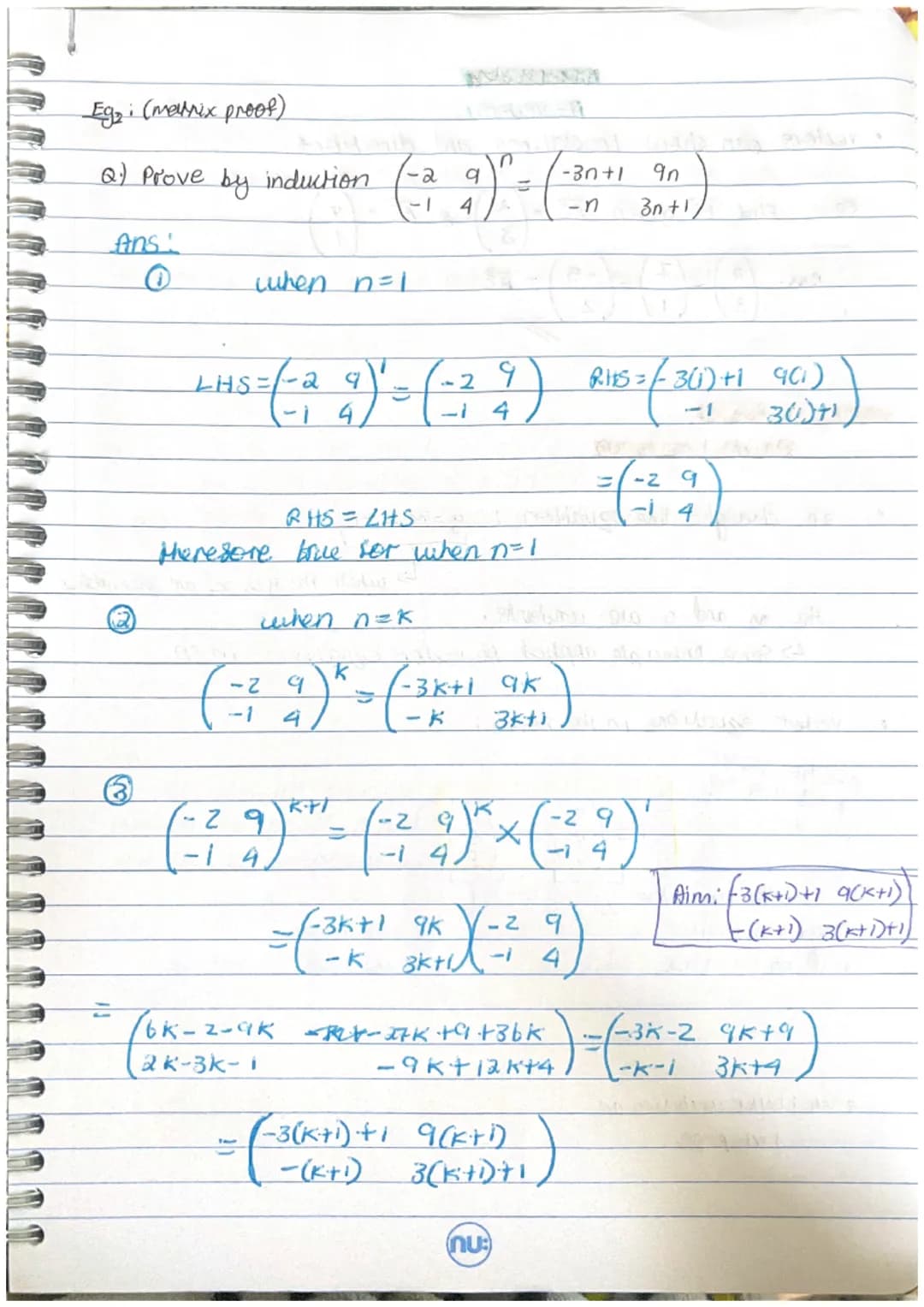
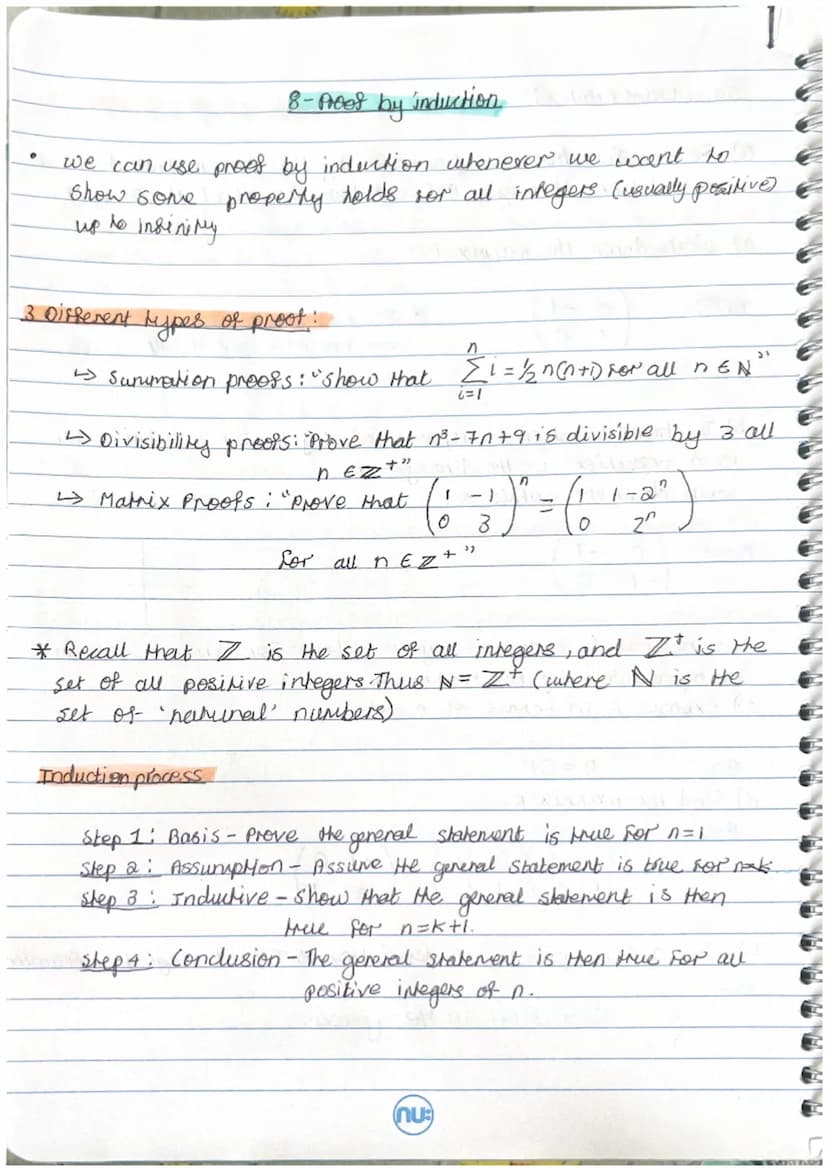
Page 1: Introduction to Proof by Induction
This page introduces the fundamental concepts of mathematical induction and its applications. The content explains how induction can be used to prove properties for all integers, particularly focusing on positive integers up to infinity.
Definition: Proof by induction is a mathematical method used to prove statements true for all natural numbers.
Highlight: The four essential steps of the induction process are:
- Basis Step - Prove for n=1
- Assumption Step - Assume true for n=k
- Inductive Step - Prove for n=k+1
- Conclusion Step - Conclude true for all positive integers
Vocabulary: Z represents the set of all integers, while N represents the set of natural (positive) numbers.
We thought you’d never ask...
What is the Knowunity AI companion?
Our AI Companion is a student-focused AI tool that offers more than just answers. Built on millions of Knowunity resources, it provides relevant information, personalised study plans, quizzes, and content directly in the chat, adapting to your individual learning journey.
Where can I download the Knowunity app?
You can download the app from Google Play Store and Apple App Store.
Is Knowunity really free of charge?
That's right! Enjoy free access to study content, connect with fellow students, and get instant help – all at your fingertips.
Similar content
Most popular content in Further Maths
9Further MathsComplex Numbers & Matrices
Explore the fundamentals of complex numbers and matrices in this comprehensive study note. Topics include the square root of complex numbers, matrix transformations, determinants, and the properties of complex conjugates. Ideal for A Level Further Maths students looking to strengthen their understanding of these key concepts.
124,935134
Further MathsAqa gcse level 2 further maths notes
These aren’t notes on all the topics! But most of them are there :)
113299
Further MathsUnderstanding Complex Numbers
Explore the fundamentals of complex numbers, including their real and imaginary parts, modulus, argument, and operations such as addition and multiplication. This summary covers key concepts like complex conjugates and polar form, essential for mastering WJEC AS Further Pure mathematics.
12981
Further MathsBivariate Data Analysis
Explore key concepts in bivariate data analysis, including hypothesis testing, correlation coefficients, and regression models. This summary covers significance levels, critical values, and the relationship between two variables, providing essential insights for WJEC AS Further Statistics. Ideal for students preparing for exams or seeking to understand statistical relationships.
12410
Further MathsMatrix Operations & Transformations
Explore key concepts in matrix operations, including multiplication, determinants, inverses, and their applications in solving simultaneous equations and transformations. This summary covers essential properties and examples relevant for A-Level Further Mathematics (OCR/MEI).
1213511
MathsA-Level Maths 2022 Solutions
Explore detailed worked solutions for the A-Level Maths Paper 1 (2022). This resource covers key concepts such as differentiation, exponential functions, trigonometric equations, and area calculations, providing step-by-step explanations for each question. Ideal for students preparing for exams.
121,61558
Further MathsMastering Complex Numbers
Explore the fundamentals of complex numbers in this comprehensive guide tailored for A-Level Further Mathematics (MEI/OCR). Delve into Cartesian and polar forms, complex conjugates, modulus-argument representation, and De Moivre's Theorem. Perfect for exam preparation and enhancing your understanding of complex solutions and operations.
1234510
Further MathsCircle Geometry Essentials
Explore key concepts of circle geometry, including the standard and expanded equations of circles, tangent lines, and the relationship between circle centers and points. This summary is ideal for GCSE Maths students looking to master circle theorems and equations.
101311
Further MathsMastering Permutations & Combinations
Explore the essential concepts of permutations and combinations with this comprehensive guide. Perfect for GCSE Further Maths and FSMQ, this resource covers key topics such as the multiplication rule, factorials, binomial coefficients, and practical examples to enhance your understanding. Ideal for students looking to excel in combinatorics and counting techniques.
123534
Most popular content
9 Sociology
Sociology of Education Overview
Explore comprehensive A-Level Sociology notes on the education system, covering key theories, policies, and sociological perspectives. This resource includes insights on marketisation, gender roles, cultural deprivation, and educational inequalities, providing a thorough understanding of how education shapes social stratification and individual achievement. Ideal for exam preparation and in-depth study.
12102,3043,037
CriminologyCriminology: Crime & Punishment Overview
Comprehensive mindmaps covering key concepts in the Crime and Punishment topic for WJEC Criminology Unit 4. This resource includes detailed insights into the Criminal Justice System, crime prevention strategies, sentencing models, and the roles of various agencies. Ideal for A-Level revision, ensuring you grasp essential theories and legislative processes to excel in your exams.
1254,7911,059
SociologySociology of Families: Comprehensive Revision
Dive into an extensive overview of family dynamics, perspectives, and patterns in sociology. This resource covers key concepts such as family diversity, gender roles, marriage, and the impact of social policies on family structures. Perfect for A-Level Sociology students preparing for Paper 2.
1273,1572,304
 English Literature
An Inspector Calls: Character Insights
Explore in-depth analysis and key quotes for characters in J.B. Priestley's 'An Inspector Calls'. This resource covers Gerald Croft, Inspector Goole, Sheila Birling, Mrs. Birling, Eric Birling, and Eva Smith, focusing on themes of class, gender roles, and social responsibility. Ideal for students aiming for Grade 8 and above.
1125,192899
CriminologyWJEC Unit 4 Criminology
Criminology unit 4 detailed revision note
127,110124
CriminologyCriminology Theories Overview
Explore key criminology theories and their implications on crime and deviance. This comprehensive summary covers biological, psychological, and sociological perspectives, including labelling theory, right realism, and the impact of social campaigns on policy development. Ideal for A-Level criminology students seeking to understand the complexities of criminal behaviour and the factors influencing crime prevention strategies.
129,745211
English LiteratureRomeo and Juliet: Key themes
Key Romeo and Juliet themes and analysed quotes
106,603197
C
 Biology
Cell Biology and Cell structure
cell structures
92,5940
English LiteratureMacbeth: Guilt and Ambition
Explore the complex themes of guilt and ambition in Shakespeare's 'Macbeth'. This analysis covers key characters, including Macbeth and Lady Macbeth, their moral dilemmas, and the tragic consequences of their ambition. Ideal for students studying character motivations, thematic elements, and the psychological impact of power. Includes insights on the natural order, manipulation, and the descent into madness.
918,765390
Can't find what you're looking for? Explore other subjects.
Students love us — and so will you.
4.6/5App Store
4.7/5Google Play
The app is very easy to use and well designed. I have found everything I was looking for so far and have been able to learn a lot from the presentations! I will definitely use the app for a class assignment! And of course it also helps a lot as an inspiration.
Stefan SiOS user
This app is really great. There are so many study notes and help [...]. My problem subject is French, for example, and the app has so many options for help. Thanks to this app, I have improved my French. I would recommend it to anyone.
Samantha KlichAndroid user
Wow, I am really amazed. I just tried the app because I've seen it advertised many times and was absolutely stunned. This app is THE HELP you want for school and above all, it offers so many things, such as workouts and fact sheets, which have been VERY helpful to me personally.
AnnaiOS user
Further Maths42 views·Updated May 28, 2026·8 pagesEasy Steps to Learn Proof by Induction for Natural Numbers
A
Ann@ann_jznv
Mathematical Induction and Proof Methods - A comprehensive guide covering proof by induction for natural numbers, examples of summation proofs using induction, and divisibility proofs with induction for integers.
- Introduces three main types of proofs: summation, divisibility, and matrix proofs... Show more
1
of 8Sign up to see the content. It's free!
- Access to all documents
- Improve your grades
- Join milions of students
Page 2: Summation Proofs
This page demonstrates a detailed example of summation proofs using induction to prove that the sum of equals n² for all positive integers.
Example: The proof shows how to verify that Σ = n² from r=1 to n
Highlight: The solution follows the standard induction steps:
- Base case verification for n=1
- Assumption for n=k
- Inductive step proving n=k+1
- Final conclusion
Definition: The left-hand side (LHS) represents the summation while the right-hand side (RHS) represents the simplified form.
2
of 8Sign up to see the content. It's free!
- Access to all documents
- Improve your grades
- Join milions of students
Page 3: Advanced Summation Proofs
This page explores a more complex summation proof involving cubic terms and demonstrates how to prove that the sum of cubes equals a quarter of n²².
Example: Proves that Σr³ = ¼n²² for r=1 to n
Highlight: The solution requires careful algebraic manipulation and understanding of polynomial expressions.
3
of 8Sign up to see the content. It's free!
- Access to all documents
- Improve your grades
- Join milions of students
Page 4: Divisibility Proofs - Method 1
This page introduces divisibility proofs using induction, specifically proving that 3²ⁿ+11 is divisible by 4 for all positive integers.
Definition: A divisibility proof shows that one expression is always divisible by another number.
Example: Proves 3²ⁿ+11 is divisible by 4 using the first method.
Highlight: The proof demonstrates how to handle exponential expressions in induction.
4
of 8Sign up to see the content. It's free!
- Access to all documents
- Improve your grades
- Join milions of students
Page 5: Divisibility Proofs - Method 2
This page presents an alternative approach to the divisibility proof from page 4 and introduces a new example involving powers of 8 and 3.
Example: Shows how 8ⁿ-3ⁿ is divisible by 5 for all positive integers n.
Highlight: The second method often provides a more elegant solution by focusing on the difference between consecutive terms.
5
of 8Sign up to see the content. It's free!
- Access to all documents
- Improve your grades
- Join milions of students
Page 6: Matrix Proofs - Part 1
This page introduces matrix proofs using induction, showing how to prove properties of matrix powers.
Definition: Matrix proofs involve proving statements about matrices raised to different powers.
Example: Proves a specific matrix equality using induction.
Highlight: Matrix proofs require understanding of matrix multiplication and properties.
6
of 8Sign up to see the content. It's free!
- Access to all documents
- Improve your grades
- Join milions of students
Page 7: Matrix Proofs - Continuation
This page continues the matrix proof example, completing the inductive step and conclusion.
Highlight: The solution demonstrates careful matrix multiplication and algebraic manipulation.
Example: Shows the completion of the matrix proof from page 6.
7
of 8Sign up to see the content. It's free!
- Access to all documents
- Improve your grades
- Join milions of students
Page 8: Advanced Matrix Proofs
This page presents another matrix proof example with more complex matrices and relationships.
Example: Demonstrates a proof involving 2x2 matrices with specific patterns.
Highlight: The solution requires careful attention to matrix multiplication rules and pattern recognition.
8
of 8Sign up to see the content. It's free!
- Access to all documents
- Improve your grades
- Join milions of students
Page 1: Introduction to Proof by Induction
This page introduces the fundamental concepts of mathematical induction and its applications. The content explains how induction can be used to prove properties for all integers, particularly focusing on positive integers up to infinity.
Definition: Proof by induction is a mathematical method used to prove statements true for all natural numbers.
Highlight: The four essential steps of the induction process are:
- Basis Step - Prove for n=1
- Assumption Step - Assume true for n=k
- Inductive Step - Prove for n=k+1
- Conclusion Step - Conclude true for all positive integers
Vocabulary: Z represents the set of all integers, while N represents the set of natural (positive) numbers.
We thought you’d never ask...
What is the Knowunity AI companion?
Our AI Companion is a student-focused AI tool that offers more than just answers. Built on millions of Knowunity resources, it provides relevant information, personalised study plans, quizzes, and content directly in the chat, adapting to your individual learning journey.
Where can I download the Knowunity app?
You can download the app from Google Play Store and Apple App Store.
Is Knowunity really free of charge?
That's right! Enjoy free access to study content, connect with fellow students, and get instant help – all at your fingertips.
Similar content
Most popular content in Further Maths
9Further MathsComplex Numbers & Matrices
Explore the fundamentals of complex numbers and matrices in this comprehensive study note. Topics include the square root of complex numbers, matrix transformations, determinants, and the properties of complex conjugates. Ideal for A Level Further Maths students looking to strengthen their understanding of these key concepts.
124,935134
Further MathsAqa gcse level 2 further maths notes
These aren’t notes on all the topics! But most of them are there :)
113299
Further MathsUnderstanding Complex Numbers
Explore the fundamentals of complex numbers, including their real and imaginary parts, modulus, argument, and operations such as addition and multiplication. This summary covers key concepts like complex conjugates and polar form, essential for mastering WJEC AS Further Pure mathematics.
12981
Further MathsBivariate Data Analysis
Explore key concepts in bivariate data analysis, including hypothesis testing, correlation coefficients, and regression models. This summary covers significance levels, critical values, and the relationship between two variables, providing essential insights for WJEC AS Further Statistics. Ideal for students preparing for exams or seeking to understand statistical relationships.
12410
Further MathsMatrix Operations & Transformations
Explore key concepts in matrix operations, including multiplication, determinants, inverses, and their applications in solving simultaneous equations and transformations. This summary covers essential properties and examples relevant for A-Level Further Mathematics (OCR/MEI).
1213511
MathsA-Level Maths 2022 Solutions
Explore detailed worked solutions for the A-Level Maths Paper 1 (2022). This resource covers key concepts such as differentiation, exponential functions, trigonometric equations, and area calculations, providing step-by-step explanations for each question. Ideal for students preparing for exams.
121,61558
Further MathsMastering Complex Numbers
Explore the fundamentals of complex numbers in this comprehensive guide tailored for A-Level Further Mathematics (MEI/OCR). Delve into Cartesian and polar forms, complex conjugates, modulus-argument representation, and De Moivre's Theorem. Perfect for exam preparation and enhancing your understanding of complex solutions and operations.
1234510
Further MathsCircle Geometry Essentials
Explore key concepts of circle geometry, including the standard and expanded equations of circles, tangent lines, and the relationship between circle centers and points. This summary is ideal for GCSE Maths students looking to master circle theorems and equations.
101311
Further MathsMastering Permutations & Combinations
Explore the essential concepts of permutations and combinations with this comprehensive guide. Perfect for GCSE Further Maths and FSMQ, this resource covers key topics such as the multiplication rule, factorials, binomial coefficients, and practical examples to enhance your understanding. Ideal for students looking to excel in combinatorics and counting techniques.
123534
Most popular content
9SociologySociology of Education Overview
Explore comprehensive A-Level Sociology notes on the education system, covering key theories, policies, and sociological perspectives. This resource includes insights on marketisation, gender roles, cultural deprivation, and educational inequalities, providing a thorough understanding of how education shapes social stratification and individual achievement. Ideal for exam preparation and in-depth study.
12102,3043,037
CriminologyCriminology: Crime & Punishment Overview
Comprehensive mindmaps covering key concepts in the Crime and Punishment topic for WJEC Criminology Unit 4. This resource includes detailed insights into the Criminal Justice System, crime prevention strategies, sentencing models, and the roles of various agencies. Ideal for A-Level revision, ensuring you grasp essential theories and legislative processes to excel in your exams.
1254,7911,059
SociologySociology of Families: Comprehensive Revision
Dive into an extensive overview of family dynamics, perspectives, and patterns in sociology. This resource covers key concepts such as family diversity, gender roles, marriage, and the impact of social policies on family structures. Perfect for A-Level Sociology students preparing for Paper 2.
1273,1572,304
English LiteratureAn Inspector Calls: Character Insights
Explore in-depth analysis and key quotes for characters in J.B. Priestley's 'An Inspector Calls'. This resource covers Gerald Croft, Inspector Goole, Sheila Birling, Mrs. Birling, Eric Birling, and Eva Smith, focusing on themes of class, gender roles, and social responsibility. Ideal for students aiming for Grade 8 and above.
1125,192899
CriminologyWJEC Unit 4 Criminology
Criminology unit 4 detailed revision note
127,110124
CriminologyCriminology Theories Overview
Explore key criminology theories and their implications on crime and deviance. This comprehensive summary covers biological, psychological, and sociological perspectives, including labelling theory, right realism, and the impact of social campaigns on policy development. Ideal for A-Level criminology students seeking to understand the complexities of criminal behaviour and the factors influencing crime prevention strategies.
129,745211
English LiteratureRomeo and Juliet: Key themes
Key Romeo and Juliet themes and analysed quotes
106,603197
C
BiologyCell Biology and Cell structure
cell structures
92,5940
English LiteratureMacbeth: Guilt and Ambition
Explore the complex themes of guilt and ambition in Shakespeare's 'Macbeth'. This analysis covers key characters, including Macbeth and Lady Macbeth, their moral dilemmas, and the tragic consequences of their ambition. Ideal for students studying character motivations, thematic elements, and the psychological impact of power. Includes insights on the natural order, manipulation, and the descent into madness.
918,765390
Can't find what you're looking for? Explore other subjects.
Students love us — and so will you.
4.6/5App Store
4.7/5Google Play
The app is very easy to use and well designed. I have found everything I was looking for so far and have been able to learn a lot from the presentations! I will definitely use the app for a class assignment! And of course it also helps a lot as an inspiration.
Stefan SiOS user
This app is really great. There are so many study notes and help [...]. My problem subject is French, for example, and the app has so many options for help. Thanks to this app, I have improved my French. I would recommend it to anyone.
Samantha KlichAndroid user
Wow, I am really amazed. I just tried the app because I've seen it advertised many times and was absolutely stunned. This app is THE HELP you want for school and above all, it offers so many things, such as workouts and fact sheets, which have been VERY helpful to me personally.
AnnaiOS user