
Amines and Amino Acids: Structure, Properties, and Synthesis
Amines are... Show more
Knowunity AI
Subjects
Triangle Congruence and Similarity Theorems
Triangle Properties and Classification
Linear Equations and Graphs
Geometric Angle Relationships
Trigonometric Functions and Identities
Equation Solving Techniques
Circle Geometry Fundamentals
Division Operations and Methods
Basic Differentiation Rules
Exponent and Logarithm Properties
Show all topics
Human Organ Systems
Reproductive Cell Cycles
Biological Sciences Subdisciplines
Cellular Energy Metabolism
Autotrophic Energy Processes
Inheritance Patterns and Principles
Biomolecular Structure and Organization
Cell Cycle and Division Mechanics
Cellular Organization and Development
Biological Structural Organization
Show all topics
Chemical Sciences and Applications
Atomic Structure and Composition
Molecular Electron Structure Representation
Atomic Electron Behavior
Matter Properties and Water
Mole Concept and Calculations
Gas Laws and Behavior
Periodic Table Organization
Chemical Thermodynamics Fundamentals
Chemical Bond Types and Properties
Show all topics
European Renaissance and Enlightenment
European Cultural Movements 800-1920
American Revolution Era 1763-1797
American Civil War 1861-1865
Global Imperial Systems
Mongol and Chinese Dynasties
U.S. Presidents and World Leaders
Historical Sources and Documentation
World Wars Era and Impact
World Religious Systems
Show all topics
Classic and Contemporary Novels
Literary Character Analysis
Rhetorical Theory and Practice
Classic Literary Narratives
Reading Analysis and Interpretation
Narrative Structure and Techniques
English Language Components
Influential English-Language Authors
Basic Sentence Structure
Narrative Voice and Perspective
Show all topics
 Chemistry216 views·Updated May 20, 2026·2 pages
Amines and Amino Acids: Structure, Properties, and Synthesis
Amines are... Show more
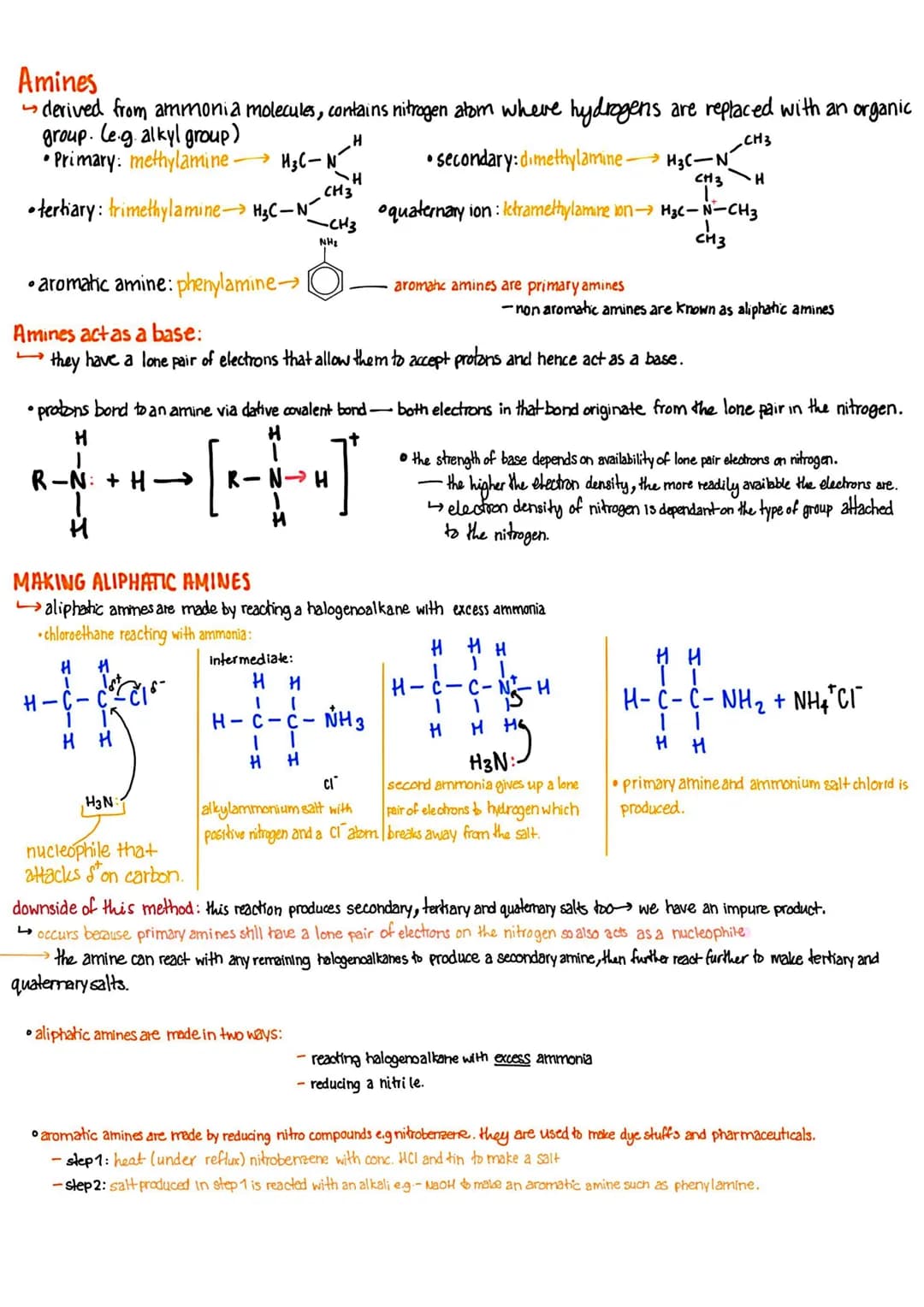
This page covers the synthesis methods for aliphatic and aromatic amines, as well as the structure and properties of amino acids.
There are two main methods for synthesizing aliphatic amines:
Example: The reaction of chloroethane with ammonia produces ethylamine (a primary amine) and ammonium chloride.
CH₃CH₂Cl + NH₃ → CH₃CH₂NH₂ + NH₄Cl
This method can produce a mixture of primary, secondary, and tertiary amines, as well as quaternary ammonium salts, due to further reactions of the initial product.
Aromatic amines, such as phenylamine, are typically made by reducing nitro compounds. This process involves two steps:
Highlight: Aromatic amines are important precursors in the production of dyes and pharmaceuticals.
Amino acids are organic compounds containing both an amino group and a carboxylic acid group .
Definition: Amino acids are amphoteric compounds with both acidic and basic properties due to their carboxyl and amino groups.
Key features of amino acids include:
Vocabulary: Amphoteric substances can act as both acids and bases.
Amino acids play a crucial role in biological systems as the building blocks of proteins and have diverse applications in biochemistry and organic synthesis.
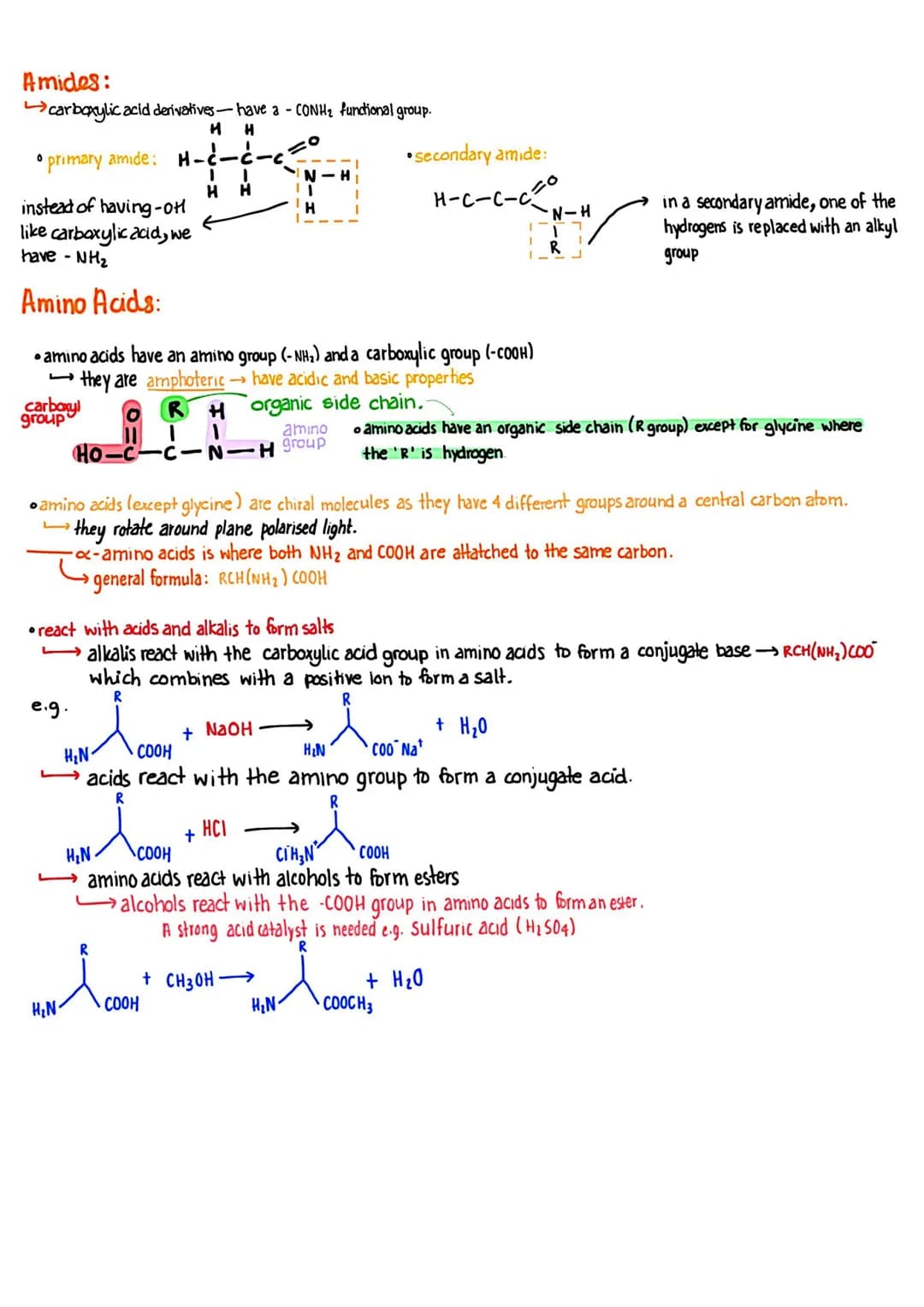
Amines are organic compounds derived from ammonia, where hydrogen atoms are replaced by organic groups. They are classified based on the number of organic groups attached to the nitrogen atom.
Definition: Amines are nitrogen-containing compounds derived from ammonia, with one or more hydrogen atoms replaced by organic groups.
The three main types of amines are:
Example: Methylamine (CH₃NH₂) is a primary amine, while trimethylamine ((CH₃)₃N) is a tertiary amine.
Amines can also be classified as aliphatic or aromatic:
Highlight: The basicity of amines depends on the availability of the lone pair of electrons on the nitrogen atom. Factors affecting this include the type of groups attached to nitrogen and electron density.
Amines act as bases due to their ability to accept protons using their lone pair of electrons. They also function as nucleophiles, attacking electron-deficient carbon atoms in various reactions.
Vocabulary: A nucleophile is a chemical species that donates an electron pair to form a chemical bond.
Our AI Companion is a student-focused AI tool that offers more than just answers. Built on millions of Knowunity resources, it provides relevant information, personalised study plans, quizzes, and content directly in the chat, adapting to your individual learning journey.
You can download the app from Google Play Store and Apple App Store.
That's right! Enjoy free access to study content, connect with fellow students, and get instant help – all at your fingertips.
ChemistryExplore essential concepts in National 5 Chemistry, including atomic structure, types of bonding (ionic and covalent), reaction rates, and acid-base chemistry. This comprehensive guide covers key topics such as chemical equations, molarity, and neutralization reactions, providing a solid foundation for your studies.
ChemistryExplore the intricate chemistry of the p-block elements, focusing on oxidation states, redox reactions, and amphoteric properties. This summary highlights key concepts such as chemical bonding, oxidation-reduction reactions, and the behavior of lead and carbon compounds. Ideal for A Level Chemistry students preparing for exams.
ChemistryExplore essential concepts in GCSE Chemistry, including ionic and covalent bonding, the periodic table, separation methods, and acid-base reactions. This comprehensive revision resource covers atomic structure, metallic bonding, and the properties of elements and compounds, making it ideal for students preparing for their exams.
ChemistryExplore the properties and reactions of acids and alkalis, including neutralization processes, everyday examples, and the use of pH indicators. This summary covers strong and weak acids, common alkalis, and practical applications such as antacids and agricultural uses. Ideal for students studying chemistry concepts related to acid-base reactions.
ChemistryExplore key concepts in AQA Chemistry Paper 1, covering covalent bonding, ionic structures, energy changes, and the periodic table. This summary includes essential topics such as balanced equations, acid-base reactions, and electrolysis, providing a comprehensive overview for exam preparation.
ChemistryExplore the essential concepts of acids and alkalis, including their properties, everyday examples, and the process of neutralisation. This summary covers laboratory acids and alkalis, pH testing methods, and practical applications such as antacids and soil treatment. Ideal for chemistry students seeking a clear understanding of acid-base reactions.
ChemistryExplore the reactions of Period 3 elements with water and oxygen, including detailed equations and trends in acidity and melting points. This summary covers the structures of acids and anions formed, focusing on sodium, magnesium, aluminum, silicon, phosphorus, and sulfur oxides. Ideal for AQA A-Level Inorganic Chemistry students.
ChemistryExplore the fundamentals of acids and bases, including the pH scale, neutralization reactions, and the formation of salts. This summary covers key concepts such as the effects of metal and non-metal oxides on pH, common acids and alkalis, and the implications of acid rain. Ideal for chemistry students preparing for exams.
ChemistryExplore key concepts in AQA GCSE Chemistry, including organic chemistry, chemical bonding, atmospheric chemistry, and resource management. This comprehensive checklist covers essential topics for both higher and foundation levels, ensuring you grasp the fundamentals of chemical principles, laboratory techniques, and energy changes. Perfect for exam preparation and revision.
ChemistryThe Atom
Chemistryhigher
ChemistryEverything from snaprevise for OCR chemistry a-level
ChemistryExplore key AQA GCSE Chemistry practicals, including flame tests, titration, and gas identification. This resource covers essential techniques for analyzing ions, making salts, and understanding reaction kinetics. Perfect for students preparing for exams and practical assessments.
ChemistryQuiz covering all of topic 1
ChemistryUnlock the secrets of chemical reactions with this comprehensive flashcard set designed to help you conquer complex concepts and ace your Chemistry exams.
Chemistry4.4 Reactions of acids with bases or carbonates
ChemistryPractice identifying subatomic particles, calculating neutrons, and defining isotopes and atomic/mass numbers.
ChemistryCalculate the number of protons, neutrons, and electrons for different elements and isotopes.
 Sociology
Explore comprehensive A-Level Sociology notes on the education system, covering key theories, policies, and sociological perspectives. This resource includes insights on marketisation, gender roles, cultural deprivation, and educational inequalities, providing a thorough understanding of how education shapes social stratification and individual achievement. Ideal for exam preparation and in-depth study.
CriminologyComprehensive mindmaps covering key concepts in the Crime and Punishment topic for WJEC Criminology Unit 4. This resource includes detailed insights into the Criminal Justice System, crime prevention strategies, sentencing models, and the roles of various agencies. Ideal for A-Level revision, ensuring you grasp essential theories and legislative processes to excel in your exams.
SociologyDive into an extensive overview of family dynamics, perspectives, and patterns in sociology. This resource covers key concepts such as family diversity, gender roles, marriage, and the impact of social policies on family structures. Perfect for A-Level Sociology students preparing for Paper 2.
 English Literature
Explore in-depth analysis and key quotes for characters in J.B. Priestley's 'An Inspector Calls'. This resource covers Gerald Croft, Inspector Goole, Sheila Birling, Mrs. Birling, Eric Birling, and Eva Smith, focusing on themes of class, gender roles, and social responsibility. Ideal for students aiming for Grade 8 and above.
CriminologyCriminology unit 4 detailed revision note
CriminologyExplore key criminology theories and their implications on crime and deviance. This comprehensive summary covers biological, psychological, and sociological perspectives, including labelling theory, right realism, and the impact of social campaigns on policy development. Ideal for A-Level criminology students seeking to understand the complexities of criminal behaviour and the factors influencing crime prevention strategies.
English LiteratureKey Romeo and Juliet themes and analysed quotes
 Biology
cell structures
English LiteratureExplore the complex themes of guilt and ambition in Shakespeare's 'Macbeth'. This analysis covers key characters, including Macbeth and Lady Macbeth, their moral dilemmas, and the tragic consequences of their ambition. Ideal for students studying character motivations, thematic elements, and the psychological impact of power. Includes insights on the natural order, manipulation, and the descent into madness.
The app is very easy to use and well designed. I have found everything I was looking for so far and have been able to learn a lot from the presentations! I will definitely use the app for a class assignment! And of course it also helps a lot as an inspiration.
This app is really great. There are so many study notes and help [...]. My problem subject is French, for example, and the app has so many options for help. Thanks to this app, I have improved my French. I would recommend it to anyone.
Wow, I am really amazed. I just tried the app because I've seen it advertised many times and was absolutely stunned. This app is THE HELP you want for school and above all, it offers so many things, such as workouts and fact sheets, which have been VERY helpful to me personally.
Chemistry216 views·Updated May 20, 2026·2 pagesAmines and Amino Acids: Structure, Properties, and Synthesis
Amines are nitrogen-containing organic compounds derived from ammonia. They play crucial roles in biological systems and chemical synthesis. This guide explores the types of amines, their properties, synthesis methods, and the related... Show more
This page covers the synthesis methods for aliphatic and aromatic amines, as well as the structure and properties of amino acids.
There are two main methods for synthesizing aliphatic amines:
Example: The reaction of chloroethane with ammonia produces ethylamine (a primary amine) and ammonium chloride.
CH₃CH₂Cl + NH₃ → CH₃CH₂NH₂ + NH₄Cl
This method can produce a mixture of primary, secondary, and tertiary amines, as well as quaternary ammonium salts, due to further reactions of the initial product.
Aromatic amines, such as phenylamine, are typically made by reducing nitro compounds. This process involves two steps:
Highlight: Aromatic amines are important precursors in the production of dyes and pharmaceuticals.
Amino acids are organic compounds containing both an amino group and a carboxylic acid group .
Definition: Amino acids are amphoteric compounds with both acidic and basic properties due to their carboxyl and amino groups.
Key features of amino acids include:
Vocabulary: Amphoteric substances can act as both acids and bases.
Amino acids play a crucial role in biological systems as the building blocks of proteins and have diverse applications in biochemistry and organic synthesis.
Amines are organic compounds derived from ammonia, where hydrogen atoms are replaced by organic groups. They are classified based on the number of organic groups attached to the nitrogen atom.
Definition: Amines are nitrogen-containing compounds derived from ammonia, with one or more hydrogen atoms replaced by organic groups.
The three main types of amines are:
Example: Methylamine (CH₃NH₂) is a primary amine, while trimethylamine ((CH₃)₃N) is a tertiary amine.
Amines can also be classified as aliphatic or aromatic:
Highlight: The basicity of amines depends on the availability of the lone pair of electrons on the nitrogen atom. Factors affecting this include the type of groups attached to nitrogen and electron density.
Amines act as bases due to their ability to accept protons using their lone pair of electrons. They also function as nucleophiles, attacking electron-deficient carbon atoms in various reactions.
Vocabulary: A nucleophile is a chemical species that donates an electron pair to form a chemical bond.
Our AI Companion is a student-focused AI tool that offers more than just answers. Built on millions of Knowunity resources, it provides relevant information, personalised study plans, quizzes, and content directly in the chat, adapting to your individual learning journey.
You can download the app from Google Play Store and Apple App Store.
That's right! Enjoy free access to study content, connect with fellow students, and get instant help – all at your fingertips.
ChemistryExplore essential concepts in National 5 Chemistry, including atomic structure, types of bonding (ionic and covalent), reaction rates, and acid-base chemistry. This comprehensive guide covers key topics such as chemical equations, molarity, and neutralization reactions, providing a solid foundation for your studies.
ChemistryExplore the intricate chemistry of the p-block elements, focusing on oxidation states, redox reactions, and amphoteric properties. This summary highlights key concepts such as chemical bonding, oxidation-reduction reactions, and the behavior of lead and carbon compounds. Ideal for A Level Chemistry students preparing for exams.
ChemistryExplore essential concepts in GCSE Chemistry, including ionic and covalent bonding, the periodic table, separation methods, and acid-base reactions. This comprehensive revision resource covers atomic structure, metallic bonding, and the properties of elements and compounds, making it ideal for students preparing for their exams.
ChemistryExplore the properties and reactions of acids and alkalis, including neutralization processes, everyday examples, and the use of pH indicators. This summary covers strong and weak acids, common alkalis, and practical applications such as antacids and agricultural uses. Ideal for students studying chemistry concepts related to acid-base reactions.
ChemistryExplore key concepts in AQA Chemistry Paper 1, covering covalent bonding, ionic structures, energy changes, and the periodic table. This summary includes essential topics such as balanced equations, acid-base reactions, and electrolysis, providing a comprehensive overview for exam preparation.
ChemistryExplore the essential concepts of acids and alkalis, including their properties, everyday examples, and the process of neutralisation. This summary covers laboratory acids and alkalis, pH testing methods, and practical applications such as antacids and soil treatment. Ideal for chemistry students seeking a clear understanding of acid-base reactions.
ChemistryExplore the reactions of Period 3 elements with water and oxygen, including detailed equations and trends in acidity and melting points. This summary covers the structures of acids and anions formed, focusing on sodium, magnesium, aluminum, silicon, phosphorus, and sulfur oxides. Ideal for AQA A-Level Inorganic Chemistry students.
ChemistryExplore the fundamentals of acids and bases, including the pH scale, neutralization reactions, and the formation of salts. This summary covers key concepts such as the effects of metal and non-metal oxides on pH, common acids and alkalis, and the implications of acid rain. Ideal for chemistry students preparing for exams.
ChemistryExplore key concepts in AQA GCSE Chemistry, including organic chemistry, chemical bonding, atmospheric chemistry, and resource management. This comprehensive checklist covers essential topics for both higher and foundation levels, ensuring you grasp the fundamentals of chemical principles, laboratory techniques, and energy changes. Perfect for exam preparation and revision.
ChemistryThe Atom
Chemistryhigher
ChemistryEverything from snaprevise for OCR chemistry a-level
ChemistryExplore key AQA GCSE Chemistry practicals, including flame tests, titration, and gas identification. This resource covers essential techniques for analyzing ions, making salts, and understanding reaction kinetics. Perfect for students preparing for exams and practical assessments.
ChemistryQuiz covering all of topic 1
ChemistryUnlock the secrets of chemical reactions with this comprehensive flashcard set designed to help you conquer complex concepts and ace your Chemistry exams.
Chemistry4.4 Reactions of acids with bases or carbonates
ChemistryPractice identifying subatomic particles, calculating neutrons, and defining isotopes and atomic/mass numbers.
ChemistryCalculate the number of protons, neutrons, and electrons for different elements and isotopes.
SociologyExplore comprehensive A-Level Sociology notes on the education system, covering key theories, policies, and sociological perspectives. This resource includes insights on marketisation, gender roles, cultural deprivation, and educational inequalities, providing a thorough understanding of how education shapes social stratification and individual achievement. Ideal for exam preparation and in-depth study.
CriminologyComprehensive mindmaps covering key concepts in the Crime and Punishment topic for WJEC Criminology Unit 4. This resource includes detailed insights into the Criminal Justice System, crime prevention strategies, sentencing models, and the roles of various agencies. Ideal for A-Level revision, ensuring you grasp essential theories and legislative processes to excel in your exams.
SociologyDive into an extensive overview of family dynamics, perspectives, and patterns in sociology. This resource covers key concepts such as family diversity, gender roles, marriage, and the impact of social policies on family structures. Perfect for A-Level Sociology students preparing for Paper 2.
English LiteratureExplore in-depth analysis and key quotes for characters in J.B. Priestley's 'An Inspector Calls'. This resource covers Gerald Croft, Inspector Goole, Sheila Birling, Mrs. Birling, Eric Birling, and Eva Smith, focusing on themes of class, gender roles, and social responsibility. Ideal for students aiming for Grade 8 and above.
CriminologyCriminology unit 4 detailed revision note
CriminologyExplore key criminology theories and their implications on crime and deviance. This comprehensive summary covers biological, psychological, and sociological perspectives, including labelling theory, right realism, and the impact of social campaigns on policy development. Ideal for A-Level criminology students seeking to understand the complexities of criminal behaviour and the factors influencing crime prevention strategies.
English LiteratureKey Romeo and Juliet themes and analysed quotes
Biologycell structures
English LiteratureExplore the complex themes of guilt and ambition in Shakespeare's 'Macbeth'. This analysis covers key characters, including Macbeth and Lady Macbeth, their moral dilemmas, and the tragic consequences of their ambition. Ideal for students studying character motivations, thematic elements, and the psychological impact of power. Includes insights on the natural order, manipulation, and the descent into madness.
The app is very easy to use and well designed. I have found everything I was looking for so far and have been able to learn a lot from the presentations! I will definitely use the app for a class assignment! And of course it also helps a lot as an inspiration.
This app is really great. There are so many study notes and help [...]. My problem subject is French, for example, and the app has so many options for help. Thanks to this app, I have improved my French. I would recommend it to anyone.
Wow, I am really amazed. I just tried the app because I've seen it advertised many times and was absolutely stunned. This app is THE HELP you want for school and above all, it offers so many things, such as workouts and fact sheets, which have been VERY helpful to me personally.