
Statistics is everywhere around you – from social media analytics... Show more
 Statistics
 Maths
Maths English Literature
 Biology
 Sociology
Sign up to see the contentIt's free!
Access to all documents
Improve your grades
Join milions of students
By signing up you accept Terms of Service and Privacy Policy
Subjects
Classic Dramatic Literature
Modern Lyric Poetry
Influential English-Language Authors
Classic and Contemporary Novels
Literary Character Analysis
Romantic and Love Poetry
Reading Analysis and Interpretation
Evidence Analysis and Integration
Author's Stylistic Elements
Figurative Language and Rhetoric
Show all topics
Human Organ Systems
Cellular Organization and Development
Biomolecular Structure and Organization
Enzyme Structure and Regulation
Cellular Organization Types
Biological Homeostatic Processes
Cellular Membrane Structure
Autotrophic Energy Processes
Environmental Sustainability and Impact
Neural Communication Systems
Show all topics
Social Sciences Research & Practice
Social Structure and Mobility
Classic Social Influence Experiments
Social Systems Theories
Family and Relationship Dynamics
Memory Systems and Processes
Neural Bases of Behavior
Social Influence and Attraction
Psychotherapeutic Approaches
Human Agency and Responsibility
Show all topics
Chemical Sciences and Applications
Chemical Bond Types and Properties
Organic Functional Groups
Atomic Structure and Composition
Chromatographic Separation Principles
Chemical Compound Classifications
Electrochemical Cell Systems
Periodic Table Organization
Chemical Reaction Kinetics
Chemical Equation Conservation
Show all topics
Nazi Germany and Holocaust 1933-1945
World Wars and Peace Treaties
European Monarchs and Statesmen
Cold War Global Tensions
Medieval Institutions and Systems
European Renaissance and Enlightenment
Modern Global Environmental-Health Challenges
Modern Military Conflicts
Medieval Migration and Invasions
World Wars Era and Impact
Show all topics
95
•
12 Jan 2026
•
Zikra Naveed
@zikranaveed
Statistics is everywhere around you – from social media analytics... Show more




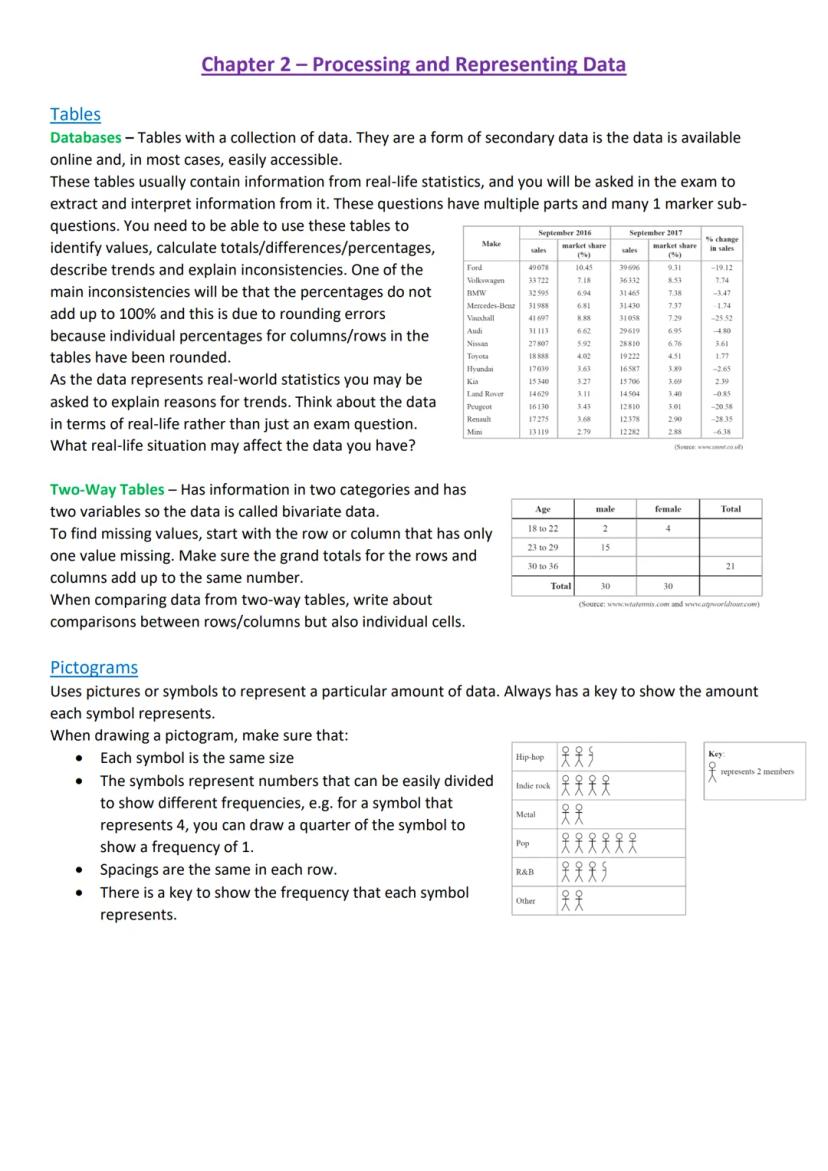

You're about to dive into one of the most practical subjects you'll study. Statistics isn't just about numbers on a page – it's the science behind understanding patterns, making predictions, and solving real-world problems.
This subject breaks down into key areas: collecting data properly, organising it so it makes sense, and presenting it in ways that tell a story. You'll learn why some surveys can't be trusted and how to design better ones yourself.
Quick Confidence Boost: Statistics is actually quite logical once you get the hang of it. Most concepts build on common sense – if something seems dodgy about a survey or graph, it probably is!
The skills you'll develop here apply to everything from understanding news reports to planning your own research projects. Let's get started with the fundamentals.
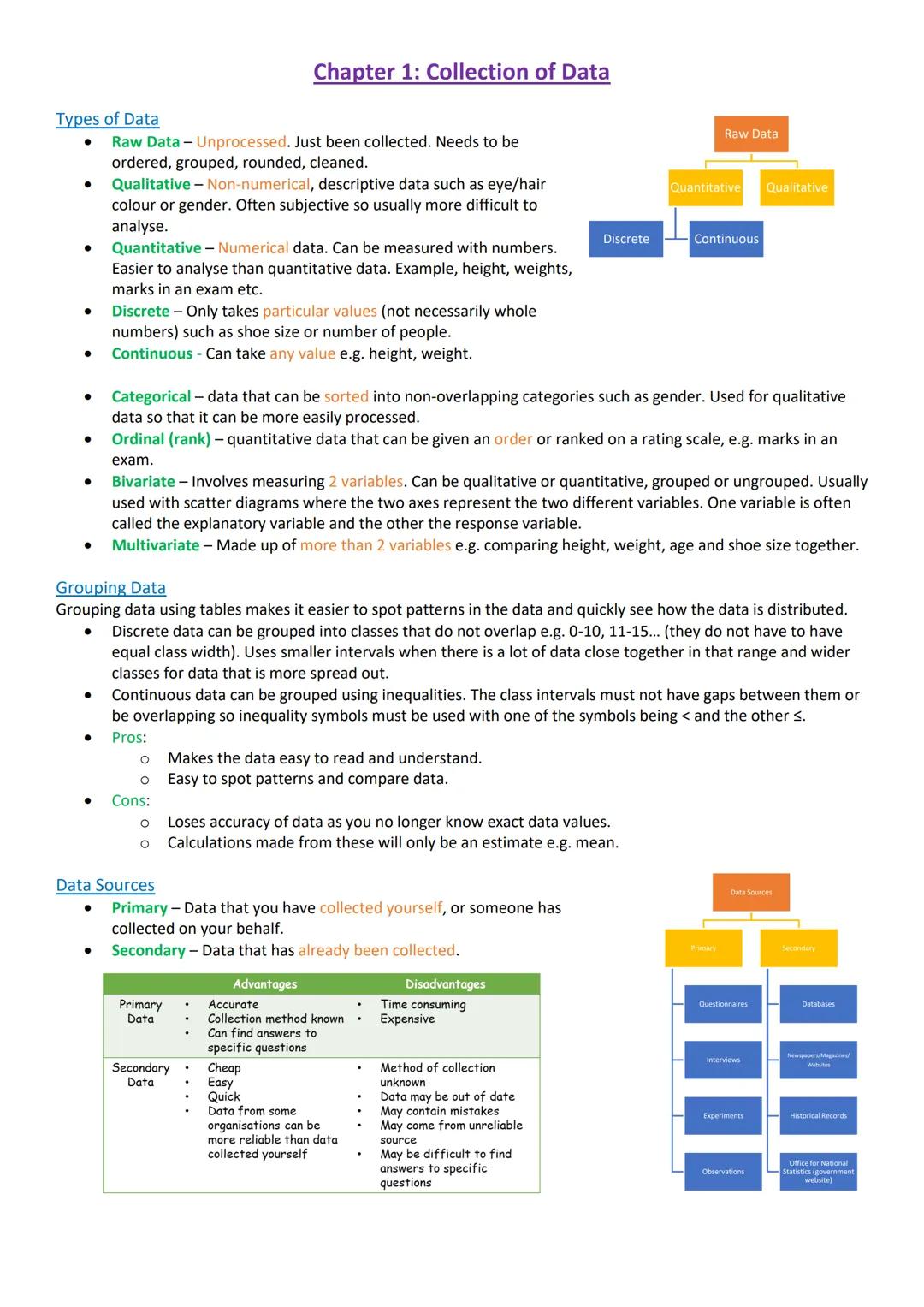
Ever wondered why some surveys seem completely wrong? It's usually because someone messed up the data collection process. Understanding different types of data is your first step to becoming a statistics detective.
Raw data is like ingredients before cooking – messy and unprocessed. You'll work with qualitative data (descriptive stuff like favourite colours) and quantitative data (actual numbers you can measure). Discrete data comes in specific chunks (like number of siblings), while continuous data flows smoothly (like your height, which changes gradually).
Grouping data makes patterns easier to spot, but there's a trade-off. You gain clarity but lose precision – imagine trying to work out someone's exact age when you only know they're "16-18 years old."
Real-World Tip: When you see grouped data in news articles, remember they've sacrificed accuracy for simplicity. Always ask yourself: "What details might be hidden here?"
Primary data is fresh from the source (you collect it yourself), while secondary data is secondhand. Primary data takes longer but gives you exactly what you need. Secondary data is quick and cheap but might not answer your specific questions.
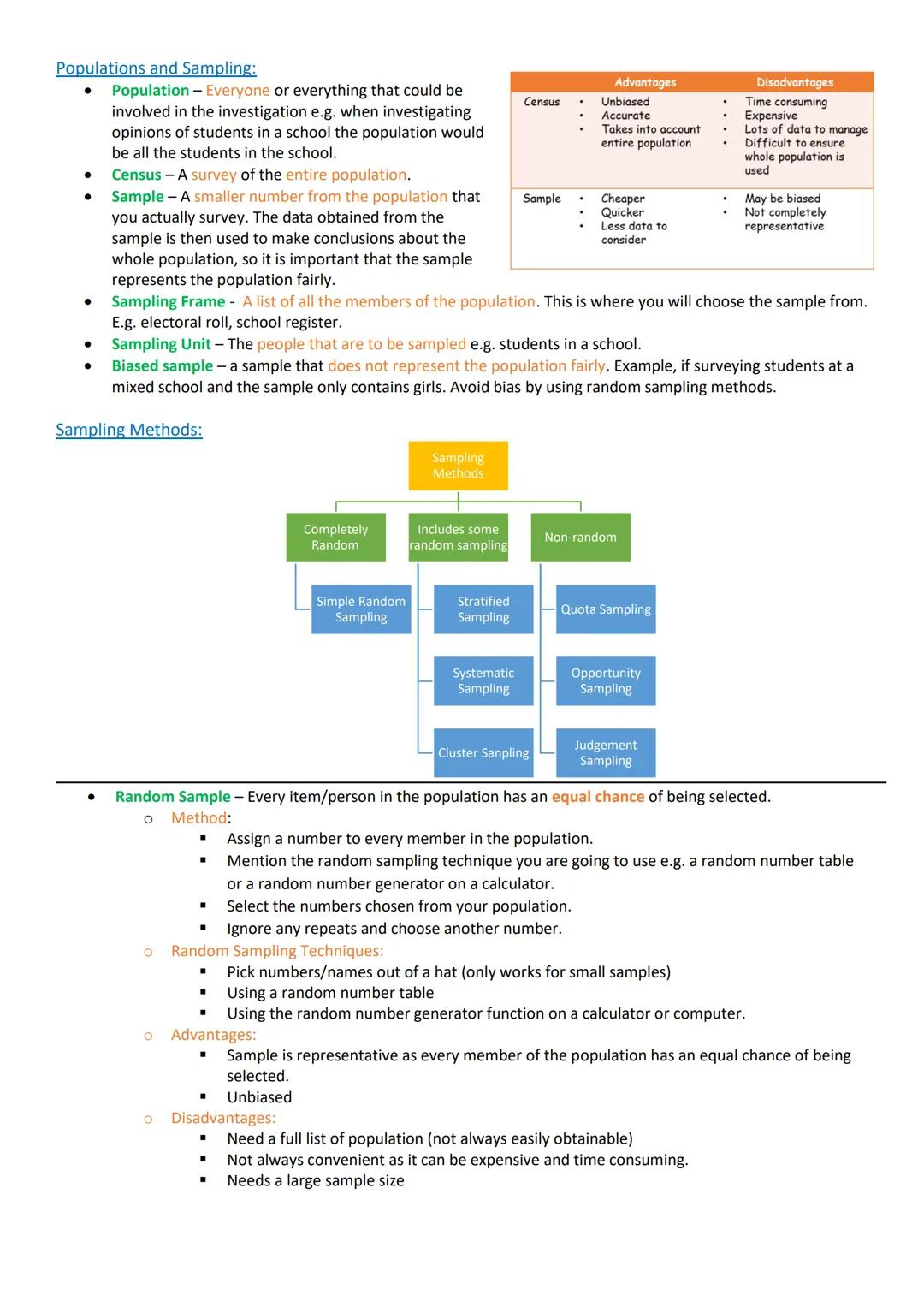
Here's where things get interesting – you can't survey everyone, so you need to get clever about who you ask. A population is everyone you're interested in studying, but a census of the entire population is usually impossible (imagine surveying every teenager in the UK!).
That's where sampling comes in. Your sample needs to represent the whole population fairly, or your results will be useless. A biased sample is like judging all teenagers based only on the ones who hang around shopping centres – not exactly representative!
Random sampling gives everyone an equal chance of being picked. You'll need a sampling frame (like a school register) and proper random selection methods. Use random number generators or tables – don't just pick people you like!
Exam Success: Always explain your random sampling method clearly. Saying "pick names from a hat" works for small samples, but examiners want to see you understand proper techniques for larger populations.
The key disadvantage? You need a complete list of everyone in your population, which isn't always possible. Plus, it can be expensive and time-consuming to track down randomly selected people.
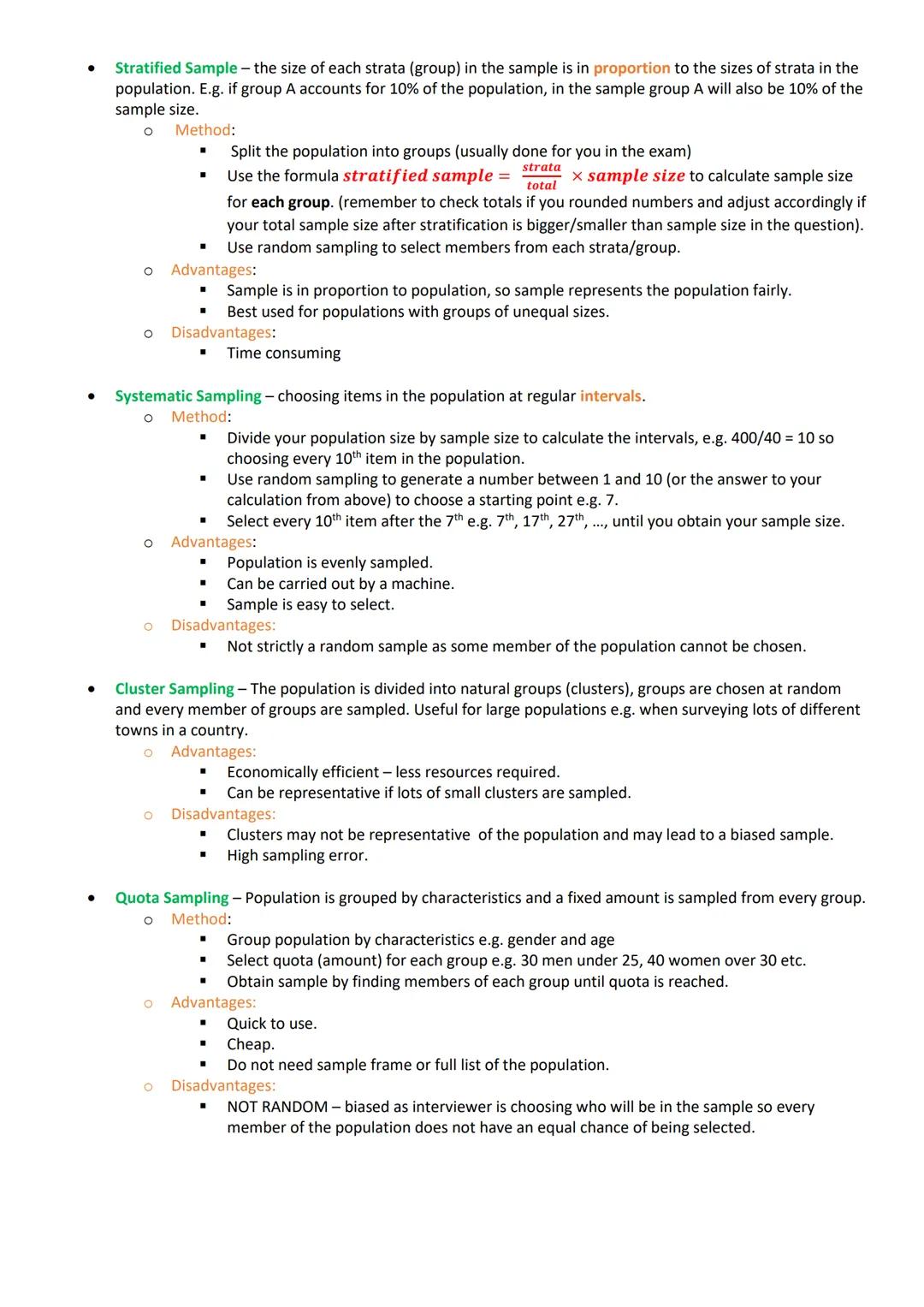
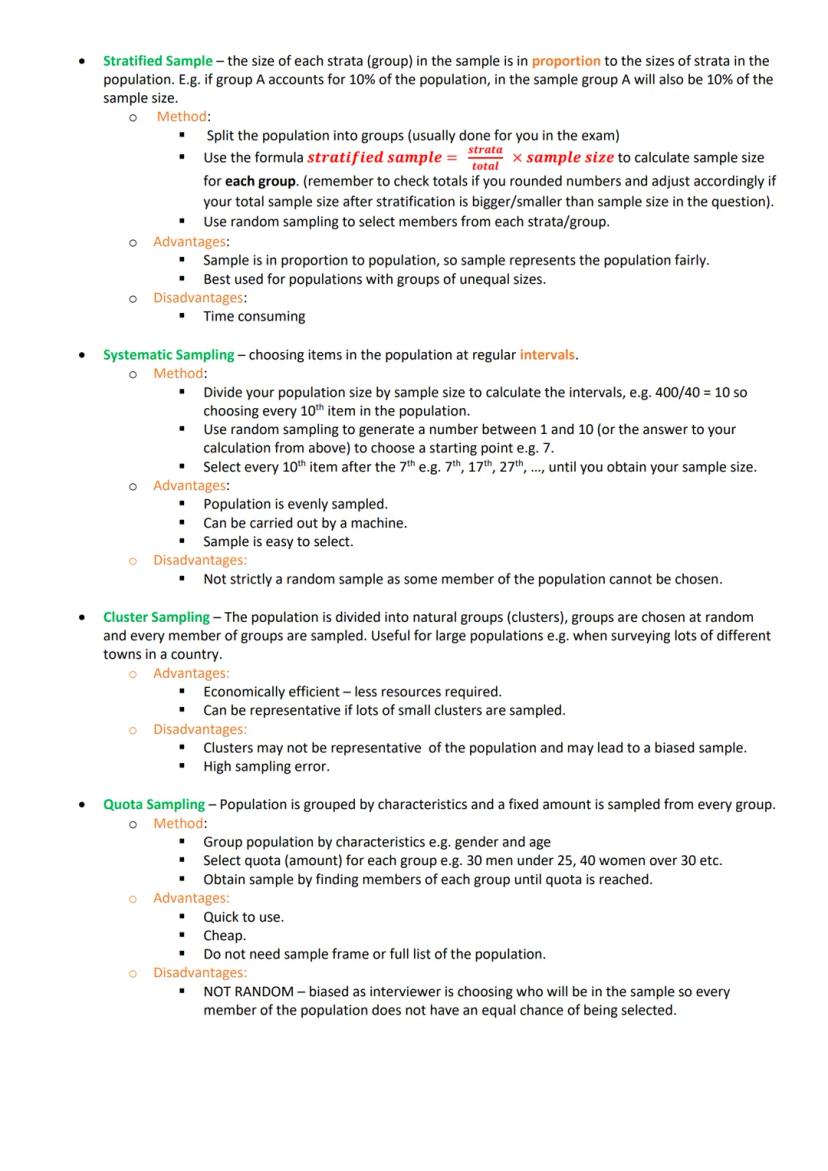
Stratified sampling is like making sure your playlist represents different music genres proportionally. If 30% of your school is Year 7, then 30% of your sample should be Year 7 students too. Use the formula: (strata size ÷ total population) × sample size.
Systematic sampling means picking every nth person – like surveying every 10th student entering school. Pick your starting point randomly, then stick to the pattern. It's efficient but not truly random since some people can never be selected.
Cluster sampling divides the population into natural groups, then surveys entire clusters. Imagine studying UK teenagers by randomly selecting whole schools. It's cost-effective for large, spread-out populations.
Memory Trick: Think of quota sampling like casting a film – you need specific numbers of different types of people, but the director (interviewer) chooses who gets picked. That's why it's not random!
Quota sampling and opportunity sampling are quick and cheap but definitely not random. The interviewer's personal biases creep in, making results unreliable. Judgement sampling relies entirely on someone's personal opinion about who to include.

The Petersen capture-recapture method helps estimate populations you can't count directly – like fish in a lake or foxes in a forest. Tag some animals, release them, then see what proportion of your second catch is tagged. It's clever but relies on big assumptions (no births, deaths, or lost tags).
The formula is straightforward: N = (M × n) ÷ m, where N is your population estimate. Remember, this only gives you an estimate, not an exact count.
Experiments test how changing one thing affects another. Your explanatory variable is what you deliberately change, while your response variable is what you measure. Watch out for extraneous variables – the sneaky factors that might mess up your results.
Real-World Connection: Think about testing revision methods. Your explanatory variable is the revision technique, response variable is exam performance, but extraneous variables include how much sleep students got or their natural ability.
Laboratory experiments give you maximum control but artificial conditions. Field experiments happen in real-world settings with less control. Natural experiments study things that already exist – like comparing exam results between different schools.
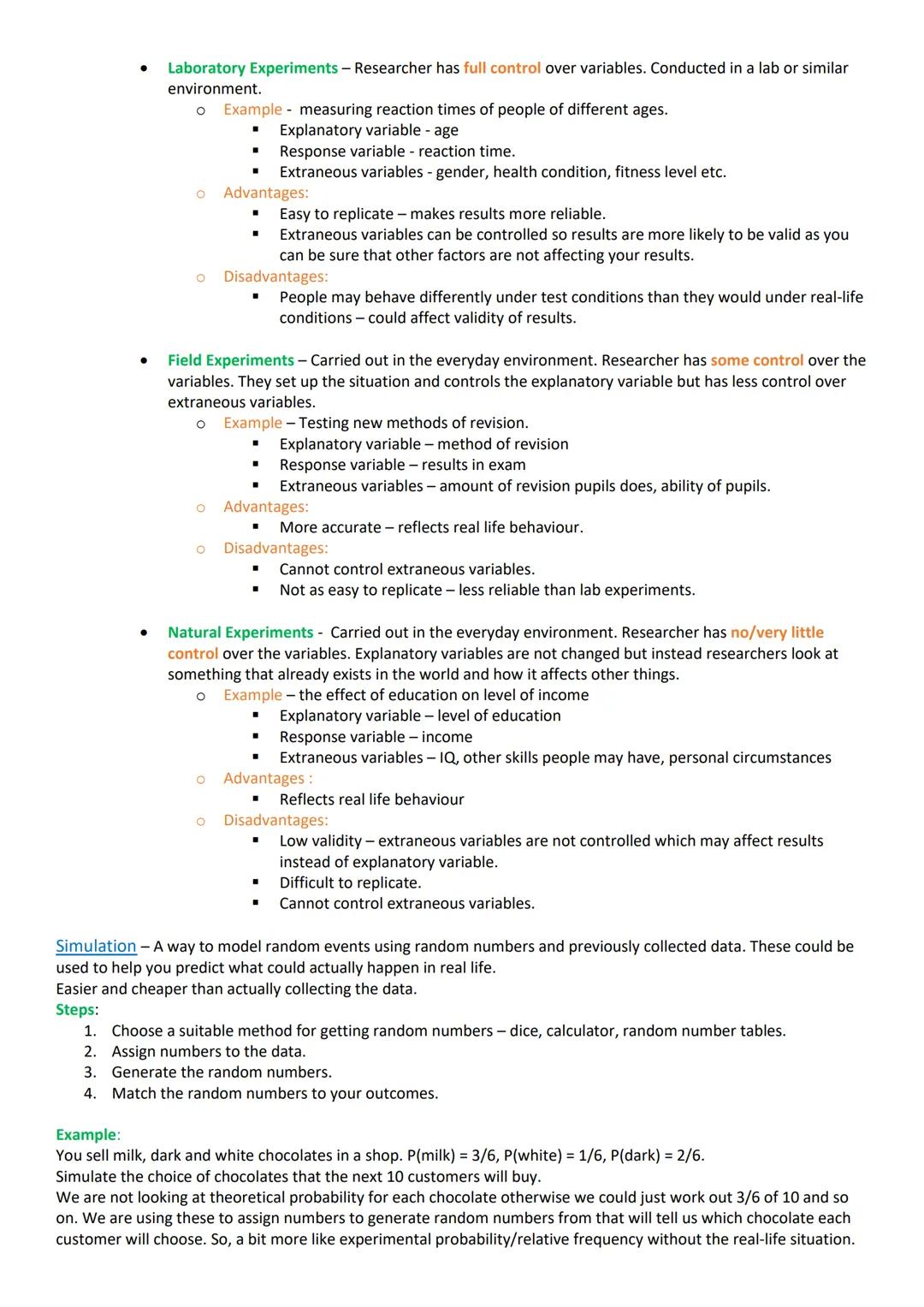
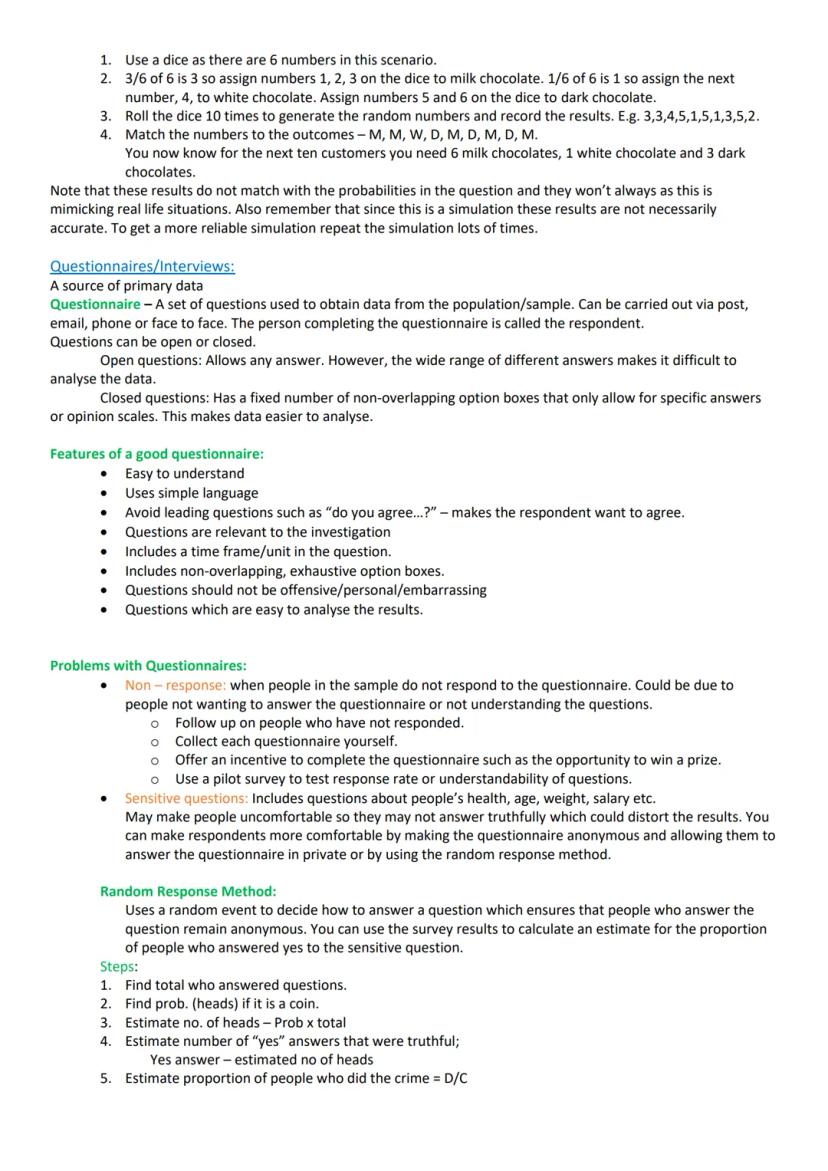
Simulation uses random numbers to model real-life situations without the expense and hassle of collecting actual data. It's like creating a virtual version of reality to test what might happen.
The process is systematic: choose your random number source (dice, calculator, random number tables), assign numbers to possible outcomes, generate random numbers, then match them to your outcomes. Your results won't match theoretical probabilities exactly – that's the point! You're mimicking real-world unpredictability.
Questionnaires are your primary data workhorses. Closed questions give you specific answer options (easier to analyse), while open questions let people write anything (harder to process but richer information).
Design Tip: Avoid leading questions like "Don't you agree that school uniforms are terrible?" Instead, ask neutral questions like "What is your opinion on school uniforms?" with balanced response options.
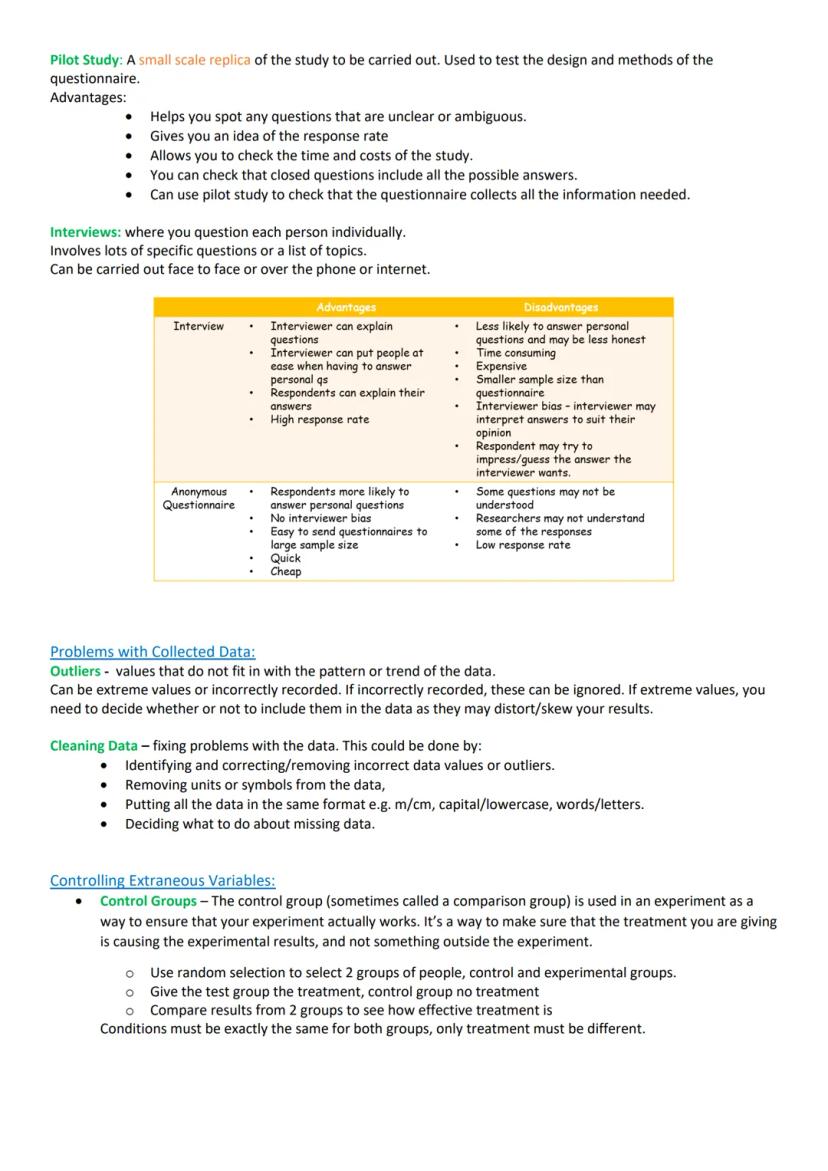
Good questionnaires use simple language, include time frames ("How many hours of TV do you watch per week?"), and provide non-overlapping answer options. Pilot studies test your questionnaire on a small group first – they'll spot confusing questions you missed.

Sensitive questions about personal topics make people uncomfortable, leading to dishonest answers or non-responses. The random response method cleverly protects anonymity while still gathering useful data – respondents flip a coin to decide whether to answer truthfully or give a predetermined response.
Non-response is a major headache. People ignore questionnaires for various reasons – too busy, don't understand questions, or simply can't be bothered. Combat this with follow-ups, incentives, or collecting responses face-to-face.
Interviews offer more flexibility than questionnaires. You can explain confusing questions and build rapport for sensitive topics. However, interviewer bias creeps in when interviewers unconsciously influence responses or interpret answers to fit their expectations.
Critical Thinking: Always question response rates in published surveys. If only 10% of people responded, how representative are those results really?
Cleaning data involves spotting and fixing problems – removing outliers (unusual values that don't fit the pattern), standardising formats, and dealing with missing information. Outliers might be genuine extreme cases or simple recording errors.
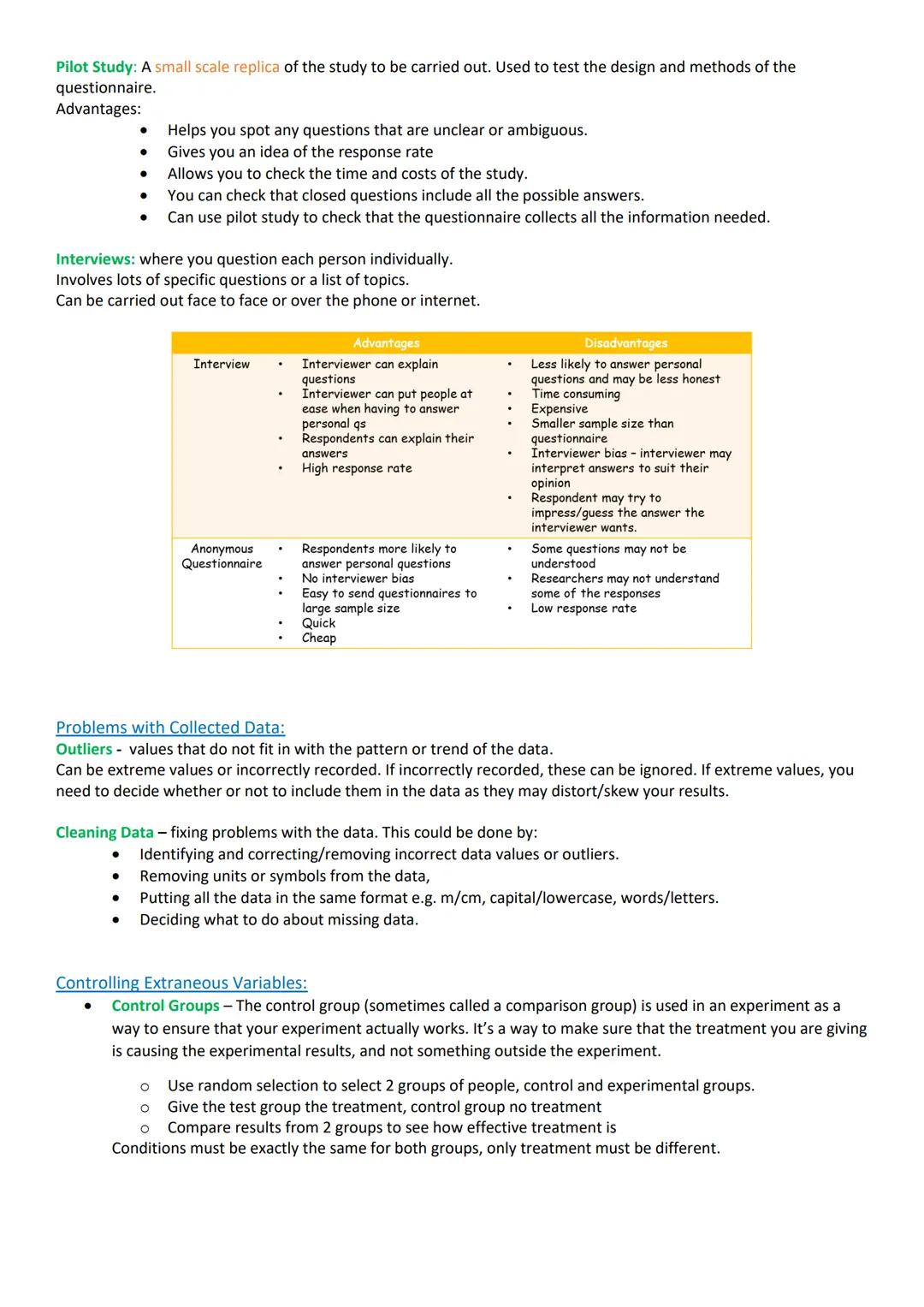
Control groups are essential for testing whether your treatment actually works. Give one group the treatment and another group nothing, keeping everything else identical. Compare the results to see if the treatment made a real difference.
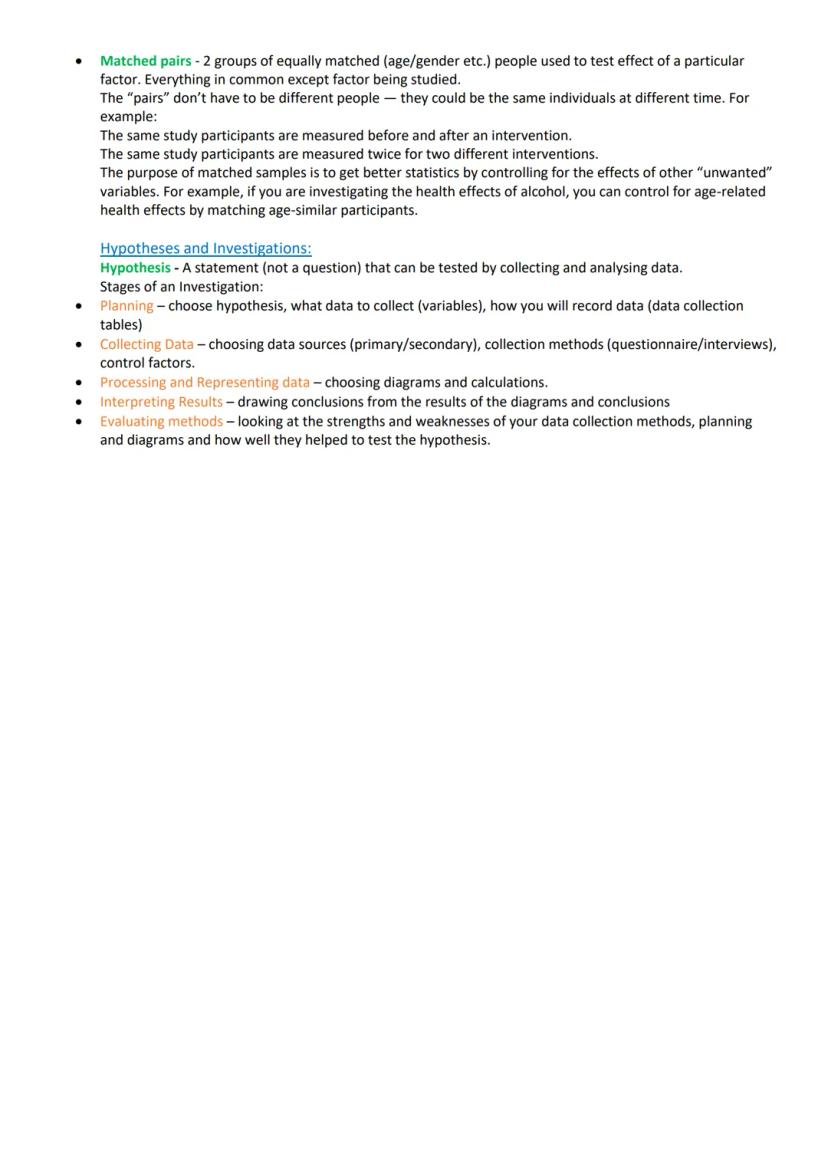
Matched pairs take this further by pairing up similar individuals or measuring the same people before and after treatment. This controls for individual differences that might skew your results.
The goal is eliminating extraneous variables that could mess up your conclusions. If you're testing whether music helps concentration, make sure both groups study in similar environments, at similar times, with similar difficulty materials.
Study Strategy: Think about your own revision experiments. If you try a new study method, what other factors might influence your performance? Sleep, stress levels, topic difficulty?
Remember that perfect control is impossible in real-world situations. The key is identifying the most important variables to control and acknowledging limitations in your conclusions.
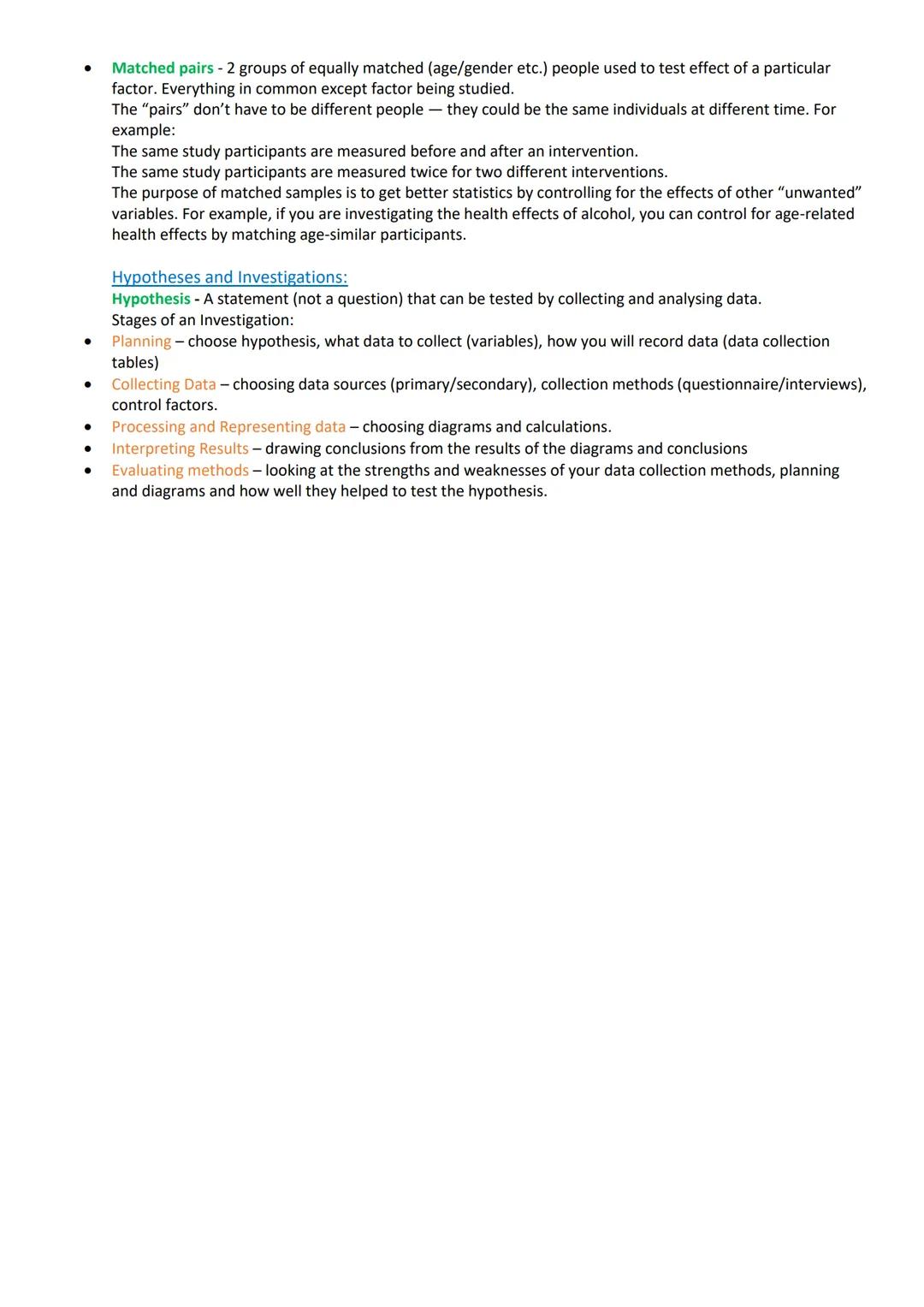
A hypothesis is a testable statement (not a question) that guides your entire investigation. Instead of asking "Do teenagers prefer Netflix or YouTube?", state "More teenagers prefer Netflix than YouTube."
Investigation stages follow a logical sequence: planning (decide what to investigate and how), collecting data (gather your evidence), processing and representing (organise and display results), interpreting (draw conclusions), and evaluating (identify strengths and weaknesses).
Each stage builds on the previous one. Poor planning leads to useless data collection, which creates meaningless results. Good investigations acknowledge their limitations and suggest improvements.
Success Tip: Examiners love seeing you evaluate methods critically. Don't just describe what you did – explain what worked well, what didn't, and how you'd improve next time.
Matched pairs can involve the same individuals tested twice or different people matched for important characteristics (age, gender, ability). The aim is controlling for variables that might otherwise confuse your results.

Our AI Companion is a student-focused AI tool that offers more than just answers. Built on millions of Knowunity resources, it provides relevant information, personalised study plans, quizzes, and content directly in the chat, adapting to your individual learning journey.
You can download the app from Google Play Store and Apple App Store.
That's right! Enjoy free access to study content, connect with fellow students, and get instant help – all at your fingertips.
App Store
Google Play
The app is very easy to use and well designed. I have found everything I was looking for so far and have been able to learn a lot from the presentations! I will definitely use the app for a class assignment! And of course it also helps a lot as an inspiration.
Stefan S
iOS user
This app is really great. There are so many study notes and help [...]. My problem subject is French, for example, and the app has so many options for help. Thanks to this app, I have improved my French. I would recommend it to anyone.
Samantha Klich
Android user
Wow, I am really amazed. I just tried the app because I've seen it advertised many times and was absolutely stunned. This app is THE HELP you want for school and above all, it offers so many things, such as workouts and fact sheets, which have been VERY helpful to me personally.
Anna
iOS user
Best app on earth! no words because it’s too good
Thomas R
iOS user
Just amazing. Let's me revise 10x better, this app is a quick 10/10. I highly recommend it to anyone. I can watch and search for notes. I can save them in the subject folder. I can revise it any time when I come back. If you haven't tried this app, you're really missing out.
Basil
Android user
This app has made me feel so much more confident in my exam prep, not only through boosting my own self confidence through the features that allow you to connect with others and feel less alone, but also through the way the app itself is centred around making you feel better. It is easy to navigate, fun to use, and helpful to anyone struggling in absolutely any way.
David K
iOS user
The app's just great! All I have to do is enter the topic in the search bar and I get the response real fast. I don't have to watch 10 YouTube videos to understand something, so I'm saving my time. Highly recommended!
Sudenaz Ocak
Android user
In school I was really bad at maths but thanks to the app, I am doing better now. I am so grateful that you made the app.
Greenlight Bonnie
Android user
very reliable app to help and grow your ideas of Maths, English and other related topics in your works. please use this app if your struggling in areas, this app is key for that. wish I'd of done a review before. and it's also free so don't worry about that.
Rohan U
Android user
I know a lot of apps use fake accounts to boost their reviews but this app deserves it all. Originally I was getting 4 in my English exams and this time I got a grade 7. I didn’t even know about this app three days until the exam and it has helped A LOT. Please actually trust me and use it as I’m sure you too will see developments.
Xander S
iOS user
THE QUIZES AND FLASHCARDS ARE SO USEFUL AND I LOVE Knowunity AI. IT ALSO IS LITREALLY LIKE CHATGPT BUT SMARTER!! HELPED ME WITH MY MASCARA PROBLEMS TOO!! AS WELL AS MY REAL SUBJECTS ! DUHHH 😍😁😲🤑💗✨🎀😮
Elisha
iOS user
This apps acc the goat. I find revision so boring but this app makes it so easy to organize it all and then you can ask the freeeee ai to test yourself so good and you can easily upload your own stuff. highly recommend as someone taking mocks now
Paul T
iOS user
The app is very easy to use and well designed. I have found everything I was looking for so far and have been able to learn a lot from the presentations! I will definitely use the app for a class assignment! And of course it also helps a lot as an inspiration.
Stefan S
iOS user
This app is really great. There are so many study notes and help [...]. My problem subject is French, for example, and the app has so many options for help. Thanks to this app, I have improved my French. I would recommend it to anyone.
Samantha Klich
Android user
Wow, I am really amazed. I just tried the app because I've seen it advertised many times and was absolutely stunned. This app is THE HELP you want for school and above all, it offers so many things, such as workouts and fact sheets, which have been VERY helpful to me personally.
Anna
iOS user
Best app on earth! no words because it’s too good
Thomas R
iOS user
Just amazing. Let's me revise 10x better, this app is a quick 10/10. I highly recommend it to anyone. I can watch and search for notes. I can save them in the subject folder. I can revise it any time when I come back. If you haven't tried this app, you're really missing out.
Basil
Android user
This app has made me feel so much more confident in my exam prep, not only through boosting my own self confidence through the features that allow you to connect with others and feel less alone, but also through the way the app itself is centred around making you feel better. It is easy to navigate, fun to use, and helpful to anyone struggling in absolutely any way.
David K
iOS user
The app's just great! All I have to do is enter the topic in the search bar and I get the response real fast. I don't have to watch 10 YouTube videos to understand something, so I'm saving my time. Highly recommended!
Sudenaz Ocak
Android user
In school I was really bad at maths but thanks to the app, I am doing better now. I am so grateful that you made the app.
Greenlight Bonnie
Android user
very reliable app to help and grow your ideas of Maths, English and other related topics in your works. please use this app if your struggling in areas, this app is key for that. wish I'd of done a review before. and it's also free so don't worry about that.
Rohan U
Android user
I know a lot of apps use fake accounts to boost their reviews but this app deserves it all. Originally I was getting 4 in my English exams and this time I got a grade 7. I didn’t even know about this app three days until the exam and it has helped A LOT. Please actually trust me and use it as I’m sure you too will see developments.
Xander S
iOS user
THE QUIZES AND FLASHCARDS ARE SO USEFUL AND I LOVE Knowunity AI. IT ALSO IS LITREALLY LIKE CHATGPT BUT SMARTER!! HELPED ME WITH MY MASCARA PROBLEMS TOO!! AS WELL AS MY REAL SUBJECTS ! DUHHH 😍😁😲🤑💗✨🎀😮
Elisha
iOS user
This apps acc the goat. I find revision so boring but this app makes it so easy to organize it all and then you can ask the freeeee ai to test yourself so good and you can easily upload your own stuff. highly recommend as someone taking mocks now
Paul T
iOS user
Zikra Naveed
@zikranaveed
Statistics is everywhere around you – from social media analytics to sports performance and opinion polls. Understanding how to collect, process, and analyse data is a crucial skill that helps you make sense of the world and spot when someone... Show more
Access to all documents
Improve your grades
Join milions of students
By signing up you accept Terms of Service and Privacy Policy
You're about to dive into one of the most practical subjects you'll study. Statistics isn't just about numbers on a page – it's the science behind understanding patterns, making predictions, and solving real-world problems.
This subject breaks down into key areas: collecting data properly, organising it so it makes sense, and presenting it in ways that tell a story. You'll learn why some surveys can't be trusted and how to design better ones yourself.
Quick Confidence Boost: Statistics is actually quite logical once you get the hang of it. Most concepts build on common sense – if something seems dodgy about a survey or graph, it probably is!
The skills you'll develop here apply to everything from understanding news reports to planning your own research projects. Let's get started with the fundamentals.
Access to all documents
Improve your grades
Join milions of students
By signing up you accept Terms of Service and Privacy Policy
Ever wondered why some surveys seem completely wrong? It's usually because someone messed up the data collection process. Understanding different types of data is your first step to becoming a statistics detective.
Raw data is like ingredients before cooking – messy and unprocessed. You'll work with qualitative data (descriptive stuff like favourite colours) and quantitative data (actual numbers you can measure). Discrete data comes in specific chunks (like number of siblings), while continuous data flows smoothly (like your height, which changes gradually).
Grouping data makes patterns easier to spot, but there's a trade-off. You gain clarity but lose precision – imagine trying to work out someone's exact age when you only know they're "16-18 years old."
Real-World Tip: When you see grouped data in news articles, remember they've sacrificed accuracy for simplicity. Always ask yourself: "What details might be hidden here?"
Primary data is fresh from the source (you collect it yourself), while secondary data is secondhand. Primary data takes longer but gives you exactly what you need. Secondary data is quick and cheap but might not answer your specific questions.
Access to all documents
Improve your grades
Join milions of students
By signing up you accept Terms of Service and Privacy Policy
Here's where things get interesting – you can't survey everyone, so you need to get clever about who you ask. A population is everyone you're interested in studying, but a census of the entire population is usually impossible (imagine surveying every teenager in the UK!).
That's where sampling comes in. Your sample needs to represent the whole population fairly, or your results will be useless. A biased sample is like judging all teenagers based only on the ones who hang around shopping centres – not exactly representative!
Random sampling gives everyone an equal chance of being picked. You'll need a sampling frame (like a school register) and proper random selection methods. Use random number generators or tables – don't just pick people you like!
Exam Success: Always explain your random sampling method clearly. Saying "pick names from a hat" works for small samples, but examiners want to see you understand proper techniques for larger populations.
The key disadvantage? You need a complete list of everyone in your population, which isn't always possible. Plus, it can be expensive and time-consuming to track down randomly selected people.
Access to all documents
Improve your grades
Join milions of students
By signing up you accept Terms of Service and Privacy Policy
Stratified sampling is like making sure your playlist represents different music genres proportionally. If 30% of your school is Year 7, then 30% of your sample should be Year 7 students too. Use the formula: (strata size ÷ total population) × sample size.
Systematic sampling means picking every nth person – like surveying every 10th student entering school. Pick your starting point randomly, then stick to the pattern. It's efficient but not truly random since some people can never be selected.
Cluster sampling divides the population into natural groups, then surveys entire clusters. Imagine studying UK teenagers by randomly selecting whole schools. It's cost-effective for large, spread-out populations.
Memory Trick: Think of quota sampling like casting a film – you need specific numbers of different types of people, but the director (interviewer) chooses who gets picked. That's why it's not random!
Quota sampling and opportunity sampling are quick and cheap but definitely not random. The interviewer's personal biases creep in, making results unreliable. Judgement sampling relies entirely on someone's personal opinion about who to include.
Access to all documents
Improve your grades
Join milions of students
By signing up you accept Terms of Service and Privacy Policy
The Petersen capture-recapture method helps estimate populations you can't count directly – like fish in a lake or foxes in a forest. Tag some animals, release them, then see what proportion of your second catch is tagged. It's clever but relies on big assumptions (no births, deaths, or lost tags).
The formula is straightforward: N = (M × n) ÷ m, where N is your population estimate. Remember, this only gives you an estimate, not an exact count.
Experiments test how changing one thing affects another. Your explanatory variable is what you deliberately change, while your response variable is what you measure. Watch out for extraneous variables – the sneaky factors that might mess up your results.
Real-World Connection: Think about testing revision methods. Your explanatory variable is the revision technique, response variable is exam performance, but extraneous variables include how much sleep students got or their natural ability.
Laboratory experiments give you maximum control but artificial conditions. Field experiments happen in real-world settings with less control. Natural experiments study things that already exist – like comparing exam results between different schools.
Access to all documents
Improve your grades
Join milions of students
By signing up you accept Terms of Service and Privacy Policy
Simulation uses random numbers to model real-life situations without the expense and hassle of collecting actual data. It's like creating a virtual version of reality to test what might happen.
The process is systematic: choose your random number source (dice, calculator, random number tables), assign numbers to possible outcomes, generate random numbers, then match them to your outcomes. Your results won't match theoretical probabilities exactly – that's the point! You're mimicking real-world unpredictability.
Questionnaires are your primary data workhorses. Closed questions give you specific answer options (easier to analyse), while open questions let people write anything (harder to process but richer information).
Design Tip: Avoid leading questions like "Don't you agree that school uniforms are terrible?" Instead, ask neutral questions like "What is your opinion on school uniforms?" with balanced response options.
Good questionnaires use simple language, include time frames ("How many hours of TV do you watch per week?"), and provide non-overlapping answer options. Pilot studies test your questionnaire on a small group first – they'll spot confusing questions you missed.
Access to all documents
Improve your grades
Join milions of students
By signing up you accept Terms of Service and Privacy Policy
Sensitive questions about personal topics make people uncomfortable, leading to dishonest answers or non-responses. The random response method cleverly protects anonymity while still gathering useful data – respondents flip a coin to decide whether to answer truthfully or give a predetermined response.
Non-response is a major headache. People ignore questionnaires for various reasons – too busy, don't understand questions, or simply can't be bothered. Combat this with follow-ups, incentives, or collecting responses face-to-face.
Interviews offer more flexibility than questionnaires. You can explain confusing questions and build rapport for sensitive topics. However, interviewer bias creeps in when interviewers unconsciously influence responses or interpret answers to fit their expectations.
Critical Thinking: Always question response rates in published surveys. If only 10% of people responded, how representative are those results really?
Cleaning data involves spotting and fixing problems – removing outliers (unusual values that don't fit the pattern), standardising formats, and dealing with missing information. Outliers might be genuine extreme cases or simple recording errors.
Access to all documents
Improve your grades
Join milions of students
By signing up you accept Terms of Service and Privacy Policy
Control groups are essential for testing whether your treatment actually works. Give one group the treatment and another group nothing, keeping everything else identical. Compare the results to see if the treatment made a real difference.
Matched pairs take this further by pairing up similar individuals or measuring the same people before and after treatment. This controls for individual differences that might skew your results.
The goal is eliminating extraneous variables that could mess up your conclusions. If you're testing whether music helps concentration, make sure both groups study in similar environments, at similar times, with similar difficulty materials.
Study Strategy: Think about your own revision experiments. If you try a new study method, what other factors might influence your performance? Sleep, stress levels, topic difficulty?
Remember that perfect control is impossible in real-world situations. The key is identifying the most important variables to control and acknowledging limitations in your conclusions.
Access to all documents
Improve your grades
Join milions of students
By signing up you accept Terms of Service and Privacy Policy
A hypothesis is a testable statement (not a question) that guides your entire investigation. Instead of asking "Do teenagers prefer Netflix or YouTube?", state "More teenagers prefer Netflix than YouTube."
Investigation stages follow a logical sequence: planning (decide what to investigate and how), collecting data (gather your evidence), processing and representing (organise and display results), interpreting (draw conclusions), and evaluating (identify strengths and weaknesses).
Each stage builds on the previous one. Poor planning leads to useless data collection, which creates meaningless results. Good investigations acknowledge their limitations and suggest improvements.
Success Tip: Examiners love seeing you evaluate methods critically. Don't just describe what you did – explain what worked well, what didn't, and how you'd improve next time.
Matched pairs can involve the same individuals tested twice or different people matched for important characteristics (age, gender, ability). The aim is controlling for variables that might otherwise confuse your results.
Access to all documents
Improve your grades
Join milions of students
By signing up you accept Terms of Service and Privacy Policy
Our AI Companion is a student-focused AI tool that offers more than just answers. Built on millions of Knowunity resources, it provides relevant information, personalised study plans, quizzes, and content directly in the chat, adapting to your individual learning journey.
You can download the app from Google Play Store and Apple App Store.
That's right! Enjoy free access to study content, connect with fellow students, and get instant help – all at your fingertips.
1
Smart Tools NEW
Transform this note into: ✓ 50+ Practice Questions ✓ Interactive Flashcards ✓ Full Mock Exam ✓ Essay Outlines
App Store
Google Play
The app is very easy to use and well designed. I have found everything I was looking for so far and have been able to learn a lot from the presentations! I will definitely use the app for a class assignment! And of course it also helps a lot as an inspiration.
Stefan S
iOS user
This app is really great. There are so many study notes and help [...]. My problem subject is French, for example, and the app has so many options for help. Thanks to this app, I have improved my French. I would recommend it to anyone.
Samantha Klich
Android user
Wow, I am really amazed. I just tried the app because I've seen it advertised many times and was absolutely stunned. This app is THE HELP you want for school and above all, it offers so many things, such as workouts and fact sheets, which have been VERY helpful to me personally.
Anna
iOS user
Best app on earth! no words because it’s too good
Thomas R
iOS user
Just amazing. Let's me revise 10x better, this app is a quick 10/10. I highly recommend it to anyone. I can watch and search for notes. I can save them in the subject folder. I can revise it any time when I come back. If you haven't tried this app, you're really missing out.
Basil
Android user
This app has made me feel so much more confident in my exam prep, not only through boosting my own self confidence through the features that allow you to connect with others and feel less alone, but also through the way the app itself is centred around making you feel better. It is easy to navigate, fun to use, and helpful to anyone struggling in absolutely any way.
David K
iOS user
The app's just great! All I have to do is enter the topic in the search bar and I get the response real fast. I don't have to watch 10 YouTube videos to understand something, so I'm saving my time. Highly recommended!
Sudenaz Ocak
Android user
In school I was really bad at maths but thanks to the app, I am doing better now. I am so grateful that you made the app.
Greenlight Bonnie
Android user
very reliable app to help and grow your ideas of Maths, English and other related topics in your works. please use this app if your struggling in areas, this app is key for that. wish I'd of done a review before. and it's also free so don't worry about that.
Rohan U
Android user
I know a lot of apps use fake accounts to boost their reviews but this app deserves it all. Originally I was getting 4 in my English exams and this time I got a grade 7. I didn’t even know about this app three days until the exam and it has helped A LOT. Please actually trust me and use it as I’m sure you too will see developments.
Xander S
iOS user
THE QUIZES AND FLASHCARDS ARE SO USEFUL AND I LOVE Knowunity AI. IT ALSO IS LITREALLY LIKE CHATGPT BUT SMARTER!! HELPED ME WITH MY MASCARA PROBLEMS TOO!! AS WELL AS MY REAL SUBJECTS ! DUHHH 😍😁😲🤑💗✨🎀😮
Elisha
iOS user
This apps acc the goat. I find revision so boring but this app makes it so easy to organize it all and then you can ask the freeeee ai to test yourself so good and you can easily upload your own stuff. highly recommend as someone taking mocks now
Paul T
iOS user
The app is very easy to use and well designed. I have found everything I was looking for so far and have been able to learn a lot from the presentations! I will definitely use the app for a class assignment! And of course it also helps a lot as an inspiration.
Stefan S
iOS user
This app is really great. There are so many study notes and help [...]. My problem subject is French, for example, and the app has so many options for help. Thanks to this app, I have improved my French. I would recommend it to anyone.
Samantha Klich
Android user
Wow, I am really amazed. I just tried the app because I've seen it advertised many times and was absolutely stunned. This app is THE HELP you want for school and above all, it offers so many things, such as workouts and fact sheets, which have been VERY helpful to me personally.
Anna
iOS user
Best app on earth! no words because it’s too good
Thomas R
iOS user
Just amazing. Let's me revise 10x better, this app is a quick 10/10. I highly recommend it to anyone. I can watch and search for notes. I can save them in the subject folder. I can revise it any time when I come back. If you haven't tried this app, you're really missing out.
Basil
Android user
This app has made me feel so much more confident in my exam prep, not only through boosting my own self confidence through the features that allow you to connect with others and feel less alone, but also through the way the app itself is centred around making you feel better. It is easy to navigate, fun to use, and helpful to anyone struggling in absolutely any way.
David K
iOS user
The app's just great! All I have to do is enter the topic in the search bar and I get the response real fast. I don't have to watch 10 YouTube videos to understand something, so I'm saving my time. Highly recommended!
Sudenaz Ocak
Android user
In school I was really bad at maths but thanks to the app, I am doing better now. I am so grateful that you made the app.
Greenlight Bonnie
Android user
very reliable app to help and grow your ideas of Maths, English and other related topics in your works. please use this app if your struggling in areas, this app is key for that. wish I'd of done a review before. and it's also free so don't worry about that.
Rohan U
Android user
I know a lot of apps use fake accounts to boost their reviews but this app deserves it all. Originally I was getting 4 in my English exams and this time I got a grade 7. I didn’t even know about this app three days until the exam and it has helped A LOT. Please actually trust me and use it as I’m sure you too will see developments.
Xander S
iOS user
THE QUIZES AND FLASHCARDS ARE SO USEFUL AND I LOVE Knowunity AI. IT ALSO IS LITREALLY LIKE CHATGPT BUT SMARTER!! HELPED ME WITH MY MASCARA PROBLEMS TOO!! AS WELL AS MY REAL SUBJECTS ! DUHHH 😍😁😲🤑💗✨🎀😮
Elisha
iOS user
This apps acc the goat. I find revision so boring but this app makes it so easy to organize it all and then you can ask the freeeee ai to test yourself so good and you can easily upload your own stuff. highly recommend as someone taking mocks now
Paul T
iOS user