
Research methods are the backbone of sociology, giving us different... Show more
 Psychology
 Sociology
 English Literature
 Biology
Sign up to see the contentIt's free!
Access to all documents
Improve your grades
Join milions of students
By signing up you accept Terms of Service and Privacy Policy
Subjects
Classic Dramatic Literature
Modern Lyric Poetry
Influential English-Language Authors
Classic and Contemporary Novels
Literary Character Analysis
Romantic and Love Poetry
Reading Analysis and Interpretation
Evidence Analysis and Integration
Author's Stylistic Elements
Figurative Language and Rhetoric
Show all topics
Human Organ Systems
Cellular Organization and Development
Biomolecular Structure and Organization
Enzyme Structure and Regulation
Cellular Organization Types
Biological Homeostatic Processes
Cellular Membrane Structure
Autotrophic Energy Processes
Environmental Sustainability and Impact
Neural Communication Systems
Show all topics
Social Sciences Research & Practice
Social Structure and Mobility
Classic Social Influence Experiments
Social Systems Theories
Family and Relationship Dynamics
Memory Systems and Processes
Neural Bases of Behavior
Social Influence and Attraction
Psychotherapeutic Approaches
Human Agency and Responsibility
Show all topics
Chemical Sciences and Applications
Chemical Bond Types and Properties
Organic Functional Groups
Atomic Structure and Composition
Chromatographic Separation Principles
Chemical Compound Classifications
Electrochemical Cell Systems
Periodic Table Organization
Chemical Reaction Kinetics
Chemical Equation Conservation
Show all topics
Nazi Germany and Holocaust 1933-1945
World Wars and Peace Treaties
European Monarchs and Statesmen
Cold War Global Tensions
Medieval Institutions and Systems
European Renaissance and Enlightenment
Modern Global Environmental-Health Challenges
Modern Military Conflicts
Medieval Migration and Invasions
World Wars Era and Impact
Show all topics
521
•
Updated 3 Mar 2026
•
Millie
@millalalou
Research methods are the backbone of sociology, giving us different... Show more
![# Research methods - Strengths, limitacions, and examples
Experiments (quantitative/positivist]
- Aim to isolare and measure maiviowal vari](/_next/image?url=https%3A%2F%2Fcontent-eu-central-1.knowunity.com%2FCONTENT%2F018fba7e-e881-7c2a-b445-624b28daf224_image_page_1.webp&w=2048&q=75)
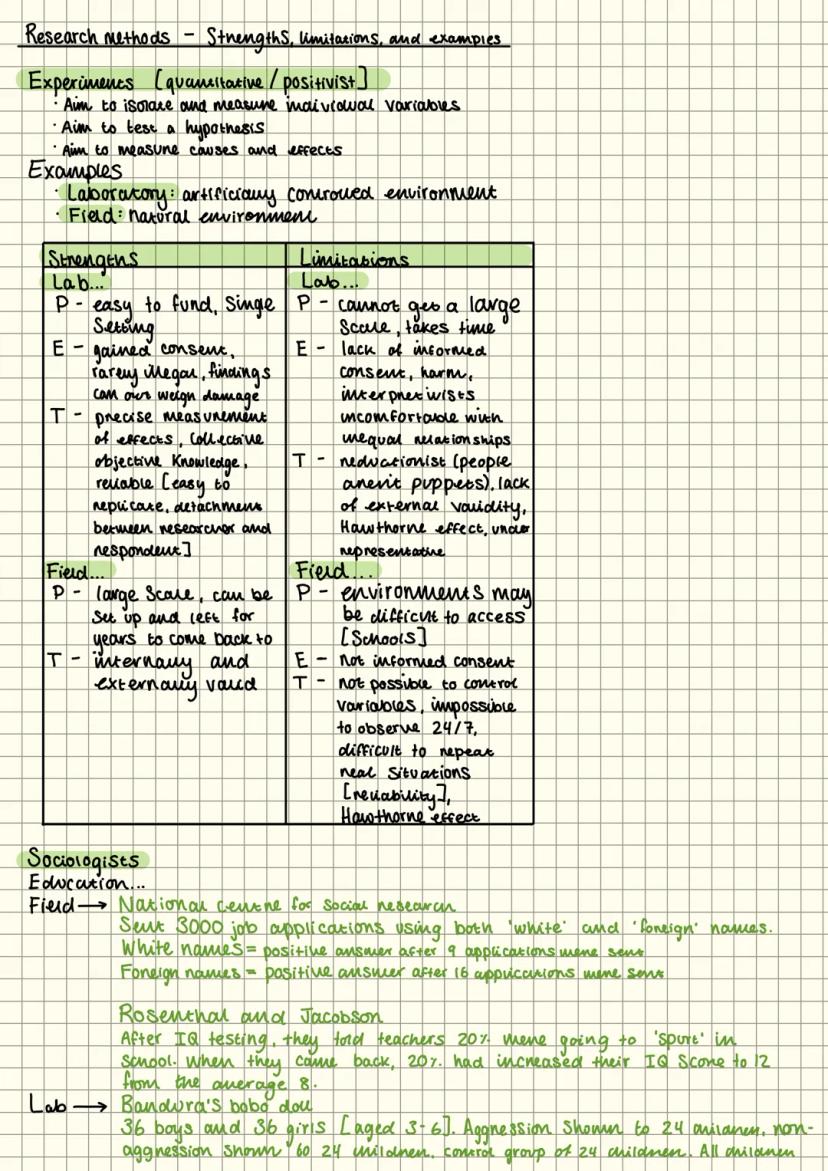
Ever wondered how psychologists prove their theories? Experiments are brilliant for testing specific ideas (hypotheses) by isolating individual factors to see what really causes what.
There are two main types: laboratory experiments happen in artificial, controlled environments, whilst field experiments take place in natural settings like schools or workplaces. Lab experiments give you precise control - think Bandura's famous bobo doll study where 72 children were shown either aggressive or non-aggressive behaviour, then observed to see if they copied what they'd seen.
Field experiments happen in real-world settings but still involve manipulation. The National Centre for Social Research sent 3000 job applications using both 'white' and 'foreign' names - white names got positive responses after 9 applications, whilst foreign names needed 16. This revealed discrimination in a way that felt completely natural to employers.
Remember: Lab experiments are reliable and easy to repeat, but field experiments give you more realistic results - though they're much harder to control perfectly.
![# Research methods - Strengths, limitacions, and examples
Experiments (quantitative/positivist]
- Aim to isolare and measure maiviowal vari](/_next/image?url=https%3A%2F%2Fcontent-eu-central-1.knowunity.com%2FCONTENT%2F018fba7e-e881-7c2a-b445-624b28daf224_image_page_2.webp&w=2048&q=75)
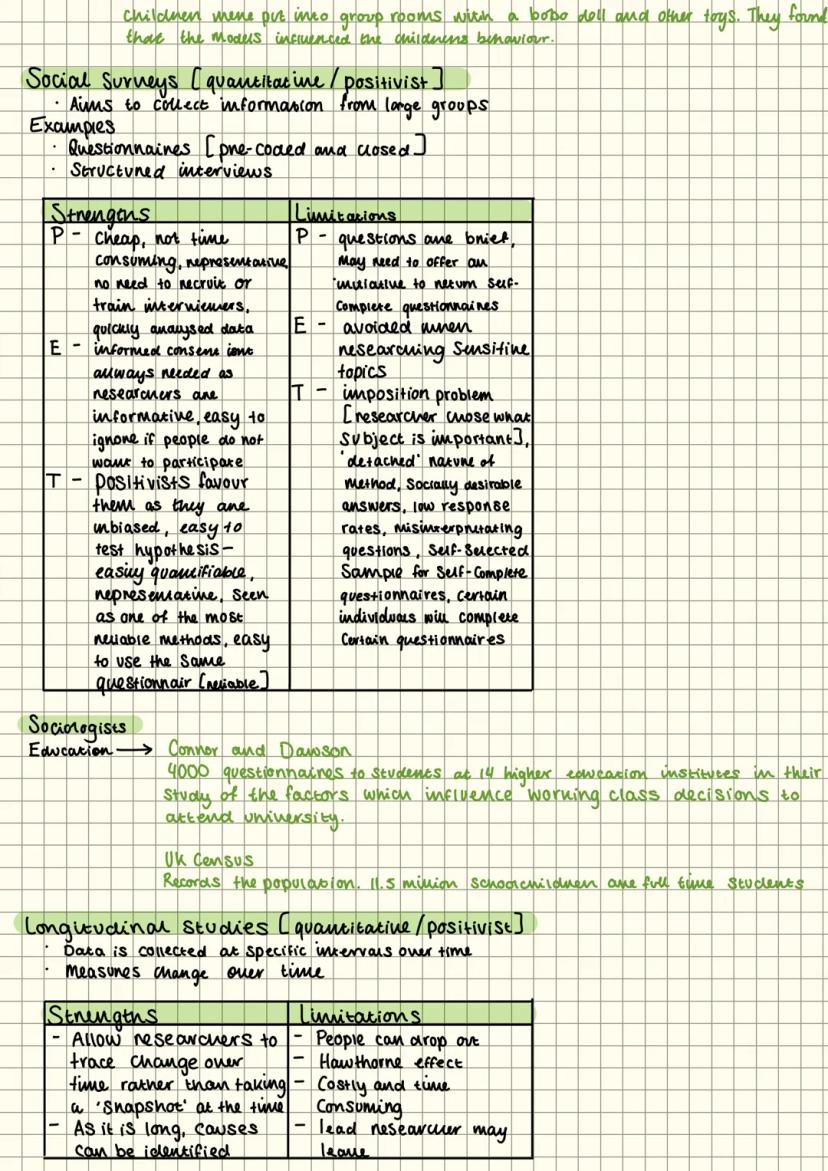
When you need to know what thousands of people think, social surveys are your best friend. These use questionnaires and structured interviews to collect information from huge groups quickly and cheaply.
Connor and Dawson sent questionnaires to 4000 students across 14 universities to understand why working-class students choose higher education. The UK Census is the ultimate survey - it records our entire population and tells us that 11.5 million schoolchildren are full-time students.
The biggest advantage? You can get representative results without spending ages training interviewers. Positivists love surveys because they produce solid, quantifiable data that's easy to analyse and test hypotheses with.
But there's a catch - people might give socially desirable answers (telling you what they think you want to hear), misinterpret questions, or simply ignore your survey completely. You're also stuck with brief questions that might miss the deeper story.
Key insight: Surveys are brilliant for the 'what' and 'how many', but rubbish for understanding the 'why' behind people's behaviour.
![# Research methods - Strengths, limitacions, and examples
Experiments (quantitative/positivist]
- Aim to isolare and measure maiviowal vari](/_next/image?url=https%3A%2F%2Fcontent-eu-central-1.knowunity.com%2FCONTENT%2F018fba7e-e881-7c2a-b445-624b28daf224_image_page_3.webp&w=2048&q=75)
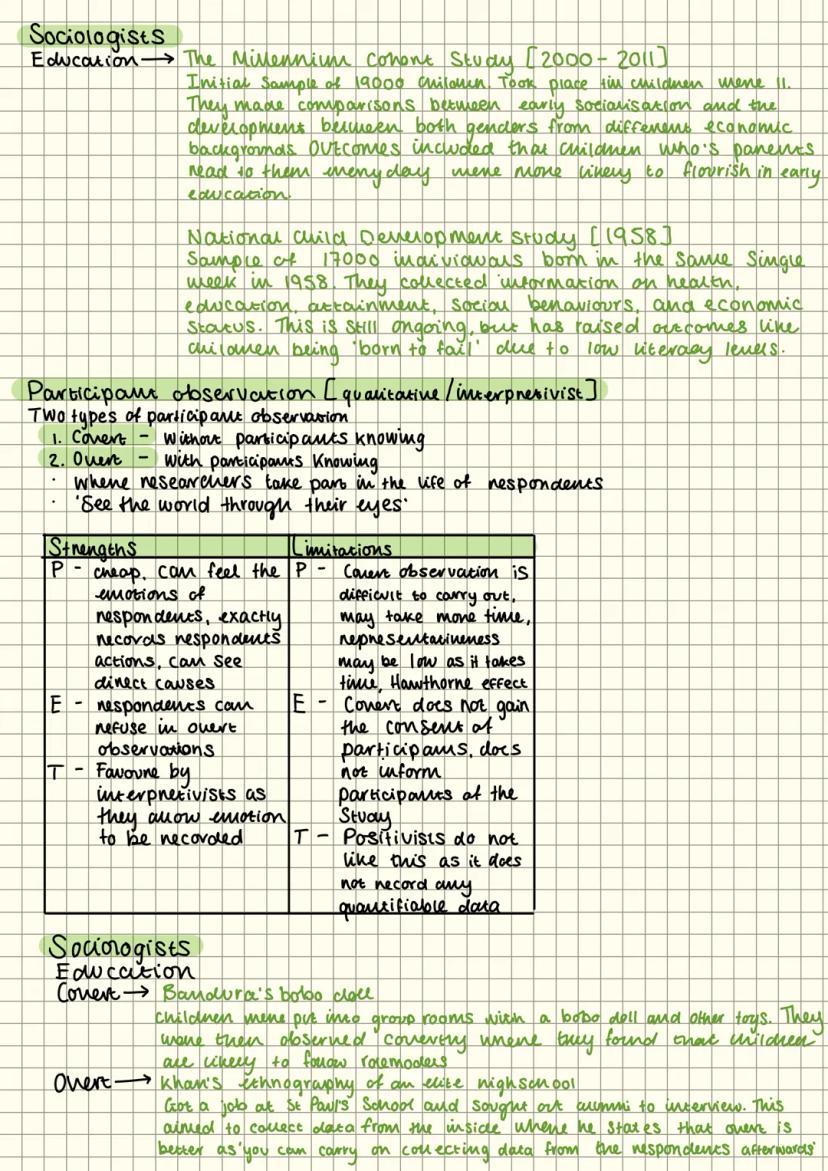
Longitudinal studies follow the same people over years or even decades, giving you a proper understanding of how things change over time. The Millennium Cohort Study tracked 19,000 children from 2000-2011, discovering that kids whose parents read to them daily were more likely to succeed in early education.
The National Child Development Study has followed 17,000 people born in the same week in 1958 - they're still collecting data today! This research revealed how some children are essentially 'born to fail' due to low literacy levels in their families.
Participant observation takes a completely different approach - researchers actually join in with people's daily lives to see the world through their eyes. This can be covert (secret) or overt (open about being a researcher).
Khan got a job at the elite St Paul's School and interviewed alumni to understand how posh schools really work. He preferred overt observation because you can keep collecting data from people afterwards. However, these methods are time-consuming, expensive, and people might drop out or change their behaviour because they know they're being watched (Hawthorne effect).
Think about it: Would you act differently if you knew a researcher was watching everything you do?
![# Research methods - Strengths, limitacions, and examples
Experiments (quantitative/positivist]
- Aim to isolare and measure maiviowal vari](/_next/image?url=https%3A%2F%2Fcontent-eu-central-1.knowunity.com%2FCONTENT%2F018fba7e-e881-7c2a-b445-624b28daf224_image_page_4.webp&w=2048&q=75)
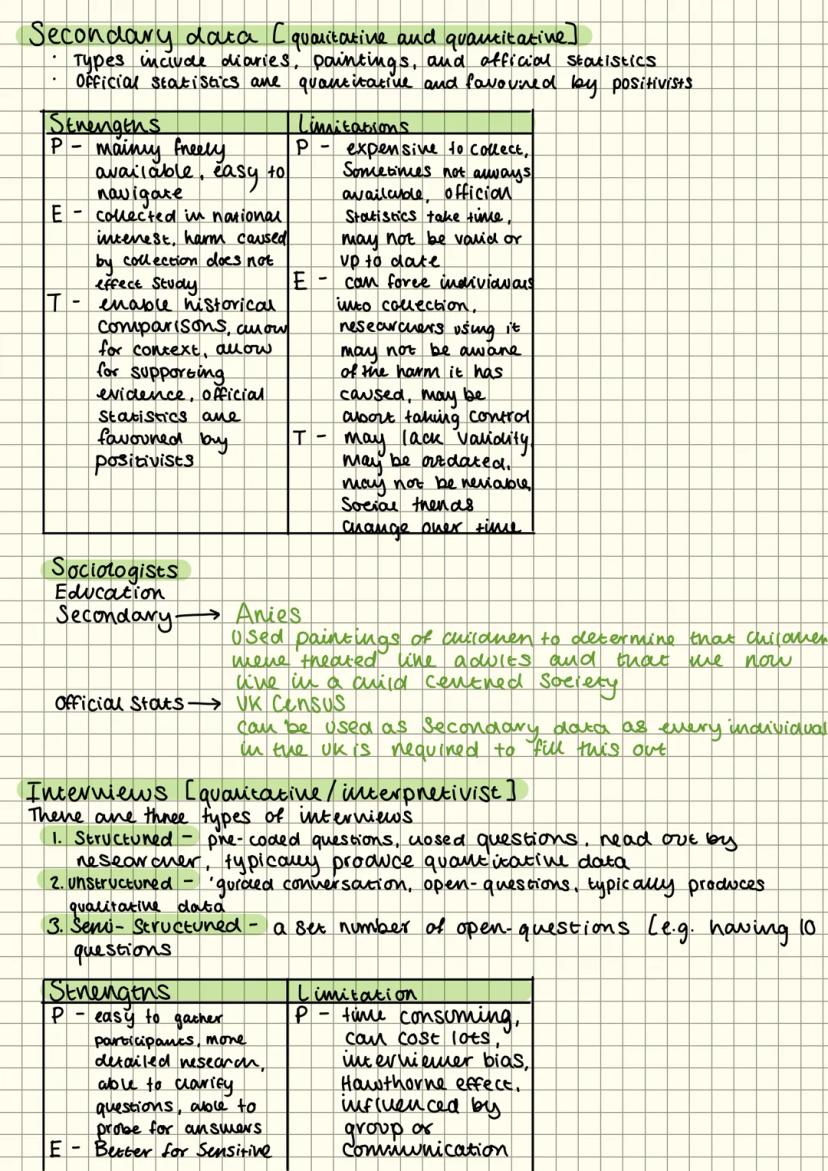
Secondary data means using information that someone else has already collected - think diaries, paintings, government statistics, or census data. It's mostly free, readily available, and lets you make historical comparisons without causing any harm to participants.
Aries used old paintings of children to show how childhood has changed - historically, kids were treated like mini-adults, but now we live in a child-centred society. The UK Census becomes secondary data when researchers use it years later to spot social trends.
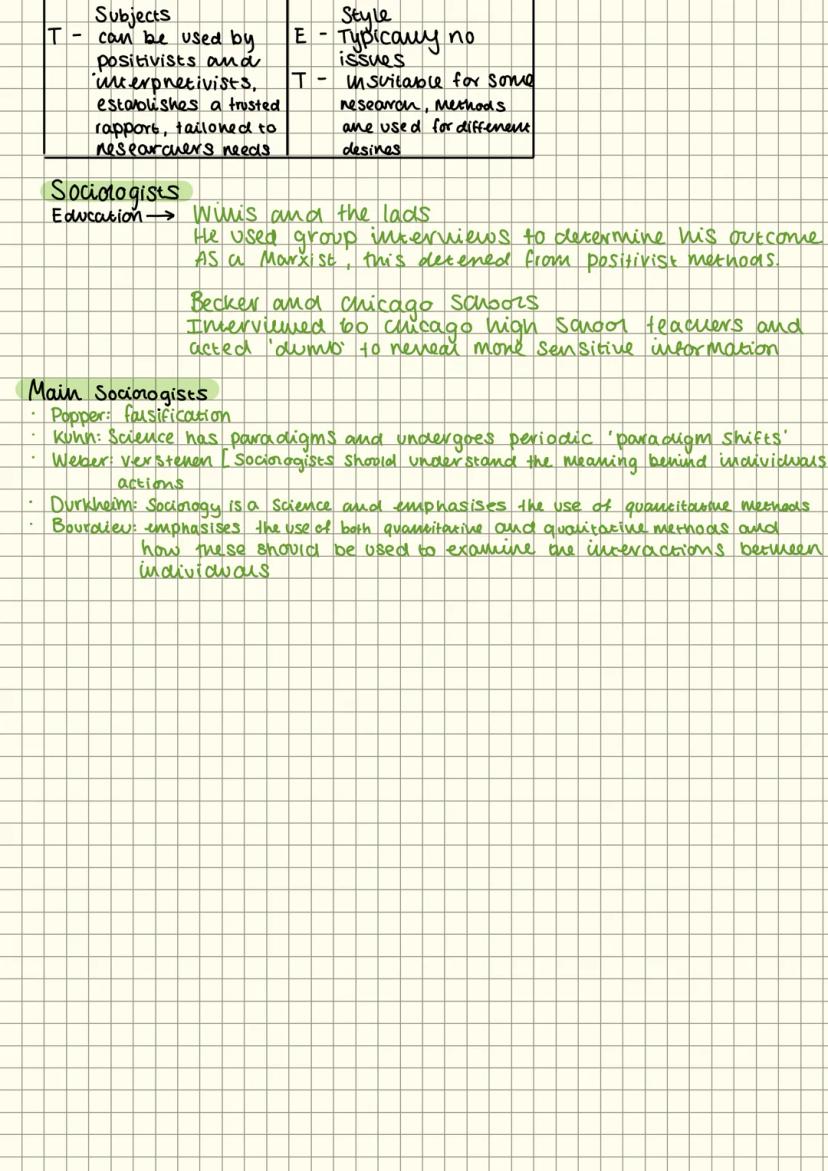
Interviews come in three flavours: structured (like reading from a script), unstructured (more like guided conversations), and semi-structured (a mix of both). Willis used group interviews with working-class lads to understand why they rejected school, whilst Becker interviewed 60 Chicago teachers and 'acted dumb' to get them to reveal sensitive information.
The beauty of interviews is that you can clarify confusing questions, probe deeper into interesting answers, and build trust with participants. However, they're expensive, time-consuming, and vulnerable to interviewer bias - your presence might influence what people say.
Pro tip: The key is matching your method to your research question - you wouldn't use a structured interview to understand someone's deepest emotions!
![# Research methods - Strengths, limitacions, and examples
Experiments (quantitative/positivist]
- Aim to isolare and measure maiviowal vari](/_next/image?url=https%3A%2F%2Fcontent-eu-central-1.knowunity.com%2FCONTENT%2F018fba7e-e881-7c2a-b445-624b28daf224_image_page_5.webp&w=2048&q=75)
Different sociologists have shaped how we think about research methods. Durkheim argued that sociology should be scientific and emphasise quantitative methods, whilst Weber introduced verstehen - the idea that we need to understand the meaning behind people's actions, not just count their behaviour.
Popper gave us falsification - the principle that good theories should be testable and potentially provable wrong. Kuhn explained how science works through paradigms (shared ways of thinking) that occasionally shift completely when new evidence emerges.
Bourdieu took a balanced approach, arguing that we need both quantitative and qualitative methods to properly examine how individuals interact with each other and society.
The reality is that each method has trade-offs. Positivists prefer quantitative methods because they're reliable and objective, whilst interpretivists favour qualitative approaches that capture emotions and meanings. The trick is choosing the right tool for the job - and sometimes that means using several different methods together.
Bottom line: There's no perfect research method - they all have strengths and limitations, so smart researchers often combine multiple approaches to get the most complete picture possible.
Our AI Companion is a student-focused AI tool that offers more than just answers. Built on millions of Knowunity resources, it provides relevant information, personalised study plans, quizzes, and content directly in the chat, adapting to your individual learning journey.
You can download the app from Google Play Store and Apple App Store.
That's right! Enjoy free access to study content, connect with fellow students, and get instant help – all at your fingertips.
App Store
Google Play
The app is very easy to use and well designed. I have found everything I was looking for so far and have been able to learn a lot from the presentations! I will definitely use the app for a class assignment! And of course it also helps a lot as an inspiration.
Stefan S
iOS user
This app is really great. There are so many study notes and help [...]. My problem subject is French, for example, and the app has so many options for help. Thanks to this app, I have improved my French. I would recommend it to anyone.
Samantha Klich
Android user
Wow, I am really amazed. I just tried the app because I've seen it advertised many times and was absolutely stunned. This app is THE HELP you want for school and above all, it offers so many things, such as workouts and fact sheets, which have been VERY helpful to me personally.
Anna
iOS user
Best app on earth! no words because it’s too good
Thomas R
iOS user
Just amazing. Let's me revise 10x better, this app is a quick 10/10. I highly recommend it to anyone. I can watch and search for notes. I can save them in the subject folder. I can revise it any time when I come back. If you haven't tried this app, you're really missing out.
Basil
Android user
This app has made me feel so much more confident in my exam prep, not only through boosting my own self confidence through the features that allow you to connect with others and feel less alone, but also through the way the app itself is centred around making you feel better. It is easy to navigate, fun to use, and helpful to anyone struggling in absolutely any way.
David K
iOS user
The app's just great! All I have to do is enter the topic in the search bar and I get the response real fast. I don't have to watch 10 YouTube videos to understand something, so I'm saving my time. Highly recommended!
Sudenaz Ocak
Android user
In school I was really bad at maths but thanks to the app, I am doing better now. I am so grateful that you made the app.
Greenlight Bonnie
Android user
very reliable app to help and grow your ideas of Maths, English and other related topics in your works. please use this app if your struggling in areas, this app is key for that. wish I'd of done a review before. and it's also free so don't worry about that.
Rohan U
Android user
I know a lot of apps use fake accounts to boost their reviews but this app deserves it all. Originally I was getting 4 in my English exams and this time I got a grade 7. I didn’t even know about this app three days until the exam and it has helped A LOT. Please actually trust me and use it as I’m sure you too will see developments.
Xander S
iOS user
THE QUIZES AND FLASHCARDS ARE SO USEFUL AND I LOVE Knowunity AI. IT ALSO IS LITREALLY LIKE CHATGPT BUT SMARTER!! HELPED ME WITH MY MASCARA PROBLEMS TOO!! AS WELL AS MY REAL SUBJECTS ! DUHHH 😍😁😲🤑💗✨🎀😮
Elisha
iOS user
This apps acc the goat. I find revision so boring but this app makes it so easy to organize it all and then you can ask the freeeee ai to test yourself so good and you can easily upload your own stuff. highly recommend as someone taking mocks now
Paul T
iOS user
The app is very easy to use and well designed. I have found everything I was looking for so far and have been able to learn a lot from the presentations! I will definitely use the app for a class assignment! And of course it also helps a lot as an inspiration.
Stefan S
iOS user
This app is really great. There are so many study notes and help [...]. My problem subject is French, for example, and the app has so many options for help. Thanks to this app, I have improved my French. I would recommend it to anyone.
Samantha Klich
Android user
Wow, I am really amazed. I just tried the app because I've seen it advertised many times and was absolutely stunned. This app is THE HELP you want for school and above all, it offers so many things, such as workouts and fact sheets, which have been VERY helpful to me personally.
Anna
iOS user
Best app on earth! no words because it’s too good
Thomas R
iOS user
Just amazing. Let's me revise 10x better, this app is a quick 10/10. I highly recommend it to anyone. I can watch and search for notes. I can save them in the subject folder. I can revise it any time when I come back. If you haven't tried this app, you're really missing out.
Basil
Android user
This app has made me feel so much more confident in my exam prep, not only through boosting my own self confidence through the features that allow you to connect with others and feel less alone, but also through the way the app itself is centred around making you feel better. It is easy to navigate, fun to use, and helpful to anyone struggling in absolutely any way.
David K
iOS user
The app's just great! All I have to do is enter the topic in the search bar and I get the response real fast. I don't have to watch 10 YouTube videos to understand something, so I'm saving my time. Highly recommended!
Sudenaz Ocak
Android user
In school I was really bad at maths but thanks to the app, I am doing better now. I am so grateful that you made the app.
Greenlight Bonnie
Android user
very reliable app to help and grow your ideas of Maths, English and other related topics in your works. please use this app if your struggling in areas, this app is key for that. wish I'd of done a review before. and it's also free so don't worry about that.
Rohan U
Android user
I know a lot of apps use fake accounts to boost their reviews but this app deserves it all. Originally I was getting 4 in my English exams and this time I got a grade 7. I didn’t even know about this app three days until the exam and it has helped A LOT. Please actually trust me and use it as I’m sure you too will see developments.
Xander S
iOS user
THE QUIZES AND FLASHCARDS ARE SO USEFUL AND I LOVE Knowunity AI. IT ALSO IS LITREALLY LIKE CHATGPT BUT SMARTER!! HELPED ME WITH MY MASCARA PROBLEMS TOO!! AS WELL AS MY REAL SUBJECTS ! DUHHH 😍😁😲🤑💗✨🎀😮
Elisha
iOS user
This apps acc the goat. I find revision so boring but this app makes it so easy to organize it all and then you can ask the freeeee ai to test yourself so good and you can easily upload your own stuff. highly recommend as someone taking mocks now
Paul T
iOS user
Millie
@millalalou
Research methods are the backbone of sociology, giving us different ways to understand how society works. From controlled experiments to in-depth interviews, each method has its own strengths and weaknesses that make it suitable for different types of research questions.
Access to all documents
Improve your grades
Join milions of students
By signing up you accept Terms of Service and Privacy Policy
Ever wondered how psychologists prove their theories? Experiments are brilliant for testing specific ideas (hypotheses) by isolating individual factors to see what really causes what.
There are two main types: laboratory experiments happen in artificial, controlled environments, whilst field experiments take place in natural settings like schools or workplaces. Lab experiments give you precise control - think Bandura's famous bobo doll study where 72 children were shown either aggressive or non-aggressive behaviour, then observed to see if they copied what they'd seen.
Field experiments happen in real-world settings but still involve manipulation. The National Centre for Social Research sent 3000 job applications using both 'white' and 'foreign' names - white names got positive responses after 9 applications, whilst foreign names needed 16. This revealed discrimination in a way that felt completely natural to employers.
Remember: Lab experiments are reliable and easy to repeat, but field experiments give you more realistic results - though they're much harder to control perfectly.
Access to all documents
Improve your grades
Join milions of students
By signing up you accept Terms of Service and Privacy Policy
When you need to know what thousands of people think, social surveys are your best friend. These use questionnaires and structured interviews to collect information from huge groups quickly and cheaply.
Connor and Dawson sent questionnaires to 4000 students across 14 universities to understand why working-class students choose higher education. The UK Census is the ultimate survey - it records our entire population and tells us that 11.5 million schoolchildren are full-time students.
The biggest advantage? You can get representative results without spending ages training interviewers. Positivists love surveys because they produce solid, quantifiable data that's easy to analyse and test hypotheses with.
But there's a catch - people might give socially desirable answers (telling you what they think you want to hear), misinterpret questions, or simply ignore your survey completely. You're also stuck with brief questions that might miss the deeper story.
Key insight: Surveys are brilliant for the 'what' and 'how many', but rubbish for understanding the 'why' behind people's behaviour.
Access to all documents
Improve your grades
Join milions of students
By signing up you accept Terms of Service and Privacy Policy
Longitudinal studies follow the same people over years or even decades, giving you a proper understanding of how things change over time. The Millennium Cohort Study tracked 19,000 children from 2000-2011, discovering that kids whose parents read to them daily were more likely to succeed in early education.
The National Child Development Study has followed 17,000 people born in the same week in 1958 - they're still collecting data today! This research revealed how some children are essentially 'born to fail' due to low literacy levels in their families.
Participant observation takes a completely different approach - researchers actually join in with people's daily lives to see the world through their eyes. This can be covert (secret) or overt (open about being a researcher).
Khan got a job at the elite St Paul's School and interviewed alumni to understand how posh schools really work. He preferred overt observation because you can keep collecting data from people afterwards. However, these methods are time-consuming, expensive, and people might drop out or change their behaviour because they know they're being watched (Hawthorne effect).
Think about it: Would you act differently if you knew a researcher was watching everything you do?
Access to all documents
Improve your grades
Join milions of students
By signing up you accept Terms of Service and Privacy Policy
Secondary data means using information that someone else has already collected - think diaries, paintings, government statistics, or census data. It's mostly free, readily available, and lets you make historical comparisons without causing any harm to participants.
Aries used old paintings of children to show how childhood has changed - historically, kids were treated like mini-adults, but now we live in a child-centred society. The UK Census becomes secondary data when researchers use it years later to spot social trends.
Interviews come in three flavours: structured (like reading from a script), unstructured (more like guided conversations), and semi-structured (a mix of both). Willis used group interviews with working-class lads to understand why they rejected school, whilst Becker interviewed 60 Chicago teachers and 'acted dumb' to get them to reveal sensitive information.
The beauty of interviews is that you can clarify confusing questions, probe deeper into interesting answers, and build trust with participants. However, they're expensive, time-consuming, and vulnerable to interviewer bias - your presence might influence what people say.
Pro tip: The key is matching your method to your research question - you wouldn't use a structured interview to understand someone's deepest emotions!
Access to all documents
Improve your grades
Join milions of students
By signing up you accept Terms of Service and Privacy Policy
Different sociologists have shaped how we think about research methods. Durkheim argued that sociology should be scientific and emphasise quantitative methods, whilst Weber introduced verstehen - the idea that we need to understand the meaning behind people's actions, not just count their behaviour.
Popper gave us falsification - the principle that good theories should be testable and potentially provable wrong. Kuhn explained how science works through paradigms (shared ways of thinking) that occasionally shift completely when new evidence emerges.
Bourdieu took a balanced approach, arguing that we need both quantitative and qualitative methods to properly examine how individuals interact with each other and society.
The reality is that each method has trade-offs. Positivists prefer quantitative methods because they're reliable and objective, whilst interpretivists favour qualitative approaches that capture emotions and meanings. The trick is choosing the right tool for the job - and sometimes that means using several different methods together.
Bottom line: There's no perfect research method - they all have strengths and limitations, so smart researchers often combine multiple approaches to get the most complete picture possible.
Our AI Companion is a student-focused AI tool that offers more than just answers. Built on millions of Knowunity resources, it provides relevant information, personalised study plans, quizzes, and content directly in the chat, adapting to your individual learning journey.
You can download the app from Google Play Store and Apple App Store.
That's right! Enjoy free access to study content, connect with fellow students, and get instant help – all at your fingertips.
5
Smart Tools NEW
Transform this note into: ✓ 50+ Practice Questions ✓ Interactive Flashcards ✓ Full Mock Exam ✓ Essay Outlines
App Store
Google Play
The app is very easy to use and well designed. I have found everything I was looking for so far and have been able to learn a lot from the presentations! I will definitely use the app for a class assignment! And of course it also helps a lot as an inspiration.
Stefan S
iOS user
This app is really great. There are so many study notes and help [...]. My problem subject is French, for example, and the app has so many options for help. Thanks to this app, I have improved my French. I would recommend it to anyone.
Samantha Klich
Android user
Wow, I am really amazed. I just tried the app because I've seen it advertised many times and was absolutely stunned. This app is THE HELP you want for school and above all, it offers so many things, such as workouts and fact sheets, which have been VERY helpful to me personally.
Anna
iOS user
Best app on earth! no words because it’s too good
Thomas R
iOS user
Just amazing. Let's me revise 10x better, this app is a quick 10/10. I highly recommend it to anyone. I can watch and search for notes. I can save them in the subject folder. I can revise it any time when I come back. If you haven't tried this app, you're really missing out.
Basil
Android user
This app has made me feel so much more confident in my exam prep, not only through boosting my own self confidence through the features that allow you to connect with others and feel less alone, but also through the way the app itself is centred around making you feel better. It is easy to navigate, fun to use, and helpful to anyone struggling in absolutely any way.
David K
iOS user
The app's just great! All I have to do is enter the topic in the search bar and I get the response real fast. I don't have to watch 10 YouTube videos to understand something, so I'm saving my time. Highly recommended!
Sudenaz Ocak
Android user
In school I was really bad at maths but thanks to the app, I am doing better now. I am so grateful that you made the app.
Greenlight Bonnie
Android user
very reliable app to help and grow your ideas of Maths, English and other related topics in your works. please use this app if your struggling in areas, this app is key for that. wish I'd of done a review before. and it's also free so don't worry about that.
Rohan U
Android user
I know a lot of apps use fake accounts to boost their reviews but this app deserves it all. Originally I was getting 4 in my English exams and this time I got a grade 7. I didn’t even know about this app three days until the exam and it has helped A LOT. Please actually trust me and use it as I’m sure you too will see developments.
Xander S
iOS user
THE QUIZES AND FLASHCARDS ARE SO USEFUL AND I LOVE Knowunity AI. IT ALSO IS LITREALLY LIKE CHATGPT BUT SMARTER!! HELPED ME WITH MY MASCARA PROBLEMS TOO!! AS WELL AS MY REAL SUBJECTS ! DUHHH 😍😁😲🤑💗✨🎀😮
Elisha
iOS user
This apps acc the goat. I find revision so boring but this app makes it so easy to organize it all and then you can ask the freeeee ai to test yourself so good and you can easily upload your own stuff. highly recommend as someone taking mocks now
Paul T
iOS user
The app is very easy to use and well designed. I have found everything I was looking for so far and have been able to learn a lot from the presentations! I will definitely use the app for a class assignment! And of course it also helps a lot as an inspiration.
Stefan S
iOS user
This app is really great. There are so many study notes and help [...]. My problem subject is French, for example, and the app has so many options for help. Thanks to this app, I have improved my French. I would recommend it to anyone.
Samantha Klich
Android user
Wow, I am really amazed. I just tried the app because I've seen it advertised many times and was absolutely stunned. This app is THE HELP you want for school and above all, it offers so many things, such as workouts and fact sheets, which have been VERY helpful to me personally.
Anna
iOS user
Best app on earth! no words because it’s too good
Thomas R
iOS user
Just amazing. Let's me revise 10x better, this app is a quick 10/10. I highly recommend it to anyone. I can watch and search for notes. I can save them in the subject folder. I can revise it any time when I come back. If you haven't tried this app, you're really missing out.
Basil
Android user
This app has made me feel so much more confident in my exam prep, not only through boosting my own self confidence through the features that allow you to connect with others and feel less alone, but also through the way the app itself is centred around making you feel better. It is easy to navigate, fun to use, and helpful to anyone struggling in absolutely any way.
David K
iOS user
The app's just great! All I have to do is enter the topic in the search bar and I get the response real fast. I don't have to watch 10 YouTube videos to understand something, so I'm saving my time. Highly recommended!
Sudenaz Ocak
Android user
In school I was really bad at maths but thanks to the app, I am doing better now. I am so grateful that you made the app.
Greenlight Bonnie
Android user
very reliable app to help and grow your ideas of Maths, English and other related topics in your works. please use this app if your struggling in areas, this app is key for that. wish I'd of done a review before. and it's also free so don't worry about that.
Rohan U
Android user
I know a lot of apps use fake accounts to boost their reviews but this app deserves it all. Originally I was getting 4 in my English exams and this time I got a grade 7. I didn’t even know about this app three days until the exam and it has helped A LOT. Please actually trust me and use it as I’m sure you too will see developments.
Xander S
iOS user
THE QUIZES AND FLASHCARDS ARE SO USEFUL AND I LOVE Knowunity AI. IT ALSO IS LITREALLY LIKE CHATGPT BUT SMARTER!! HELPED ME WITH MY MASCARA PROBLEMS TOO!! AS WELL AS MY REAL SUBJECTS ! DUHHH 😍😁😲🤑💗✨🎀😮
Elisha
iOS user
This apps acc the goat. I find revision so boring but this app makes it so easy to organize it all and then you can ask the freeeee ai to test yourself so good and you can easily upload your own stuff. highly recommend as someone taking mocks now
Paul T
iOS user