
Ever wondered how society has changed from the industrial age... Show more
 English Literature
 Biology
Sign up to see the contentIt's free!
Access to all documents
Improve your grades
Join milions of students
By signing up you accept Terms of Service and Privacy Policy
Subjects
Classic Dramatic Literature
Modern Lyric Poetry
Influential English-Language Authors
Classic and Contemporary Novels
Literary Character Analysis
Romantic and Love Poetry
Reading Analysis and Interpretation
Evidence Analysis and Integration
Author's Stylistic Elements
Figurative Language and Rhetoric
Show all topics
Human Organ Systems
Cellular Organization and Development
Biomolecular Structure and Organization
Enzyme Structure and Regulation
Cellular Organization Types
Biological Homeostatic Processes
Cellular Membrane Structure
Autotrophic Energy Processes
Environmental Sustainability and Impact
Neural Communication Systems
Show all topics
Social Sciences Research & Practice
Social Structure and Mobility
Classic Social Influence Experiments
Social Systems Theories
Family and Relationship Dynamics
Memory Systems and Processes
Neural Bases of Behavior
Social Influence and Attraction
Psychotherapeutic Approaches
Human Agency and Responsibility
Show all topics
Chemical Sciences and Applications
Chemical Bond Types and Properties
Organic Functional Groups
Atomic Structure and Composition
Chromatographic Separation Principles
Chemical Compound Classifications
Electrochemical Cell Systems
Periodic Table Organization
Chemical Reaction Kinetics
Chemical Equation Conservation
Show all topics
Nazi Germany and Holocaust 1933-1945
World Wars and Peace Treaties
European Monarchs and Statesmen
Cold War Global Tensions
Medieval Institutions and Systems
European Renaissance and Enlightenment
Modern Global Environmental-Health Challenges
Modern Military Conflicts
Medieval Migration and Invasions
World Wars Era and Impact
Show all topics
109
•
18 Feb 2026
•
Prabh
@prabhleenkaur_girr
Ever wondered how society has changed from the industrial age... Show more

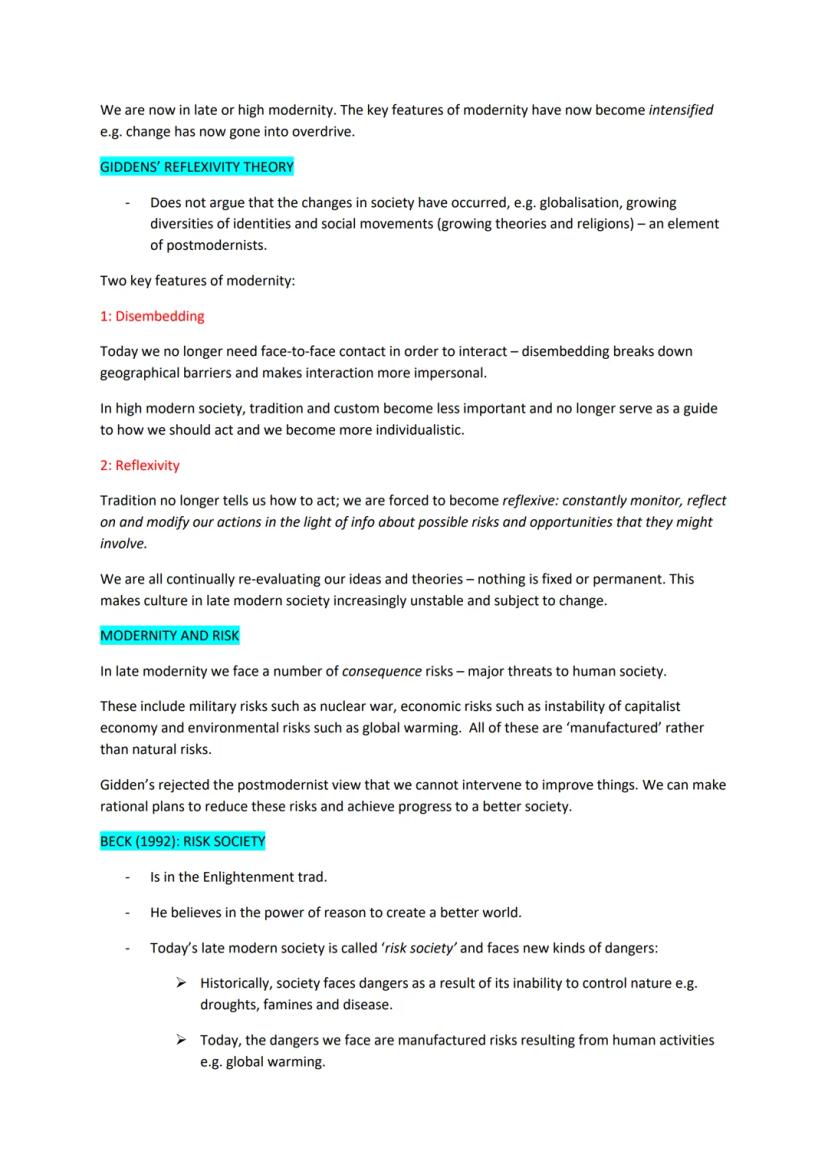

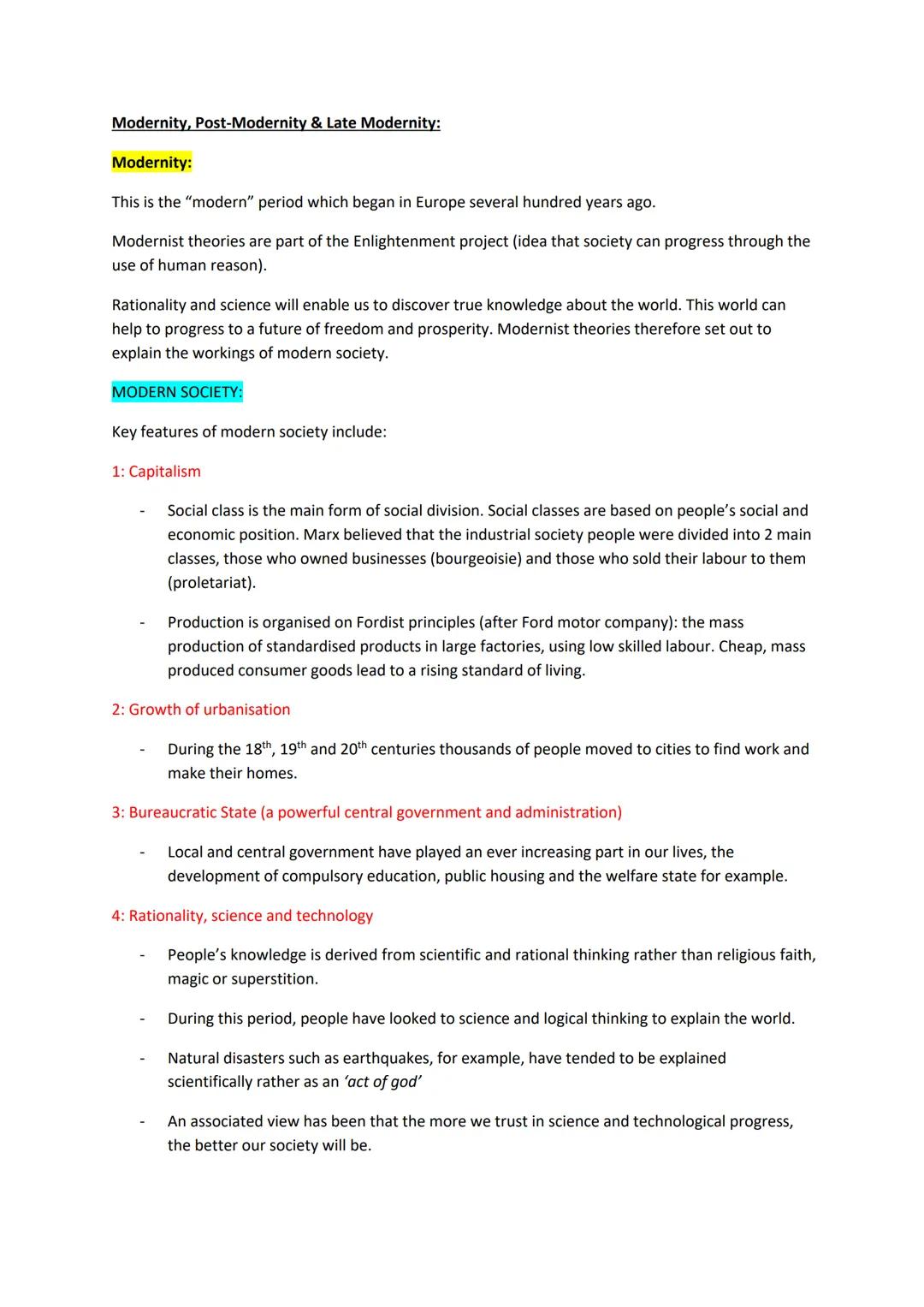
Think of modernity as the period when humans got really confident about rationality and science. Starting a few hundred years ago in Europe, people believed we could use reason to discover truth and create a better future - this was called the Enlightenment project.
Modern society had some key features you'd recognise from history lessons. Capitalism divided people into clear social classes - Marx's bourgeoisie (business owners) and proletariat (workers). Factories used Fordist principles to mass-produce identical products with low-skilled labour, giving people cheap consumer goods and higher living standards.
Urbanisation saw thousands move to cities for work, whilst a bureaucratic state developed compulsory education, public housing, and the welfare state. People trusted science and technology over religion to explain everything from earthquakes to progress itself.
Key insight: Modernity was all about believing that science, reason, and progress would solve humanity's problems and create a better future for everyone.
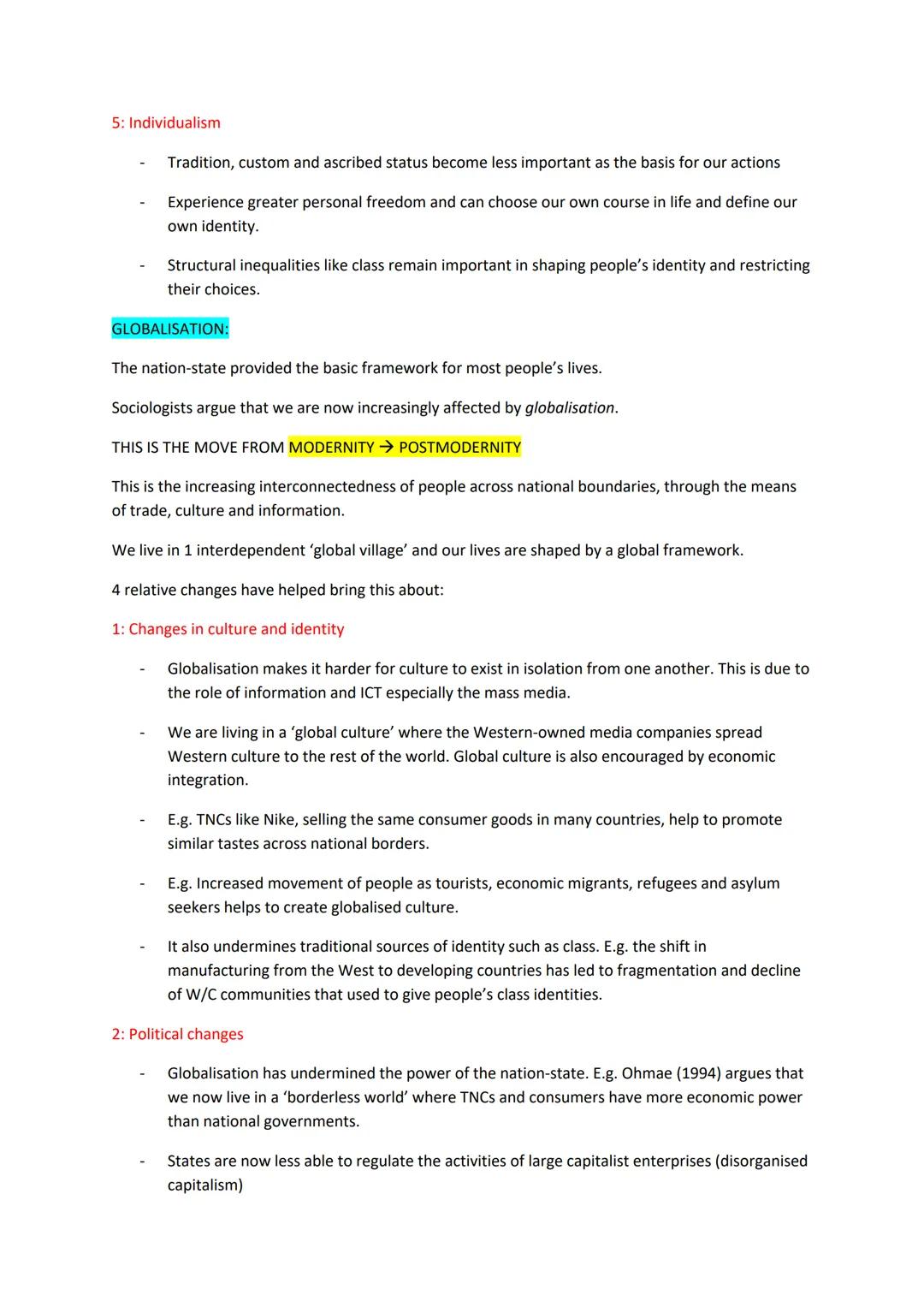
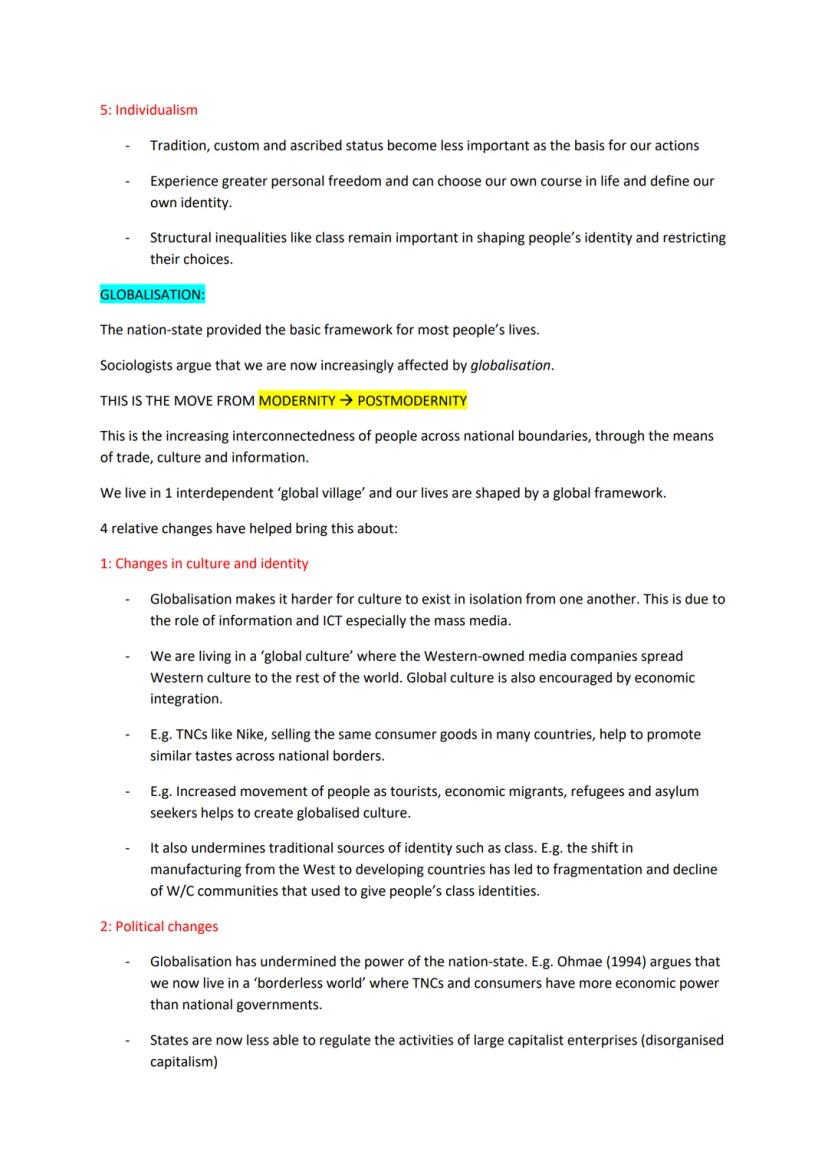
The final feature of modernity was individualism - you could choose your own path rather than follow tradition, though structural inequalities like class still mattered. But then everything started changing through globalisation.
Globalisation means we're all connected across borders through trade, culture, and information - we live in one big 'global village'. This shift represents the move from modernity to postmodernity, and it happened through four major changes.
Cultural changes mean isolated cultures barely exist anymore. Western media companies spread their culture globally, whilst companies like Nike sell the same products everywhere. Tourism, migration, and refugees create a globalised culture that weakens traditional class identities - especially as manufacturing moved from the West to developing countries.
Political changes have undermined nation-states' power. Some argue we live in a 'borderless world' where multinational corporations and consumers have more economic power than governments, creating 'disorganised capitalism'.
Key insight: Globalisation hasn't just connected us - it's fundamentally changed how we see ourselves and how power works in society.
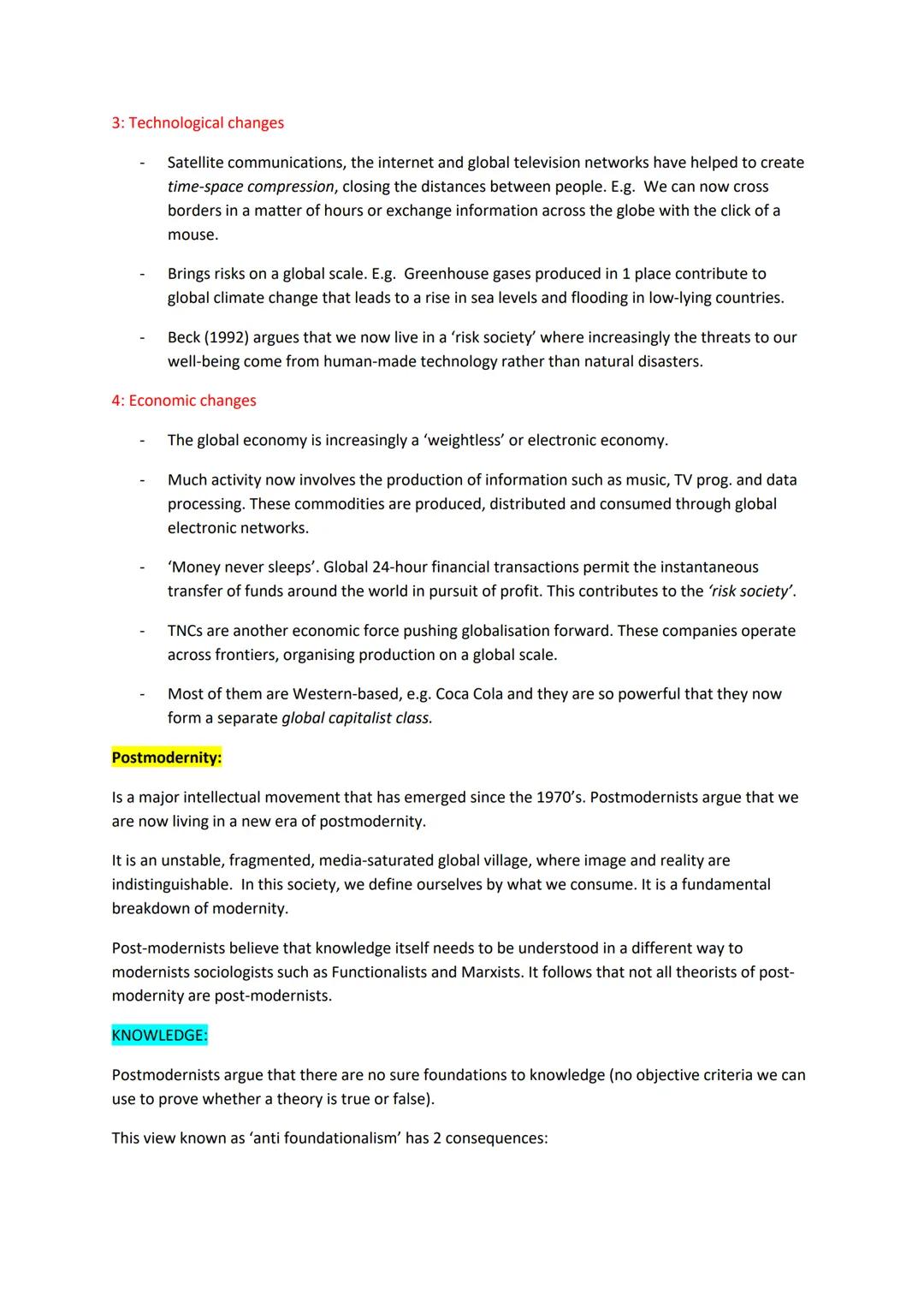
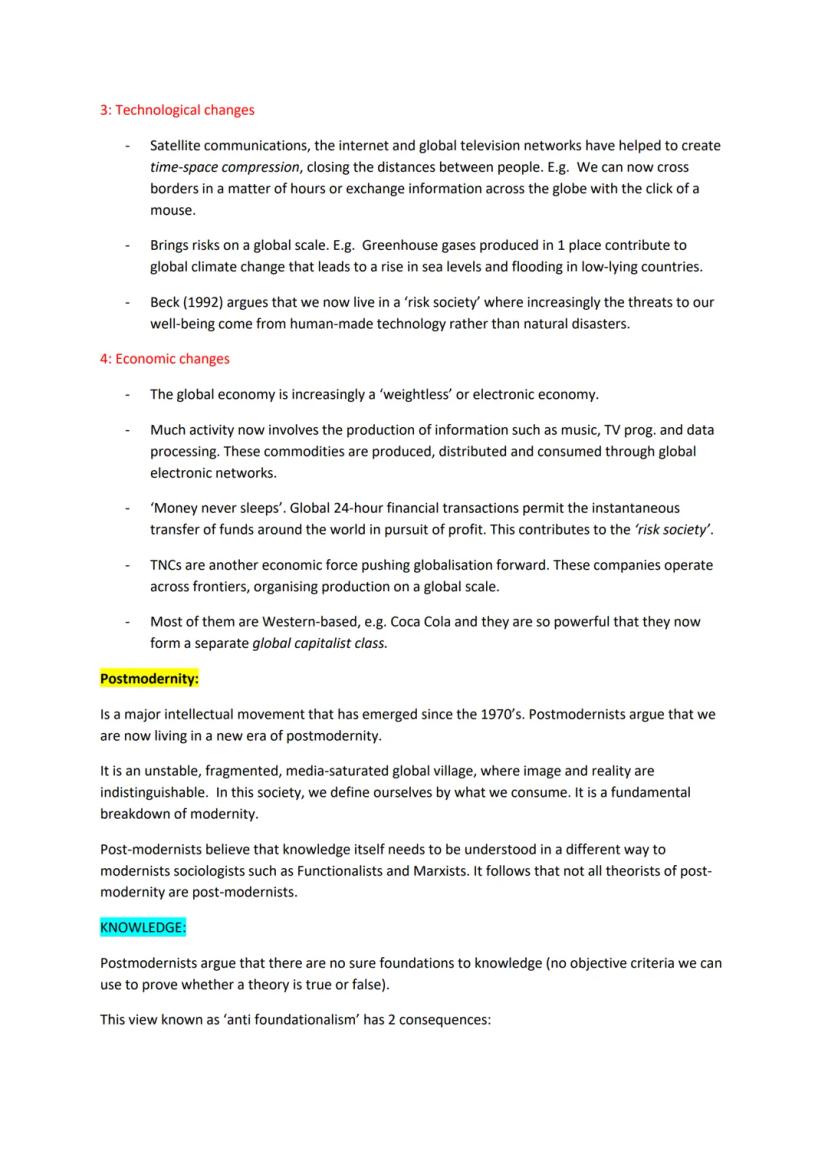
Technological changes have created time-space compression - satellite communications, the internet, and global TV networks mean you can cross borders in hours or share information instantly with a click. Brilliant, right? Well, not entirely.
These same technologies bring global-scale risks. Greenhouse gases produced anywhere contribute to climate change that causes flooding in completely different countries. Beck's 'risk society' theory argues that human-made technology now threatens us more than natural disasters do.
Economic changes have created a 'weightless' electronic economy. Much of our economy now involves producing information - music, TV programmes, data processing - distributed through global electronic networks. 'Money never sleeps' with 24-hour financial transactions moving funds instantly worldwide for profit.
Transnational corporations (TNCs) like Coca-Cola operate across borders, organising production globally. They're so powerful they form a separate global capitalist class that influences politics and culture worldwide.
Key insight: Our hyper-connected world brings amazing opportunities but also creates new types of risks that no single country can solve alone.
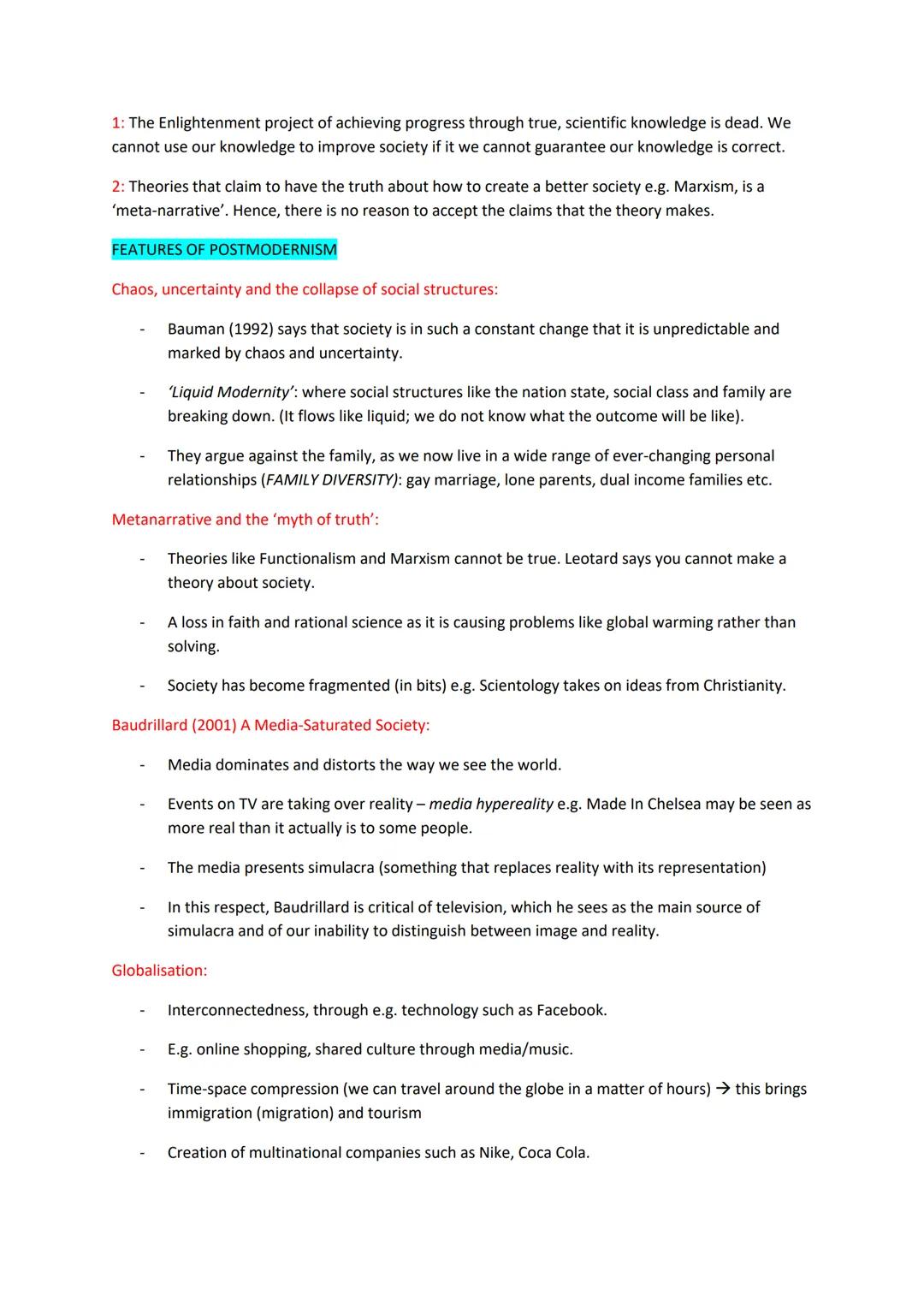
Postmodernity emerged in the 1970s as theorists argued we'd entered a completely new era. It's described as an unstable, fragmented, media-saturated global village where you can't tell image from reality anymore, and we define ourselves by what we consume.
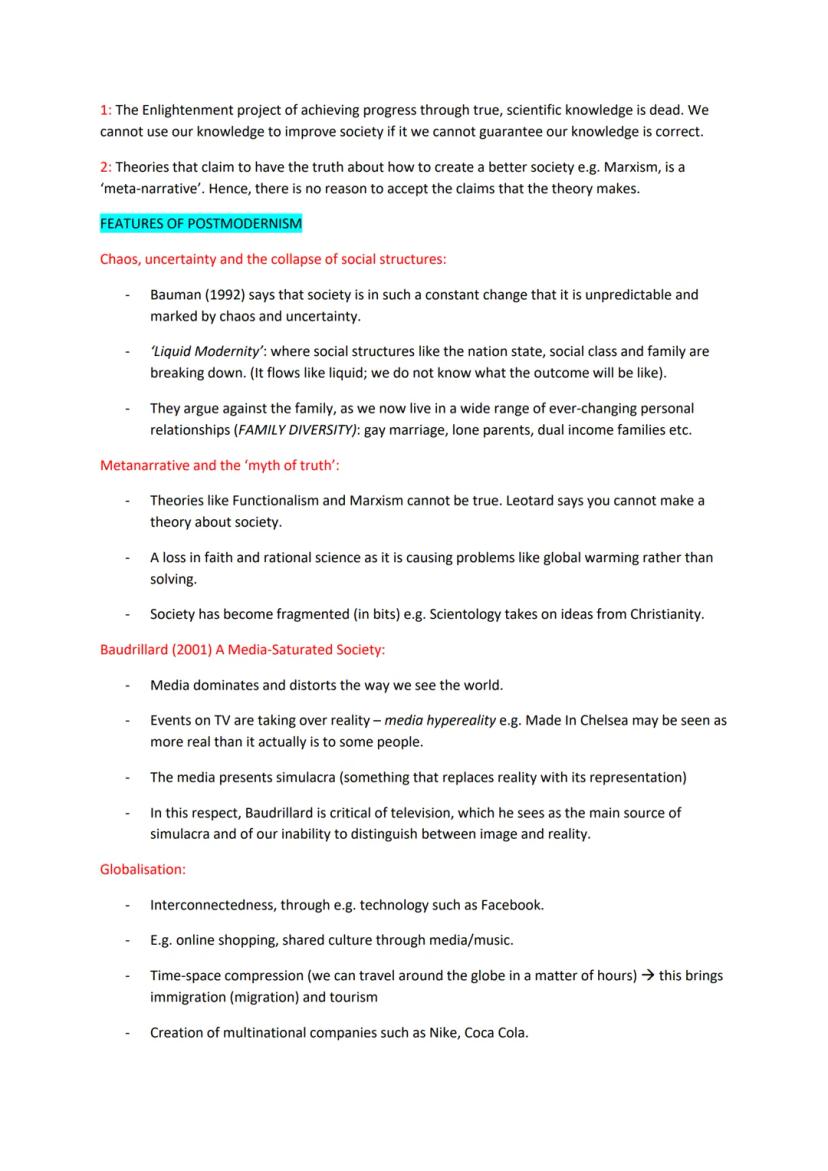
Postmodernists believe there are no sure foundations to knowledge - you can't prove whether theories are true or false. This 'anti-foundationalism' means two things: the Enlightenment project is dead (we can't improve society through 'true' knowledge), and theories like Marxism are just 'meta-narratives' with no special claim to truth.
Bauman's 'liquid modernity' describes society in constant, unpredictable change where social structures like family, social class, and nation-states are breaking down and flowing like liquid. We now have family diversity - gay marriage, lone parents, dual-income families - rather than one 'normal' family type.
Baudrillard's media theory argues that media doesn't just report reality - it creates 'hyperreality' where TV events seem more real than actual life. Think about how reality shows like Made in Chelsea might feel more 'real' to viewers than their own experiences. Media presents simulacra - representations that replace reality itself.
Key insight: Postmodernists argue we've moved beyond the modern world into something fundamentally different, where traditional certainties no longer exist.
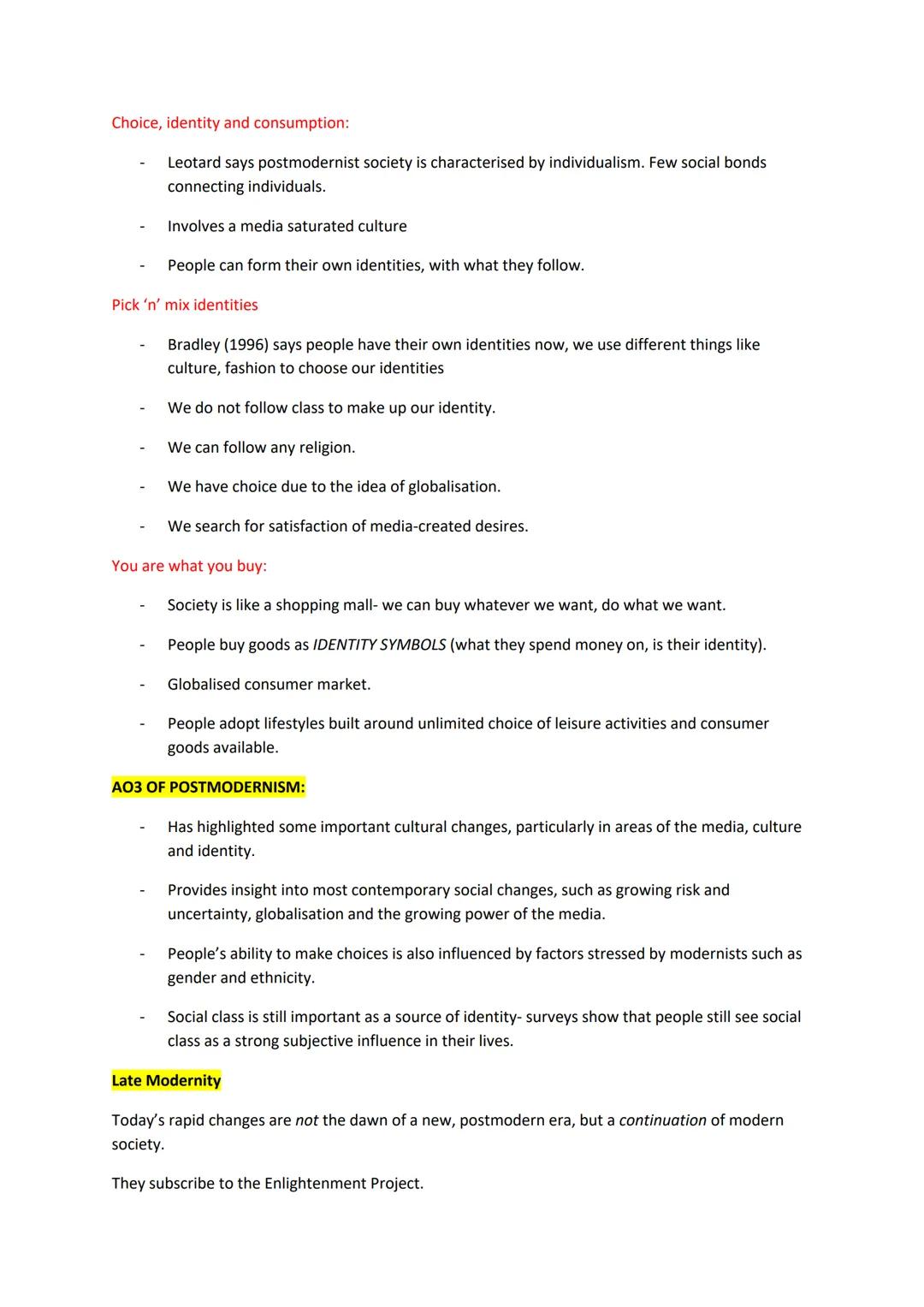
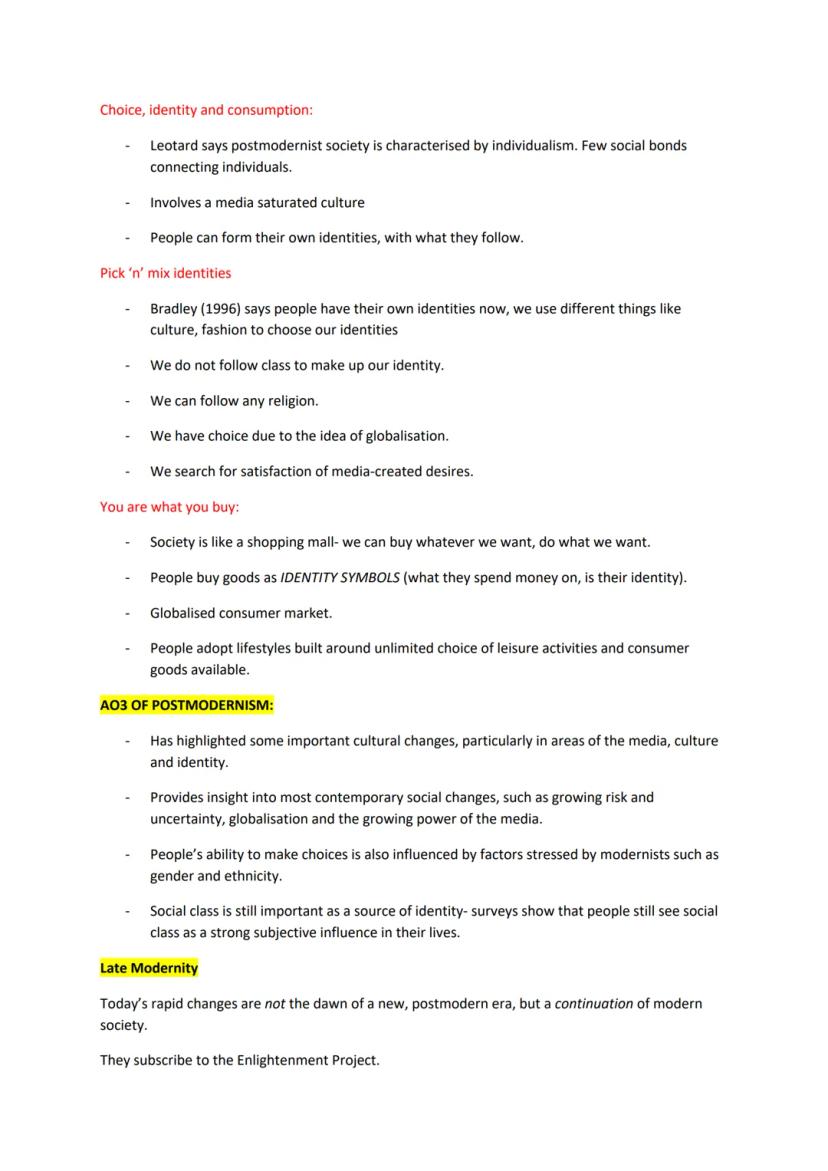
In postmodern society, you're not stuck with the identity your social class gives you. Lyotard describes a society characterised by individualism with few social bonds connecting people in a media-saturated culture where people form their own identities.
Bradley's 'pick 'n' mix identities' theory suggests you now choose your identity using culture, fashion, religion - whatever you want. You don't have to follow your class background or stick to one religion. Globalisation gives you these choices.
The key phrase here is 'you are what you buy'. Society becomes like a shopping mall where people buy goods as identity symbols. Your purchases become your identity in a globalised consumer market. People adopt lifestyles built around unlimited choice of leisure activities and consumer goods.
However, critics argue that postmodernism ignores important realities. Social class still matters - surveys show people see it as a strong influence in their lives. Your ability to make choices is still influenced by gender and ethnicity, and not everyone has equal access to this consumer playground.
Key insight: Postmodernity suggests we can choose our identities like items in a shop, but critics question whether this freedom is real for everyone.
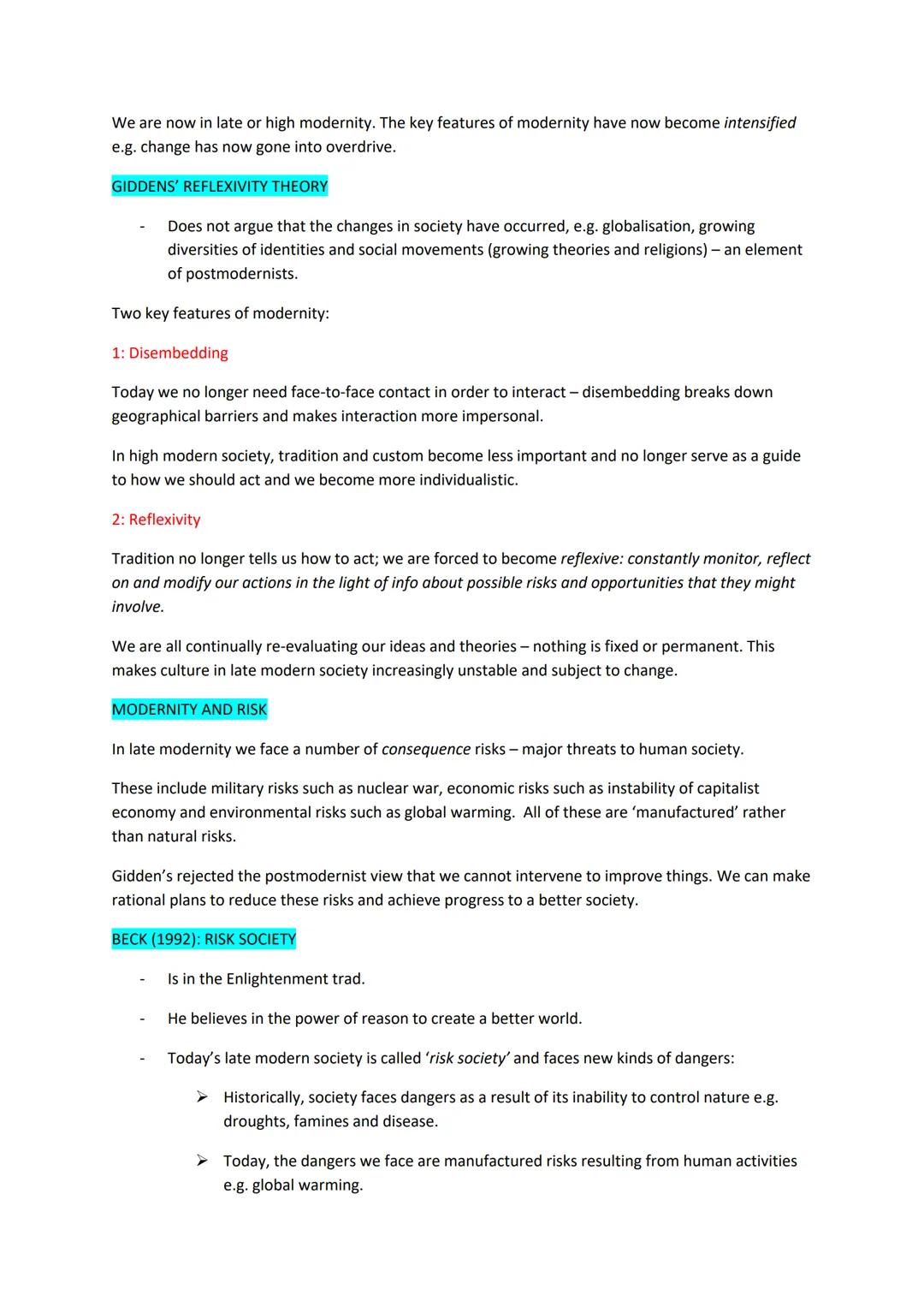
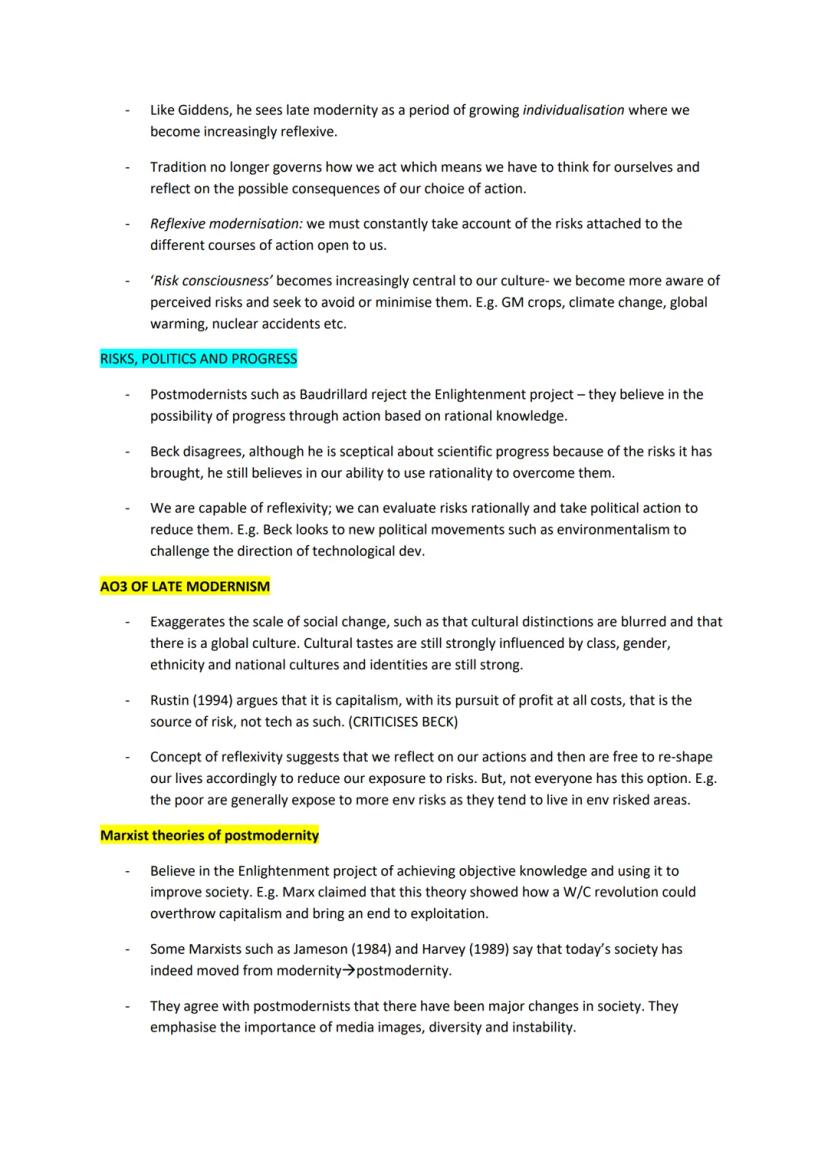
Not everyone agrees we've entered postmodernity. Late modernity theorists like Giddens argue that today's changes are just modernity intensified - change has gone into overdrive, but we're still in the same basic period. They still believe in the Enlightenment project.
Giddens' reflexivity theory identifies two key features. Disembedding means we no longer need face-to-face contact to interact - think social media and online shopping. This breaks down geographical barriers but makes interaction more impersonal. Tradition becomes less important as a guide for behaviour.
Reflexivity means we constantly monitor, reflect on, and modify our actions based on information about risks and opportunities. Since tradition no longer tells us how to act, we're forced to become reflexive - constantly re-evaluating our ideas and theories. Nothing is fixed or permanent.
Beck's 'risk society' theory argues we face manufactured risks from human activities rather than natural disasters. Think nuclear war, economic instability, global warming. Unlike postmodernists, Beck believes we can use rational planning to reduce risks and create progress.
Key insight: Late modernity theorists argue we're still in the modern period, but it's become more intense, risky, and requires constant reflection on our choices.

Beck emphasises how we've become increasingly individualised and reflexive - we must think for ourselves about consequences since tradition no longer governs our actions. This creates 'reflexive modernisation' where we constantly consider risks attached to different courses of action.
'Risk consciousness' becomes central to culture as we become aware of perceived risks and try to avoid them. Think about debates over GM crops, climate change, nuclear accidents - we're constantly evaluating and trying to minimise risks.
Unlike postmodernists who reject progress, Beck believes in using rationality to overcome risks. We can evaluate risks rationally and take political action to reduce them. He looks to new political movements like environmentalism to challenge dangerous technological development.
Critics argue late modernists exaggerate social change. Cultural distinctions aren't as blurred as claimed - class, gender, and ethnicity still strongly influence cultural tastes. Rustin argues it's capitalism's pursuit of profit, not technology itself, that creates risk. The concept of reflexivity ignores how the poor have less choice - they're generally exposed to more environmental risks.
Key insight: Late modernity theorists maintain optimism about human reason while acknowledging the new risks our advanced society has created.

Our AI Companion is a student-focused AI tool that offers more than just answers. Built on millions of Knowunity resources, it provides relevant information, personalised study plans, quizzes, and content directly in the chat, adapting to your individual learning journey.
You can download the app from Google Play Store and Apple App Store.
That's right! Enjoy free access to study content, connect with fellow students, and get instant help – all at your fingertips.
Paper 1 AQA A Level sociology - education
 Sociology
App Store
Google Play
The app is very easy to use and well designed. I have found everything I was looking for so far and have been able to learn a lot from the presentations! I will definitely use the app for a class assignment! And of course it also helps a lot as an inspiration.
Stefan S
iOS user
This app is really great. There are so many study notes and help [...]. My problem subject is French, for example, and the app has so many options for help. Thanks to this app, I have improved my French. I would recommend it to anyone.
Samantha Klich
Android user
Wow, I am really amazed. I just tried the app because I've seen it advertised many times and was absolutely stunned. This app is THE HELP you want for school and above all, it offers so many things, such as workouts and fact sheets, which have been VERY helpful to me personally.
Anna
iOS user
Best app on earth! no words because it’s too good
Thomas R
iOS user
Just amazing. Let's me revise 10x better, this app is a quick 10/10. I highly recommend it to anyone. I can watch and search for notes. I can save them in the subject folder. I can revise it any time when I come back. If you haven't tried this app, you're really missing out.
Basil
Android user
This app has made me feel so much more confident in my exam prep, not only through boosting my own self confidence through the features that allow you to connect with others and feel less alone, but also through the way the app itself is centred around making you feel better. It is easy to navigate, fun to use, and helpful to anyone struggling in absolutely any way.
David K
iOS user
The app's just great! All I have to do is enter the topic in the search bar and I get the response real fast. I don't have to watch 10 YouTube videos to understand something, so I'm saving my time. Highly recommended!
Sudenaz Ocak
Android user
In school I was really bad at maths but thanks to the app, I am doing better now. I am so grateful that you made the app.
Greenlight Bonnie
Android user
very reliable app to help and grow your ideas of Maths, English and other related topics in your works. please use this app if your struggling in areas, this app is key for that. wish I'd of done a review before. and it's also free so don't worry about that.
Rohan U
Android user
I know a lot of apps use fake accounts to boost their reviews but this app deserves it all. Originally I was getting 4 in my English exams and this time I got a grade 7. I didn’t even know about this app three days until the exam and it has helped A LOT. Please actually trust me and use it as I’m sure you too will see developments.
Xander S
iOS user
THE QUIZES AND FLASHCARDS ARE SO USEFUL AND I LOVE Knowunity AI. IT ALSO IS LITREALLY LIKE CHATGPT BUT SMARTER!! HELPED ME WITH MY MASCARA PROBLEMS TOO!! AS WELL AS MY REAL SUBJECTS ! DUHHH 😍😁😲🤑💗✨🎀😮
Elisha
iOS user
This apps acc the goat. I find revision so boring but this app makes it so easy to organize it all and then you can ask the freeeee ai to test yourself so good and you can easily upload your own stuff. highly recommend as someone taking mocks now
Paul T
iOS user
The app is very easy to use and well designed. I have found everything I was looking for so far and have been able to learn a lot from the presentations! I will definitely use the app for a class assignment! And of course it also helps a lot as an inspiration.
Stefan S
iOS user
This app is really great. There are so many study notes and help [...]. My problem subject is French, for example, and the app has so many options for help. Thanks to this app, I have improved my French. I would recommend it to anyone.
Samantha Klich
Android user
Wow, I am really amazed. I just tried the app because I've seen it advertised many times and was absolutely stunned. This app is THE HELP you want for school and above all, it offers so many things, such as workouts and fact sheets, which have been VERY helpful to me personally.
Anna
iOS user
Best app on earth! no words because it’s too good
Thomas R
iOS user
Just amazing. Let's me revise 10x better, this app is a quick 10/10. I highly recommend it to anyone. I can watch and search for notes. I can save them in the subject folder. I can revise it any time when I come back. If you haven't tried this app, you're really missing out.
Basil
Android user
This app has made me feel so much more confident in my exam prep, not only through boosting my own self confidence through the features that allow you to connect with others and feel less alone, but also through the way the app itself is centred around making you feel better. It is easy to navigate, fun to use, and helpful to anyone struggling in absolutely any way.
David K
iOS user
The app's just great! All I have to do is enter the topic in the search bar and I get the response real fast. I don't have to watch 10 YouTube videos to understand something, so I'm saving my time. Highly recommended!
Sudenaz Ocak
Android user
In school I was really bad at maths but thanks to the app, I am doing better now. I am so grateful that you made the app.
Greenlight Bonnie
Android user
very reliable app to help and grow your ideas of Maths, English and other related topics in your works. please use this app if your struggling in areas, this app is key for that. wish I'd of done a review before. and it's also free so don't worry about that.
Rohan U
Android user
I know a lot of apps use fake accounts to boost their reviews but this app deserves it all. Originally I was getting 4 in my English exams and this time I got a grade 7. I didn’t even know about this app three days until the exam and it has helped A LOT. Please actually trust me and use it as I’m sure you too will see developments.
Xander S
iOS user
THE QUIZES AND FLASHCARDS ARE SO USEFUL AND I LOVE Knowunity AI. IT ALSO IS LITREALLY LIKE CHATGPT BUT SMARTER!! HELPED ME WITH MY MASCARA PROBLEMS TOO!! AS WELL AS MY REAL SUBJECTS ! DUHHH 😍😁😲🤑💗✨🎀😮
Elisha
iOS user
This apps acc the goat. I find revision so boring but this app makes it so easy to organize it all and then you can ask the freeeee ai to test yourself so good and you can easily upload your own stuff. highly recommend as someone taking mocks now
Paul T
iOS user
Prabh
@prabhleenkaur_girr
Ever wondered how society has changed from the industrial age to our Instagram-obsessed world? Understanding the shift from modernity to postmodernity (and what some call "late modernity") helps explain everything from why your identity isn't just based on your social... Show more
Access to all documents
Improve your grades
Join milions of students
By signing up you accept Terms of Service and Privacy Policy
Think of modernity as the period when humans got really confident about rationality and science. Starting a few hundred years ago in Europe, people believed we could use reason to discover truth and create a better future - this was called the Enlightenment project.
Modern society had some key features you'd recognise from history lessons. Capitalism divided people into clear social classes - Marx's bourgeoisie (business owners) and proletariat (workers). Factories used Fordist principles to mass-produce identical products with low-skilled labour, giving people cheap consumer goods and higher living standards.
Urbanisation saw thousands move to cities for work, whilst a bureaucratic state developed compulsory education, public housing, and the welfare state. People trusted science and technology over religion to explain everything from earthquakes to progress itself.
Key insight: Modernity was all about believing that science, reason, and progress would solve humanity's problems and create a better future for everyone.
Access to all documents
Improve your grades
Join milions of students
By signing up you accept Terms of Service and Privacy Policy
The final feature of modernity was individualism - you could choose your own path rather than follow tradition, though structural inequalities like class still mattered. But then everything started changing through globalisation.
Globalisation means we're all connected across borders through trade, culture, and information - we live in one big 'global village'. This shift represents the move from modernity to postmodernity, and it happened through four major changes.
Cultural changes mean isolated cultures barely exist anymore. Western media companies spread their culture globally, whilst companies like Nike sell the same products everywhere. Tourism, migration, and refugees create a globalised culture that weakens traditional class identities - especially as manufacturing moved from the West to developing countries.
Political changes have undermined nation-states' power. Some argue we live in a 'borderless world' where multinational corporations and consumers have more economic power than governments, creating 'disorganised capitalism'.
Key insight: Globalisation hasn't just connected us - it's fundamentally changed how we see ourselves and how power works in society.
Access to all documents
Improve your grades
Join milions of students
By signing up you accept Terms of Service and Privacy Policy
Technological changes have created time-space compression - satellite communications, the internet, and global TV networks mean you can cross borders in hours or share information instantly with a click. Brilliant, right? Well, not entirely.
These same technologies bring global-scale risks. Greenhouse gases produced anywhere contribute to climate change that causes flooding in completely different countries. Beck's 'risk society' theory argues that human-made technology now threatens us more than natural disasters do.
Economic changes have created a 'weightless' electronic economy. Much of our economy now involves producing information - music, TV programmes, data processing - distributed through global electronic networks. 'Money never sleeps' with 24-hour financial transactions moving funds instantly worldwide for profit.
Transnational corporations (TNCs) like Coca-Cola operate across borders, organising production globally. They're so powerful they form a separate global capitalist class that influences politics and culture worldwide.
Key insight: Our hyper-connected world brings amazing opportunities but also creates new types of risks that no single country can solve alone.
Access to all documents
Improve your grades
Join milions of students
By signing up you accept Terms of Service and Privacy Policy
Postmodernity emerged in the 1970s as theorists argued we'd entered a completely new era. It's described as an unstable, fragmented, media-saturated global village where you can't tell image from reality anymore, and we define ourselves by what we consume.
Postmodernists believe there are no sure foundations to knowledge - you can't prove whether theories are true or false. This 'anti-foundationalism' means two things: the Enlightenment project is dead (we can't improve society through 'true' knowledge), and theories like Marxism are just 'meta-narratives' with no special claim to truth.
Bauman's 'liquid modernity' describes society in constant, unpredictable change where social structures like family, social class, and nation-states are breaking down and flowing like liquid. We now have family diversity - gay marriage, lone parents, dual-income families - rather than one 'normal' family type.
Baudrillard's media theory argues that media doesn't just report reality - it creates 'hyperreality' where TV events seem more real than actual life. Think about how reality shows like Made in Chelsea might feel more 'real' to viewers than their own experiences. Media presents simulacra - representations that replace reality itself.
Key insight: Postmodernists argue we've moved beyond the modern world into something fundamentally different, where traditional certainties no longer exist.
Access to all documents
Improve your grades
Join milions of students
By signing up you accept Terms of Service and Privacy Policy
In postmodern society, you're not stuck with the identity your social class gives you. Lyotard describes a society characterised by individualism with few social bonds connecting people in a media-saturated culture where people form their own identities.
Bradley's 'pick 'n' mix identities' theory suggests you now choose your identity using culture, fashion, religion - whatever you want. You don't have to follow your class background or stick to one religion. Globalisation gives you these choices.
The key phrase here is 'you are what you buy'. Society becomes like a shopping mall where people buy goods as identity symbols. Your purchases become your identity in a globalised consumer market. People adopt lifestyles built around unlimited choice of leisure activities and consumer goods.
However, critics argue that postmodernism ignores important realities. Social class still matters - surveys show people see it as a strong influence in their lives. Your ability to make choices is still influenced by gender and ethnicity, and not everyone has equal access to this consumer playground.
Key insight: Postmodernity suggests we can choose our identities like items in a shop, but critics question whether this freedom is real for everyone.
Access to all documents
Improve your grades
Join milions of students
By signing up you accept Terms of Service and Privacy Policy
Not everyone agrees we've entered postmodernity. Late modernity theorists like Giddens argue that today's changes are just modernity intensified - change has gone into overdrive, but we're still in the same basic period. They still believe in the Enlightenment project.
Giddens' reflexivity theory identifies two key features. Disembedding means we no longer need face-to-face contact to interact - think social media and online shopping. This breaks down geographical barriers but makes interaction more impersonal. Tradition becomes less important as a guide for behaviour.
Reflexivity means we constantly monitor, reflect on, and modify our actions based on information about risks and opportunities. Since tradition no longer tells us how to act, we're forced to become reflexive - constantly re-evaluating our ideas and theories. Nothing is fixed or permanent.
Beck's 'risk society' theory argues we face manufactured risks from human activities rather than natural disasters. Think nuclear war, economic instability, global warming. Unlike postmodernists, Beck believes we can use rational planning to reduce risks and create progress.
Key insight: Late modernity theorists argue we're still in the modern period, but it's become more intense, risky, and requires constant reflection on our choices.
Access to all documents
Improve your grades
Join milions of students
By signing up you accept Terms of Service and Privacy Policy
Beck emphasises how we've become increasingly individualised and reflexive - we must think for ourselves about consequences since tradition no longer governs our actions. This creates 'reflexive modernisation' where we constantly consider risks attached to different courses of action.
'Risk consciousness' becomes central to culture as we become aware of perceived risks and try to avoid them. Think about debates over GM crops, climate change, nuclear accidents - we're constantly evaluating and trying to minimise risks.
Unlike postmodernists who reject progress, Beck believes in using rationality to overcome risks. We can evaluate risks rationally and take political action to reduce them. He looks to new political movements like environmentalism to challenge dangerous technological development.
Critics argue late modernists exaggerate social change. Cultural distinctions aren't as blurred as claimed - class, gender, and ethnicity still strongly influence cultural tastes. Rustin argues it's capitalism's pursuit of profit, not technology itself, that creates risk. The concept of reflexivity ignores how the poor have less choice - they're generally exposed to more environmental risks.
Key insight: Late modernity theorists maintain optimism about human reason while acknowledging the new risks our advanced society has created.
Access to all documents
Improve your grades
Join milions of students
By signing up you accept Terms of Service and Privacy Policy
Our AI Companion is a student-focused AI tool that offers more than just answers. Built on millions of Knowunity resources, it provides relevant information, personalised study plans, quizzes, and content directly in the chat, adapting to your individual learning journey.
You can download the app from Google Play Store and Apple App Store.
That's right! Enjoy free access to study content, connect with fellow students, and get instant help – all at your fingertips.
0
Smart Tools NEW
Transform this note into: ✓ 50+ Practice Questions ✓ Interactive Flashcards ✓ Full Mock Exam ✓ Essay Outlines
Paper 1 AQA A Level sociology - education
SociologyApp Store
Google Play
The app is very easy to use and well designed. I have found everything I was looking for so far and have been able to learn a lot from the presentations! I will definitely use the app for a class assignment! And of course it also helps a lot as an inspiration.
Stefan S
iOS user
This app is really great. There are so many study notes and help [...]. My problem subject is French, for example, and the app has so many options for help. Thanks to this app, I have improved my French. I would recommend it to anyone.
Samantha Klich
Android user
Wow, I am really amazed. I just tried the app because I've seen it advertised many times and was absolutely stunned. This app is THE HELP you want for school and above all, it offers so many things, such as workouts and fact sheets, which have been VERY helpful to me personally.
Anna
iOS user
Best app on earth! no words because it’s too good
Thomas R
iOS user
Just amazing. Let's me revise 10x better, this app is a quick 10/10. I highly recommend it to anyone. I can watch and search for notes. I can save them in the subject folder. I can revise it any time when I come back. If you haven't tried this app, you're really missing out.
Basil
Android user
This app has made me feel so much more confident in my exam prep, not only through boosting my own self confidence through the features that allow you to connect with others and feel less alone, but also through the way the app itself is centred around making you feel better. It is easy to navigate, fun to use, and helpful to anyone struggling in absolutely any way.
David K
iOS user
The app's just great! All I have to do is enter the topic in the search bar and I get the response real fast. I don't have to watch 10 YouTube videos to understand something, so I'm saving my time. Highly recommended!
Sudenaz Ocak
Android user
In school I was really bad at maths but thanks to the app, I am doing better now. I am so grateful that you made the app.
Greenlight Bonnie
Android user
very reliable app to help and grow your ideas of Maths, English and other related topics in your works. please use this app if your struggling in areas, this app is key for that. wish I'd of done a review before. and it's also free so don't worry about that.
Rohan U
Android user
I know a lot of apps use fake accounts to boost their reviews but this app deserves it all. Originally I was getting 4 in my English exams and this time I got a grade 7. I didn’t even know about this app three days until the exam and it has helped A LOT. Please actually trust me and use it as I’m sure you too will see developments.
Xander S
iOS user
THE QUIZES AND FLASHCARDS ARE SO USEFUL AND I LOVE Knowunity AI. IT ALSO IS LITREALLY LIKE CHATGPT BUT SMARTER!! HELPED ME WITH MY MASCARA PROBLEMS TOO!! AS WELL AS MY REAL SUBJECTS ! DUHHH 😍😁😲🤑💗✨🎀😮
Elisha
iOS user
This apps acc the goat. I find revision so boring but this app makes it so easy to organize it all and then you can ask the freeeee ai to test yourself so good and you can easily upload your own stuff. highly recommend as someone taking mocks now
Paul T
iOS user
The app is very easy to use and well designed. I have found everything I was looking for so far and have been able to learn a lot from the presentations! I will definitely use the app for a class assignment! And of course it also helps a lot as an inspiration.
Stefan S
iOS user
This app is really great. There are so many study notes and help [...]. My problem subject is French, for example, and the app has so many options for help. Thanks to this app, I have improved my French. I would recommend it to anyone.
Samantha Klich
Android user
Wow, I am really amazed. I just tried the app because I've seen it advertised many times and was absolutely stunned. This app is THE HELP you want for school and above all, it offers so many things, such as workouts and fact sheets, which have been VERY helpful to me personally.
Anna
iOS user
Best app on earth! no words because it’s too good
Thomas R
iOS user
Just amazing. Let's me revise 10x better, this app is a quick 10/10. I highly recommend it to anyone. I can watch and search for notes. I can save them in the subject folder. I can revise it any time when I come back. If you haven't tried this app, you're really missing out.
Basil
Android user
This app has made me feel so much more confident in my exam prep, not only through boosting my own self confidence through the features that allow you to connect with others and feel less alone, but also through the way the app itself is centred around making you feel better. It is easy to navigate, fun to use, and helpful to anyone struggling in absolutely any way.
David K
iOS user
The app's just great! All I have to do is enter the topic in the search bar and I get the response real fast. I don't have to watch 10 YouTube videos to understand something, so I'm saving my time. Highly recommended!
Sudenaz Ocak
Android user
In school I was really bad at maths but thanks to the app, I am doing better now. I am so grateful that you made the app.
Greenlight Bonnie
Android user
very reliable app to help and grow your ideas of Maths, English and other related topics in your works. please use this app if your struggling in areas, this app is key for that. wish I'd of done a review before. and it's also free so don't worry about that.
Rohan U
Android user
I know a lot of apps use fake accounts to boost their reviews but this app deserves it all. Originally I was getting 4 in my English exams and this time I got a grade 7. I didn’t even know about this app three days until the exam and it has helped A LOT. Please actually trust me and use it as I’m sure you too will see developments.
Xander S
iOS user
THE QUIZES AND FLASHCARDS ARE SO USEFUL AND I LOVE Knowunity AI. IT ALSO IS LITREALLY LIKE CHATGPT BUT SMARTER!! HELPED ME WITH MY MASCARA PROBLEMS TOO!! AS WELL AS MY REAL SUBJECTS ! DUHHH 😍😁😲🤑💗✨🎀😮
Elisha
iOS user
This apps acc the goat. I find revision so boring but this app makes it so easy to organize it all and then you can ask the freeeee ai to test yourself so good and you can easily upload your own stuff. highly recommend as someone taking mocks now
Paul T
iOS user