
Education is one of society's most important institutions, but different... Show more
 Sociology
 Psychology
 English Literature
 Biology
Sign up to see the contentIt's free!
Access to all documents
Improve your grades
Join milions of students
Knowunity AI
Subjects
Triangle Congruence and Similarity Theorems
Triangle Properties and Classification
Linear Equations and Graphs
Geometric Angle Relationships
Trigonometric Functions and Identities
Equation Solving Techniques
Circle Geometry Fundamentals
Division Operations and Methods
Basic Differentiation Rules
Exponent and Logarithm Properties
Show all topics
Human Organ Systems
Reproductive Cell Cycles
Biological Sciences Subdisciplines
Cellular Energy Metabolism
Autotrophic Energy Processes
Inheritance Patterns and Principles
Biomolecular Structure and Organization
Cell Cycle and Division Mechanics
Cellular Organization and Development
Biological Structural Organization
Show all topics
Chemical Sciences and Applications
Atomic Structure and Composition
Molecular Electron Structure Representation
Atomic Electron Behavior
Matter Properties and Water
Mole Concept and Calculations
Gas Laws and Behavior
Periodic Table Organization
Chemical Thermodynamics Fundamentals
Chemical Bond Types and Properties
Show all topics
European Renaissance and Enlightenment
European Cultural Movements 800-1920
American Revolution Era 1763-1797
American Civil War 1861-1865
Global Imperial Systems
Mongol and Chinese Dynasties
U.S. Presidents and World Leaders
Historical Sources and Documentation
World Wars Era and Impact
World Religious Systems
Show all topics
Classic and Contemporary Novels
Literary Character Analysis
Rhetorical Theory and Practice
Classic Literary Narratives
Reading Analysis and Interpretation
Narrative Structure and Techniques
English Language Components
Influential English-Language Authors
Basic Sentence Structure
Narrative Voice and Perspective
Show all topics
1,606
•
Updated May 11, 2026
•
Jessica
@.jess.
Education is one of society's most important institutions, but different... Show more
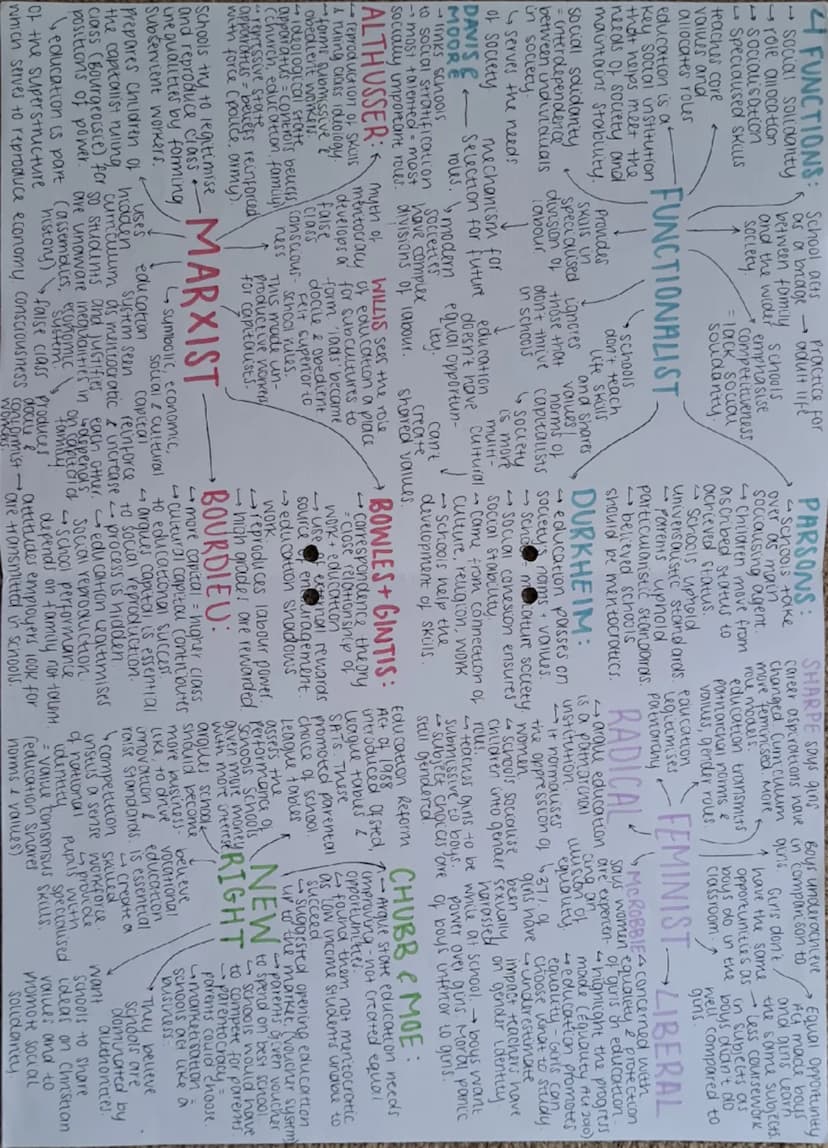
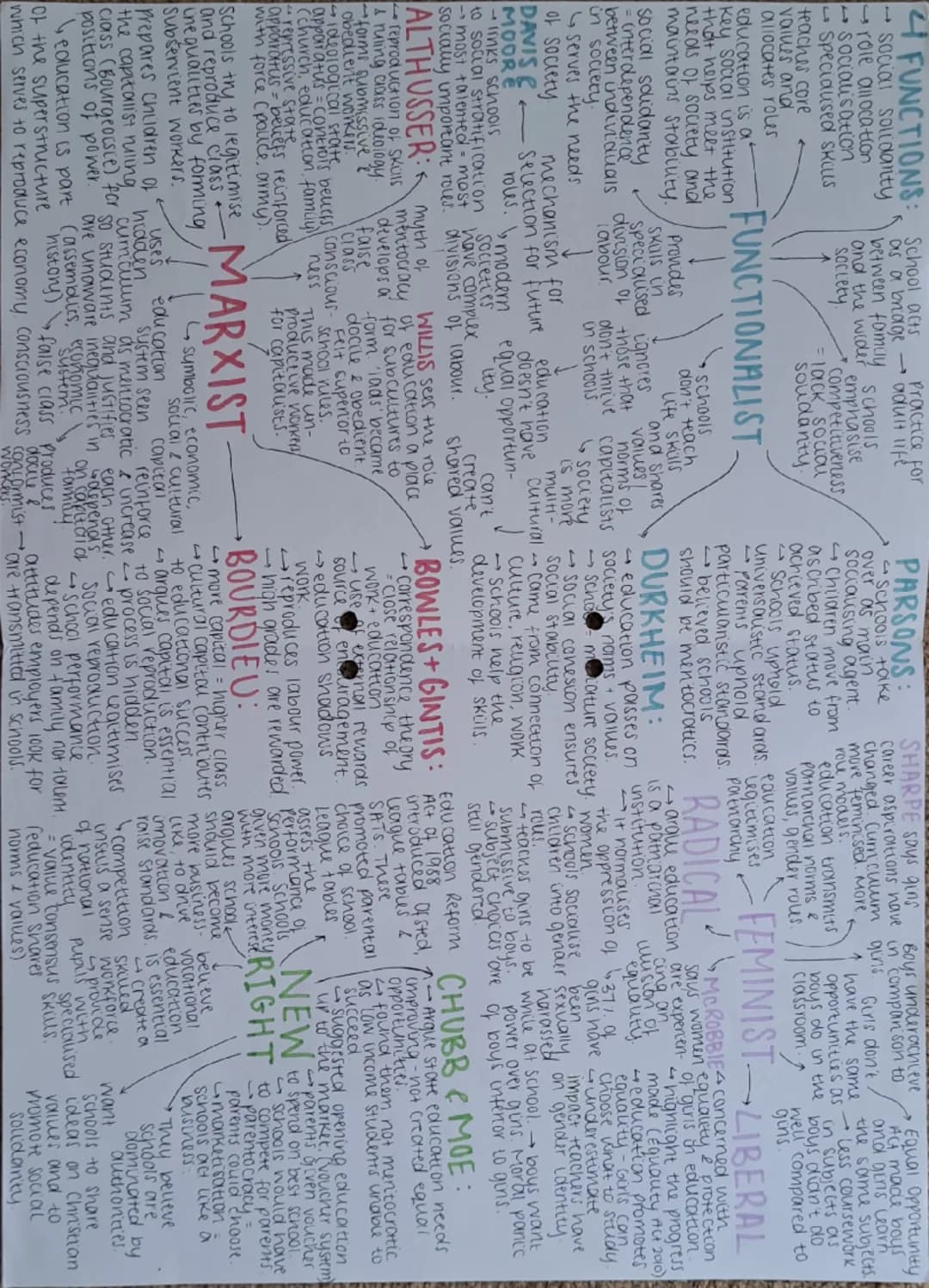
Ever wondered why some people see school as the great equaliser whilst others think it just keeps the rich on top? Functionalist theory views education as essential for society's stability. Durkheim argued schools create social solidarity by teaching shared values, whilst Parsons saw them as bridges between family and adult life.
Davis and Moore believed schools sort people into the right jobs through meritocracy - basically, the most talented get the best positions. They argued this role allocation serves society's needs by putting skilled people in important roles.
However, Marxist theorists completely disagree. Althusser saw schools as part of the ideological state apparatus - institutions that control our beliefs to benefit the ruling class. Bowles and Gintis developed correspondence theory, arguing that school life mirrors work life to create obedient workers.
Key Insight: Functionalists see education as beneficial for everyone, whilst Marxists view it as a tool of oppression that maintains class inequality.
Feminist perspectives highlight how education can both challenge and reinforce patriarchal norms. Liberal feminists celebrate girls' improved achievement, whilst radical feminists argue the hidden curriculum still teaches traditional gender roles.
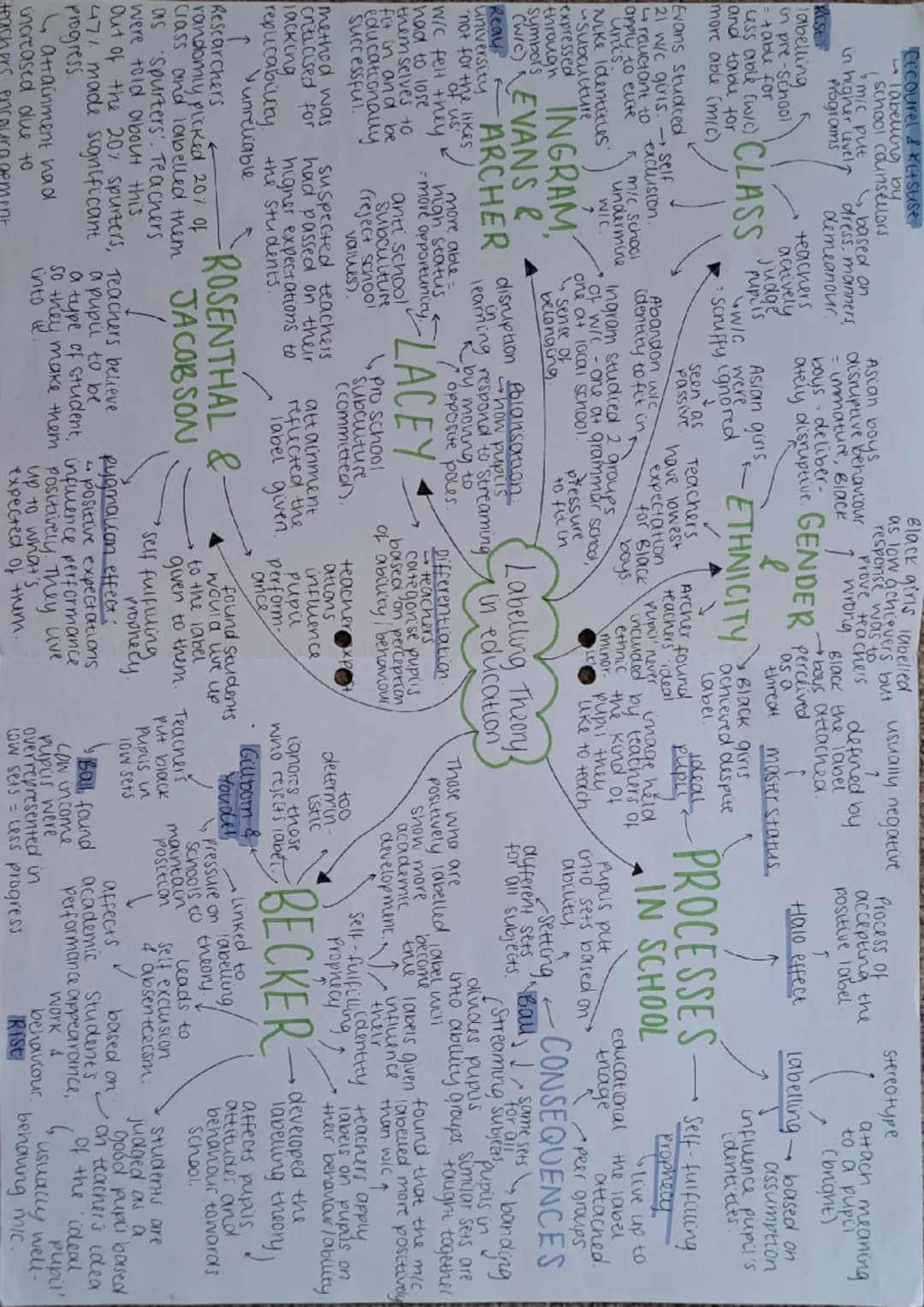
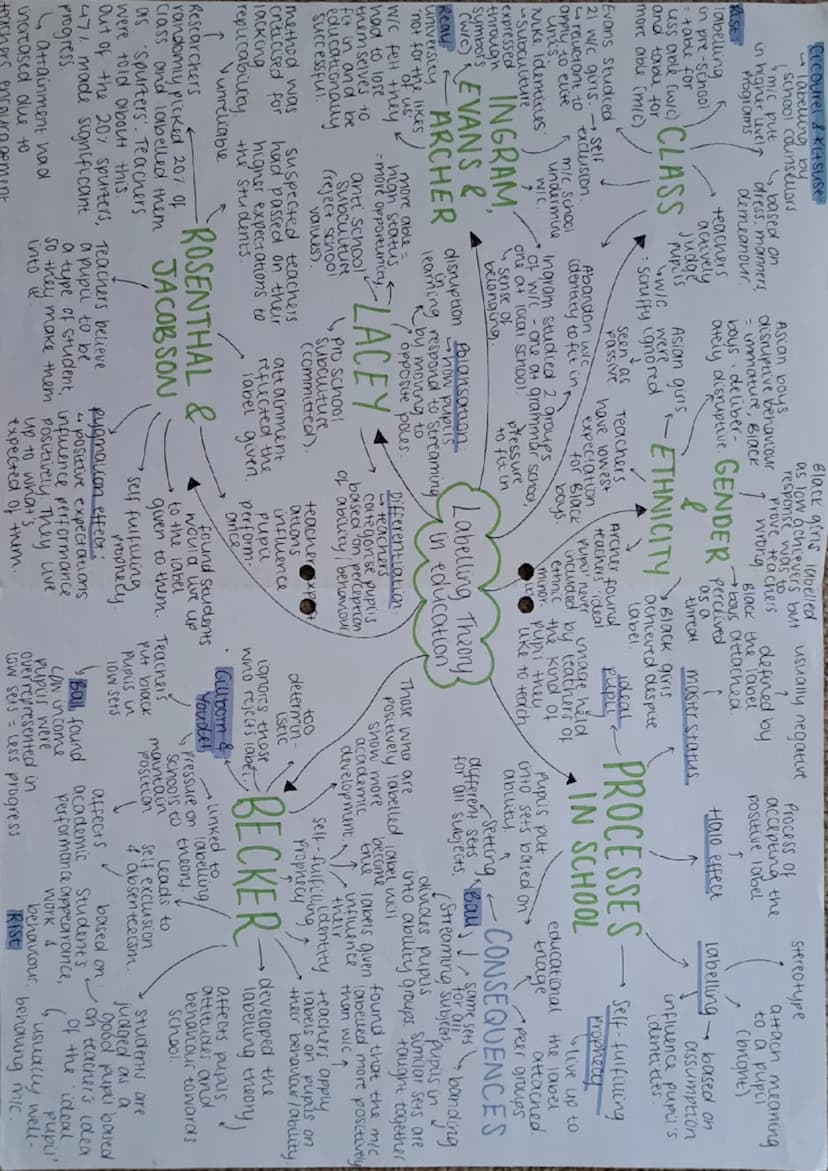
Your teachers' expectations might shape your future more than you think. Labelling theory shows how teachers categorise pupils based on their perceptions, creating powerful effects on achievement.
Rosenthal and Jacobson's famous study randomly labelled 20% of pupils as 'spurters' likely to improve rapidly. These students made significantly more progress, demonstrating the self-fulfilling prophecy - when positive expectations lead to positive outcomes.
Becker found teachers had clear ideas about the 'ideal pupil' - typically middle-class, well-behaved students. This leads to differentiation, where pupils are treated differently based on these assumptions. The halo effect means once you're labelled positively, teachers interpret everything you do more favourably.
Reality Check: These labelling processes happen constantly in schools through streaming, setting, and everyday interactions - they're not just abstract theories.
Streaming divides pupils into ability groups across all subjects, whilst setting groups them differently for each subject. Research consistently shows that middle-class pupils are more likely to be placed in higher sets, regardless of actual ability. This creates unequal opportunities that can determine your entire educational journey.
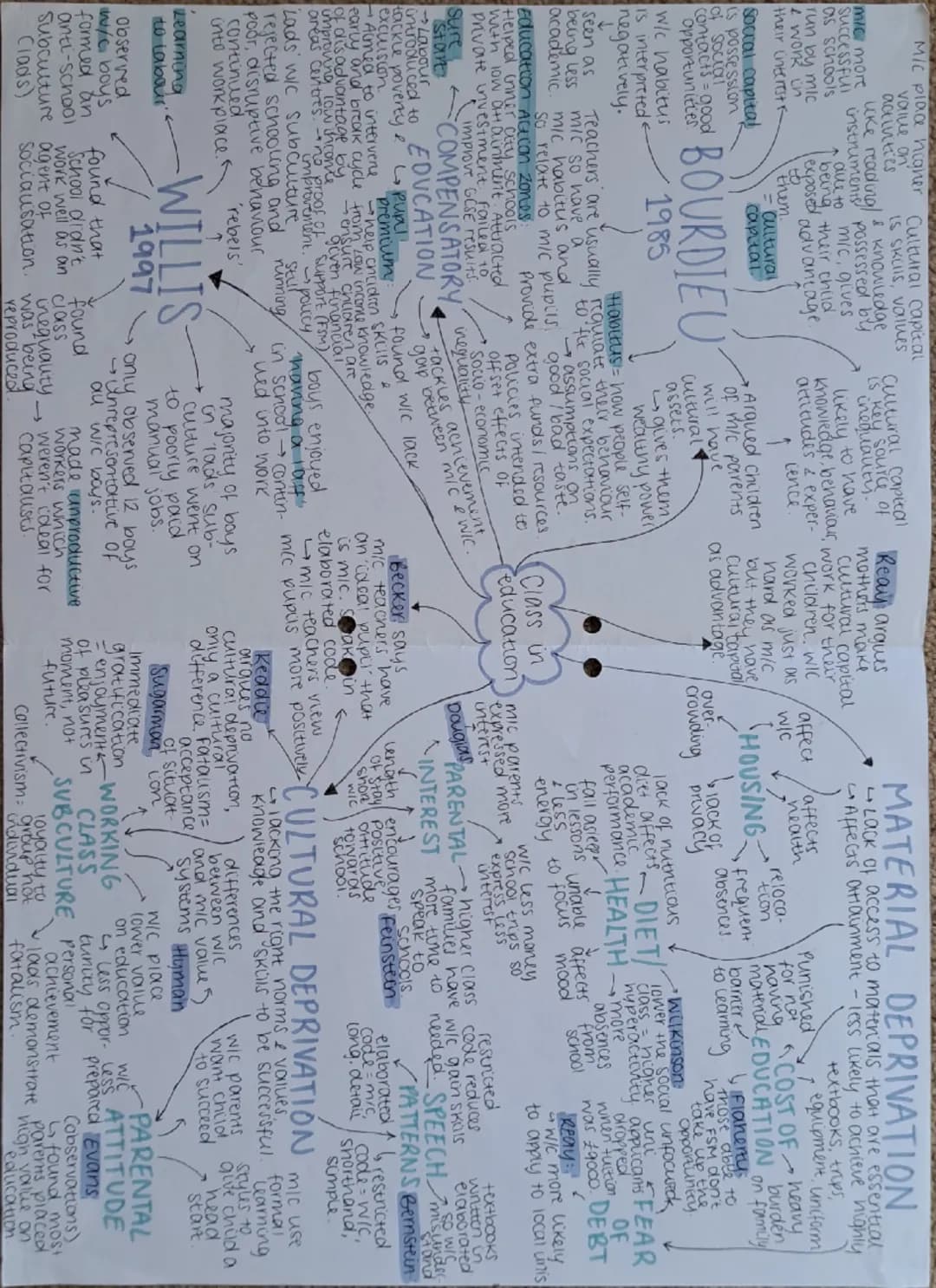
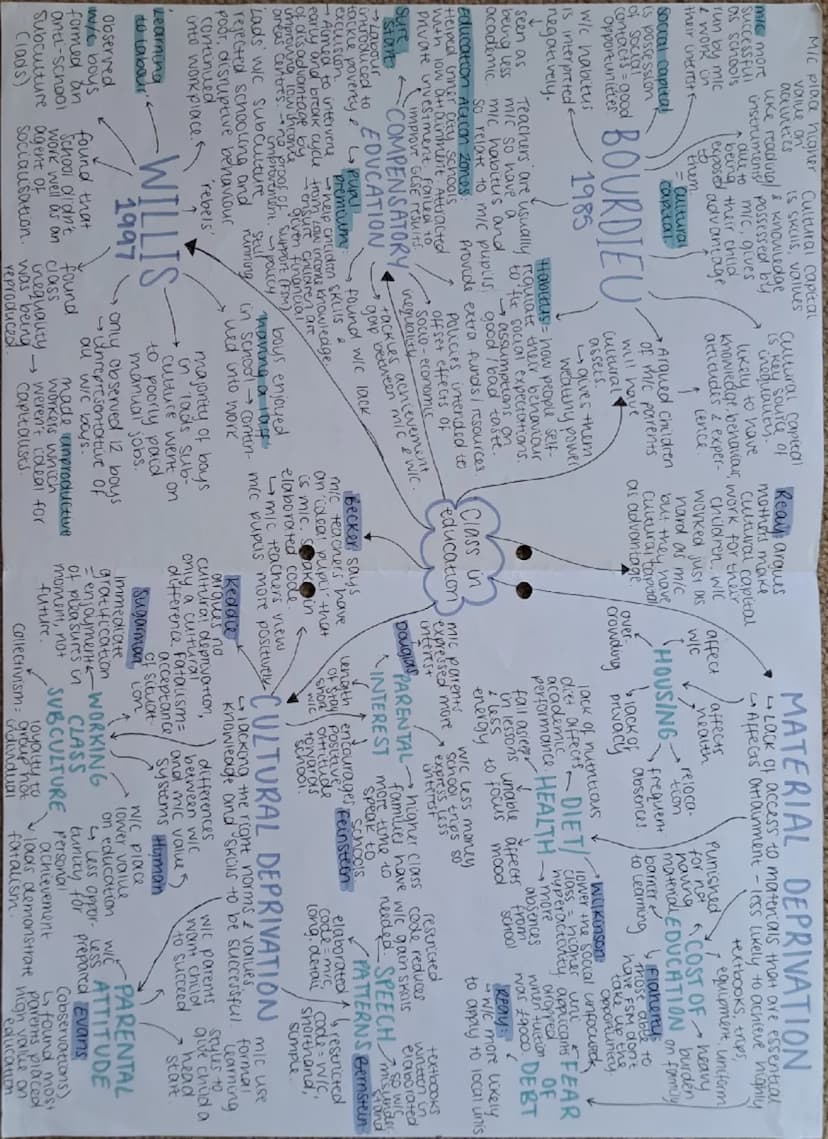
Your postcode still predicts your grades more than your potential. Material deprivation - lacking essential resources like textbooks, computers, or even adequate food - creates immediate barriers to learning. Many working-class families simply can't afford the hidden costs of 'free' education.
Cultural capital theory, developed by Bourdieu, explains how middle-class culture gives some students massive advantages. Middle-class pupils arrive at school already familiar with the 'elaborated code' of formal language that schools use, whilst working-class pupils may struggle with this unfamiliar communication style.
Willis's study of 'the lads' showed how some working-class boys reject school values entirely, forming anti-school subcultures. Ironically, this resistance actually prepares them for manual jobs, reproducing class inequality. The lads' counter-culture ultimately served capitalism by creating willing manual workers.
Think About It: Many working-class students work just as hard as their middle-class peers but lack the cultural advantages that make success easier to achieve.
Compensatory education policies like Education Action Zones and pupil premium attempt to level the playing field. However, critics argue these initiatives often fail because they focus on changing working-class culture rather than addressing structural inequalities in society.
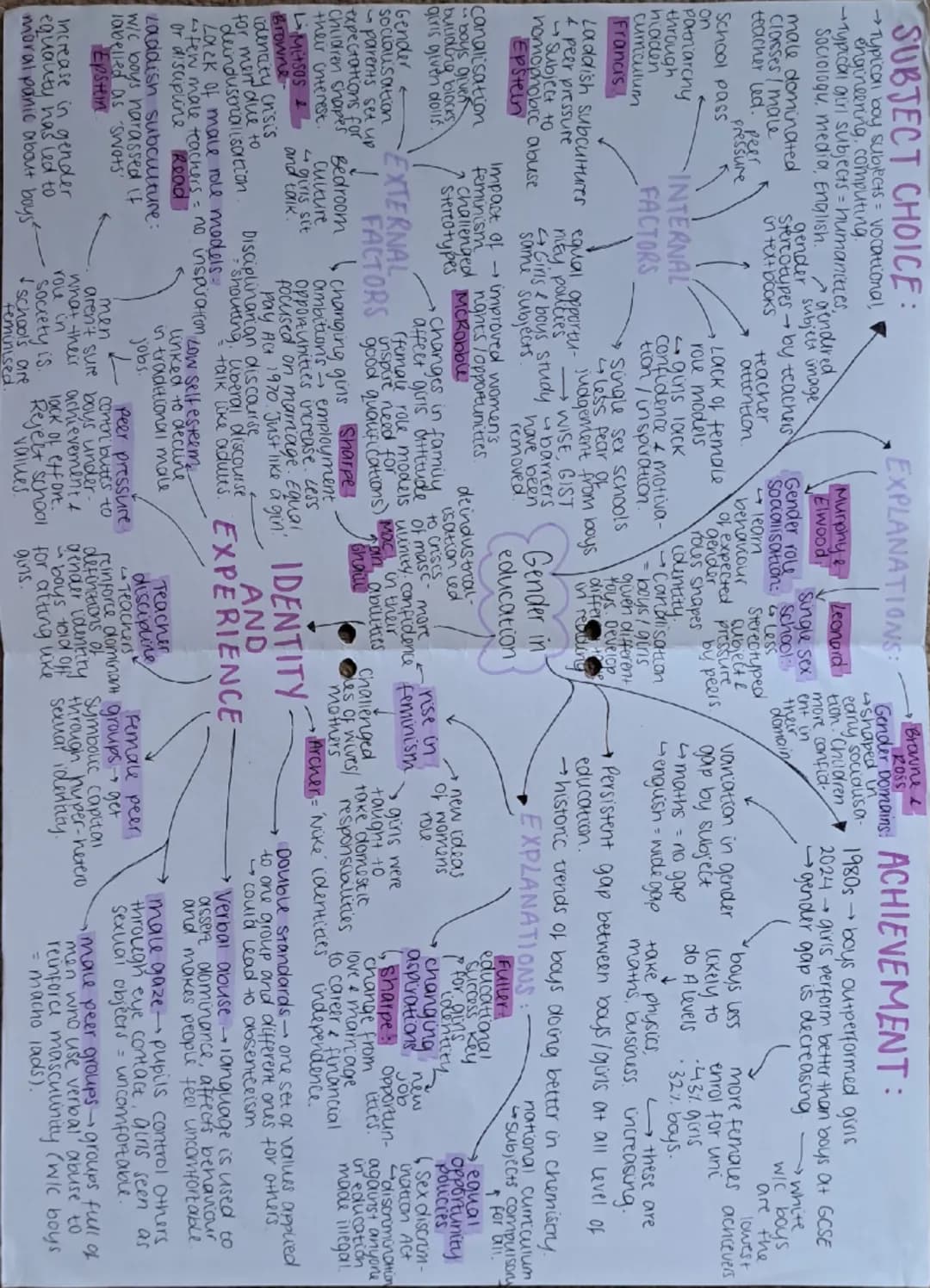
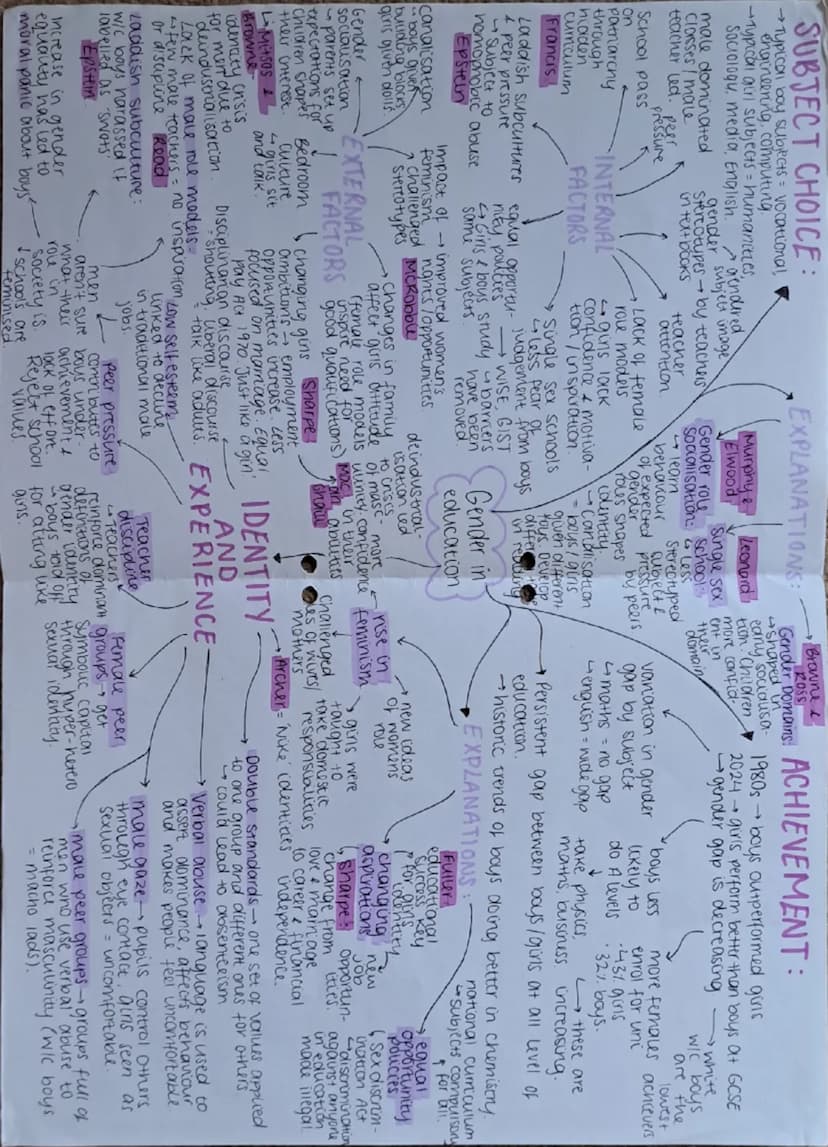
The gender gap has completely flipped - girls now outperform boys at almost every level. In the 1980s, boys dominated; by 2024, girls achieve better GCSE results across most subjects, though significant gaps remain in specific areas like English.
External factors explain much of this transformation. The rise of feminism challenged traditional stereotypes, whilst deindustrialisation reduced traditional male jobs, making qualifications essential for everyone. Girls' aspirations shifted from marriage-focused to career-focused, driving higher achievement.
Internal factors within schools also matter. The introduction of coursework suits many girls' learning styles better than traditional exams. However, subject choice remains heavily gendered - boys still dominate computing and engineering, whilst girls prefer humanities and social sciences.
Modern Reality: Despite girls' success, the 'crisis of masculinity' affecting working-class boys has created new concerns about male underachievement.
Laddish subcultures see some boys reject academic effort as 'feminine', facing peer pressure to prioritise sports or 'street credibility' over studying. Meanwhile, girls in single-sex environments often show increased confidence in traditionally male subjects like maths and science.
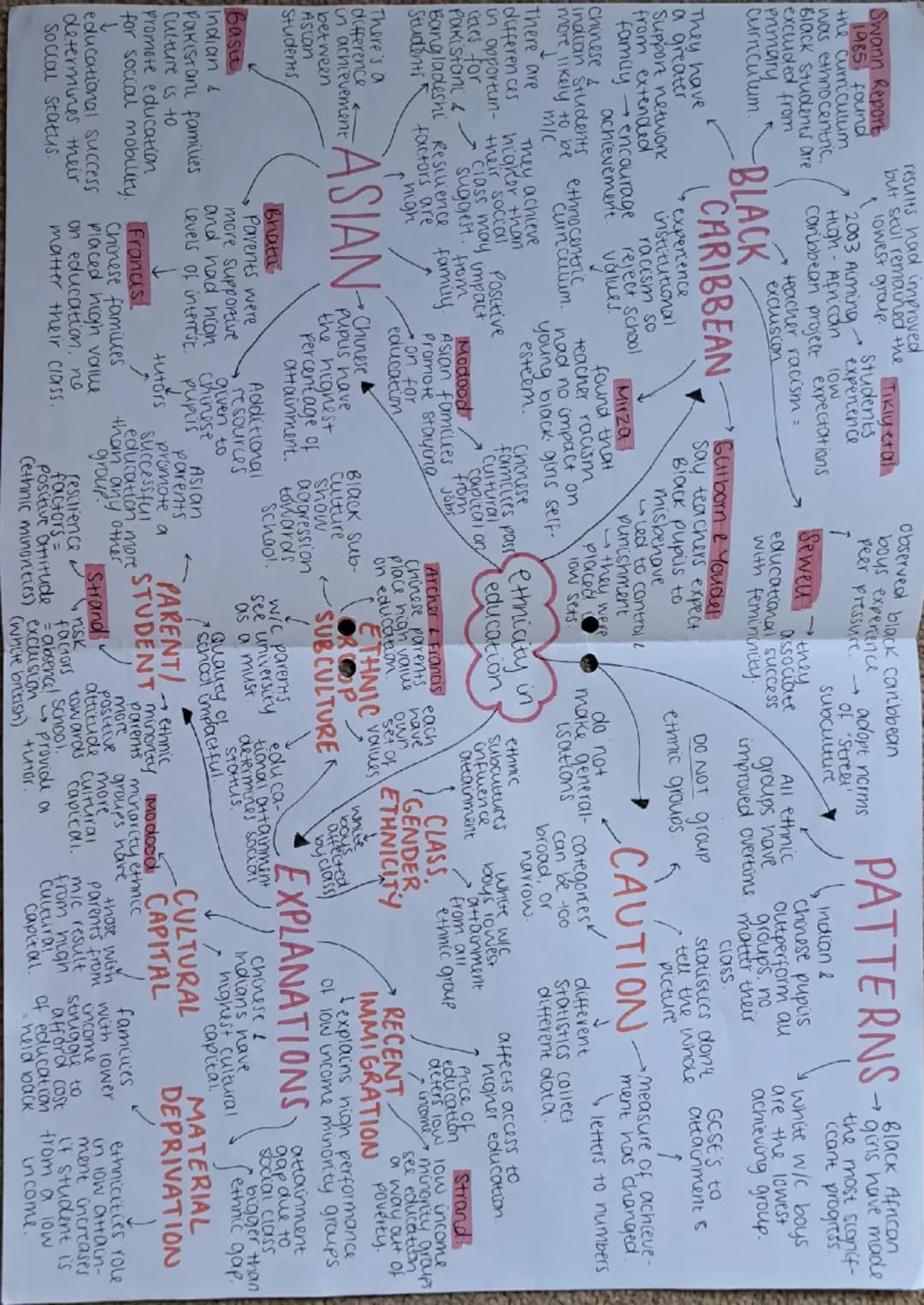
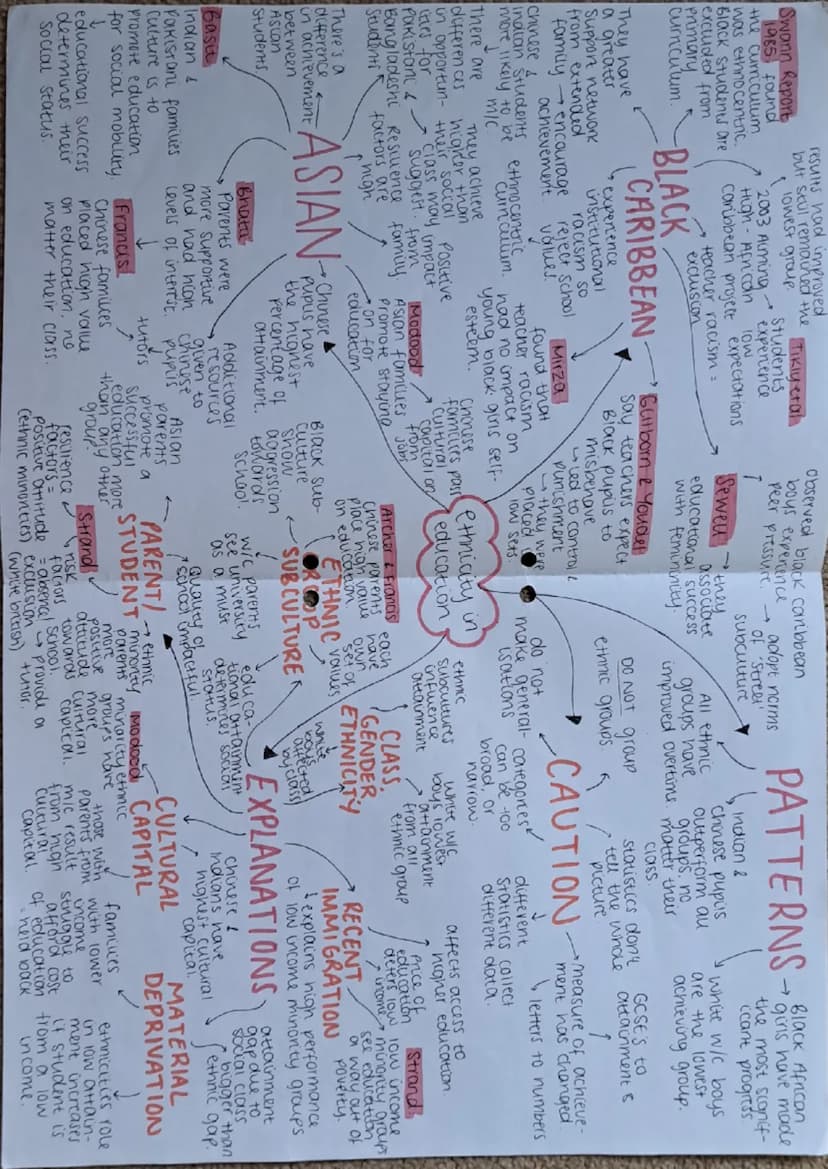
Achievement varies dramatically between ethnic groups, but the picture is more complex than simple stereotypes suggest. Chinese and Indian pupils consistently outperform all other groups, whilst Pakistani, Bangladeshi, and Black Caribbean students face ongoing challenges.
Cultural factors play crucial roles. Many Asian families place extremely high value on education, seeing it as essential for social mobility. Chinese parents often provide additional tutoring and view educational success as determining family status, regardless of social class.
However, Black Caribbean pupils face particular challenges. Gillborn and Youdell found teachers often expect black pupils to misbehave, leading to institutional racism through lower expectations and disproportionate exclusions. Many black students experience this as a constant battle against negative stereotypes.
Important Note: Social class often has a bigger impact than ethnicity - middle-class ethnic minority pupils typically outperform working-class white pupils.
Material deprivation affects many ethnic minority families, particularly recent immigrants who may lack cultural capital valued by British schools. However, the resilience shown by many minority ethnic families demonstrates how high aspirations can overcome material disadvantages when parents prioritise education.
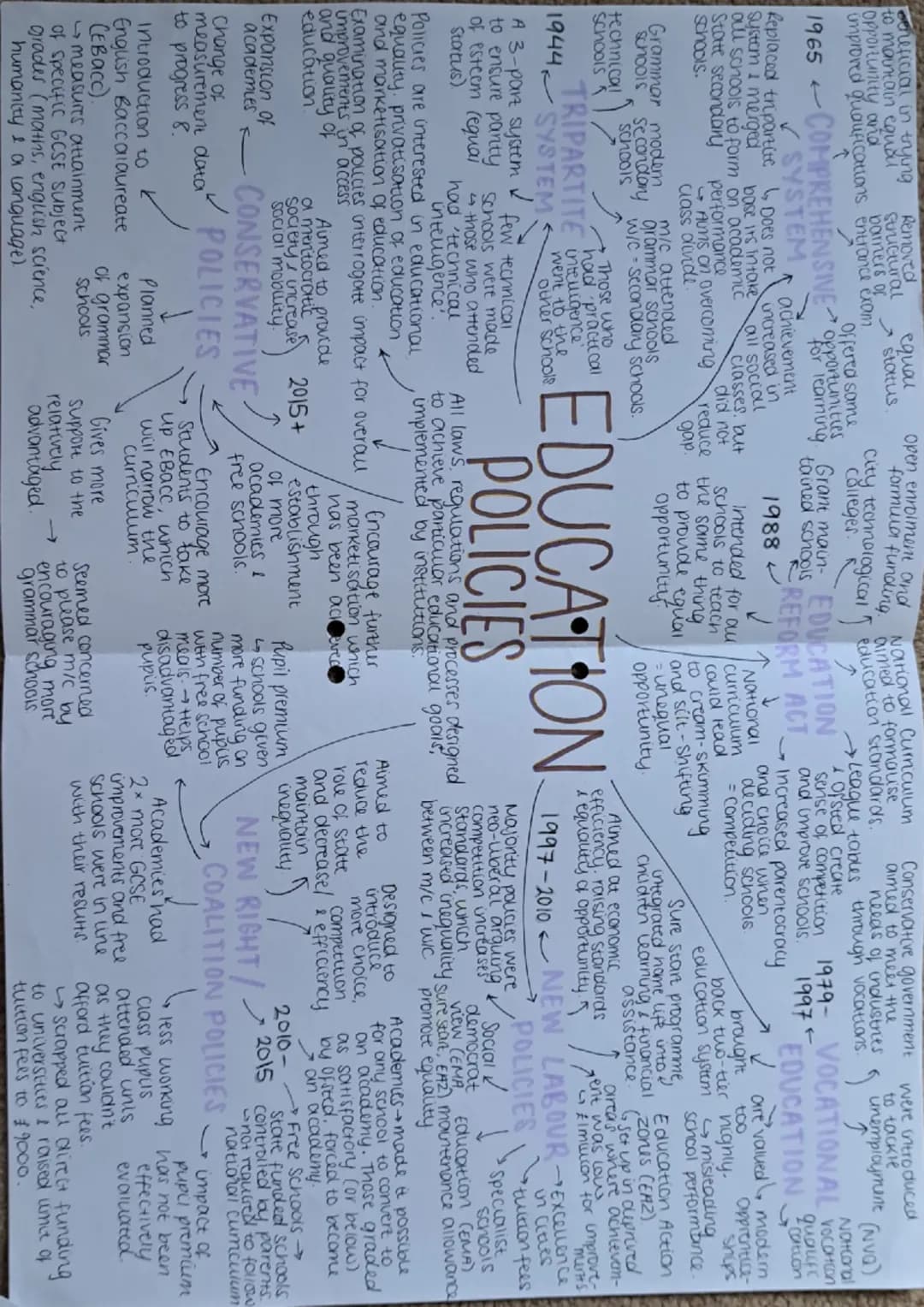
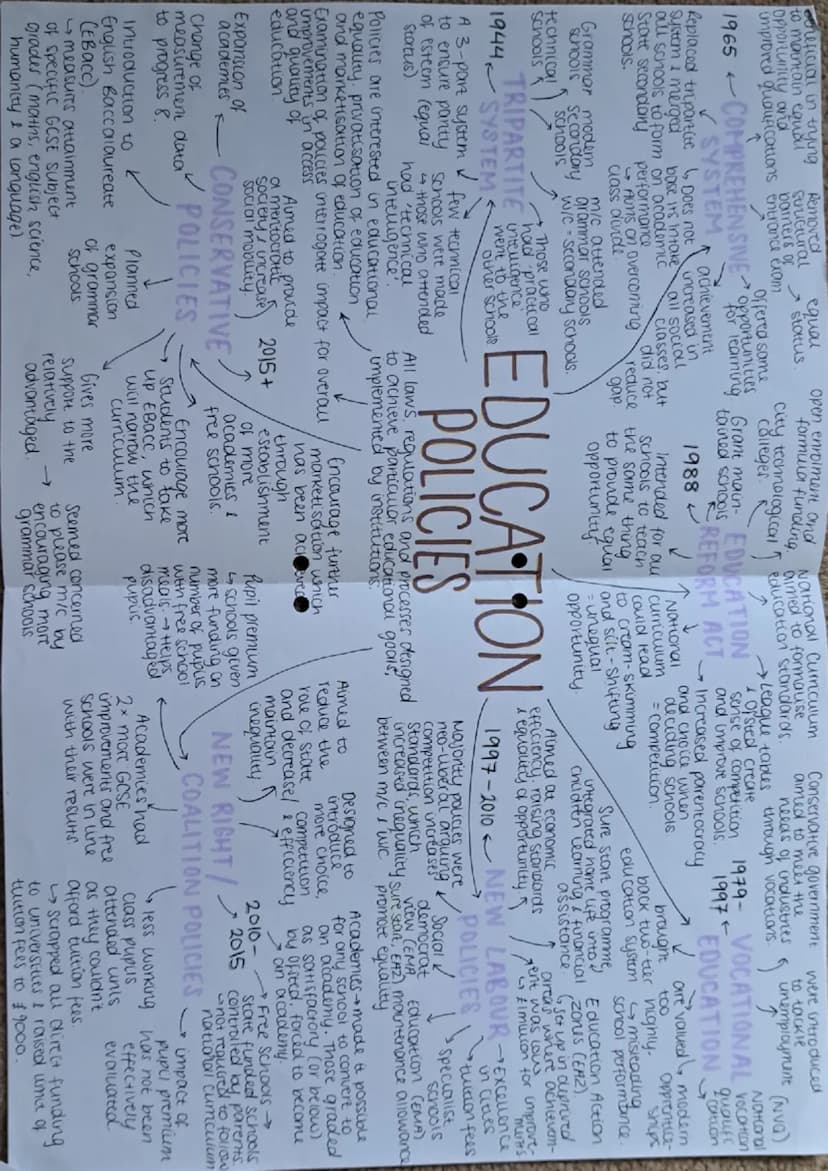
British education has undergone massive transformations, each reflecting different political ideologies about equality and competition. The 1944 Education Act created the tripartite system - grammar, secondary modern, and technical schools - supposedly based on different types of intelligence.
This system actually reinforced class divisions, with middle-class pupils dominating grammar schools. Comprehensive education in the 1960s aimed to create genuine equality by merging all school types, removing barriers that prevented working-class pupils accessing quality education.
The 1988 Education Reform Act introduced marketisation - treating education like a business. League tables, Ofsted inspections, and parental choice aimed to drive up standards through competition between schools.
Key Change: Recent policies have moved increasingly towards privatisation, with academies and free schools operating outside traditional local authority control.
New Labour (1997-2010) introduced targeted interventions like Education Action Zones and pupil premium funding to help disadvantaged pupils. However, they also raised university tuition fees, potentially deterring working-class students from higher education.
Current Conservative policies emphasise further marketisation through academy expansion and the English Baccalaureate, which critics argue narrows curriculum choice and reinforces traditional academic subjects.
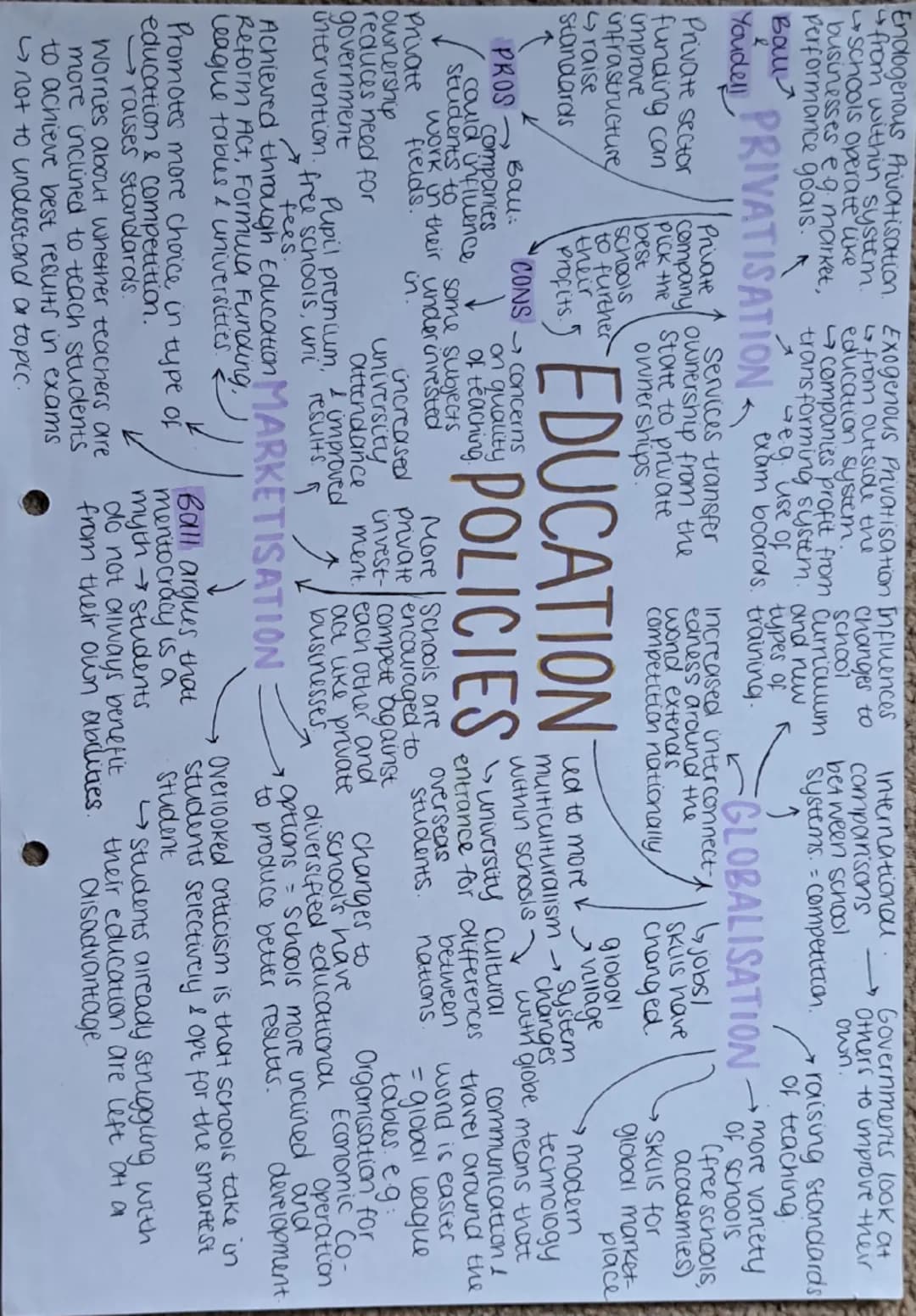
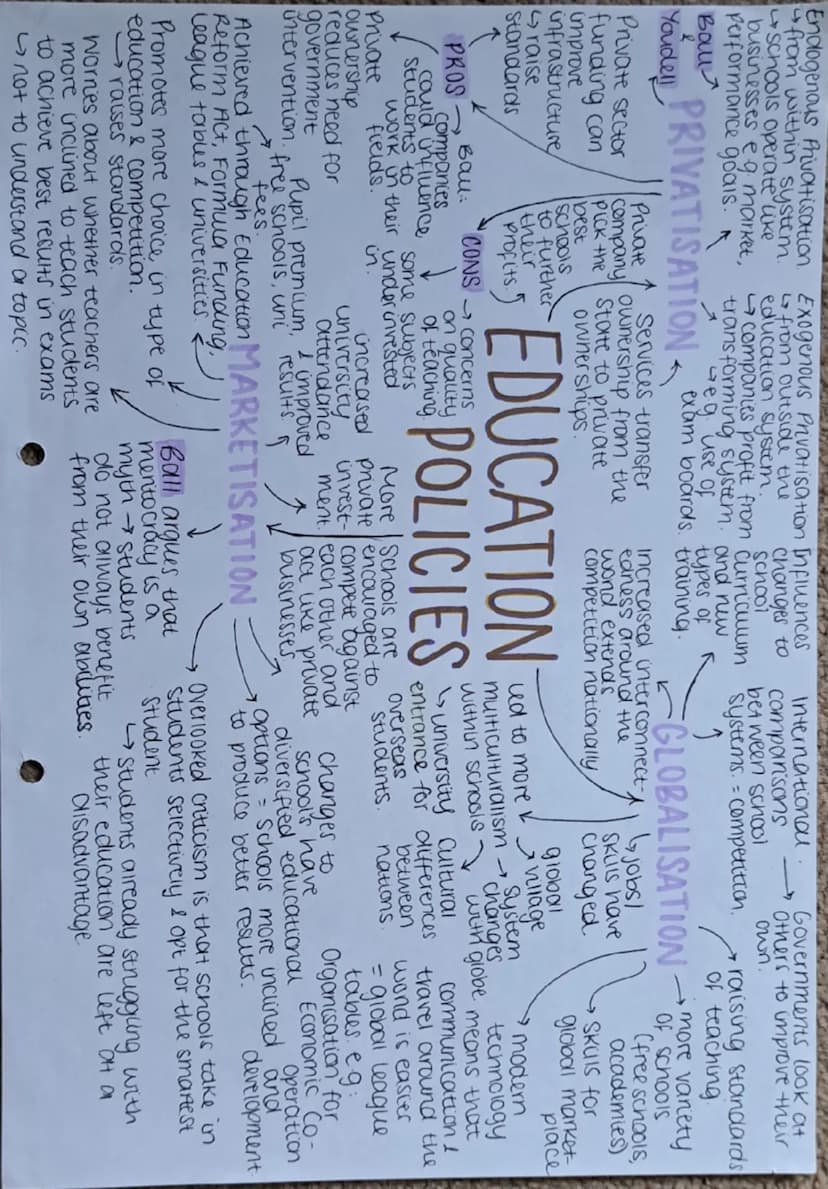
Modern education increasingly operates like a marketplace, with privatisation bringing both opportunities and concerns. Endogenous privatisation sees schools adopting business practices internally, whilst exogenous privatisation involves external companies providing services or funding.
Globalisation has transformed education through increased international competition. Global league tables compare national education systems, creating pressure for governments to improve performance. Universities now compete internationally for students, particularly high-paying overseas pupils.
Marketisation theoretically increases choice and raises standards through competition. Parents can compare schools using league tables and choose the best options for their children. This parentocracy supposedly empowers families to demand better education.
Critical Question: Does marketisation actually improve education for everyone, or does it just give middle-class families more advantages in navigating the system?
However, critics argue marketisation creates a myth of meritocracy. Schools can engage in cream-skimming (selecting the best pupils) and silt-shifting (avoiding challenging students) to boost their league table positions. This potentially leaves struggling students in underperforming schools whilst privileged families access the best options.
The reality is that education policies often reflect broader political ideologies about society, equality, and the role of the state rather than simply pursuing educational improvement.
Our AI Companion is a student-focused AI tool that offers more than just answers. Built on millions of Knowunity resources, it provides relevant information, personalised study plans, quizzes, and content directly in the chat, adapting to your individual learning journey.
You can download the app from Google Play Store and Apple App Store.
That's right! Enjoy free access to study content, connect with fellow students, and get instant help – all at your fingertips.
App Store
Google Play
The app is very easy to use and well designed. I have found everything I was looking for so far and have been able to learn a lot from the presentations! I will definitely use the app for a class assignment! And of course it also helps a lot as an inspiration.
Stefan S
iOS user
This app is really great. There are so many study notes and help [...]. My problem subject is French, for example, and the app has so many options for help. Thanks to this app, I have improved my French. I would recommend it to anyone.
Samantha Klich
Android user
Wow, I am really amazed. I just tried the app because I've seen it advertised many times and was absolutely stunned. This app is THE HELP you want for school and above all, it offers so many things, such as workouts and fact sheets, which have been VERY helpful to me personally.
Anna
iOS user
Best app on earth! no words because it’s too good
Thomas R
iOS user
Just amazing. Let's me revise 10x better, this app is a quick 10/10. I highly recommend it to anyone. I can watch and search for notes. I can save them in the subject folder. I can revise it any time when I come back. If you haven't tried this app, you're really missing out.
Basil
Android user
This app has made me feel so much more confident in my exam prep, not only through boosting my own self confidence through the features that allow you to connect with others and feel less alone, but also through the way the app itself is centred around making you feel better. It is easy to navigate, fun to use, and helpful to anyone struggling in absolutely any way.
David K
iOS user
The app's just great! All I have to do is enter the topic in the search bar and I get the response real fast. I don't have to watch 10 YouTube videos to understand something, so I'm saving my time. Highly recommended!
Sudenaz Ocak
Android user
In school I was really bad at maths but thanks to the app, I am doing better now. I am so grateful that you made the app.
Greenlight Bonnie
Android user
very reliable app to help and grow your ideas of Maths, English and other related topics in your works. please use this app if your struggling in areas, this app is key for that. wish I'd of done a review before. and it's also free so don't worry about that.
Rohan U
Android user
I know a lot of apps use fake accounts to boost their reviews but this app deserves it all. Originally I was getting 4 in my English exams and this time I got a grade 7. I didn’t even know about this app three days until the exam and it has helped A LOT. Please actually trust me and use it as I’m sure you too will see developments.
Xander S
iOS user
THE QUIZES AND FLASHCARDS ARE SO USEFUL AND I LOVE Knowunity AI. IT ALSO IS LITREALLY LIKE CHATGPT BUT SMARTER!! HELPED ME WITH MY MASCARA PROBLEMS TOO!! AS WELL AS MY REAL SUBJECTS ! DUHHH 😍😁😲🤑💗✨🎀😮
Elisha
iOS user
This apps acc the goat. I find revision so boring but this app makes it so easy to organize it all and then you can ask the freeeee ai to test yourself so good and you can easily upload your own stuff. highly recommend as someone taking mocks now
Paul T
iOS user
The app is very easy to use and well designed. I have found everything I was looking for so far and have been able to learn a lot from the presentations! I will definitely use the app for a class assignment! And of course it also helps a lot as an inspiration.
Stefan S
iOS user
This app is really great. There are so many study notes and help [...]. My problem subject is French, for example, and the app has so many options for help. Thanks to this app, I have improved my French. I would recommend it to anyone.
Samantha Klich
Android user
Wow, I am really amazed. I just tried the app because I've seen it advertised many times and was absolutely stunned. This app is THE HELP you want for school and above all, it offers so many things, such as workouts and fact sheets, which have been VERY helpful to me personally.
Anna
iOS user
Best app on earth! no words because it’s too good
Thomas R
iOS user
Just amazing. Let's me revise 10x better, this app is a quick 10/10. I highly recommend it to anyone. I can watch and search for notes. I can save them in the subject folder. I can revise it any time when I come back. If you haven't tried this app, you're really missing out.
Basil
Android user
This app has made me feel so much more confident in my exam prep, not only through boosting my own self confidence through the features that allow you to connect with others and feel less alone, but also through the way the app itself is centred around making you feel better. It is easy to navigate, fun to use, and helpful to anyone struggling in absolutely any way.
David K
iOS user
The app's just great! All I have to do is enter the topic in the search bar and I get the response real fast. I don't have to watch 10 YouTube videos to understand something, so I'm saving my time. Highly recommended!
Sudenaz Ocak
Android user
In school I was really bad at maths but thanks to the app, I am doing better now. I am so grateful that you made the app.
Greenlight Bonnie
Android user
very reliable app to help and grow your ideas of Maths, English and other related topics in your works. please use this app if your struggling in areas, this app is key for that. wish I'd of done a review before. and it's also free so don't worry about that.
Rohan U
Android user
I know a lot of apps use fake accounts to boost their reviews but this app deserves it all. Originally I was getting 4 in my English exams and this time I got a grade 7. I didn’t even know about this app three days until the exam and it has helped A LOT. Please actually trust me and use it as I’m sure you too will see developments.
Xander S
iOS user
THE QUIZES AND FLASHCARDS ARE SO USEFUL AND I LOVE Knowunity AI. IT ALSO IS LITREALLY LIKE CHATGPT BUT SMARTER!! HELPED ME WITH MY MASCARA PROBLEMS TOO!! AS WELL AS MY REAL SUBJECTS ! DUHHH 😍😁😲🤑💗✨🎀😮
Elisha
iOS user
This apps acc the goat. I find revision so boring but this app makes it so easy to organize it all and then you can ask the freeeee ai to test yourself so good and you can easily upload your own stuff. highly recommend as someone taking mocks now
Paul T
iOS user
Jessica
@.jess.
Education is one of society's most important institutions, but different theories explain its role in completely different ways. From functionalists who see schools as creating social unity, to Marxists who argue education reproduces class inequality, these perspectives shape how we... Show more
Access to all documents
Improve your grades
Join milions of students
Ever wondered why some people see school as the great equaliser whilst others think it just keeps the rich on top? Functionalist theory views education as essential for society's stability. Durkheim argued schools create social solidarity by teaching shared values, whilst Parsons saw them as bridges between family and adult life.
Davis and Moore believed schools sort people into the right jobs through meritocracy - basically, the most talented get the best positions. They argued this role allocation serves society's needs by putting skilled people in important roles.
However, Marxist theorists completely disagree. Althusser saw schools as part of the ideological state apparatus - institutions that control our beliefs to benefit the ruling class. Bowles and Gintis developed correspondence theory, arguing that school life mirrors work life to create obedient workers.
Key Insight: Functionalists see education as beneficial for everyone, whilst Marxists view it as a tool of oppression that maintains class inequality.
Feminist perspectives highlight how education can both challenge and reinforce patriarchal norms. Liberal feminists celebrate girls' improved achievement, whilst radical feminists argue the hidden curriculum still teaches traditional gender roles.
Access to all documents
Improve your grades
Join milions of students
Your teachers' expectations might shape your future more than you think. Labelling theory shows how teachers categorise pupils based on their perceptions, creating powerful effects on achievement.
Rosenthal and Jacobson's famous study randomly labelled 20% of pupils as 'spurters' likely to improve rapidly. These students made significantly more progress, demonstrating the self-fulfilling prophecy - when positive expectations lead to positive outcomes.
Becker found teachers had clear ideas about the 'ideal pupil' - typically middle-class, well-behaved students. This leads to differentiation, where pupils are treated differently based on these assumptions. The halo effect means once you're labelled positively, teachers interpret everything you do more favourably.
Reality Check: These labelling processes happen constantly in schools through streaming, setting, and everyday interactions - they're not just abstract theories.
Streaming divides pupils into ability groups across all subjects, whilst setting groups them differently for each subject. Research consistently shows that middle-class pupils are more likely to be placed in higher sets, regardless of actual ability. This creates unequal opportunities that can determine your entire educational journey.
Access to all documents
Improve your grades
Join milions of students
Your postcode still predicts your grades more than your potential. Material deprivation - lacking essential resources like textbooks, computers, or even adequate food - creates immediate barriers to learning. Many working-class families simply can't afford the hidden costs of 'free' education.
Cultural capital theory, developed by Bourdieu, explains how middle-class culture gives some students massive advantages. Middle-class pupils arrive at school already familiar with the 'elaborated code' of formal language that schools use, whilst working-class pupils may struggle with this unfamiliar communication style.
Willis's study of 'the lads' showed how some working-class boys reject school values entirely, forming anti-school subcultures. Ironically, this resistance actually prepares them for manual jobs, reproducing class inequality. The lads' counter-culture ultimately served capitalism by creating willing manual workers.
Think About It: Many working-class students work just as hard as their middle-class peers but lack the cultural advantages that make success easier to achieve.
Compensatory education policies like Education Action Zones and pupil premium attempt to level the playing field. However, critics argue these initiatives often fail because they focus on changing working-class culture rather than addressing structural inequalities in society.
Access to all documents
Improve your grades
Join milions of students
The gender gap has completely flipped - girls now outperform boys at almost every level. In the 1980s, boys dominated; by 2024, girls achieve better GCSE results across most subjects, though significant gaps remain in specific areas like English.
External factors explain much of this transformation. The rise of feminism challenged traditional stereotypes, whilst deindustrialisation reduced traditional male jobs, making qualifications essential for everyone. Girls' aspirations shifted from marriage-focused to career-focused, driving higher achievement.
Internal factors within schools also matter. The introduction of coursework suits many girls' learning styles better than traditional exams. However, subject choice remains heavily gendered - boys still dominate computing and engineering, whilst girls prefer humanities and social sciences.
Modern Reality: Despite girls' success, the 'crisis of masculinity' affecting working-class boys has created new concerns about male underachievement.
Laddish subcultures see some boys reject academic effort as 'feminine', facing peer pressure to prioritise sports or 'street credibility' over studying. Meanwhile, girls in single-sex environments often show increased confidence in traditionally male subjects like maths and science.
Access to all documents
Improve your grades
Join milions of students
Achievement varies dramatically between ethnic groups, but the picture is more complex than simple stereotypes suggest. Chinese and Indian pupils consistently outperform all other groups, whilst Pakistani, Bangladeshi, and Black Caribbean students face ongoing challenges.
Cultural factors play crucial roles. Many Asian families place extremely high value on education, seeing it as essential for social mobility. Chinese parents often provide additional tutoring and view educational success as determining family status, regardless of social class.
However, Black Caribbean pupils face particular challenges. Gillborn and Youdell found teachers often expect black pupils to misbehave, leading to institutional racism through lower expectations and disproportionate exclusions. Many black students experience this as a constant battle against negative stereotypes.
Important Note: Social class often has a bigger impact than ethnicity - middle-class ethnic minority pupils typically outperform working-class white pupils.
Material deprivation affects many ethnic minority families, particularly recent immigrants who may lack cultural capital valued by British schools. However, the resilience shown by many minority ethnic families demonstrates how high aspirations can overcome material disadvantages when parents prioritise education.
Access to all documents
Improve your grades
Join milions of students
British education has undergone massive transformations, each reflecting different political ideologies about equality and competition. The 1944 Education Act created the tripartite system - grammar, secondary modern, and technical schools - supposedly based on different types of intelligence.
This system actually reinforced class divisions, with middle-class pupils dominating grammar schools. Comprehensive education in the 1960s aimed to create genuine equality by merging all school types, removing barriers that prevented working-class pupils accessing quality education.
The 1988 Education Reform Act introduced marketisation - treating education like a business. League tables, Ofsted inspections, and parental choice aimed to drive up standards through competition between schools.
Key Change: Recent policies have moved increasingly towards privatisation, with academies and free schools operating outside traditional local authority control.
New Labour (1997-2010) introduced targeted interventions like Education Action Zones and pupil premium funding to help disadvantaged pupils. However, they also raised university tuition fees, potentially deterring working-class students from higher education.
Current Conservative policies emphasise further marketisation through academy expansion and the English Baccalaureate, which critics argue narrows curriculum choice and reinforces traditional academic subjects.
Access to all documents
Improve your grades
Join milions of students
Modern education increasingly operates like a marketplace, with privatisation bringing both opportunities and concerns. Endogenous privatisation sees schools adopting business practices internally, whilst exogenous privatisation involves external companies providing services or funding.
Globalisation has transformed education through increased international competition. Global league tables compare national education systems, creating pressure for governments to improve performance. Universities now compete internationally for students, particularly high-paying overseas pupils.
Marketisation theoretically increases choice and raises standards through competition. Parents can compare schools using league tables and choose the best options for their children. This parentocracy supposedly empowers families to demand better education.
Critical Question: Does marketisation actually improve education for everyone, or does it just give middle-class families more advantages in navigating the system?
However, critics argue marketisation creates a myth of meritocracy. Schools can engage in cream-skimming (selecting the best pupils) and silt-shifting (avoiding challenging students) to boost their league table positions. This potentially leaves struggling students in underperforming schools whilst privileged families access the best options.
The reality is that education policies often reflect broader political ideologies about society, equality, and the role of the state rather than simply pursuing educational improvement.
Our AI Companion is a student-focused AI tool that offers more than just answers. Built on millions of Knowunity resources, it provides relevant information, personalised study plans, quizzes, and content directly in the chat, adapting to your individual learning journey.
You can download the app from Google Play Store and Apple App Store.
That's right! Enjoy free access to study content, connect with fellow students, and get instant help – all at your fingertips.
46
Smart Tools NEW
Transform this note into: ✓ 50+ Practice Questions ✓ Interactive Flashcards ✓ Full Mock Exam ✓ Essay Outlines
App Store
Google Play
The app is very easy to use and well designed. I have found everything I was looking for so far and have been able to learn a lot from the presentations! I will definitely use the app for a class assignment! And of course it also helps a lot as an inspiration.
Stefan S
iOS user
This app is really great. There are so many study notes and help [...]. My problem subject is French, for example, and the app has so many options for help. Thanks to this app, I have improved my French. I would recommend it to anyone.
Samantha Klich
Android user
Wow, I am really amazed. I just tried the app because I've seen it advertised many times and was absolutely stunned. This app is THE HELP you want for school and above all, it offers so many things, such as workouts and fact sheets, which have been VERY helpful to me personally.
Anna
iOS user
Best app on earth! no words because it’s too good
Thomas R
iOS user
Just amazing. Let's me revise 10x better, this app is a quick 10/10. I highly recommend it to anyone. I can watch and search for notes. I can save them in the subject folder. I can revise it any time when I come back. If you haven't tried this app, you're really missing out.
Basil
Android user
This app has made me feel so much more confident in my exam prep, not only through boosting my own self confidence through the features that allow you to connect with others and feel less alone, but also through the way the app itself is centred around making you feel better. It is easy to navigate, fun to use, and helpful to anyone struggling in absolutely any way.
David K
iOS user
The app's just great! All I have to do is enter the topic in the search bar and I get the response real fast. I don't have to watch 10 YouTube videos to understand something, so I'm saving my time. Highly recommended!
Sudenaz Ocak
Android user
In school I was really bad at maths but thanks to the app, I am doing better now. I am so grateful that you made the app.
Greenlight Bonnie
Android user
very reliable app to help and grow your ideas of Maths, English and other related topics in your works. please use this app if your struggling in areas, this app is key for that. wish I'd of done a review before. and it's also free so don't worry about that.
Rohan U
Android user
I know a lot of apps use fake accounts to boost their reviews but this app deserves it all. Originally I was getting 4 in my English exams and this time I got a grade 7. I didn’t even know about this app three days until the exam and it has helped A LOT. Please actually trust me and use it as I’m sure you too will see developments.
Xander S
iOS user
THE QUIZES AND FLASHCARDS ARE SO USEFUL AND I LOVE Knowunity AI. IT ALSO IS LITREALLY LIKE CHATGPT BUT SMARTER!! HELPED ME WITH MY MASCARA PROBLEMS TOO!! AS WELL AS MY REAL SUBJECTS ! DUHHH 😍😁😲🤑💗✨🎀😮
Elisha
iOS user
This apps acc the goat. I find revision so boring but this app makes it so easy to organize it all and then you can ask the freeeee ai to test yourself so good and you can easily upload your own stuff. highly recommend as someone taking mocks now
Paul T
iOS user
The app is very easy to use and well designed. I have found everything I was looking for so far and have been able to learn a lot from the presentations! I will definitely use the app for a class assignment! And of course it also helps a lot as an inspiration.
Stefan S
iOS user
This app is really great. There are so many study notes and help [...]. My problem subject is French, for example, and the app has so many options for help. Thanks to this app, I have improved my French. I would recommend it to anyone.
Samantha Klich
Android user
Wow, I am really amazed. I just tried the app because I've seen it advertised many times and was absolutely stunned. This app is THE HELP you want for school and above all, it offers so many things, such as workouts and fact sheets, which have been VERY helpful to me personally.
Anna
iOS user
Best app on earth! no words because it’s too good
Thomas R
iOS user
Just amazing. Let's me revise 10x better, this app is a quick 10/10. I highly recommend it to anyone. I can watch and search for notes. I can save them in the subject folder. I can revise it any time when I come back. If you haven't tried this app, you're really missing out.
Basil
Android user
This app has made me feel so much more confident in my exam prep, not only through boosting my own self confidence through the features that allow you to connect with others and feel less alone, but also through the way the app itself is centred around making you feel better. It is easy to navigate, fun to use, and helpful to anyone struggling in absolutely any way.
David K
iOS user
The app's just great! All I have to do is enter the topic in the search bar and I get the response real fast. I don't have to watch 10 YouTube videos to understand something, so I'm saving my time. Highly recommended!
Sudenaz Ocak
Android user
In school I was really bad at maths but thanks to the app, I am doing better now. I am so grateful that you made the app.
Greenlight Bonnie
Android user
very reliable app to help and grow your ideas of Maths, English and other related topics in your works. please use this app if your struggling in areas, this app is key for that. wish I'd of done a review before. and it's also free so don't worry about that.
Rohan U
Android user
I know a lot of apps use fake accounts to boost their reviews but this app deserves it all. Originally I was getting 4 in my English exams and this time I got a grade 7. I didn’t even know about this app three days until the exam and it has helped A LOT. Please actually trust me and use it as I’m sure you too will see developments.
Xander S
iOS user
THE QUIZES AND FLASHCARDS ARE SO USEFUL AND I LOVE Knowunity AI. IT ALSO IS LITREALLY LIKE CHATGPT BUT SMARTER!! HELPED ME WITH MY MASCARA PROBLEMS TOO!! AS WELL AS MY REAL SUBJECTS ! DUHHH 😍😁😲🤑💗✨🎀😮
Elisha
iOS user
This apps acc the goat. I find revision so boring but this app makes it so easy to organize it all and then you can ask the freeeee ai to test yourself so good and you can easily upload your own stuff. highly recommend as someone taking mocks now
Paul T
iOS user