
Education isn't just about getting qualifications - it plays a... Show more
 Sociology
 English Literature
 Biology
Sign up to see the contentIt's free!
Access to all documents
Improve your grades
Join milions of students
By signing up you accept Terms of Service and Privacy Policy
Subjects
Classic Dramatic Literature
Modern Lyric Poetry
Influential English-Language Authors
Classic and Contemporary Novels
Literary Character Analysis
Romantic and Love Poetry
Reading Analysis and Interpretation
Evidence Analysis and Integration
Author's Stylistic Elements
Figurative Language and Rhetoric
Show all topics
Human Organ Systems
Cellular Organization and Development
Biomolecular Structure and Organization
Enzyme Structure and Regulation
Cellular Organization Types
Biological Homeostatic Processes
Cellular Membrane Structure
Autotrophic Energy Processes
Environmental Sustainability and Impact
Neural Communication Systems
Show all topics
Social Sciences Research & Practice
Social Structure and Mobility
Classic Social Influence Experiments
Social Systems Theories
Family and Relationship Dynamics
Memory Systems and Processes
Neural Bases of Behavior
Social Influence and Attraction
Psychotherapeutic Approaches
Human Agency and Responsibility
Show all topics
Chemical Sciences and Applications
Chemical Bond Types and Properties
Organic Functional Groups
Atomic Structure and Composition
Chromatographic Separation Principles
Chemical Compound Classifications
Electrochemical Cell Systems
Periodic Table Organization
Chemical Reaction Kinetics
Chemical Equation Conservation
Show all topics
Nazi Germany and Holocaust 1933-1945
World Wars and Peace Treaties
European Monarchs and Statesmen
Cold War Global Tensions
Medieval Institutions and Systems
European Renaissance and Enlightenment
Modern Global Environmental-Health Challenges
Modern Military Conflicts
Medieval Migration and Invasions
World Wars Era and Impact
Show all topics
2,432
•
Updated 6 Mar 2026
•

muskan s
@mu5kan_s
Education isn't just about getting qualifications - it plays a... Show more
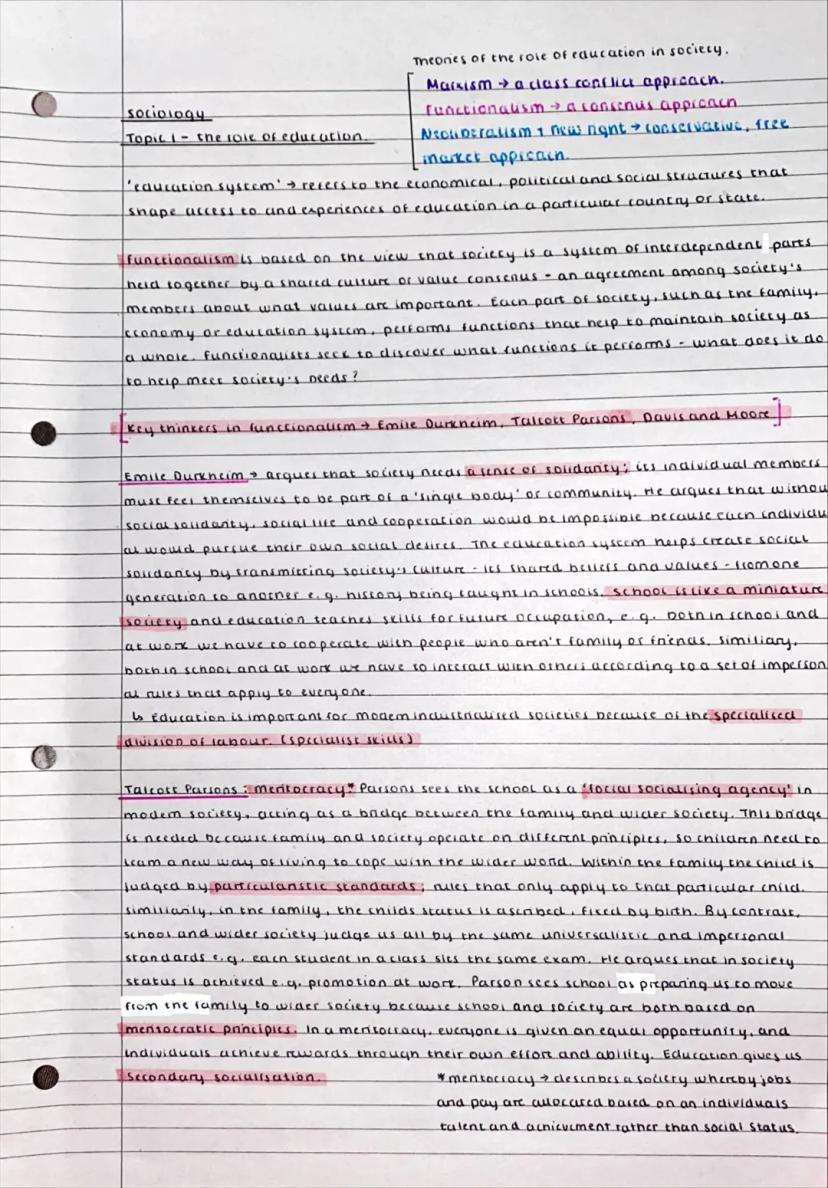

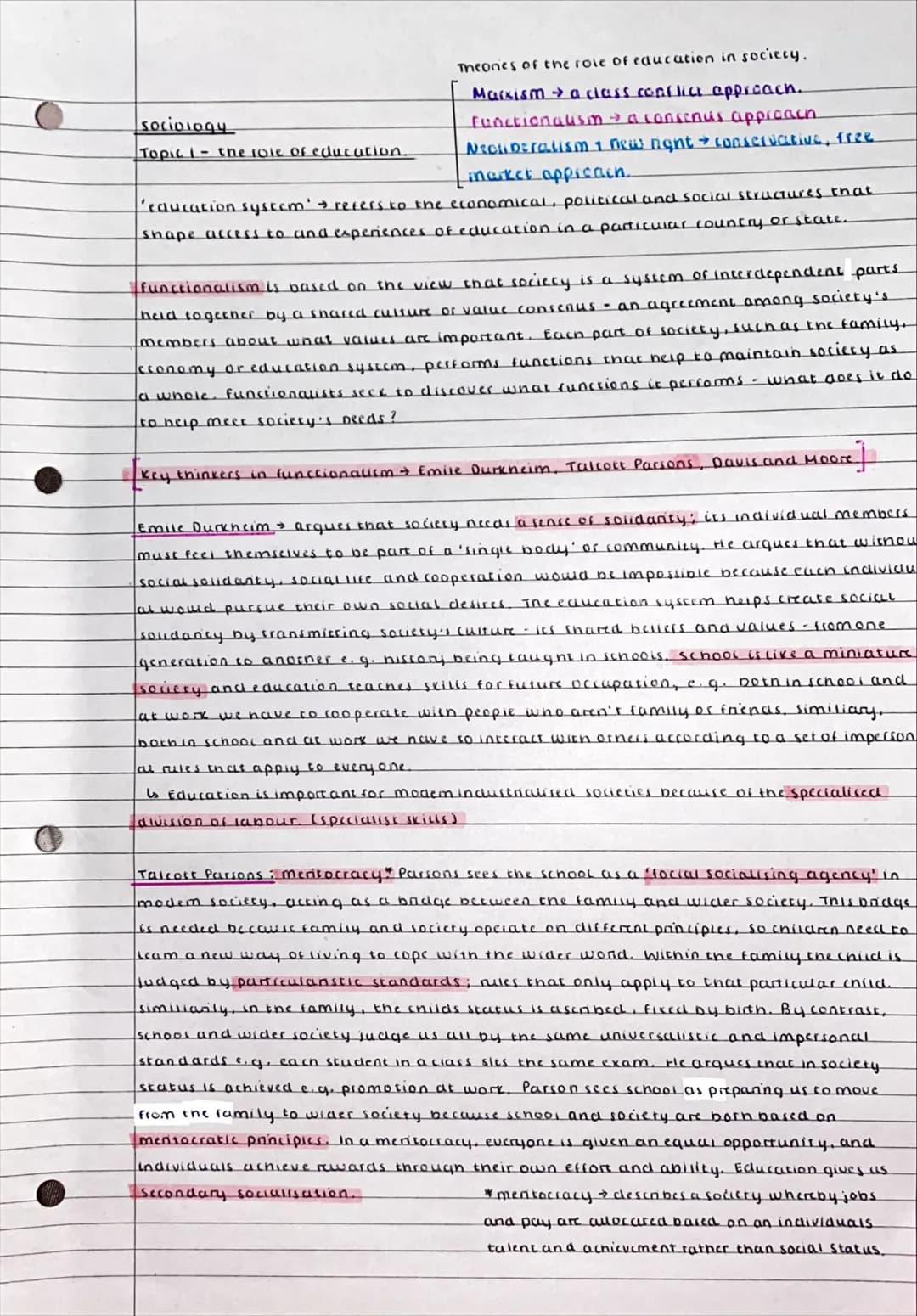
Think about why you're actually in school - is it to help you succeed, or is there something bigger going on? Functionalists reckon education benefits everyone by creating social unity and preparing you for work. Marxists argue it's all about keeping wealthy people in control. Neoliberals believe the free market should run education like a business.
Functionalism sees society as different parts working together, held together by shared values. Emile Durkheim argued that schools create social solidarity by teaching shared culture - like learning British history to feel part of the nation. School acts like a mini-society where you learn to work with people outside your family using the same rules that apply to everyone.
Talcott Parsons focused on how school bridges family and society. At home, you're judged by different standards than your siblings, but at school everyone sits the same exam. This prepares you for a meritocracy - where success comes from talent and effort, not who your parents are.
Key Point: Functionalists believe education gives everyone equal opportunities to succeed through hard work and ability.
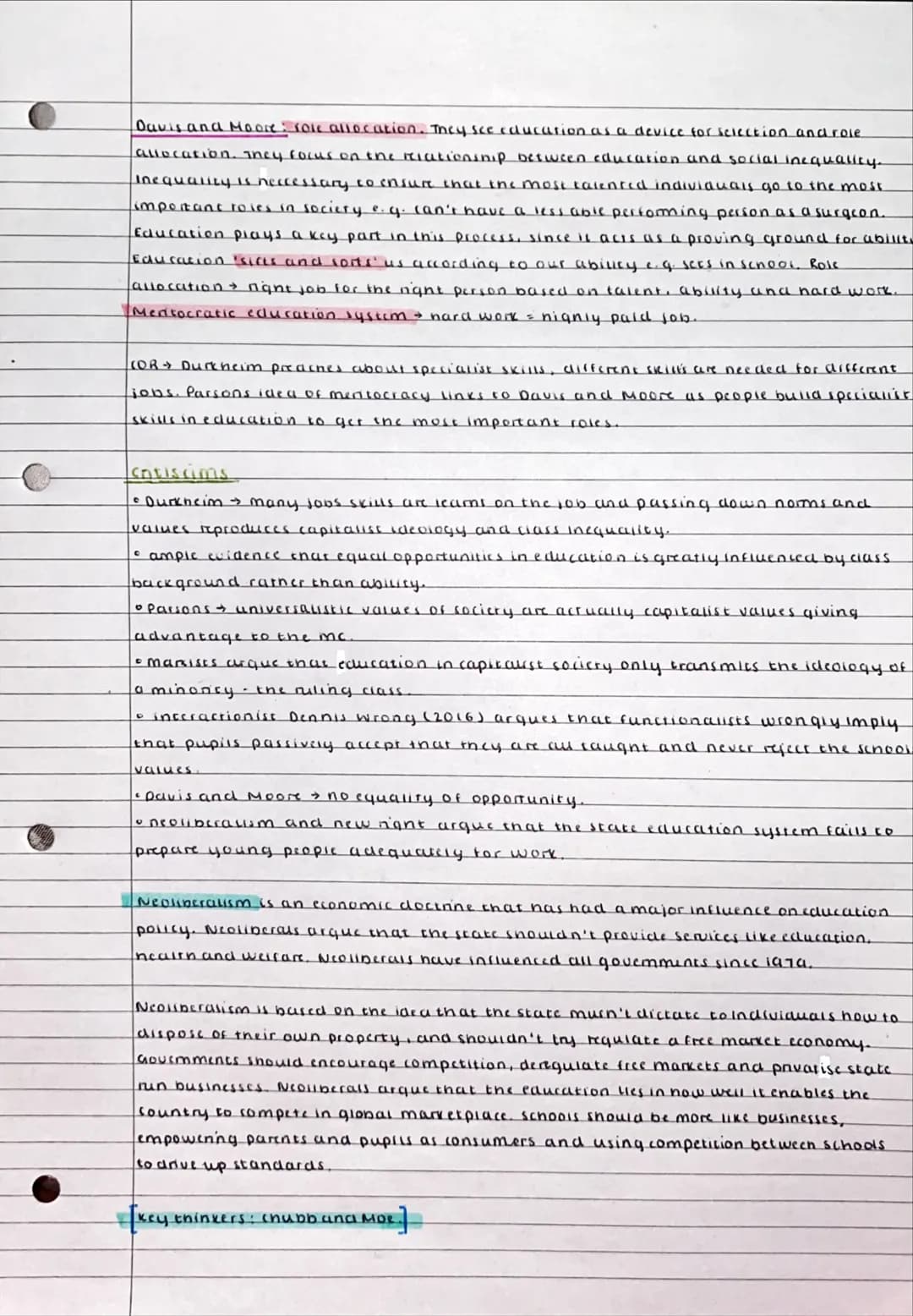
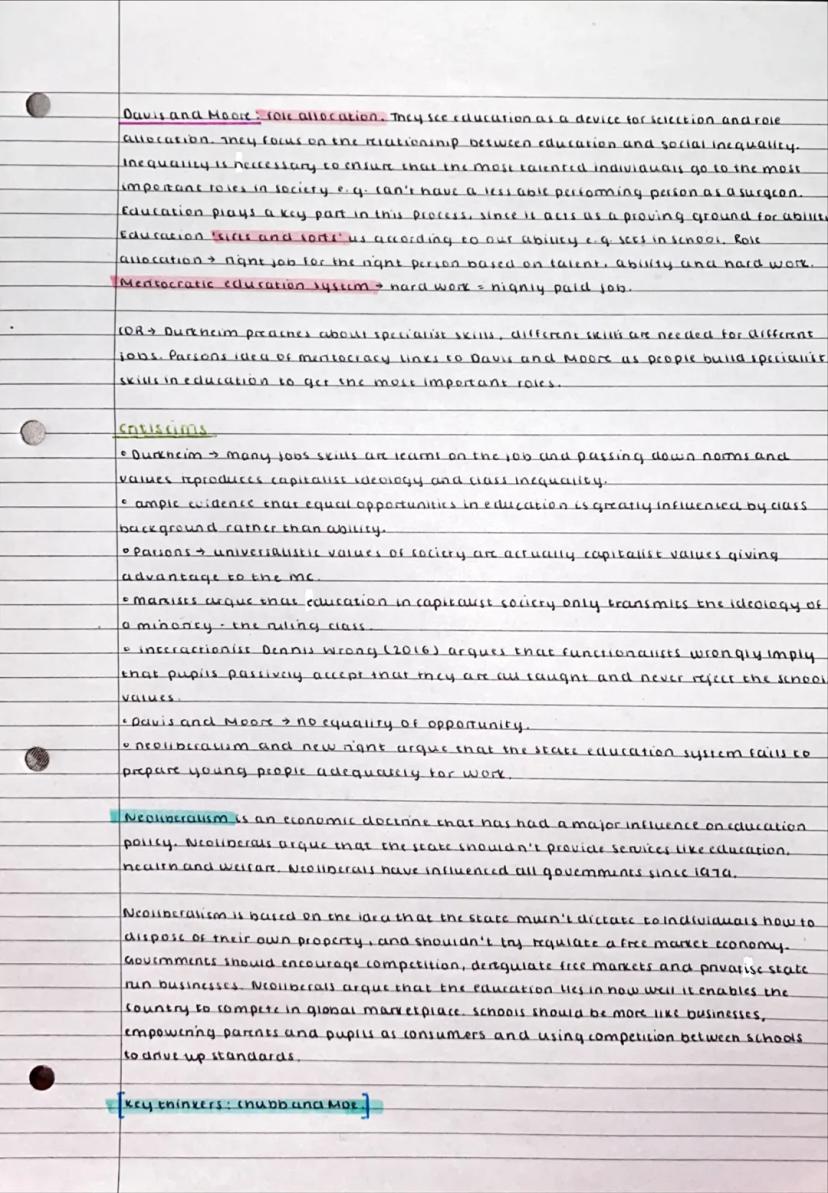
Davis and Moore argued that inequality is actually necessary - you wouldn't want an unqualified person performing surgery on you! Education acts like a sorting system, identifying the most talented people for the most important jobs through role allocation.
However, these theories face serious criticism. Many job skills are learned on the job, not in school. There's loads of evidence that your class background matters more than ability when it comes to educational success.
Critics argue that functionalists ignore how education might actually reinforce capitalist ideology rather than shared values. Dennis Wrong pointed out that students aren't passive - they often reject school values and create their own cultures.
The biggest issue? Equal opportunities in education are heavily influenced by your family's wealth and social class, not just your natural talent.
Reality Check: If education was truly meritocratic, wouldn't we see more working-class students at top universities?
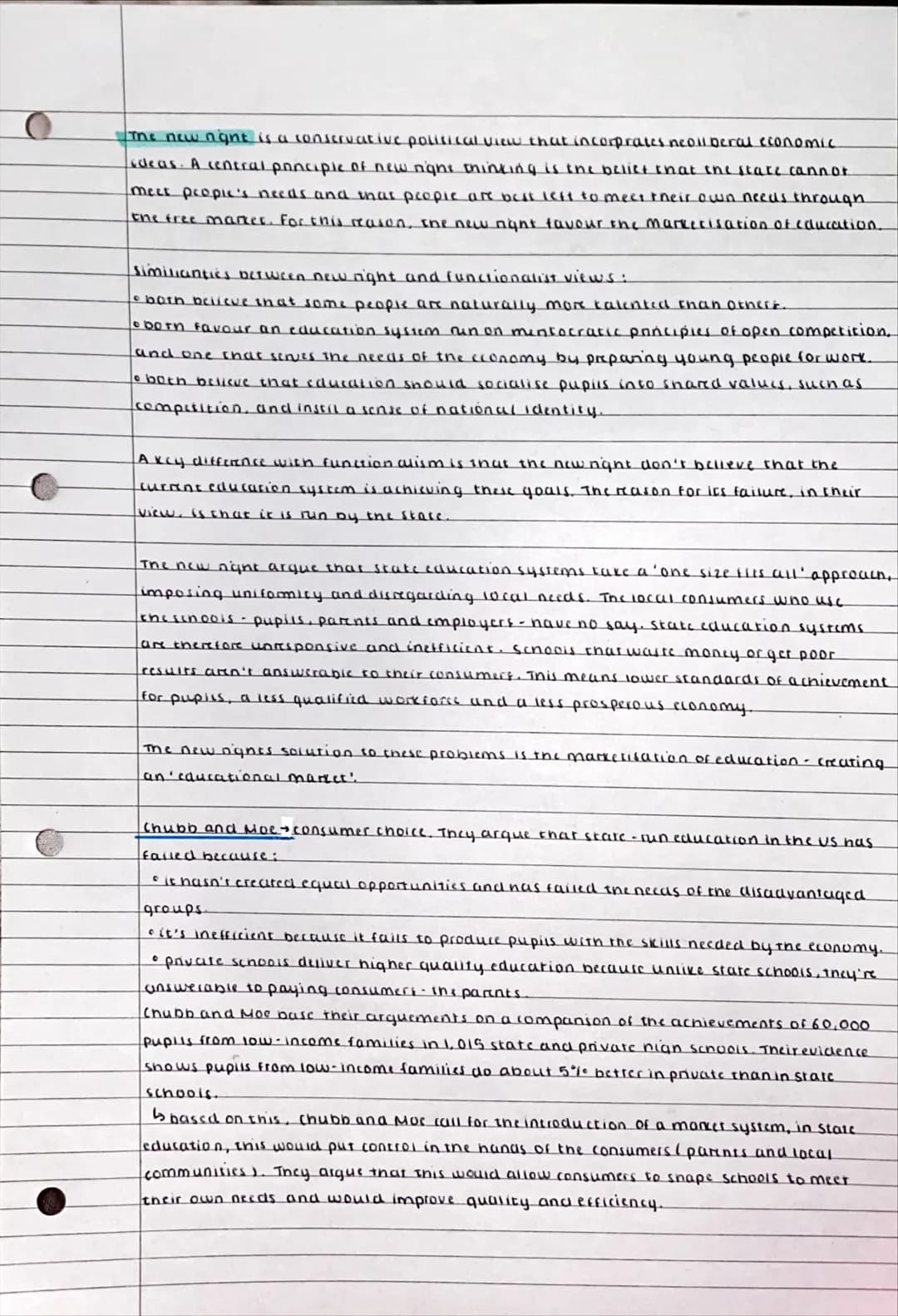
Neoliberalism treats education like a business transaction. These theorists argue that state-run schools fail because they're inefficient monopolies that don't respond to what students and parents actually want.
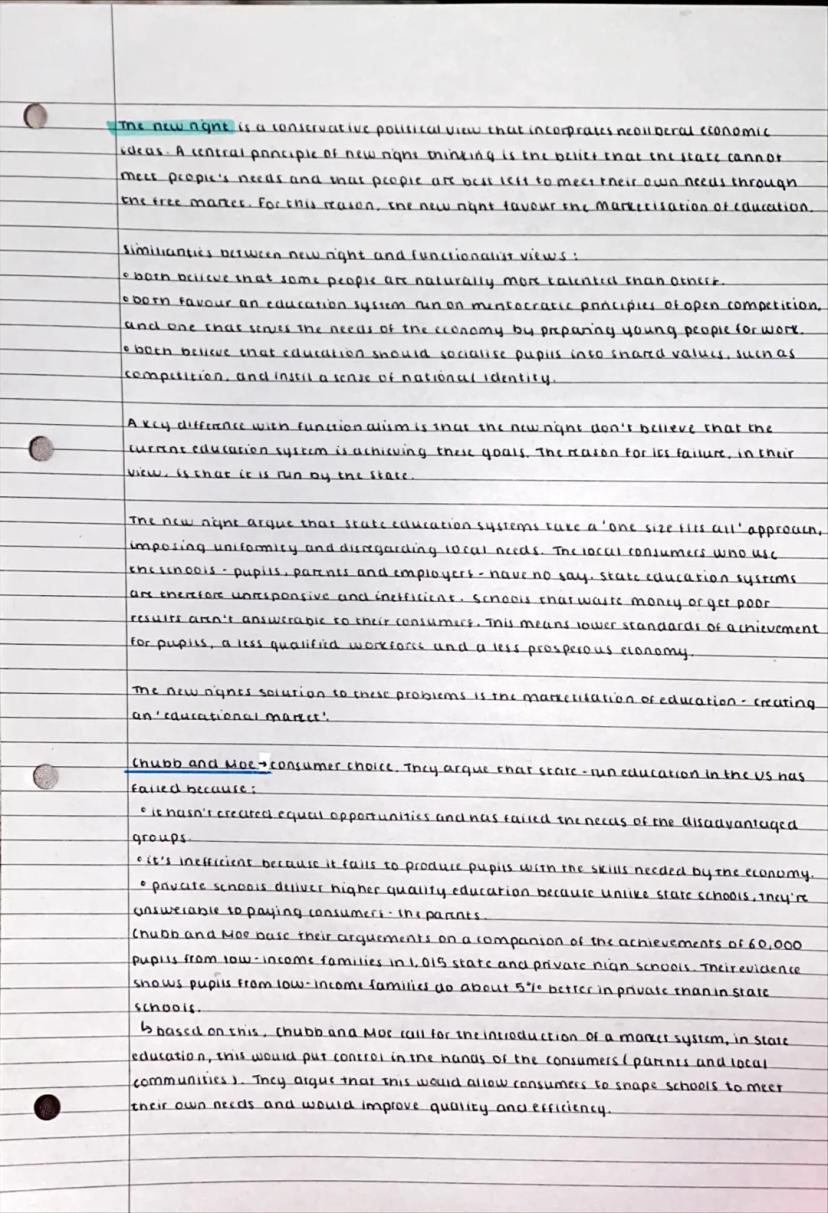
The New Right combines conservative politics with free-market economics. They believe people should meet their own needs through market competition rather than relying on government services. This leads to support for marketisation of education - turning schools into competing businesses.
Chubb and Moe studied 60,000 students and found that those from low-income families performed 5% better in private schools. They proposed giving families education vouchers to spend at any school, forcing schools to compete for customers like businesses do.
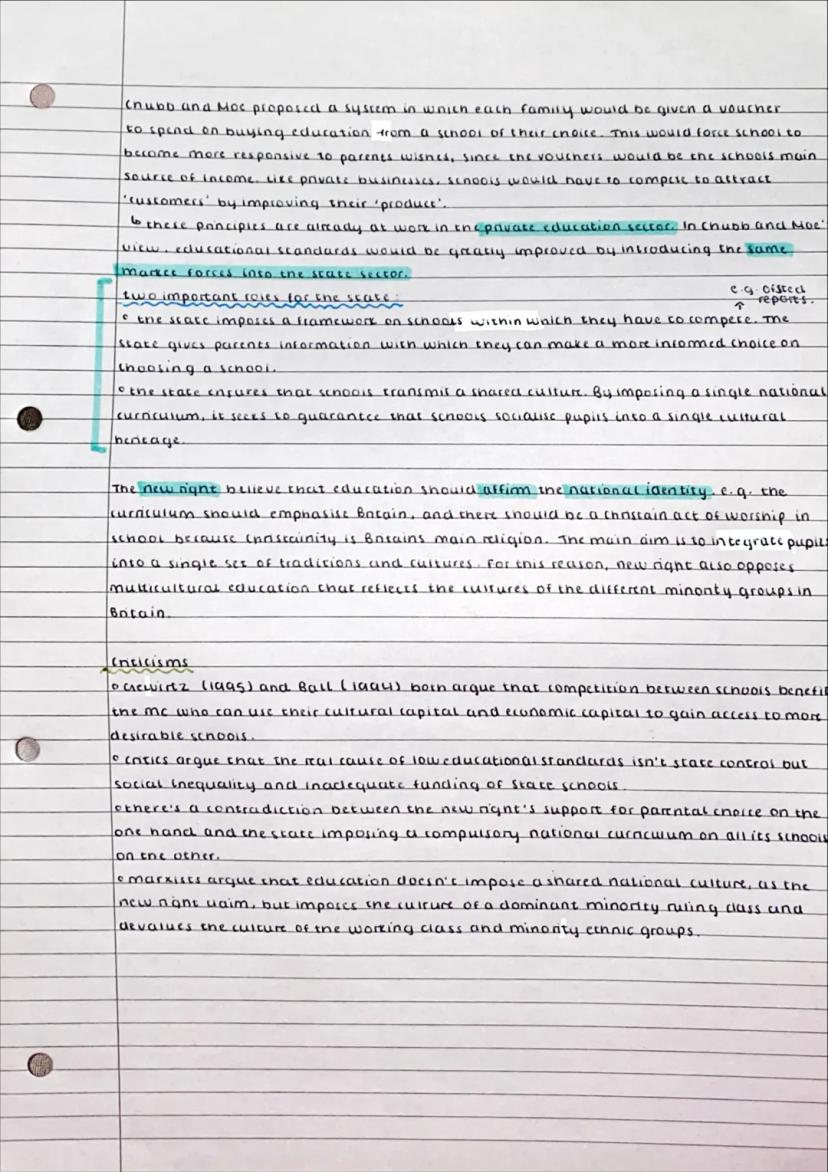
The New Right supports two key state roles: providing information (like Ofsted reports) so parents can choose wisely, and ensuring schools teach a shared national curriculum to maintain British cultural identity.
Think About It: Would turning schools into businesses really improve education, or just benefit families who can afford the best options?
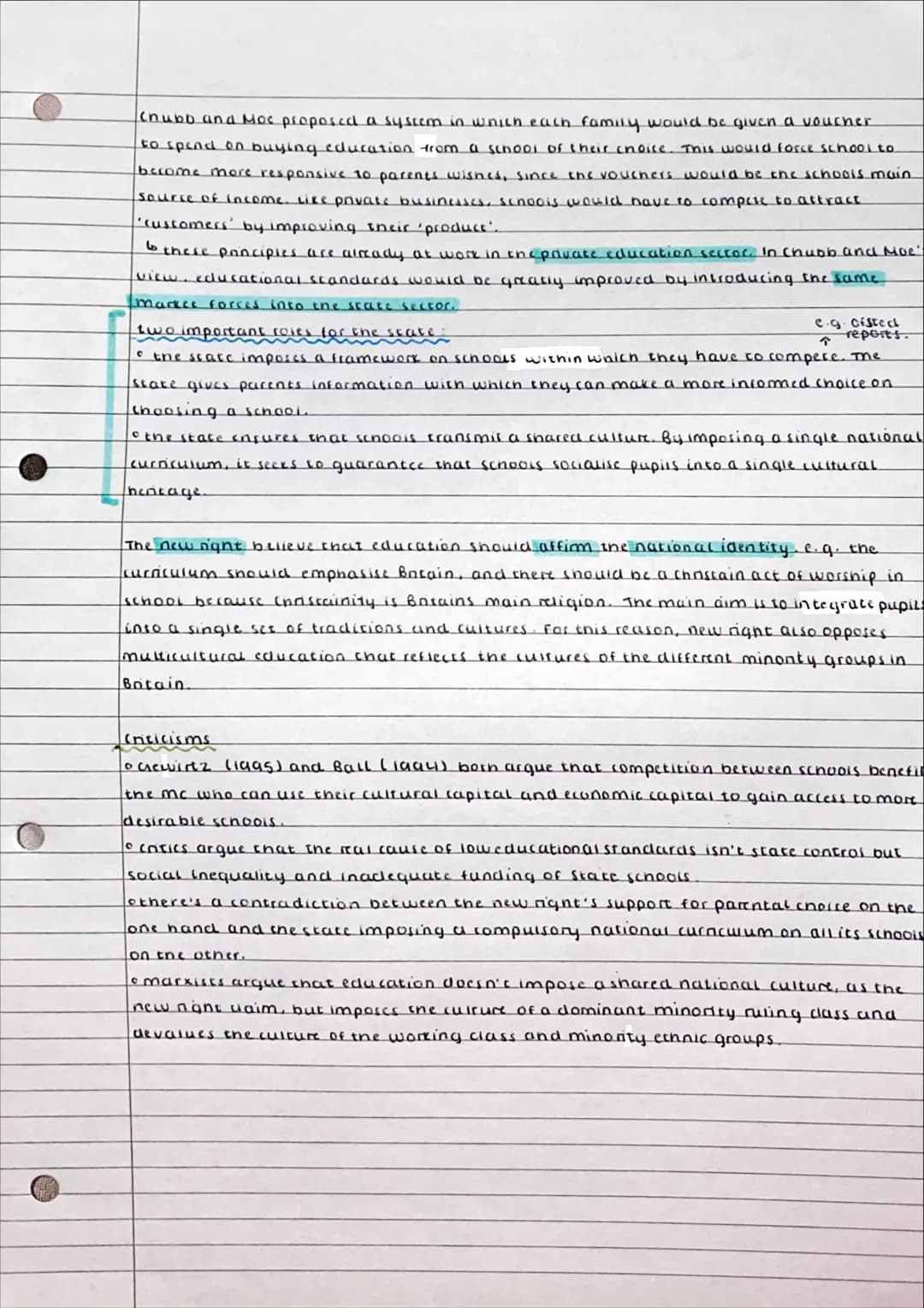
The voucher system would make schools compete for students by offering better education. Schools would have to attract 'customers' or lose funding - just like private businesses improving their products to stay competitive.
However, the New Right faces major contradictions. They support parental choice while simultaneously wanting government to impose a compulsory national curriculum on all schools. They also oppose multicultural education, preferring to emphasise British traditions and Christian worship.
Gerwitz and Ball found that school competition actually benefits middle-class families who have the cultural and economic capital to access better schools. Working-class families often lack the knowledge, contacts, or resources to navigate school choice effectively.
Critics argue that low educational standards come from social inequality and underfunding, not state control. The system doesn't create a shared national culture - it imposes ruling-class values while devaluing working-class and minority cultures.
Reality Check: School choice might sound fair, but does everyone really have equal access to choose?
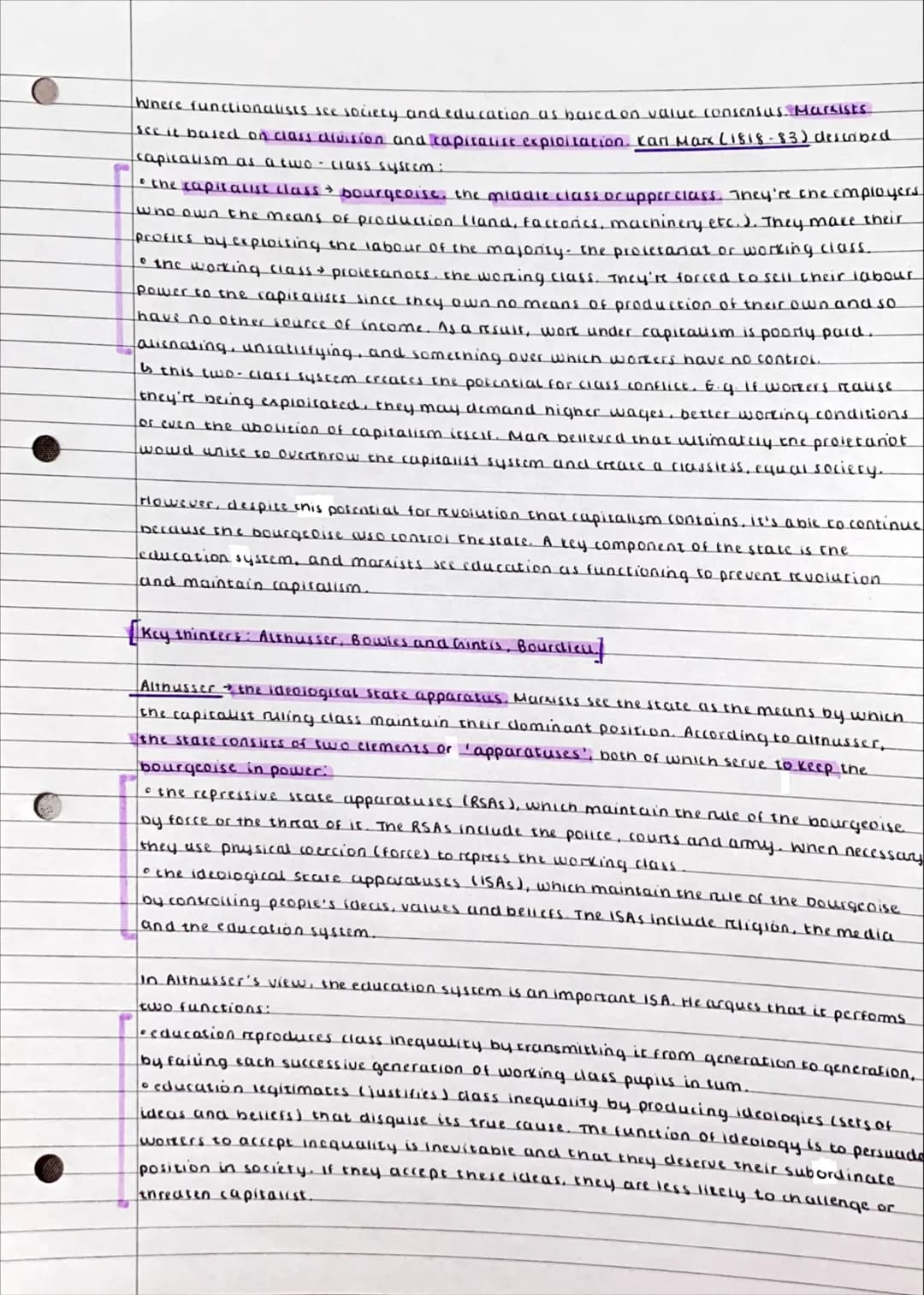
Marxists see education completely differently - as a tool to keep wealthy capitalists in power. Karl Marx described society as divided between the bourgeoisie (owners of businesses and land) who exploit the proletariat (workers who only have their labour to sell).
This creates potential for class conflict - if workers realise they're being exploited, they might demand better conditions or even overthrow capitalism. Education prevents this revolution by controlling how people think.
Althusser argued the state uses two methods to stay in power: Repressive State Apparatuses (police, courts, army) that use force, and Ideological State Apparatuses (schools, media, religion) that control ideas and beliefs.
Education serves capitalism by reproducing class inequality - failing working-class students generation after generation. It also legitimates inequality by promoting ideologies that make people accept their position as natural and deserved.
Critical Question: Does your school actually challenge inequality, or does it convince you that academic failure is your own fault?
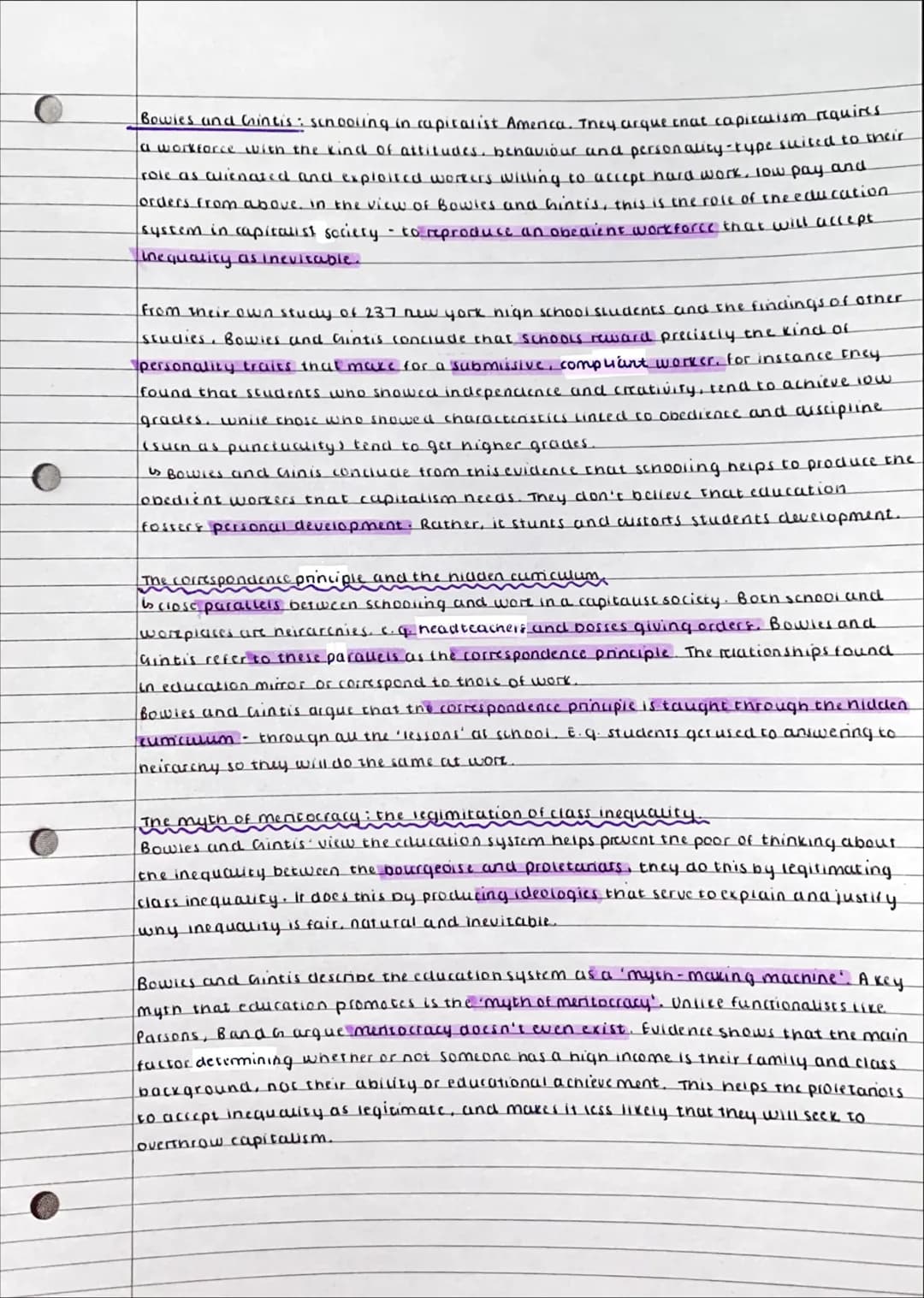
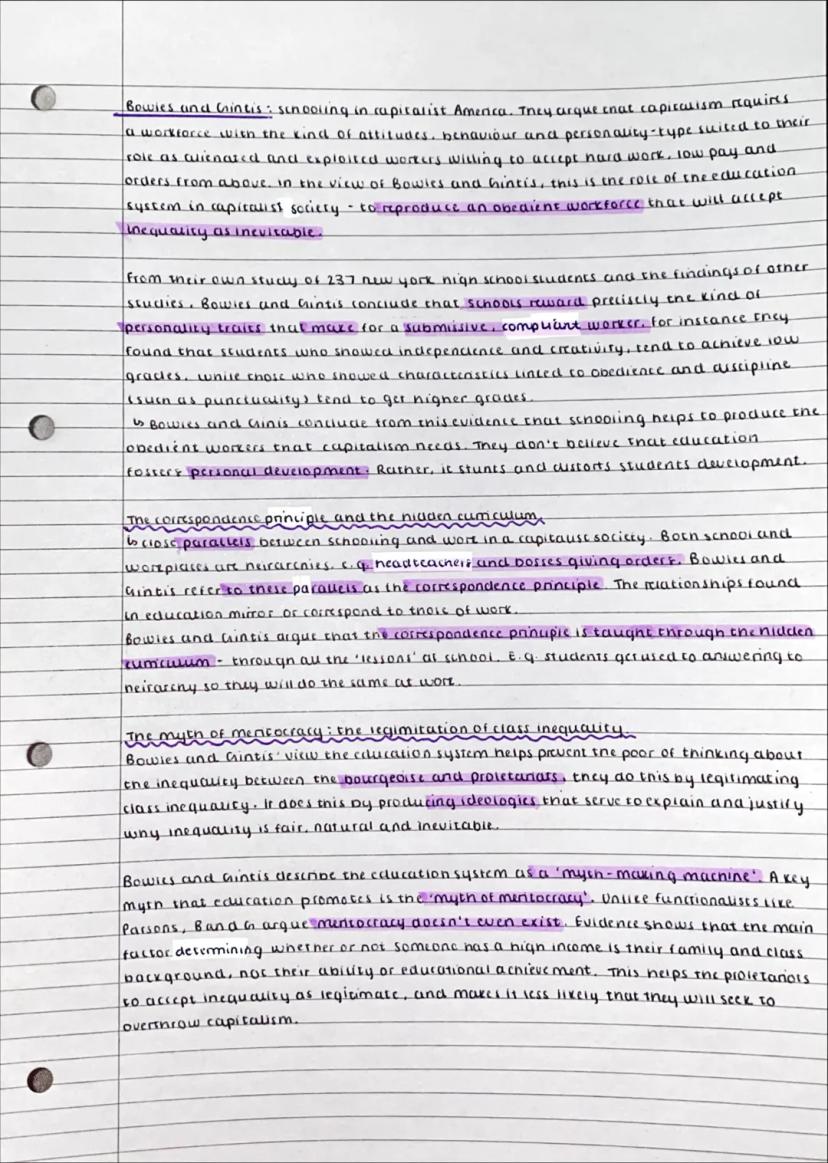
Bowles and Gintis studied American schools and found they reward obedient, punctual students while penalising independent, creative ones. Schools basically train compliant workers who'll accept low pay and follow orders without question.
The correspondence principle shows how school mirrors workplace hierarchies. Headteachers give orders like bosses, students compete like workers, and everyone learns their place in the system. This happens through the hidden curriculum - all the unofficial lessons about authority and obedience.
They argue meritocracy is a myth designed to make inequality seem fair. Your family background and social class matter far more than ability when determining your future income and success.
Education acts as a 'myth-making machine', convincing people that if they're poor or unsuccessful, it's because they didn't work hard enough - not because the system is rigged against them.
Think About It: How often do you follow school rules without questioning whether they're actually fair or necessary?
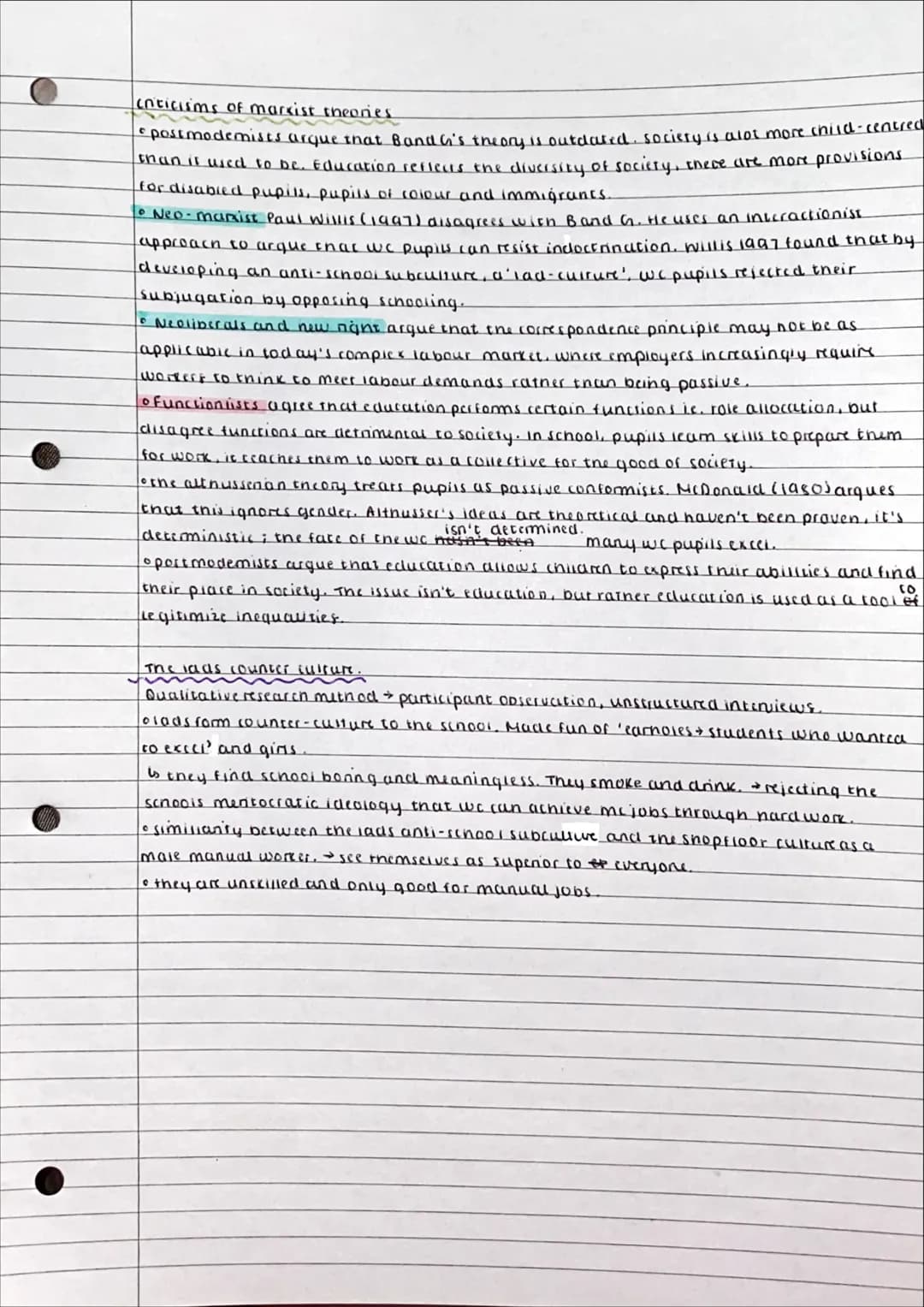
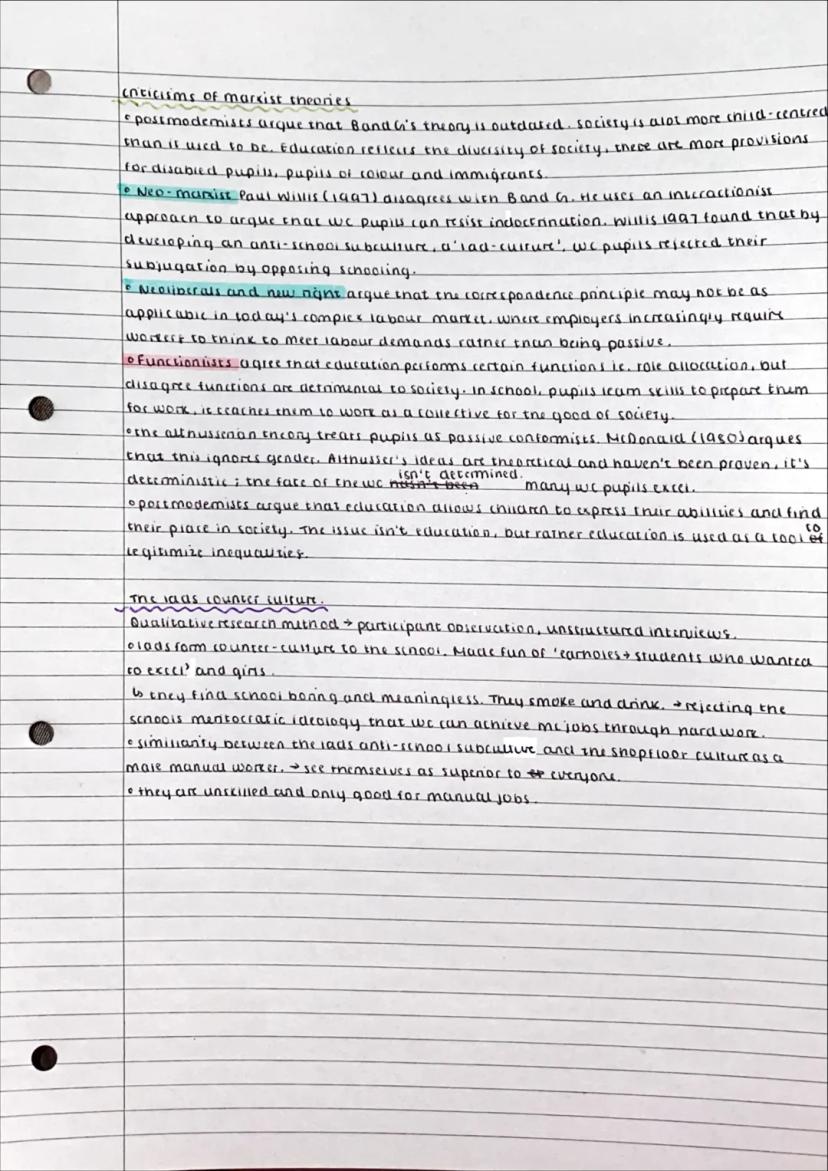
Paul Willis challenged Marxist ideas through his study of working-class 'lads' who created an anti-school subculture. These students rejected school values, mocked academic achievers ('ear'oles'), and celebrated their own counter-culture of smoking, drinking, and disrupting lessons.
Ironically, this rebellion led them straight into manual jobs - exactly what the system wanted. Their resistance actually confirmed their position in the class structure, showing how complicated the relationship between education and social control really is.
Postmodernists argue that Bowles and Gintis' theory is outdated. Modern education is more child-centred and diverse, with better provision for disabled students, ethnic minorities, and immigrants. Today's employers often want creative, independent workers rather than passive followers.
Critics point out that Marxist theories treat students as passive victims who can't resist indoctrination. Many working-class pupils do excel academically, proving that class determinism isn't absolute.
Key Insight: Students aren't just empty vessels - they actively interpret and sometimes resist what schools try to teach them.
Our AI Companion is a student-focused AI tool that offers more than just answers. Built on millions of Knowunity resources, it provides relevant information, personalised study plans, quizzes, and content directly in the chat, adapting to your individual learning journey.
You can download the app from Google Play Store and Apple App Store.
That's right! Enjoy free access to study content, connect with fellow students, and get instant help – all at your fingertips.
App Store
Google Play
The app is very easy to use and well designed. I have found everything I was looking for so far and have been able to learn a lot from the presentations! I will definitely use the app for a class assignment! And of course it also helps a lot as an inspiration.
Stefan S
iOS user
This app is really great. There are so many study notes and help [...]. My problem subject is French, for example, and the app has so many options for help. Thanks to this app, I have improved my French. I would recommend it to anyone.
Samantha Klich
Android user
Wow, I am really amazed. I just tried the app because I've seen it advertised many times and was absolutely stunned. This app is THE HELP you want for school and above all, it offers so many things, such as workouts and fact sheets, which have been VERY helpful to me personally.
Anna
iOS user
Best app on earth! no words because it’s too good
Thomas R
iOS user
Just amazing. Let's me revise 10x better, this app is a quick 10/10. I highly recommend it to anyone. I can watch and search for notes. I can save them in the subject folder. I can revise it any time when I come back. If you haven't tried this app, you're really missing out.
Basil
Android user
This app has made me feel so much more confident in my exam prep, not only through boosting my own self confidence through the features that allow you to connect with others and feel less alone, but also through the way the app itself is centred around making you feel better. It is easy to navigate, fun to use, and helpful to anyone struggling in absolutely any way.
David K
iOS user
The app's just great! All I have to do is enter the topic in the search bar and I get the response real fast. I don't have to watch 10 YouTube videos to understand something, so I'm saving my time. Highly recommended!
Sudenaz Ocak
Android user
In school I was really bad at maths but thanks to the app, I am doing better now. I am so grateful that you made the app.
Greenlight Bonnie
Android user
very reliable app to help and grow your ideas of Maths, English and other related topics in your works. please use this app if your struggling in areas, this app is key for that. wish I'd of done a review before. and it's also free so don't worry about that.
Rohan U
Android user
I know a lot of apps use fake accounts to boost their reviews but this app deserves it all. Originally I was getting 4 in my English exams and this time I got a grade 7. I didn’t even know about this app three days until the exam and it has helped A LOT. Please actually trust me and use it as I’m sure you too will see developments.
Xander S
iOS user
THE QUIZES AND FLASHCARDS ARE SO USEFUL AND I LOVE Knowunity AI. IT ALSO IS LITREALLY LIKE CHATGPT BUT SMARTER!! HELPED ME WITH MY MASCARA PROBLEMS TOO!! AS WELL AS MY REAL SUBJECTS ! DUHHH 😍😁😲🤑💗✨🎀😮
Elisha
iOS user
This apps acc the goat. I find revision so boring but this app makes it so easy to organize it all and then you can ask the freeeee ai to test yourself so good and you can easily upload your own stuff. highly recommend as someone taking mocks now
Paul T
iOS user
The app is very easy to use and well designed. I have found everything I was looking for so far and have been able to learn a lot from the presentations! I will definitely use the app for a class assignment! And of course it also helps a lot as an inspiration.
Stefan S
iOS user
This app is really great. There are so many study notes and help [...]. My problem subject is French, for example, and the app has so many options for help. Thanks to this app, I have improved my French. I would recommend it to anyone.
Samantha Klich
Android user
Wow, I am really amazed. I just tried the app because I've seen it advertised many times and was absolutely stunned. This app is THE HELP you want for school and above all, it offers so many things, such as workouts and fact sheets, which have been VERY helpful to me personally.
Anna
iOS user
Best app on earth! no words because it’s too good
Thomas R
iOS user
Just amazing. Let's me revise 10x better, this app is a quick 10/10. I highly recommend it to anyone. I can watch and search for notes. I can save them in the subject folder. I can revise it any time when I come back. If you haven't tried this app, you're really missing out.
Basil
Android user
This app has made me feel so much more confident in my exam prep, not only through boosting my own self confidence through the features that allow you to connect with others and feel less alone, but also through the way the app itself is centred around making you feel better. It is easy to navigate, fun to use, and helpful to anyone struggling in absolutely any way.
David K
iOS user
The app's just great! All I have to do is enter the topic in the search bar and I get the response real fast. I don't have to watch 10 YouTube videos to understand something, so I'm saving my time. Highly recommended!
Sudenaz Ocak
Android user
In school I was really bad at maths but thanks to the app, I am doing better now. I am so grateful that you made the app.
Greenlight Bonnie
Android user
very reliable app to help and grow your ideas of Maths, English and other related topics in your works. please use this app if your struggling in areas, this app is key for that. wish I'd of done a review before. and it's also free so don't worry about that.
Rohan U
Android user
I know a lot of apps use fake accounts to boost their reviews but this app deserves it all. Originally I was getting 4 in my English exams and this time I got a grade 7. I didn’t even know about this app three days until the exam and it has helped A LOT. Please actually trust me and use it as I’m sure you too will see developments.
Xander S
iOS user
THE QUIZES AND FLASHCARDS ARE SO USEFUL AND I LOVE Knowunity AI. IT ALSO IS LITREALLY LIKE CHATGPT BUT SMARTER!! HELPED ME WITH MY MASCARA PROBLEMS TOO!! AS WELL AS MY REAL SUBJECTS ! DUHHH 😍😁😲🤑💗✨🎀😮
Elisha
iOS user
This apps acc the goat. I find revision so boring but this app makes it so easy to organize it all and then you can ask the freeeee ai to test yourself so good and you can easily upload your own stuff. highly recommend as someone taking mocks now
Paul T
iOS user
muskan s
@mu5kan_s
Education isn't just about getting qualifications - it plays a massive role in how society operates. Different sociologists have wildly different views on whether schools help everyone succeed or just keep the rich in power.
Access to all documents
Improve your grades
Join milions of students
By signing up you accept Terms of Service and Privacy Policy
Think about why you're actually in school - is it to help you succeed, or is there something bigger going on? Functionalists reckon education benefits everyone by creating social unity and preparing you for work. Marxists argue it's all about keeping wealthy people in control. Neoliberals believe the free market should run education like a business.
Functionalism sees society as different parts working together, held together by shared values. Emile Durkheim argued that schools create social solidarity by teaching shared culture - like learning British history to feel part of the nation. School acts like a mini-society where you learn to work with people outside your family using the same rules that apply to everyone.
Talcott Parsons focused on how school bridges family and society. At home, you're judged by different standards than your siblings, but at school everyone sits the same exam. This prepares you for a meritocracy - where success comes from talent and effort, not who your parents are.
Key Point: Functionalists believe education gives everyone equal opportunities to succeed through hard work and ability.
Access to all documents
Improve your grades
Join milions of students
By signing up you accept Terms of Service and Privacy Policy
Davis and Moore argued that inequality is actually necessary - you wouldn't want an unqualified person performing surgery on you! Education acts like a sorting system, identifying the most talented people for the most important jobs through role allocation.
However, these theories face serious criticism. Many job skills are learned on the job, not in school. There's loads of evidence that your class background matters more than ability when it comes to educational success.
Critics argue that functionalists ignore how education might actually reinforce capitalist ideology rather than shared values. Dennis Wrong pointed out that students aren't passive - they often reject school values and create their own cultures.
The biggest issue? Equal opportunities in education are heavily influenced by your family's wealth and social class, not just your natural talent.
Reality Check: If education was truly meritocratic, wouldn't we see more working-class students at top universities?
Access to all documents
Improve your grades
Join milions of students
By signing up you accept Terms of Service and Privacy Policy
Neoliberalism treats education like a business transaction. These theorists argue that state-run schools fail because they're inefficient monopolies that don't respond to what students and parents actually want.
The New Right combines conservative politics with free-market economics. They believe people should meet their own needs through market competition rather than relying on government services. This leads to support for marketisation of education - turning schools into competing businesses.
Chubb and Moe studied 60,000 students and found that those from low-income families performed 5% better in private schools. They proposed giving families education vouchers to spend at any school, forcing schools to compete for customers like businesses do.
The New Right supports two key state roles: providing information (like Ofsted reports) so parents can choose wisely, and ensuring schools teach a shared national curriculum to maintain British cultural identity.
Think About It: Would turning schools into businesses really improve education, or just benefit families who can afford the best options?
Access to all documents
Improve your grades
Join milions of students
By signing up you accept Terms of Service and Privacy Policy
The voucher system would make schools compete for students by offering better education. Schools would have to attract 'customers' or lose funding - just like private businesses improving their products to stay competitive.
However, the New Right faces major contradictions. They support parental choice while simultaneously wanting government to impose a compulsory national curriculum on all schools. They also oppose multicultural education, preferring to emphasise British traditions and Christian worship.
Gerwitz and Ball found that school competition actually benefits middle-class families who have the cultural and economic capital to access better schools. Working-class families often lack the knowledge, contacts, or resources to navigate school choice effectively.
Critics argue that low educational standards come from social inequality and underfunding, not state control. The system doesn't create a shared national culture - it imposes ruling-class values while devaluing working-class and minority cultures.
Reality Check: School choice might sound fair, but does everyone really have equal access to choose?
Access to all documents
Improve your grades
Join milions of students
By signing up you accept Terms of Service and Privacy Policy
Marxists see education completely differently - as a tool to keep wealthy capitalists in power. Karl Marx described society as divided between the bourgeoisie (owners of businesses and land) who exploit the proletariat (workers who only have their labour to sell).
This creates potential for class conflict - if workers realise they're being exploited, they might demand better conditions or even overthrow capitalism. Education prevents this revolution by controlling how people think.
Althusser argued the state uses two methods to stay in power: Repressive State Apparatuses (police, courts, army) that use force, and Ideological State Apparatuses (schools, media, religion) that control ideas and beliefs.
Education serves capitalism by reproducing class inequality - failing working-class students generation after generation. It also legitimates inequality by promoting ideologies that make people accept their position as natural and deserved.
Critical Question: Does your school actually challenge inequality, or does it convince you that academic failure is your own fault?
Access to all documents
Improve your grades
Join milions of students
By signing up you accept Terms of Service and Privacy Policy
Bowles and Gintis studied American schools and found they reward obedient, punctual students while penalising independent, creative ones. Schools basically train compliant workers who'll accept low pay and follow orders without question.
The correspondence principle shows how school mirrors workplace hierarchies. Headteachers give orders like bosses, students compete like workers, and everyone learns their place in the system. This happens through the hidden curriculum - all the unofficial lessons about authority and obedience.
They argue meritocracy is a myth designed to make inequality seem fair. Your family background and social class matter far more than ability when determining your future income and success.
Education acts as a 'myth-making machine', convincing people that if they're poor or unsuccessful, it's because they didn't work hard enough - not because the system is rigged against them.
Think About It: How often do you follow school rules without questioning whether they're actually fair or necessary?
Access to all documents
Improve your grades
Join milions of students
By signing up you accept Terms of Service and Privacy Policy
Paul Willis challenged Marxist ideas through his study of working-class 'lads' who created an anti-school subculture. These students rejected school values, mocked academic achievers ('ear'oles'), and celebrated their own counter-culture of smoking, drinking, and disrupting lessons.
Ironically, this rebellion led them straight into manual jobs - exactly what the system wanted. Their resistance actually confirmed their position in the class structure, showing how complicated the relationship between education and social control really is.
Postmodernists argue that Bowles and Gintis' theory is outdated. Modern education is more child-centred and diverse, with better provision for disabled students, ethnic minorities, and immigrants. Today's employers often want creative, independent workers rather than passive followers.
Critics point out that Marxist theories treat students as passive victims who can't resist indoctrination. Many working-class pupils do excel academically, proving that class determinism isn't absolute.
Key Insight: Students aren't just empty vessels - they actively interpret and sometimes resist what schools try to teach them.
Our AI Companion is a student-focused AI tool that offers more than just answers. Built on millions of Knowunity resources, it provides relevant information, personalised study plans, quizzes, and content directly in the chat, adapting to your individual learning journey.
You can download the app from Google Play Store and Apple App Store.
That's right! Enjoy free access to study content, connect with fellow students, and get instant help – all at your fingertips.
45
Smart Tools NEW
Transform this note into: ✓ 50+ Practice Questions ✓ Interactive Flashcards ✓ Full Mock Exam ✓ Essay Outlines
App Store
Google Play
The app is very easy to use and well designed. I have found everything I was looking for so far and have been able to learn a lot from the presentations! I will definitely use the app for a class assignment! And of course it also helps a lot as an inspiration.
Stefan S
iOS user
This app is really great. There are so many study notes and help [...]. My problem subject is French, for example, and the app has so many options for help. Thanks to this app, I have improved my French. I would recommend it to anyone.
Samantha Klich
Android user
Wow, I am really amazed. I just tried the app because I've seen it advertised many times and was absolutely stunned. This app is THE HELP you want for school and above all, it offers so many things, such as workouts and fact sheets, which have been VERY helpful to me personally.
Anna
iOS user
Best app on earth! no words because it’s too good
Thomas R
iOS user
Just amazing. Let's me revise 10x better, this app is a quick 10/10. I highly recommend it to anyone. I can watch and search for notes. I can save them in the subject folder. I can revise it any time when I come back. If you haven't tried this app, you're really missing out.
Basil
Android user
This app has made me feel so much more confident in my exam prep, not only through boosting my own self confidence through the features that allow you to connect with others and feel less alone, but also through the way the app itself is centred around making you feel better. It is easy to navigate, fun to use, and helpful to anyone struggling in absolutely any way.
David K
iOS user
The app's just great! All I have to do is enter the topic in the search bar and I get the response real fast. I don't have to watch 10 YouTube videos to understand something, so I'm saving my time. Highly recommended!
Sudenaz Ocak
Android user
In school I was really bad at maths but thanks to the app, I am doing better now. I am so grateful that you made the app.
Greenlight Bonnie
Android user
very reliable app to help and grow your ideas of Maths, English and other related topics in your works. please use this app if your struggling in areas, this app is key for that. wish I'd of done a review before. and it's also free so don't worry about that.
Rohan U
Android user
I know a lot of apps use fake accounts to boost their reviews but this app deserves it all. Originally I was getting 4 in my English exams and this time I got a grade 7. I didn’t even know about this app three days until the exam and it has helped A LOT. Please actually trust me and use it as I’m sure you too will see developments.
Xander S
iOS user
THE QUIZES AND FLASHCARDS ARE SO USEFUL AND I LOVE Knowunity AI. IT ALSO IS LITREALLY LIKE CHATGPT BUT SMARTER!! HELPED ME WITH MY MASCARA PROBLEMS TOO!! AS WELL AS MY REAL SUBJECTS ! DUHHH 😍😁😲🤑💗✨🎀😮
Elisha
iOS user
This apps acc the goat. I find revision so boring but this app makes it so easy to organize it all and then you can ask the freeeee ai to test yourself so good and you can easily upload your own stuff. highly recommend as someone taking mocks now
Paul T
iOS user
The app is very easy to use and well designed. I have found everything I was looking for so far and have been able to learn a lot from the presentations! I will definitely use the app for a class assignment! And of course it also helps a lot as an inspiration.
Stefan S
iOS user
This app is really great. There are so many study notes and help [...]. My problem subject is French, for example, and the app has so many options for help. Thanks to this app, I have improved my French. I would recommend it to anyone.
Samantha Klich
Android user
Wow, I am really amazed. I just tried the app because I've seen it advertised many times and was absolutely stunned. This app is THE HELP you want for school and above all, it offers so many things, such as workouts and fact sheets, which have been VERY helpful to me personally.
Anna
iOS user
Best app on earth! no words because it’s too good
Thomas R
iOS user
Just amazing. Let's me revise 10x better, this app is a quick 10/10. I highly recommend it to anyone. I can watch and search for notes. I can save them in the subject folder. I can revise it any time when I come back. If you haven't tried this app, you're really missing out.
Basil
Android user
This app has made me feel so much more confident in my exam prep, not only through boosting my own self confidence through the features that allow you to connect with others and feel less alone, but also through the way the app itself is centred around making you feel better. It is easy to navigate, fun to use, and helpful to anyone struggling in absolutely any way.
David K
iOS user
The app's just great! All I have to do is enter the topic in the search bar and I get the response real fast. I don't have to watch 10 YouTube videos to understand something, so I'm saving my time. Highly recommended!
Sudenaz Ocak
Android user
In school I was really bad at maths but thanks to the app, I am doing better now. I am so grateful that you made the app.
Greenlight Bonnie
Android user
very reliable app to help and grow your ideas of Maths, English and other related topics in your works. please use this app if your struggling in areas, this app is key for that. wish I'd of done a review before. and it's also free so don't worry about that.
Rohan U
Android user
I know a lot of apps use fake accounts to boost their reviews but this app deserves it all. Originally I was getting 4 in my English exams and this time I got a grade 7. I didn’t even know about this app three days until the exam and it has helped A LOT. Please actually trust me and use it as I’m sure you too will see developments.
Xander S
iOS user
THE QUIZES AND FLASHCARDS ARE SO USEFUL AND I LOVE Knowunity AI. IT ALSO IS LITREALLY LIKE CHATGPT BUT SMARTER!! HELPED ME WITH MY MASCARA PROBLEMS TOO!! AS WELL AS MY REAL SUBJECTS ! DUHHH 😍😁😲🤑💗✨🎀😮
Elisha
iOS user
This apps acc the goat. I find revision so boring but this app makes it so easy to organize it all and then you can ask the freeeee ai to test yourself so good and you can easily upload your own stuff. highly recommend as someone taking mocks now
Paul T
iOS user