Open the App

Subjects

1,554

7 Dec 2025

15 pages

AQA Sociology: Understanding Crime and Deviance

J

Joshua Whitehead-Jones

@jwjjoshua

Crime and deviance might seem like straightforward concepts, but they're... Show more

Page 1
Page 2
Page 3
Page 4
Page 5
Page 6
Page 7
Page 8
Page 9
Page 10
1 / 10
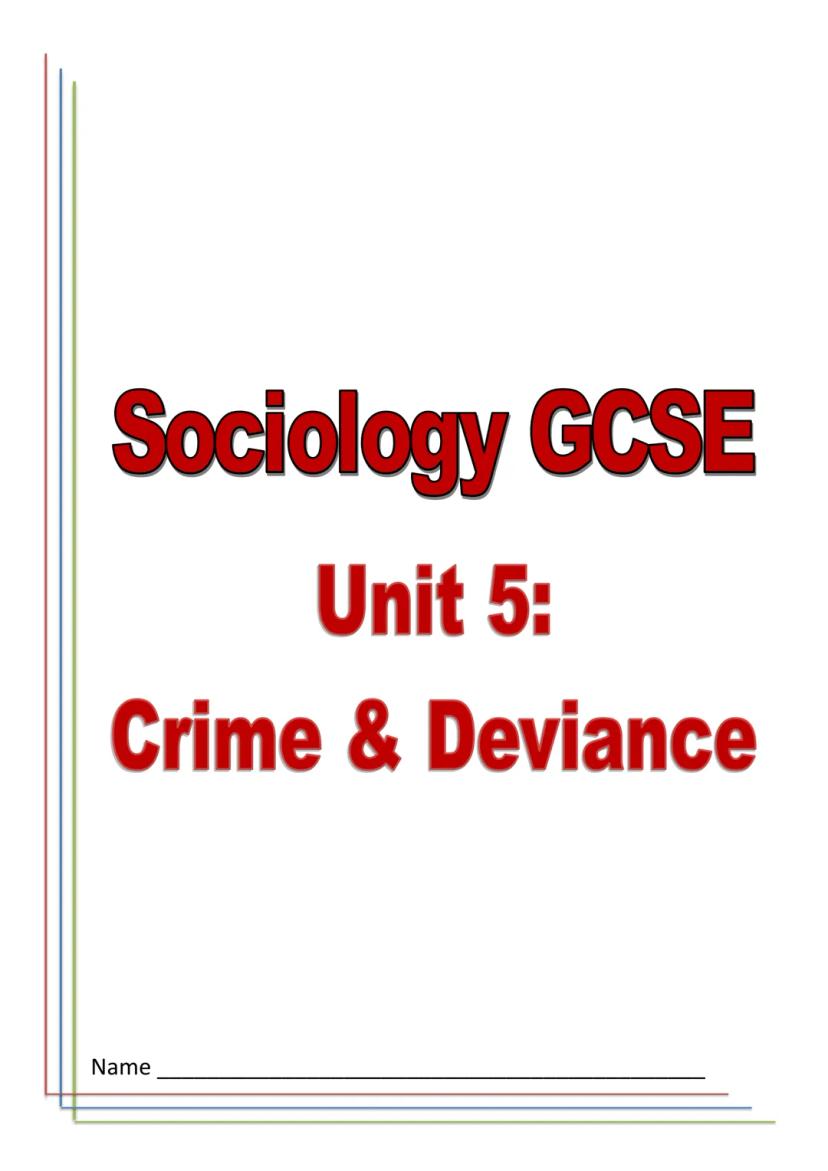
Sociology GCSE
Unit 5:
Crime & Deviance
Name 2.2
Assessments
Paper 1: The sociology of families and
education
What's assessed
⚫ The sociolog

GCSE Crime & Deviance Overview

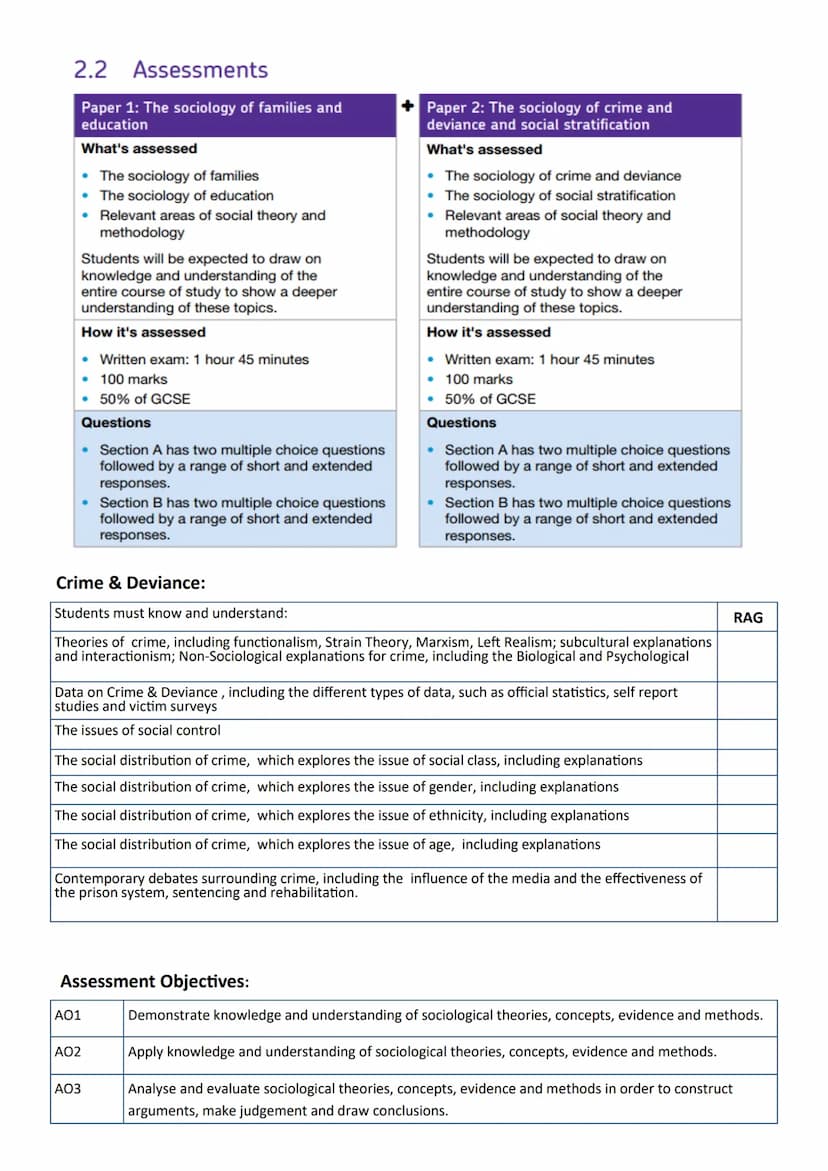
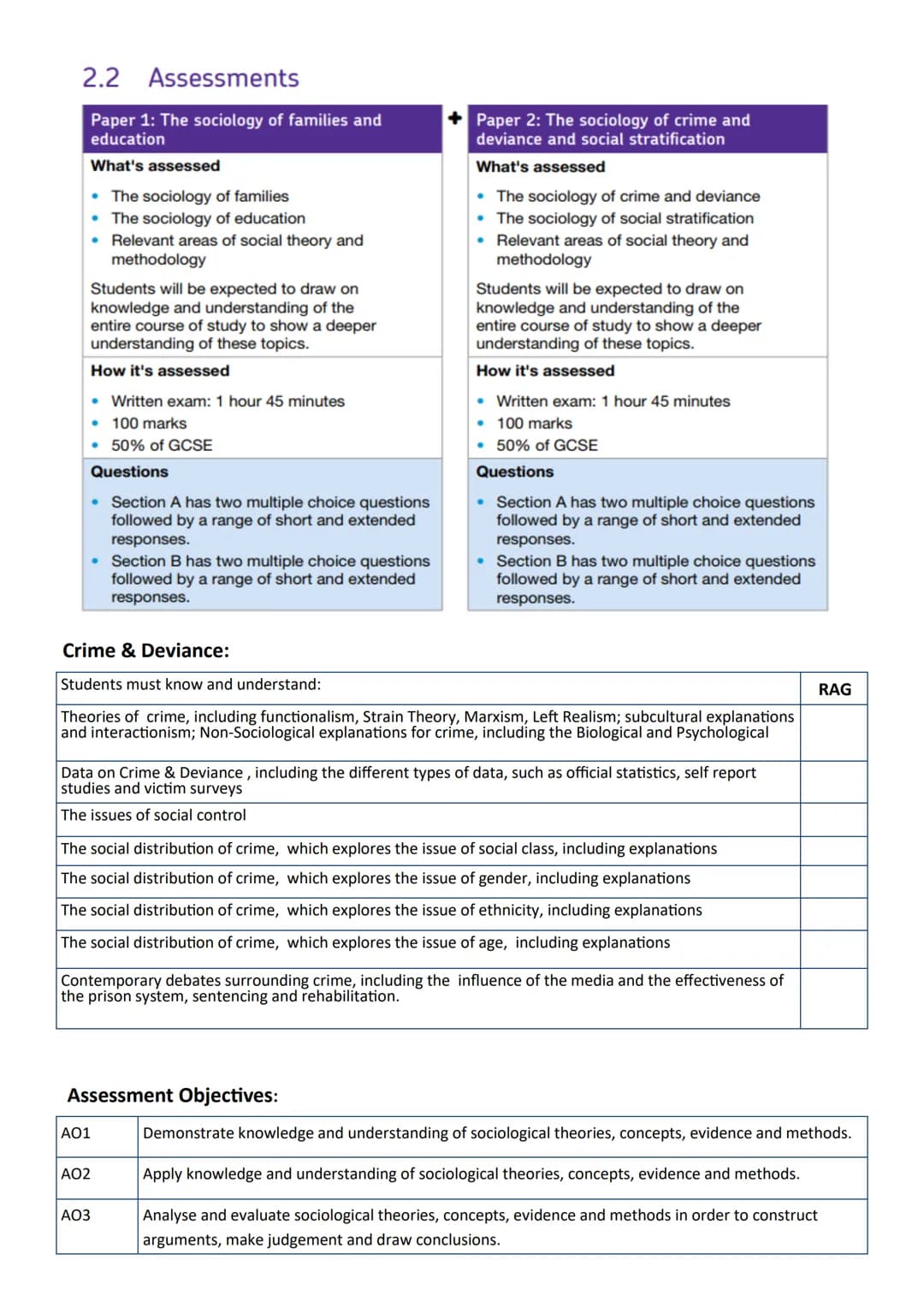
Your Crime & Deviance unit is assessed in Paper 2, worth 50% of your entire GCSE. You'll sit a 1 hour 45 minute exam covering multiple choice questions and extended responses.

The key topics you need to master include theories of crime (like functionalism and Marxism), crime data (official statistics and surveys), social control, and how factors like social class, gender, ethnicity and age affect crime patterns.

You'll also explore contemporary debates about media influence on crime and whether our prison system actually works. The assessment objectives test your knowledge (AO1), application skills (AO2), and ability to analyse and evaluate different perspectives (AO3).

Remember: You're expected to draw on knowledge from your entire course to show deeper understanding, so connect crime theories to what you've learned about families and education.

Sociology GCSE
Unit 5:
Crime & Deviance
Name 2.2
Assessments
Paper 1: The sociology of families and
education
What's assessed
⚫ The sociolog

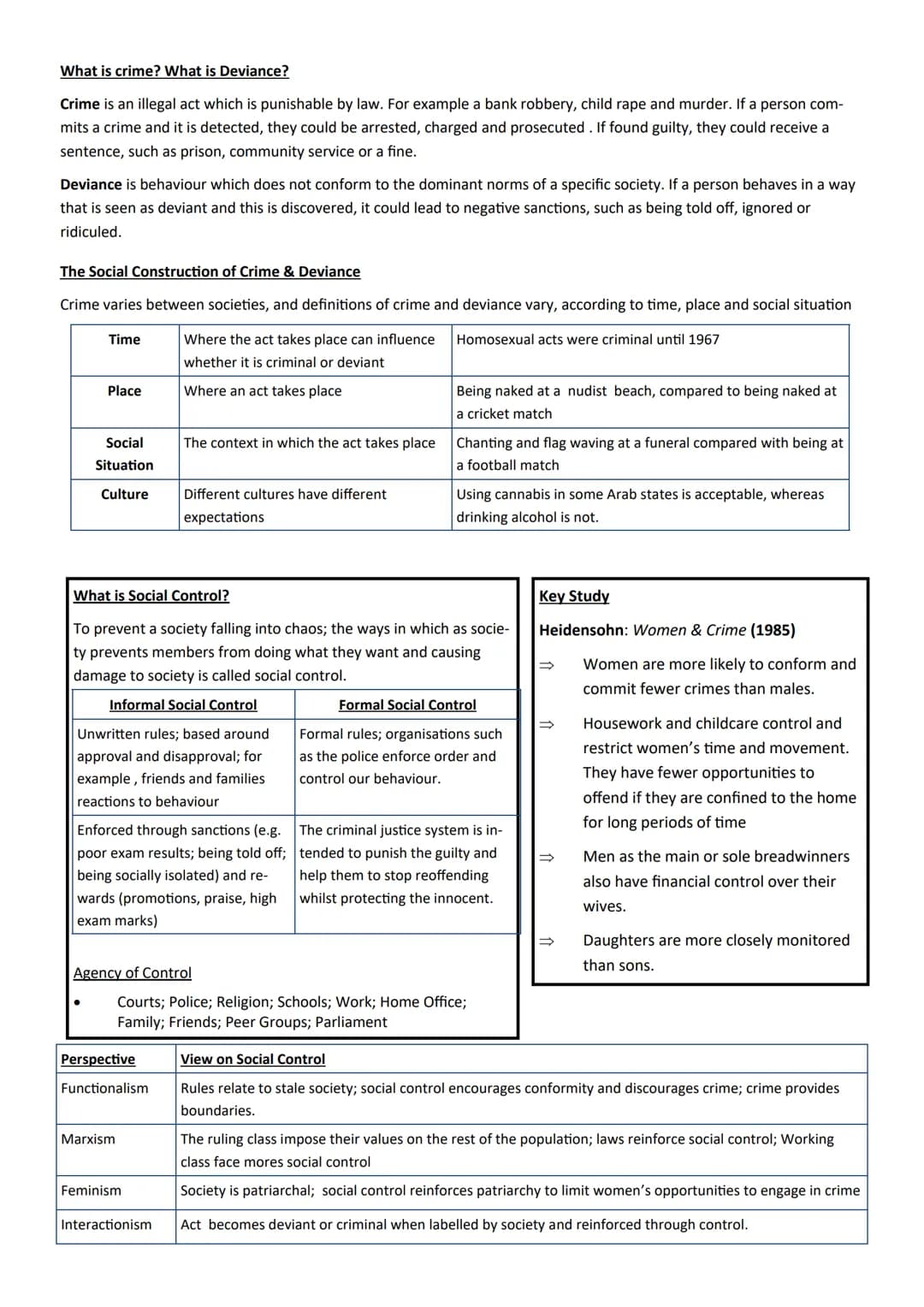
What is Crime? What is Deviance?

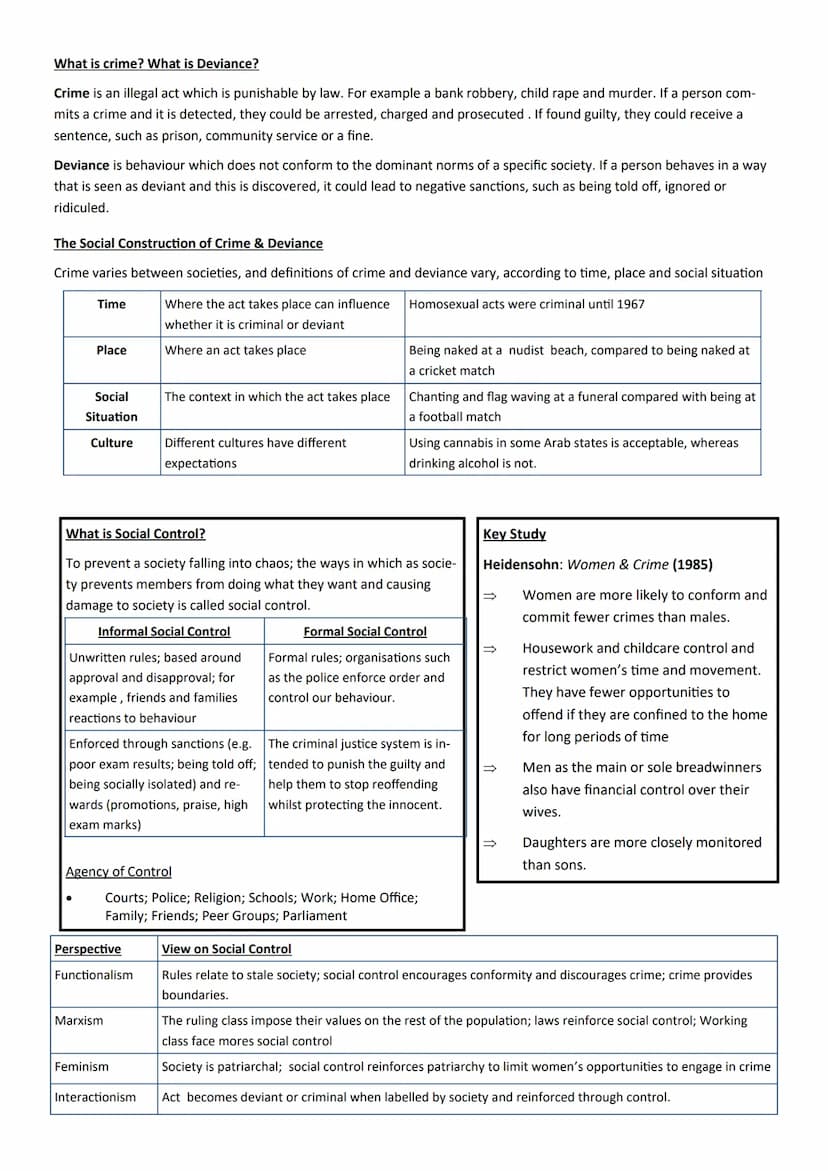
Crime is simple - it's any illegal act punishable by law, like theft or assault. Get caught, and you could face arrest, prosecution, and sentences ranging from fines to prison time.

Deviance is trickier - it's behaviour that doesn't follow society's expected norms. Think wearing pyjamas to school or talking loudly in a library. You won't get arrested, but you might face negative sanctions like disapproval or ridicule.

Here's what makes this fascinating: both crime and deviance are socially constructed. What counts as criminal or deviant changes depending on time (homosexuality was illegal until 1967), place (being naked at a nudist beach versus a cricket match), and culture (cannabis is acceptable in some Arab states, alcohol isn't).

Social control keeps society from falling into chaos through both informal control (family disapproval, peer pressure) and formal control (police, courts, schools). Different sociological perspectives view social control differently - functionalists see it as maintaining stability, whilst Marxists argue it protects the ruling class's interests.

Quick Tip: Remember the acronym TPCS - Time, Place, Culture, Situation - to explain why crime and deviance are socially constructed.

Sociology GCSE
Unit 5:
Crime & Deviance
Name 2.2
Assessments
Paper 1: The sociology of families and
education
What's assessed
⚫ The sociolog

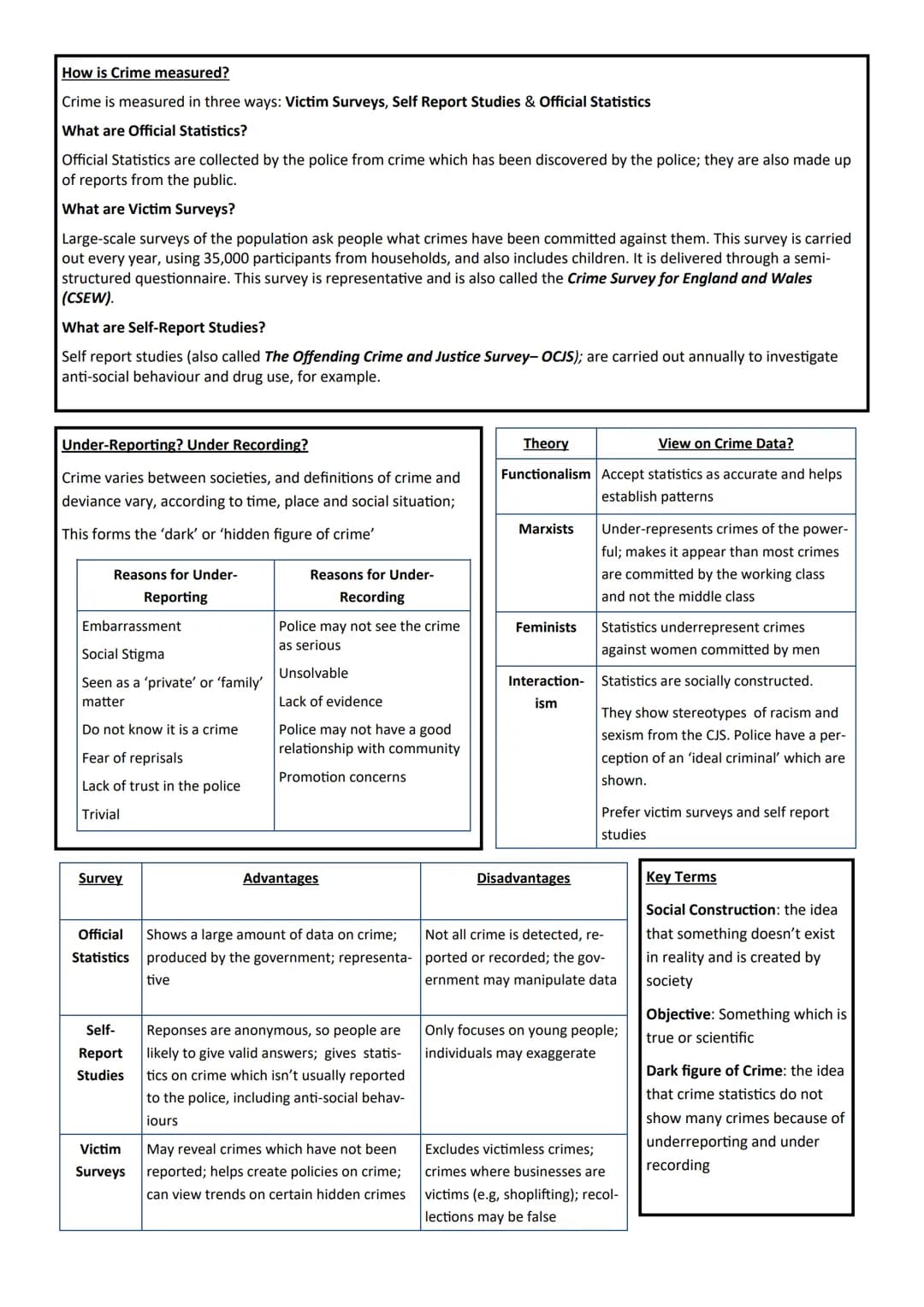
How Crime is Measured

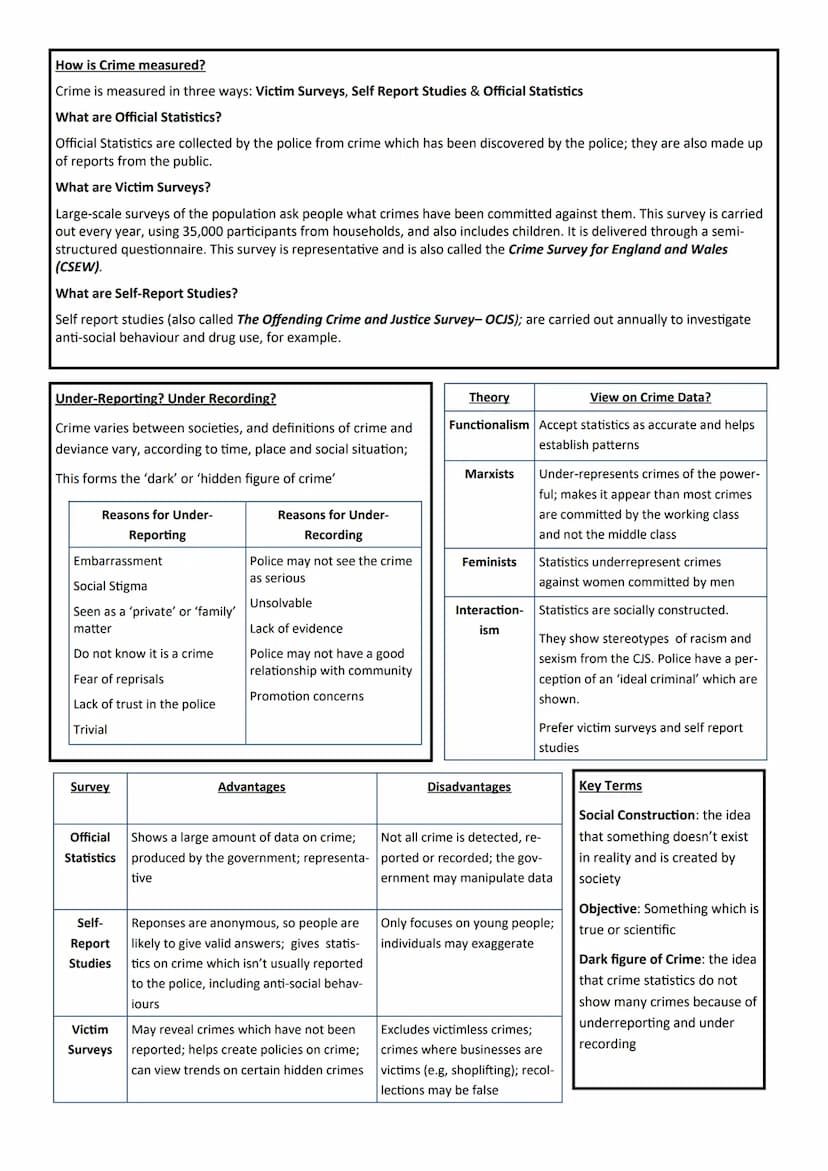
You'll need to know three main ways we measure crime, each with serious limitations that create the 'dark figure of crime' - all the unreported and unrecorded criminal activity.

Official statistics come from police records and public reports. They're government-produced and show large-scale patterns, but miss loads of crime due to under-reporting (embarrassment, fear, not trusting police) and under-recording (police don't think it's serious enough).

Victim surveys like the Crime Survey for England and Wales ask 35,000 people annually what crimes they've experienced. These reveal hidden crimes and help create policies, but exclude 'victimless' crimes and rely on potentially faulty memories.

Self-report studies anonymously ask people (mainly young people) about crimes they've committed. They're brilliant for uncovering unreported anti-social behaviour, but participants might exaggerate or lie.

Different theories interpret this data differently. Functionalists accept statistics as accurate, Marxists argue they under-represent powerful people's crimes, feminists say they ignore crimes against women, and interactionists claim statistics just reflect police stereotypes about who looks 'criminal'.

Exam Hack: Always discuss advantages AND disadvantages of each measurement method - examiners love students who show critical thinking about data reliability.

Sociology GCSE
Unit 5:
Crime & Deviance
Name 2.2
Assessments
Paper 1: The sociology of families and
education
What's assessed
⚫ The sociolog

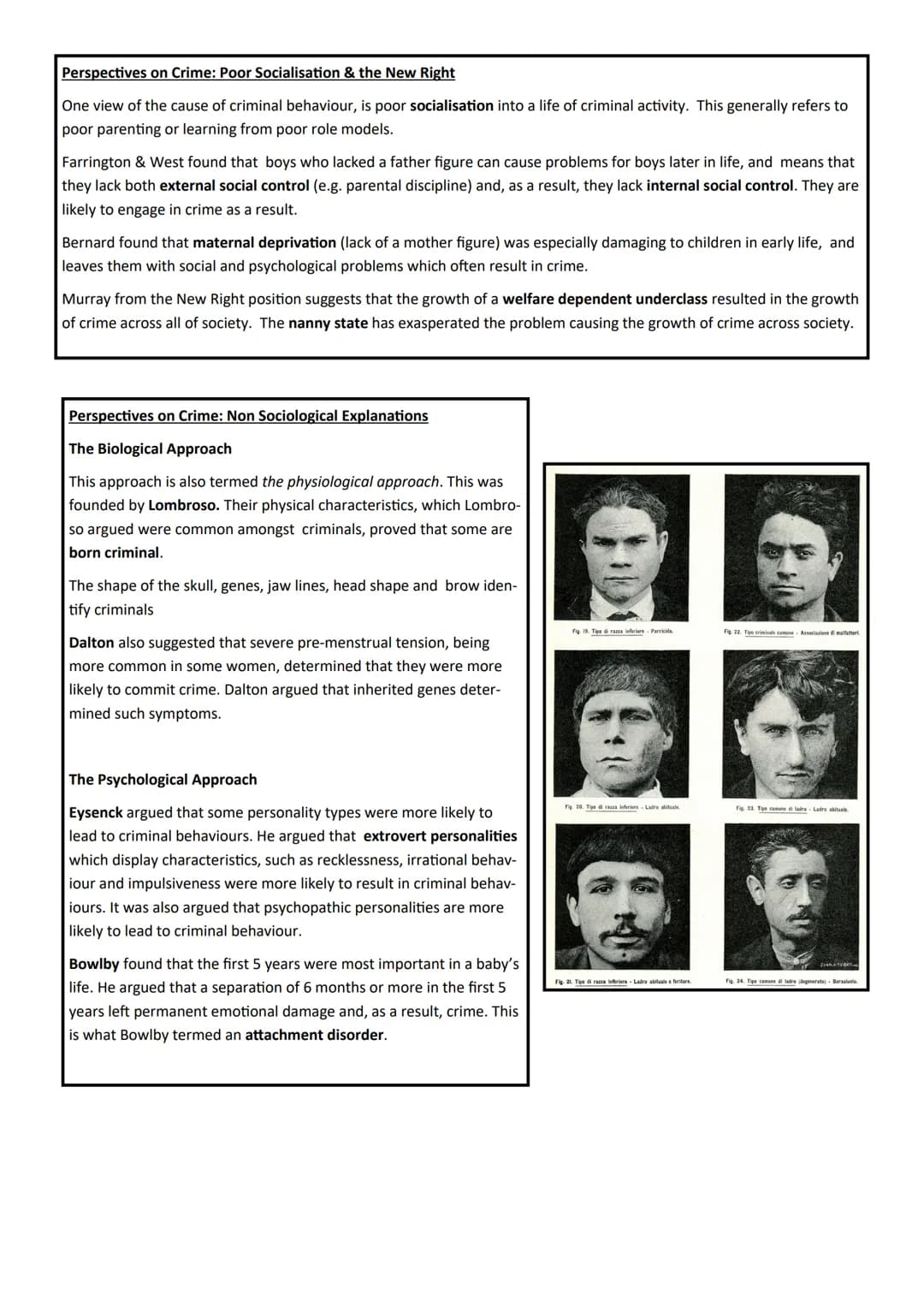
Non-Sociological & New Right Explanations

Not all crime explanations come from sociology - biological and psychological approaches offer different perspectives you need to understand.

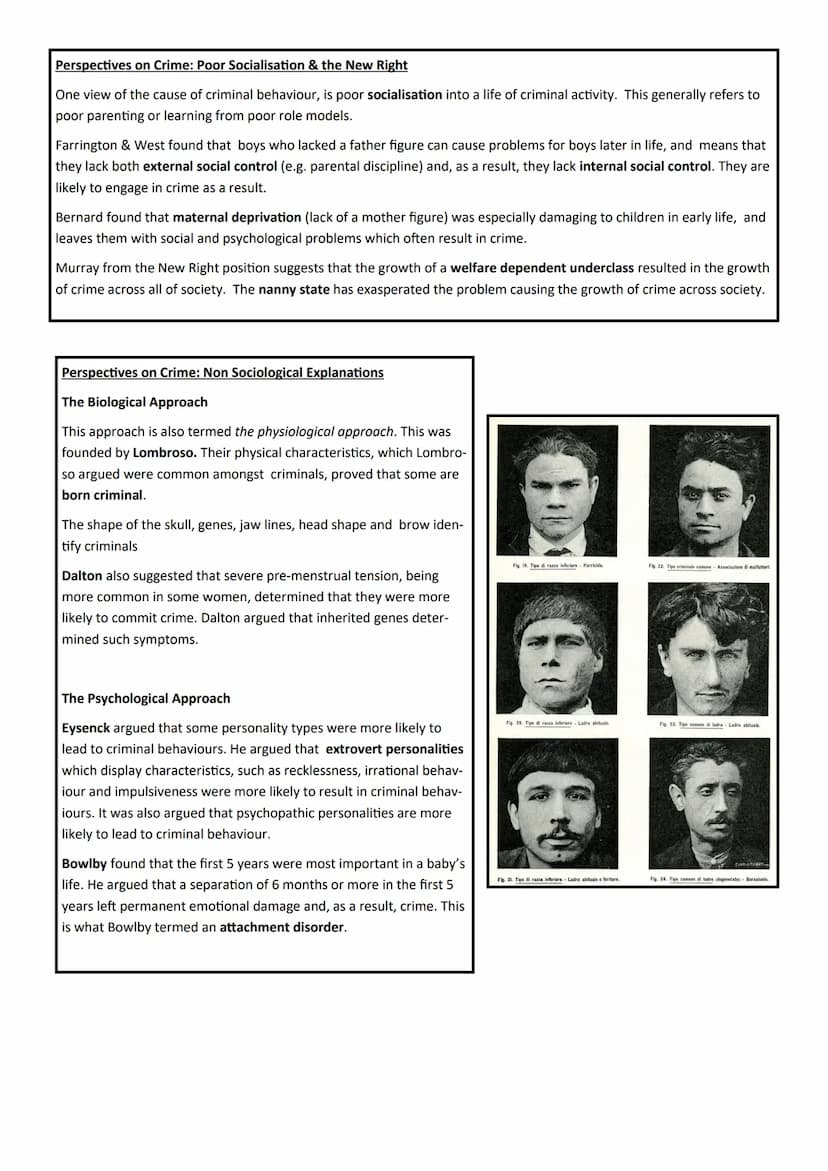
Lombroso's biological approach claimed criminals are born with distinctive physical features like specific skull shapes and jaw lines. Dalton even suggested women's pre-menstrual tension made them more likely to offend. These theories are largely discredited today but show how people once thought crime was inherited.

Psychological explanations focus on personality types and early experiences. Eysenck argued extroverted, impulsive personalities were more crime-prone, whilst Bowlby claimed separation from mothers in the first five years caused permanent emotional damage leading to criminal behaviour.

The New Right blames poor socialisation, particularly absent fathers and inadequate parenting. Farrington & West found boys without father figures lacked both external discipline and internal self-control. Murray controversially argued that welfare dependency created an 'underclass' where crime flourished.

These explanations are appealing because they seem straightforward, but they ignore social factors like poverty, inequality, and how society itself might create criminal behaviour.

Critical Point: These theories often ignore social context - ask yourself why crime rates vary between different areas and social groups if it's all about biology or individual psychology.

Sociology GCSE
Unit 5:
Crime & Deviance
Name 2.2
Assessments
Paper 1: The sociology of families and
education
What's assessed
⚫ The sociolog

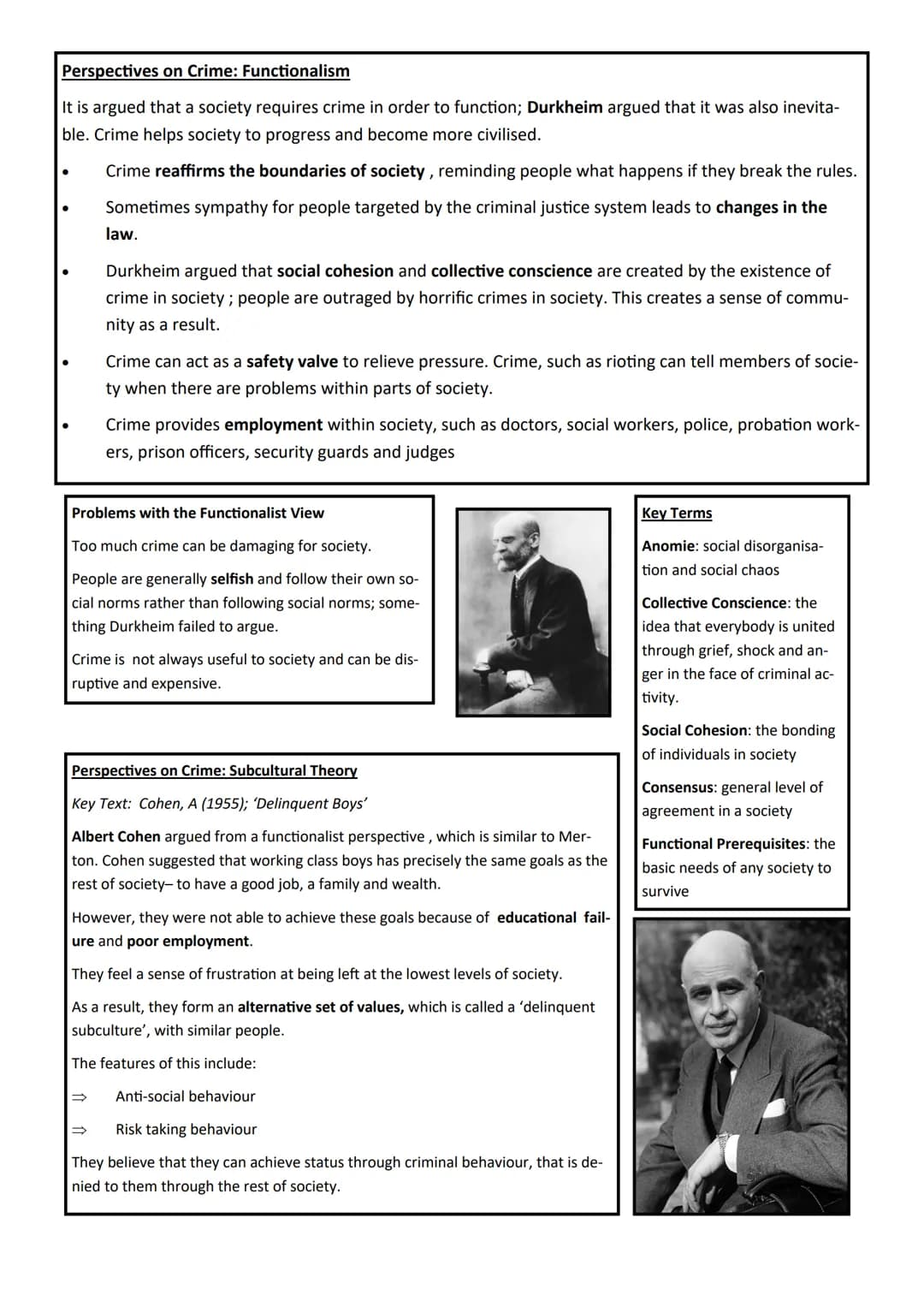
Functionalist & Subcultural Theories

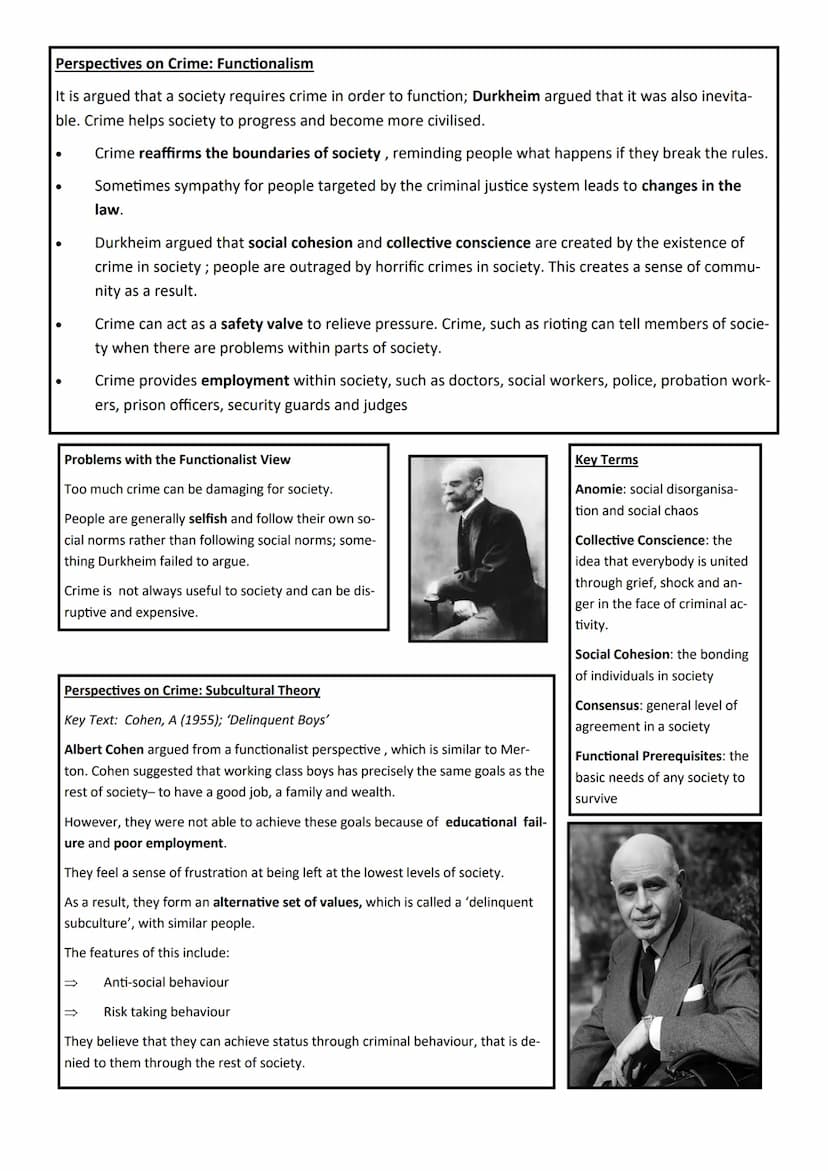
Durkheim's functionalist theory presents a surprising argument - crime is actually inevitable and beneficial for society. It reaffirms moral boundaries, creates social cohesion when people unite against horrific crimes, and even provides employment for police, judges, and social workers.

Crime acts as a 'safety valve' releasing social pressure (think riots highlighting social problems) and can lead to positive legal changes when public sympathy shifts. However, too much crime becomes destructive and expensive, and not everyone shares the same moral values.

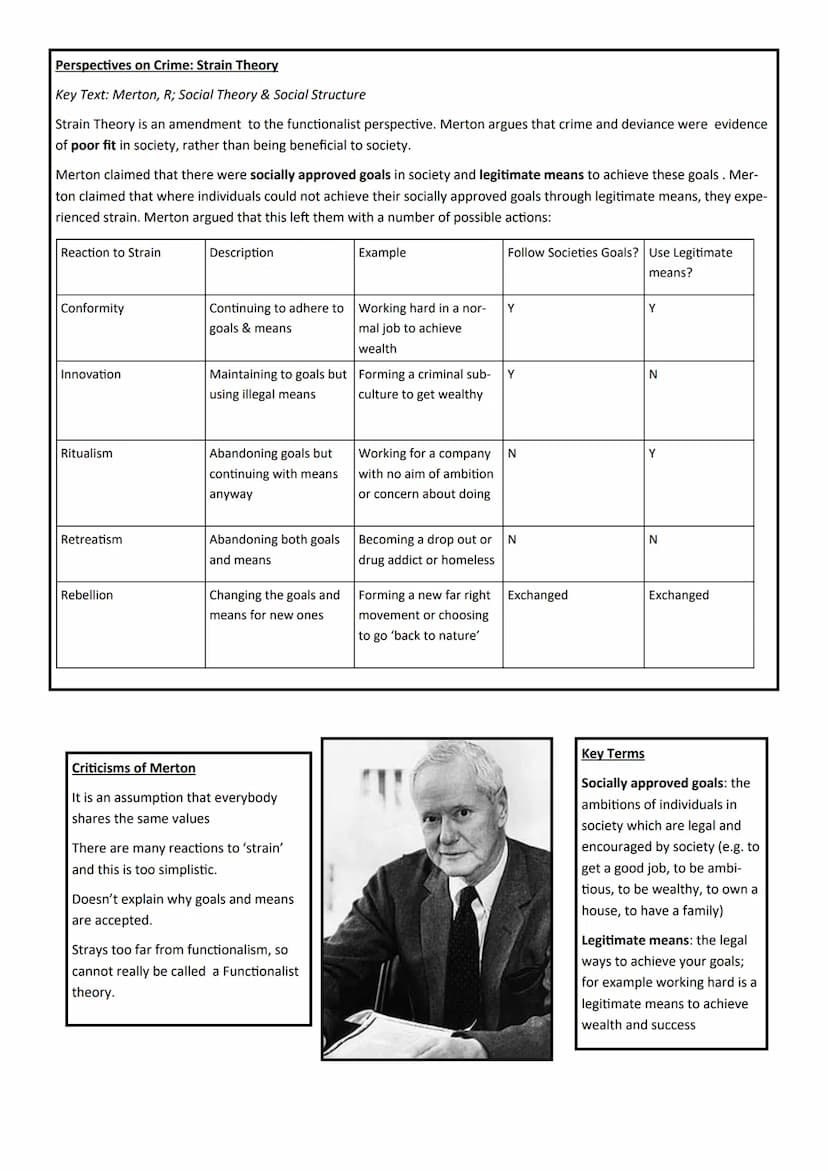
Merton's Strain Theory modifies functionalism, arguing crime results from a poor fit between society's goals (wealth, success) and legitimate means to achieve them. When people can't reach socially approved goals legally, they experience 'strain' and may choose innovation (crime to get rich), ritualism (giving up on ambition), retreatism (dropping out entirely), or rebellion (creating new goals).

Cohen's subcultural theory focuses on working-class boys who share society's goals but can't achieve them through education or employment. Their frustration creates delinquent subcultures with alternative values celebrating anti-social behaviour and risk-taking to gain status denied elsewhere.

Remember: Functionalists see crime as serving positive functions, unlike other theories that view it as purely harmful.

Sociology GCSE
Unit 5:
Crime & Deviance
Name 2.2
Assessments
Paper 1: The sociology of families and
education
What's assessed
⚫ The sociolog

Interactionism, Left Realism & Marxism

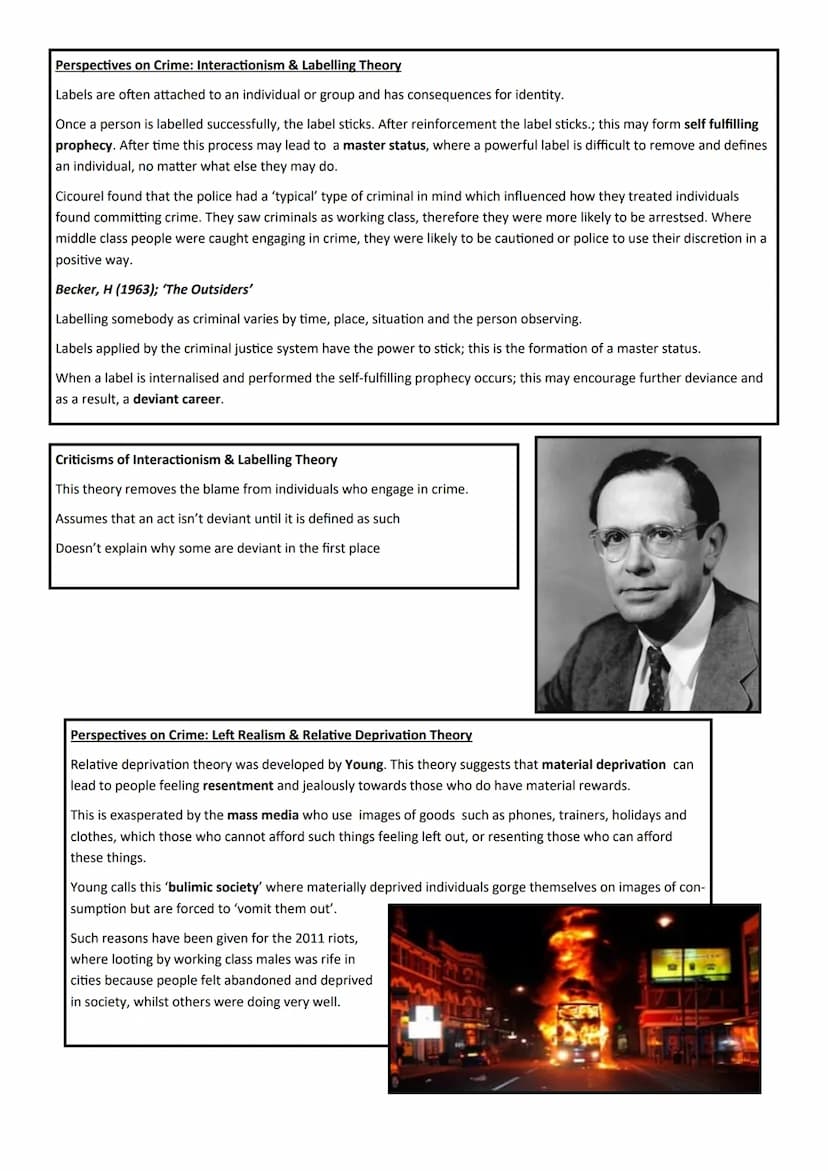
Labelling theory argues that acts aren't inherently criminal - they become so when society labels them. Becker showed how labels stick and create master status, where being seen as 'criminal' dominates your identity. This can become a self-fulfilling prophecy leading to a deviant career.

Cicourel discovered police have 'typical criminal' stereotypes, making working-class people more likely to be arrested whilst middle-class offenders get cautioned. The theory explains why some groups are over-represented in crime statistics, though critics argue it removes individual responsibility.

Left Realism focuses on relative deprivation - how people feel about their circumstances compared to others. Young's 'bulimic society' describes how media images of consumer goods make deprived individuals 'gorge' on advertising but can't afford the products, creating resentment that may lead to crime like the 2011 riots.

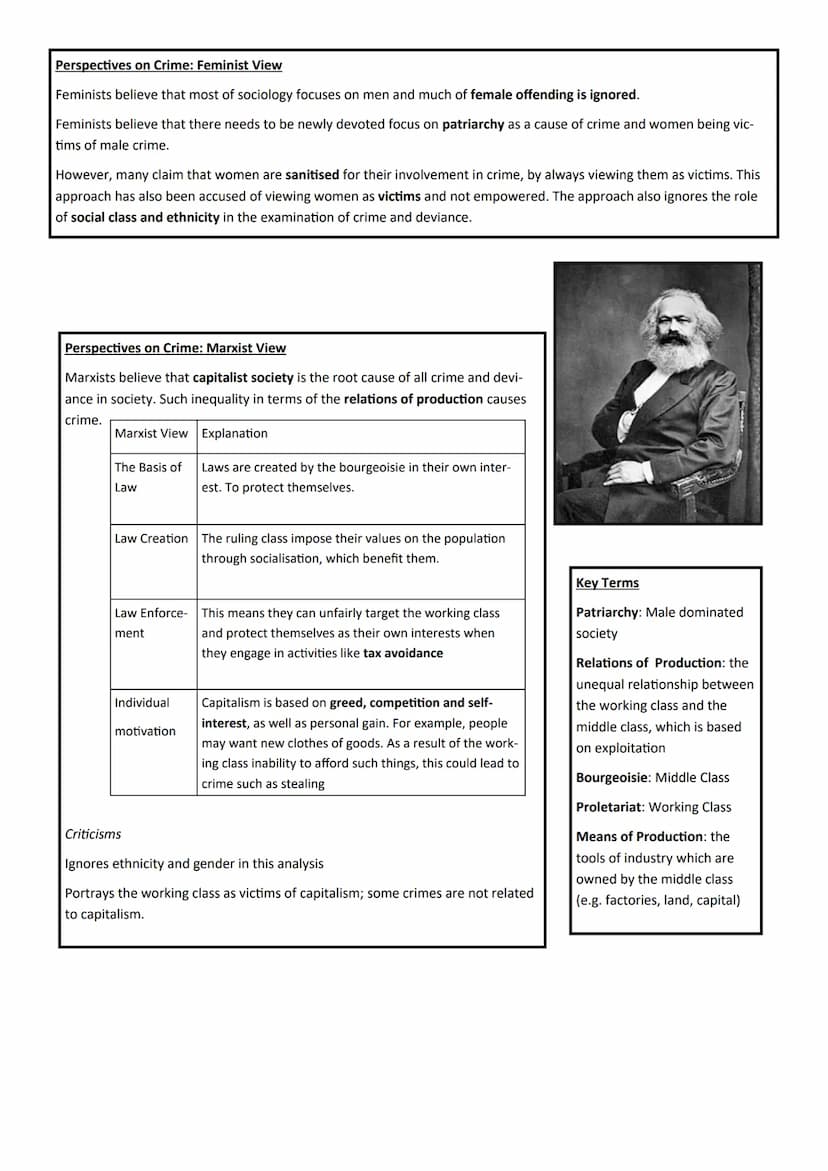
Marxists see capitalism as crime's root cause. Laws protect bourgeoisie interests, law enforcement targets working-class people unfairly, and capitalism's emphasis on greed and competition motivates criminal behaviour. However, this ignores how gender and ethnicity also influence crime patterns.

Key Insight: These theories shift focus from individual failings to how society's structure and reactions create criminal behaviour.

Sociology GCSE
Unit 5:
Crime & Deviance
Name 2.2
Assessments
Paper 1: The sociology of families and
education
What's assessed
⚫ The sociolog

Social Class and Crime Patterns

Working-class crime dominates official statistics and prison populations, but the reasons are hotly debated among sociologists.

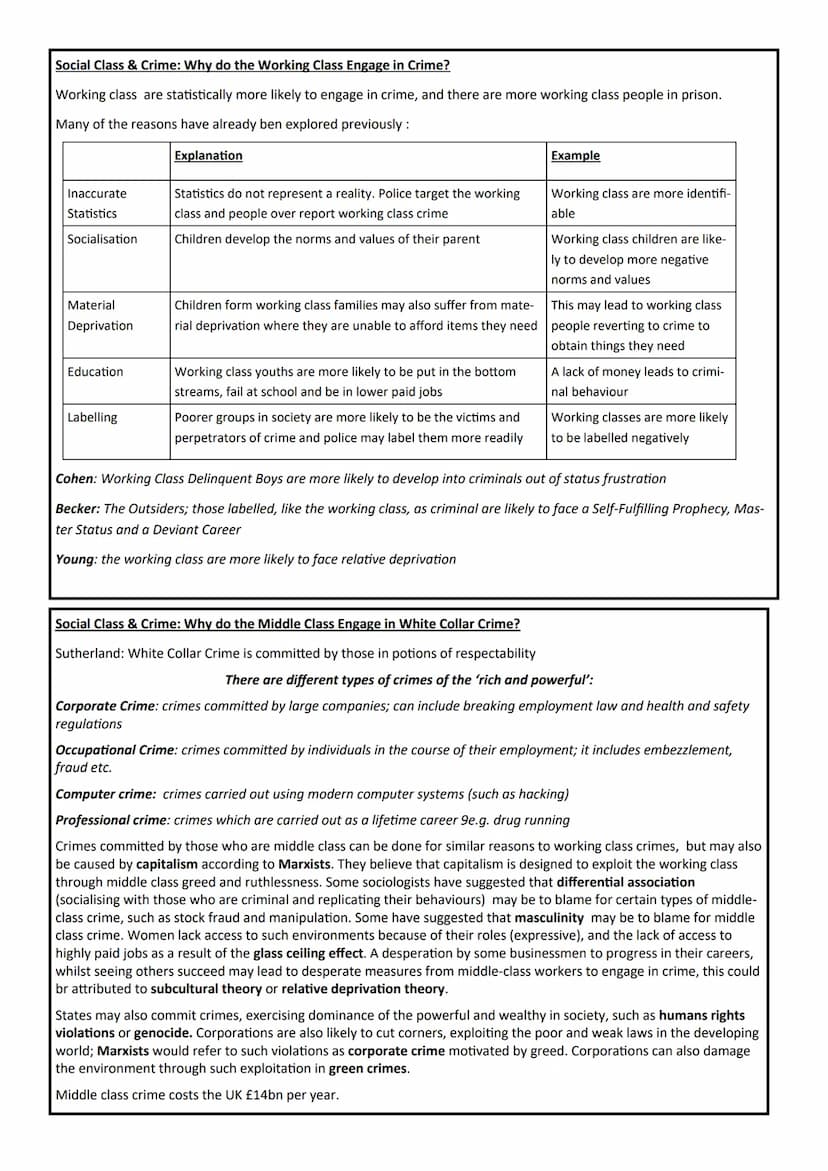
Material deprivation means working-class people may turn to crime when they can't afford necessities. Poor socialisation in some families might transmit criminal values, whilst educational failure limits legitimate opportunities for success. However, labelling theory suggests statistics are misleading - police simply target working-class areas more heavily and middle-class crime goes undetected.

Cohen's status frustration explains how working-class boys form delinquent subcultures when mainstream success seems impossible. Young's relative deprivation shows how seeing others' wealth can motivate criminal behaviour among the poor.

White-collar and corporate crime by middle-class professionals often gets overlooked but costs the UK £14 billion annually. This includes corporate crime (companies breaking health and safety laws), occupational crime (individual fraud and embezzlement), and professional crime (career criminals in respectable positions).

Sutherland noted how middle-class criminals use their respectability as cover. Differential association theory suggests business environments normalise certain illegal practices, whilst some argue masculine competitive culture in corporate settings encourages rule-breaking.

Think Critically: Why might middle-class crime be less visible in official statistics? Consider who has power to define what gets investigated and prosecuted.

Sociology GCSE
Unit 5:
Crime & Deviance
Name 2.2
Assessments
Paper 1: The sociology of families and
education
What's assessed
⚫ The sociolog
Sociology GCSE
Unit 5:
Crime & Deviance
Name 2.2
Assessments
Paper 1: The sociology of families and
education
What's assessed
⚫ The sociolog
Sociology GCSE
Unit 5:
Crime & Deviance
Name 2.2
Assessments
Paper 1: The sociology of families and
education
What's assessed
⚫ The sociolog


We thought you’d never ask...

What is the Knowunity AI companion?

Our AI Companion is a student-focused AI tool that offers more than just answers. Built on millions of Knowunity resources, it provides relevant information, personalised study plans, quizzes, and content directly in the chat, adapting to your individual learning journey.

Where can I download the Knowunity app?

You can download the app from Google Play Store and Apple App Store.

Is Knowunity really free of charge?

That's right! Enjoy free access to study content, connect with fellow students, and get instant help – all at your fingertips.

Most popular content: Deviance and Social Control

Most popular content in Sociology

Most popular content

Can't find what you're looking for? Explore other subjects.

Students love us — and so will you.

4.9/5

App Store

4.8/5

Google Play

The app is very easy to use and well designed. I have found everything I was looking for so far and have been able to learn a lot from the presentations! I will definitely use the app for a class assignment! And of course it also helps a lot as an inspiration.

Stefan S

iOS user

This app is really great. There are so many study notes and help [...]. My problem subject is French, for example, and the app has so many options for help. Thanks to this app, I have improved my French. I would recommend it to anyone.

Samantha Klich

Android user

Wow, I am really amazed. I just tried the app because I've seen it advertised many times and was absolutely stunned. This app is THE HELP you want for school and above all, it offers so many things, such as workouts and fact sheets, which have been VERY helpful to me personally.

Anna

iOS user

Best app on earth! no words because it’s too good

Thomas R

iOS user

Just amazing. Let's me revise 10x better, this app is a quick 10/10. I highly recommend it to anyone. I can watch and search for notes. I can save them in the subject folder. I can revise it any time when I come back. If you haven't tried this app, you're really missing out.

Basil

Android user

This app has made me feel so much more confident in my exam prep, not only through boosting my own self confidence through the features that allow you to connect with others and feel less alone, but also through the way the app itself is centred around making you feel better. It is easy to navigate, fun to use, and helpful to anyone struggling in absolutely any way.

David K

iOS user

The app's just great! All I have to do is enter the topic in the search bar and I get the response real fast. I don't have to watch 10 YouTube videos to understand something, so I'm saving my time. Highly recommended!

Sudenaz Ocak

Android user

In school I was really bad at maths but thanks to the app, I am doing better now. I am so grateful that you made the app.

Greenlight Bonnie

Android user

very reliable app to help and grow your ideas of Maths, English and other related topics in your works. please use this app if your struggling in areas, this app is key for that. wish I'd of done a review before. and it's also free so don't worry about that.

Rohan U

Android user

I know a lot of apps use fake accounts to boost their reviews but this app deserves it all. Originally I was getting 4 in my English exams and this time I got a grade 7. I didn’t even know about this app three days until the exam and it has helped A LOT. Please actually trust me and use it as I’m sure you too will see developments.

Xander S

iOS user

THE QUIZES AND FLASHCARDS ARE SO USEFUL AND I LOVE THE SCHOOLGPT. IT ALSO IS LITREALLY LIKE CHATGPT BUT SMARTER!! HELPED ME WITH MY MASCARA PROBLEMS TOO!! AS WELL AS MY REAL SUBJECTS ! DUHHH 😍😁😲🤑💗✨🎀😮

Elisha

iOS user

This apps acc the goat. I find revision so boring but this app makes it so easy to organize it all and then you can ask the freeeee ai to test yourself so good and you can easily upload your own stuff. highly recommend as someone taking mocks now

Paul T

iOS user

The app is very easy to use and well designed. I have found everything I was looking for so far and have been able to learn a lot from the presentations! I will definitely use the app for a class assignment! And of course it also helps a lot as an inspiration.

Stefan S

iOS user

This app is really great. There are so many study notes and help [...]. My problem subject is French, for example, and the app has so many options for help. Thanks to this app, I have improved my French. I would recommend it to anyone.

Samantha Klich

Android user

Wow, I am really amazed. I just tried the app because I've seen it advertised many times and was absolutely stunned. This app is THE HELP you want for school and above all, it offers so many things, such as workouts and fact sheets, which have been VERY helpful to me personally.

Anna

iOS user

Best app on earth! no words because it’s too good

Thomas R

iOS user

Just amazing. Let's me revise 10x better, this app is a quick 10/10. I highly recommend it to anyone. I can watch and search for notes. I can save them in the subject folder. I can revise it any time when I come back. If you haven't tried this app, you're really missing out.

Basil

Android user

This app has made me feel so much more confident in my exam prep, not only through boosting my own self confidence through the features that allow you to connect with others and feel less alone, but also through the way the app itself is centred around making you feel better. It is easy to navigate, fun to use, and helpful to anyone struggling in absolutely any way.

David K

iOS user

The app's just great! All I have to do is enter the topic in the search bar and I get the response real fast. I don't have to watch 10 YouTube videos to understand something, so I'm saving my time. Highly recommended!

Sudenaz Ocak

Android user

In school I was really bad at maths but thanks to the app, I am doing better now. I am so grateful that you made the app.

Greenlight Bonnie

Android user

very reliable app to help and grow your ideas of Maths, English and other related topics in your works. please use this app if your struggling in areas, this app is key for that. wish I'd of done a review before. and it's also free so don't worry about that.

Rohan U

Android user

I know a lot of apps use fake accounts to boost their reviews but this app deserves it all. Originally I was getting 4 in my English exams and this time I got a grade 7. I didn’t even know about this app three days until the exam and it has helped A LOT. Please actually trust me and use it as I’m sure you too will see developments.

Xander S

iOS user

THE QUIZES AND FLASHCARDS ARE SO USEFUL AND I LOVE THE SCHOOLGPT. IT ALSO IS LITREALLY LIKE CHATGPT BUT SMARTER!! HELPED ME WITH MY MASCARA PROBLEMS TOO!! AS WELL AS MY REAL SUBJECTS ! DUHHH 😍😁😲🤑💗✨🎀😮

Elisha

iOS user

This apps acc the goat. I find revision so boring but this app makes it so easy to organize it all and then you can ask the freeeee ai to test yourself so good and you can easily upload your own stuff. highly recommend as someone taking mocks now

Paul T

iOS user


Sociology

1,554

7 Dec 2025

15 pages

AQA Sociology: Understanding Crime and Deviance

J

Joshua Whitehead-Jones

@jwjjoshua

Crime and deviance might seem like straightforward concepts, but they're actually much more complex and interesting than you'd think. Understanding how society defines what's criminal, who commits crimes, and why people break the rules is essential for your GCSE Sociology... Show more

Sociology GCSE
Unit 5:
Crime & Deviance
Name 2.2
Assessments
Paper 1: The sociology of families and
education
What's assessed
⚫ The sociolog

Sign up to see the contentIt's free!

Access to all documents

Improve your grades

Join milions of students

By signing up you accept Terms of Service and Privacy Policy

GCSE Crime & Deviance Overview

Your Crime & Deviance unit is assessed in Paper 2, worth 50% of your entire GCSE. You'll sit a 1 hour 45 minute exam covering multiple choice questions and extended responses.

The key topics you need to master include theories of crime (like functionalism and Marxism), crime data (official statistics and surveys), social control, and how factors like social class, gender, ethnicity and age affect crime patterns.

You'll also explore contemporary debates about media influence on crime and whether our prison system actually works. The assessment objectives test your knowledge (AO1), application skills (AO2), and ability to analyse and evaluate different perspectives (AO3).

Remember: You're expected to draw on knowledge from your entire course to show deeper understanding, so connect crime theories to what you've learned about families and education.

Sociology GCSE
Unit 5:
Crime & Deviance
Name 2.2
Assessments
Paper 1: The sociology of families and
education
What's assessed
⚫ The sociolog

Sign up to see the contentIt's free!

Access to all documents

Improve your grades

Join milions of students

By signing up you accept Terms of Service and Privacy Policy

What is Crime? What is Deviance?

Crime is simple - it's any illegal act punishable by law, like theft or assault. Get caught, and you could face arrest, prosecution, and sentences ranging from fines to prison time.

Deviance is trickier - it's behaviour that doesn't follow society's expected norms. Think wearing pyjamas to school or talking loudly in a library. You won't get arrested, but you might face negative sanctions like disapproval or ridicule.

Here's what makes this fascinating: both crime and deviance are socially constructed. What counts as criminal or deviant changes depending on time (homosexuality was illegal until 1967), place (being naked at a nudist beach versus a cricket match), and culture (cannabis is acceptable in some Arab states, alcohol isn't).

Social control keeps society from falling into chaos through both informal control (family disapproval, peer pressure) and formal control (police, courts, schools). Different sociological perspectives view social control differently - functionalists see it as maintaining stability, whilst Marxists argue it protects the ruling class's interests.

Quick Tip: Remember the acronym TPCS - Time, Place, Culture, Situation - to explain why crime and deviance are socially constructed.

Sociology GCSE
Unit 5:
Crime & Deviance
Name 2.2
Assessments
Paper 1: The sociology of families and
education
What's assessed
⚫ The sociolog

Sign up to see the contentIt's free!

Access to all documents

Improve your grades

Join milions of students

By signing up you accept Terms of Service and Privacy Policy

How Crime is Measured

You'll need to know three main ways we measure crime, each with serious limitations that create the 'dark figure of crime' - all the unreported and unrecorded criminal activity.

Official statistics come from police records and public reports. They're government-produced and show large-scale patterns, but miss loads of crime due to under-reporting (embarrassment, fear, not trusting police) and under-recording (police don't think it's serious enough).

Victim surveys like the Crime Survey for England and Wales ask 35,000 people annually what crimes they've experienced. These reveal hidden crimes and help create policies, but exclude 'victimless' crimes and rely on potentially faulty memories.

Self-report studies anonymously ask people (mainly young people) about crimes they've committed. They're brilliant for uncovering unreported anti-social behaviour, but participants might exaggerate or lie.

Different theories interpret this data differently. Functionalists accept statistics as accurate, Marxists argue they under-represent powerful people's crimes, feminists say they ignore crimes against women, and interactionists claim statistics just reflect police stereotypes about who looks 'criminal'.

Exam Hack: Always discuss advantages AND disadvantages of each measurement method - examiners love students who show critical thinking about data reliability.

Sociology GCSE
Unit 5:
Crime & Deviance
Name 2.2
Assessments
Paper 1: The sociology of families and
education
What's assessed
⚫ The sociolog

Sign up to see the contentIt's free!

Access to all documents

Improve your grades

Join milions of students

By signing up you accept Terms of Service and Privacy Policy

Non-Sociological & New Right Explanations

Not all crime explanations come from sociology - biological and psychological approaches offer different perspectives you need to understand.

Lombroso's biological approach claimed criminals are born with distinctive physical features like specific skull shapes and jaw lines. Dalton even suggested women's pre-menstrual tension made them more likely to offend. These theories are largely discredited today but show how people once thought crime was inherited.

Psychological explanations focus on personality types and early experiences. Eysenck argued extroverted, impulsive personalities were more crime-prone, whilst Bowlby claimed separation from mothers in the first five years caused permanent emotional damage leading to criminal behaviour.

The New Right blames poor socialisation, particularly absent fathers and inadequate parenting. Farrington & West found boys without father figures lacked both external discipline and internal self-control. Murray controversially argued that welfare dependency created an 'underclass' where crime flourished.

These explanations are appealing because they seem straightforward, but they ignore social factors like poverty, inequality, and how society itself might create criminal behaviour.

Critical Point: These theories often ignore social context - ask yourself why crime rates vary between different areas and social groups if it's all about biology or individual psychology.

Sociology GCSE
Unit 5:
Crime & Deviance
Name 2.2
Assessments
Paper 1: The sociology of families and
education
What's assessed
⚫ The sociolog

Sign up to see the contentIt's free!

Access to all documents

Improve your grades

Join milions of students

By signing up you accept Terms of Service and Privacy Policy

Functionalist & Subcultural Theories

Durkheim's functionalist theory presents a surprising argument - crime is actually inevitable and beneficial for society. It reaffirms moral boundaries, creates social cohesion when people unite against horrific crimes, and even provides employment for police, judges, and social workers.

Crime acts as a 'safety valve' releasing social pressure (think riots highlighting social problems) and can lead to positive legal changes when public sympathy shifts. However, too much crime becomes destructive and expensive, and not everyone shares the same moral values.

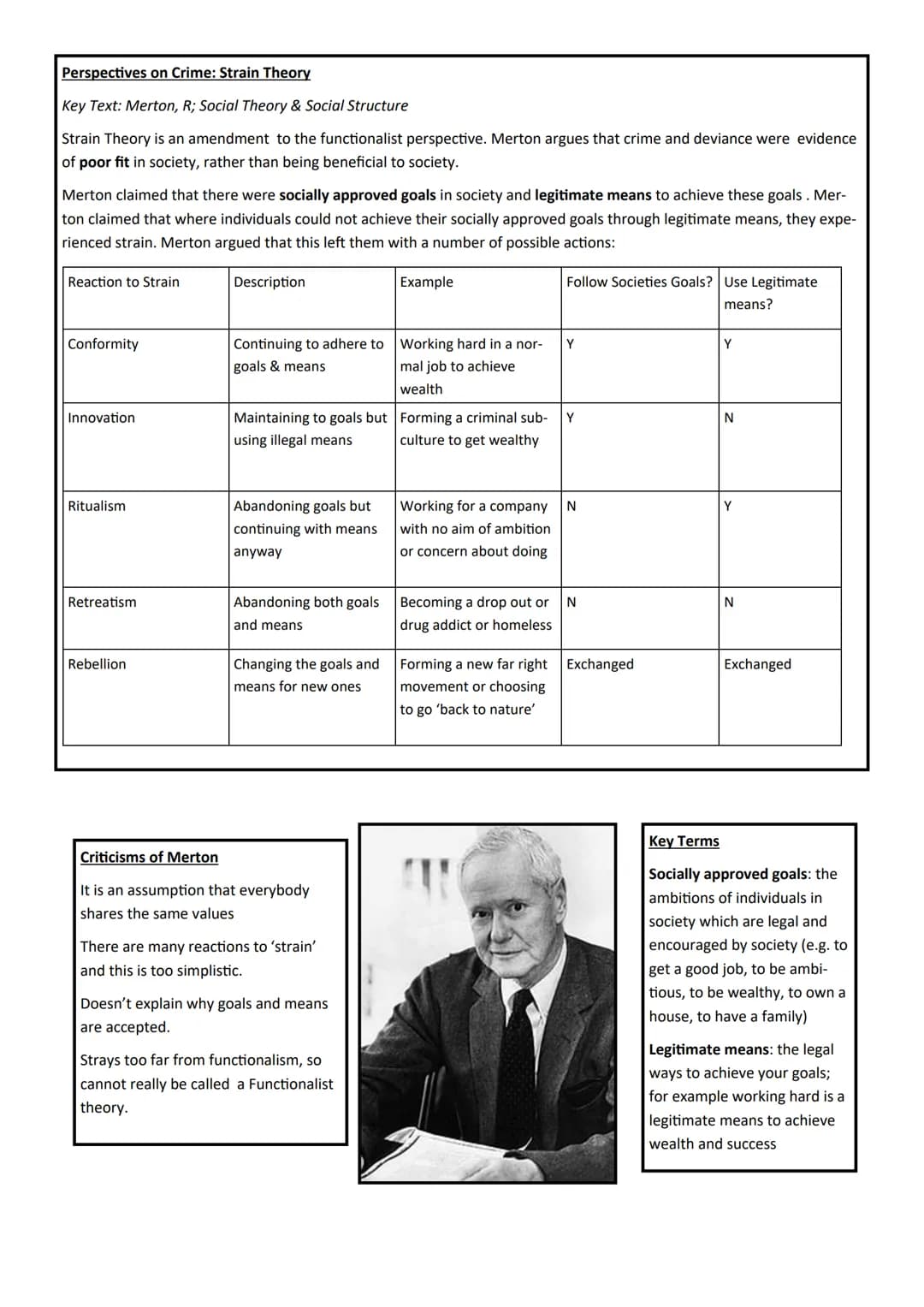
Merton's Strain Theory modifies functionalism, arguing crime results from a poor fit between society's goals (wealth, success) and legitimate means to achieve them. When people can't reach socially approved goals legally, they experience 'strain' and may choose innovation (crime to get rich), ritualism (giving up on ambition), retreatism (dropping out entirely), or rebellion (creating new goals).

Cohen's subcultural theory focuses on working-class boys who share society's goals but can't achieve them through education or employment. Their frustration creates delinquent subcultures with alternative values celebrating anti-social behaviour and risk-taking to gain status denied elsewhere.

Remember: Functionalists see crime as serving positive functions, unlike other theories that view it as purely harmful.

Sociology GCSE
Unit 5:
Crime & Deviance
Name 2.2
Assessments
Paper 1: The sociology of families and
education
What's assessed
⚫ The sociolog

Sign up to see the contentIt's free!

Access to all documents

Improve your grades

Join milions of students

By signing up you accept Terms of Service and Privacy Policy

Interactionism, Left Realism & Marxism

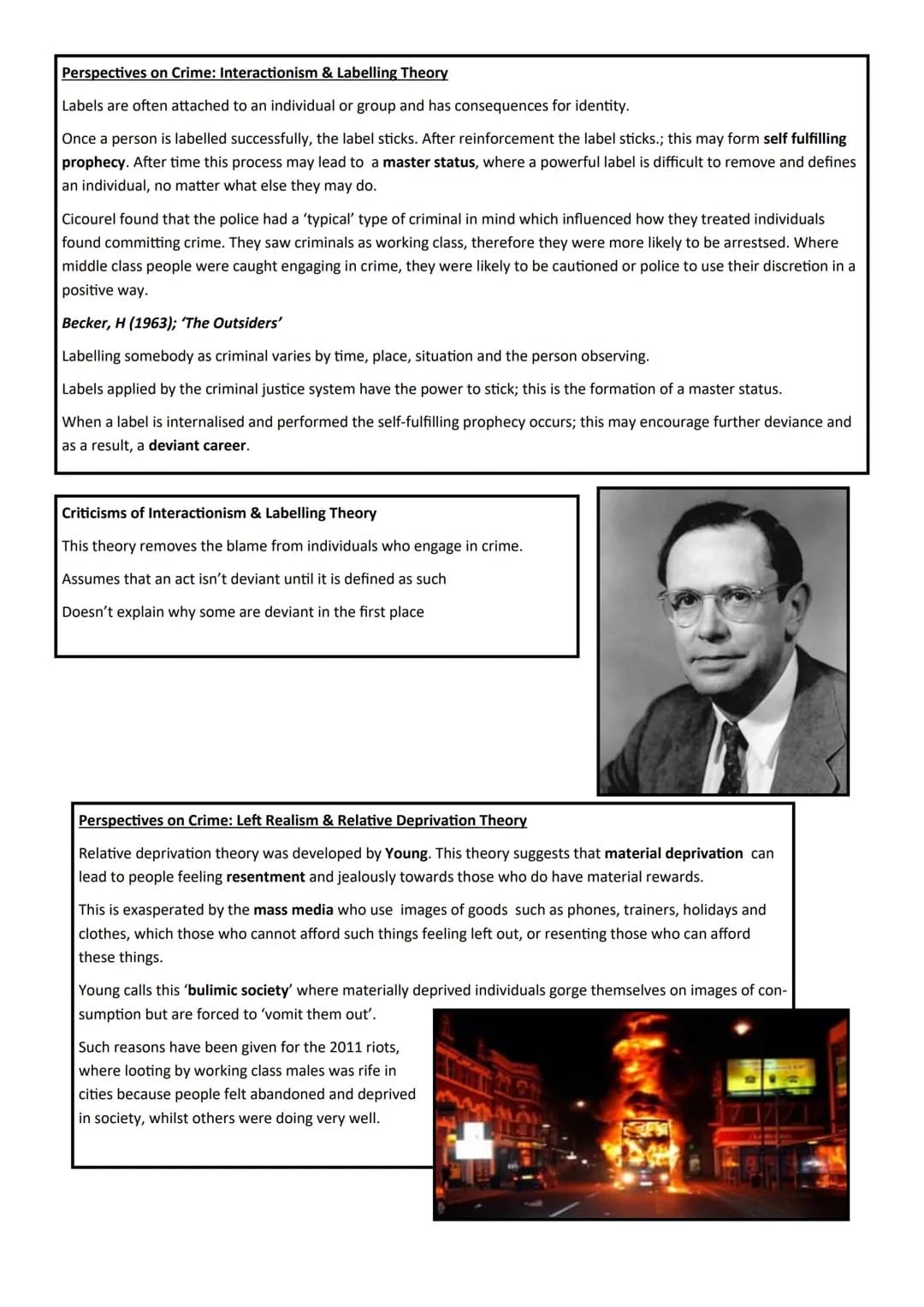
Labelling theory argues that acts aren't inherently criminal - they become so when society labels them. Becker showed how labels stick and create master status, where being seen as 'criminal' dominates your identity. This can become a self-fulfilling prophecy leading to a deviant career.

Cicourel discovered police have 'typical criminal' stereotypes, making working-class people more likely to be arrested whilst middle-class offenders get cautioned. The theory explains why some groups are over-represented in crime statistics, though critics argue it removes individual responsibility.

Left Realism focuses on relative deprivation - how people feel about their circumstances compared to others. Young's 'bulimic society' describes how media images of consumer goods make deprived individuals 'gorge' on advertising but can't afford the products, creating resentment that may lead to crime like the 2011 riots.

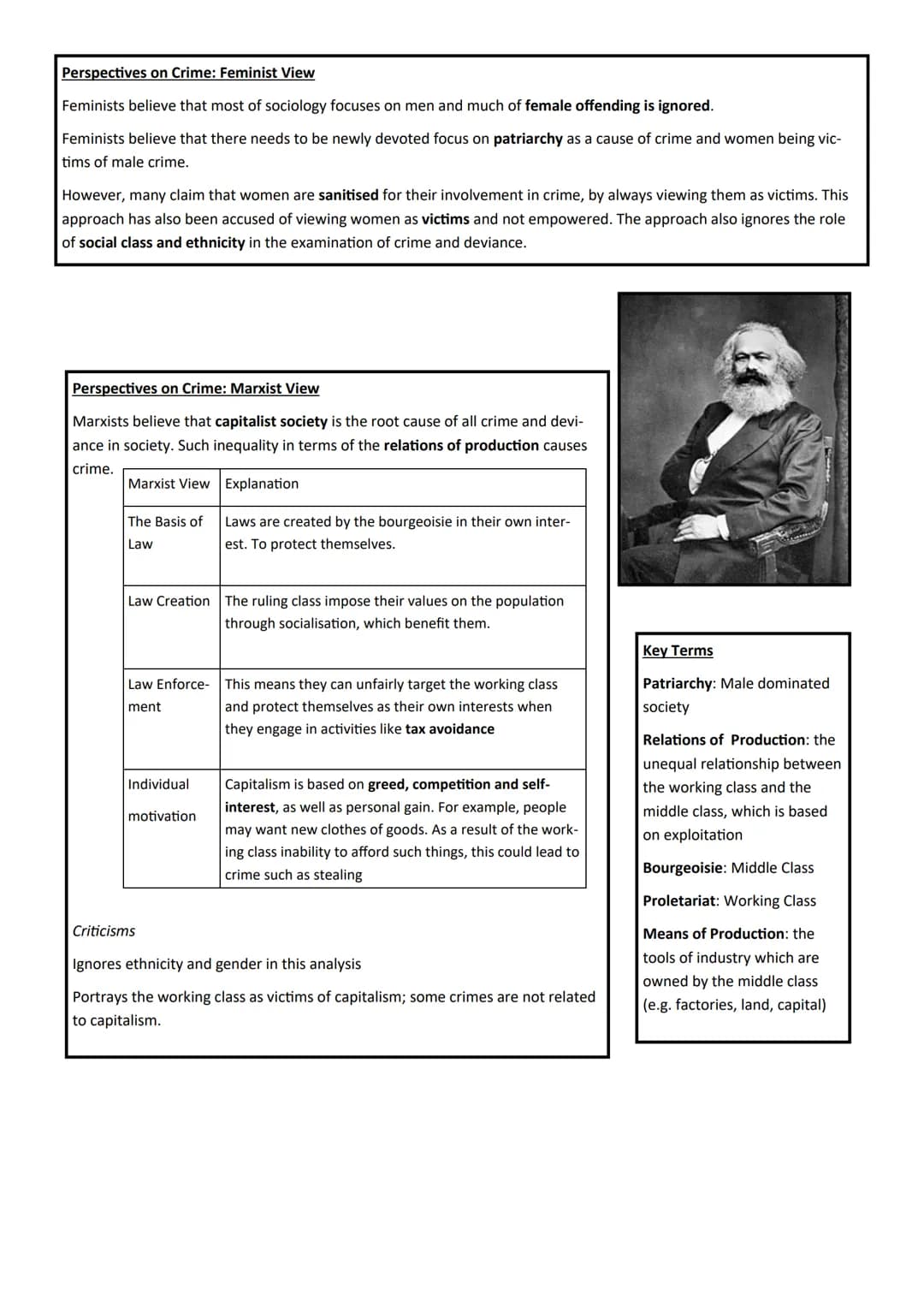
Marxists see capitalism as crime's root cause. Laws protect bourgeoisie interests, law enforcement targets working-class people unfairly, and capitalism's emphasis on greed and competition motivates criminal behaviour. However, this ignores how gender and ethnicity also influence crime patterns.

Key Insight: These theories shift focus from individual failings to how society's structure and reactions create criminal behaviour.

Sociology GCSE
Unit 5:
Crime & Deviance
Name 2.2
Assessments
Paper 1: The sociology of families and
education
What's assessed
⚫ The sociolog

Sign up to see the contentIt's free!

Access to all documents

Improve your grades

Join milions of students

By signing up you accept Terms of Service and Privacy Policy

Social Class and Crime Patterns

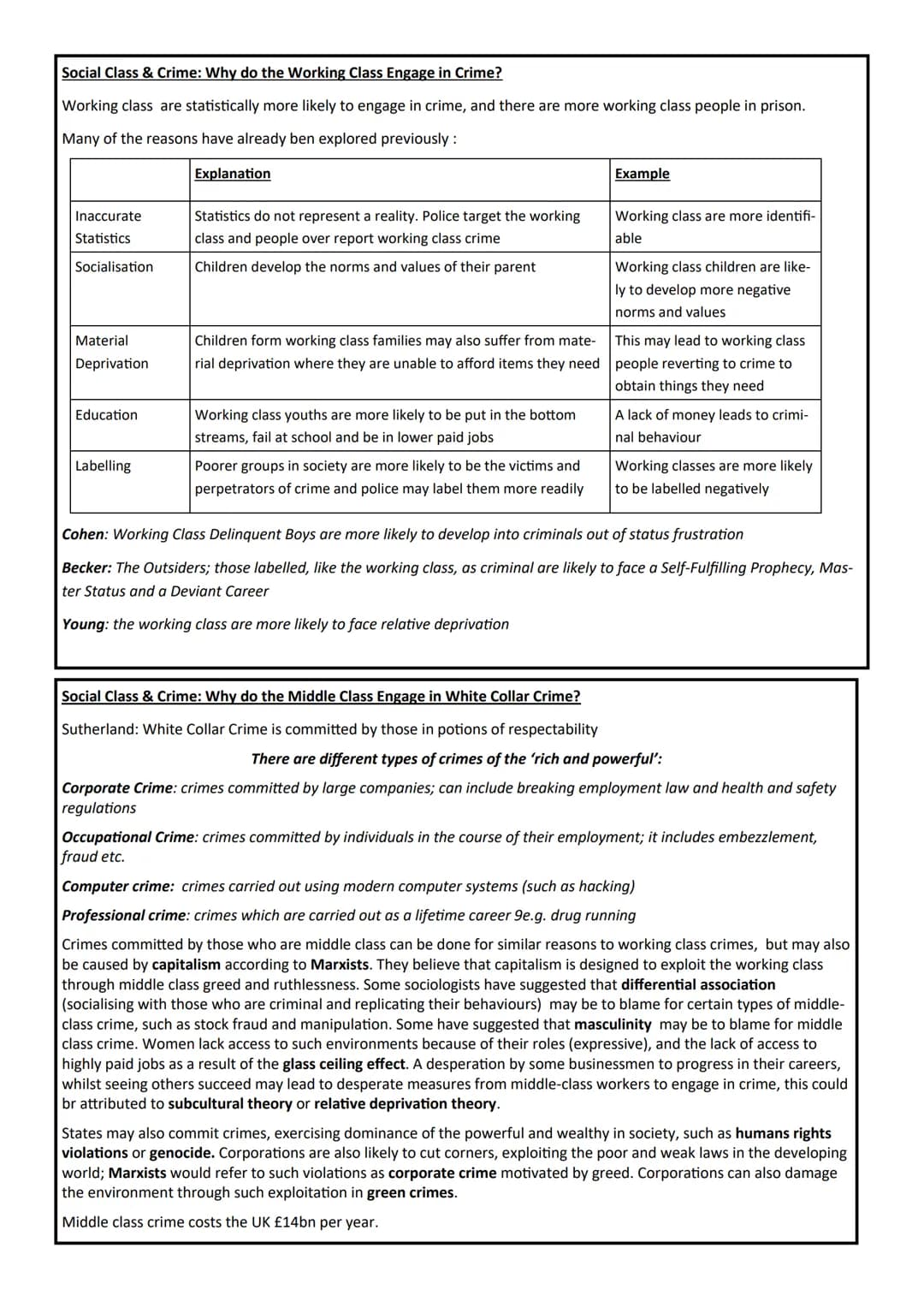
Working-class crime dominates official statistics and prison populations, but the reasons are hotly debated among sociologists.

Material deprivation means working-class people may turn to crime when they can't afford necessities. Poor socialisation in some families might transmit criminal values, whilst educational failure limits legitimate opportunities for success. However, labelling theory suggests statistics are misleading - police simply target working-class areas more heavily and middle-class crime goes undetected.

Cohen's status frustration explains how working-class boys form delinquent subcultures when mainstream success seems impossible. Young's relative deprivation shows how seeing others' wealth can motivate criminal behaviour among the poor.

White-collar and corporate crime by middle-class professionals often gets overlooked but costs the UK £14 billion annually. This includes corporate crime (companies breaking health and safety laws), occupational crime (individual fraud and embezzlement), and professional crime (career criminals in respectable positions).

Sutherland noted how middle-class criminals use their respectability as cover. Differential association theory suggests business environments normalise certain illegal practices, whilst some argue masculine competitive culture in corporate settings encourages rule-breaking.

Think Critically: Why might middle-class crime be less visible in official statistics? Consider who has power to define what gets investigated and prosecuted.

Sociology GCSE
Unit 5:
Crime & Deviance
Name 2.2
Assessments
Paper 1: The sociology of families and
education
What's assessed
⚫ The sociolog

Sign up to see the contentIt's free!

Access to all documents

Improve your grades

Join milions of students

By signing up you accept Terms of Service and Privacy Policy

Sociology GCSE
Unit 5:
Crime & Deviance
Name 2.2
Assessments
Paper 1: The sociology of families and
education
What's assessed
⚫ The sociolog

Sign up to see the contentIt's free!

Access to all documents

Improve your grades

Join milions of students

By signing up you accept Terms of Service and Privacy Policy

Sociology GCSE
Unit 5:
Crime & Deviance
Name 2.2
Assessments
Paper 1: The sociology of families and
education
What's assessed
⚫ The sociolog

Sign up to see the contentIt's free!

Access to all documents

Improve your grades

Join milions of students

By signing up you accept Terms of Service and Privacy Policy

We thought you’d never ask...

What is the Knowunity AI companion?

Our AI Companion is a student-focused AI tool that offers more than just answers. Built on millions of Knowunity resources, it provides relevant information, personalised study plans, quizzes, and content directly in the chat, adapting to your individual learning journey.

Where can I download the Knowunity app?

You can download the app from Google Play Store and Apple App Store.

Is Knowunity really free of charge?

That's right! Enjoy free access to study content, connect with fellow students, and get instant help – all at your fingertips.

15

Smart Tools NEW

Transform this note into: ✓ 50+ Practice Questions ✓ Interactive Flashcards ✓ Full Mock Exam ✓ Essay Outlines

Mock Exam
Quiz
Flashcards
Essay

Most popular content: Deviance and Social Control

Most popular content in Sociology

Most popular content

Can't find what you're looking for? Explore other subjects.

Students love us — and so will you.

4.9/5

App Store

4.8/5

Google Play

The app is very easy to use and well designed. I have found everything I was looking for so far and have been able to learn a lot from the presentations! I will definitely use the app for a class assignment! And of course it also helps a lot as an inspiration.

Stefan S

iOS user

This app is really great. There are so many study notes and help [...]. My problem subject is French, for example, and the app has so many options for help. Thanks to this app, I have improved my French. I would recommend it to anyone.

Samantha Klich

Android user

Wow, I am really amazed. I just tried the app because I've seen it advertised many times and was absolutely stunned. This app is THE HELP you want for school and above all, it offers so many things, such as workouts and fact sheets, which have been VERY helpful to me personally.

Anna

iOS user

Best app on earth! no words because it’s too good

Thomas R

iOS user

Just amazing. Let's me revise 10x better, this app is a quick 10/10. I highly recommend it to anyone. I can watch and search for notes. I can save them in the subject folder. I can revise it any time when I come back. If you haven't tried this app, you're really missing out.

Basil

Android user

This app has made me feel so much more confident in my exam prep, not only through boosting my own self confidence through the features that allow you to connect with others and feel less alone, but also through the way the app itself is centred around making you feel better. It is easy to navigate, fun to use, and helpful to anyone struggling in absolutely any way.

David K

iOS user

The app's just great! All I have to do is enter the topic in the search bar and I get the response real fast. I don't have to watch 10 YouTube videos to understand something, so I'm saving my time. Highly recommended!

Sudenaz Ocak

Android user

In school I was really bad at maths but thanks to the app, I am doing better now. I am so grateful that you made the app.

Greenlight Bonnie

Android user

very reliable app to help and grow your ideas of Maths, English and other related topics in your works. please use this app if your struggling in areas, this app is key for that. wish I'd of done a review before. and it's also free so don't worry about that.

Rohan U

Android user

I know a lot of apps use fake accounts to boost their reviews but this app deserves it all. Originally I was getting 4 in my English exams and this time I got a grade 7. I didn’t even know about this app three days until the exam and it has helped A LOT. Please actually trust me and use it as I’m sure you too will see developments.

Xander S

iOS user

THE QUIZES AND FLASHCARDS ARE SO USEFUL AND I LOVE THE SCHOOLGPT. IT ALSO IS LITREALLY LIKE CHATGPT BUT SMARTER!! HELPED ME WITH MY MASCARA PROBLEMS TOO!! AS WELL AS MY REAL SUBJECTS ! DUHHH 😍😁😲🤑💗✨🎀😮

Elisha

iOS user

This apps acc the goat. I find revision so boring but this app makes it so easy to organize it all and then you can ask the freeeee ai to test yourself so good and you can easily upload your own stuff. highly recommend as someone taking mocks now

Paul T

iOS user

The app is very easy to use and well designed. I have found everything I was looking for so far and have been able to learn a lot from the presentations! I will definitely use the app for a class assignment! And of course it also helps a lot as an inspiration.

Stefan S

iOS user

This app is really great. There are so many study notes and help [...]. My problem subject is French, for example, and the app has so many options for help. Thanks to this app, I have improved my French. I would recommend it to anyone.

Samantha Klich

Android user

Wow, I am really amazed. I just tried the app because I've seen it advertised many times and was absolutely stunned. This app is THE HELP you want for school and above all, it offers so many things, such as workouts and fact sheets, which have been VERY helpful to me personally.

Anna

iOS user

Best app on earth! no words because it’s too good

Thomas R

iOS user

Just amazing. Let's me revise 10x better, this app is a quick 10/10. I highly recommend it to anyone. I can watch and search for notes. I can save them in the subject folder. I can revise it any time when I come back. If you haven't tried this app, you're really missing out.

Basil

Android user

This app has made me feel so much more confident in my exam prep, not only through boosting my own self confidence through the features that allow you to connect with others and feel less alone, but also through the way the app itself is centred around making you feel better. It is easy to navigate, fun to use, and helpful to anyone struggling in absolutely any way.

David K

iOS user

The app's just great! All I have to do is enter the topic in the search bar and I get the response real fast. I don't have to watch 10 YouTube videos to understand something, so I'm saving my time. Highly recommended!

Sudenaz Ocak

Android user

In school I was really bad at maths but thanks to the app, I am doing better now. I am so grateful that you made the app.

Greenlight Bonnie

Android user

very reliable app to help and grow your ideas of Maths, English and other related topics in your works. please use this app if your struggling in areas, this app is key for that. wish I'd of done a review before. and it's also free so don't worry about that.

Rohan U

Android user

I know a lot of apps use fake accounts to boost their reviews but this app deserves it all. Originally I was getting 4 in my English exams and this time I got a grade 7. I didn’t even know about this app three days until the exam and it has helped A LOT. Please actually trust me and use it as I’m sure you too will see developments.

Xander S

iOS user

THE QUIZES AND FLASHCARDS ARE SO USEFUL AND I LOVE THE SCHOOLGPT. IT ALSO IS LITREALLY LIKE CHATGPT BUT SMARTER!! HELPED ME WITH MY MASCARA PROBLEMS TOO!! AS WELL AS MY REAL SUBJECTS ! DUHHH 😍😁😲🤑💗✨🎀😮

Elisha

iOS user

This apps acc the goat. I find revision so boring but this app makes it so easy to organize it all and then you can ask the freeeee ai to test yourself so good and you can easily upload your own stuff. highly recommend as someone taking mocks now

Paul T

iOS user