
Ever wondered how philosophers try to prove God exists, or... Show more
 Humanities
 Religious Studies
 English Literature
 Biology
 Sociology
Sign up to see the contentIt's free!
Access to all documents
Improve your grades
Join milions of students
By signing up you accept Terms of Service and Privacy Policy
Subjects
Classic Dramatic Literature
Modern Lyric Poetry
Influential English-Language Authors
Classic and Contemporary Novels
Literary Character Analysis
Romantic and Love Poetry
Reading Analysis and Interpretation
Evidence Analysis and Integration
Author's Stylistic Elements
Figurative Language and Rhetoric
Show all topics
Human Organ Systems
Cellular Organization and Development
Biomolecular Structure and Organization
Enzyme Structure and Regulation
Cellular Organization Types
Biological Homeostatic Processes
Cellular Membrane Structure
Autotrophic Energy Processes
Environmental Sustainability and Impact
Neural Communication Systems
Show all topics
Social Sciences Research & Practice
Social Structure and Mobility
Classic Social Influence Experiments
Social Systems Theories
Family and Relationship Dynamics
Memory Systems and Processes
Neural Bases of Behavior
Social Influence and Attraction
Psychotherapeutic Approaches
Human Agency and Responsibility
Show all topics
Chemical Sciences and Applications
Chemical Bond Types and Properties
Organic Functional Groups
Atomic Structure and Composition
Chromatographic Separation Principles
Chemical Compound Classifications
Electrochemical Cell Systems
Periodic Table Organization
Chemical Reaction Kinetics
Chemical Equation Conservation
Show all topics
Nazi Germany and Holocaust 1933-1945
World Wars and Peace Treaties
European Monarchs and Statesmen
Cold War Global Tensions
Medieval Institutions and Systems
European Renaissance and Enlightenment
Modern Global Environmental-Health Challenges
Modern Military Conflicts
Medieval Migration and Invasions
World Wars Era and Impact
Show all topics
51
•
4 Jan 2026
•
Kacie Hodgson
@kaciehodgson_ffxs
Ever wondered how philosophers try to prove God exists, or... Show more
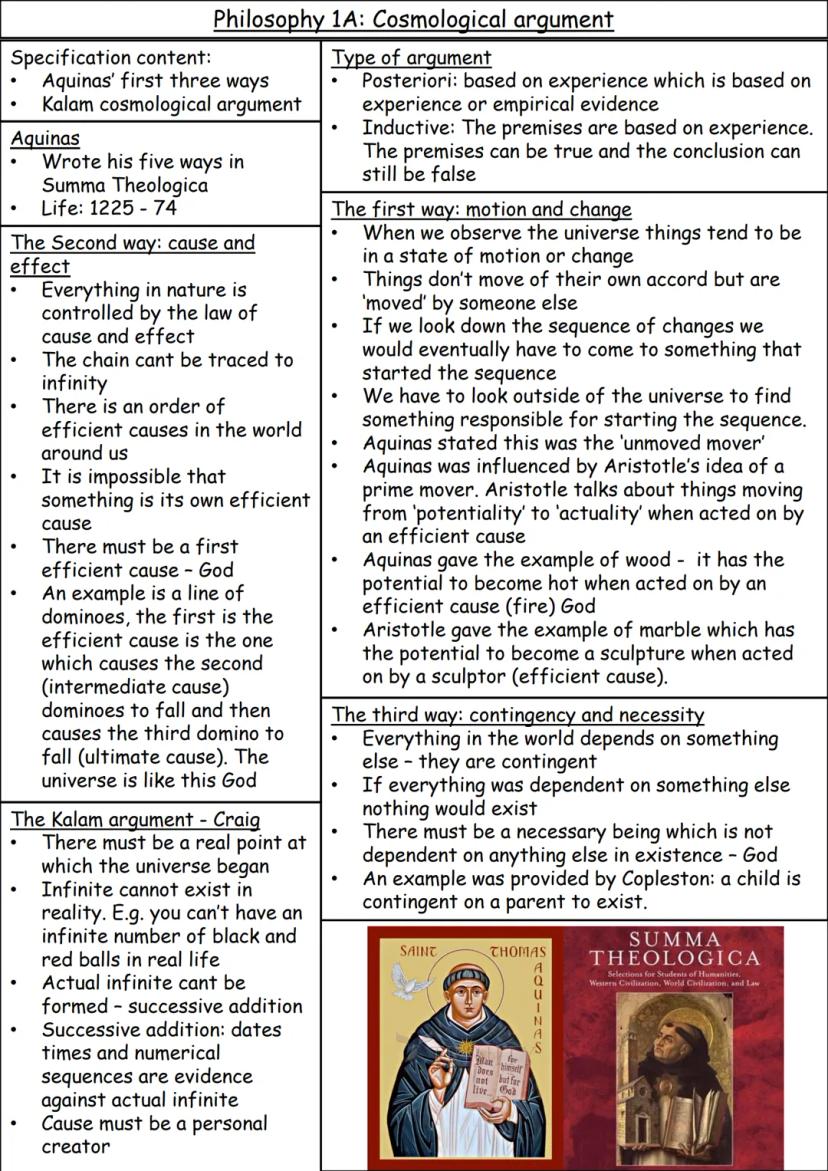
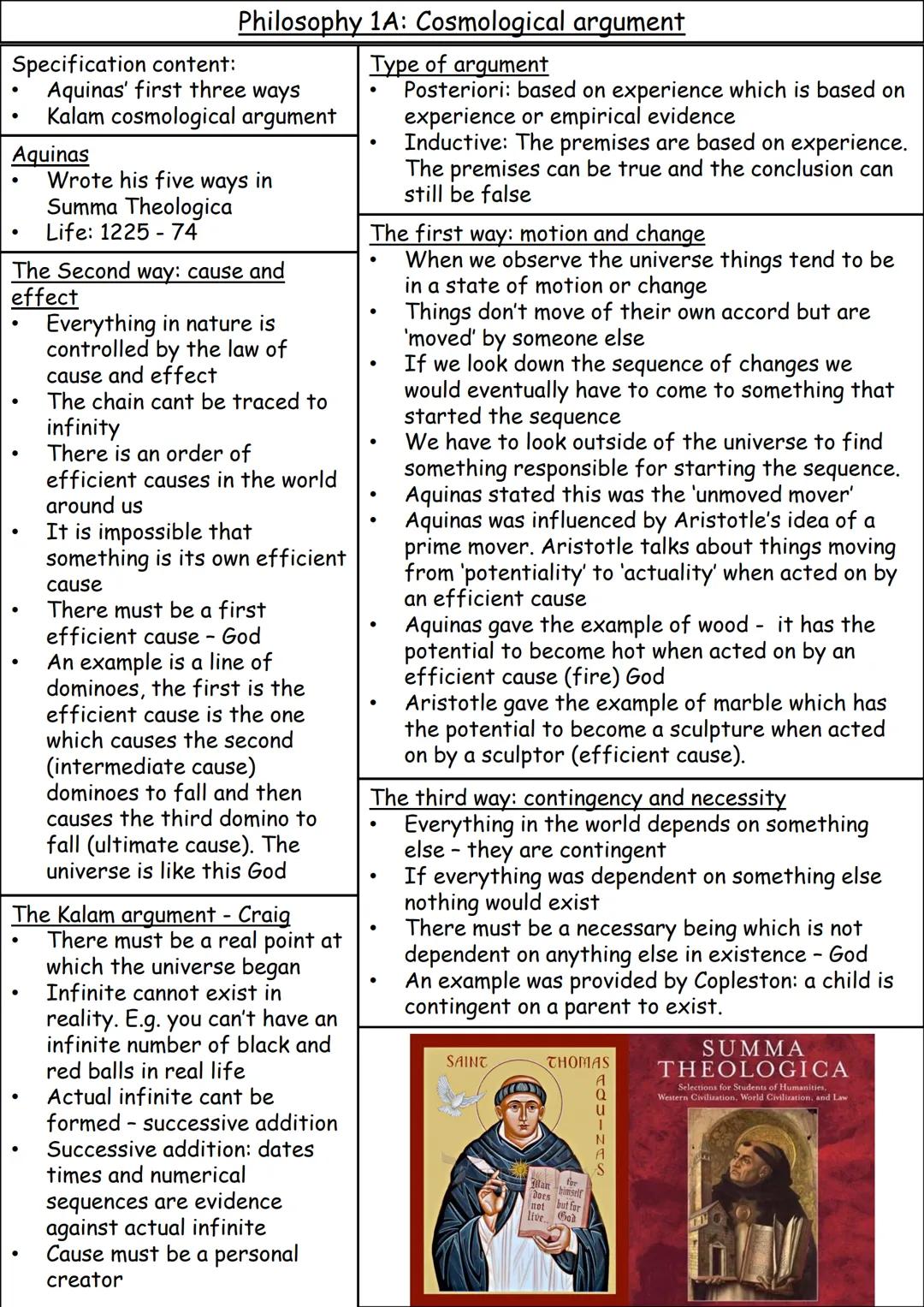
Think about dominoes falling - each one knocks over the next, but something had to push the first one. Aquinas believed the universe works the same way, and that "something" is God.
His Second Way focuses on cause and effect. Everything we see is caused by something else, creating a chain that can't go back forever. There must be a first efficient cause - God. Just like dominoes, the universe needs that initial push.
The First Way looks at motion and change. Nothing moves by itself - everything is moved by something else. Aquinas called this the unmoved mover. He borrowed from Aristotle's idea that things move from potentiality to actuality (like wood has the potential to become hot when fire acts on it).
The Third Way deals with dependency. Everything depends on something else to exist - they're contingent. But if everything was dependent, nothing would exist at all. There must be a necessary being that doesn't depend on anything else - God.
Key Point: The Kalam argument (developed by Craig) argues that infinite things can't actually exist in reality - the universe must have had a real beginning, and that beginning needed a personal creator.
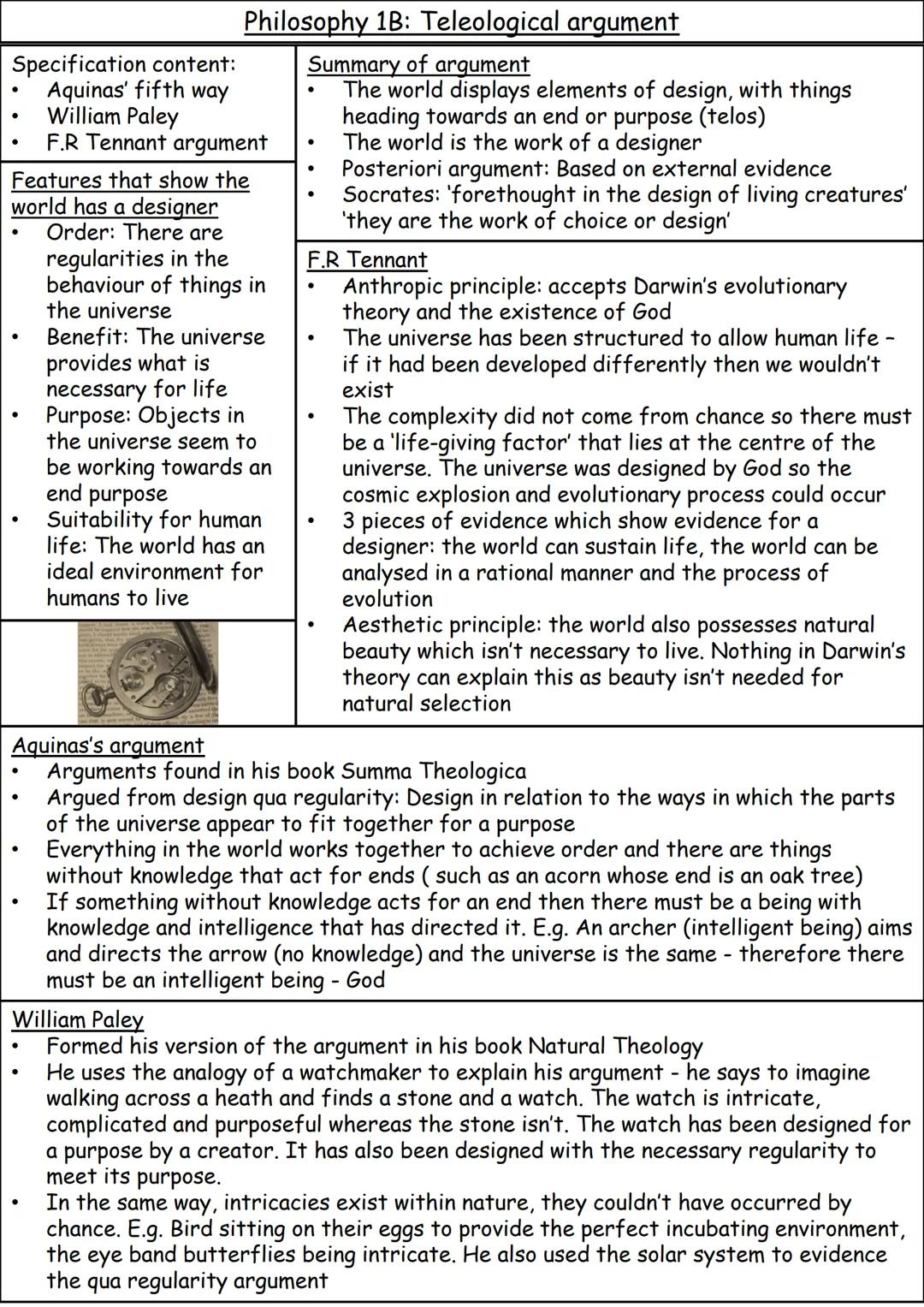
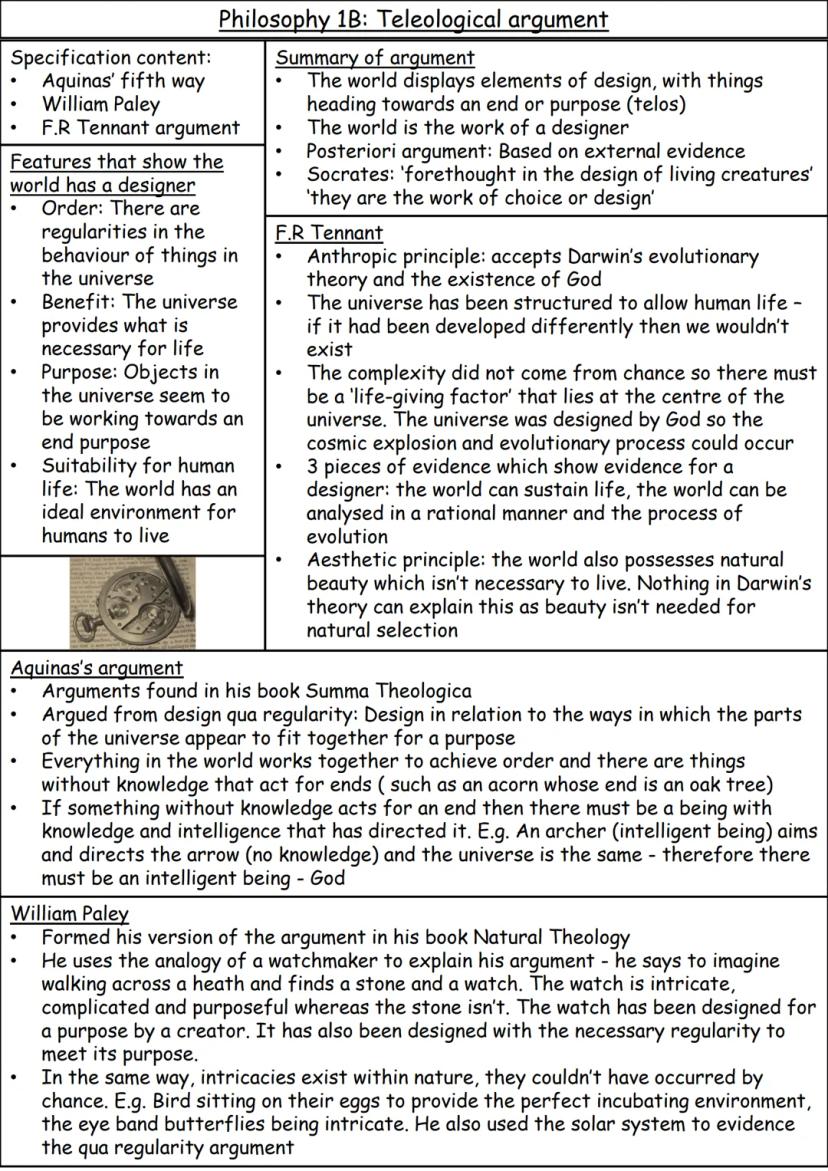
When you see a complex watch, you don't think it happened by accident - you know someone designed it. William Paley argued the universe is like that watch, showing clear signs of intelligent design.
Aquinas's Fifth Way pointed to design qua regularity - everything in nature seems to work together perfectly. An acorn "knows" to become an oak tree, but since it has no intelligence, something intelligent must be directing it. That something is God, like an archer directing an arrow.
Paley's watchmaker analogy is brilliant in its simplicity. If you found a watch on a heath, you'd instantly recognise its intricate, purposeful design. The natural world shows even more complexity - bird eggs incubating at perfect temperatures, the incredible design of the human eye.
F.R. Tennant took this further with the anthropic principle. The universe seems perfectly fine-tuned for human life - if conditions were slightly different, we wouldn't exist. He also noted the aesthetic principle - natural beauty serves no survival purpose, yet it exists everywhere.
Design Features: The argument points to order (regular patterns), benefit , purpose (everything working towards goals), and suitability for human existence.
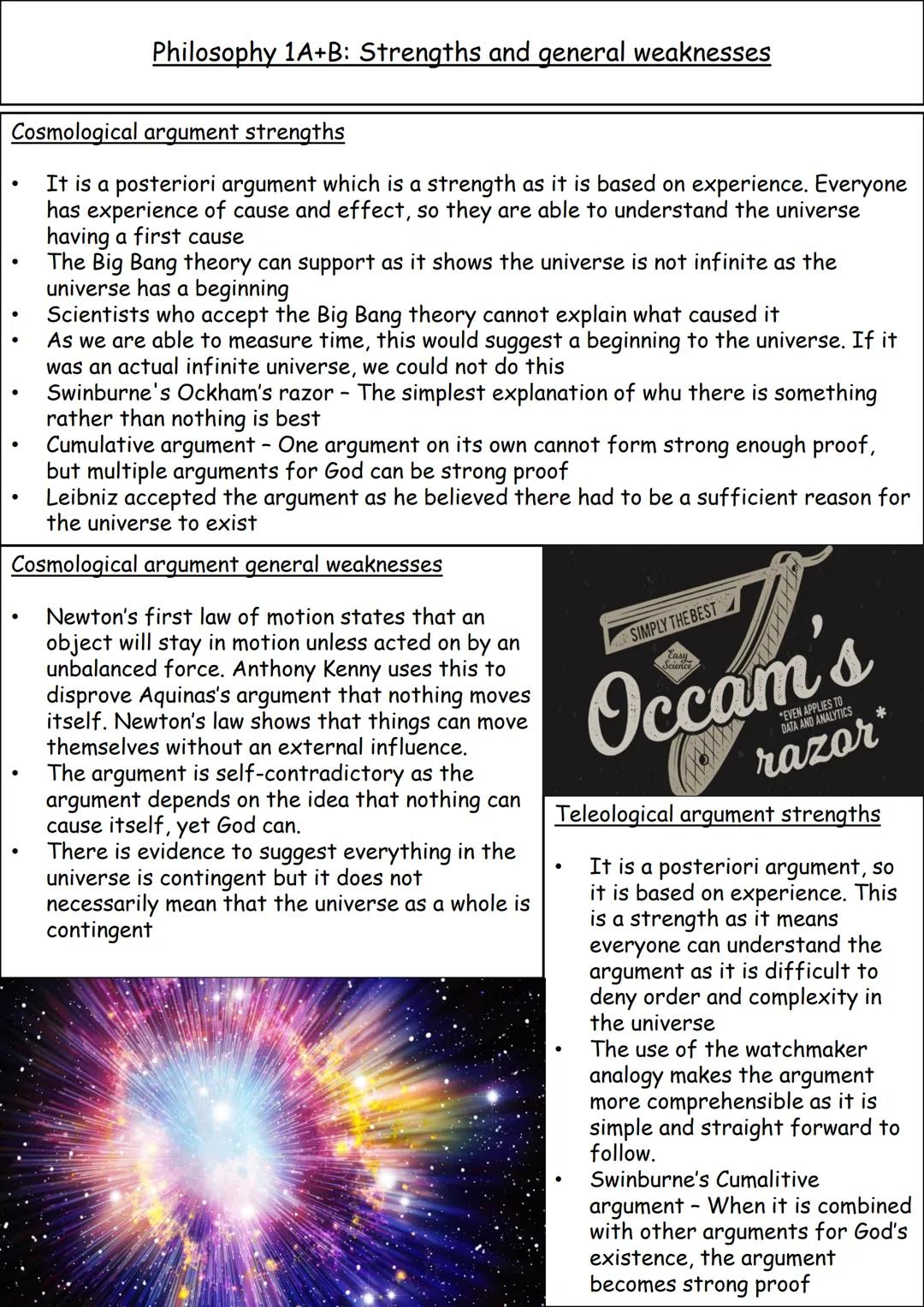
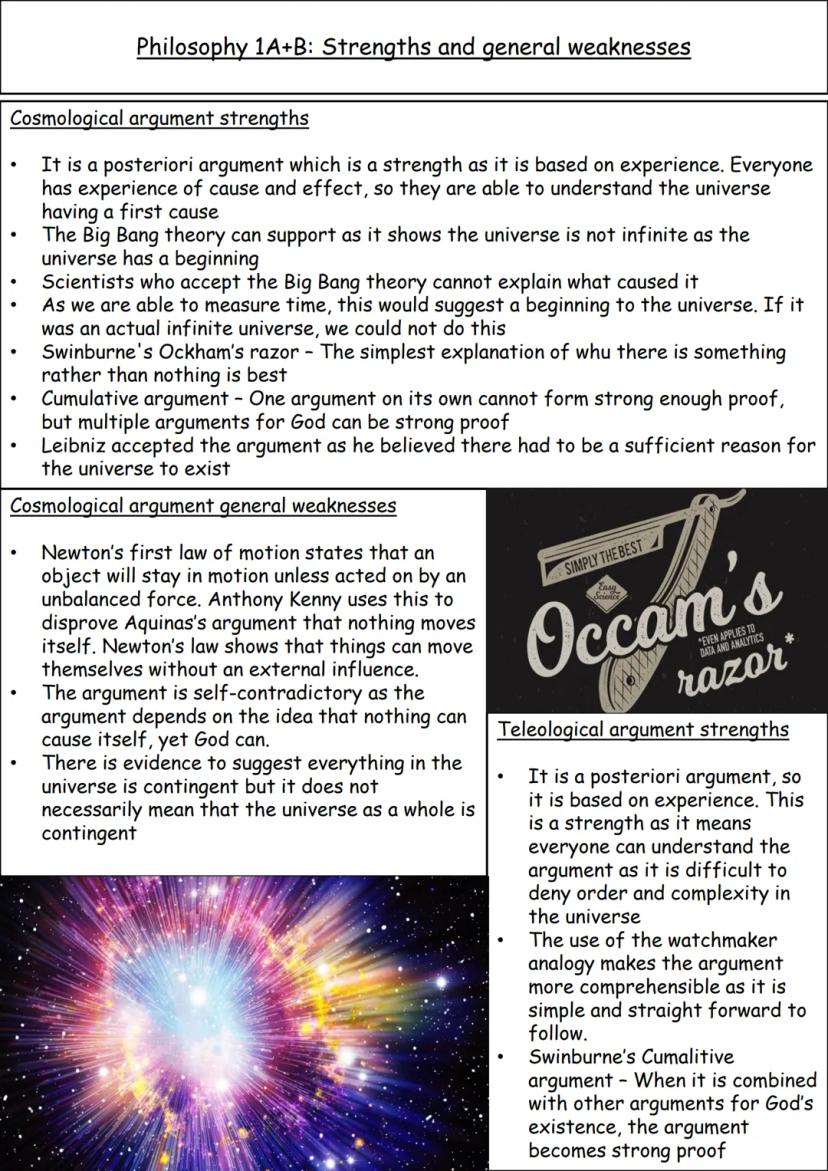
Both arguments have real strengths that make them compelling. They're posteriori arguments - based on what we can actually observe and experience. Everyone understands cause and effect, and it's hard to deny the apparent design in nature.
The Big Bang theory actually supports the cosmological argument by showing the universe had a beginning. Scientists can explain the explosion but not what caused it. Swinburne's cumulative argument suggests that while one proof might not convince you, several together create strong evidence.
However, Newton's first law challenges Aquinas - objects in motion stay in motion without needing a constant mover. Anthony Kenny used this to argue that things can move themselves. There's also a logical problem: if nothing can cause itself, how can God cause himself?
The arguments might be self-contradictory. They claim everything needs a cause, then exempt God from this rule. Hume pointed out the fallacy of composition - just because parts of the universe are caused doesn't mean the whole universe is caused.
Think About It: Ockham's razor suggests the simplest explanation is usually best - but is "God did it" simpler than natural explanations?

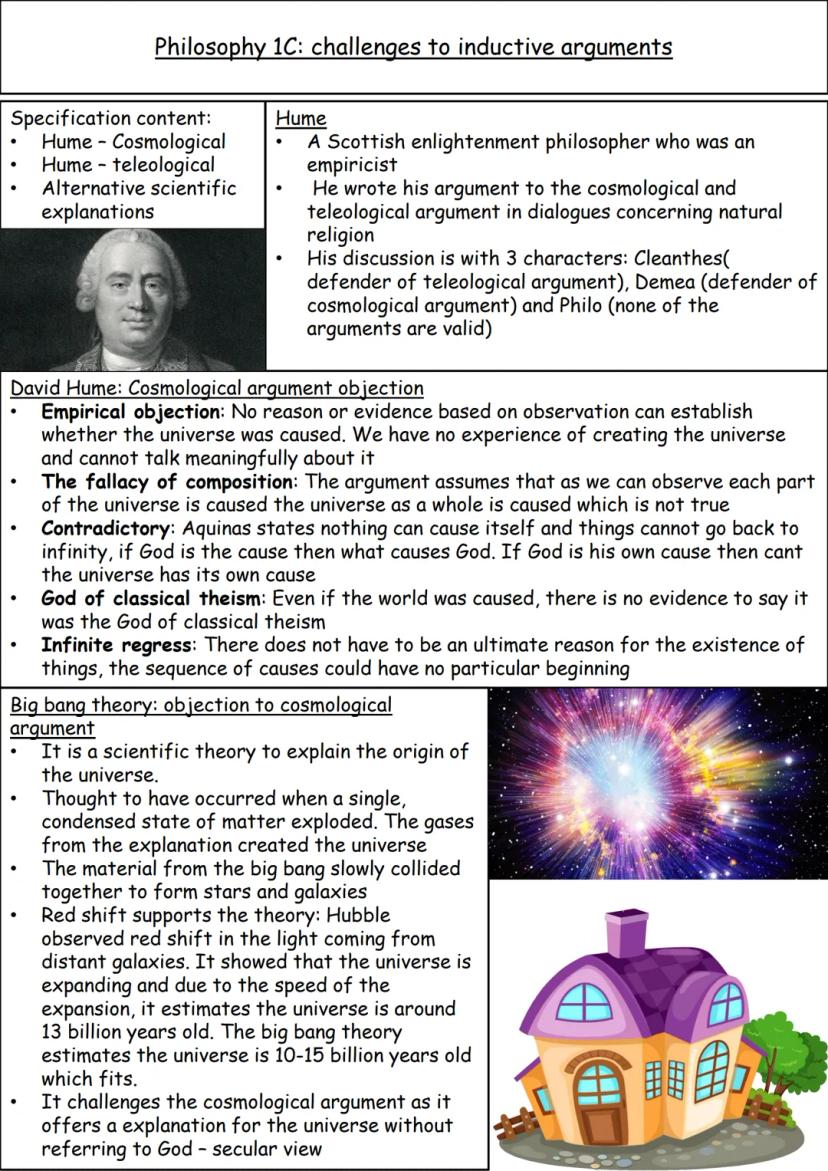
David Hume, the Scottish philosopher, delivered devastating critiques of both arguments. For the cosmological argument, he argued we have no experience of universe-creation, so we can't meaningfully discuss what caused it. That's his empirical objection.
His fallacy of composition argument is particularly clever. Just because every part of the universe seems caused doesn't mean the universe as a whole needs a cause. It's like saying because every brick is small, the wall must be small too.
Hume also questioned whether the first cause would be the God of classical theism. Even if something started the universe, why assume it's all-powerful, all-knowing, and all-good? Maybe it's just a very powerful alien!
The Big Bang theory offers a scientific explanation for the universe's origin without needing God. Red shift observations show the universe is expanding, suggesting it started from a single point about 13 billion years ago. This gives us a natural explanation for cosmic origins.
Hume's Point: We might not need an ultimate first cause - the chain of causes could potentially go back forever, with no particular beginning required.
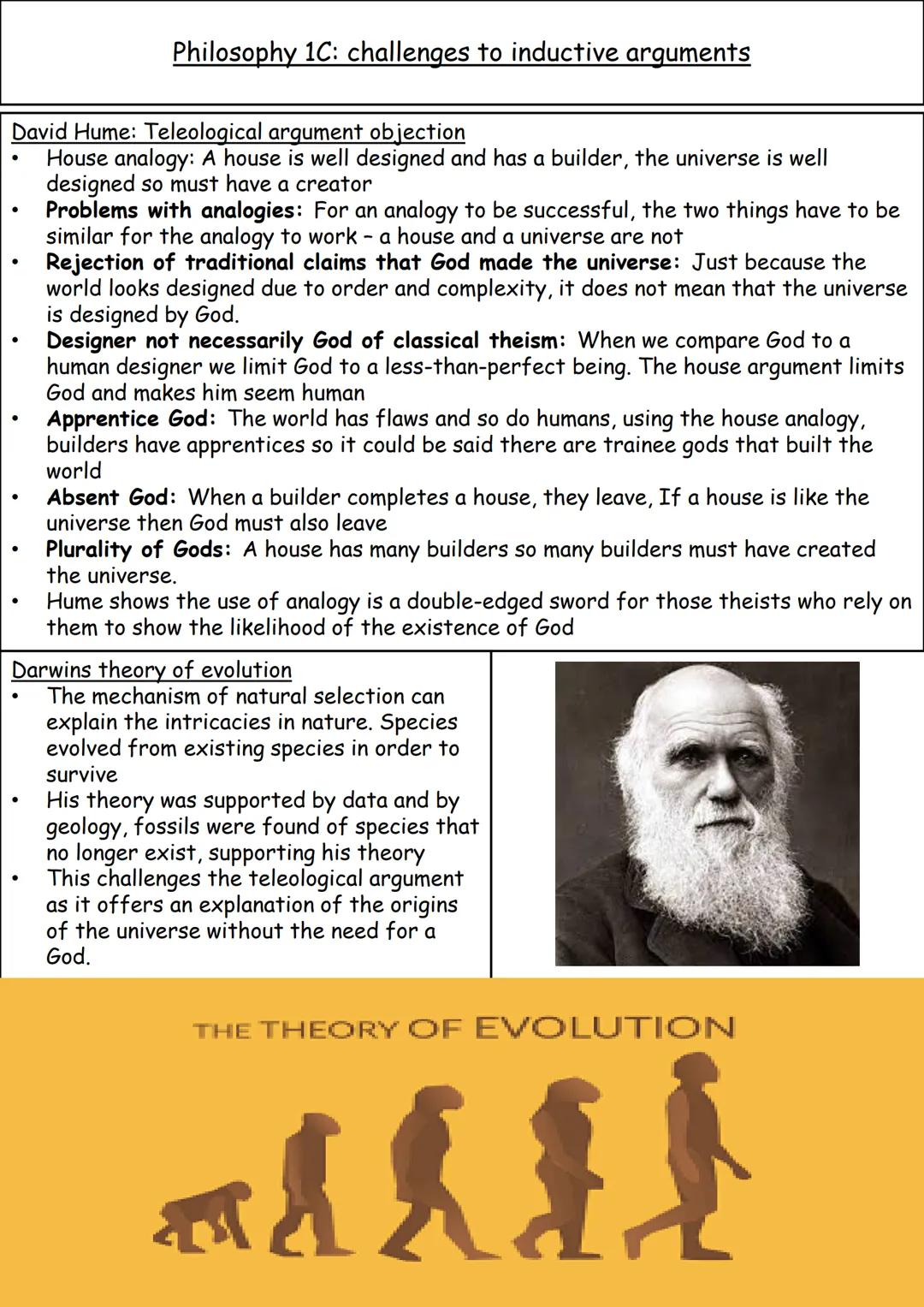
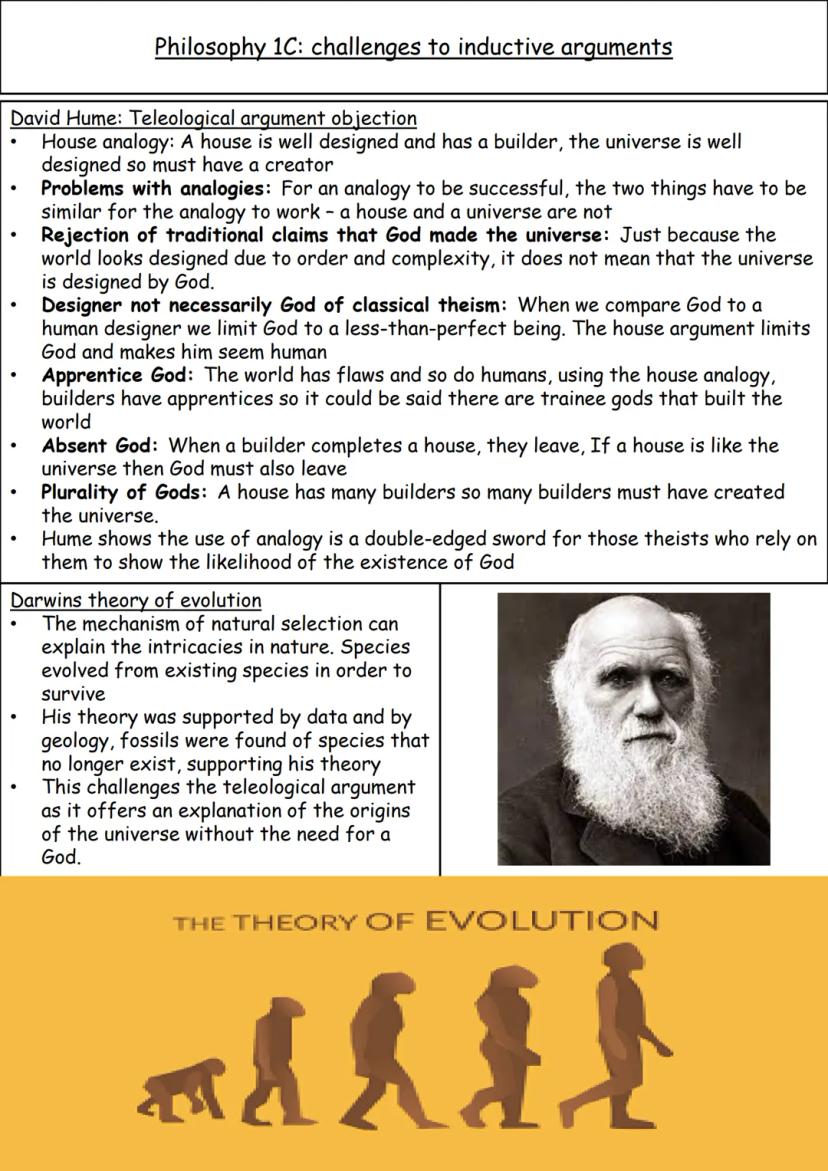
Hume's attack on the teleological argument was equally ruthless. He focused on the problems with analogies - comparing the universe to a house or watch. Houses and universes are so different that the comparison breaks down completely.
His house analogy critique is brilliant. If we're comparing God to a human designer, we're limiting God to human-like qualities. Builders have apprentices, so maybe there are apprentice gods. Builders leave when finished, so maybe God is absent. Multiple builders work on houses, so maybe there are multiple gods.
These critiques show how analogies can backfire - they're a double-edged sword for religious believers. The very comparisons meant to prove God's existence might actually limit or disprove it.
Darwin's theory of evolution delivered the final blow to design arguments. Natural selection explains apparent design without needing a designer. Complex features like eyes evolved gradually because they helped survival. Fossils support this theory by showing species that no longer exist.
Darwin's Impact: Evolution provides a scientific explanation for life's complexity, removing the need for a divine designer to explain natural "engineering."
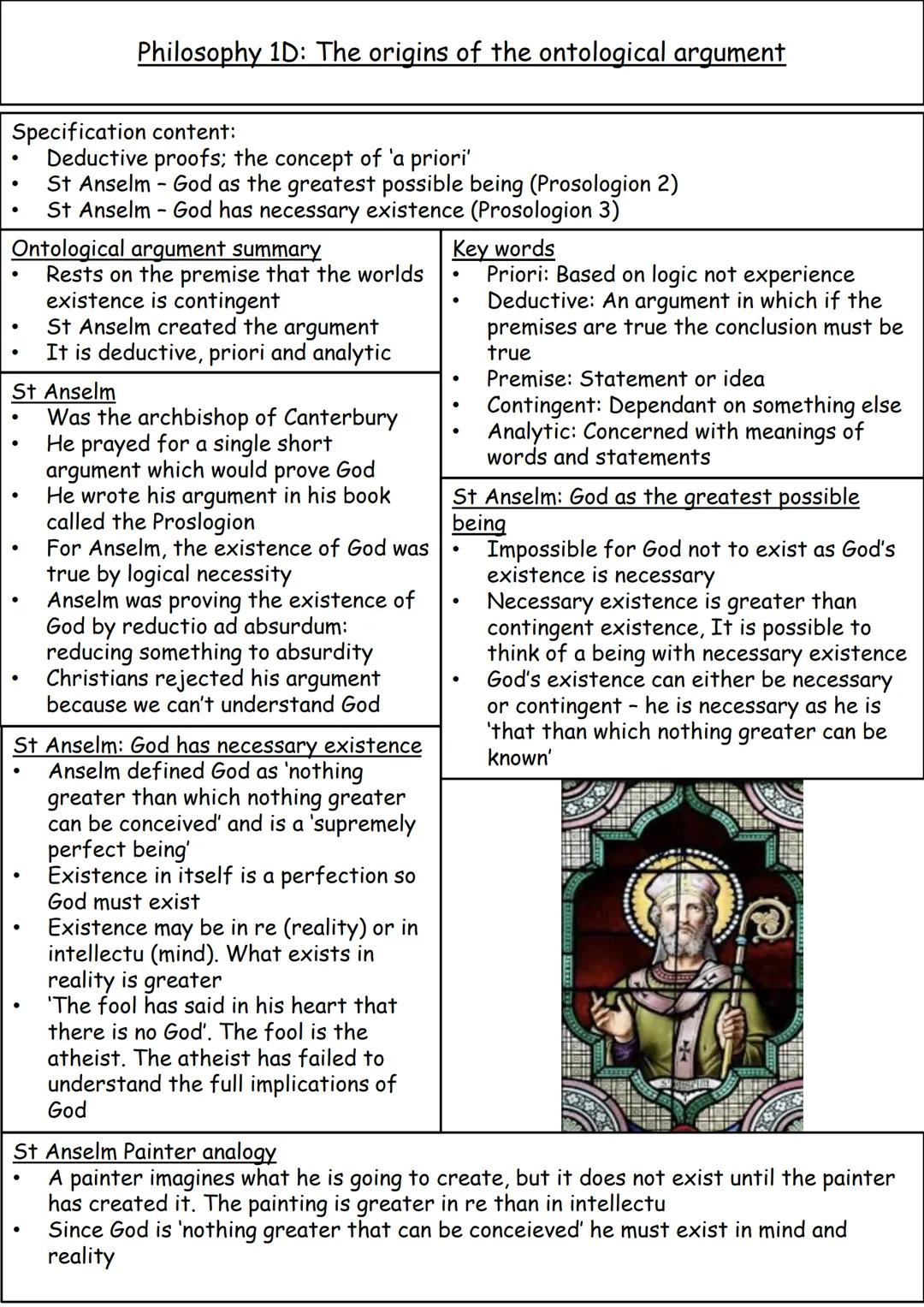
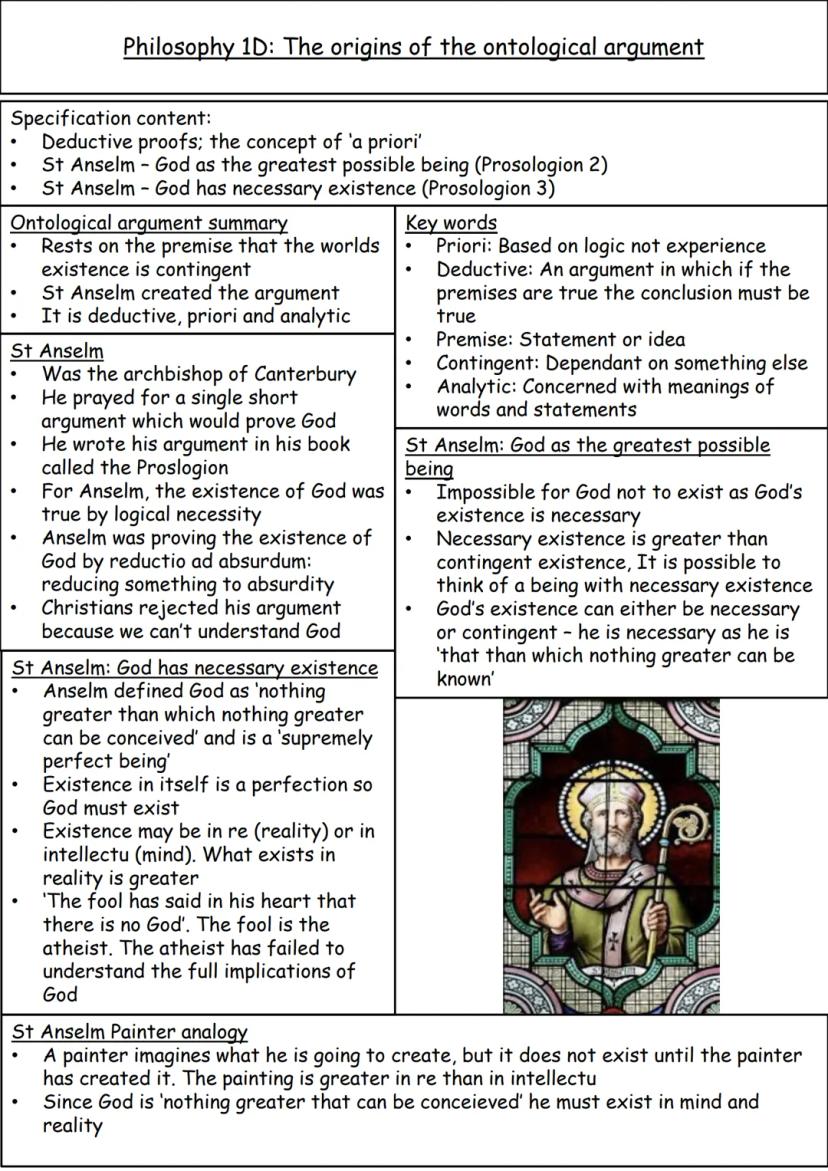
St Anselm attempted something incredible - proving God exists using pure logic, without any reference to the physical world. This a priori approach relies only on reasoning, not evidence.
Anselm defined God as "that than which nothing greater can be conceived" - basically, the greatest possible being. His argument uses reductio ad absurdum - showing that denying God's existence leads to logical contradictions.
The painter analogy explains his reasoning. A painter imagines a painting before creating it. The painting exists first in the mind (in intellectu), then in reality (in re). What exists in reality is greater than what exists only in the mind.
Since God is the greatest possible being, he must exist both in the mind and in reality. If God existed only in our minds, we could imagine something greater - a God who actually exists. But nothing can be greater than the greatest possible being, so God must exist in reality.
Proslogion 3 adds that God has necessary existence - he can't not exist. Necessary existence is greater than contingent existence (depending on something else), so the greatest being must exist necessarily.
Key Insight: This argument is deductive - if the premises are true, the conclusion must be true. It's also analytic - it's about the meaning of words and concepts, not empirical facts.
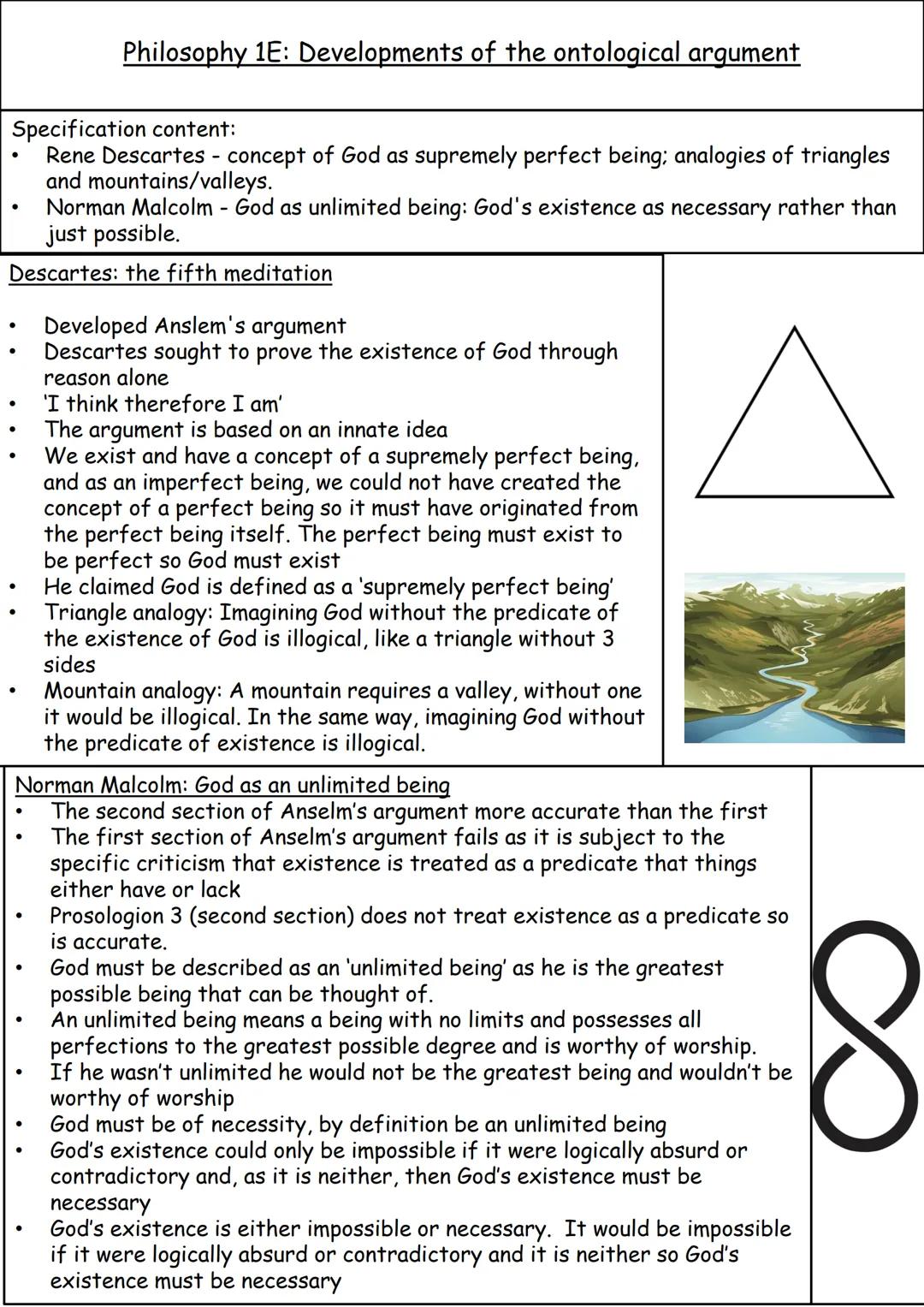
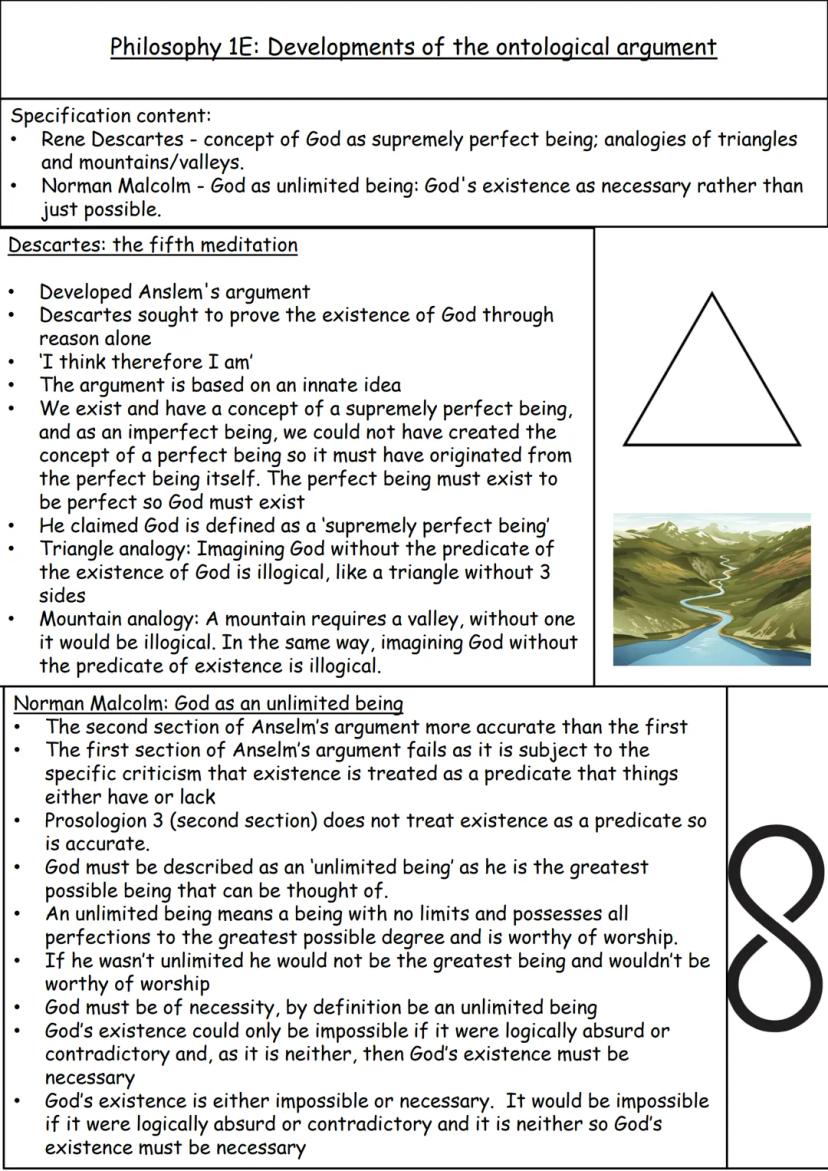
René Descartes refined Anselm's argument in his Fifth Meditation. Starting from "I think therefore I am," he argued that we imperfect beings couldn't have created the concept of a perfect being - it must come from the perfect being itself.
Descartes used powerful analogies. The triangle analogy shows that imagining God without existence is like imagining a triangle without three sides - logically impossible. The mountain and valley analogy makes the same point - you can't have a mountain without a valley.
Norman Malcolm focused on Anselm's Proslogion 3, arguing it's stronger than the first version. He described God as an unlimited being - having no limits and possessing all perfections to the greatest degree. Such a being would be worthy of worship.
Malcolm's key insight: God's existence is either impossible or necessary - there's no middle ground. If God's existence were logically contradictory, it would be impossible. Since it's not contradictory, God's existence must be necessary.
An unlimited being cannot have contingent existence (depending on other things) because that would be a limitation. Therefore, God must exist necessarily.
Malcolm's Logic: God's existence can only be impossible if it's logically absurd. Since it's not absurd, it must be necessary - and necessary things must exist.
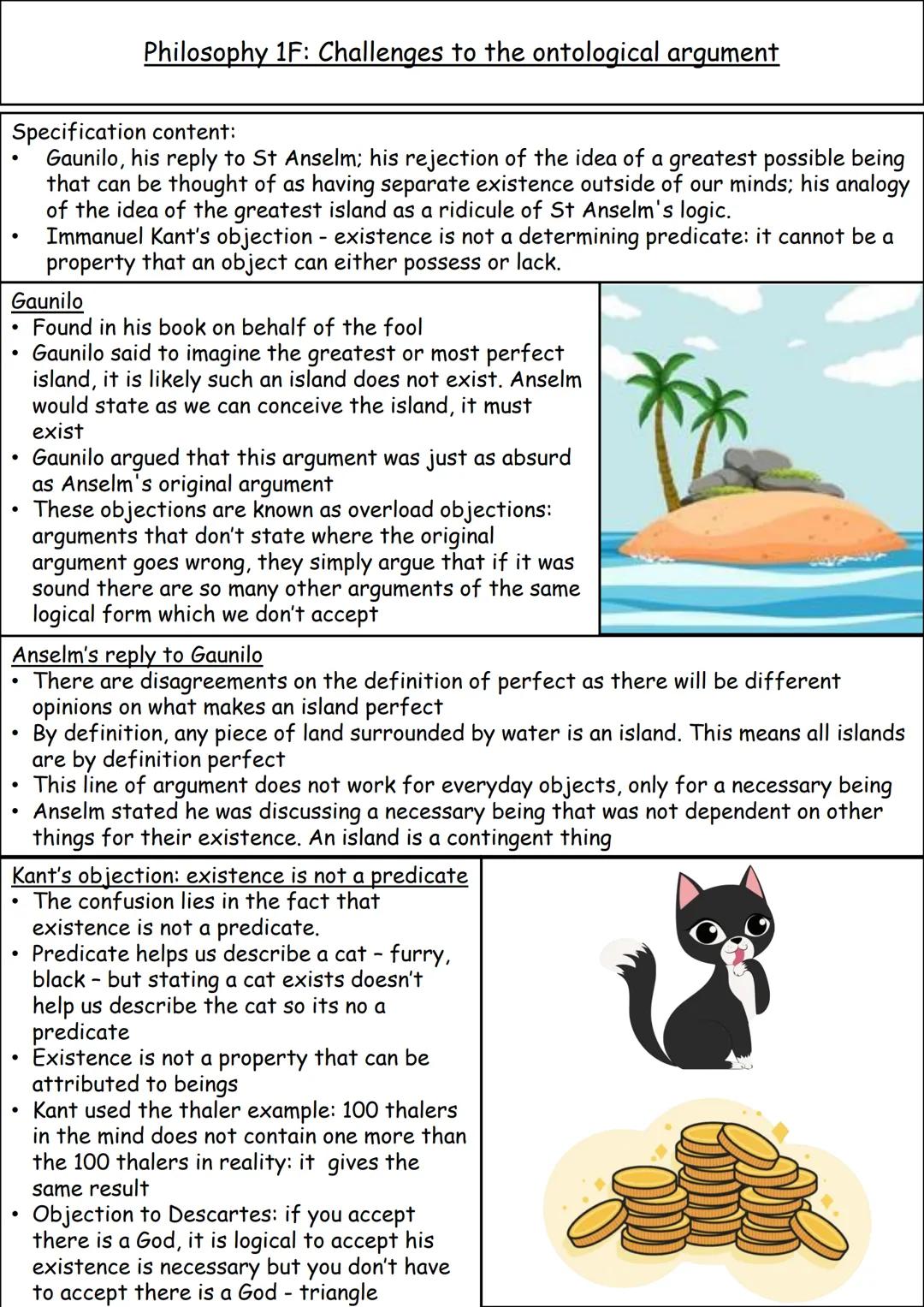
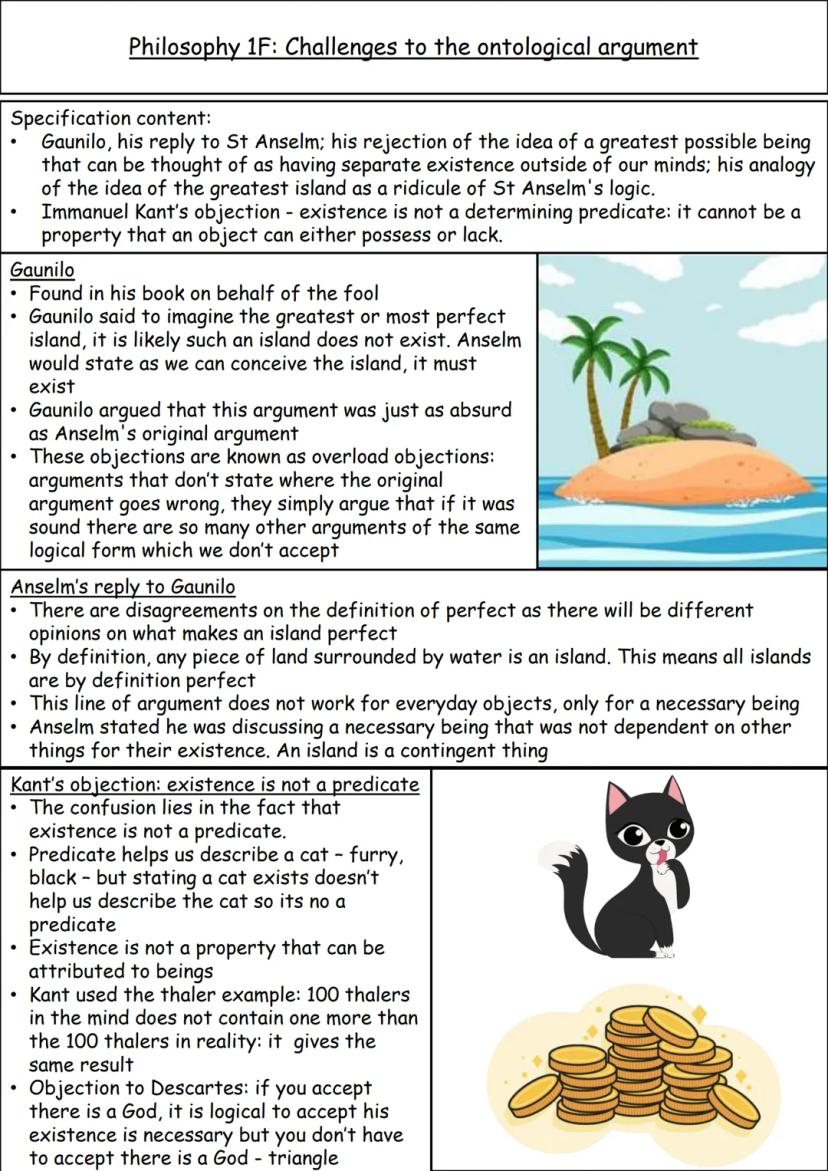
Gaunilo attacked Anselm with a brilliant reductio ad absurdum. Using Anselm's logic, we could prove anything exists. Imagine the greatest possible island - by Anselm's reasoning, it must exist because existing islands are greater than imaginary ones.
This overload objection doesn't pinpoint where Anselm's argument goes wrong - it shows that if the argument worked, we'd have to accept absurd conclusions. We could "prove" the existence of perfect pizzas, perfect cars, or perfect anything.
Anselm replied that his argument only works for necessary beings, not contingent objects like islands. Islands depend on other things (land, water) and people disagree about what makes them perfect. God is different - a necessary being that doesn't depend on anything else.
Immanuel Kant delivered the most famous critique: existence is not a predicate. Predicates describe things (cats are furry, black, small), but saying something exists doesn't describe it - it just states that it's real.
Kant's 100 thalers example illustrates this perfectly. One hundred real coins don't contain any more properties than one hundred imaginary coins - they have exactly the same description. The only difference is that one set exists and the other doesn't.
Kant's Devastating Point: If existence isn't a property things can possess or lack, then Anselm's entire argument collapses - you can't include existence as part of perfection.
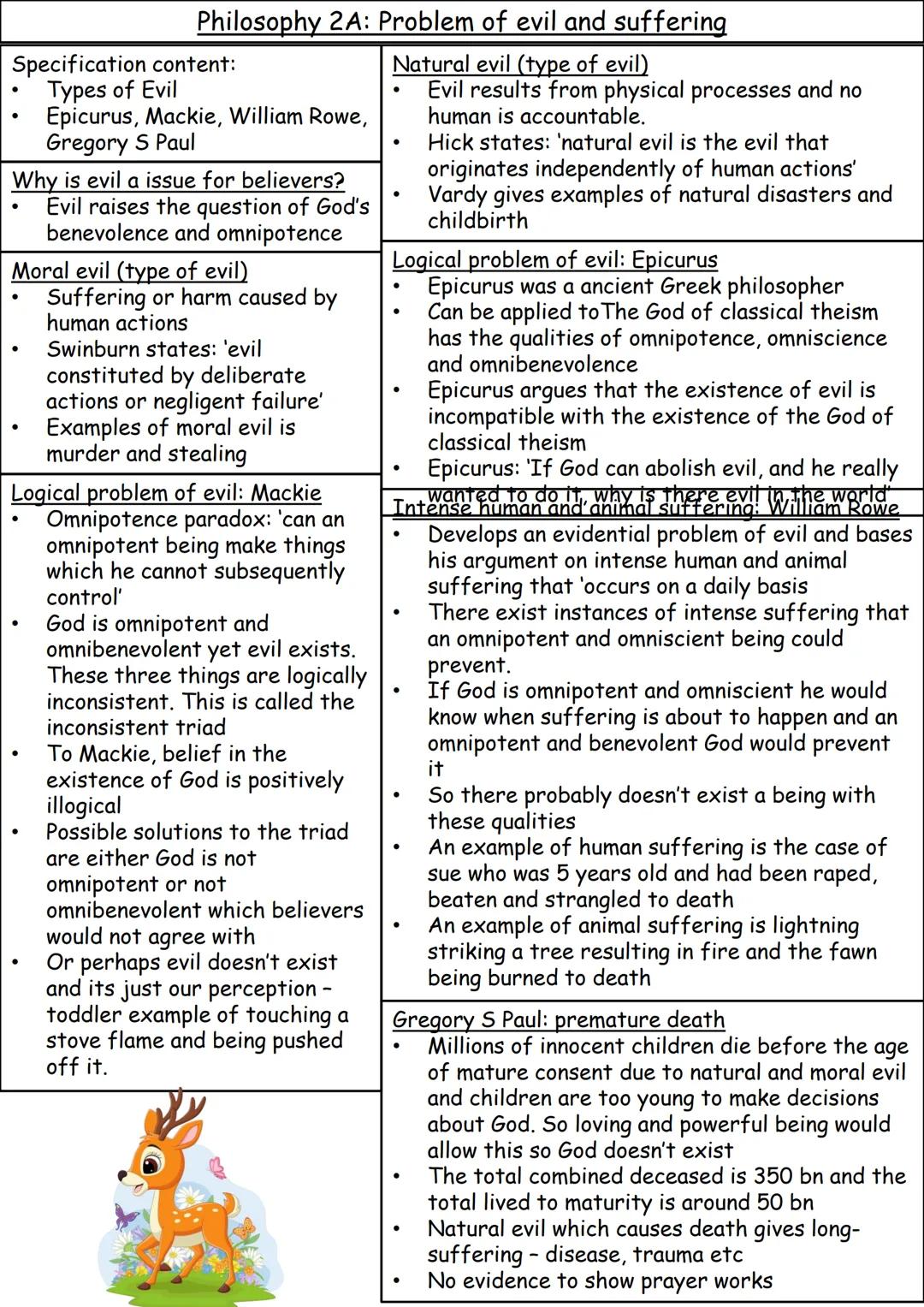
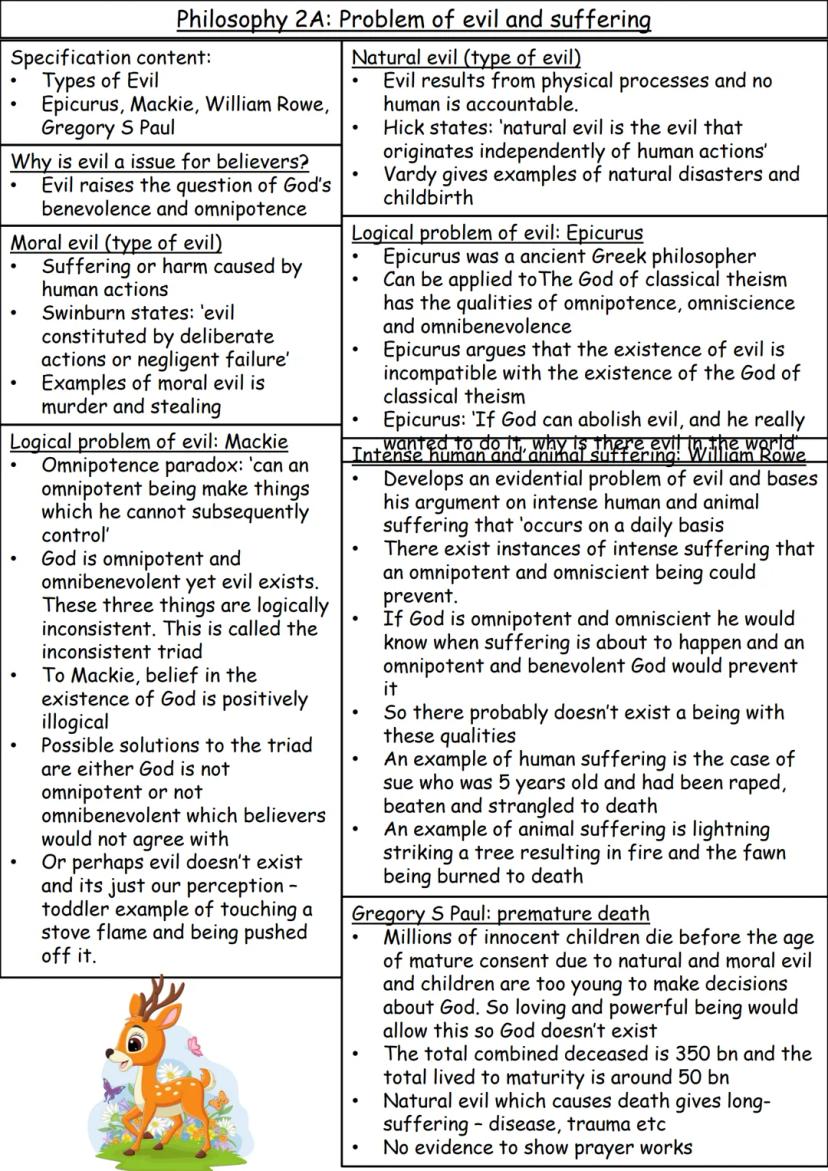
If God is all-powerful, all-knowing, and all-good, why does evil exist? This question has troubled believers for centuries and given atheists their strongest argument against God's existence.
Moral evil comes from human actions - murder, theft, cruelty. Natural evil comes from physical processes - earthquakes, diseases, natural disasters. Both types cause immense suffering that seems incompatible with a loving, powerful God.
Epicurus posed the classic challenge: "If God can abolish evil and really wants to, why is there evil in the world?" This creates the inconsistent triad - God's omnipotence, omnibenevolence, and evil's existence can't all be true simultaneously.
J.L. Mackie argued these three claims are logically inconsistent - believing in God while acknowledging evil is "positively irrational." Either God isn't all-powerful, isn't all-good, or evil doesn't really exist.
William Rowe focused on intense suffering that seems pointless. A five-year-old girl brutally murdered, a fawn burned alive in a forest fire - what possible good could justify allowing such horrors? An omniscient God would know about them, an omnipotent God could prevent them, and an omnibenevolent God would want to.
Statistical Challenge: Gregory Paul noted that of roughly 400 billion humans who've lived, only 50 billion reached maturity - 350 billion died as children, often horribly, before they could even choose faith.

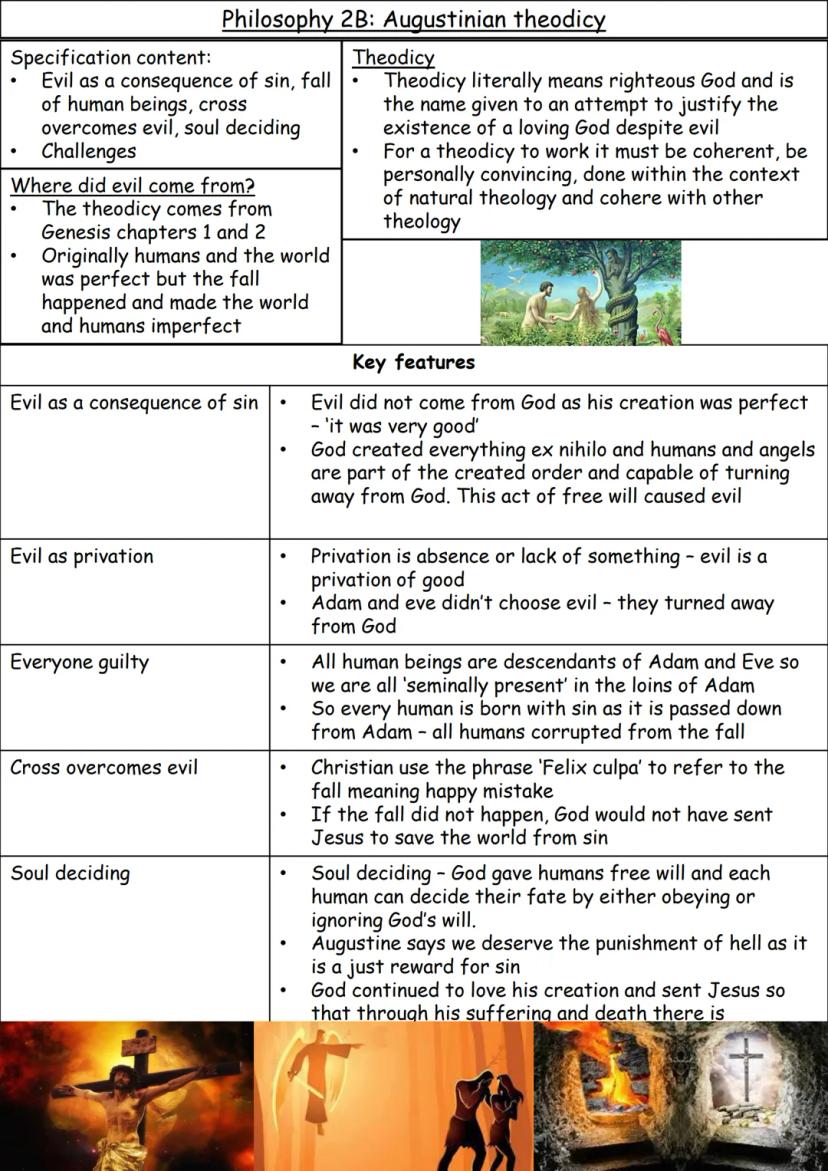
Augustine's theodicy attempts to solve the problem of evil while maintaining God's perfect goodness. His solution starts with Genesis - God's original creation was perfect, but humans messed it up through free will.
Evil as privation is Augustine's key insight. Evil isn't a "thing" God created - it's the absence of good, like darkness is the absence of light. When humans turned away from God, evil entered the world as a corruption of goodness.
The Fall explains everything. Adam and Eve's disobedience brought sin into the world, and since we're all their descendants, we're all seminally present in Adam's sin. Every human is born corrupted, deserving punishment.
But there's hope. Christians call the Fall "felix culpa" (happy fault) because it led to Jesus's coming. Without sin, there would be no need for salvation, no demonstration of God's incredible love through sacrifice.
Soul deciding gives humans ultimate responsibility. God gave us free will, and each person chooses their eternal fate by obeying or rejecting God. Hell isn't cruel - it's the just consequence of choosing evil over good.
Augustine's Logic: Evil exists because God values freedom so much that he allows us to choose wrongly. True love requires the possibility of rejection - forced love isn't really love at all.
Our AI Companion is a student-focused AI tool that offers more than just answers. Built on millions of Knowunity resources, it provides relevant information, personalised study plans, quizzes, and content directly in the chat, adapting to your individual learning journey.
You can download the app from Google Play Store and Apple App Store.
That's right! Enjoy free access to study content, connect with fellow students, and get instant help – all at your fingertips.
App Store
Google Play
The app is very easy to use and well designed. I have found everything I was looking for so far and have been able to learn a lot from the presentations! I will definitely use the app for a class assignment! And of course it also helps a lot as an inspiration.
Stefan S
iOS user
This app is really great. There are so many study notes and help [...]. My problem subject is French, for example, and the app has so many options for help. Thanks to this app, I have improved my French. I would recommend it to anyone.
Samantha Klich
Android user
Wow, I am really amazed. I just tried the app because I've seen it advertised many times and was absolutely stunned. This app is THE HELP you want for school and above all, it offers so many things, such as workouts and fact sheets, which have been VERY helpful to me personally.
Anna
iOS user
Best app on earth! no words because it’s too good
Thomas R
iOS user
Just amazing. Let's me revise 10x better, this app is a quick 10/10. I highly recommend it to anyone. I can watch and search for notes. I can save them in the subject folder. I can revise it any time when I come back. If you haven't tried this app, you're really missing out.
Basil
Android user
This app has made me feel so much more confident in my exam prep, not only through boosting my own self confidence through the features that allow you to connect with others and feel less alone, but also through the way the app itself is centred around making you feel better. It is easy to navigate, fun to use, and helpful to anyone struggling in absolutely any way.
David K
iOS user
The app's just great! All I have to do is enter the topic in the search bar and I get the response real fast. I don't have to watch 10 YouTube videos to understand something, so I'm saving my time. Highly recommended!
Sudenaz Ocak
Android user
In school I was really bad at maths but thanks to the app, I am doing better now. I am so grateful that you made the app.
Greenlight Bonnie
Android user
very reliable app to help and grow your ideas of Maths, English and other related topics in your works. please use this app if your struggling in areas, this app is key for that. wish I'd of done a review before. and it's also free so don't worry about that.
Rohan U
Android user
I know a lot of apps use fake accounts to boost their reviews but this app deserves it all. Originally I was getting 4 in my English exams and this time I got a grade 7. I didn’t even know about this app three days until the exam and it has helped A LOT. Please actually trust me and use it as I’m sure you too will see developments.
Xander S
iOS user
THE QUIZES AND FLASHCARDS ARE SO USEFUL AND I LOVE THE SCHOOLGPT. IT ALSO IS LITREALLY LIKE CHATGPT BUT SMARTER!! HELPED ME WITH MY MASCARA PROBLEMS TOO!! AS WELL AS MY REAL SUBJECTS ! DUHHH 😍😁😲🤑💗✨🎀😮
Elisha
iOS user
This apps acc the goat. I find revision so boring but this app makes it so easy to organize it all and then you can ask the freeeee ai to test yourself so good and you can easily upload your own stuff. highly recommend as someone taking mocks now
Paul T
iOS user
The app is very easy to use and well designed. I have found everything I was looking for so far and have been able to learn a lot from the presentations! I will definitely use the app for a class assignment! And of course it also helps a lot as an inspiration.
Stefan S
iOS user
This app is really great. There are so many study notes and help [...]. My problem subject is French, for example, and the app has so many options for help. Thanks to this app, I have improved my French. I would recommend it to anyone.
Samantha Klich
Android user
Wow, I am really amazed. I just tried the app because I've seen it advertised many times and was absolutely stunned. This app is THE HELP you want for school and above all, it offers so many things, such as workouts and fact sheets, which have been VERY helpful to me personally.
Anna
iOS user
Best app on earth! no words because it’s too good
Thomas R
iOS user
Just amazing. Let's me revise 10x better, this app is a quick 10/10. I highly recommend it to anyone. I can watch and search for notes. I can save them in the subject folder. I can revise it any time when I come back. If you haven't tried this app, you're really missing out.
Basil
Android user
This app has made me feel so much more confident in my exam prep, not only through boosting my own self confidence through the features that allow you to connect with others and feel less alone, but also through the way the app itself is centred around making you feel better. It is easy to navigate, fun to use, and helpful to anyone struggling in absolutely any way.
David K
iOS user
The app's just great! All I have to do is enter the topic in the search bar and I get the response real fast. I don't have to watch 10 YouTube videos to understand something, so I'm saving my time. Highly recommended!
Sudenaz Ocak
Android user
In school I was really bad at maths but thanks to the app, I am doing better now. I am so grateful that you made the app.
Greenlight Bonnie
Android user
very reliable app to help and grow your ideas of Maths, English and other related topics in your works. please use this app if your struggling in areas, this app is key for that. wish I'd of done a review before. and it's also free so don't worry about that.
Rohan U
Android user
I know a lot of apps use fake accounts to boost their reviews but this app deserves it all. Originally I was getting 4 in my English exams and this time I got a grade 7. I didn’t even know about this app three days until the exam and it has helped A LOT. Please actually trust me and use it as I’m sure you too will see developments.
Xander S
iOS user
THE QUIZES AND FLASHCARDS ARE SO USEFUL AND I LOVE THE SCHOOLGPT. IT ALSO IS LITREALLY LIKE CHATGPT BUT SMARTER!! HELPED ME WITH MY MASCARA PROBLEMS TOO!! AS WELL AS MY REAL SUBJECTS ! DUHHH 😍😁😲🤑💗✨🎀😮
Elisha
iOS user
This apps acc the goat. I find revision so boring but this app makes it so easy to organize it all and then you can ask the freeeee ai to test yourself so good and you can easily upload your own stuff. highly recommend as someone taking mocks now
Paul T
iOS user
Kacie Hodgson
@kaciehodgson_ffxs
Ever wondered how philosophers try to prove God exists, or why bad things happen if God is all-good and all-powerful? These are some of the biggest questions in philosophy of religion. From ancient arguments about the universe needing a first... Show more
Access to all documents
Improve your grades
Join milions of students
By signing up you accept Terms of Service and Privacy Policy
Think about dominoes falling - each one knocks over the next, but something had to push the first one. Aquinas believed the universe works the same way, and that "something" is God.
His Second Way focuses on cause and effect. Everything we see is caused by something else, creating a chain that can't go back forever. There must be a first efficient cause - God. Just like dominoes, the universe needs that initial push.
The First Way looks at motion and change. Nothing moves by itself - everything is moved by something else. Aquinas called this the unmoved mover. He borrowed from Aristotle's idea that things move from potentiality to actuality (like wood has the potential to become hot when fire acts on it).
The Third Way deals with dependency. Everything depends on something else to exist - they're contingent. But if everything was dependent, nothing would exist at all. There must be a necessary being that doesn't depend on anything else - God.
Key Point: The Kalam argument (developed by Craig) argues that infinite things can't actually exist in reality - the universe must have had a real beginning, and that beginning needed a personal creator.
Access to all documents
Improve your grades
Join milions of students
By signing up you accept Terms of Service and Privacy Policy
When you see a complex watch, you don't think it happened by accident - you know someone designed it. William Paley argued the universe is like that watch, showing clear signs of intelligent design.
Aquinas's Fifth Way pointed to design qua regularity - everything in nature seems to work together perfectly. An acorn "knows" to become an oak tree, but since it has no intelligence, something intelligent must be directing it. That something is God, like an archer directing an arrow.
Paley's watchmaker analogy is brilliant in its simplicity. If you found a watch on a heath, you'd instantly recognise its intricate, purposeful design. The natural world shows even more complexity - bird eggs incubating at perfect temperatures, the incredible design of the human eye.
F.R. Tennant took this further with the anthropic principle. The universe seems perfectly fine-tuned for human life - if conditions were slightly different, we wouldn't exist. He also noted the aesthetic principle - natural beauty serves no survival purpose, yet it exists everywhere.
Design Features: The argument points to order (regular patterns), benefit , purpose (everything working towards goals), and suitability for human existence.
Access to all documents
Improve your grades
Join milions of students
By signing up you accept Terms of Service and Privacy Policy
Both arguments have real strengths that make them compelling. They're posteriori arguments - based on what we can actually observe and experience. Everyone understands cause and effect, and it's hard to deny the apparent design in nature.
The Big Bang theory actually supports the cosmological argument by showing the universe had a beginning. Scientists can explain the explosion but not what caused it. Swinburne's cumulative argument suggests that while one proof might not convince you, several together create strong evidence.
However, Newton's first law challenges Aquinas - objects in motion stay in motion without needing a constant mover. Anthony Kenny used this to argue that things can move themselves. There's also a logical problem: if nothing can cause itself, how can God cause himself?
The arguments might be self-contradictory. They claim everything needs a cause, then exempt God from this rule. Hume pointed out the fallacy of composition - just because parts of the universe are caused doesn't mean the whole universe is caused.
Think About It: Ockham's razor suggests the simplest explanation is usually best - but is "God did it" simpler than natural explanations?
Access to all documents
Improve your grades
Join milions of students
By signing up you accept Terms of Service and Privacy Policy
David Hume, the Scottish philosopher, delivered devastating critiques of both arguments. For the cosmological argument, he argued we have no experience of universe-creation, so we can't meaningfully discuss what caused it. That's his empirical objection.
His fallacy of composition argument is particularly clever. Just because every part of the universe seems caused doesn't mean the universe as a whole needs a cause. It's like saying because every brick is small, the wall must be small too.
Hume also questioned whether the first cause would be the God of classical theism. Even if something started the universe, why assume it's all-powerful, all-knowing, and all-good? Maybe it's just a very powerful alien!
The Big Bang theory offers a scientific explanation for the universe's origin without needing God. Red shift observations show the universe is expanding, suggesting it started from a single point about 13 billion years ago. This gives us a natural explanation for cosmic origins.
Hume's Point: We might not need an ultimate first cause - the chain of causes could potentially go back forever, with no particular beginning required.
Access to all documents
Improve your grades
Join milions of students
By signing up you accept Terms of Service and Privacy Policy
Hume's attack on the teleological argument was equally ruthless. He focused on the problems with analogies - comparing the universe to a house or watch. Houses and universes are so different that the comparison breaks down completely.
His house analogy critique is brilliant. If we're comparing God to a human designer, we're limiting God to human-like qualities. Builders have apprentices, so maybe there are apprentice gods. Builders leave when finished, so maybe God is absent. Multiple builders work on houses, so maybe there are multiple gods.
These critiques show how analogies can backfire - they're a double-edged sword for religious believers. The very comparisons meant to prove God's existence might actually limit or disprove it.
Darwin's theory of evolution delivered the final blow to design arguments. Natural selection explains apparent design without needing a designer. Complex features like eyes evolved gradually because they helped survival. Fossils support this theory by showing species that no longer exist.
Darwin's Impact: Evolution provides a scientific explanation for life's complexity, removing the need for a divine designer to explain natural "engineering."
Access to all documents
Improve your grades
Join milions of students
By signing up you accept Terms of Service and Privacy Policy
St Anselm attempted something incredible - proving God exists using pure logic, without any reference to the physical world. This a priori approach relies only on reasoning, not evidence.
Anselm defined God as "that than which nothing greater can be conceived" - basically, the greatest possible being. His argument uses reductio ad absurdum - showing that denying God's existence leads to logical contradictions.
The painter analogy explains his reasoning. A painter imagines a painting before creating it. The painting exists first in the mind (in intellectu), then in reality (in re). What exists in reality is greater than what exists only in the mind.
Since God is the greatest possible being, he must exist both in the mind and in reality. If God existed only in our minds, we could imagine something greater - a God who actually exists. But nothing can be greater than the greatest possible being, so God must exist in reality.
Proslogion 3 adds that God has necessary existence - he can't not exist. Necessary existence is greater than contingent existence (depending on something else), so the greatest being must exist necessarily.
Key Insight: This argument is deductive - if the premises are true, the conclusion must be true. It's also analytic - it's about the meaning of words and concepts, not empirical facts.
Access to all documents
Improve your grades
Join milions of students
By signing up you accept Terms of Service and Privacy Policy
René Descartes refined Anselm's argument in his Fifth Meditation. Starting from "I think therefore I am," he argued that we imperfect beings couldn't have created the concept of a perfect being - it must come from the perfect being itself.
Descartes used powerful analogies. The triangle analogy shows that imagining God without existence is like imagining a triangle without three sides - logically impossible. The mountain and valley analogy makes the same point - you can't have a mountain without a valley.
Norman Malcolm focused on Anselm's Proslogion 3, arguing it's stronger than the first version. He described God as an unlimited being - having no limits and possessing all perfections to the greatest degree. Such a being would be worthy of worship.
Malcolm's key insight: God's existence is either impossible or necessary - there's no middle ground. If God's existence were logically contradictory, it would be impossible. Since it's not contradictory, God's existence must be necessary.
An unlimited being cannot have contingent existence (depending on other things) because that would be a limitation. Therefore, God must exist necessarily.
Malcolm's Logic: God's existence can only be impossible if it's logically absurd. Since it's not absurd, it must be necessary - and necessary things must exist.
Access to all documents
Improve your grades
Join milions of students
By signing up you accept Terms of Service and Privacy Policy
Gaunilo attacked Anselm with a brilliant reductio ad absurdum. Using Anselm's logic, we could prove anything exists. Imagine the greatest possible island - by Anselm's reasoning, it must exist because existing islands are greater than imaginary ones.
This overload objection doesn't pinpoint where Anselm's argument goes wrong - it shows that if the argument worked, we'd have to accept absurd conclusions. We could "prove" the existence of perfect pizzas, perfect cars, or perfect anything.
Anselm replied that his argument only works for necessary beings, not contingent objects like islands. Islands depend on other things (land, water) and people disagree about what makes them perfect. God is different - a necessary being that doesn't depend on anything else.
Immanuel Kant delivered the most famous critique: existence is not a predicate. Predicates describe things (cats are furry, black, small), but saying something exists doesn't describe it - it just states that it's real.
Kant's 100 thalers example illustrates this perfectly. One hundred real coins don't contain any more properties than one hundred imaginary coins - they have exactly the same description. The only difference is that one set exists and the other doesn't.
Kant's Devastating Point: If existence isn't a property things can possess or lack, then Anselm's entire argument collapses - you can't include existence as part of perfection.
Access to all documents
Improve your grades
Join milions of students
By signing up you accept Terms of Service and Privacy Policy
If God is all-powerful, all-knowing, and all-good, why does evil exist? This question has troubled believers for centuries and given atheists their strongest argument against God's existence.
Moral evil comes from human actions - murder, theft, cruelty. Natural evil comes from physical processes - earthquakes, diseases, natural disasters. Both types cause immense suffering that seems incompatible with a loving, powerful God.
Epicurus posed the classic challenge: "If God can abolish evil and really wants to, why is there evil in the world?" This creates the inconsistent triad - God's omnipotence, omnibenevolence, and evil's existence can't all be true simultaneously.
J.L. Mackie argued these three claims are logically inconsistent - believing in God while acknowledging evil is "positively irrational." Either God isn't all-powerful, isn't all-good, or evil doesn't really exist.
William Rowe focused on intense suffering that seems pointless. A five-year-old girl brutally murdered, a fawn burned alive in a forest fire - what possible good could justify allowing such horrors? An omniscient God would know about them, an omnipotent God could prevent them, and an omnibenevolent God would want to.
Statistical Challenge: Gregory Paul noted that of roughly 400 billion humans who've lived, only 50 billion reached maturity - 350 billion died as children, often horribly, before they could even choose faith.
Access to all documents
Improve your grades
Join milions of students
By signing up you accept Terms of Service and Privacy Policy
Augustine's theodicy attempts to solve the problem of evil while maintaining God's perfect goodness. His solution starts with Genesis - God's original creation was perfect, but humans messed it up through free will.
Evil as privation is Augustine's key insight. Evil isn't a "thing" God created - it's the absence of good, like darkness is the absence of light. When humans turned away from God, evil entered the world as a corruption of goodness.
The Fall explains everything. Adam and Eve's disobedience brought sin into the world, and since we're all their descendants, we're all seminally present in Adam's sin. Every human is born corrupted, deserving punishment.
But there's hope. Christians call the Fall "felix culpa" (happy fault) because it led to Jesus's coming. Without sin, there would be no need for salvation, no demonstration of God's incredible love through sacrifice.
Soul deciding gives humans ultimate responsibility. God gave us free will, and each person chooses their eternal fate by obeying or rejecting God. Hell isn't cruel - it's the just consequence of choosing evil over good.
Augustine's Logic: Evil exists because God values freedom so much that he allows us to choose wrongly. True love requires the possibility of rejection - forced love isn't really love at all.
Our AI Companion is a student-focused AI tool that offers more than just answers. Built on millions of Knowunity resources, it provides relevant information, personalised study plans, quizzes, and content directly in the chat, adapting to your individual learning journey.
You can download the app from Google Play Store and Apple App Store.
That's right! Enjoy free access to study content, connect with fellow students, and get instant help – all at your fingertips.
0
Smart Tools NEW
Transform this note into: ✓ 50+ Practice Questions ✓ Interactive Flashcards ✓ Full Mock Exam ✓ Essay Outlines
App Store
Google Play
The app is very easy to use and well designed. I have found everything I was looking for so far and have been able to learn a lot from the presentations! I will definitely use the app for a class assignment! And of course it also helps a lot as an inspiration.
Stefan S
iOS user
This app is really great. There are so many study notes and help [...]. My problem subject is French, for example, and the app has so many options for help. Thanks to this app, I have improved my French. I would recommend it to anyone.
Samantha Klich
Android user
Wow, I am really amazed. I just tried the app because I've seen it advertised many times and was absolutely stunned. This app is THE HELP you want for school and above all, it offers so many things, such as workouts and fact sheets, which have been VERY helpful to me personally.
Anna
iOS user
Best app on earth! no words because it’s too good
Thomas R
iOS user
Just amazing. Let's me revise 10x better, this app is a quick 10/10. I highly recommend it to anyone. I can watch and search for notes. I can save them in the subject folder. I can revise it any time when I come back. If you haven't tried this app, you're really missing out.
Basil
Android user
This app has made me feel so much more confident in my exam prep, not only through boosting my own self confidence through the features that allow you to connect with others and feel less alone, but also through the way the app itself is centred around making you feel better. It is easy to navigate, fun to use, and helpful to anyone struggling in absolutely any way.
David K
iOS user
The app's just great! All I have to do is enter the topic in the search bar and I get the response real fast. I don't have to watch 10 YouTube videos to understand something, so I'm saving my time. Highly recommended!
Sudenaz Ocak
Android user
In school I was really bad at maths but thanks to the app, I am doing better now. I am so grateful that you made the app.
Greenlight Bonnie
Android user
very reliable app to help and grow your ideas of Maths, English and other related topics in your works. please use this app if your struggling in areas, this app is key for that. wish I'd of done a review before. and it's also free so don't worry about that.
Rohan U
Android user
I know a lot of apps use fake accounts to boost their reviews but this app deserves it all. Originally I was getting 4 in my English exams and this time I got a grade 7. I didn’t even know about this app three days until the exam and it has helped A LOT. Please actually trust me and use it as I’m sure you too will see developments.
Xander S
iOS user
THE QUIZES AND FLASHCARDS ARE SO USEFUL AND I LOVE THE SCHOOLGPT. IT ALSO IS LITREALLY LIKE CHATGPT BUT SMARTER!! HELPED ME WITH MY MASCARA PROBLEMS TOO!! AS WELL AS MY REAL SUBJECTS ! DUHHH 😍😁😲🤑💗✨🎀😮
Elisha
iOS user
This apps acc the goat. I find revision so boring but this app makes it so easy to organize it all and then you can ask the freeeee ai to test yourself so good and you can easily upload your own stuff. highly recommend as someone taking mocks now
Paul T
iOS user
The app is very easy to use and well designed. I have found everything I was looking for so far and have been able to learn a lot from the presentations! I will definitely use the app for a class assignment! And of course it also helps a lot as an inspiration.
Stefan S
iOS user
This app is really great. There are so many study notes and help [...]. My problem subject is French, for example, and the app has so many options for help. Thanks to this app, I have improved my French. I would recommend it to anyone.
Samantha Klich
Android user
Wow, I am really amazed. I just tried the app because I've seen it advertised many times and was absolutely stunned. This app is THE HELP you want for school and above all, it offers so many things, such as workouts and fact sheets, which have been VERY helpful to me personally.
Anna
iOS user
Best app on earth! no words because it’s too good
Thomas R
iOS user
Just amazing. Let's me revise 10x better, this app is a quick 10/10. I highly recommend it to anyone. I can watch and search for notes. I can save them in the subject folder. I can revise it any time when I come back. If you haven't tried this app, you're really missing out.
Basil
Android user
This app has made me feel so much more confident in my exam prep, not only through boosting my own self confidence through the features that allow you to connect with others and feel less alone, but also through the way the app itself is centred around making you feel better. It is easy to navigate, fun to use, and helpful to anyone struggling in absolutely any way.
David K
iOS user
The app's just great! All I have to do is enter the topic in the search bar and I get the response real fast. I don't have to watch 10 YouTube videos to understand something, so I'm saving my time. Highly recommended!
Sudenaz Ocak
Android user
In school I was really bad at maths but thanks to the app, I am doing better now. I am so grateful that you made the app.
Greenlight Bonnie
Android user
very reliable app to help and grow your ideas of Maths, English and other related topics in your works. please use this app if your struggling in areas, this app is key for that. wish I'd of done a review before. and it's also free so don't worry about that.
Rohan U
Android user
I know a lot of apps use fake accounts to boost their reviews but this app deserves it all. Originally I was getting 4 in my English exams and this time I got a grade 7. I didn’t even know about this app three days until the exam and it has helped A LOT. Please actually trust me and use it as I’m sure you too will see developments.
Xander S
iOS user
THE QUIZES AND FLASHCARDS ARE SO USEFUL AND I LOVE THE SCHOOLGPT. IT ALSO IS LITREALLY LIKE CHATGPT BUT SMARTER!! HELPED ME WITH MY MASCARA PROBLEMS TOO!! AS WELL AS MY REAL SUBJECTS ! DUHHH 😍😁😲🤑💗✨🎀😮
Elisha
iOS user
This apps acc the goat. I find revision so boring but this app makes it so easy to organize it all and then you can ask the freeeee ai to test yourself so good and you can easily upload your own stuff. highly recommend as someone taking mocks now
Paul T
iOS user