
Social influence shapes how we behave around others, from going... Show more
 Psychology
 Criminology
 English Literature
 Biology
Sign up to see the contentIt's free!
Access to all documents
Improve your grades
Join milions of students
By signing up you accept Terms of Service and Privacy Policy
Subjects
Classic Dramatic Literature
Modern Lyric Poetry
Influential English-Language Authors
Classic and Contemporary Novels
Literary Character Analysis
Romantic and Love Poetry
Reading Analysis and Interpretation
Evidence Analysis and Integration
Author's Stylistic Elements
Figurative Language and Rhetoric
Show all topics
Human Organ Systems
Cellular Organization and Development
Biomolecular Structure and Organization
Enzyme Structure and Regulation
Cellular Organization Types
Biological Homeostatic Processes
Cellular Membrane Structure
Autotrophic Energy Processes
Environmental Sustainability and Impact
Neural Communication Systems
Show all topics
Social Sciences Research & Practice
Social Structure and Mobility
Classic Social Influence Experiments
Social Systems Theories
Family and Relationship Dynamics
Memory Systems and Processes
Neural Bases of Behavior
Social Influence and Attraction
Psychotherapeutic Approaches
Human Agency and Responsibility
Show all topics
Chemical Sciences and Applications
Chemical Bond Types and Properties
Organic Functional Groups
Atomic Structure and Composition
Chromatographic Separation Principles
Chemical Compound Classifications
Electrochemical Cell Systems
Periodic Table Organization
Chemical Reaction Kinetics
Chemical Equation Conservation
Show all topics
Nazi Germany and Holocaust 1933-1945
World Wars and Peace Treaties
European Monarchs and Statesmen
Cold War Global Tensions
Medieval Institutions and Systems
European Renaissance and Enlightenment
Modern Global Environmental-Health Challenges
Modern Military Conflicts
Medieval Migration and Invasions
World Wars Era and Impact
Show all topics
277
•
24 Dec 2025
•

izzy
@izzy_mac
Social influence shapes how we behave around others, from going... Show more
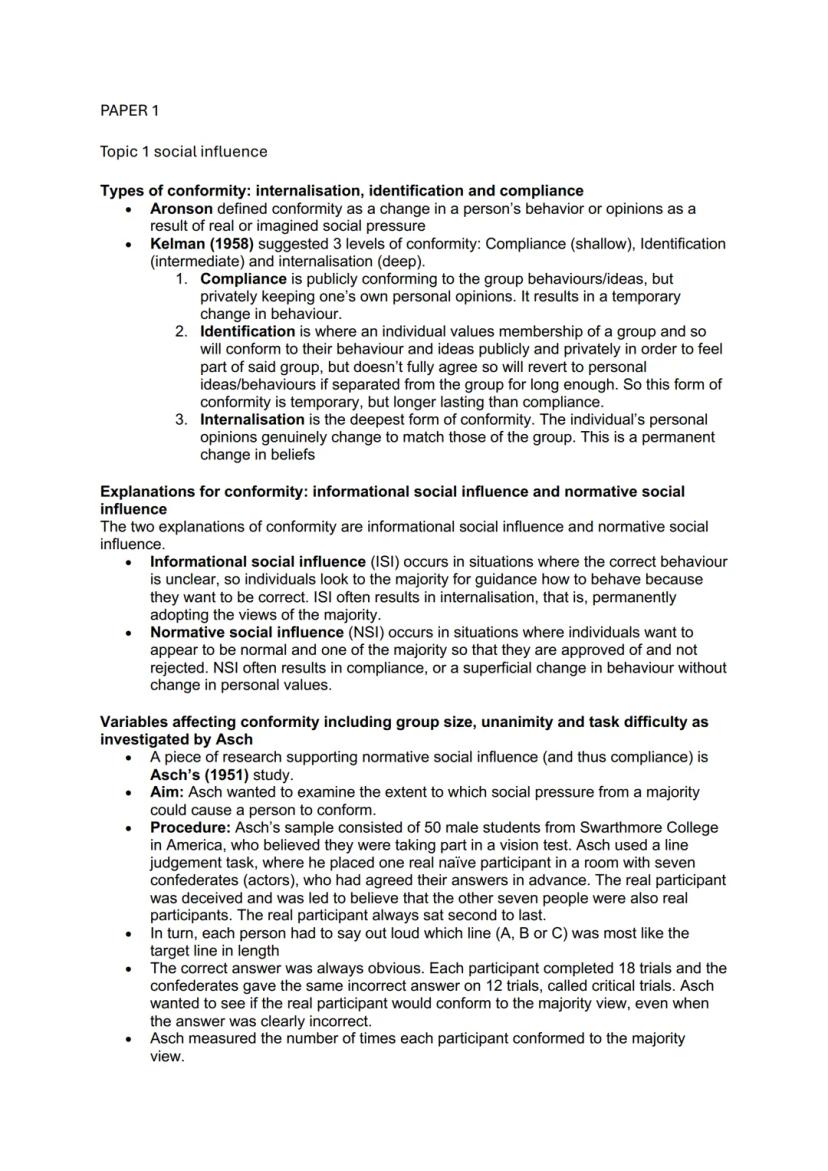
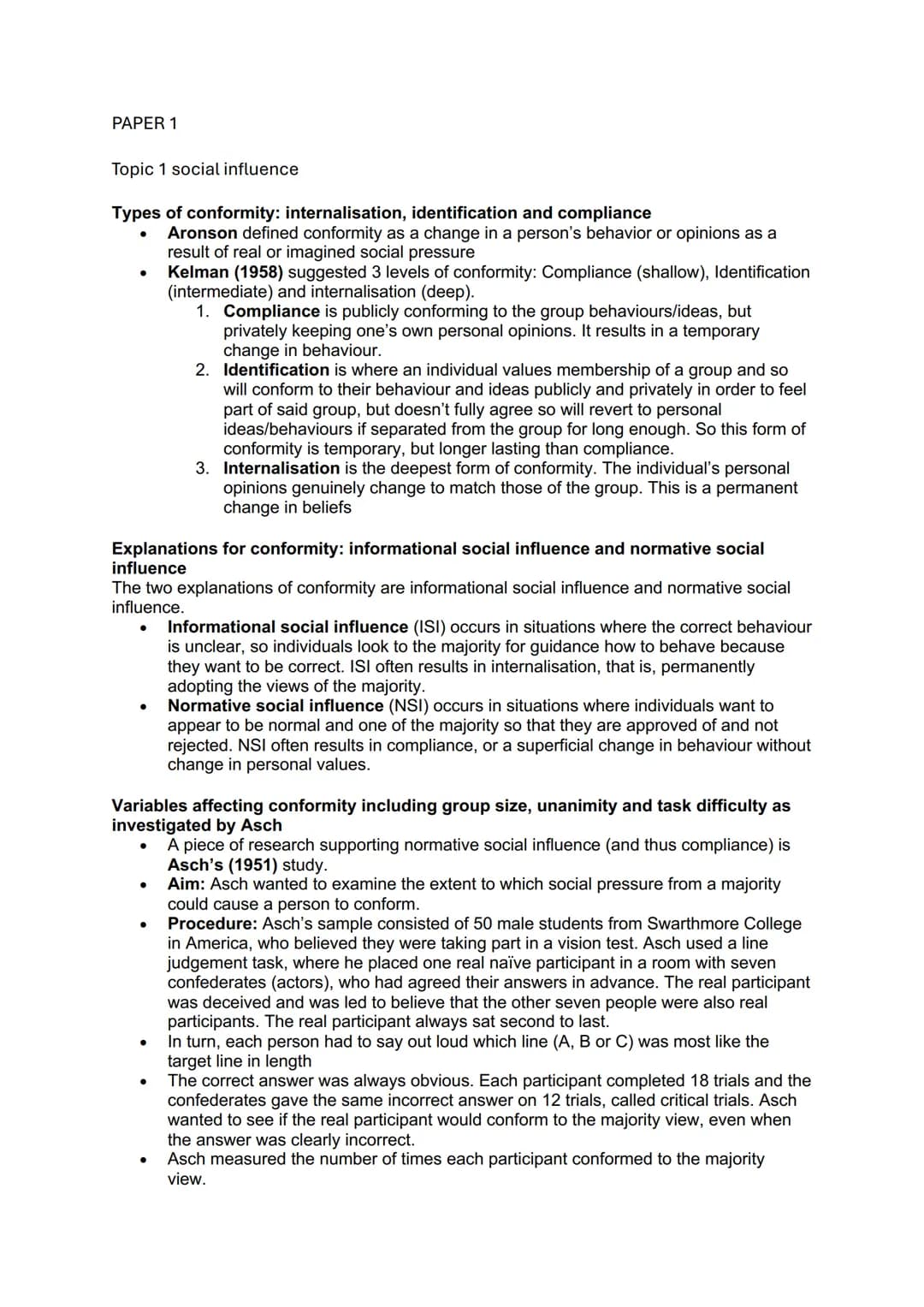
Ever wondered why you sometimes go along with your mates even when you disagree? That's conformity - changing your behaviour or opinions because of social pressure, and it happens in three different ways.
Compliance is the shallowest type - you publicly agree but privately keep your own views. Think of agreeing that a terrible film is "brilliant" just to fit in with your friends. Identification goes deeper - you genuinely adopt the group's views to feel like you belong, but you'd probably change back if you left the group. Internalisation is permanent - you actually change your mind and truly believe the new viewpoint.
Two main forces drive conformity: Informational Social Influence (ISI) happens when you're unsure what's right, so you look to others for guidance. Normative Social Influence (NSI) kicks in when you just want to be liked and accepted by the group.
Key insight: Most everyday conformity is actually compliance - you're just trying to fit in whilst keeping your real opinions private.
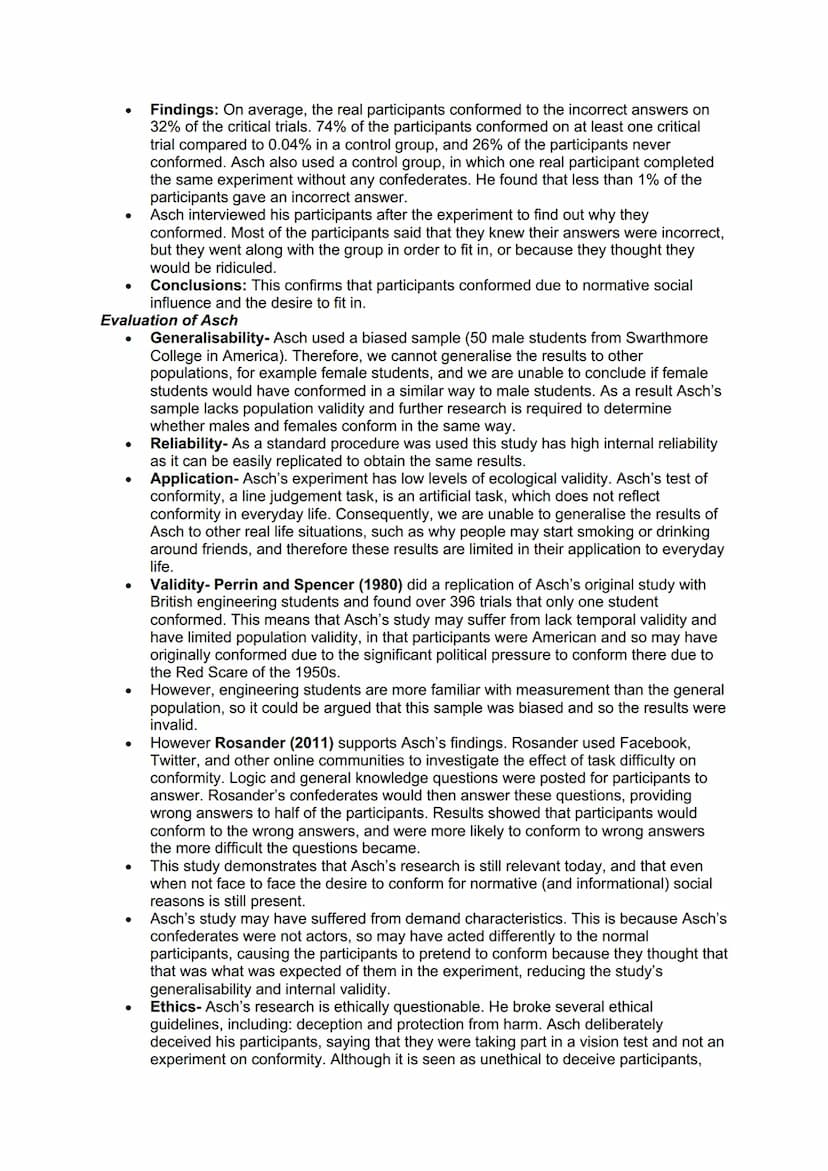
Asch's famous line experiment proved how powerful NSI can be. He got participants to judge which of three lines matched a target line - dead easy normally. But when surrounded by actors giving wrong answers, real participants conformed 32% of the time, even though they knew the answers were incorrect!
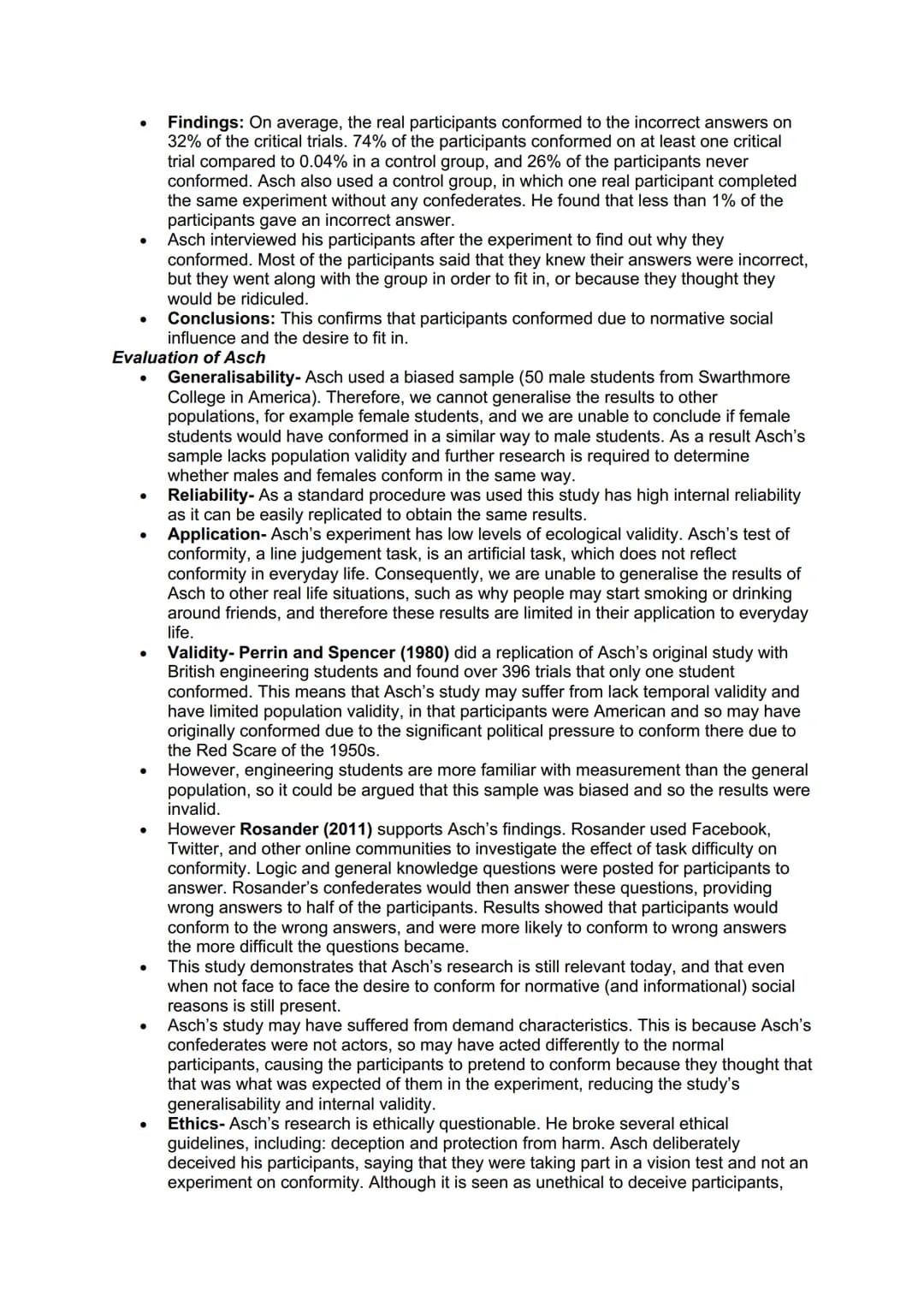
Asch's results were pretty shocking - 74% of participants conformed at least once to obviously wrong answers, compared to almost zero mistakes when alone. When interviewed afterwards, most admitted they knew they were wrong but went along with the group to avoid looking stupid or being ridiculed.
The study's got some serious limitations though. Using only American male students in the 1950s means we can't assume the same results apply to everyone. Perrin and Spencer tried replicating it with British engineering students in 1980 and found almost no conformity - suggesting the original results might've been influenced by the political pressure to conform during America's "Red Scare" period.
However, Rosander's 2011 study using social media found people still conform to wrong answers online, especially when questions get harder. This shows Asch's findings remain relevant in our digital age.
Remember: The study used an artificial task (judging lines) that doesn't really reflect real-world conformity situations.
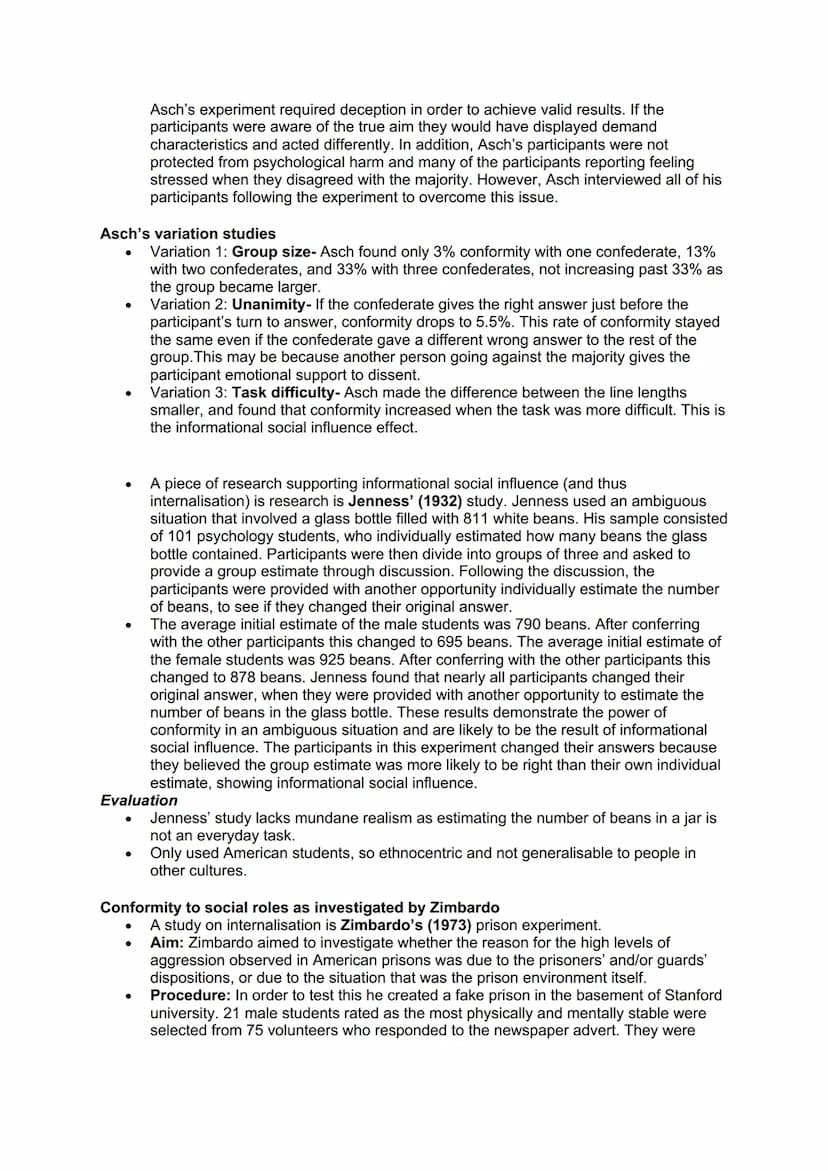
Asch's variations revealed key factors: conformity peaked at just three confederates (33%), dropped massively when just one person gave the right answer (5.5%), and increased when the task became harder. These findings show that group size, unanimity, and task difficulty all affect how likely we are to conform.
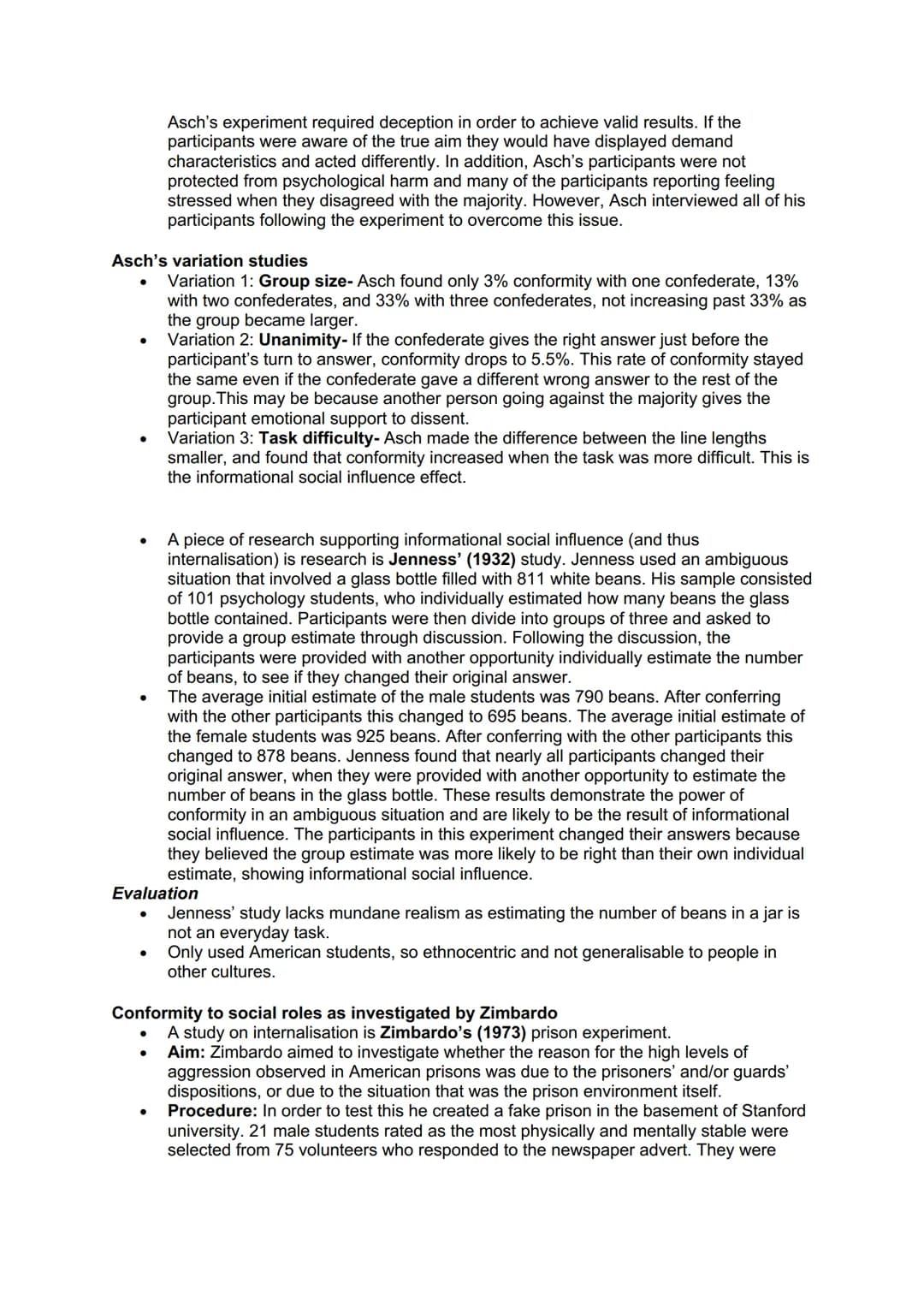
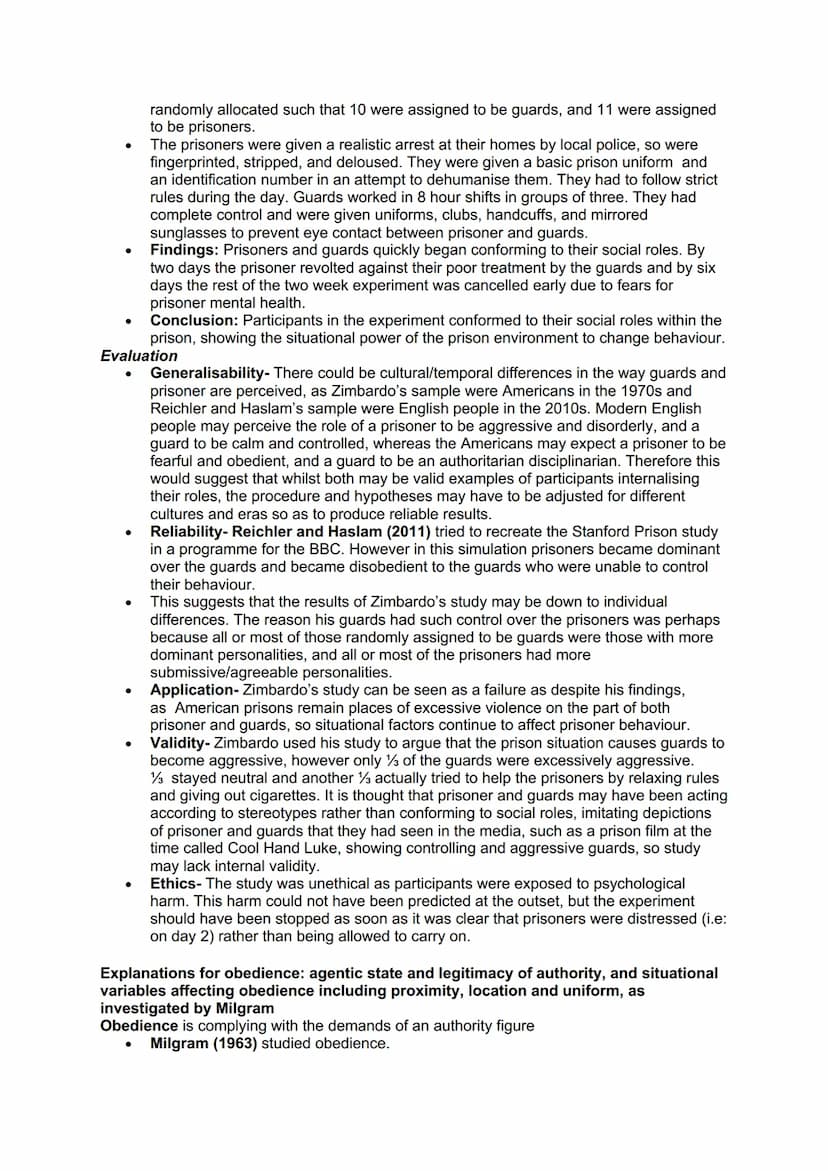
Sometimes we conform so deeply that we become the role we're playing. Zimbardo's Stanford Prison Experiment demonstrated this terrifying possibility by creating a fake prison with student volunteers as guards and prisoners.
The transformation was rapid and disturbing. Within days, guards became authoritarian and cruel whilst prisoners became submissive and distressed. The study had to be stopped after just six days instead of the planned two weeks because of concerns for the prisoners' mental health.
This suggests that situational factors - not just personality - can make ordinary people behave in extreme ways. The prison environment itself seemed to create the brutal behaviour, supporting the idea that social roles have incredible power over our actions.
Critical point: Only one-third of guards were actually aggressive - the others remained neutral or even helped prisoners, questioning whether it was really the situation or just individual personalities.
However, the study faces serious criticisms. Recher and Haslam's BBC replication found completely different results - prisoners became dominant over guards. This suggests cultural and temporal differences might affect how we perceive these roles. The ethical issues are also massive - participants suffered genuine psychological harm that couldn't have been predicted but should've stopped the study much earlier.
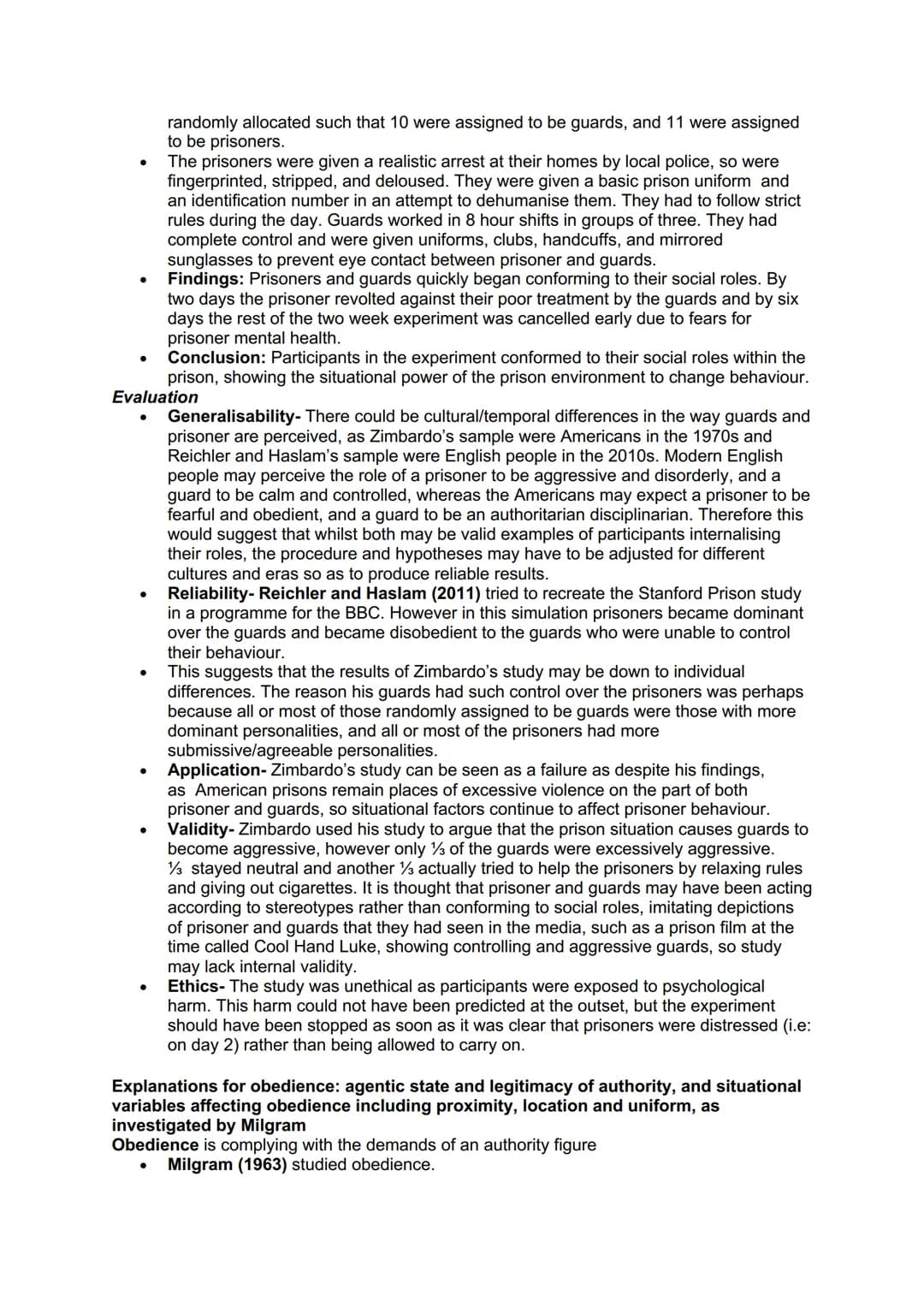
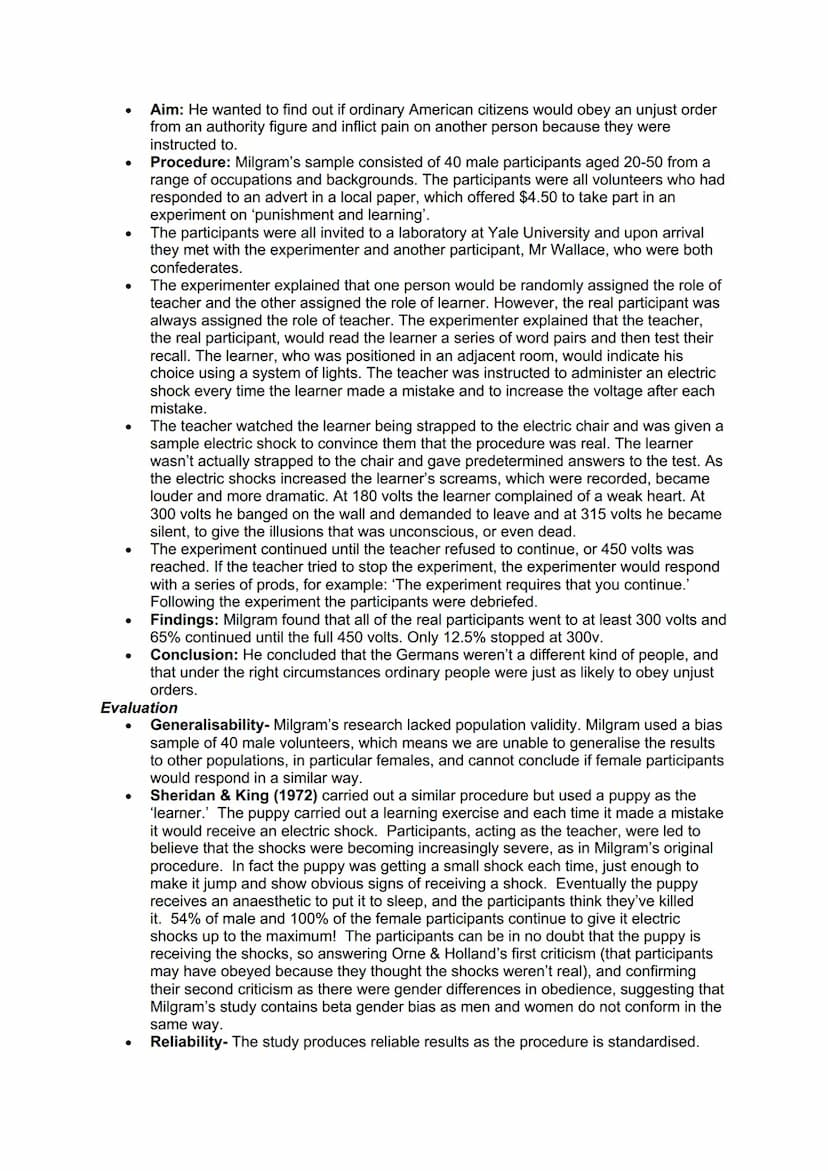
Obedience means following orders from authority figures, and Milgram's experiments revealed just how far ordinary people will go. His study aimed to understand how normal citizens could participate in atrocities like the Holocaust.
Participants thought they were testing "learning and punishment" but were actually delivering what they believed were real electric shocks to another person. The setup was convincing - they heard screams, complaints about heart problems, and eventually silence suggesting the "learner" was unconscious or dead.
The results were staggering: 65% of participants delivered the maximum 450 volts, and everyone went to at least 300 volts. Most participants showed obvious distress but continued when the experimenter insisted "the experiment requires that you continue."
Sobering reality: These weren't monsters - they were ordinary people who believed they were seriously harming someone just because an authority figure told them to.
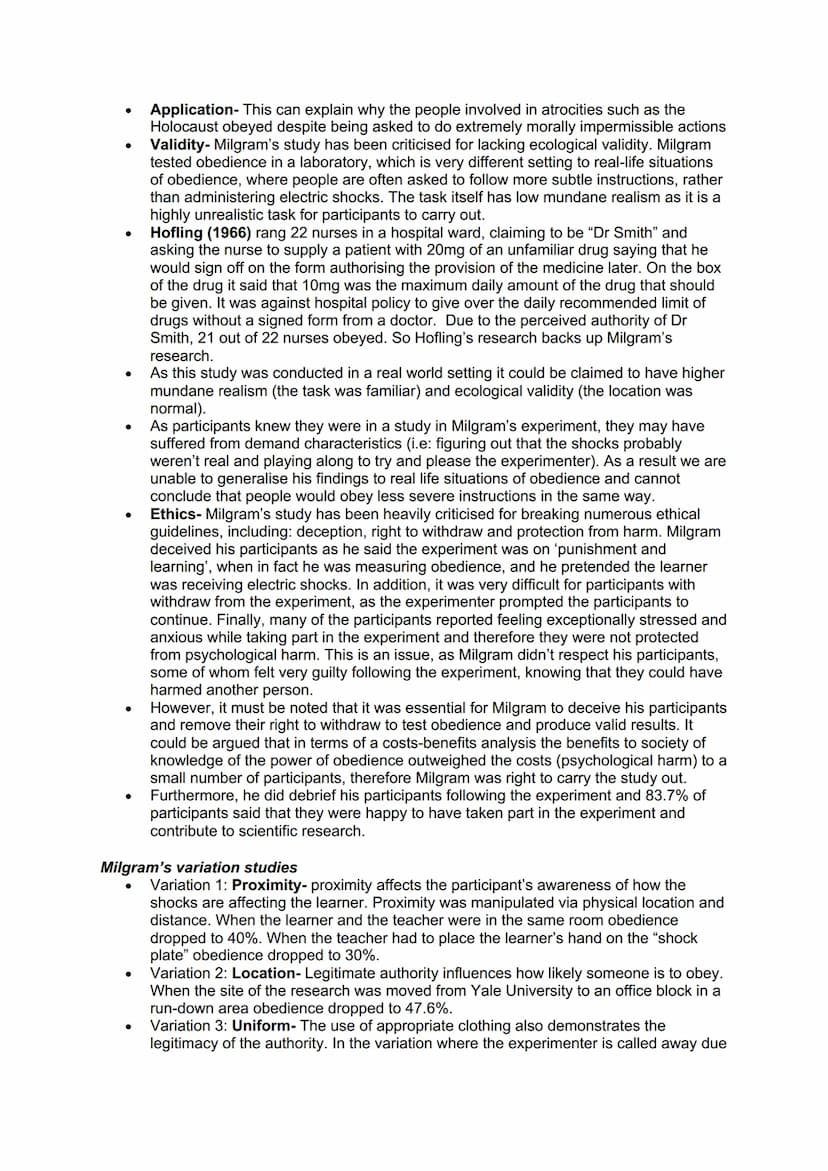
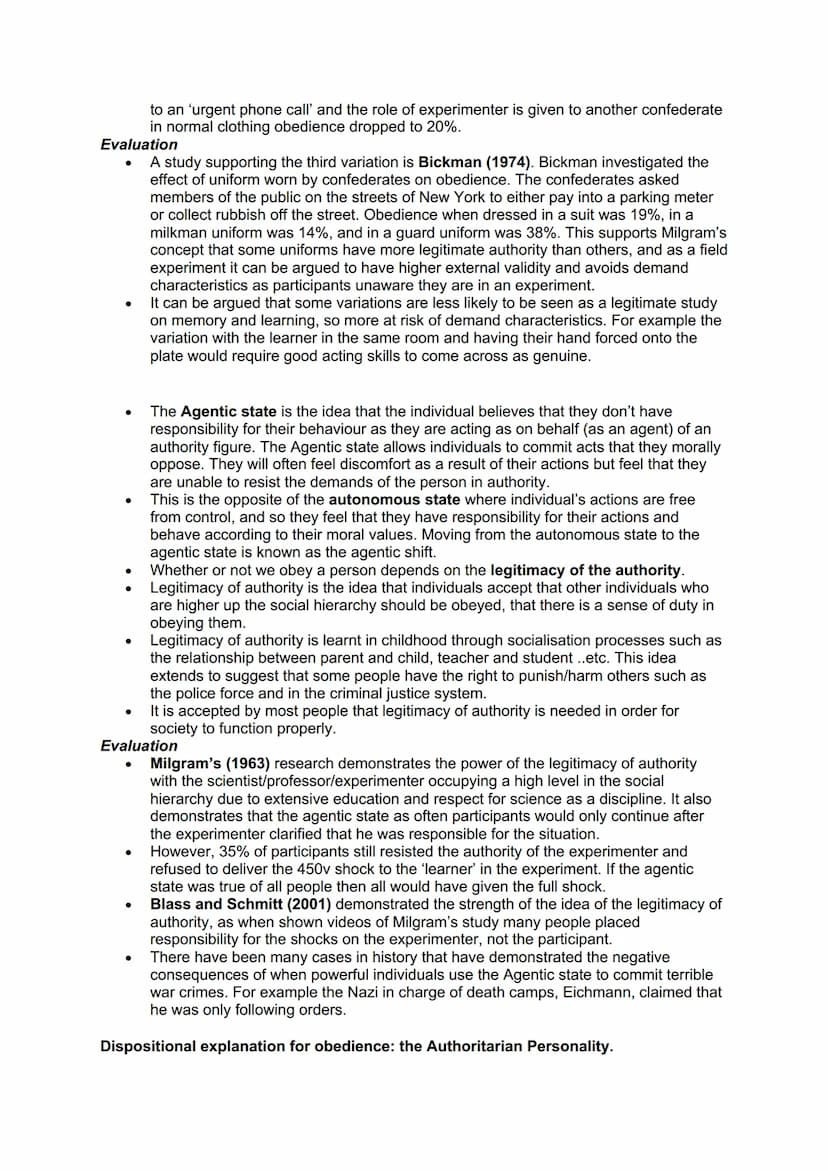
Milgram's variations showed what affects obedience levels. Proximity mattered hugely - obedience dropped to 30% when participants had to physically place the learner's hand on the shock plate. Location influenced legitimacy - moving from prestigious Yale to a run-down office building reduced obedience to 47.5%. Uniform also mattered - when the authority figure wore normal clothes instead of a lab coat, obedience plummeted to just 20%.
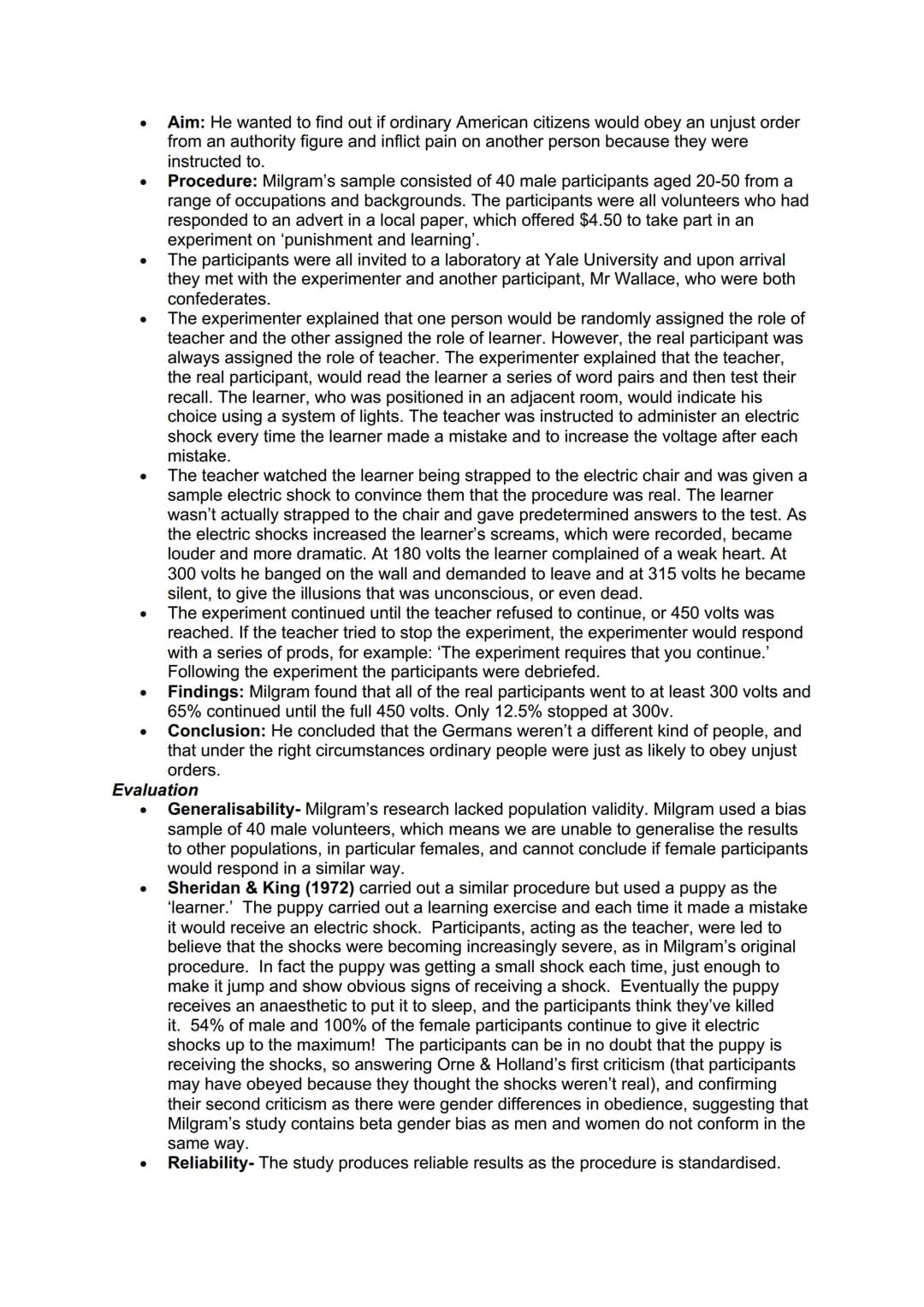
Why do people obey destructive orders? Two key psychological concepts explain this disturbing behaviour.
The Agentic State occurs when people believe they're not responsible for their actions because they're just following orders - acting as an "agent" of authority. This shifts them from their normal autonomous state (where they feel responsible) into a mindset where they can commit acts they'd normally find morally repugnant.
Legitimacy of Authority explains why we accept that some people have the right to give us orders. We learn this through childhood socialisation - obeying parents, teachers, police officers. Society actually needs this hierarchy to function properly, but it can be exploited by those in power.
Historical connection: Nazi war criminals like Eichmann famously claimed "I was just following orders" - a classic example of the agentic state defence.
However, these explanations aren't perfect. 35% of Milgram's participants still refused to give the maximum shock, suggesting individual differences matter. If everyone automatically entered an agentic state, we'd expect 100% obedience.
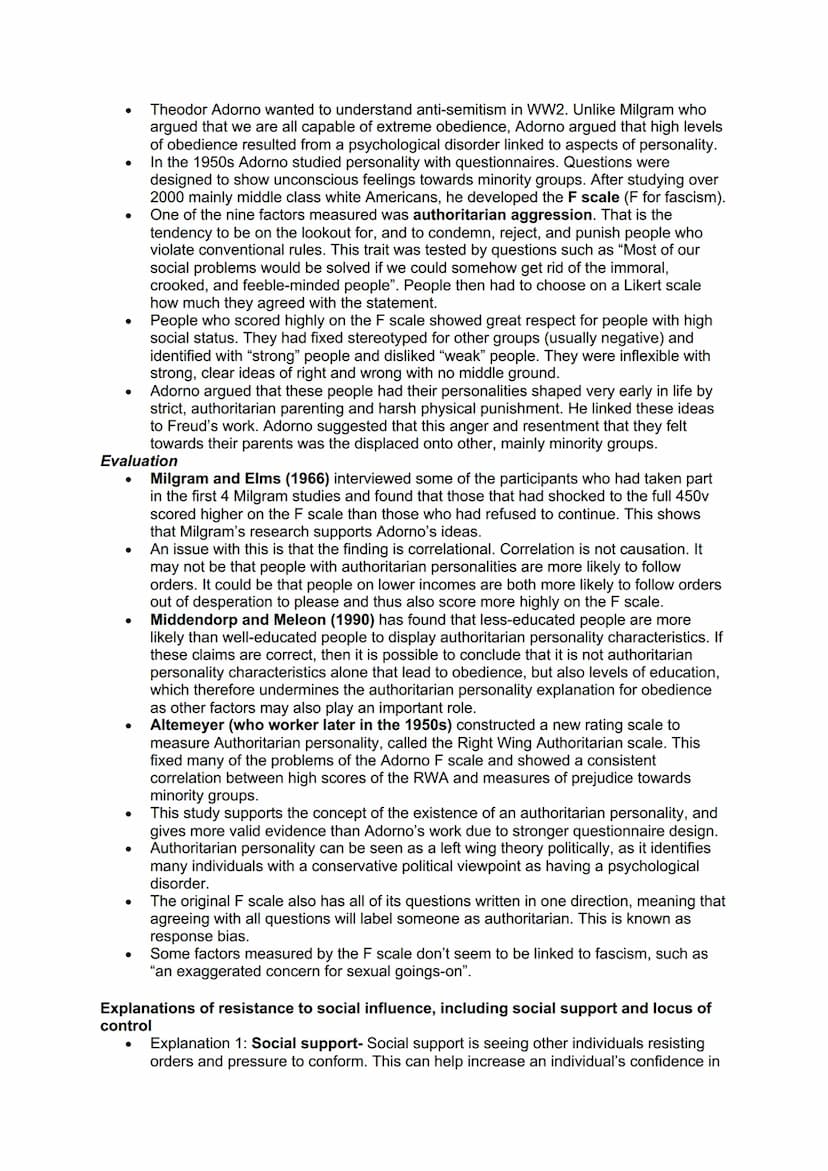
The Authoritarian Personality offers a different explanation. Adorno argued that some people are more naturally obedient due to strict, harsh upbringing. His F-Scale identified people who show excessive respect for authority, rigid thinking, and hostility towards minority groups. While Milgram found some support for this - high-shock participants scored higher on authoritarianism - the evidence is correlational, not causal.
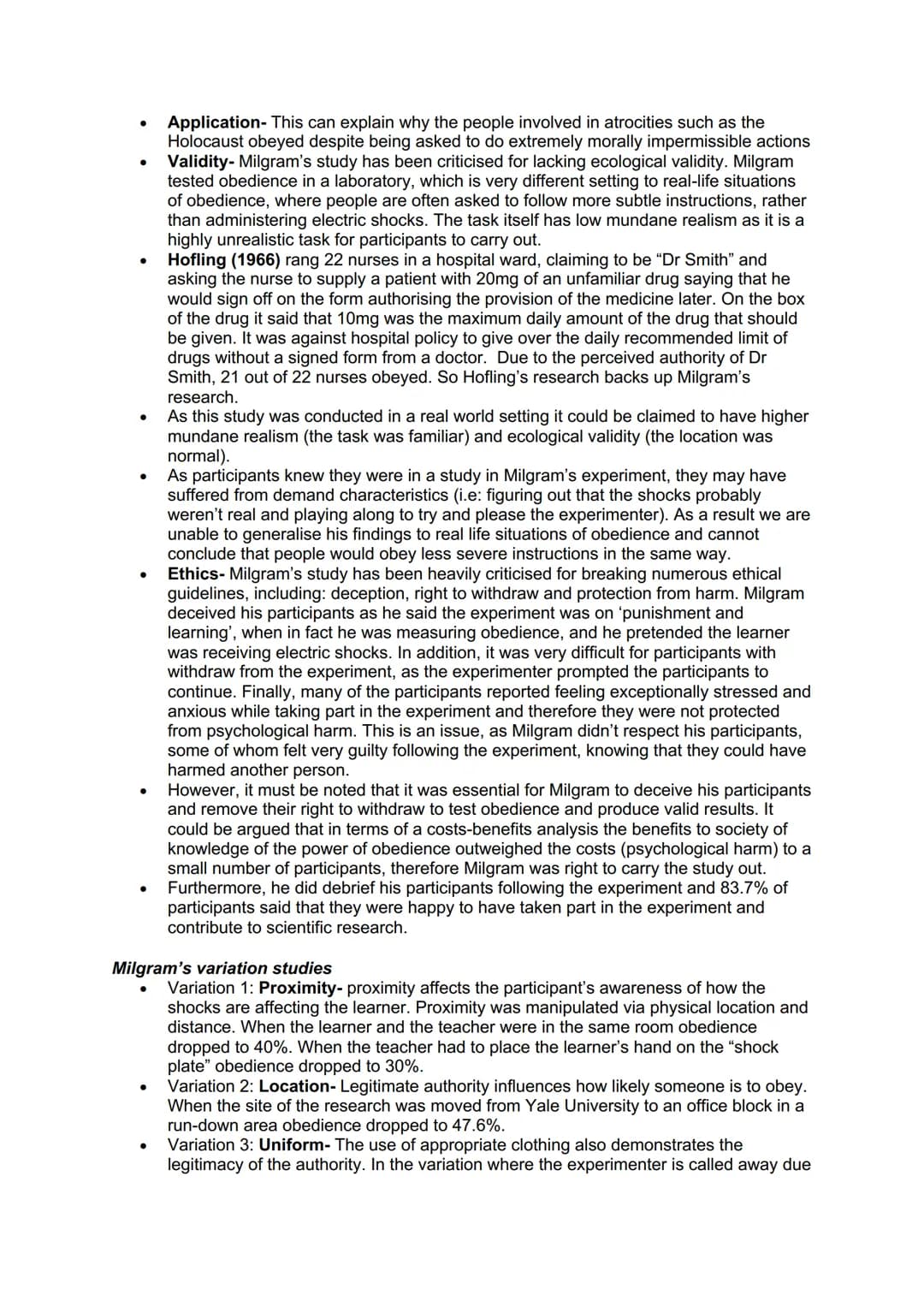
Not everyone goes along with the crowd or follows orders blindly. Understanding resistance to social influence helps explain why some people maintain their independence even under intense pressure.
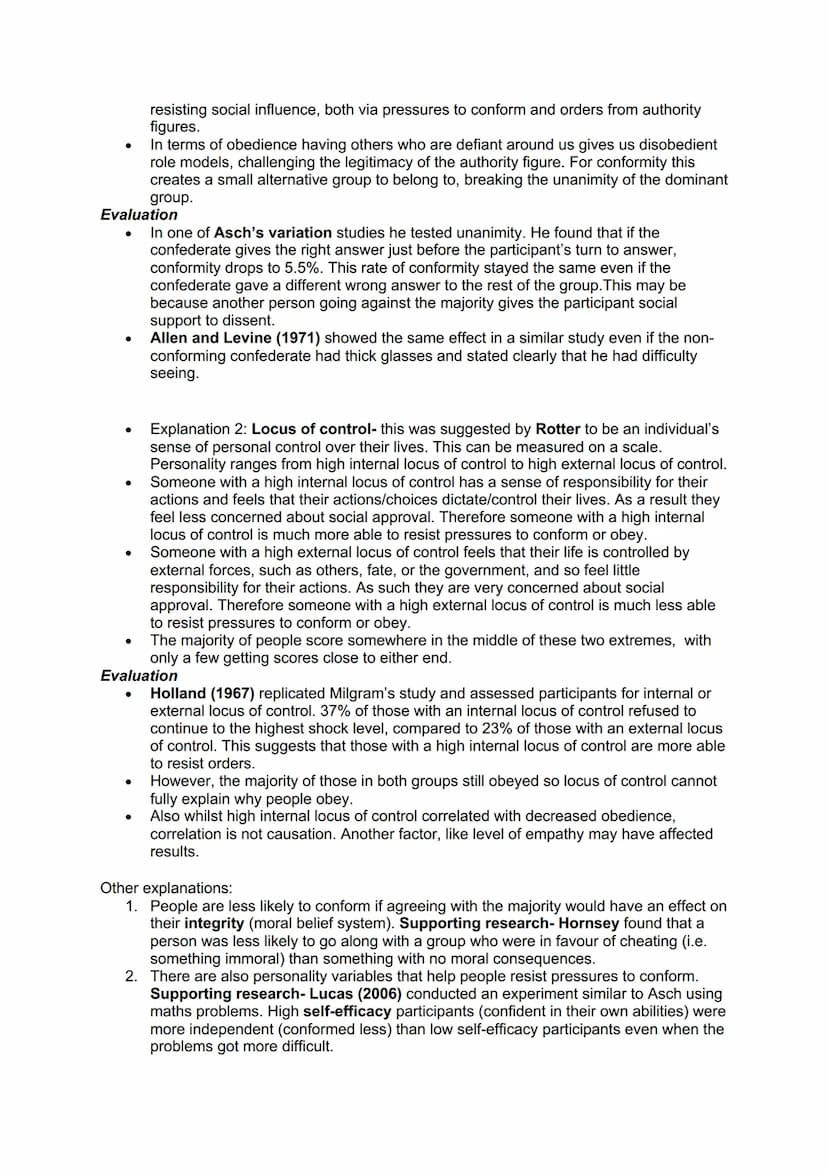
Social Support provides the confidence to resist by showing you're not alone. In conformity situations, even one person agreeing with you breaks the majority's power - Asch found conformity dropped from 32% to just 5.5% when one confederate gave the right answer. For obedience, seeing others disobey gives you disobedient role models and challenges the authority figure's legitimacy.
Locus of Control describes how much personal control people feel they have over their lives. Those with high internal locus of control believe their actions determine their outcomes, making them less concerned about social approval and more likely to resist pressure. People with high external locus of control feel controlled by outside forces, making them more susceptible to social influence.
Empowering fact: Holland found that 37% of people with internal locus of control refused Milgram's highest shock level, compared to only 23% of those with external locus of control.
Other factors matter too. People resist more when conforming would violate their moral beliefs - you're less likely to go along with cheating than something morally neutral. High self-efficacy (confidence in your abilities) also helps - Lucas found confident people conformed less even when tasks became difficult.
Remember that significant minorities resist even extreme pressure: 26% never conformed in Asch's study, 35% refused maximum obedience in Milgram's, and most guards didn't become aggressive in Zimbardo's prison.
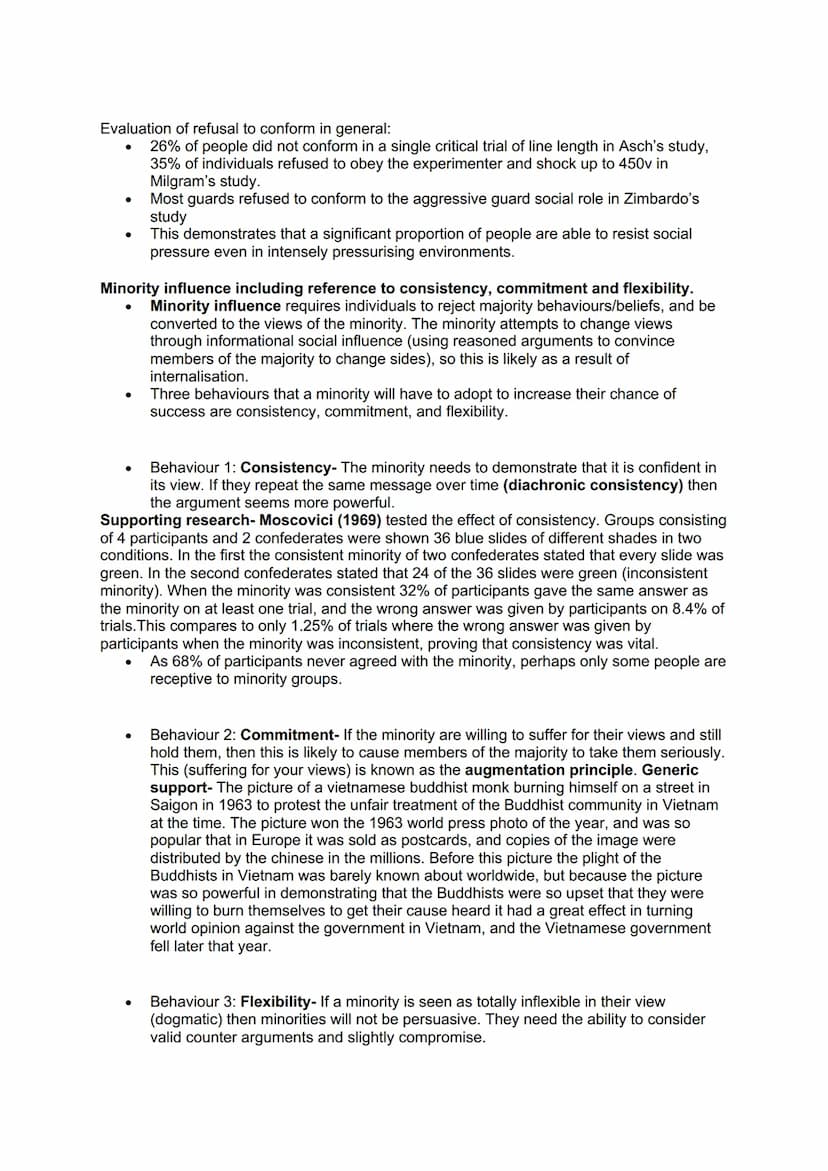
Sometimes the few convince the many. Minority influence happens when small groups successfully convert majority members to their viewpoint, usually through informational social influence rather than social pressure.
Successful minorities need three key qualities. Consistency is crucial - repeating the same message over time makes it seem more credible. Moscovici's blue-green slide study proved this: when a minority consistently called blue slides "green," 32% of majority participants agreed at least once. When the minority was inconsistent, this dropped to just 1.25%.
Commitment involves showing you're willing to suffer for your beliefs. The augmentation principle suggests that when minorities face costs or risks for their views, majorities take them more seriously. The famous image of a Buddhist monk self-immolating in 1963 Vietnam powerfully demonstrated this - the extreme commitment drew worldwide attention to Buddhist persecution and helped bring down the government.
Change happens: Most social progress - from civil rights to environmental protection - started with committed minorities who refused to give up.
Flexibility prevents minorities from seeming dogmatic or extreme. Successful minority groups need to show they can consider counter-arguments and compromise when appropriate, whilst maintaining their core message.
The process works through conversion rather than compliance - people genuinely change their minds rather than just going along. This makes minority influence potentially more powerful and lasting than majority pressure, even though it affects fewer people initially.
Our AI Companion is a student-focused AI tool that offers more than just answers. Built on millions of Knowunity resources, it provides relevant information, personalised study plans, quizzes, and content directly in the chat, adapting to your individual learning journey.
You can download the app from Google Play Store and Apple App Store.
That's right! Enjoy free access to study content, connect with fellow students, and get instant help – all at your fingertips.
App Store
Google Play
The app is very easy to use and well designed. I have found everything I was looking for so far and have been able to learn a lot from the presentations! I will definitely use the app for a class assignment! And of course it also helps a lot as an inspiration.
Stefan S
iOS user
This app is really great. There are so many study notes and help [...]. My problem subject is French, for example, and the app has so many options for help. Thanks to this app, I have improved my French. I would recommend it to anyone.
Samantha Klich
Android user
Wow, I am really amazed. I just tried the app because I've seen it advertised many times and was absolutely stunned. This app is THE HELP you want for school and above all, it offers so many things, such as workouts and fact sheets, which have been VERY helpful to me personally.
Anna
iOS user
Best app on earth! no words because it’s too good
Thomas R
iOS user
Just amazing. Let's me revise 10x better, this app is a quick 10/10. I highly recommend it to anyone. I can watch and search for notes. I can save them in the subject folder. I can revise it any time when I come back. If you haven't tried this app, you're really missing out.
Basil
Android user
This app has made me feel so much more confident in my exam prep, not only through boosting my own self confidence through the features that allow you to connect with others and feel less alone, but also through the way the app itself is centred around making you feel better. It is easy to navigate, fun to use, and helpful to anyone struggling in absolutely any way.
David K
iOS user
The app's just great! All I have to do is enter the topic in the search bar and I get the response real fast. I don't have to watch 10 YouTube videos to understand something, so I'm saving my time. Highly recommended!
Sudenaz Ocak
Android user
In school I was really bad at maths but thanks to the app, I am doing better now. I am so grateful that you made the app.
Greenlight Bonnie
Android user
very reliable app to help and grow your ideas of Maths, English and other related topics in your works. please use this app if your struggling in areas, this app is key for that. wish I'd of done a review before. and it's also free so don't worry about that.
Rohan U
Android user
I know a lot of apps use fake accounts to boost their reviews but this app deserves it all. Originally I was getting 4 in my English exams and this time I got a grade 7. I didn’t even know about this app three days until the exam and it has helped A LOT. Please actually trust me and use it as I’m sure you too will see developments.
Xander S
iOS user
THE QUIZES AND FLASHCARDS ARE SO USEFUL AND I LOVE THE SCHOOLGPT. IT ALSO IS LITREALLY LIKE CHATGPT BUT SMARTER!! HELPED ME WITH MY MASCARA PROBLEMS TOO!! AS WELL AS MY REAL SUBJECTS ! DUHHH 😍😁😲🤑💗✨🎀😮
Elisha
iOS user
This apps acc the goat. I find revision so boring but this app makes it so easy to organize it all and then you can ask the freeeee ai to test yourself so good and you can easily upload your own stuff. highly recommend as someone taking mocks now
Paul T
iOS user
The app is very easy to use and well designed. I have found everything I was looking for so far and have been able to learn a lot from the presentations! I will definitely use the app for a class assignment! And of course it also helps a lot as an inspiration.
Stefan S
iOS user
This app is really great. There are so many study notes and help [...]. My problem subject is French, for example, and the app has so many options for help. Thanks to this app, I have improved my French. I would recommend it to anyone.
Samantha Klich
Android user
Wow, I am really amazed. I just tried the app because I've seen it advertised many times and was absolutely stunned. This app is THE HELP you want for school and above all, it offers so many things, such as workouts and fact sheets, which have been VERY helpful to me personally.
Anna
iOS user
Best app on earth! no words because it’s too good
Thomas R
iOS user
Just amazing. Let's me revise 10x better, this app is a quick 10/10. I highly recommend it to anyone. I can watch and search for notes. I can save them in the subject folder. I can revise it any time when I come back. If you haven't tried this app, you're really missing out.
Basil
Android user
This app has made me feel so much more confident in my exam prep, not only through boosting my own self confidence through the features that allow you to connect with others and feel less alone, but also through the way the app itself is centred around making you feel better. It is easy to navigate, fun to use, and helpful to anyone struggling in absolutely any way.
David K
iOS user
The app's just great! All I have to do is enter the topic in the search bar and I get the response real fast. I don't have to watch 10 YouTube videos to understand something, so I'm saving my time. Highly recommended!
Sudenaz Ocak
Android user
In school I was really bad at maths but thanks to the app, I am doing better now. I am so grateful that you made the app.
Greenlight Bonnie
Android user
very reliable app to help and grow your ideas of Maths, English and other related topics in your works. please use this app if your struggling in areas, this app is key for that. wish I'd of done a review before. and it's also free so don't worry about that.
Rohan U
Android user
I know a lot of apps use fake accounts to boost their reviews but this app deserves it all. Originally I was getting 4 in my English exams and this time I got a grade 7. I didn’t even know about this app three days until the exam and it has helped A LOT. Please actually trust me and use it as I’m sure you too will see developments.
Xander S
iOS user
THE QUIZES AND FLASHCARDS ARE SO USEFUL AND I LOVE THE SCHOOLGPT. IT ALSO IS LITREALLY LIKE CHATGPT BUT SMARTER!! HELPED ME WITH MY MASCARA PROBLEMS TOO!! AS WELL AS MY REAL SUBJECTS ! DUHHH 😍😁😲🤑💗✨🎀😮
Elisha
iOS user
This apps acc the goat. I find revision so boring but this app makes it so easy to organize it all and then you can ask the freeeee ai to test yourself so good and you can easily upload your own stuff. highly recommend as someone taking mocks now
Paul T
iOS user
izzy
@izzy_mac
Social influence shapes how we behave around others, from going along with the crowd to following orders from authority figures. Understanding these psychological processes helps explain everything from peer pressure at school to major historical events like the Holocaust.
Access to all documents
Improve your grades
Join milions of students
By signing up you accept Terms of Service and Privacy Policy
Ever wondered why you sometimes go along with your mates even when you disagree? That's conformity - changing your behaviour or opinions because of social pressure, and it happens in three different ways.
Compliance is the shallowest type - you publicly agree but privately keep your own views. Think of agreeing that a terrible film is "brilliant" just to fit in with your friends. Identification goes deeper - you genuinely adopt the group's views to feel like you belong, but you'd probably change back if you left the group. Internalisation is permanent - you actually change your mind and truly believe the new viewpoint.
Two main forces drive conformity: Informational Social Influence (ISI) happens when you're unsure what's right, so you look to others for guidance. Normative Social Influence (NSI) kicks in when you just want to be liked and accepted by the group.
Key insight: Most everyday conformity is actually compliance - you're just trying to fit in whilst keeping your real opinions private.
Asch's famous line experiment proved how powerful NSI can be. He got participants to judge which of three lines matched a target line - dead easy normally. But when surrounded by actors giving wrong answers, real participants conformed 32% of the time, even though they knew the answers were incorrect!
Access to all documents
Improve your grades
Join milions of students
By signing up you accept Terms of Service and Privacy Policy
Asch's results were pretty shocking - 74% of participants conformed at least once to obviously wrong answers, compared to almost zero mistakes when alone. When interviewed afterwards, most admitted they knew they were wrong but went along with the group to avoid looking stupid or being ridiculed.
The study's got some serious limitations though. Using only American male students in the 1950s means we can't assume the same results apply to everyone. Perrin and Spencer tried replicating it with British engineering students in 1980 and found almost no conformity - suggesting the original results might've been influenced by the political pressure to conform during America's "Red Scare" period.
However, Rosander's 2011 study using social media found people still conform to wrong answers online, especially when questions get harder. This shows Asch's findings remain relevant in our digital age.
Remember: The study used an artificial task (judging lines) that doesn't really reflect real-world conformity situations.
Asch's variations revealed key factors: conformity peaked at just three confederates (33%), dropped massively when just one person gave the right answer (5.5%), and increased when the task became harder. These findings show that group size, unanimity, and task difficulty all affect how likely we are to conform.
Access to all documents
Improve your grades
Join milions of students
By signing up you accept Terms of Service and Privacy Policy
Sometimes we conform so deeply that we become the role we're playing. Zimbardo's Stanford Prison Experiment demonstrated this terrifying possibility by creating a fake prison with student volunteers as guards and prisoners.
The transformation was rapid and disturbing. Within days, guards became authoritarian and cruel whilst prisoners became submissive and distressed. The study had to be stopped after just six days instead of the planned two weeks because of concerns for the prisoners' mental health.
This suggests that situational factors - not just personality - can make ordinary people behave in extreme ways. The prison environment itself seemed to create the brutal behaviour, supporting the idea that social roles have incredible power over our actions.
Critical point: Only one-third of guards were actually aggressive - the others remained neutral or even helped prisoners, questioning whether it was really the situation or just individual personalities.
However, the study faces serious criticisms. Recher and Haslam's BBC replication found completely different results - prisoners became dominant over guards. This suggests cultural and temporal differences might affect how we perceive these roles. The ethical issues are also massive - participants suffered genuine psychological harm that couldn't have been predicted but should've stopped the study much earlier.
Access to all documents
Improve your grades
Join milions of students
By signing up you accept Terms of Service and Privacy Policy
Obedience means following orders from authority figures, and Milgram's experiments revealed just how far ordinary people will go. His study aimed to understand how normal citizens could participate in atrocities like the Holocaust.
Participants thought they were testing "learning and punishment" but were actually delivering what they believed were real electric shocks to another person. The setup was convincing - they heard screams, complaints about heart problems, and eventually silence suggesting the "learner" was unconscious or dead.
The results were staggering: 65% of participants delivered the maximum 450 volts, and everyone went to at least 300 volts. Most participants showed obvious distress but continued when the experimenter insisted "the experiment requires that you continue."
Sobering reality: These weren't monsters - they were ordinary people who believed they were seriously harming someone just because an authority figure told them to.
Milgram's variations showed what affects obedience levels. Proximity mattered hugely - obedience dropped to 30% when participants had to physically place the learner's hand on the shock plate. Location influenced legitimacy - moving from prestigious Yale to a run-down office building reduced obedience to 47.5%. Uniform also mattered - when the authority figure wore normal clothes instead of a lab coat, obedience plummeted to just 20%.
Access to all documents
Improve your grades
Join milions of students
By signing up you accept Terms of Service and Privacy Policy
Why do people obey destructive orders? Two key psychological concepts explain this disturbing behaviour.
The Agentic State occurs when people believe they're not responsible for their actions because they're just following orders - acting as an "agent" of authority. This shifts them from their normal autonomous state (where they feel responsible) into a mindset where they can commit acts they'd normally find morally repugnant.
Legitimacy of Authority explains why we accept that some people have the right to give us orders. We learn this through childhood socialisation - obeying parents, teachers, police officers. Society actually needs this hierarchy to function properly, but it can be exploited by those in power.
Historical connection: Nazi war criminals like Eichmann famously claimed "I was just following orders" - a classic example of the agentic state defence.
However, these explanations aren't perfect. 35% of Milgram's participants still refused to give the maximum shock, suggesting individual differences matter. If everyone automatically entered an agentic state, we'd expect 100% obedience.
The Authoritarian Personality offers a different explanation. Adorno argued that some people are more naturally obedient due to strict, harsh upbringing. His F-Scale identified people who show excessive respect for authority, rigid thinking, and hostility towards minority groups. While Milgram found some support for this - high-shock participants scored higher on authoritarianism - the evidence is correlational, not causal.
Access to all documents
Improve your grades
Join milions of students
By signing up you accept Terms of Service and Privacy Policy
Not everyone goes along with the crowd or follows orders blindly. Understanding resistance to social influence helps explain why some people maintain their independence even under intense pressure.
Social Support provides the confidence to resist by showing you're not alone. In conformity situations, even one person agreeing with you breaks the majority's power - Asch found conformity dropped from 32% to just 5.5% when one confederate gave the right answer. For obedience, seeing others disobey gives you disobedient role models and challenges the authority figure's legitimacy.
Locus of Control describes how much personal control people feel they have over their lives. Those with high internal locus of control believe their actions determine their outcomes, making them less concerned about social approval and more likely to resist pressure. People with high external locus of control feel controlled by outside forces, making them more susceptible to social influence.
Empowering fact: Holland found that 37% of people with internal locus of control refused Milgram's highest shock level, compared to only 23% of those with external locus of control.
Other factors matter too. People resist more when conforming would violate their moral beliefs - you're less likely to go along with cheating than something morally neutral. High self-efficacy (confidence in your abilities) also helps - Lucas found confident people conformed less even when tasks became difficult.
Remember that significant minorities resist even extreme pressure: 26% never conformed in Asch's study, 35% refused maximum obedience in Milgram's, and most guards didn't become aggressive in Zimbardo's prison.
Access to all documents
Improve your grades
Join milions of students
By signing up you accept Terms of Service and Privacy Policy
Sometimes the few convince the many. Minority influence happens when small groups successfully convert majority members to their viewpoint, usually through informational social influence rather than social pressure.
Successful minorities need three key qualities. Consistency is crucial - repeating the same message over time makes it seem more credible. Moscovici's blue-green slide study proved this: when a minority consistently called blue slides "green," 32% of majority participants agreed at least once. When the minority was inconsistent, this dropped to just 1.25%.
Commitment involves showing you're willing to suffer for your beliefs. The augmentation principle suggests that when minorities face costs or risks for their views, majorities take them more seriously. The famous image of a Buddhist monk self-immolating in 1963 Vietnam powerfully demonstrated this - the extreme commitment drew worldwide attention to Buddhist persecution and helped bring down the government.
Change happens: Most social progress - from civil rights to environmental protection - started with committed minorities who refused to give up.
Flexibility prevents minorities from seeming dogmatic or extreme. Successful minority groups need to show they can consider counter-arguments and compromise when appropriate, whilst maintaining their core message.
The process works through conversion rather than compliance - people genuinely change their minds rather than just going along. This makes minority influence potentially more powerful and lasting than majority pressure, even though it affects fewer people initially.
Access to all documents
Improve your grades
Join milions of students
By signing up you accept Terms of Service and Privacy Policy
Access to all documents
Improve your grades
Join milions of students
By signing up you accept Terms of Service and Privacy Policy
Access to all documents
Improve your grades
Join milions of students
By signing up you accept Terms of Service and Privacy Policy
Our AI Companion is a student-focused AI tool that offers more than just answers. Built on millions of Knowunity resources, it provides relevant information, personalised study plans, quizzes, and content directly in the chat, adapting to your individual learning journey.
You can download the app from Google Play Store and Apple App Store.
That's right! Enjoy free access to study content, connect with fellow students, and get instant help – all at your fingertips.
6
Smart Tools NEW
Transform this note into: ✓ 50+ Practice Questions ✓ Interactive Flashcards ✓ Full Mock Exam ✓ Essay Outlines
App Store
Google Play
The app is very easy to use and well designed. I have found everything I was looking for so far and have been able to learn a lot from the presentations! I will definitely use the app for a class assignment! And of course it also helps a lot as an inspiration.
Stefan S
iOS user
This app is really great. There are so many study notes and help [...]. My problem subject is French, for example, and the app has so many options for help. Thanks to this app, I have improved my French. I would recommend it to anyone.
Samantha Klich
Android user
Wow, I am really amazed. I just tried the app because I've seen it advertised many times and was absolutely stunned. This app is THE HELP you want for school and above all, it offers so many things, such as workouts and fact sheets, which have been VERY helpful to me personally.
Anna
iOS user
Best app on earth! no words because it’s too good
Thomas R
iOS user
Just amazing. Let's me revise 10x better, this app is a quick 10/10. I highly recommend it to anyone. I can watch and search for notes. I can save them in the subject folder. I can revise it any time when I come back. If you haven't tried this app, you're really missing out.
Basil
Android user
This app has made me feel so much more confident in my exam prep, not only through boosting my own self confidence through the features that allow you to connect with others and feel less alone, but also through the way the app itself is centred around making you feel better. It is easy to navigate, fun to use, and helpful to anyone struggling in absolutely any way.
David K
iOS user
The app's just great! All I have to do is enter the topic in the search bar and I get the response real fast. I don't have to watch 10 YouTube videos to understand something, so I'm saving my time. Highly recommended!
Sudenaz Ocak
Android user
In school I was really bad at maths but thanks to the app, I am doing better now. I am so grateful that you made the app.
Greenlight Bonnie
Android user
very reliable app to help and grow your ideas of Maths, English and other related topics in your works. please use this app if your struggling in areas, this app is key for that. wish I'd of done a review before. and it's also free so don't worry about that.
Rohan U
Android user
I know a lot of apps use fake accounts to boost their reviews but this app deserves it all. Originally I was getting 4 in my English exams and this time I got a grade 7. I didn’t even know about this app three days until the exam and it has helped A LOT. Please actually trust me and use it as I’m sure you too will see developments.
Xander S
iOS user
THE QUIZES AND FLASHCARDS ARE SO USEFUL AND I LOVE THE SCHOOLGPT. IT ALSO IS LITREALLY LIKE CHATGPT BUT SMARTER!! HELPED ME WITH MY MASCARA PROBLEMS TOO!! AS WELL AS MY REAL SUBJECTS ! DUHHH 😍😁😲🤑💗✨🎀😮
Elisha
iOS user
This apps acc the goat. I find revision so boring but this app makes it so easy to organize it all and then you can ask the freeeee ai to test yourself so good and you can easily upload your own stuff. highly recommend as someone taking mocks now
Paul T
iOS user
The app is very easy to use and well designed. I have found everything I was looking for so far and have been able to learn a lot from the presentations! I will definitely use the app for a class assignment! And of course it also helps a lot as an inspiration.
Stefan S
iOS user
This app is really great. There are so many study notes and help [...]. My problem subject is French, for example, and the app has so many options for help. Thanks to this app, I have improved my French. I would recommend it to anyone.
Samantha Klich
Android user
Wow, I am really amazed. I just tried the app because I've seen it advertised many times and was absolutely stunned. This app is THE HELP you want for school and above all, it offers so many things, such as workouts and fact sheets, which have been VERY helpful to me personally.
Anna
iOS user
Best app on earth! no words because it’s too good
Thomas R
iOS user
Just amazing. Let's me revise 10x better, this app is a quick 10/10. I highly recommend it to anyone. I can watch and search for notes. I can save them in the subject folder. I can revise it any time when I come back. If you haven't tried this app, you're really missing out.
Basil
Android user
This app has made me feel so much more confident in my exam prep, not only through boosting my own self confidence through the features that allow you to connect with others and feel less alone, but also through the way the app itself is centred around making you feel better. It is easy to navigate, fun to use, and helpful to anyone struggling in absolutely any way.
David K
iOS user
The app's just great! All I have to do is enter the topic in the search bar and I get the response real fast. I don't have to watch 10 YouTube videos to understand something, so I'm saving my time. Highly recommended!
Sudenaz Ocak
Android user
In school I was really bad at maths but thanks to the app, I am doing better now. I am so grateful that you made the app.
Greenlight Bonnie
Android user
very reliable app to help and grow your ideas of Maths, English and other related topics in your works. please use this app if your struggling in areas, this app is key for that. wish I'd of done a review before. and it's also free so don't worry about that.
Rohan U
Android user
I know a lot of apps use fake accounts to boost their reviews but this app deserves it all. Originally I was getting 4 in my English exams and this time I got a grade 7. I didn’t even know about this app three days until the exam and it has helped A LOT. Please actually trust me and use it as I’m sure you too will see developments.
Xander S
iOS user
THE QUIZES AND FLASHCARDS ARE SO USEFUL AND I LOVE THE SCHOOLGPT. IT ALSO IS LITREALLY LIKE CHATGPT BUT SMARTER!! HELPED ME WITH MY MASCARA PROBLEMS TOO!! AS WELL AS MY REAL SUBJECTS ! DUHHH 😍😁😲🤑💗✨🎀😮
Elisha
iOS user
This apps acc the goat. I find revision so boring but this app makes it so easy to organize it all and then you can ask the freeeee ai to test yourself so good and you can easily upload your own stuff. highly recommend as someone taking mocks now
Paul T
iOS user