
Understanding research methods is crucial for your Psychology A-Level -... Show more
 Psychology
 Sociology
 English Literature
 Biology
Sign up to see the contentIt's free!
Access to all documents
Improve your grades
Join milions of students
Knowunity AI
Subjects
Triangle Congruence and Similarity Theorems
Triangle Properties and Classification
Linear Equations and Graphs
Geometric Angle Relationships
Trigonometric Functions and Identities
Equation Solving Techniques
Circle Geometry Fundamentals
Division Operations and Methods
Basic Differentiation Rules
Exponent and Logarithm Properties
Show all topics
Human Organ Systems
Reproductive Cell Cycles
Biological Sciences Subdisciplines
Cellular Energy Metabolism
Autotrophic Energy Processes
Inheritance Patterns and Principles
Biomolecular Structure and Organization
Cell Cycle and Division Mechanics
Cellular Organization and Development
Biological Structural Organization
Show all topics
Chemical Sciences and Applications
Atomic Structure and Composition
Molecular Electron Structure Representation
Atomic Electron Behavior
Matter Properties and Water
Mole Concept and Calculations
Gas Laws and Behavior
Periodic Table Organization
Chemical Thermodynamics Fundamentals
Chemical Bond Types and Properties
Show all topics
European Renaissance and Enlightenment
European Cultural Movements 800-1920
American Revolution Era 1763-1797
American Civil War 1861-1865
Global Imperial Systems
Mongol and Chinese Dynasties
U.S. Presidents and World Leaders
Historical Sources and Documentation
World Wars Era and Impact
World Religious Systems
Show all topics
Classic and Contemporary Novels
Literary Character Analysis
Rhetorical Theory and Practice
Classic Literary Narratives
Reading Analysis and Interpretation
Narrative Structure and Techniques
English Language Components
Influential English-Language Authors
Basic Sentence Structure
Narrative Voice and Perspective
Show all topics
241
•
Updated Mar 24, 2026
•

Zainab
@zainab_02839
Understanding research methods is crucial for your Psychology A-Level -... Show more
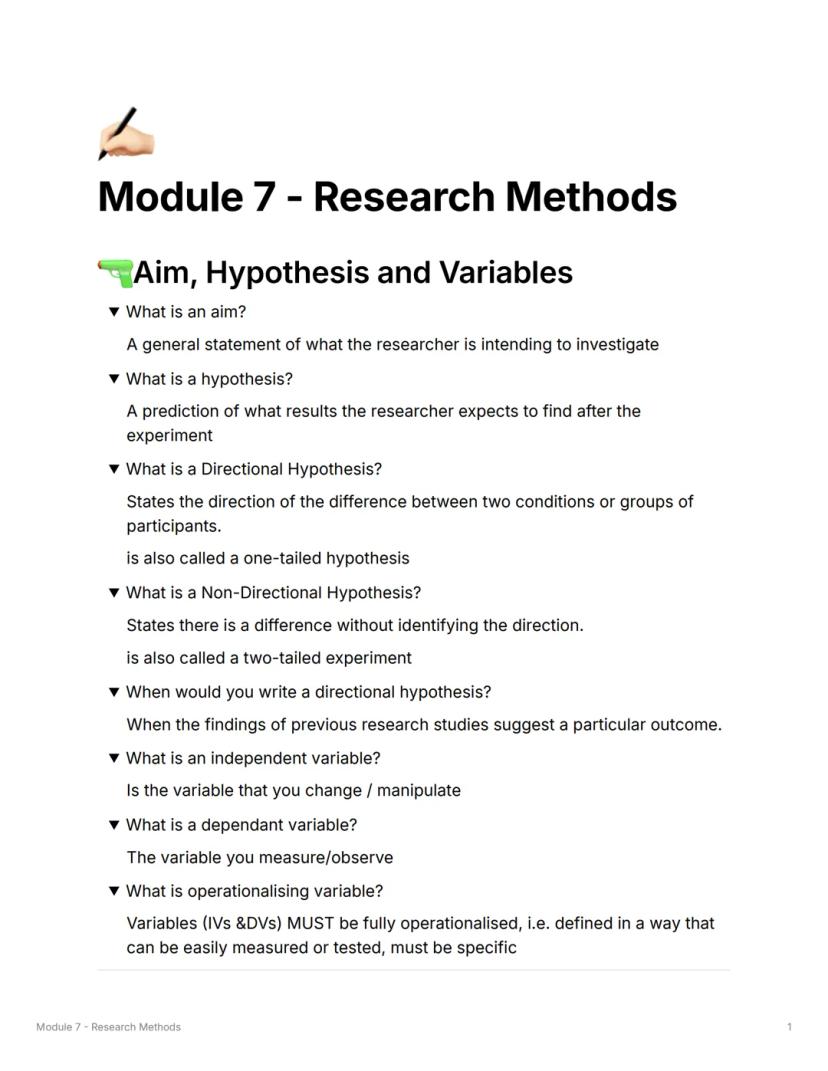


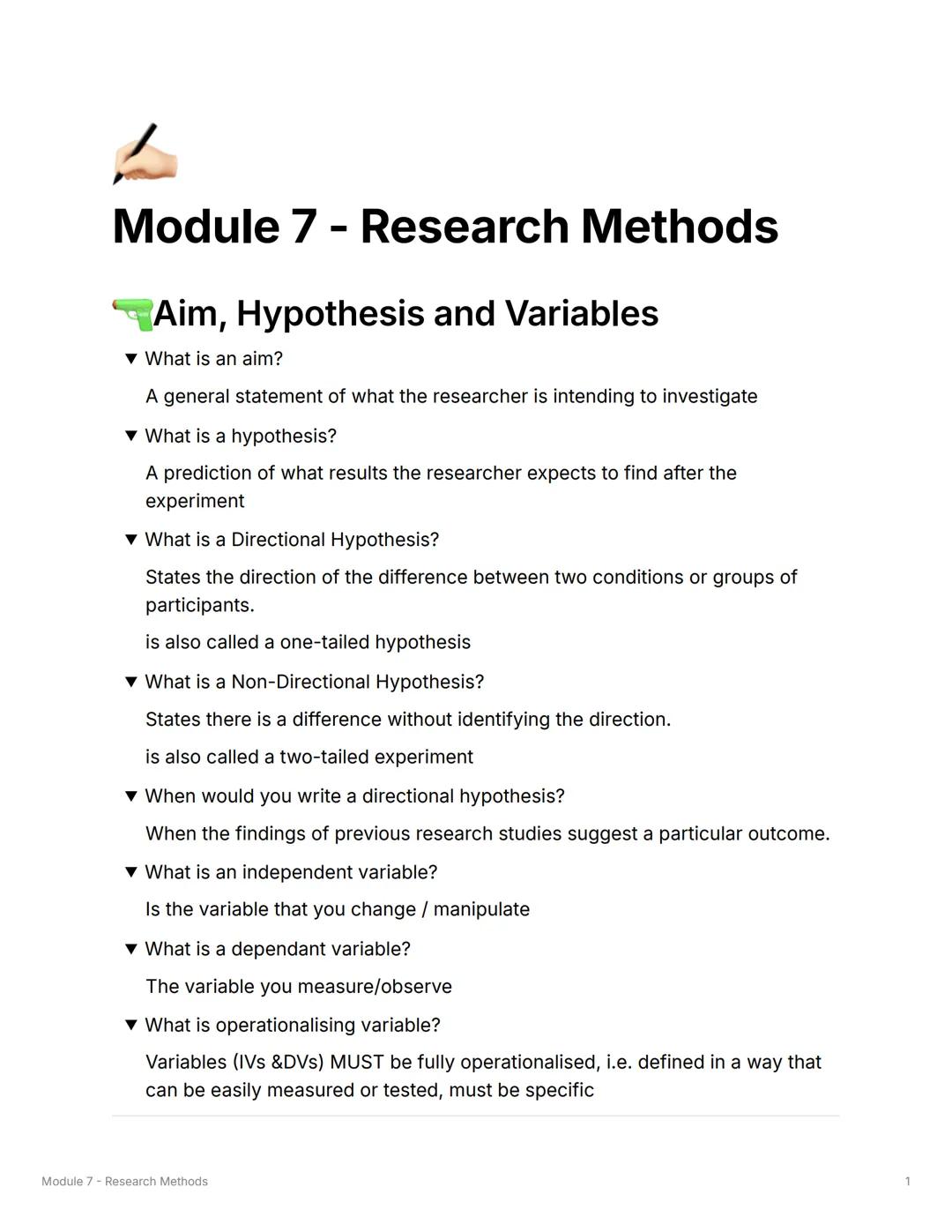
Every psychology experiment starts with a clear aim - basically, what the researcher wants to find out. Think of it as the big question they're trying to answer. From this aim, researchers create a hypothesis, which is their educated guess about what they expect to discover.
There are two types of hypotheses you need to know. A directional hypothesis predicts exactly what will happen - like "students will perform better after drinking coffee." A non-directional hypothesis just says there'll be a difference without specifying which way - "there will be a difference in performance between students who drink coffee and those who don't."
The key to any experiment is identifying your variables correctly. The independent variable (IV) is what you change or manipulate - in our example, whether students drink coffee or not. The dependent variable (DV) is what you measure - their test performance. Both variables must be operationalised, meaning defined so specifically that anyone could measure them exactly the same way.
Quick Tip: Always ask yourself - could another researcher replicate this study using my definitions? If not, your variables aren't operationalised enough!
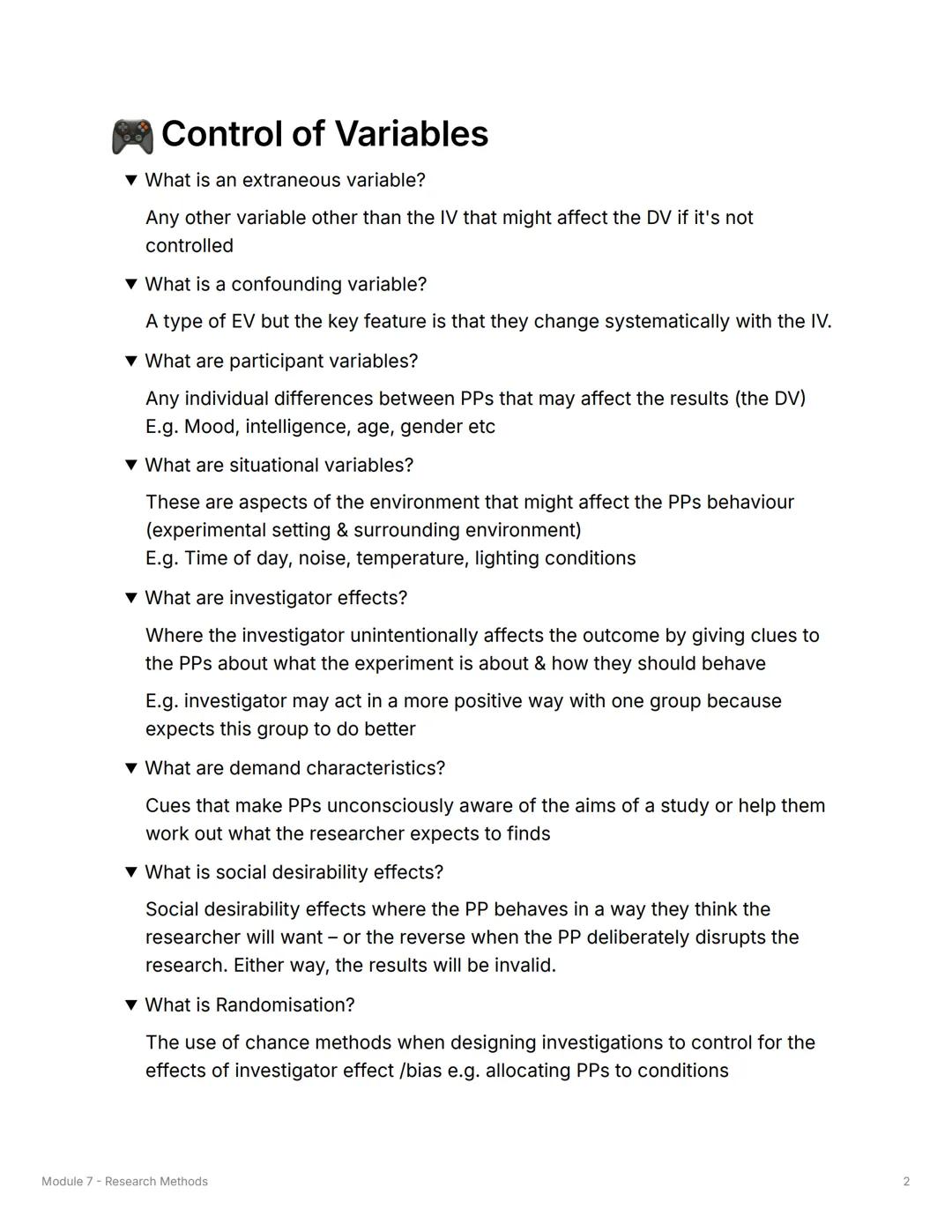
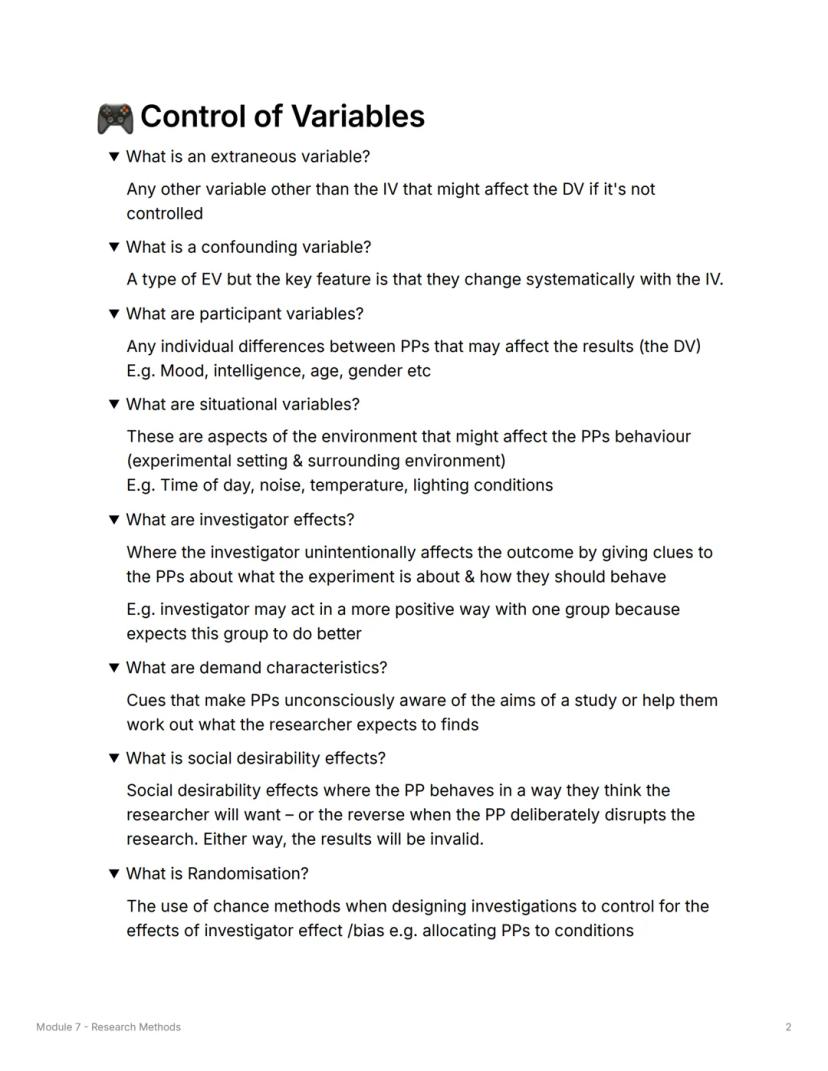
Here's where experiments can go wrong if you're not careful. Extraneous variables are anything other than your IV that might mess with your DV. When these change systematically with your IV, they become confounding variables - the real troublemakers that can ruin your results.
Participant variables include individual differences like age, mood, or intelligence that could affect results. Situational variables are environmental factors - think noise, temperature, or time of day. Both can seriously impact your findings if not controlled properly.
You also need to watch out for investigator effects (when researchers accidentally influence participants) and demand characteristics (when participants figure out what you're looking for and change their behaviour). Social desirability effects happen when people try to look good or deliberately sabotage your study.
The solution? Randomisation uses chance to allocate participants and reduce bias, while standardisation ensures everyone gets exactly the same experience. These aren't just fancy terms - they're your tools for getting reliable results.
Remember: A well-controlled experiment is like a fair test - everyone gets the same treatment except for the one thing you're actually studying.
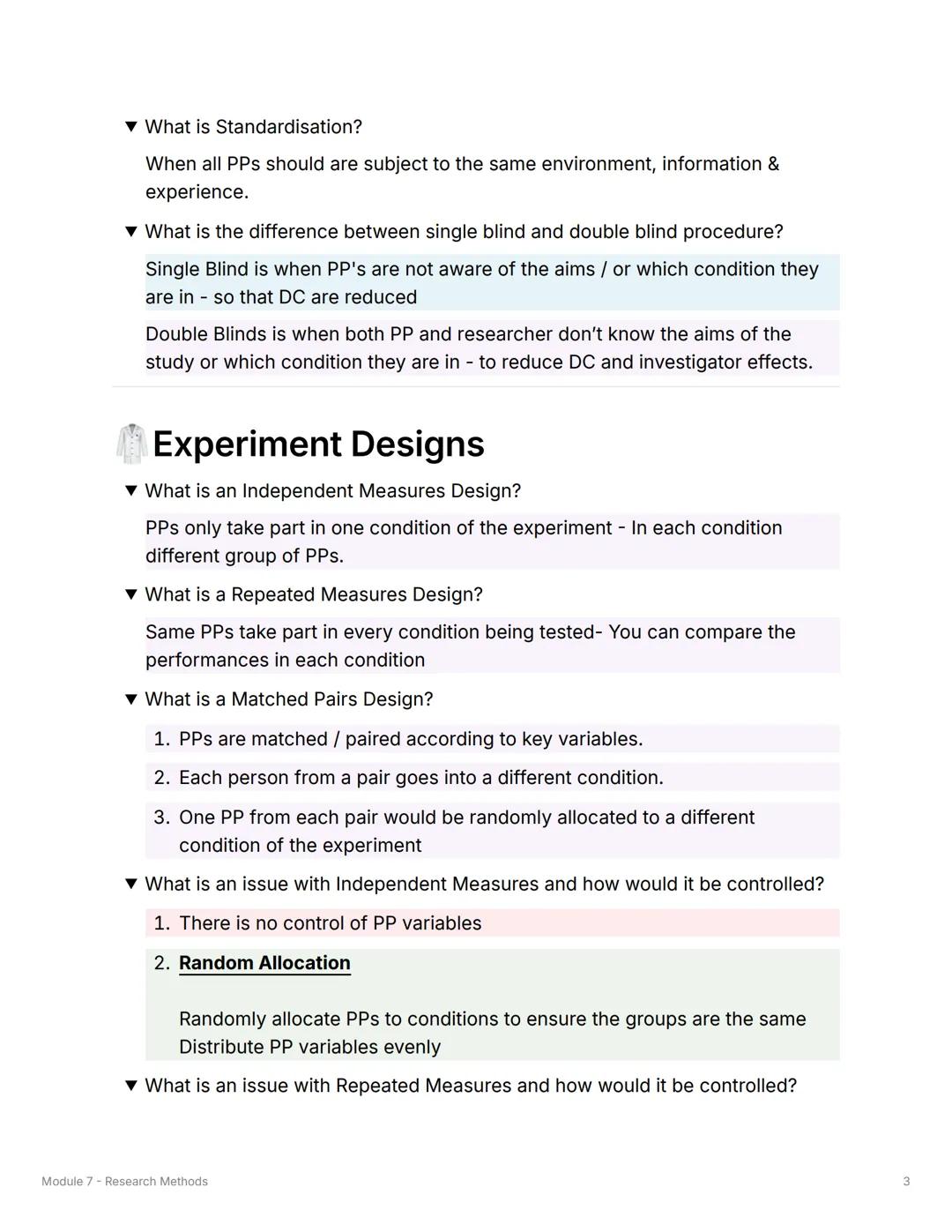
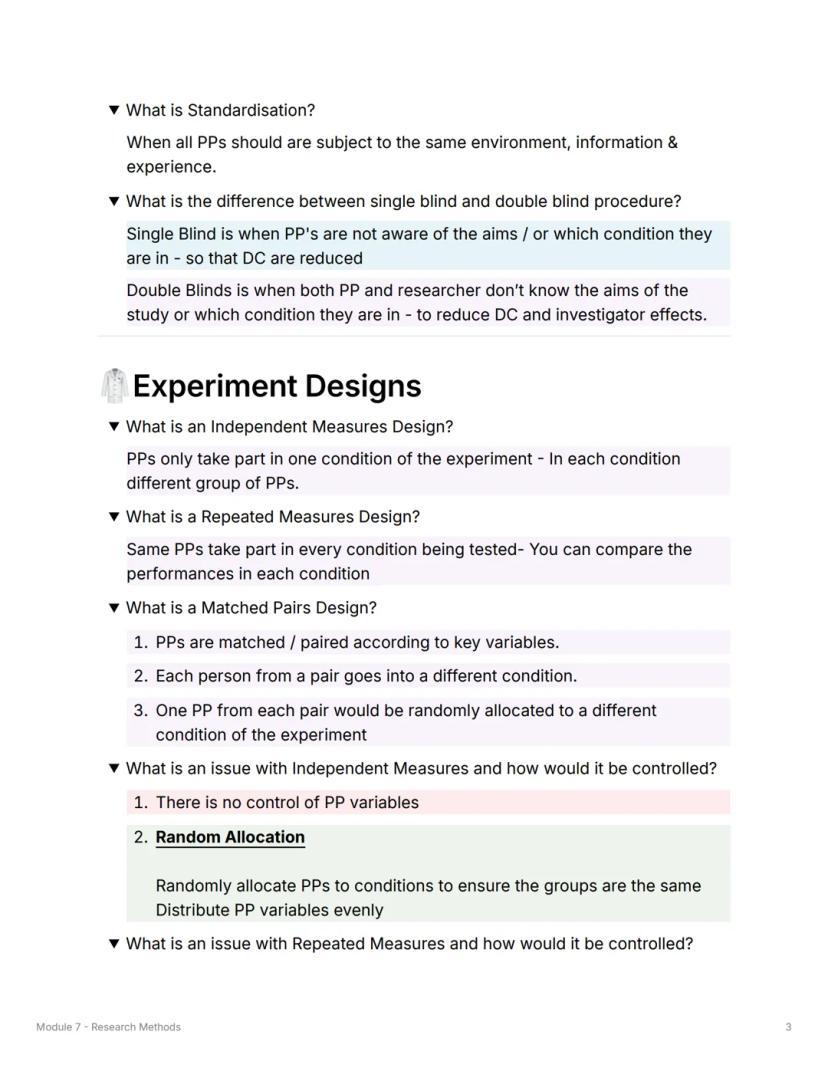
Now for the big question - how do you organise your participants? You've got three main experimental designs to choose from, each with distinct advantages and problems you need to solve.
Independent measures design uses different participants for each condition. It's straightforward but creates issues with participant variables - your groups might be naturally different. The fix? Random allocation to spread individual differences evenly across conditions.
Repeated measures design uses the same participants in all conditions, which is great for controlling participant variables. However, you'll face order effects - people might do better the second time due to practice, or worse due to fatigue. Counterbalancing solves this by having half your participants do condition A then B, while the other half does B then A.
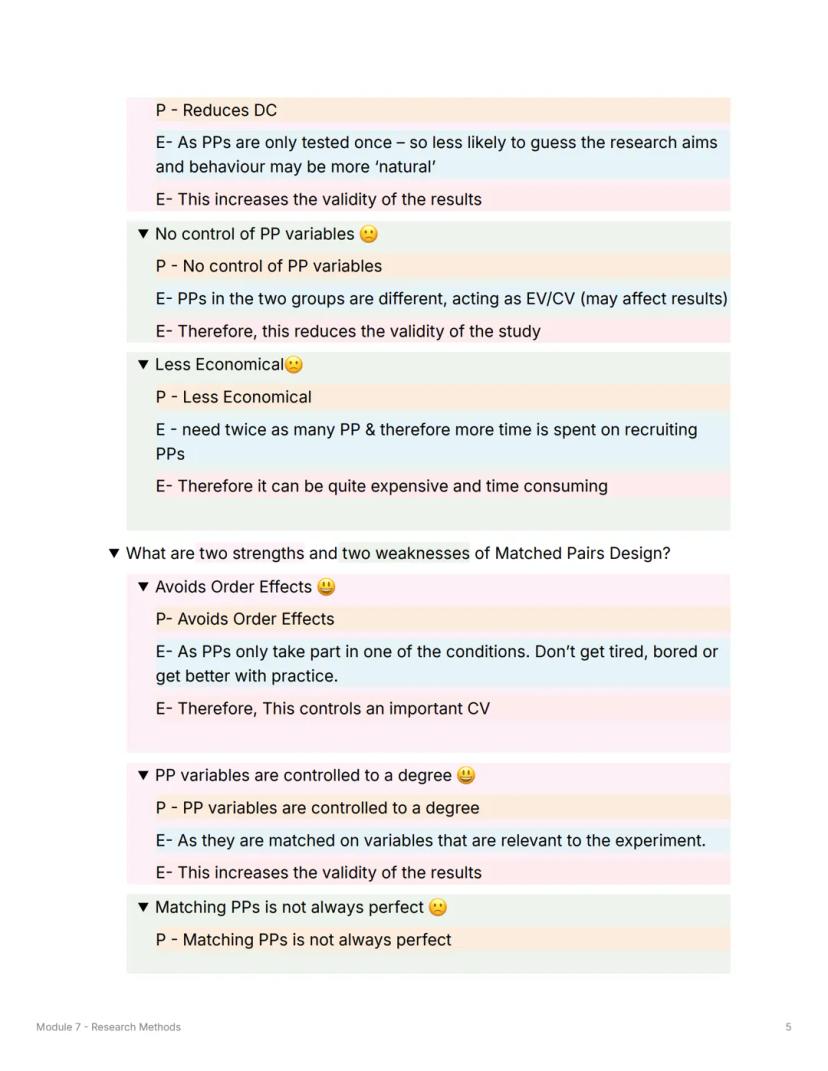
Matched pairs design tries to get the best of both worlds. You match participants on key variables (like IQ), then randomly allocate one from each pair to different conditions. It's clever but time-consuming and expensive since you need twice as many participants.
Study Hack: When evaluating any study, immediately identify which design was used - it'll help you spot potential issues with the results.
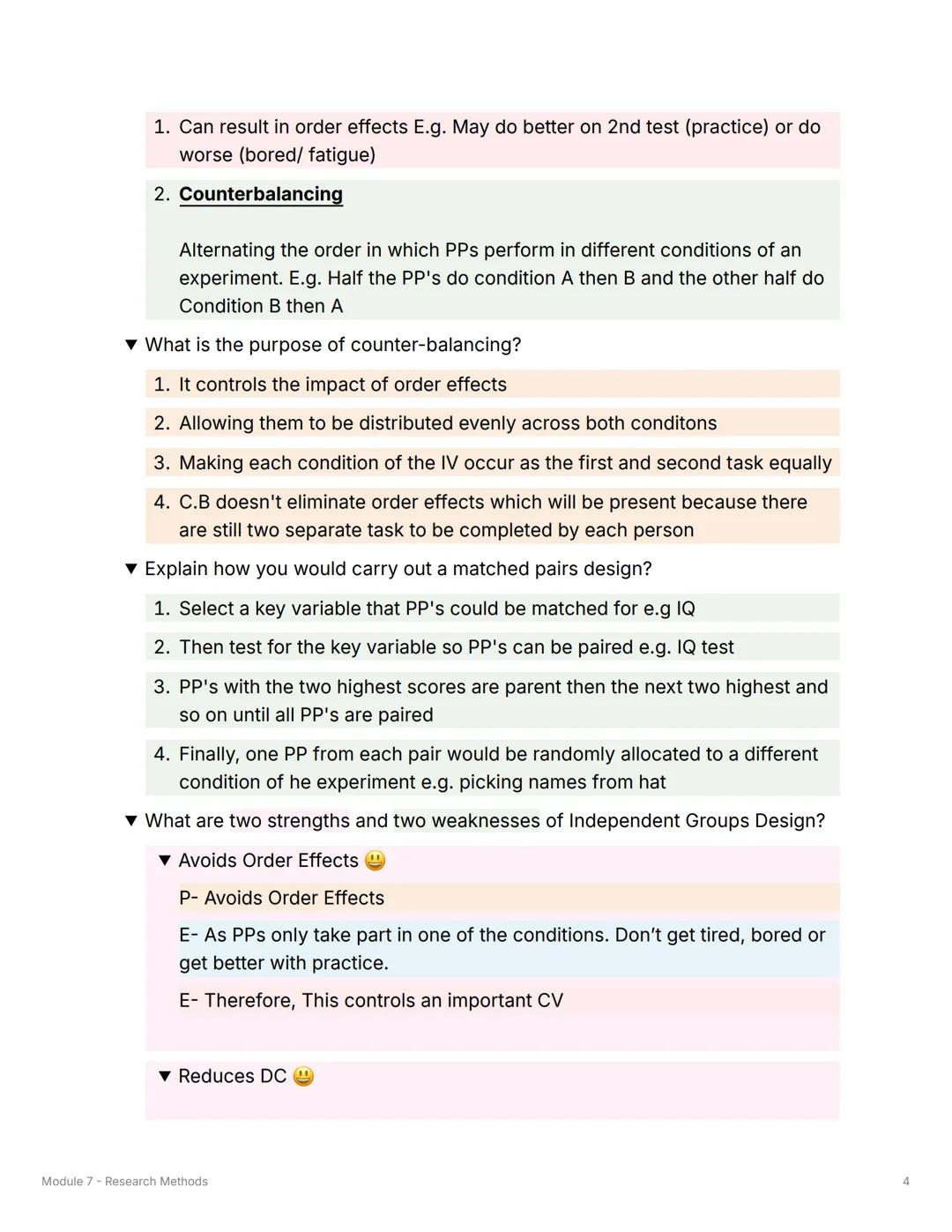
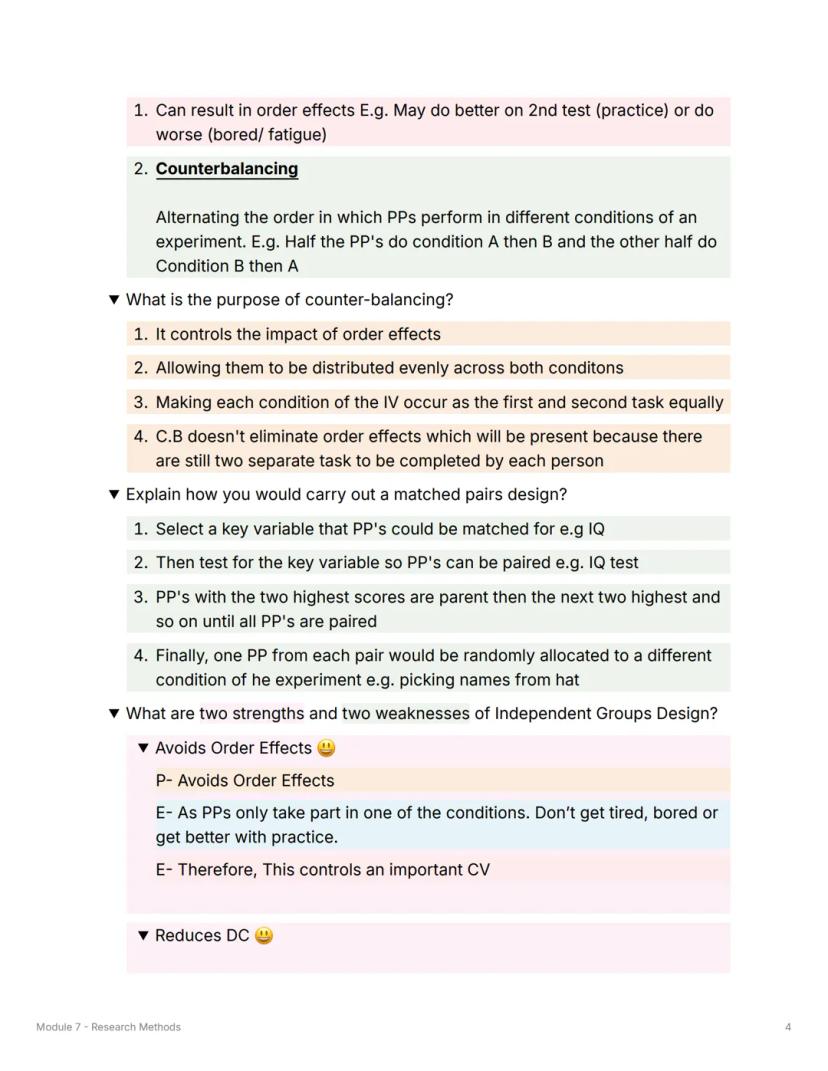
Let's break down what each experimental design actually means for your results. Independent measures avoids order effects completely and reduces demand characteristics since participants only see one condition. However, you can't control participant variables, and you need loads more people, making it expensive and time-consuming.
Counterbalancing in repeated measures doesn't eliminate order effects - it just distributes them evenly across conditions. This is crucial to understand because the effects are still there, just balanced out. The technique ensures each condition appears first and second equally often.
Setting up matched pairs requires several steps: first, identify key variables to match on (like IQ or age), then test all participants on these variables. Next, pair up participants with similar scores, and finally, randomly allocate one from each pair to different conditions - perhaps by picking names from a hat.
Each design represents a trade-off between different types of control and practical considerations. Repeated measures gives you maximum control over participant variables but creates order effects. Independent measures avoids order effects but loses control over participant differences. Matched pairs tries to balance both but requires much more effort and resources.
Exam Tip: Learn the standard evaluation points for each design - they come up repeatedly in exam questions and you can apply them to any study.
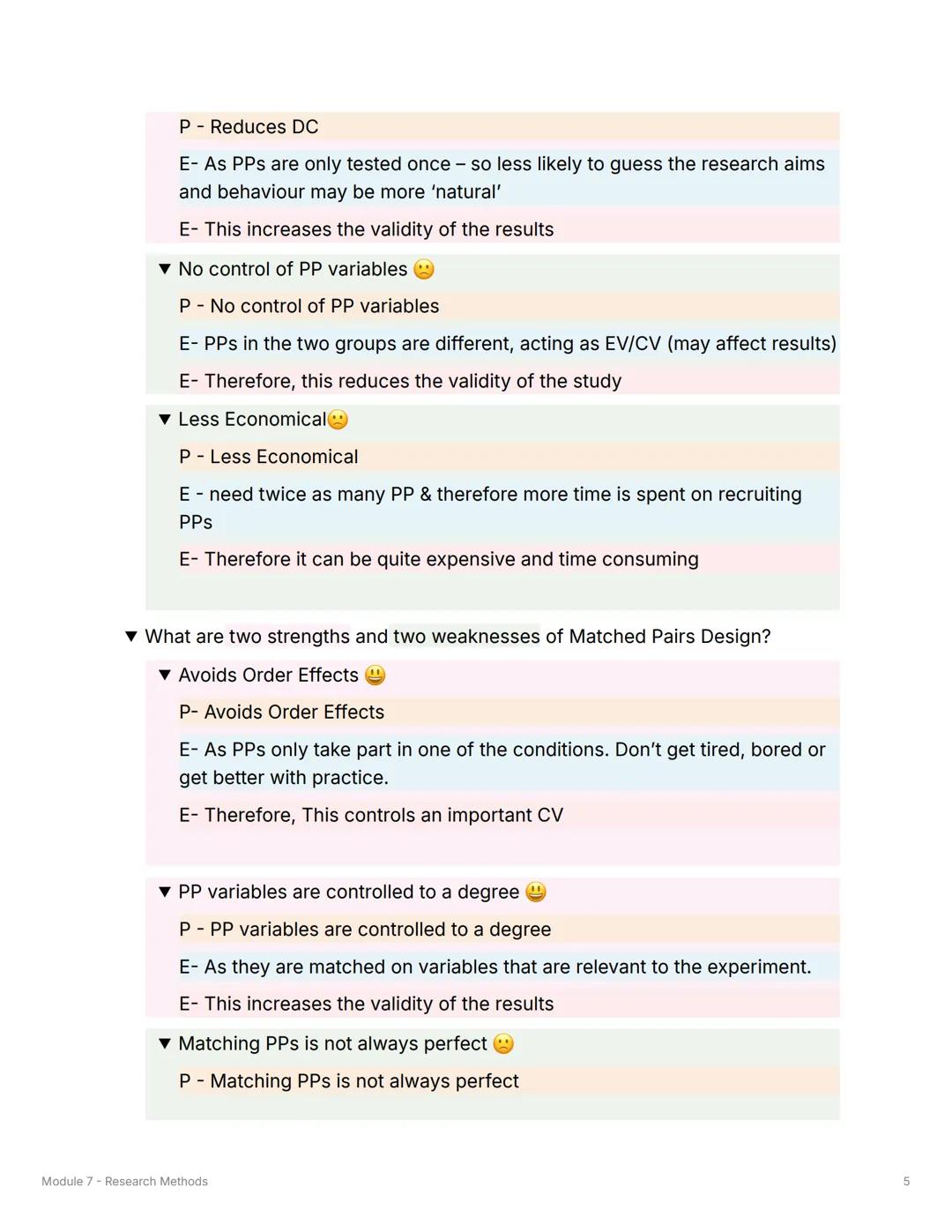
Matched pairs design shares some key advantages with independent measures - it avoids order effects since participants only do one condition, and it controls participant variables to some degree through the matching process. This increases the validity of your results compared to standard independent measures.
However, matching isn't perfect. It's incredibly time-consuming, and you can't match people on every relevant variable - there are simply too many potential individual differences. This means participant variables might still affect your results, just less than in independent measures.
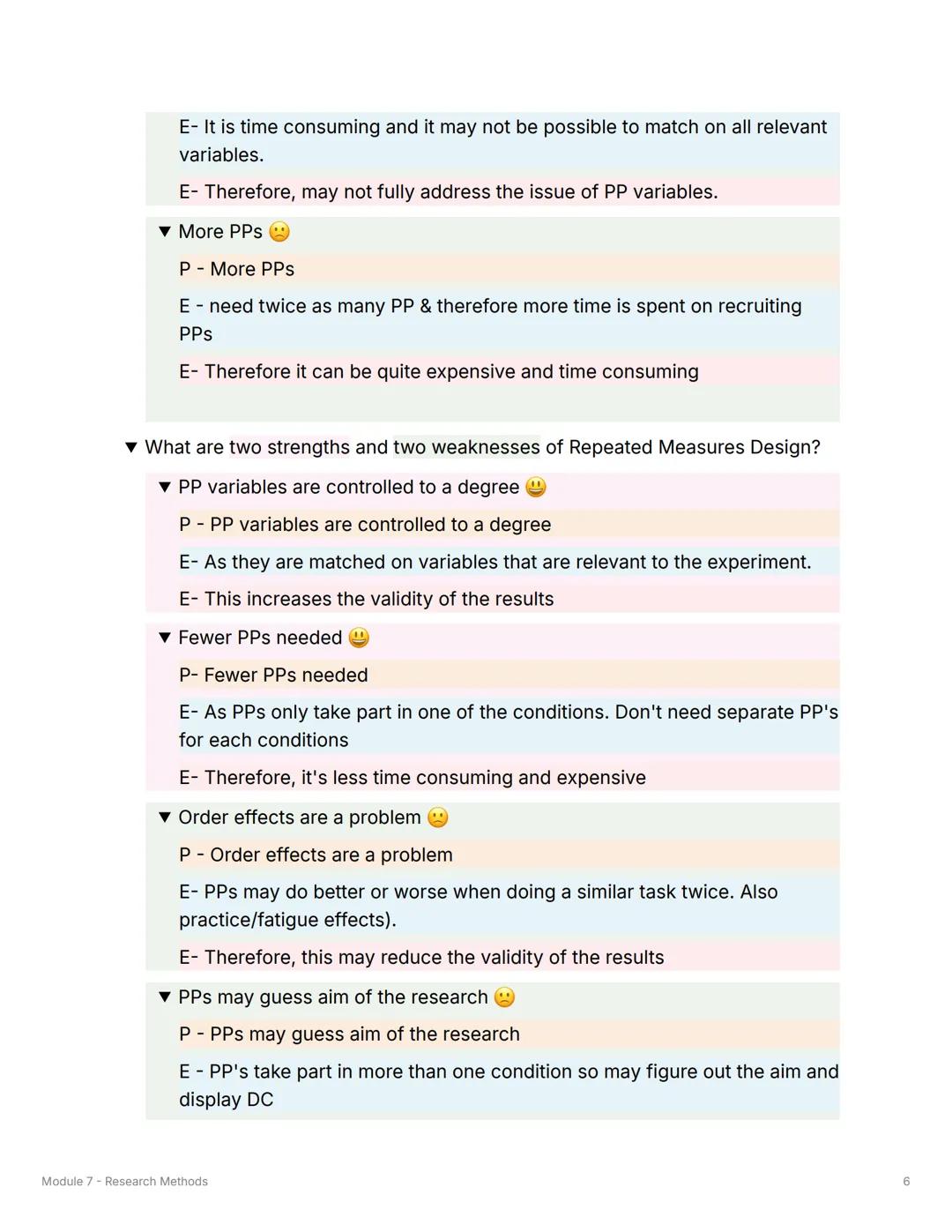
Repeated measures design gives you the ultimate control over participant variables since you're literally using the same people in each condition. It's also economical - you need far fewer participants since everyone does all conditions, saving time and money on recruitment.
The downside is significant though. Order effects become a major problem as participants might improve through practice or get worse through fatigue. There's also a higher risk of demand characteristics since participants experience multiple conditions and might figure out your hypothesis.
Key Point: No design is perfect - they all involve compromises between different types of control and practical limitations.
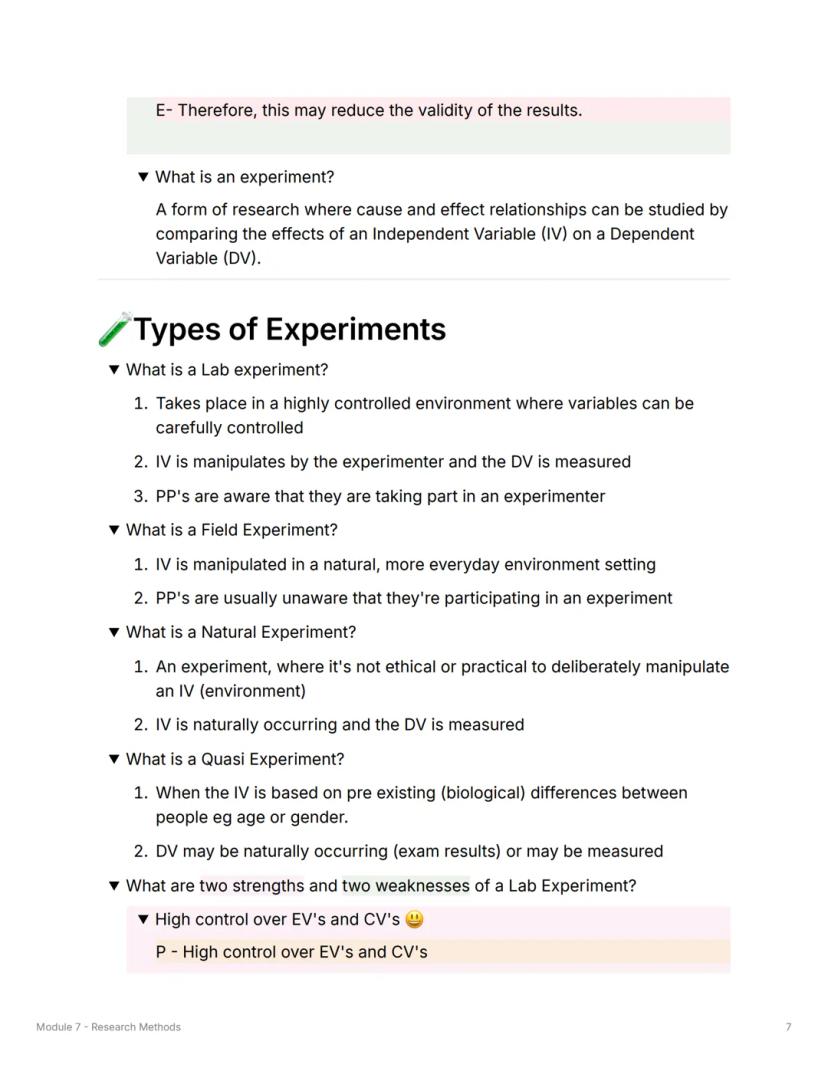
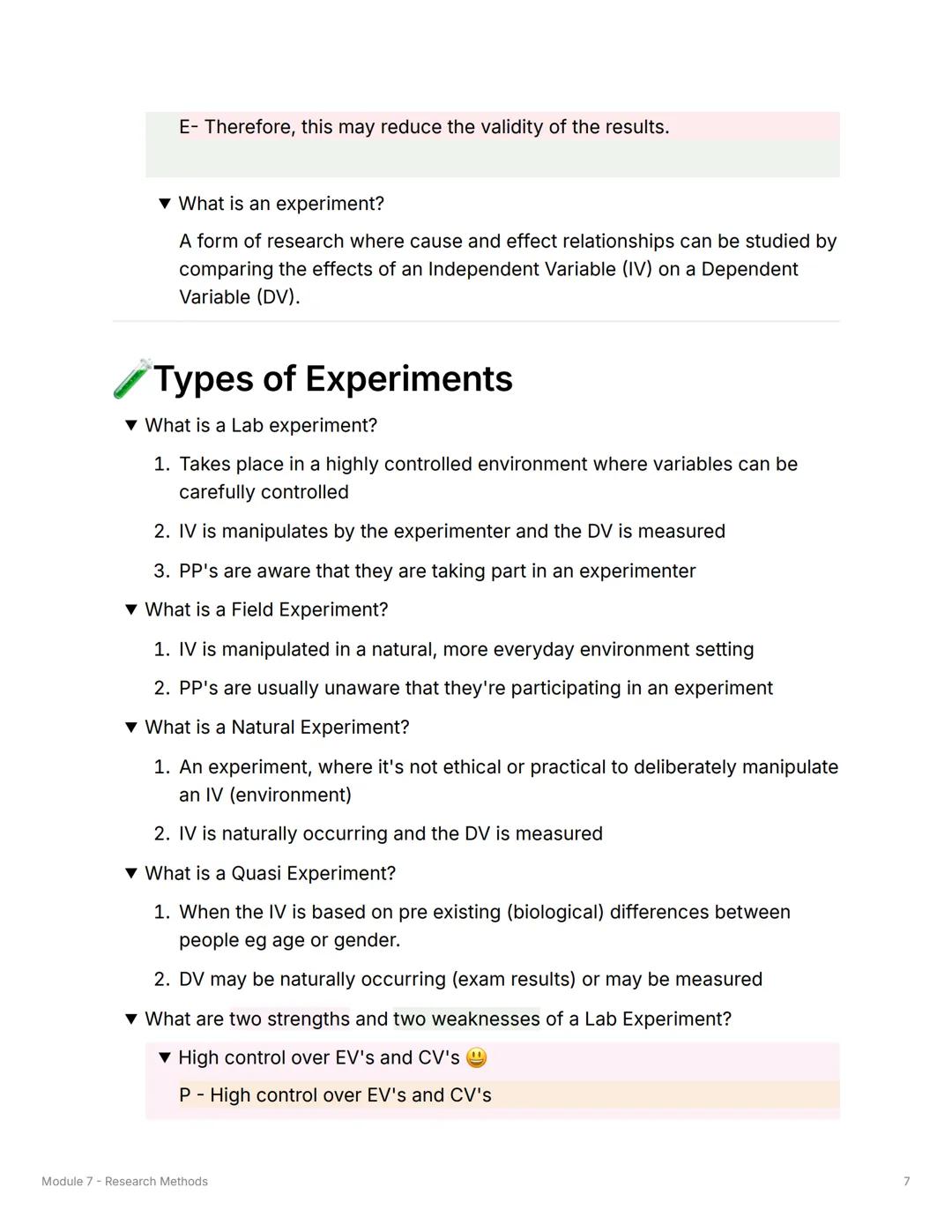
Understanding where experiments take place is just as important as how they're designed. Laboratory experiments happen in highly controlled environments where researchers can manipulate the IV precisely and control extraneous variables. Participants know they're in a study, which has both advantages and disadvantages.
Field experiments move into natural, everyday settings while still manipulating the IV. The key difference is that participants usually don't know they're being studied, which can produce more natural behaviour but raises ethical concerns.
Natural experiments occur when researchers can't or shouldn't manipulate the IV for ethical or practical reasons. Instead, they study naturally occurring events - like the effects of a natural disaster on stress levels. The IV happens naturally, and researchers just measure the DV.
Quasi experiments focus on pre-existing differences between people, like age or gender. You can't randomly allocate people to be male or female, so you work with these natural groupings. The DV might be naturally occurring (exam results) or measured specifically for the study.
Reality Check: Most real-world psychology research combines elements from different experiment types - pure laboratory studies are actually quite rare outside of controlled academic settings.
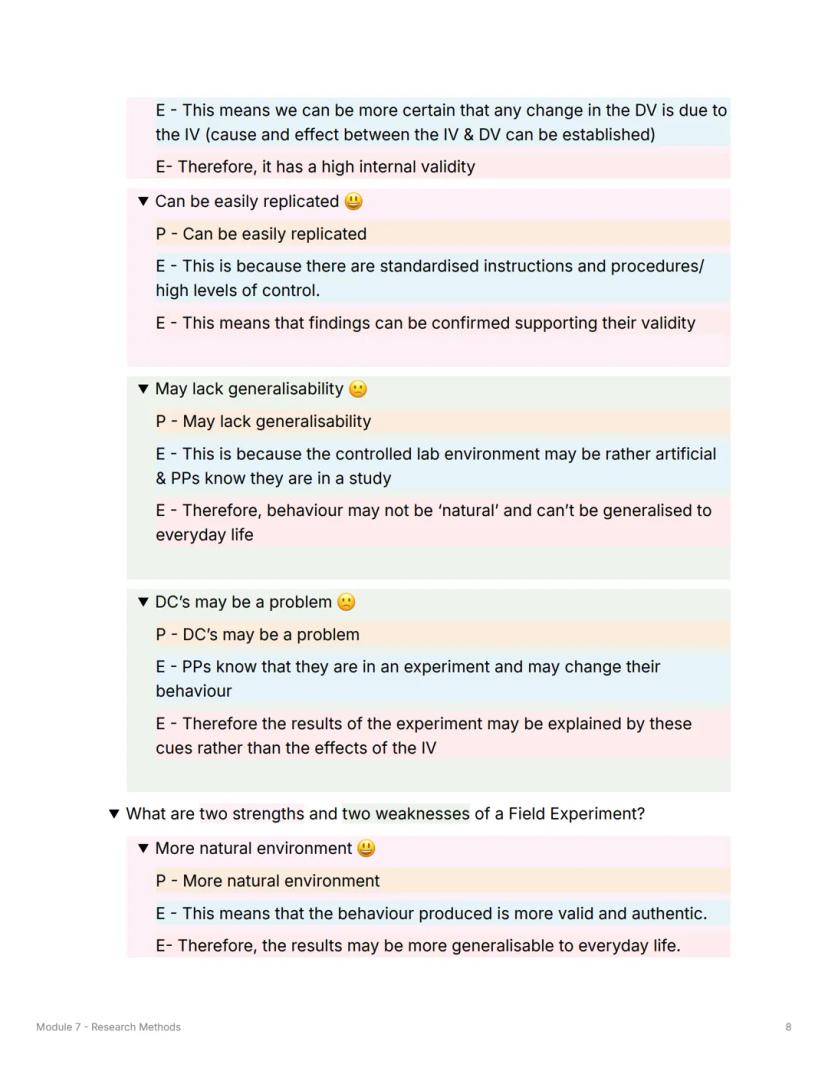
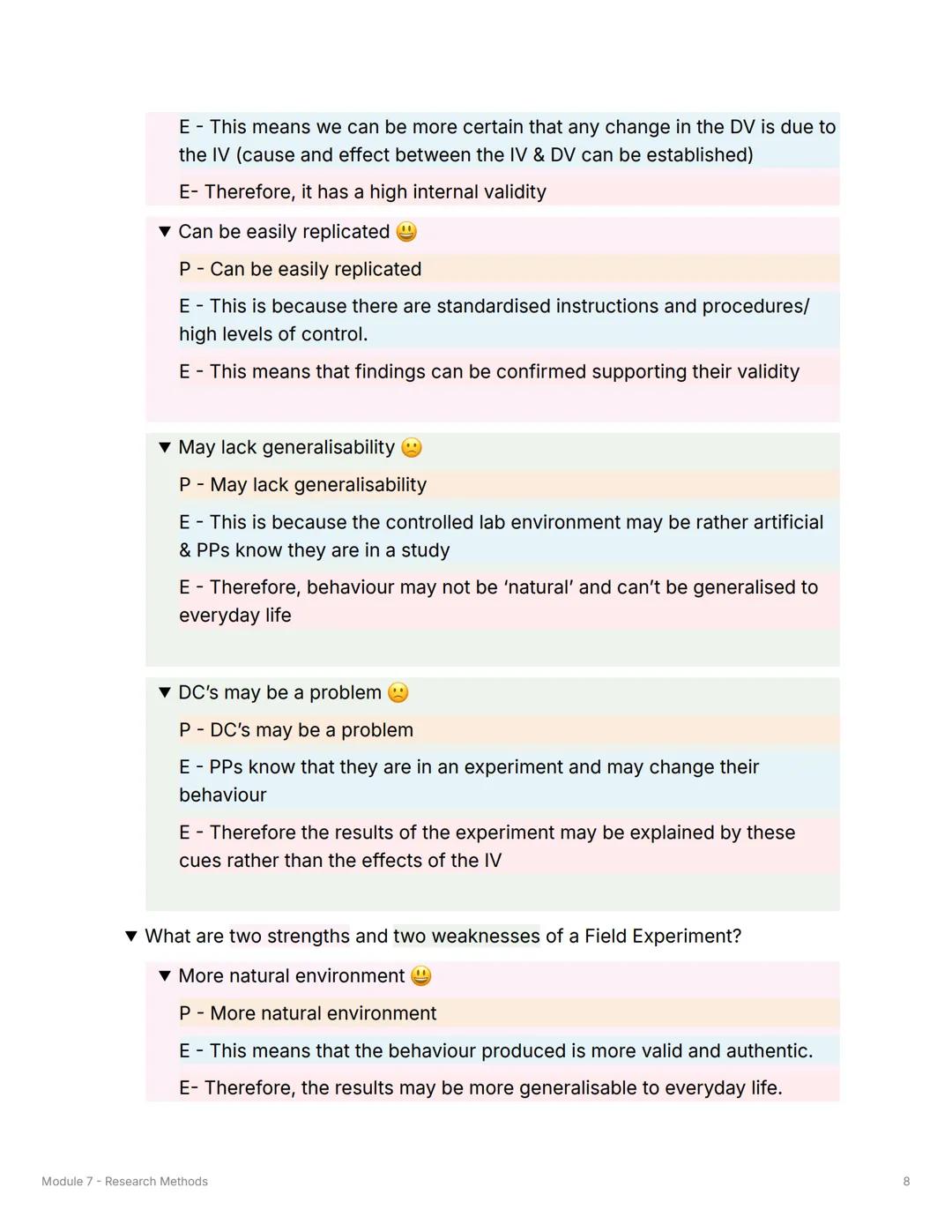
Laboratory experiments give you incredible control over extraneous and confounding variables, making it much easier to establish cause and effect between your IV and DV. This high internal validity is their biggest strength. They're also easy to replicate because of standardised procedures, helping confirm findings.
However, this control comes at a cost. The artificial lab environment might not reflect real life, and participants know they're being studied. This can make behaviour less natural and harder to generalise to everyday situations - a problem with external validity.
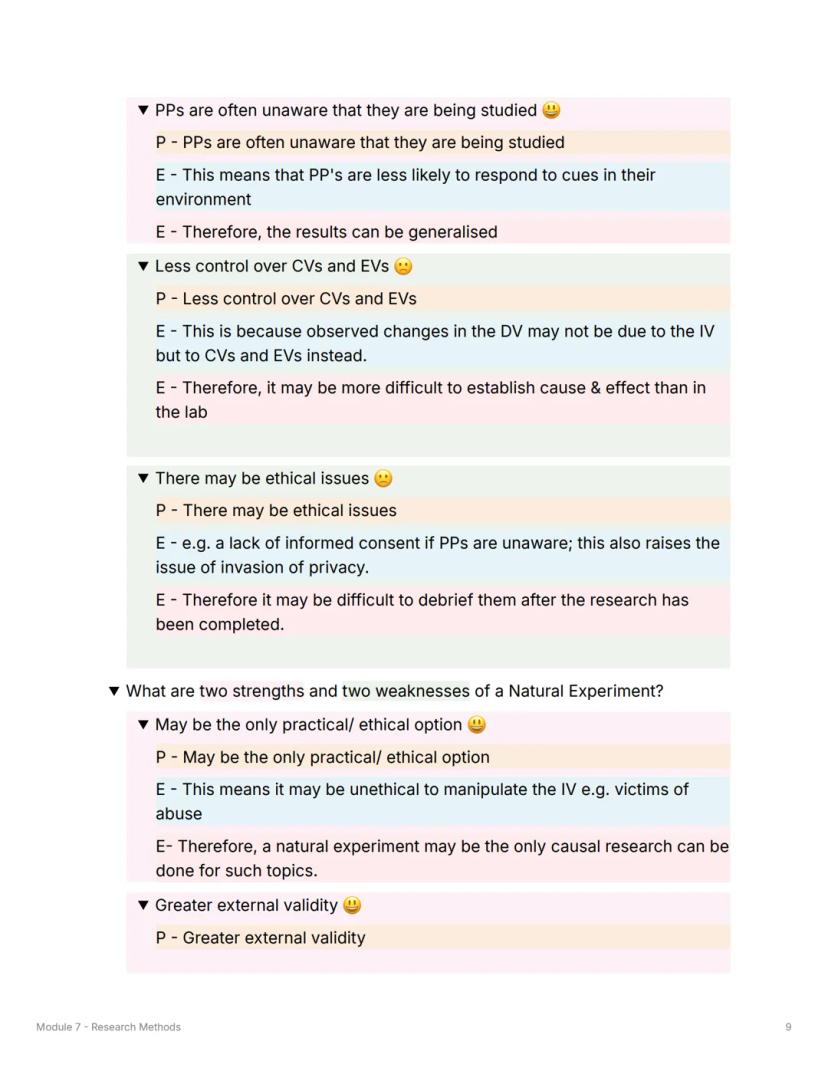
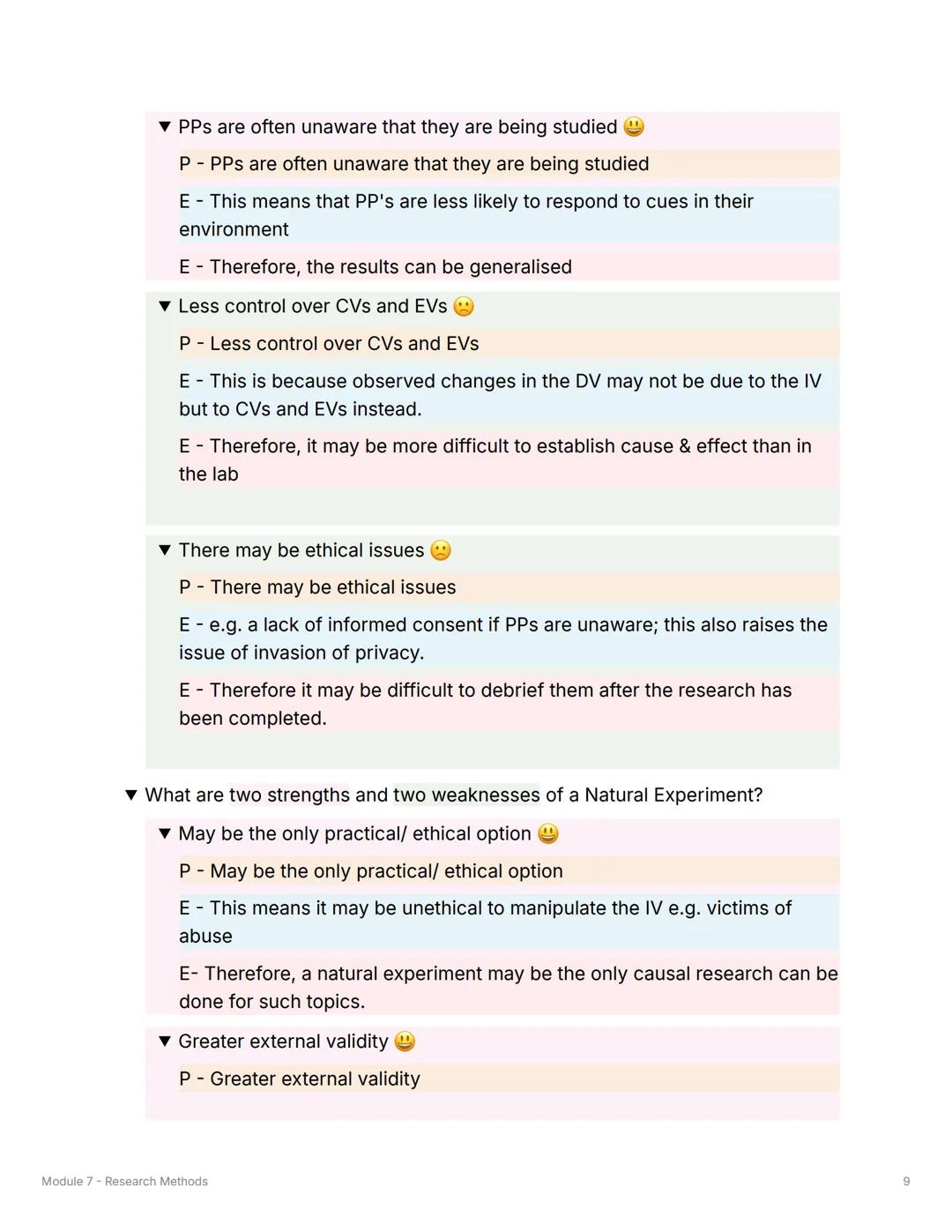
Field experiments flip these strengths and weaknesses. The natural environment produces more authentic behaviour that's easier to generalise to real life. Since participants often don't know they're being studied, demand characteristics are less of an issue.
But you lose control over confounding and extraneous variables, making it harder to establish clear cause and effect. There are also ethical concerns - lack of informed consent and potential invasion of privacy become serious issues when people don't know they're being studied.
Balance Point: The choice between lab and field experiments often comes down to prioritising internal validity (lab) versus external validity (field).
Sometimes natural experiments are your only ethical option. You can't deliberately abuse children to study trauma effects, but you can study children who have unfortunately experienced abuse naturally. This makes natural experiments crucial for researching sensitive topics that would be unethical to manipulate.
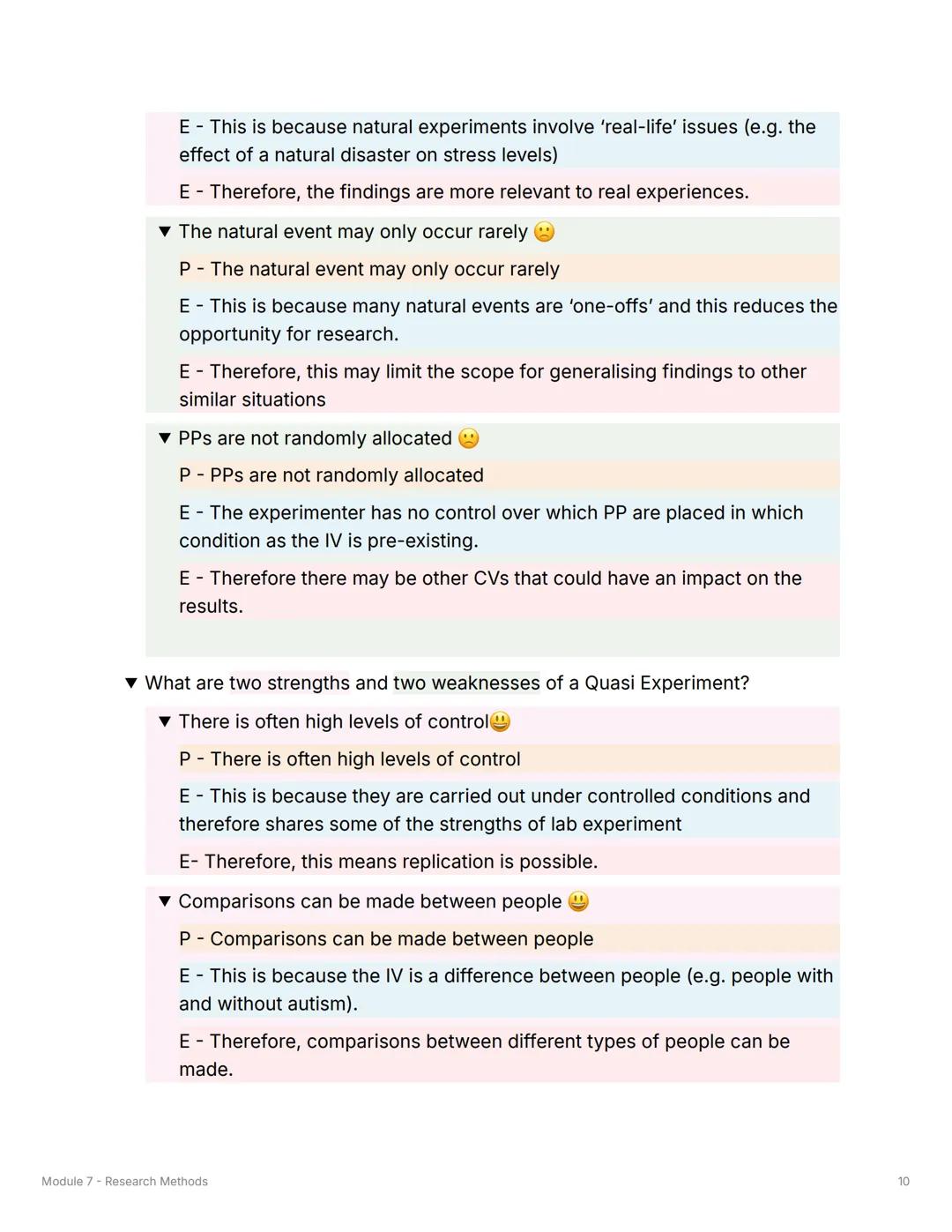
They also have excellent external validity because they involve real-life issues and events. When you study the effects of an actual natural disaster, your findings are highly relevant to real experiences and can inform practical interventions.
The downside is that natural events are often rare, one-off occurrences. This limits opportunities for research and makes it harder to generalise findings to other similar situations. You also can't randomly allocate participants since the event has already happened, potentially introducing confounding variables.
Quasi experiments often combine high levels of control (since they're usually conducted in controlled conditions) with the ability to make meaningful comparisons between different types of people. This is particularly valuable in areas like developmental psychology or mental health research.
Practical Application: Natural and quasi experiments are often the foundation for important social policies and interventions because they study real-world phenomena that directly affect people's lives.
Our AI Companion is a student-focused AI tool that offers more than just answers. Built on millions of Knowunity resources, it provides relevant information, personalised study plans, quizzes, and content directly in the chat, adapting to your individual learning journey.
You can download the app from Google Play Store and Apple App Store.
That's right! Enjoy free access to study content, connect with fellow students, and get instant help – all at your fingertips.
App Store
Google Play
The app is very easy to use and well designed. I have found everything I was looking for so far and have been able to learn a lot from the presentations! I will definitely use the app for a class assignment! And of course it also helps a lot as an inspiration.
Stefan S
iOS user
This app is really great. There are so many study notes and help [...]. My problem subject is French, for example, and the app has so many options for help. Thanks to this app, I have improved my French. I would recommend it to anyone.
Samantha Klich
Android user
Wow, I am really amazed. I just tried the app because I've seen it advertised many times and was absolutely stunned. This app is THE HELP you want for school and above all, it offers so many things, such as workouts and fact sheets, which have been VERY helpful to me personally.
Anna
iOS user
Best app on earth! no words because it’s too good
Thomas R
iOS user
Just amazing. Let's me revise 10x better, this app is a quick 10/10. I highly recommend it to anyone. I can watch and search for notes. I can save them in the subject folder. I can revise it any time when I come back. If you haven't tried this app, you're really missing out.
Basil
Android user
This app has made me feel so much more confident in my exam prep, not only through boosting my own self confidence through the features that allow you to connect with others and feel less alone, but also through the way the app itself is centred around making you feel better. It is easy to navigate, fun to use, and helpful to anyone struggling in absolutely any way.
David K
iOS user
The app's just great! All I have to do is enter the topic in the search bar and I get the response real fast. I don't have to watch 10 YouTube videos to understand something, so I'm saving my time. Highly recommended!
Sudenaz Ocak
Android user
In school I was really bad at maths but thanks to the app, I am doing better now. I am so grateful that you made the app.
Greenlight Bonnie
Android user
very reliable app to help and grow your ideas of Maths, English and other related topics in your works. please use this app if your struggling in areas, this app is key for that. wish I'd of done a review before. and it's also free so don't worry about that.
Rohan U
Android user
I know a lot of apps use fake accounts to boost their reviews but this app deserves it all. Originally I was getting 4 in my English exams and this time I got a grade 7. I didn’t even know about this app three days until the exam and it has helped A LOT. Please actually trust me and use it as I’m sure you too will see developments.
Xander S
iOS user
THE QUIZES AND FLASHCARDS ARE SO USEFUL AND I LOVE Knowunity AI. IT ALSO IS LITREALLY LIKE CHATGPT BUT SMARTER!! HELPED ME WITH MY MASCARA PROBLEMS TOO!! AS WELL AS MY REAL SUBJECTS ! DUHHH 😍😁😲🤑💗✨🎀😮
Elisha
iOS user
This apps acc the goat. I find revision so boring but this app makes it so easy to organize it all and then you can ask the freeeee ai to test yourself so good and you can easily upload your own stuff. highly recommend as someone taking mocks now
Paul T
iOS user
The app is very easy to use and well designed. I have found everything I was looking for so far and have been able to learn a lot from the presentations! I will definitely use the app for a class assignment! And of course it also helps a lot as an inspiration.
Stefan S
iOS user
This app is really great. There are so many study notes and help [...]. My problem subject is French, for example, and the app has so many options for help. Thanks to this app, I have improved my French. I would recommend it to anyone.
Samantha Klich
Android user
Wow, I am really amazed. I just tried the app because I've seen it advertised many times and was absolutely stunned. This app is THE HELP you want for school and above all, it offers so many things, such as workouts and fact sheets, which have been VERY helpful to me personally.
Anna
iOS user
Best app on earth! no words because it’s too good
Thomas R
iOS user
Just amazing. Let's me revise 10x better, this app is a quick 10/10. I highly recommend it to anyone. I can watch and search for notes. I can save them in the subject folder. I can revise it any time when I come back. If you haven't tried this app, you're really missing out.
Basil
Android user
This app has made me feel so much more confident in my exam prep, not only through boosting my own self confidence through the features that allow you to connect with others and feel less alone, but also through the way the app itself is centred around making you feel better. It is easy to navigate, fun to use, and helpful to anyone struggling in absolutely any way.
David K
iOS user
The app's just great! All I have to do is enter the topic in the search bar and I get the response real fast. I don't have to watch 10 YouTube videos to understand something, so I'm saving my time. Highly recommended!
Sudenaz Ocak
Android user
In school I was really bad at maths but thanks to the app, I am doing better now. I am so grateful that you made the app.
Greenlight Bonnie
Android user
very reliable app to help and grow your ideas of Maths, English and other related topics in your works. please use this app if your struggling in areas, this app is key for that. wish I'd of done a review before. and it's also free so don't worry about that.
Rohan U
Android user
I know a lot of apps use fake accounts to boost their reviews but this app deserves it all. Originally I was getting 4 in my English exams and this time I got a grade 7. I didn’t even know about this app three days until the exam and it has helped A LOT. Please actually trust me and use it as I’m sure you too will see developments.
Xander S
iOS user
THE QUIZES AND FLASHCARDS ARE SO USEFUL AND I LOVE Knowunity AI. IT ALSO IS LITREALLY LIKE CHATGPT BUT SMARTER!! HELPED ME WITH MY MASCARA PROBLEMS TOO!! AS WELL AS MY REAL SUBJECTS ! DUHHH 😍😁😲🤑💗✨🎀😮
Elisha
iOS user
This apps acc the goat. I find revision so boring but this app makes it so easy to organize it all and then you can ask the freeeee ai to test yourself so good and you can easily upload your own stuff. highly recommend as someone taking mocks now
Paul T
iOS user
Zainab
@zainab_02839
Understanding research methods is crucial for your Psychology A-Level - it's not just theory, but the foundation for evaluating every study you'll encounter. This module breaks down how psychologists design experiments, control variables, and ensure their findings are reliable and... Show more
Access to all documents
Improve your grades
Join milions of students
Every psychology experiment starts with a clear aim - basically, what the researcher wants to find out. Think of it as the big question they're trying to answer. From this aim, researchers create a hypothesis, which is their educated guess about what they expect to discover.
There are two types of hypotheses you need to know. A directional hypothesis predicts exactly what will happen - like "students will perform better after drinking coffee." A non-directional hypothesis just says there'll be a difference without specifying which way - "there will be a difference in performance between students who drink coffee and those who don't."
The key to any experiment is identifying your variables correctly. The independent variable (IV) is what you change or manipulate - in our example, whether students drink coffee or not. The dependent variable (DV) is what you measure - their test performance. Both variables must be operationalised, meaning defined so specifically that anyone could measure them exactly the same way.
Quick Tip: Always ask yourself - could another researcher replicate this study using my definitions? If not, your variables aren't operationalised enough!
Access to all documents
Improve your grades
Join milions of students
Here's where experiments can go wrong if you're not careful. Extraneous variables are anything other than your IV that might mess with your DV. When these change systematically with your IV, they become confounding variables - the real troublemakers that can ruin your results.
Participant variables include individual differences like age, mood, or intelligence that could affect results. Situational variables are environmental factors - think noise, temperature, or time of day. Both can seriously impact your findings if not controlled properly.
You also need to watch out for investigator effects (when researchers accidentally influence participants) and demand characteristics (when participants figure out what you're looking for and change their behaviour). Social desirability effects happen when people try to look good or deliberately sabotage your study.
The solution? Randomisation uses chance to allocate participants and reduce bias, while standardisation ensures everyone gets exactly the same experience. These aren't just fancy terms - they're your tools for getting reliable results.
Remember: A well-controlled experiment is like a fair test - everyone gets the same treatment except for the one thing you're actually studying.
Access to all documents
Improve your grades
Join milions of students
Now for the big question - how do you organise your participants? You've got three main experimental designs to choose from, each with distinct advantages and problems you need to solve.
Independent measures design uses different participants for each condition. It's straightforward but creates issues with participant variables - your groups might be naturally different. The fix? Random allocation to spread individual differences evenly across conditions.
Repeated measures design uses the same participants in all conditions, which is great for controlling participant variables. However, you'll face order effects - people might do better the second time due to practice, or worse due to fatigue. Counterbalancing solves this by having half your participants do condition A then B, while the other half does B then A.
Matched pairs design tries to get the best of both worlds. You match participants on key variables (like IQ), then randomly allocate one from each pair to different conditions. It's clever but time-consuming and expensive since you need twice as many participants.
Study Hack: When evaluating any study, immediately identify which design was used - it'll help you spot potential issues with the results.
Access to all documents
Improve your grades
Join milions of students
Let's break down what each experimental design actually means for your results. Independent measures avoids order effects completely and reduces demand characteristics since participants only see one condition. However, you can't control participant variables, and you need loads more people, making it expensive and time-consuming.
Counterbalancing in repeated measures doesn't eliminate order effects - it just distributes them evenly across conditions. This is crucial to understand because the effects are still there, just balanced out. The technique ensures each condition appears first and second equally often.
Setting up matched pairs requires several steps: first, identify key variables to match on (like IQ or age), then test all participants on these variables. Next, pair up participants with similar scores, and finally, randomly allocate one from each pair to different conditions - perhaps by picking names from a hat.
Each design represents a trade-off between different types of control and practical considerations. Repeated measures gives you maximum control over participant variables but creates order effects. Independent measures avoids order effects but loses control over participant differences. Matched pairs tries to balance both but requires much more effort and resources.
Exam Tip: Learn the standard evaluation points for each design - they come up repeatedly in exam questions and you can apply them to any study.
Access to all documents
Improve your grades
Join milions of students
Matched pairs design shares some key advantages with independent measures - it avoids order effects since participants only do one condition, and it controls participant variables to some degree through the matching process. This increases the validity of your results compared to standard independent measures.
However, matching isn't perfect. It's incredibly time-consuming, and you can't match people on every relevant variable - there are simply too many potential individual differences. This means participant variables might still affect your results, just less than in independent measures.
Repeated measures design gives you the ultimate control over participant variables since you're literally using the same people in each condition. It's also economical - you need far fewer participants since everyone does all conditions, saving time and money on recruitment.
The downside is significant though. Order effects become a major problem as participants might improve through practice or get worse through fatigue. There's also a higher risk of demand characteristics since participants experience multiple conditions and might figure out your hypothesis.
Key Point: No design is perfect - they all involve compromises between different types of control and practical limitations.
Access to all documents
Improve your grades
Join milions of students
Understanding where experiments take place is just as important as how they're designed. Laboratory experiments happen in highly controlled environments where researchers can manipulate the IV precisely and control extraneous variables. Participants know they're in a study, which has both advantages and disadvantages.
Field experiments move into natural, everyday settings while still manipulating the IV. The key difference is that participants usually don't know they're being studied, which can produce more natural behaviour but raises ethical concerns.
Natural experiments occur when researchers can't or shouldn't manipulate the IV for ethical or practical reasons. Instead, they study naturally occurring events - like the effects of a natural disaster on stress levels. The IV happens naturally, and researchers just measure the DV.
Quasi experiments focus on pre-existing differences between people, like age or gender. You can't randomly allocate people to be male or female, so you work with these natural groupings. The DV might be naturally occurring (exam results) or measured specifically for the study.
Reality Check: Most real-world psychology research combines elements from different experiment types - pure laboratory studies are actually quite rare outside of controlled academic settings.
Access to all documents
Improve your grades
Join milions of students
Laboratory experiments give you incredible control over extraneous and confounding variables, making it much easier to establish cause and effect between your IV and DV. This high internal validity is their biggest strength. They're also easy to replicate because of standardised procedures, helping confirm findings.
However, this control comes at a cost. The artificial lab environment might not reflect real life, and participants know they're being studied. This can make behaviour less natural and harder to generalise to everyday situations - a problem with external validity.
Field experiments flip these strengths and weaknesses. The natural environment produces more authentic behaviour that's easier to generalise to real life. Since participants often don't know they're being studied, demand characteristics are less of an issue.
But you lose control over confounding and extraneous variables, making it harder to establish clear cause and effect. There are also ethical concerns - lack of informed consent and potential invasion of privacy become serious issues when people don't know they're being studied.
Balance Point: The choice between lab and field experiments often comes down to prioritising internal validity (lab) versus external validity (field).
Access to all documents
Improve your grades
Join milions of students
Sometimes natural experiments are your only ethical option. You can't deliberately abuse children to study trauma effects, but you can study children who have unfortunately experienced abuse naturally. This makes natural experiments crucial for researching sensitive topics that would be unethical to manipulate.
They also have excellent external validity because they involve real-life issues and events. When you study the effects of an actual natural disaster, your findings are highly relevant to real experiences and can inform practical interventions.
The downside is that natural events are often rare, one-off occurrences. This limits opportunities for research and makes it harder to generalise findings to other similar situations. You also can't randomly allocate participants since the event has already happened, potentially introducing confounding variables.
Quasi experiments often combine high levels of control (since they're usually conducted in controlled conditions) with the ability to make meaningful comparisons between different types of people. This is particularly valuable in areas like developmental psychology or mental health research.
Practical Application: Natural and quasi experiments are often the foundation for important social policies and interventions because they study real-world phenomena that directly affect people's lives.
Access to all documents
Improve your grades
Join milions of students
Access to all documents
Improve your grades
Join milions of students
Our AI Companion is a student-focused AI tool that offers more than just answers. Built on millions of Knowunity resources, it provides relevant information, personalised study plans, quizzes, and content directly in the chat, adapting to your individual learning journey.
You can download the app from Google Play Store and Apple App Store.
That's right! Enjoy free access to study content, connect with fellow students, and get instant help – all at your fingertips.
4
Smart Tools NEW
Transform this note into: ✓ 50+ Practice Questions ✓ Interactive Flashcards ✓ Full Mock Exam ✓ Essay Outlines
App Store
Google Play
The app is very easy to use and well designed. I have found everything I was looking for so far and have been able to learn a lot from the presentations! I will definitely use the app for a class assignment! And of course it also helps a lot as an inspiration.
Stefan S
iOS user
This app is really great. There are so many study notes and help [...]. My problem subject is French, for example, and the app has so many options for help. Thanks to this app, I have improved my French. I would recommend it to anyone.
Samantha Klich
Android user
Wow, I am really amazed. I just tried the app because I've seen it advertised many times and was absolutely stunned. This app is THE HELP you want for school and above all, it offers so many things, such as workouts and fact sheets, which have been VERY helpful to me personally.
Anna
iOS user
Best app on earth! no words because it’s too good
Thomas R
iOS user
Just amazing. Let's me revise 10x better, this app is a quick 10/10. I highly recommend it to anyone. I can watch and search for notes. I can save them in the subject folder. I can revise it any time when I come back. If you haven't tried this app, you're really missing out.
Basil
Android user
This app has made me feel so much more confident in my exam prep, not only through boosting my own self confidence through the features that allow you to connect with others and feel less alone, but also through the way the app itself is centred around making you feel better. It is easy to navigate, fun to use, and helpful to anyone struggling in absolutely any way.
David K
iOS user
The app's just great! All I have to do is enter the topic in the search bar and I get the response real fast. I don't have to watch 10 YouTube videos to understand something, so I'm saving my time. Highly recommended!
Sudenaz Ocak
Android user
In school I was really bad at maths but thanks to the app, I am doing better now. I am so grateful that you made the app.
Greenlight Bonnie
Android user
very reliable app to help and grow your ideas of Maths, English and other related topics in your works. please use this app if your struggling in areas, this app is key for that. wish I'd of done a review before. and it's also free so don't worry about that.
Rohan U
Android user
I know a lot of apps use fake accounts to boost their reviews but this app deserves it all. Originally I was getting 4 in my English exams and this time I got a grade 7. I didn’t even know about this app three days until the exam and it has helped A LOT. Please actually trust me and use it as I’m sure you too will see developments.
Xander S
iOS user
THE QUIZES AND FLASHCARDS ARE SO USEFUL AND I LOVE Knowunity AI. IT ALSO IS LITREALLY LIKE CHATGPT BUT SMARTER!! HELPED ME WITH MY MASCARA PROBLEMS TOO!! AS WELL AS MY REAL SUBJECTS ! DUHHH 😍😁😲🤑💗✨🎀😮
Elisha
iOS user
This apps acc the goat. I find revision so boring but this app makes it so easy to organize it all and then you can ask the freeeee ai to test yourself so good and you can easily upload your own stuff. highly recommend as someone taking mocks now
Paul T
iOS user
The app is very easy to use and well designed. I have found everything I was looking for so far and have been able to learn a lot from the presentations! I will definitely use the app for a class assignment! And of course it also helps a lot as an inspiration.
Stefan S
iOS user
This app is really great. There are so many study notes and help [...]. My problem subject is French, for example, and the app has so many options for help. Thanks to this app, I have improved my French. I would recommend it to anyone.
Samantha Klich
Android user
Wow, I am really amazed. I just tried the app because I've seen it advertised many times and was absolutely stunned. This app is THE HELP you want for school and above all, it offers so many things, such as workouts and fact sheets, which have been VERY helpful to me personally.
Anna
iOS user
Best app on earth! no words because it’s too good
Thomas R
iOS user
Just amazing. Let's me revise 10x better, this app is a quick 10/10. I highly recommend it to anyone. I can watch and search for notes. I can save them in the subject folder. I can revise it any time when I come back. If you haven't tried this app, you're really missing out.
Basil
Android user
This app has made me feel so much more confident in my exam prep, not only through boosting my own self confidence through the features that allow you to connect with others and feel less alone, but also through the way the app itself is centred around making you feel better. It is easy to navigate, fun to use, and helpful to anyone struggling in absolutely any way.
David K
iOS user
The app's just great! All I have to do is enter the topic in the search bar and I get the response real fast. I don't have to watch 10 YouTube videos to understand something, so I'm saving my time. Highly recommended!
Sudenaz Ocak
Android user
In school I was really bad at maths but thanks to the app, I am doing better now. I am so grateful that you made the app.
Greenlight Bonnie
Android user
very reliable app to help and grow your ideas of Maths, English and other related topics in your works. please use this app if your struggling in areas, this app is key for that. wish I'd of done a review before. and it's also free so don't worry about that.
Rohan U
Android user
I know a lot of apps use fake accounts to boost their reviews but this app deserves it all. Originally I was getting 4 in my English exams and this time I got a grade 7. I didn’t even know about this app three days until the exam and it has helped A LOT. Please actually trust me and use it as I’m sure you too will see developments.
Xander S
iOS user
THE QUIZES AND FLASHCARDS ARE SO USEFUL AND I LOVE Knowunity AI. IT ALSO IS LITREALLY LIKE CHATGPT BUT SMARTER!! HELPED ME WITH MY MASCARA PROBLEMS TOO!! AS WELL AS MY REAL SUBJECTS ! DUHHH 😍😁😲🤑💗✨🎀😮
Elisha
iOS user
This apps acc the goat. I find revision so boring but this app makes it so easy to organize it all and then you can ask the freeeee ai to test yourself so good and you can easily upload your own stuff. highly recommend as someone taking mocks now
Paul T
iOS user