
Ever wondered what makes behaviour "abnormal" or how we can... Show more
 Psychology
 Sociology
Sign up to see the contentIt's free!
Access to all documents
Improve your grades
Join milions of students
By signing up you accept Terms of Service and Privacy Policy
Subjects

Maths

Chemistry

Biology

English Language

History
Responding to change (a2 only)
Infection and response
Homeostasis and response
Energy transfers (a2 only)
Cell biology
Organisms respond to changes in their internal and external environments (a-level only)
Biological molecules
Organisation
Substance exchange
Bioenergetics
Genetic information & variation
Inheritance, variation and evolution
Genetics & ecosystems (a2 only)
Ecology
Cells
Show all topics
Britain & the wider world: 1745 -1901
1l the quest for political stability: germany, 1871-1991
The cold war
Inter-war germany
Medieval period: 1066 -1509
2d religious conflict and the church in england, c1529-c1570
2o democracy and nazism: germany, 1918-1945
1f industrialisation and the people: britain, c1783-1885
1c the tudors: england, 1485-1603
2m wars and welfare: britain in transition, 1906-1957
World war two & the holocaust
2n revolution and dictatorship: russia, 1917-1953
2s the making of modern britain, 1951-2007
World war one
Britain: 1509 -1745
Show all topics
19
1

zara!!
06/12/2025
Psychology
psychopathology topic notes
719
•
6 Dec 2025
•
zara!!
@zara.louisee
Ever wondered what makes behaviour "abnormal" or how we can... Show more
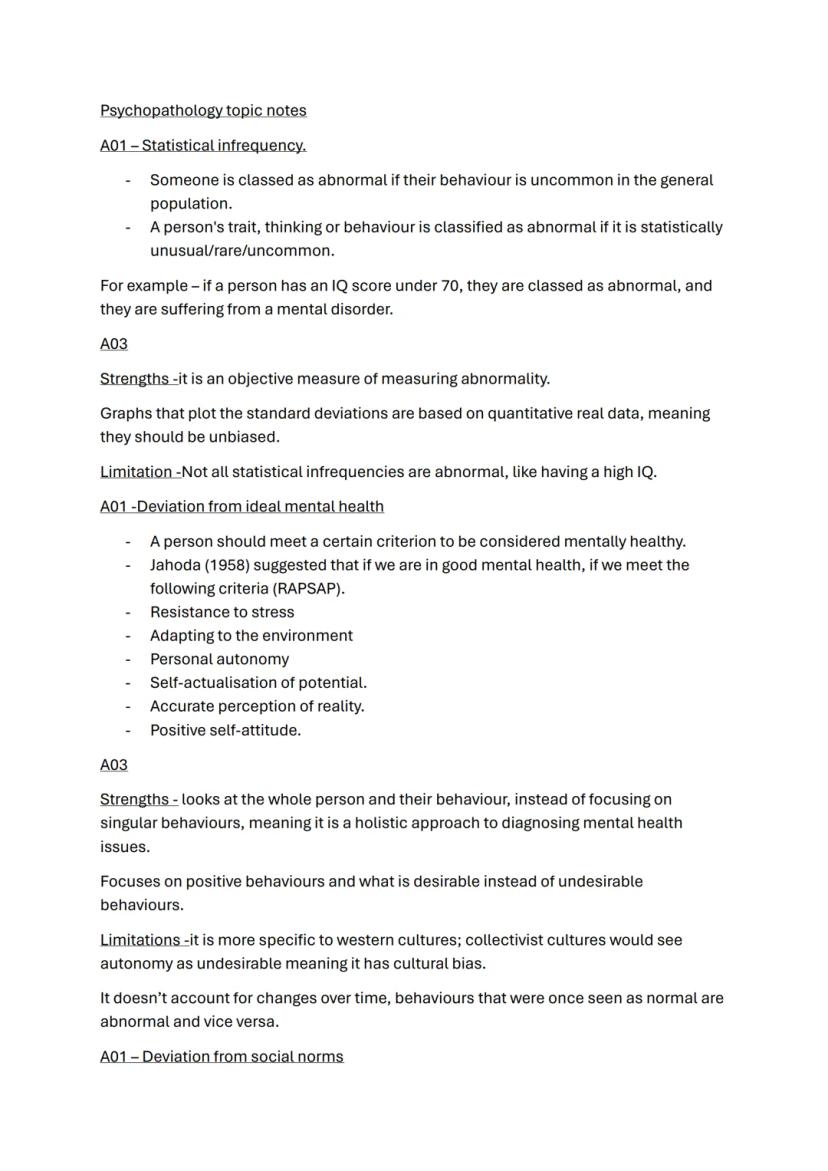




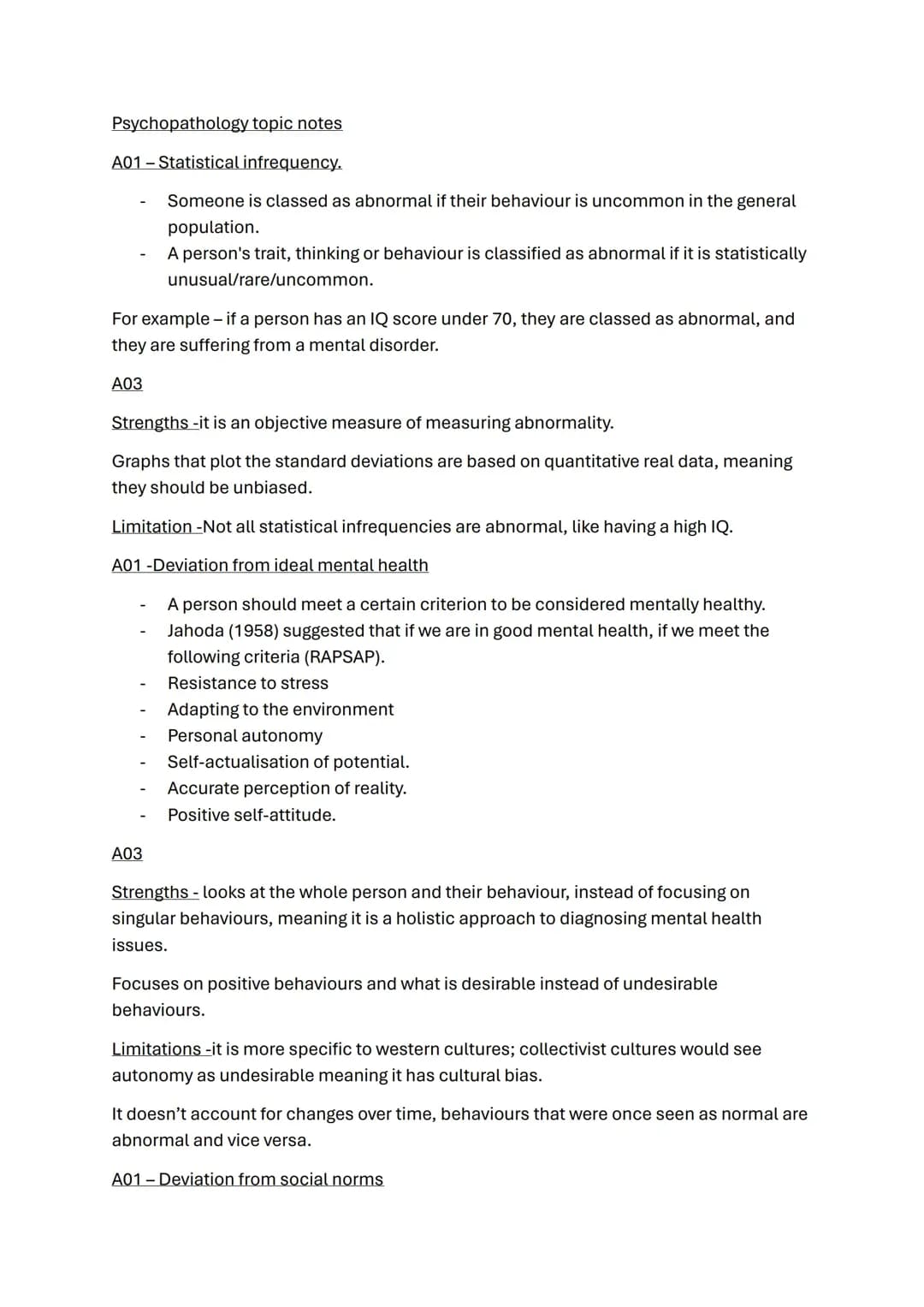
Psychology doesn't have a simple answer to "what's abnormal?" Instead, there are four main ways to define it, each with their own strengths and problems.
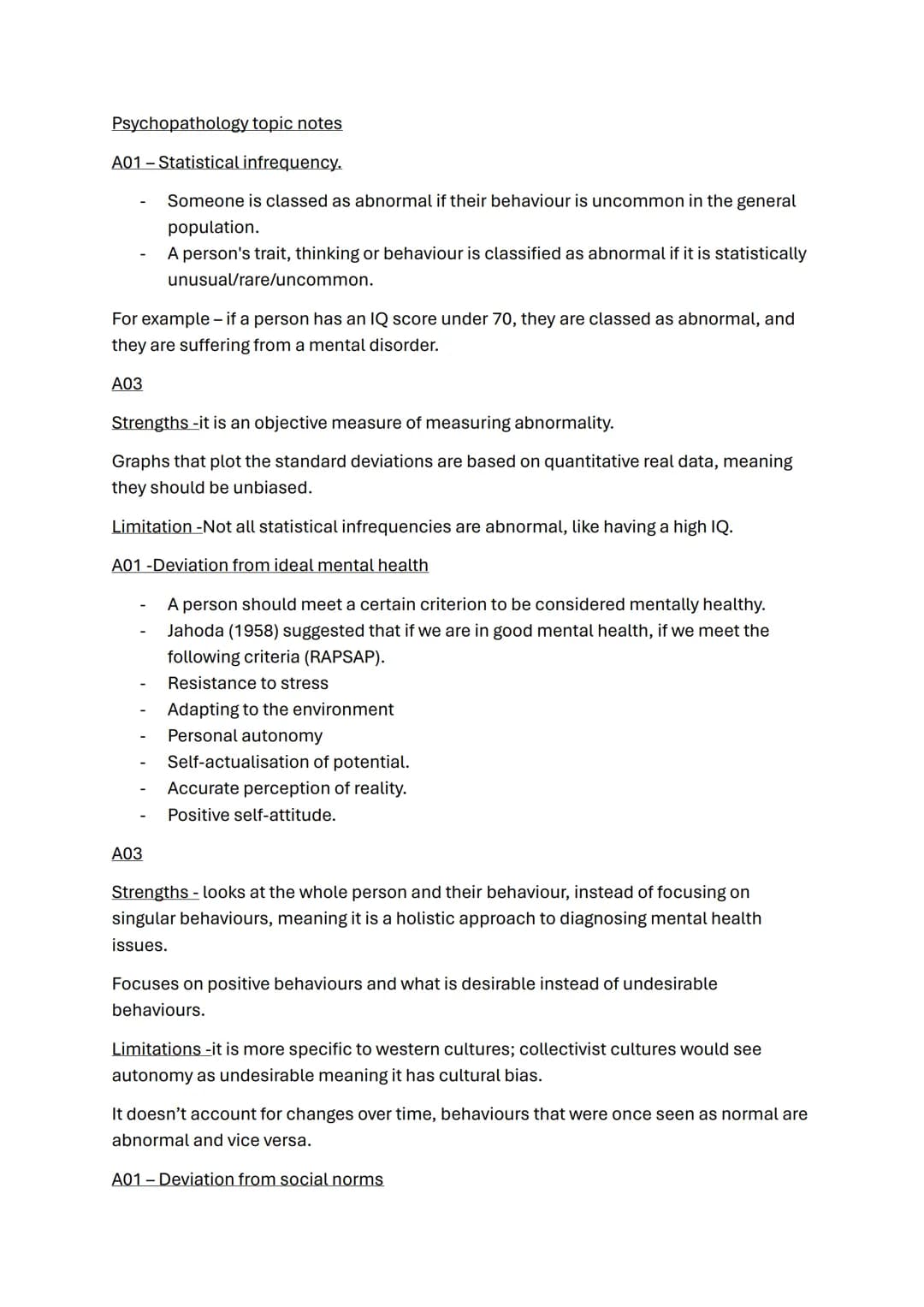
Statistical infrequency is the most straightforward - if your behaviour is rare (like having an IQ under 70), you're considered abnormal. It's objective and based on real data, but it falls apart when you realise that having a high IQ is also statistically rare! Not all uncommon traits are disorders.
Deviation from ideal mental health flips the script by asking what mentally healthy people should have. Jahoda suggested we need things like stress resistance, personal autonomy, and accurate perception of reality (remember RAPSAP). This approach looks at the whole person rather than just problems, but it's heavily biased towards Western values - many cultures don't value individual autonomy the same way.
Key Point: Each definition captures something important about abnormality, but none work perfectly on their own - that's why psychologists often combine approaches.
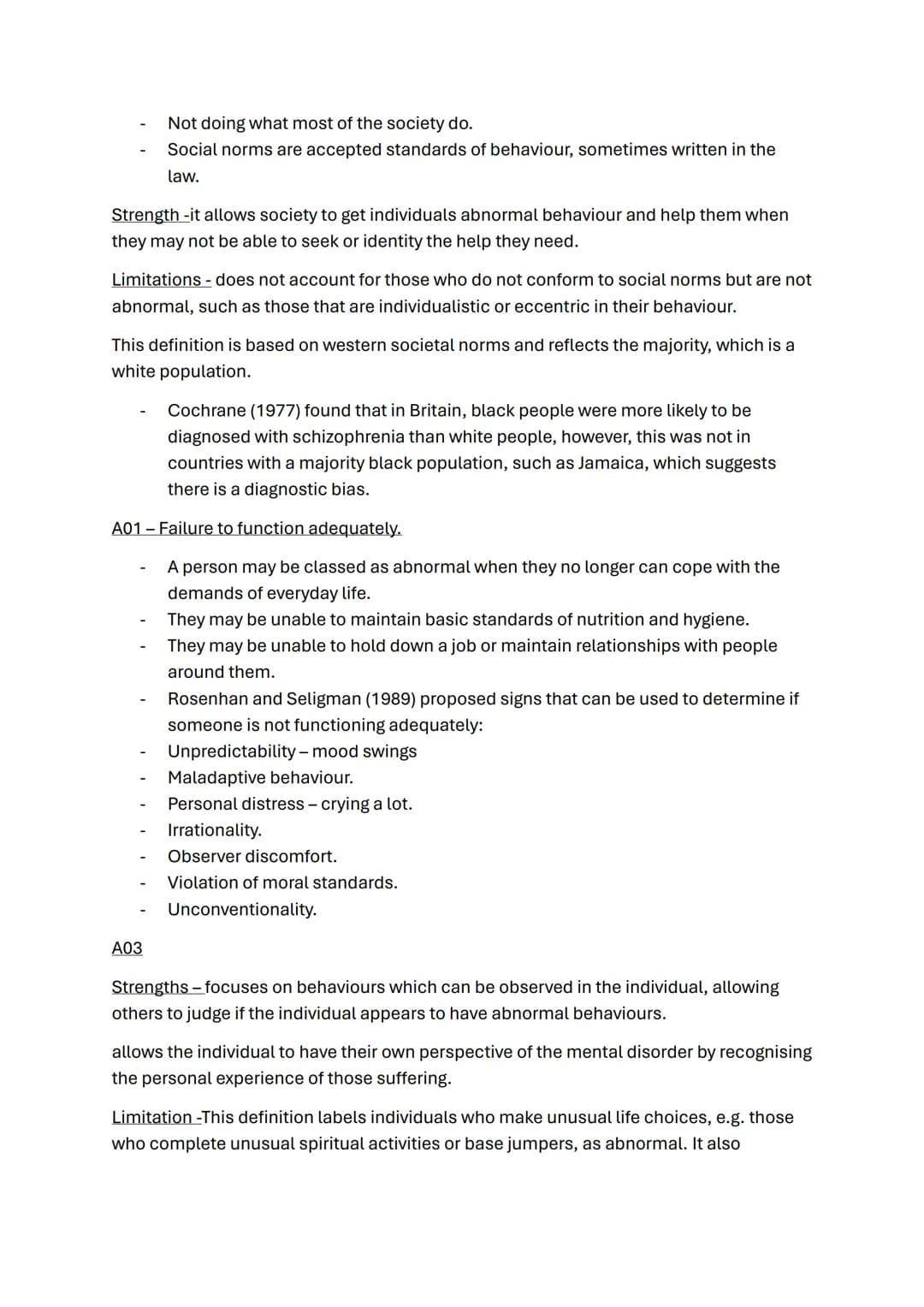
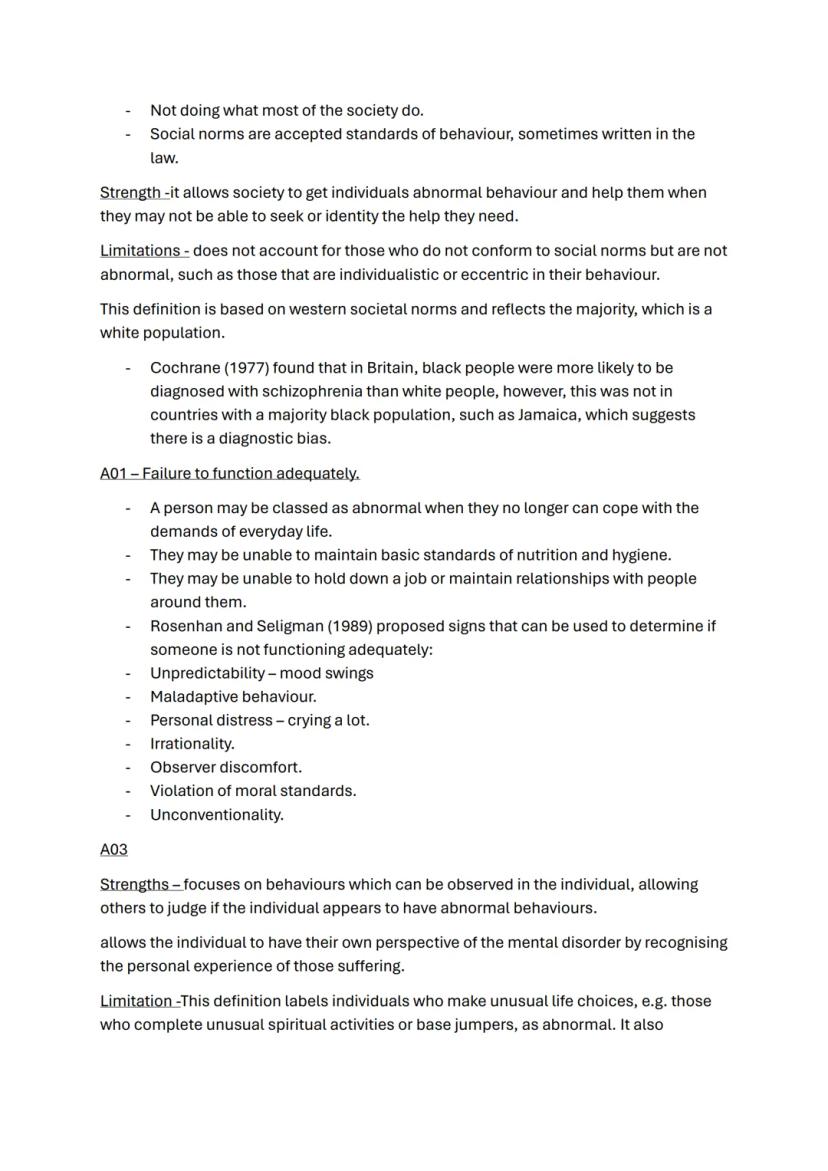
Deviation from social norms focuses on breaking society's unwritten (and written) rules. This helps identify people who need support, but it's problematic because it can unfairly target people who are just different or individualistic.
The approach also shows clear cultural bias. Cochrane's research found that Black people in Britain were more likely to be diagnosed with schizophrenia than white people, but this pattern disappeared in countries with majority Black populations like Jamaica - suggesting diagnostic prejudice rather than genuine differences.
Failure to function adequately looks at whether someone can handle daily life basics like hygiene, work, and relationships. Rosenhan and Seligman identified key signs including unpredictability, personal distress, and maladaptive behaviour.
This definition has real practical value because it focuses on observable behaviours and includes the person's own experience of distress. However, it can unfairly label people making unusual lifestyle choices (like extreme sports enthusiasts or travellers) as abnormal.
Remember: What counts as "normal" varies massively between cultures and time periods - context is everything.
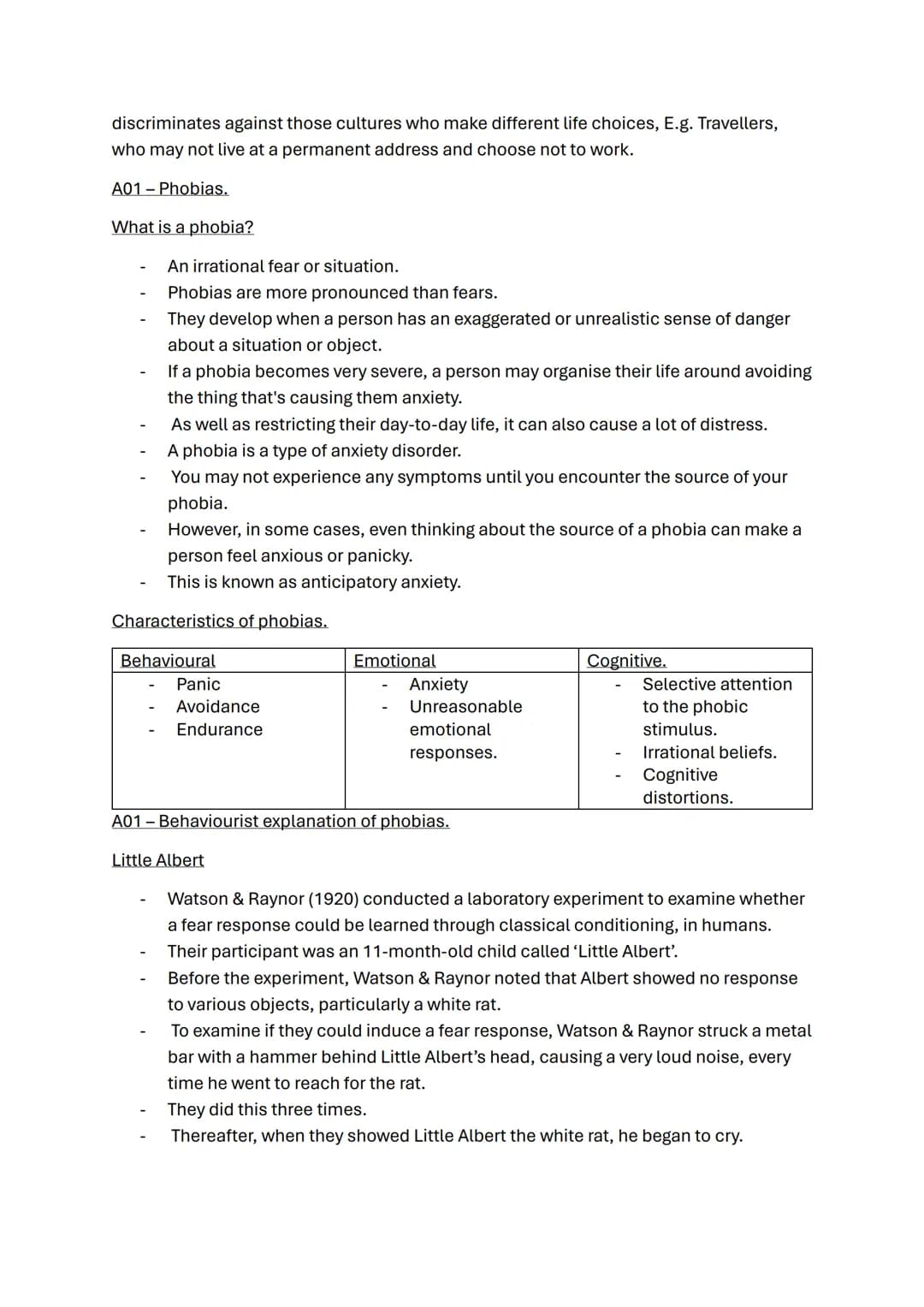
Phobias are way more intense than normal fears - they're irrational, overwhelming responses that can completely disrupt someone's life. Unlike regular worries, phobias involve anticipatory anxiety where even thinking about the feared object causes panic.
Phobias show three types of characteristics. Behavioural ones include panic attacks, avoidance of the feared object, and sometimes endurance (staying but suffering). Emotional characteristics involve intense anxiety and unreasonable responses. Cognitive features include selective attention to the phobic stimulus and irrational beliefs.
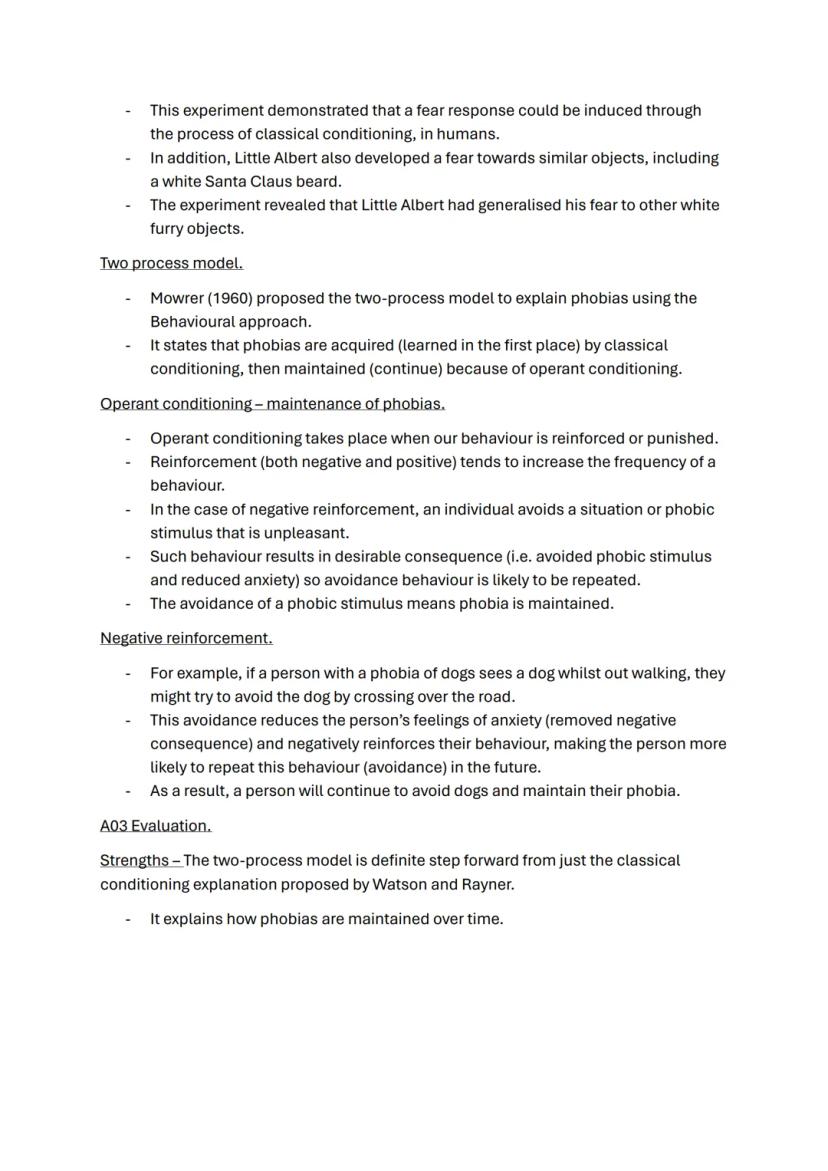
The famous Little Albert experiment by Watson and Raynor showed how phobias develop. They conditioned an 11-month-old to fear white rats by making loud noises whenever he reached for one. After just three trials, Albert cried when seeing the rat, and this fear generalised to other white, furry objects.
Mowrer's two-process model explains how phobias work: they're acquired through classical conditioning (like Little Albert's experience) but maintained through operant conditioning. When you avoid your phobia, anxiety decreases, which negatively reinforces the avoidance behaviour.
Clinical Insight: Understanding that avoidance maintains phobias is crucial for treatment - patients need controlled exposure to break the cycle.
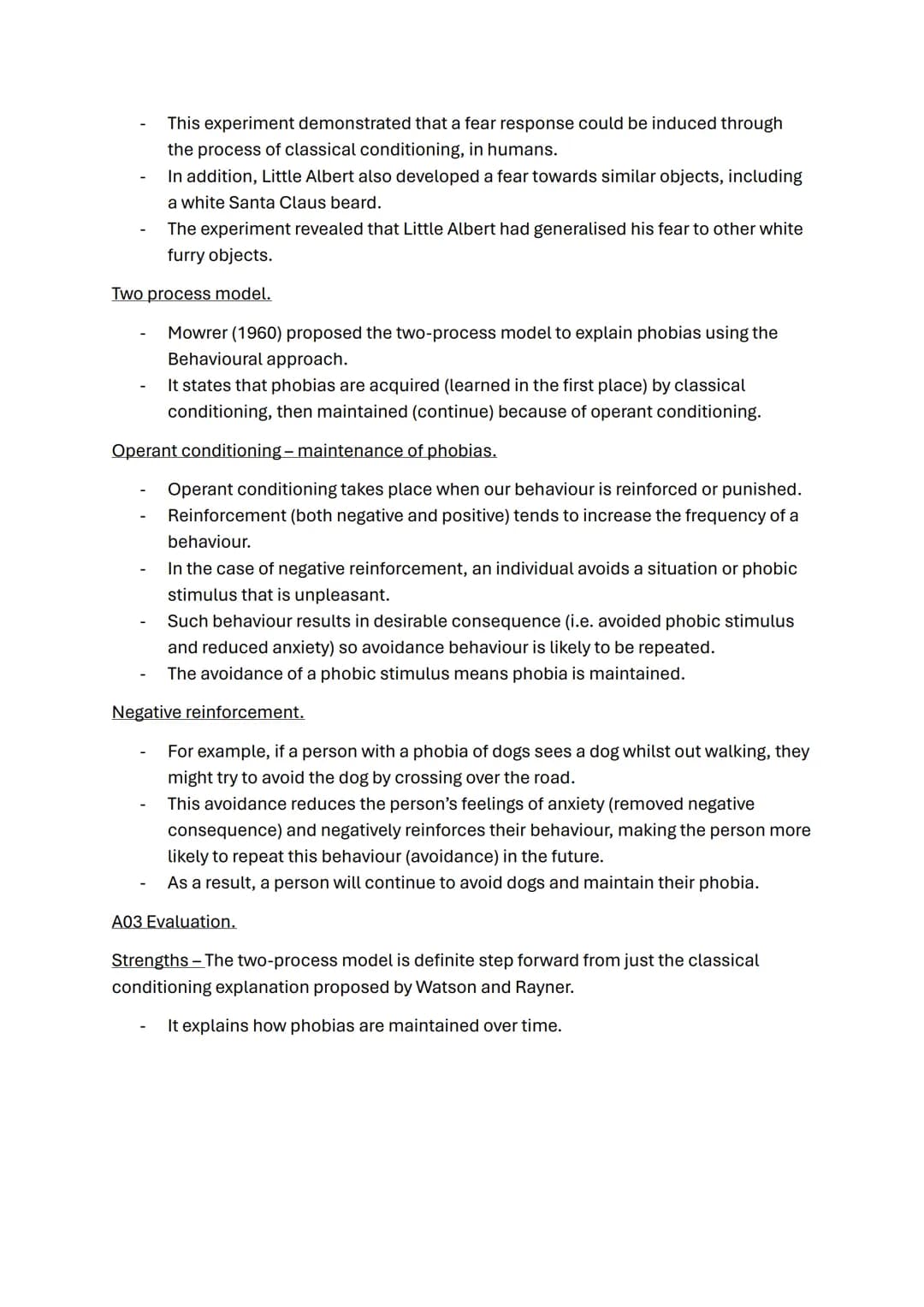
The two-process model is brilliant because it explains both how phobias start and why they persist. It also has massive implications for therapy - if avoidance maintains phobias, then exposure should cure them. Research supports the classical conditioning element too.
However, the model has significant gaps. Many people with phobias can't remember any traumatic trigger event. It also ignores evolutionary factors - we're biologically prepared to fear things that were dangerous to our ancestors (snakes, heights, darkness) more easily than modern dangers like cars.
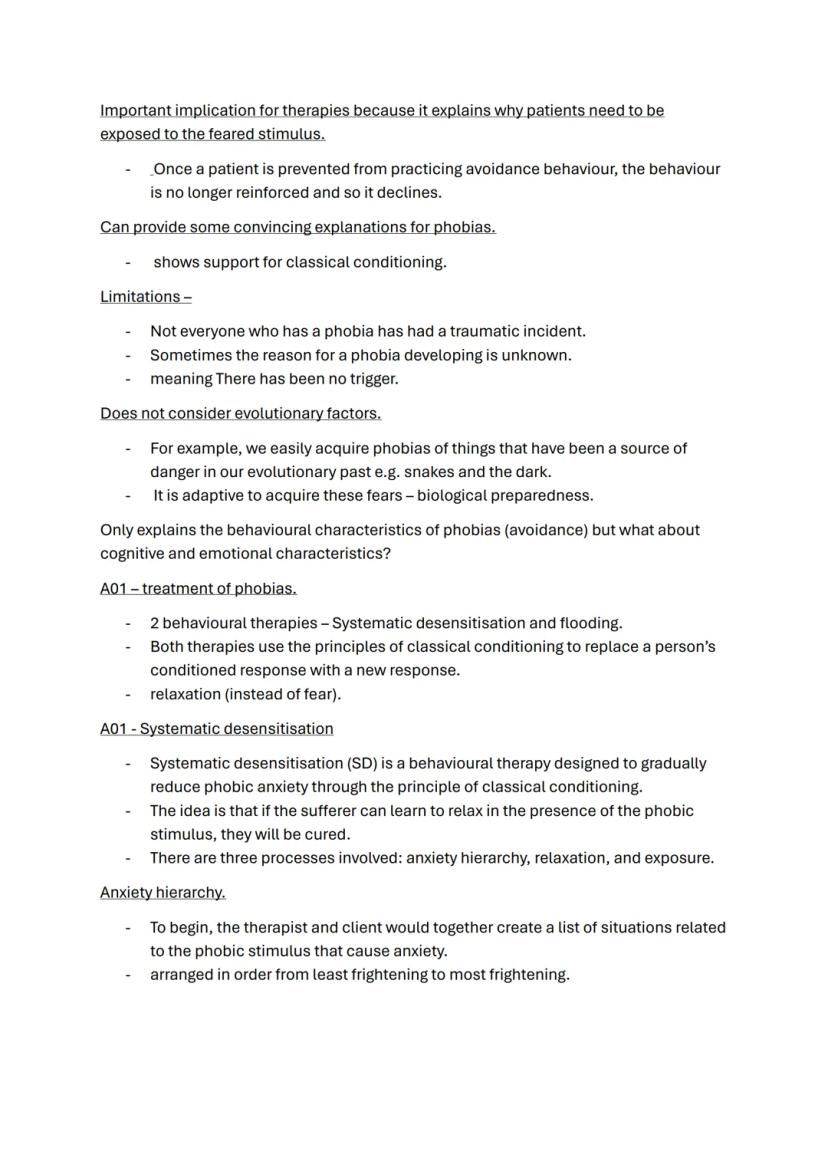
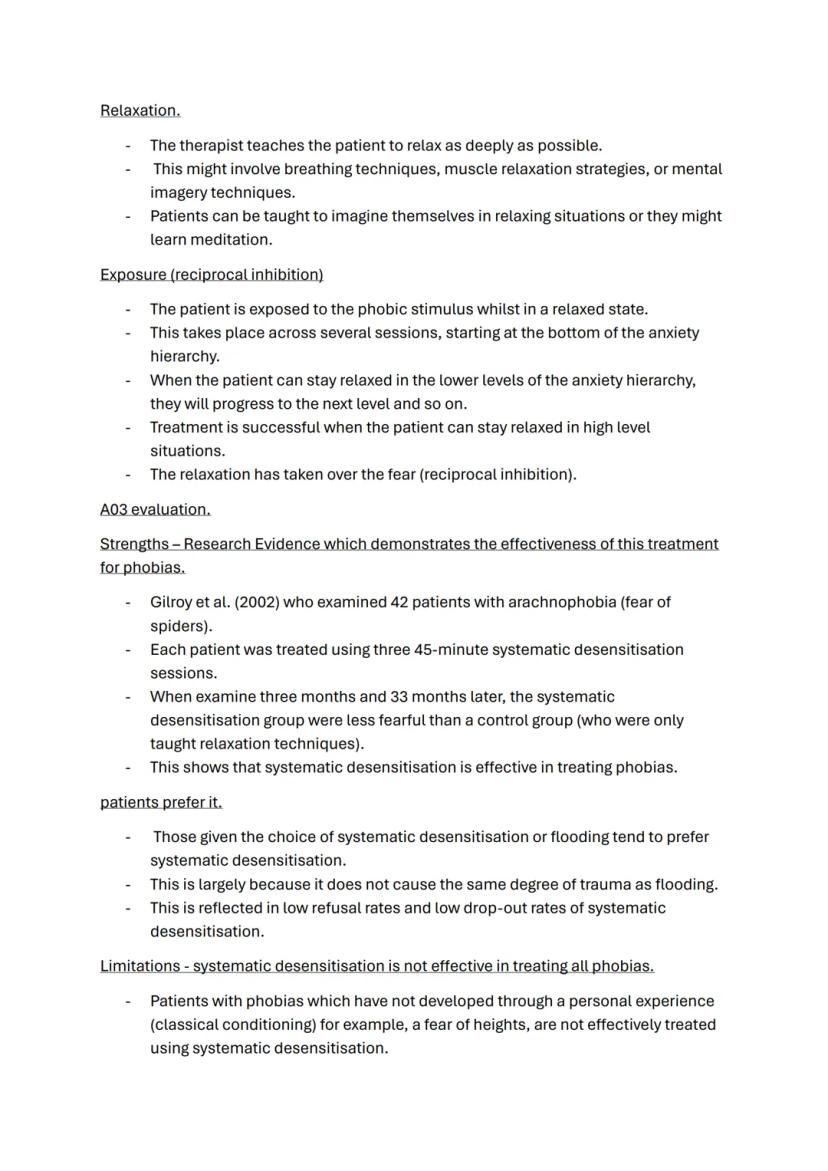
Systematic desensitisation is the gentler treatment approach. It involves creating an anxiety hierarchy (ranking fears from mild to severe), learning deep relaxation techniques, then gradual exposure starting with the least frightening situations. The relaxation response eventually replaces the fear response through reciprocal inhibition.
Gilroy's research with spider phobia patients showed systematic desensitisation was still effective 33 months later. Patients prefer this approach because it's less traumatic, leading to lower dropout rates. However, it doesn't work well for evolutionary phobias that weren't learned through personal experience.
Exam Tip: Remember that systematic desensitisation works through classical conditioning - the relaxation response becomes the new conditioned response to the phobic stimulus.
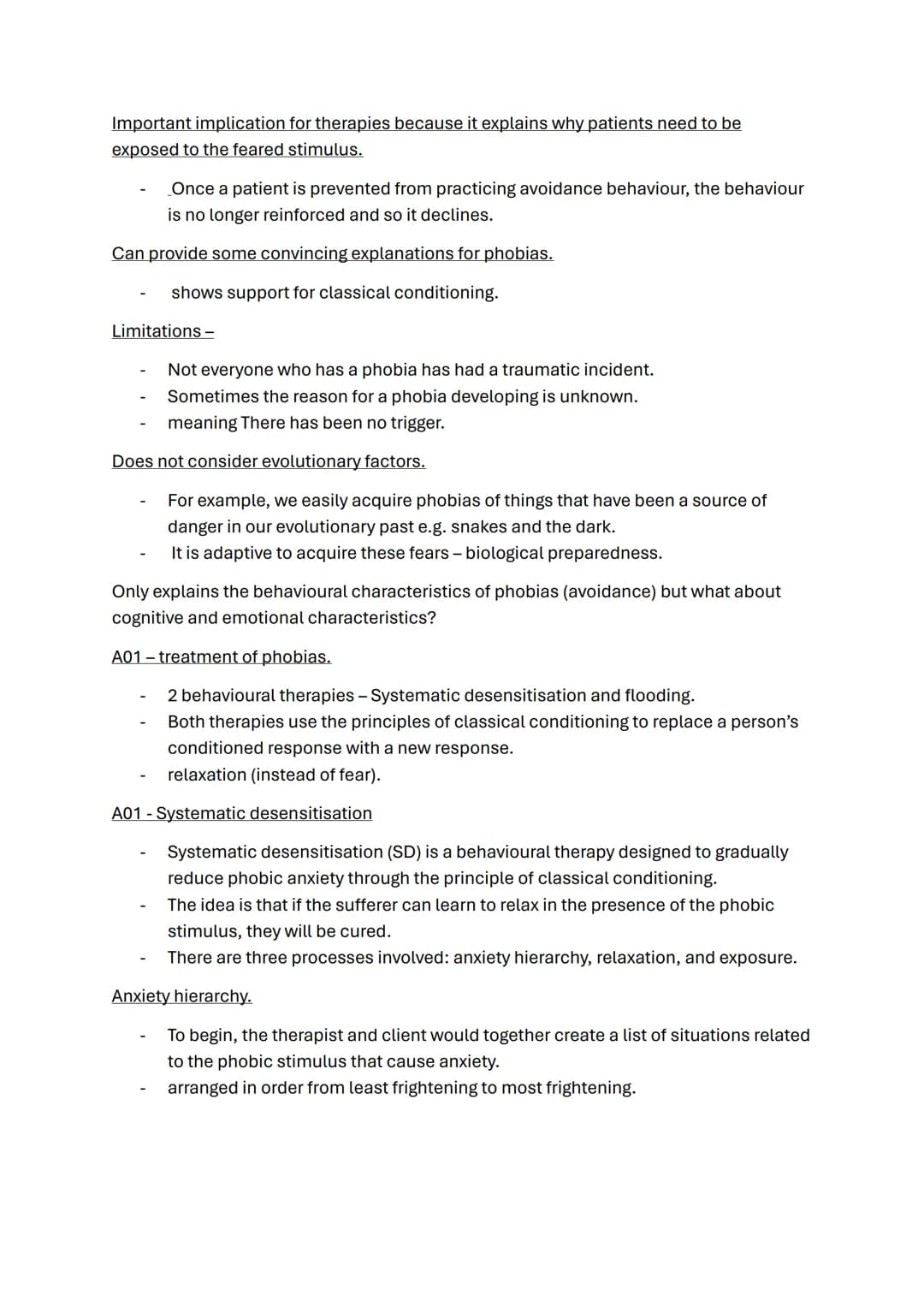
Flooding is the extreme alternative - patients face their worst fear immediately rather than gradually. It can work in just one session because there's no escape, so anxiety naturally decreases over time. It's cost-effective and research shows it's as effective as other treatments.
The major downside? Flooding is incredibly traumatic, leading to high dropout rates. It also doesn't work well for complex phobias like social anxiety, which involve irrational thinking rather than just learned fear responses.
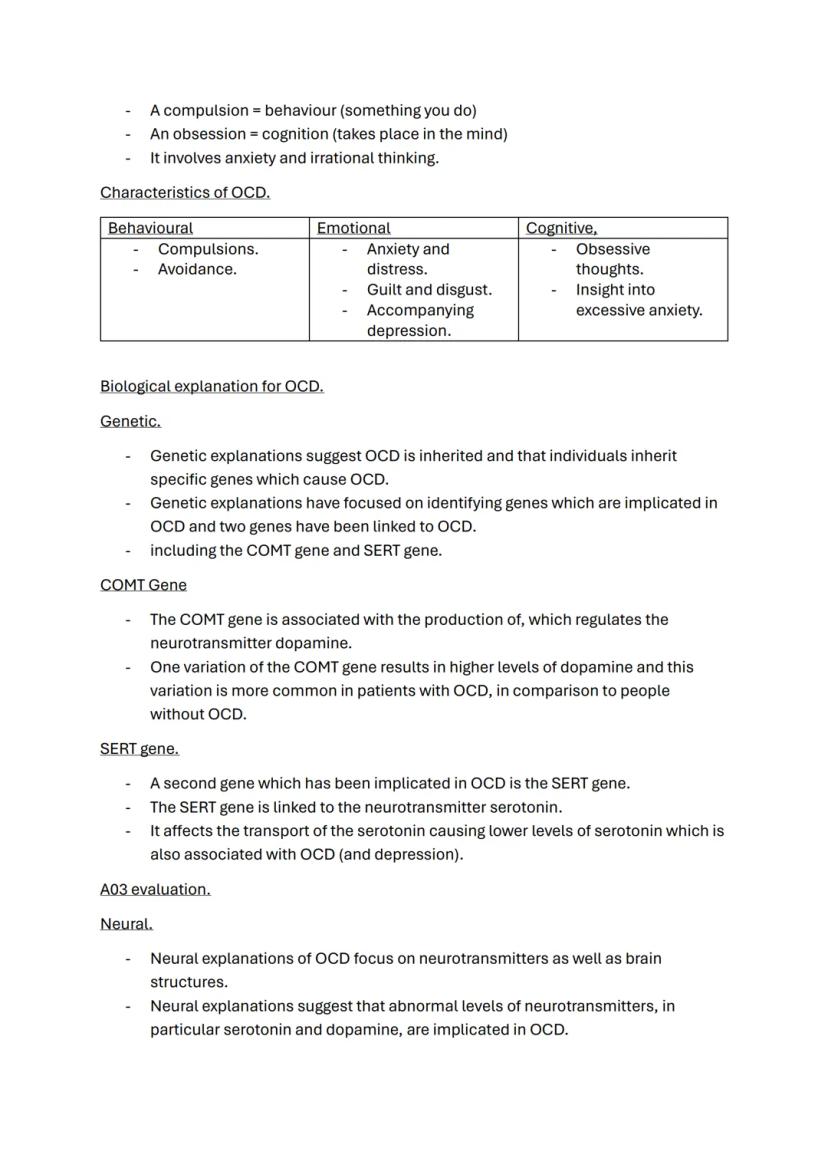
Obsessive-Compulsive Disorder (OCD) involves two main components: obsessions (unwanted, repetitive thoughts) and compulsions (repetitive behaviours). Remember that obsessions happen in your mind while compulsions are things you actually do.
The characteristics break down predictably: behavioural (compulsions and avoidance), emotional (anxiety, distress, guilt, often accompanied by depression), and cognitive (obsessive thoughts, but usually insight that the anxiety is excessive).
Key Distinction: Unlike many mental health conditions, people with OCD typically know their thoughts and behaviours are irrational - they just can't stop them.
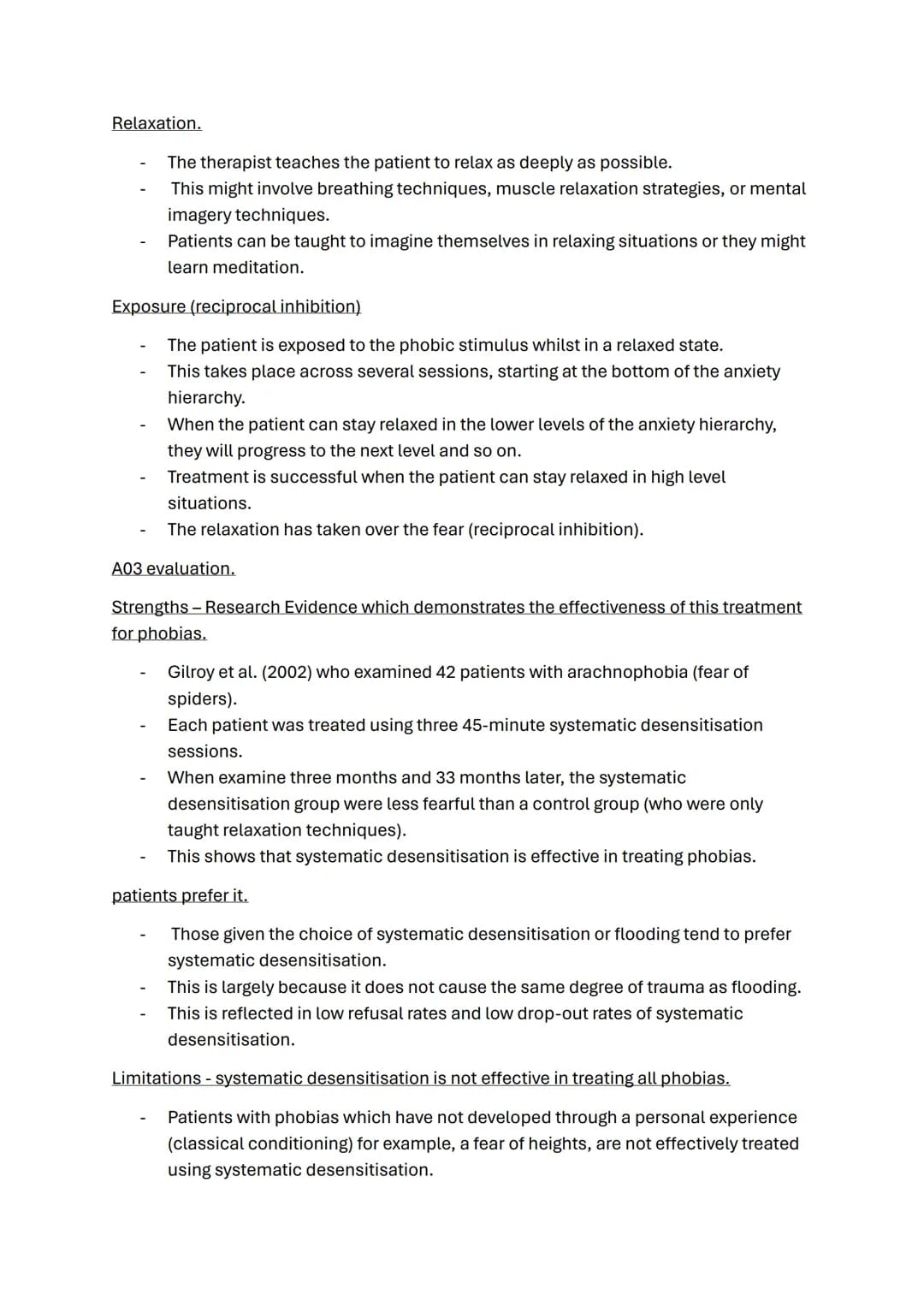
Genetic explanations focus on inherited vulnerability. Two key genes are involved: the COMT gene affects dopamine regulation (higher dopamine levels are more common in OCD patients), while the SERT gene affects serotonin transport, leading to lower serotonin levels associated with OCD.
Neural explanations look at both neurotransmitters and brain structures. Serotonin deficiency is linked to OCD (which explains why antidepressants that boost serotonin help), while higher dopamine levels are associated with compulsive behaviours.
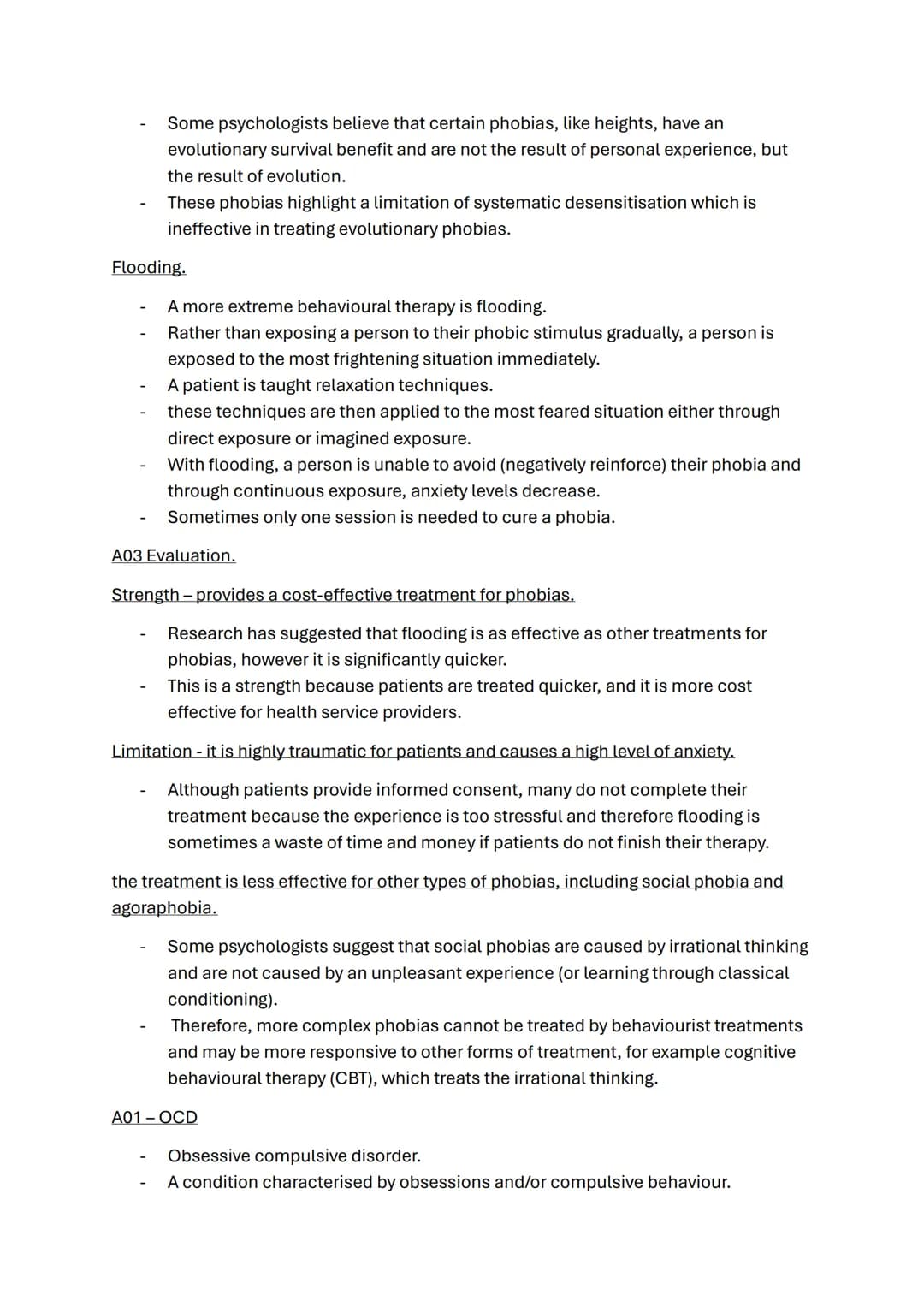
Two brain regions are crucial. The basal ganglia coordinates movement - head injuries here often cause OCD-like symptoms, and disconnecting it from the frontal cortex during surgery reduces OCD symptoms. The orbitofrontal cortex converts sensory info into thoughts and actions - PET scans show this area is overactive in OCD patients.
The research evidence is strong. Lewis found 37% of OCD patients had parents with the disorder. Twin studies show 68% concordance in identical twins versus 31% in non-identical twins, suggesting powerful genetic influence.
Research Insight: The fact that antidepressants work for OCD provides strong support for the serotonin theory - if symptoms improve when serotonin increases, low serotonin was likely part of the problem.
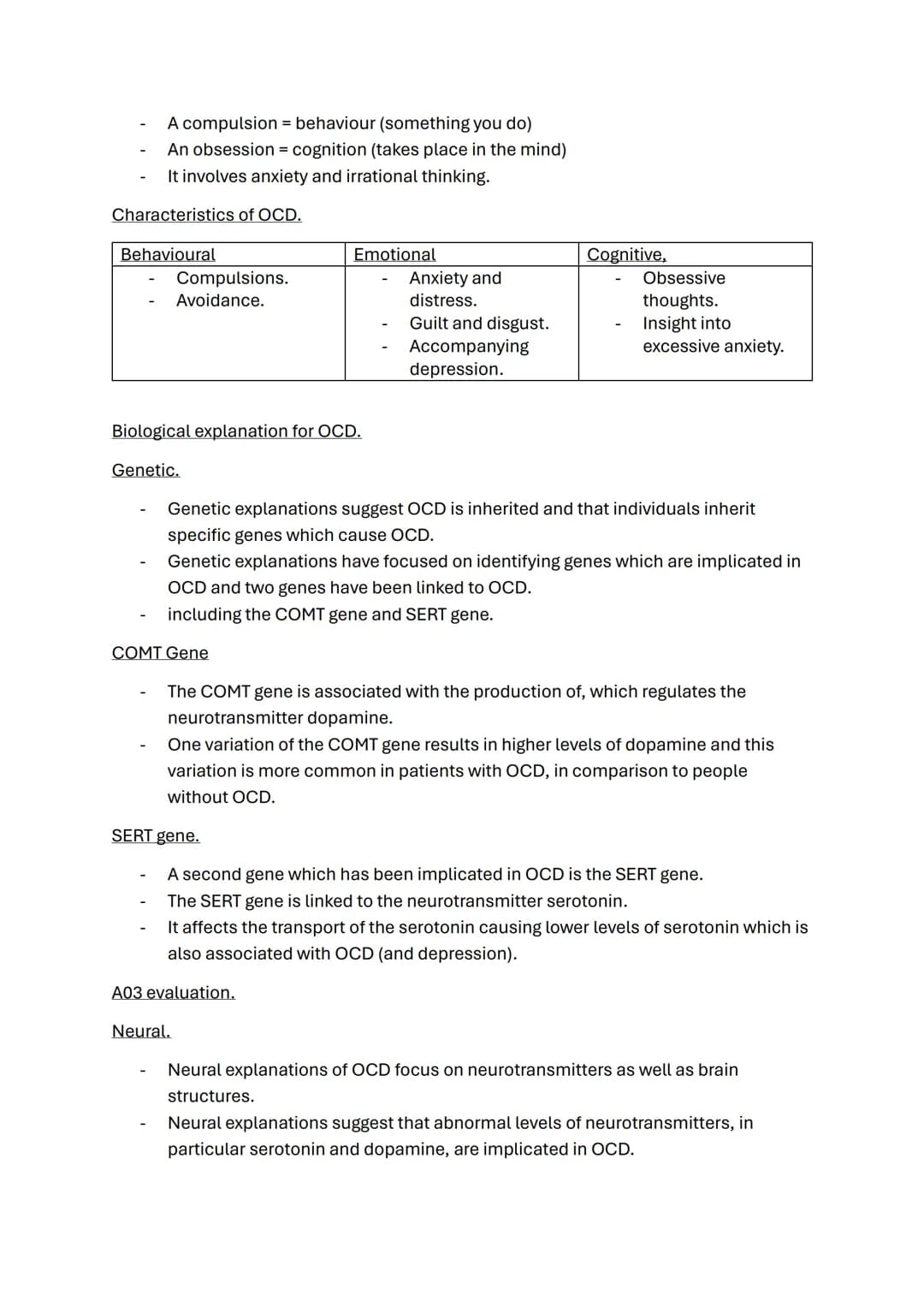
Drug therapy is the main biological treatment, usually SSRIs (Selective Serotonin Reuptake Inhibitors). These work by preventing serotonin from being reabsorbed too quickly, keeping more available in the brain to regulate mood and reduce OCD symptoms.
The biological approach has solid research backing, from family studies to brain imaging. The effectiveness of SSRIs provides particularly convincing evidence that neurotransmitter imbalances contribute to OCD.
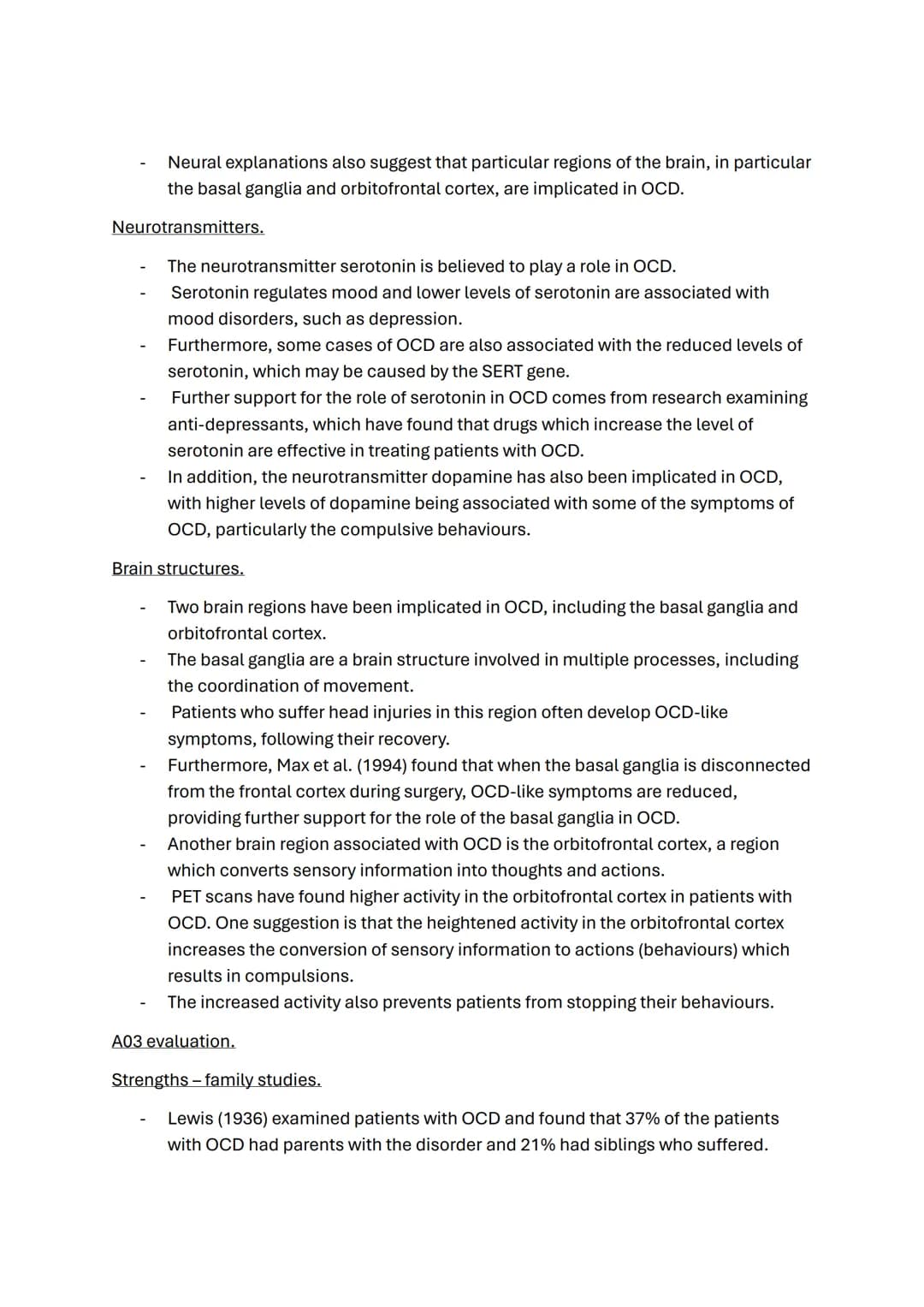
However, biological explanations are quite reductionist - they ignore psychological factors completely. Some researchers argue OCD could be learned through classical conditioning (associating neutral stimuli with anxiety) and maintained through operant conditioning (compulsions reduce anxiety, so they're negatively reinforced).
The reality is probably that biological vulnerability interacts with psychological and environmental factors. Someone might inherit genes that make them prone to OCD, but psychological triggers and learning experiences determine whether and how it develops.
Critical Thinking: While biological treatments work, their effectiveness doesn't prove that OCD is purely biological - aspirin helps headaches, but headaches aren't caused by aspirin deficiency!
Our AI Companion is a student-focused AI tool that offers more than just answers. Built on millions of Knowunity resources, it provides relevant information, personalised study plans, quizzes, and content directly in the chat, adapting to your individual learning journey.
You can download the app from Google Play Store and Apple App Store.
That's right! Enjoy free access to study content, connect with fellow students, and get instant help – all at your fingertips.
Quotes from every main character
English LiteratureApp Store
Google Play
The app is very easy to use and well designed. I have found everything I was looking for so far and have been able to learn a lot from the presentations! I will definitely use the app for a class assignment! And of course it also helps a lot as an inspiration.
Stefan S
iOS user
This app is really great. There are so many study notes and help [...]. My problem subject is French, for example, and the app has so many options for help. Thanks to this app, I have improved my French. I would recommend it to anyone.
Samantha Klich
Android user
Wow, I am really amazed. I just tried the app because I've seen it advertised many times and was absolutely stunned. This app is THE HELP you want for school and above all, it offers so many things, such as workouts and fact sheets, which have been VERY helpful to me personally.
Anna
iOS user
Best app on earth! no words because it’s too good
Thomas R
iOS user
Just amazing. Let's me revise 10x better, this app is a quick 10/10. I highly recommend it to anyone. I can watch and search for notes. I can save them in the subject folder. I can revise it any time when I come back. If you haven't tried this app, you're really missing out.
Basil
Android user
This app has made me feel so much more confident in my exam prep, not only through boosting my own self confidence through the features that allow you to connect with others and feel less alone, but also through the way the app itself is centred around making you feel better. It is easy to navigate, fun to use, and helpful to anyone struggling in absolutely any way.
David K
iOS user
The app's just great! All I have to do is enter the topic in the search bar and I get the response real fast. I don't have to watch 10 YouTube videos to understand something, so I'm saving my time. Highly recommended!
Sudenaz Ocak
Android user
In school I was really bad at maths but thanks to the app, I am doing better now. I am so grateful that you made the app.
Greenlight Bonnie
Android user
very reliable app to help and grow your ideas of Maths, English and other related topics in your works. please use this app if your struggling in areas, this app is key for that. wish I'd of done a review before. and it's also free so don't worry about that.
Rohan U
Android user
I know a lot of apps use fake accounts to boost their reviews but this app deserves it all. Originally I was getting 4 in my English exams and this time I got a grade 7. I didn’t even know about this app three days until the exam and it has helped A LOT. Please actually trust me and use it as I’m sure you too will see developments.
Xander S
iOS user
THE QUIZES AND FLASHCARDS ARE SO USEFUL AND I LOVE THE SCHOOLGPT. IT ALSO IS LITREALLY LIKE CHATGPT BUT SMARTER!! HELPED ME WITH MY MASCARA PROBLEMS TOO!! AS WELL AS MY REAL SUBJECTS ! DUHHH 😍😁😲🤑💗✨🎀😮
Elisha
iOS user
This apps acc the goat. I find revision so boring but this app makes it so easy to organize it all and then you can ask the freeeee ai to test yourself so good and you can easily upload your own stuff. highly recommend as someone taking mocks now
Paul T
iOS user
The app is very easy to use and well designed. I have found everything I was looking for so far and have been able to learn a lot from the presentations! I will definitely use the app for a class assignment! And of course it also helps a lot as an inspiration.
Stefan S
iOS user
This app is really great. There are so many study notes and help [...]. My problem subject is French, for example, and the app has so many options for help. Thanks to this app, I have improved my French. I would recommend it to anyone.
Samantha Klich
Android user
Wow, I am really amazed. I just tried the app because I've seen it advertised many times and was absolutely stunned. This app is THE HELP you want for school and above all, it offers so many things, such as workouts and fact sheets, which have been VERY helpful to me personally.
Anna
iOS user
Best app on earth! no words because it’s too good
Thomas R
iOS user
Just amazing. Let's me revise 10x better, this app is a quick 10/10. I highly recommend it to anyone. I can watch and search for notes. I can save them in the subject folder. I can revise it any time when I come back. If you haven't tried this app, you're really missing out.
Basil
Android user
This app has made me feel so much more confident in my exam prep, not only through boosting my own self confidence through the features that allow you to connect with others and feel less alone, but also through the way the app itself is centred around making you feel better. It is easy to navigate, fun to use, and helpful to anyone struggling in absolutely any way.
David K
iOS user
The app's just great! All I have to do is enter the topic in the search bar and I get the response real fast. I don't have to watch 10 YouTube videos to understand something, so I'm saving my time. Highly recommended!
Sudenaz Ocak
Android user
In school I was really bad at maths but thanks to the app, I am doing better now. I am so grateful that you made the app.
Greenlight Bonnie
Android user
very reliable app to help and grow your ideas of Maths, English and other related topics in your works. please use this app if your struggling in areas, this app is key for that. wish I'd of done a review before. and it's also free so don't worry about that.
Rohan U
Android user
I know a lot of apps use fake accounts to boost their reviews but this app deserves it all. Originally I was getting 4 in my English exams and this time I got a grade 7. I didn’t even know about this app three days until the exam and it has helped A LOT. Please actually trust me and use it as I’m sure you too will see developments.
Xander S
iOS user
THE QUIZES AND FLASHCARDS ARE SO USEFUL AND I LOVE THE SCHOOLGPT. IT ALSO IS LITREALLY LIKE CHATGPT BUT SMARTER!! HELPED ME WITH MY MASCARA PROBLEMS TOO!! AS WELL AS MY REAL SUBJECTS ! DUHHH 😍😁😲🤑💗✨🎀😮
Elisha
iOS user
This apps acc the goat. I find revision so boring but this app makes it so easy to organize it all and then you can ask the freeeee ai to test yourself so good and you can easily upload your own stuff. highly recommend as someone taking mocks now
Paul T
iOS user
zara!!
@zara.louisee
Ever wondered what makes behaviour "abnormal" or how we can actually treat serious mental health issues like phobias and OCD? This topic dives into the fascinating world of psychopathology - essentially how psychologists define, explain, and treat mental disorders that... Show more
Access to all documents
Improve your grades
Join milions of students
By signing up you accept Terms of Service and Privacy Policy
Psychology doesn't have a simple answer to "what's abnormal?" Instead, there are four main ways to define it, each with their own strengths and problems.
Statistical infrequency is the most straightforward - if your behaviour is rare (like having an IQ under 70), you're considered abnormal. It's objective and based on real data, but it falls apart when you realise that having a high IQ is also statistically rare! Not all uncommon traits are disorders.
Deviation from ideal mental health flips the script by asking what mentally healthy people should have. Jahoda suggested we need things like stress resistance, personal autonomy, and accurate perception of reality (remember RAPSAP). This approach looks at the whole person rather than just problems, but it's heavily biased towards Western values - many cultures don't value individual autonomy the same way.
Key Point: Each definition captures something important about abnormality, but none work perfectly on their own - that's why psychologists often combine approaches.
Access to all documents
Improve your grades
Join milions of students
By signing up you accept Terms of Service and Privacy Policy
Deviation from social norms focuses on breaking society's unwritten (and written) rules. This helps identify people who need support, but it's problematic because it can unfairly target people who are just different or individualistic.
The approach also shows clear cultural bias. Cochrane's research found that Black people in Britain were more likely to be diagnosed with schizophrenia than white people, but this pattern disappeared in countries with majority Black populations like Jamaica - suggesting diagnostic prejudice rather than genuine differences.
Failure to function adequately looks at whether someone can handle daily life basics like hygiene, work, and relationships. Rosenhan and Seligman identified key signs including unpredictability, personal distress, and maladaptive behaviour.
This definition has real practical value because it focuses on observable behaviours and includes the person's own experience of distress. However, it can unfairly label people making unusual lifestyle choices (like extreme sports enthusiasts or travellers) as abnormal.
Remember: What counts as "normal" varies massively between cultures and time periods - context is everything.
Access to all documents
Improve your grades
Join milions of students
By signing up you accept Terms of Service and Privacy Policy
Phobias are way more intense than normal fears - they're irrational, overwhelming responses that can completely disrupt someone's life. Unlike regular worries, phobias involve anticipatory anxiety where even thinking about the feared object causes panic.
Phobias show three types of characteristics. Behavioural ones include panic attacks, avoidance of the feared object, and sometimes endurance (staying but suffering). Emotional characteristics involve intense anxiety and unreasonable responses. Cognitive features include selective attention to the phobic stimulus and irrational beliefs.
The famous Little Albert experiment by Watson and Raynor showed how phobias develop. They conditioned an 11-month-old to fear white rats by making loud noises whenever he reached for one. After just three trials, Albert cried when seeing the rat, and this fear generalised to other white, furry objects.
Mowrer's two-process model explains how phobias work: they're acquired through classical conditioning (like Little Albert's experience) but maintained through operant conditioning. When you avoid your phobia, anxiety decreases, which negatively reinforces the avoidance behaviour.
Clinical Insight: Understanding that avoidance maintains phobias is crucial for treatment - patients need controlled exposure to break the cycle.
Access to all documents
Improve your grades
Join milions of students
By signing up you accept Terms of Service and Privacy Policy
The two-process model is brilliant because it explains both how phobias start and why they persist. It also has massive implications for therapy - if avoidance maintains phobias, then exposure should cure them. Research supports the classical conditioning element too.
However, the model has significant gaps. Many people with phobias can't remember any traumatic trigger event. It also ignores evolutionary factors - we're biologically prepared to fear things that were dangerous to our ancestors (snakes, heights, darkness) more easily than modern dangers like cars.
Systematic desensitisation is the gentler treatment approach. It involves creating an anxiety hierarchy (ranking fears from mild to severe), learning deep relaxation techniques, then gradual exposure starting with the least frightening situations. The relaxation response eventually replaces the fear response through reciprocal inhibition.
Gilroy's research with spider phobia patients showed systematic desensitisation was still effective 33 months later. Patients prefer this approach because it's less traumatic, leading to lower dropout rates. However, it doesn't work well for evolutionary phobias that weren't learned through personal experience.
Exam Tip: Remember that systematic desensitisation works through classical conditioning - the relaxation response becomes the new conditioned response to the phobic stimulus.
Access to all documents
Improve your grades
Join milions of students
By signing up you accept Terms of Service and Privacy Policy
Flooding is the extreme alternative - patients face their worst fear immediately rather than gradually. It can work in just one session because there's no escape, so anxiety naturally decreases over time. It's cost-effective and research shows it's as effective as other treatments.
The major downside? Flooding is incredibly traumatic, leading to high dropout rates. It also doesn't work well for complex phobias like social anxiety, which involve irrational thinking rather than just learned fear responses.
Obsessive-Compulsive Disorder (OCD) involves two main components: obsessions (unwanted, repetitive thoughts) and compulsions (repetitive behaviours). Remember that obsessions happen in your mind while compulsions are things you actually do.
The characteristics break down predictably: behavioural (compulsions and avoidance), emotional (anxiety, distress, guilt, often accompanied by depression), and cognitive (obsessive thoughts, but usually insight that the anxiety is excessive).
Key Distinction: Unlike many mental health conditions, people with OCD typically know their thoughts and behaviours are irrational - they just can't stop them.
Access to all documents
Improve your grades
Join milions of students
By signing up you accept Terms of Service and Privacy Policy
Genetic explanations focus on inherited vulnerability. Two key genes are involved: the COMT gene affects dopamine regulation (higher dopamine levels are more common in OCD patients), while the SERT gene affects serotonin transport, leading to lower serotonin levels associated with OCD.
Neural explanations look at both neurotransmitters and brain structures. Serotonin deficiency is linked to OCD (which explains why antidepressants that boost serotonin help), while higher dopamine levels are associated with compulsive behaviours.
Two brain regions are crucial. The basal ganglia coordinates movement - head injuries here often cause OCD-like symptoms, and disconnecting it from the frontal cortex during surgery reduces OCD symptoms. The orbitofrontal cortex converts sensory info into thoughts and actions - PET scans show this area is overactive in OCD patients.
The research evidence is strong. Lewis found 37% of OCD patients had parents with the disorder. Twin studies show 68% concordance in identical twins versus 31% in non-identical twins, suggesting powerful genetic influence.
Research Insight: The fact that antidepressants work for OCD provides strong support for the serotonin theory - if symptoms improve when serotonin increases, low serotonin was likely part of the problem.
Access to all documents
Improve your grades
Join milions of students
By signing up you accept Terms of Service and Privacy Policy
Drug therapy is the main biological treatment, usually SSRIs (Selective Serotonin Reuptake Inhibitors). These work by preventing serotonin from being reabsorbed too quickly, keeping more available in the brain to regulate mood and reduce OCD symptoms.
The biological approach has solid research backing, from family studies to brain imaging. The effectiveness of SSRIs provides particularly convincing evidence that neurotransmitter imbalances contribute to OCD.
However, biological explanations are quite reductionist - they ignore psychological factors completely. Some researchers argue OCD could be learned through classical conditioning (associating neutral stimuli with anxiety) and maintained through operant conditioning (compulsions reduce anxiety, so they're negatively reinforced).
The reality is probably that biological vulnerability interacts with psychological and environmental factors. Someone might inherit genes that make them prone to OCD, but psychological triggers and learning experiences determine whether and how it develops.
Critical Thinking: While biological treatments work, their effectiveness doesn't prove that OCD is purely biological - aspirin helps headaches, but headaches aren't caused by aspirin deficiency!
Access to all documents
Improve your grades
Join milions of students
By signing up you accept Terms of Service and Privacy Policy
Access to all documents
Improve your grades
Join milions of students
By signing up you accept Terms of Service and Privacy Policy
Access to all documents
Improve your grades
Join milions of students
By signing up you accept Terms of Service and Privacy Policy
Our AI Companion is a student-focused AI tool that offers more than just answers. Built on millions of Knowunity resources, it provides relevant information, personalised study plans, quizzes, and content directly in the chat, adapting to your individual learning journey.
You can download the app from Google Play Store and Apple App Store.
That's right! Enjoy free access to study content, connect with fellow students, and get instant help – all at your fingertips.
19
Smart Tools NEW
Transform this note into: ✓ 50+ Practice Questions ✓ Interactive Flashcards ✓ Full Mock Exam ✓ Essay Outlines
Quotes from every main character
English LiteratureApp Store
Google Play
The app is very easy to use and well designed. I have found everything I was looking for so far and have been able to learn a lot from the presentations! I will definitely use the app for a class assignment! And of course it also helps a lot as an inspiration.
Stefan S
iOS user
This app is really great. There are so many study notes and help [...]. My problem subject is French, for example, and the app has so many options for help. Thanks to this app, I have improved my French. I would recommend it to anyone.
Samantha Klich
Android user
Wow, I am really amazed. I just tried the app because I've seen it advertised many times and was absolutely stunned. This app is THE HELP you want for school and above all, it offers so many things, such as workouts and fact sheets, which have been VERY helpful to me personally.
Anna
iOS user
Best app on earth! no words because it’s too good
Thomas R
iOS user
Just amazing. Let's me revise 10x better, this app is a quick 10/10. I highly recommend it to anyone. I can watch and search for notes. I can save them in the subject folder. I can revise it any time when I come back. If you haven't tried this app, you're really missing out.
Basil
Android user
This app has made me feel so much more confident in my exam prep, not only through boosting my own self confidence through the features that allow you to connect with others and feel less alone, but also through the way the app itself is centred around making you feel better. It is easy to navigate, fun to use, and helpful to anyone struggling in absolutely any way.
David K
iOS user
The app's just great! All I have to do is enter the topic in the search bar and I get the response real fast. I don't have to watch 10 YouTube videos to understand something, so I'm saving my time. Highly recommended!
Sudenaz Ocak
Android user
In school I was really bad at maths but thanks to the app, I am doing better now. I am so grateful that you made the app.
Greenlight Bonnie
Android user
very reliable app to help and grow your ideas of Maths, English and other related topics in your works. please use this app if your struggling in areas, this app is key for that. wish I'd of done a review before. and it's also free so don't worry about that.
Rohan U
Android user
I know a lot of apps use fake accounts to boost their reviews but this app deserves it all. Originally I was getting 4 in my English exams and this time I got a grade 7. I didn’t even know about this app three days until the exam and it has helped A LOT. Please actually trust me and use it as I’m sure you too will see developments.
Xander S
iOS user
THE QUIZES AND FLASHCARDS ARE SO USEFUL AND I LOVE THE SCHOOLGPT. IT ALSO IS LITREALLY LIKE CHATGPT BUT SMARTER!! HELPED ME WITH MY MASCARA PROBLEMS TOO!! AS WELL AS MY REAL SUBJECTS ! DUHHH 😍😁😲🤑💗✨🎀😮
Elisha
iOS user
This apps acc the goat. I find revision so boring but this app makes it so easy to organize it all and then you can ask the freeeee ai to test yourself so good and you can easily upload your own stuff. highly recommend as someone taking mocks now
Paul T
iOS user
The app is very easy to use and well designed. I have found everything I was looking for so far and have been able to learn a lot from the presentations! I will definitely use the app for a class assignment! And of course it also helps a lot as an inspiration.
Stefan S
iOS user
This app is really great. There are so many study notes and help [...]. My problem subject is French, for example, and the app has so many options for help. Thanks to this app, I have improved my French. I would recommend it to anyone.
Samantha Klich
Android user
Wow, I am really amazed. I just tried the app because I've seen it advertised many times and was absolutely stunned. This app is THE HELP you want for school and above all, it offers so many things, such as workouts and fact sheets, which have been VERY helpful to me personally.
Anna
iOS user
Best app on earth! no words because it’s too good
Thomas R
iOS user
Just amazing. Let's me revise 10x better, this app is a quick 10/10. I highly recommend it to anyone. I can watch and search for notes. I can save them in the subject folder. I can revise it any time when I come back. If you haven't tried this app, you're really missing out.
Basil
Android user
This app has made me feel so much more confident in my exam prep, not only through boosting my own self confidence through the features that allow you to connect with others and feel less alone, but also through the way the app itself is centred around making you feel better. It is easy to navigate, fun to use, and helpful to anyone struggling in absolutely any way.
David K
iOS user
The app's just great! All I have to do is enter the topic in the search bar and I get the response real fast. I don't have to watch 10 YouTube videos to understand something, so I'm saving my time. Highly recommended!
Sudenaz Ocak
Android user
In school I was really bad at maths but thanks to the app, I am doing better now. I am so grateful that you made the app.
Greenlight Bonnie
Android user
very reliable app to help and grow your ideas of Maths, English and other related topics in your works. please use this app if your struggling in areas, this app is key for that. wish I'd of done a review before. and it's also free so don't worry about that.
Rohan U
Android user
I know a lot of apps use fake accounts to boost their reviews but this app deserves it all. Originally I was getting 4 in my English exams and this time I got a grade 7. I didn’t even know about this app three days until the exam and it has helped A LOT. Please actually trust me and use it as I’m sure you too will see developments.
Xander S
iOS user
THE QUIZES AND FLASHCARDS ARE SO USEFUL AND I LOVE THE SCHOOLGPT. IT ALSO IS LITREALLY LIKE CHATGPT BUT SMARTER!! HELPED ME WITH MY MASCARA PROBLEMS TOO!! AS WELL AS MY REAL SUBJECTS ! DUHHH 😍😁😲🤑💗✨🎀😮
Elisha
iOS user
This apps acc the goat. I find revision so boring but this app makes it so easy to organize it all and then you can ask the freeeee ai to test yourself so good and you can easily upload your own stuff. highly recommend as someone taking mocks now
Paul T
iOS user