
Ever wondered why you can remember song lyrics from years... Show more
 Psychology
 English Literature
 Biology
 Sociology
Sign up to see the contentIt's free!
Access to all documents
Improve your grades
Join milions of students
By signing up you accept Terms of Service and Privacy Policy
Subjects
Classic Dramatic Literature
Modern Lyric Poetry
Influential English-Language Authors
Classic and Contemporary Novels
Literary Character Analysis
Romantic and Love Poetry
Reading Analysis and Interpretation
Evidence Analysis and Integration
Author's Stylistic Elements
Figurative Language and Rhetoric
Show all topics
Human Organ Systems
Cellular Organization and Development
Biomolecular Structure and Organization
Enzyme Structure and Regulation
Cellular Organization Types
Biological Homeostatic Processes
Cellular Membrane Structure
Autotrophic Energy Processes
Environmental Sustainability and Impact
Neural Communication Systems
Show all topics
Social Sciences Research & Practice
Social Structure and Mobility
Classic Social Influence Experiments
Social Systems Theories
Family and Relationship Dynamics
Memory Systems and Processes
Neural Bases of Behavior
Social Influence and Attraction
Psychotherapeutic Approaches
Human Agency and Responsibility
Show all topics
Chemical Sciences and Applications
Chemical Bond Types and Properties
Organic Functional Groups
Atomic Structure and Composition
Chromatographic Separation Principles
Chemical Compound Classifications
Electrochemical Cell Systems
Periodic Table Organization
Chemical Reaction Kinetics
Chemical Equation Conservation
Show all topics
Nazi Germany and Holocaust 1933-1945
World Wars and Peace Treaties
European Monarchs and Statesmen
Cold War Global Tensions
Medieval Institutions and Systems
European Renaissance and Enlightenment
Modern Global Environmental-Health Challenges
Modern Military Conflicts
Medieval Migration and Invasions
World Wars Era and Impact
Show all topics
400
•
21 Jan 2026
•

Zainab
@zainab_02839
Ever wondered why you can remember song lyrics from years... Show more
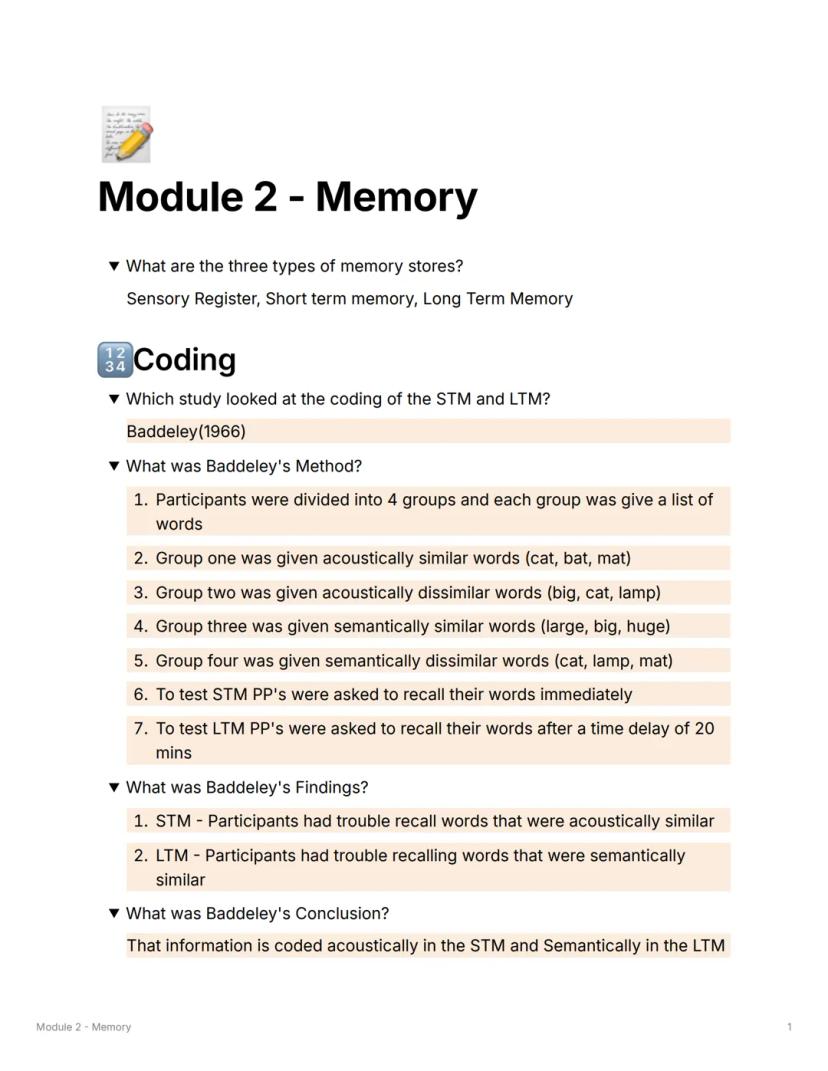

Your brain operates like a three-stage filing system with sensory register, short-term memory (STM), and long-term memory (LTM). Each store processes information differently, which explains why some things stick whilst others vanish instantly.
Baddeley's 1966 study revealed something brilliant about how your brain codes information. He gave participants four types of word lists - some that sounded similar (cat, bat, mat) and others that meant similar things (large, big, huge). When testing immediately, people struggled with words that sounded alike, but after 20 minutes, they had trouble with words that meant similar things.
This shows your STM codes acoustically (by sound) whilst your LTM codes semantically (by meaning). It's why you might confuse "write" and "right" when trying to remember a quick instruction, but mix up "happy" and "joyful" when recalling an old story.
Quick Tip: When revising, say information aloud for short-term recall, but focus on understanding meaning for long-term retention.
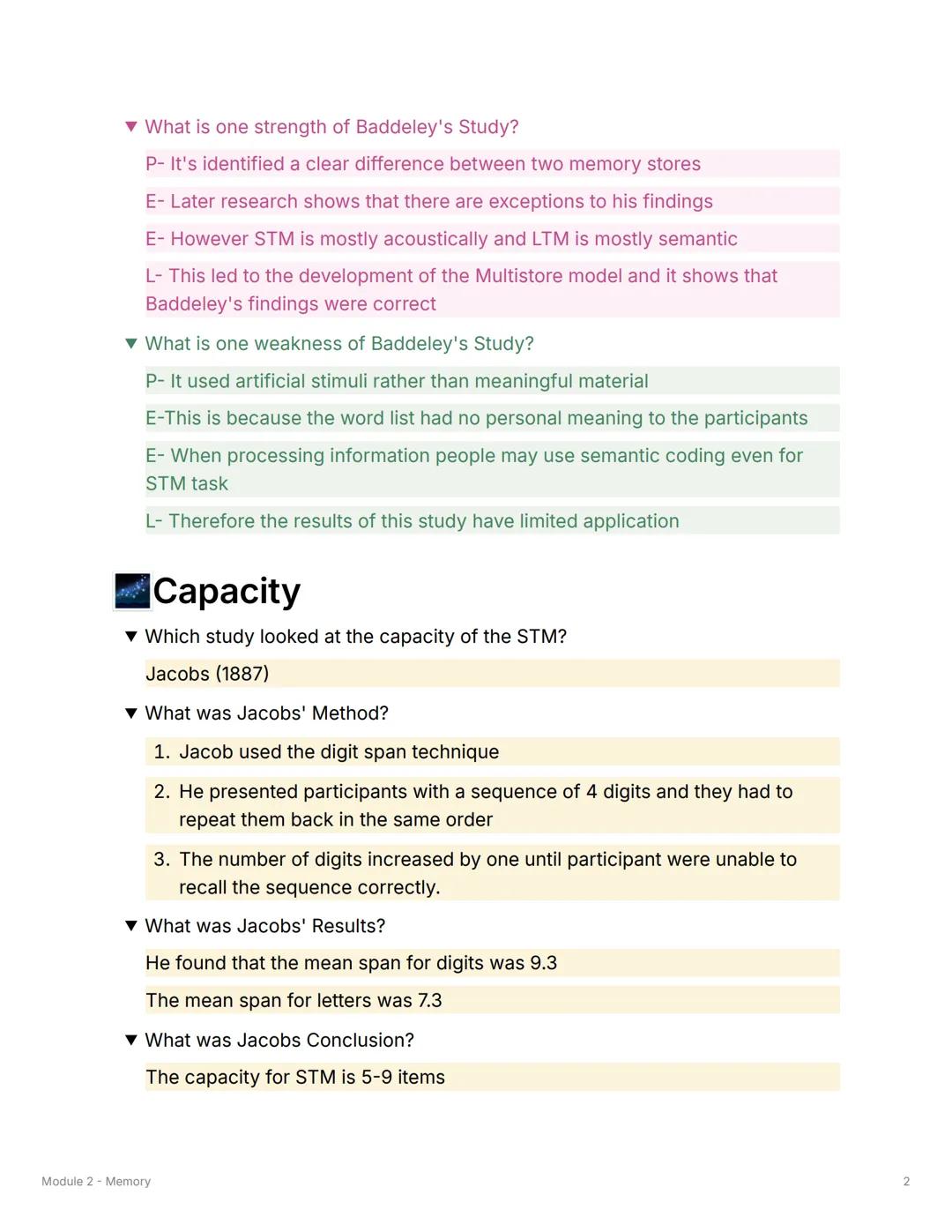
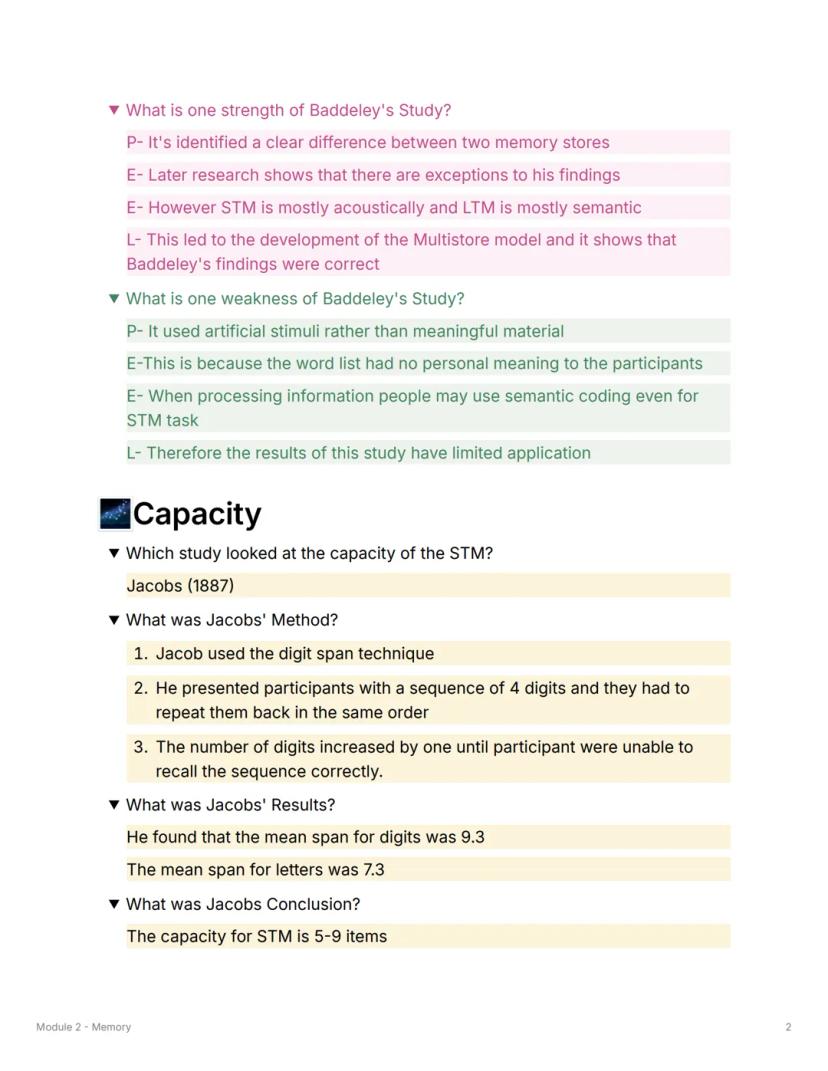
Jacob's 1887 study used the digit span technique to discover STM capacity. Participants repeated sequences of numbers that got progressively longer until they couldn't manage anymore. Results showed people could handle about 9 digits or 7 letters on average.
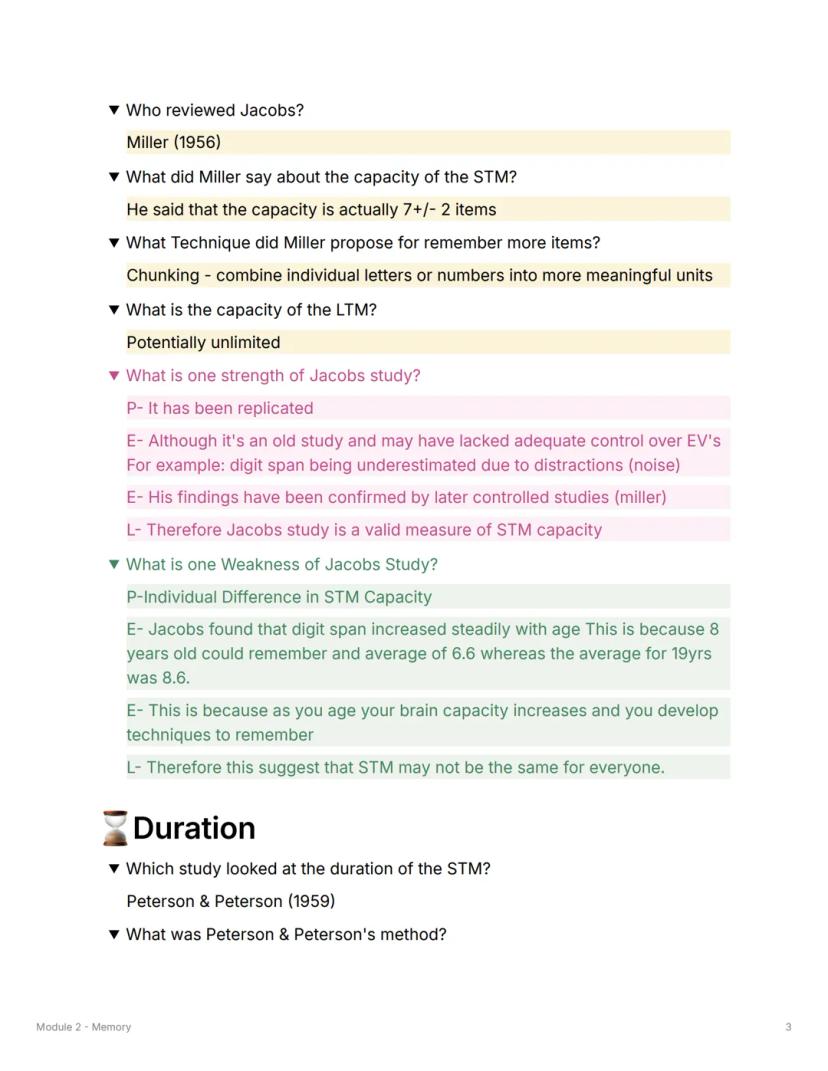
Miller's 1956 review refined this to the famous "7 plus or minus 2 items" rule. But here's the clever bit - Miller discovered chunking. Instead of remembering individual letters, you can group them into meaningful units. Try remembering "FBI CIA BBC" rather than "F-B-I-C-I-A-B-B-C".
Your LTM capacity is potentially unlimited - brilliant news for your A-levels! Jacob's findings have been replicated many times, though capacity does improve with age as your brain develops better memory strategies.
Study Hack: Use chunking to remember phone numbers, dates, or long lists by grouping information into meaningful chunks.
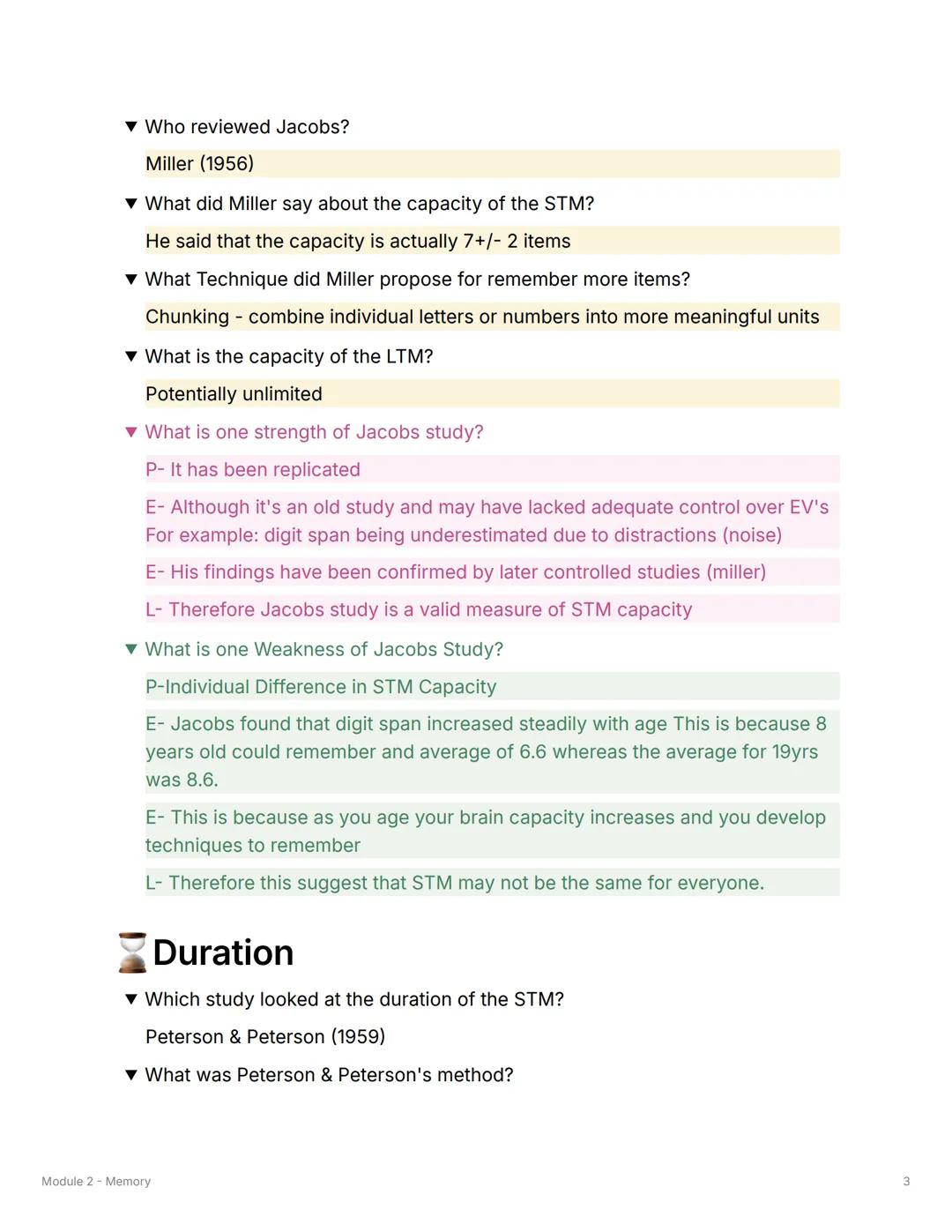
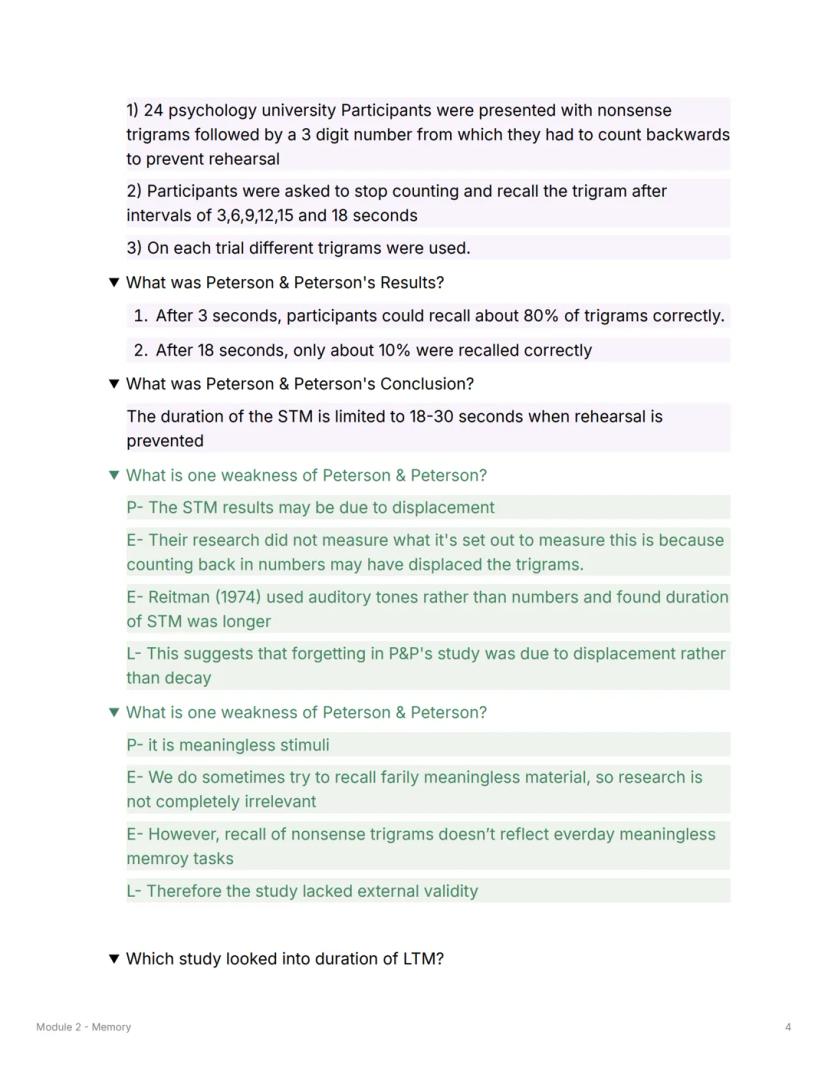
Peterson & Peterson's 1959 study tested STM duration using nonsense syllables like "XQF". Participants had to count backwards immediately after seeing the letters to prevent rehearsal. After just 18 seconds, recall dropped to 10% - proving STM duration is only 18-30 seconds without rehearsal.
However, this study faced criticism because counting backwards might have displaced the original information rather than proving it naturally decayed. Reitman's 1974 follow-up using auditory tones instead of numbers found longer STM duration, suggesting displacement was the real culprit.
The key takeaway? Without active rehearsal, information vanishes from your STM frighteningly quickly. This explains why you forget someone's name seconds after being introduced if you don't repeat it.
Memory Booster: Always rehearse important information immediately - repeat names, phone numbers, or key facts within 30 seconds of hearing them.
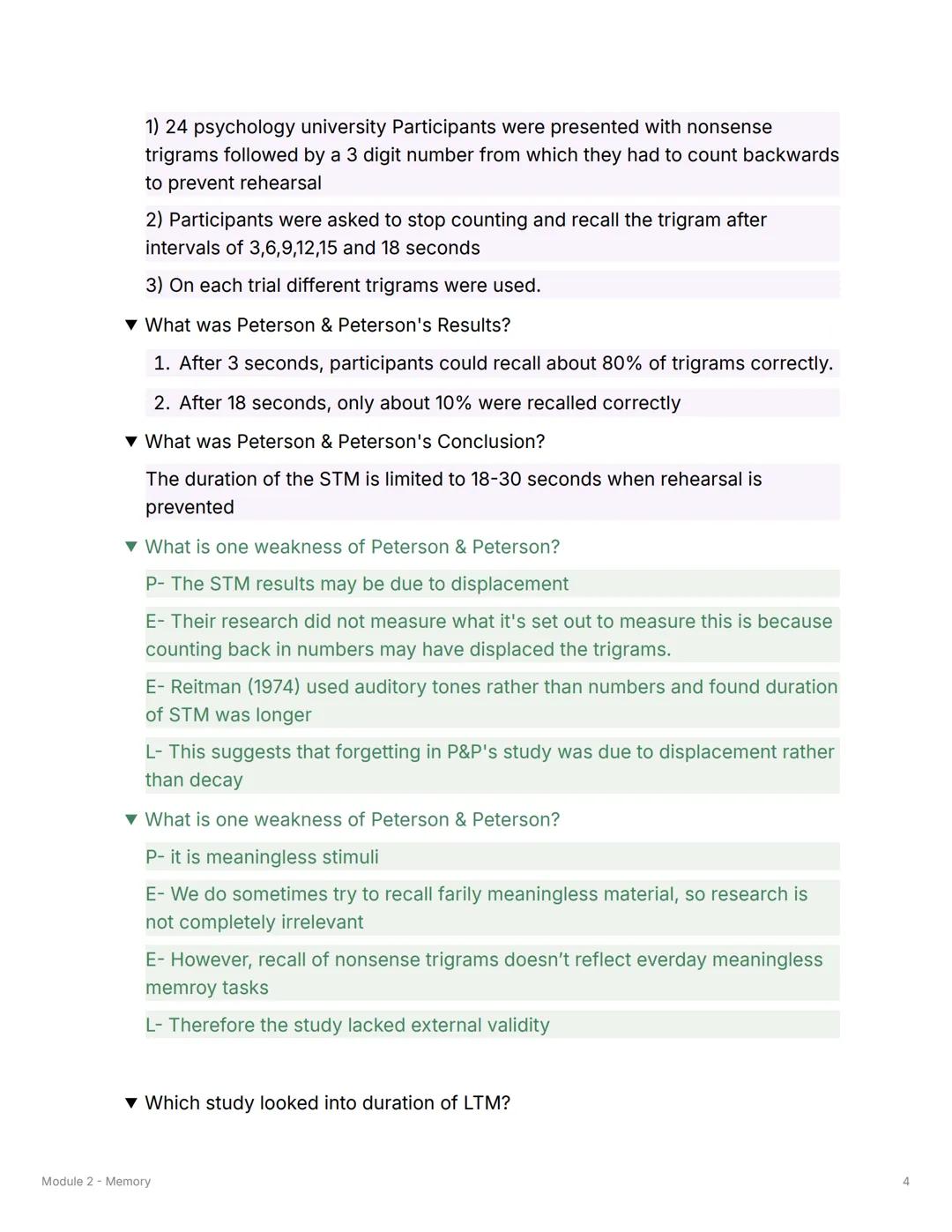
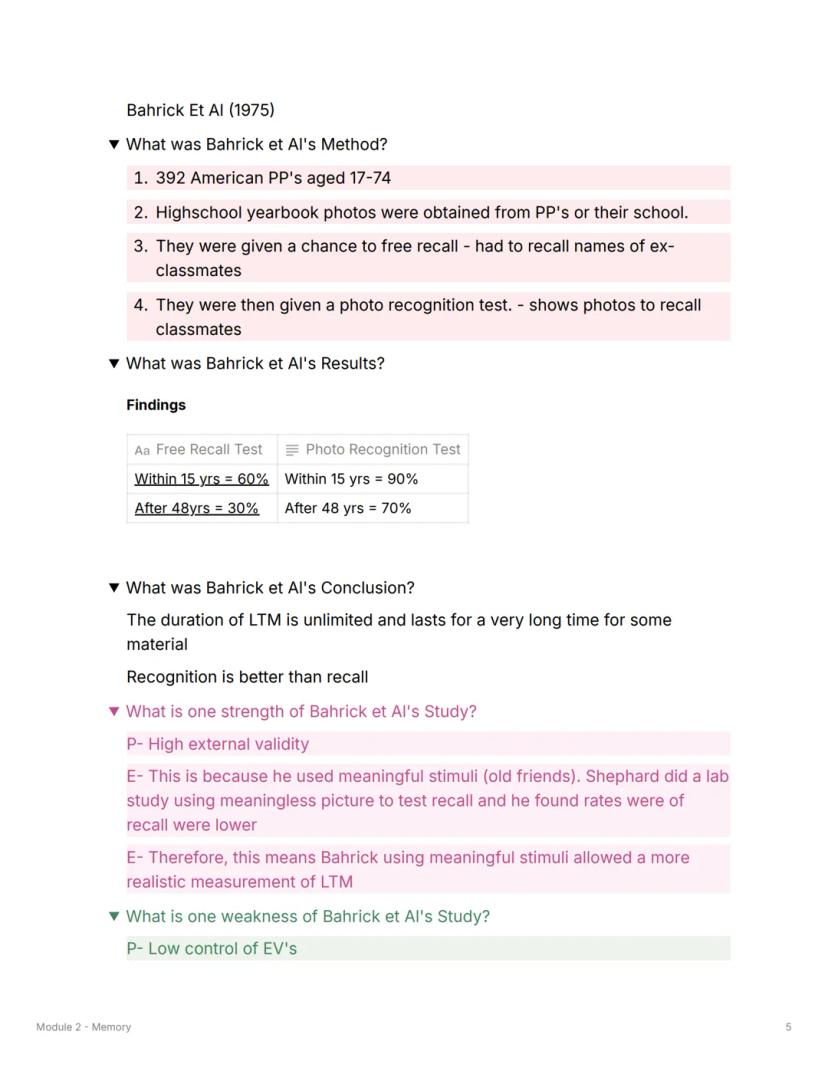
Bahrick et al's 1975 study tested LTM duration using something meaningful - high school yearbook photos. They tested 392 Americans aged 17-74 on recognising old classmates. Results were impressive: even after 48 years, people could recognise 70% of faces and recall 30% of names without prompts.
This demonstrates LTM duration is essentially unlimited for meaningful material. Recognition consistently outperformed recall, which explains why multiple-choice questions feel easier than essay questions - your brain finds it simpler to recognise correct information than retrieve it from scratch.
The study used meaningful stimuli (real friends) rather than random word lists, making it more relevant to real-life memory. However, external variables like staying in contact with classmates could have influenced results.
Exam Strategy: Create recognition cues for yourself - use flashcards, mind maps, or visual triggers to help retrieve information during exams.
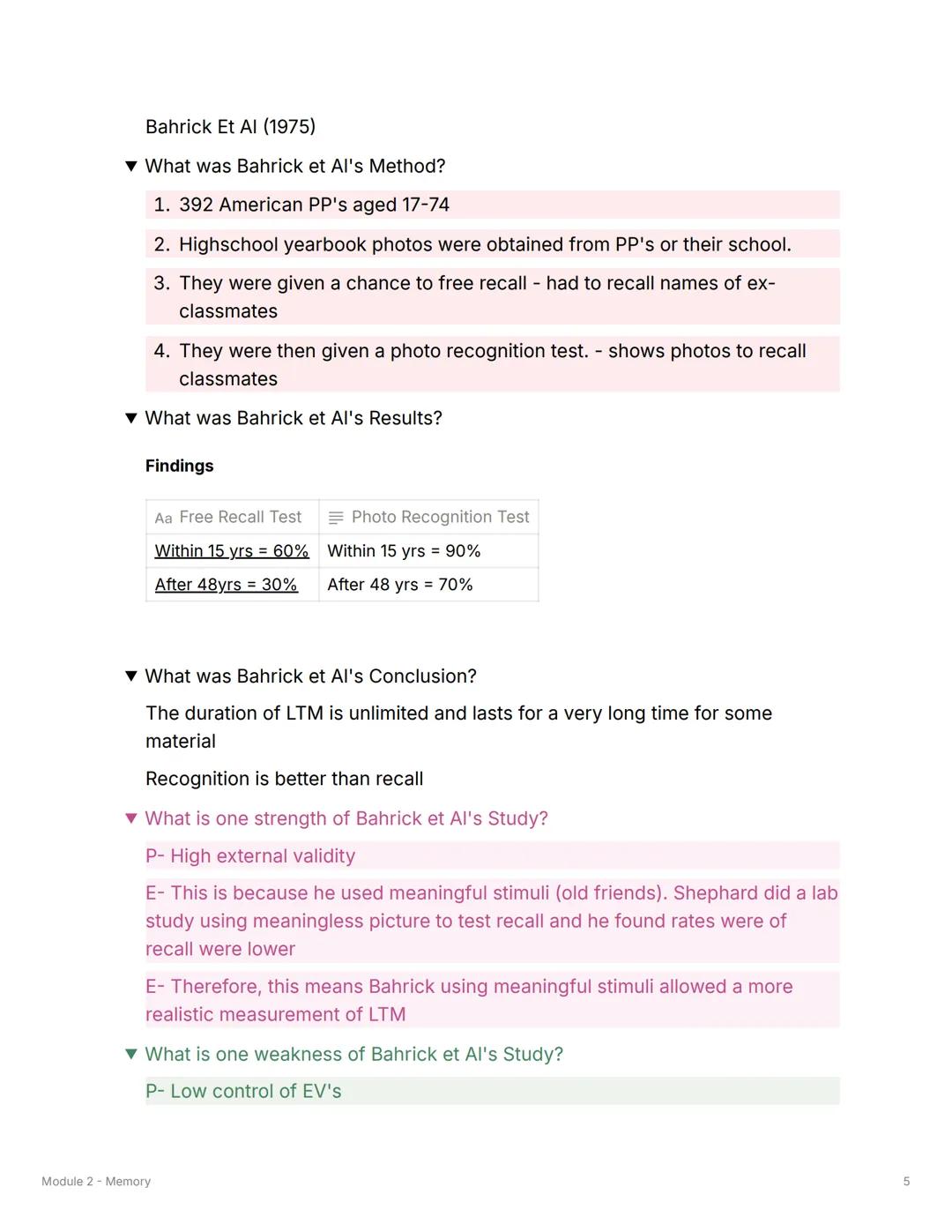
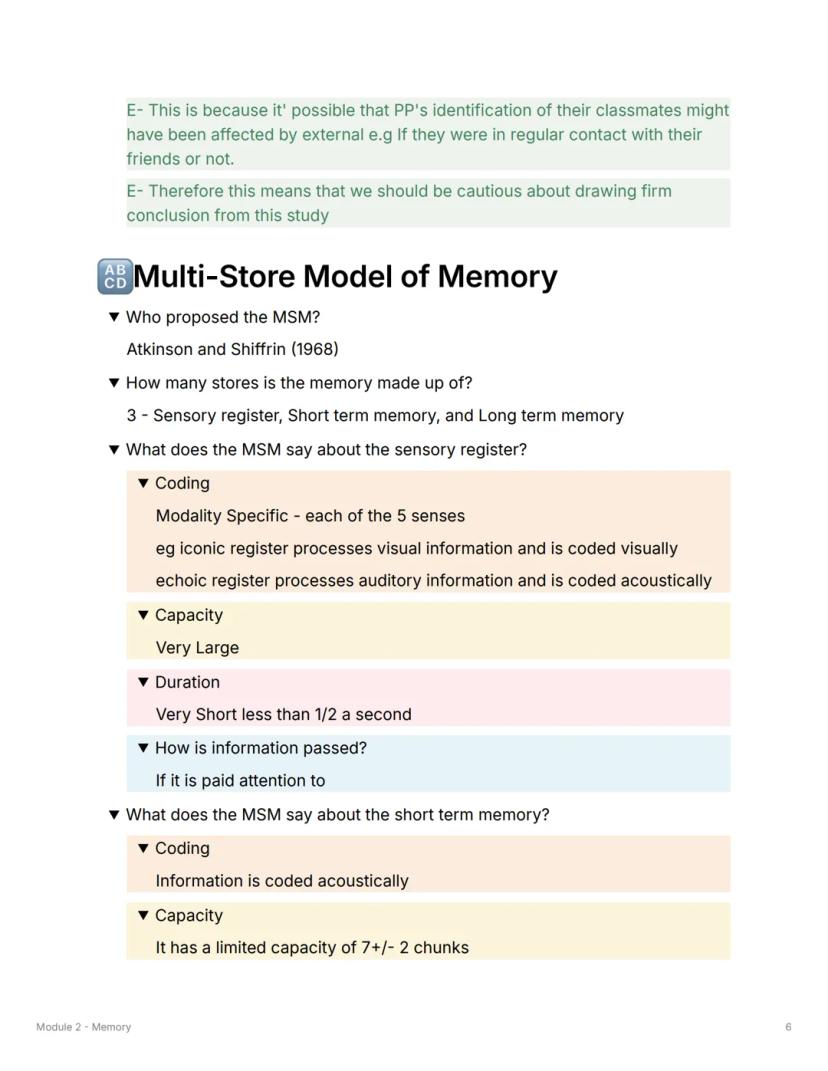
Atkinson and Shiffrin's 1968 Multi-Store Model explains how information flows through your three memory stores. Think of it as a production line where information must pass specific checkpoints to survive.
The sensory register captures everything your senses detect but holds it for less than half a second. Only information you pay attention to moves to STM, which holds 7±2 items for 18-30 seconds through acoustic coding. Maintenance rehearsal transfers information to LTM, where it's stored semantically with unlimited capacity and duration.
Information flows one way through attention and rehearsal, but can return from LTM to STM through retrieval. This explains why you sometimes "remember remembering" something - you're accessing the LTM version through your STM.
Study Tip: Use maintenance rehearsal (repeating information) to keep important facts in STM whilst you're learning, then elaborate on meaning to transfer to LTM.
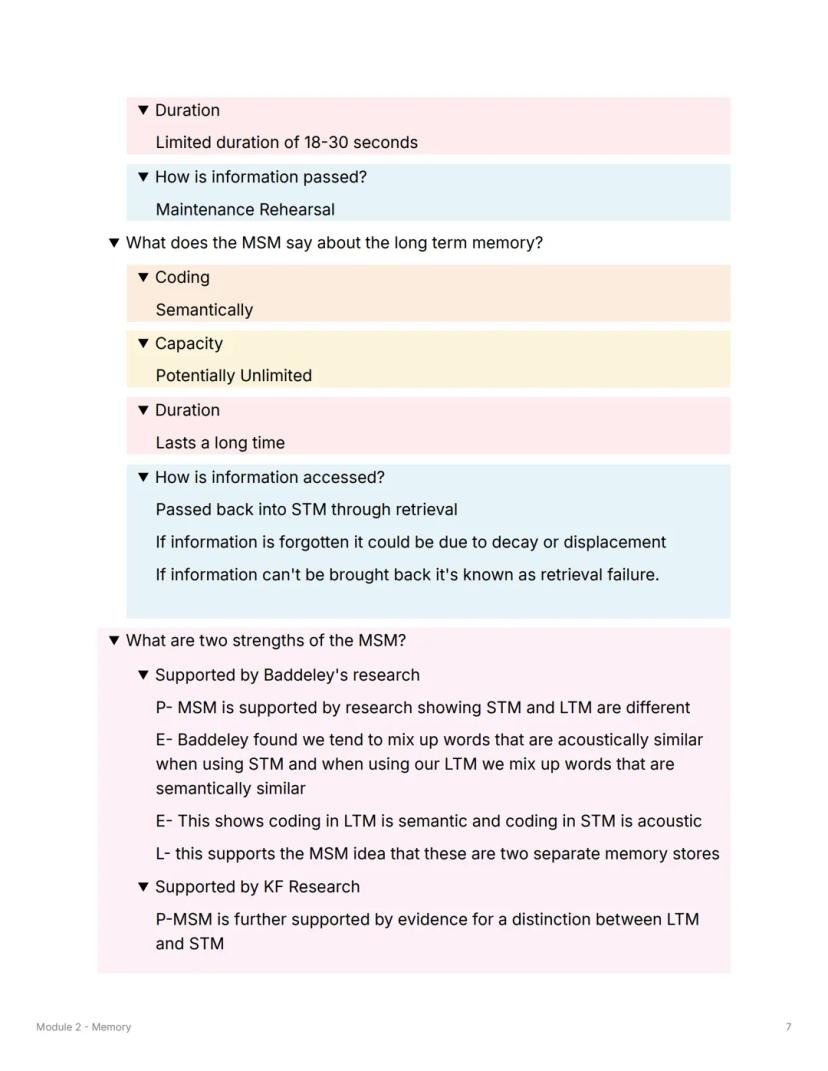
Research strongly supports the MSM's core principles. Baddeley's coding studies prove STM and LTM process information differently - acoustic versus semantic coding shows they're genuinely separate stores.
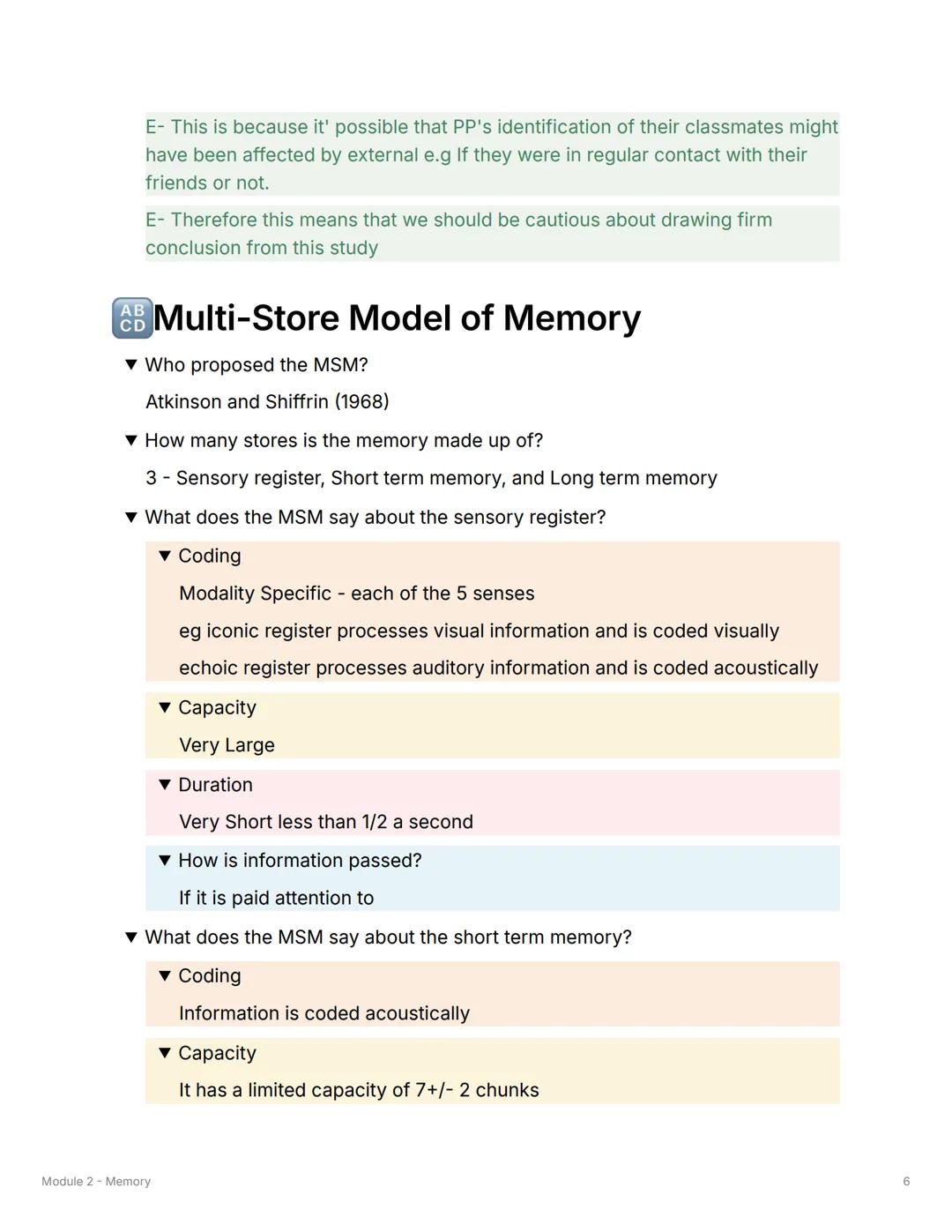
Brain damage cases provide compelling evidence. Patient KF, studied by Shallice and Warrington, had severely impaired STM (only 2 items capacity) after a motorcycle accident, whilst his LTM remained intact. This demonstrates the stores are physically separate in the brain.
The model successfully explains many everyday memory experiences and has guided decades of memory research. It provides a clear framework for understanding why some information sticks whilst other details disappear.
Real-World Application: Understanding separate stores helps explain why you might forget what someone just said (STM failure) but remember childhood events perfectly (successful LTM storage).

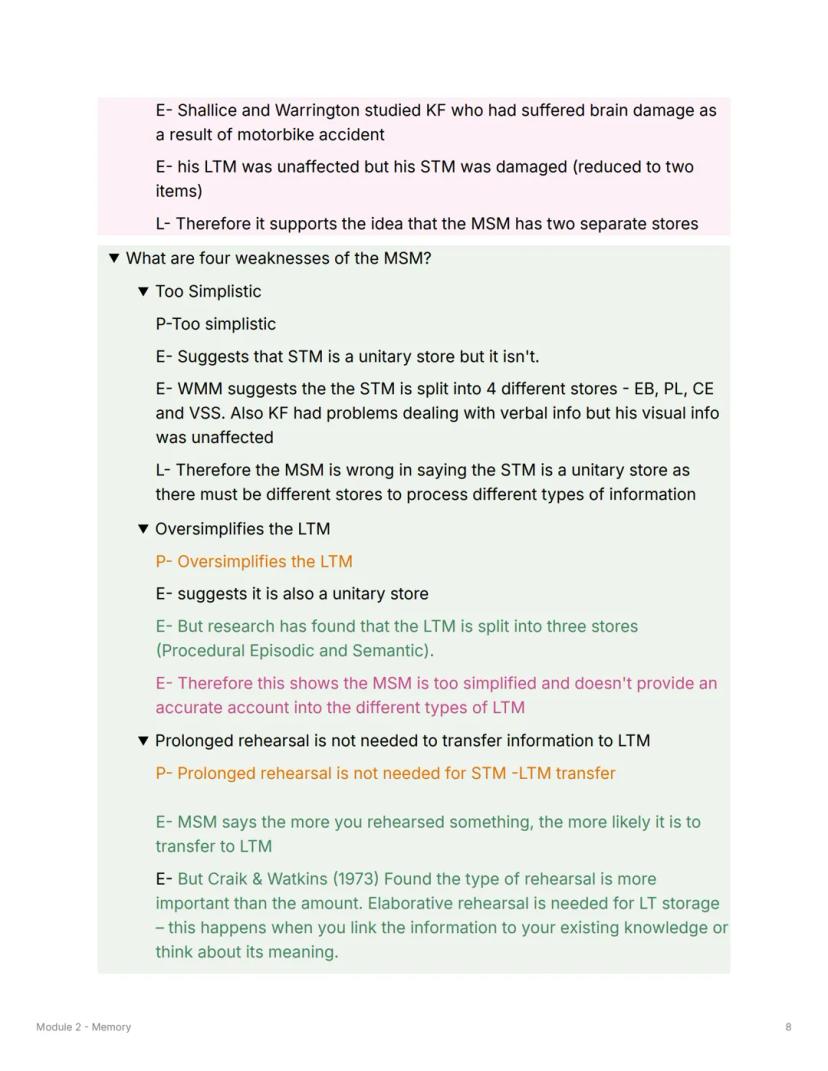
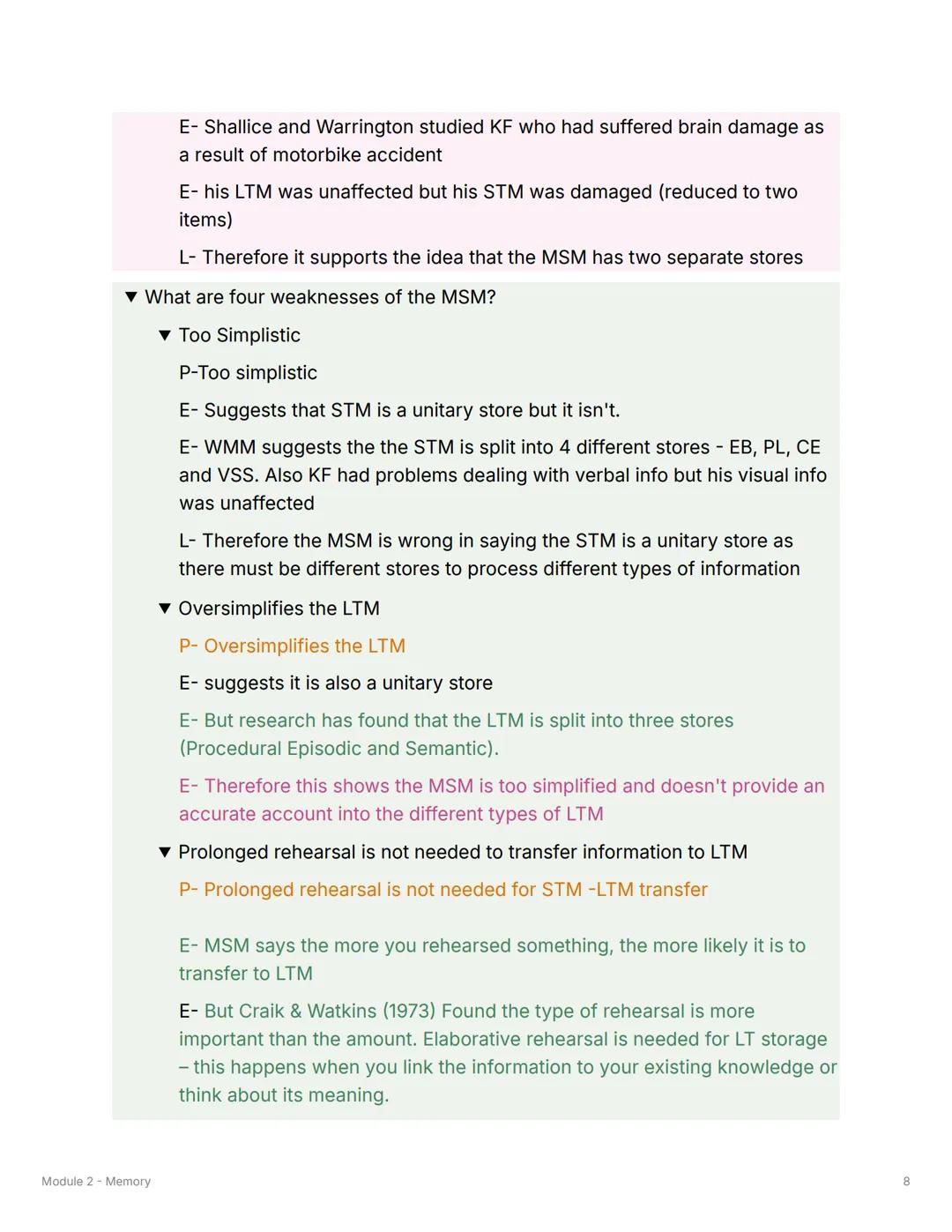
Despite its influence, the MSM oversimplifies memory. The Working Memory Model shows STM isn't one unified store but contains separate components for different information types. Patient KF could handle visual information better than verbal material, proving STM has multiple parts.
LTM also isn't unified - research reveals episodic, semantic, and procedural memory types with different characteristics. The MSM's single LTM store doesn't account for these important distinctions.
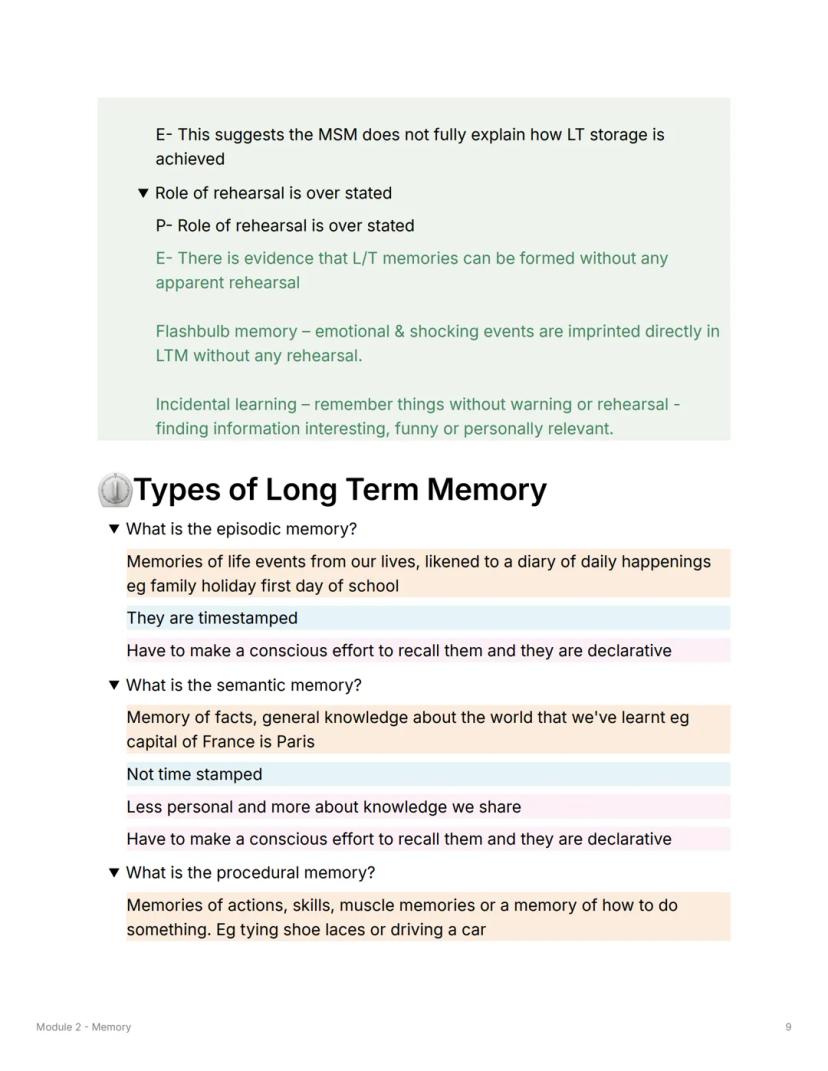
Rehearsal assumptions are problematic. Craik and Watkins found that elaborative rehearsal (linking to existing knowledge) matters more than simple repetition. Flashbulb memories and incidental learning prove LTM storage can occur without conscious rehearsal.
Critical Thinking: While the MSM provides a useful foundation, remember that real memory is more complex and flexible than this model suggests.
Your LTM contains three distinct types of memories that work differently. Episodic memory stores personal experiences like your first day at college or last summer's holiday - these are timestamped and feel like diary entries you consciously recall.
Semantic memory holds general knowledge and facts like knowing Paris is France's capital or understanding what dogs are. These memories aren't timestamped or personal but represent shared cultural knowledge.
Procedural memory contains skills and actions like riding a bike or typing. These become automatic with practice and are difficult to explain verbally - you just "know how" to do them without conscious thought.
Study Application: Use all three memory types - create personal connections (episodic), learn facts (semantic), and practice skills repeatedly (procedural).

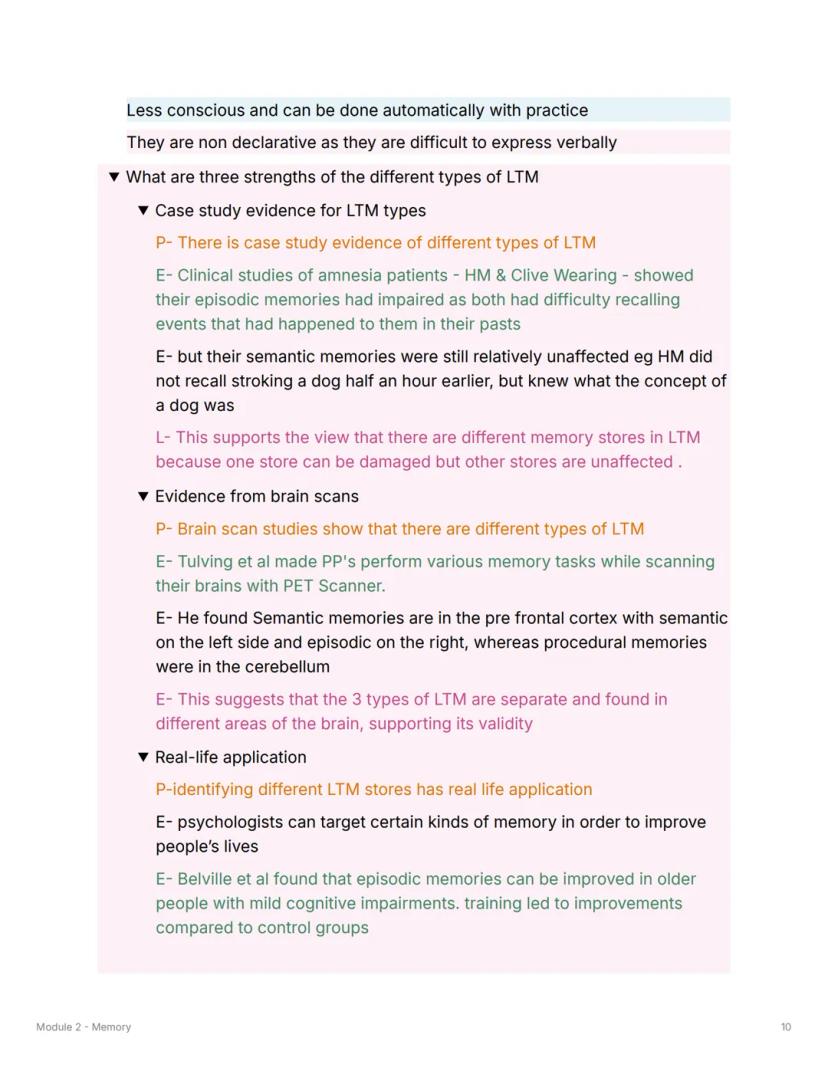
Case studies provide powerful evidence for separate LTM types. Patients HM and Clive Wearing suffered brain damage that severely impaired episodic memory whilst leaving semantic memory relatively intact. HM couldn't remember stroking a dog 30 minutes earlier but understood what dogs were.
Brain scanning studies by Tulving showed different LTM types activate separate brain regions. Semantic memories appear in the left prefrontal cortex, episodic in the right, and procedural in the cerebellum. This physical separation confirms they're genuinely different systems.
Real-world applications emerge from understanding memory types. Belleville's research showed that targeted episodic memory training helps older adults with cognitive impairments, proving that identifying specific memory types leads to practical interventions.
Exam Success: Recognise which memory type each question targets - factual recall (semantic), personal examples (episodic), or demonstrating skills (procedural).

Our AI Companion is a student-focused AI tool that offers more than just answers. Built on millions of Knowunity resources, it provides relevant information, personalised study plans, quizzes, and content directly in the chat, adapting to your individual learning journey.
You can download the app from Google Play Store and Apple App Store.
That's right! Enjoy free access to study content, connect with fellow students, and get instant help – all at your fingertips.
App Store
Google Play
The app is very easy to use and well designed. I have found everything I was looking for so far and have been able to learn a lot from the presentations! I will definitely use the app for a class assignment! And of course it also helps a lot as an inspiration.
Stefan S
iOS user
This app is really great. There are so many study notes and help [...]. My problem subject is French, for example, and the app has so many options for help. Thanks to this app, I have improved my French. I would recommend it to anyone.
Samantha Klich
Android user
Wow, I am really amazed. I just tried the app because I've seen it advertised many times and was absolutely stunned. This app is THE HELP you want for school and above all, it offers so many things, such as workouts and fact sheets, which have been VERY helpful to me personally.
Anna
iOS user
Best app on earth! no words because it’s too good
Thomas R
iOS user
Just amazing. Let's me revise 10x better, this app is a quick 10/10. I highly recommend it to anyone. I can watch and search for notes. I can save them in the subject folder. I can revise it any time when I come back. If you haven't tried this app, you're really missing out.
Basil
Android user
This app has made me feel so much more confident in my exam prep, not only through boosting my own self confidence through the features that allow you to connect with others and feel less alone, but also through the way the app itself is centred around making you feel better. It is easy to navigate, fun to use, and helpful to anyone struggling in absolutely any way.
David K
iOS user
The app's just great! All I have to do is enter the topic in the search bar and I get the response real fast. I don't have to watch 10 YouTube videos to understand something, so I'm saving my time. Highly recommended!
Sudenaz Ocak
Android user
In school I was really bad at maths but thanks to the app, I am doing better now. I am so grateful that you made the app.
Greenlight Bonnie
Android user
very reliable app to help and grow your ideas of Maths, English and other related topics in your works. please use this app if your struggling in areas, this app is key for that. wish I'd of done a review before. and it's also free so don't worry about that.
Rohan U
Android user
I know a lot of apps use fake accounts to boost their reviews but this app deserves it all. Originally I was getting 4 in my English exams and this time I got a grade 7. I didn’t even know about this app three days until the exam and it has helped A LOT. Please actually trust me and use it as I’m sure you too will see developments.
Xander S
iOS user
THE QUIZES AND FLASHCARDS ARE SO USEFUL AND I LOVE Knowunity AI. IT ALSO IS LITREALLY LIKE CHATGPT BUT SMARTER!! HELPED ME WITH MY MASCARA PROBLEMS TOO!! AS WELL AS MY REAL SUBJECTS ! DUHHH 😍😁😲🤑💗✨🎀😮
Elisha
iOS user
This apps acc the goat. I find revision so boring but this app makes it so easy to organize it all and then you can ask the freeeee ai to test yourself so good and you can easily upload your own stuff. highly recommend as someone taking mocks now
Paul T
iOS user
The app is very easy to use and well designed. I have found everything I was looking for so far and have been able to learn a lot from the presentations! I will definitely use the app for a class assignment! And of course it also helps a lot as an inspiration.
Stefan S
iOS user
This app is really great. There are so many study notes and help [...]. My problem subject is French, for example, and the app has so many options for help. Thanks to this app, I have improved my French. I would recommend it to anyone.
Samantha Klich
Android user
Wow, I am really amazed. I just tried the app because I've seen it advertised many times and was absolutely stunned. This app is THE HELP you want for school and above all, it offers so many things, such as workouts and fact sheets, which have been VERY helpful to me personally.
Anna
iOS user
Best app on earth! no words because it’s too good
Thomas R
iOS user
Just amazing. Let's me revise 10x better, this app is a quick 10/10. I highly recommend it to anyone. I can watch and search for notes. I can save them in the subject folder. I can revise it any time when I come back. If you haven't tried this app, you're really missing out.
Basil
Android user
This app has made me feel so much more confident in my exam prep, not only through boosting my own self confidence through the features that allow you to connect with others and feel less alone, but also through the way the app itself is centred around making you feel better. It is easy to navigate, fun to use, and helpful to anyone struggling in absolutely any way.
David K
iOS user
The app's just great! All I have to do is enter the topic in the search bar and I get the response real fast. I don't have to watch 10 YouTube videos to understand something, so I'm saving my time. Highly recommended!
Sudenaz Ocak
Android user
In school I was really bad at maths but thanks to the app, I am doing better now. I am so grateful that you made the app.
Greenlight Bonnie
Android user
very reliable app to help and grow your ideas of Maths, English and other related topics in your works. please use this app if your struggling in areas, this app is key for that. wish I'd of done a review before. and it's also free so don't worry about that.
Rohan U
Android user
I know a lot of apps use fake accounts to boost their reviews but this app deserves it all. Originally I was getting 4 in my English exams and this time I got a grade 7. I didn’t even know about this app three days until the exam and it has helped A LOT. Please actually trust me and use it as I’m sure you too will see developments.
Xander S
iOS user
THE QUIZES AND FLASHCARDS ARE SO USEFUL AND I LOVE Knowunity AI. IT ALSO IS LITREALLY LIKE CHATGPT BUT SMARTER!! HELPED ME WITH MY MASCARA PROBLEMS TOO!! AS WELL AS MY REAL SUBJECTS ! DUHHH 😍😁😲🤑💗✨🎀😮
Elisha
iOS user
This apps acc the goat. I find revision so boring but this app makes it so easy to organize it all and then you can ask the freeeee ai to test yourself so good and you can easily upload your own stuff. highly recommend as someone taking mocks now
Paul T
iOS user
Zainab
@zainab_02839
Ever wondered why you can remember song lyrics from years ago but forget what you studied yesterday? Your brain uses three different memory stores that work in fascinating ways. Understanding how memory works isn't just academic - it's the key... Show more
Access to all documents
Improve your grades
Join milions of students
By signing up you accept Terms of Service and Privacy Policy
Your brain operates like a three-stage filing system with sensory register, short-term memory (STM), and long-term memory (LTM). Each store processes information differently, which explains why some things stick whilst others vanish instantly.
Baddeley's 1966 study revealed something brilliant about how your brain codes information. He gave participants four types of word lists - some that sounded similar (cat, bat, mat) and others that meant similar things (large, big, huge). When testing immediately, people struggled with words that sounded alike, but after 20 minutes, they had trouble with words that meant similar things.
This shows your STM codes acoustically (by sound) whilst your LTM codes semantically (by meaning). It's why you might confuse "write" and "right" when trying to remember a quick instruction, but mix up "happy" and "joyful" when recalling an old story.
Quick Tip: When revising, say information aloud for short-term recall, but focus on understanding meaning for long-term retention.
Access to all documents
Improve your grades
Join milions of students
By signing up you accept Terms of Service and Privacy Policy
Jacob's 1887 study used the digit span technique to discover STM capacity. Participants repeated sequences of numbers that got progressively longer until they couldn't manage anymore. Results showed people could handle about 9 digits or 7 letters on average.
Miller's 1956 review refined this to the famous "7 plus or minus 2 items" rule. But here's the clever bit - Miller discovered chunking. Instead of remembering individual letters, you can group them into meaningful units. Try remembering "FBI CIA BBC" rather than "F-B-I-C-I-A-B-B-C".
Your LTM capacity is potentially unlimited - brilliant news for your A-levels! Jacob's findings have been replicated many times, though capacity does improve with age as your brain develops better memory strategies.
Study Hack: Use chunking to remember phone numbers, dates, or long lists by grouping information into meaningful chunks.
Access to all documents
Improve your grades
Join milions of students
By signing up you accept Terms of Service and Privacy Policy
Peterson & Peterson's 1959 study tested STM duration using nonsense syllables like "XQF". Participants had to count backwards immediately after seeing the letters to prevent rehearsal. After just 18 seconds, recall dropped to 10% - proving STM duration is only 18-30 seconds without rehearsal.
However, this study faced criticism because counting backwards might have displaced the original information rather than proving it naturally decayed. Reitman's 1974 follow-up using auditory tones instead of numbers found longer STM duration, suggesting displacement was the real culprit.
The key takeaway? Without active rehearsal, information vanishes from your STM frighteningly quickly. This explains why you forget someone's name seconds after being introduced if you don't repeat it.
Memory Booster: Always rehearse important information immediately - repeat names, phone numbers, or key facts within 30 seconds of hearing them.
Access to all documents
Improve your grades
Join milions of students
By signing up you accept Terms of Service and Privacy Policy
Bahrick et al's 1975 study tested LTM duration using something meaningful - high school yearbook photos. They tested 392 Americans aged 17-74 on recognising old classmates. Results were impressive: even after 48 years, people could recognise 70% of faces and recall 30% of names without prompts.
This demonstrates LTM duration is essentially unlimited for meaningful material. Recognition consistently outperformed recall, which explains why multiple-choice questions feel easier than essay questions - your brain finds it simpler to recognise correct information than retrieve it from scratch.
The study used meaningful stimuli (real friends) rather than random word lists, making it more relevant to real-life memory. However, external variables like staying in contact with classmates could have influenced results.
Exam Strategy: Create recognition cues for yourself - use flashcards, mind maps, or visual triggers to help retrieve information during exams.
Access to all documents
Improve your grades
Join milions of students
By signing up you accept Terms of Service and Privacy Policy
Atkinson and Shiffrin's 1968 Multi-Store Model explains how information flows through your three memory stores. Think of it as a production line where information must pass specific checkpoints to survive.
The sensory register captures everything your senses detect but holds it for less than half a second. Only information you pay attention to moves to STM, which holds 7±2 items for 18-30 seconds through acoustic coding. Maintenance rehearsal transfers information to LTM, where it's stored semantically with unlimited capacity and duration.
Information flows one way through attention and rehearsal, but can return from LTM to STM through retrieval. This explains why you sometimes "remember remembering" something - you're accessing the LTM version through your STM.
Study Tip: Use maintenance rehearsal (repeating information) to keep important facts in STM whilst you're learning, then elaborate on meaning to transfer to LTM.
Access to all documents
Improve your grades
Join milions of students
By signing up you accept Terms of Service and Privacy Policy
Research strongly supports the MSM's core principles. Baddeley's coding studies prove STM and LTM process information differently - acoustic versus semantic coding shows they're genuinely separate stores.
Brain damage cases provide compelling evidence. Patient KF, studied by Shallice and Warrington, had severely impaired STM (only 2 items capacity) after a motorcycle accident, whilst his LTM remained intact. This demonstrates the stores are physically separate in the brain.
The model successfully explains many everyday memory experiences and has guided decades of memory research. It provides a clear framework for understanding why some information sticks whilst other details disappear.
Real-World Application: Understanding separate stores helps explain why you might forget what someone just said (STM failure) but remember childhood events perfectly (successful LTM storage).
Access to all documents
Improve your grades
Join milions of students
By signing up you accept Terms of Service and Privacy Policy
Despite its influence, the MSM oversimplifies memory. The Working Memory Model shows STM isn't one unified store but contains separate components for different information types. Patient KF could handle visual information better than verbal material, proving STM has multiple parts.
LTM also isn't unified - research reveals episodic, semantic, and procedural memory types with different characteristics. The MSM's single LTM store doesn't account for these important distinctions.
Rehearsal assumptions are problematic. Craik and Watkins found that elaborative rehearsal (linking to existing knowledge) matters more than simple repetition. Flashbulb memories and incidental learning prove LTM storage can occur without conscious rehearsal.
Critical Thinking: While the MSM provides a useful foundation, remember that real memory is more complex and flexible than this model suggests.
Access to all documents
Improve your grades
Join milions of students
By signing up you accept Terms of Service and Privacy Policy
Your LTM contains three distinct types of memories that work differently. Episodic memory stores personal experiences like your first day at college or last summer's holiday - these are timestamped and feel like diary entries you consciously recall.
Semantic memory holds general knowledge and facts like knowing Paris is France's capital or understanding what dogs are. These memories aren't timestamped or personal but represent shared cultural knowledge.
Procedural memory contains skills and actions like riding a bike or typing. These become automatic with practice and are difficult to explain verbally - you just "know how" to do them without conscious thought.
Study Application: Use all three memory types - create personal connections (episodic), learn facts (semantic), and practice skills repeatedly (procedural).
Access to all documents
Improve your grades
Join milions of students
By signing up you accept Terms of Service and Privacy Policy
Case studies provide powerful evidence for separate LTM types. Patients HM and Clive Wearing suffered brain damage that severely impaired episodic memory whilst leaving semantic memory relatively intact. HM couldn't remember stroking a dog 30 minutes earlier but understood what dogs were.
Brain scanning studies by Tulving showed different LTM types activate separate brain regions. Semantic memories appear in the left prefrontal cortex, episodic in the right, and procedural in the cerebellum. This physical separation confirms they're genuinely different systems.
Real-world applications emerge from understanding memory types. Belleville's research showed that targeted episodic memory training helps older adults with cognitive impairments, proving that identifying specific memory types leads to practical interventions.
Exam Success: Recognise which memory type each question targets - factual recall (semantic), personal examples (episodic), or demonstrating skills (procedural).
Access to all documents
Improve your grades
Join milions of students
By signing up you accept Terms of Service and Privacy Policy
Our AI Companion is a student-focused AI tool that offers more than just answers. Built on millions of Knowunity resources, it provides relevant information, personalised study plans, quizzes, and content directly in the chat, adapting to your individual learning journey.
You can download the app from Google Play Store and Apple App Store.
That's right! Enjoy free access to study content, connect with fellow students, and get instant help – all at your fingertips.
7
Smart Tools NEW
Transform this note into: ✓ 50+ Practice Questions ✓ Interactive Flashcards ✓ Full Mock Exam ✓ Essay Outlines
App Store
Google Play
The app is very easy to use and well designed. I have found everything I was looking for so far and have been able to learn a lot from the presentations! I will definitely use the app for a class assignment! And of course it also helps a lot as an inspiration.
Stefan S
iOS user
This app is really great. There are so many study notes and help [...]. My problem subject is French, for example, and the app has so many options for help. Thanks to this app, I have improved my French. I would recommend it to anyone.
Samantha Klich
Android user
Wow, I am really amazed. I just tried the app because I've seen it advertised many times and was absolutely stunned. This app is THE HELP you want for school and above all, it offers so many things, such as workouts and fact sheets, which have been VERY helpful to me personally.
Anna
iOS user
Best app on earth! no words because it’s too good
Thomas R
iOS user
Just amazing. Let's me revise 10x better, this app is a quick 10/10. I highly recommend it to anyone. I can watch and search for notes. I can save them in the subject folder. I can revise it any time when I come back. If you haven't tried this app, you're really missing out.
Basil
Android user
This app has made me feel so much more confident in my exam prep, not only through boosting my own self confidence through the features that allow you to connect with others and feel less alone, but also through the way the app itself is centred around making you feel better. It is easy to navigate, fun to use, and helpful to anyone struggling in absolutely any way.
David K
iOS user
The app's just great! All I have to do is enter the topic in the search bar and I get the response real fast. I don't have to watch 10 YouTube videos to understand something, so I'm saving my time. Highly recommended!
Sudenaz Ocak
Android user
In school I was really bad at maths but thanks to the app, I am doing better now. I am so grateful that you made the app.
Greenlight Bonnie
Android user
very reliable app to help and grow your ideas of Maths, English and other related topics in your works. please use this app if your struggling in areas, this app is key for that. wish I'd of done a review before. and it's also free so don't worry about that.
Rohan U
Android user
I know a lot of apps use fake accounts to boost their reviews but this app deserves it all. Originally I was getting 4 in my English exams and this time I got a grade 7. I didn’t even know about this app three days until the exam and it has helped A LOT. Please actually trust me and use it as I’m sure you too will see developments.
Xander S
iOS user
THE QUIZES AND FLASHCARDS ARE SO USEFUL AND I LOVE Knowunity AI. IT ALSO IS LITREALLY LIKE CHATGPT BUT SMARTER!! HELPED ME WITH MY MASCARA PROBLEMS TOO!! AS WELL AS MY REAL SUBJECTS ! DUHHH 😍😁😲🤑💗✨🎀😮
Elisha
iOS user
This apps acc the goat. I find revision so boring but this app makes it so easy to organize it all and then you can ask the freeeee ai to test yourself so good and you can easily upload your own stuff. highly recommend as someone taking mocks now
Paul T
iOS user
The app is very easy to use and well designed. I have found everything I was looking for so far and have been able to learn a lot from the presentations! I will definitely use the app for a class assignment! And of course it also helps a lot as an inspiration.
Stefan S
iOS user
This app is really great. There are so many study notes and help [...]. My problem subject is French, for example, and the app has so many options for help. Thanks to this app, I have improved my French. I would recommend it to anyone.
Samantha Klich
Android user
Wow, I am really amazed. I just tried the app because I've seen it advertised many times and was absolutely stunned. This app is THE HELP you want for school and above all, it offers so many things, such as workouts and fact sheets, which have been VERY helpful to me personally.
Anna
iOS user
Best app on earth! no words because it’s too good
Thomas R
iOS user
Just amazing. Let's me revise 10x better, this app is a quick 10/10. I highly recommend it to anyone. I can watch and search for notes. I can save them in the subject folder. I can revise it any time when I come back. If you haven't tried this app, you're really missing out.
Basil
Android user
This app has made me feel so much more confident in my exam prep, not only through boosting my own self confidence through the features that allow you to connect with others and feel less alone, but also through the way the app itself is centred around making you feel better. It is easy to navigate, fun to use, and helpful to anyone struggling in absolutely any way.
David K
iOS user
The app's just great! All I have to do is enter the topic in the search bar and I get the response real fast. I don't have to watch 10 YouTube videos to understand something, so I'm saving my time. Highly recommended!
Sudenaz Ocak
Android user
In school I was really bad at maths but thanks to the app, I am doing better now. I am so grateful that you made the app.
Greenlight Bonnie
Android user
very reliable app to help and grow your ideas of Maths, English and other related topics in your works. please use this app if your struggling in areas, this app is key for that. wish I'd of done a review before. and it's also free so don't worry about that.
Rohan U
Android user
I know a lot of apps use fake accounts to boost their reviews but this app deserves it all. Originally I was getting 4 in my English exams and this time I got a grade 7. I didn’t even know about this app three days until the exam and it has helped A LOT. Please actually trust me and use it as I’m sure you too will see developments.
Xander S
iOS user
THE QUIZES AND FLASHCARDS ARE SO USEFUL AND I LOVE Knowunity AI. IT ALSO IS LITREALLY LIKE CHATGPT BUT SMARTER!! HELPED ME WITH MY MASCARA PROBLEMS TOO!! AS WELL AS MY REAL SUBJECTS ! DUHHH 😍😁😲🤑💗✨🎀😮
Elisha
iOS user
This apps acc the goat. I find revision so boring but this app makes it so easy to organize it all and then you can ask the freeeee ai to test yourself so good and you can easily upload your own stuff. highly recommend as someone taking mocks now
Paul T
iOS user