
Ever wondered why damage to different parts of your brain... Show more
 Psychology
 English Literature
 Sociology
 Biology
Sign up to see the contentIt's free!
Access to all documents
Improve your grades
Join milions of students
By signing up you accept Terms of Service and Privacy Policy
Subjects
Classic Dramatic Literature
Modern Lyric Poetry
Influential English-Language Authors
Classic and Contemporary Novels
Literary Character Analysis
Romantic and Love Poetry
Reading Analysis and Interpretation
Evidence Analysis and Integration
Author's Stylistic Elements
Figurative Language and Rhetoric
Show all topics
Human Organ Systems
Cellular Organization and Development
Biomolecular Structure and Organization
Enzyme Structure and Regulation
Cellular Organization Types
Biological Homeostatic Processes
Cellular Membrane Structure
Autotrophic Energy Processes
Environmental Sustainability and Impact
Neural Communication Systems
Show all topics
Social Sciences Research & Practice
Social Structure and Mobility
Classic Social Influence Experiments
Social Systems Theories
Family and Relationship Dynamics
Memory Systems and Processes
Neural Bases of Behavior
Social Influence and Attraction
Psychotherapeutic Approaches
Human Agency and Responsibility
Show all topics
Chemical Sciences and Applications
Chemical Bond Types and Properties
Organic Functional Groups
Atomic Structure and Composition
Chromatographic Separation Principles
Chemical Compound Classifications
Electrochemical Cell Systems
Periodic Table Organization
Chemical Reaction Kinetics
Chemical Equation Conservation
Show all topics
Nazi Germany and Holocaust 1933-1945
World Wars and Peace Treaties
European Monarchs and Statesmen
Cold War Global Tensions
Medieval Institutions and Systems
European Renaissance and Enlightenment
Modern Global Environmental-Health Challenges
Modern Military Conflicts
Medieval Migration and Invasions
World Wars Era and Impact
Show all topics
119
•
Updated 13 Mar 2026
•

Aleena
@aleena05
Ever wondered why damage to different parts of your brain... Show more
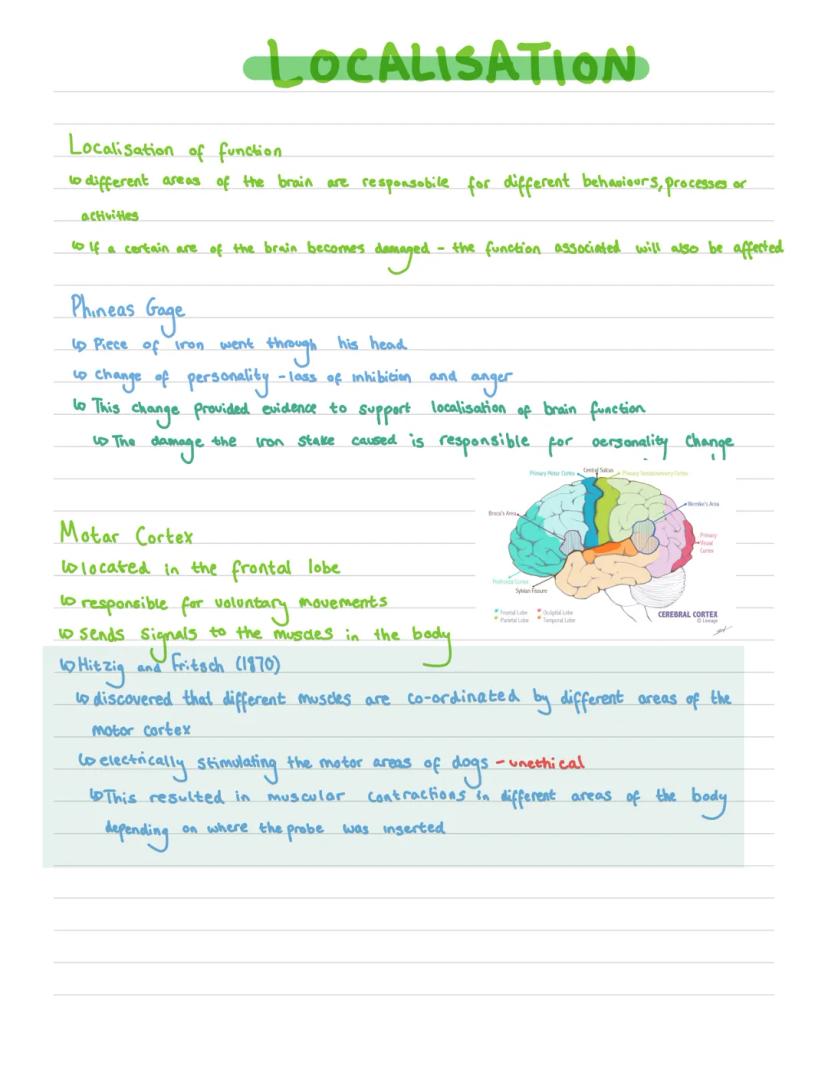
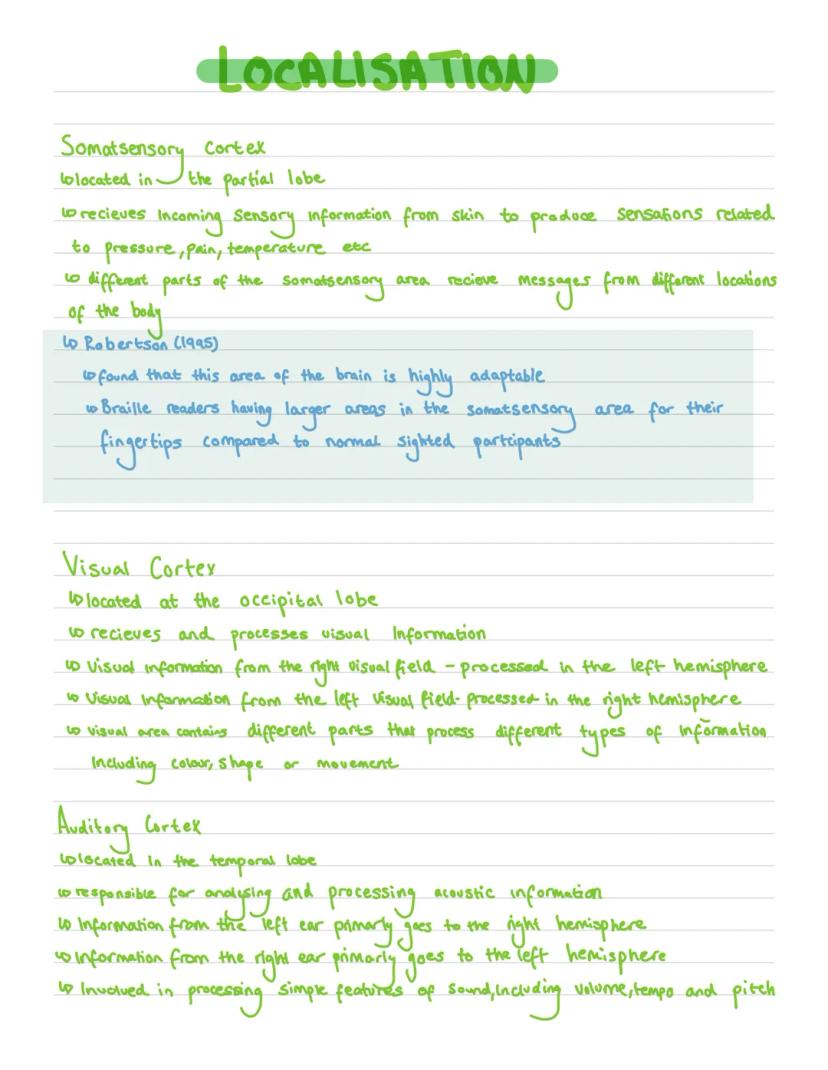
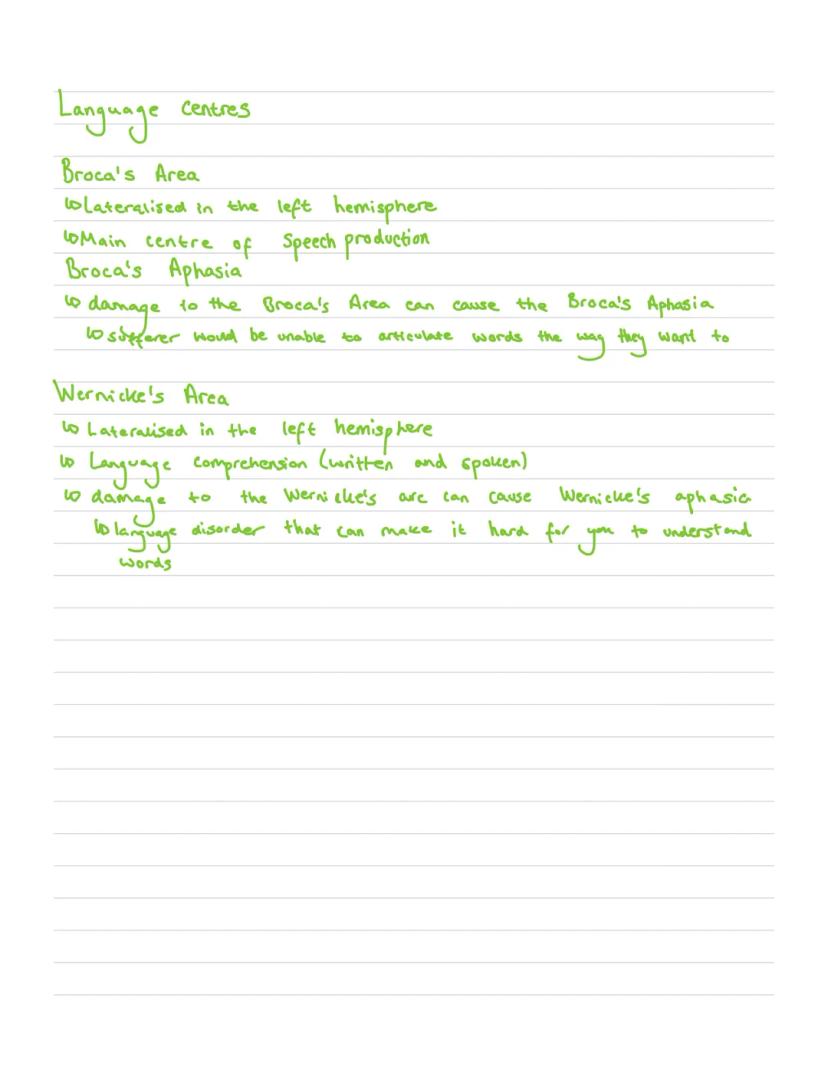
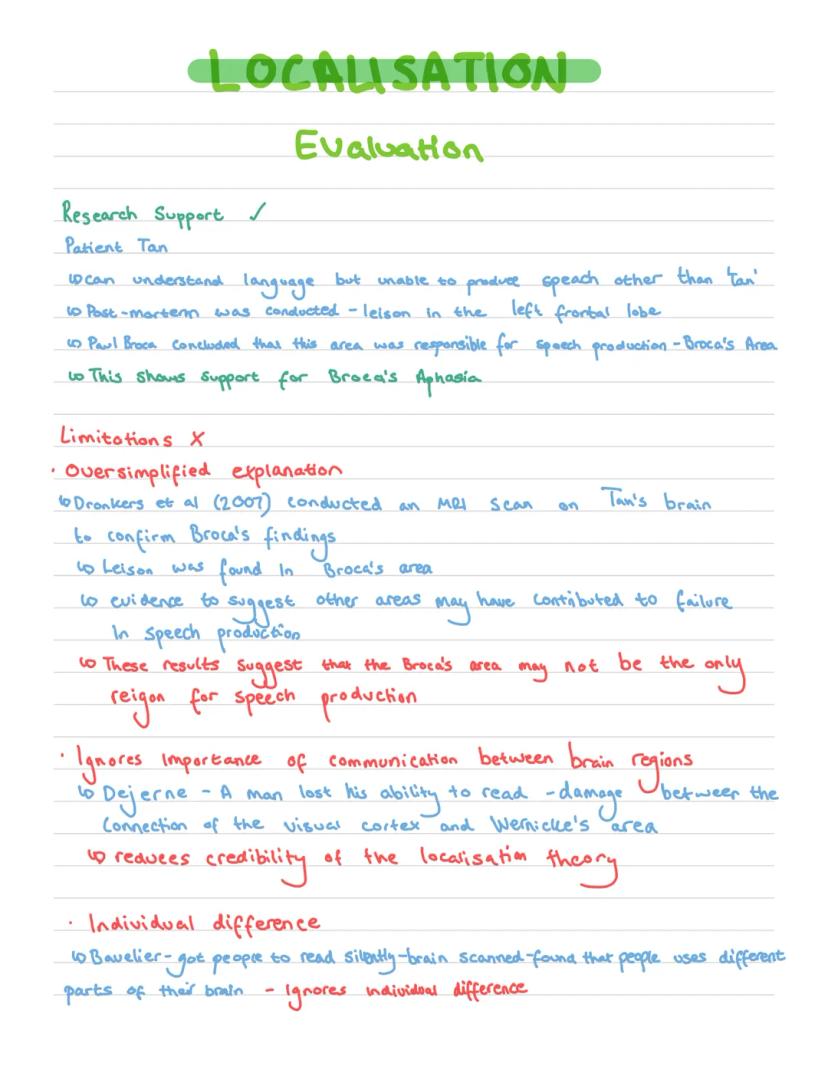
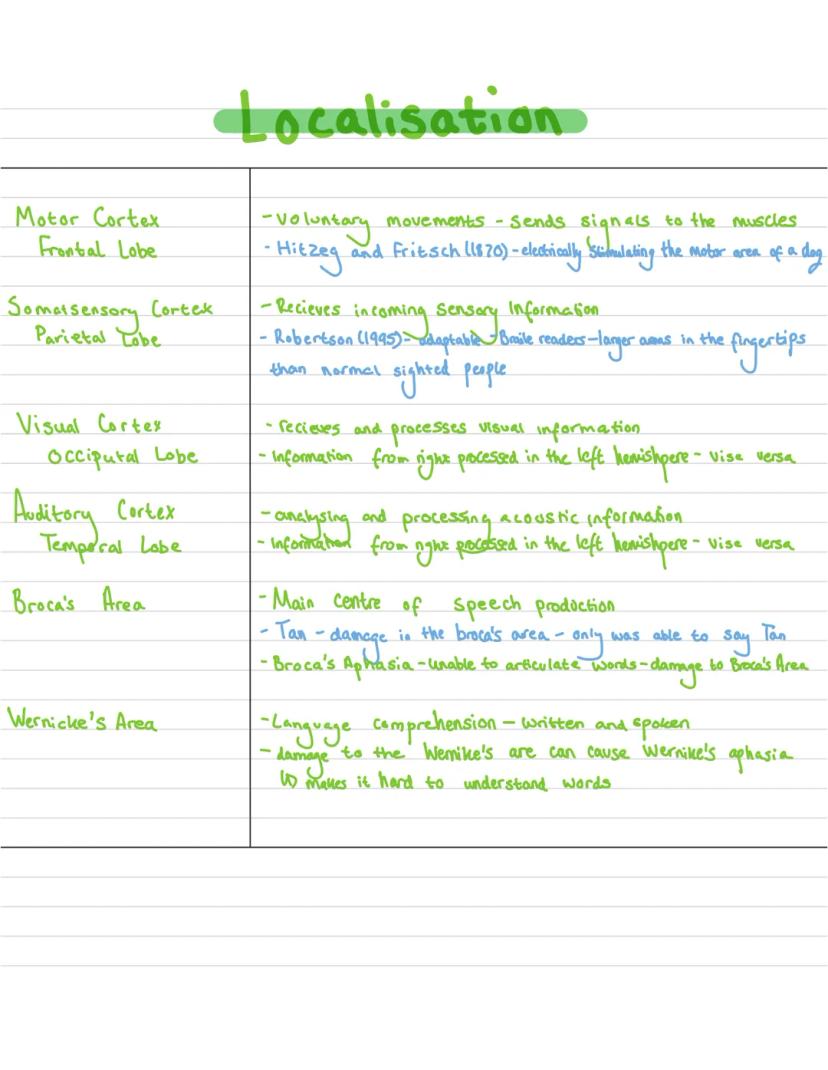
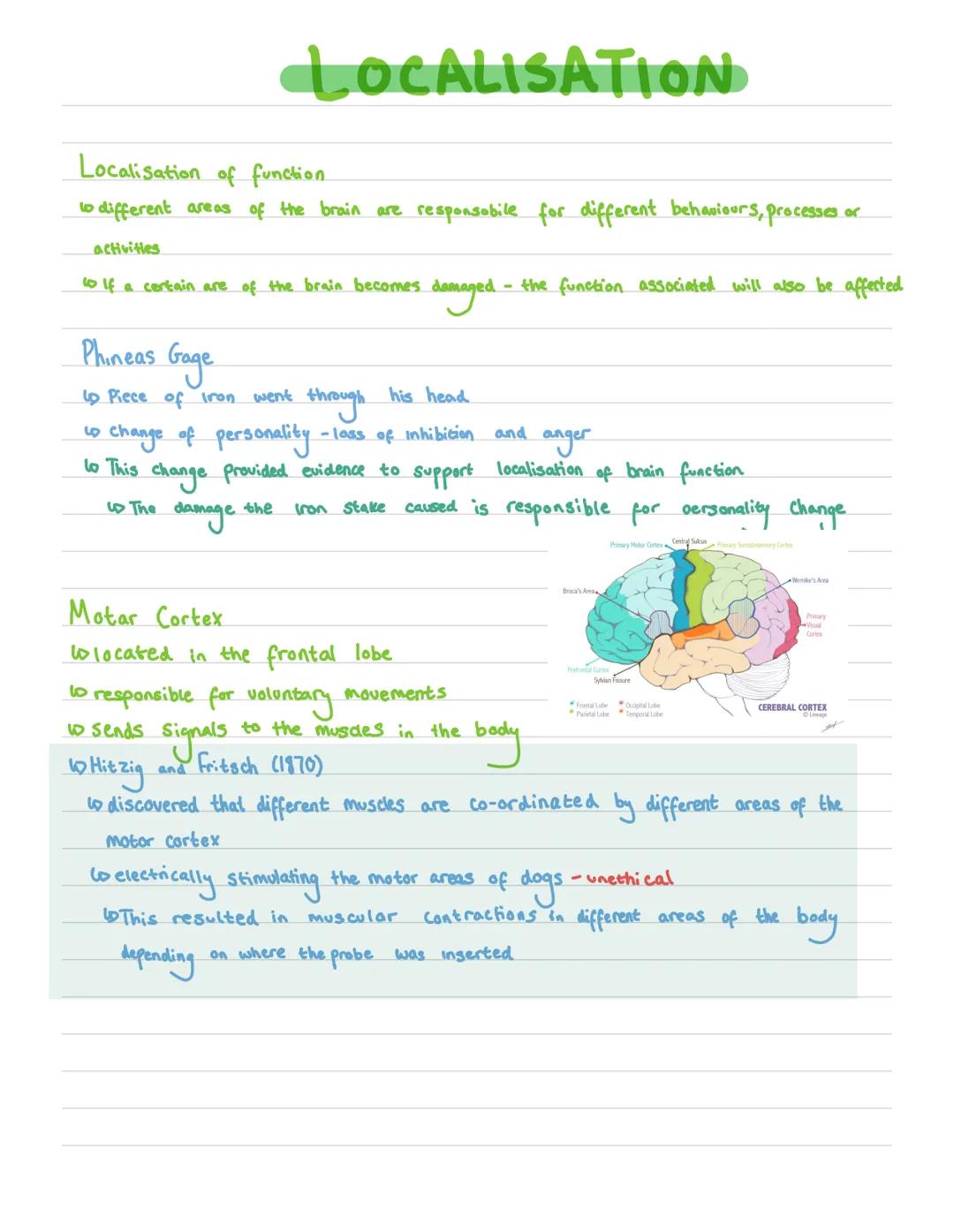
Your brain isn't just one big thinking blob - it's more like a sophisticated control centre with specialised departments. Each area handles specific jobs, which means damage to one spot affects only certain abilities whilst leaving others intact.
The famous case of Phineas Gage perfectly demonstrates this. When a metal rod shot through his skull in 1848, he survived but his personality completely changed - he became impulsive and aggressive. This dramatic shift provided early evidence that different brain areas control different aspects of who we are.
Your brain's outer layer, the cerebral cortex, contains several key regions. The motor cortex in your frontal lobe sends signals to make your muscles move voluntarily. Back in 1870, researchers Hitzig and Fritsch discovered this by electrically stimulating dogs' brains - different areas controlled different body parts.
Quick Tip: Think of your brain like a smartphone - different apps handle different functions, but they're all running on the same device.
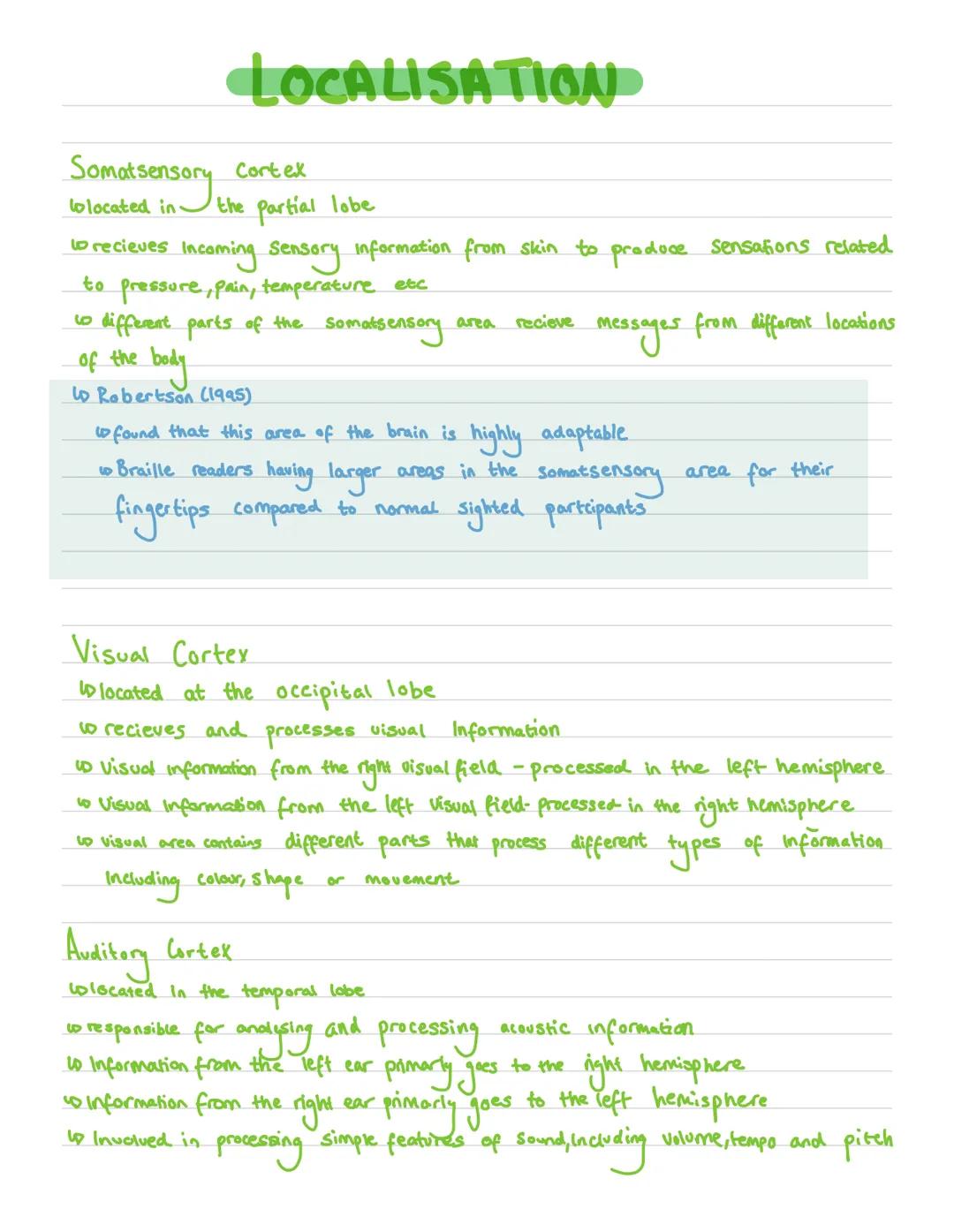
Your brain has dedicated zones for processing everything you experience through your senses. The somatosensory cortex in your parietal lobe handles touch, pressure, pain, and temperature from your skin. What's fascinating is that people who read Braille actually develop larger areas for processing fingertip sensations - your brain literally adapts to what you use most!
The visual cortex at the back of your brain (occipital lobe) processes everything you see. Here's something cool: information from your right visual field gets processed by your left brain hemisphere, and vice versa. Different parts of this area handle colour, shapes, and movement separately.
Your auditory cortex in the temporal lobe deals with sound processing. Like vision, it works in a crossed pattern - sounds from your left ear mainly go to your right brain hemisphere. This area breaks down acoustic information into volume, tempo, and pitch.
Remember: Each sensory area has multiple subdivisions that handle different aspects of what you're experiencing.
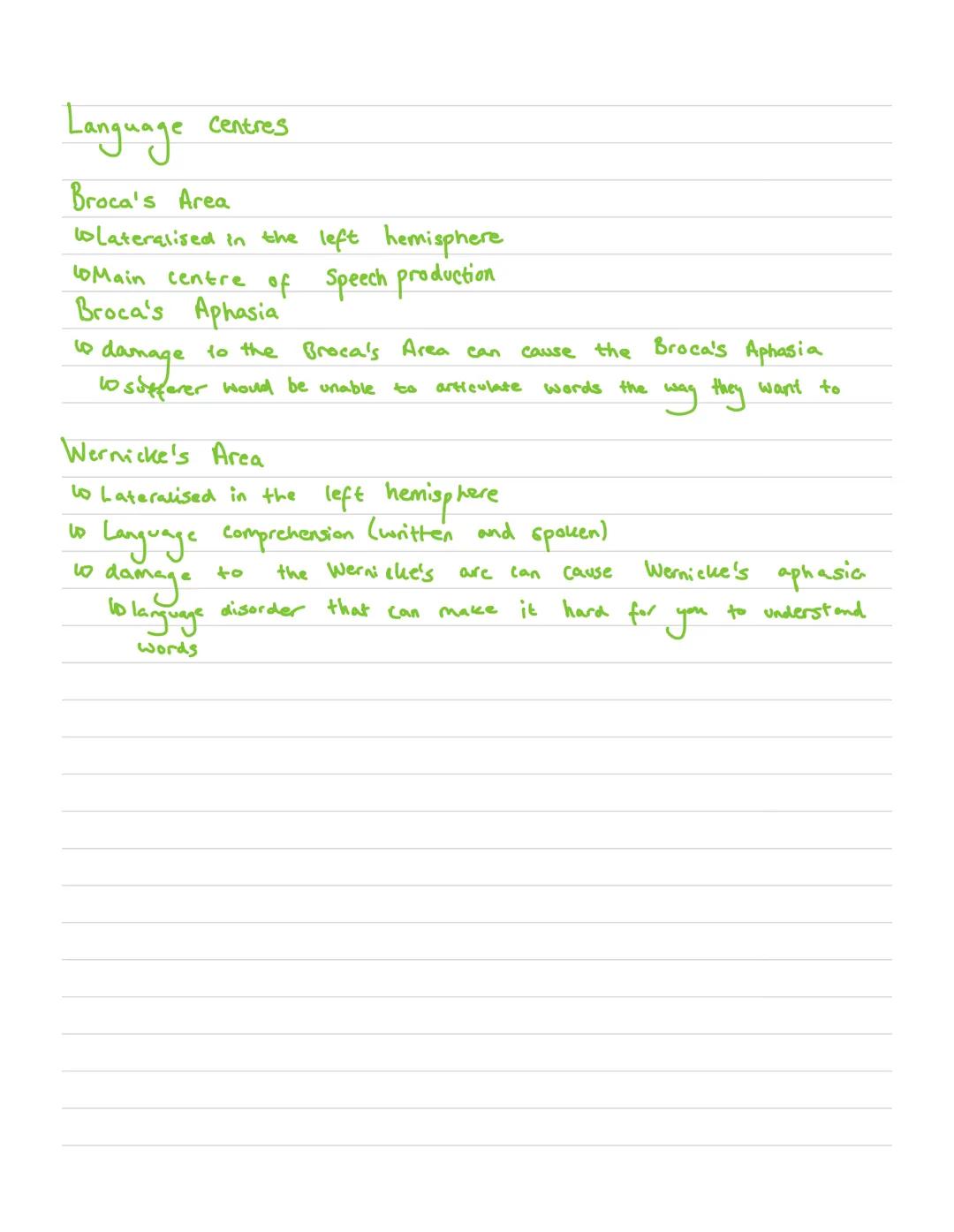
Two crucial areas in your left brain hemisphere control language - and damage to either creates very different problems. Broca's area is your speech production centre. When it's damaged, you get Broca's aphasia - you know what you want to say but can't get the words out properly.
Wernicke's area handles language comprehension for both spoken and written words. Damage here causes Wernicke's aphasia, where you can speak fluently but struggle to understand what others are saying or what you're reading.
Both areas are typically found in the left hemisphere, which is why left-brain strokes often cause language problems. The famous patient "Tan" could understand everything people said to him but could only say one word - "tan" - because his Broca's area was damaged.
Key Point: Think of Broca's area as your "output centre" and Wernicke's area as your "input processor" for language.
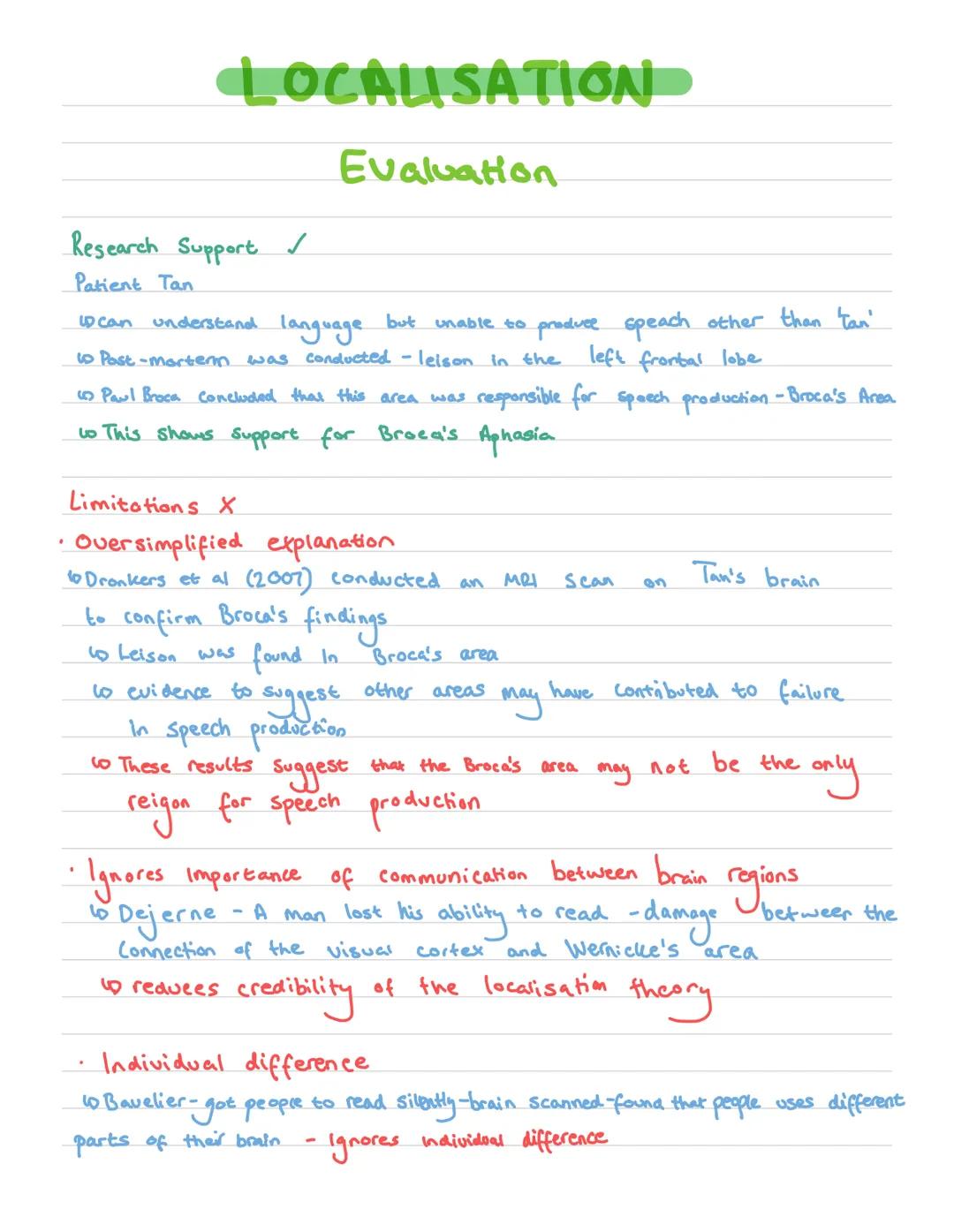
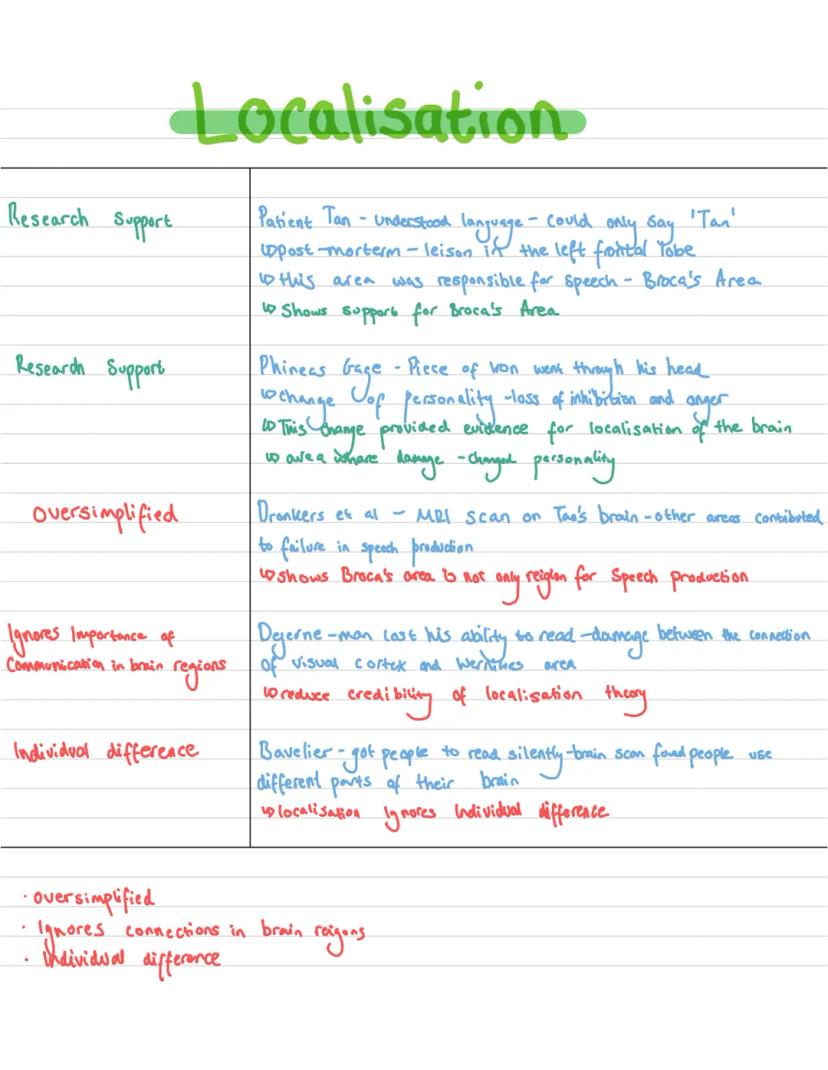
Patient Tan provided strong evidence for localisation. His post-mortem revealed damage exactly where Broca predicted - in the left frontal lobe. This supported the idea that specific brain areas control specific functions.
However, the theory has significant limitations. Modern brain scans of Tan's preserved brain revealed damage beyond just Broca's area, suggesting speech production involves multiple regions. This shows localisation might be oversimplified.
Brain connectivity is also crucial. One patient lost his reading ability not from damage to a specific area, but from severed connections between his visual cortex and Wernicke's area. This suggests that communication between regions matters as much as the regions themselves.
Individual differences further complicate things. Brain scans show people use different areas when performing the same tasks like silent reading, which challenges the idea that functions are always located in exactly the same spots.
Critical Thinking: The brain works more like an orchestra than individual instruments - coordination between parts is essential.
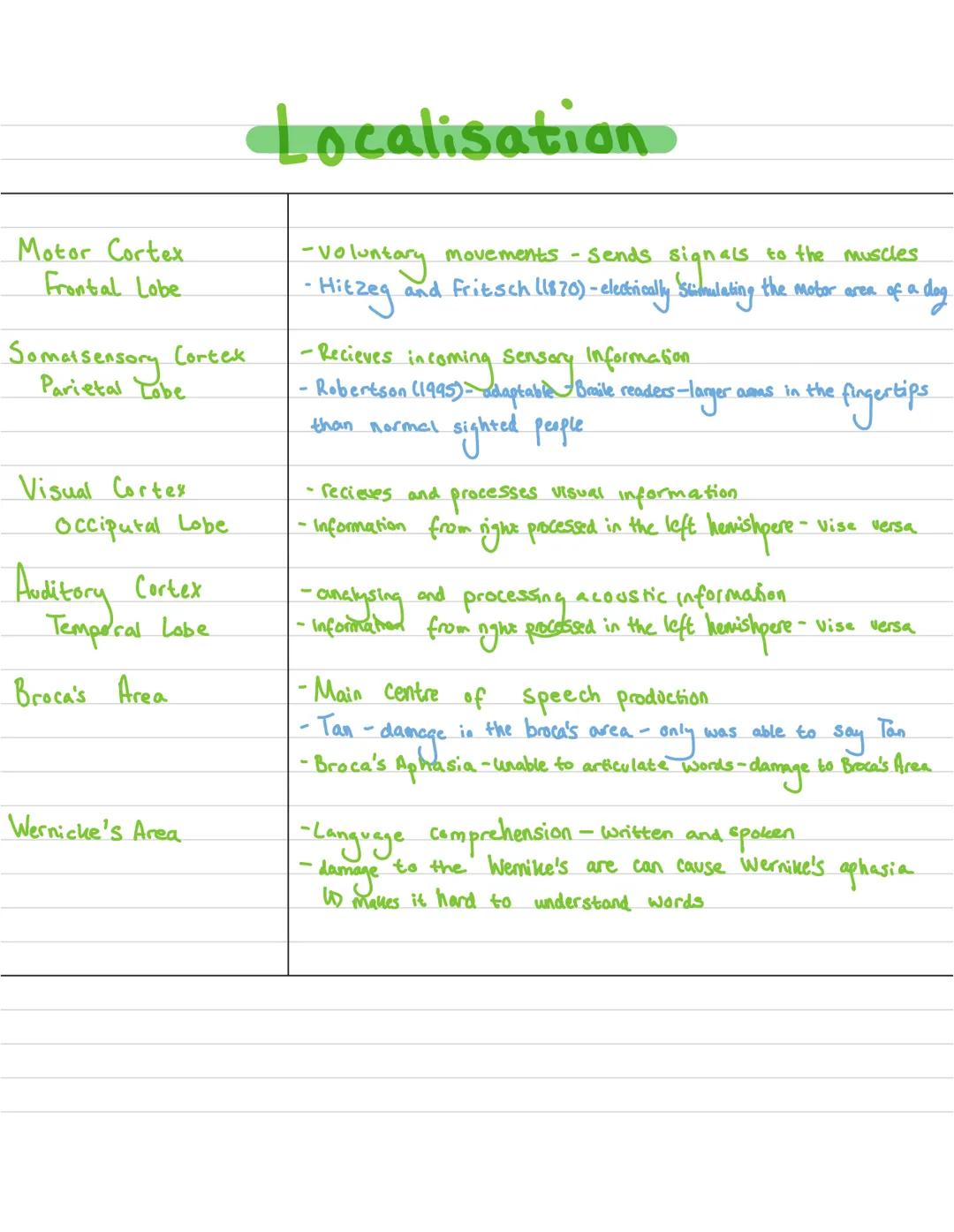
The motor cortex (frontal lobe) controls voluntary movements by sending signals to your muscles. Hitzig and Fritsch's experiments on dogs showed different areas control different body parts.
Your somatosensory cortex (parietal lobe) receives sensory information from your skin. Robertson's research on Braille readers showed this area can adapt and expand based on use.
The visual cortex (occipital lobe) processes visual information, with right visual field data going to the left hemisphere and vice versa. The auditory cortex (temporal lobe) works similarly for sound processing.
Broca's area handles speech production - damage causes difficulty articulating words. Wernicke's area manages language comprehension - damage makes understanding words difficult.
Memory Aid: Each lobe has a specialty - frontal (movement), parietal (touch), occipital (vision), temporal (hearing and language comprehension).
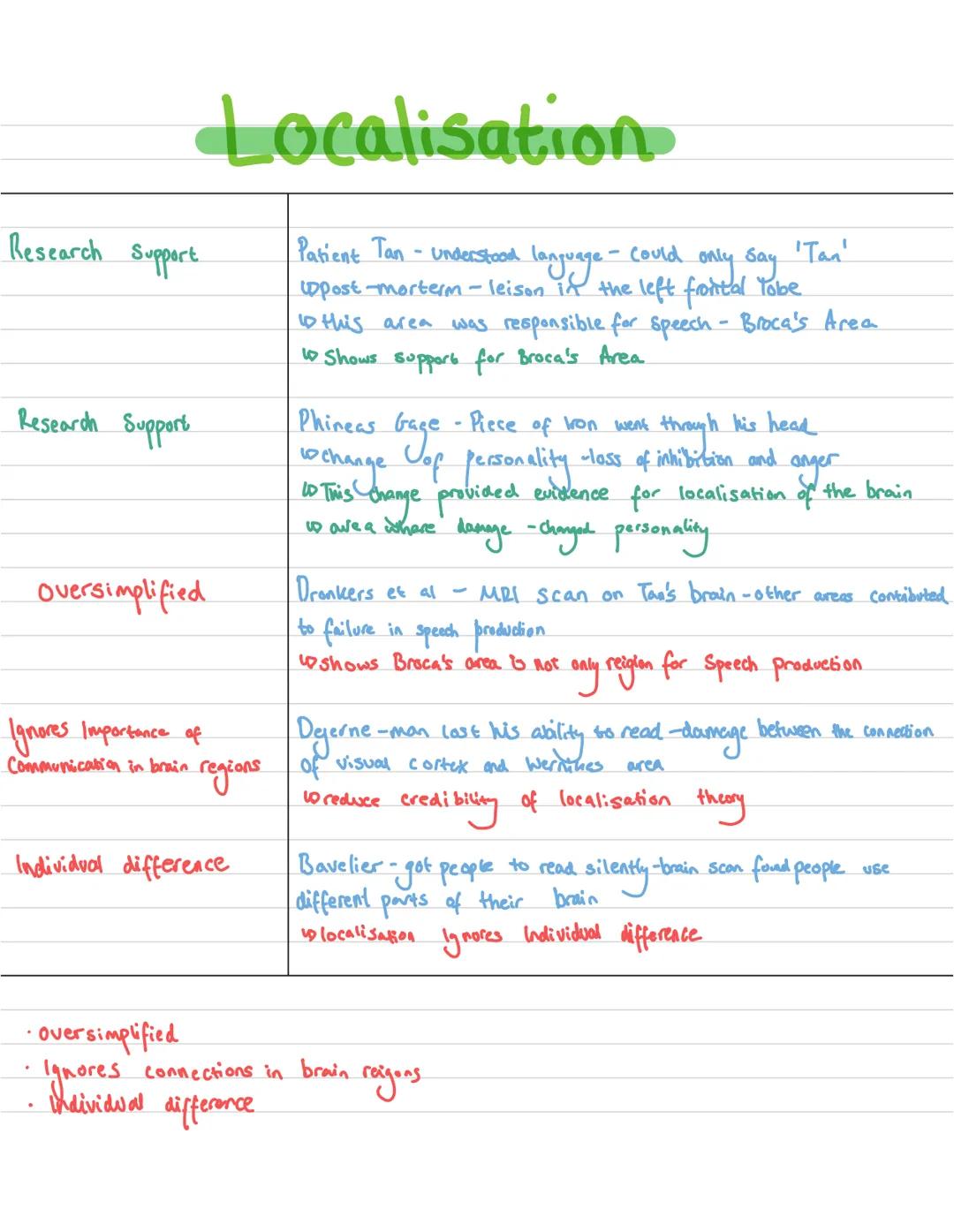
Strong research support comes from cases like Patient Tan, who could only say "tan" due to left frontal lobe damage, and Phineas Gage, whose personality changed after frontal lobe injury. These cases clearly link specific brain damage to particular functional losses.
However, modern research reveals complications. Dronkers' MRI scans of Tan's brain found additional damaged areas beyond Broca's region, suggesting speech production involves multiple brain areas working together.
The theory also ignores brain connectivity. Dejerine's patient lost reading ability due to severed connections between brain areas, not damage to a specific region. This reduces the credibility of strict localisation.
Individual differences pose another challenge. Bavelier's brain scanning studies showed people use different brain areas for the same tasks, suggesting localisation patterns vary between individuals.
The main limitations are oversimplification, ignoring connections between brain regions, and not accounting for individual differences in brain organisation.
Bottom Line: Localisation theory provides a useful framework but real brain function is more complex and interconnected than originally thought.
Our AI Companion is a student-focused AI tool that offers more than just answers. Built on millions of Knowunity resources, it provides relevant information, personalised study plans, quizzes, and content directly in the chat, adapting to your individual learning journey.
You can download the app from Google Play Store and Apple App Store.
That's right! Enjoy free access to study content, connect with fellow students, and get instant help – all at your fingertips.
App Store
Google Play
The app is very easy to use and well designed. I have found everything I was looking for so far and have been able to learn a lot from the presentations! I will definitely use the app for a class assignment! And of course it also helps a lot as an inspiration.
Stefan S
iOS user
This app is really great. There are so many study notes and help [...]. My problem subject is French, for example, and the app has so many options for help. Thanks to this app, I have improved my French. I would recommend it to anyone.
Samantha Klich
Android user
Wow, I am really amazed. I just tried the app because I've seen it advertised many times and was absolutely stunned. This app is THE HELP you want for school and above all, it offers so many things, such as workouts and fact sheets, which have been VERY helpful to me personally.
Anna
iOS user
Best app on earth! no words because it’s too good
Thomas R
iOS user
Just amazing. Let's me revise 10x better, this app is a quick 10/10. I highly recommend it to anyone. I can watch and search for notes. I can save them in the subject folder. I can revise it any time when I come back. If you haven't tried this app, you're really missing out.
Basil
Android user
This app has made me feel so much more confident in my exam prep, not only through boosting my own self confidence through the features that allow you to connect with others and feel less alone, but also through the way the app itself is centred around making you feel better. It is easy to navigate, fun to use, and helpful to anyone struggling in absolutely any way.
David K
iOS user
The app's just great! All I have to do is enter the topic in the search bar and I get the response real fast. I don't have to watch 10 YouTube videos to understand something, so I'm saving my time. Highly recommended!
Sudenaz Ocak
Android user
In school I was really bad at maths but thanks to the app, I am doing better now. I am so grateful that you made the app.
Greenlight Bonnie
Android user
very reliable app to help and grow your ideas of Maths, English and other related topics in your works. please use this app if your struggling in areas, this app is key for that. wish I'd of done a review before. and it's also free so don't worry about that.
Rohan U
Android user
I know a lot of apps use fake accounts to boost their reviews but this app deserves it all. Originally I was getting 4 in my English exams and this time I got a grade 7. I didn’t even know about this app three days until the exam and it has helped A LOT. Please actually trust me and use it as I’m sure you too will see developments.
Xander S
iOS user
THE QUIZES AND FLASHCARDS ARE SO USEFUL AND I LOVE Knowunity AI. IT ALSO IS LITREALLY LIKE CHATGPT BUT SMARTER!! HELPED ME WITH MY MASCARA PROBLEMS TOO!! AS WELL AS MY REAL SUBJECTS ! DUHHH 😍😁😲🤑💗✨🎀😮
Elisha
iOS user
This apps acc the goat. I find revision so boring but this app makes it so easy to organize it all and then you can ask the freeeee ai to test yourself so good and you can easily upload your own stuff. highly recommend as someone taking mocks now
Paul T
iOS user
The app is very easy to use and well designed. I have found everything I was looking for so far and have been able to learn a lot from the presentations! I will definitely use the app for a class assignment! And of course it also helps a lot as an inspiration.
Stefan S
iOS user
This app is really great. There are so many study notes and help [...]. My problem subject is French, for example, and the app has so many options for help. Thanks to this app, I have improved my French. I would recommend it to anyone.
Samantha Klich
Android user
Wow, I am really amazed. I just tried the app because I've seen it advertised many times and was absolutely stunned. This app is THE HELP you want for school and above all, it offers so many things, such as workouts and fact sheets, which have been VERY helpful to me personally.
Anna
iOS user
Best app on earth! no words because it’s too good
Thomas R
iOS user
Just amazing. Let's me revise 10x better, this app is a quick 10/10. I highly recommend it to anyone. I can watch and search for notes. I can save them in the subject folder. I can revise it any time when I come back. If you haven't tried this app, you're really missing out.
Basil
Android user
This app has made me feel so much more confident in my exam prep, not only through boosting my own self confidence through the features that allow you to connect with others and feel less alone, but also through the way the app itself is centred around making you feel better. It is easy to navigate, fun to use, and helpful to anyone struggling in absolutely any way.
David K
iOS user
The app's just great! All I have to do is enter the topic in the search bar and I get the response real fast. I don't have to watch 10 YouTube videos to understand something, so I'm saving my time. Highly recommended!
Sudenaz Ocak
Android user
In school I was really bad at maths but thanks to the app, I am doing better now. I am so grateful that you made the app.
Greenlight Bonnie
Android user
very reliable app to help and grow your ideas of Maths, English and other related topics in your works. please use this app if your struggling in areas, this app is key for that. wish I'd of done a review before. and it's also free so don't worry about that.
Rohan U
Android user
I know a lot of apps use fake accounts to boost their reviews but this app deserves it all. Originally I was getting 4 in my English exams and this time I got a grade 7. I didn’t even know about this app three days until the exam and it has helped A LOT. Please actually trust me and use it as I’m sure you too will see developments.
Xander S
iOS user
THE QUIZES AND FLASHCARDS ARE SO USEFUL AND I LOVE Knowunity AI. IT ALSO IS LITREALLY LIKE CHATGPT BUT SMARTER!! HELPED ME WITH MY MASCARA PROBLEMS TOO!! AS WELL AS MY REAL SUBJECTS ! DUHHH 😍😁😲🤑💗✨🎀😮
Elisha
iOS user
This apps acc the goat. I find revision so boring but this app makes it so easy to organize it all and then you can ask the freeeee ai to test yourself so good and you can easily upload your own stuff. highly recommend as someone taking mocks now
Paul T
iOS user
Aleena
@aleena05
Ever wondered why damage to different parts of your brain affects you in completely different ways? Localisation theory explains how specific brain regions control distinct functions - from moving your hand to understanding speech. This concept is crucial for understanding... Show more
Access to all documents
Improve your grades
Join milions of students
By signing up you accept Terms of Service and Privacy Policy
Your brain isn't just one big thinking blob - it's more like a sophisticated control centre with specialised departments. Each area handles specific jobs, which means damage to one spot affects only certain abilities whilst leaving others intact.
The famous case of Phineas Gage perfectly demonstrates this. When a metal rod shot through his skull in 1848, he survived but his personality completely changed - he became impulsive and aggressive. This dramatic shift provided early evidence that different brain areas control different aspects of who we are.
Your brain's outer layer, the cerebral cortex, contains several key regions. The motor cortex in your frontal lobe sends signals to make your muscles move voluntarily. Back in 1870, researchers Hitzig and Fritsch discovered this by electrically stimulating dogs' brains - different areas controlled different body parts.
Quick Tip: Think of your brain like a smartphone - different apps handle different functions, but they're all running on the same device.
Access to all documents
Improve your grades
Join milions of students
By signing up you accept Terms of Service and Privacy Policy
Your brain has dedicated zones for processing everything you experience through your senses. The somatosensory cortex in your parietal lobe handles touch, pressure, pain, and temperature from your skin. What's fascinating is that people who read Braille actually develop larger areas for processing fingertip sensations - your brain literally adapts to what you use most!
The visual cortex at the back of your brain (occipital lobe) processes everything you see. Here's something cool: information from your right visual field gets processed by your left brain hemisphere, and vice versa. Different parts of this area handle colour, shapes, and movement separately.
Your auditory cortex in the temporal lobe deals with sound processing. Like vision, it works in a crossed pattern - sounds from your left ear mainly go to your right brain hemisphere. This area breaks down acoustic information into volume, tempo, and pitch.
Remember: Each sensory area has multiple subdivisions that handle different aspects of what you're experiencing.
Access to all documents
Improve your grades
Join milions of students
By signing up you accept Terms of Service and Privacy Policy
Two crucial areas in your left brain hemisphere control language - and damage to either creates very different problems. Broca's area is your speech production centre. When it's damaged, you get Broca's aphasia - you know what you want to say but can't get the words out properly.
Wernicke's area handles language comprehension for both spoken and written words. Damage here causes Wernicke's aphasia, where you can speak fluently but struggle to understand what others are saying or what you're reading.
Both areas are typically found in the left hemisphere, which is why left-brain strokes often cause language problems. The famous patient "Tan" could understand everything people said to him but could only say one word - "tan" - because his Broca's area was damaged.
Key Point: Think of Broca's area as your "output centre" and Wernicke's area as your "input processor" for language.
Access to all documents
Improve your grades
Join milions of students
By signing up you accept Terms of Service and Privacy Policy
Patient Tan provided strong evidence for localisation. His post-mortem revealed damage exactly where Broca predicted - in the left frontal lobe. This supported the idea that specific brain areas control specific functions.
However, the theory has significant limitations. Modern brain scans of Tan's preserved brain revealed damage beyond just Broca's area, suggesting speech production involves multiple regions. This shows localisation might be oversimplified.
Brain connectivity is also crucial. One patient lost his reading ability not from damage to a specific area, but from severed connections between his visual cortex and Wernicke's area. This suggests that communication between regions matters as much as the regions themselves.
Individual differences further complicate things. Brain scans show people use different areas when performing the same tasks like silent reading, which challenges the idea that functions are always located in exactly the same spots.
Critical Thinking: The brain works more like an orchestra than individual instruments - coordination between parts is essential.
Access to all documents
Improve your grades
Join milions of students
By signing up you accept Terms of Service and Privacy Policy
The motor cortex (frontal lobe) controls voluntary movements by sending signals to your muscles. Hitzig and Fritsch's experiments on dogs showed different areas control different body parts.
Your somatosensory cortex (parietal lobe) receives sensory information from your skin. Robertson's research on Braille readers showed this area can adapt and expand based on use.
The visual cortex (occipital lobe) processes visual information, with right visual field data going to the left hemisphere and vice versa. The auditory cortex (temporal lobe) works similarly for sound processing.
Broca's area handles speech production - damage causes difficulty articulating words. Wernicke's area manages language comprehension - damage makes understanding words difficult.
Memory Aid: Each lobe has a specialty - frontal (movement), parietal (touch), occipital (vision), temporal (hearing and language comprehension).
Access to all documents
Improve your grades
Join milions of students
By signing up you accept Terms of Service and Privacy Policy
Strong research support comes from cases like Patient Tan, who could only say "tan" due to left frontal lobe damage, and Phineas Gage, whose personality changed after frontal lobe injury. These cases clearly link specific brain damage to particular functional losses.
However, modern research reveals complications. Dronkers' MRI scans of Tan's brain found additional damaged areas beyond Broca's region, suggesting speech production involves multiple brain areas working together.
The theory also ignores brain connectivity. Dejerine's patient lost reading ability due to severed connections between brain areas, not damage to a specific region. This reduces the credibility of strict localisation.
Individual differences pose another challenge. Bavelier's brain scanning studies showed people use different brain areas for the same tasks, suggesting localisation patterns vary between individuals.
The main limitations are oversimplification, ignoring connections between brain regions, and not accounting for individual differences in brain organisation.
Bottom Line: Localisation theory provides a useful framework but real brain function is more complex and interconnected than originally thought.
Our AI Companion is a student-focused AI tool that offers more than just answers. Built on millions of Knowunity resources, it provides relevant information, personalised study plans, quizzes, and content directly in the chat, adapting to your individual learning journey.
You can download the app from Google Play Store and Apple App Store.
That's right! Enjoy free access to study content, connect with fellow students, and get instant help – all at your fingertips.
1
Smart Tools NEW
Transform this note into: ✓ 50+ Practice Questions ✓ Interactive Flashcards ✓ Full Mock Exam ✓ Essay Outlines
App Store
Google Play
The app is very easy to use and well designed. I have found everything I was looking for so far and have been able to learn a lot from the presentations! I will definitely use the app for a class assignment! And of course it also helps a lot as an inspiration.
Stefan S
iOS user
This app is really great. There are so many study notes and help [...]. My problem subject is French, for example, and the app has so many options for help. Thanks to this app, I have improved my French. I would recommend it to anyone.
Samantha Klich
Android user
Wow, I am really amazed. I just tried the app because I've seen it advertised many times and was absolutely stunned. This app is THE HELP you want for school and above all, it offers so many things, such as workouts and fact sheets, which have been VERY helpful to me personally.
Anna
iOS user
Best app on earth! no words because it’s too good
Thomas R
iOS user
Just amazing. Let's me revise 10x better, this app is a quick 10/10. I highly recommend it to anyone. I can watch and search for notes. I can save them in the subject folder. I can revise it any time when I come back. If you haven't tried this app, you're really missing out.
Basil
Android user
This app has made me feel so much more confident in my exam prep, not only through boosting my own self confidence through the features that allow you to connect with others and feel less alone, but also through the way the app itself is centred around making you feel better. It is easy to navigate, fun to use, and helpful to anyone struggling in absolutely any way.
David K
iOS user
The app's just great! All I have to do is enter the topic in the search bar and I get the response real fast. I don't have to watch 10 YouTube videos to understand something, so I'm saving my time. Highly recommended!
Sudenaz Ocak
Android user
In school I was really bad at maths but thanks to the app, I am doing better now. I am so grateful that you made the app.
Greenlight Bonnie
Android user
very reliable app to help and grow your ideas of Maths, English and other related topics in your works. please use this app if your struggling in areas, this app is key for that. wish I'd of done a review before. and it's also free so don't worry about that.
Rohan U
Android user
I know a lot of apps use fake accounts to boost their reviews but this app deserves it all. Originally I was getting 4 in my English exams and this time I got a grade 7. I didn’t even know about this app three days until the exam and it has helped A LOT. Please actually trust me and use it as I’m sure you too will see developments.
Xander S
iOS user
THE QUIZES AND FLASHCARDS ARE SO USEFUL AND I LOVE Knowunity AI. IT ALSO IS LITREALLY LIKE CHATGPT BUT SMARTER!! HELPED ME WITH MY MASCARA PROBLEMS TOO!! AS WELL AS MY REAL SUBJECTS ! DUHHH 😍😁😲🤑💗✨🎀😮
Elisha
iOS user
This apps acc the goat. I find revision so boring but this app makes it so easy to organize it all and then you can ask the freeeee ai to test yourself so good and you can easily upload your own stuff. highly recommend as someone taking mocks now
Paul T
iOS user
The app is very easy to use and well designed. I have found everything I was looking for so far and have been able to learn a lot from the presentations! I will definitely use the app for a class assignment! And of course it also helps a lot as an inspiration.
Stefan S
iOS user
This app is really great. There are so many study notes and help [...]. My problem subject is French, for example, and the app has so many options for help. Thanks to this app, I have improved my French. I would recommend it to anyone.
Samantha Klich
Android user
Wow, I am really amazed. I just tried the app because I've seen it advertised many times and was absolutely stunned. This app is THE HELP you want for school and above all, it offers so many things, such as workouts and fact sheets, which have been VERY helpful to me personally.
Anna
iOS user
Best app on earth! no words because it’s too good
Thomas R
iOS user
Just amazing. Let's me revise 10x better, this app is a quick 10/10. I highly recommend it to anyone. I can watch and search for notes. I can save them in the subject folder. I can revise it any time when I come back. If you haven't tried this app, you're really missing out.
Basil
Android user
This app has made me feel so much more confident in my exam prep, not only through boosting my own self confidence through the features that allow you to connect with others and feel less alone, but also through the way the app itself is centred around making you feel better. It is easy to navigate, fun to use, and helpful to anyone struggling in absolutely any way.
David K
iOS user
The app's just great! All I have to do is enter the topic in the search bar and I get the response real fast. I don't have to watch 10 YouTube videos to understand something, so I'm saving my time. Highly recommended!
Sudenaz Ocak
Android user
In school I was really bad at maths but thanks to the app, I am doing better now. I am so grateful that you made the app.
Greenlight Bonnie
Android user
very reliable app to help and grow your ideas of Maths, English and other related topics in your works. please use this app if your struggling in areas, this app is key for that. wish I'd of done a review before. and it's also free so don't worry about that.
Rohan U
Android user
I know a lot of apps use fake accounts to boost their reviews but this app deserves it all. Originally I was getting 4 in my English exams and this time I got a grade 7. I didn’t even know about this app three days until the exam and it has helped A LOT. Please actually trust me and use it as I’m sure you too will see developments.
Xander S
iOS user
THE QUIZES AND FLASHCARDS ARE SO USEFUL AND I LOVE Knowunity AI. IT ALSO IS LITREALLY LIKE CHATGPT BUT SMARTER!! HELPED ME WITH MY MASCARA PROBLEMS TOO!! AS WELL AS MY REAL SUBJECTS ! DUHHH 😍😁😲🤑💗✨🎀😮
Elisha
iOS user
This apps acc the goat. I find revision so boring but this app makes it so easy to organize it all and then you can ask the freeeee ai to test yourself so good and you can easily upload your own stuff. highly recommend as someone taking mocks now
Paul T
iOS user