Open the App

Subjects

Psychology

15 Dec 2025

133

5 pages

Comprehensive AQA Psychology Mind Maps: Attachment

user profile picture

Isha๐Ÿค— @isha_cly

Attachment theory explores how infants form emotional bonds with their caregivers, a process crucial to healthy development. These... Show more

## Reciprociry. ($
\frac{1}{x}$)

- 2 way, child bonds with mummy.
- mummy bonds w/ child.
- these above steps = successful attachment
- Bot

Caregiver-Infant Interactions & Reciprocity

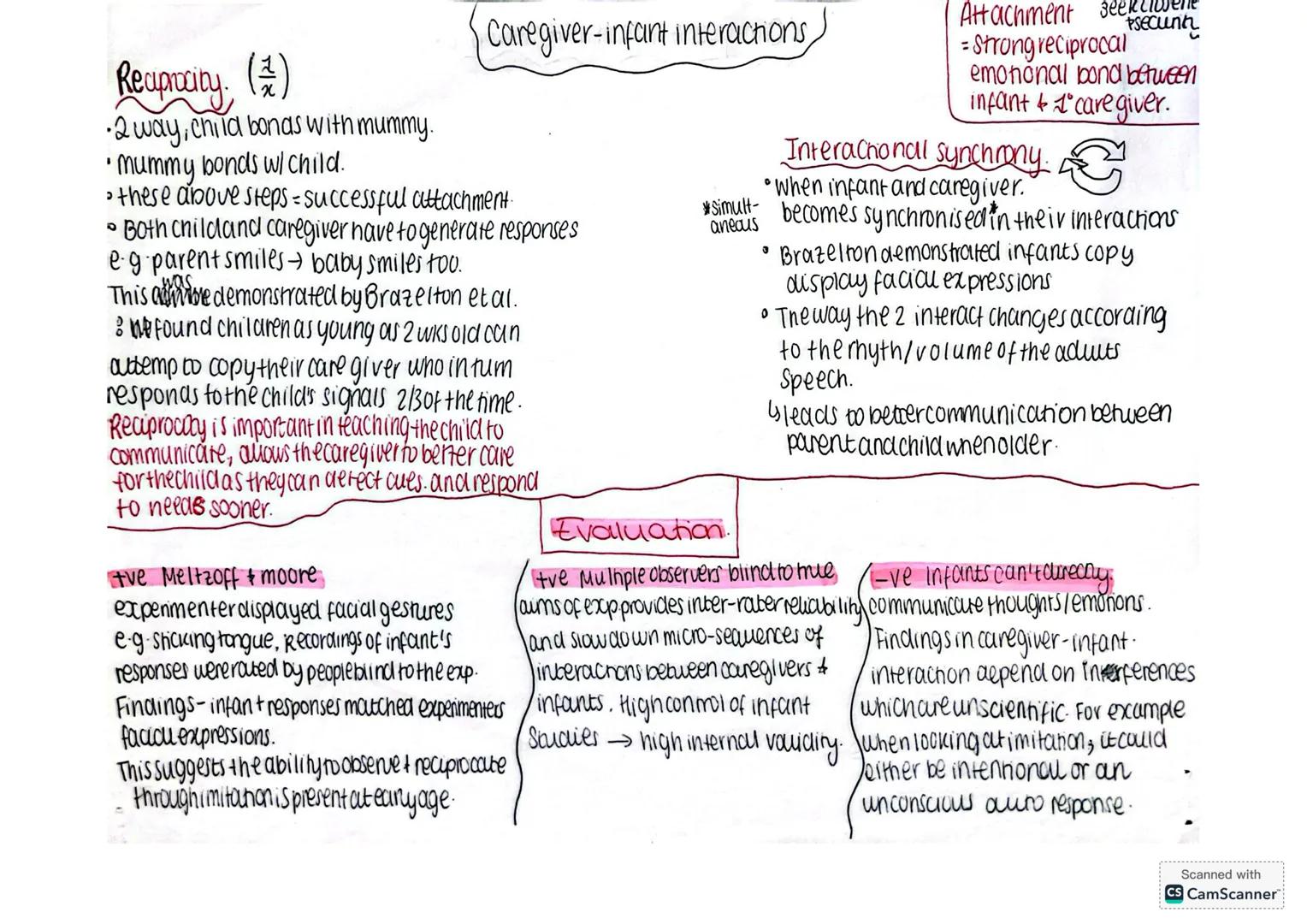
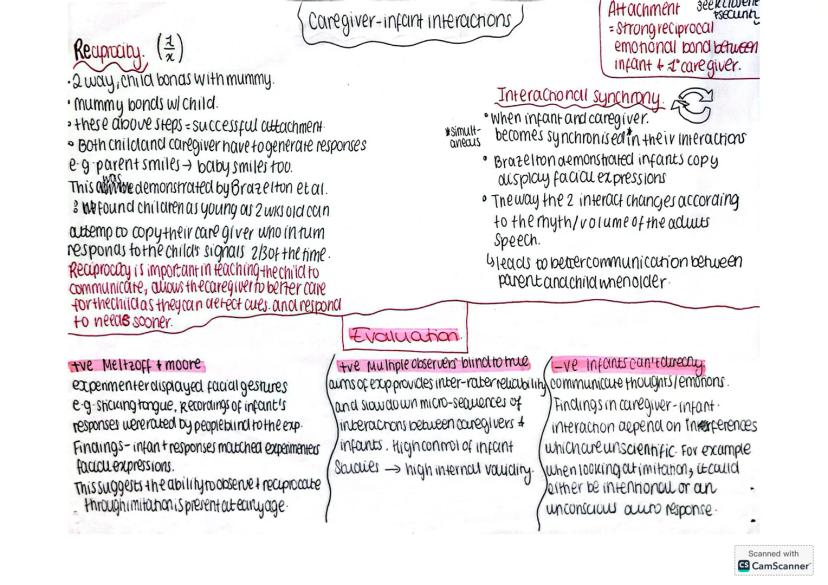
Attachment begins with reciprocity - the two-way bonding process between infant and caregiver. This crucial exchange occurs when both parties generate responses to each other, like when a parent smiles and the baby smiles back.

Brazelton's research revealed that infants as young as 2 weeks old attempt to copy their caregivers, who respond to these signals about two-thirds of the time. This reciprocity teaches children to communicate and helps caregivers detect cues and respond to needs faster.

Interactional synchrony happens when infant and caregiver become perfectly coordinated in their interactions. The rhythm and volume of adult speech influence how they interact, leading to improved communication as the child develops.

Did you know? Meltzoff and Moore's experiment showed that even very young infants can imitate facial expressions made by adults, suggesting that the ability to observe and reciprocate through imitation is present from early on!

Research supports these findings, though it has limitations. Studies use multiple blind observers to ensure reliability when analyzing micro-sequences of caregiver-infant interactions. However, since infants can't directly communicate their thoughts, researchers must make inferences about what behaviors actually mean - for instance, is imitation intentional or simply an unconscious response?

## Reciprociry. ($
\frac{1}{x}$)

- 2 way, child bonds with mummy.
- mummy bonds w/ child.
- these above steps = successful attachment
- Bot

Stages of Attachment Development

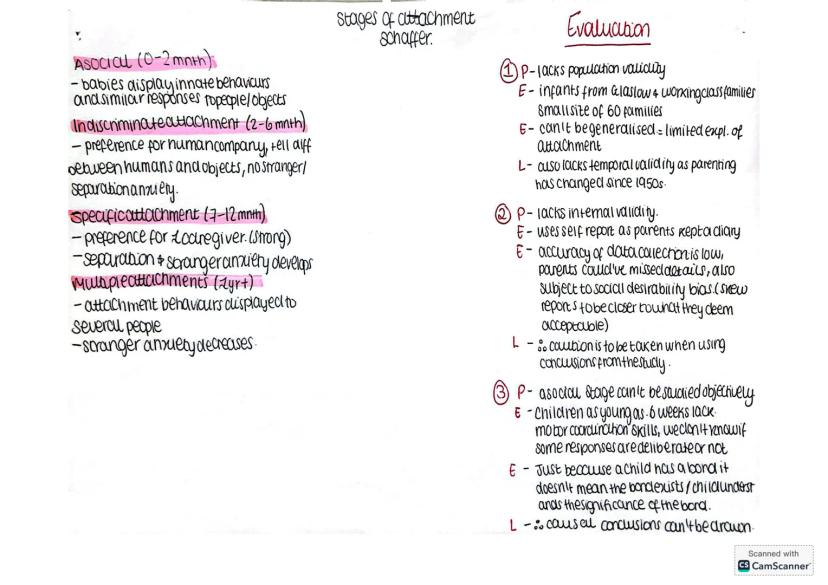
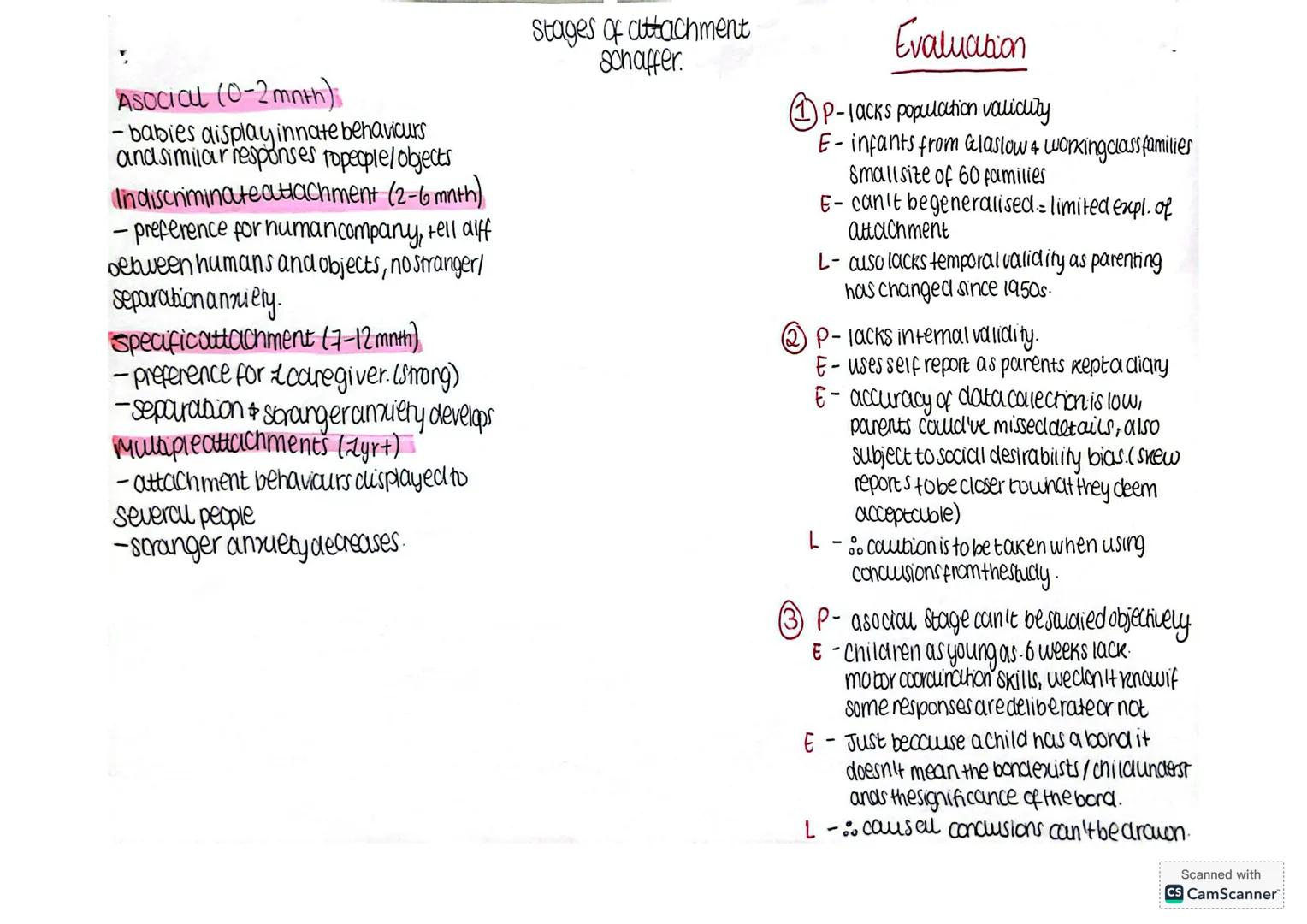
Schaffer identified four distinct stages in how infants develop attachments. You'll find these stages follow a logical progression as babies develop their social awareness

The Asocial Stage 0โˆ’2months0-2 months is when babies display innate behaviours with similar responses to both people and objects. They're not yet socially discriminating in their interactions.

During the Indiscriminate Attachment Stage 2โˆ’6months2-6 months, babies begin to prefer human company and can distinguish between humans and objects. However, they don't yet show stranger anxiety or distress when separated from caregivers.

The Specific Attachment Stage 7โˆ’12months7-12 months marks when infants develop a strong preference for their primary caregiver. This is when separation anxiety and stranger anxiety typically emerge.

By the Multiple Attachments Stage 2+years2+ years, children extend their attachment behaviours to several people, and their stranger anxiety decreases as their social world expands.

Remember These stages aren't rigid - every child develops at their own pace!

This research has limitations though. Schaffer's studies lacked population validity with small sample sizes and primarily focused on middle and working-class families. The research also relied on parent diaries, which might be inaccurate or influenced by social desirability bias, where parents report what seems most acceptable rather than what actually happened.

## Reciprociry. ($
\frac{1}{x}$)

- 2 way, child bonds with mummy.
- mummy bonds w/ child.
- these above steps = successful attachment
- Bot

Cultural Variations in Attachment

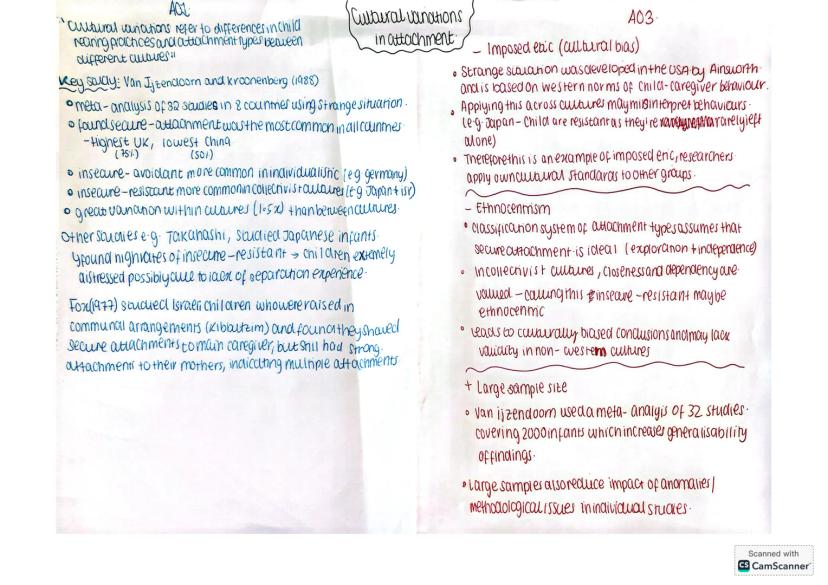
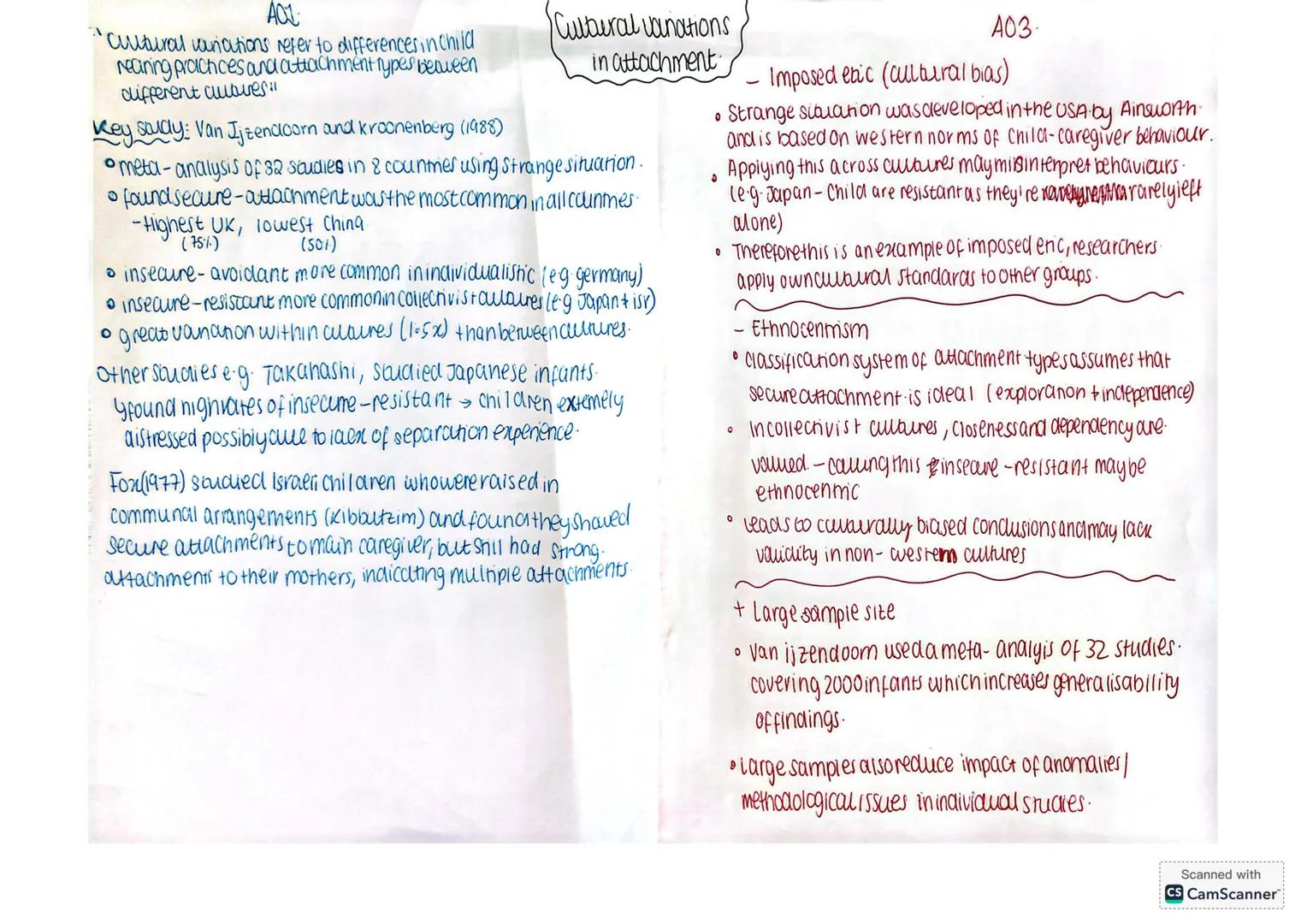
How children form attachments varies significantly across different cultures, reflecting diverse child-rearing practices worldwide. Van Ijzendoorn and Kroonenberg's influential meta-analysis of 32 studies across 8 countries revealed fascinating patterns.

While secure attachment was most common everywhere (ranging from 75% in the UK to 50% in China), the distribution of insecure attachment types varied culturally. Insecure-avoidant attachment appeared more frequently in individualistic cultures like Germany, whereas insecure-resistant attachment was more common in collectivist cultures such as Japan and Israel.

Cultural practices directly influence attachment patterns. Takahashi found Japanese infants showed high rates of insecure-resistant attachment, likely because they rarely experienced separation from caregivers. Similarly, Fox studied Israeli children raised in kibbutzim (communal arrangements) and found they formed secure attachments to multiple caregivers alongside strong bonds with their mothers.

Think critically Is it fair to apply Western standards of attachment to all cultures? What might we misunderstand when we do this?

The research has significant limitations. The Strange Situation procedure was developed in the USA based on Western norms, creating potential cultural bias (imposed etic) when applied across cultures. What might appear as "insecure-resistant" attachment in collectivist cultures could actually reflect valued traits like closeness and dependence rather than insecurity. This ethnocentrism undermines the validity of conclusions in non-Western contexts, despite the impressive sample size of Van Ijzendoorn's meta-analysis.

## Reciprociry. ($
\frac{1}{x}$)

- 2 way, child bonds with mummy.
- mummy bonds w/ child.
- these above steps = successful attachment
- Bot

Maternal Deprivation

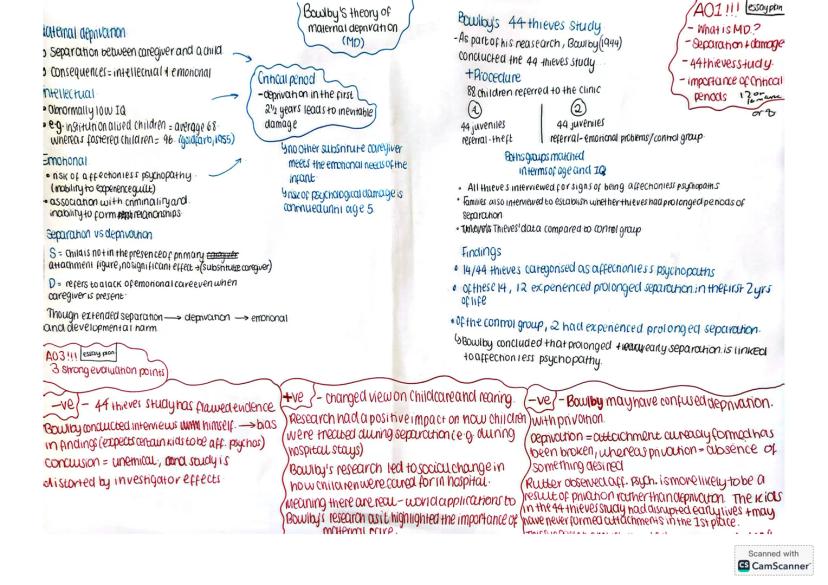
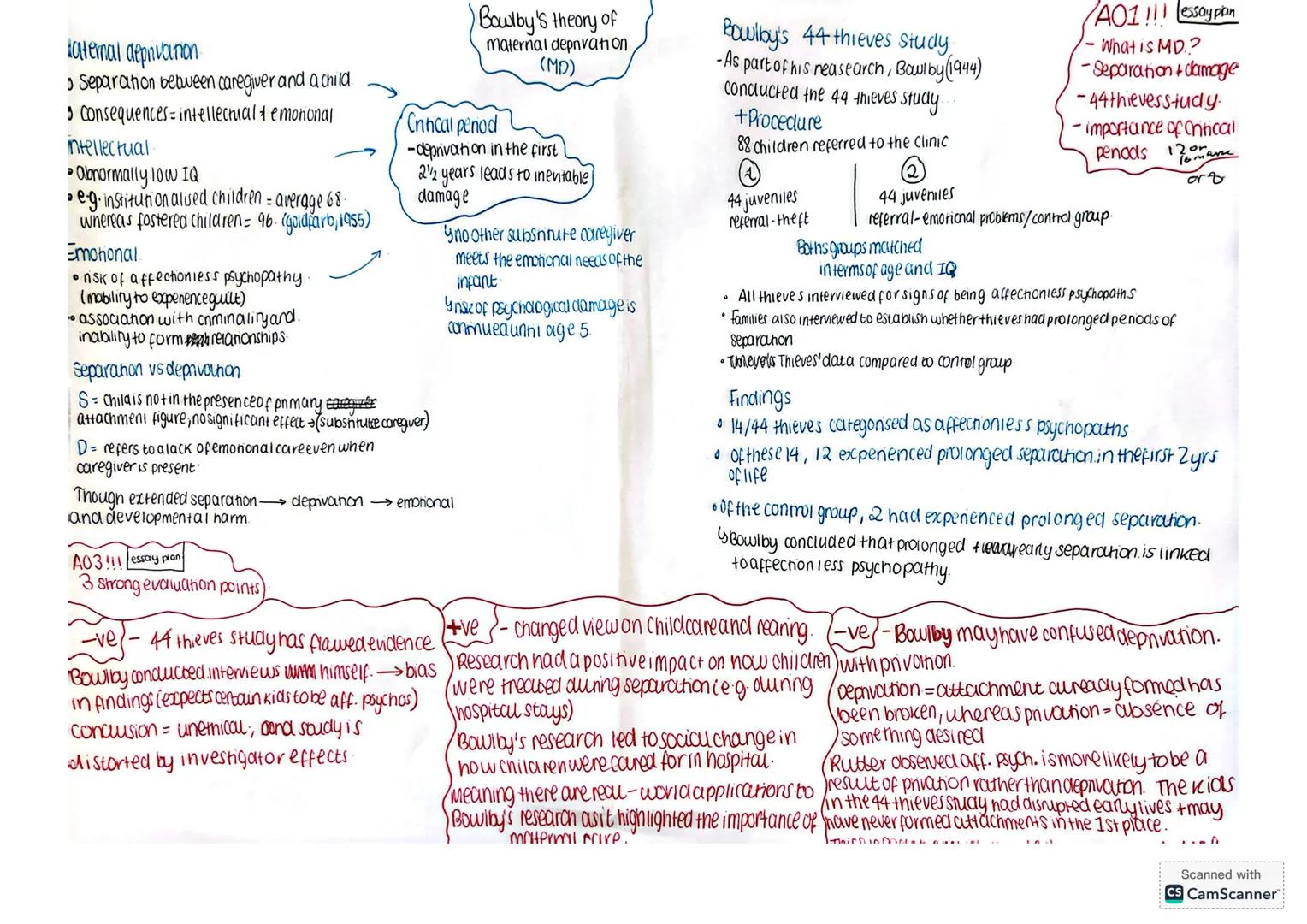
Maternal deprivation refers to the separation between a child and their caregiver, with potentially serious consequences for development. Research has identified two main areas of impact intellectual development (with institutionalised children showing abnormally low IQs compared to fostered children) and emotional development (including risks of developing affectionless psychopathy - an inability to experience guilt).

It's crucial to understand the difference between separation and deprivation. Separation occurs when a child isn't in the presence of their primary attachment figure but has a substitute caregiver, causing no significant effect. Deprivation refers to a lack of emotional care even when the caregiver is present. Extended separation, however, can lead to deprivation and subsequent harm.

Bowlby's theory of maternal deprivation emphasised the critical period in the first 2ยฝ years, suggesting that deprivation during this time leads to inevitable damage that might continue until age 5. He argued no substitute caregiver could adequately meet the emotional needs of the infant.

Exam tip When discussing Bowlby's 44 thieves study, always mention both the procedure AND the limitations to gain full marks!

Bowlby's famous 44 thieves study compared 44 juvenile thieves with 44 emotionally troubled children. He found that 12 of the 14 thieves categorised as affectionless psychopaths had experienced prolonged separation in their first two years, compared to only 2 in the control group.

However, this research has significant flaws. Bowlby conducted the interviews himself, introducing potential bias, and may have confused deprivation with privation (where attachments never formed at all). Despite these limitations, his work positively impacted childcare practices, particularly in hospitals, highlighting the importance of maternal care.


## Reciprociry. ($
\frac{1}{x}$)

- 2 way, child bonds with mummy.
- mummy bonds w/ child.
- these above steps = successful attachment
- Bot

Institutionalisation and Its Effects

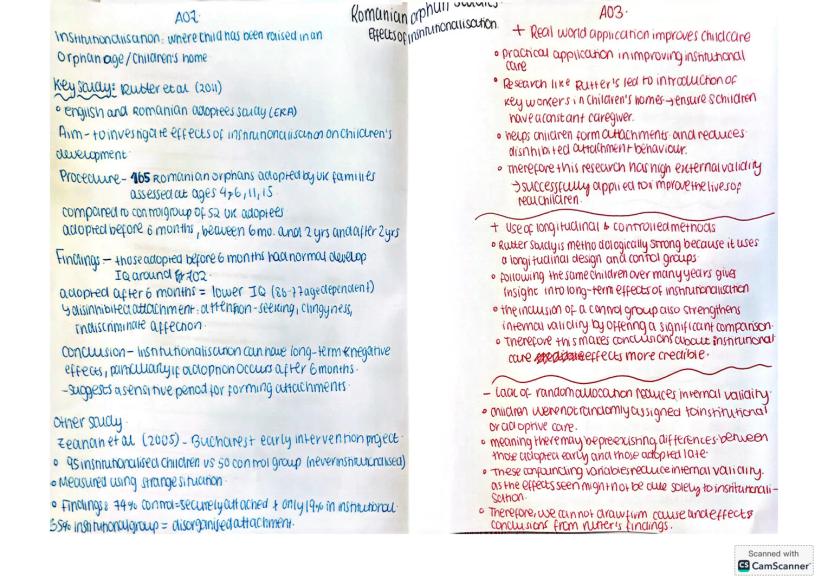
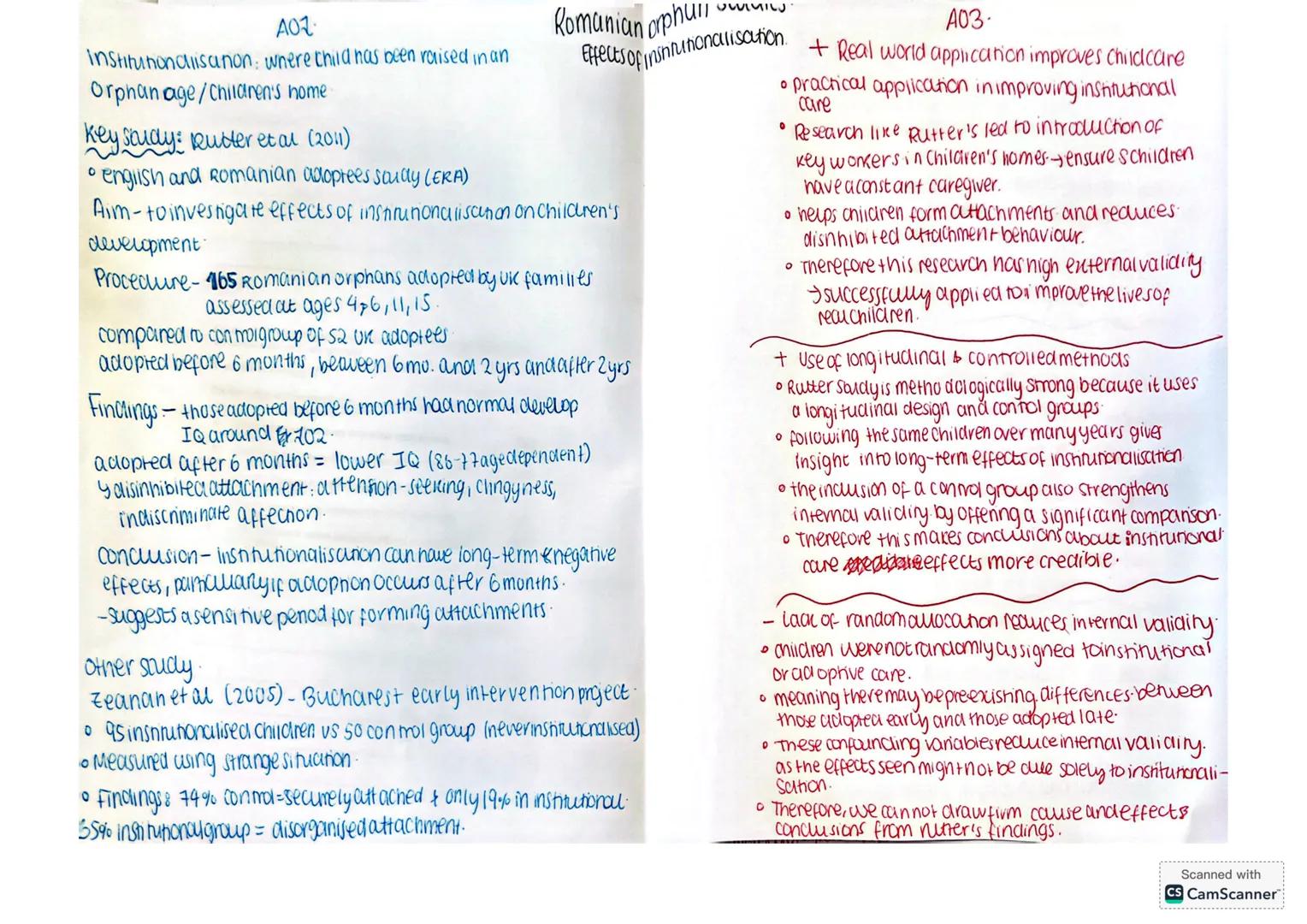
Institutionalisation occurs when a child is raised in an orphanage or children's home rather than a family setting. The English and Romanian Adoptees (ERA) study by Rutter et al. (2011) provides compelling evidence about its effects on development.

This landmark study followed 165 Romanian orphans adopted by UK families, assessing them at ages 4, 6, 11, and 15. Researchers compared them with 52 UK adoptees and grouped them based on adoption age before 6 months, between 6 months and 2 years, and after 2 years.

The findings revealed stark differences. Children adopted before 6 months showed normal development with IQs around 102, while those adopted later had significantly lower IQs rangingfrom86โˆ’77ranging from 86-77. Many also exhibited disinhibited attachment - characterised by attention-seeking behaviour, clinginess, and indiscriminate affection toward strangers.

Critical insight These studies suggest a sensitive period for forming attachments - the earlier a child is removed from institutional care, the better their developmental outcomes!

The Bucharest Early Intervention Project by Zeanah et al. (2005) strengthens these findings. Their research compared 95 institutionalised children with never-institutionalised controls using the Strange Situation procedure. While 74% of the control group showed secure attachment, only 19% of institutionalised children did so. Most concerning, 59% of the institutionalised group displayed disorganised attachment patterns.

Together, these studies demonstrate that institutionalisation can have long-lasting negative effects on children's development, particularly when they remain in institutional care beyond 6 months of age.

We thought youโ€™d never ask...

What is the Knowunity AI companion?

Our AI Companion is a student-focused AI tool that offers more than just answers. Built on millions of Knowunity resources, it provides relevant information, personalised study plans, quizzes, and content directly in the chat, adapting to your individual learning journey.

Where can I download the Knowunity app?

You can download the app from Google Play Store and Apple App Store.

Is Knowunity really free of charge?

That's right! Enjoy free access to study content, connect with fellow students, and get instant help โ€“ all at your fingertips.

1

Smart Tools NEW

Transform this note into: โœ“ 50+ Practice Questions โœ“ Interactive Flashcards โœ“ Full Mock Exam โœ“ Essay Outlines

Mock Exam
Quiz
Flashcards
Essay

Most popular content in Psychology

Most popular content

English - inspector calls quotes and analysis

Quotes from every main character

English LiteratureEnglish Literature
10

Can't find what you're looking for? Explore other subjects.

Students love us โ€” and so will you.

4.9/5

App Store

4.8/5

Google Play

The app is very easy to use and well designed. I have found everything I was looking for so far and have been able to learn a lot from the presentations! I will definitely use the app for a class assignment! And of course it also helps a lot as an inspiration.

Stefan S

iOS user

This app is really great. There are so many study notes and help [...]. My problem subject is French, for example, and the app has so many options for help. Thanks to this app, I have improved my French. I would recommend it to anyone.

Samantha Klich

Android user

Wow, I am really amazed. I just tried the app because I've seen it advertised many times and was absolutely stunned. This app is THE HELP you want for school and above all, it offers so many things, such as workouts and fact sheets, which have been VERY helpful to me personally.

Anna

iOS user

Best app on earth! no words because itโ€™s too good

Thomas R

iOS user

Just amazing. Let's me revise 10x better, this app is a quick 10/10. I highly recommend it to anyone. I can watch and search for notes. I can save them in the subject folder. I can revise it any time when I come back. If you haven't tried this app, you're really missing out.

Basil

Android user

This app has made me feel so much more confident in my exam prep, not only through boosting my own self confidence through the features that allow you to connect with others and feel less alone, but also through the way the app itself is centred around making you feel better. It is easy to navigate, fun to use, and helpful to anyone struggling in absolutely any way.

David K

iOS user

The app's just great! All I have to do is enter the topic in the search bar and I get the response real fast. I don't have to watch 10 YouTube videos to understand something, so I'm saving my time. Highly recommended!

Sudenaz Ocak

Android user

In school I was really bad at maths but thanks to the app, I am doing better now. I am so grateful that you made the app.

Greenlight Bonnie

Android user

very reliable app to help and grow your ideas of Maths, English and other related topics in your works. please use this app if your struggling in areas, this app is key for that. wish I'd of done a review before. and it's also free so don't worry about that.

Rohan U

Android user

I know a lot of apps use fake accounts to boost their reviews but this app deserves it all. Originally I was getting 4 in my English exams and this time I got a grade 7. I didnโ€™t even know about this app three days until the exam and it has helped A LOT. Please actually trust me and use it as Iโ€™m sure you too will see developments.

Xander S

iOS user

THE QUIZES AND FLASHCARDS ARE SO USEFUL AND I LOVE THE SCHOOLGPT. IT ALSO IS LITREALLY LIKE CHATGPT BUT SMARTER!! HELPED ME WITH MY MASCARA PROBLEMS TOO!! AS WELL AS MY REAL SUBJECTS ! DUHHH ๐Ÿ˜๐Ÿ˜๐Ÿ˜ฒ๐Ÿค‘๐Ÿ’—โœจ๐ŸŽ€๐Ÿ˜ฎ

Elisha

iOS user

This apps acc the goat. I find revision so boring but this app makes it so easy to organize it all and then you can ask the freeeee ai to test yourself so good and you can easily upload your own stuff. highly recommend as someone taking mocks now

Paul T

iOS user

The app is very easy to use and well designed. I have found everything I was looking for so far and have been able to learn a lot from the presentations! I will definitely use the app for a class assignment! And of course it also helps a lot as an inspiration.

Stefan S

iOS user

This app is really great. There are so many study notes and help [...]. My problem subject is French, for example, and the app has so many options for help. Thanks to this app, I have improved my French. I would recommend it to anyone.

Samantha Klich

Android user

Wow, I am really amazed. I just tried the app because I've seen it advertised many times and was absolutely stunned. This app is THE HELP you want for school and above all, it offers so many things, such as workouts and fact sheets, which have been VERY helpful to me personally.

Anna

iOS user

Best app on earth! no words because itโ€™s too good

Thomas R

iOS user

Just amazing. Let's me revise 10x better, this app is a quick 10/10. I highly recommend it to anyone. I can watch and search for notes. I can save them in the subject folder. I can revise it any time when I come back. If you haven't tried this app, you're really missing out.

Basil

Android user

This app has made me feel so much more confident in my exam prep, not only through boosting my own self confidence through the features that allow you to connect with others and feel less alone, but also through the way the app itself is centred around making you feel better. It is easy to navigate, fun to use, and helpful to anyone struggling in absolutely any way.

David K

iOS user

The app's just great! All I have to do is enter the topic in the search bar and I get the response real fast. I don't have to watch 10 YouTube videos to understand something, so I'm saving my time. Highly recommended!

Sudenaz Ocak

Android user

In school I was really bad at maths but thanks to the app, I am doing better now. I am so grateful that you made the app.

Greenlight Bonnie

Android user

very reliable app to help and grow your ideas of Maths, English and other related topics in your works. please use this app if your struggling in areas, this app is key for that. wish I'd of done a review before. and it's also free so don't worry about that.

Rohan U

Android user

I know a lot of apps use fake accounts to boost their reviews but this app deserves it all. Originally I was getting 4 in my English exams and this time I got a grade 7. I didnโ€™t even know about this app three days until the exam and it has helped A LOT. Please actually trust me and use it as Iโ€™m sure you too will see developments.

Xander S

iOS user

THE QUIZES AND FLASHCARDS ARE SO USEFUL AND I LOVE THE SCHOOLGPT. IT ALSO IS LITREALLY LIKE CHATGPT BUT SMARTER!! HELPED ME WITH MY MASCARA PROBLEMS TOO!! AS WELL AS MY REAL SUBJECTS ! DUHHH ๐Ÿ˜๐Ÿ˜๐Ÿ˜ฒ๐Ÿค‘๐Ÿ’—โœจ๐ŸŽ€๐Ÿ˜ฎ

Elisha

iOS user

This apps acc the goat. I find revision so boring but this app makes it so easy to organize it all and then you can ask the freeeee ai to test yourself so good and you can easily upload your own stuff. highly recommend as someone taking mocks now

Paul T

iOS user

ย 

Psychology

โ€ข

133

โ€ข

15 Dec 2025

โ€ข

5 pages

Comprehensive AQA Psychology Mind Maps: Attachment

user profile picture

Isha๐Ÿค—

@isha_cly

Attachment theory explores how infants form emotional bonds with their caregivers, a process crucial to healthy development. These notes cover the mechanisms of attachment formation, different stages of attachment development, and how disruptions can impact children's emotional and intellectual growth.

## Reciprociry. ($
\frac{1}{x}$)

- 2 way, child bonds with mummy.
- mummy bonds w/ child.
- these above steps = successful attachment
- Bot

Sign up to see the contentIt's free!

Access to all documents

Improve your grades

Join milions of students

By signing up you accept Terms of Service and Privacy Policy

Caregiver-Infant Interactions & Reciprocity

Attachment begins with reciprocity - the two-way bonding process between infant and caregiver. This crucial exchange occurs when both parties generate responses to each other, like when a parent smiles and the baby smiles back.

Brazelton's research revealed that infants as young as 2 weeks old attempt to copy their caregivers, who respond to these signals about two-thirds of the time. This reciprocity teaches children to communicate and helps caregivers detect cues and respond to needs faster.

Interactional synchrony happens when infant and caregiver become perfectly coordinated in their interactions. The rhythm and volume of adult speech influence how they interact, leading to improved communication as the child develops.

Did you know? Meltzoff and Moore's experiment showed that even very young infants can imitate facial expressions made by adults, suggesting that the ability to observe and reciprocate through imitation is present from early on!

Research supports these findings, though it has limitations. Studies use multiple blind observers to ensure reliability when analyzing micro-sequences of caregiver-infant interactions. However, since infants can't directly communicate their thoughts, researchers must make inferences about what behaviors actually mean - for instance, is imitation intentional or simply an unconscious response?

## Reciprociry. ($
\frac{1}{x}$)

- 2 way, child bonds with mummy.
- mummy bonds w/ child.
- these above steps = successful attachment
- Bot

Sign up to see the contentIt's free!

Access to all documents

Improve your grades

Join milions of students

By signing up you accept Terms of Service and Privacy Policy

Stages of Attachment Development

Schaffer identified four distinct stages in how infants develop attachments. You'll find these stages follow a logical progression as babies develop their social awareness:

The Asocial Stage 0โˆ’2months0-2 months is when babies display innate behaviours with similar responses to both people and objects. They're not yet socially discriminating in their interactions.

During the Indiscriminate Attachment Stage 2โˆ’6months2-6 months, babies begin to prefer human company and can distinguish between humans and objects. However, they don't yet show stranger anxiety or distress when separated from caregivers.

The Specific Attachment Stage 7โˆ’12months7-12 months marks when infants develop a strong preference for their primary caregiver. This is when separation anxiety and stranger anxiety typically emerge.

By the Multiple Attachments Stage 2+years2+ years, children extend their attachment behaviours to several people, and their stranger anxiety decreases as their social world expands.

Remember: These stages aren't rigid - every child develops at their own pace!

This research has limitations though. Schaffer's studies lacked population validity with small sample sizes and primarily focused on middle and working-class families. The research also relied on parent diaries, which might be inaccurate or influenced by social desirability bias, where parents report what seems most acceptable rather than what actually happened.

## Reciprociry. ($
\frac{1}{x}$)

- 2 way, child bonds with mummy.
- mummy bonds w/ child.
- these above steps = successful attachment
- Bot

Sign up to see the contentIt's free!

Access to all documents

Improve your grades

Join milions of students

By signing up you accept Terms of Service and Privacy Policy

Cultural Variations in Attachment

How children form attachments varies significantly across different cultures, reflecting diverse child-rearing practices worldwide. Van Ijzendoorn and Kroonenberg's influential meta-analysis of 32 studies across 8 countries revealed fascinating patterns.

While secure attachment was most common everywhere (ranging from 75% in the UK to 50% in China), the distribution of insecure attachment types varied culturally. Insecure-avoidant attachment appeared more frequently in individualistic cultures like Germany, whereas insecure-resistant attachment was more common in collectivist cultures such as Japan and Israel.

Cultural practices directly influence attachment patterns. Takahashi found Japanese infants showed high rates of insecure-resistant attachment, likely because they rarely experienced separation from caregivers. Similarly, Fox studied Israeli children raised in kibbutzim (communal arrangements) and found they formed secure attachments to multiple caregivers alongside strong bonds with their mothers.

Think critically: Is it fair to apply Western standards of attachment to all cultures? What might we misunderstand when we do this?

The research has significant limitations. The Strange Situation procedure was developed in the USA based on Western norms, creating potential cultural bias (imposed etic) when applied across cultures. What might appear as "insecure-resistant" attachment in collectivist cultures could actually reflect valued traits like closeness and dependence rather than insecurity. This ethnocentrism undermines the validity of conclusions in non-Western contexts, despite the impressive sample size of Van Ijzendoorn's meta-analysis.

## Reciprociry. ($
\frac{1}{x}$)

- 2 way, child bonds with mummy.
- mummy bonds w/ child.
- these above steps = successful attachment
- Bot

Sign up to see the contentIt's free!

Access to all documents

Improve your grades

Join milions of students

By signing up you accept Terms of Service and Privacy Policy

Maternal Deprivation

Maternal deprivation refers to the separation between a child and their caregiver, with potentially serious consequences for development. Research has identified two main areas of impact: intellectual development (with institutionalised children showing abnormally low IQs compared to fostered children) and emotional development (including risks of developing affectionless psychopathy - an inability to experience guilt).

It's crucial to understand the difference between separation and deprivation. Separation occurs when a child isn't in the presence of their primary attachment figure but has a substitute caregiver, causing no significant effect. Deprivation refers to a lack of emotional care even when the caregiver is present. Extended separation, however, can lead to deprivation and subsequent harm.

Bowlby's theory of maternal deprivation emphasised the critical period in the first 2ยฝ years, suggesting that deprivation during this time leads to inevitable damage that might continue until age 5. He argued no substitute caregiver could adequately meet the emotional needs of the infant.

Exam tip: When discussing Bowlby's 44 thieves study, always mention both the procedure AND the limitations to gain full marks!

Bowlby's famous 44 thieves study compared 44 juvenile thieves with 44 emotionally troubled children. He found that 12 of the 14 thieves categorised as affectionless psychopaths had experienced prolonged separation in their first two years, compared to only 2 in the control group.

However, this research has significant flaws. Bowlby conducted the interviews himself, introducing potential bias, and may have confused deprivation with privation (where attachments never formed at all). Despite these limitations, his work positively impacted childcare practices, particularly in hospitals, highlighting the importance of maternal care.
## Reciprociry. ($
\frac{1}{x}$)

- 2 way, child bonds with mummy.
- mummy bonds w/ child.
- these above steps = successful attachment
- Bot

Sign up to see the contentIt's free!

Access to all documents

Improve your grades

Join milions of students

By signing up you accept Terms of Service and Privacy Policy

Institutionalisation and Its Effects

Institutionalisation occurs when a child is raised in an orphanage or children's home rather than a family setting. The English and Romanian Adoptees (ERA) study by Rutter et al. (2011) provides compelling evidence about its effects on development.

This landmark study followed 165 Romanian orphans adopted by UK families, assessing them at ages 4, 6, 11, and 15. Researchers compared them with 52 UK adoptees and grouped them based on adoption age: before 6 months, between 6 months and 2 years, and after 2 years.

The findings revealed stark differences. Children adopted before 6 months showed normal development with IQs around 102, while those adopted later had significantly lower IQs rangingfrom86โˆ’77ranging from 86-77. Many also exhibited disinhibited attachment - characterised by attention-seeking behaviour, clinginess, and indiscriminate affection toward strangers.

Critical insight: These studies suggest a sensitive period for forming attachments - the earlier a child is removed from institutional care, the better their developmental outcomes!

The Bucharest Early Intervention Project by Zeanah et al. (2005) strengthens these findings. Their research compared 95 institutionalised children with never-institutionalised controls using the Strange Situation procedure. While 74% of the control group showed secure attachment, only 19% of institutionalised children did so. Most concerning, 59% of the institutionalised group displayed disorganised attachment patterns.

Together, these studies demonstrate that institutionalisation can have long-lasting negative effects on children's development, particularly when they remain in institutional care beyond 6 months of age.

We thought youโ€™d never ask...

What is the Knowunity AI companion?

Our AI Companion is a student-focused AI tool that offers more than just answers. Built on millions of Knowunity resources, it provides relevant information, personalised study plans, quizzes, and content directly in the chat, adapting to your individual learning journey.

Where can I download the Knowunity app?

You can download the app from Google Play Store and Apple App Store.

Is Knowunity really free of charge?

That's right! Enjoy free access to study content, connect with fellow students, and get instant help โ€“ all at your fingertips.

1

Smart Tools NEW

Transform this note into: โœ“ 50+ Practice Questions โœ“ Interactive Flashcards โœ“ Full Mock Exam โœ“ Essay Outlines

Mock Exam
Quiz
Flashcards
Essay

Most popular content in Psychology

Most popular content

English - inspector calls quotes and analysis

Quotes from every main character

English LiteratureEnglish Literature
10

Can't find what you're looking for? Explore other subjects.

Students love us โ€” and so will you.

4.9/5

App Store

4.8/5

Google Play

The app is very easy to use and well designed. I have found everything I was looking for so far and have been able to learn a lot from the presentations! I will definitely use the app for a class assignment! And of course it also helps a lot as an inspiration.

Stefan S

iOS user

This app is really great. There are so many study notes and help [...]. My problem subject is French, for example, and the app has so many options for help. Thanks to this app, I have improved my French. I would recommend it to anyone.

Samantha Klich

Android user

Wow, I am really amazed. I just tried the app because I've seen it advertised many times and was absolutely stunned. This app is THE HELP you want for school and above all, it offers so many things, such as workouts and fact sheets, which have been VERY helpful to me personally.

Anna

iOS user

Best app on earth! no words because itโ€™s too good

Thomas R

iOS user

Just amazing. Let's me revise 10x better, this app is a quick 10/10. I highly recommend it to anyone. I can watch and search for notes. I can save them in the subject folder. I can revise it any time when I come back. If you haven't tried this app, you're really missing out.

Basil

Android user

This app has made me feel so much more confident in my exam prep, not only through boosting my own self confidence through the features that allow you to connect with others and feel less alone, but also through the way the app itself is centred around making you feel better. It is easy to navigate, fun to use, and helpful to anyone struggling in absolutely any way.

David K

iOS user

The app's just great! All I have to do is enter the topic in the search bar and I get the response real fast. I don't have to watch 10 YouTube videos to understand something, so I'm saving my time. Highly recommended!

Sudenaz Ocak

Android user

In school I was really bad at maths but thanks to the app, I am doing better now. I am so grateful that you made the app.

Greenlight Bonnie

Android user

very reliable app to help and grow your ideas of Maths, English and other related topics in your works. please use this app if your struggling in areas, this app is key for that. wish I'd of done a review before. and it's also free so don't worry about that.

Rohan U

Android user

I know a lot of apps use fake accounts to boost their reviews but this app deserves it all. Originally I was getting 4 in my English exams and this time I got a grade 7. I didnโ€™t even know about this app three days until the exam and it has helped A LOT. Please actually trust me and use it as Iโ€™m sure you too will see developments.

Xander S

iOS user

THE QUIZES AND FLASHCARDS ARE SO USEFUL AND I LOVE THE SCHOOLGPT. IT ALSO IS LITREALLY LIKE CHATGPT BUT SMARTER!! HELPED ME WITH MY MASCARA PROBLEMS TOO!! AS WELL AS MY REAL SUBJECTS ! DUHHH ๐Ÿ˜๐Ÿ˜๐Ÿ˜ฒ๐Ÿค‘๐Ÿ’—โœจ๐ŸŽ€๐Ÿ˜ฎ

Elisha

iOS user

This apps acc the goat. I find revision so boring but this app makes it so easy to organize it all and then you can ask the freeeee ai to test yourself so good and you can easily upload your own stuff. highly recommend as someone taking mocks now

Paul T

iOS user

The app is very easy to use and well designed. I have found everything I was looking for so far and have been able to learn a lot from the presentations! I will definitely use the app for a class assignment! And of course it also helps a lot as an inspiration.

Stefan S

iOS user

This app is really great. There are so many study notes and help [...]. My problem subject is French, for example, and the app has so many options for help. Thanks to this app, I have improved my French. I would recommend it to anyone.

Samantha Klich

Android user

Wow, I am really amazed. I just tried the app because I've seen it advertised many times and was absolutely stunned. This app is THE HELP you want for school and above all, it offers so many things, such as workouts and fact sheets, which have been VERY helpful to me personally.

Anna

iOS user

Best app on earth! no words because itโ€™s too good

Thomas R

iOS user

Just amazing. Let's me revise 10x better, this app is a quick 10/10. I highly recommend it to anyone. I can watch and search for notes. I can save them in the subject folder. I can revise it any time when I come back. If you haven't tried this app, you're really missing out.

Basil

Android user

This app has made me feel so much more confident in my exam prep, not only through boosting my own self confidence through the features that allow you to connect with others and feel less alone, but also through the way the app itself is centred around making you feel better. It is easy to navigate, fun to use, and helpful to anyone struggling in absolutely any way.

David K

iOS user

The app's just great! All I have to do is enter the topic in the search bar and I get the response real fast. I don't have to watch 10 YouTube videos to understand something, so I'm saving my time. Highly recommended!

Sudenaz Ocak

Android user

In school I was really bad at maths but thanks to the app, I am doing better now. I am so grateful that you made the app.

Greenlight Bonnie

Android user

very reliable app to help and grow your ideas of Maths, English and other related topics in your works. please use this app if your struggling in areas, this app is key for that. wish I'd of done a review before. and it's also free so don't worry about that.

Rohan U

Android user

I know a lot of apps use fake accounts to boost their reviews but this app deserves it all. Originally I was getting 4 in my English exams and this time I got a grade 7. I didnโ€™t even know about this app three days until the exam and it has helped A LOT. Please actually trust me and use it as Iโ€™m sure you too will see developments.

Xander S

iOS user

THE QUIZES AND FLASHCARDS ARE SO USEFUL AND I LOVE THE SCHOOLGPT. IT ALSO IS LITREALLY LIKE CHATGPT BUT SMARTER!! HELPED ME WITH MY MASCARA PROBLEMS TOO!! AS WELL AS MY REAL SUBJECTS ! DUHHH ๐Ÿ˜๐Ÿ˜๐Ÿ˜ฒ๐Ÿค‘๐Ÿ’—โœจ๐ŸŽ€๐Ÿ˜ฎ

Elisha

iOS user

This apps acc the goat. I find revision so boring but this app makes it so easy to organize it all and then you can ask the freeeee ai to test yourself so good and you can easily upload your own stuff. highly recommend as someone taking mocks now

Paul T

iOS user