Open the App

Subjects

917

2 Dec 2025

23 pages

Understanding AS AQA Psychology Research Methods

user profile picture

Hope

@hoperebekah

Psychological research methods are the backbone of understanding human behaviour,... Show more

Page 1
Page 2
Page 3
Page 4
Page 5
Page 6
Page 7
Page 8
Page 9
Page 10
1 / 10
Experimental Methods
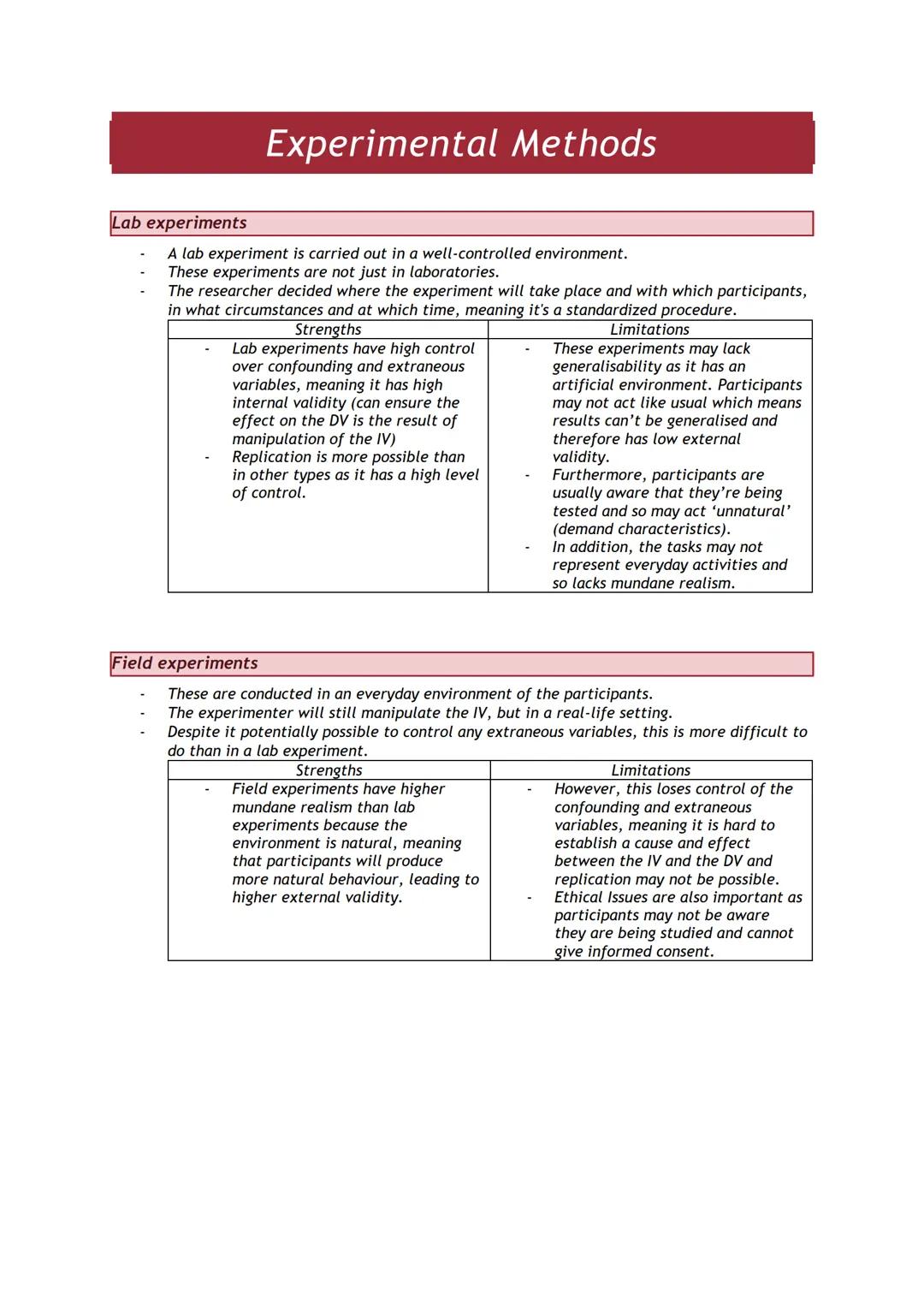
Lab experiments
A lab experiment is carried out in a well-controlled environment.
These experiments are not just in lab

Experimental Methods

Ever wondered why some psychology studies feel more "real" than others? It all comes down to where and how the research takes place.

Lab experiments give researchers maximum control by creating standardised, artificial environments. Think of them as the "goldilocks" of internal validity - everything's perfectly controlled, making it easy to spot cause-and-effect relationships and replicate studies. However, this control comes at a cost: participants might act unnaturally when they know they're being studied (demand characteristics), and the artificial setting means results might not apply to real-world situations.

Field experiments flip this around by taking research into natural, everyday environments whilst still manipulating variables. You'll get much more realistic behaviour and better external validity, but controlling confounding variables becomes a nightmare. Plus, there's the sticky ethical issue of people not knowing they're being studied.

Key insight: Lab experiments prioritise precision, whilst field experiments prioritise realism - choose based on what your research question needs most.

Experimental Methods
Lab experiments
A lab experiment is carried out in a well-controlled environment.
These experiments are not just in lab

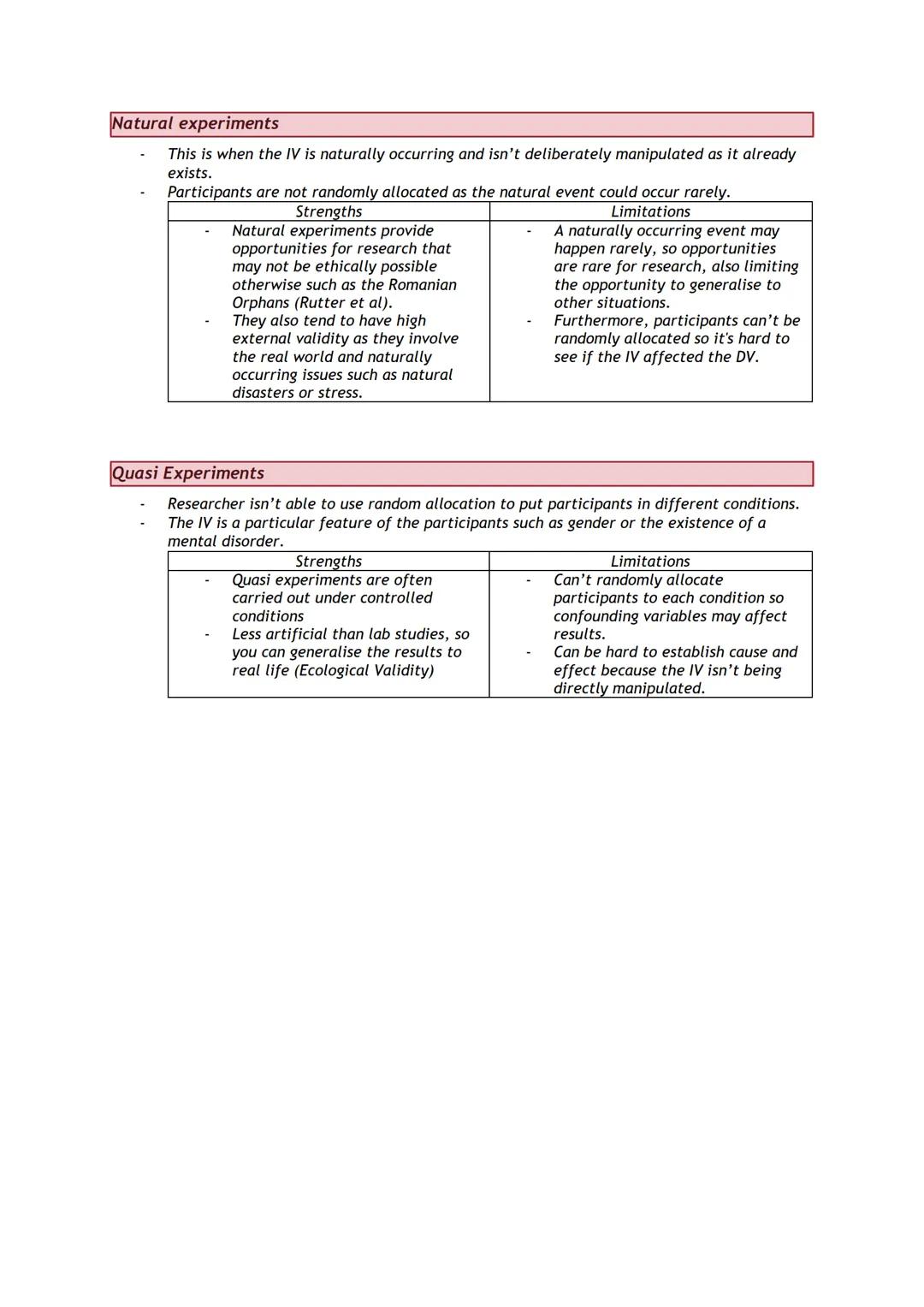
Natural and Quasi Experiments

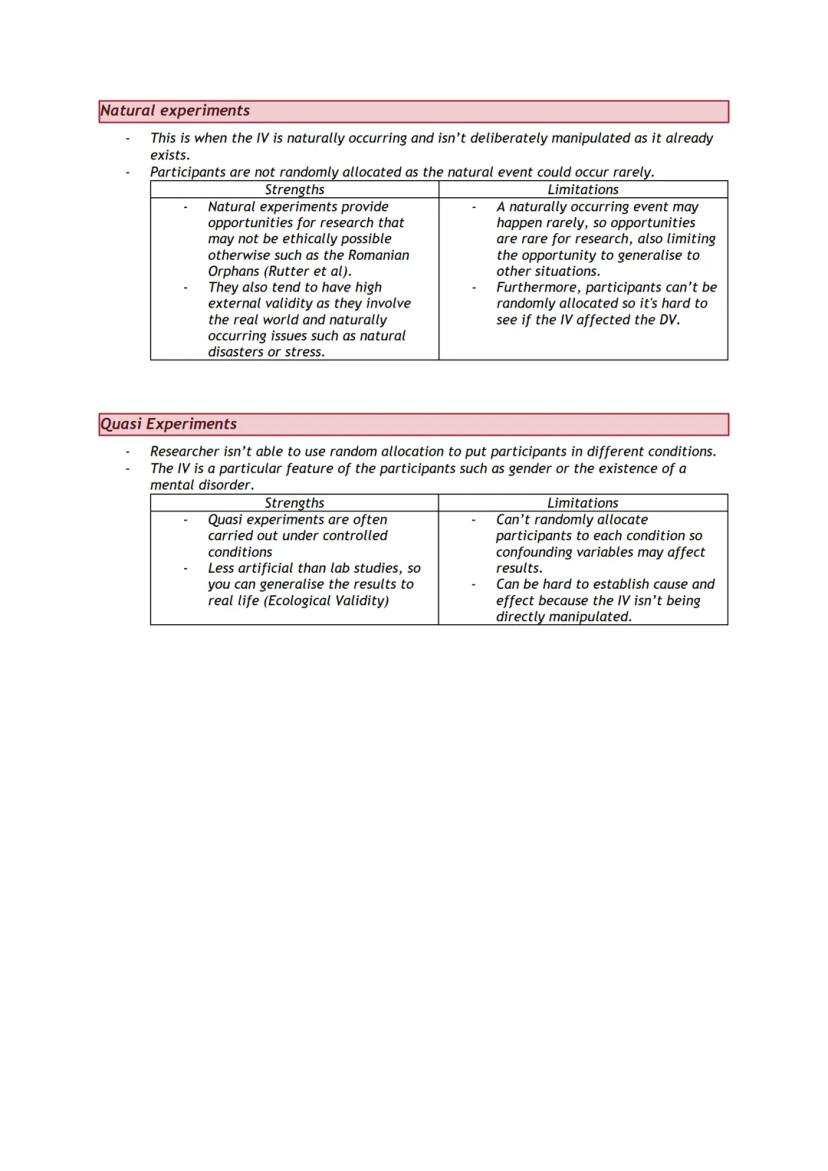
Sometimes researchers can't manipulate variables directly, so they work with what life gives them.

Natural experiments occur when life does the manipulating for you - think natural disasters, policy changes, or rare events like the Romanian orphan studies. These provide incredible opportunities to study situations that would be completely unethical to create artificially. The downside? You can't randomly assign participants, and these events happen so rarely that generalising results becomes tricky.

Quasi experiments deal with variables that already exist as part of who people are - like gender, age, or mental health conditions. They're less artificial than lab studies, giving you decent ecological validity. However, you're stuck with the same problem: no random allocation means confounding variables can sneak in and muddy your results.

Remember: Both types sacrifice control for ethical feasibility and real-world relevance.

Experimental Methods
Lab experiments
A lab experiment is carried out in a well-controlled environment.
These experiments are not just in lab

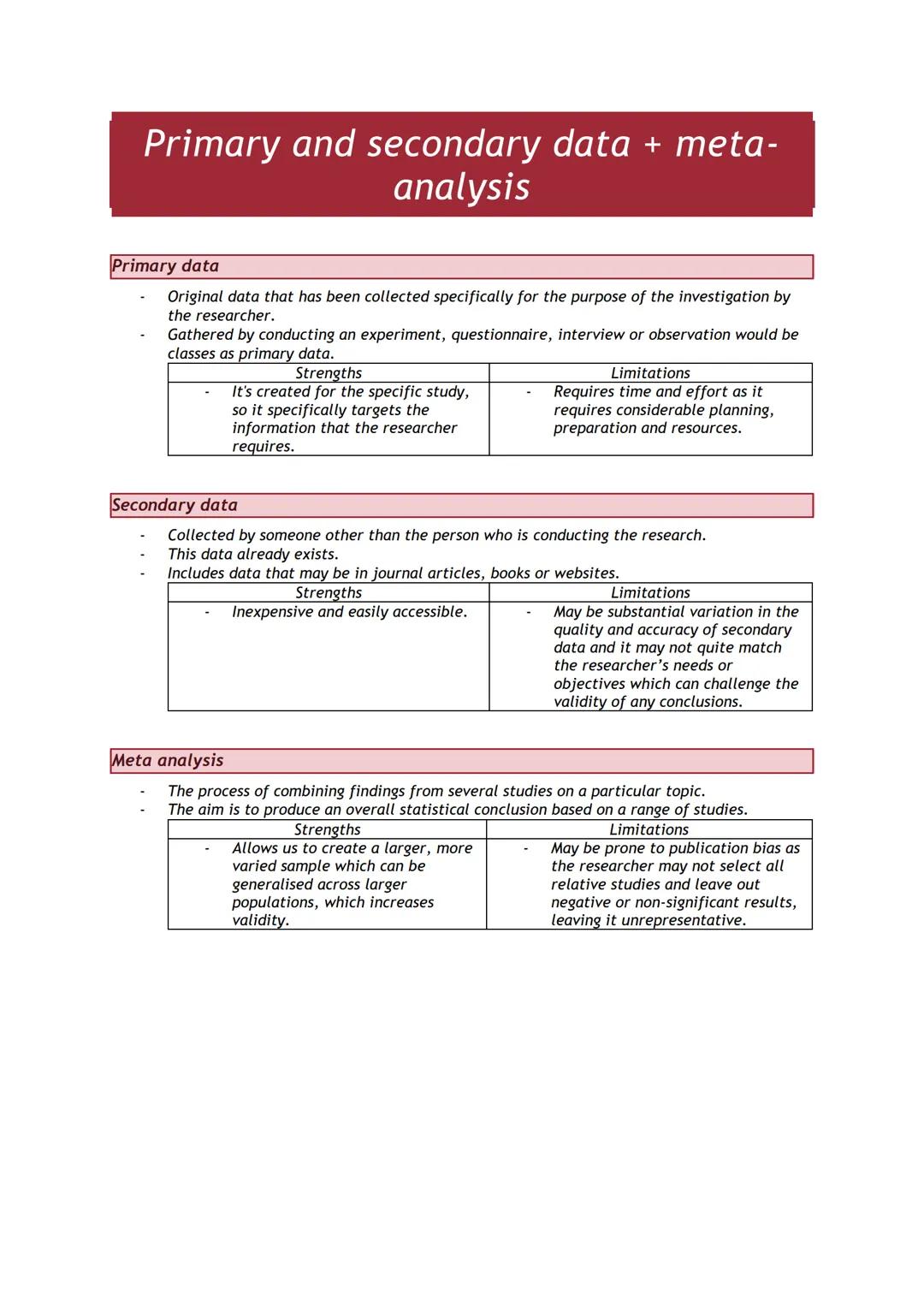
Data Sources and Meta-Analysis

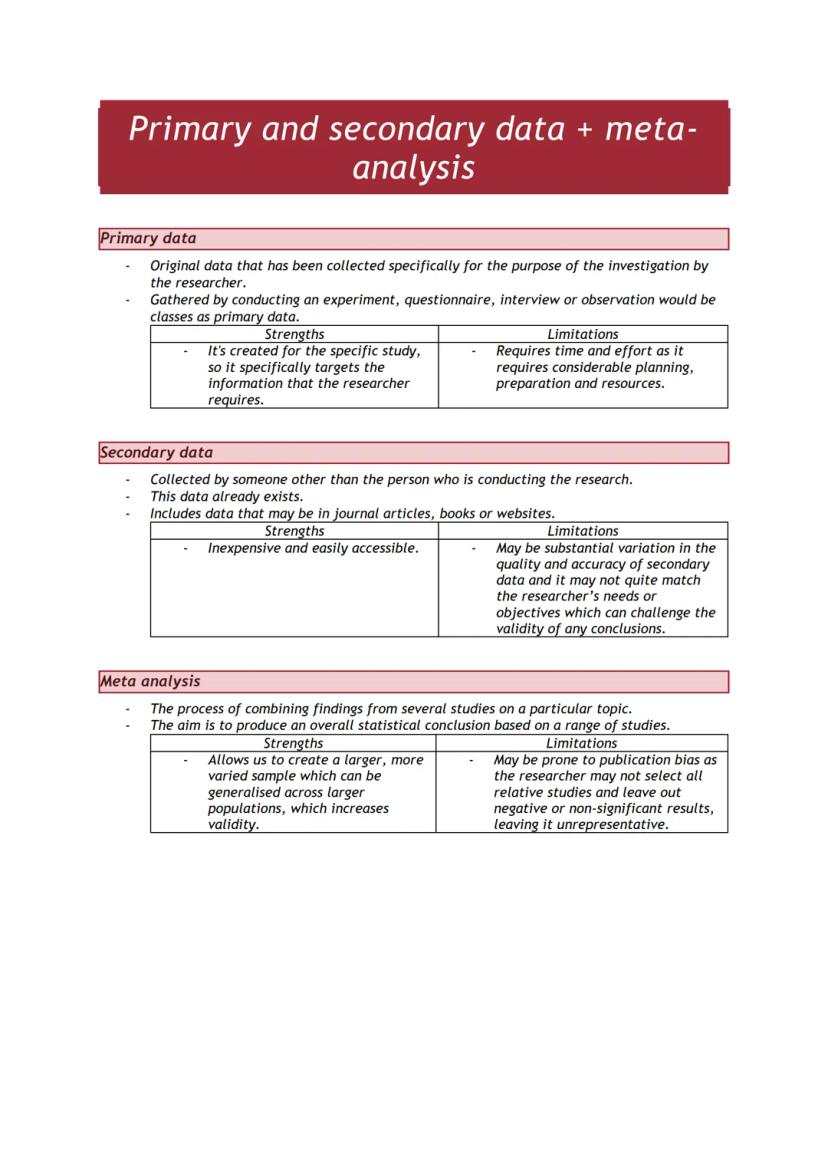
Understanding where your data comes from is crucial for evaluating any psychological study you encounter.

Primary data is the fresh, made-to-order option - collected specifically for your research question through experiments, interviews, or observations. It's perfectly tailored to what you need, but gathering it requires serious time, effort, and resources. Think of it as cooking from scratch.

Secondary data is like buying ready-made - it already exists in journal articles, books, or databases. It's quick, cheap, and easily accessible, but the quality can be patchy, and it might not quite fit your specific research needs.

Meta-analysis combines multiple studies on the same topic to create a bigger picture. This approach gives you larger, more diverse samples and stronger conclusions. However, researchers might cherry-pick studies that support their views (publication bias), potentially skewing the overall findings.

Pro tip: The best research often combines multiple data sources to get a complete picture.

Experimental Methods
Lab experiments
A lab experiment is carried out in a well-controlled environment.
These experiments are not just in lab

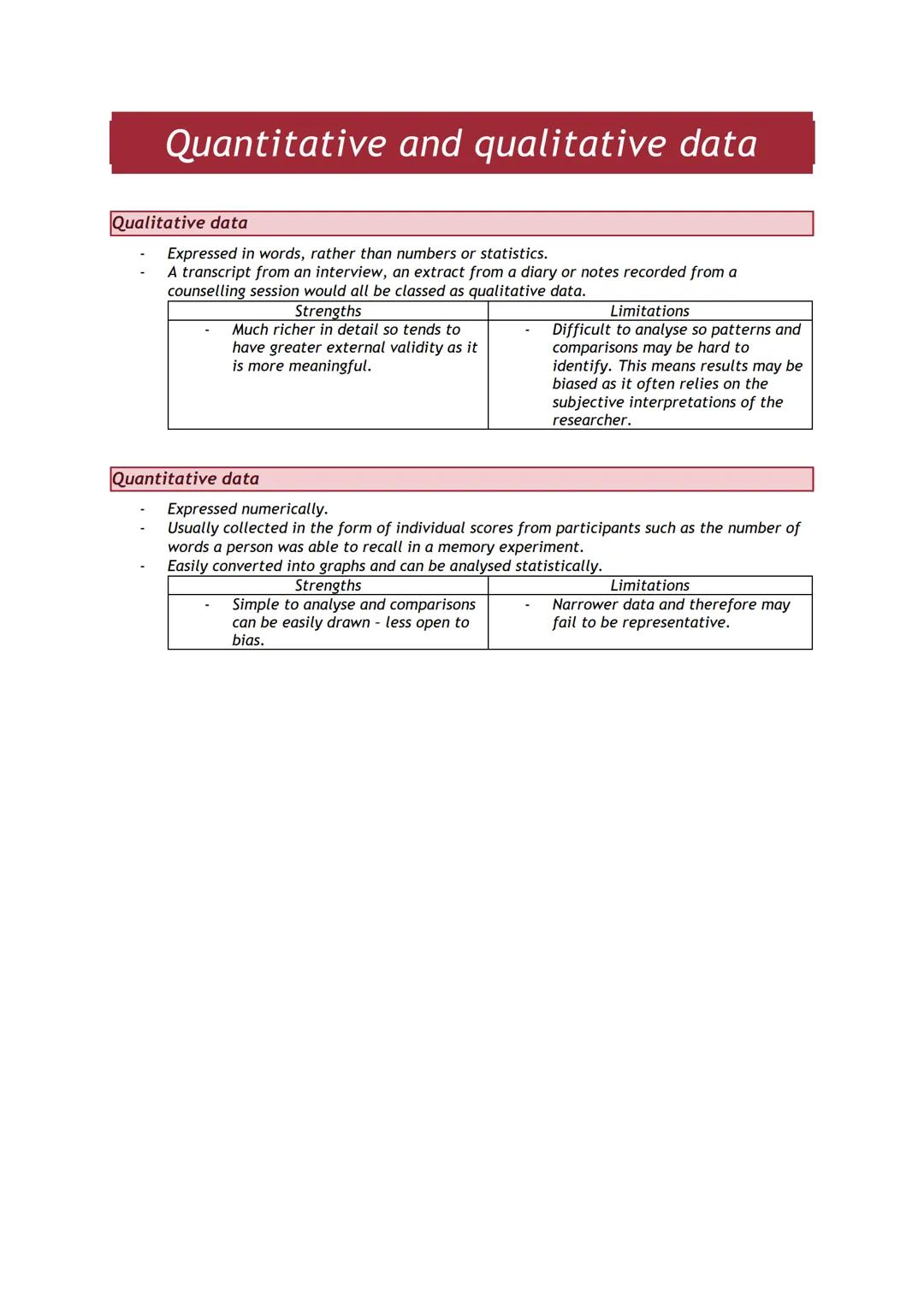
Types of Data

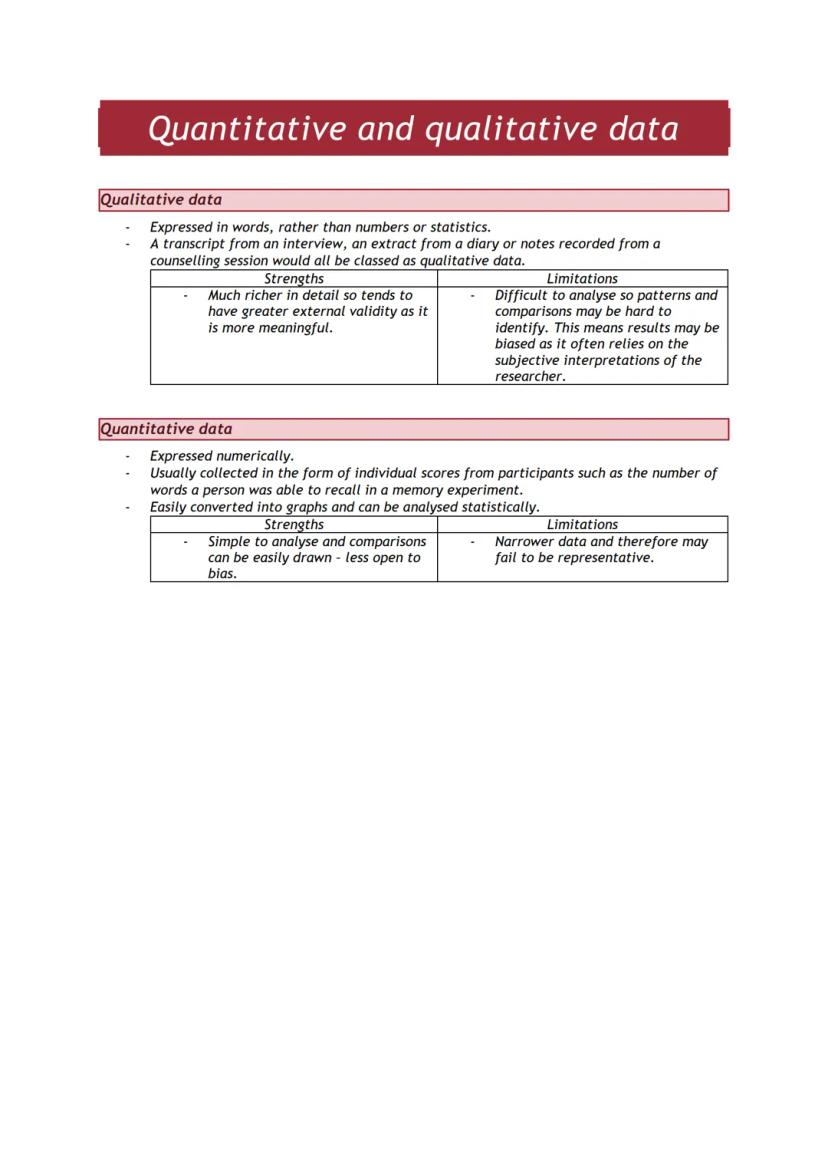
The type of data you collect fundamentally shapes what you can discover and how convincing your findings will be.

Qualitative data comes in words, stories, and detailed descriptions - like interview transcripts or diary entries. It's incredibly rich and meaningful, giving you deep insights into human experience and high external validity. The catch? It's subjective and difficult to analyse, making it prone to researcher bias.

Quantitative data deals in numbers and statistics - test scores, reaction times, or frequency counts. It's straightforward to analyse, compare, and present in graphs, with less room for bias to creep in. However, numbers can't capture the full complexity of human behaviour, potentially missing important nuances.

Most strong psychological research combines both approaches, using numbers to identify patterns and words to explain what those patterns actually mean for real people.

Think about it: Would you rather have precise measurements that miss the human story, or rich stories that are hard to compare?

Experimental Methods
Lab experiments
A lab experiment is carried out in a well-controlled environment.
These experiments are not just in lab

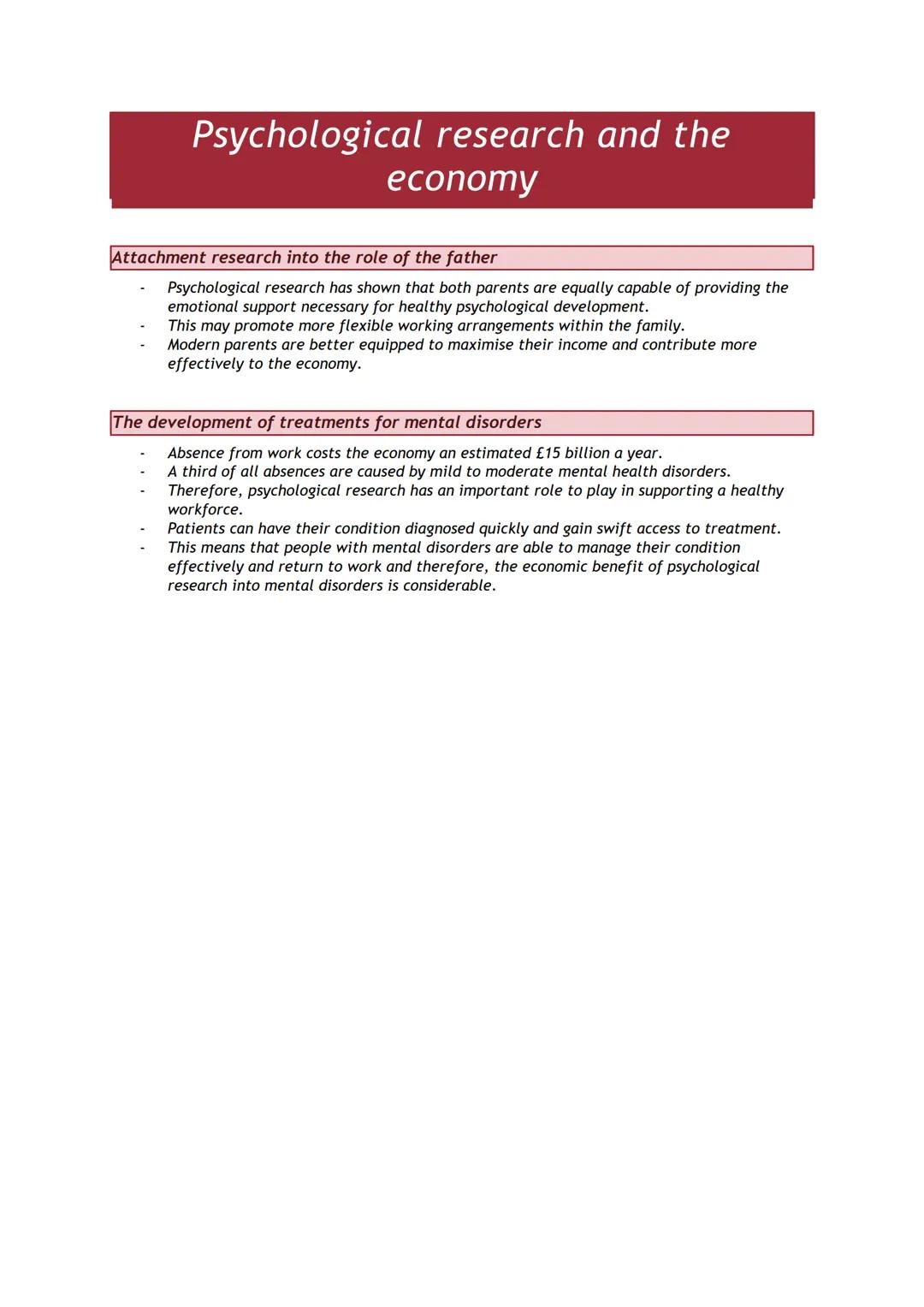
Psychological Research and the Economy

Psychology isn't just academic - it has massive real-world economic impact that affects everyone.

Research on attachment and parenting has revolutionised how we think about family roles. Studies showing both parents can provide equal emotional support have encouraged flexible working arrangements, helping families maximise income whilst supporting child development. This means parents can contribute more effectively to the economy without sacrificing their children's wellbeing.

Mental health research delivers even bigger economic benefits. With work absences costing the UK economy around £15 billion annually - and a third of these being mental health-related - psychological treatments become crucial economic tools. Quick diagnosis and effective treatments mean people can manage conditions like depression and anxiety whilst staying productive at work.

The bottom line? Every pound invested in psychological research potentially saves much more in reduced healthcare costs, improved productivity, and stronger families.

Real impact: Your understanding of psychology contributes to research that genuinely improves lives and economic wellbeing.

Experimental Methods
Lab experiments
A lab experiment is carried out in a well-controlled environment.
These experiments are not just in lab

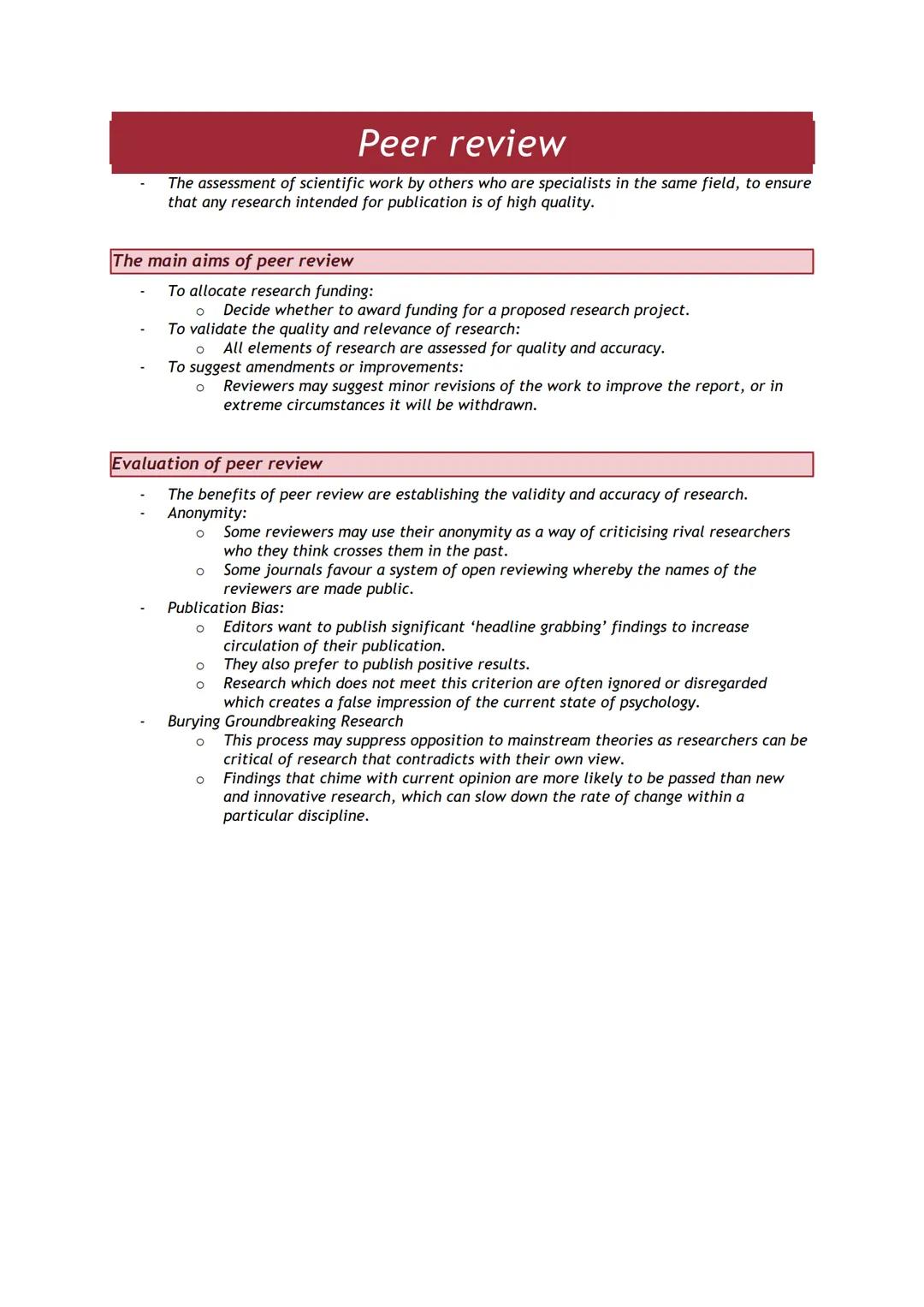
Peer Review Process

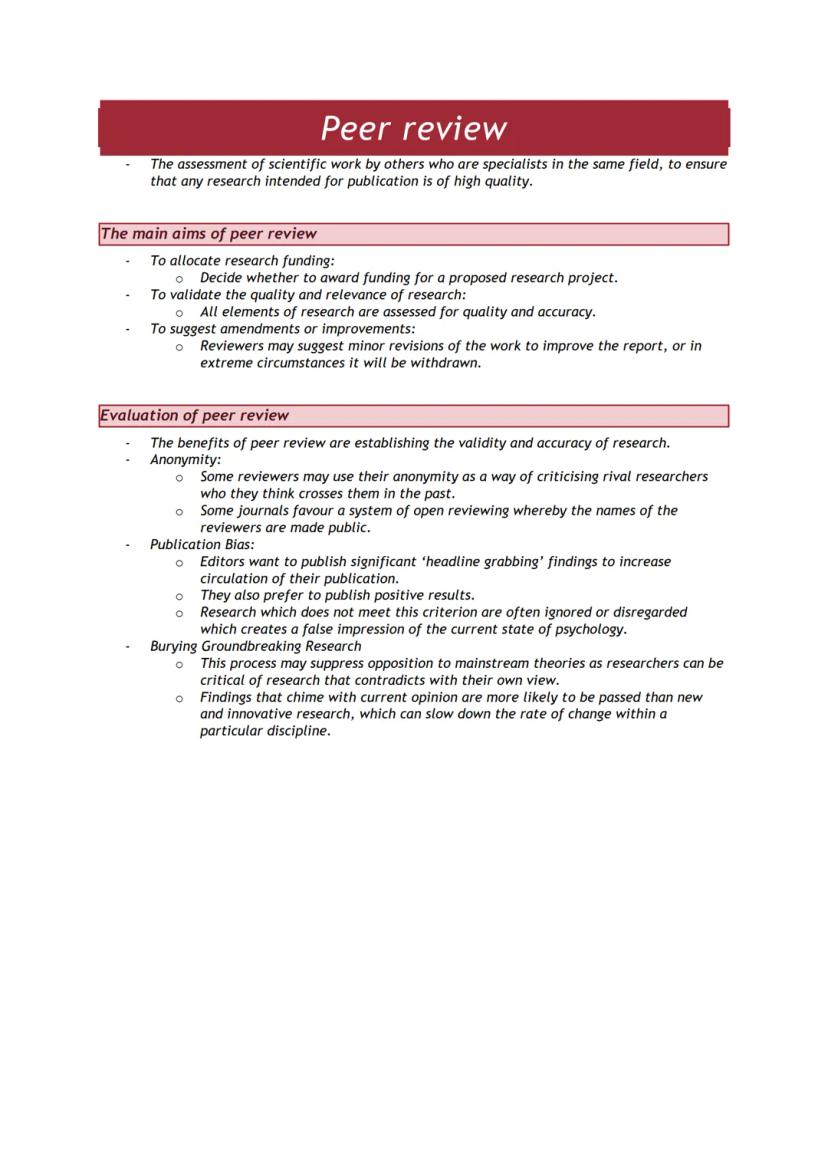
Before any psychological research reaches you, it goes through a rigorous quality control process called peer review.

This system works like academic quality assurance - experts in the same field evaluate research before publication, checking everything from methodology to conclusions. They decide on funding, validate research quality, and suggest improvements. It's designed to catch errors, ensure accuracy, and maintain scientific standards.

However, the system isn't perfect. Anonymous reviewers might use their cover to unfairly criticise rivals, whilst publication bias means editors prefer exciting, positive results over important but "boring" findings. This creates a skewed view of what psychology actually knows.

Perhaps most concerning is how peer review can bury groundbreaking research. Revolutionary ideas that challenge mainstream thinking often get rejected, whilst studies confirming existing beliefs sail through. This can significantly slow scientific progress.

Critical thinking: Always ask yourself - what research might not have been published, and why?

Experimental Methods
Lab experiments
A lab experiment is carried out in a well-controlled environment.
These experiments are not just in lab

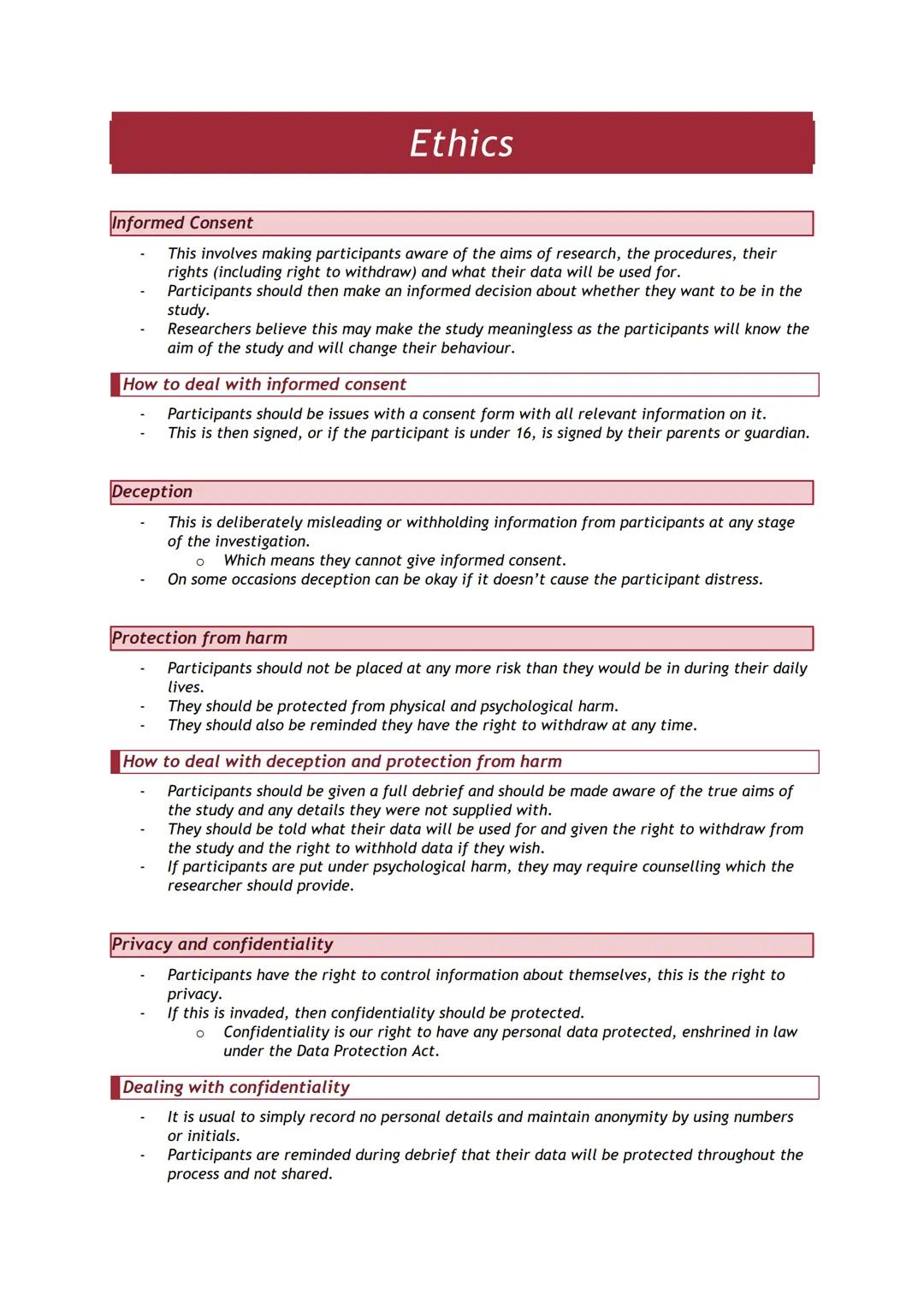
Research Ethics

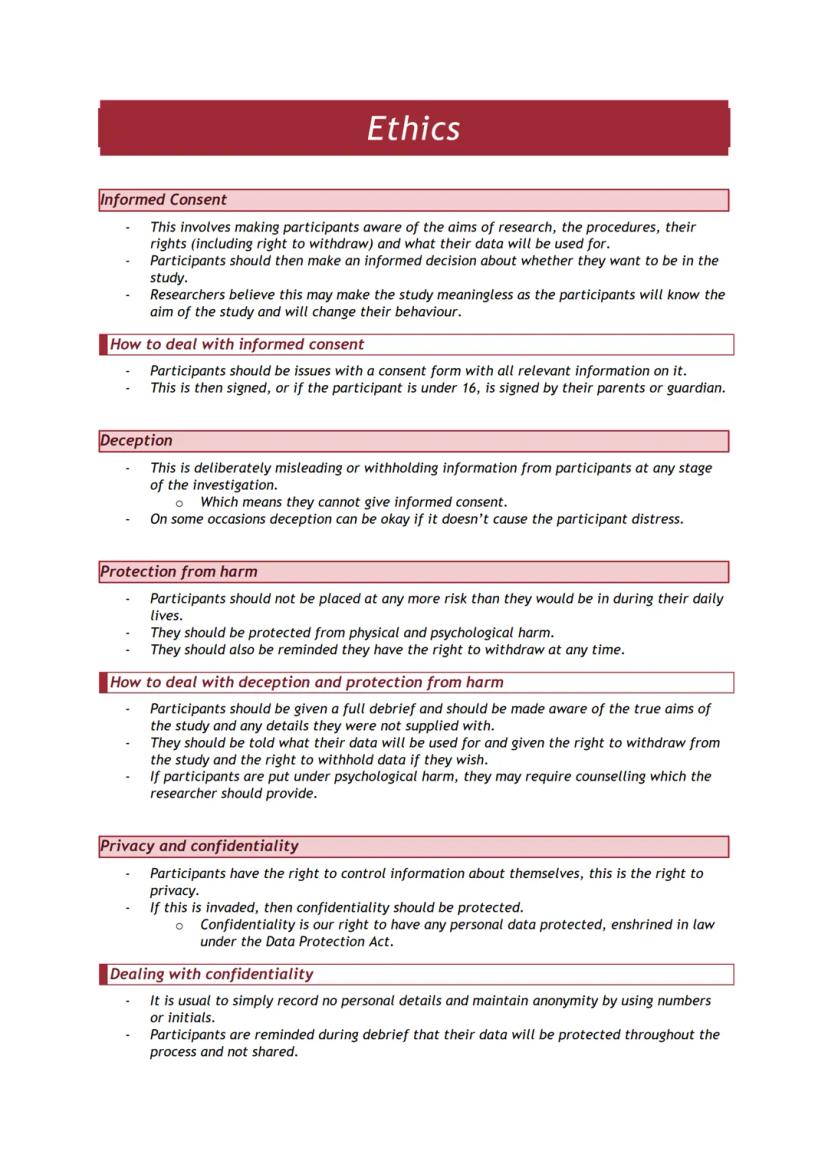
Ethics in psychology isn't just about following rules - it's about respecting human dignity whilst pursuing knowledge.

Informed consent means participants understand what they're signing up for: the study's aims, procedures, their rights, and how their data will be used. Sometimes researchers worry this knowledge will change behaviour and ruin results, but participant welfare always comes first.

Deception involves misleading or withholding information from participants. Whilst sometimes necessary for valid results, it must never cause distress. Any deception requires thorough debriefing afterwards, explaining the true aims and giving participants the right to withdraw their data.

Protection from harm is fundamental - participants shouldn't face more risk than in daily life. This includes physical safety and psychological wellbeing. Privacy and confidentiality protect participants' personal information, typically through anonymity and secure data storage.

Key principle: The potential benefits of research must always outweigh the risks to participants - no exceptions.

Experimental Methods
Lab experiments
A lab experiment is carried out in a well-controlled environment.
These experiments are not just in lab

Understanding Variables

Getting your head around different types of variables is essential for designing and evaluating psychological research.

The independent variable (IV) is what researchers manipulate or what changes naturally - like testing different teaching methods or comparing age groups. The dependent variable (DV) is what gets measured - perhaps test scores or reaction times. Everything else that might interfere becomes an extraneous variable.

Confounding variables are the sneaky ones - they change systematically alongside your IV, making it impossible to know what's actually causing any effects. Imagine studying stress and exam performance, but stressed students also sleep less - is it stress or sleep deprivation affecting their scores?

Demand characteristics occur when participants guess what the study's about and change their behaviour accordingly. Investigator effects happen when researchers unconsciously influence results through their expectations or behaviour.

Success strategy: Always ask yourself - what else could be explaining these results besides the obvious answer?

Experimental Methods
Lab experiments
A lab experiment is carried out in a well-controlled environment.
These experiments are not just in lab

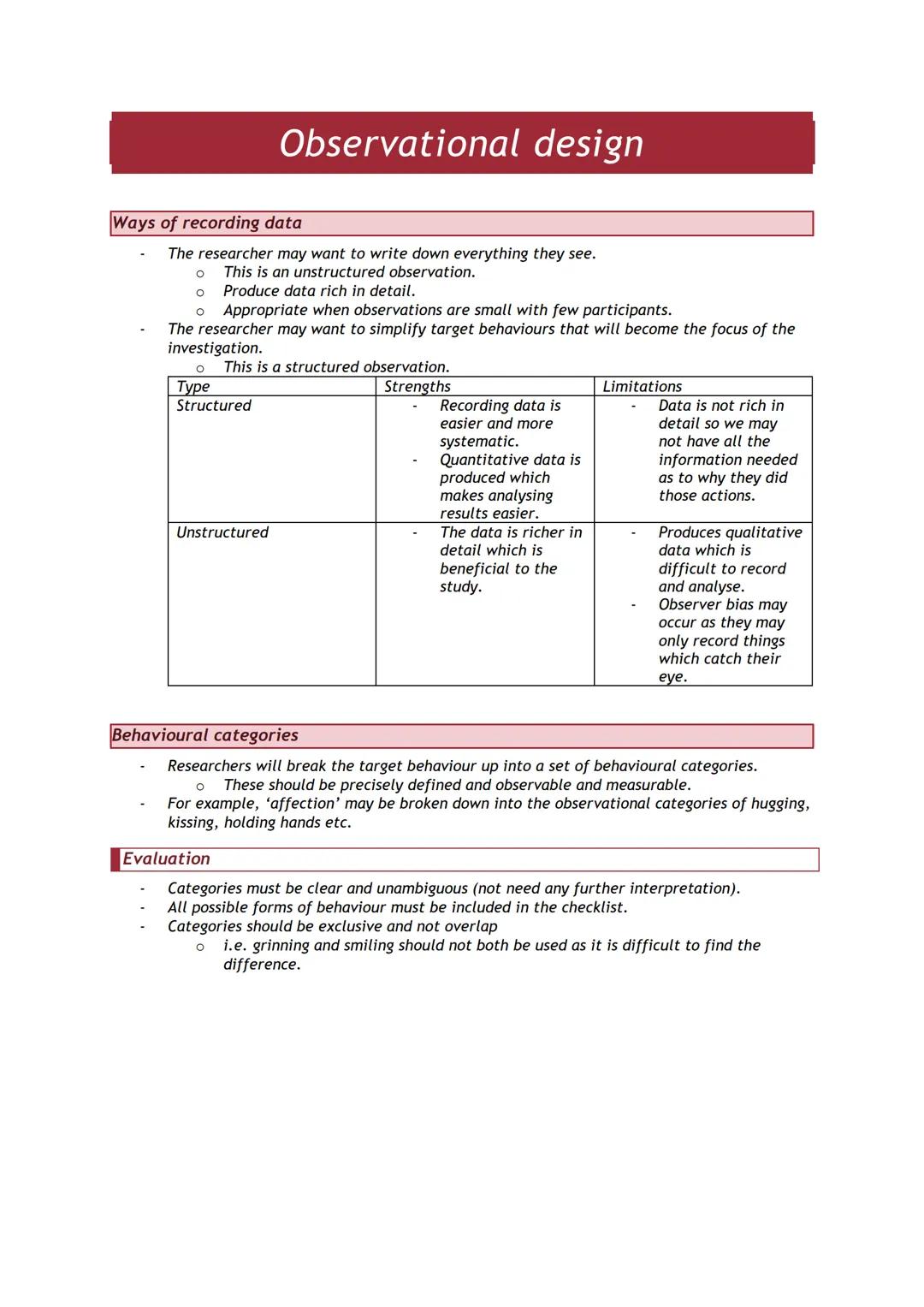
Observational Design

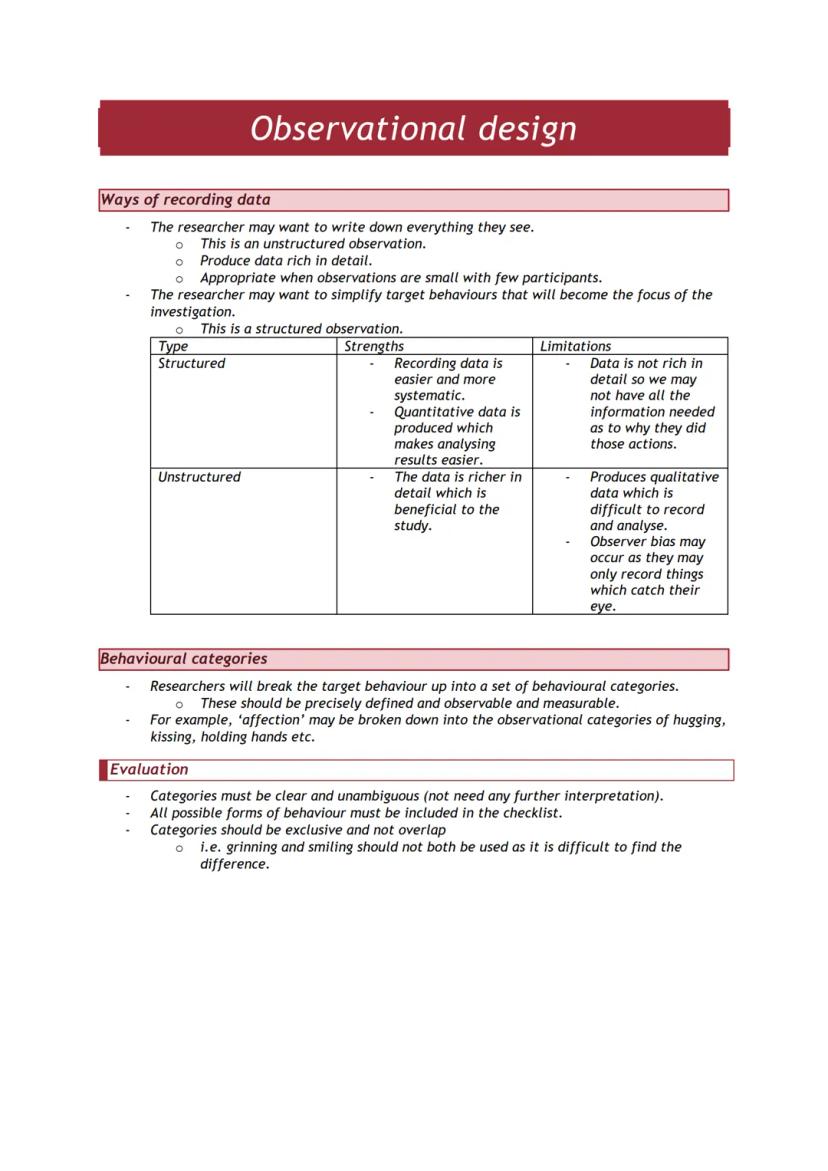
Observation might seem straightforward, but there's serious skill in watching and recording behaviour systematically.

Unstructured observations involve recording everything you see, creating rich, detailed data perfect for small-scale studies. However, this approach generates massive amounts of qualitative data that's difficult to analyse, and observer bias means you might only notice things that catch your attention.

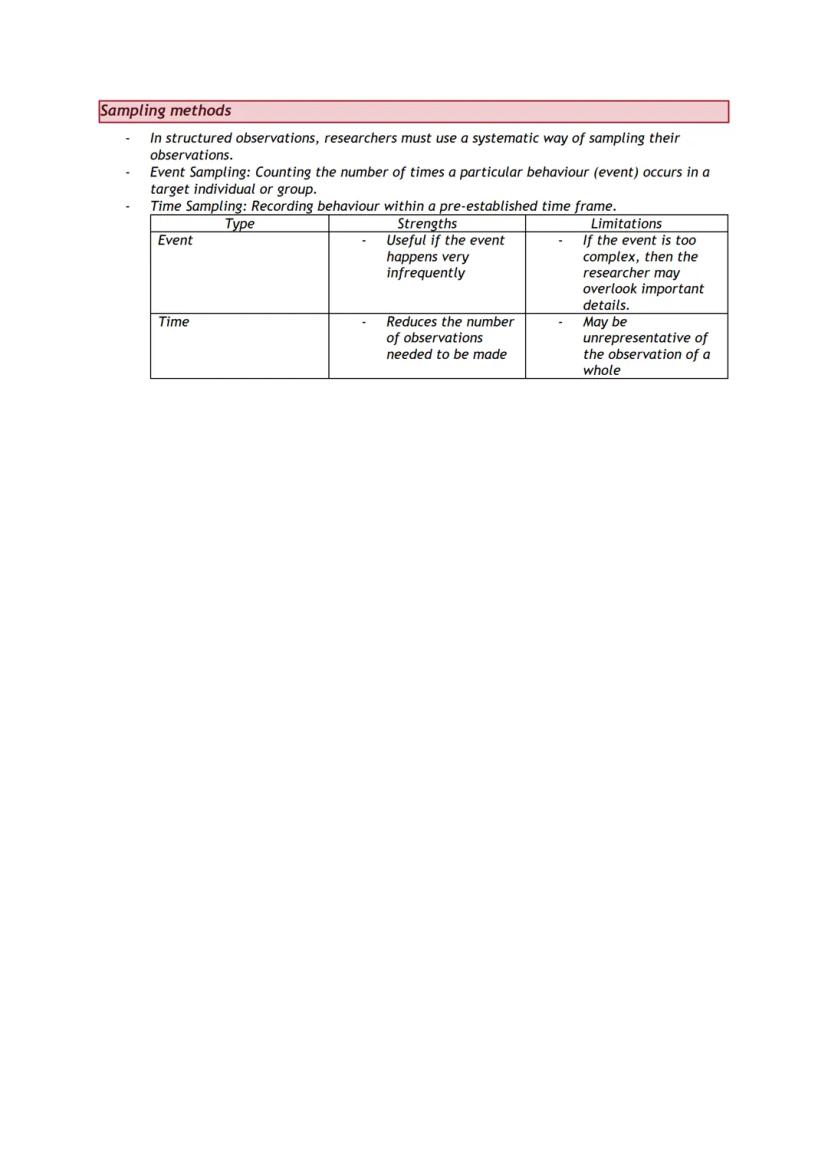
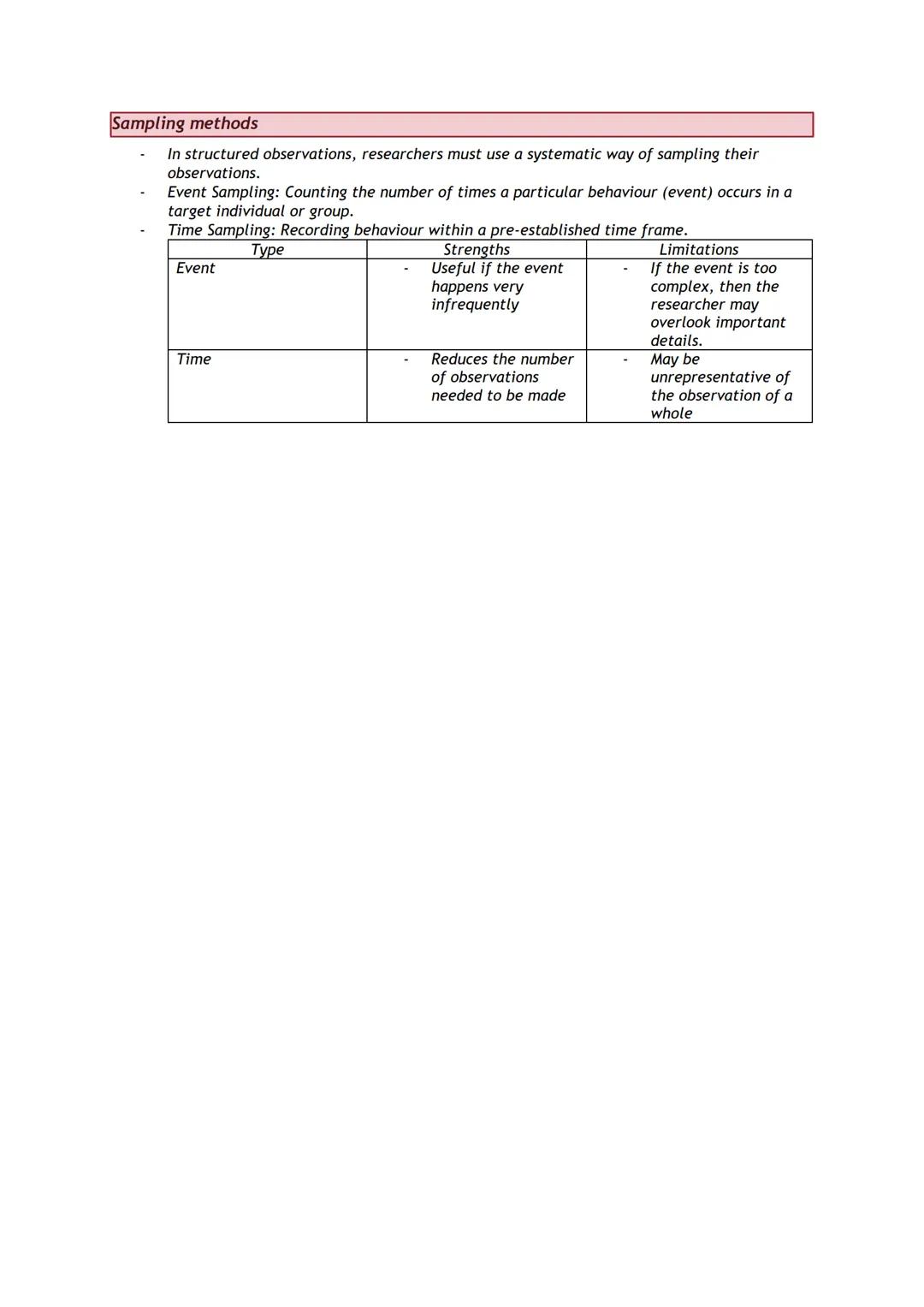
Structured observations focus on specific, pre-defined behaviours using behavioural categories - breaking complex behaviours like "aggression" into measurable components like "hitting," "shouting," or "threatening gestures." This creates quantitative data that's easier to analyse and compare, but you might miss important details outside your categories.

The key to good behavioural categories is making them clear, comprehensive, and exclusive - no overlap or ambiguity allowed.

Practical tip: Always pilot test your behavioural categories to check they capture what you actually need to measure.

Experimental Methods
Lab experiments
A lab experiment is carried out in a well-controlled environment.
These experiments are not just in lab


We thought you’d never ask...

What is the Knowunity AI companion?

Our AI Companion is a student-focused AI tool that offers more than just answers. Built on millions of Knowunity resources, it provides relevant information, personalised study plans, quizzes, and content directly in the chat, adapting to your individual learning journey.

Where can I download the Knowunity app?

You can download the app from Google Play Store and Apple App Store.

Is Knowunity really free of charge?

That's right! Enjoy free access to study content, connect with fellow students, and get instant help – all at your fingertips.

Most popular content: Research Methods

Most popular content in Psychology

Most popular content

Can't find what you're looking for? Explore other subjects.

Students love us — and so will you.

4.9/5

App Store

4.8/5

Google Play

The app is very easy to use and well designed. I have found everything I was looking for so far and have been able to learn a lot from the presentations! I will definitely use the app for a class assignment! And of course it also helps a lot as an inspiration.

Stefan S

iOS user

This app is really great. There are so many study notes and help [...]. My problem subject is French, for example, and the app has so many options for help. Thanks to this app, I have improved my French. I would recommend it to anyone.

Samantha Klich

Android user

Wow, I am really amazed. I just tried the app because I've seen it advertised many times and was absolutely stunned. This app is THE HELP you want for school and above all, it offers so many things, such as workouts and fact sheets, which have been VERY helpful to me personally.

Anna

iOS user

Best app on earth! no words because it’s too good

Thomas R

iOS user

Just amazing. Let's me revise 10x better, this app is a quick 10/10. I highly recommend it to anyone. I can watch and search for notes. I can save them in the subject folder. I can revise it any time when I come back. If you haven't tried this app, you're really missing out.

Basil

Android user

This app has made me feel so much more confident in my exam prep, not only through boosting my own self confidence through the features that allow you to connect with others and feel less alone, but also through the way the app itself is centred around making you feel better. It is easy to navigate, fun to use, and helpful to anyone struggling in absolutely any way.

David K

iOS user

The app's just great! All I have to do is enter the topic in the search bar and I get the response real fast. I don't have to watch 10 YouTube videos to understand something, so I'm saving my time. Highly recommended!

Sudenaz Ocak

Android user

In school I was really bad at maths but thanks to the app, I am doing better now. I am so grateful that you made the app.

Greenlight Bonnie

Android user

very reliable app to help and grow your ideas of Maths, English and other related topics in your works. please use this app if your struggling in areas, this app is key for that. wish I'd of done a review before. and it's also free so don't worry about that.

Rohan U

Android user

I know a lot of apps use fake accounts to boost their reviews but this app deserves it all. Originally I was getting 4 in my English exams and this time I got a grade 7. I didn’t even know about this app three days until the exam and it has helped A LOT. Please actually trust me and use it as I’m sure you too will see developments.

Xander S

iOS user

THE QUIZES AND FLASHCARDS ARE SO USEFUL AND I LOVE THE SCHOOLGPT. IT ALSO IS LITREALLY LIKE CHATGPT BUT SMARTER!! HELPED ME WITH MY MASCARA PROBLEMS TOO!! AS WELL AS MY REAL SUBJECTS ! DUHHH 😍😁😲🤑💗✨🎀😮

Elisha

iOS user

This apps acc the goat. I find revision so boring but this app makes it so easy to organize it all and then you can ask the freeeee ai to test yourself so good and you can easily upload your own stuff. highly recommend as someone taking mocks now

Paul T

iOS user

The app is very easy to use and well designed. I have found everything I was looking for so far and have been able to learn a lot from the presentations! I will definitely use the app for a class assignment! And of course it also helps a lot as an inspiration.

Stefan S

iOS user

This app is really great. There are so many study notes and help [...]. My problem subject is French, for example, and the app has so many options for help. Thanks to this app, I have improved my French. I would recommend it to anyone.

Samantha Klich

Android user

Wow, I am really amazed. I just tried the app because I've seen it advertised many times and was absolutely stunned. This app is THE HELP you want for school and above all, it offers so many things, such as workouts and fact sheets, which have been VERY helpful to me personally.

Anna

iOS user

Best app on earth! no words because it’s too good

Thomas R

iOS user

Just amazing. Let's me revise 10x better, this app is a quick 10/10. I highly recommend it to anyone. I can watch and search for notes. I can save them in the subject folder. I can revise it any time when I come back. If you haven't tried this app, you're really missing out.

Basil

Android user

This app has made me feel so much more confident in my exam prep, not only through boosting my own self confidence through the features that allow you to connect with others and feel less alone, but also through the way the app itself is centred around making you feel better. It is easy to navigate, fun to use, and helpful to anyone struggling in absolutely any way.

David K

iOS user

The app's just great! All I have to do is enter the topic in the search bar and I get the response real fast. I don't have to watch 10 YouTube videos to understand something, so I'm saving my time. Highly recommended!

Sudenaz Ocak

Android user

In school I was really bad at maths but thanks to the app, I am doing better now. I am so grateful that you made the app.

Greenlight Bonnie

Android user

very reliable app to help and grow your ideas of Maths, English and other related topics in your works. please use this app if your struggling in areas, this app is key for that. wish I'd of done a review before. and it's also free so don't worry about that.

Rohan U

Android user

I know a lot of apps use fake accounts to boost their reviews but this app deserves it all. Originally I was getting 4 in my English exams and this time I got a grade 7. I didn’t even know about this app three days until the exam and it has helped A LOT. Please actually trust me and use it as I’m sure you too will see developments.

Xander S

iOS user

THE QUIZES AND FLASHCARDS ARE SO USEFUL AND I LOVE THE SCHOOLGPT. IT ALSO IS LITREALLY LIKE CHATGPT BUT SMARTER!! HELPED ME WITH MY MASCARA PROBLEMS TOO!! AS WELL AS MY REAL SUBJECTS ! DUHHH 😍😁😲🤑💗✨🎀😮

Elisha

iOS user

This apps acc the goat. I find revision so boring but this app makes it so easy to organize it all and then you can ask the freeeee ai to test yourself so good and you can easily upload your own stuff. highly recommend as someone taking mocks now

Paul T

iOS user


Psychology

917

2 Dec 2025

23 pages

Understanding AS AQA Psychology Research Methods

user profile picture

Hope

@hoperebekah

Psychological research methods are the backbone of understanding human behaviour, and they're essential tools you'll need to master for your A-levels. These methods help researchers gather reliable evidence whilst navigating ethical considerations and practical limitations.

Experimental Methods
Lab experiments
A lab experiment is carried out in a well-controlled environment.
These experiments are not just in lab

Sign up to see the contentIt's free!

Access to all documents

Improve your grades

Join milions of students

By signing up you accept Terms of Service and Privacy Policy

Experimental Methods

Ever wondered why some psychology studies feel more "real" than others? It all comes down to where and how the research takes place.

Lab experiments give researchers maximum control by creating standardised, artificial environments. Think of them as the "goldilocks" of internal validity - everything's perfectly controlled, making it easy to spot cause-and-effect relationships and replicate studies. However, this control comes at a cost: participants might act unnaturally when they know they're being studied (demand characteristics), and the artificial setting means results might not apply to real-world situations.

Field experiments flip this around by taking research into natural, everyday environments whilst still manipulating variables. You'll get much more realistic behaviour and better external validity, but controlling confounding variables becomes a nightmare. Plus, there's the sticky ethical issue of people not knowing they're being studied.

Key insight: Lab experiments prioritise precision, whilst field experiments prioritise realism - choose based on what your research question needs most.

Experimental Methods
Lab experiments
A lab experiment is carried out in a well-controlled environment.
These experiments are not just in lab

Sign up to see the contentIt's free!

Access to all documents

Improve your grades

Join milions of students

By signing up you accept Terms of Service and Privacy Policy

Natural and Quasi Experiments

Sometimes researchers can't manipulate variables directly, so they work with what life gives them.

Natural experiments occur when life does the manipulating for you - think natural disasters, policy changes, or rare events like the Romanian orphan studies. These provide incredible opportunities to study situations that would be completely unethical to create artificially. The downside? You can't randomly assign participants, and these events happen so rarely that generalising results becomes tricky.

Quasi experiments deal with variables that already exist as part of who people are - like gender, age, or mental health conditions. They're less artificial than lab studies, giving you decent ecological validity. However, you're stuck with the same problem: no random allocation means confounding variables can sneak in and muddy your results.

Remember: Both types sacrifice control for ethical feasibility and real-world relevance.

Experimental Methods
Lab experiments
A lab experiment is carried out in a well-controlled environment.
These experiments are not just in lab

Sign up to see the contentIt's free!

Access to all documents

Improve your grades

Join milions of students

By signing up you accept Terms of Service and Privacy Policy

Data Sources and Meta-Analysis

Understanding where your data comes from is crucial for evaluating any psychological study you encounter.

Primary data is the fresh, made-to-order option - collected specifically for your research question through experiments, interviews, or observations. It's perfectly tailored to what you need, but gathering it requires serious time, effort, and resources. Think of it as cooking from scratch.

Secondary data is like buying ready-made - it already exists in journal articles, books, or databases. It's quick, cheap, and easily accessible, but the quality can be patchy, and it might not quite fit your specific research needs.

Meta-analysis combines multiple studies on the same topic to create a bigger picture. This approach gives you larger, more diverse samples and stronger conclusions. However, researchers might cherry-pick studies that support their views (publication bias), potentially skewing the overall findings.

Pro tip: The best research often combines multiple data sources to get a complete picture.

Experimental Methods
Lab experiments
A lab experiment is carried out in a well-controlled environment.
These experiments are not just in lab

Sign up to see the contentIt's free!

Access to all documents

Improve your grades

Join milions of students

By signing up you accept Terms of Service and Privacy Policy

Types of Data

The type of data you collect fundamentally shapes what you can discover and how convincing your findings will be.

Qualitative data comes in words, stories, and detailed descriptions - like interview transcripts or diary entries. It's incredibly rich and meaningful, giving you deep insights into human experience and high external validity. The catch? It's subjective and difficult to analyse, making it prone to researcher bias.

Quantitative data deals in numbers and statistics - test scores, reaction times, or frequency counts. It's straightforward to analyse, compare, and present in graphs, with less room for bias to creep in. However, numbers can't capture the full complexity of human behaviour, potentially missing important nuances.

Most strong psychological research combines both approaches, using numbers to identify patterns and words to explain what those patterns actually mean for real people.

Think about it: Would you rather have precise measurements that miss the human story, or rich stories that are hard to compare?

Experimental Methods
Lab experiments
A lab experiment is carried out in a well-controlled environment.
These experiments are not just in lab

Sign up to see the contentIt's free!

Access to all documents

Improve your grades

Join milions of students

By signing up you accept Terms of Service and Privacy Policy

Psychological Research and the Economy

Psychology isn't just academic - it has massive real-world economic impact that affects everyone.

Research on attachment and parenting has revolutionised how we think about family roles. Studies showing both parents can provide equal emotional support have encouraged flexible working arrangements, helping families maximise income whilst supporting child development. This means parents can contribute more effectively to the economy without sacrificing their children's wellbeing.

Mental health research delivers even bigger economic benefits. With work absences costing the UK economy around £15 billion annually - and a third of these being mental health-related - psychological treatments become crucial economic tools. Quick diagnosis and effective treatments mean people can manage conditions like depression and anxiety whilst staying productive at work.

The bottom line? Every pound invested in psychological research potentially saves much more in reduced healthcare costs, improved productivity, and stronger families.

Real impact: Your understanding of psychology contributes to research that genuinely improves lives and economic wellbeing.

Experimental Methods
Lab experiments
A lab experiment is carried out in a well-controlled environment.
These experiments are not just in lab

Sign up to see the contentIt's free!

Access to all documents

Improve your grades

Join milions of students

By signing up you accept Terms of Service and Privacy Policy

Peer Review Process

Before any psychological research reaches you, it goes through a rigorous quality control process called peer review.

This system works like academic quality assurance - experts in the same field evaluate research before publication, checking everything from methodology to conclusions. They decide on funding, validate research quality, and suggest improvements. It's designed to catch errors, ensure accuracy, and maintain scientific standards.

However, the system isn't perfect. Anonymous reviewers might use their cover to unfairly criticise rivals, whilst publication bias means editors prefer exciting, positive results over important but "boring" findings. This creates a skewed view of what psychology actually knows.

Perhaps most concerning is how peer review can bury groundbreaking research. Revolutionary ideas that challenge mainstream thinking often get rejected, whilst studies confirming existing beliefs sail through. This can significantly slow scientific progress.

Critical thinking: Always ask yourself - what research might not have been published, and why?

Experimental Methods
Lab experiments
A lab experiment is carried out in a well-controlled environment.
These experiments are not just in lab

Sign up to see the contentIt's free!

Access to all documents

Improve your grades

Join milions of students

By signing up you accept Terms of Service and Privacy Policy

Research Ethics

Ethics in psychology isn't just about following rules - it's about respecting human dignity whilst pursuing knowledge.

Informed consent means participants understand what they're signing up for: the study's aims, procedures, their rights, and how their data will be used. Sometimes researchers worry this knowledge will change behaviour and ruin results, but participant welfare always comes first.

Deception involves misleading or withholding information from participants. Whilst sometimes necessary for valid results, it must never cause distress. Any deception requires thorough debriefing afterwards, explaining the true aims and giving participants the right to withdraw their data.

Protection from harm is fundamental - participants shouldn't face more risk than in daily life. This includes physical safety and psychological wellbeing. Privacy and confidentiality protect participants' personal information, typically through anonymity and secure data storage.

Key principle: The potential benefits of research must always outweigh the risks to participants - no exceptions.

Experimental Methods
Lab experiments
A lab experiment is carried out in a well-controlled environment.
These experiments are not just in lab

Sign up to see the contentIt's free!

Access to all documents

Improve your grades

Join milions of students

By signing up you accept Terms of Service and Privacy Policy

Understanding Variables

Getting your head around different types of variables is essential for designing and evaluating psychological research.

The independent variable (IV) is what researchers manipulate or what changes naturally - like testing different teaching methods or comparing age groups. The dependent variable (DV) is what gets measured - perhaps test scores or reaction times. Everything else that might interfere becomes an extraneous variable.

Confounding variables are the sneaky ones - they change systematically alongside your IV, making it impossible to know what's actually causing any effects. Imagine studying stress and exam performance, but stressed students also sleep less - is it stress or sleep deprivation affecting their scores?

Demand characteristics occur when participants guess what the study's about and change their behaviour accordingly. Investigator effects happen when researchers unconsciously influence results through their expectations or behaviour.

Success strategy: Always ask yourself - what else could be explaining these results besides the obvious answer?

Experimental Methods
Lab experiments
A lab experiment is carried out in a well-controlled environment.
These experiments are not just in lab

Sign up to see the contentIt's free!

Access to all documents

Improve your grades

Join milions of students

By signing up you accept Terms of Service and Privacy Policy

Observational Design

Observation might seem straightforward, but there's serious skill in watching and recording behaviour systematically.

Unstructured observations involve recording everything you see, creating rich, detailed data perfect for small-scale studies. However, this approach generates massive amounts of qualitative data that's difficult to analyse, and observer bias means you might only notice things that catch your attention.

Structured observations focus on specific, pre-defined behaviours using behavioural categories - breaking complex behaviours like "aggression" into measurable components like "hitting," "shouting," or "threatening gestures." This creates quantitative data that's easier to analyse and compare, but you might miss important details outside your categories.

The key to good behavioural categories is making them clear, comprehensive, and exclusive - no overlap or ambiguity allowed.

Practical tip: Always pilot test your behavioural categories to check they capture what you actually need to measure.

Experimental Methods
Lab experiments
A lab experiment is carried out in a well-controlled environment.
These experiments are not just in lab

Sign up to see the contentIt's free!

Access to all documents

Improve your grades

Join milions of students

By signing up you accept Terms of Service and Privacy Policy

We thought you’d never ask...

What is the Knowunity AI companion?

Our AI Companion is a student-focused AI tool that offers more than just answers. Built on millions of Knowunity resources, it provides relevant information, personalised study plans, quizzes, and content directly in the chat, adapting to your individual learning journey.

Where can I download the Knowunity app?

You can download the app from Google Play Store and Apple App Store.

Is Knowunity really free of charge?

That's right! Enjoy free access to study content, connect with fellow students, and get instant help – all at your fingertips.

18

Smart Tools NEW

Transform this note into: ✓ 50+ Practice Questions ✓ Interactive Flashcards ✓ Full Mock Exam ✓ Essay Outlines

Mock Exam
Quiz
Flashcards
Essay

Most popular content: Research Methods

Most popular content in Psychology

Most popular content

Can't find what you're looking for? Explore other subjects.

Students love us — and so will you.

4.9/5

App Store

4.8/5

Google Play

The app is very easy to use and well designed. I have found everything I was looking for so far and have been able to learn a lot from the presentations! I will definitely use the app for a class assignment! And of course it also helps a lot as an inspiration.

Stefan S

iOS user

This app is really great. There are so many study notes and help [...]. My problem subject is French, for example, and the app has so many options for help. Thanks to this app, I have improved my French. I would recommend it to anyone.

Samantha Klich

Android user

Wow, I am really amazed. I just tried the app because I've seen it advertised many times and was absolutely stunned. This app is THE HELP you want for school and above all, it offers so many things, such as workouts and fact sheets, which have been VERY helpful to me personally.

Anna

iOS user

Best app on earth! no words because it’s too good

Thomas R

iOS user

Just amazing. Let's me revise 10x better, this app is a quick 10/10. I highly recommend it to anyone. I can watch and search for notes. I can save them in the subject folder. I can revise it any time when I come back. If you haven't tried this app, you're really missing out.

Basil

Android user

This app has made me feel so much more confident in my exam prep, not only through boosting my own self confidence through the features that allow you to connect with others and feel less alone, but also through the way the app itself is centred around making you feel better. It is easy to navigate, fun to use, and helpful to anyone struggling in absolutely any way.

David K

iOS user

The app's just great! All I have to do is enter the topic in the search bar and I get the response real fast. I don't have to watch 10 YouTube videos to understand something, so I'm saving my time. Highly recommended!

Sudenaz Ocak

Android user

In school I was really bad at maths but thanks to the app, I am doing better now. I am so grateful that you made the app.

Greenlight Bonnie

Android user

very reliable app to help and grow your ideas of Maths, English and other related topics in your works. please use this app if your struggling in areas, this app is key for that. wish I'd of done a review before. and it's also free so don't worry about that.

Rohan U

Android user

I know a lot of apps use fake accounts to boost their reviews but this app deserves it all. Originally I was getting 4 in my English exams and this time I got a grade 7. I didn’t even know about this app three days until the exam and it has helped A LOT. Please actually trust me and use it as I’m sure you too will see developments.

Xander S

iOS user

THE QUIZES AND FLASHCARDS ARE SO USEFUL AND I LOVE THE SCHOOLGPT. IT ALSO IS LITREALLY LIKE CHATGPT BUT SMARTER!! HELPED ME WITH MY MASCARA PROBLEMS TOO!! AS WELL AS MY REAL SUBJECTS ! DUHHH 😍😁😲🤑💗✨🎀😮

Elisha

iOS user

This apps acc the goat. I find revision so boring but this app makes it so easy to organize it all and then you can ask the freeeee ai to test yourself so good and you can easily upload your own stuff. highly recommend as someone taking mocks now

Paul T

iOS user

The app is very easy to use and well designed. I have found everything I was looking for so far and have been able to learn a lot from the presentations! I will definitely use the app for a class assignment! And of course it also helps a lot as an inspiration.

Stefan S

iOS user

This app is really great. There are so many study notes and help [...]. My problem subject is French, for example, and the app has so many options for help. Thanks to this app, I have improved my French. I would recommend it to anyone.

Samantha Klich

Android user

Wow, I am really amazed. I just tried the app because I've seen it advertised many times and was absolutely stunned. This app is THE HELP you want for school and above all, it offers so many things, such as workouts and fact sheets, which have been VERY helpful to me personally.

Anna

iOS user

Best app on earth! no words because it’s too good

Thomas R

iOS user

Just amazing. Let's me revise 10x better, this app is a quick 10/10. I highly recommend it to anyone. I can watch and search for notes. I can save them in the subject folder. I can revise it any time when I come back. If you haven't tried this app, you're really missing out.

Basil

Android user

This app has made me feel so much more confident in my exam prep, not only through boosting my own self confidence through the features that allow you to connect with others and feel less alone, but also through the way the app itself is centred around making you feel better. It is easy to navigate, fun to use, and helpful to anyone struggling in absolutely any way.

David K

iOS user

The app's just great! All I have to do is enter the topic in the search bar and I get the response real fast. I don't have to watch 10 YouTube videos to understand something, so I'm saving my time. Highly recommended!

Sudenaz Ocak

Android user

In school I was really bad at maths but thanks to the app, I am doing better now. I am so grateful that you made the app.

Greenlight Bonnie

Android user

very reliable app to help and grow your ideas of Maths, English and other related topics in your works. please use this app if your struggling in areas, this app is key for that. wish I'd of done a review before. and it's also free so don't worry about that.

Rohan U

Android user

I know a lot of apps use fake accounts to boost their reviews but this app deserves it all. Originally I was getting 4 in my English exams and this time I got a grade 7. I didn’t even know about this app three days until the exam and it has helped A LOT. Please actually trust me and use it as I’m sure you too will see developments.

Xander S

iOS user

THE QUIZES AND FLASHCARDS ARE SO USEFUL AND I LOVE THE SCHOOLGPT. IT ALSO IS LITREALLY LIKE CHATGPT BUT SMARTER!! HELPED ME WITH MY MASCARA PROBLEMS TOO!! AS WELL AS MY REAL SUBJECTS ! DUHHH 😍😁😲🤑💗✨🎀😮

Elisha

iOS user

This apps acc the goat. I find revision so boring but this app makes it so easy to organize it all and then you can ask the freeeee ai to test yourself so good and you can easily upload your own stuff. highly recommend as someone taking mocks now

Paul T

iOS user