Open the App

Subjects

AQA A Level Psychology: Research Methods Explained

7

0

H

Hamzino

08/12/2025

Psychology

AQA A LEVEL PSYCHOLOGY TOPIC 7 RESEARCH METHODS

261

8 Dec 2025

33 pages

AQA A Level Psychology: Research Methods Explained

H

Hamzino

@hamda123

Psychology A-level research methods might seem daunting, but they're actually... Show more

Page 1
Page 2
Page 3
Page 4
Page 5
Page 6
Page 7
Page 8
Page 9
Page 10
1 / 10
--- OCR Start ---
PMT
-resources-tuition-courses
AQA Psychology A-level
Topic 7: Research Methods
Detailed Notes
This work by PMT Education

Getting Started: The Experimental Method

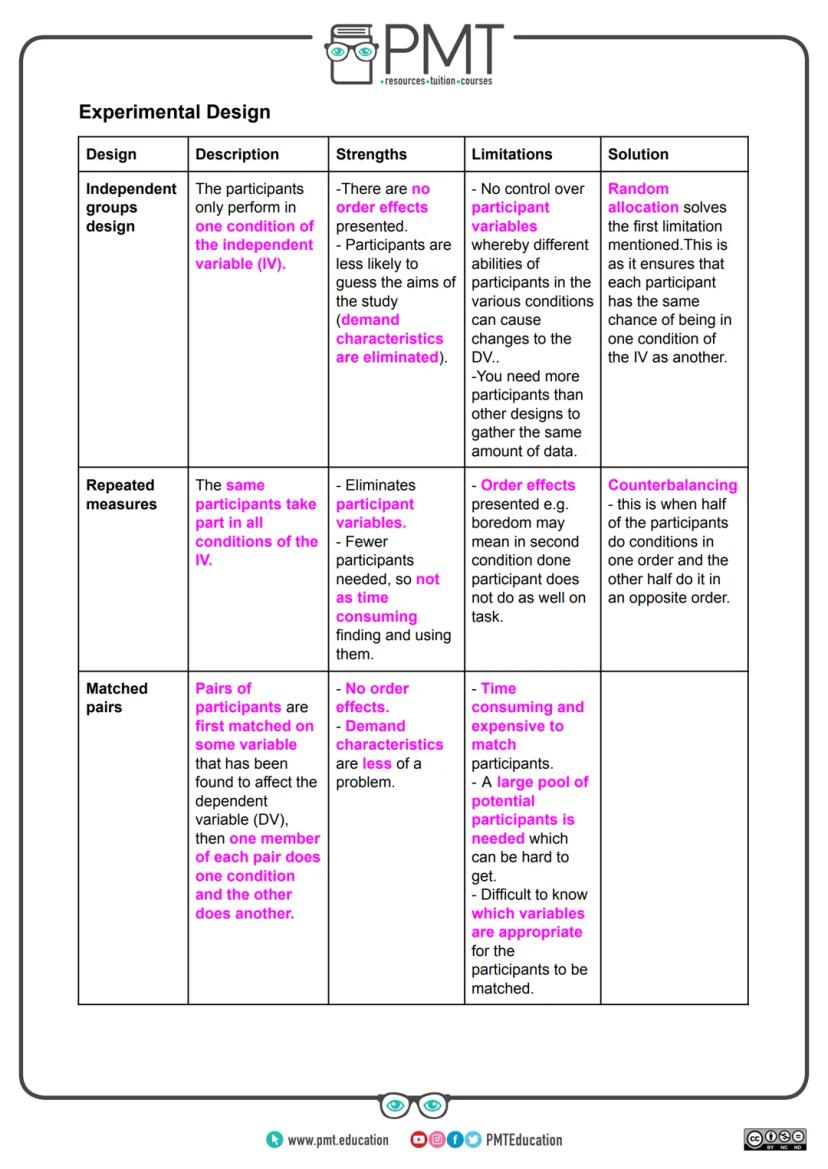
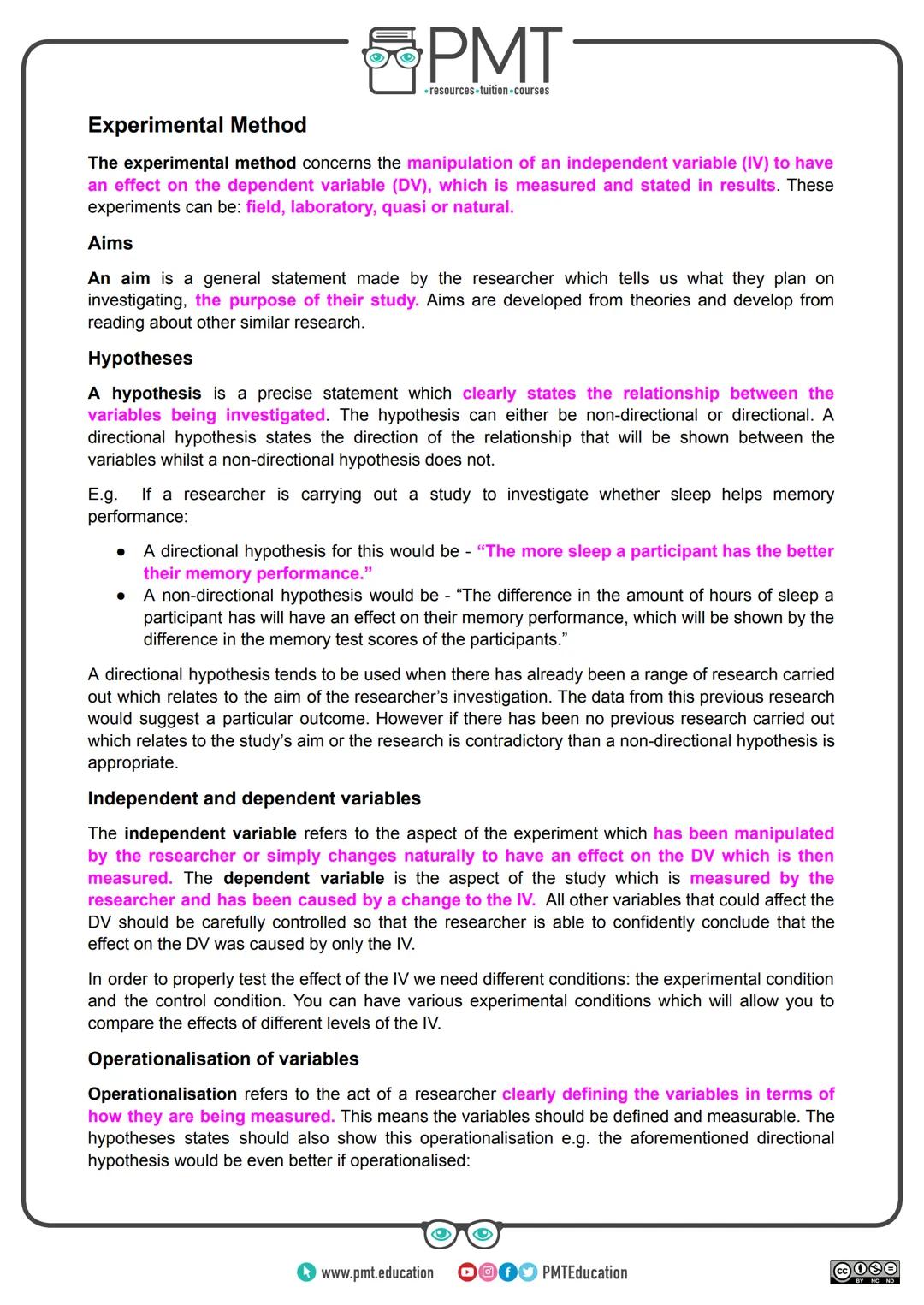
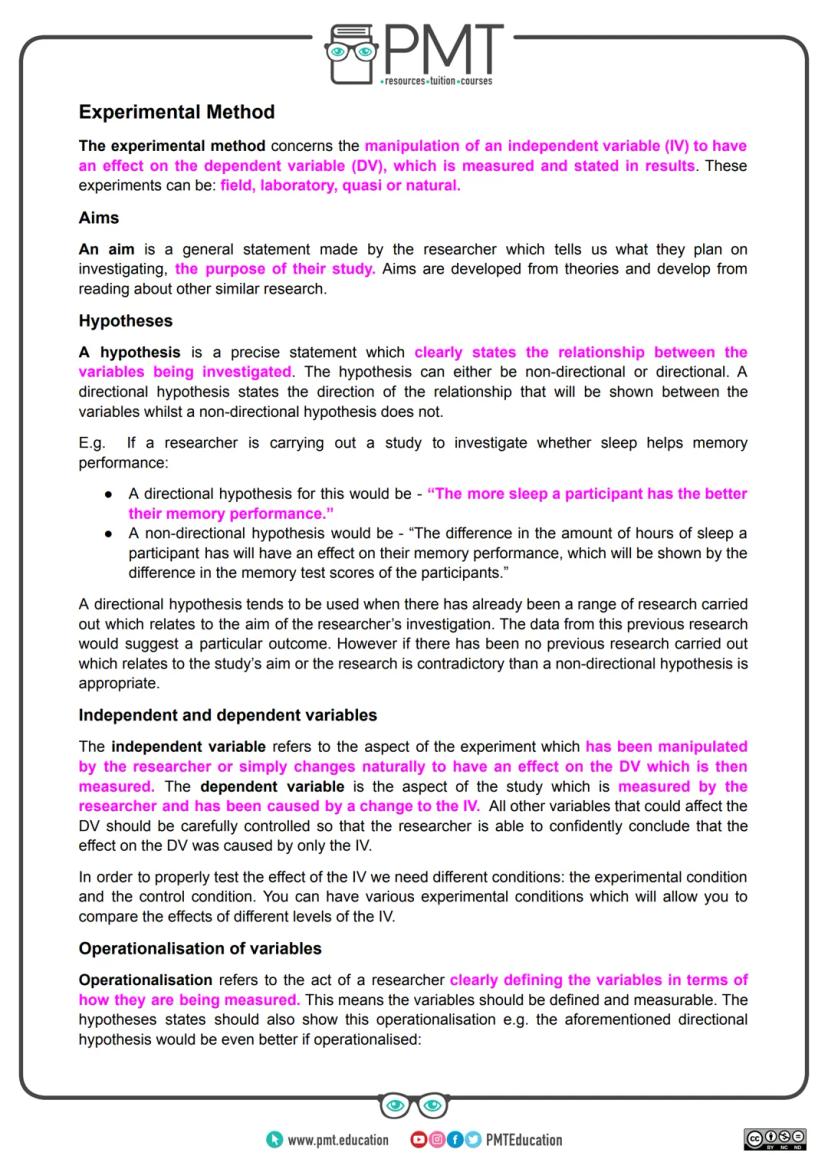
Ever wondered how psychologists prove that one thing causes another? The experimental method is your answer. It works by manipulating one variable (the independent variable or IV) to see what happens to another variable (the dependent variable or DV).

Think of it like testing whether caffeine improves exam performance. The caffeine amount is your IV, and the test scores are your DV. Simple as that.

You'll encounter four types of experiments: laboratory (controlled lab setting), field realworldbutcontrolledreal-world but controlled, quasi (using naturally existing differences), and natural (studying events that happen anyway). Each has its place depending on what you're investigating.

Quick Tip: Remember IV = what you change, DV = what you measure. This distinction will save you marks in every exam question about experiments.

--- OCR Start ---
PMT
-resources-tuition-courses
AQA Psychology A-level
Topic 7: Research Methods
Detailed Notes
This work by PMT Education

Aims and Hypotheses: Your Research Roadmap

Your aim is basically your research question in simple terms - what are you actually trying to find out? It's the starting point that guides everything else you do.

The hypothesis is where things get more specific. You're making a precise prediction about what you think will happen between your variables. Directional hypotheses tell you which way the relationship will go ("more sleep leads to better memory"), while non-directional hypotheses just predict a difference without specifying direction.

Use directional hypotheses when previous research points you in a clear direction. Go non-directional when you're exploring uncharted territory or when existing studies contradict each other.

Operationalisation is crucial here - you need to define exactly how you'll measure your variables. Instead of saying "better memory," specify "higher scores on a 20-question recall test." This precision makes your study replicable and credible.

Exam Smart: Always operationalise variables in your answers. Vague definitions lose marks, but specific, measurable ones show you understand proper scientific method.

--- OCR Start ---
PMT
-resources-tuition-courses
AQA Psychology A-level
Topic 7: Research Methods
Detailed Notes
This work by PMT Education

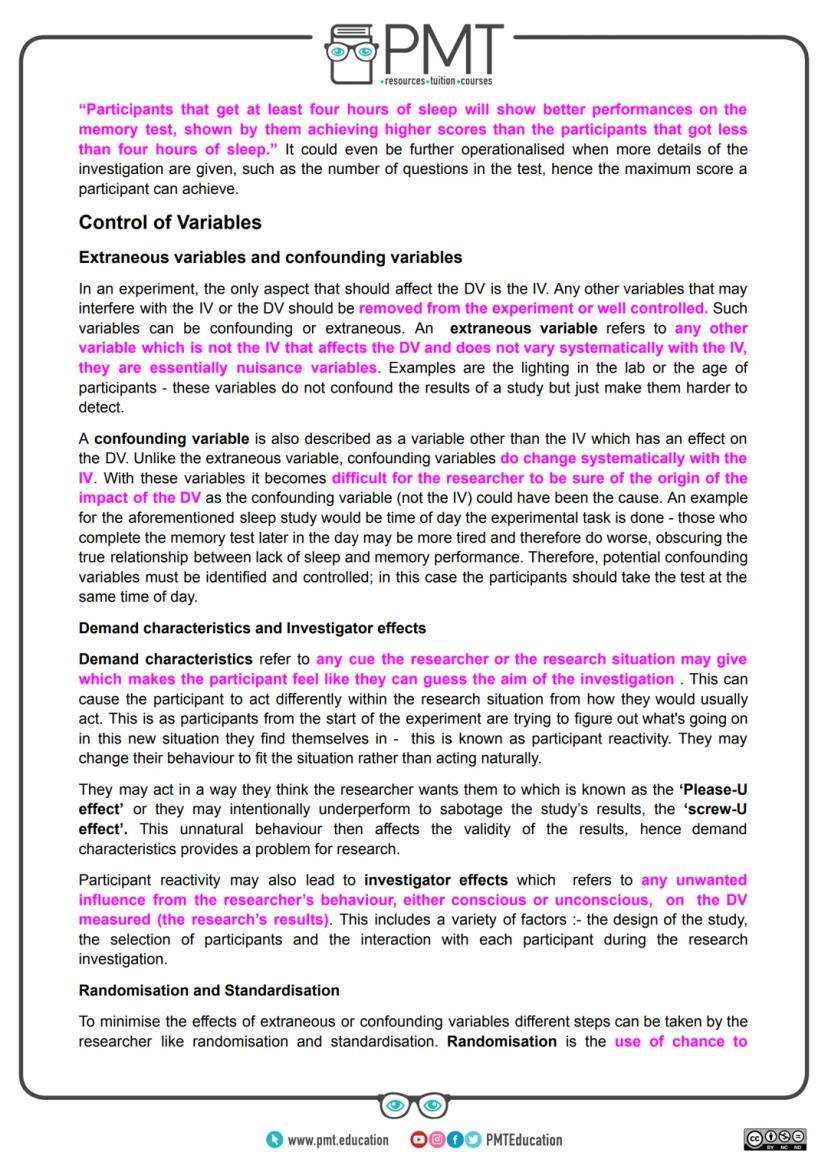
Controlling Variables: Keeping Things Fair

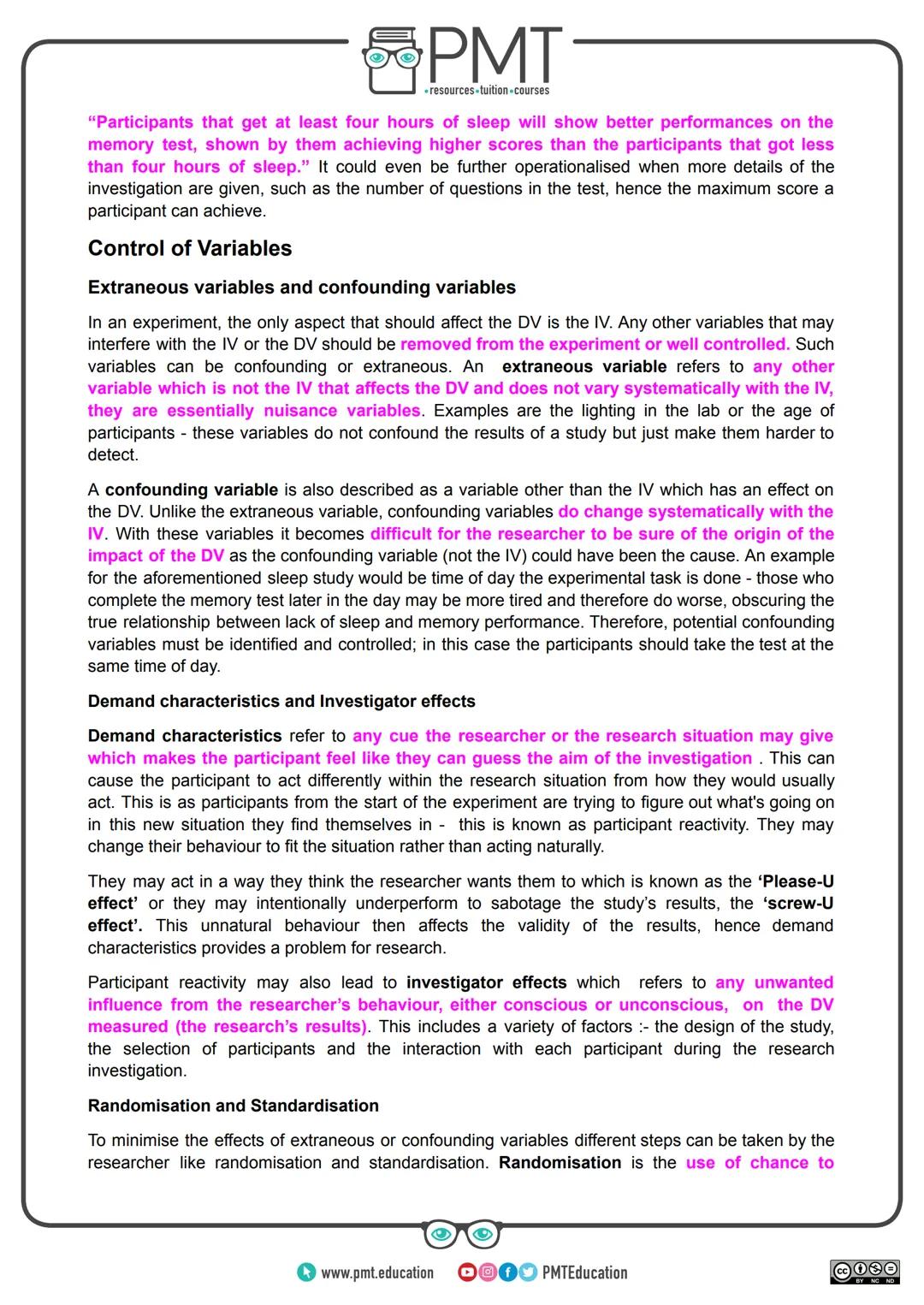
Real psychology research is messy, but good control of variables helps you isolate what's actually causing your results. Extraneous variables are annoying background factors (like room temperature) that don't systematically affect your results but add noise.

Confounding variables are the real troublemakers - they change alongside your IV and could be the actual cause of your results. Imagine testing memory at different times of day; tiredness could confound your sleep study results.

Demand characteristics occur when participants guess what you're studying and change their behaviour accordingly. They might try to help you the"pleaseUeffect"the "please-U effect" or deliberately sabotage your study the"screwUeffect"the "screw-U effect". Both mess up your validity.

Investigator effects happen when researchers unconsciously influence results through their expectations or behaviour. Combat these problems with randomisation (using chance to reduce bias) and standardisation (identical procedures for everyone).

Real Talk: Perfect control is impossible, but good researchers anticipate problems and plan solutions. Examiners love seeing you identify potential confounding variables and suggest controls.

--- OCR Start ---
PMT
-resources-tuition-courses
AQA Psychology A-level
Topic 7: Research Methods
Detailed Notes
This work by PMT Education

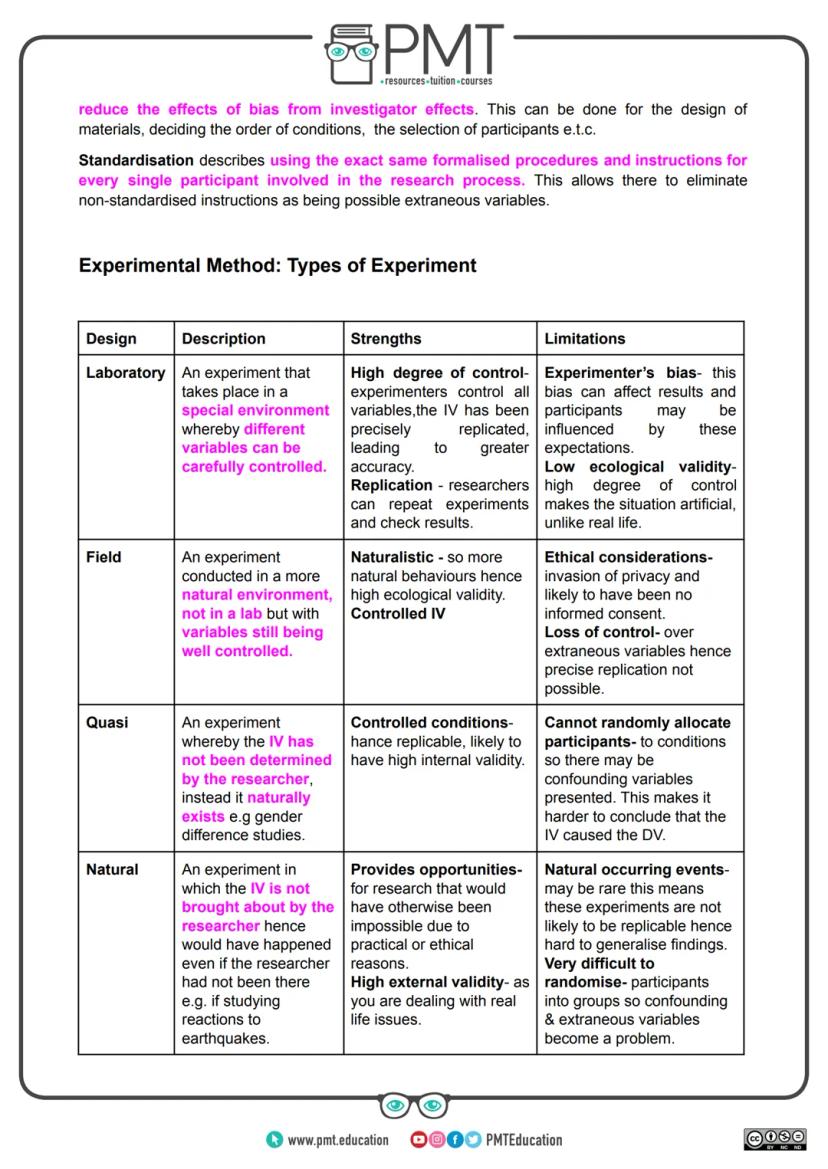
Types of Experiments: Choosing Your Setting

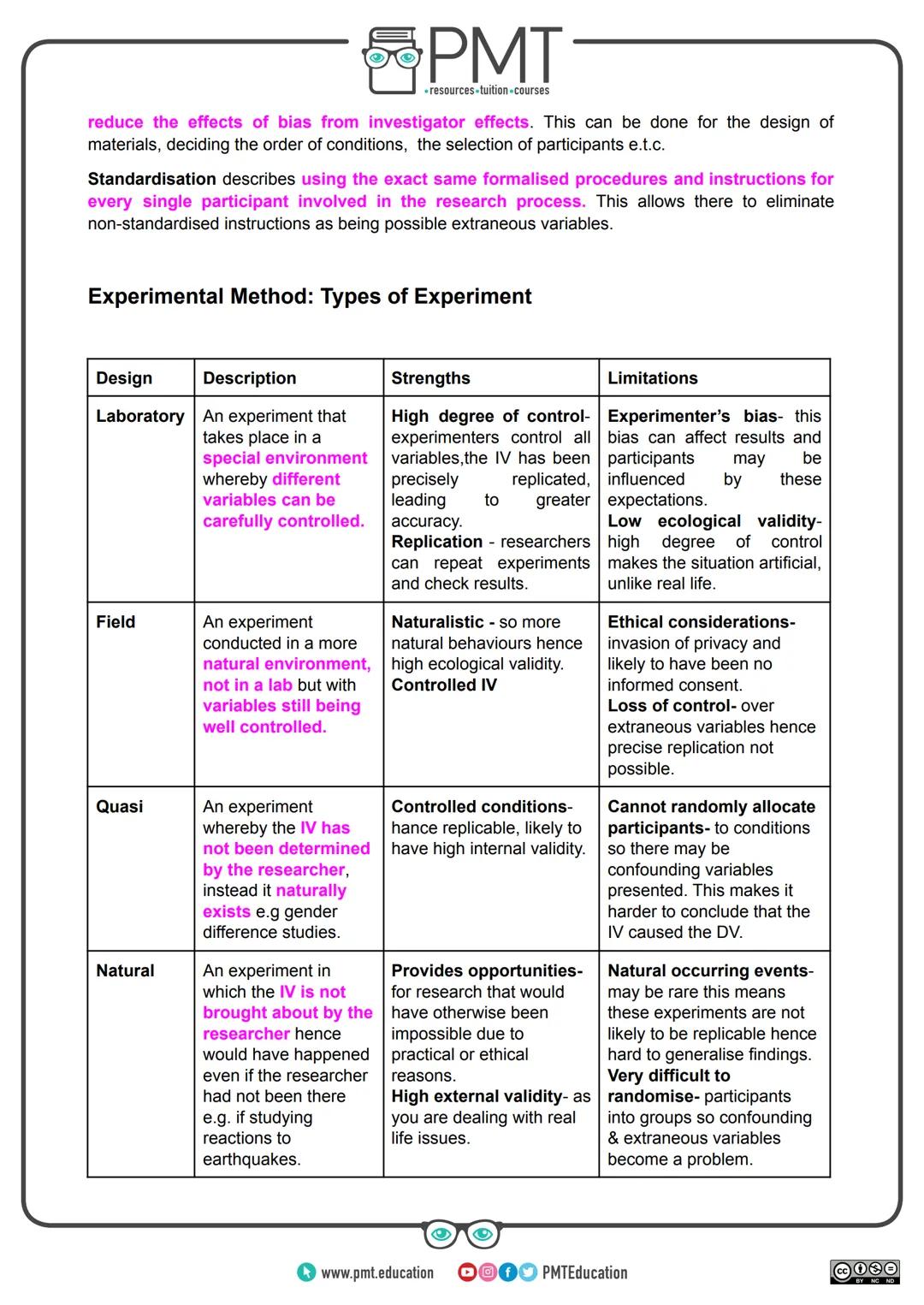
Laboratory experiments give you maximum control but sacrifice realism. You can manipulate variables precisely and replicate studies easily, but participants might behave unnaturally in the artificial setting. They're perfect when you need to establish clear cause-and-effect relationships.

Field experiments happen in natural environments whilst maintaining control over the IV. You get more realistic behaviour, but it's harder to control extraneous variables, and you might face ethical issues around consent.

Quasi-experiments use naturally occurring differences (like gender or age) as your IV. You can't randomly allocate participants to conditions, making it harder to prove causation, but sometimes it's your only ethical option.

Natural experiments study the effects of events that would happen anyway (like natural disasters). They allow research that would be impossible or unethical to create artificially, but they're rare and hard to replicate.

Strategy Note: Different research questions need different experimental types. Match your method to your research aims, and always consider the trade-offs between control and realism.

--- OCR Start ---
PMT
-resources-tuition-courses
AQA Psychology A-level
Topic 7: Research Methods
Detailed Notes
This work by PMT Education

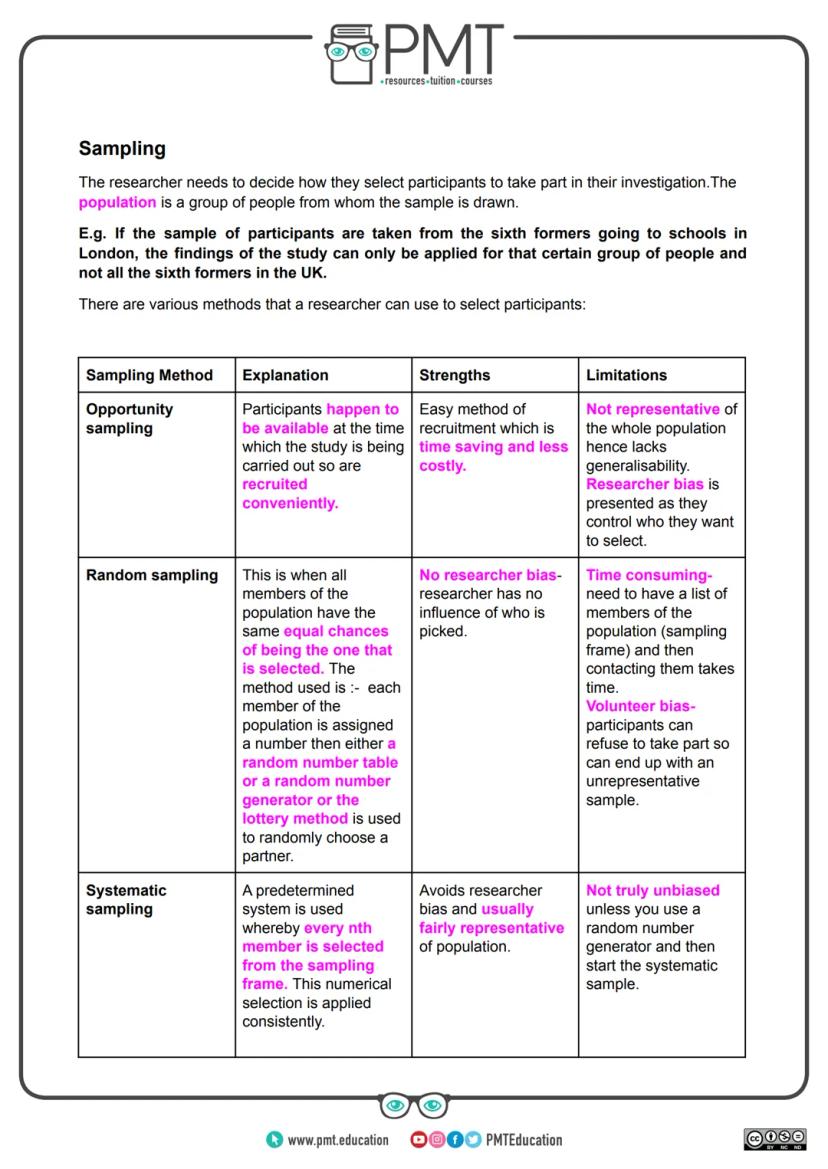
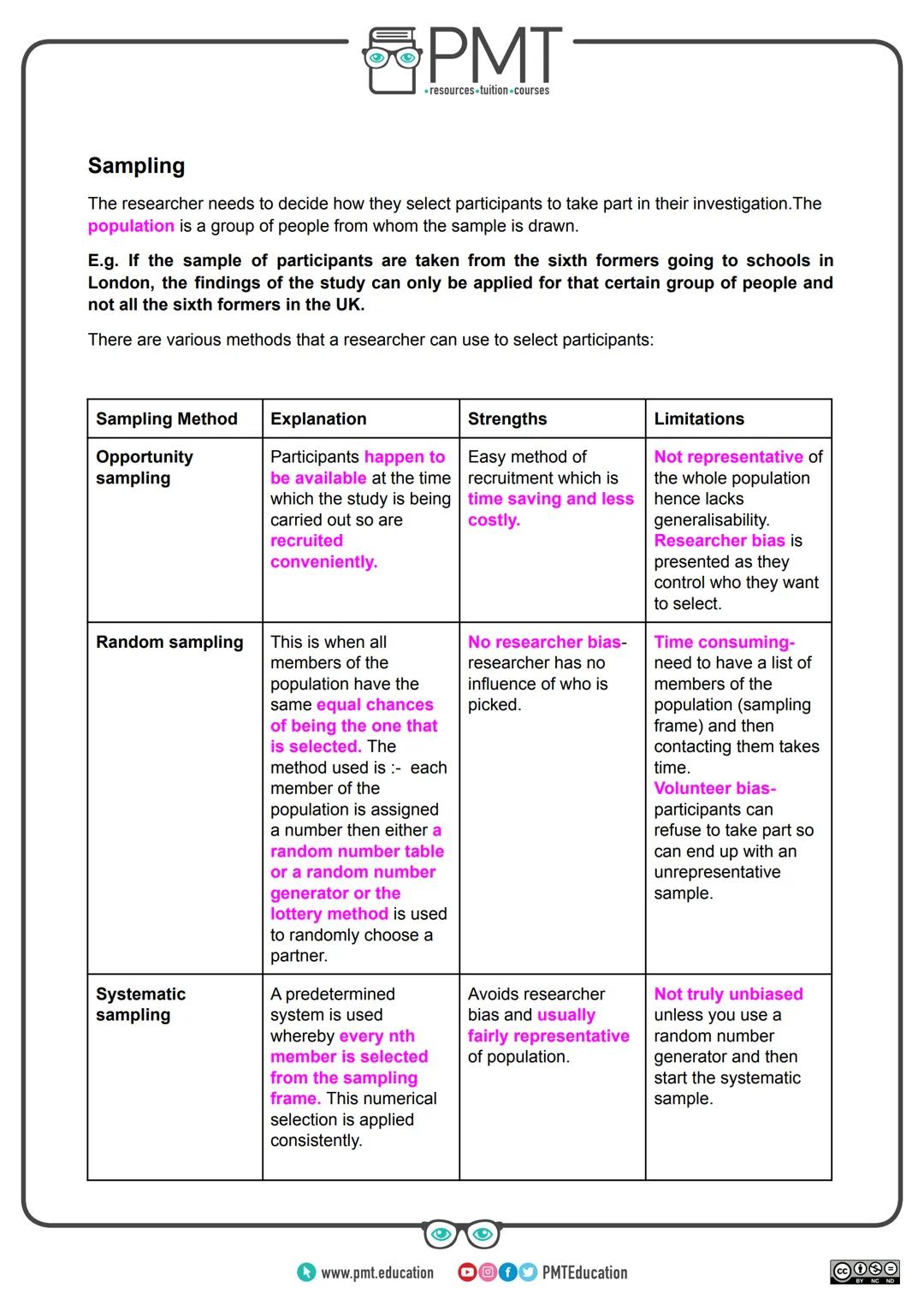
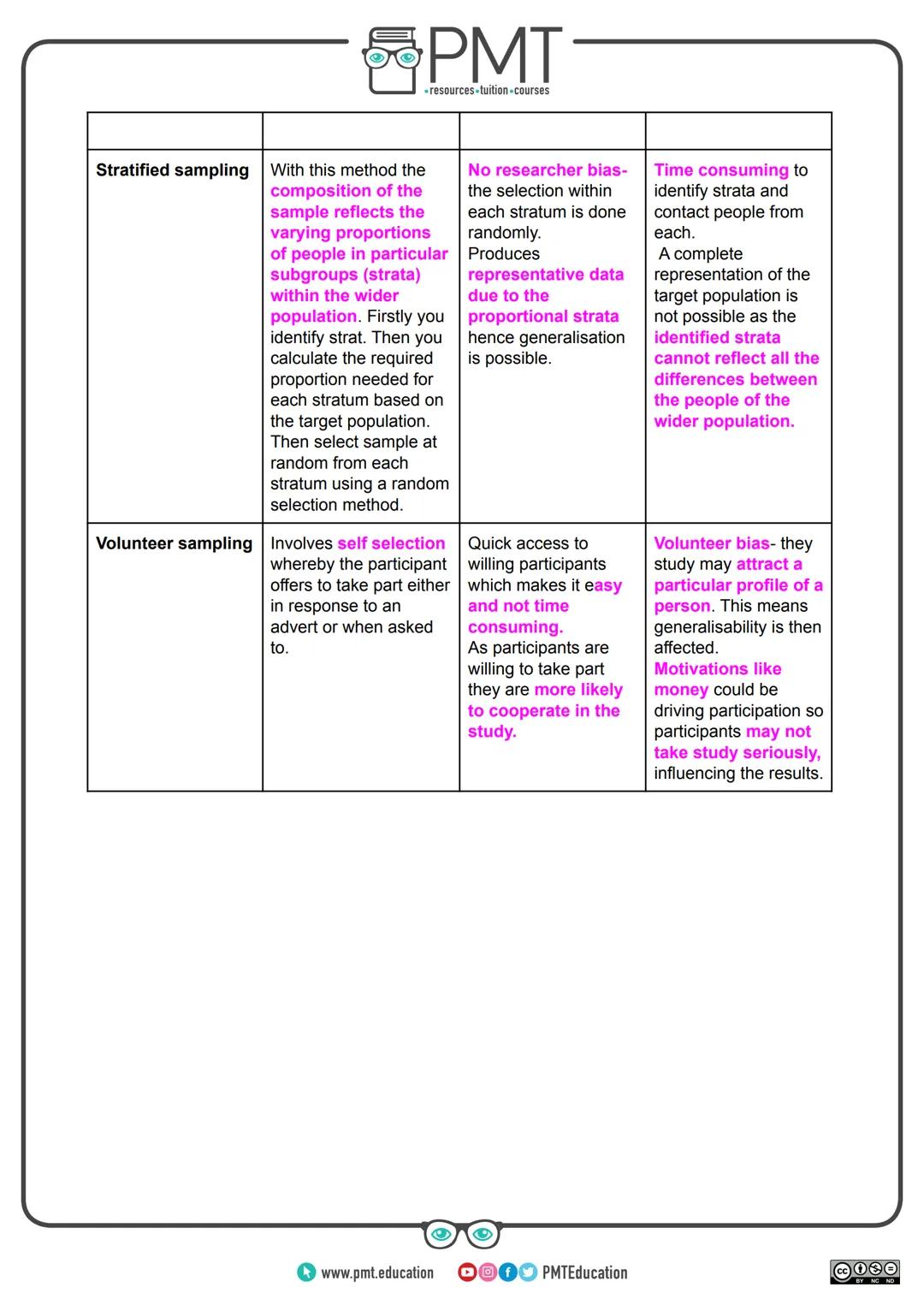
Sampling: Getting the Right People

Your sample determines who your findings apply to, so choosing participants matters enormously. Opportunity sampling grabs whoever's available - quick and cheap, but potentially biased and unrepresentative.

Random sampling gives everyone equal chances of selection, eliminating researcher bias, but it's time-consuming and people can refuse to participate. Systematic sampling uses a predetermined pattern (every 5th person) and avoids researcher bias whilst being fairly representative.

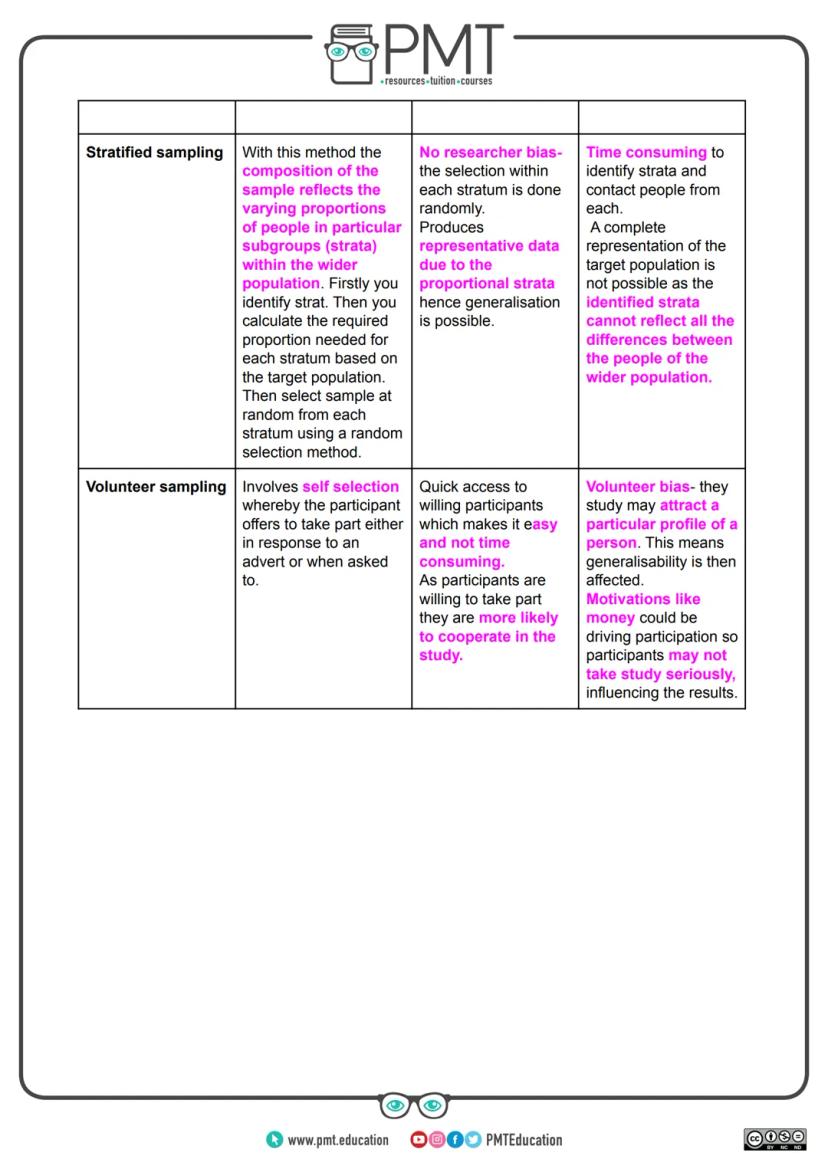
Stratified sampling reflects population proportions by dividing people into subgroups first, then randomly selecting from each. It produces representative samples but requires detailed population knowledge and significant time investment.

Volunteer sampling relies on self-selection through adverts or requests. You get willing participants who'll cooperate, but they might share particular characteristics that limit how widely you can generalise your findings.

Exam Focus: Know when each sampling method works best. Random is ideal in theory, but opportunity is often practical reality. Stratified gives the best representativeness when time allows.

--- OCR Start ---
PMT
-resources-tuition-courses
AQA Psychology A-level
Topic 7: Research Methods
Detailed Notes
This work by PMT Education

Pilot Studies and Blind Procedures

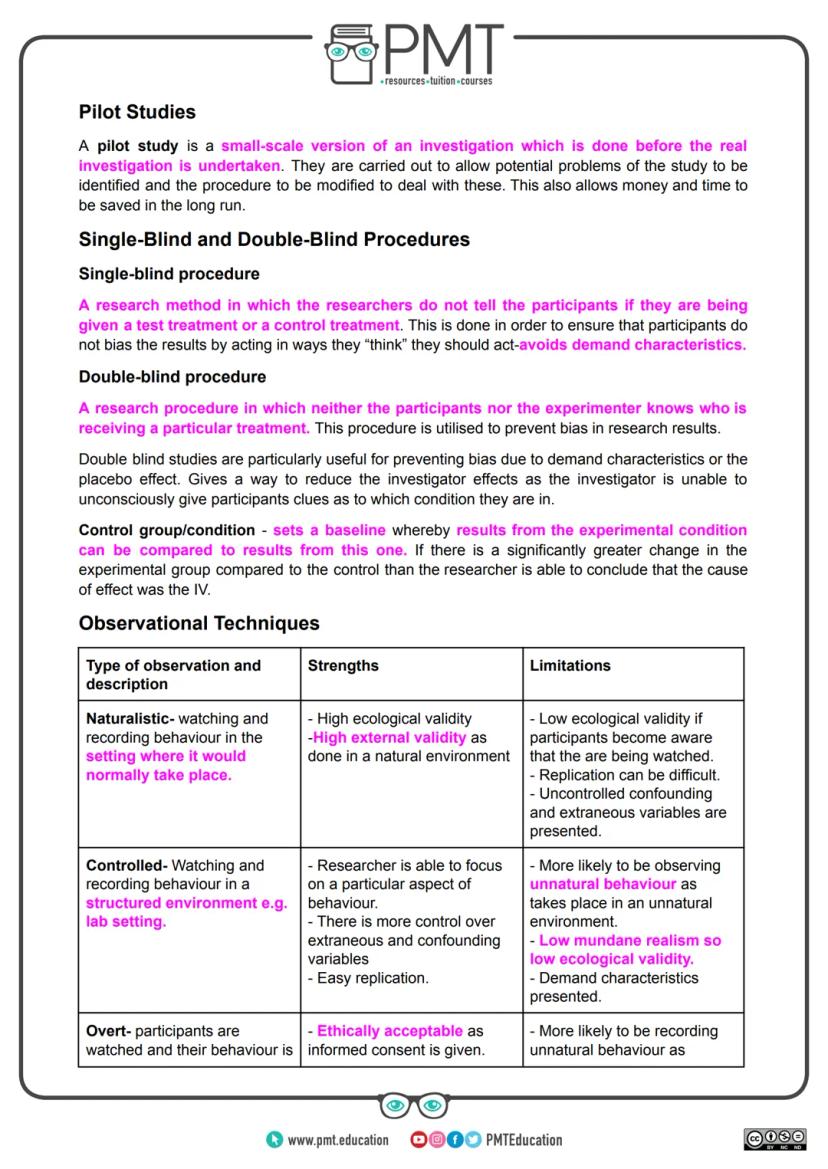
Pilot studies are like dress rehearsals - small-scale versions that reveal problems before you invest time and money in the full study. They're essential for identifying practical issues, confusing instructions, or timing problems.

Single-blind procedures keep participants unaware of which condition they're in, reducing demand characteristics and the placebo effect. Participants can't bias results by acting how they think they should.

Double-blind procedures keep both participants and researchers unaware of conditions, eliminating both demand characteristics and investigator effects. The person collecting data can't unconsciously give clues about which condition participants are in.

Control groups provide baselines for comparison. Without them, you can't tell whether your experimental manipulation actually caused any changes. They're the foundation of proper experimental design.

Pro Tip: Always suggest pilot studies in exam answers about improving research. They show you understand the practical challenges of conducting good psychological research.

--- OCR Start ---
PMT
-resources-tuition-courses
AQA Psychology A-level
Topic 7: Research Methods
Detailed Notes
This work by PMT Education

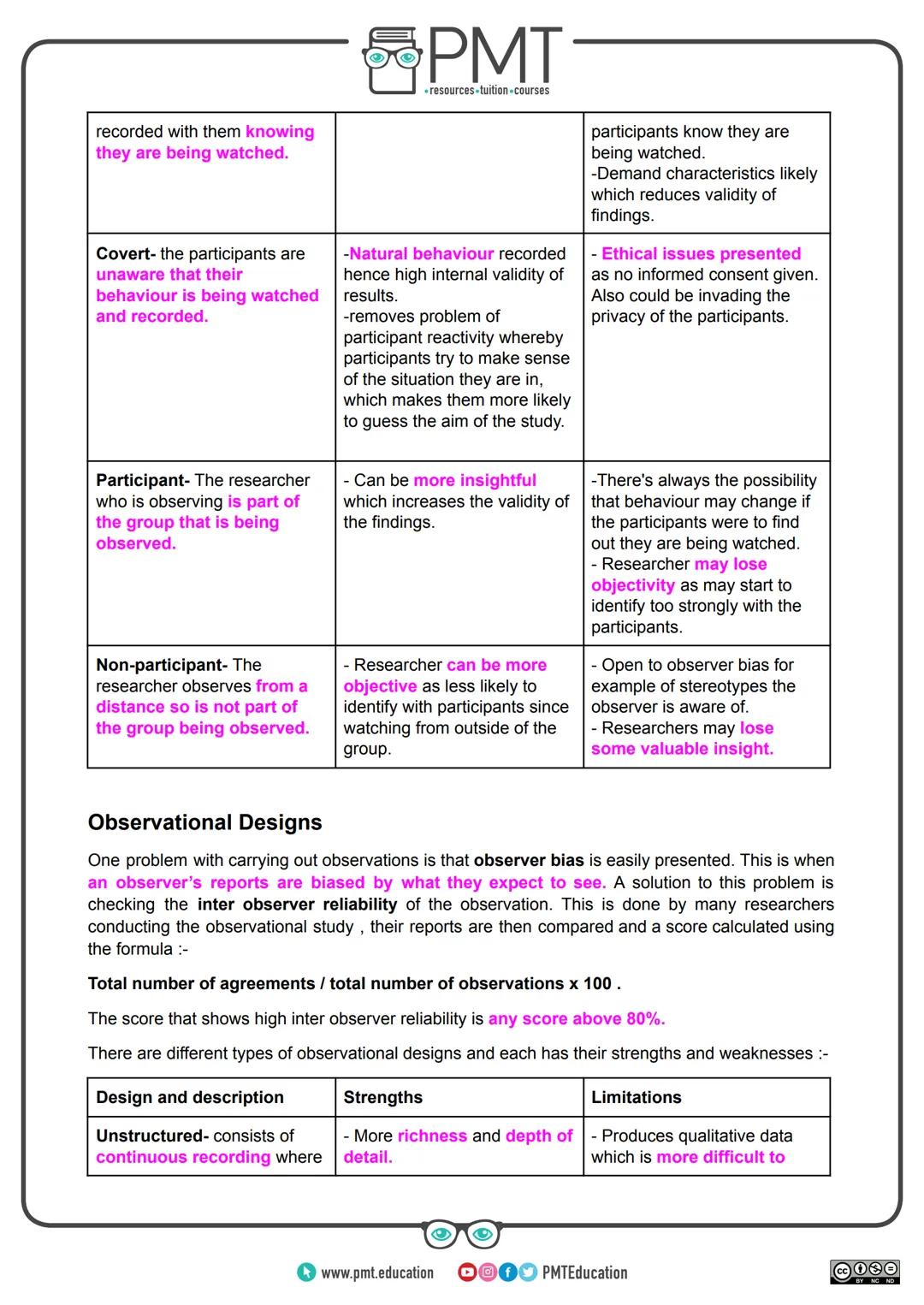
Observational Techniques: Watching Behaviour

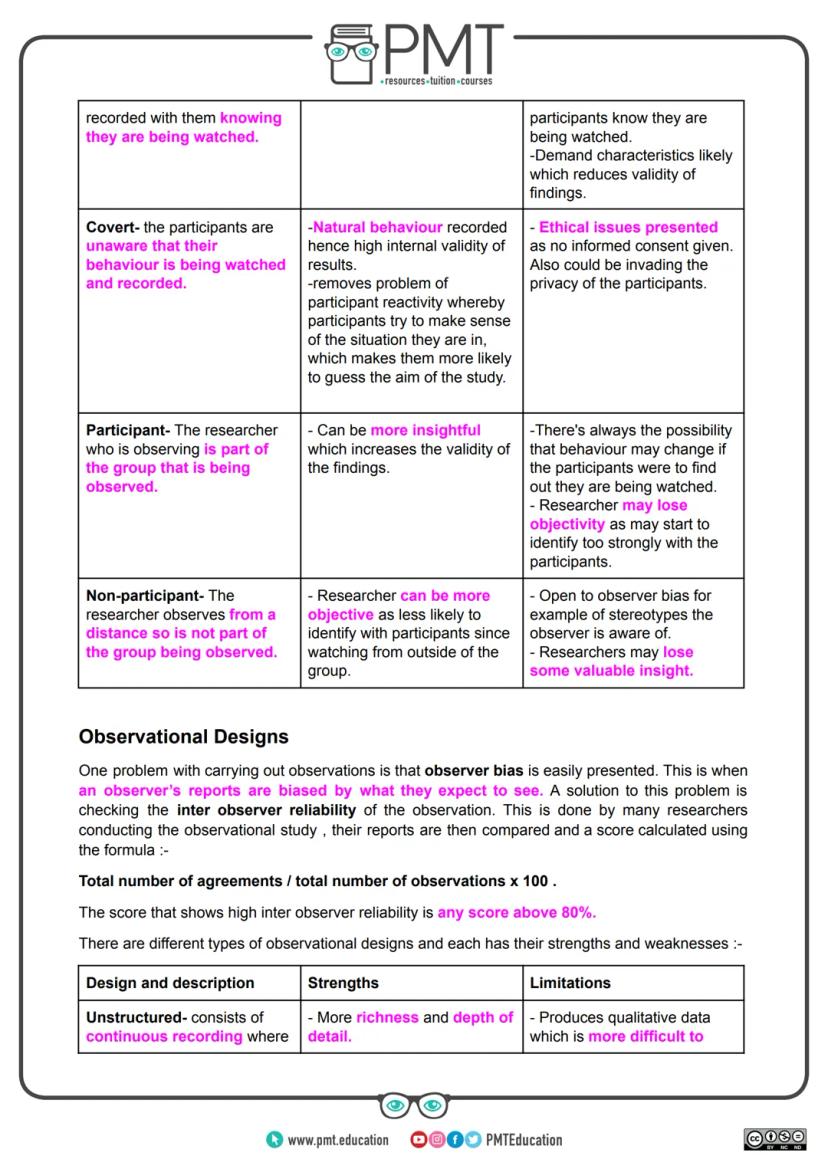
Naturalistic observations study behaviour in natural settings, giving high ecological validity, but you lose control over variables and replication becomes difficult. Controlled observations happen in structured environments, allowing focus on specific behaviours but potentially creating artificial situations.

Overt observations involve participants knowing they're being watched - ethically sound but potentially creating unnatural behaviour. Covert observations capture natural behaviour but raise serious ethical concerns about consent and privacy.

Participant observation puts researchers inside the group being studied, providing deeper insights but risking loss of objectivity. Non-participant observation maintains researcher objectivity but might miss subtle social dynamics.

Observer bias is a constant threat - researchers might see what they expect rather than what's actually happening. Combat this with multiple observers and calculate inter-observer reliability (agreements should exceed 80%).

Reality Check: All observational methods involve trade-offs between natural behaviour, ethical considerations, and practical constraints. Choose based on your specific research needs.

--- OCR Start ---
PMT
-resources-tuition-courses
AQA Psychology A-level
Topic 7: Research Methods
Detailed Notes
This work by PMT Education

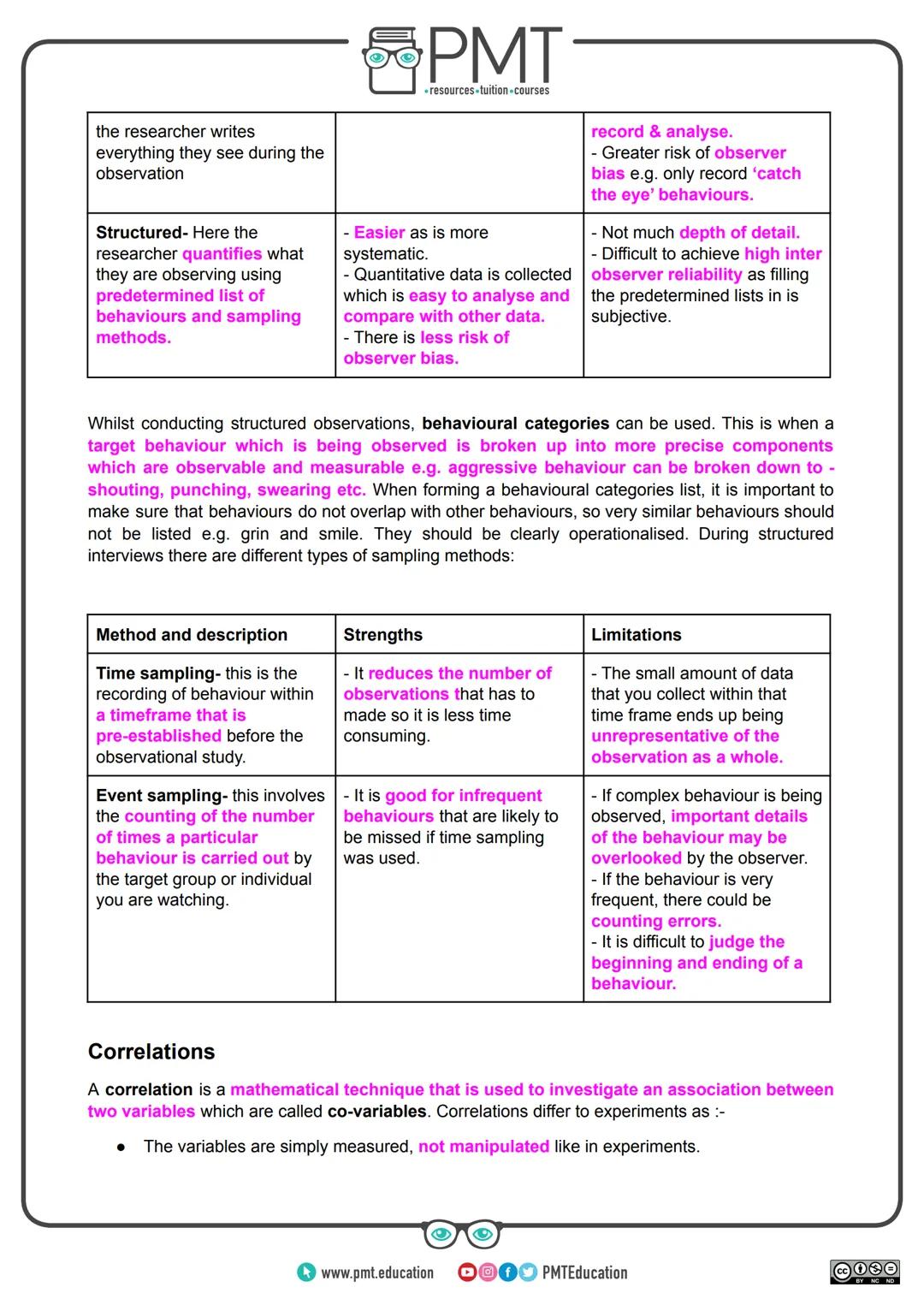
Observational Designs and Sampling

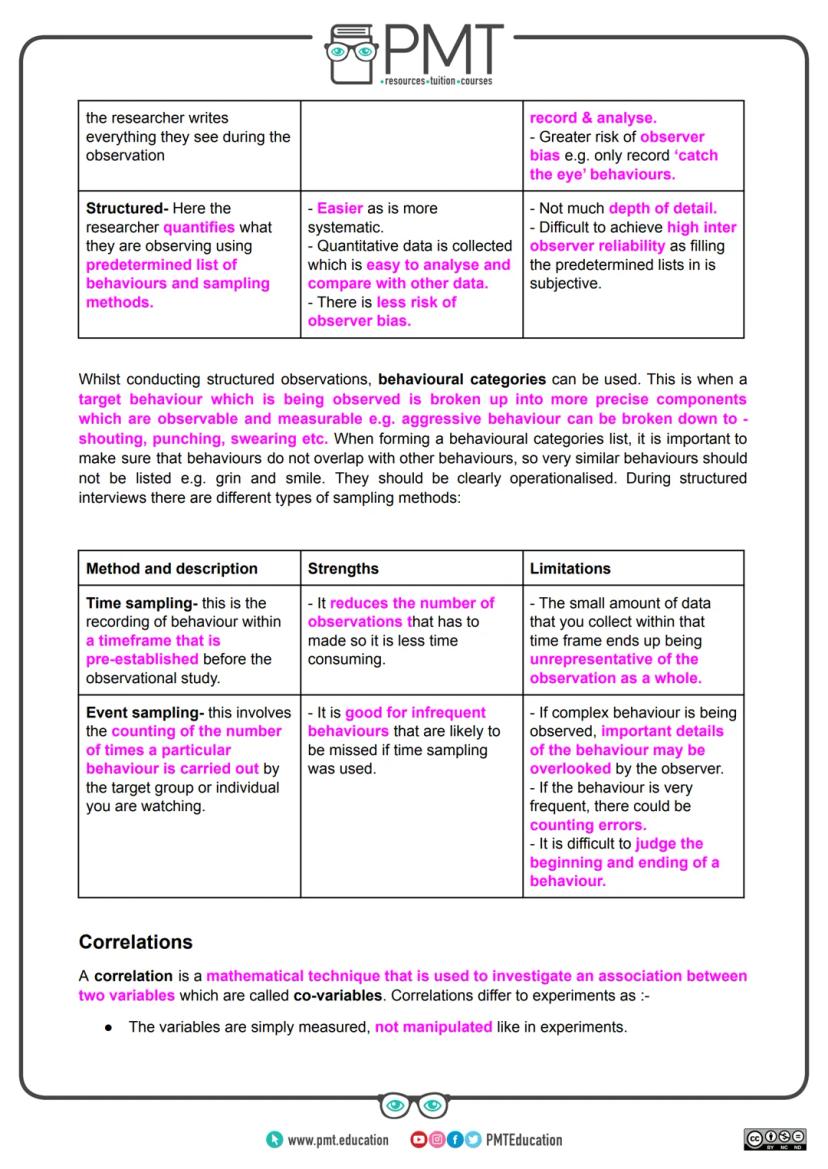
Unstructured observations record everything continuously, providing rich detail but creating difficult-to-analyse qualitative data. Structured observations use predetermined categories and sampling methods, making analysis easier but potentially missing important behaviours.

Behavioural categories break target behaviours into observable, measurable components. For example, "aggression" becomes "shouting," "hitting," and "verbal threats." Categories must be clearly defined and non-overlapping to ensure reliable measurement.

Time sampling records behaviour within predetermined time windows, reducing observation load but potentially missing important events between sampling periods. Event sampling counts specific behaviours whenever they occur, capturing infrequent behaviours but potentially causing counting errors with frequent ones.

The choice between methods depends on your research question, the frequency of target behaviours, and the complexity of what you're studying.

Practical Advice: Good behavioural categories are specific, observable, and mutually exclusive. Vague categories like "being friendly" won't give reliable data across different observers.

--- OCR Start ---
PMT
-resources-tuition-courses
AQA Psychology A-level
Topic 7: Research Methods
Detailed Notes
This work by PMT Education

Correlations: Finding Relationships

Correlations investigate associations between two co-variables without manipulating anything - you simply measure both variables and see if they're related. Unlike experiments, you can't establish cause and effect, just relationships.

Positive correlations mean both variables increase together (more study time, higher grades). Negative correlations show one increasing as the other decreases (more TV watching, lower grades). Zero correlations indicate no relationship exists.

Correlation coefficients quantify relationship strength from -1 (perfect negative) through 0 (no relationship) to +1 (perfect positive). Curvilinear relationships show more complex patterns - variables might be positively related up to a point, then negatively related beyond it.

Scattergrams visualise these relationships clearly. Just remember: correlation never proves causation. Third variables might explain apparent relationships, or the relationship might work in the opposite direction to what you assume.

Critical Thinking: Always question correlational findings. High ice cream sales correlate with drowning deaths, but ice cream doesn't cause drowning - hot weather causes both!

--- OCR Start ---
PMT
-resources-tuition-courses
AQA Psychology A-level
Topic 7: Research Methods
Detailed Notes
This work by PMT Education

Wrapping Up Correlational Research

Directional hypotheses for correlations predict whether you'll find positive or negative relationships between co-variables. Non-directional hypotheses simply predict some kind of relationship without specifying the direction.

The Yerkes-Dodson Law provides a perfect example of curvilinear relationships - anxiety improves performance up to an optimal point, then performance decreases as anxiety continues rising. This creates an inverted U-shaped curve on graphs.

Correlational research is brilliant for studying variables you can't or shouldn't manipulate ethically (like the effects of smoking or childhood trauma). It's also useful for identifying relationships worth investigating experimentally later.

Remember that correlation coefficients tell you about strength and direction, but interpreting what relationships actually mean requires careful consideration of alternative explanations and potential confounding variables.

Exam Success: When discussing correlations, always mention that correlation doesn't equal causation. This shows sophisticated understanding that examiners reward highly.


We thought you’d never ask...

What is the Knowunity AI companion?

Our AI Companion is a student-focused AI tool that offers more than just answers. Built on millions of Knowunity resources, it provides relevant information, personalised study plans, quizzes, and content directly in the chat, adapting to your individual learning journey.

Where can I download the Knowunity app?

You can download the app from Google Play Store and Apple App Store.

Is Knowunity really free of charge?

That's right! Enjoy free access to study content, connect with fellow students, and get instant help – all at your fingertips.

Most popular content: Research Methods

Most popular content in Psychology

Most popular content

Can't find what you're looking for? Explore other subjects.

Students love us — and so will you.

4.9/5

App Store

4.8/5

Google Play

The app is very easy to use and well designed. I have found everything I was looking for so far and have been able to learn a lot from the presentations! I will definitely use the app for a class assignment! And of course it also helps a lot as an inspiration.

Stefan S

iOS user

This app is really great. There are so many study notes and help [...]. My problem subject is French, for example, and the app has so many options for help. Thanks to this app, I have improved my French. I would recommend it to anyone.

Samantha Klich

Android user

Wow, I am really amazed. I just tried the app because I've seen it advertised many times and was absolutely stunned. This app is THE HELP you want for school and above all, it offers so many things, such as workouts and fact sheets, which have been VERY helpful to me personally.

Anna

iOS user

Best app on earth! no words because it’s too good

Thomas R

iOS user

Just amazing. Let's me revise 10x better, this app is a quick 10/10. I highly recommend it to anyone. I can watch and search for notes. I can save them in the subject folder. I can revise it any time when I come back. If you haven't tried this app, you're really missing out.

Basil

Android user

This app has made me feel so much more confident in my exam prep, not only through boosting my own self confidence through the features that allow you to connect with others and feel less alone, but also through the way the app itself is centred around making you feel better. It is easy to navigate, fun to use, and helpful to anyone struggling in absolutely any way.

David K

iOS user

The app's just great! All I have to do is enter the topic in the search bar and I get the response real fast. I don't have to watch 10 YouTube videos to understand something, so I'm saving my time. Highly recommended!

Sudenaz Ocak

Android user

In school I was really bad at maths but thanks to the app, I am doing better now. I am so grateful that you made the app.

Greenlight Bonnie

Android user

very reliable app to help and grow your ideas of Maths, English and other related topics in your works. please use this app if your struggling in areas, this app is key for that. wish I'd of done a review before. and it's also free so don't worry about that.

Rohan U

Android user

I know a lot of apps use fake accounts to boost their reviews but this app deserves it all. Originally I was getting 4 in my English exams and this time I got a grade 7. I didn’t even know about this app three days until the exam and it has helped A LOT. Please actually trust me and use it as I’m sure you too will see developments.

Xander S

iOS user

THE QUIZES AND FLASHCARDS ARE SO USEFUL AND I LOVE THE SCHOOLGPT. IT ALSO IS LITREALLY LIKE CHATGPT BUT SMARTER!! HELPED ME WITH MY MASCARA PROBLEMS TOO!! AS WELL AS MY REAL SUBJECTS ! DUHHH 😍😁😲🤑💗✨🎀😮

Elisha

iOS user

This apps acc the goat. I find revision so boring but this app makes it so easy to organize it all and then you can ask the freeeee ai to test yourself so good and you can easily upload your own stuff. highly recommend as someone taking mocks now

Paul T

iOS user

The app is very easy to use and well designed. I have found everything I was looking for so far and have been able to learn a lot from the presentations! I will definitely use the app for a class assignment! And of course it also helps a lot as an inspiration.

Stefan S

iOS user

This app is really great. There are so many study notes and help [...]. My problem subject is French, for example, and the app has so many options for help. Thanks to this app, I have improved my French. I would recommend it to anyone.

Samantha Klich

Android user

Wow, I am really amazed. I just tried the app because I've seen it advertised many times and was absolutely stunned. This app is THE HELP you want for school and above all, it offers so many things, such as workouts and fact sheets, which have been VERY helpful to me personally.

Anna

iOS user

Best app on earth! no words because it’s too good

Thomas R

iOS user

Just amazing. Let's me revise 10x better, this app is a quick 10/10. I highly recommend it to anyone. I can watch and search for notes. I can save them in the subject folder. I can revise it any time when I come back. If you haven't tried this app, you're really missing out.

Basil

Android user

This app has made me feel so much more confident in my exam prep, not only through boosting my own self confidence through the features that allow you to connect with others and feel less alone, but also through the way the app itself is centred around making you feel better. It is easy to navigate, fun to use, and helpful to anyone struggling in absolutely any way.

David K

iOS user

The app's just great! All I have to do is enter the topic in the search bar and I get the response real fast. I don't have to watch 10 YouTube videos to understand something, so I'm saving my time. Highly recommended!

Sudenaz Ocak

Android user

In school I was really bad at maths but thanks to the app, I am doing better now. I am so grateful that you made the app.

Greenlight Bonnie

Android user

very reliable app to help and grow your ideas of Maths, English and other related topics in your works. please use this app if your struggling in areas, this app is key for that. wish I'd of done a review before. and it's also free so don't worry about that.

Rohan U

Android user

I know a lot of apps use fake accounts to boost their reviews but this app deserves it all. Originally I was getting 4 in my English exams and this time I got a grade 7. I didn’t even know about this app three days until the exam and it has helped A LOT. Please actually trust me and use it as I’m sure you too will see developments.

Xander S

iOS user

THE QUIZES AND FLASHCARDS ARE SO USEFUL AND I LOVE THE SCHOOLGPT. IT ALSO IS LITREALLY LIKE CHATGPT BUT SMARTER!! HELPED ME WITH MY MASCARA PROBLEMS TOO!! AS WELL AS MY REAL SUBJECTS ! DUHHH 😍😁😲🤑💗✨🎀😮

Elisha

iOS user

This apps acc the goat. I find revision so boring but this app makes it so easy to organize it all and then you can ask the freeeee ai to test yourself so good and you can easily upload your own stuff. highly recommend as someone taking mocks now

Paul T

iOS user


Psychology

261

8 Dec 2025

33 pages

AQA A Level Psychology: Research Methods Explained

H

Hamzino

@hamda123

Psychology A-level research methods might seem daunting, but they're actually the toolkit that helps psychologists discover how our minds work. These methods give you the skills to design proper studies, spot dodgy research, and understand what makes psychological findings reliable... Show more

--- OCR Start ---
PMT
-resources-tuition-courses
AQA Psychology A-level
Topic 7: Research Methods
Detailed Notes
This work by PMT Education

Sign up to see the contentIt's free!

Access to all documents

Improve your grades

Join milions of students

By signing up you accept Terms of Service and Privacy Policy

Getting Started: The Experimental Method

Ever wondered how psychologists prove that one thing causes another? The experimental method is your answer. It works by manipulating one variable (the independent variable or IV) to see what happens to another variable (the dependent variable or DV).

Think of it like testing whether caffeine improves exam performance. The caffeine amount is your IV, and the test scores are your DV. Simple as that.

You'll encounter four types of experiments: laboratory (controlled lab setting), field realworldbutcontrolledreal-world but controlled, quasi (using naturally existing differences), and natural (studying events that happen anyway). Each has its place depending on what you're investigating.

Quick Tip: Remember IV = what you change, DV = what you measure. This distinction will save you marks in every exam question about experiments.

--- OCR Start ---
PMT
-resources-tuition-courses
AQA Psychology A-level
Topic 7: Research Methods
Detailed Notes
This work by PMT Education

Sign up to see the contentIt's free!

Access to all documents

Improve your grades

Join milions of students

By signing up you accept Terms of Service and Privacy Policy

Aims and Hypotheses: Your Research Roadmap

Your aim is basically your research question in simple terms - what are you actually trying to find out? It's the starting point that guides everything else you do.

The hypothesis is where things get more specific. You're making a precise prediction about what you think will happen between your variables. Directional hypotheses tell you which way the relationship will go ("more sleep leads to better memory"), while non-directional hypotheses just predict a difference without specifying direction.

Use directional hypotheses when previous research points you in a clear direction. Go non-directional when you're exploring uncharted territory or when existing studies contradict each other.

Operationalisation is crucial here - you need to define exactly how you'll measure your variables. Instead of saying "better memory," specify "higher scores on a 20-question recall test." This precision makes your study replicable and credible.

Exam Smart: Always operationalise variables in your answers. Vague definitions lose marks, but specific, measurable ones show you understand proper scientific method.

--- OCR Start ---
PMT
-resources-tuition-courses
AQA Psychology A-level
Topic 7: Research Methods
Detailed Notes
This work by PMT Education

Sign up to see the contentIt's free!

Access to all documents

Improve your grades

Join milions of students

By signing up you accept Terms of Service and Privacy Policy

Controlling Variables: Keeping Things Fair

Real psychology research is messy, but good control of variables helps you isolate what's actually causing your results. Extraneous variables are annoying background factors (like room temperature) that don't systematically affect your results but add noise.

Confounding variables are the real troublemakers - they change alongside your IV and could be the actual cause of your results. Imagine testing memory at different times of day; tiredness could confound your sleep study results.

Demand characteristics occur when participants guess what you're studying and change their behaviour accordingly. They might try to help you the"pleaseUeffect"the "please-U effect" or deliberately sabotage your study the"screwUeffect"the "screw-U effect". Both mess up your validity.

Investigator effects happen when researchers unconsciously influence results through their expectations or behaviour. Combat these problems with randomisation (using chance to reduce bias) and standardisation (identical procedures for everyone).

Real Talk: Perfect control is impossible, but good researchers anticipate problems and plan solutions. Examiners love seeing you identify potential confounding variables and suggest controls.

--- OCR Start ---
PMT
-resources-tuition-courses
AQA Psychology A-level
Topic 7: Research Methods
Detailed Notes
This work by PMT Education

Sign up to see the contentIt's free!

Access to all documents

Improve your grades

Join milions of students

By signing up you accept Terms of Service and Privacy Policy

Types of Experiments: Choosing Your Setting

Laboratory experiments give you maximum control but sacrifice realism. You can manipulate variables precisely and replicate studies easily, but participants might behave unnaturally in the artificial setting. They're perfect when you need to establish clear cause-and-effect relationships.

Field experiments happen in natural environments whilst maintaining control over the IV. You get more realistic behaviour, but it's harder to control extraneous variables, and you might face ethical issues around consent.

Quasi-experiments use naturally occurring differences (like gender or age) as your IV. You can't randomly allocate participants to conditions, making it harder to prove causation, but sometimes it's your only ethical option.

Natural experiments study the effects of events that would happen anyway (like natural disasters). They allow research that would be impossible or unethical to create artificially, but they're rare and hard to replicate.

Strategy Note: Different research questions need different experimental types. Match your method to your research aims, and always consider the trade-offs between control and realism.

--- OCR Start ---
PMT
-resources-tuition-courses
AQA Psychology A-level
Topic 7: Research Methods
Detailed Notes
This work by PMT Education

Sign up to see the contentIt's free!

Access to all documents

Improve your grades

Join milions of students

By signing up you accept Terms of Service and Privacy Policy

Sampling: Getting the Right People

Your sample determines who your findings apply to, so choosing participants matters enormously. Opportunity sampling grabs whoever's available - quick and cheap, but potentially biased and unrepresentative.

Random sampling gives everyone equal chances of selection, eliminating researcher bias, but it's time-consuming and people can refuse to participate. Systematic sampling uses a predetermined pattern (every 5th person) and avoids researcher bias whilst being fairly representative.

Stratified sampling reflects population proportions by dividing people into subgroups first, then randomly selecting from each. It produces representative samples but requires detailed population knowledge and significant time investment.

Volunteer sampling relies on self-selection through adverts or requests. You get willing participants who'll cooperate, but they might share particular characteristics that limit how widely you can generalise your findings.

Exam Focus: Know when each sampling method works best. Random is ideal in theory, but opportunity is often practical reality. Stratified gives the best representativeness when time allows.

--- OCR Start ---
PMT
-resources-tuition-courses
AQA Psychology A-level
Topic 7: Research Methods
Detailed Notes
This work by PMT Education

Sign up to see the contentIt's free!

Access to all documents

Improve your grades

Join milions of students

By signing up you accept Terms of Service and Privacy Policy

Pilot Studies and Blind Procedures

Pilot studies are like dress rehearsals - small-scale versions that reveal problems before you invest time and money in the full study. They're essential for identifying practical issues, confusing instructions, or timing problems.

Single-blind procedures keep participants unaware of which condition they're in, reducing demand characteristics and the placebo effect. Participants can't bias results by acting how they think they should.

Double-blind procedures keep both participants and researchers unaware of conditions, eliminating both demand characteristics and investigator effects. The person collecting data can't unconsciously give clues about which condition participants are in.

Control groups provide baselines for comparison. Without them, you can't tell whether your experimental manipulation actually caused any changes. They're the foundation of proper experimental design.

Pro Tip: Always suggest pilot studies in exam answers about improving research. They show you understand the practical challenges of conducting good psychological research.

--- OCR Start ---
PMT
-resources-tuition-courses
AQA Psychology A-level
Topic 7: Research Methods
Detailed Notes
This work by PMT Education

Sign up to see the contentIt's free!

Access to all documents

Improve your grades

Join milions of students

By signing up you accept Terms of Service and Privacy Policy

Observational Techniques: Watching Behaviour

Naturalistic observations study behaviour in natural settings, giving high ecological validity, but you lose control over variables and replication becomes difficult. Controlled observations happen in structured environments, allowing focus on specific behaviours but potentially creating artificial situations.

Overt observations involve participants knowing they're being watched - ethically sound but potentially creating unnatural behaviour. Covert observations capture natural behaviour but raise serious ethical concerns about consent and privacy.

Participant observation puts researchers inside the group being studied, providing deeper insights but risking loss of objectivity. Non-participant observation maintains researcher objectivity but might miss subtle social dynamics.

Observer bias is a constant threat - researchers might see what they expect rather than what's actually happening. Combat this with multiple observers and calculate inter-observer reliability (agreements should exceed 80%).

Reality Check: All observational methods involve trade-offs between natural behaviour, ethical considerations, and practical constraints. Choose based on your specific research needs.

--- OCR Start ---
PMT
-resources-tuition-courses
AQA Psychology A-level
Topic 7: Research Methods
Detailed Notes
This work by PMT Education

Sign up to see the contentIt's free!

Access to all documents

Improve your grades

Join milions of students

By signing up you accept Terms of Service and Privacy Policy

Observational Designs and Sampling

Unstructured observations record everything continuously, providing rich detail but creating difficult-to-analyse qualitative data. Structured observations use predetermined categories and sampling methods, making analysis easier but potentially missing important behaviours.

Behavioural categories break target behaviours into observable, measurable components. For example, "aggression" becomes "shouting," "hitting," and "verbal threats." Categories must be clearly defined and non-overlapping to ensure reliable measurement.

Time sampling records behaviour within predetermined time windows, reducing observation load but potentially missing important events between sampling periods. Event sampling counts specific behaviours whenever they occur, capturing infrequent behaviours but potentially causing counting errors with frequent ones.

The choice between methods depends on your research question, the frequency of target behaviours, and the complexity of what you're studying.

Practical Advice: Good behavioural categories are specific, observable, and mutually exclusive. Vague categories like "being friendly" won't give reliable data across different observers.
--- OCR Start ---
PMT
-resources-tuition-courses
AQA Psychology A-level
Topic 7: Research Methods
Detailed Notes
This work by PMT Education

Sign up to see the contentIt's free!

Access to all documents

Improve your grades

Join milions of students

By signing up you accept Terms of Service and Privacy Policy

Correlations: Finding Relationships

Correlations investigate associations between two co-variables without manipulating anything - you simply measure both variables and see if they're related. Unlike experiments, you can't establish cause and effect, just relationships.

Positive correlations mean both variables increase together (more study time, higher grades). Negative correlations show one increasing as the other decreases (more TV watching, lower grades). Zero correlations indicate no relationship exists.

Correlation coefficients quantify relationship strength from -1 (perfect negative) through 0 (no relationship) to +1 (perfect positive). Curvilinear relationships show more complex patterns - variables might be positively related up to a point, then negatively related beyond it.

Scattergrams visualise these relationships clearly. Just remember: correlation never proves causation. Third variables might explain apparent relationships, or the relationship might work in the opposite direction to what you assume.

Critical Thinking: Always question correlational findings. High ice cream sales correlate with drowning deaths, but ice cream doesn't cause drowning - hot weather causes both!

--- OCR Start ---
PMT
-resources-tuition-courses
AQA Psychology A-level
Topic 7: Research Methods
Detailed Notes
This work by PMT Education

Sign up to see the contentIt's free!

Access to all documents

Improve your grades

Join milions of students

By signing up you accept Terms of Service and Privacy Policy

Wrapping Up Correlational Research

Directional hypotheses for correlations predict whether you'll find positive or negative relationships between co-variables. Non-directional hypotheses simply predict some kind of relationship without specifying the direction.

The Yerkes-Dodson Law provides a perfect example of curvilinear relationships - anxiety improves performance up to an optimal point, then performance decreases as anxiety continues rising. This creates an inverted U-shaped curve on graphs.

Correlational research is brilliant for studying variables you can't or shouldn't manipulate ethically (like the effects of smoking or childhood trauma). It's also useful for identifying relationships worth investigating experimentally later.

Remember that correlation coefficients tell you about strength and direction, but interpreting what relationships actually mean requires careful consideration of alternative explanations and potential confounding variables.

Exam Success: When discussing correlations, always mention that correlation doesn't equal causation. This shows sophisticated understanding that examiners reward highly.

We thought you’d never ask...

What is the Knowunity AI companion?

Our AI Companion is a student-focused AI tool that offers more than just answers. Built on millions of Knowunity resources, it provides relevant information, personalised study plans, quizzes, and content directly in the chat, adapting to your individual learning journey.

Where can I download the Knowunity app?

You can download the app from Google Play Store and Apple App Store.

Is Knowunity really free of charge?

That's right! Enjoy free access to study content, connect with fellow students, and get instant help – all at your fingertips.

7

Smart Tools NEW

Transform this note into: ✓ 50+ Practice Questions ✓ Interactive Flashcards ✓ Full Mock Exam ✓ Essay Outlines

Mock Exam
Quiz
Flashcards
Essay

Most popular content: Research Methods

Most popular content in Psychology

Most popular content

Can't find what you're looking for? Explore other subjects.

Students love us — and so will you.

4.9/5

App Store

4.8/5

Google Play

The app is very easy to use and well designed. I have found everything I was looking for so far and have been able to learn a lot from the presentations! I will definitely use the app for a class assignment! And of course it also helps a lot as an inspiration.

Stefan S

iOS user

This app is really great. There are so many study notes and help [...]. My problem subject is French, for example, and the app has so many options for help. Thanks to this app, I have improved my French. I would recommend it to anyone.

Samantha Klich

Android user

Wow, I am really amazed. I just tried the app because I've seen it advertised many times and was absolutely stunned. This app is THE HELP you want for school and above all, it offers so many things, such as workouts and fact sheets, which have been VERY helpful to me personally.

Anna

iOS user

Best app on earth! no words because it’s too good

Thomas R

iOS user

Just amazing. Let's me revise 10x better, this app is a quick 10/10. I highly recommend it to anyone. I can watch and search for notes. I can save them in the subject folder. I can revise it any time when I come back. If you haven't tried this app, you're really missing out.

Basil

Android user

This app has made me feel so much more confident in my exam prep, not only through boosting my own self confidence through the features that allow you to connect with others and feel less alone, but also through the way the app itself is centred around making you feel better. It is easy to navigate, fun to use, and helpful to anyone struggling in absolutely any way.

David K

iOS user

The app's just great! All I have to do is enter the topic in the search bar and I get the response real fast. I don't have to watch 10 YouTube videos to understand something, so I'm saving my time. Highly recommended!

Sudenaz Ocak

Android user

In school I was really bad at maths but thanks to the app, I am doing better now. I am so grateful that you made the app.

Greenlight Bonnie

Android user

very reliable app to help and grow your ideas of Maths, English and other related topics in your works. please use this app if your struggling in areas, this app is key for that. wish I'd of done a review before. and it's also free so don't worry about that.

Rohan U

Android user

I know a lot of apps use fake accounts to boost their reviews but this app deserves it all. Originally I was getting 4 in my English exams and this time I got a grade 7. I didn’t even know about this app three days until the exam and it has helped A LOT. Please actually trust me and use it as I’m sure you too will see developments.

Xander S

iOS user

THE QUIZES AND FLASHCARDS ARE SO USEFUL AND I LOVE THE SCHOOLGPT. IT ALSO IS LITREALLY LIKE CHATGPT BUT SMARTER!! HELPED ME WITH MY MASCARA PROBLEMS TOO!! AS WELL AS MY REAL SUBJECTS ! DUHHH 😍😁😲🤑💗✨🎀😮

Elisha

iOS user

This apps acc the goat. I find revision so boring but this app makes it so easy to organize it all and then you can ask the freeeee ai to test yourself so good and you can easily upload your own stuff. highly recommend as someone taking mocks now

Paul T

iOS user

The app is very easy to use and well designed. I have found everything I was looking for so far and have been able to learn a lot from the presentations! I will definitely use the app for a class assignment! And of course it also helps a lot as an inspiration.

Stefan S

iOS user

This app is really great. There are so many study notes and help [...]. My problem subject is French, for example, and the app has so many options for help. Thanks to this app, I have improved my French. I would recommend it to anyone.

Samantha Klich

Android user

Wow, I am really amazed. I just tried the app because I've seen it advertised many times and was absolutely stunned. This app is THE HELP you want for school and above all, it offers so many things, such as workouts and fact sheets, which have been VERY helpful to me personally.

Anna

iOS user

Best app on earth! no words because it’s too good

Thomas R

iOS user

Just amazing. Let's me revise 10x better, this app is a quick 10/10. I highly recommend it to anyone. I can watch and search for notes. I can save them in the subject folder. I can revise it any time when I come back. If you haven't tried this app, you're really missing out.

Basil

Android user

This app has made me feel so much more confident in my exam prep, not only through boosting my own self confidence through the features that allow you to connect with others and feel less alone, but also through the way the app itself is centred around making you feel better. It is easy to navigate, fun to use, and helpful to anyone struggling in absolutely any way.

David K

iOS user

The app's just great! All I have to do is enter the topic in the search bar and I get the response real fast. I don't have to watch 10 YouTube videos to understand something, so I'm saving my time. Highly recommended!

Sudenaz Ocak

Android user

In school I was really bad at maths but thanks to the app, I am doing better now. I am so grateful that you made the app.

Greenlight Bonnie

Android user

very reliable app to help and grow your ideas of Maths, English and other related topics in your works. please use this app if your struggling in areas, this app is key for that. wish I'd of done a review before. and it's also free so don't worry about that.

Rohan U

Android user

I know a lot of apps use fake accounts to boost their reviews but this app deserves it all. Originally I was getting 4 in my English exams and this time I got a grade 7. I didn’t even know about this app three days until the exam and it has helped A LOT. Please actually trust me and use it as I’m sure you too will see developments.

Xander S

iOS user

THE QUIZES AND FLASHCARDS ARE SO USEFUL AND I LOVE THE SCHOOLGPT. IT ALSO IS LITREALLY LIKE CHATGPT BUT SMARTER!! HELPED ME WITH MY MASCARA PROBLEMS TOO!! AS WELL AS MY REAL SUBJECTS ! DUHHH 😍😁😲🤑💗✨🎀😮

Elisha

iOS user

This apps acc the goat. I find revision so boring but this app makes it so easy to organize it all and then you can ask the freeeee ai to test yourself so good and you can easily upload your own stuff. highly recommend as someone taking mocks now

Paul T

iOS user