Forces and Motion
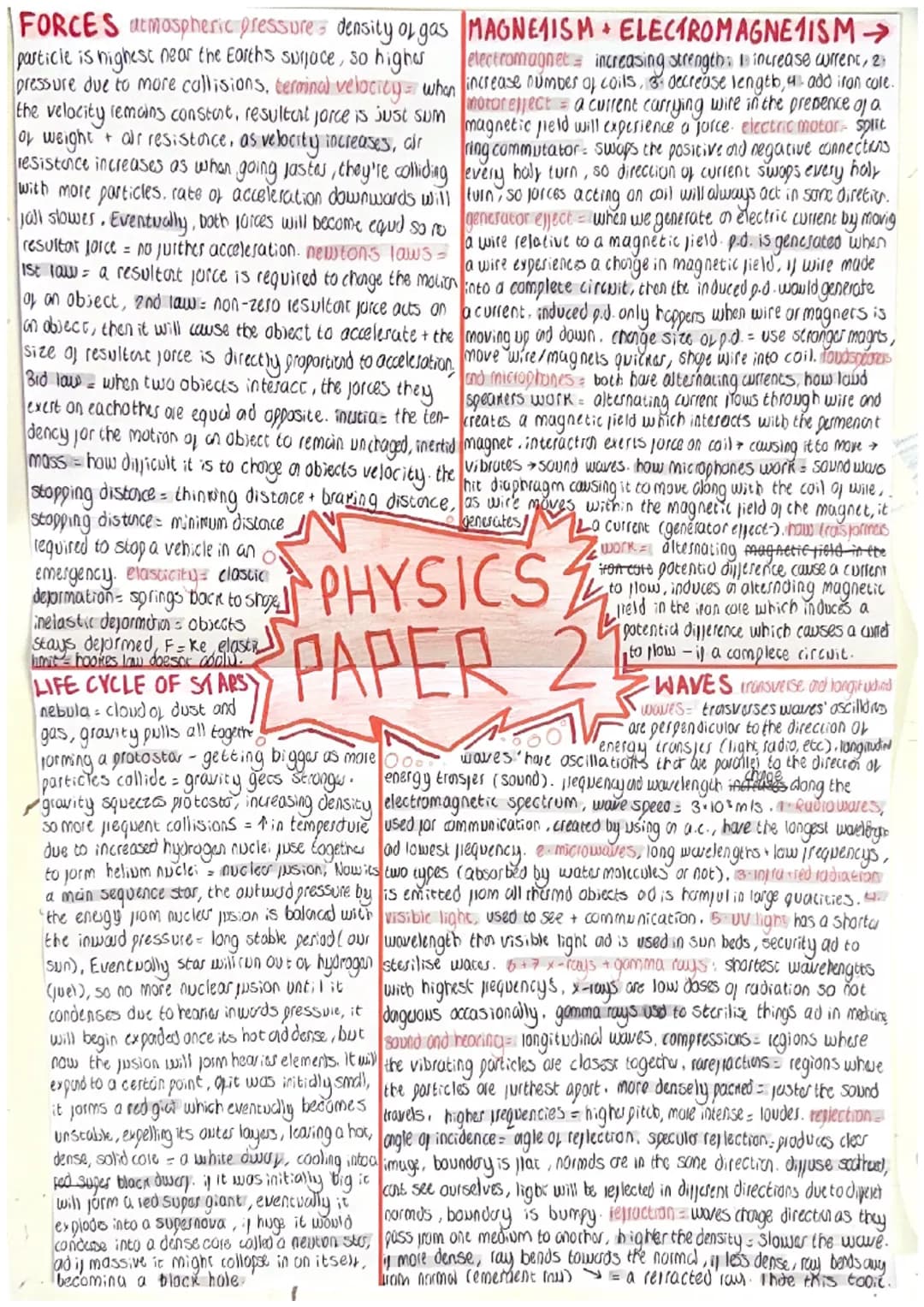
When objects fall, they eventually reach terminal velocity - a constant speed where weight equals air resistance. This happens because air resistance increases with speed until forces balance out, resulting in zero acceleration.
Newton's laws are fundamental to understanding motion. The first law states that objects need a resultant force to change motion. The second law shows that force is directly proportional to acceleration. The third law tells us that interacting objects exert equal and opposite forces on each other.
When driving, remember that stopping distance = thinking distance + braking distance. This is crucial for road safety as it represents the minimum distance needed to stop in an emergency.
Quick Tip: When describing elasticity, remember that elastic objects return to their original shape, while inelastic objects remain deformed. Hooke's Law F=ke applies only up to the elastic limit!
Life Cycle of Stars
Stars begin as nebulae - clouds of dust and gas pulled together by gravity to form protostars. As gravity increases density and temperature, hydrogen nuclei fuse to create helium through nuclear fusion, creating a main sequence star.
When stars run out of hydrogen fuel, their fate depends on size. Small stars become red giants before ejecting outer layers to form white dwarfs. Large stars form red supergiants that explode as supernovae, leaving behind either neutron stars or, for the most massive stars, black holes.
Electromagnetism
Electromagnets get stronger when you increase current, add more coils, decrease their length, or add an iron core. The motor effect occurs when a current-carrying wire in a magnetic field experiences a force - the principle behind electric motors.
The generator effect works in reverse - moving a wire through a magnetic field induces electrical current. This powers transformers, microphones, and generators. In microphones, sound waves move a coil within a magnetic field to generate current, while loudspeakers use current to create magnetic fields that move a coil and produce sound waves.
Waves
Waves come in two main types: transverse waves (like light) oscillate perpendicular to their direction, while longitudinal waves (like sound) oscillate parallel to their direction.
The electromagnetic spectrum includes radio waves (longest wavelength), microwaves, infrared, visible light, ultraviolet, X-rays, and gamma rays (shortest wavelength). All travel at 3×10⁸ m/s but have different properties and uses.
Reflection occurs when waves bounce off surfaces. With specular reflection, the angle of incidence equals the angle of reflection, creating clear images. Refraction happens when waves change direction moving between media of different densities - bending toward the normal when entering denser materials and away when entering less dense materials.


 Physics
 Chemistry
 English Literature
 Biology
 Sociology