Open the App

Subjects

Physics

27 Nov 2025

5,089

11 pages

Comprehensive Physics Topics Guide

user profile picture

B€LA〄 @bxla

Get ready to tackle GCSE Physics with confidence! This guide breaks down all eight units from energy and... Show more

Physics Knowledge Organisers
Unit 1: Energy
Unit 2: Electricity
Unit 3: Particle model of matter
Unit 4: Radioactivity
Unit 5: Forces and Mo

Physics Course Overview and Study Strategy

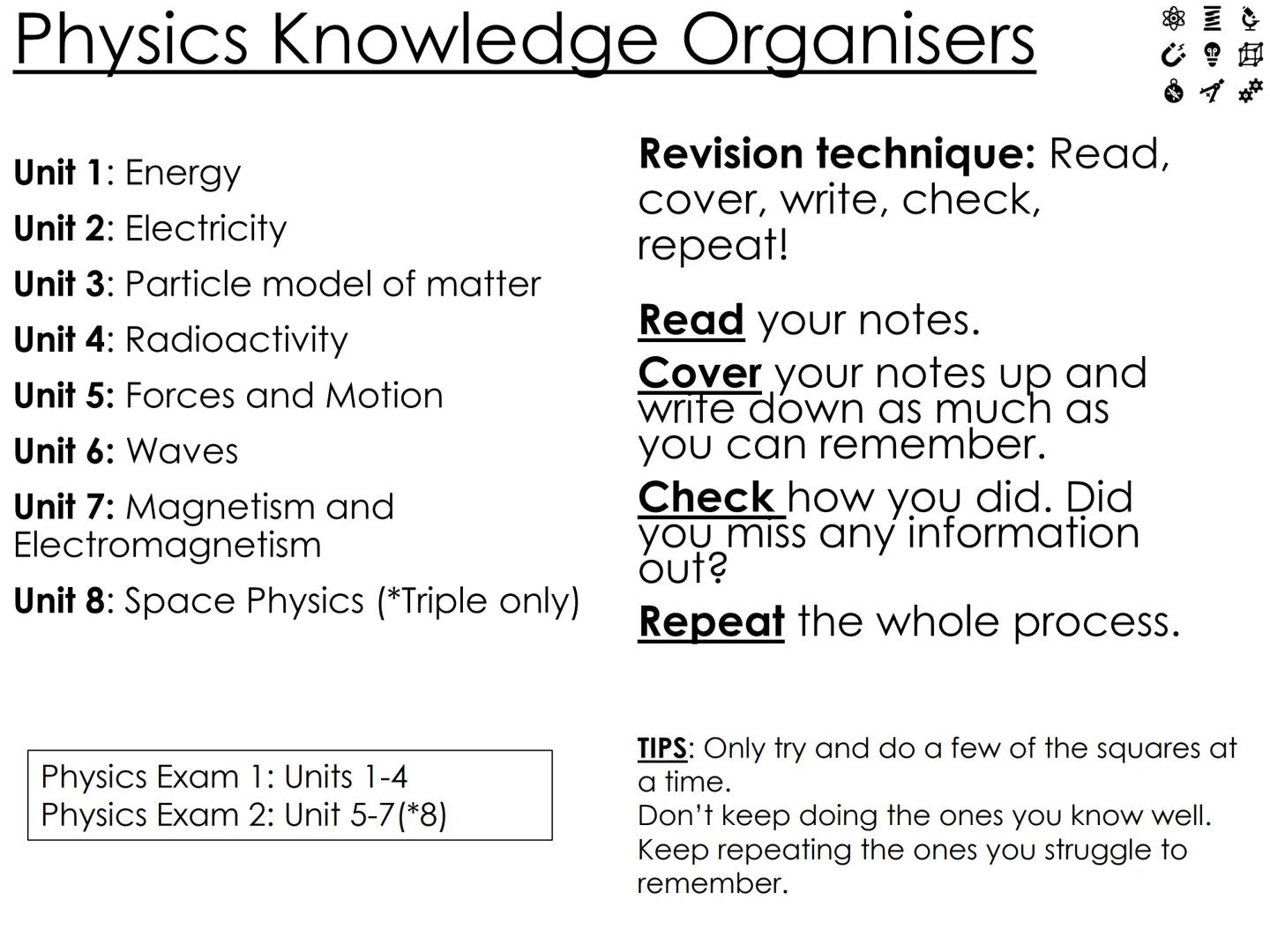
You've got eight key units to master for GCSE Physics, split across two exams. Units 1-4 (Energy, Electricity, Particle Model, and Radioactivity) appear on your first paper, while Units 5-7 (Forces, Waves, and Magnetism) plus Unit 8 for Triple Science students make up the second exam.

The "read, cover, write, check, repeat" method is your best mate for memorising all those equations and concepts. Don't waste time repeatedly going over stuff you already know well - focus your energy on the bits that trip you up.

Top Tip Only tackle a few topic squares at a time rather than trying to cram everything at once. Your brain will thank you for it!

Physics Knowledge Organisers
Unit 1: Energy
Unit 2: Electricity
Unit 3: Particle model of matter
Unit 4: Radioactivity
Unit 5: Forces and Mo

Essential Physics Equations for GCSE Success

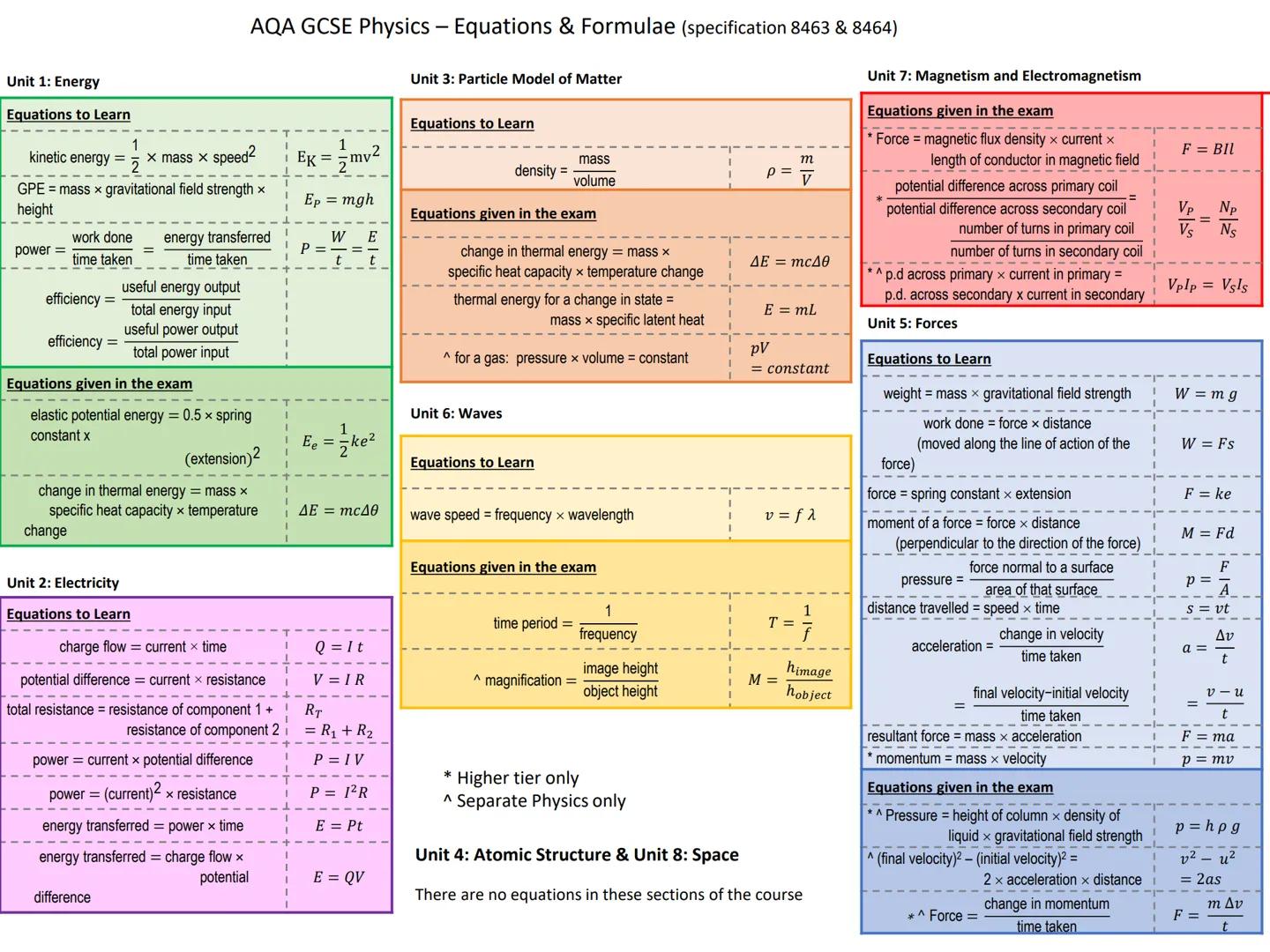
Energy equations you absolutely must memorise include kinetic energy = ½ × mass × speed² and gravitational potential energy = mass × gravitational field strength × height. Power calculations pop up everywhere, so nail down power = work done ÷ time taken.

For electricity, master the basics charge flow = current × time, potential difference = current × resistance, and power = current × potential difference. These form the foundation for tackling any electrical circuit problem.

Forces and motion pack the most equations to learn. Key ones include weight = mass × gravitational field strength, acceleration = change in velocity ÷ time taken, and momentum = mass × velocity. The formula sheet gives you some equations during exams, but knowing the core ones by heart saves precious time.

Remember Units 4 (Atomic Structure) and 8 (Space) have no equations to memorise - one less thing to stress about!

Physics Knowledge Organisers
Unit 1: Energy
Unit 2: Electricity
Unit 3: Particle model of matter
Unit 4: Radioactivity
Unit 5: Forces and Mo

Unit 1 Energy - The Foundation of Physics

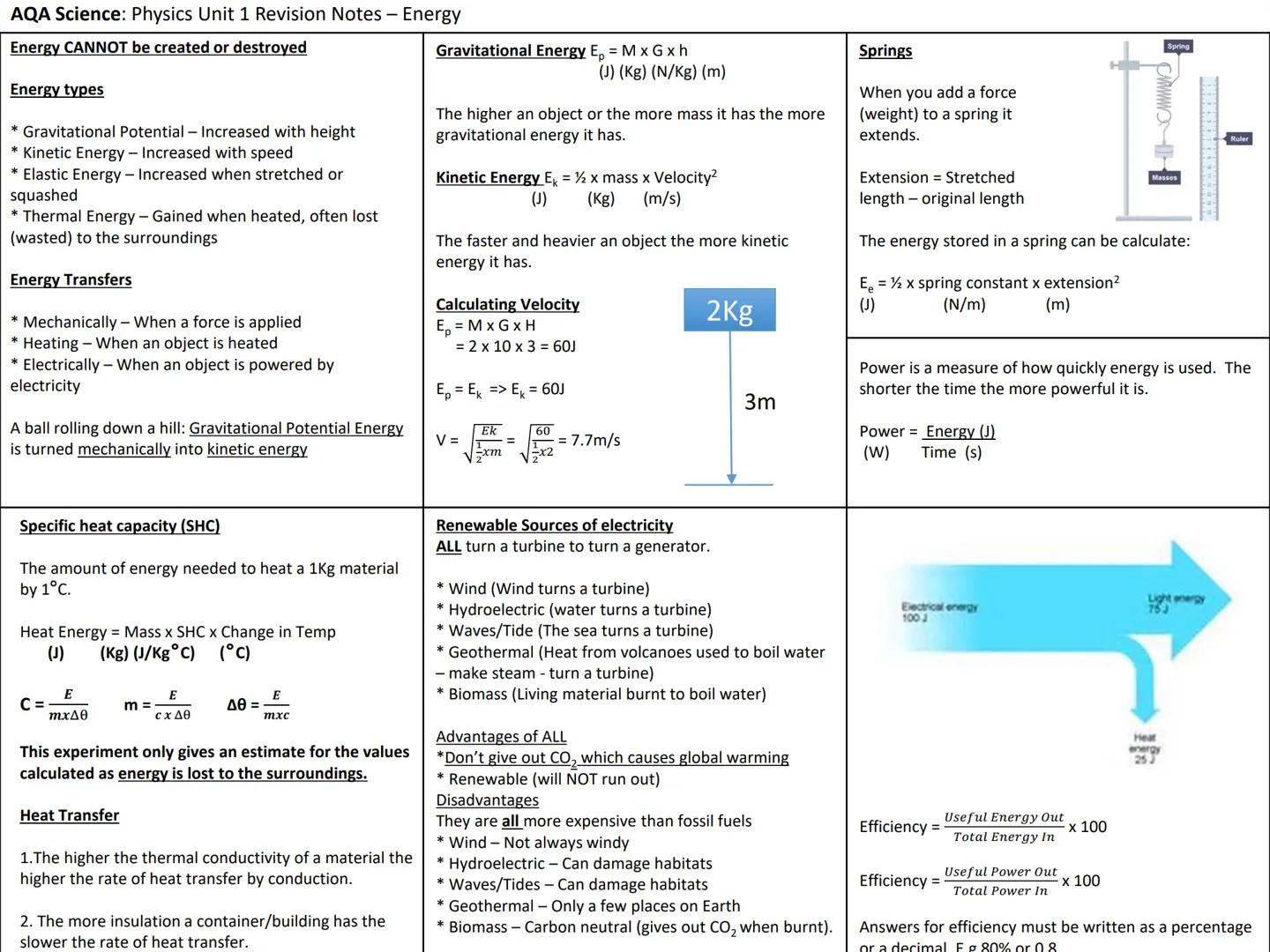
Energy cannot be created or destroyed - it only transfers from one type to another. You'll encounter gravitational potential energy (increases with height), kinetic energy (increases with speed), elastic energy (when things stretch), and thermal energy (often wasted to surroundings).

Energy transfers happen three ways mechanically (applying force), heating (adding thermal energy), and electrically (powering with electricity). Picture a ball rolling downhill - gravitational potential energy converts mechanically into kinetic energy.

Specific heat capacity measures how much energy heats 1kg of material by 1°C. The equation Heat Energy = Mass × SHC × Temperature Change helps you calculate energy changes, though remember your answers are estimates since energy always escapes to surroundings.

Renewable energy sources all work by turning turbines to generate electricity. Wind, hydroelectric, waves, geothermal, and biomass don't produce CO₂ and won't run out, but they're more expensive than fossil fuels and often depend on weather conditions.

Efficiency Tip Efficiency = (useful energy out ÷ total energy in) × 100. Always express your answer as a percentage or decimal!

Physics Knowledge Organisers
Unit 1: Energy
Unit 2: Electricity
Unit 3: Particle model of matter
Unit 4: Radioactivity
Unit 5: Forces and Mo

Unit 2 Electricity - Circuits and Current Flow

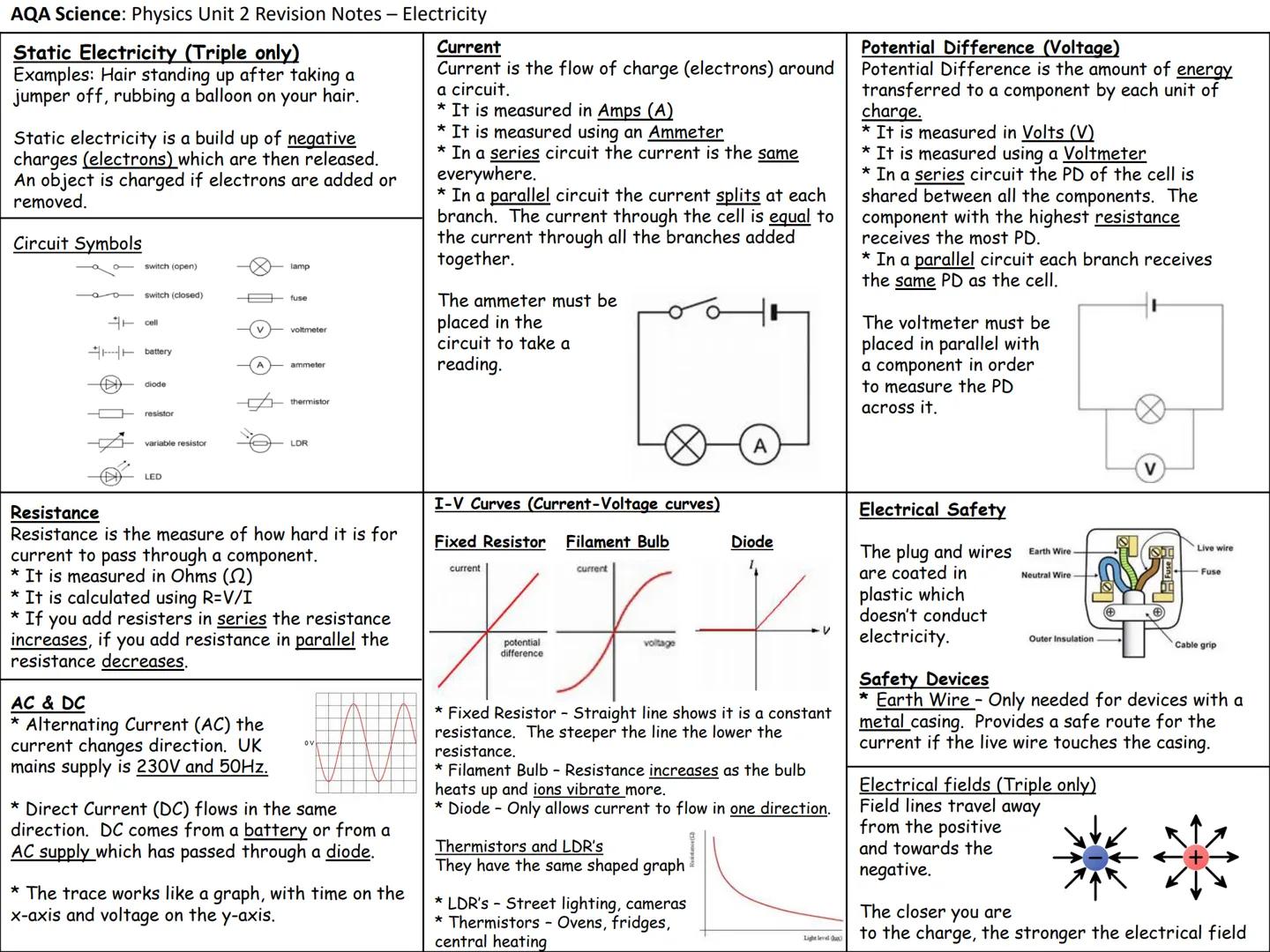
Current flows differently in series and parallel circuits. In series, current stays the same throughout, while in parallel circuits, current splits at branches then adds back up. Use ammeters in series with components and voltmeters in parallel to measure properly.

Resistance measures how hard it is for current to pass through components (measured in Ohms). Adding resistors in series increases total resistance, while parallel resistors decrease it. The equation R = V/I is your go-to for calculations.

I-V curves reveal component behaviour. Fixed resistors give straight lines (constant resistance), filament bulbs curve upward as they heat up, and diodes only allow current in one direction. Thermistors and LDRs change resistance with temperature and light respectively.

Mains electricity supplies 230V AC at 50Hz, while batteries provide DC. The earth wire protects metal-cased appliances, and fuses prevent dangerous current surges by melting when current gets too high.

Safety First Electrical fields travel from positive to negative charges. The closer you are to a charge, the stronger the field becomes.

Physics Knowledge Organisers
Unit 1: Energy
Unit 2: Electricity
Unit 3: Particle model of matter
Unit 4: Radioactivity
Unit 5: Forces and Mo

Unit 3 Particle Model of Matter - States and Behaviour

Density = mass ÷ volume - solids pack particles tightly (high density), liquids less so, while gases have particles spread far apart (low density). Use a Eureka can to measure irregular object volumes by water displacement.

Particle movement defines each state. Solids vibrate around fixed positions, liquids move freely but stay attracted together, while gas particles zip about with enough energy to overcome attraction. Only gases compress because they have space between particles.

Internal energy combines kinetic and potential energy in particles. Temperature links to kinetic energy - hotter means faster-moving particles. When substances change state melting/boilingmelting/boiling, internal energy increases but temperature stays constant until the change completes.

Gas behaviour follows simple rules. Pressure × Volume = constant (at fixed temperature), so squashing gas into smaller volume increases pressure. Heating gas increases particle collisions with container walls, boosting pressure.

Key Insight During state changes, temperature plateaus even though you're adding energy - it's all going into breaking particle bonds!

Physics Knowledge Organisers
Unit 1: Energy
Unit 2: Electricity
Unit 3: Particle model of matter
Unit 4: Radioactivity
Unit 5: Forces and Mo

Unit 4 Radioactivity - Atomic Structure and Decay

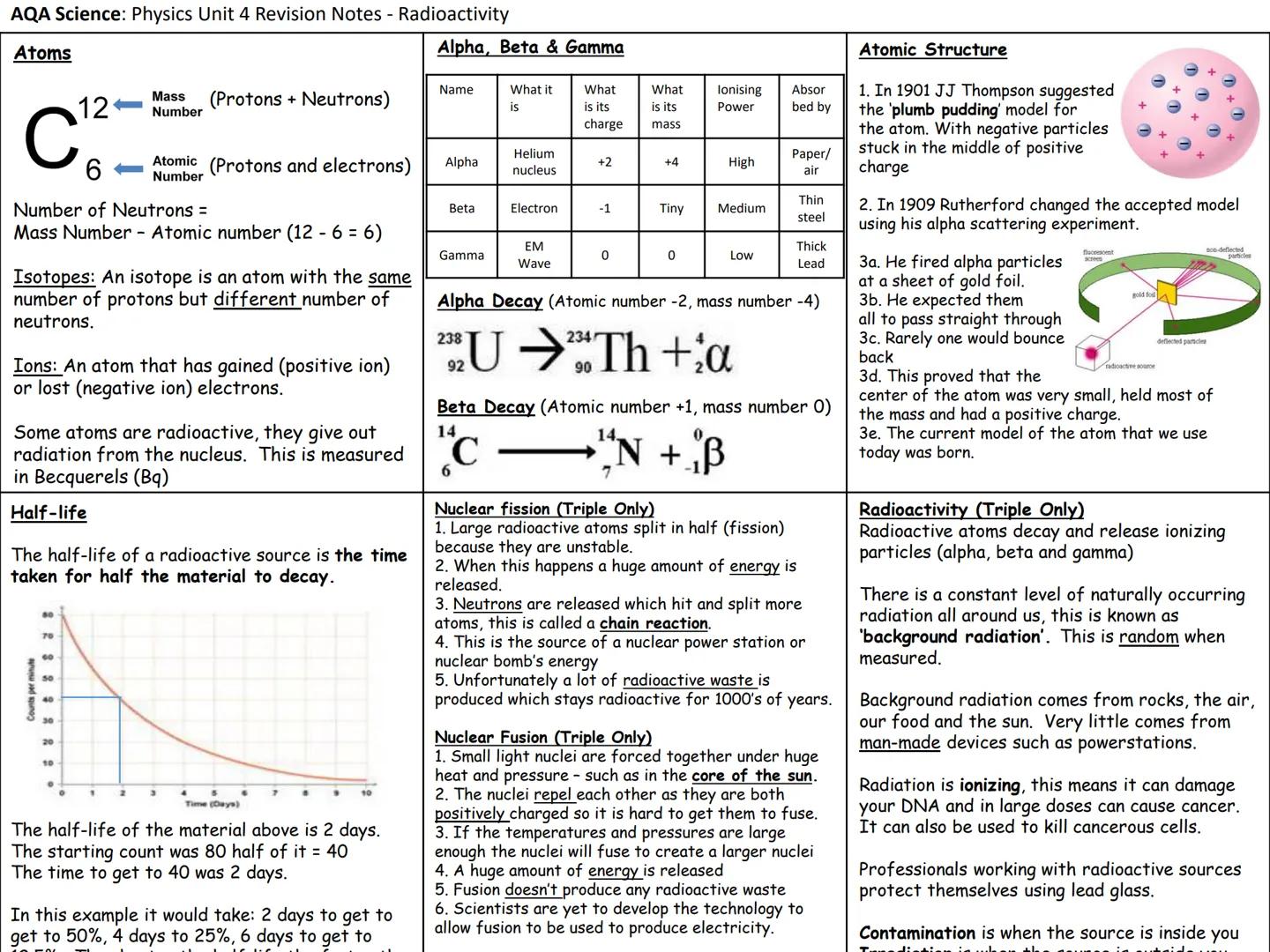
Atoms contain protons and neutrons in the nucleus, with electrons orbiting outside. The mass number counts protons plus neutrons, while atomic number counts just protons. Isotopes have identical proton numbers but different neutron counts.

Radioactive decay produces three radiation types. Alpha particles are helium nuclei charge+2,mass4charge +2, mass 4, beta particles are electrons charge1,tinymasscharge -1, tiny mass, and gamma rays are electromagnetic waves (no charge or mass). Paper stops alpha, thin steel stops beta, thick lead stops gamma.

Half-life measures how long half the radioactive material takes to decay. If you start with 80 counts and drop to 40 counts in 2 days, the half-life is 2 days. After another 2 days, you'll have 20 counts remaining.

Nuclear reactions release enormous energy. Fission splits large unstable nuclei, creating chain reactions used in power stations. Fusion forces small nuclei together under extreme conditions like inside stars, producing even more energy with less radioactive waste.

Remember Alpha decay reduces atomic number by 2 and mass by 4. Beta decay increases atomic number by 1 with no mass change.

Physics Knowledge Organisers
Unit 1: Energy
Unit 2: Electricity
Unit 3: Particle model of matter
Unit 4: Radioactivity
Unit 5: Forces and Mo

Unit 5 Forces and Motion - Movement and Momentum

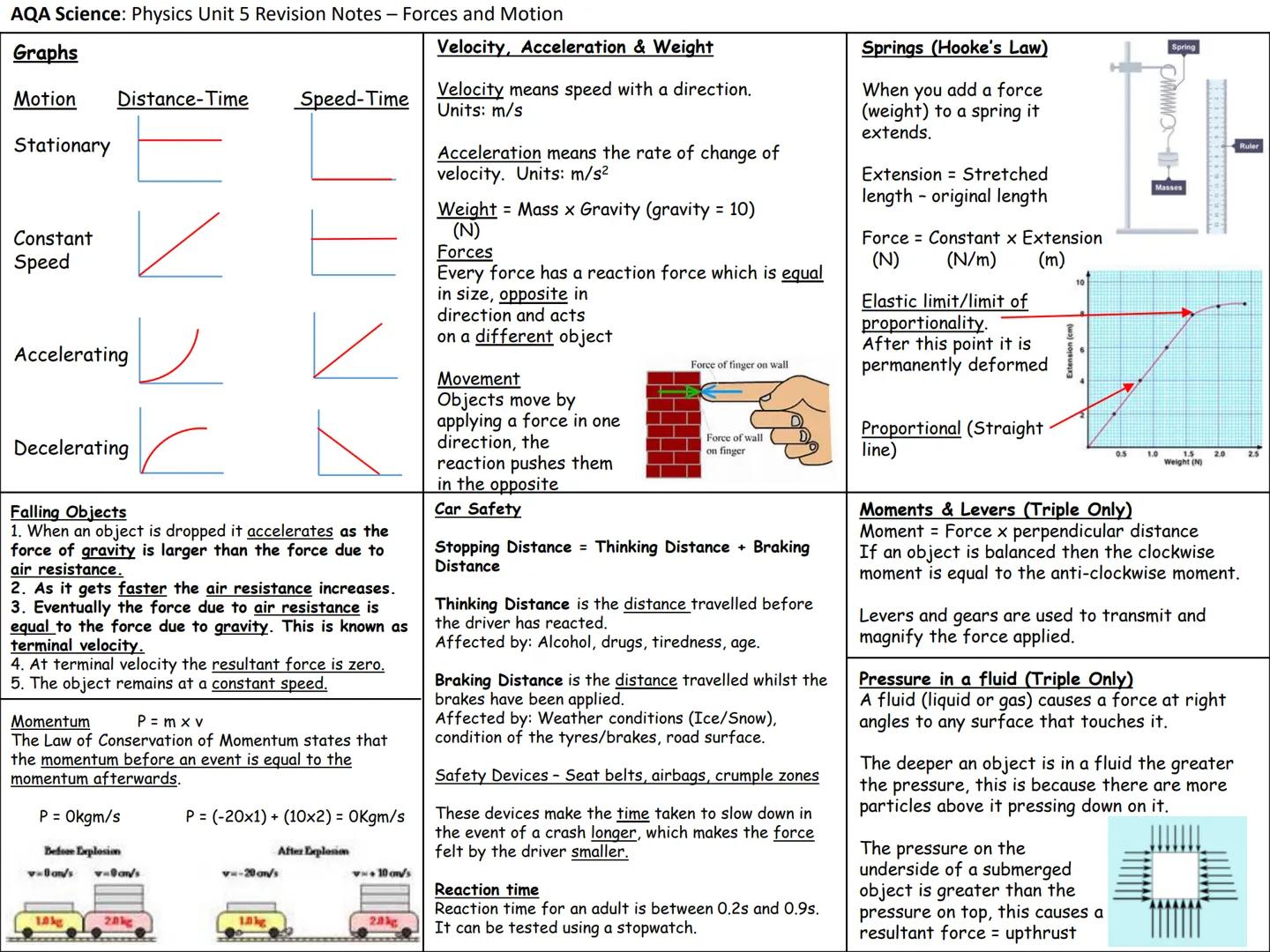
Motion graphs tell the whole story. Distance-time graphs show stationary (horizontal line), constant speed (diagonal line), or acceleration (curved line). Speed-time graphs reveal acceleration as the gradient - steeper slopes mean faster acceleration changes.

Terminal velocity occurs when falling objects reach constant speed. Initially, gravity exceeds air resistance so objects accelerate. As speed increases, air resistance grows until it equals gravity, creating zero resultant force and constant velocity.

Momentum = mass × velocity and it's always conserved. Before and after any collision or explosion, total momentum stays identical. This explains why a cannon recoils backward when firing - momentum must balance out.

Car safety depends on stopping distances. Thinking distance (before you react) plus braking distance (while slowing down) equals total stopping distance. Seatbelts, airbags, and crumple zones increase collision time, reducing the forces your body experiences.

Safety Logic Making crashes take longer means smaller forces act on passengers. It's all about F = ma - longer time means less acceleration and lower forces.

Physics Knowledge Organisers
Unit 1: Energy
Unit 2: Electricity
Unit 3: Particle model of matter
Unit 4: Radioactivity
Unit 5: Forces and Mo

Unit 6 Waves - Light, Sound and Electromagnetic Radiation

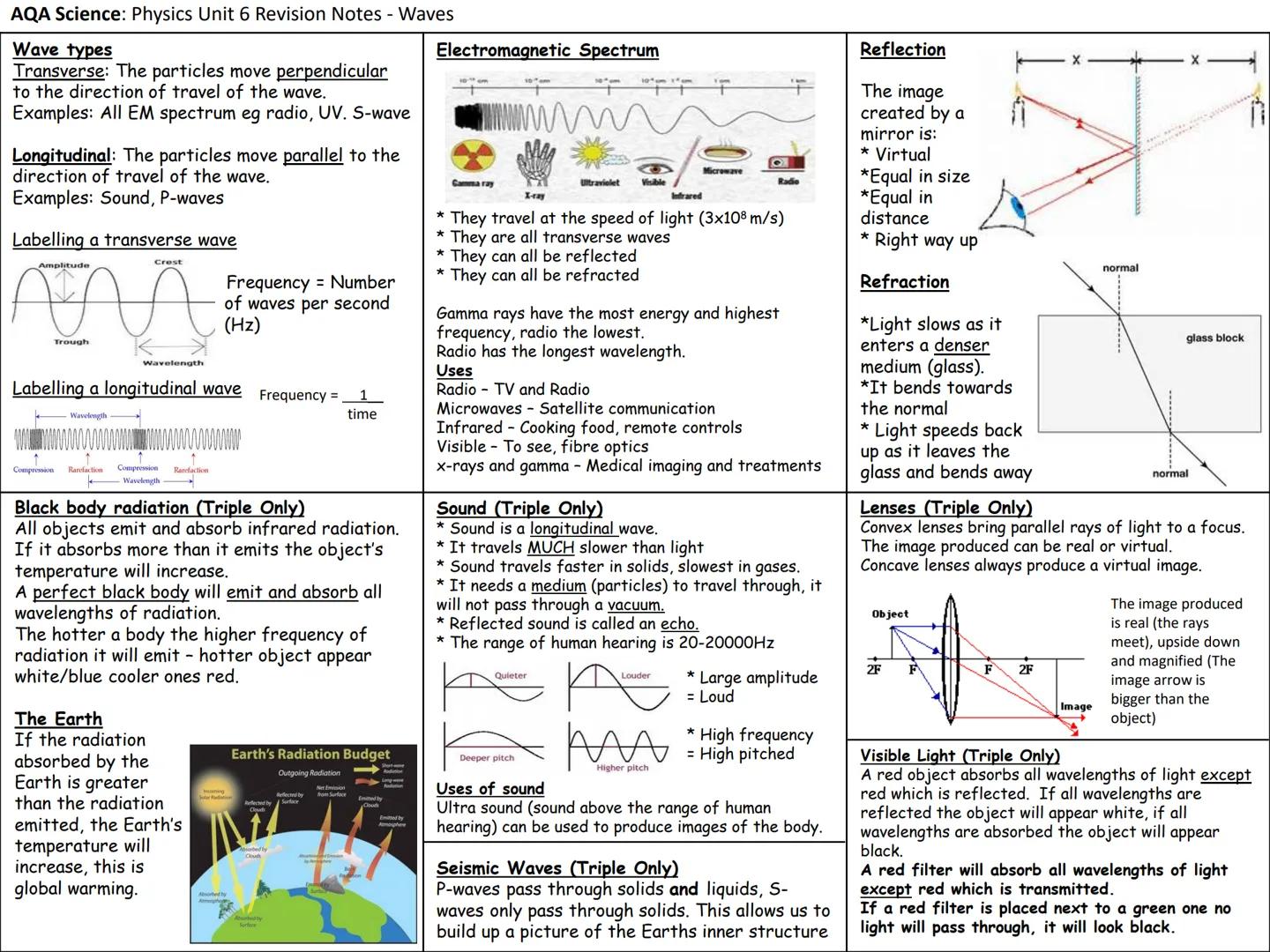
Wave types behave differently. Transverse waves (like light) have particles moving perpendicular to wave direction, while longitudinal waves (like sound) have particles moving parallel to wave direction. Frequency = number of waves per second.

The electromagnetic spectrum travels at light speed 3×10⁸m/s3 × 10⁸ m/s and includes radio, microwaves, infrared, visible light, ultraviolet, X-rays, and gamma rays. Gamma rays pack the most energy and highest frequency, while radio waves have the longest wavelength.

Light behaviour follows predictable patterns. Reflection creates virtual images equal in size and distance from mirrors. Refraction bends light when entering denser materials - light slows down and bends toward the normal line.

Sound travels much slower than light and needs particles to move through - it won't cross a vacuum. Ultrasound abovehumanhearingrangeof2020,000Hzabove human hearing range of 20-20,000Hz creates body images, while seismic waves reveal Earth's internal structure.

Wave Equation Wave speed = frequency × wavelength. This works for all wave types and appears constantly in calculations.

Physics Knowledge Organisers
Unit 1: Energy
Unit 2: Electricity
Unit 3: Particle model of matter
Unit 4: Radioactivity
Unit 5: Forces and Mo

Unit 7 Magnetism and Electromagnetism - Fields and Motors

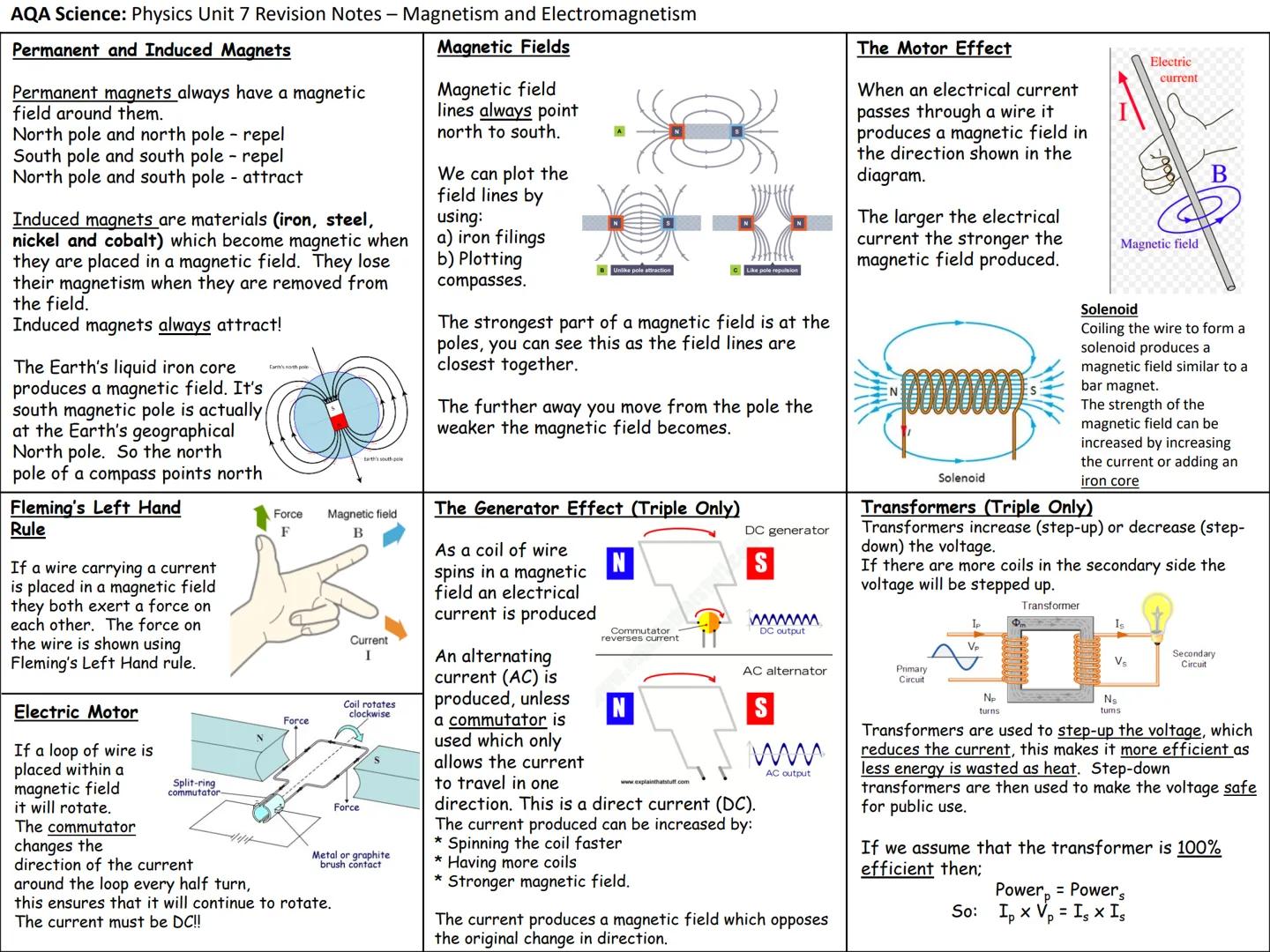
Magnetic fields always point from north to south poles. Permanent magnets maintain constant fields, while induced magnets (iron, steel, nickel, cobalt) only become magnetic when placed in existing fields. Unlike poles attract, like poles repel.

Electric current creates magnetic fields around wires. Coiling wire into a solenoid produces bar magnet-like fields. Increasing current or adding iron cores strengthens the magnetic field significantly.

Fleming's Left Hand Rule predicts motor forces. When current-carrying wires sit in magnetic fields, they experience forces. Electric motors use this principle - current loops in magnetic fields rotate, with commutators reversing current direction each half-turn to maintain rotation.

Transformers change voltages using electromagnetic induction. Step-up transformers increase voltage for efficient power transmission (higher voltage means lower current and less energy waste). Step-down transformers then reduce voltage for safe domestic use.

Power Efficiency Transformers work because power in = power out, so increasing voltage decreases current, reducing energy lost as heat in power lines.

Physics Knowledge Organisers
Unit 1: Energy
Unit 2: Electricity
Unit 3: Particle model of matter
Unit 4: Radioactivity
Unit 5: Forces and Mo

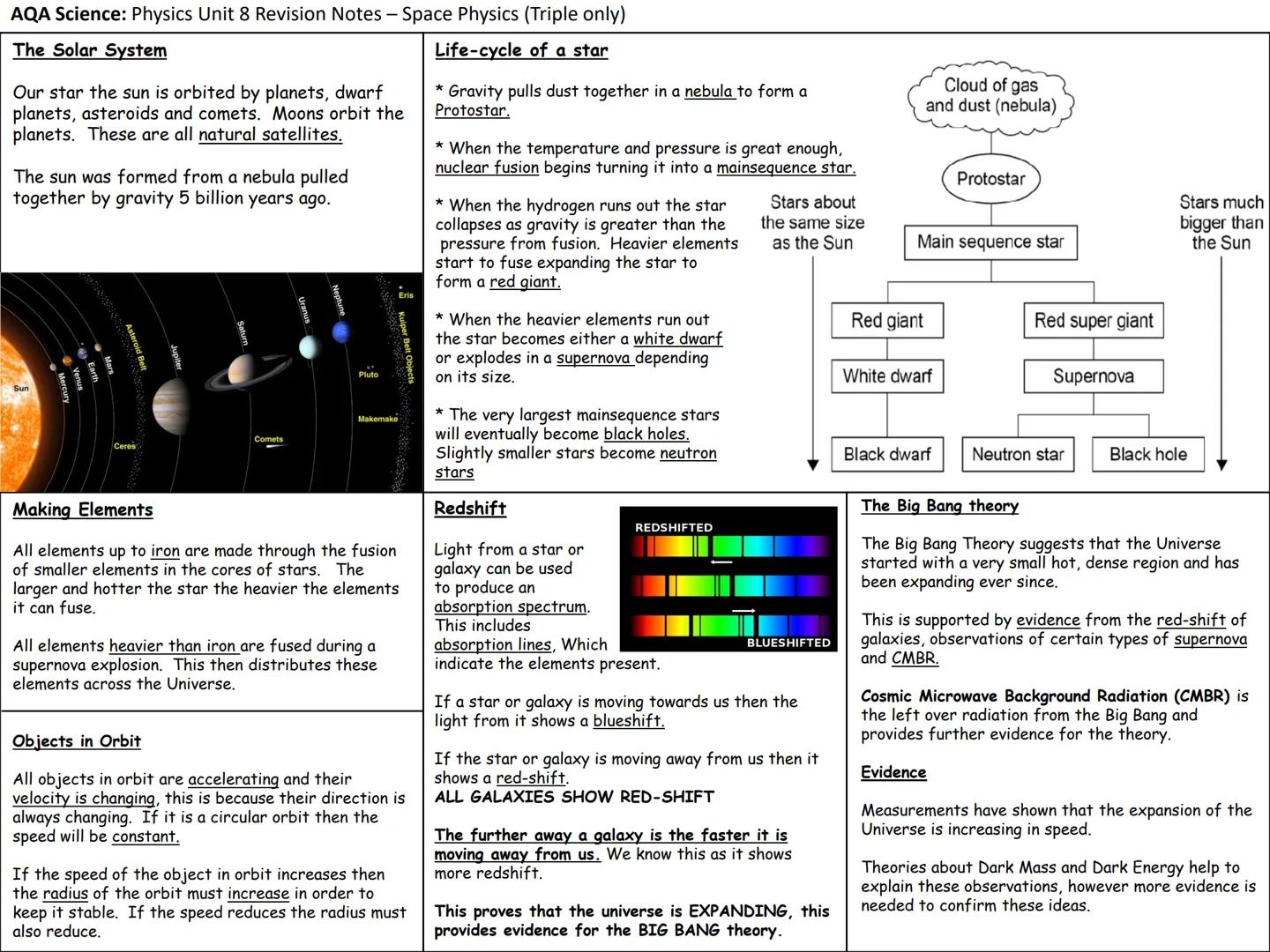
Unit 8 Space Physics - Universe and Stellar Evolution

Our solar system formed 5 billion years ago when gravity pulled nebula material together to create the Sun. Planets, moons, asteroids, and comets orbit our star, with everything held in place by gravitational forces.

Stars follow predictable life cycles. Main sequence stars fuse hydrogen into helium. When hydrogen runs out, they expand into red giants, then become white dwarfs (smaller stars) or explode as supernovas (massive stars), potentially forming neutron stars or black holes.

Redshift provides crucial evidence for an expanding universe. Light from distant galaxies shifts toward red wavelengths because they're moving away from us. The further away a galaxy, the faster it's receding, proving universe expansion.

The Big Bang theory explains how our universe started from an incredibly hot, dense point and has been expanding ever since. Cosmic Microwave Background Radiation provides supporting evidence - it's leftover radiation from the initial explosion.

Universal Truth All galaxies show redshift, meaning everything is moving away from us. This expansion is actually accelerating, supported by observations of distant supernovas.

We thought you’d never ask...

What is the Knowunity AI companion?

Our AI Companion is a student-focused AI tool that offers more than just answers. Built on millions of Knowunity resources, it provides relevant information, personalised study plans, quizzes, and content directly in the chat, adapting to your individual learning journey.

Where can I download the Knowunity app?

You can download the app from Google Play Store and Apple App Store.

Is Knowunity really free of charge?

That's right! Enjoy free access to study content, connect with fellow students, and get instant help – all at your fingertips.

768

Smart Tools NEW

Transform this note into: ✓ 50+ Practice Questions ✓ Interactive Flashcards ✓ Full Mock Exam ✓ Essay Outlines

Mock Exam
Quiz
Flashcards
Essay

Most popular content in Physics

Most popular content

Can't find what you're looking for? Explore other subjects.

Students love us — and so will you.

4.9/5

App Store

4.8/5

Google Play

The app is very easy to use and well designed. I have found everything I was looking for so far and have been able to learn a lot from the presentations! I will definitely use the app for a class assignment! And of course it also helps a lot as an inspiration.

Stefan S

iOS user

This app is really great. There are so many study notes and help [...]. My problem subject is French, for example, and the app has so many options for help. Thanks to this app, I have improved my French. I would recommend it to anyone.

Samantha Klich

Android user

Wow, I am really amazed. I just tried the app because I've seen it advertised many times and was absolutely stunned. This app is THE HELP you want for school and above all, it offers so many things, such as workouts and fact sheets, which have been VERY helpful to me personally.

Anna

iOS user

Best app on earth! no words because it’s too good

Thomas R

iOS user

Just amazing. Let's me revise 10x better, this app is a quick 10/10. I highly recommend it to anyone. I can watch and search for notes. I can save them in the subject folder. I can revise it any time when I come back. If you haven't tried this app, you're really missing out.

Basil

Android user

This app has made me feel so much more confident in my exam prep, not only through boosting my own self confidence through the features that allow you to connect with others and feel less alone, but also through the way the app itself is centred around making you feel better. It is easy to navigate, fun to use, and helpful to anyone struggling in absolutely any way.

David K

iOS user

The app's just great! All I have to do is enter the topic in the search bar and I get the response real fast. I don't have to watch 10 YouTube videos to understand something, so I'm saving my time. Highly recommended!

Sudenaz Ocak

Android user

In school I was really bad at maths but thanks to the app, I am doing better now. I am so grateful that you made the app.

Greenlight Bonnie

Android user

very reliable app to help and grow your ideas of Maths, English and other related topics in your works. please use this app if your struggling in areas, this app is key for that. wish I'd of done a review before. and it's also free so don't worry about that.

Rohan U

Android user

I know a lot of apps use fake accounts to boost their reviews but this app deserves it all. Originally I was getting 4 in my English exams and this time I got a grade 7. I didn’t even know about this app three days until the exam and it has helped A LOT. Please actually trust me and use it as I’m sure you too will see developments.

Xander S

iOS user

THE QUIZES AND FLASHCARDS ARE SO USEFUL AND I LOVE THE SCHOOLGPT. IT ALSO IS LITREALLY LIKE CHATGPT BUT SMARTER!! HELPED ME WITH MY MASCARA PROBLEMS TOO!! AS WELL AS MY REAL SUBJECTS ! DUHHH 😍😁😲🤑💗✨🎀😮

Elisha

iOS user

This apps acc the goat. I find revision so boring but this app makes it so easy to organize it all and then you can ask the freeeee ai to test yourself so good and you can easily upload your own stuff. highly recommend as someone taking mocks now

Paul T

iOS user

The app is very easy to use and well designed. I have found everything I was looking for so far and have been able to learn a lot from the presentations! I will definitely use the app for a class assignment! And of course it also helps a lot as an inspiration.

Stefan S

iOS user

This app is really great. There are so many study notes and help [...]. My problem subject is French, for example, and the app has so many options for help. Thanks to this app, I have improved my French. I would recommend it to anyone.

Samantha Klich

Android user

Wow, I am really amazed. I just tried the app because I've seen it advertised many times and was absolutely stunned. This app is THE HELP you want for school and above all, it offers so many things, such as workouts and fact sheets, which have been VERY helpful to me personally.

Anna

iOS user

Best app on earth! no words because it’s too good

Thomas R

iOS user

Just amazing. Let's me revise 10x better, this app is a quick 10/10. I highly recommend it to anyone. I can watch and search for notes. I can save them in the subject folder. I can revise it any time when I come back. If you haven't tried this app, you're really missing out.

Basil

Android user

This app has made me feel so much more confident in my exam prep, not only through boosting my own self confidence through the features that allow you to connect with others and feel less alone, but also through the way the app itself is centred around making you feel better. It is easy to navigate, fun to use, and helpful to anyone struggling in absolutely any way.

David K

iOS user

The app's just great! All I have to do is enter the topic in the search bar and I get the response real fast. I don't have to watch 10 YouTube videos to understand something, so I'm saving my time. Highly recommended!

Sudenaz Ocak

Android user

In school I was really bad at maths but thanks to the app, I am doing better now. I am so grateful that you made the app.

Greenlight Bonnie

Android user

very reliable app to help and grow your ideas of Maths, English and other related topics in your works. please use this app if your struggling in areas, this app is key for that. wish I'd of done a review before. and it's also free so don't worry about that.

Rohan U

Android user

I know a lot of apps use fake accounts to boost their reviews but this app deserves it all. Originally I was getting 4 in my English exams and this time I got a grade 7. I didn’t even know about this app three days until the exam and it has helped A LOT. Please actually trust me and use it as I’m sure you too will see developments.

Xander S

iOS user

THE QUIZES AND FLASHCARDS ARE SO USEFUL AND I LOVE THE SCHOOLGPT. IT ALSO IS LITREALLY LIKE CHATGPT BUT SMARTER!! HELPED ME WITH MY MASCARA PROBLEMS TOO!! AS WELL AS MY REAL SUBJECTS ! DUHHH 😍😁😲🤑💗✨🎀😮

Elisha

iOS user

This apps acc the goat. I find revision so boring but this app makes it so easy to organize it all and then you can ask the freeeee ai to test yourself so good and you can easily upload your own stuff. highly recommend as someone taking mocks now

Paul T

iOS user


Physics

5,089

27 Nov 2025

11 pages

Comprehensive Physics Topics Guide

user profile picture

B€LA〄

@bxla

Get ready to tackle GCSE Physics with confidence! This guide breaks down all eight units from energy and electricity to space physics, giving you the essential knowledge and equations you need for your exams.

Physics Knowledge Organisers
Unit 1: Energy
Unit 2: Electricity
Unit 3: Particle model of matter
Unit 4: Radioactivity
Unit 5: Forces and Mo

Sign up to see the contentIt's free!

Access to all documents

Improve your grades

Join milions of students

By signing up you accept Terms of Service and Privacy Policy

Physics Course Overview and Study Strategy

You've got eight key units to master for GCSE Physics, split across two exams. Units 1-4 (Energy, Electricity, Particle Model, and Radioactivity) appear on your first paper, while Units 5-7 (Forces, Waves, and Magnetism) plus Unit 8 for Triple Science students make up the second exam.

The "read, cover, write, check, repeat" method is your best mate for memorising all those equations and concepts. Don't waste time repeatedly going over stuff you already know well - focus your energy on the bits that trip you up.

Top Tip: Only tackle a few topic squares at a time rather than trying to cram everything at once. Your brain will thank you for it!

Physics Knowledge Organisers
Unit 1: Energy
Unit 2: Electricity
Unit 3: Particle model of matter
Unit 4: Radioactivity
Unit 5: Forces and Mo

Sign up to see the contentIt's free!

Access to all documents

Improve your grades

Join milions of students

By signing up you accept Terms of Service and Privacy Policy

Essential Physics Equations for GCSE Success

Energy equations you absolutely must memorise include kinetic energy = ½ × mass × speed² and gravitational potential energy = mass × gravitational field strength × height. Power calculations pop up everywhere, so nail down power = work done ÷ time taken.

For electricity, master the basics: charge flow = current × time, potential difference = current × resistance, and power = current × potential difference. These form the foundation for tackling any electrical circuit problem.

Forces and motion pack the most equations to learn. Key ones include weight = mass × gravitational field strength, acceleration = change in velocity ÷ time taken, and momentum = mass × velocity. The formula sheet gives you some equations during exams, but knowing the core ones by heart saves precious time.

Remember: Units 4 (Atomic Structure) and 8 (Space) have no equations to memorise - one less thing to stress about!

Physics Knowledge Organisers
Unit 1: Energy
Unit 2: Electricity
Unit 3: Particle model of matter
Unit 4: Radioactivity
Unit 5: Forces and Mo

Sign up to see the contentIt's free!

Access to all documents

Improve your grades

Join milions of students

By signing up you accept Terms of Service and Privacy Policy

Unit 1: Energy - The Foundation of Physics

Energy cannot be created or destroyed - it only transfers from one type to another. You'll encounter gravitational potential energy (increases with height), kinetic energy (increases with speed), elastic energy (when things stretch), and thermal energy (often wasted to surroundings).

Energy transfers happen three ways: mechanically (applying force), heating (adding thermal energy), and electrically (powering with electricity). Picture a ball rolling downhill - gravitational potential energy converts mechanically into kinetic energy.

Specific heat capacity measures how much energy heats 1kg of material by 1°C. The equation Heat Energy = Mass × SHC × Temperature Change helps you calculate energy changes, though remember your answers are estimates since energy always escapes to surroundings.

Renewable energy sources all work by turning turbines to generate electricity. Wind, hydroelectric, waves, geothermal, and biomass don't produce CO₂ and won't run out, but they're more expensive than fossil fuels and often depend on weather conditions.

Efficiency Tip: Efficiency = (useful energy out ÷ total energy in) × 100. Always express your answer as a percentage or decimal!

Physics Knowledge Organisers
Unit 1: Energy
Unit 2: Electricity
Unit 3: Particle model of matter
Unit 4: Radioactivity
Unit 5: Forces and Mo

Sign up to see the contentIt's free!

Access to all documents

Improve your grades

Join milions of students

By signing up you accept Terms of Service and Privacy Policy

Unit 2: Electricity - Circuits and Current Flow

Current flows differently in series and parallel circuits. In series, current stays the same throughout, while in parallel circuits, current splits at branches then adds back up. Use ammeters in series with components and voltmeters in parallel to measure properly.

Resistance measures how hard it is for current to pass through components (measured in Ohms). Adding resistors in series increases total resistance, while parallel resistors decrease it. The equation R = V/I is your go-to for calculations.

I-V curves reveal component behaviour. Fixed resistors give straight lines (constant resistance), filament bulbs curve upward as they heat up, and diodes only allow current in one direction. Thermistors and LDRs change resistance with temperature and light respectively.

Mains electricity supplies 230V AC at 50Hz, while batteries provide DC. The earth wire protects metal-cased appliances, and fuses prevent dangerous current surges by melting when current gets too high.

Safety First: Electrical fields travel from positive to negative charges. The closer you are to a charge, the stronger the field becomes.

Physics Knowledge Organisers
Unit 1: Energy
Unit 2: Electricity
Unit 3: Particle model of matter
Unit 4: Radioactivity
Unit 5: Forces and Mo

Sign up to see the contentIt's free!

Access to all documents

Improve your grades

Join milions of students

By signing up you accept Terms of Service and Privacy Policy

Unit 3: Particle Model of Matter - States and Behaviour

Density = mass ÷ volume - solids pack particles tightly (high density), liquids less so, while gases have particles spread far apart (low density). Use a Eureka can to measure irregular object volumes by water displacement.

Particle movement defines each state. Solids vibrate around fixed positions, liquids move freely but stay attracted together, while gas particles zip about with enough energy to overcome attraction. Only gases compress because they have space between particles.

Internal energy combines kinetic and potential energy in particles. Temperature links to kinetic energy - hotter means faster-moving particles. When substances change state melting/boilingmelting/boiling, internal energy increases but temperature stays constant until the change completes.

Gas behaviour follows simple rules. Pressure × Volume = constant (at fixed temperature), so squashing gas into smaller volume increases pressure. Heating gas increases particle collisions with container walls, boosting pressure.

Key Insight: During state changes, temperature plateaus even though you're adding energy - it's all going into breaking particle bonds!

Physics Knowledge Organisers
Unit 1: Energy
Unit 2: Electricity
Unit 3: Particle model of matter
Unit 4: Radioactivity
Unit 5: Forces and Mo

Sign up to see the contentIt's free!

Access to all documents

Improve your grades

Join milions of students

By signing up you accept Terms of Service and Privacy Policy

Unit 4: Radioactivity - Atomic Structure and Decay

Atoms contain protons and neutrons in the nucleus, with electrons orbiting outside. The mass number counts protons plus neutrons, while atomic number counts just protons. Isotopes have identical proton numbers but different neutron counts.

Radioactive decay produces three radiation types. Alpha particles are helium nuclei charge+2,mass4charge +2, mass 4, beta particles are electrons charge1,tinymasscharge -1, tiny mass, and gamma rays are electromagnetic waves (no charge or mass). Paper stops alpha, thin steel stops beta, thick lead stops gamma.

Half-life measures how long half the radioactive material takes to decay. If you start with 80 counts and drop to 40 counts in 2 days, the half-life is 2 days. After another 2 days, you'll have 20 counts remaining.

Nuclear reactions release enormous energy. Fission splits large unstable nuclei, creating chain reactions used in power stations. Fusion forces small nuclei together under extreme conditions like inside stars, producing even more energy with less radioactive waste.

Remember: Alpha decay reduces atomic number by 2 and mass by 4. Beta decay increases atomic number by 1 with no mass change.

Physics Knowledge Organisers
Unit 1: Energy
Unit 2: Electricity
Unit 3: Particle model of matter
Unit 4: Radioactivity
Unit 5: Forces and Mo

Sign up to see the contentIt's free!

Access to all documents

Improve your grades

Join milions of students

By signing up you accept Terms of Service and Privacy Policy

Unit 5: Forces and Motion - Movement and Momentum

Motion graphs tell the whole story. Distance-time graphs show stationary (horizontal line), constant speed (diagonal line), or acceleration (curved line). Speed-time graphs reveal acceleration as the gradient - steeper slopes mean faster acceleration changes.

Terminal velocity occurs when falling objects reach constant speed. Initially, gravity exceeds air resistance so objects accelerate. As speed increases, air resistance grows until it equals gravity, creating zero resultant force and constant velocity.

Momentum = mass × velocity and it's always conserved. Before and after any collision or explosion, total momentum stays identical. This explains why a cannon recoils backward when firing - momentum must balance out.

Car safety depends on stopping distances. Thinking distance (before you react) plus braking distance (while slowing down) equals total stopping distance. Seatbelts, airbags, and crumple zones increase collision time, reducing the forces your body experiences.

Safety Logic: Making crashes take longer means smaller forces act on passengers. It's all about F = ma - longer time means less acceleration and lower forces.

Physics Knowledge Organisers
Unit 1: Energy
Unit 2: Electricity
Unit 3: Particle model of matter
Unit 4: Radioactivity
Unit 5: Forces and Mo

Sign up to see the contentIt's free!

Access to all documents

Improve your grades

Join milions of students

By signing up you accept Terms of Service and Privacy Policy

Unit 6: Waves - Light, Sound and Electromagnetic Radiation

Wave types behave differently. Transverse waves (like light) have particles moving perpendicular to wave direction, while longitudinal waves (like sound) have particles moving parallel to wave direction. Frequency = number of waves per second.

The electromagnetic spectrum travels at light speed 3×10⁸m/s3 × 10⁸ m/s and includes radio, microwaves, infrared, visible light, ultraviolet, X-rays, and gamma rays. Gamma rays pack the most energy and highest frequency, while radio waves have the longest wavelength.

Light behaviour follows predictable patterns. Reflection creates virtual images equal in size and distance from mirrors. Refraction bends light when entering denser materials - light slows down and bends toward the normal line.

Sound travels much slower than light and needs particles to move through - it won't cross a vacuum. Ultrasound abovehumanhearingrangeof2020,000Hzabove human hearing range of 20-20,000Hz creates body images, while seismic waves reveal Earth's internal structure.

Wave Equation: Wave speed = frequency × wavelength. This works for all wave types and appears constantly in calculations.

Physics Knowledge Organisers
Unit 1: Energy
Unit 2: Electricity
Unit 3: Particle model of matter
Unit 4: Radioactivity
Unit 5: Forces and Mo

Sign up to see the contentIt's free!

Access to all documents

Improve your grades

Join milions of students

By signing up you accept Terms of Service and Privacy Policy

Unit 7: Magnetism and Electromagnetism - Fields and Motors

Magnetic fields always point from north to south poles. Permanent magnets maintain constant fields, while induced magnets (iron, steel, nickel, cobalt) only become magnetic when placed in existing fields. Unlike poles attract, like poles repel.

Electric current creates magnetic fields around wires. Coiling wire into a solenoid produces bar magnet-like fields. Increasing current or adding iron cores strengthens the magnetic field significantly.

Fleming's Left Hand Rule predicts motor forces. When current-carrying wires sit in magnetic fields, they experience forces. Electric motors use this principle - current loops in magnetic fields rotate, with commutators reversing current direction each half-turn to maintain rotation.

Transformers change voltages using electromagnetic induction. Step-up transformers increase voltage for efficient power transmission (higher voltage means lower current and less energy waste). Step-down transformers then reduce voltage for safe domestic use.

Power Efficiency: Transformers work because power in = power out, so increasing voltage decreases current, reducing energy lost as heat in power lines.

Physics Knowledge Organisers
Unit 1: Energy
Unit 2: Electricity
Unit 3: Particle model of matter
Unit 4: Radioactivity
Unit 5: Forces and Mo

Sign up to see the contentIt's free!

Access to all documents

Improve your grades

Join milions of students

By signing up you accept Terms of Service and Privacy Policy

Unit 8: Space Physics - Universe and Stellar Evolution

Our solar system formed 5 billion years ago when gravity pulled nebula material together to create the Sun. Planets, moons, asteroids, and comets orbit our star, with everything held in place by gravitational forces.

Stars follow predictable life cycles. Main sequence stars fuse hydrogen into helium. When hydrogen runs out, they expand into red giants, then become white dwarfs (smaller stars) or explode as supernovas (massive stars), potentially forming neutron stars or black holes.

Redshift provides crucial evidence for an expanding universe. Light from distant galaxies shifts toward red wavelengths because they're moving away from us. The further away a galaxy, the faster it's receding, proving universe expansion.

The Big Bang theory explains how our universe started from an incredibly hot, dense point and has been expanding ever since. Cosmic Microwave Background Radiation provides supporting evidence - it's leftover radiation from the initial explosion.

Universal Truth: All galaxies show redshift, meaning everything is moving away from us. This expansion is actually accelerating, supported by observations of distant supernovas.

We thought you’d never ask...

What is the Knowunity AI companion?

Our AI Companion is a student-focused AI tool that offers more than just answers. Built on millions of Knowunity resources, it provides relevant information, personalised study plans, quizzes, and content directly in the chat, adapting to your individual learning journey.

Where can I download the Knowunity app?

You can download the app from Google Play Store and Apple App Store.

Is Knowunity really free of charge?

That's right! Enjoy free access to study content, connect with fellow students, and get instant help – all at your fingertips.

768

Smart Tools NEW

Transform this note into: ✓ 50+ Practice Questions ✓ Interactive Flashcards ✓ Full Mock Exam ✓ Essay Outlines

Mock Exam
Quiz
Flashcards
Essay

Most popular content in Physics

Most popular content

Can't find what you're looking for? Explore other subjects.

Students love us — and so will you.

4.9/5

App Store

4.8/5

Google Play

The app is very easy to use and well designed. I have found everything I was looking for so far and have been able to learn a lot from the presentations! I will definitely use the app for a class assignment! And of course it also helps a lot as an inspiration.

Stefan S

iOS user

This app is really great. There are so many study notes and help [...]. My problem subject is French, for example, and the app has so many options for help. Thanks to this app, I have improved my French. I would recommend it to anyone.

Samantha Klich

Android user

Wow, I am really amazed. I just tried the app because I've seen it advertised many times and was absolutely stunned. This app is THE HELP you want for school and above all, it offers so many things, such as workouts and fact sheets, which have been VERY helpful to me personally.

Anna

iOS user

Best app on earth! no words because it’s too good

Thomas R

iOS user

Just amazing. Let's me revise 10x better, this app is a quick 10/10. I highly recommend it to anyone. I can watch and search for notes. I can save them in the subject folder. I can revise it any time when I come back. If you haven't tried this app, you're really missing out.

Basil

Android user

This app has made me feel so much more confident in my exam prep, not only through boosting my own self confidence through the features that allow you to connect with others and feel less alone, but also through the way the app itself is centred around making you feel better. It is easy to navigate, fun to use, and helpful to anyone struggling in absolutely any way.

David K

iOS user

The app's just great! All I have to do is enter the topic in the search bar and I get the response real fast. I don't have to watch 10 YouTube videos to understand something, so I'm saving my time. Highly recommended!

Sudenaz Ocak

Android user

In school I was really bad at maths but thanks to the app, I am doing better now. I am so grateful that you made the app.

Greenlight Bonnie

Android user

very reliable app to help and grow your ideas of Maths, English and other related topics in your works. please use this app if your struggling in areas, this app is key for that. wish I'd of done a review before. and it's also free so don't worry about that.

Rohan U

Android user

I know a lot of apps use fake accounts to boost their reviews but this app deserves it all. Originally I was getting 4 in my English exams and this time I got a grade 7. I didn’t even know about this app three days until the exam and it has helped A LOT. Please actually trust me and use it as I’m sure you too will see developments.

Xander S

iOS user

THE QUIZES AND FLASHCARDS ARE SO USEFUL AND I LOVE THE SCHOOLGPT. IT ALSO IS LITREALLY LIKE CHATGPT BUT SMARTER!! HELPED ME WITH MY MASCARA PROBLEMS TOO!! AS WELL AS MY REAL SUBJECTS ! DUHHH 😍😁😲🤑💗✨🎀😮

Elisha

iOS user

This apps acc the goat. I find revision so boring but this app makes it so easy to organize it all and then you can ask the freeeee ai to test yourself so good and you can easily upload your own stuff. highly recommend as someone taking mocks now

Paul T

iOS user

The app is very easy to use and well designed. I have found everything I was looking for so far and have been able to learn a lot from the presentations! I will definitely use the app for a class assignment! And of course it also helps a lot as an inspiration.

Stefan S

iOS user

This app is really great. There are so many study notes and help [...]. My problem subject is French, for example, and the app has so many options for help. Thanks to this app, I have improved my French. I would recommend it to anyone.

Samantha Klich

Android user

Wow, I am really amazed. I just tried the app because I've seen it advertised many times and was absolutely stunned. This app is THE HELP you want for school and above all, it offers so many things, such as workouts and fact sheets, which have been VERY helpful to me personally.

Anna

iOS user

Best app on earth! no words because it’s too good

Thomas R

iOS user

Just amazing. Let's me revise 10x better, this app is a quick 10/10. I highly recommend it to anyone. I can watch and search for notes. I can save them in the subject folder. I can revise it any time when I come back. If you haven't tried this app, you're really missing out.

Basil

Android user

This app has made me feel so much more confident in my exam prep, not only through boosting my own self confidence through the features that allow you to connect with others and feel less alone, but also through the way the app itself is centred around making you feel better. It is easy to navigate, fun to use, and helpful to anyone struggling in absolutely any way.

David K

iOS user

The app's just great! All I have to do is enter the topic in the search bar and I get the response real fast. I don't have to watch 10 YouTube videos to understand something, so I'm saving my time. Highly recommended!

Sudenaz Ocak

Android user

In school I was really bad at maths but thanks to the app, I am doing better now. I am so grateful that you made the app.

Greenlight Bonnie

Android user

very reliable app to help and grow your ideas of Maths, English and other related topics in your works. please use this app if your struggling in areas, this app is key for that. wish I'd of done a review before. and it's also free so don't worry about that.

Rohan U

Android user

I know a lot of apps use fake accounts to boost their reviews but this app deserves it all. Originally I was getting 4 in my English exams and this time I got a grade 7. I didn’t even know about this app three days until the exam and it has helped A LOT. Please actually trust me and use it as I’m sure you too will see developments.

Xander S

iOS user

THE QUIZES AND FLASHCARDS ARE SO USEFUL AND I LOVE THE SCHOOLGPT. IT ALSO IS LITREALLY LIKE CHATGPT BUT SMARTER!! HELPED ME WITH MY MASCARA PROBLEMS TOO!! AS WELL AS MY REAL SUBJECTS ! DUHHH 😍😁😲🤑💗✨🎀😮

Elisha

iOS user

This apps acc the goat. I find revision so boring but this app makes it so easy to organize it all and then you can ask the freeeee ai to test yourself so good and you can easily upload your own stuff. highly recommend as someone taking mocks now

Paul T

iOS user