
This GCSE Physics Higher Tier paper covers essential topics including...
 Physics429 views·Updated 16 Jul 2026·32 pages
2023 Physics Paper 1: Practice Exam
Z
Zach Sandford@zachsandford
1 / 10
1
of 10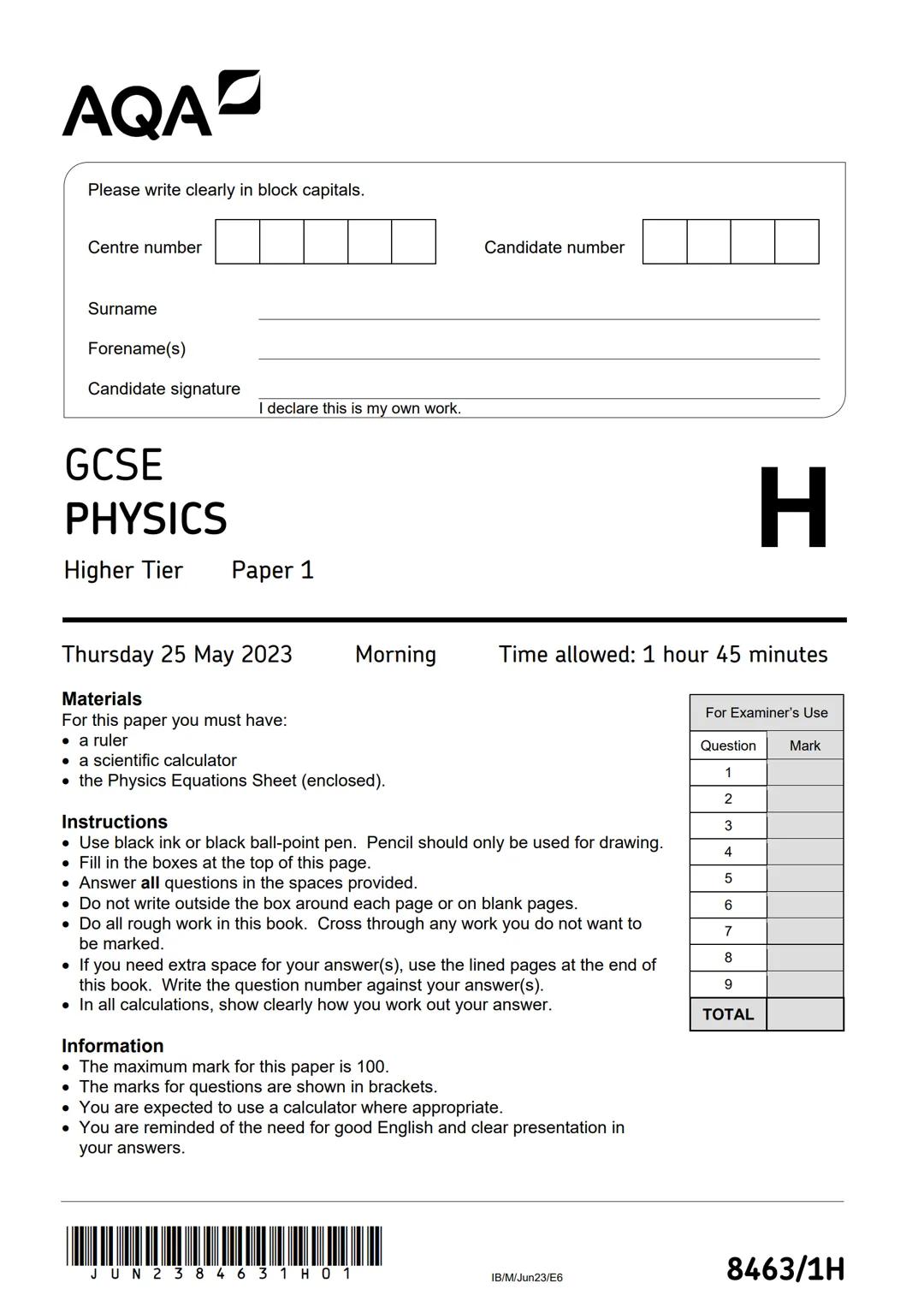
Exam Information and Setup
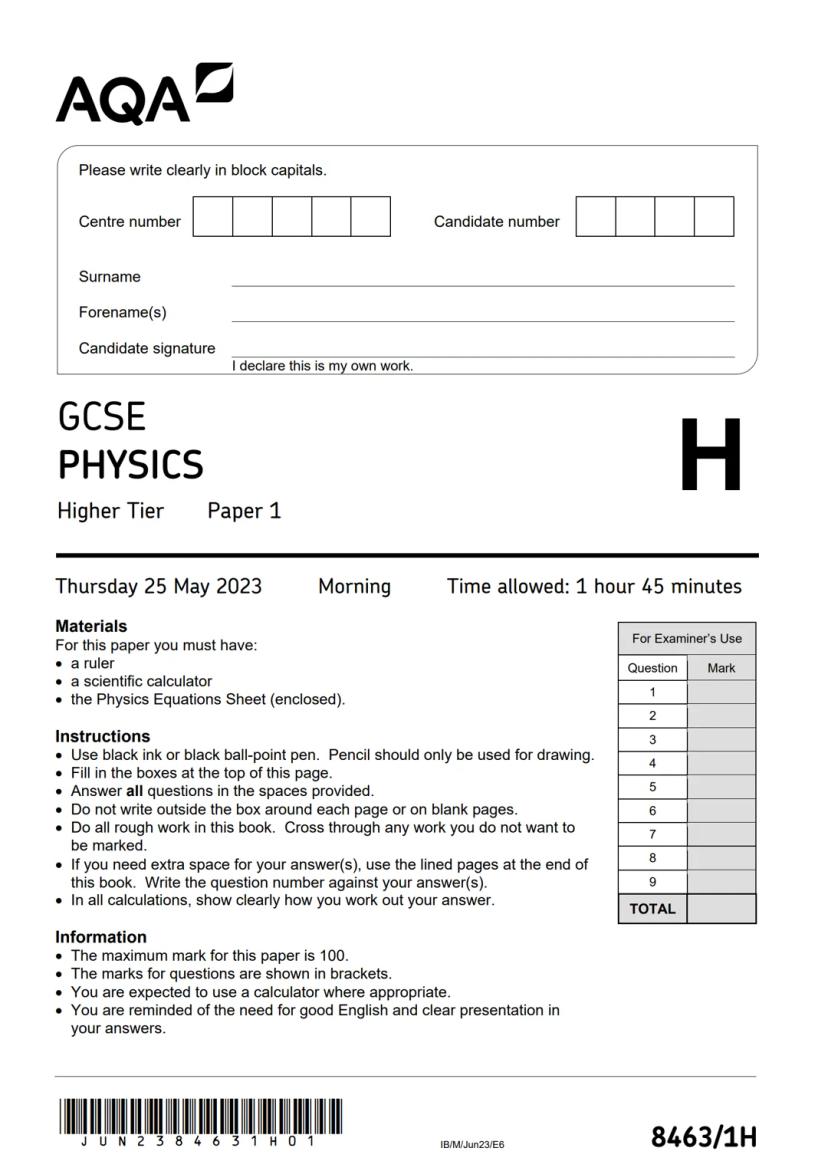
This is your standard GCSE Physics Higher Tier paper worth 100 marks total. You've got 1 hour 45 minutes to complete it, so that's roughly just over a minute per mark - perfect for pacing yourself.
Make sure you've got your scientific calculator and Physics Equations Sheet ready. These are absolute essentials, especially since many questions specifically tell you to use the equations sheet.
Top Tip: Always show your working clearly in calculations - you can pick up method marks even if your final answer isn't quite right!
Remember to write in black ink and only use pencil for diagrams. The paper expects you to demonstrate good English and clear presentation, so take your time to write legibly.
2
of 10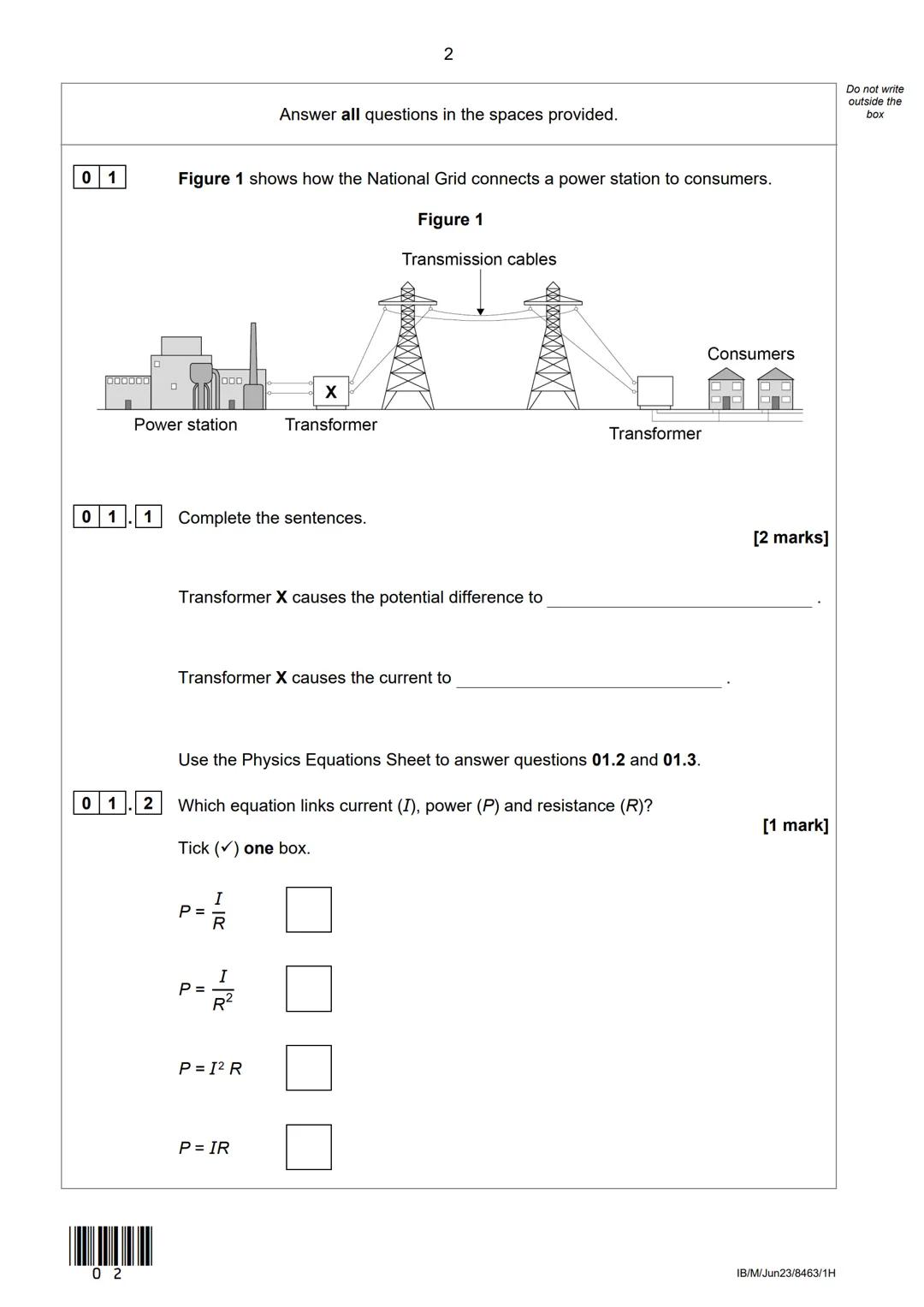
National Grid and Power Transmission
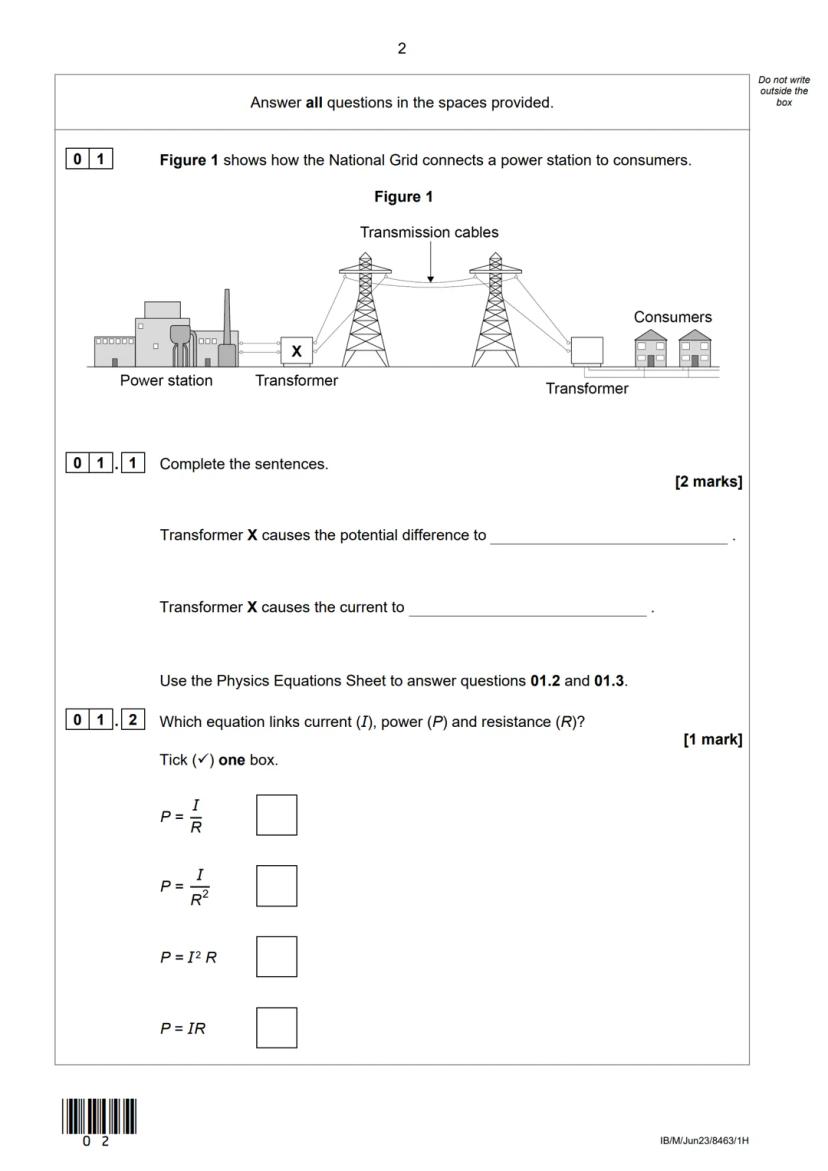
The National Grid connects power stations to your home through a clever system of transformers. Transformer X (the step-up transformer) increases the potential difference and decreases the current for efficient long-distance transmission.
You'll need to identify the correct power equation that links current, power, and resistance. The key relationship here is P = I²R, which is crucial for understanding power losses in transmission cables.
Remember: High voltage transmission reduces current, which dramatically cuts power losses in the cables!
This setup is all about energy efficiency - by stepping up the voltage, we can transmit electricity across the country without wasting loads of energy as heat in the cables.
3
of 10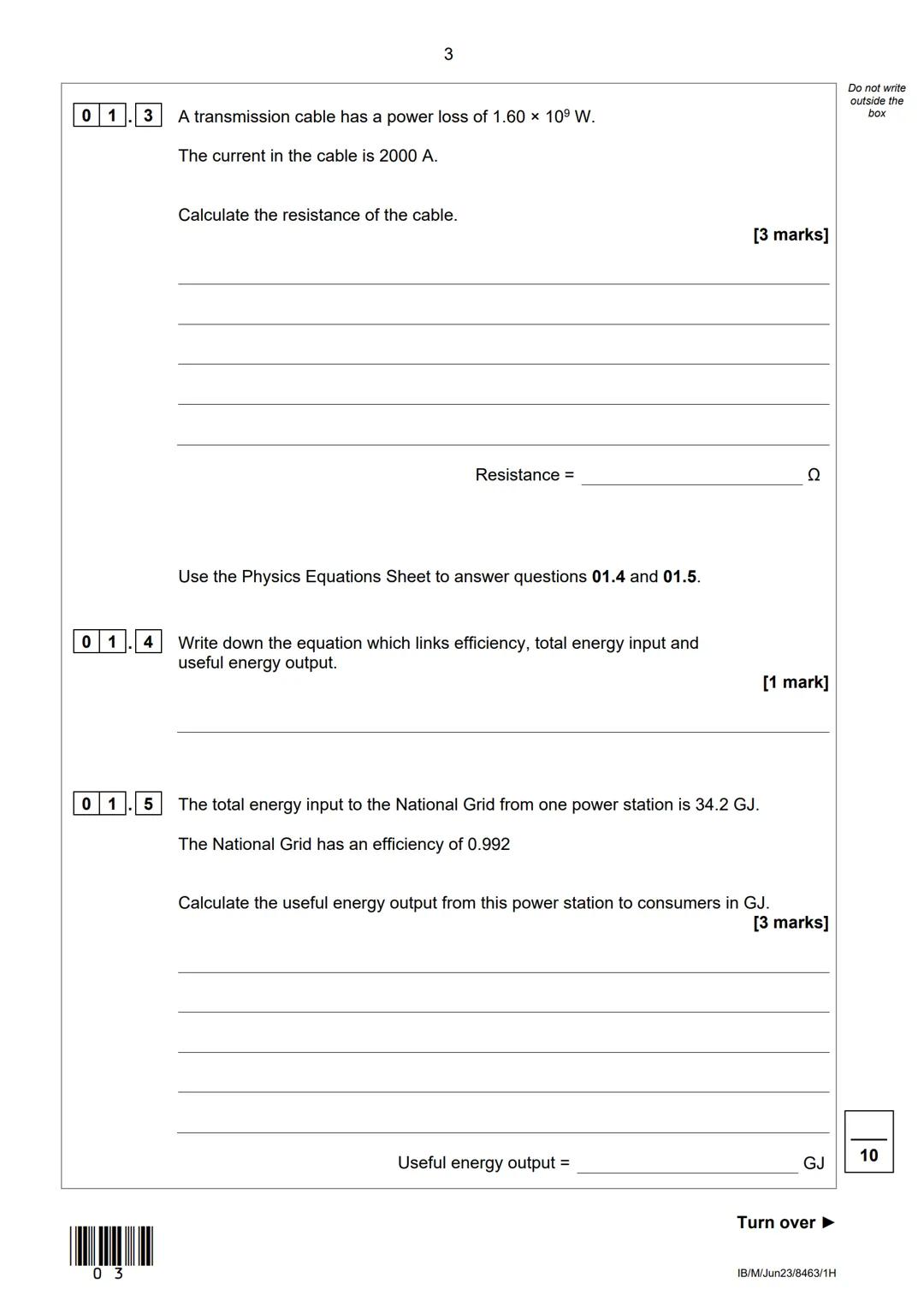
Power Loss Calculations and Grid Efficiency
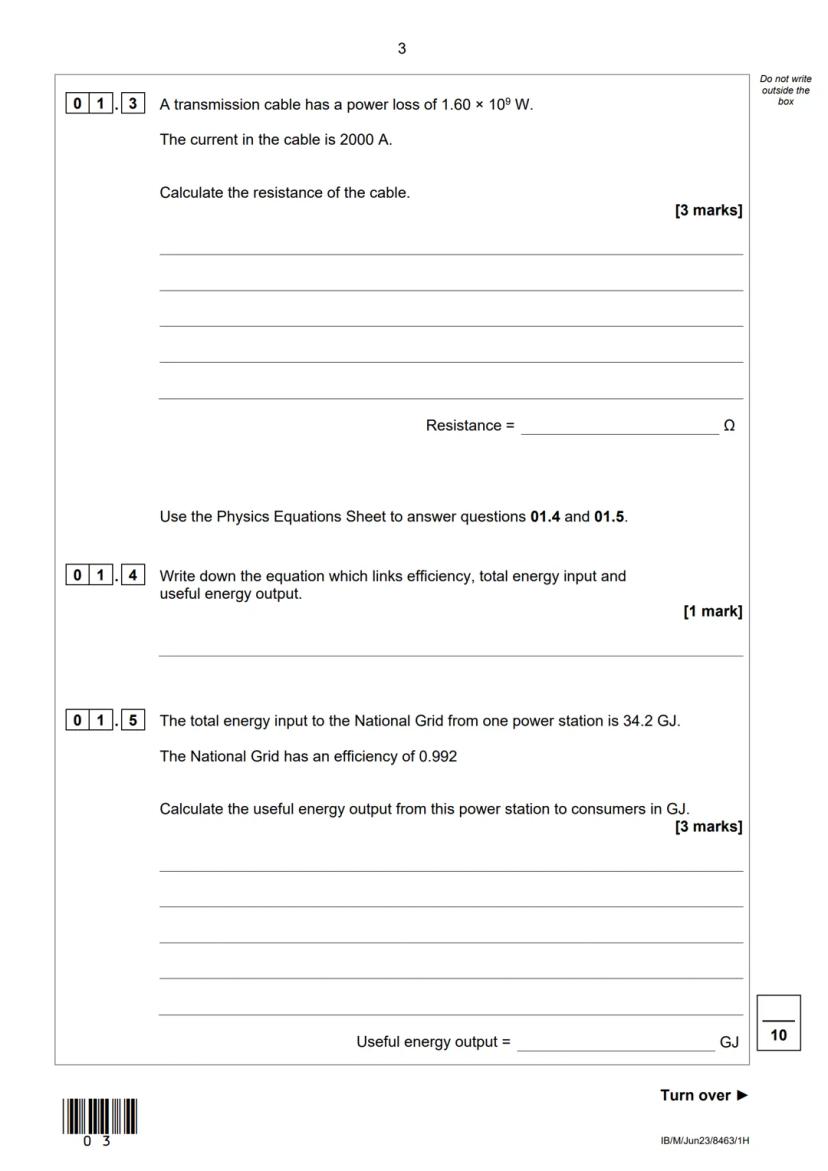
Here's where the maths gets practical! You'll calculate the resistance of transmission cables using the power loss formula. With a power loss of 1.60 × 10⁹ W and current of 2000 A, you can find resistance using P = I²R.
The efficiency equation connects total energy input with useful energy output. It's straightforward: efficiency = useful energy output ÷ total energy input.
Quick Check: An efficiency of 0.992 means 99.2% of energy reaches consumers - that's pretty impressive for such a massive system!
With 34.2 GJ input and 0.992 efficiency, you can calculate exactly how much energy reaches homes and businesses. This shows why the National Grid is so well-designed.
4
of 10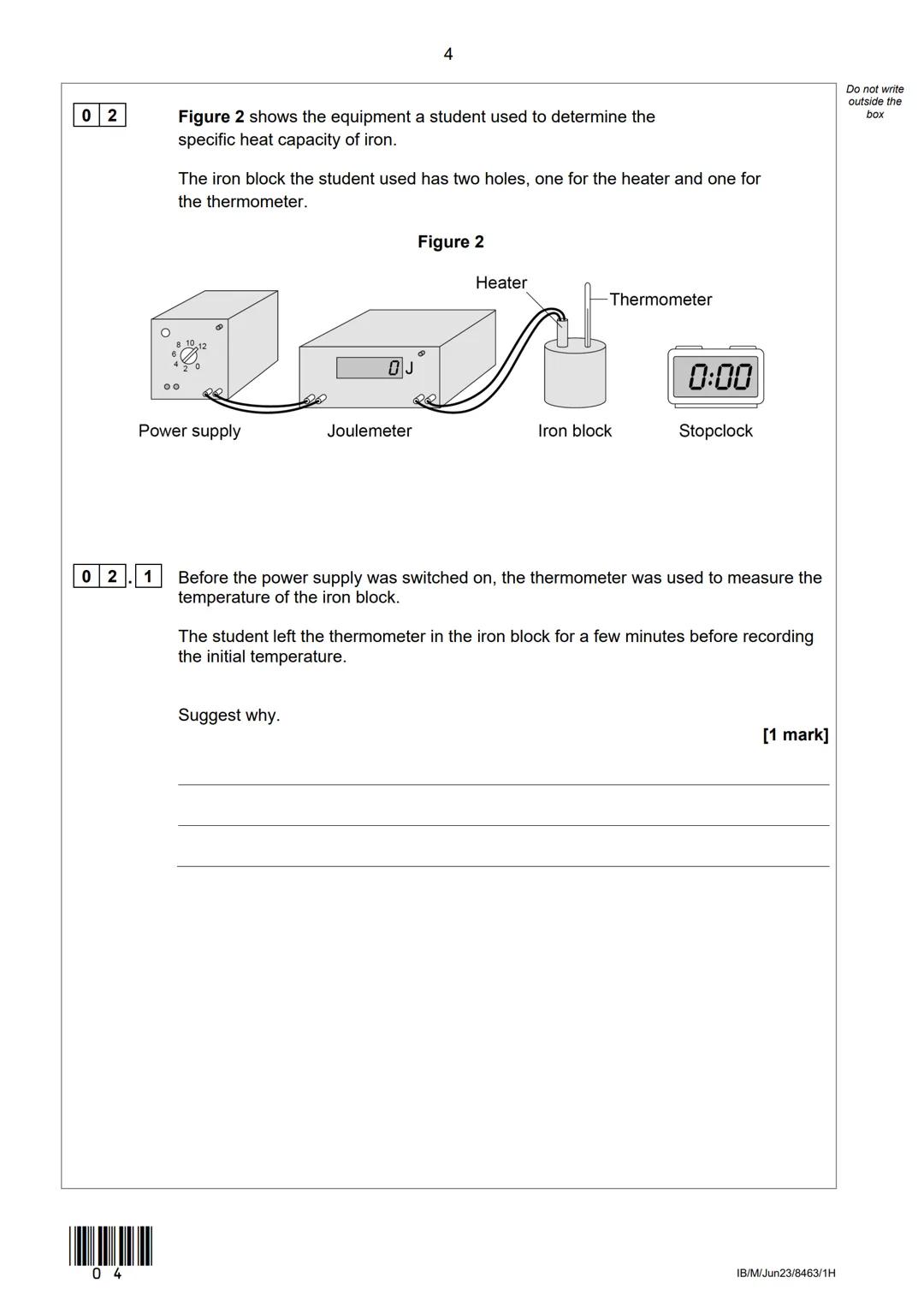
Specific Heat Capacity Experiment Setup
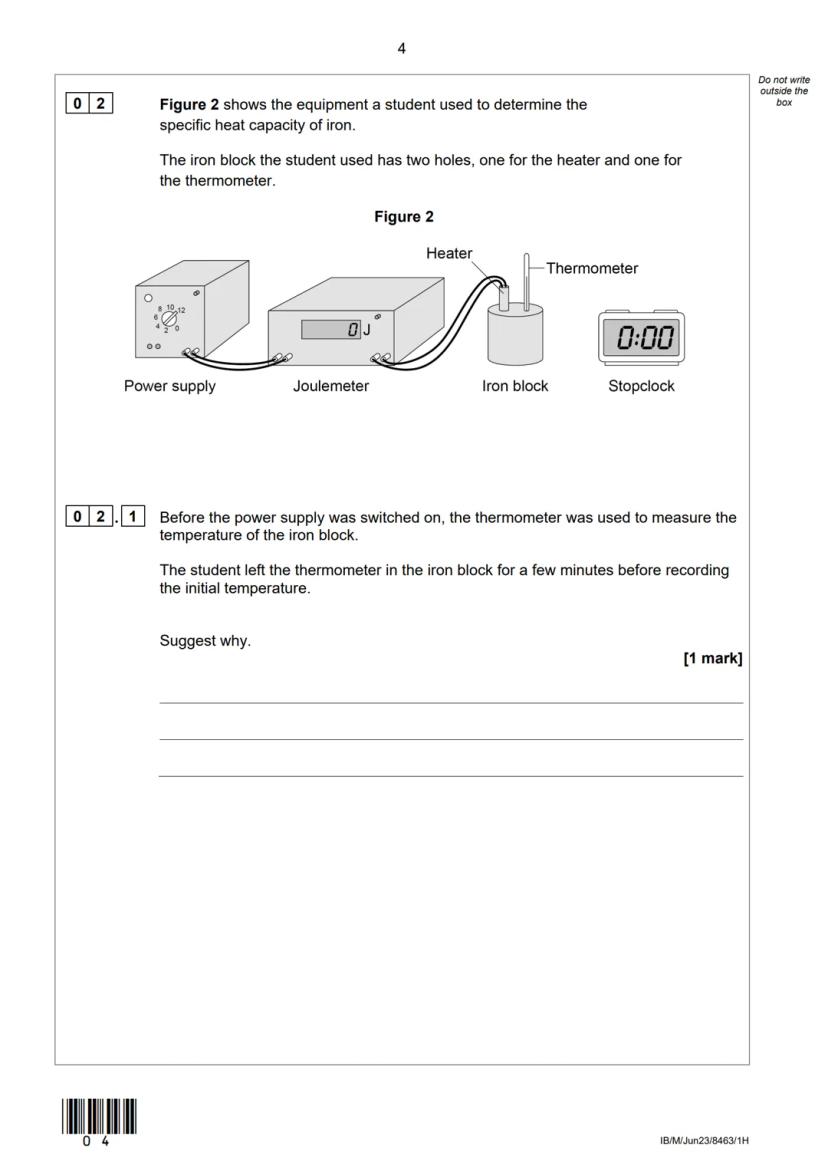
This classic specific heat capacity experiment uses a metal block with holes for a heater and thermometer. The setup includes a joulemeter to measure energy input and a stopwatch for timing.
The key technique here is letting the thermometer equilibrate with the iron block before recording the initial temperature. This ensures you get an accurate starting point for your measurements.
Lab Wisdom: Always wait for thermal equilibrium - rushing this step ruins your entire experiment!
The equipment layout is dead simple but effective. You're measuring how much energy it takes to heat up a known mass of iron by a specific temperature change.
5
of 10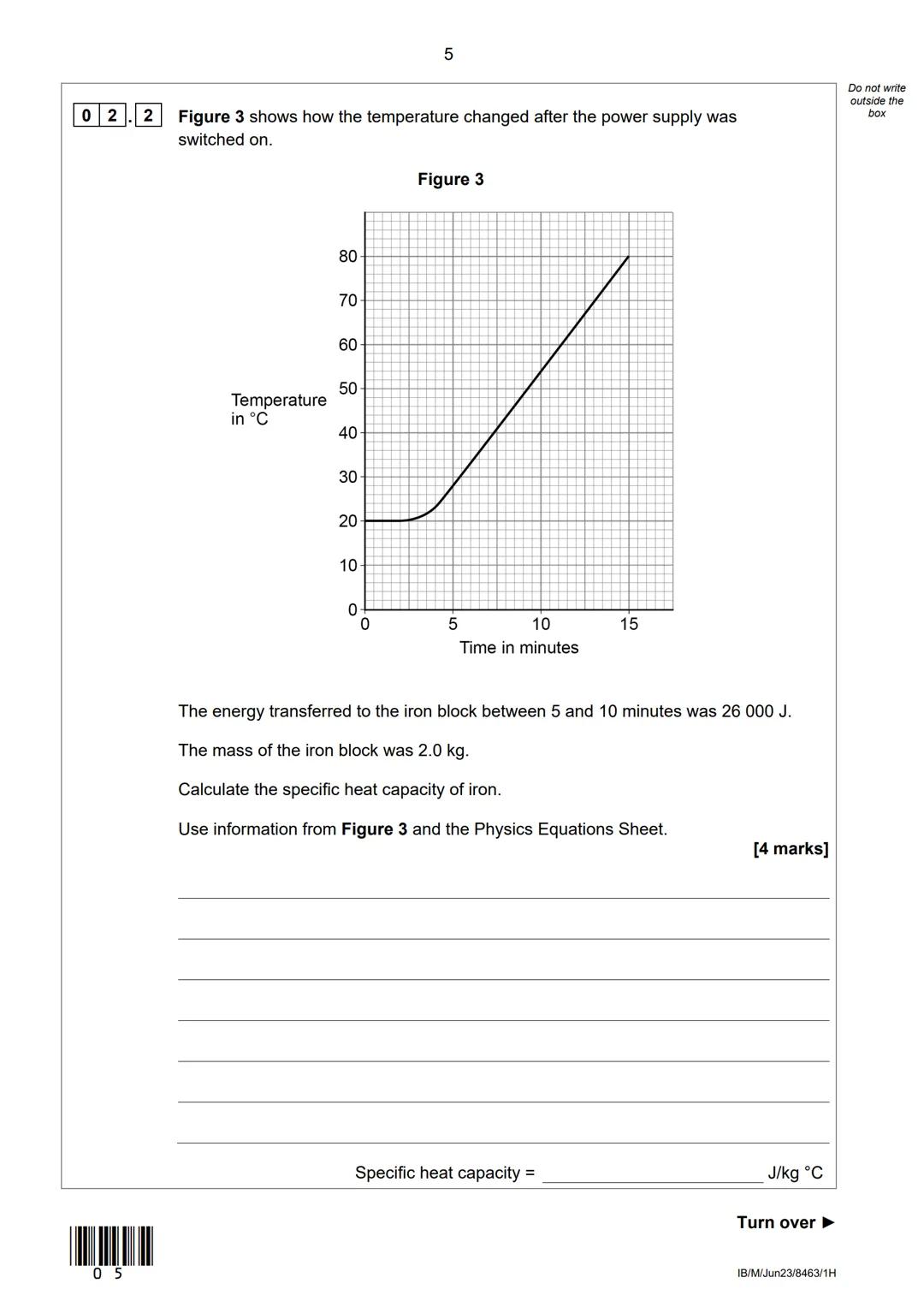
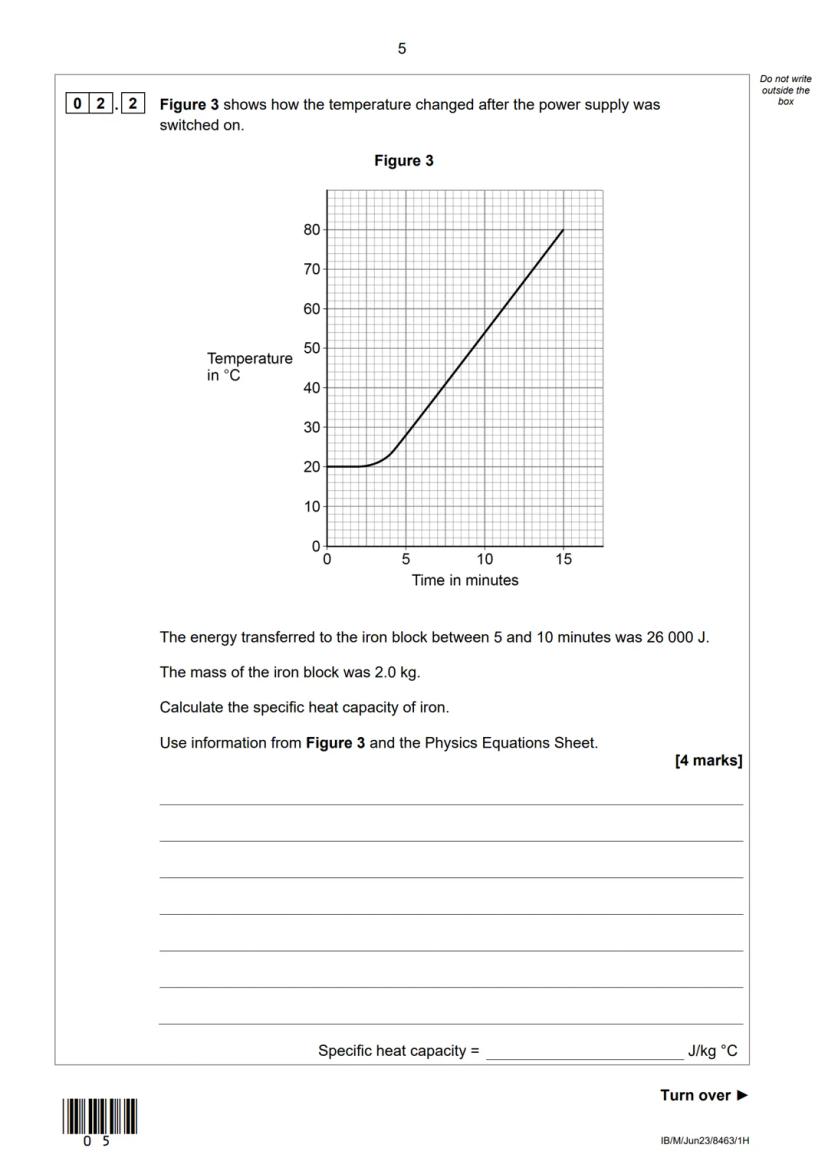
Calculating Specific Heat Capacity
The graph shows temperature change over time once the heater starts working. Between 5 and 10 minutes, you can see a steady temperature rise that's perfect for calculations.
Using the specific heat capacity formula , you'll work with 26,000 J of energy, 2.0 kg mass, and the temperature change from the graph. Read the temperatures carefully at 5 and 10 minutes.
Graph Skills: Always read values precisely from the grid lines - small errors here multiply through your calculation!
This practical demonstrates how different materials need different amounts of energy to heat up. Iron's specific heat capacity tells you exactly how much energy per kilogram per degree Celsius.
6
of 10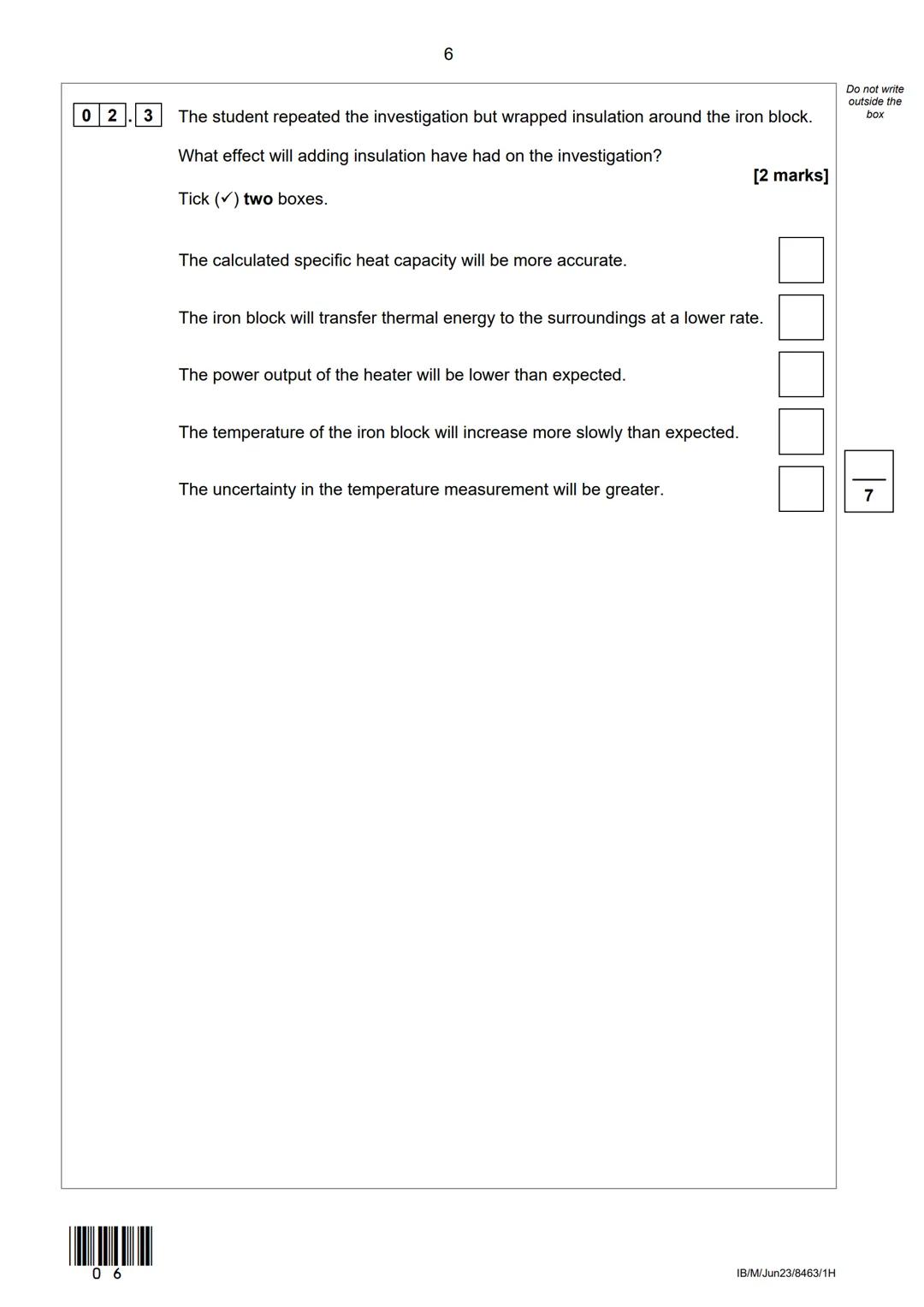
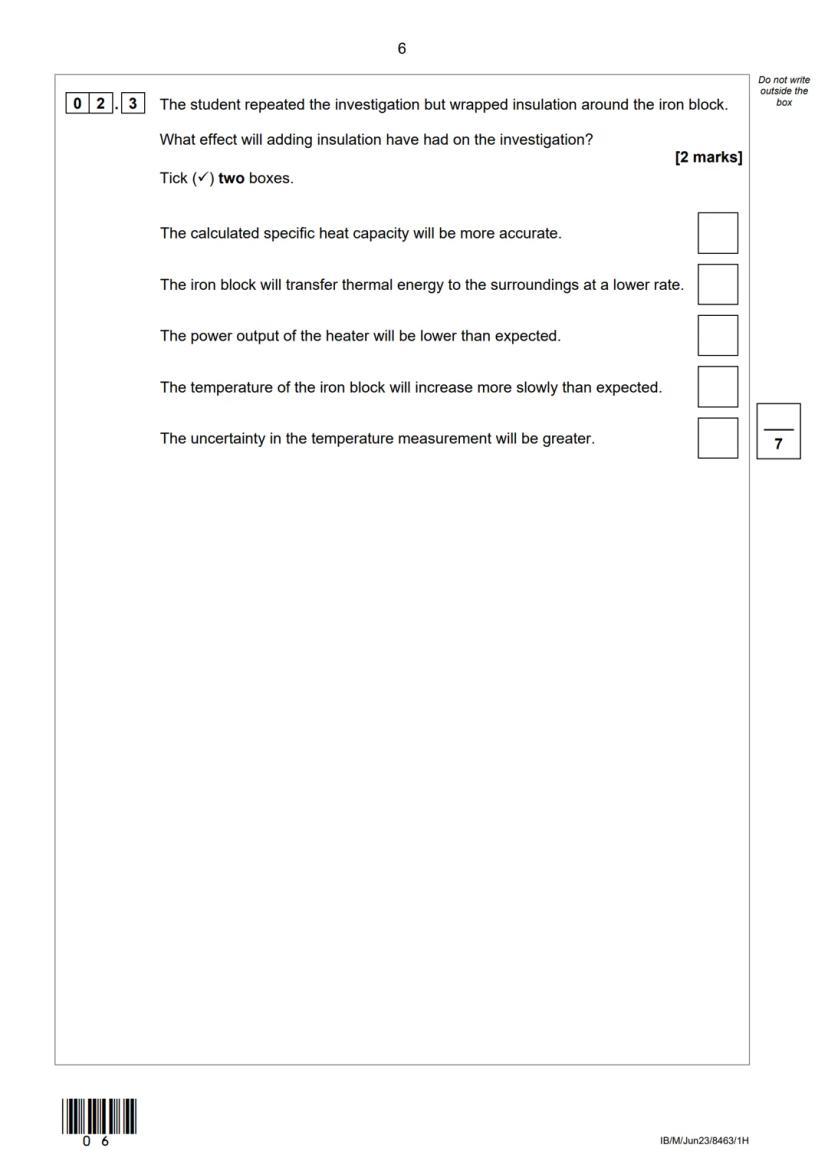
Improving Experimental Accuracy
Adding insulation around the iron block makes a massive difference to your results. It reduces heat loss to the surroundings, giving you more accurate measurements of the iron's actual specific heat capacity.
With insulation, the iron block transfers thermal energy to the surroundings much more slowly. This means more of the heater's energy actually goes into heating the iron rather than warming the air around it.
Error Analysis: Insulation is your best friend for getting reliable results in heating experiments!
You'll need to identify two correct effects from the list. Think about what happens when you reduce unwanted heat transfer - your measurements become much more reliable and the calculated values more accurate.
7
of 10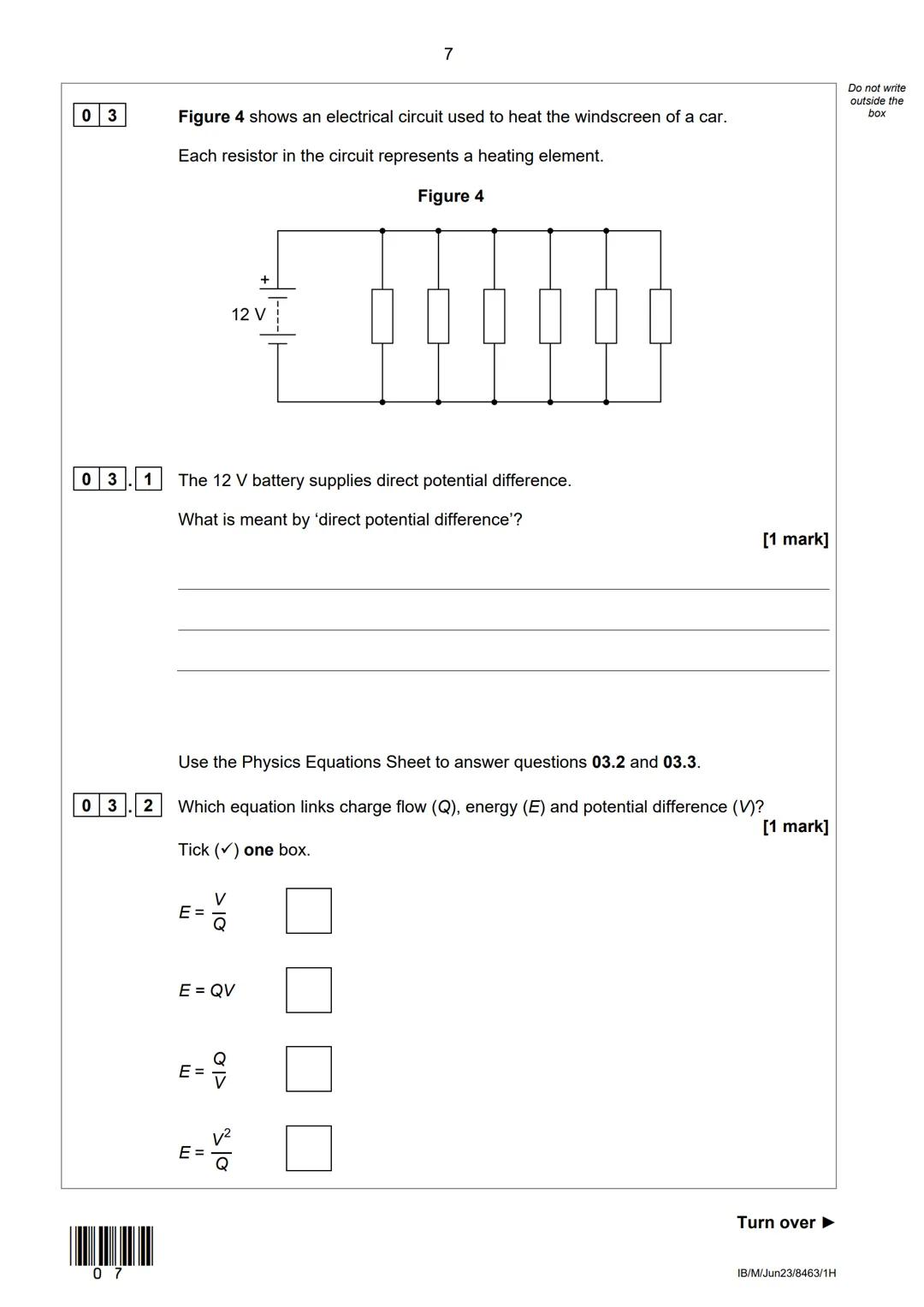
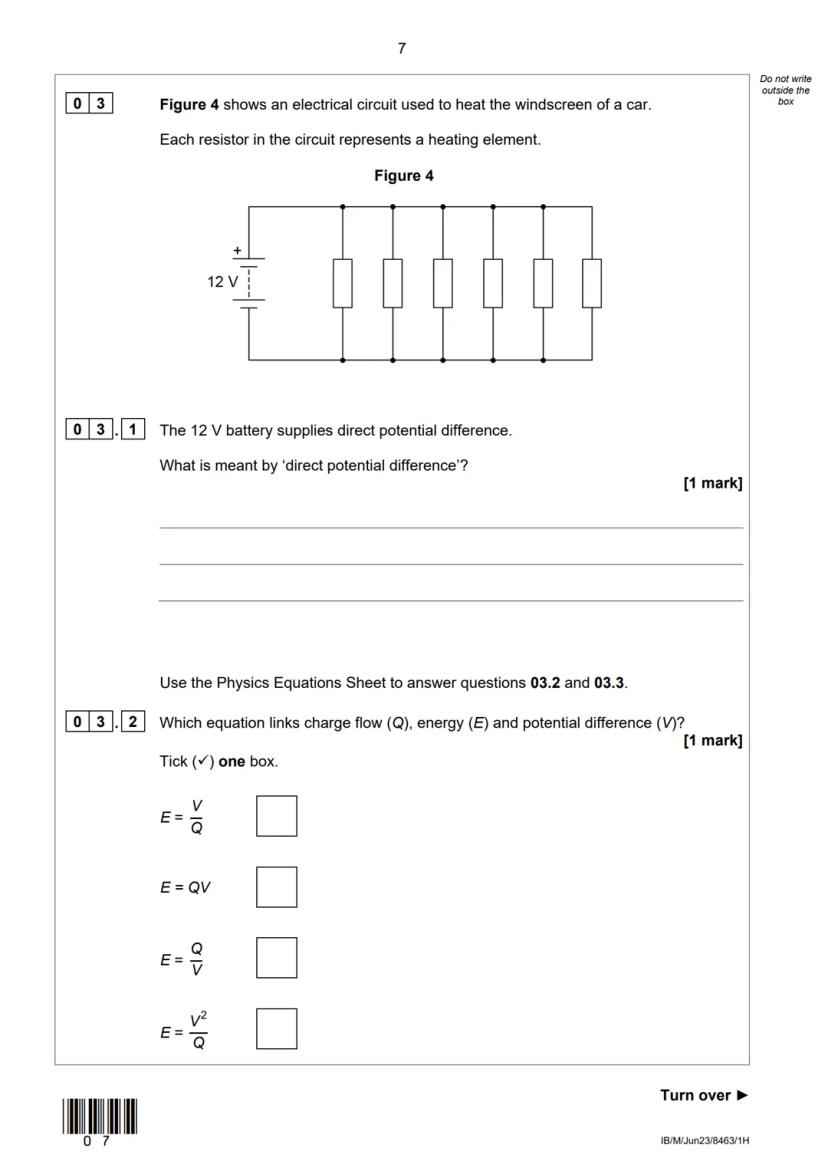
Direct Current and Electrical Circuits
Direct potential difference means the voltage doesn't change direction or vary with time - it's constant, unlike the alternating current in your home's mains supply. Car batteries provide this steady 12V supply.
You need to identify the correct equation linking charge flow, energy, and potential difference. The relationship E = QV is fundamental to understanding electrical circuits.
Memory Hook: Think "Energy = Charge × Voltage" - it's as straightforward as it sounds!
This circuit represents the heating elements in a car windscreen. Each resistor is a heating wire that melts ice when current flows through it.
8
of 10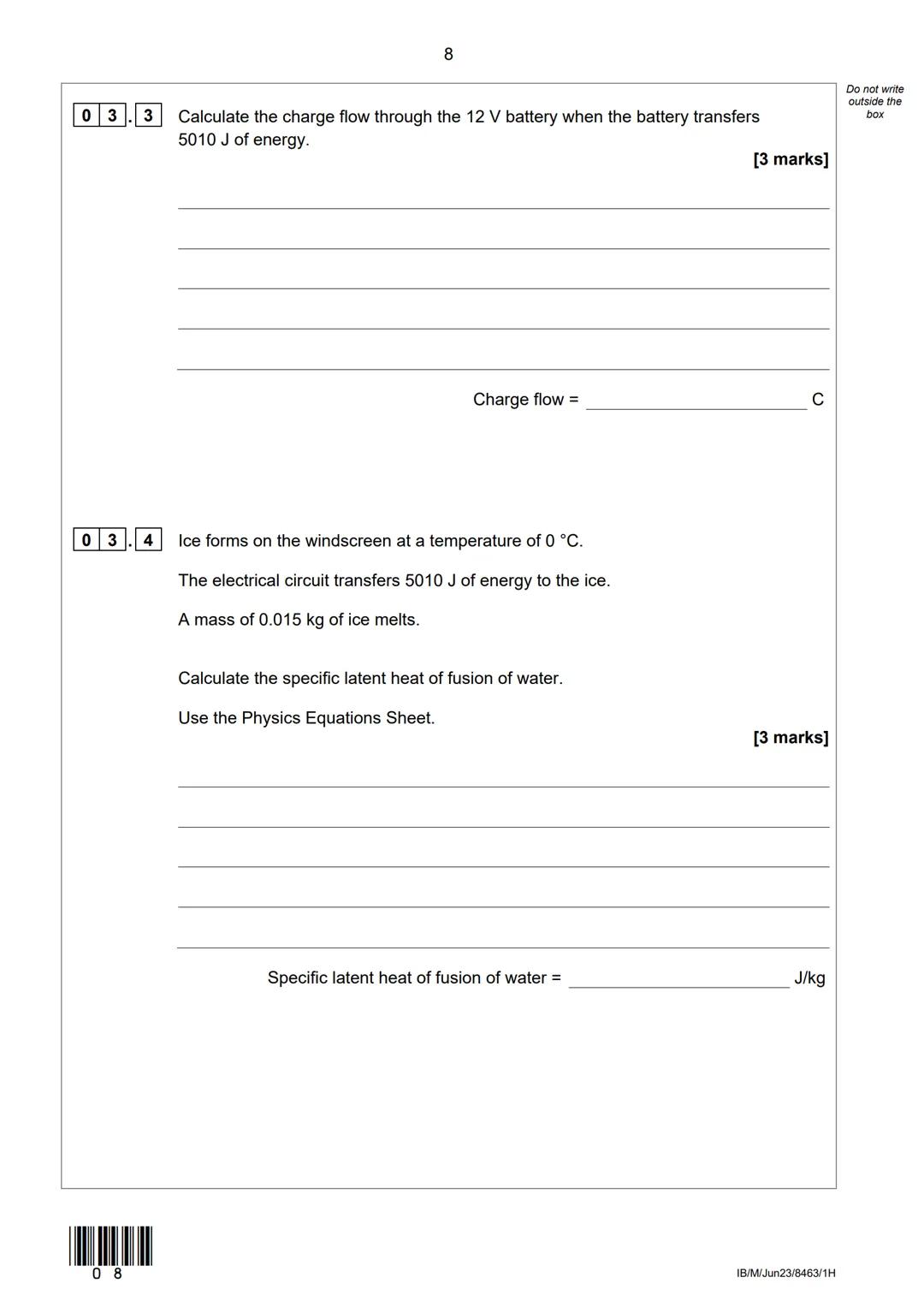
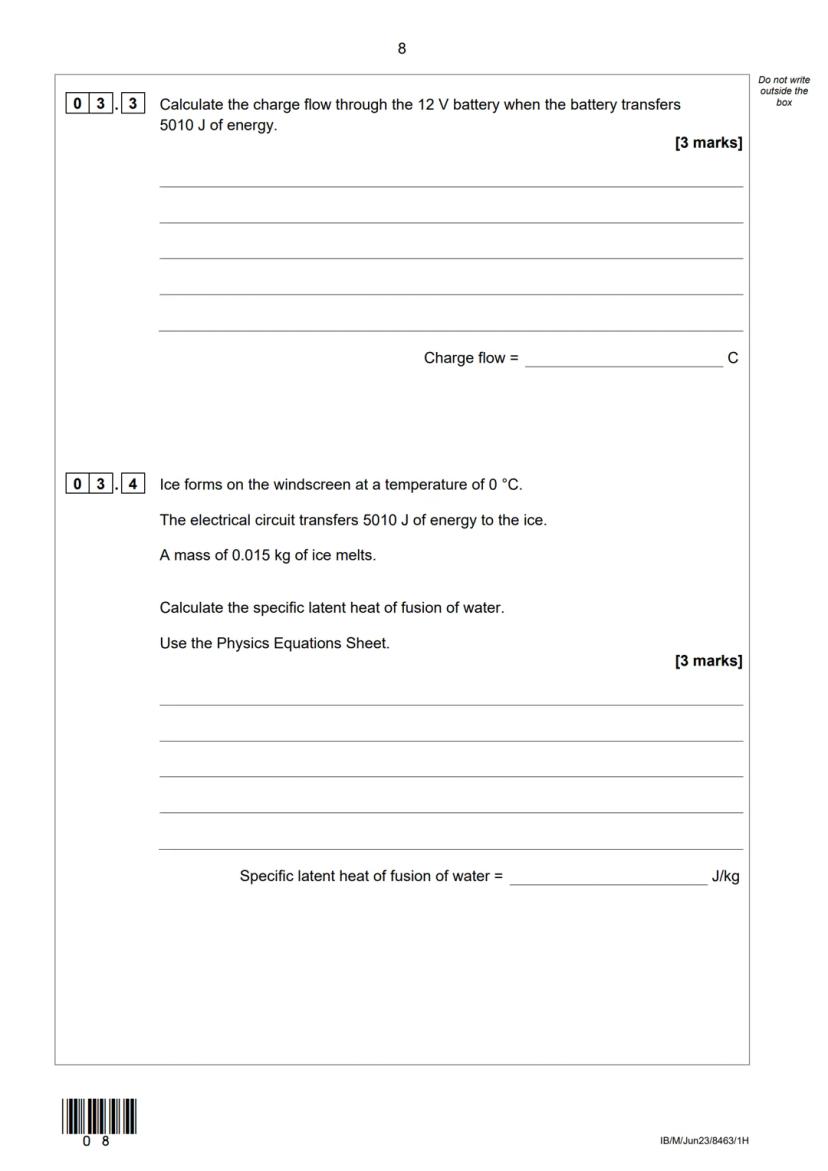
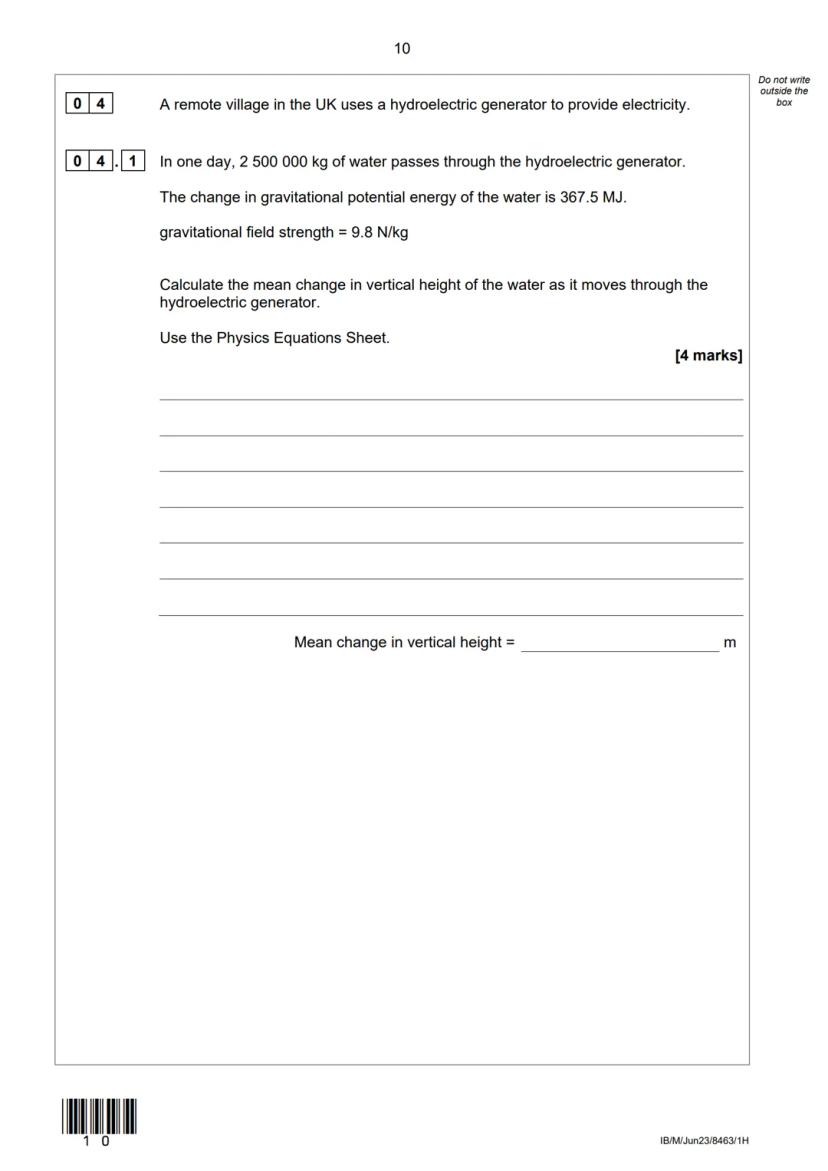
Charge Flow and Latent Heat Calculations
Calculate charge flow using Q = E ÷ V when the battery transfers 5010 J of energy at 12V. This shows how much electrical charge moved through the circuit to provide that energy.
The same 5010 J of energy melts 0.015 kg of ice, letting you calculate the specific latent heat of fusion of water. This is the energy needed per kilogram to change ice into liquid water at 0°C.
Key Concept: Latent heat is about changing state, not changing temperature - the ice stays at 0°C while melting!
Use L = E ÷ m to find how much energy per kilogram is needed for this phase change. It's a huge amount of energy compared to just heating water up.
9
of 10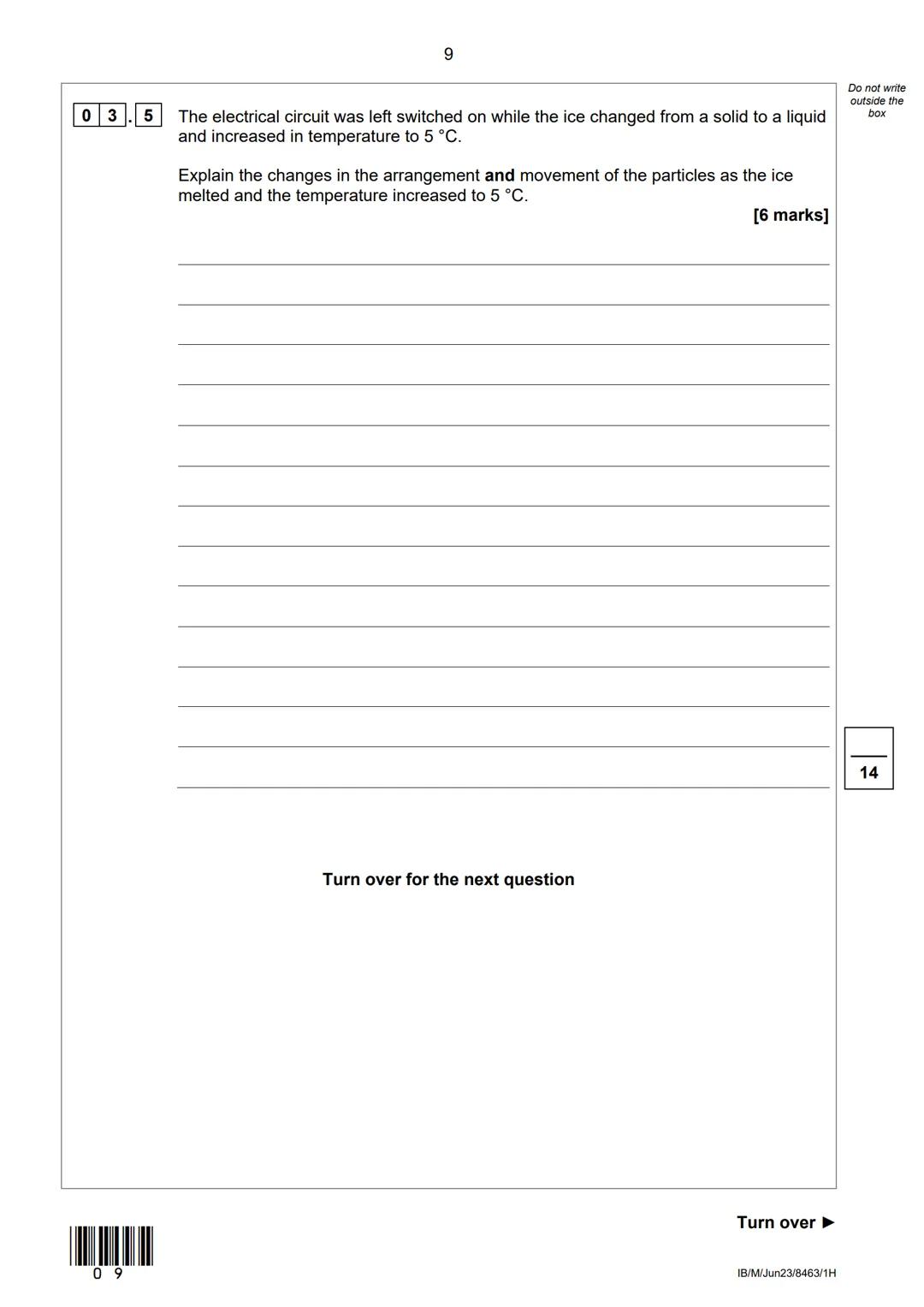
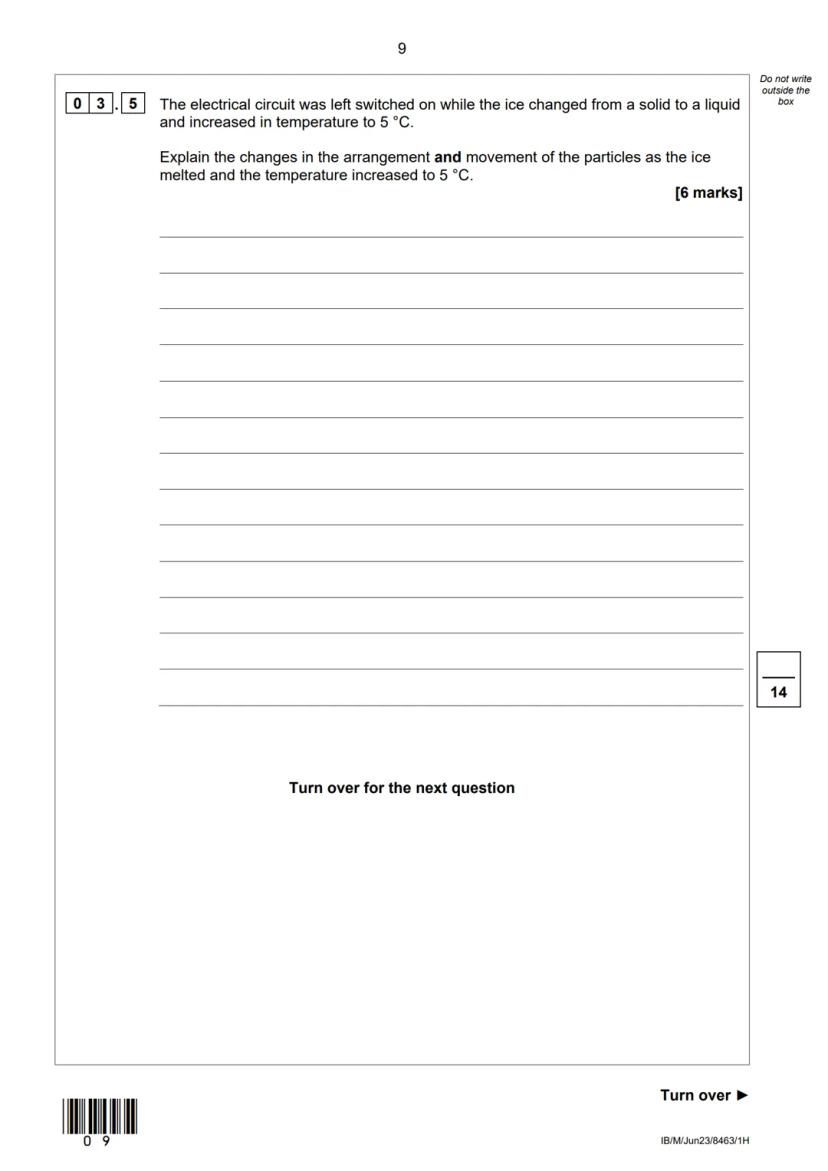
Particle Theory and State Changes
This question tests your understanding of what happens to particles during melting and heating. As ice melts, the rigid structure breaks down and particles gain freedom to move around each other.
During melting, particles vibrate more vigorously until they overcome the forces holding them in fixed positions. The arrangement changes from ordered (solid) to disordered (liquid).
Visualise This: Think of particles as people in a crowd - solids are like a military parade, liquids like people milling about at a festival!
When temperature increases from 0°C to 5°C after melting, the liquid water particles move faster and faster. More kinetic energy means more movement and higher temperature.
10
of 10
We thought you’d never ask...
Our AI Companion is a student-focused AI tool that offers more than just answers. Built on millions of Knowunity resources, it provides relevant information, personalised study plans, quizzes, and content directly in the chat, adapting to your individual learning journey.
You can download the app from Google Play Store and Apple App Store.
That's right! Enjoy free access to study content, connect with fellow students, and get instant help – all at your fingertips.
Similar content
Most popular content: Power
2PhysicsUnderstanding Power in Circuits
Explore the fundamentals of power in electrical circuits, including key formulas (P = E/t, P = VI) and the differences between series and parallel configurations. This summary covers energy transfer, voltage distribution, and current behavior in various circuit setups, making it essential for A-Level Physics students.
12962
PhysicsUnderstanding Domestic Electricity
Explore the fundamentals of domestic electricity, including household plugs, electrical circuits, energy efficiency, and the workings of the electric grid. This summary covers key concepts such as Ohm's Law, power calculations, and the importance of safety measures like fuses and earthing. Ideal for AQA GCSE students preparing for exams.
1151214
Most popular content in Physics
9G
PhysicsGCSE Physics - Energy stores and Systems
Pl-Energy topic to revise for GCSE
111,3782
PhysicsForces and Motion Overview
Explore key concepts in Forces and Motion, including Hooke's Law, velocity, acceleration, and the principles of moments. This summary covers essential topics such as the relationship between force and extension, terminal velocity, and the impact of safety devices in physics. Ideal for AQA Physics Unit 5 revision.
109,205872
C
PhysicsConservation of energy- energy types and stores
Build a strong foundation in physics with these easy flashcards covering key concepts and principles.
96411
P
PhysicsPhysics Made Easy: Essential Concepts for Grade 10 Students
Master the fundamentals of physics with this comprehensive flashcard set designed specifically for grade 10 students. Learn key concepts and principles in an easy and engaging way!
104541
PhysicsPhysics paper 2 notes
physics aqa gcse paper 2 combined higher notes
101,24411
PhysicsPhysics Paper 2 Essentials
Master key concepts for AQA Combined Physics Paper 2, including electromagnetic waves, mechanics, forces, and motion. This comprehensive summary covers essential topics like wave properties, Newton's laws, and the motor effect, ensuring you're well-prepared for your exam.
1116,074940
PhysicsGCSE Physics Practical Experiments
Explore essential GCSE Physics practicals for AQA, covering key concepts such as Hooke's Law, wave properties, thermal insulation, and electrical circuits. This comprehensive guide includes step-by-step procedures, variables, and safety considerations for each experiment, ensuring a thorough understanding of practical applications in physics.
1011,413477
I
PhysicsIdentifying Types of Energy Stores
Learn to recognize different energy stores including kinetic, gravitational potential, chemical, and thermal in various objects and systems.
S32380
Physicsphysics paper 2 foundation notes
aqa combined science physics paper 2 foundation notes
111,33138
Most popular content
9 Sociology
Sociology of Education Overview
Explore comprehensive A-Level Sociology notes on the education system, covering key theories, policies, and sociological perspectives. This resource includes insights on marketisation, gender roles, cultural deprivation, and educational inequalities, providing a thorough understanding of how education shapes social stratification and individual achievement. Ideal for exam preparation and in-depth study.
12102,9313,041
SociologySociology of Families: Comprehensive Revision
Dive into an extensive overview of family dynamics, perspectives, and patterns in sociology. This resource covers key concepts such as family diversity, gender roles, marriage, and the impact of social policies on family structures. Perfect for A-Level Sociology students preparing for Paper 2.
1273,7382,307
CriminologyCriminology: Crime & Punishment Overview
Comprehensive mindmaps covering key concepts in the Crime and Punishment topic for WJEC Criminology Unit 4. This resource includes detailed insights into the Criminal Justice System, crime prevention strategies, sentencing models, and the roles of various agencies. Ideal for A-Level revision, ensuring you grasp essential theories and legislative processes to excel in your exams.
1254,8921,060
SociologyComprehensive Crime & Deviance Overview
Explore an extensive revision of crime and deviance topics, including theories, types of crime, and the impact of media. This resource covers key concepts such as Marxism, functionalism, gender and crime, and the influence of globalization on criminal behavior. Ideal for students seeking a thorough understanding of criminology and its various theories. Type: Full Topic Revision.
1251,6681,400
C
 Biology
Cell Biology and Cell structure
cell structures
93,2720
CriminologyWJEC Unit 4 Criminology
Criminology unit 4 detailed revision note
127,173125
SociologySociological Theories Overview
Comprehensive revision of key sociological theories including Functionalism, Marxism, Feminism, and Interpretivism. Explore concepts like value freedom, identity formation, and the critique of social control. Ideal for AQA A-Level Sociology students preparing for exams. This summary covers essential theories and their implications in sociology, providing a clear understanding of each perspective.
1231,474846
T
BiologyThe functions of subcellular structures - B1 Biology
Flashcards on the different functions of subcellular structures: cell membrane, nucleus, mitochondria, ribosomes, cytoplasm, permant vacuole, chloroplasts and cell wall.
102,8215
1
Biology1.cells Gcse biology question cards
combined science higher biology
92,3604
Students love us — and so will you.
4.6/5App Store
4.7/5Google Play
The app is very easy to use and well designed. I have found everything I was looking for so far and have been able to learn a lot from the presentations! I will definitely use the app for a class assignment! And of course it also helps a lot as an inspiration.
Stefan SiOS user
This app is really great. There are so many study notes and help [...]. My problem subject is French, for example, and the app has so many options for help. Thanks to this app, I have improved my French. I would recommend it to anyone.
Samantha KlichAndroid user
Wow, I am really amazed. I just tried the app because I've seen it advertised many times and was absolutely stunned. This app is THE HELP you want for school and above all, it offers so many things, such as workouts and fact sheets, which have been VERY helpful to me personally.
AnnaiOS user
Physics429 views·Updated 16 Jul 2026·32 pages2023 Physics Paper 1: Practice Exam
Z
Zach Sandford@zachsandford
This GCSE Physics Higher Tier paper covers essential topics including the National Grid, specific heat capacity experiments, electrical circuits, and renewable energy. You'll tackle real-world applications like power transmission, car windscreen heating systems, and hydroelectric generators.
1
of 10
Sign up to see the content. It's free!
- Access to all documents
- Improve your grades
- Join milions of students
By signing up you accept Terms of Service and Privacy Policy
Exam Information and Setup
This is your standard GCSE Physics Higher Tier paper worth 100 marks total. You've got 1 hour 45 minutes to complete it, so that's roughly just over a minute per mark - perfect for pacing yourself.
Make sure you've got your scientific calculator and Physics Equations Sheet ready. These are absolute essentials, especially since many questions specifically tell you to use the equations sheet.
Top Tip: Always show your working clearly in calculations - you can pick up method marks even if your final answer isn't quite right!
Remember to write in black ink and only use pencil for diagrams. The paper expects you to demonstrate good English and clear presentation, so take your time to write legibly.
2
of 10Sign up to see the content. It's free!
- Access to all documents
- Improve your grades
- Join milions of students
By signing up you accept Terms of Service and Privacy Policy
National Grid and Power Transmission
The National Grid connects power stations to your home through a clever system of transformers. Transformer X (the step-up transformer) increases the potential difference and decreases the current for efficient long-distance transmission.
You'll need to identify the correct power equation that links current, power, and resistance. The key relationship here is P = I²R, which is crucial for understanding power losses in transmission cables.
Remember: High voltage transmission reduces current, which dramatically cuts power losses in the cables!
This setup is all about energy efficiency - by stepping up the voltage, we can transmit electricity across the country without wasting loads of energy as heat in the cables.
3
of 10Sign up to see the content. It's free!
- Access to all documents
- Improve your grades
- Join milions of students
By signing up you accept Terms of Service and Privacy Policy
Power Loss Calculations and Grid Efficiency
Here's where the maths gets practical! You'll calculate the resistance of transmission cables using the power loss formula. With a power loss of 1.60 × 10⁹ W and current of 2000 A, you can find resistance using P = I²R.
The efficiency equation connects total energy input with useful energy output. It's straightforward: efficiency = useful energy output ÷ total energy input.
Quick Check: An efficiency of 0.992 means 99.2% of energy reaches consumers - that's pretty impressive for such a massive system!
With 34.2 GJ input and 0.992 efficiency, you can calculate exactly how much energy reaches homes and businesses. This shows why the National Grid is so well-designed.
4
of 10Sign up to see the content. It's free!
- Access to all documents
- Improve your grades
- Join milions of students
By signing up you accept Terms of Service and Privacy Policy
Specific Heat Capacity Experiment Setup
This classic specific heat capacity experiment uses a metal block with holes for a heater and thermometer. The setup includes a joulemeter to measure energy input and a stopwatch for timing.
The key technique here is letting the thermometer equilibrate with the iron block before recording the initial temperature. This ensures you get an accurate starting point for your measurements.
Lab Wisdom: Always wait for thermal equilibrium - rushing this step ruins your entire experiment!
The equipment layout is dead simple but effective. You're measuring how much energy it takes to heat up a known mass of iron by a specific temperature change.
5
of 10Sign up to see the content. It's free!
- Access to all documents
- Improve your grades
- Join milions of students
By signing up you accept Terms of Service and Privacy Policy
Calculating Specific Heat Capacity
The graph shows temperature change over time once the heater starts working. Between 5 and 10 minutes, you can see a steady temperature rise that's perfect for calculations.
Using the specific heat capacity formula , you'll work with 26,000 J of energy, 2.0 kg mass, and the temperature change from the graph. Read the temperatures carefully at 5 and 10 minutes.
Graph Skills: Always read values precisely from the grid lines - small errors here multiply through your calculation!
This practical demonstrates how different materials need different amounts of energy to heat up. Iron's specific heat capacity tells you exactly how much energy per kilogram per degree Celsius.
6
of 10Sign up to see the content. It's free!
- Access to all documents
- Improve your grades
- Join milions of students
By signing up you accept Terms of Service and Privacy Policy
Improving Experimental Accuracy
Adding insulation around the iron block makes a massive difference to your results. It reduces heat loss to the surroundings, giving you more accurate measurements of the iron's actual specific heat capacity.
With insulation, the iron block transfers thermal energy to the surroundings much more slowly. This means more of the heater's energy actually goes into heating the iron rather than warming the air around it.
Error Analysis: Insulation is your best friend for getting reliable results in heating experiments!
You'll need to identify two correct effects from the list. Think about what happens when you reduce unwanted heat transfer - your measurements become much more reliable and the calculated values more accurate.
7
of 10Sign up to see the content. It's free!
- Access to all documents
- Improve your grades
- Join milions of students
By signing up you accept Terms of Service and Privacy Policy
Direct Current and Electrical Circuits
Direct potential difference means the voltage doesn't change direction or vary with time - it's constant, unlike the alternating current in your home's mains supply. Car batteries provide this steady 12V supply.
You need to identify the correct equation linking charge flow, energy, and potential difference. The relationship E = QV is fundamental to understanding electrical circuits.
Memory Hook: Think "Energy = Charge × Voltage" - it's as straightforward as it sounds!
This circuit represents the heating elements in a car windscreen. Each resistor is a heating wire that melts ice when current flows through it.
8
of 10Sign up to see the content. It's free!
- Access to all documents
- Improve your grades
- Join milions of students
By signing up you accept Terms of Service and Privacy Policy
Charge Flow and Latent Heat Calculations
Calculate charge flow using Q = E ÷ V when the battery transfers 5010 J of energy at 12V. This shows how much electrical charge moved through the circuit to provide that energy.
The same 5010 J of energy melts 0.015 kg of ice, letting you calculate the specific latent heat of fusion of water. This is the energy needed per kilogram to change ice into liquid water at 0°C.
Key Concept: Latent heat is about changing state, not changing temperature - the ice stays at 0°C while melting!
Use L = E ÷ m to find how much energy per kilogram is needed for this phase change. It's a huge amount of energy compared to just heating water up.
9
of 10Sign up to see the content. It's free!
- Access to all documents
- Improve your grades
- Join milions of students
By signing up you accept Terms of Service and Privacy Policy
Particle Theory and State Changes
This question tests your understanding of what happens to particles during melting and heating. As ice melts, the rigid structure breaks down and particles gain freedom to move around each other.
During melting, particles vibrate more vigorously until they overcome the forces holding them in fixed positions. The arrangement changes from ordered (solid) to disordered (liquid).
Visualise This: Think of particles as people in a crowd - solids are like a military parade, liquids like people milling about at a festival!
When temperature increases from 0°C to 5°C after melting, the liquid water particles move faster and faster. More kinetic energy means more movement and higher temperature.
10
of 10Sign up to see the content. It's free!
- Access to all documents
- Improve your grades
- Join milions of students
By signing up you accept Terms of Service and Privacy Policy
We thought you’d never ask...
Our AI Companion is a student-focused AI tool that offers more than just answers. Built on millions of Knowunity resources, it provides relevant information, personalised study plans, quizzes, and content directly in the chat, adapting to your individual learning journey.
You can download the app from Google Play Store and Apple App Store.
That's right! Enjoy free access to study content, connect with fellow students, and get instant help – all at your fingertips.
Similar content
Most popular content: Power
2PhysicsUnderstanding Power in Circuits
Explore the fundamentals of power in electrical circuits, including key formulas (P = E/t, P = VI) and the differences between series and parallel configurations. This summary covers energy transfer, voltage distribution, and current behavior in various circuit setups, making it essential for A-Level Physics students.
12962
PhysicsUnderstanding Domestic Electricity
Explore the fundamentals of domestic electricity, including household plugs, electrical circuits, energy efficiency, and the workings of the electric grid. This summary covers key concepts such as Ohm's Law, power calculations, and the importance of safety measures like fuses and earthing. Ideal for AQA GCSE students preparing for exams.
1151214
Most popular content in Physics
9G
PhysicsGCSE Physics - Energy stores and Systems
Pl-Energy topic to revise for GCSE
111,3782
PhysicsForces and Motion Overview
Explore key concepts in Forces and Motion, including Hooke's Law, velocity, acceleration, and the principles of moments. This summary covers essential topics such as the relationship between force and extension, terminal velocity, and the impact of safety devices in physics. Ideal for AQA Physics Unit 5 revision.
109,205872
C
PhysicsConservation of energy- energy types and stores
Build a strong foundation in physics with these easy flashcards covering key concepts and principles.
96411
P
PhysicsPhysics Made Easy: Essential Concepts for Grade 10 Students
Master the fundamentals of physics with this comprehensive flashcard set designed specifically for grade 10 students. Learn key concepts and principles in an easy and engaging way!
104541
PhysicsPhysics paper 2 notes
physics aqa gcse paper 2 combined higher notes
101,24411
PhysicsPhysics Paper 2 Essentials
Master key concepts for AQA Combined Physics Paper 2, including electromagnetic waves, mechanics, forces, and motion. This comprehensive summary covers essential topics like wave properties, Newton's laws, and the motor effect, ensuring you're well-prepared for your exam.
1116,074940
PhysicsGCSE Physics Practical Experiments
Explore essential GCSE Physics practicals for AQA, covering key concepts such as Hooke's Law, wave properties, thermal insulation, and electrical circuits. This comprehensive guide includes step-by-step procedures, variables, and safety considerations for each experiment, ensuring a thorough understanding of practical applications in physics.
1011,413477
I
PhysicsIdentifying Types of Energy Stores
Learn to recognize different energy stores including kinetic, gravitational potential, chemical, and thermal in various objects and systems.
S32380
Physicsphysics paper 2 foundation notes
aqa combined science physics paper 2 foundation notes
111,33138
Most popular content
9SociologySociology of Education Overview
Explore comprehensive A-Level Sociology notes on the education system, covering key theories, policies, and sociological perspectives. This resource includes insights on marketisation, gender roles, cultural deprivation, and educational inequalities, providing a thorough understanding of how education shapes social stratification and individual achievement. Ideal for exam preparation and in-depth study.
12102,9313,041
SociologySociology of Families: Comprehensive Revision
Dive into an extensive overview of family dynamics, perspectives, and patterns in sociology. This resource covers key concepts such as family diversity, gender roles, marriage, and the impact of social policies on family structures. Perfect for A-Level Sociology students preparing for Paper 2.
1273,7382,307
CriminologyCriminology: Crime & Punishment Overview
Comprehensive mindmaps covering key concepts in the Crime and Punishment topic for WJEC Criminology Unit 4. This resource includes detailed insights into the Criminal Justice System, crime prevention strategies, sentencing models, and the roles of various agencies. Ideal for A-Level revision, ensuring you grasp essential theories and legislative processes to excel in your exams.
1254,8921,060
SociologyComprehensive Crime & Deviance Overview
Explore an extensive revision of crime and deviance topics, including theories, types of crime, and the impact of media. This resource covers key concepts such as Marxism, functionalism, gender and crime, and the influence of globalization on criminal behavior. Ideal for students seeking a thorough understanding of criminology and its various theories. Type: Full Topic Revision.
1251,6681,400
C
BiologyCell Biology and Cell structure
cell structures
93,2720
CriminologyWJEC Unit 4 Criminology
Criminology unit 4 detailed revision note
127,173125
SociologySociological Theories Overview
Comprehensive revision of key sociological theories including Functionalism, Marxism, Feminism, and Interpretivism. Explore concepts like value freedom, identity formation, and the critique of social control. Ideal for AQA A-Level Sociology students preparing for exams. This summary covers essential theories and their implications in sociology, providing a clear understanding of each perspective.
1231,474846
T
BiologyThe functions of subcellular structures - B1 Biology
Flashcards on the different functions of subcellular structures: cell membrane, nucleus, mitochondria, ribosomes, cytoplasm, permant vacuole, chloroplasts and cell wall.
102,8215
1
Biology1.cells Gcse biology question cards
combined science higher biology
92,3604
Students love us — and so will you.
4.6/5App Store
4.7/5Google Play
The app is very easy to use and well designed. I have found everything I was looking for so far and have been able to learn a lot from the presentations! I will definitely use the app for a class assignment! And of course it also helps a lot as an inspiration.
Stefan SiOS user
This app is really great. There are so many study notes and help [...]. My problem subject is French, for example, and the app has so many options for help. Thanks to this app, I have improved my French. I would recommend it to anyone.
Samantha KlichAndroid user
Wow, I am really amazed. I just tried the app because I've seen it advertised many times and was absolutely stunned. This app is THE HELP you want for school and above all, it offers so many things, such as workouts and fact sheets, which have been VERY helpful to me personally.
AnnaiOS user