The Skeletal System: Your Body's Amazing Framework
Ever wondered why you don't collapse into a heap on the floor? Your skeletal system is working 24/7 to keep you together! This incredible network of 206 bones does way more than just hold you up.
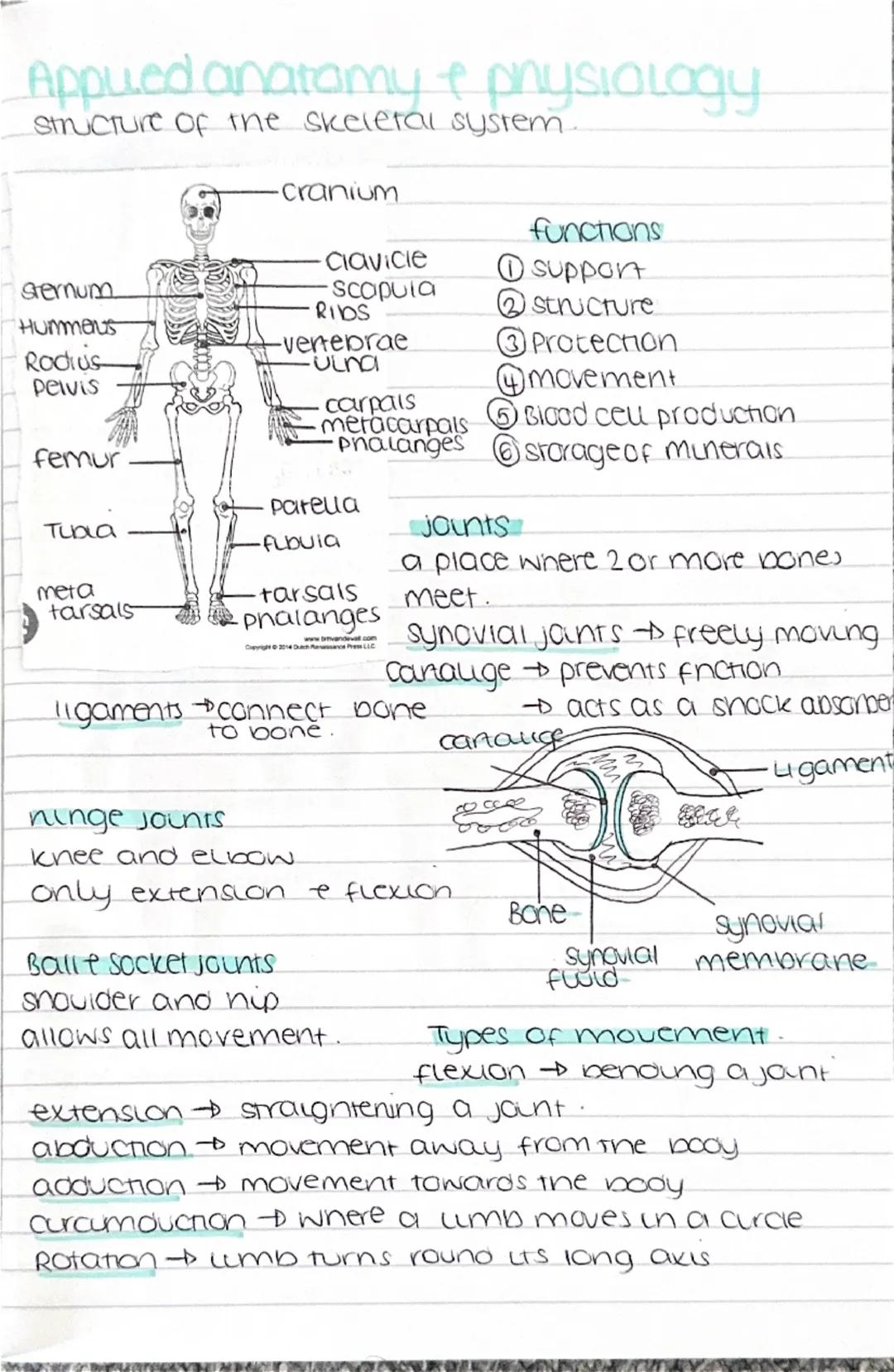
Your skeleton has five main jobs that keep you alive and kicking. It provides support for your entire body weight, gives you structure so you actually look human-shaped, and offers protection for delicate organs like your brain and heart. Plus, it enables movement when muscles pull on bones, and even produces blood cells in your bone marrow while storing essential minerals like calcium.
The major bones you need to know include your cranium (skull), clavicle (collarbone), sternum (breastbone), and scapula (shoulder blade). Your arms contain the humerus, radius, and ulna, whilst your hands have carpals, metacarpals, and phalanges (finger bones). Don't forget your vertebrae (spine), ribs, pelvis, and leg bones like the femur, patella (kneecap), tibia, fibula, plus foot bones including tarsals, metatarsals, and toe phalanges.
Joints are where two or more bones meet, and they're absolutely crucial for movement. Synovial joints are the freely moving ones, lubricated by synovial fluid and cushioned by cartilage that prevents friction. Ligaments connect bone to bone and act like natural shock absorbers.
Key Point: Cartilage is like your body's built-in bubble wrap - it stops bones grinding against each other and absorbs impact when you move!
You've got different joint types for different jobs. Hinge joints at your knee and elbow only allow flexion (bending) and extension (straightening). Ball and socket joints at your shoulder and hip are the superstars - they allow abduction (movement away from body), adduction (movement towards body), circumduction (circular movement), and rotation (turning around the bone's axis).

 Physical Education
 Biology
 Combined Science
 English Literature
 Sociology