
Ever wondered how the UK education system actually works and... Show more
 Other
Other Sociology
Sign up to see the contentIt's free!
Access to all documents
Improve your grades
Join milions of students
By signing up you accept Terms of Service and Privacy Policy
Subjects

Maths

Chemistry

Biology

English Language

History
Responding to change (a2 only)
Infection and response
Homeostasis and response
Energy transfers (a2 only)
Cell biology
Organisms respond to changes in their internal and external environments (a-level only)
Biological molecules
Organisation
Substance exchange
Bioenergetics
Genetic information & variation
Inheritance, variation and evolution
Genetics & ecosystems (a2 only)
Ecology
Cells
Show all topics
Britain & the wider world: 1745 -1901
1l the quest for political stability: germany, 1871-1991
The cold war
Inter-war germany
Medieval period: 1066 -1509
2d religious conflict and the church in england, c1529-c1570
2o democracy and nazism: germany, 1918-1945
1f industrialisation and the people: britain, c1783-1885
1c the tudors: england, 1485-1603
2m wars and welfare: britain in transition, 1906-1957
World war two & the holocaust
2n revolution and dictatorship: russia, 1917-1953
2s the making of modern britain, 1951-2007
World war one
Britain: 1509 -1745
Show all topics
166
•
10 Dec 2025
•

Tia
@tia.1
Ever wondered how the UK education system actually works and... Show more
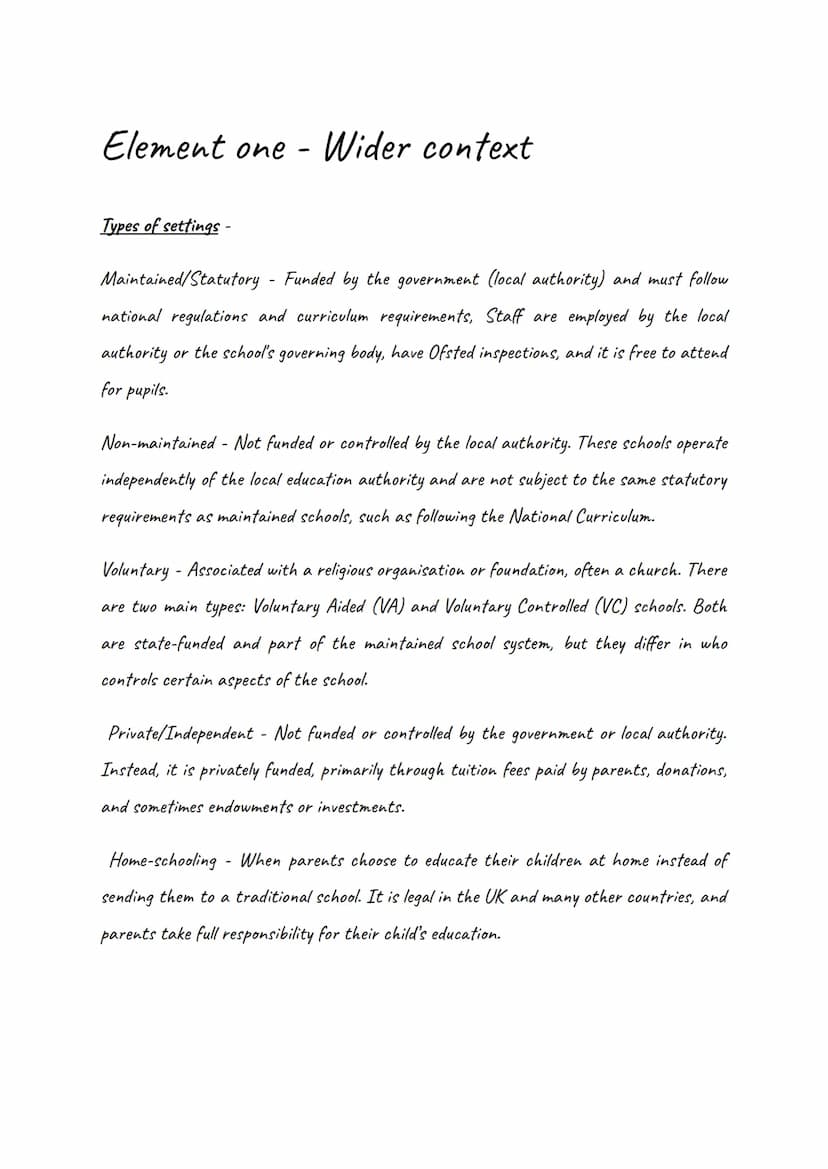
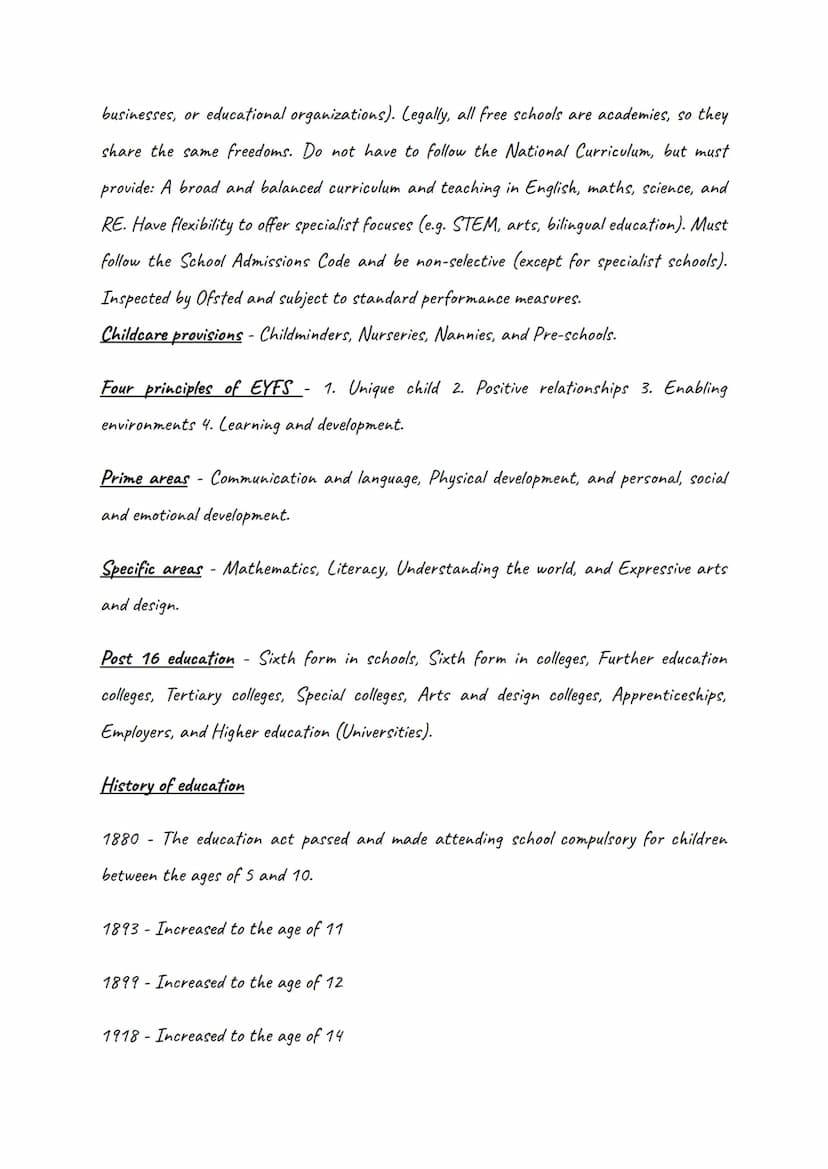
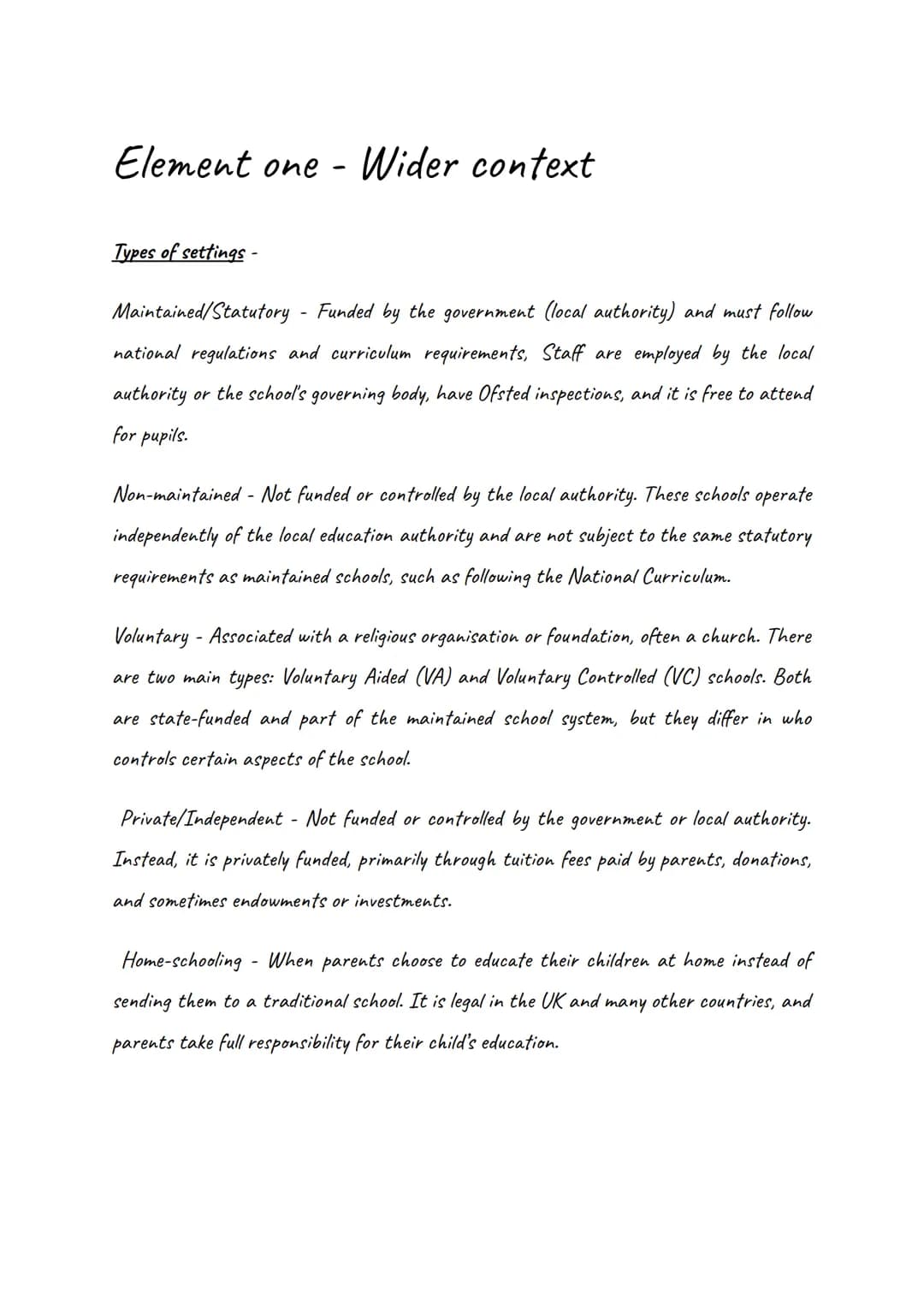
The UK education system isn't just "school" - there are loads of different types, each with their own rules and funding. Maintained schools are the ones funded by your local council, so they're free to attend and must follow the National Curriculum. Think of your typical primary or secondary school down the road.
Non-maintained schools operate independently from local authorities and don't have to stick to all the same rules. Voluntary schools have religious connections - usually churches - but still get government funding. Meanwhile, private schools charge fees and can pretty much do their own thing curriculum-wise.
Home-schooling is completely legal in the UK, where parents take full responsibility for their child's education. You don't need to follow the National Curriculum or take SATs if you're home-schooled, though some families choose to anyway.
Key Point: Understanding these differences helps explain why your mate's school might do things differently to yours - it's all about who's in charge and who pays the bills!
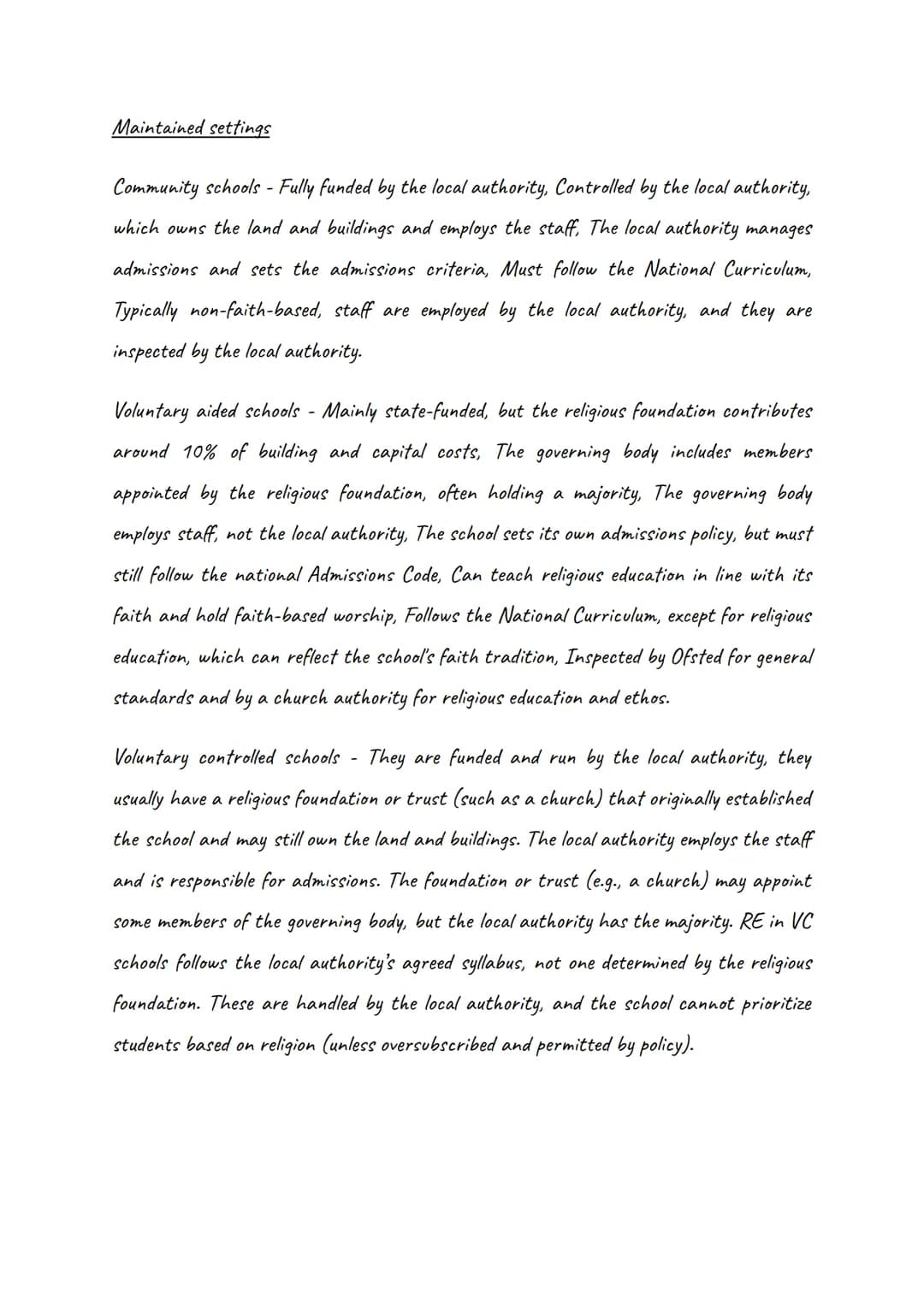
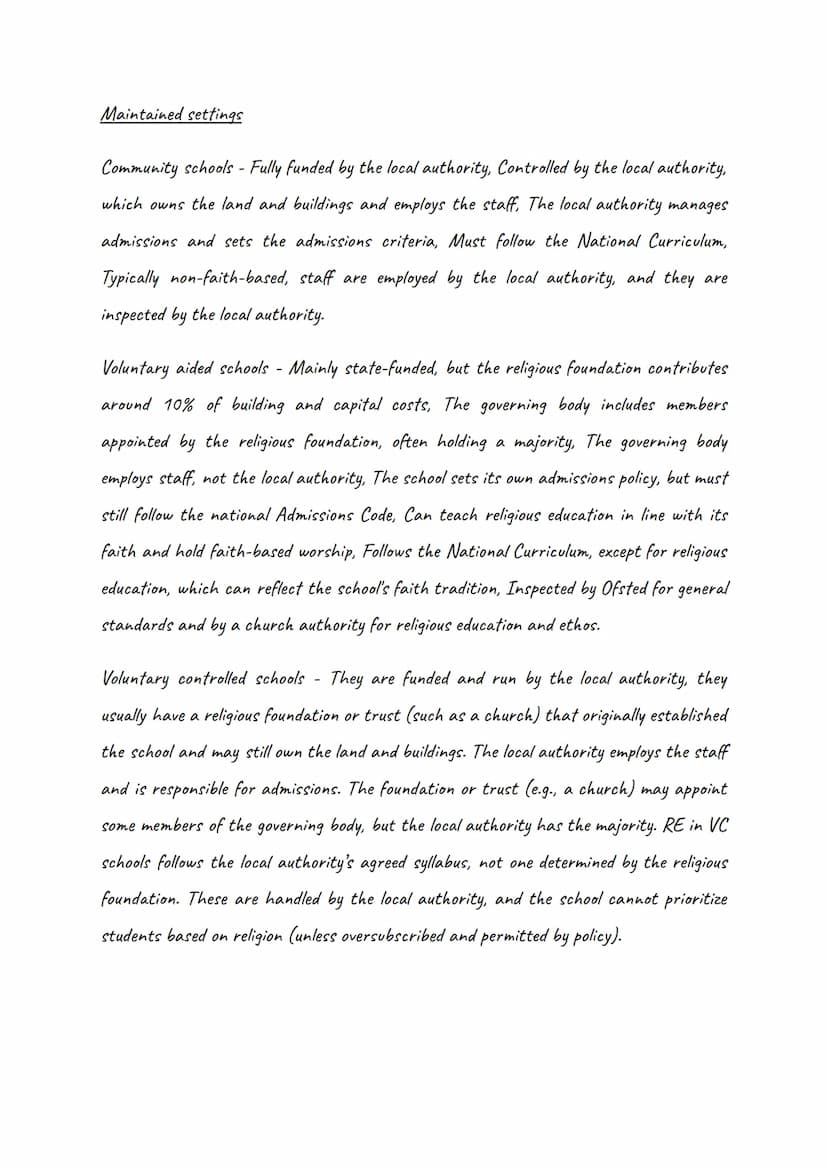
Community schools are your standard state schools - fully funded and controlled by the local authority. They follow the National Curriculum religiously and are completely non-faith based. The council owns everything and employs all the staff.
Voluntary aided schools are where it gets interesting. These are mostly state-funded but have a religious foundation that chips in about 10% of building costs. The governing body employs staff (not the council) and they can prioritise faith-based admissions. They still follow the National Curriculum except for RE, which reflects their religious tradition.
Voluntary controlled schools flip this around - they're funded and run by the local authority but often sit on land owned by a church. The council employs staff and handles admissions, so they can't prioritise students based on religion. Their RE follows the local authority's syllabus, not the church's.
Reality Check: These distinctions matter when choosing schools - VA schools can be more selective about who gets in, whilst VC schools operate more like standard community schools.
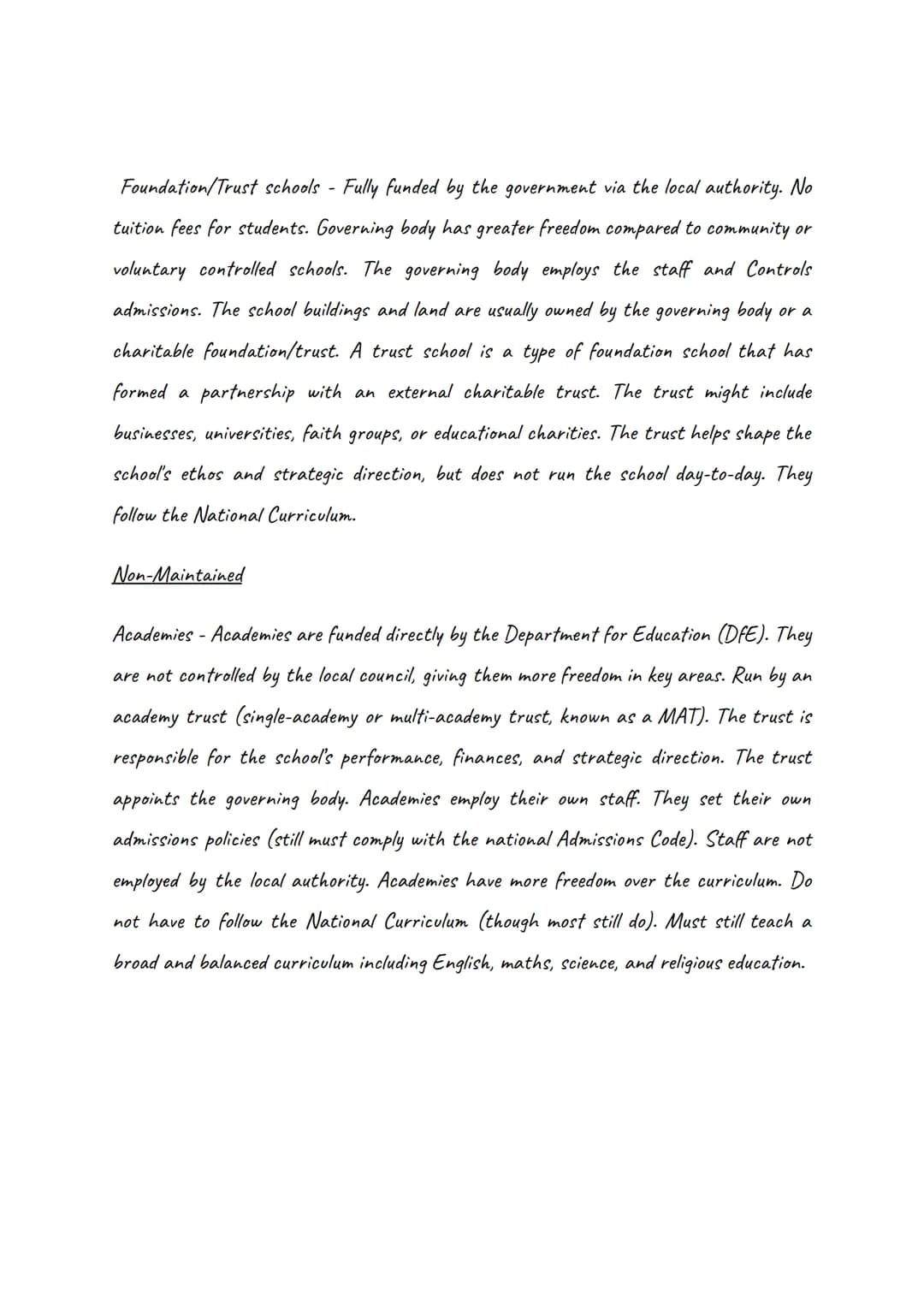
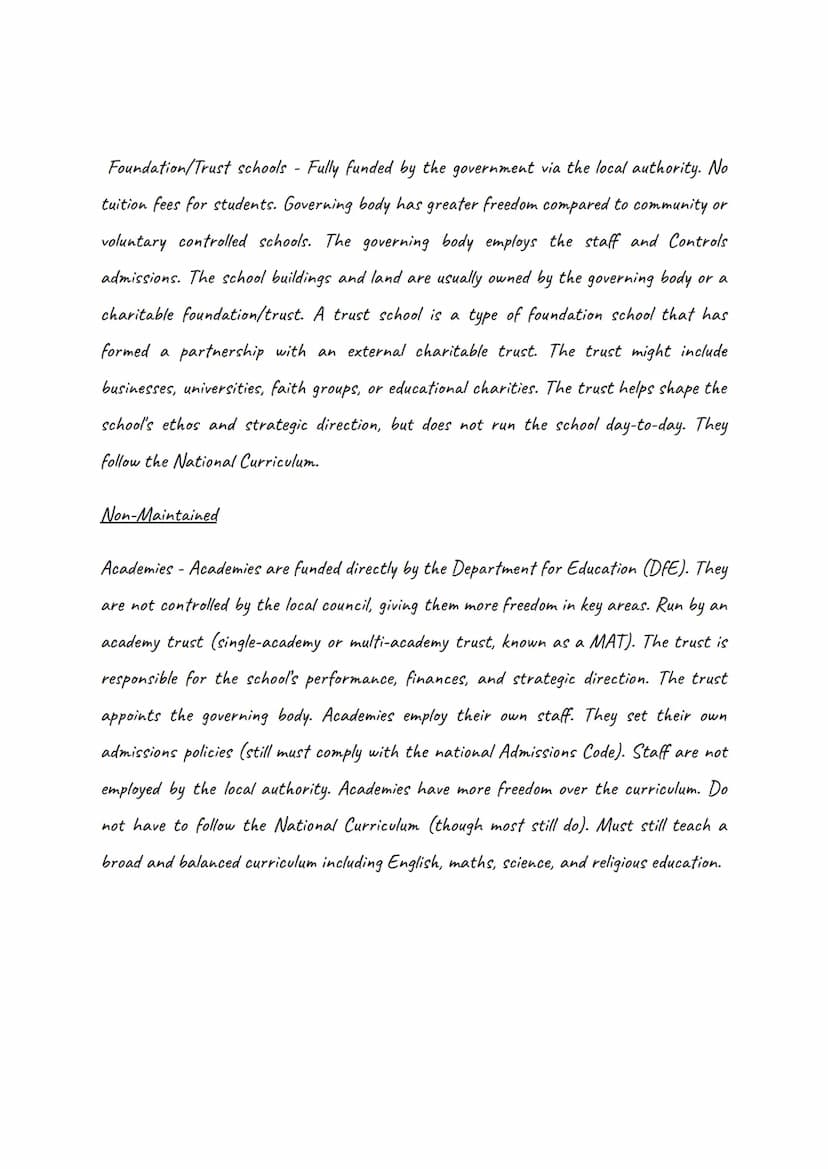
Foundation and trust schools get full government funding but their governing body has way more freedom than community schools. They employ their own staff, control admissions, and usually own their buildings. Trust schools partner with external organisations like businesses or universities to shape their direction.
Academies are the game-changers of recent years. Funded directly by the Department for Education, they're run by academy trusts and have serious freedom. They don't have to follow the National Curriculum (though most do), can set their own term dates, and employ their own staff.
Multi-academy trusts (MATs) run several schools together, sharing resources and expertise. This gives them even more power to innovate whilst maintaining consistency across their schools.
Insider Tip: Academies often have more flexibility to try new teaching methods or offer specialised subjects, which can be brilliant if it matches your interests.
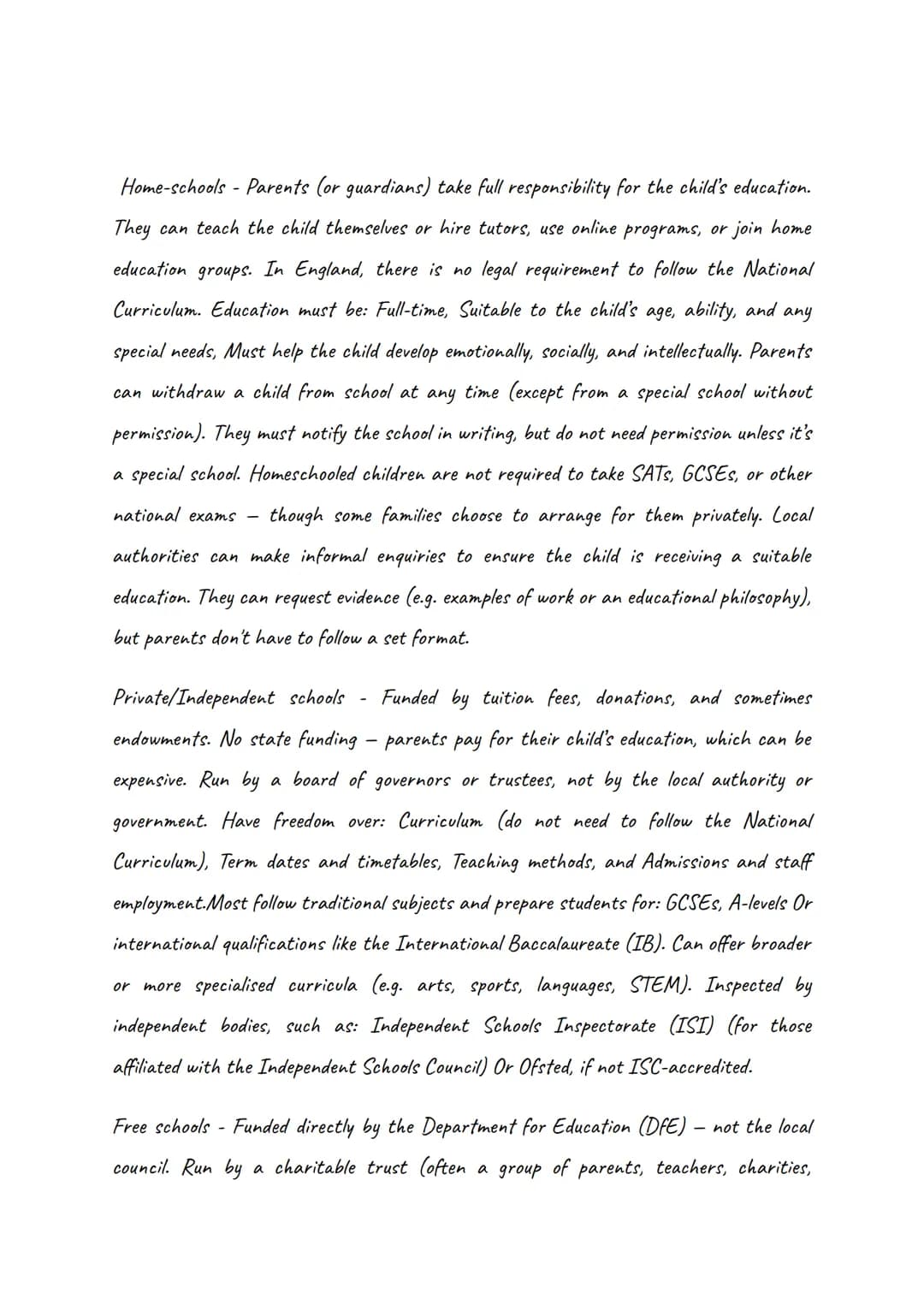
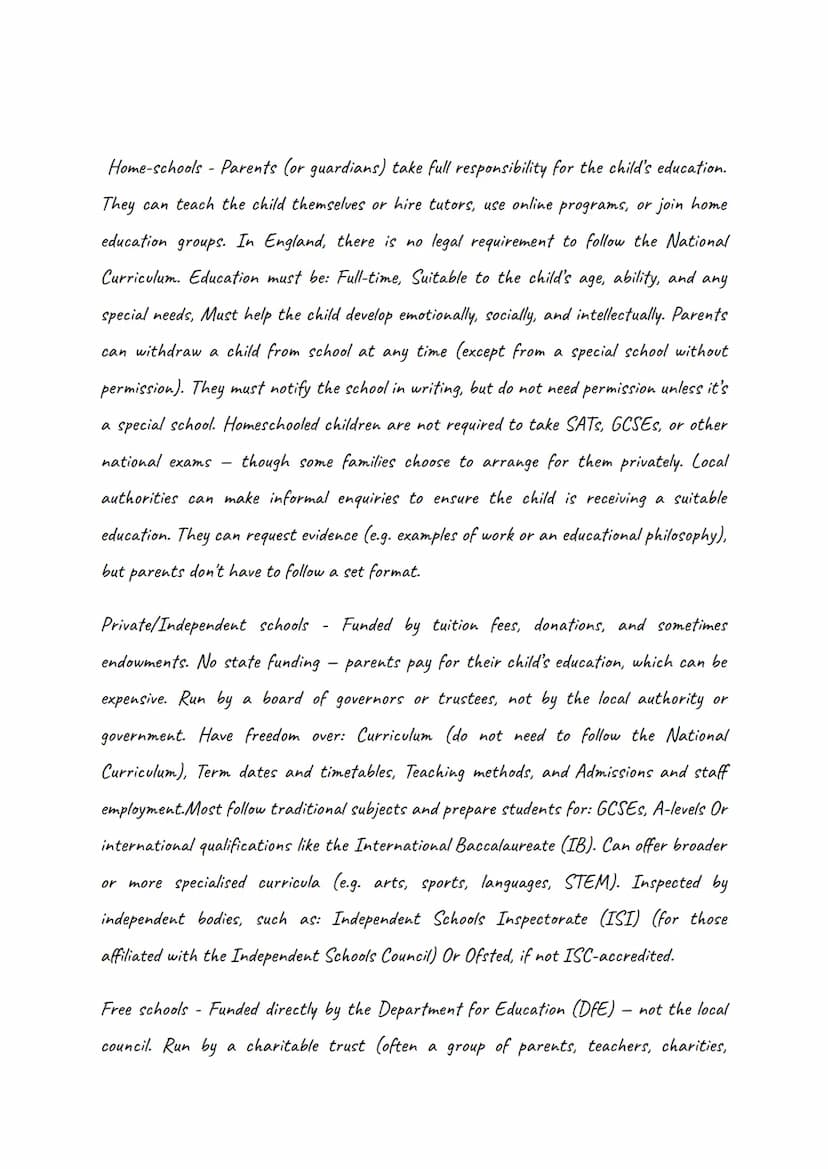
Home-schooling gives parents complete control over education. You don't need permission to withdraw from school (except special schools), just written notice. The education must be full-time and suitable for the child's age and ability, but there's no set curriculum to follow.
Private schools charge fees and operate independently. They don't follow the National Curriculum and can set their own term dates and teaching methods. Most prepare students for GCSEs and A-levels, though some offer international qualifications like the International Baccalaureate.
Free schools are basically academies set up by groups like parents, teachers, or charities. They're funded by the DfE and must provide a broad curriculum including English, maths, science, and RE. They can specialise in areas like STEM or arts whilst remaining non-selective.
Money Matters: Private schools can cost thousands per year, whilst maintained schools and academies are completely free - a massive factor for most families.
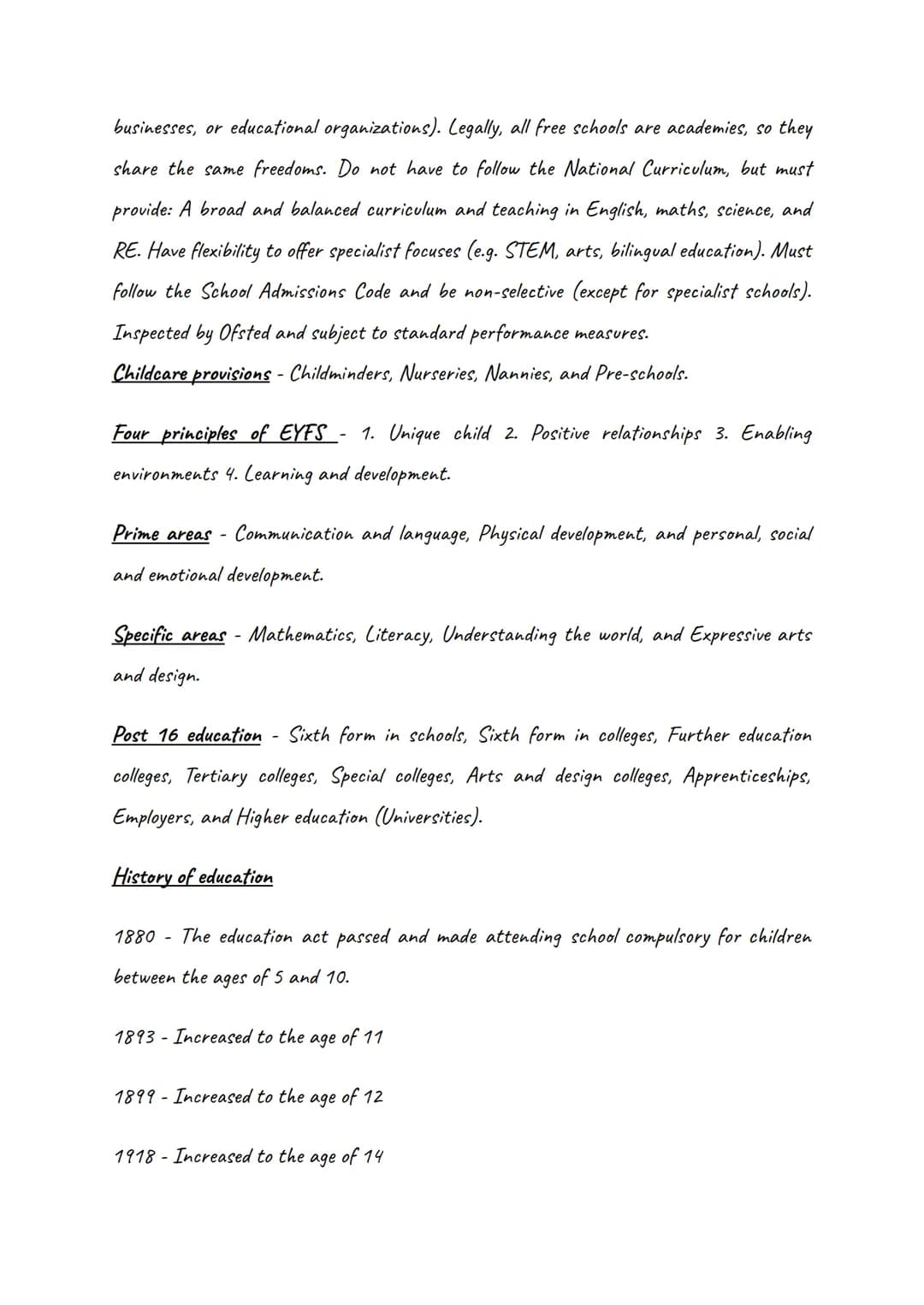
The Early Years Foundation Stage (EYFS) covers ages 0-5 in nurseries, pre-schools, and Reception. It's built on four principles: unique child, positive relationships, enabling environments, and learning and development. There are prime areas and specific areas (maths, literacy, understanding the world, expressive arts).
Post-16 education opens up loads of options: sixth forms in schools or colleges, further education colleges, apprenticeships, or jumping straight into higher education. Each path suits different learning styles and career goals.
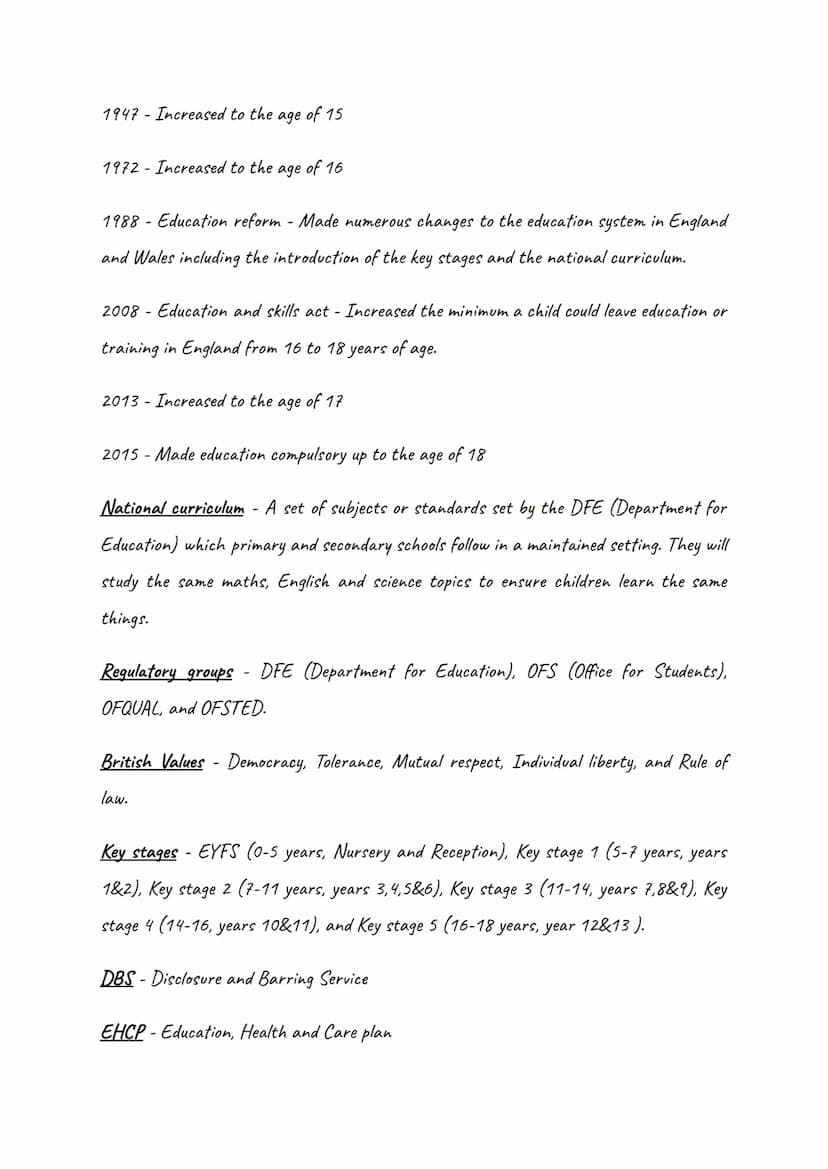
The compulsory education age has gradually increased throughout history - from age 10 in 1880 to age 18 today (though you can do apprenticeships or training instead of traditional school from 16).
Future Planning: Understanding these pathways early helps you make informed decisions about your education route after GCSEs.
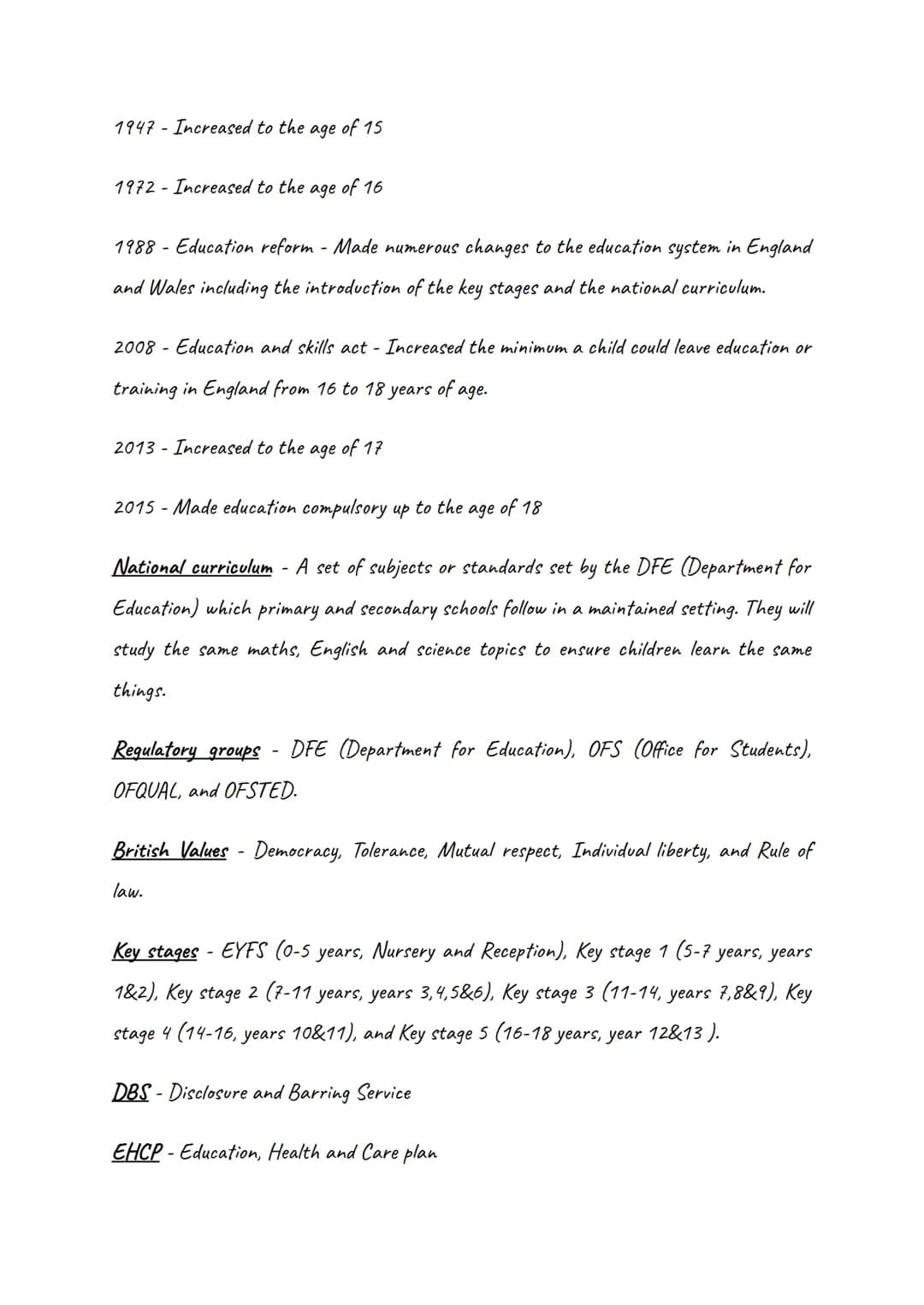
The National Curriculum ensures all maintained schools teach the same core subjects in maths, English, and science. It's divided into key stages: EYFS (0-5), KS1 (5-7), KS2 (7-11), KS3 (11-14), KS4 (14-16), and KS5 (16-18).
Regulatory bodies keep everything running smoothly: the DfE sets policy, Ofsted inspects schools, OFQUAL regulates qualifications, and OFS oversees universities. Schools must also promote British Values: democracy, tolerance, mutual respect, individual liberty, and rule of law.
Key legislation like the 1988 Education Reform Act introduced the National Curriculum and key stages, whilst the 2008 Education and Skills Act raised the participation age to 18.
Exam Insight: Understanding key stages helps you see where you fit in the bigger picture and what's expected at each level.
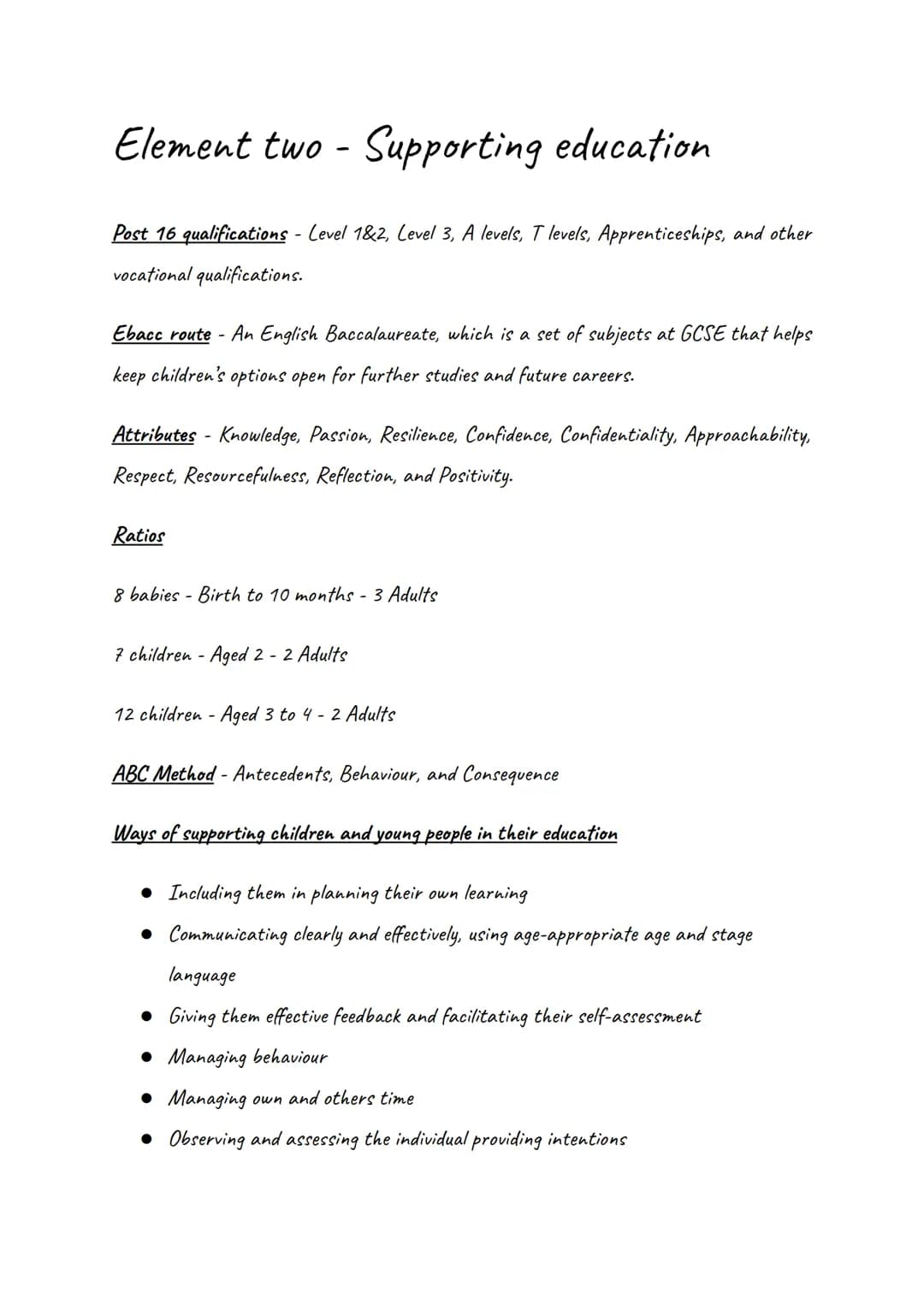
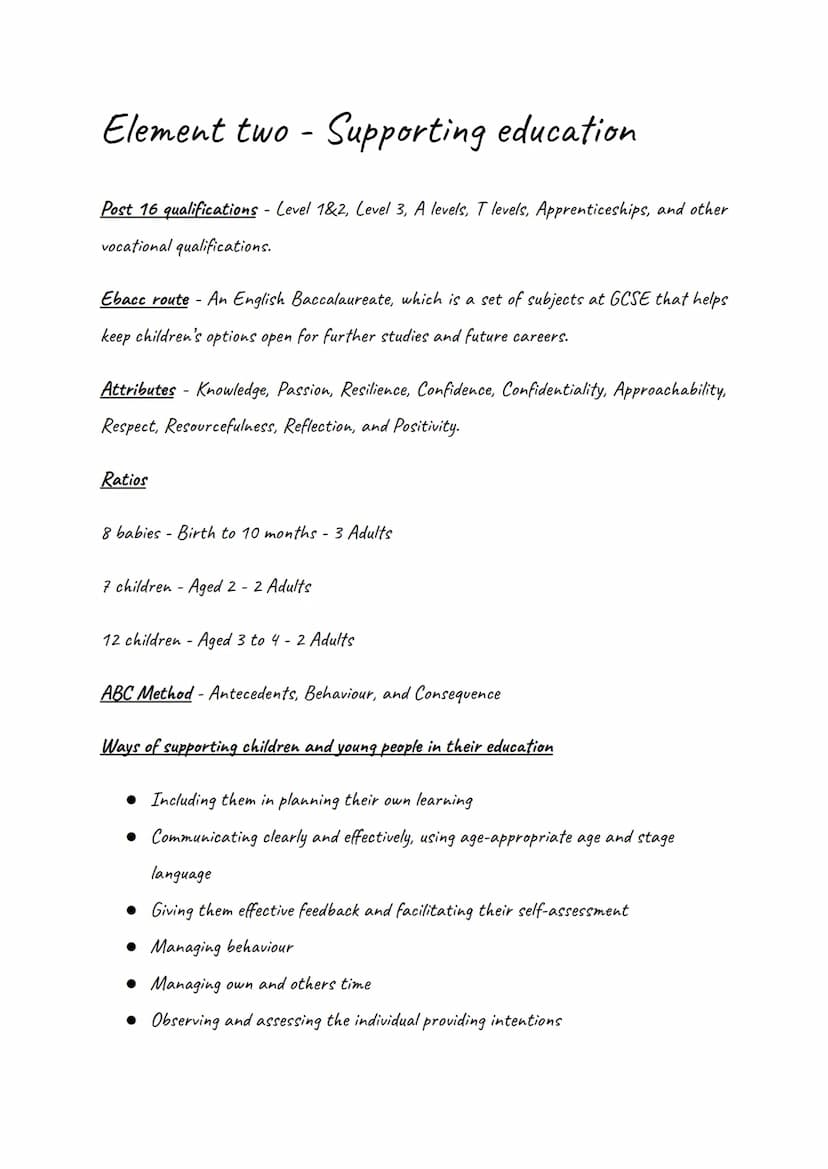
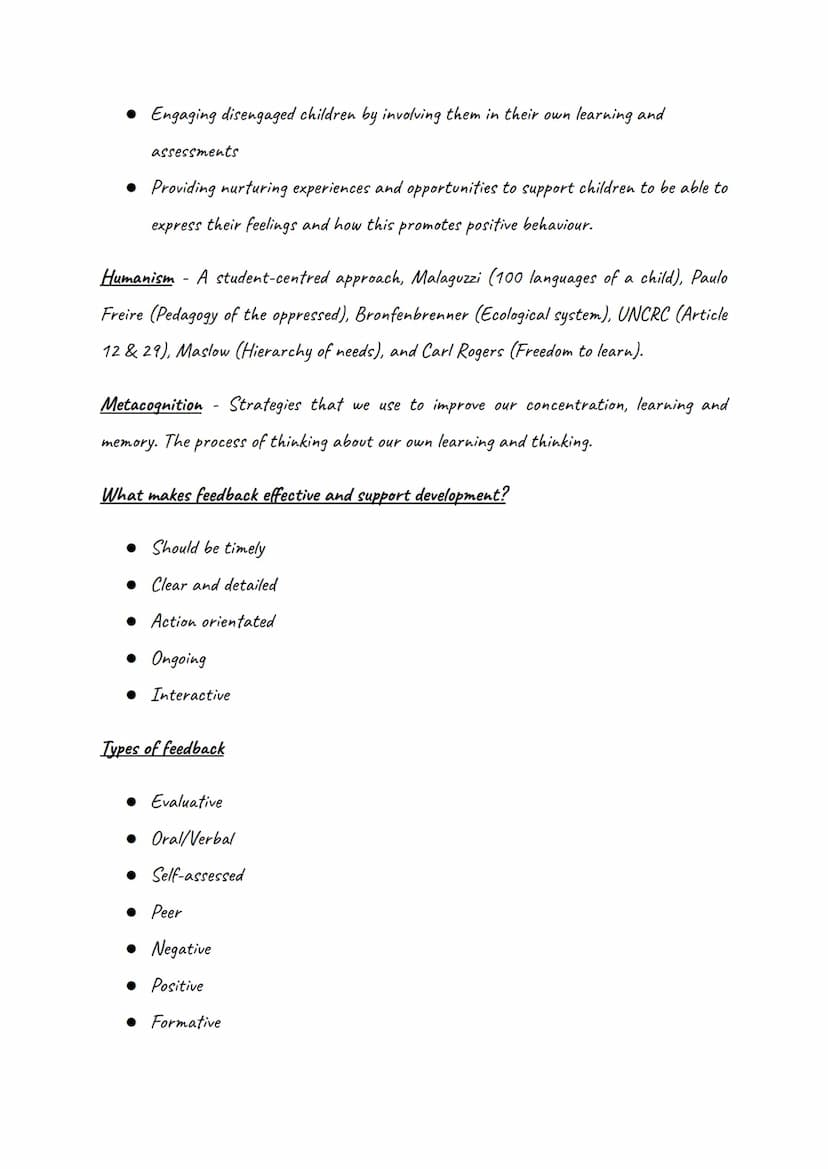
Great educational support involves including students in planning their own learning and giving clear, age-appropriate communication. Effective feedback should be timely, detailed, action-oriented, ongoing, and interactive - not just "well done" or "try harder."
Key attributes for education professionals include knowledge, passion, resilience, confidence, and maintaining confidentiality. The ABC method (Antecedents, Behaviour, Consequences) helps understand and manage behaviour effectively.
Post-16 qualifications include Level 1&2 courses, Level 3 , apprenticeships, and vocational qualifications. The EBacc route (English Baccalaureate) includes core GCSE subjects that keep options open for further study.
Study Smart: Getting involved in planning your own learning makes you more engaged and helps develop crucial metacognition skills - thinking about your own thinking.
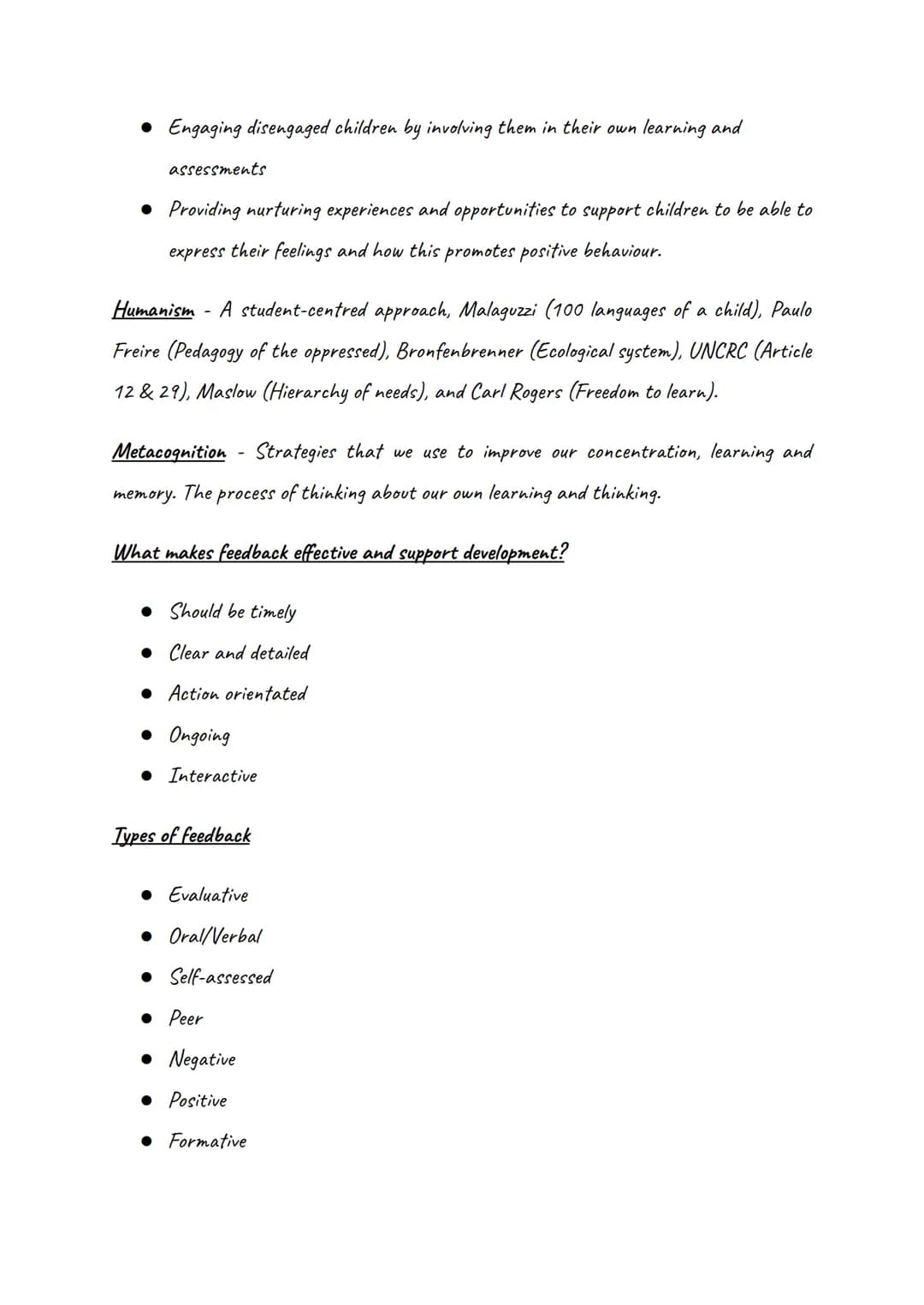
Humanism puts students at the centre of learning. Key figures include Malaguzzi (100 languages of children), Paulo Freire (critical thinking), and Maslow (hierarchy of needs). This approach emphasises nurturing experiences that help children express feelings and promote positive behaviour.
Metacognition - strategies to improve concentration, learning, and memory - is crucial for academic success. It's about understanding how you learn best and adapting your approach accordingly.
Effective feedback comes in many forms: evaluative, oral, written, peer-assessed, formative, summative, and feed-forward (focusing on future improvement). The key is making it specific and actionable rather than just praise or criticism.
Learning Hack: Developing metacognitive awareness - knowing what works for your brain - is like having a secret weapon for academic success.
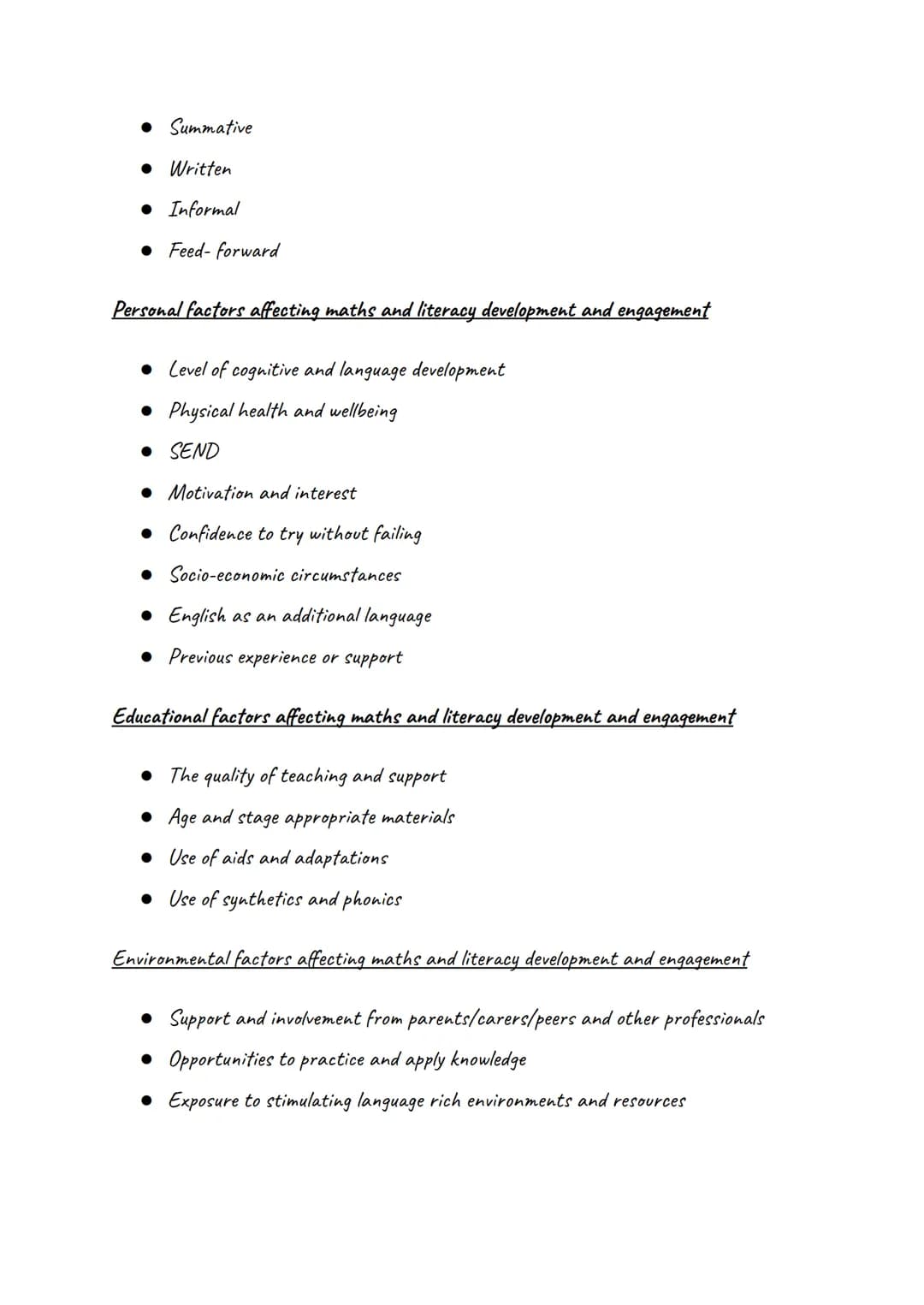
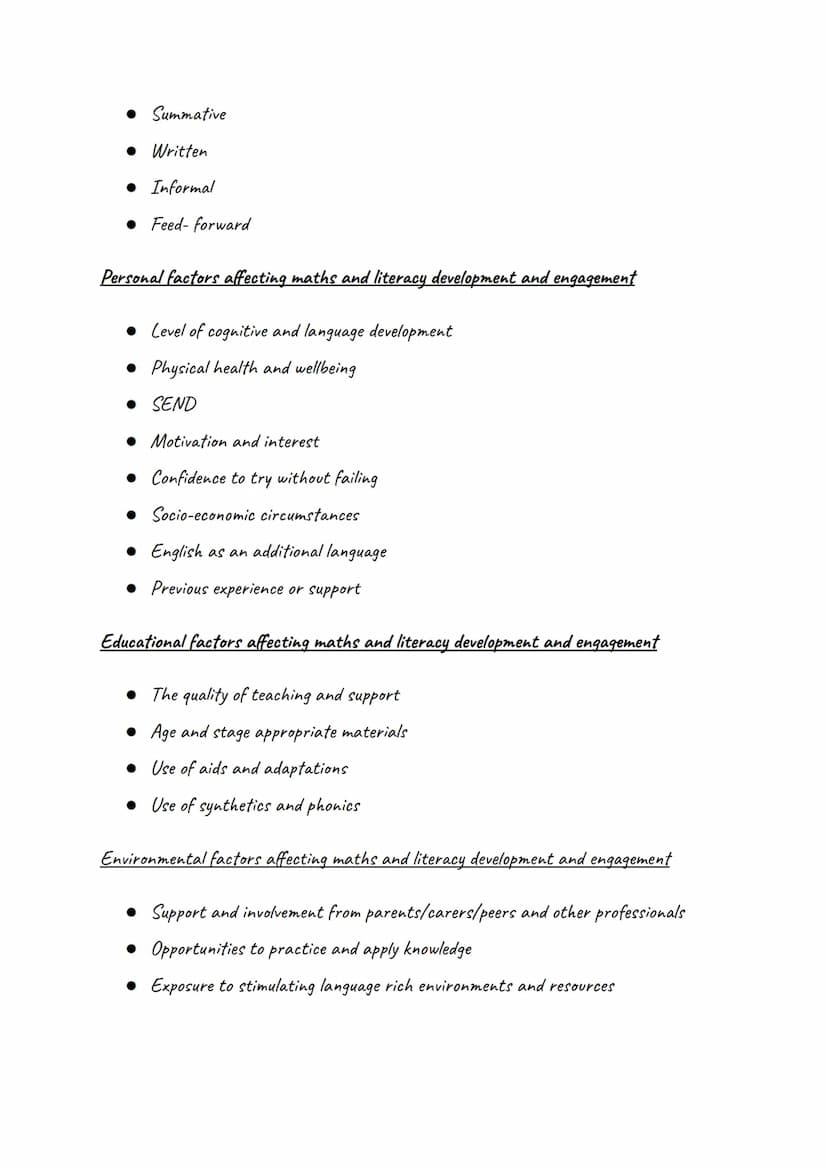
Personal factors significantly impact maths and literacy development: cognitive development level, physical health, SEND requirements, motivation, confidence, socio-economic circumstances, and whether English is an additional language. Previous educational experiences also play a huge role.
Educational factors include teaching quality, age-appropriate materials, use of learning aids and adaptations, and synthetic phonics approaches for reading. The learning environment needs to match the student's developmental stage.
Environmental factors encompass family support, peer relationships, professional involvement, practice opportunities, and exposure to language-rich environments. All these elements work together to either support or hinder academic progress.
Reality Check: Recognising these factors helps explain why some students find certain subjects easier than others - it's rarely just about being "clever" or not.
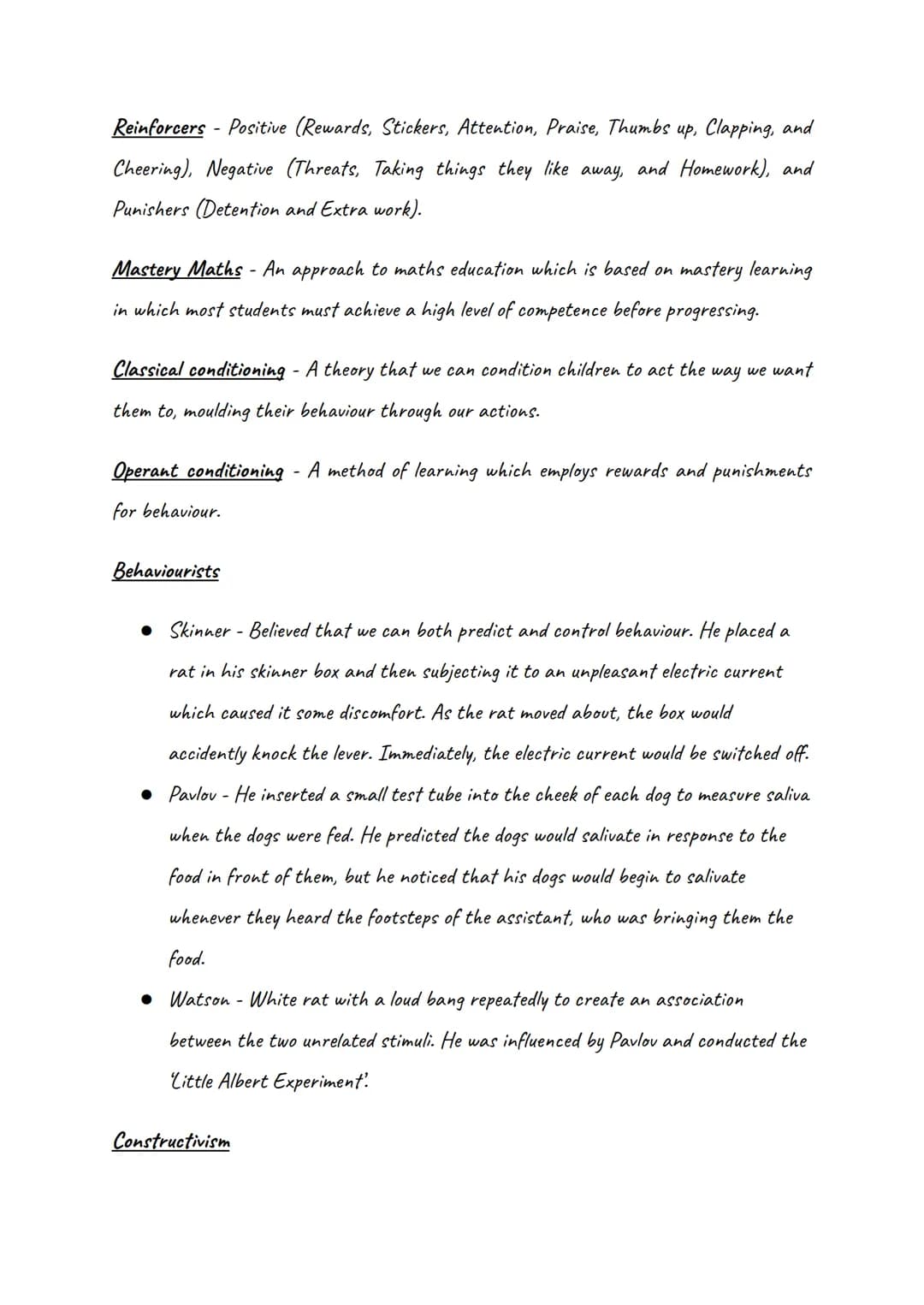
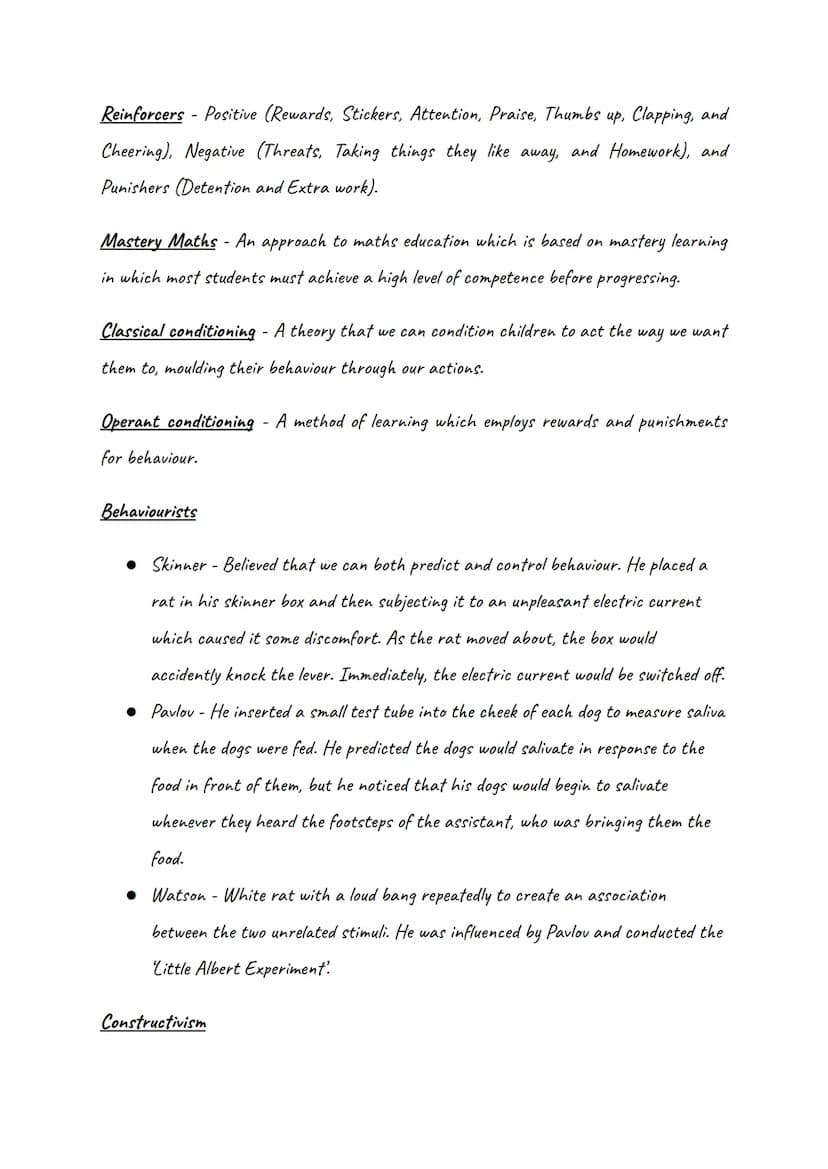
Behaviourism focuses on conditioning responses through reinforcers. Positive reinforcers include rewards, praise, and attention, whilst negative approaches involve removing privileges. Classical conditioning (Pavlov's dogs) and operant conditioning explain how behaviour patterns develop.
Key behaviourists like Skinner believed behaviour could be predicted and controlled, whilst Watson showed how fears could be conditioned through association. These theories still influence classroom management today.
Constructivism offers an alternative approach, emphasising how students build their own understanding rather than just responding to stimuli. Mastery learning in subjects like maths ensures students achieve competence before moving on to harder concepts.
Behaviour Insight: Understanding these theories helps explain why certain classroom strategies work - it's all about finding the right balance of support, challenge, and motivation for each individual.
Our AI Companion is a student-focused AI tool that offers more than just answers. Built on millions of Knowunity resources, it provides relevant information, personalised study plans, quizzes, and content directly in the chat, adapting to your individual learning journey.
You can download the app from Google Play Store and Apple App Store.
That's right! Enjoy free access to study content, connect with fellow students, and get instant help – all at your fingertips.
Quotes from every main character
English LiteratureApp Store
Google Play
The app is very easy to use and well designed. I have found everything I was looking for so far and have been able to learn a lot from the presentations! I will definitely use the app for a class assignment! And of course it also helps a lot as an inspiration.
Stefan S
iOS user
This app is really great. There are so many study notes and help [...]. My problem subject is French, for example, and the app has so many options for help. Thanks to this app, I have improved my French. I would recommend it to anyone.
Samantha Klich
Android user
Wow, I am really amazed. I just tried the app because I've seen it advertised many times and was absolutely stunned. This app is THE HELP you want for school and above all, it offers so many things, such as workouts and fact sheets, which have been VERY helpful to me personally.
Anna
iOS user
Best app on earth! no words because it’s too good
Thomas R
iOS user
Just amazing. Let's me revise 10x better, this app is a quick 10/10. I highly recommend it to anyone. I can watch and search for notes. I can save them in the subject folder. I can revise it any time when I come back. If you haven't tried this app, you're really missing out.
Basil
Android user
This app has made me feel so much more confident in my exam prep, not only through boosting my own self confidence through the features that allow you to connect with others and feel less alone, but also through the way the app itself is centred around making you feel better. It is easy to navigate, fun to use, and helpful to anyone struggling in absolutely any way.
David K
iOS user
The app's just great! All I have to do is enter the topic in the search bar and I get the response real fast. I don't have to watch 10 YouTube videos to understand something, so I'm saving my time. Highly recommended!
Sudenaz Ocak
Android user
In school I was really bad at maths but thanks to the app, I am doing better now. I am so grateful that you made the app.
Greenlight Bonnie
Android user
very reliable app to help and grow your ideas of Maths, English and other related topics in your works. please use this app if your struggling in areas, this app is key for that. wish I'd of done a review before. and it's also free so don't worry about that.
Rohan U
Android user
I know a lot of apps use fake accounts to boost their reviews but this app deserves it all. Originally I was getting 4 in my English exams and this time I got a grade 7. I didn’t even know about this app three days until the exam and it has helped A LOT. Please actually trust me and use it as I’m sure you too will see developments.
Xander S
iOS user
THE QUIZES AND FLASHCARDS ARE SO USEFUL AND I LOVE THE SCHOOLGPT. IT ALSO IS LITREALLY LIKE CHATGPT BUT SMARTER!! HELPED ME WITH MY MASCARA PROBLEMS TOO!! AS WELL AS MY REAL SUBJECTS ! DUHHH 😍😁😲🤑💗✨🎀😮
Elisha
iOS user
This apps acc the goat. I find revision so boring but this app makes it so easy to organize it all and then you can ask the freeeee ai to test yourself so good and you can easily upload your own stuff. highly recommend as someone taking mocks now
Paul T
iOS user
The app is very easy to use and well designed. I have found everything I was looking for so far and have been able to learn a lot from the presentations! I will definitely use the app for a class assignment! And of course it also helps a lot as an inspiration.
Stefan S
iOS user
This app is really great. There are so many study notes and help [...]. My problem subject is French, for example, and the app has so many options for help. Thanks to this app, I have improved my French. I would recommend it to anyone.
Samantha Klich
Android user
Wow, I am really amazed. I just tried the app because I've seen it advertised many times and was absolutely stunned. This app is THE HELP you want for school and above all, it offers so many things, such as workouts and fact sheets, which have been VERY helpful to me personally.
Anna
iOS user
Best app on earth! no words because it’s too good
Thomas R
iOS user
Just amazing. Let's me revise 10x better, this app is a quick 10/10. I highly recommend it to anyone. I can watch and search for notes. I can save them in the subject folder. I can revise it any time when I come back. If you haven't tried this app, you're really missing out.
Basil
Android user
This app has made me feel so much more confident in my exam prep, not only through boosting my own self confidence through the features that allow you to connect with others and feel less alone, but also through the way the app itself is centred around making you feel better. It is easy to navigate, fun to use, and helpful to anyone struggling in absolutely any way.
David K
iOS user
The app's just great! All I have to do is enter the topic in the search bar and I get the response real fast. I don't have to watch 10 YouTube videos to understand something, so I'm saving my time. Highly recommended!
Sudenaz Ocak
Android user
In school I was really bad at maths but thanks to the app, I am doing better now. I am so grateful that you made the app.
Greenlight Bonnie
Android user
very reliable app to help and grow your ideas of Maths, English and other related topics in your works. please use this app if your struggling in areas, this app is key for that. wish I'd of done a review before. and it's also free so don't worry about that.
Rohan U
Android user
I know a lot of apps use fake accounts to boost their reviews but this app deserves it all. Originally I was getting 4 in my English exams and this time I got a grade 7. I didn’t even know about this app three days until the exam and it has helped A LOT. Please actually trust me and use it as I’m sure you too will see developments.
Xander S
iOS user
THE QUIZES AND FLASHCARDS ARE SO USEFUL AND I LOVE THE SCHOOLGPT. IT ALSO IS LITREALLY LIKE CHATGPT BUT SMARTER!! HELPED ME WITH MY MASCARA PROBLEMS TOO!! AS WELL AS MY REAL SUBJECTS ! DUHHH 😍😁😲🤑💗✨🎀😮
Elisha
iOS user
This apps acc the goat. I find revision so boring but this app makes it so easy to organize it all and then you can ask the freeeee ai to test yourself so good and you can easily upload your own stuff. highly recommend as someone taking mocks now
Paul T
iOS user
Tia
@tia.1
Ever wondered how the UK education system actually works and what makes different schools tick? This guide breaks down everything from the various types of schools you might attend to the theories behind how you learn best, plus practical strategies... Show more
Access to all documents
Improve your grades
Join milions of students
By signing up you accept Terms of Service and Privacy Policy
The UK education system isn't just "school" - there are loads of different types, each with their own rules and funding. Maintained schools are the ones funded by your local council, so they're free to attend and must follow the National Curriculum. Think of your typical primary or secondary school down the road.
Non-maintained schools operate independently from local authorities and don't have to stick to all the same rules. Voluntary schools have religious connections - usually churches - but still get government funding. Meanwhile, private schools charge fees and can pretty much do their own thing curriculum-wise.
Home-schooling is completely legal in the UK, where parents take full responsibility for their child's education. You don't need to follow the National Curriculum or take SATs if you're home-schooled, though some families choose to anyway.
Key Point: Understanding these differences helps explain why your mate's school might do things differently to yours - it's all about who's in charge and who pays the bills!
Access to all documents
Improve your grades
Join milions of students
By signing up you accept Terms of Service and Privacy Policy
Community schools are your standard state schools - fully funded and controlled by the local authority. They follow the National Curriculum religiously and are completely non-faith based. The council owns everything and employs all the staff.
Voluntary aided schools are where it gets interesting. These are mostly state-funded but have a religious foundation that chips in about 10% of building costs. The governing body employs staff (not the council) and they can prioritise faith-based admissions. They still follow the National Curriculum except for RE, which reflects their religious tradition.
Voluntary controlled schools flip this around - they're funded and run by the local authority but often sit on land owned by a church. The council employs staff and handles admissions, so they can't prioritise students based on religion. Their RE follows the local authority's syllabus, not the church's.
Reality Check: These distinctions matter when choosing schools - VA schools can be more selective about who gets in, whilst VC schools operate more like standard community schools.
Access to all documents
Improve your grades
Join milions of students
By signing up you accept Terms of Service and Privacy Policy
Foundation and trust schools get full government funding but their governing body has way more freedom than community schools. They employ their own staff, control admissions, and usually own their buildings. Trust schools partner with external organisations like businesses or universities to shape their direction.
Academies are the game-changers of recent years. Funded directly by the Department for Education, they're run by academy trusts and have serious freedom. They don't have to follow the National Curriculum (though most do), can set their own term dates, and employ their own staff.
Multi-academy trusts (MATs) run several schools together, sharing resources and expertise. This gives them even more power to innovate whilst maintaining consistency across their schools.
Insider Tip: Academies often have more flexibility to try new teaching methods or offer specialised subjects, which can be brilliant if it matches your interests.
Access to all documents
Improve your grades
Join milions of students
By signing up you accept Terms of Service and Privacy Policy
Home-schooling gives parents complete control over education. You don't need permission to withdraw from school (except special schools), just written notice. The education must be full-time and suitable for the child's age and ability, but there's no set curriculum to follow.
Private schools charge fees and operate independently. They don't follow the National Curriculum and can set their own term dates and teaching methods. Most prepare students for GCSEs and A-levels, though some offer international qualifications like the International Baccalaureate.
Free schools are basically academies set up by groups like parents, teachers, or charities. They're funded by the DfE and must provide a broad curriculum including English, maths, science, and RE. They can specialise in areas like STEM or arts whilst remaining non-selective.
Money Matters: Private schools can cost thousands per year, whilst maintained schools and academies are completely free - a massive factor for most families.
Access to all documents
Improve your grades
Join milions of students
By signing up you accept Terms of Service and Privacy Policy
The Early Years Foundation Stage (EYFS) covers ages 0-5 in nurseries, pre-schools, and Reception. It's built on four principles: unique child, positive relationships, enabling environments, and learning and development. There are prime areas and specific areas (maths, literacy, understanding the world, expressive arts).
Post-16 education opens up loads of options: sixth forms in schools or colleges, further education colleges, apprenticeships, or jumping straight into higher education. Each path suits different learning styles and career goals.
The compulsory education age has gradually increased throughout history - from age 10 in 1880 to age 18 today (though you can do apprenticeships or training instead of traditional school from 16).
Future Planning: Understanding these pathways early helps you make informed decisions about your education route after GCSEs.
Access to all documents
Improve your grades
Join milions of students
By signing up you accept Terms of Service and Privacy Policy
The National Curriculum ensures all maintained schools teach the same core subjects in maths, English, and science. It's divided into key stages: EYFS (0-5), KS1 (5-7), KS2 (7-11), KS3 (11-14), KS4 (14-16), and KS5 (16-18).
Regulatory bodies keep everything running smoothly: the DfE sets policy, Ofsted inspects schools, OFQUAL regulates qualifications, and OFS oversees universities. Schools must also promote British Values: democracy, tolerance, mutual respect, individual liberty, and rule of law.
Key legislation like the 1988 Education Reform Act introduced the National Curriculum and key stages, whilst the 2008 Education and Skills Act raised the participation age to 18.
Exam Insight: Understanding key stages helps you see where you fit in the bigger picture and what's expected at each level.
Access to all documents
Improve your grades
Join milions of students
By signing up you accept Terms of Service and Privacy Policy
Great educational support involves including students in planning their own learning and giving clear, age-appropriate communication. Effective feedback should be timely, detailed, action-oriented, ongoing, and interactive - not just "well done" or "try harder."
Key attributes for education professionals include knowledge, passion, resilience, confidence, and maintaining confidentiality. The ABC method (Antecedents, Behaviour, Consequences) helps understand and manage behaviour effectively.
Post-16 qualifications include Level 1&2 courses, Level 3 , apprenticeships, and vocational qualifications. The EBacc route (English Baccalaureate) includes core GCSE subjects that keep options open for further study.
Study Smart: Getting involved in planning your own learning makes you more engaged and helps develop crucial metacognition skills - thinking about your own thinking.
Access to all documents
Improve your grades
Join milions of students
By signing up you accept Terms of Service and Privacy Policy
Humanism puts students at the centre of learning. Key figures include Malaguzzi (100 languages of children), Paulo Freire (critical thinking), and Maslow (hierarchy of needs). This approach emphasises nurturing experiences that help children express feelings and promote positive behaviour.
Metacognition - strategies to improve concentration, learning, and memory - is crucial for academic success. It's about understanding how you learn best and adapting your approach accordingly.
Effective feedback comes in many forms: evaluative, oral, written, peer-assessed, formative, summative, and feed-forward (focusing on future improvement). The key is making it specific and actionable rather than just praise or criticism.
Learning Hack: Developing metacognitive awareness - knowing what works for your brain - is like having a secret weapon for academic success.
Access to all documents
Improve your grades
Join milions of students
By signing up you accept Terms of Service and Privacy Policy
Personal factors significantly impact maths and literacy development: cognitive development level, physical health, SEND requirements, motivation, confidence, socio-economic circumstances, and whether English is an additional language. Previous educational experiences also play a huge role.
Educational factors include teaching quality, age-appropriate materials, use of learning aids and adaptations, and synthetic phonics approaches for reading. The learning environment needs to match the student's developmental stage.
Environmental factors encompass family support, peer relationships, professional involvement, practice opportunities, and exposure to language-rich environments. All these elements work together to either support or hinder academic progress.
Reality Check: Recognising these factors helps explain why some students find certain subjects easier than others - it's rarely just about being "clever" or not.
Access to all documents
Improve your grades
Join milions of students
By signing up you accept Terms of Service and Privacy Policy
Behaviourism focuses on conditioning responses through reinforcers. Positive reinforcers include rewards, praise, and attention, whilst negative approaches involve removing privileges. Classical conditioning (Pavlov's dogs) and operant conditioning explain how behaviour patterns develop.
Key behaviourists like Skinner believed behaviour could be predicted and controlled, whilst Watson showed how fears could be conditioned through association. These theories still influence classroom management today.
Constructivism offers an alternative approach, emphasising how students build their own understanding rather than just responding to stimuli. Mastery learning in subjects like maths ensures students achieve competence before moving on to harder concepts.
Behaviour Insight: Understanding these theories helps explain why certain classroom strategies work - it's all about finding the right balance of support, challenge, and motivation for each individual.
Our AI Companion is a student-focused AI tool that offers more than just answers. Built on millions of Knowunity resources, it provides relevant information, personalised study plans, quizzes, and content directly in the chat, adapting to your individual learning journey.
You can download the app from Google Play Store and Apple App Store.
That's right! Enjoy free access to study content, connect with fellow students, and get instant help – all at your fingertips.
6
Smart Tools NEW
Transform this note into: ✓ 50+ Practice Questions ✓ Interactive Flashcards ✓ Full Mock Exam ✓ Essay Outlines
Quotes from every main character
English LiteratureApp Store
Google Play
The app is very easy to use and well designed. I have found everything I was looking for so far and have been able to learn a lot from the presentations! I will definitely use the app for a class assignment! And of course it also helps a lot as an inspiration.
Stefan S
iOS user
This app is really great. There are so many study notes and help [...]. My problem subject is French, for example, and the app has so many options for help. Thanks to this app, I have improved my French. I would recommend it to anyone.
Samantha Klich
Android user
Wow, I am really amazed. I just tried the app because I've seen it advertised many times and was absolutely stunned. This app is THE HELP you want for school and above all, it offers so many things, such as workouts and fact sheets, which have been VERY helpful to me personally.
Anna
iOS user
Best app on earth! no words because it’s too good
Thomas R
iOS user
Just amazing. Let's me revise 10x better, this app is a quick 10/10. I highly recommend it to anyone. I can watch and search for notes. I can save them in the subject folder. I can revise it any time when I come back. If you haven't tried this app, you're really missing out.
Basil
Android user
This app has made me feel so much more confident in my exam prep, not only through boosting my own self confidence through the features that allow you to connect with others and feel less alone, but also through the way the app itself is centred around making you feel better. It is easy to navigate, fun to use, and helpful to anyone struggling in absolutely any way.
David K
iOS user
The app's just great! All I have to do is enter the topic in the search bar and I get the response real fast. I don't have to watch 10 YouTube videos to understand something, so I'm saving my time. Highly recommended!
Sudenaz Ocak
Android user
In school I was really bad at maths but thanks to the app, I am doing better now. I am so grateful that you made the app.
Greenlight Bonnie
Android user
very reliable app to help and grow your ideas of Maths, English and other related topics in your works. please use this app if your struggling in areas, this app is key for that. wish I'd of done a review before. and it's also free so don't worry about that.
Rohan U
Android user
I know a lot of apps use fake accounts to boost their reviews but this app deserves it all. Originally I was getting 4 in my English exams and this time I got a grade 7. I didn’t even know about this app three days until the exam and it has helped A LOT. Please actually trust me and use it as I’m sure you too will see developments.
Xander S
iOS user
THE QUIZES AND FLASHCARDS ARE SO USEFUL AND I LOVE THE SCHOOLGPT. IT ALSO IS LITREALLY LIKE CHATGPT BUT SMARTER!! HELPED ME WITH MY MASCARA PROBLEMS TOO!! AS WELL AS MY REAL SUBJECTS ! DUHHH 😍😁😲🤑💗✨🎀😮
Elisha
iOS user
This apps acc the goat. I find revision so boring but this app makes it so easy to organize it all and then you can ask the freeeee ai to test yourself so good and you can easily upload your own stuff. highly recommend as someone taking mocks now
Paul T
iOS user
The app is very easy to use and well designed. I have found everything I was looking for so far and have been able to learn a lot from the presentations! I will definitely use the app for a class assignment! And of course it also helps a lot as an inspiration.
Stefan S
iOS user
This app is really great. There are so many study notes and help [...]. My problem subject is French, for example, and the app has so many options for help. Thanks to this app, I have improved my French. I would recommend it to anyone.
Samantha Klich
Android user
Wow, I am really amazed. I just tried the app because I've seen it advertised many times and was absolutely stunned. This app is THE HELP you want for school and above all, it offers so many things, such as workouts and fact sheets, which have been VERY helpful to me personally.
Anna
iOS user
Best app on earth! no words because it’s too good
Thomas R
iOS user
Just amazing. Let's me revise 10x better, this app is a quick 10/10. I highly recommend it to anyone. I can watch and search for notes. I can save them in the subject folder. I can revise it any time when I come back. If you haven't tried this app, you're really missing out.
Basil
Android user
This app has made me feel so much more confident in my exam prep, not only through boosting my own self confidence through the features that allow you to connect with others and feel less alone, but also through the way the app itself is centred around making you feel better. It is easy to navigate, fun to use, and helpful to anyone struggling in absolutely any way.
David K
iOS user
The app's just great! All I have to do is enter the topic in the search bar and I get the response real fast. I don't have to watch 10 YouTube videos to understand something, so I'm saving my time. Highly recommended!
Sudenaz Ocak
Android user
In school I was really bad at maths but thanks to the app, I am doing better now. I am so grateful that you made the app.
Greenlight Bonnie
Android user
very reliable app to help and grow your ideas of Maths, English and other related topics in your works. please use this app if your struggling in areas, this app is key for that. wish I'd of done a review before. and it's also free so don't worry about that.
Rohan U
Android user
I know a lot of apps use fake accounts to boost their reviews but this app deserves it all. Originally I was getting 4 in my English exams and this time I got a grade 7. I didn’t even know about this app three days until the exam and it has helped A LOT. Please actually trust me and use it as I’m sure you too will see developments.
Xander S
iOS user
THE QUIZES AND FLASHCARDS ARE SO USEFUL AND I LOVE THE SCHOOLGPT. IT ALSO IS LITREALLY LIKE CHATGPT BUT SMARTER!! HELPED ME WITH MY MASCARA PROBLEMS TOO!! AS WELL AS MY REAL SUBJECTS ! DUHHH 😍😁😲🤑💗✨🎀😮
Elisha
iOS user
This apps acc the goat. I find revision so boring but this app makes it so easy to organize it all and then you can ask the freeeee ai to test yourself so good and you can easily upload your own stuff. highly recommend as someone taking mocks now
Paul T
iOS user