
Psychology isn't just about understanding the mind - it's everywhere... Show more
 Other
Other Food & Nutrition
 History
 English Literature
 Sociology
 Biology
Sign up to see the contentIt's free!
Access to all documents
Improve your grades
Join milions of students
Knowunity AI
Subjects
Triangle Congruence and Similarity Theorems
Triangle Properties and Classification
Linear Equations and Graphs
Geometric Angle Relationships
Trigonometric Functions and Identities
Equation Solving Techniques
Circle Geometry Fundamentals
Division Operations and Methods
Basic Differentiation Rules
Exponent and Logarithm Properties
Show all topics
Human Organ Systems
Reproductive Cell Cycles
Biological Sciences Subdisciplines
Cellular Energy Metabolism
Autotrophic Energy Processes
Inheritance Patterns and Principles
Biomolecular Structure and Organization
Cell Cycle and Division Mechanics
Cellular Organization and Development
Biological Structural Organization
Show all topics
Chemical Sciences and Applications
Atomic Structure and Composition
Molecular Electron Structure Representation
Atomic Electron Behavior
Matter Properties and Water
Mole Concept and Calculations
Gas Laws and Behavior
Periodic Table Organization
Chemical Thermodynamics Fundamentals
Chemical Bond Types and Properties
Show all topics
European Renaissance and Enlightenment
European Cultural Movements 800-1920
American Revolution Era 1763-1797
American Civil War 1861-1865
Global Imperial Systems
Mongol and Chinese Dynasties
U.S. Presidents and World Leaders
Historical Sources and Documentation
World Wars Era and Impact
World Religious Systems
Show all topics
Classic and Contemporary Novels
Literary Character Analysis
Rhetorical Theory and Practice
Classic Literary Narratives
Reading Analysis and Interpretation
Narrative Structure and Techniques
English Language Components
Influential English-Language Authors
Basic Sentence Structure
Narrative Voice and Perspective
Show all topics
134
•
Updated Mar 19, 2026
•

Tia
@tia.1
Psychology isn't just about understanding the mind - it's everywhere... Show more
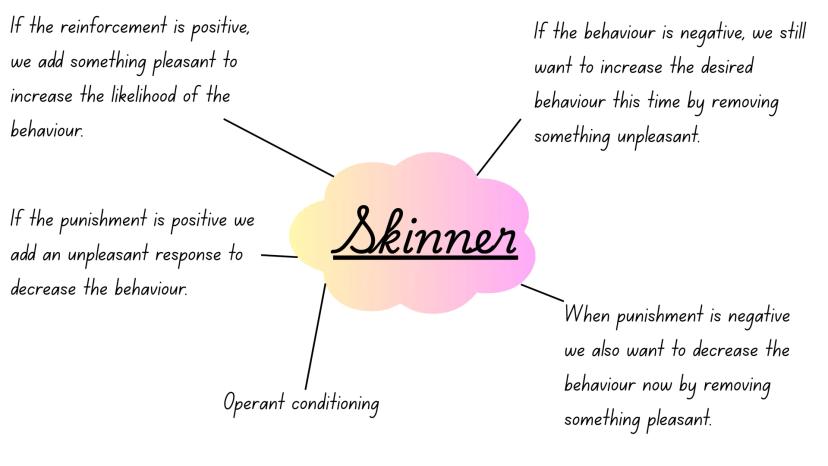
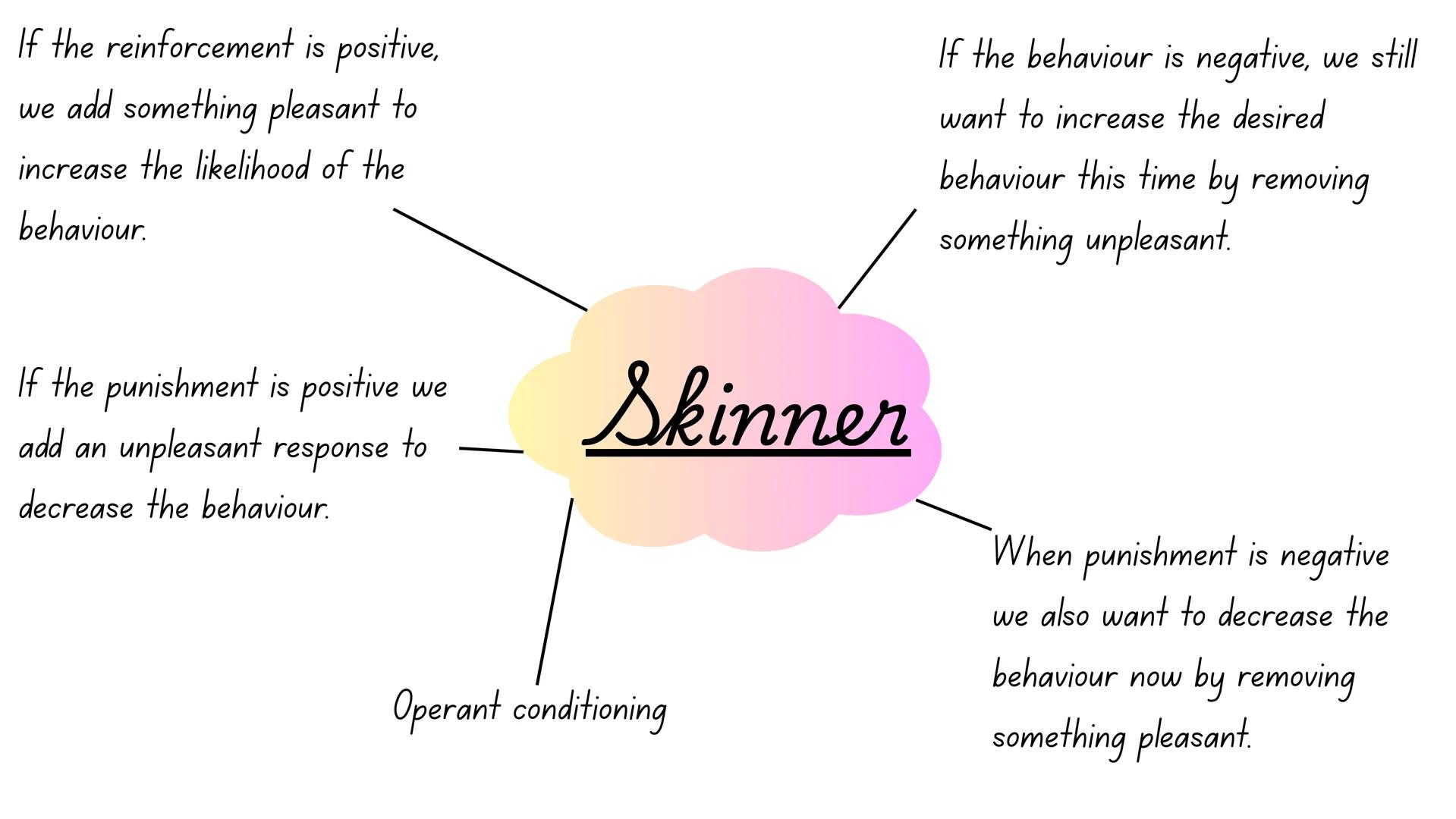
Ever wondered why some habits stick whilst others don't? Operant conditioning is all about how consequences shape our behaviour - and it's happening to you every day.
Positive reinforcement means adding something pleasant (like praise or money) to make a behaviour more likely to happen again. Think getting your phone back after good grades. Positive punishment works the opposite way - adding something unpleasant (like extra chores) to stop unwanted behaviour.
Negative reinforcement removes something annoying to encourage good behaviour - like your parents stopping their nagging when you tidy your room. Negative punishment takes away something nice (like screen time) to discourage bad behaviour.
Remember: Positive/negative doesn't mean good/bad - it just means adding or removing something!
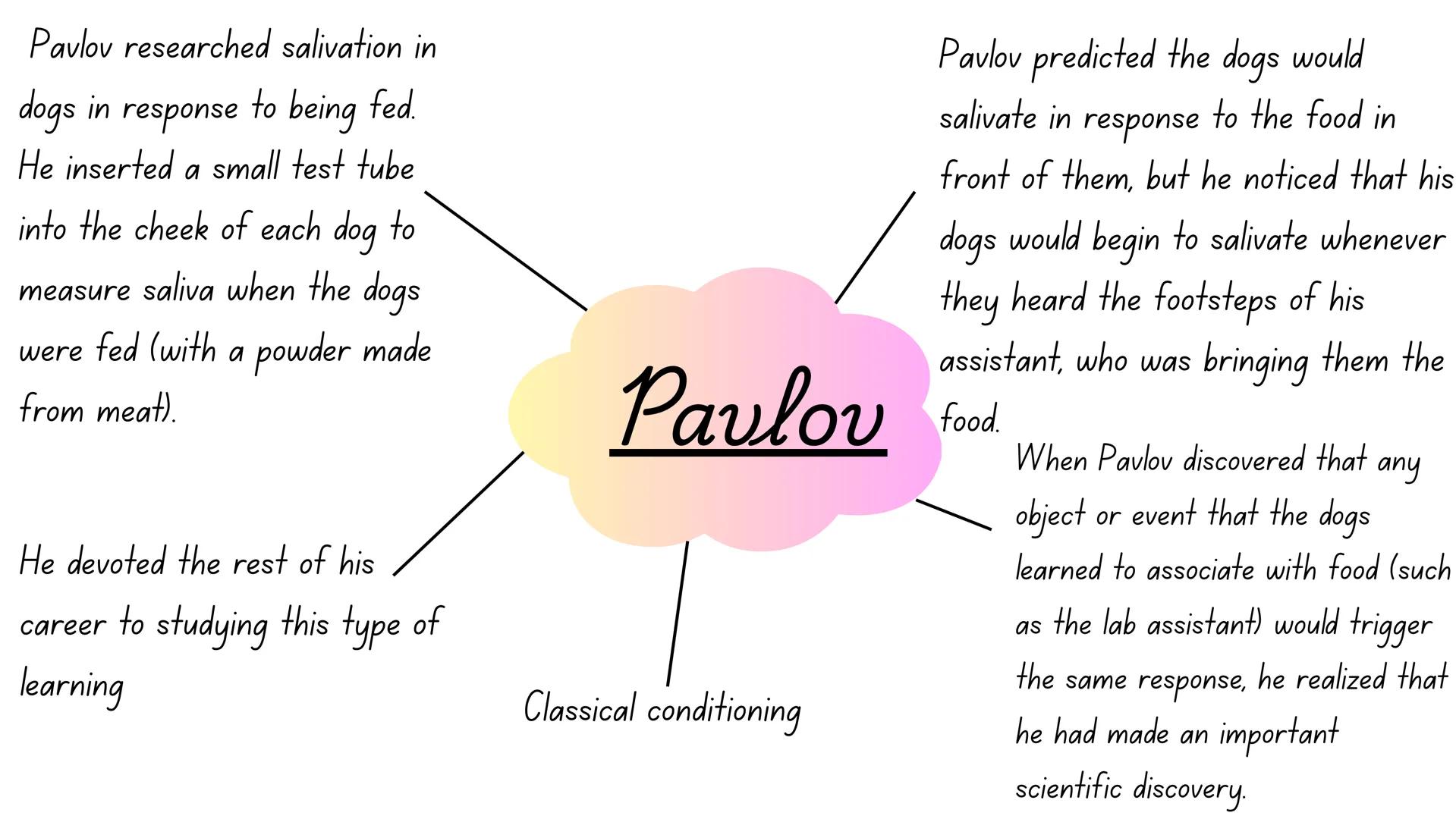
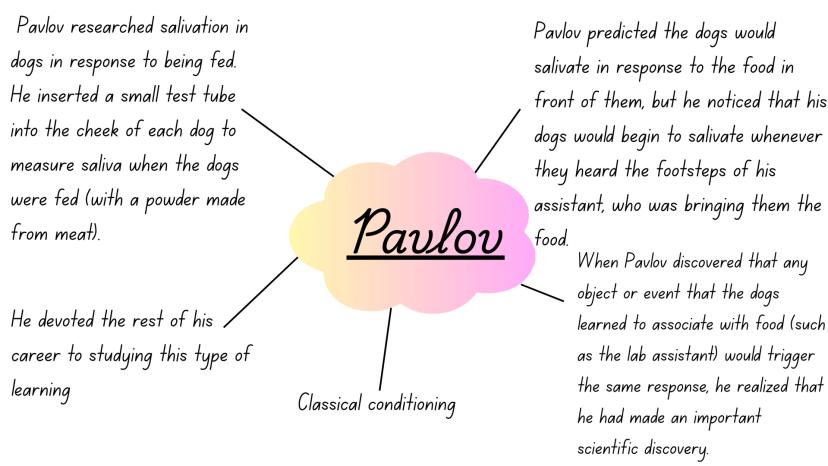
Pavlov accidentally discovered one of psychology's most important concepts whilst studying dog digestion - proving that sometimes the best discoveries happen by chance!
He was measuring how much dogs salivated when fed, but noticed something odd: the dogs started drooling before they even saw food. Just hearing his assistant's footsteps was enough to get their mouths watering.
This became classical conditioning - when two things get linked together so strongly that one automatically triggers a response to the other. The dogs had learned to associate footsteps with food, creating a completely new automatic response.
Key insight: Your brain constantly makes these connections without you realising it - like feeling hungry when you smell your favourite takeaway!
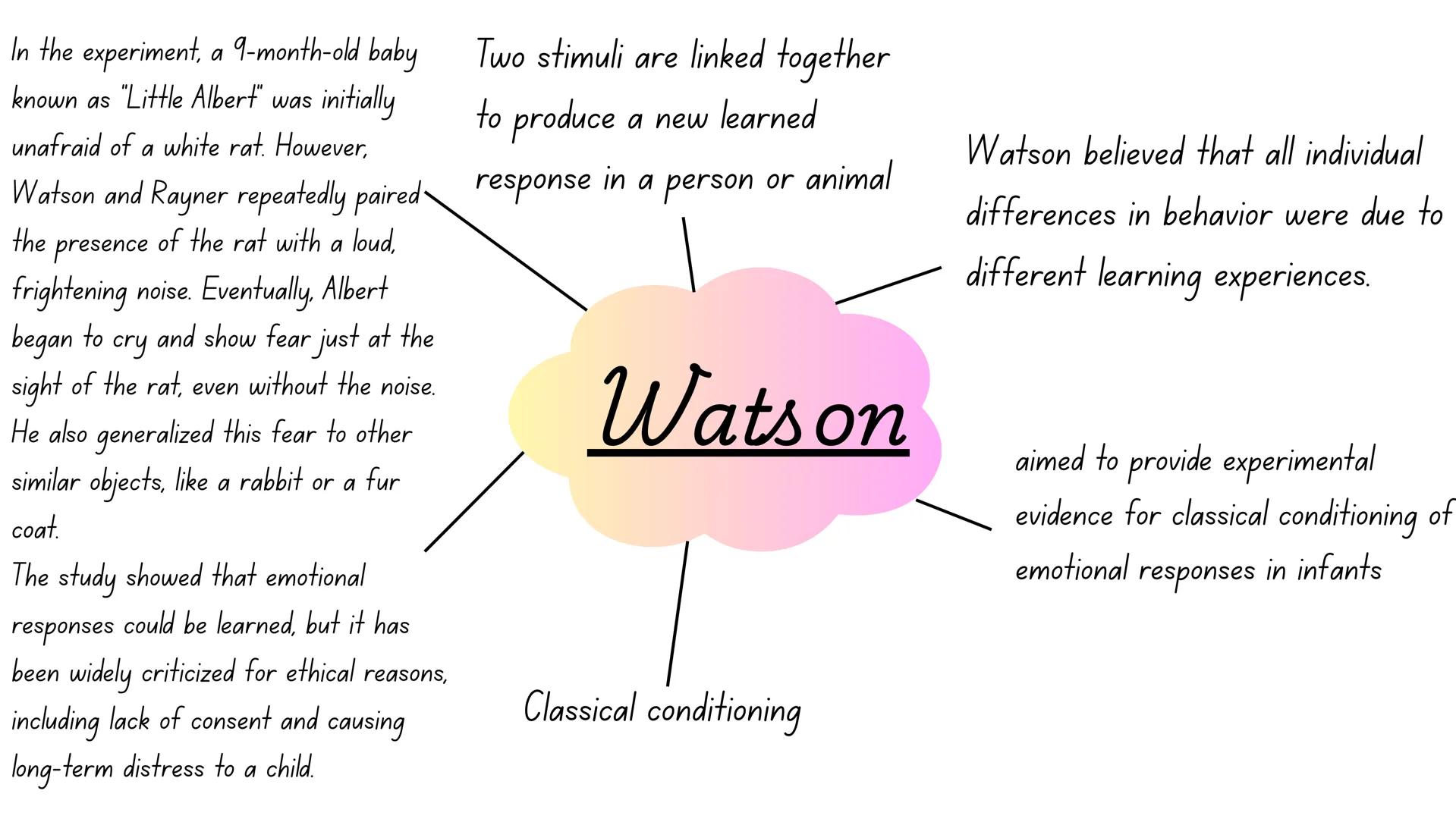
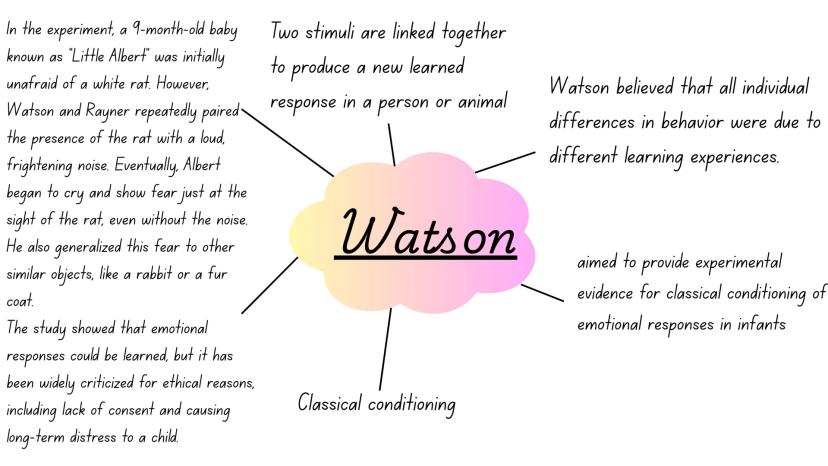
Watson wanted to prove that our fears aren't born with us - they're learned. His experiment with baby Albert became one of psychology's most famous (and controversial) studies.
Nine-month-old Albert wasn't initially scared of a white rat. But Watson repeatedly paired the rat with a loud, frightening noise. Eventually, Albert became terrified of the rat even without the scary sound - and this fear spread to similar furry objects.
The study proved that emotional responses can be conditioned, but it's now considered deeply unethical. Albert never gave consent, and the researchers caused lasting psychological harm to a child.
Watson believed all personality differences come from different learning experiences, not genetics. This classical conditioning approach showed how powerfully our environment shapes our emotional reactions.
Ethics matter: This experiment would never be allowed today - it shows why we need strict rules about research with vulnerable people.
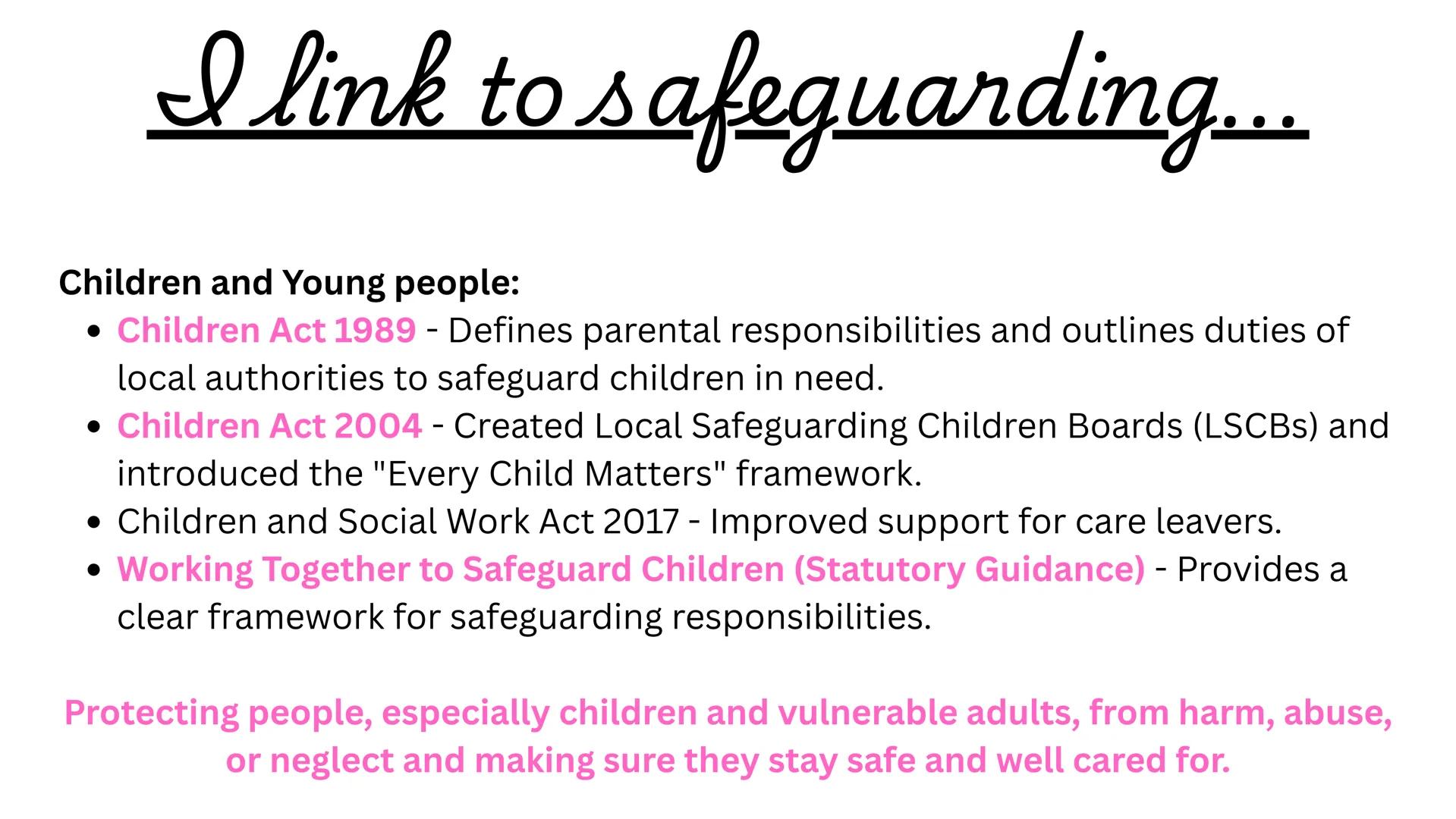
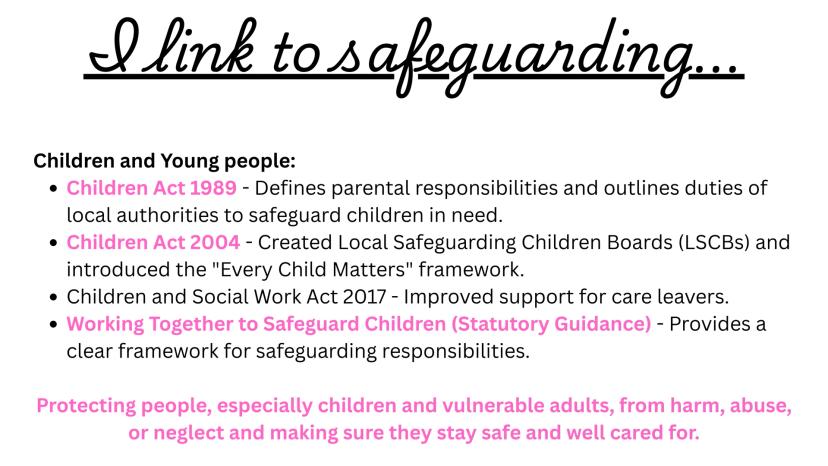
Safeguarding means protecting people from harm, abuse, or neglect - and there are specific laws designed to keep you safe throughout your life.
The Children Act 1989 laid the groundwork by defining what parents and local authorities must do to protect children. The Children Act 2004 created Local Safeguarding Children Boards and introduced the "Every Child Matters" framework - basically ensuring all agencies work together.
More recent laws like the Children and Social Work Act 2017 focus on supporting care leavers as they transition to independence. Working Together to Safeguard Children provides clear guidance on everyone's responsibilities.
Your rights matter: These laws exist because every young person deserves to be safe, supported, and heard.
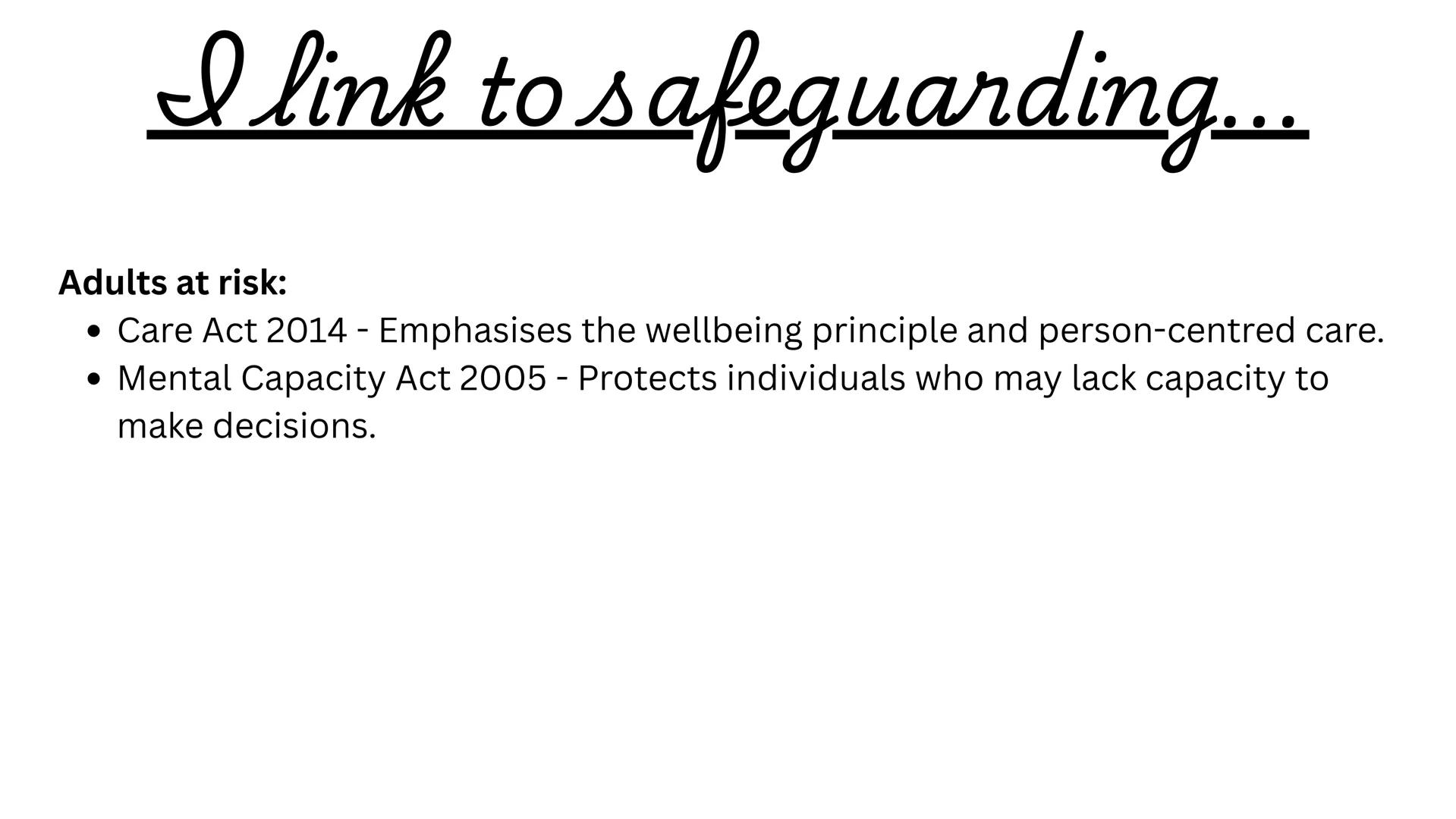
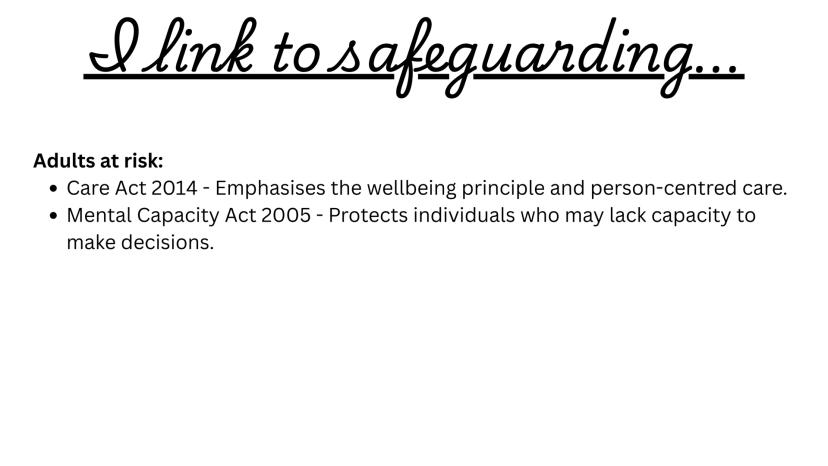
Adults need protection too, especially those who might be vulnerable due to age, disability, or circumstances.
The Care Act 2014 emphasises putting wellbeing first and making sure care is person-centred - meaning services should fit around the individual, not the other way around. The Mental Capacity Act 2005 specifically protects people who might struggle to make decisions for themselves.
These laws ensure that vulnerability doesn't mean losing your rights or dignity. They create frameworks for supporting people whilst respecting their autonomy and choices wherever possible.
Protection with dignity: These laws balance keeping people safe with respecting their right to make their own decisions.
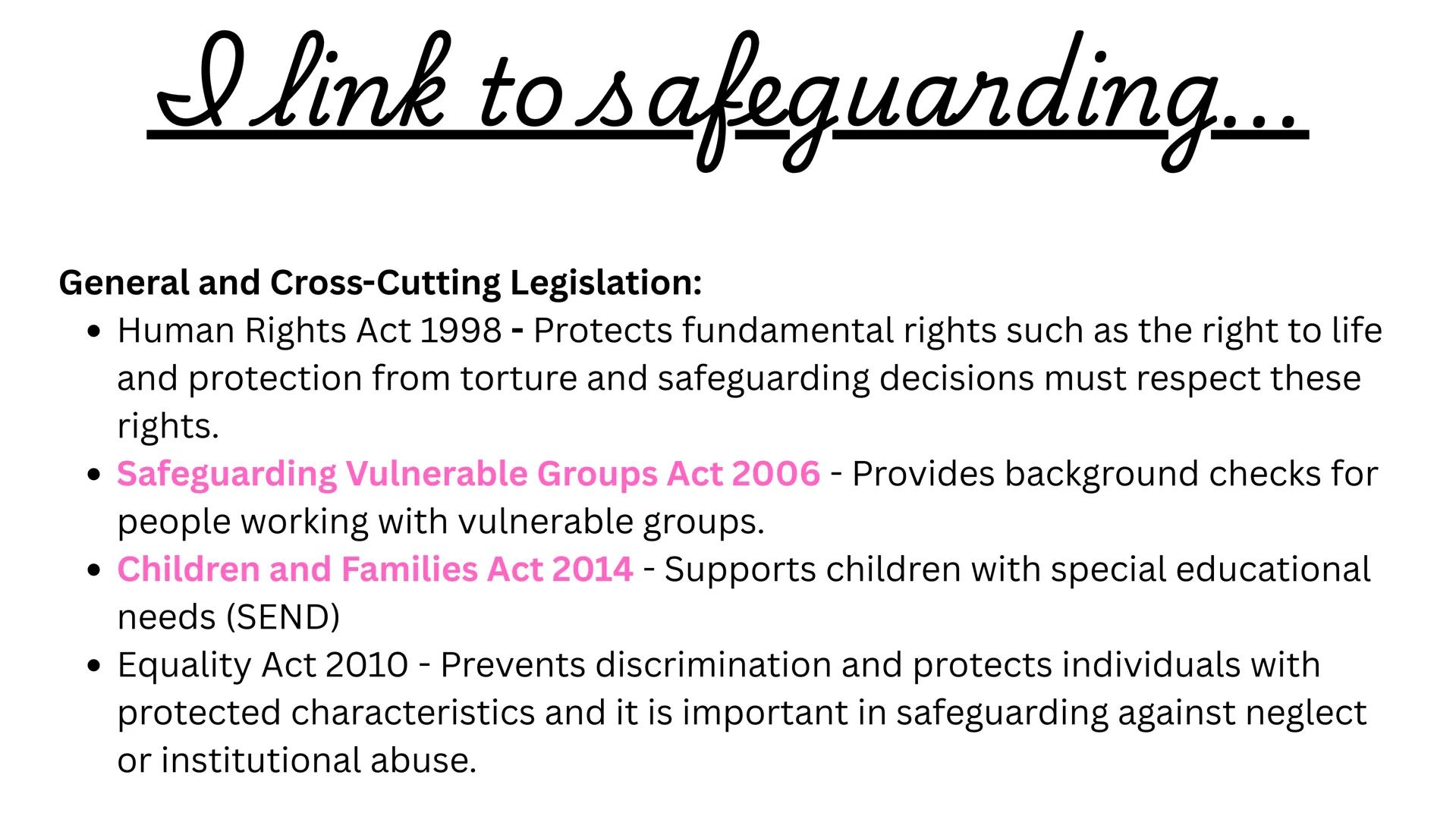
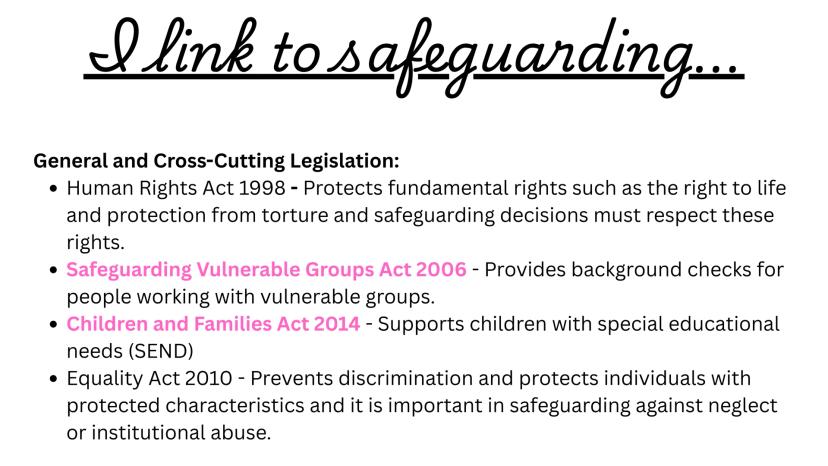
Several broader laws create the foundation for protecting everyone's rights and safety.
The Human Rights Act 1998 protects fundamental rights like life and freedom from torture - safeguarding decisions must respect these basic human rights. The Safeguarding Vulnerable Groups Act 2006 ensures people working with vulnerable groups undergo proper background checks.
The Children and Families Act 2014 specifically supports children with special educational needs, whilst the Equality Act 2010 prevents discrimination based on protected characteristics like race, gender, or disability.
Universal protection: These laws work together to create a safety net that protects everyone's basic rights and dignity.
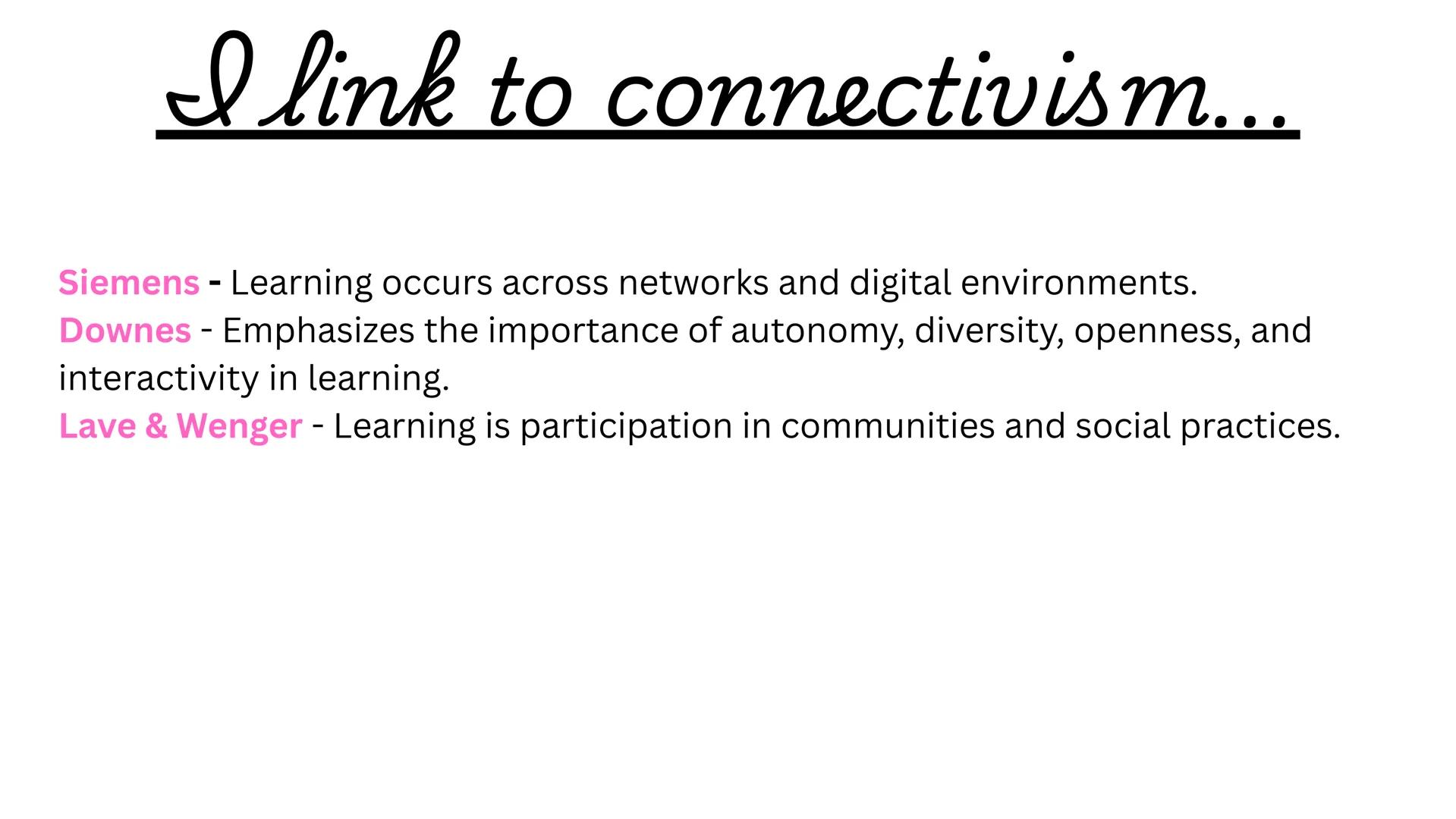
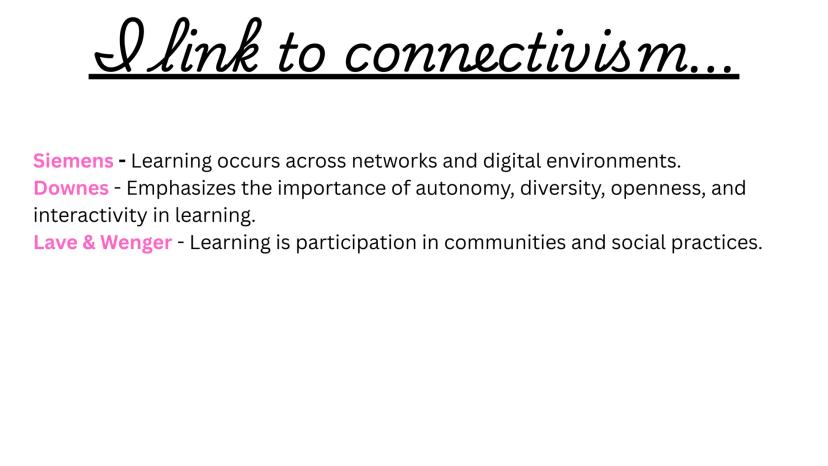
Connectivism recognises that learning today happens differently than it did before the internet - you're constantly connected to information and other learners.
Siemens argued that learning now occurs across networks and digital environments rather than just in your head. Downes emphasised that effective learning needs autonomy, diversity, openness, and interactivity.
Lave and Wenger showed that learning is really about participating in communities and social practices - think about how you learn from YouTube, Discord, or TikTok.
You're already doing it: Every time you learn something new online or share knowledge digitally, you're using connectivist principles!
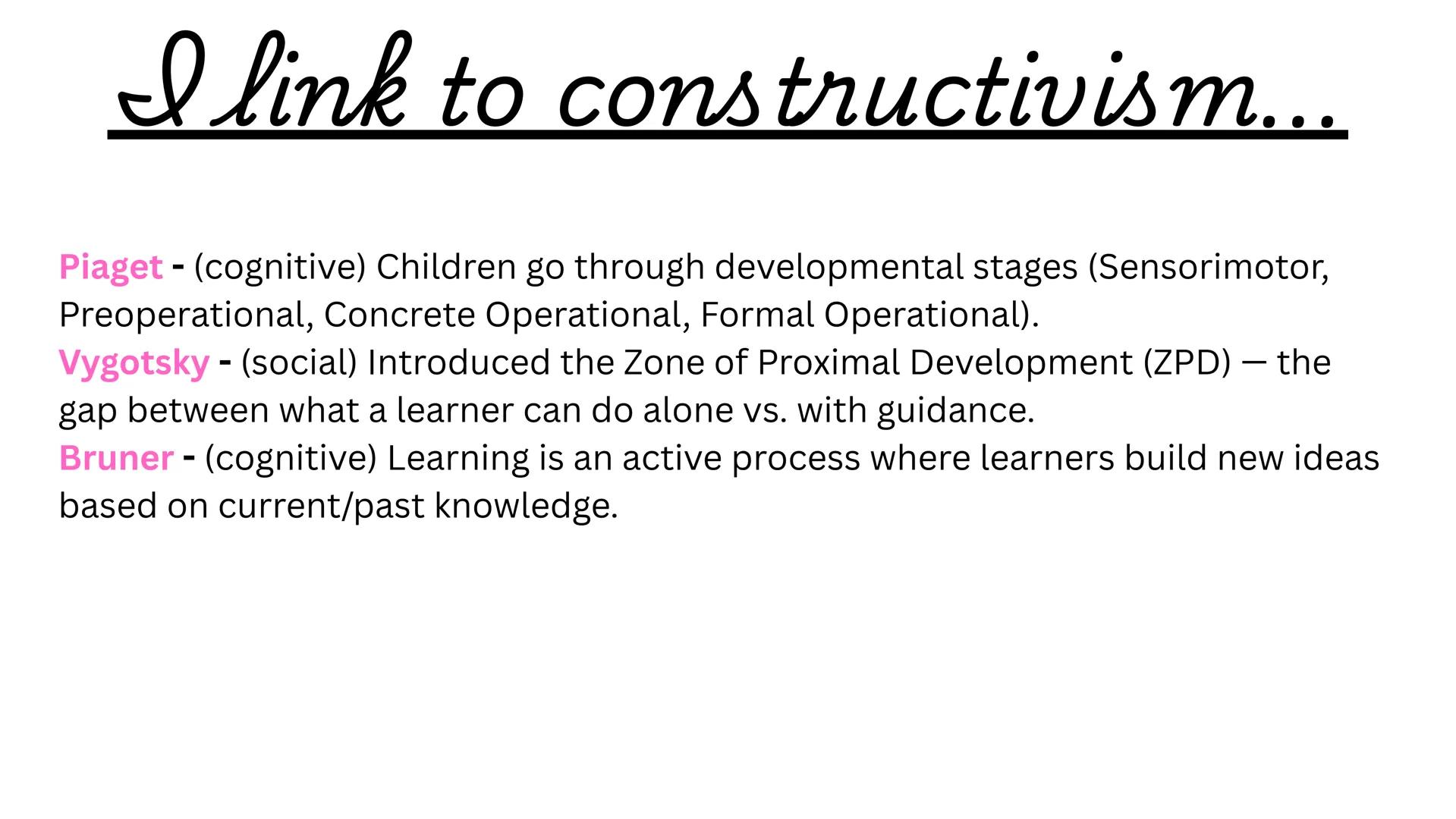
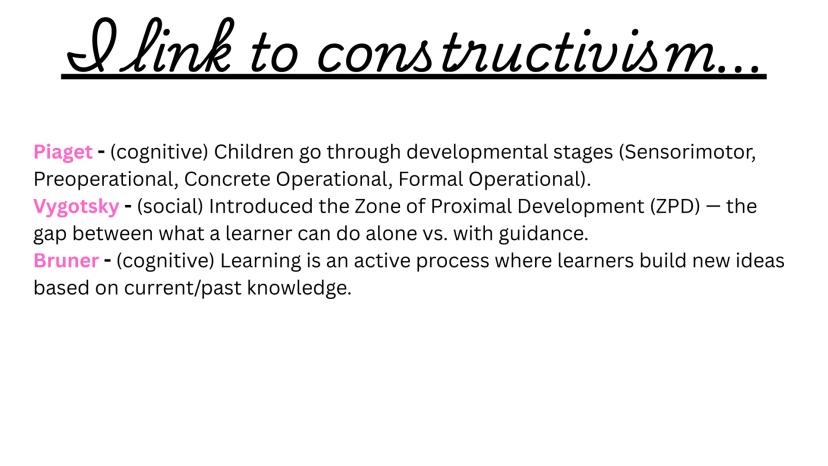
Constructivism says you don't just absorb information like a sponge - you actively build your own understanding based on what you already know.
Piaget identified four developmental stages we all go through: Sensorimotor, Preoperational, Concrete Operational, and Formal Operational. Vygotsky introduced the Zone of Proximal Development - the sweet spot between what you can do alone and what you need help with.
Bruner emphasised that learning is an active process where you build new ideas on top of your current knowledge. It's like constructing a building - each new concept needs solid foundations.
You're the architect: Your brain doesn't just store facts - it actively constructs meaning and connections.
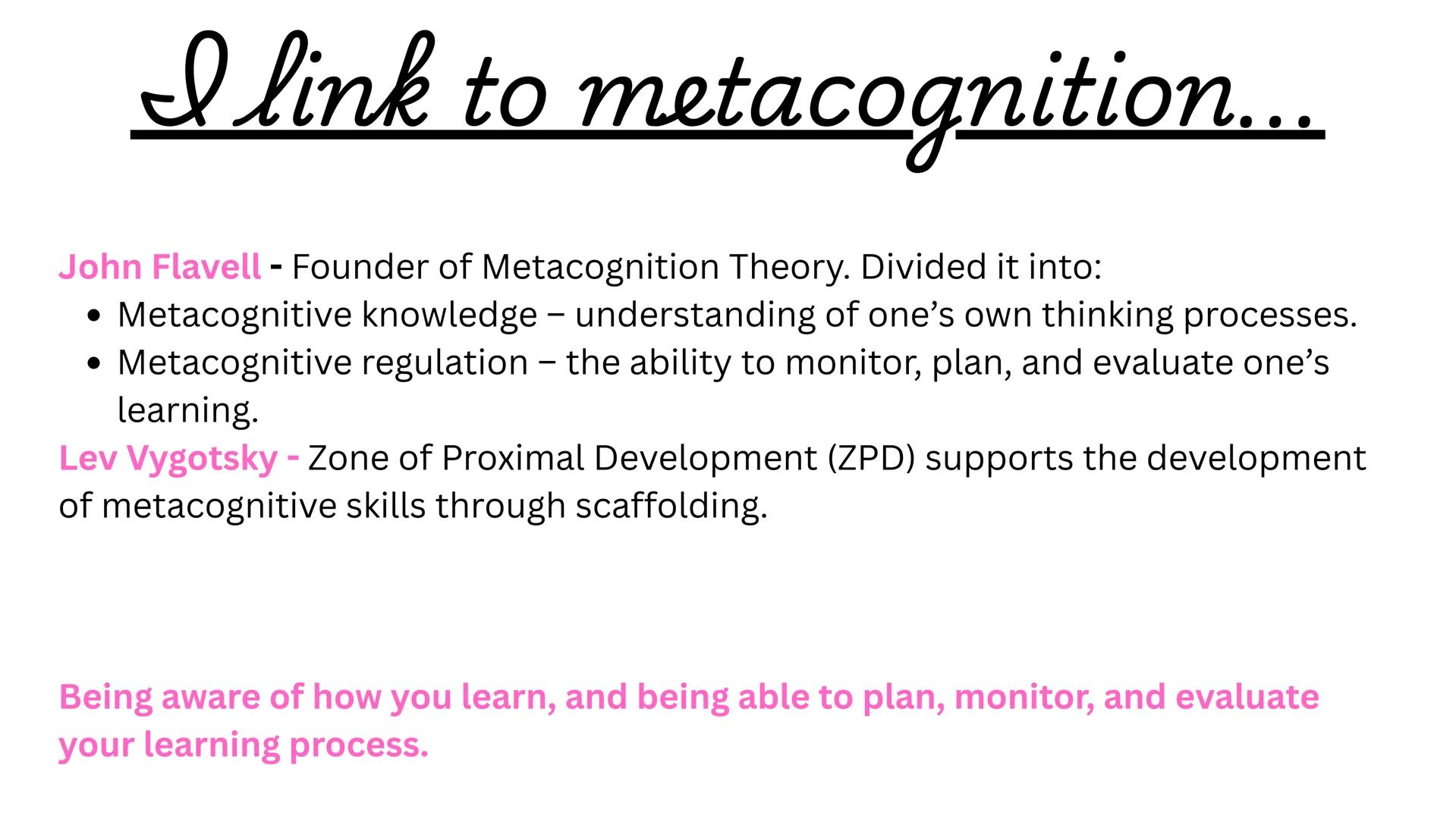
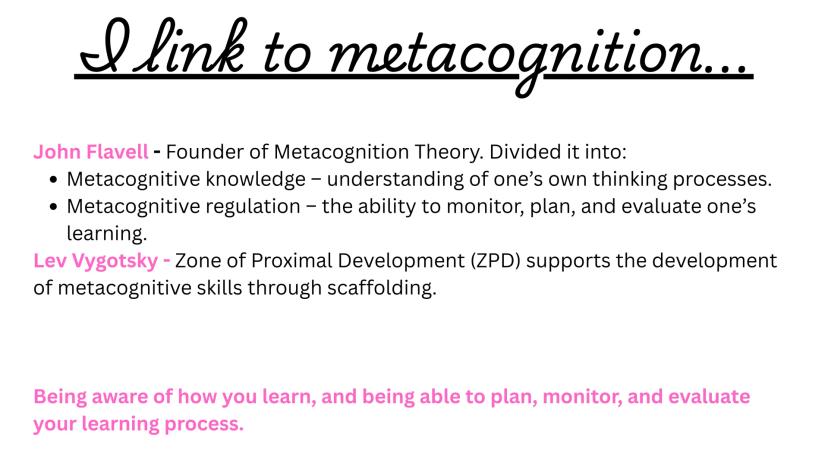
Metacognition is basically being aware of how your own mind works - and it's one of the most powerful tools for improving your learning.
John Flavell founded this theory and split it into two parts: metacognitive knowledge (understanding your own thinking processes) and metacognitive regulation (planning, monitoring, and evaluating your learning).
Vygotsky's Zone of Proximal Development supports developing these skills through scaffolding - gradually removing support as you become more self-aware.
When you know how you learn best, you can plan better study strategies, monitor your progress, and evaluate what's working.
Level up your learning: Students who develop metacognitive skills consistently outperform those who don't - it's like having a user manual for your own brain!
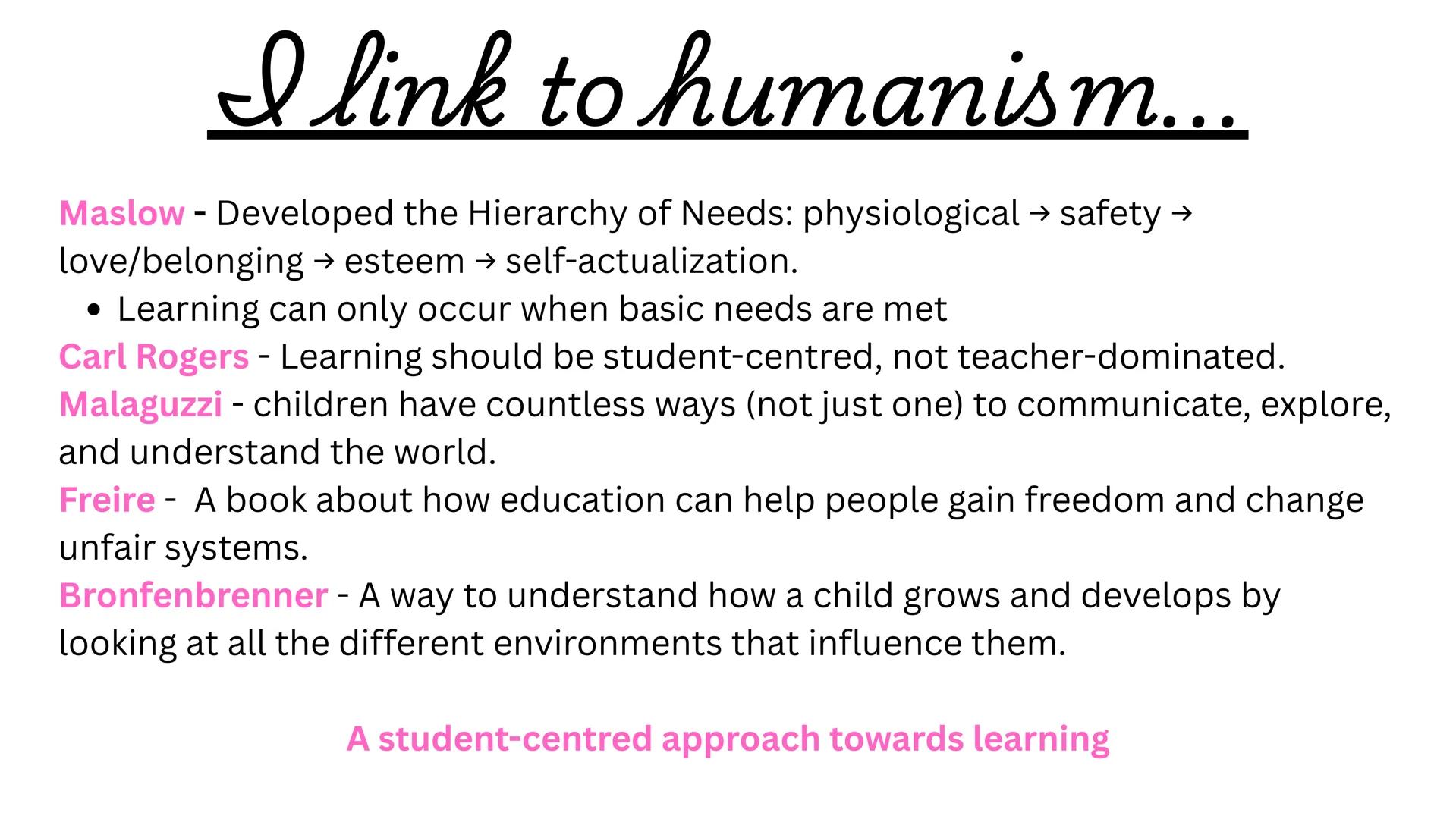
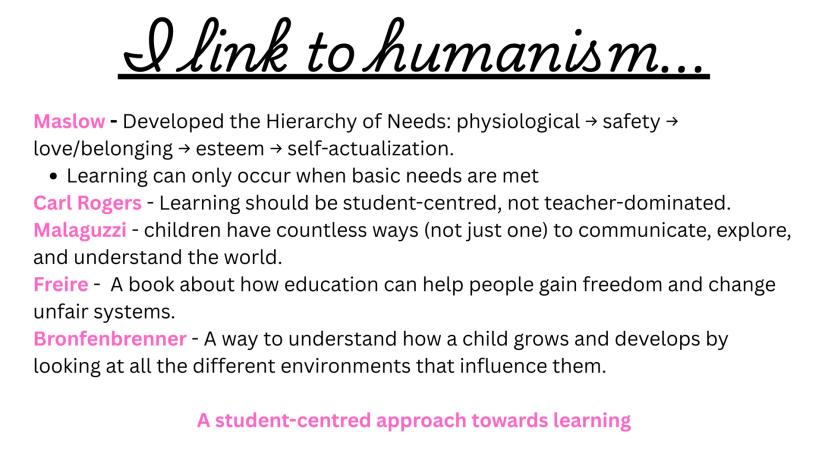
Humanism puts you at the centre of your own learning journey, recognising that you're a whole person with needs, feelings, and unique potential.
Maslow's Hierarchy of Needs shows that learning can only happen when your basic needs are met - you can't focus on algebra if you're hungry or feel unsafe. Carl Rogers believed learning should be student-centred, not teacher-dominated.
Malaguzzi recognised that children have countless ways to communicate and understand the world. Freire saw education as a tool for freedom and social change, whilst Bronfenbrenner showed how all your different environments influence your development.
This student-centred approach recognises that effective learning happens when you feel valued, supported, and free to explore your interests.
You matter: Humanistic approaches recognise that your thoughts, feelings, and experiences are central to meaningful learning.
Our AI Companion is a student-focused AI tool that offers more than just answers. Built on millions of Knowunity resources, it provides relevant information, personalised study plans, quizzes, and content directly in the chat, adapting to your individual learning journey.
You can download the app from Google Play Store and Apple App Store.
That's right! Enjoy free access to study content, connect with fellow students, and get instant help – all at your fingertips.
App Store
Google Play
The app is very easy to use and well designed. I have found everything I was looking for so far and have been able to learn a lot from the presentations! I will definitely use the app for a class assignment! And of course it also helps a lot as an inspiration.
Stefan S
iOS user
This app is really great. There are so many study notes and help [...]. My problem subject is French, for example, and the app has so many options for help. Thanks to this app, I have improved my French. I would recommend it to anyone.
Samantha Klich
Android user
Wow, I am really amazed. I just tried the app because I've seen it advertised many times and was absolutely stunned. This app is THE HELP you want for school and above all, it offers so many things, such as workouts and fact sheets, which have been VERY helpful to me personally.
Anna
iOS user
Best app on earth! no words because it’s too good
Thomas R
iOS user
Just amazing. Let's me revise 10x better, this app is a quick 10/10. I highly recommend it to anyone. I can watch and search for notes. I can save them in the subject folder. I can revise it any time when I come back. If you haven't tried this app, you're really missing out.
Basil
Android user
This app has made me feel so much more confident in my exam prep, not only through boosting my own self confidence through the features that allow you to connect with others and feel less alone, but also through the way the app itself is centred around making you feel better. It is easy to navigate, fun to use, and helpful to anyone struggling in absolutely any way.
David K
iOS user
The app's just great! All I have to do is enter the topic in the search bar and I get the response real fast. I don't have to watch 10 YouTube videos to understand something, so I'm saving my time. Highly recommended!
Sudenaz Ocak
Android user
In school I was really bad at maths but thanks to the app, I am doing better now. I am so grateful that you made the app.
Greenlight Bonnie
Android user
very reliable app to help and grow your ideas of Maths, English and other related topics in your works. please use this app if your struggling in areas, this app is key for that. wish I'd of done a review before. and it's also free so don't worry about that.
Rohan U
Android user
I know a lot of apps use fake accounts to boost their reviews but this app deserves it all. Originally I was getting 4 in my English exams and this time I got a grade 7. I didn’t even know about this app three days until the exam and it has helped A LOT. Please actually trust me and use it as I’m sure you too will see developments.
Xander S
iOS user
THE QUIZES AND FLASHCARDS ARE SO USEFUL AND I LOVE Knowunity AI. IT ALSO IS LITREALLY LIKE CHATGPT BUT SMARTER!! HELPED ME WITH MY MASCARA PROBLEMS TOO!! AS WELL AS MY REAL SUBJECTS ! DUHHH 😍😁😲🤑💗✨🎀😮
Elisha
iOS user
This apps acc the goat. I find revision so boring but this app makes it so easy to organize it all and then you can ask the freeeee ai to test yourself so good and you can easily upload your own stuff. highly recommend as someone taking mocks now
Paul T
iOS user
The app is very easy to use and well designed. I have found everything I was looking for so far and have been able to learn a lot from the presentations! I will definitely use the app for a class assignment! And of course it also helps a lot as an inspiration.
Stefan S
iOS user
This app is really great. There are so many study notes and help [...]. My problem subject is French, for example, and the app has so many options for help. Thanks to this app, I have improved my French. I would recommend it to anyone.
Samantha Klich
Android user
Wow, I am really amazed. I just tried the app because I've seen it advertised many times and was absolutely stunned. This app is THE HELP you want for school and above all, it offers so many things, such as workouts and fact sheets, which have been VERY helpful to me personally.
Anna
iOS user
Best app on earth! no words because it’s too good
Thomas R
iOS user
Just amazing. Let's me revise 10x better, this app is a quick 10/10. I highly recommend it to anyone. I can watch and search for notes. I can save them in the subject folder. I can revise it any time when I come back. If you haven't tried this app, you're really missing out.
Basil
Android user
This app has made me feel so much more confident in my exam prep, not only through boosting my own self confidence through the features that allow you to connect with others and feel less alone, but also through the way the app itself is centred around making you feel better. It is easy to navigate, fun to use, and helpful to anyone struggling in absolutely any way.
David K
iOS user
The app's just great! All I have to do is enter the topic in the search bar and I get the response real fast. I don't have to watch 10 YouTube videos to understand something, so I'm saving my time. Highly recommended!
Sudenaz Ocak
Android user
In school I was really bad at maths but thanks to the app, I am doing better now. I am so grateful that you made the app.
Greenlight Bonnie
Android user
very reliable app to help and grow your ideas of Maths, English and other related topics in your works. please use this app if your struggling in areas, this app is key for that. wish I'd of done a review before. and it's also free so don't worry about that.
Rohan U
Android user
I know a lot of apps use fake accounts to boost their reviews but this app deserves it all. Originally I was getting 4 in my English exams and this time I got a grade 7. I didn’t even know about this app three days until the exam and it has helped A LOT. Please actually trust me and use it as I’m sure you too will see developments.
Xander S
iOS user
THE QUIZES AND FLASHCARDS ARE SO USEFUL AND I LOVE Knowunity AI. IT ALSO IS LITREALLY LIKE CHATGPT BUT SMARTER!! HELPED ME WITH MY MASCARA PROBLEMS TOO!! AS WELL AS MY REAL SUBJECTS ! DUHHH 😍😁😲🤑💗✨🎀😮
Elisha
iOS user
This apps acc the goat. I find revision so boring but this app makes it so easy to organize it all and then you can ask the freeeee ai to test yourself so good and you can easily upload your own stuff. highly recommend as someone taking mocks now
Paul T
iOS user
Tia
@tia.1
Psychology isn't just about understanding the mind - it's everywhere in your daily life, from how you learn new skills to how laws protect you and others. This collection covers the major learning theories that explain how we develop behaviours... Show more
Access to all documents
Improve your grades
Join milions of students
Ever wondered why some habits stick whilst others don't? Operant conditioning is all about how consequences shape our behaviour - and it's happening to you every day.
Positive reinforcement means adding something pleasant (like praise or money) to make a behaviour more likely to happen again. Think getting your phone back after good grades. Positive punishment works the opposite way - adding something unpleasant (like extra chores) to stop unwanted behaviour.
Negative reinforcement removes something annoying to encourage good behaviour - like your parents stopping their nagging when you tidy your room. Negative punishment takes away something nice (like screen time) to discourage bad behaviour.
Remember: Positive/negative doesn't mean good/bad - it just means adding or removing something!
Access to all documents
Improve your grades
Join milions of students
Pavlov accidentally discovered one of psychology's most important concepts whilst studying dog digestion - proving that sometimes the best discoveries happen by chance!
He was measuring how much dogs salivated when fed, but noticed something odd: the dogs started drooling before they even saw food. Just hearing his assistant's footsteps was enough to get their mouths watering.
This became classical conditioning - when two things get linked together so strongly that one automatically triggers a response to the other. The dogs had learned to associate footsteps with food, creating a completely new automatic response.
Key insight: Your brain constantly makes these connections without you realising it - like feeling hungry when you smell your favourite takeaway!
Access to all documents
Improve your grades
Join milions of students
Watson wanted to prove that our fears aren't born with us - they're learned. His experiment with baby Albert became one of psychology's most famous (and controversial) studies.
Nine-month-old Albert wasn't initially scared of a white rat. But Watson repeatedly paired the rat with a loud, frightening noise. Eventually, Albert became terrified of the rat even without the scary sound - and this fear spread to similar furry objects.
The study proved that emotional responses can be conditioned, but it's now considered deeply unethical. Albert never gave consent, and the researchers caused lasting psychological harm to a child.
Watson believed all personality differences come from different learning experiences, not genetics. This classical conditioning approach showed how powerfully our environment shapes our emotional reactions.
Ethics matter: This experiment would never be allowed today - it shows why we need strict rules about research with vulnerable people.
Access to all documents
Improve your grades
Join milions of students
Safeguarding means protecting people from harm, abuse, or neglect - and there are specific laws designed to keep you safe throughout your life.
The Children Act 1989 laid the groundwork by defining what parents and local authorities must do to protect children. The Children Act 2004 created Local Safeguarding Children Boards and introduced the "Every Child Matters" framework - basically ensuring all agencies work together.
More recent laws like the Children and Social Work Act 2017 focus on supporting care leavers as they transition to independence. Working Together to Safeguard Children provides clear guidance on everyone's responsibilities.
Your rights matter: These laws exist because every young person deserves to be safe, supported, and heard.
Access to all documents
Improve your grades
Join milions of students
Adults need protection too, especially those who might be vulnerable due to age, disability, or circumstances.
The Care Act 2014 emphasises putting wellbeing first and making sure care is person-centred - meaning services should fit around the individual, not the other way around. The Mental Capacity Act 2005 specifically protects people who might struggle to make decisions for themselves.
These laws ensure that vulnerability doesn't mean losing your rights or dignity. They create frameworks for supporting people whilst respecting their autonomy and choices wherever possible.
Protection with dignity: These laws balance keeping people safe with respecting their right to make their own decisions.
Access to all documents
Improve your grades
Join milions of students
Several broader laws create the foundation for protecting everyone's rights and safety.
The Human Rights Act 1998 protects fundamental rights like life and freedom from torture - safeguarding decisions must respect these basic human rights. The Safeguarding Vulnerable Groups Act 2006 ensures people working with vulnerable groups undergo proper background checks.
The Children and Families Act 2014 specifically supports children with special educational needs, whilst the Equality Act 2010 prevents discrimination based on protected characteristics like race, gender, or disability.
Universal protection: These laws work together to create a safety net that protects everyone's basic rights and dignity.
Access to all documents
Improve your grades
Join milions of students
Connectivism recognises that learning today happens differently than it did before the internet - you're constantly connected to information and other learners.
Siemens argued that learning now occurs across networks and digital environments rather than just in your head. Downes emphasised that effective learning needs autonomy, diversity, openness, and interactivity.
Lave and Wenger showed that learning is really about participating in communities and social practices - think about how you learn from YouTube, Discord, or TikTok.
You're already doing it: Every time you learn something new online or share knowledge digitally, you're using connectivist principles!
Access to all documents
Improve your grades
Join milions of students
Constructivism says you don't just absorb information like a sponge - you actively build your own understanding based on what you already know.
Piaget identified four developmental stages we all go through: Sensorimotor, Preoperational, Concrete Operational, and Formal Operational. Vygotsky introduced the Zone of Proximal Development - the sweet spot between what you can do alone and what you need help with.
Bruner emphasised that learning is an active process where you build new ideas on top of your current knowledge. It's like constructing a building - each new concept needs solid foundations.
You're the architect: Your brain doesn't just store facts - it actively constructs meaning and connections.
Access to all documents
Improve your grades
Join milions of students
Metacognition is basically being aware of how your own mind works - and it's one of the most powerful tools for improving your learning.
John Flavell founded this theory and split it into two parts: metacognitive knowledge (understanding your own thinking processes) and metacognitive regulation (planning, monitoring, and evaluating your learning).
Vygotsky's Zone of Proximal Development supports developing these skills through scaffolding - gradually removing support as you become more self-aware.
When you know how you learn best, you can plan better study strategies, monitor your progress, and evaluate what's working.
Level up your learning: Students who develop metacognitive skills consistently outperform those who don't - it's like having a user manual for your own brain!
Access to all documents
Improve your grades
Join milions of students
Humanism puts you at the centre of your own learning journey, recognising that you're a whole person with needs, feelings, and unique potential.
Maslow's Hierarchy of Needs shows that learning can only happen when your basic needs are met - you can't focus on algebra if you're hungry or feel unsafe. Carl Rogers believed learning should be student-centred, not teacher-dominated.
Malaguzzi recognised that children have countless ways to communicate and understand the world. Freire saw education as a tool for freedom and social change, whilst Bronfenbrenner showed how all your different environments influence your development.
This student-centred approach recognises that effective learning happens when you feel valued, supported, and free to explore your interests.
You matter: Humanistic approaches recognise that your thoughts, feelings, and experiences are central to meaningful learning.
Our AI Companion is a student-focused AI tool that offers more than just answers. Built on millions of Knowunity resources, it provides relevant information, personalised study plans, quizzes, and content directly in the chat, adapting to your individual learning journey.
You can download the app from Google Play Store and Apple App Store.
That's right! Enjoy free access to study content, connect with fellow students, and get instant help – all at your fingertips.
4
Smart Tools NEW
Transform this note into: ✓ 50+ Practice Questions ✓ Interactive Flashcards ✓ Full Mock Exam ✓ Essay Outlines
App Store
Google Play
The app is very easy to use and well designed. I have found everything I was looking for so far and have been able to learn a lot from the presentations! I will definitely use the app for a class assignment! And of course it also helps a lot as an inspiration.
Stefan S
iOS user
This app is really great. There are so many study notes and help [...]. My problem subject is French, for example, and the app has so many options for help. Thanks to this app, I have improved my French. I would recommend it to anyone.
Samantha Klich
Android user
Wow, I am really amazed. I just tried the app because I've seen it advertised many times and was absolutely stunned. This app is THE HELP you want for school and above all, it offers so many things, such as workouts and fact sheets, which have been VERY helpful to me personally.
Anna
iOS user
Best app on earth! no words because it’s too good
Thomas R
iOS user
Just amazing. Let's me revise 10x better, this app is a quick 10/10. I highly recommend it to anyone. I can watch and search for notes. I can save them in the subject folder. I can revise it any time when I come back. If you haven't tried this app, you're really missing out.
Basil
Android user
This app has made me feel so much more confident in my exam prep, not only through boosting my own self confidence through the features that allow you to connect with others and feel less alone, but also through the way the app itself is centred around making you feel better. It is easy to navigate, fun to use, and helpful to anyone struggling in absolutely any way.
David K
iOS user
The app's just great! All I have to do is enter the topic in the search bar and I get the response real fast. I don't have to watch 10 YouTube videos to understand something, so I'm saving my time. Highly recommended!
Sudenaz Ocak
Android user
In school I was really bad at maths but thanks to the app, I am doing better now. I am so grateful that you made the app.
Greenlight Bonnie
Android user
very reliable app to help and grow your ideas of Maths, English and other related topics in your works. please use this app if your struggling in areas, this app is key for that. wish I'd of done a review before. and it's also free so don't worry about that.
Rohan U
Android user
I know a lot of apps use fake accounts to boost their reviews but this app deserves it all. Originally I was getting 4 in my English exams and this time I got a grade 7. I didn’t even know about this app three days until the exam and it has helped A LOT. Please actually trust me and use it as I’m sure you too will see developments.
Xander S
iOS user
THE QUIZES AND FLASHCARDS ARE SO USEFUL AND I LOVE Knowunity AI. IT ALSO IS LITREALLY LIKE CHATGPT BUT SMARTER!! HELPED ME WITH MY MASCARA PROBLEMS TOO!! AS WELL AS MY REAL SUBJECTS ! DUHHH 😍😁😲🤑💗✨🎀😮
Elisha
iOS user
This apps acc the goat. I find revision so boring but this app makes it so easy to organize it all and then you can ask the freeeee ai to test yourself so good and you can easily upload your own stuff. highly recommend as someone taking mocks now
Paul T
iOS user
The app is very easy to use and well designed. I have found everything I was looking for so far and have been able to learn a lot from the presentations! I will definitely use the app for a class assignment! And of course it also helps a lot as an inspiration.
Stefan S
iOS user
This app is really great. There are so many study notes and help [...]. My problem subject is French, for example, and the app has so many options for help. Thanks to this app, I have improved my French. I would recommend it to anyone.
Samantha Klich
Android user
Wow, I am really amazed. I just tried the app because I've seen it advertised many times and was absolutely stunned. This app is THE HELP you want for school and above all, it offers so many things, such as workouts and fact sheets, which have been VERY helpful to me personally.
Anna
iOS user
Best app on earth! no words because it’s too good
Thomas R
iOS user
Just amazing. Let's me revise 10x better, this app is a quick 10/10. I highly recommend it to anyone. I can watch and search for notes. I can save them in the subject folder. I can revise it any time when I come back. If you haven't tried this app, you're really missing out.
Basil
Android user
This app has made me feel so much more confident in my exam prep, not only through boosting my own self confidence through the features that allow you to connect with others and feel less alone, but also through the way the app itself is centred around making you feel better. It is easy to navigate, fun to use, and helpful to anyone struggling in absolutely any way.
David K
iOS user
The app's just great! All I have to do is enter the topic in the search bar and I get the response real fast. I don't have to watch 10 YouTube videos to understand something, so I'm saving my time. Highly recommended!
Sudenaz Ocak
Android user
In school I was really bad at maths but thanks to the app, I am doing better now. I am so grateful that you made the app.
Greenlight Bonnie
Android user
very reliable app to help and grow your ideas of Maths, English and other related topics in your works. please use this app if your struggling in areas, this app is key for that. wish I'd of done a review before. and it's also free so don't worry about that.
Rohan U
Android user
I know a lot of apps use fake accounts to boost their reviews but this app deserves it all. Originally I was getting 4 in my English exams and this time I got a grade 7. I didn’t even know about this app three days until the exam and it has helped A LOT. Please actually trust me and use it as I’m sure you too will see developments.
Xander S
iOS user
THE QUIZES AND FLASHCARDS ARE SO USEFUL AND I LOVE Knowunity AI. IT ALSO IS LITREALLY LIKE CHATGPT BUT SMARTER!! HELPED ME WITH MY MASCARA PROBLEMS TOO!! AS WELL AS MY REAL SUBJECTS ! DUHHH 😍😁😲🤑💗✨🎀😮
Elisha
iOS user
This apps acc the goat. I find revision so boring but this app makes it so easy to organize it all and then you can ask the freeeee ai to test yourself so good and you can easily upload your own stuff. highly recommend as someone taking mocks now
Paul T
iOS user