
Ever wondered how businesses find and hire the right people?... Show more
 Other
Other History
 Biology
 English Literature
 Sociology
Sign up to see the contentIt's free!
Access to all documents
Improve your grades
Join milions of students
By signing up you accept Terms of Service and Privacy Policy
Subjects
Classic Dramatic Literature
Modern Lyric Poetry
Influential English-Language Authors
Classic and Contemporary Novels
Literary Character Analysis
Romantic and Love Poetry
Reading Analysis and Interpretation
Evidence Analysis and Integration
Author's Stylistic Elements
Figurative Language and Rhetoric
Show all topics
Human Organ Systems
Cellular Organization and Development
Biomolecular Structure and Organization
Enzyme Structure and Regulation
Cellular Organization Types
Biological Homeostatic Processes
Cellular Membrane Structure
Autotrophic Energy Processes
Environmental Sustainability and Impact
Neural Communication Systems
Show all topics
Social Sciences Research & Practice
Social Structure and Mobility
Classic Social Influence Experiments
Social Systems Theories
Family and Relationship Dynamics
Memory Systems and Processes
Neural Bases of Behavior
Social Influence and Attraction
Psychotherapeutic Approaches
Human Agency and Responsibility
Show all topics
Chemical Sciences and Applications
Chemical Bond Types and Properties
Organic Functional Groups
Atomic Structure and Composition
Chromatographic Separation Principles
Chemical Compound Classifications
Electrochemical Cell Systems
Periodic Table Organization
Chemical Reaction Kinetics
Chemical Equation Conservation
Show all topics
Nazi Germany and Holocaust 1933-1945
World Wars and Peace Treaties
European Monarchs and Statesmen
Cold War Global Tensions
Medieval Institutions and Systems
European Renaissance and Enlightenment
Modern Global Environmental-Health Challenges
Modern Military Conflicts
Medieval Migration and Invasions
World Wars Era and Impact
Show all topics
72
•
27 Dec 2025
•
Holly Carnson
@hollycarnson_eakb
Ever wondered how businesses find and hire the right people?... Show more
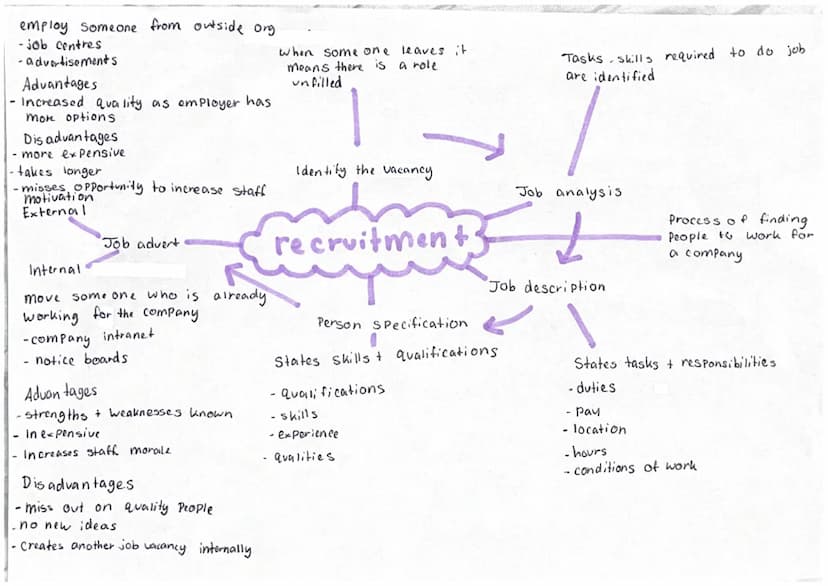
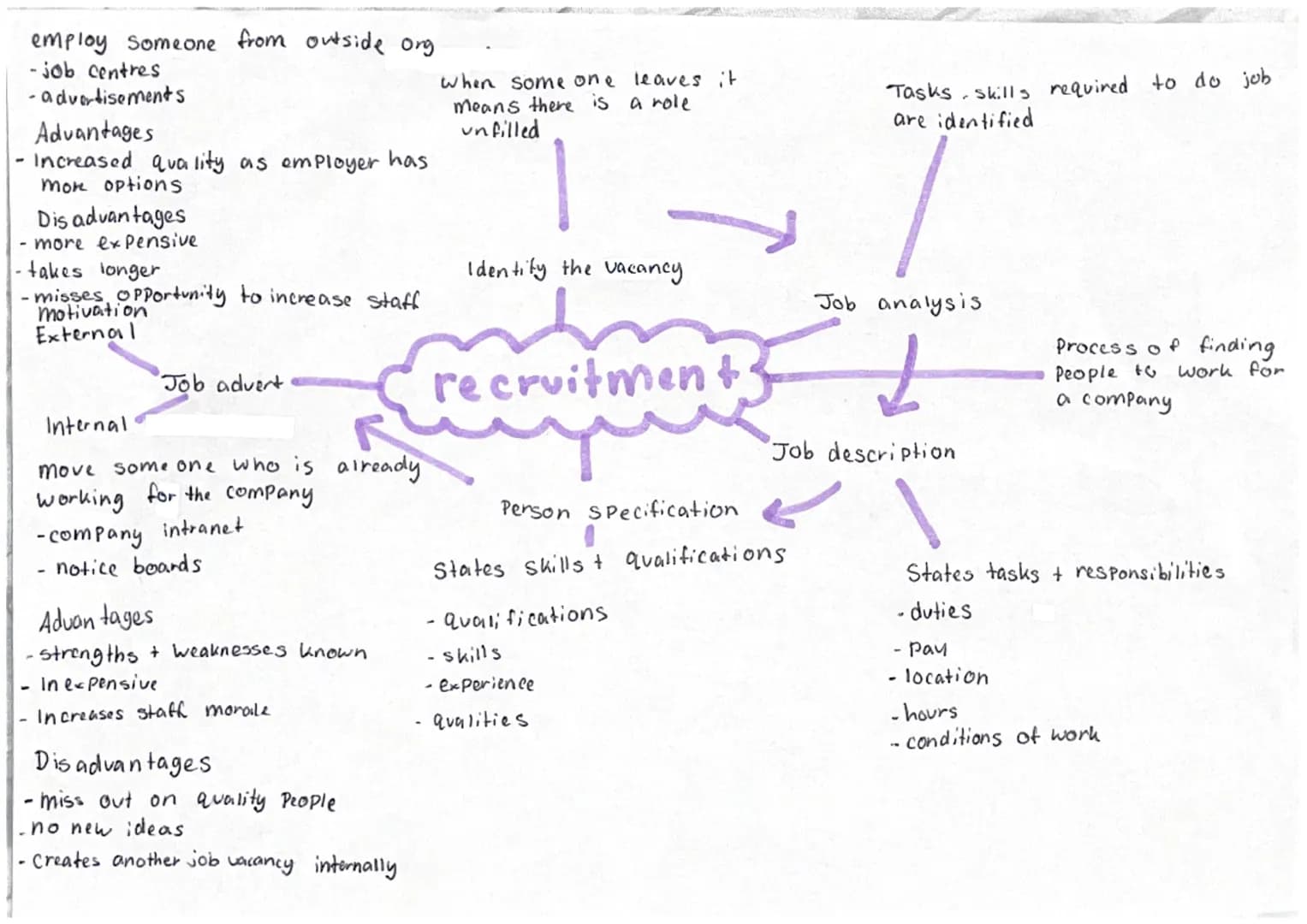
When a company needs new staff, they've got two main options: internal recruitment (promoting existing employees) or external recruitment (hiring from outside). Each approach has its trade-offs that smart managers need to weigh up.
Internal recruitment means moving someone who already works for the company into a new role. It's cheaper, boosts staff morale, and you already know the person's strengths and weaknesses. However, you'll miss out on fresh ideas and talented outsiders, plus you'll create another vacancy to fill internally.
External recruitment involves advertising through job centres or public adverts to attract outside candidates. You'll have more quality options to choose from, but it's more expensive, takes longer, and won't motivate your existing staff.
Before recruiting anyone, companies must complete a job analysis to identify exactly what skills and tasks are needed. This leads to creating a job description (listing duties, pay, and working conditions) and a person specification (outlining required qualifications, skills, and experience).
Quick Tip: Most successful companies use a mix of both internal and external recruitment depending on the specific role and circumstances.
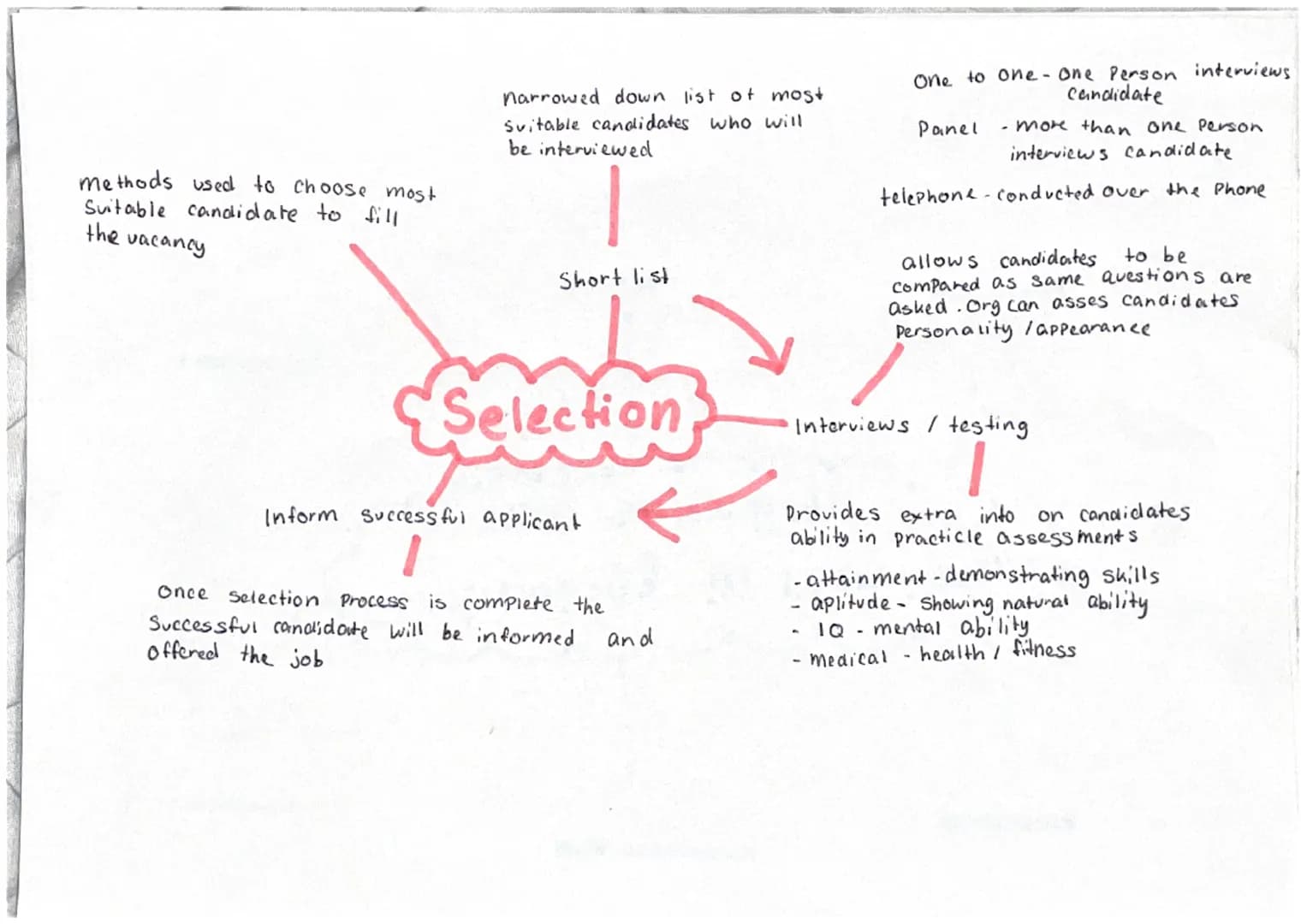
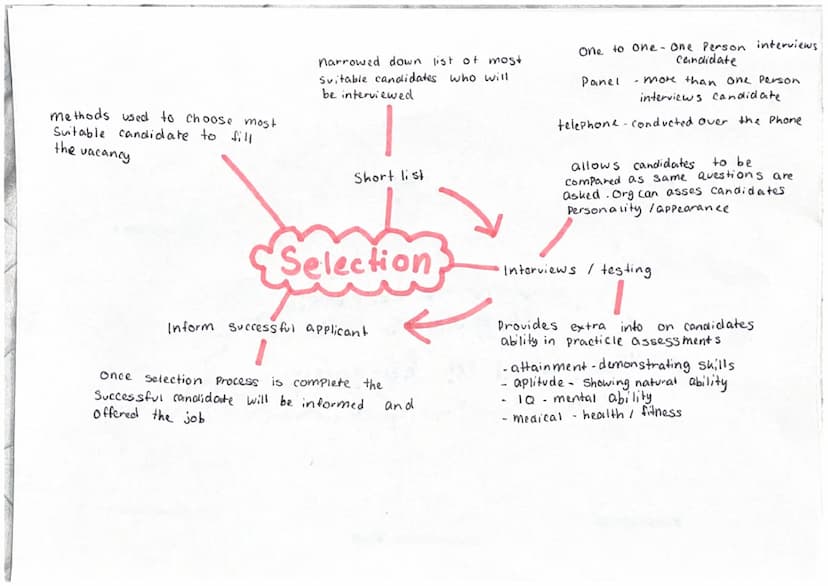
Once applications pour in, employers need systematic ways to choose the best candidate from potentially hundreds of applicants. The selection process helps narrow down options through various assessment methods.
The first step creates a shortlist - identifying the most suitable candidates who'll be invited for interviews. This saves time and ensures only serious contenders proceed to the next stage.
Interview formats vary depending on company needs. One-to-one interviews offer personal connection, whilst panel interviews (multiple interviewers) provide different perspectives. Telephone interviews work for initial screening, and they're becoming increasingly popular for cost-effectiveness.
Companies often combine interviews with testing methods to get a complete picture of candidates. Practical assessments demonstrate actual skills, aptitude tests reveal natural ability, and IQ tests measure mental capability. Some roles require medical examinations to ensure candidates can handle physical demands.
Remember: The selection process aims to be fair and thorough - employers want to make the right choice just as much as you want to land the job!
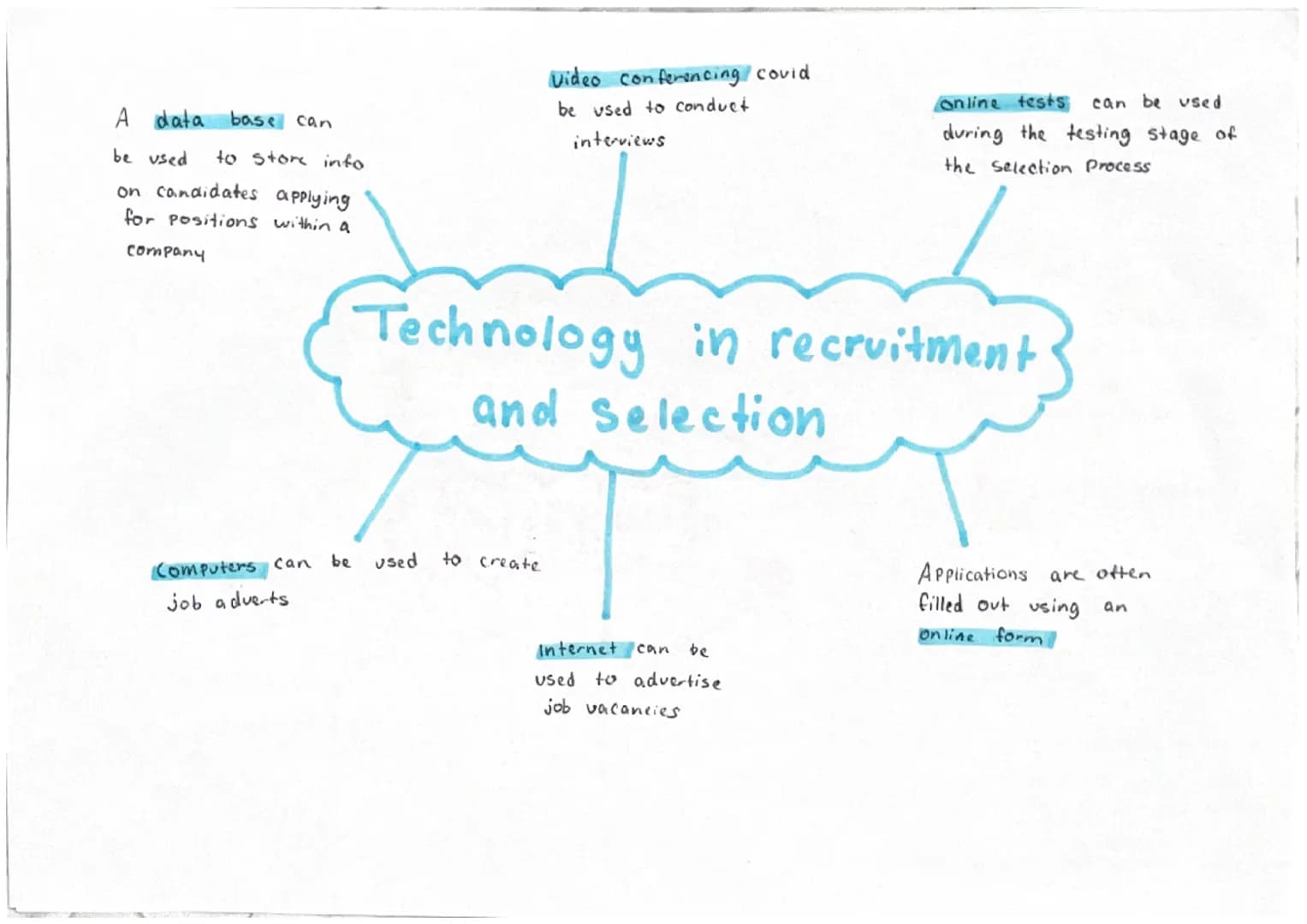
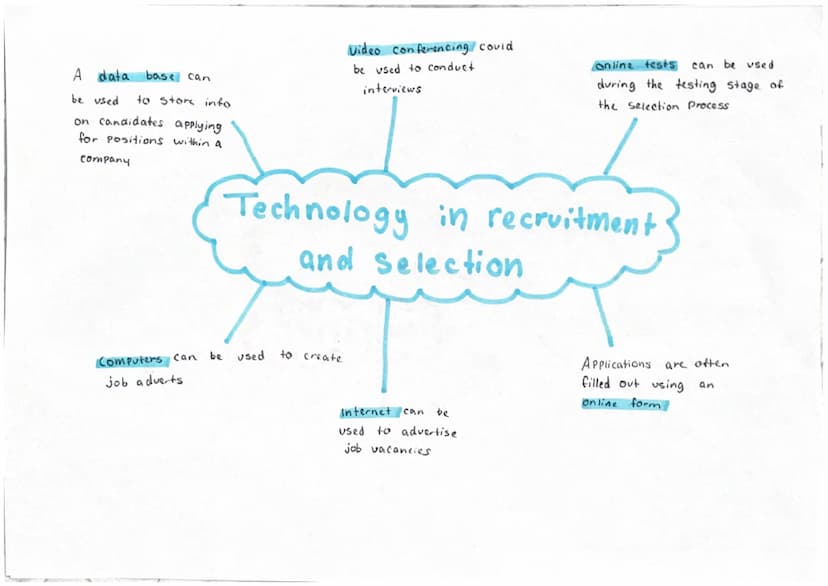
Modern recruitment has gone digital, making the whole process faster and more efficient for both employers and job seekers. Technology in recruitment has revolutionised how companies find and assess potential employees.
Online applications have largely replaced paper forms, making it easier for candidates to apply and for employers to manage responses. Databases store candidate information efficiently, allowing quick searches when new positions become available.
The internet serves as a massive advertising platform for job vacancies, reaching far more potential candidates than traditional newspaper ads. Companies can create professional job adverts using computers and post them instantly across multiple platforms.
Video conferencing became essential during COVID-19 and remains popular for initial interviews. It saves time and travel costs whilst still allowing face-to-face interaction. Online tests can be administered during the selection process, providing immediate results and standardised assessment conditions.
Tech Savvy Tip: Being comfortable with online applications and video interviews gives you a real advantage in today's job market.
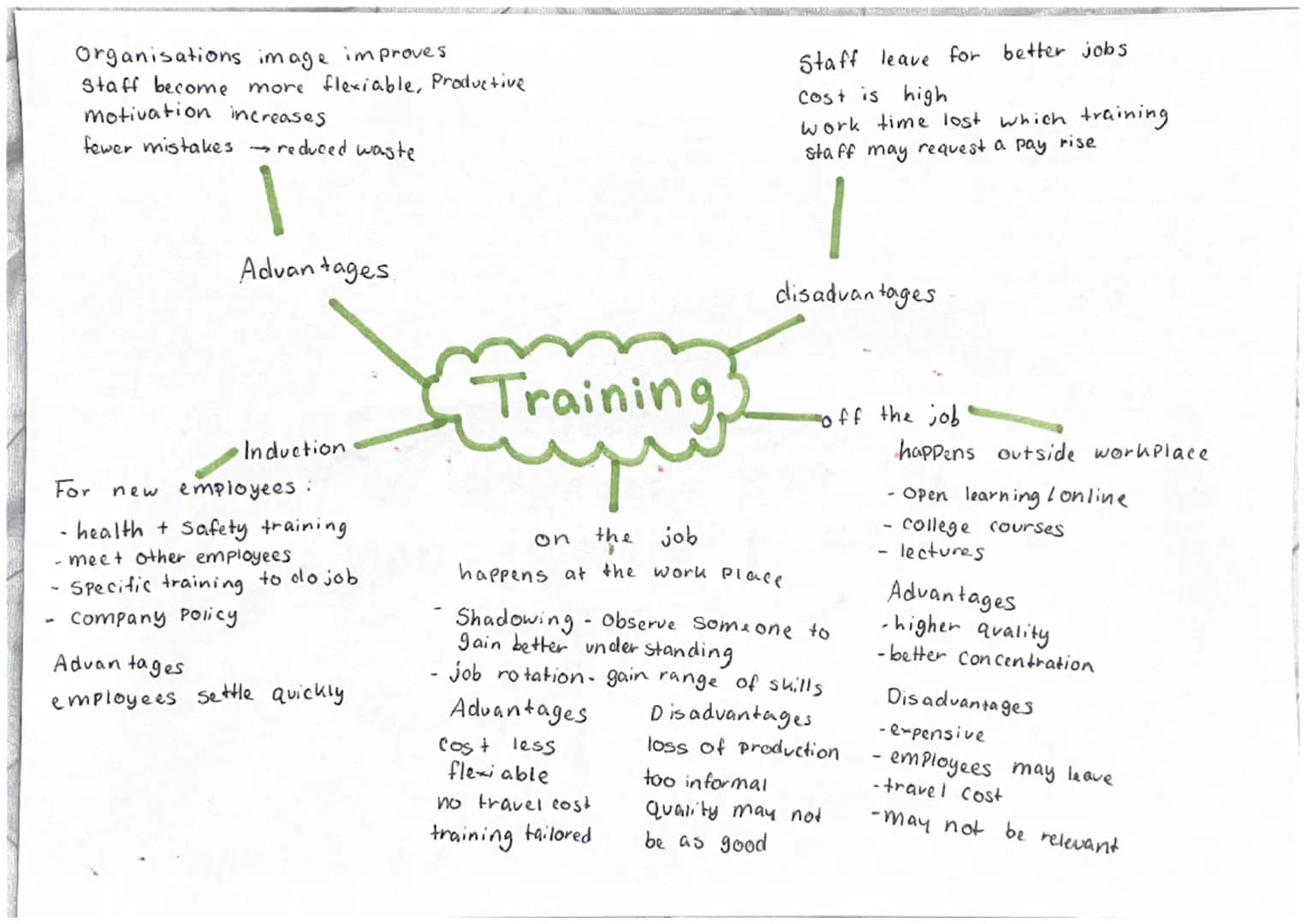
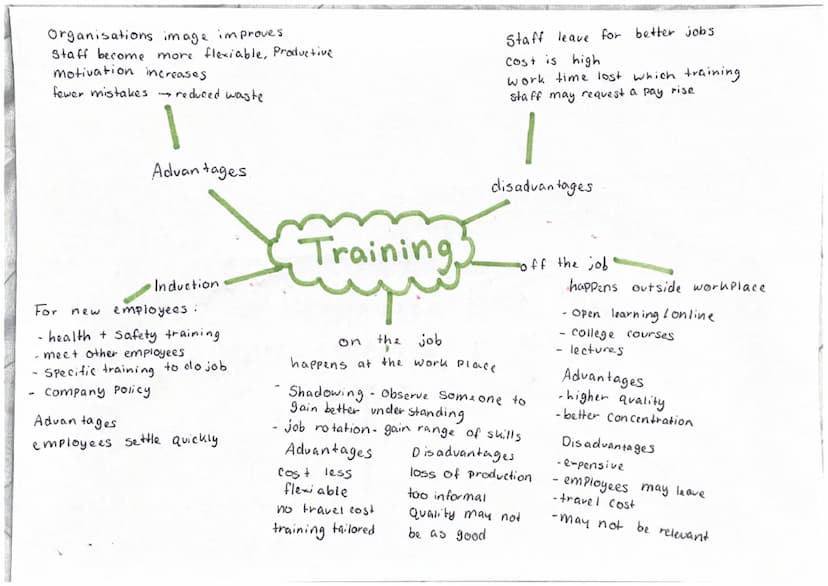
Getting the right people is only half the battle - training ensures they can actually do their jobs effectively. Smart companies invest heavily in developing their workforce, though it comes with both benefits and costs.
Induction training helps new employees settle in quickly. It covers health and safety requirements, company policies, introductions to colleagues, and specific job skills. This initial investment pays off by reducing early mistakes and helping staff become productive faster.
On-the-job training happens at the workplace through methods like shadowing (observing experienced workers) and job rotation (gaining skills across different areas). It's cost-effective and flexible, but can reduce productivity and may lack formal structure.
Off-the-job training takes place outside the workplace through college courses, lectures, or online learning. The quality is typically higher with better concentration, but it's expensive and employees might leave for better opportunities elsewhere.
Training brings clear advantages: improved company image, more flexible and productive staff, increased motivation, and fewer costly mistakes. However, the downsides include high costs, lost work time, and the risk that newly trained employees will seek better-paid jobs elsewhere.
Success Factor: Companies that invest in training often see higher employee loyalty and better long-term performance.
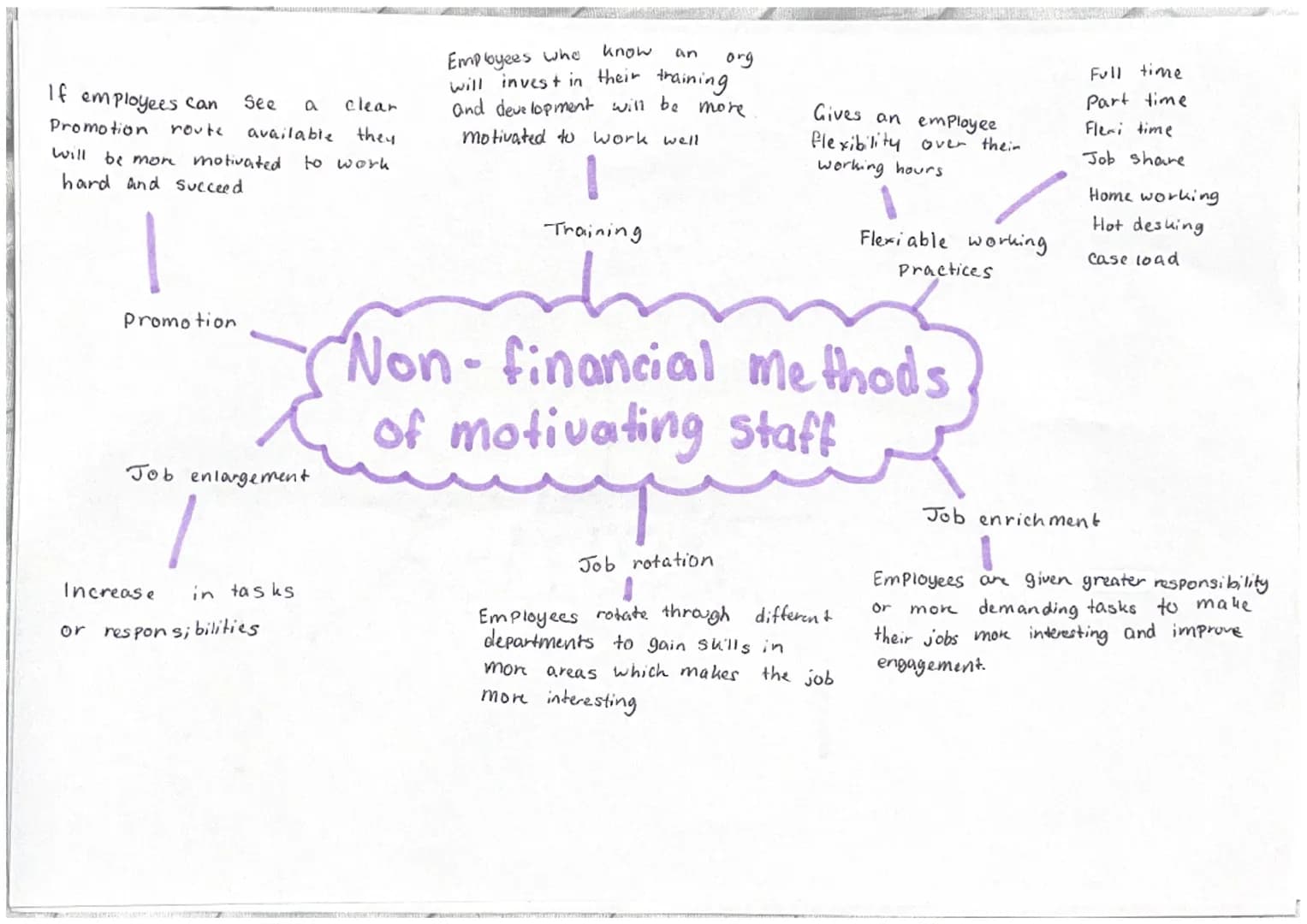
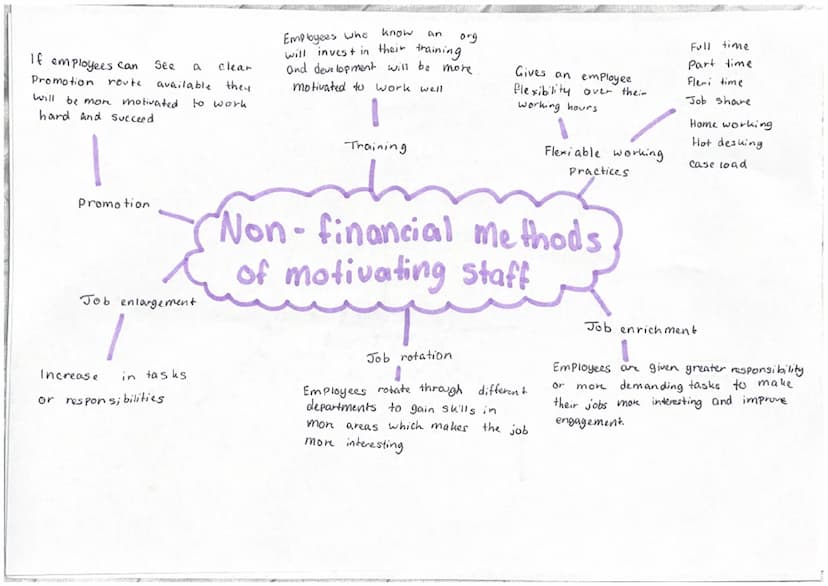
Money isn't everything - many employees value flexible working practices and career development opportunities just as much as their paycheque. Understanding these motivators helps explain why some companies have happier, more productive workforces.
Flexible working gives employees control over their work-life balance. Options include part-time hours, flexitime (choosing start and finish times), job sharing, home working, and hot-desking. These arrangements often cost companies nothing but dramatically improve employee satisfaction.
Career development through promotion opportunities motivates staff to work harder and stay longer. When employees see a clear path upward, they're more likely to invest effort in their current role.
Job design techniques make work more interesting and engaging. Job enlargement increases tasks and responsibilities, whilst job rotation moves employees through different departments to build varied skills. Job enrichment gives greater responsibility and more demanding tasks, making roles more stimulating and improving engagement.
Motivation Insight: The best workplaces combine financial rewards with meaningful work and flexibility - it's about treating employees as whole people, not just workers.
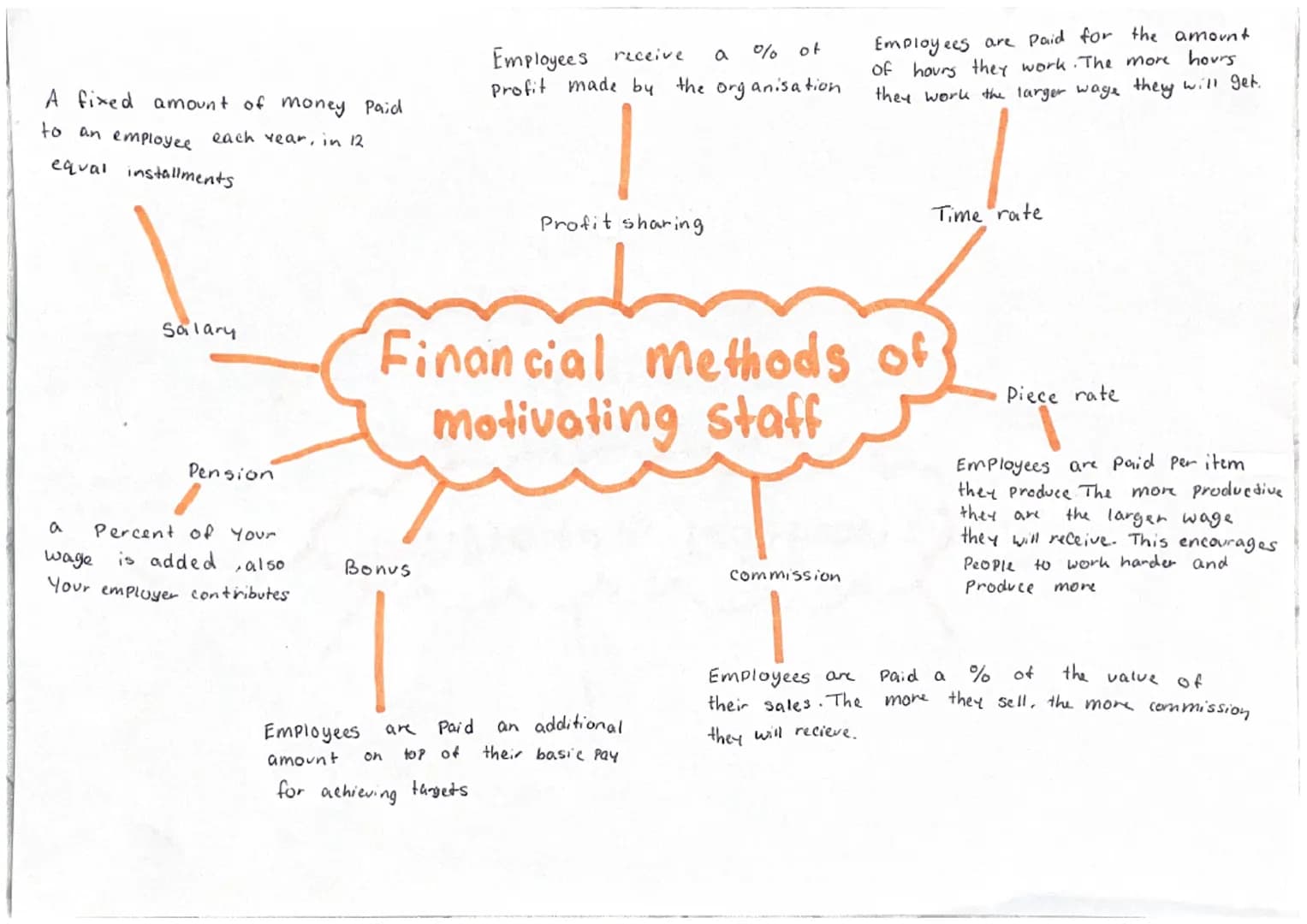
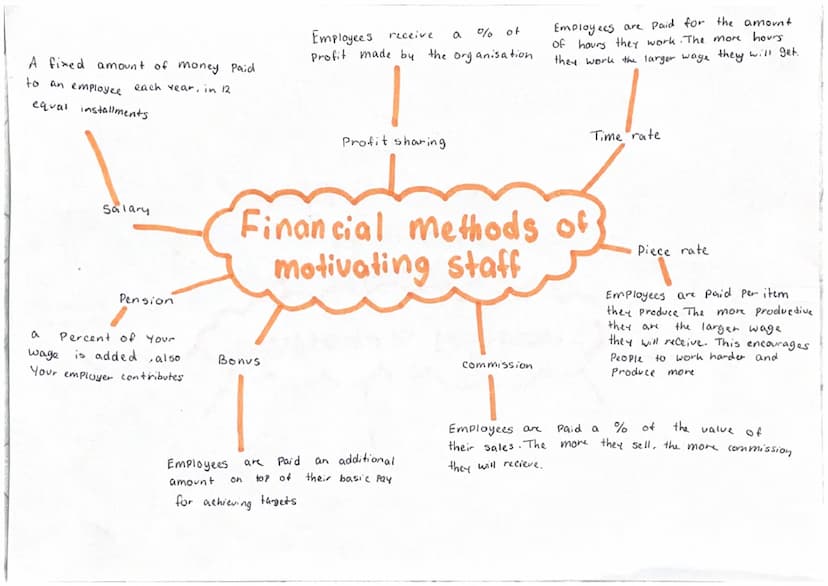
While job satisfaction matters, financial methods of motivating staff remain crucial for attracting and retaining talent. Different payment systems suit different types of work and employee preferences.
Basic payment structures include salary (fixed annual amount paid monthly), time rate (hourly wages), and piece rate (payment per item produced). Each system creates different incentives - hourly workers focus on time spent, whilst piece rate workers prioritise output.
Performance-linked payments directly connect effort to rewards. Commission pays a percentage of sales value, encouraging higher sales performance. Bonuses reward achieving specific targets, whilst profit sharing gives employees a stake in overall company success.
Additional benefits like pensions add long-term value. Employers typically match employee contributions, making this essentially free money for workers who participate.
These financial incentives work because they align employee interests with company goals. Sales staff work harder when they earn commission, production workers increase output with piece rates, and everyone benefits when profit sharing rewards collective success.
Money Matters: The most effective payment systems match the method to the job - you wouldn't pay a salesperson piece rate or a factory worker commission!
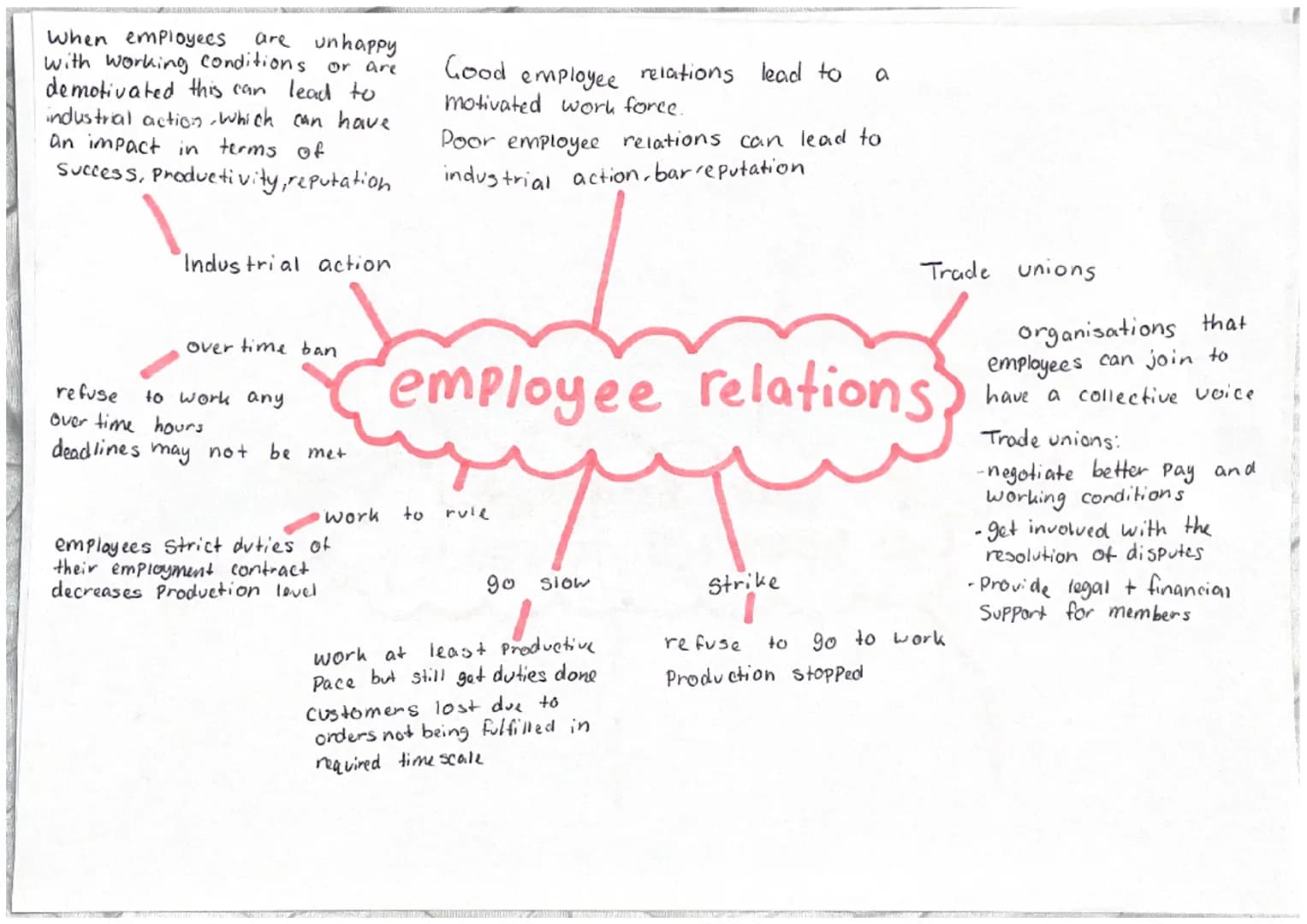
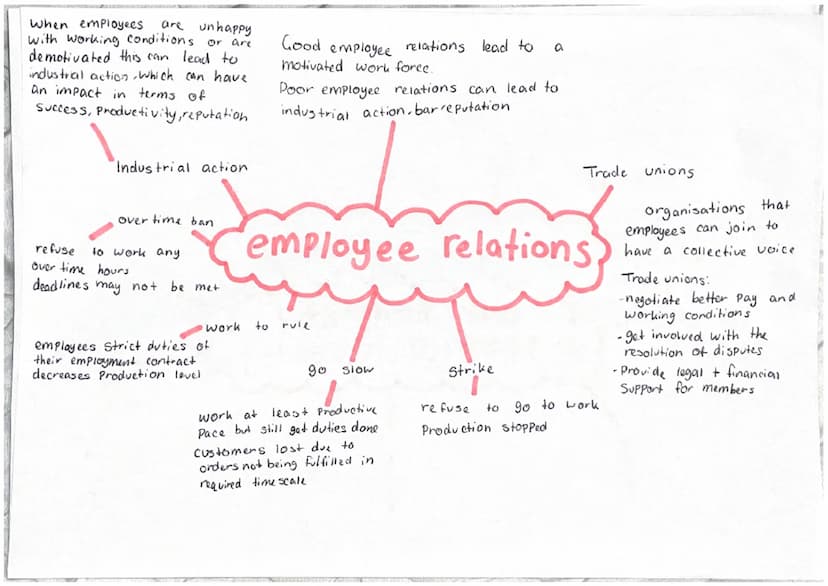
When workplace relationships break down, the consequences can be severe for everyone involved. Understanding employee relations and industrial action helps explain why smart companies work hard to keep their workforce happy.
Trade unions give employees collective bargaining power. They negotiate better pay and working conditions, help resolve disputes, and provide legal and financial support for members. While some employers see unions as problematic, they often help prevent serious conflicts through formal communication channels.
Industrial action occurs when employees feel they have no other options. An overtime ban refuses additional hours, potentially missing deadlines. 'Work to rule' means following contracts strictly, which usually decreases productivity. 'Go slow' involves working at minimum pace whilst still completing duties.
Strikes represent the most serious action - employees refuse to work entirely. Production stops, orders can't be fulfilled, and customers may be lost permanently. The reputation damage often lasts longer than the strike itself.
Good employee relations create motivated workforces, improved productivity, and positive company reputations. Poor relations lead to industrial action, damaged reputations, lost customers, and decreased profitability.
Relationship Reality: Most workplace conflicts can be prevented through open communication and fair treatment - strikes usually happen when other solutions have failed.
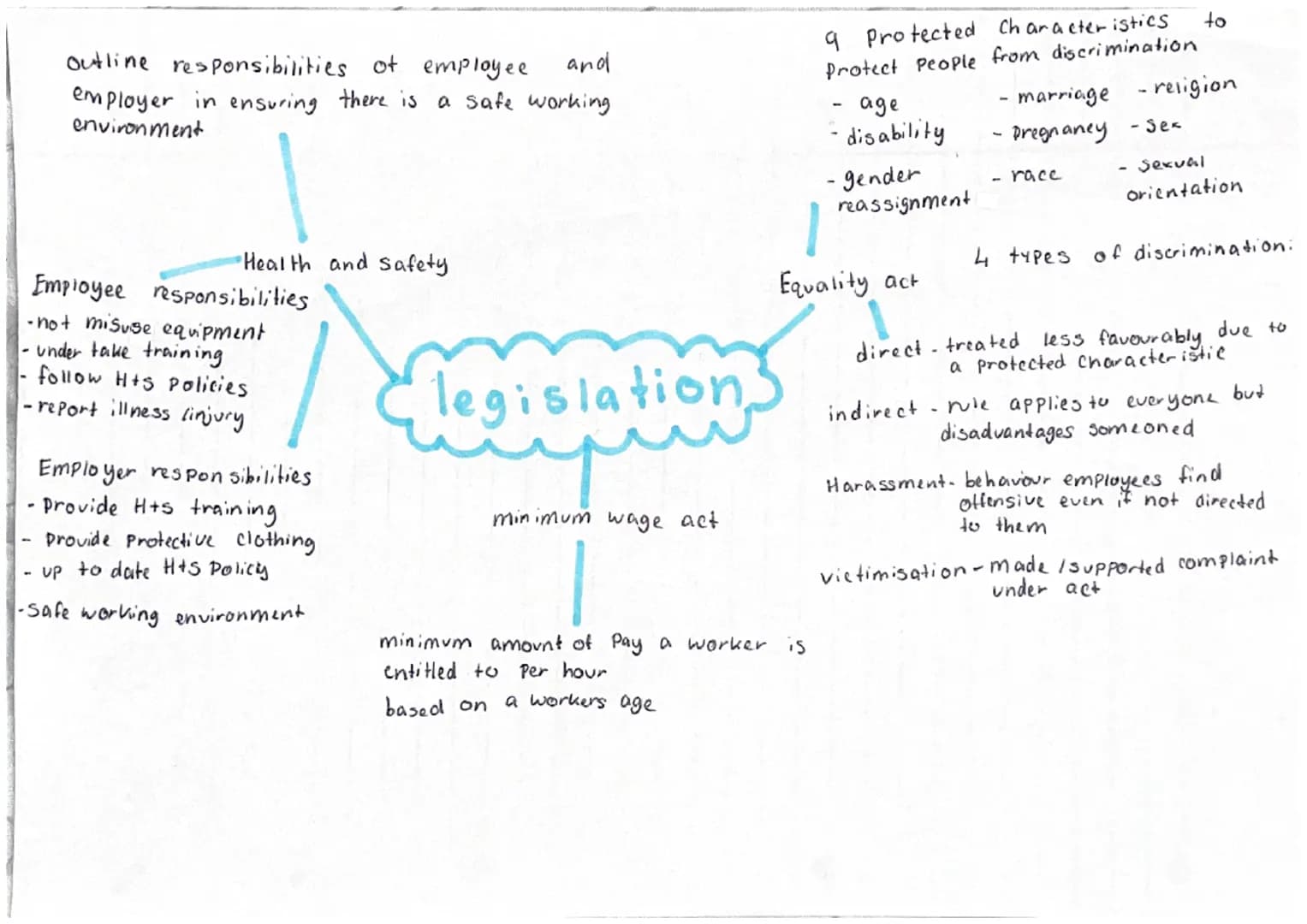
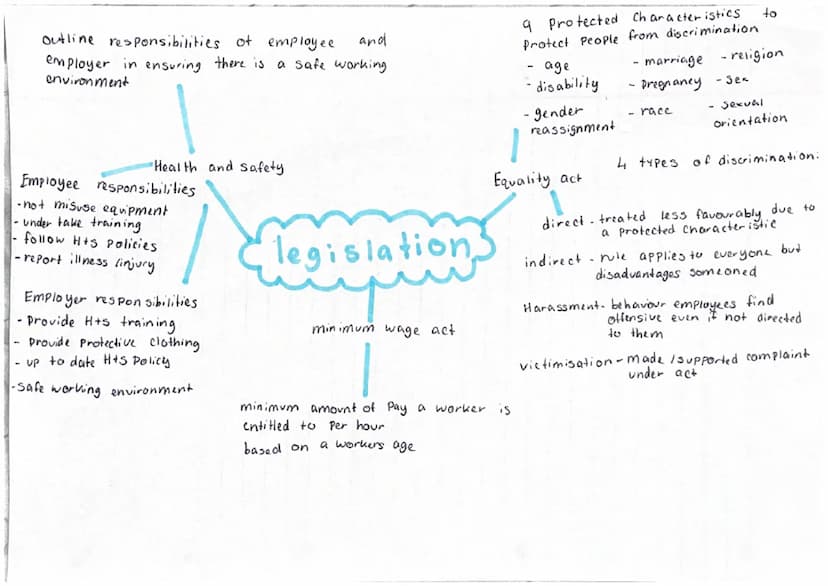
The law protects both employees and employers through important legislation that creates safer, fairer workplaces. Understanding these rules helps everyone know their rights and responsibilities.
Health and safety regulations require employers to provide training, protective clothing, up-to-date policies, and safe working environments. Employees must not misuse equipment, undertake required training, follow health and safety policies, and report illnesses or injuries promptly.
The Equality Act identifies nine protected characteristics preventing discrimination: age, disability, gender reassignment, marriage, pregnancy, race, religion, sex, and sexual orientation. This creates four types of discrimination that are illegal.
Direct discrimination treats someone less favourably because of a protected characteristic. Indirect discrimination applies rules that disadvantage certain groups. Harassment involves offensive behaviour, whilst victimisation targets people who make or support complaints.
The minimum wage sets the lowest hourly pay allowed, based on worker age. This ensures basic living standards and prevents exploitation of vulnerable workers.
These laws create frameworks for fair treatment, but they only work when everyone understands and follows them properly.
Legal Protection: These laws exist to protect everyone - knowing your rights and responsibilities makes workplaces better for all involved.
Our AI Companion is a student-focused AI tool that offers more than just answers. Built on millions of Knowunity resources, it provides relevant information, personalised study plans, quizzes, and content directly in the chat, adapting to your individual learning journey.
You can download the app from Google Play Store and Apple App Store.
That's right! Enjoy free access to study content, connect with fellow students, and get instant help – all at your fingertips.
App Store
Google Play
The app is very easy to use and well designed. I have found everything I was looking for so far and have been able to learn a lot from the presentations! I will definitely use the app for a class assignment! And of course it also helps a lot as an inspiration.
Stefan S
iOS user
This app is really great. There are so many study notes and help [...]. My problem subject is French, for example, and the app has so many options for help. Thanks to this app, I have improved my French. I would recommend it to anyone.
Samantha Klich
Android user
Wow, I am really amazed. I just tried the app because I've seen it advertised many times and was absolutely stunned. This app is THE HELP you want for school and above all, it offers so many things, such as workouts and fact sheets, which have been VERY helpful to me personally.
Anna
iOS user
Best app on earth! no words because it’s too good
Thomas R
iOS user
Just amazing. Let's me revise 10x better, this app is a quick 10/10. I highly recommend it to anyone. I can watch and search for notes. I can save them in the subject folder. I can revise it any time when I come back. If you haven't tried this app, you're really missing out.
Basil
Android user
This app has made me feel so much more confident in my exam prep, not only through boosting my own self confidence through the features that allow you to connect with others and feel less alone, but also through the way the app itself is centred around making you feel better. It is easy to navigate, fun to use, and helpful to anyone struggling in absolutely any way.
David K
iOS user
The app's just great! All I have to do is enter the topic in the search bar and I get the response real fast. I don't have to watch 10 YouTube videos to understand something, so I'm saving my time. Highly recommended!
Sudenaz Ocak
Android user
In school I was really bad at maths but thanks to the app, I am doing better now. I am so grateful that you made the app.
Greenlight Bonnie
Android user
very reliable app to help and grow your ideas of Maths, English and other related topics in your works. please use this app if your struggling in areas, this app is key for that. wish I'd of done a review before. and it's also free so don't worry about that.
Rohan U
Android user
I know a lot of apps use fake accounts to boost their reviews but this app deserves it all. Originally I was getting 4 in my English exams and this time I got a grade 7. I didn’t even know about this app three days until the exam and it has helped A LOT. Please actually trust me and use it as I’m sure you too will see developments.
Xander S
iOS user
THE QUIZES AND FLASHCARDS ARE SO USEFUL AND I LOVE THE SCHOOLGPT. IT ALSO IS LITREALLY LIKE CHATGPT BUT SMARTER!! HELPED ME WITH MY MASCARA PROBLEMS TOO!! AS WELL AS MY REAL SUBJECTS ! DUHHH 😍😁😲🤑💗✨🎀😮
Elisha
iOS user
This apps acc the goat. I find revision so boring but this app makes it so easy to organize it all and then you can ask the freeeee ai to test yourself so good and you can easily upload your own stuff. highly recommend as someone taking mocks now
Paul T
iOS user
The app is very easy to use and well designed. I have found everything I was looking for so far and have been able to learn a lot from the presentations! I will definitely use the app for a class assignment! And of course it also helps a lot as an inspiration.
Stefan S
iOS user
This app is really great. There are so many study notes and help [...]. My problem subject is French, for example, and the app has so many options for help. Thanks to this app, I have improved my French. I would recommend it to anyone.
Samantha Klich
Android user
Wow, I am really amazed. I just tried the app because I've seen it advertised many times and was absolutely stunned. This app is THE HELP you want for school and above all, it offers so many things, such as workouts and fact sheets, which have been VERY helpful to me personally.
Anna
iOS user
Best app on earth! no words because it’s too good
Thomas R
iOS user
Just amazing. Let's me revise 10x better, this app is a quick 10/10. I highly recommend it to anyone. I can watch and search for notes. I can save them in the subject folder. I can revise it any time when I come back. If you haven't tried this app, you're really missing out.
Basil
Android user
This app has made me feel so much more confident in my exam prep, not only through boosting my own self confidence through the features that allow you to connect with others and feel less alone, but also through the way the app itself is centred around making you feel better. It is easy to navigate, fun to use, and helpful to anyone struggling in absolutely any way.
David K
iOS user
The app's just great! All I have to do is enter the topic in the search bar and I get the response real fast. I don't have to watch 10 YouTube videos to understand something, so I'm saving my time. Highly recommended!
Sudenaz Ocak
Android user
In school I was really bad at maths but thanks to the app, I am doing better now. I am so grateful that you made the app.
Greenlight Bonnie
Android user
very reliable app to help and grow your ideas of Maths, English and other related topics in your works. please use this app if your struggling in areas, this app is key for that. wish I'd of done a review before. and it's also free so don't worry about that.
Rohan U
Android user
I know a lot of apps use fake accounts to boost their reviews but this app deserves it all. Originally I was getting 4 in my English exams and this time I got a grade 7. I didn’t even know about this app three days until the exam and it has helped A LOT. Please actually trust me and use it as I’m sure you too will see developments.
Xander S
iOS user
THE QUIZES AND FLASHCARDS ARE SO USEFUL AND I LOVE THE SCHOOLGPT. IT ALSO IS LITREALLY LIKE CHATGPT BUT SMARTER!! HELPED ME WITH MY MASCARA PROBLEMS TOO!! AS WELL AS MY REAL SUBJECTS ! DUHHH 😍😁😲🤑💗✨🎀😮
Elisha
iOS user
This apps acc the goat. I find revision so boring but this app makes it so easy to organize it all and then you can ask the freeeee ai to test yourself so good and you can easily upload your own stuff. highly recommend as someone taking mocks now
Paul T
iOS user
Holly Carnson
@hollycarnson_eakb
Ever wondered how businesses find and hire the right people? From posting job adverts to training new employees, recruitment and human resources are all about managing people effectively to keep companies running smoothly.
Access to all documents
Improve your grades
Join milions of students
By signing up you accept Terms of Service and Privacy Policy
When a company needs new staff, they've got two main options: internal recruitment (promoting existing employees) or external recruitment (hiring from outside). Each approach has its trade-offs that smart managers need to weigh up.
Internal recruitment means moving someone who already works for the company into a new role. It's cheaper, boosts staff morale, and you already know the person's strengths and weaknesses. However, you'll miss out on fresh ideas and talented outsiders, plus you'll create another vacancy to fill internally.
External recruitment involves advertising through job centres or public adverts to attract outside candidates. You'll have more quality options to choose from, but it's more expensive, takes longer, and won't motivate your existing staff.
Before recruiting anyone, companies must complete a job analysis to identify exactly what skills and tasks are needed. This leads to creating a job description (listing duties, pay, and working conditions) and a person specification (outlining required qualifications, skills, and experience).
Quick Tip: Most successful companies use a mix of both internal and external recruitment depending on the specific role and circumstances.
Access to all documents
Improve your grades
Join milions of students
By signing up you accept Terms of Service and Privacy Policy
Once applications pour in, employers need systematic ways to choose the best candidate from potentially hundreds of applicants. The selection process helps narrow down options through various assessment methods.
The first step creates a shortlist - identifying the most suitable candidates who'll be invited for interviews. This saves time and ensures only serious contenders proceed to the next stage.
Interview formats vary depending on company needs. One-to-one interviews offer personal connection, whilst panel interviews (multiple interviewers) provide different perspectives. Telephone interviews work for initial screening, and they're becoming increasingly popular for cost-effectiveness.
Companies often combine interviews with testing methods to get a complete picture of candidates. Practical assessments demonstrate actual skills, aptitude tests reveal natural ability, and IQ tests measure mental capability. Some roles require medical examinations to ensure candidates can handle physical demands.
Remember: The selection process aims to be fair and thorough - employers want to make the right choice just as much as you want to land the job!
Access to all documents
Improve your grades
Join milions of students
By signing up you accept Terms of Service and Privacy Policy
Modern recruitment has gone digital, making the whole process faster and more efficient for both employers and job seekers. Technology in recruitment has revolutionised how companies find and assess potential employees.
Online applications have largely replaced paper forms, making it easier for candidates to apply and for employers to manage responses. Databases store candidate information efficiently, allowing quick searches when new positions become available.
The internet serves as a massive advertising platform for job vacancies, reaching far more potential candidates than traditional newspaper ads. Companies can create professional job adverts using computers and post them instantly across multiple platforms.
Video conferencing became essential during COVID-19 and remains popular for initial interviews. It saves time and travel costs whilst still allowing face-to-face interaction. Online tests can be administered during the selection process, providing immediate results and standardised assessment conditions.
Tech Savvy Tip: Being comfortable with online applications and video interviews gives you a real advantage in today's job market.
Access to all documents
Improve your grades
Join milions of students
By signing up you accept Terms of Service and Privacy Policy
Getting the right people is only half the battle - training ensures they can actually do their jobs effectively. Smart companies invest heavily in developing their workforce, though it comes with both benefits and costs.
Induction training helps new employees settle in quickly. It covers health and safety requirements, company policies, introductions to colleagues, and specific job skills. This initial investment pays off by reducing early mistakes and helping staff become productive faster.
On-the-job training happens at the workplace through methods like shadowing (observing experienced workers) and job rotation (gaining skills across different areas). It's cost-effective and flexible, but can reduce productivity and may lack formal structure.
Off-the-job training takes place outside the workplace through college courses, lectures, or online learning. The quality is typically higher with better concentration, but it's expensive and employees might leave for better opportunities elsewhere.
Training brings clear advantages: improved company image, more flexible and productive staff, increased motivation, and fewer costly mistakes. However, the downsides include high costs, lost work time, and the risk that newly trained employees will seek better-paid jobs elsewhere.
Success Factor: Companies that invest in training often see higher employee loyalty and better long-term performance.
Access to all documents
Improve your grades
Join milions of students
By signing up you accept Terms of Service and Privacy Policy
Money isn't everything - many employees value flexible working practices and career development opportunities just as much as their paycheque. Understanding these motivators helps explain why some companies have happier, more productive workforces.
Flexible working gives employees control over their work-life balance. Options include part-time hours, flexitime (choosing start and finish times), job sharing, home working, and hot-desking. These arrangements often cost companies nothing but dramatically improve employee satisfaction.
Career development through promotion opportunities motivates staff to work harder and stay longer. When employees see a clear path upward, they're more likely to invest effort in their current role.
Job design techniques make work more interesting and engaging. Job enlargement increases tasks and responsibilities, whilst job rotation moves employees through different departments to build varied skills. Job enrichment gives greater responsibility and more demanding tasks, making roles more stimulating and improving engagement.
Motivation Insight: The best workplaces combine financial rewards with meaningful work and flexibility - it's about treating employees as whole people, not just workers.
Access to all documents
Improve your grades
Join milions of students
By signing up you accept Terms of Service and Privacy Policy
While job satisfaction matters, financial methods of motivating staff remain crucial for attracting and retaining talent. Different payment systems suit different types of work and employee preferences.
Basic payment structures include salary (fixed annual amount paid monthly), time rate (hourly wages), and piece rate (payment per item produced). Each system creates different incentives - hourly workers focus on time spent, whilst piece rate workers prioritise output.
Performance-linked payments directly connect effort to rewards. Commission pays a percentage of sales value, encouraging higher sales performance. Bonuses reward achieving specific targets, whilst profit sharing gives employees a stake in overall company success.
Additional benefits like pensions add long-term value. Employers typically match employee contributions, making this essentially free money for workers who participate.
These financial incentives work because they align employee interests with company goals. Sales staff work harder when they earn commission, production workers increase output with piece rates, and everyone benefits when profit sharing rewards collective success.
Money Matters: The most effective payment systems match the method to the job - you wouldn't pay a salesperson piece rate or a factory worker commission!
Access to all documents
Improve your grades
Join milions of students
By signing up you accept Terms of Service and Privacy Policy
When workplace relationships break down, the consequences can be severe for everyone involved. Understanding employee relations and industrial action helps explain why smart companies work hard to keep their workforce happy.
Trade unions give employees collective bargaining power. They negotiate better pay and working conditions, help resolve disputes, and provide legal and financial support for members. While some employers see unions as problematic, they often help prevent serious conflicts through formal communication channels.
Industrial action occurs when employees feel they have no other options. An overtime ban refuses additional hours, potentially missing deadlines. 'Work to rule' means following contracts strictly, which usually decreases productivity. 'Go slow' involves working at minimum pace whilst still completing duties.
Strikes represent the most serious action - employees refuse to work entirely. Production stops, orders can't be fulfilled, and customers may be lost permanently. The reputation damage often lasts longer than the strike itself.
Good employee relations create motivated workforces, improved productivity, and positive company reputations. Poor relations lead to industrial action, damaged reputations, lost customers, and decreased profitability.
Relationship Reality: Most workplace conflicts can be prevented through open communication and fair treatment - strikes usually happen when other solutions have failed.
Access to all documents
Improve your grades
Join milions of students
By signing up you accept Terms of Service and Privacy Policy
The law protects both employees and employers through important legislation that creates safer, fairer workplaces. Understanding these rules helps everyone know their rights and responsibilities.
Health and safety regulations require employers to provide training, protective clothing, up-to-date policies, and safe working environments. Employees must not misuse equipment, undertake required training, follow health and safety policies, and report illnesses or injuries promptly.
The Equality Act identifies nine protected characteristics preventing discrimination: age, disability, gender reassignment, marriage, pregnancy, race, religion, sex, and sexual orientation. This creates four types of discrimination that are illegal.
Direct discrimination treats someone less favourably because of a protected characteristic. Indirect discrimination applies rules that disadvantage certain groups. Harassment involves offensive behaviour, whilst victimisation targets people who make or support complaints.
The minimum wage sets the lowest hourly pay allowed, based on worker age. This ensures basic living standards and prevents exploitation of vulnerable workers.
These laws create frameworks for fair treatment, but they only work when everyone understands and follows them properly.
Legal Protection: These laws exist to protect everyone - knowing your rights and responsibilities makes workplaces better for all involved.
Our AI Companion is a student-focused AI tool that offers more than just answers. Built on millions of Knowunity resources, it provides relevant information, personalised study plans, quizzes, and content directly in the chat, adapting to your individual learning journey.
You can download the app from Google Play Store and Apple App Store.
That's right! Enjoy free access to study content, connect with fellow students, and get instant help – all at your fingertips.
2
Smart Tools NEW
Transform this note into: ✓ 50+ Practice Questions ✓ Interactive Flashcards ✓ Full Mock Exam ✓ Essay Outlines
App Store
Google Play
The app is very easy to use and well designed. I have found everything I was looking for so far and have been able to learn a lot from the presentations! I will definitely use the app for a class assignment! And of course it also helps a lot as an inspiration.
Stefan S
iOS user
This app is really great. There are so many study notes and help [...]. My problem subject is French, for example, and the app has so many options for help. Thanks to this app, I have improved my French. I would recommend it to anyone.
Samantha Klich
Android user
Wow, I am really amazed. I just tried the app because I've seen it advertised many times and was absolutely stunned. This app is THE HELP you want for school and above all, it offers so many things, such as workouts and fact sheets, which have been VERY helpful to me personally.
Anna
iOS user
Best app on earth! no words because it’s too good
Thomas R
iOS user
Just amazing. Let's me revise 10x better, this app is a quick 10/10. I highly recommend it to anyone. I can watch and search for notes. I can save them in the subject folder. I can revise it any time when I come back. If you haven't tried this app, you're really missing out.
Basil
Android user
This app has made me feel so much more confident in my exam prep, not only through boosting my own self confidence through the features that allow you to connect with others and feel less alone, but also through the way the app itself is centred around making you feel better. It is easy to navigate, fun to use, and helpful to anyone struggling in absolutely any way.
David K
iOS user
The app's just great! All I have to do is enter the topic in the search bar and I get the response real fast. I don't have to watch 10 YouTube videos to understand something, so I'm saving my time. Highly recommended!
Sudenaz Ocak
Android user
In school I was really bad at maths but thanks to the app, I am doing better now. I am so grateful that you made the app.
Greenlight Bonnie
Android user
very reliable app to help and grow your ideas of Maths, English and other related topics in your works. please use this app if your struggling in areas, this app is key for that. wish I'd of done a review before. and it's also free so don't worry about that.
Rohan U
Android user
I know a lot of apps use fake accounts to boost their reviews but this app deserves it all. Originally I was getting 4 in my English exams and this time I got a grade 7. I didn’t even know about this app three days until the exam and it has helped A LOT. Please actually trust me and use it as I’m sure you too will see developments.
Xander S
iOS user
THE QUIZES AND FLASHCARDS ARE SO USEFUL AND I LOVE THE SCHOOLGPT. IT ALSO IS LITREALLY LIKE CHATGPT BUT SMARTER!! HELPED ME WITH MY MASCARA PROBLEMS TOO!! AS WELL AS MY REAL SUBJECTS ! DUHHH 😍😁😲🤑💗✨🎀😮
Elisha
iOS user
This apps acc the goat. I find revision so boring but this app makes it so easy to organize it all and then you can ask the freeeee ai to test yourself so good and you can easily upload your own stuff. highly recommend as someone taking mocks now
Paul T
iOS user
The app is very easy to use and well designed. I have found everything I was looking for so far and have been able to learn a lot from the presentations! I will definitely use the app for a class assignment! And of course it also helps a lot as an inspiration.
Stefan S
iOS user
This app is really great. There are so many study notes and help [...]. My problem subject is French, for example, and the app has so many options for help. Thanks to this app, I have improved my French. I would recommend it to anyone.
Samantha Klich
Android user
Wow, I am really amazed. I just tried the app because I've seen it advertised many times and was absolutely stunned. This app is THE HELP you want for school and above all, it offers so many things, such as workouts and fact sheets, which have been VERY helpful to me personally.
Anna
iOS user
Best app on earth! no words because it’s too good
Thomas R
iOS user
Just amazing. Let's me revise 10x better, this app is a quick 10/10. I highly recommend it to anyone. I can watch and search for notes. I can save them in the subject folder. I can revise it any time when I come back. If you haven't tried this app, you're really missing out.
Basil
Android user
This app has made me feel so much more confident in my exam prep, not only through boosting my own self confidence through the features that allow you to connect with others and feel less alone, but also through the way the app itself is centred around making you feel better. It is easy to navigate, fun to use, and helpful to anyone struggling in absolutely any way.
David K
iOS user
The app's just great! All I have to do is enter the topic in the search bar and I get the response real fast. I don't have to watch 10 YouTube videos to understand something, so I'm saving my time. Highly recommended!
Sudenaz Ocak
Android user
In school I was really bad at maths but thanks to the app, I am doing better now. I am so grateful that you made the app.
Greenlight Bonnie
Android user
very reliable app to help and grow your ideas of Maths, English and other related topics in your works. please use this app if your struggling in areas, this app is key for that. wish I'd of done a review before. and it's also free so don't worry about that.
Rohan U
Android user
I know a lot of apps use fake accounts to boost their reviews but this app deserves it all. Originally I was getting 4 in my English exams and this time I got a grade 7. I didn’t even know about this app three days until the exam and it has helped A LOT. Please actually trust me and use it as I’m sure you too will see developments.
Xander S
iOS user
THE QUIZES AND FLASHCARDS ARE SO USEFUL AND I LOVE THE SCHOOLGPT. IT ALSO IS LITREALLY LIKE CHATGPT BUT SMARTER!! HELPED ME WITH MY MASCARA PROBLEMS TOO!! AS WELL AS MY REAL SUBJECTS ! DUHHH 😍😁😲🤑💗✨🎀😮
Elisha
iOS user
This apps acc the goat. I find revision so boring but this app makes it so easy to organize it all and then you can ask the freeeee ai to test yourself so good and you can easily upload your own stuff. highly recommend as someone taking mocks now
Paul T
iOS user