Understanding Sequences and Linear Patterns
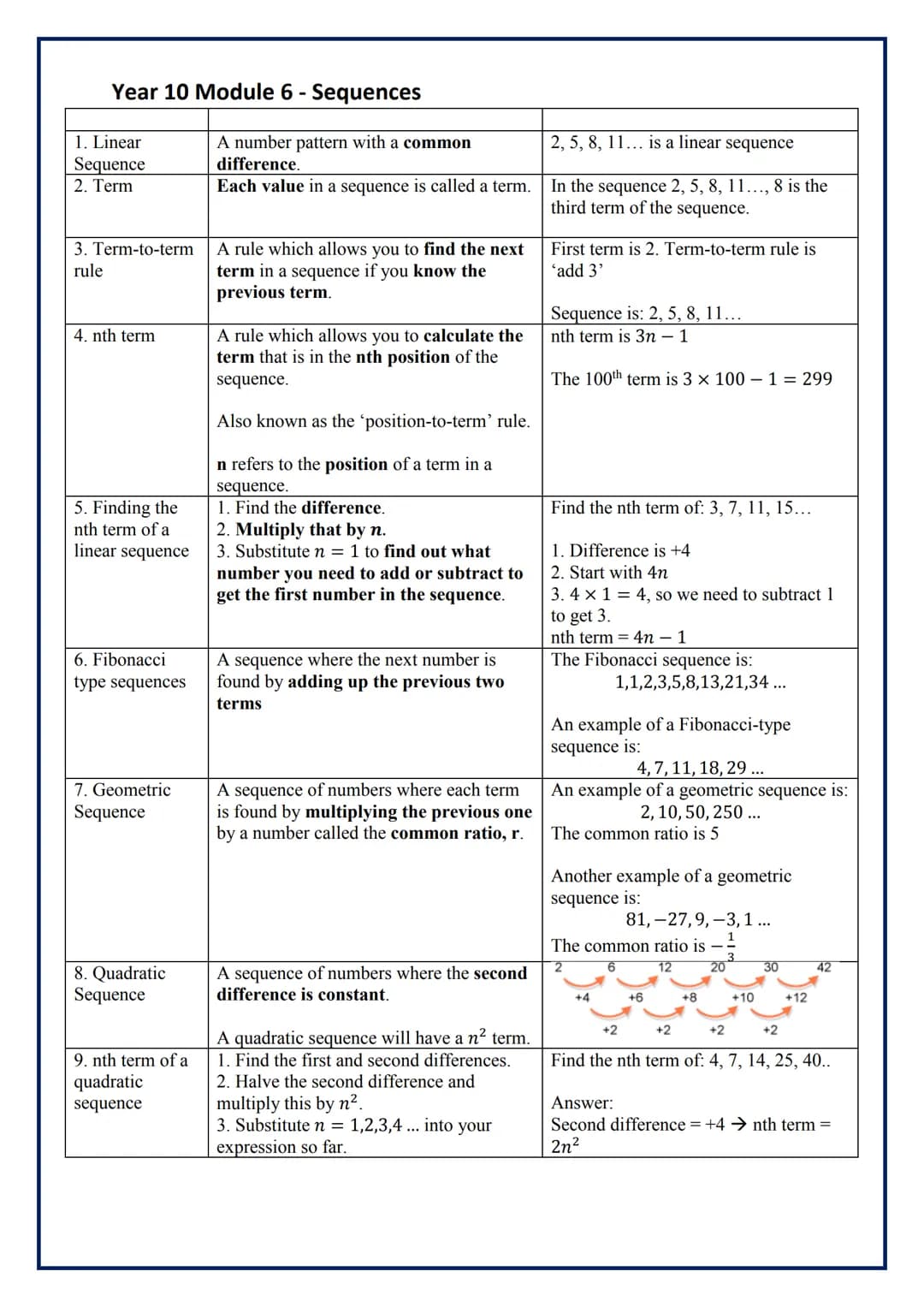
Think of a sequence as a number pattern with a secret rule - once you crack it, you can predict what comes next! A linear sequence is the simplest type, where you add (or subtract) the same amount each time. For example, 2, 5, 8, 11... follows the pattern of adding 3.
Each number in your sequence is called a term. So in 2, 5, 8, 11..., the number 8 is the third term. The term-to-term rule tells you how to get from one number to the next - it's like having step-by-step directions.
But here's where it gets powerful: the nth term formula lets you jump straight to any position without calculating all the steps in between. For the sequence 2, 5, 8, 11..., the nth term is 3n - 1. Want the 100th term? Just plug in: 3 × 100 - 1 = 299. Dead simple!
Finding the nth term follows three easy steps: find the difference between terms, multiply by n, then work out what to add or subtract to match your first term. Master this, and you'll never be stumped by linear sequences again.
Quick Tip: The difference between consecutive terms in a linear sequence is always the coefficient of n in your formula!
Beyond basic patterns, Fibonacci-type sequences add the two previous terms together (like 1, 1, 2, 3, 5, 8...), whilst geometric sequences multiply by the same number each time, creating rapid growth or shrinkage.

 Maths
Maths English Literature
 Sociology
 Biology