
Ever wondered how maths actually works in real life? This... Show more
 Maths
Maths English Literature
 Sociology
 Biology
Sign up to see the contentIt's free!
Access to all documents
Improve your grades
Join milions of students
Knowunity AI
Subjects
Triangle Congruence and Similarity Theorems
Triangle Properties and Classification
Linear Equations and Graphs
Geometric Angle Relationships
Trigonometric Functions and Identities
Equation Solving Techniques
Circle Geometry Fundamentals
Division Operations and Methods
Basic Differentiation Rules
Exponent and Logarithm Properties
Show all topics
Human Organ Systems
Reproductive Cell Cycles
Biological Sciences Subdisciplines
Cellular Energy Metabolism
Autotrophic Energy Processes
Inheritance Patterns and Principles
Biomolecular Structure and Organization
Cell Cycle and Division Mechanics
Cellular Organization and Development
Biological Structural Organization
Show all topics
Chemical Sciences and Applications
Atomic Structure and Composition
Molecular Electron Structure Representation
Atomic Electron Behavior
Matter Properties and Water
Mole Concept and Calculations
Gas Laws and Behavior
Periodic Table Organization
Chemical Thermodynamics Fundamentals
Chemical Bond Types and Properties
Show all topics
European Renaissance and Enlightenment
European Cultural Movements 800-1920
American Revolution Era 1763-1797
American Civil War 1861-1865
Global Imperial Systems
Mongol and Chinese Dynasties
U.S. Presidents and World Leaders
Historical Sources and Documentation
World Wars Era and Impact
World Religious Systems
Show all topics
Classic and Contemporary Novels
Literary Character Analysis
Rhetorical Theory and Practice
Classic Literary Narratives
Reading Analysis and Interpretation
Narrative Structure and Techniques
English Language Components
Influential English-Language Authors
Basic Sentence Structure
Narrative Voice and Perspective
Show all topics
417
•
Updated Mar 20, 2026
•

Aarya
@aaryathiru_vqyq
Ever wondered how maths actually works in real life? This... Show more

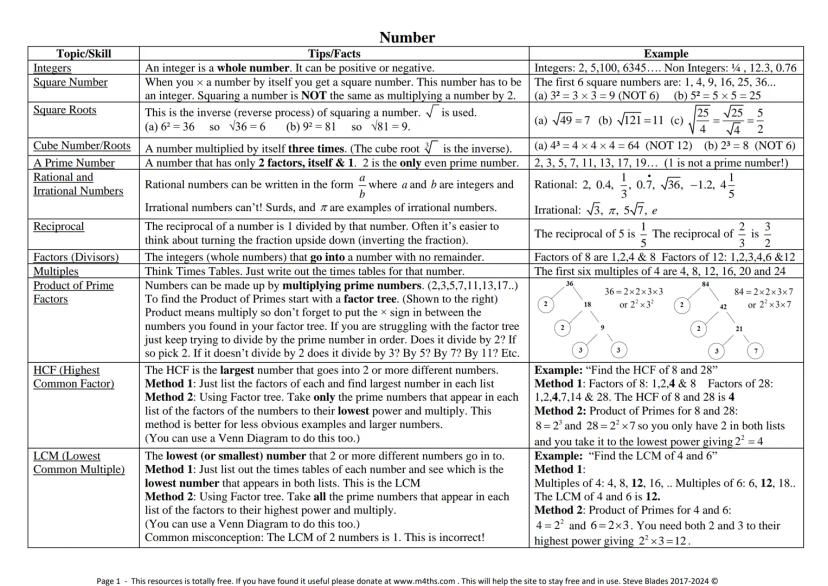

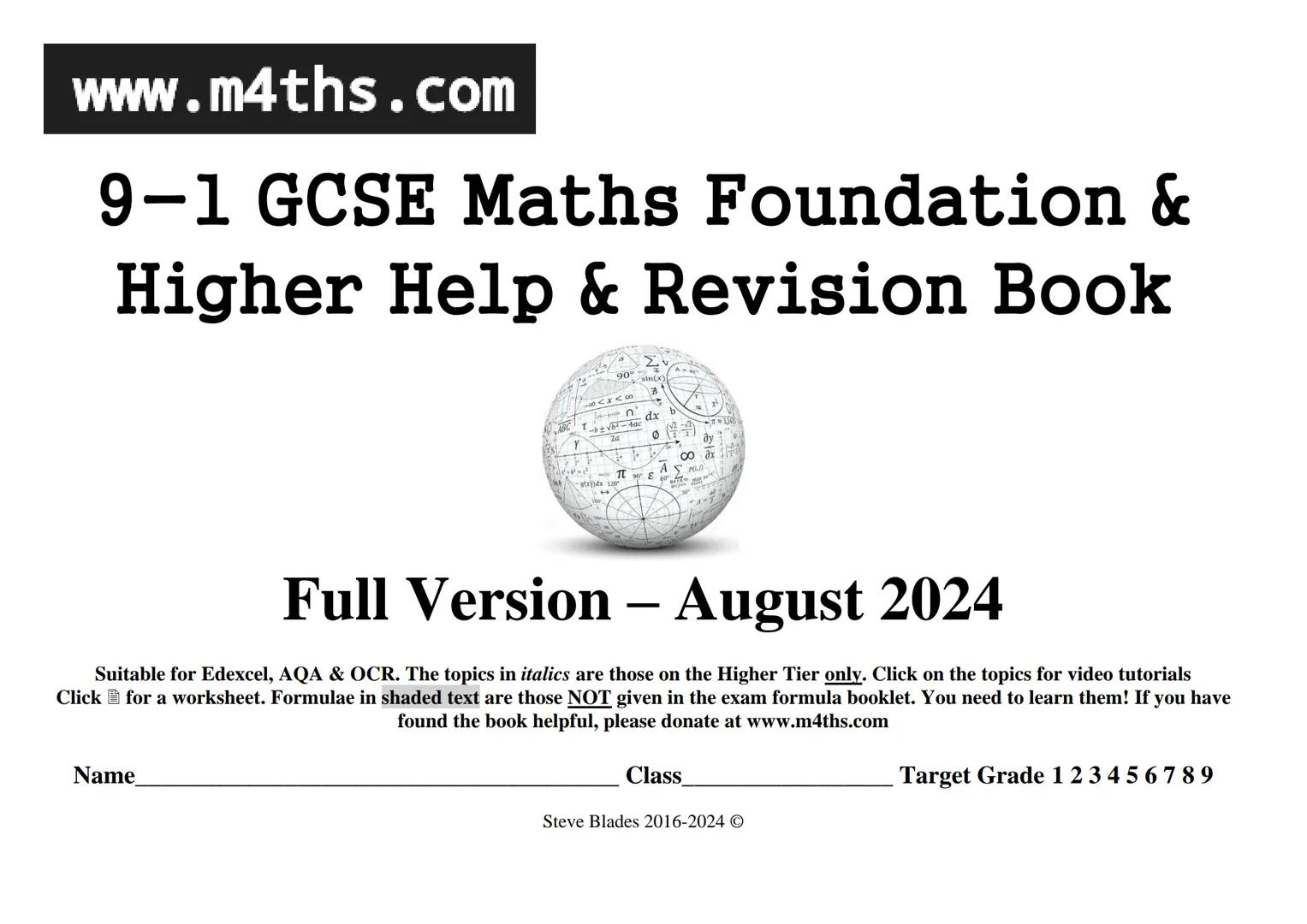
This is your complete guide to mastering GCSE maths, covering both Foundation and Higher tier topics. The book works for all major exam boards including Edexcel, AQA, and OCR.
You'll notice some topics are in italics - these are Higher tier only content, so Foundation students can skip them. The shaded formulas are the ones you absolutely must memorise because they won't be given in your exam formula booklet.
Each topic links to video tutorials and worksheets, making it dead easy to get extra practice when you need it. Whether you're aiming for a grade 4 or pushing for that grade 9, this resource has got your back.
Top Tip: Focus on the non-shaded formulas first - these will be provided in your exam, so understanding how to use them is more important than memorising them.
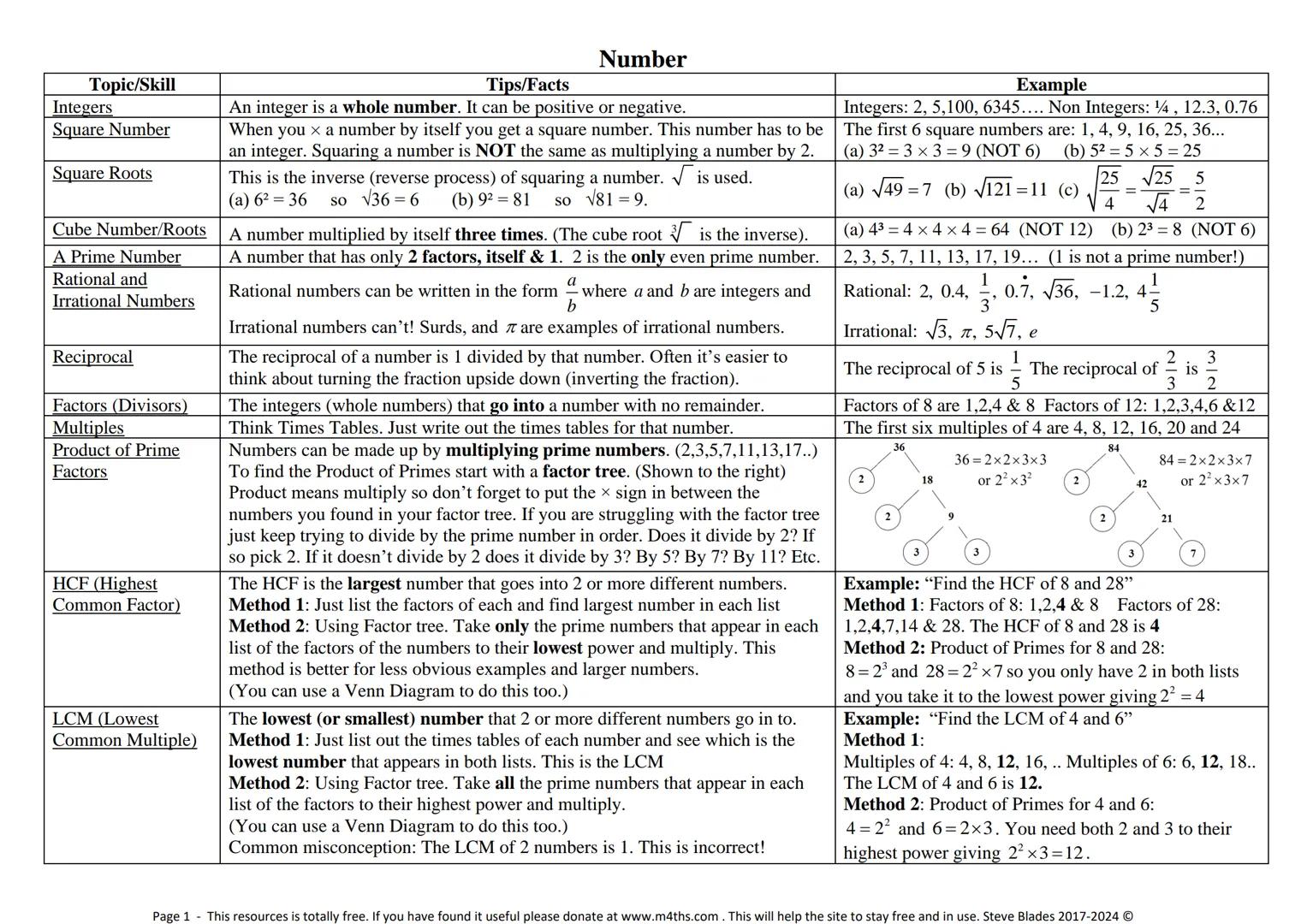
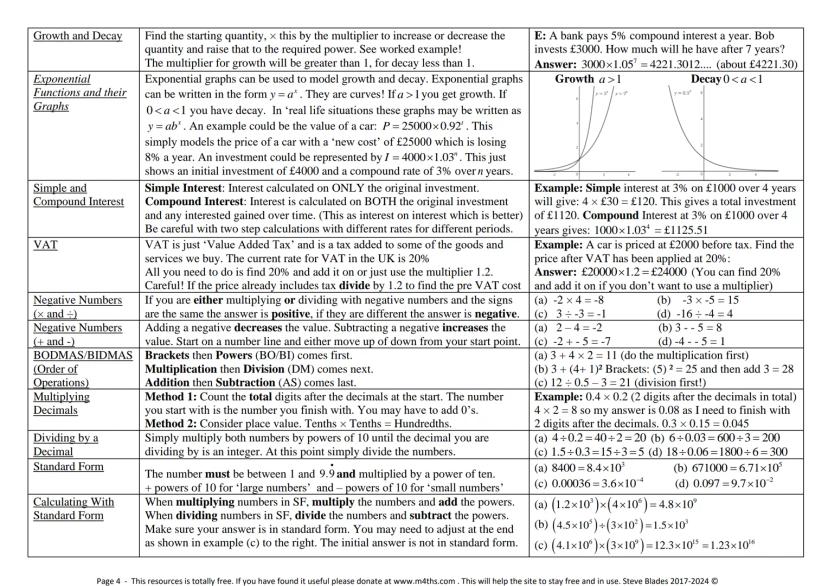
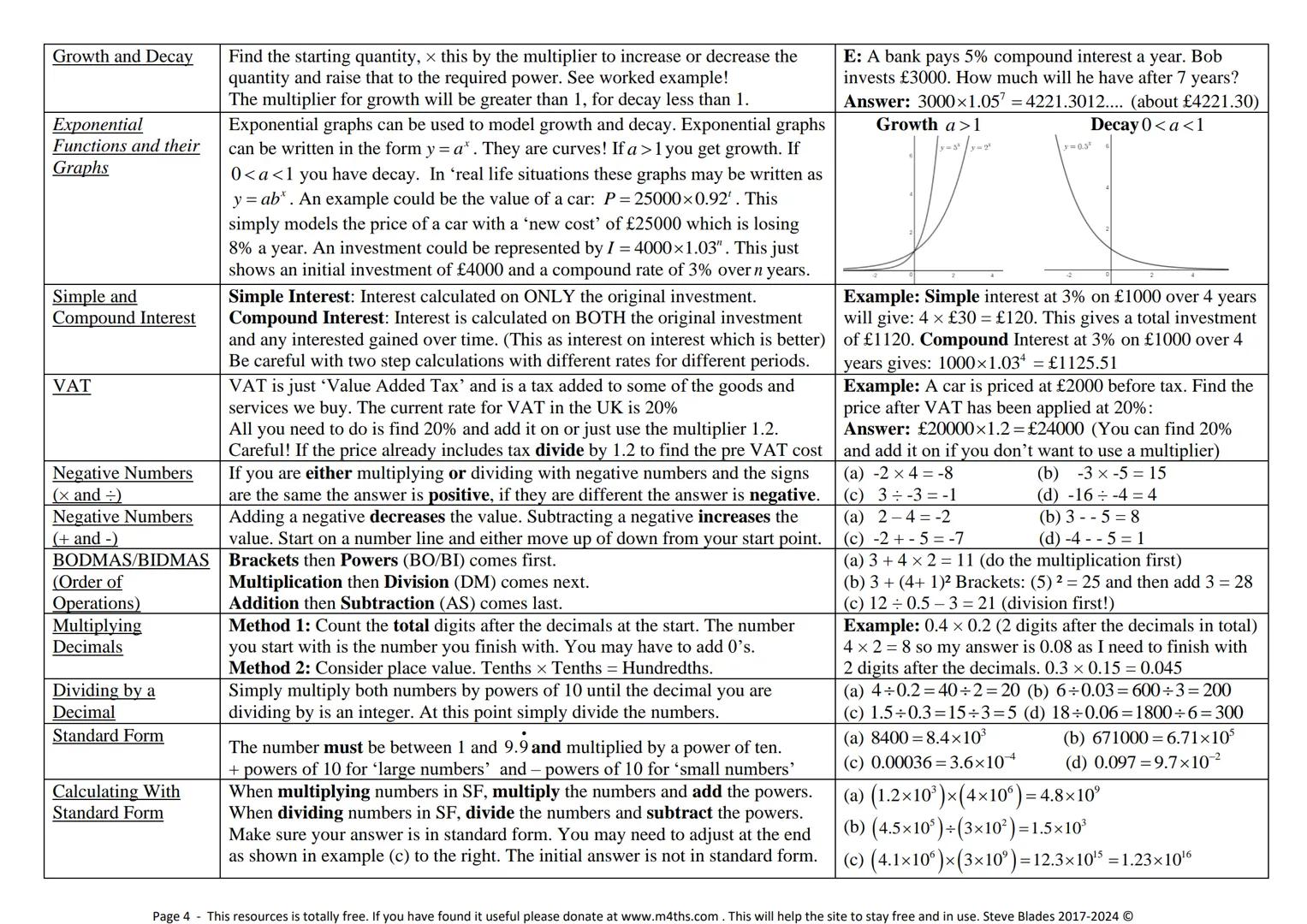
Growth and decay problems are everywhere - from your savings account to a car losing value. The key is finding the right multiplier. For growth, use a multiplier greater than 1 (like 1.05 for 5% growth). For decay, use less than 1 (like 0.92 for 8% decrease).
Exponential graphs follow the pattern y = aˣ and create smooth curves. When a > 1, you get growth curves shooting upwards. When 0 < a < 1, you get decay curves falling down. These graphs model real situations like population growth or radioactive decay.
Compound interest beats simple interest every time because you earn "interest on interest". Simple interest only calculates on your original amount, whilst compound interest grows your money faster by including previous interest in the calculation.
VAT is just a 20% tax added to goods and services. Multiply by 1.2 to add VAT, or divide by 1.2 to find the pre-VAT price. Dead simple once you remember which way round to do it!
Money Saver: Understanding compound interest helps you see why starting to save early makes such a massive difference to your future wealth.
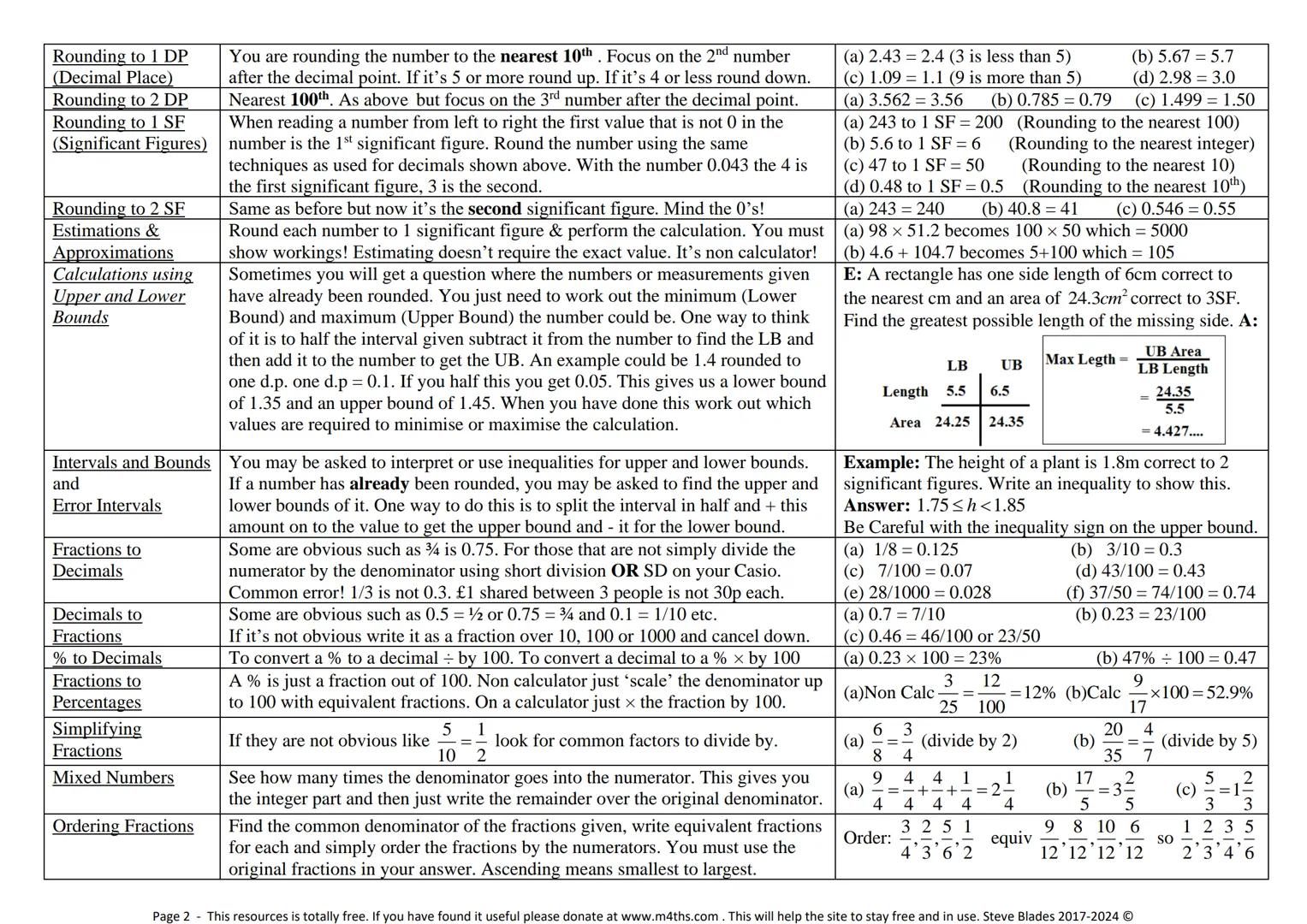
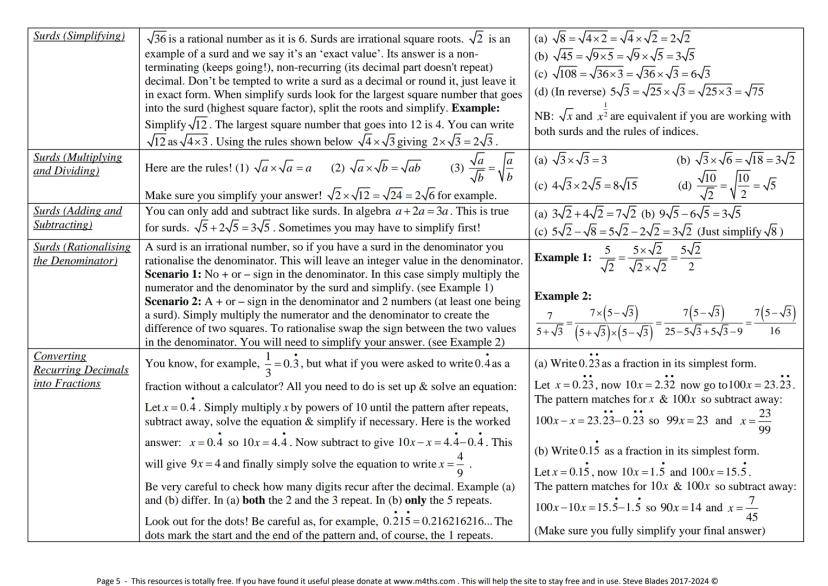
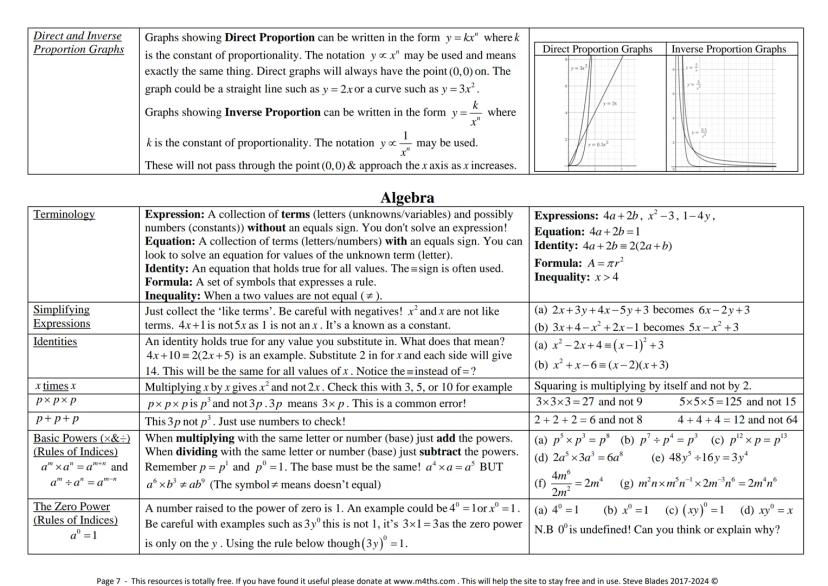
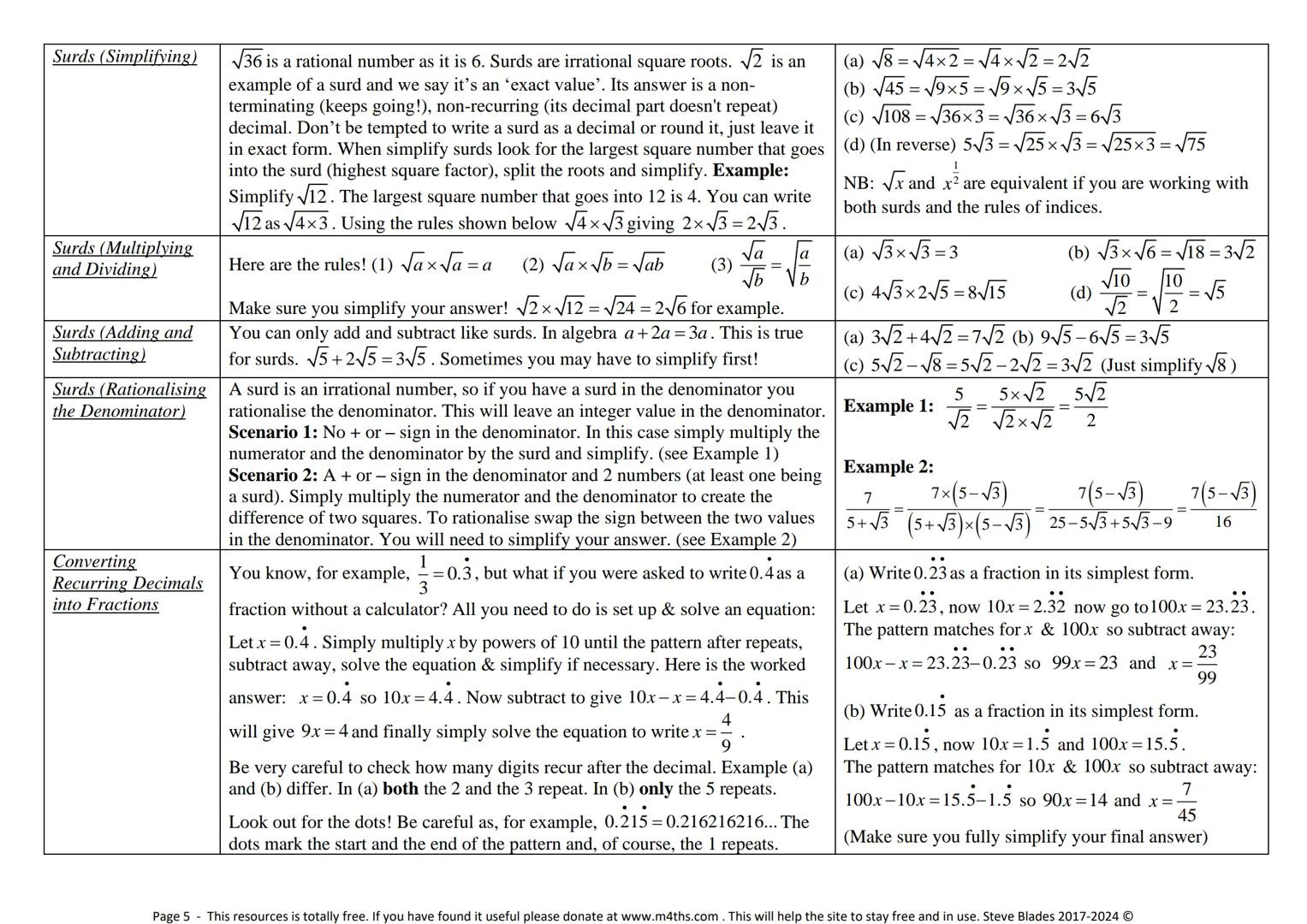
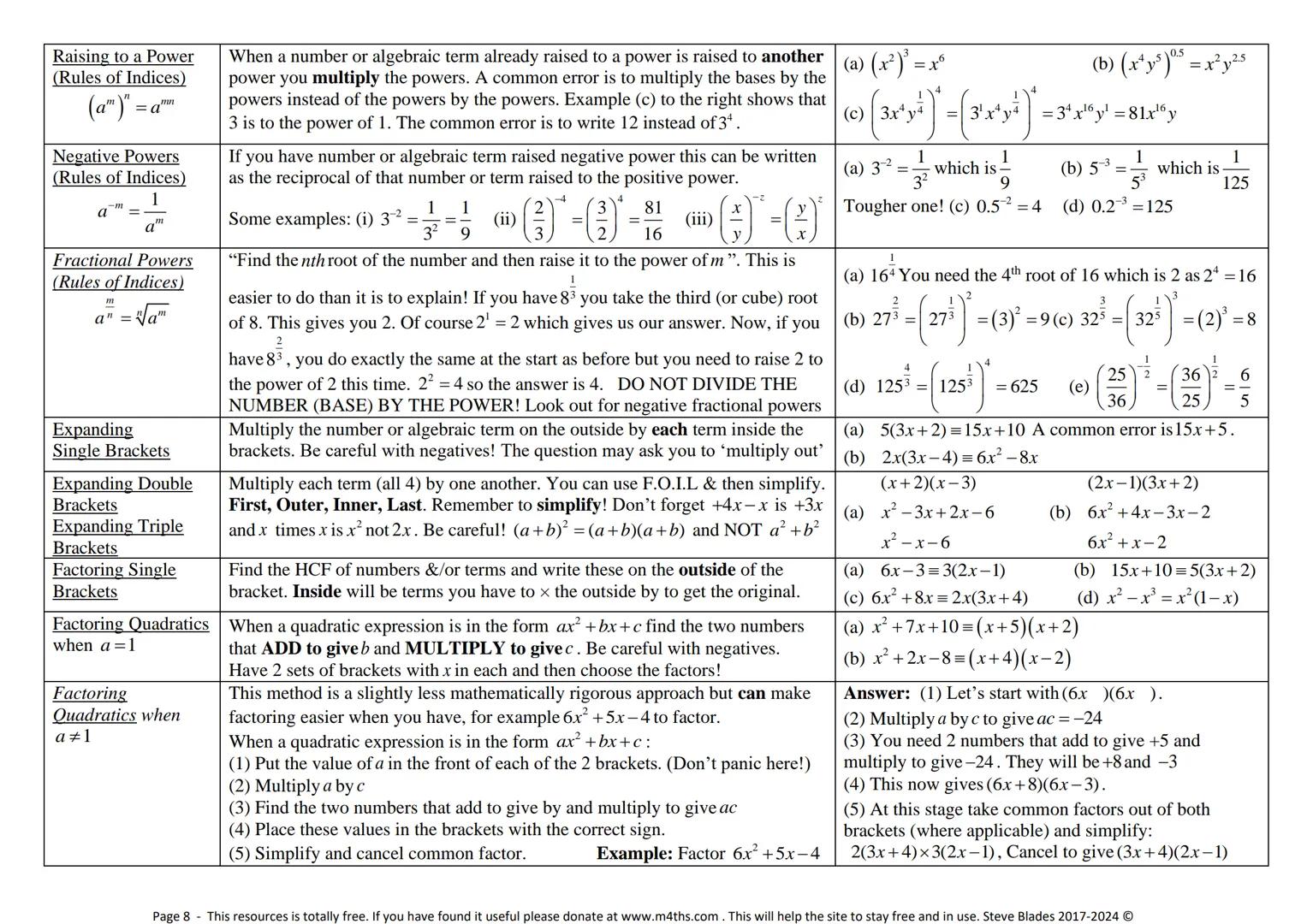
Surds are those "exact" square roots like √2 that never end as decimals. Don't convert them to decimals - leave them as surds for exact answers. To simplify, find the largest square number that divides into your surd, then split it up.
When multiplying and dividing surds, remember these golden rules: √a × √a = a, and √a × √b = √ab. You can only add surds that are "like" terms - think of √5 + 2√5 = 3√5, just like algebra.
Rationalising the denominator means getting rid of surds from the bottom of fractions. For simple cases, multiply top and bottom by the surd. For expressions like 5 + √3, multiply by the opposite sign version to create a difference of two squares.
Converting recurring decimals to fractions uses a clever algebraic trick. Set x equal to your decimal, multiply by powers of 10 until the pattern repeats, then subtract to solve for x. The dots show you exactly which digits repeat.
Exam Gold: Always simplify your surds completely - examiners love to see √12 written as 2√3, not left as √12.
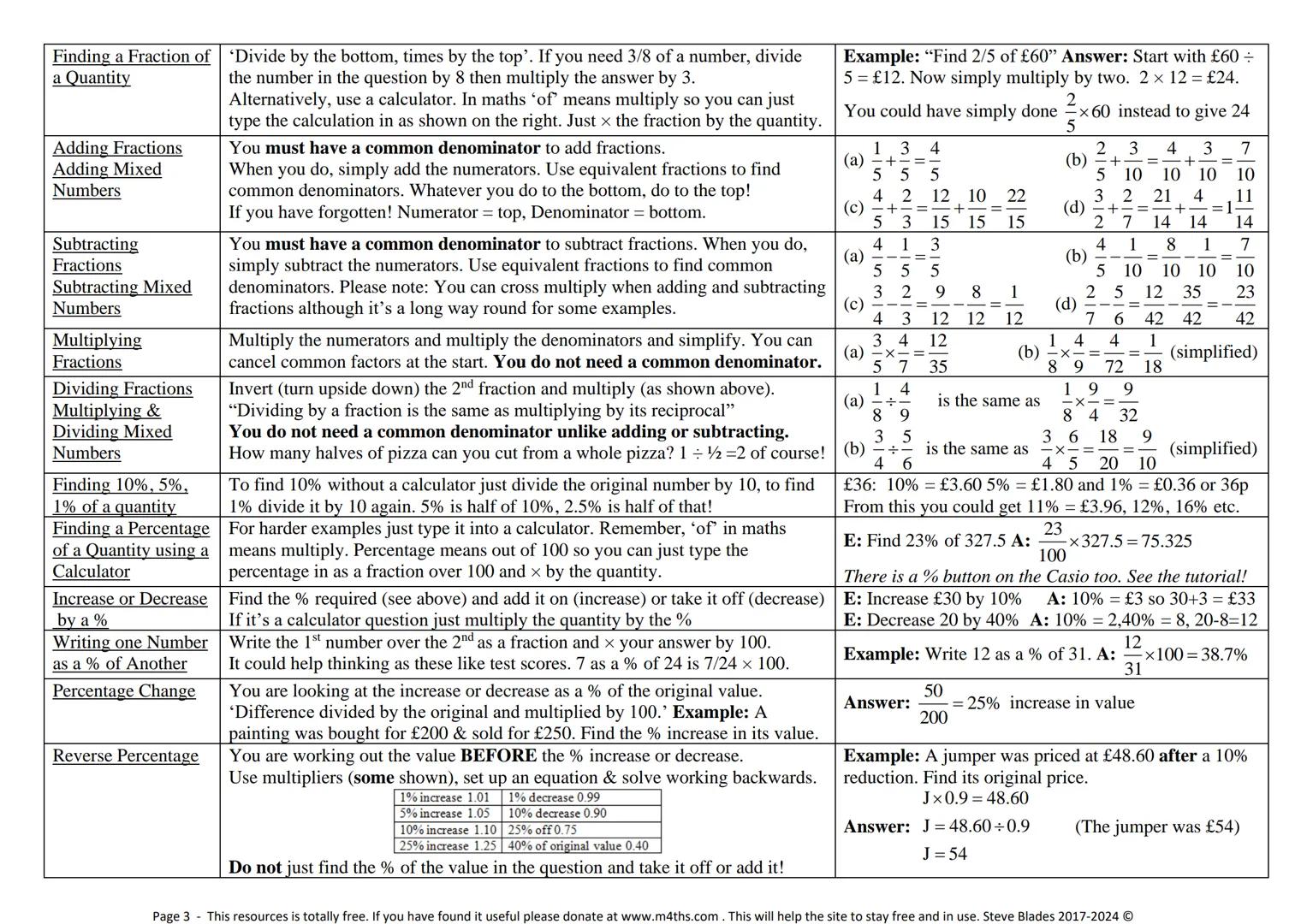
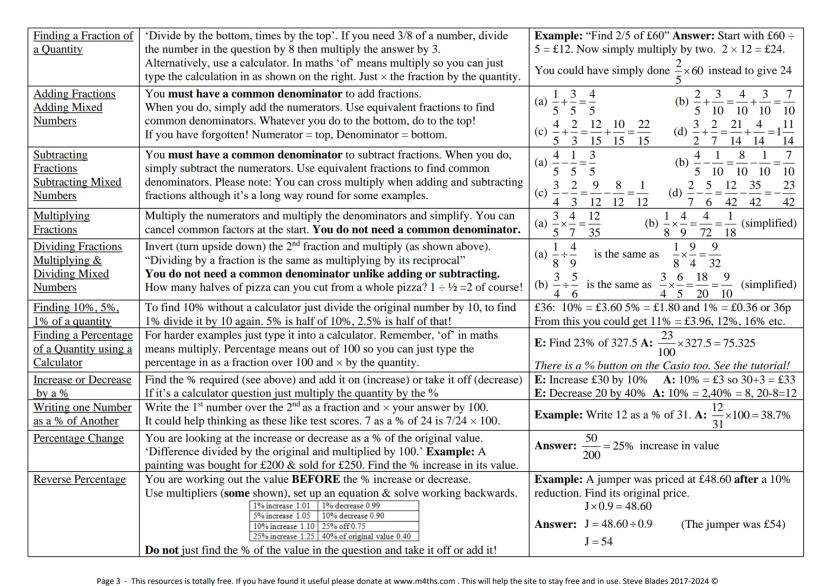
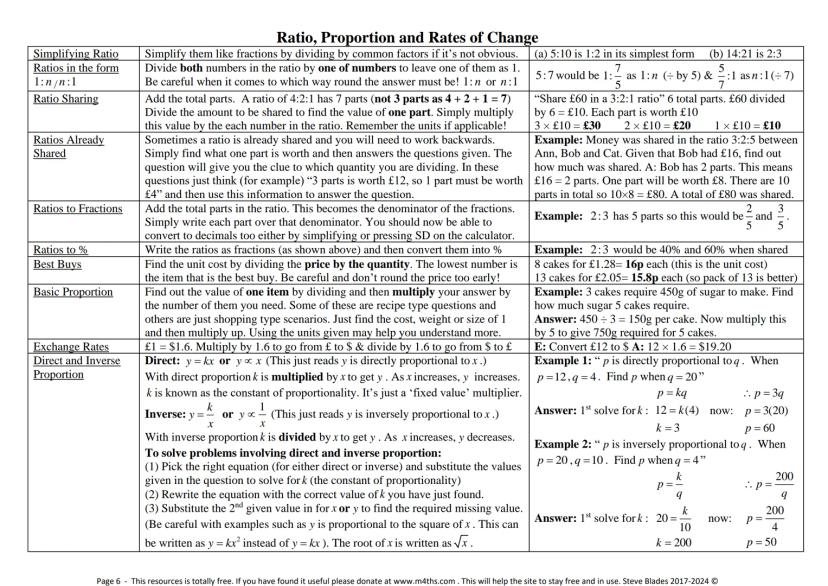
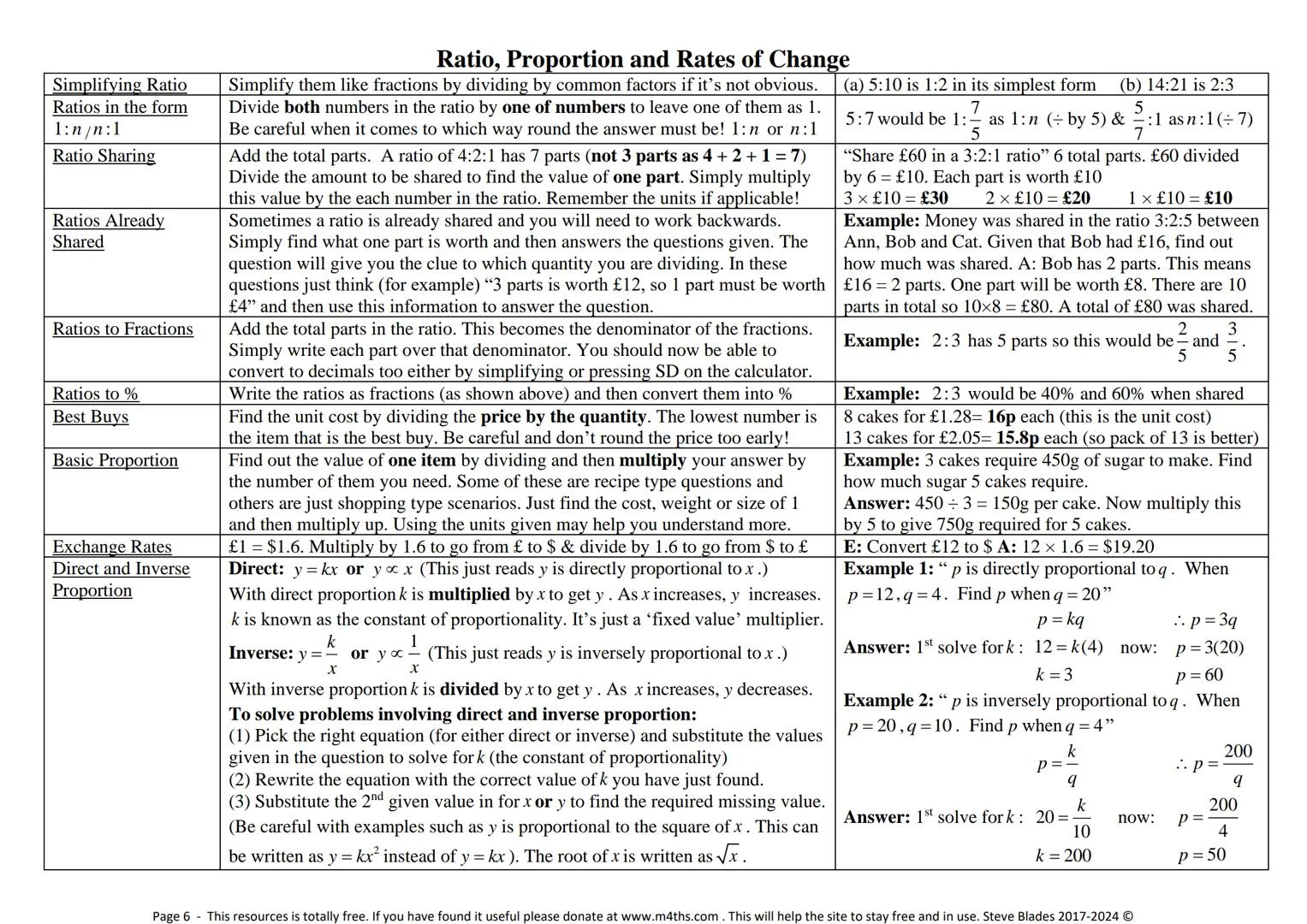
Ratios work exactly like fractions - just divide by common factors to simplify. When sharing amounts, add up all the parts first, then work out what one part is worth by dividing the total amount by the number of parts.
Best buys are found by calculating the unit cost - divide the price by the quantity. The item with the lowest cost per unit wins. Don't round too early or you might get the wrong answer!
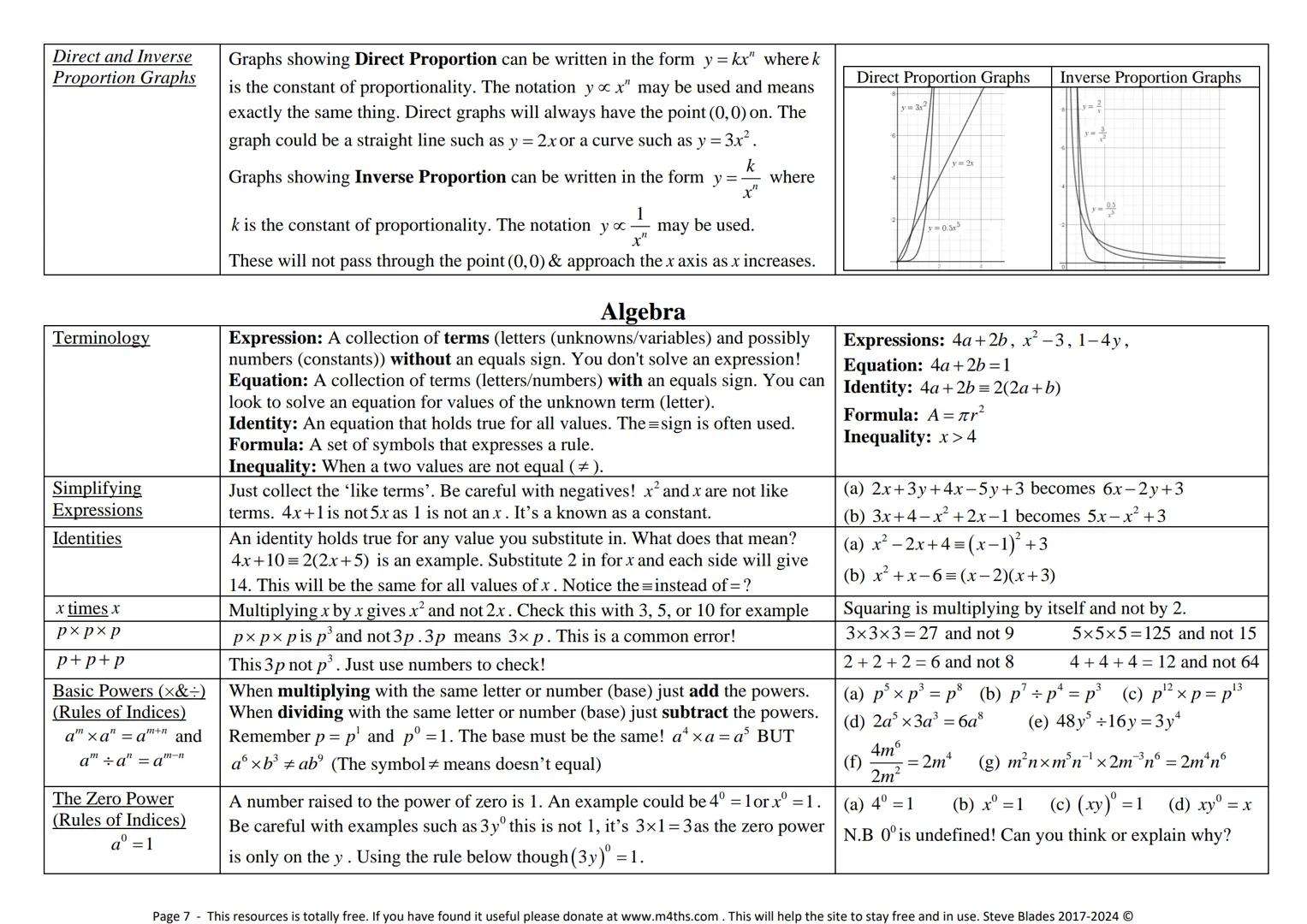
Direct proportion means as one thing increases, the other increases too . Inverse proportion means as one increases, the other decreases . The constant k stays the same in both cases.
Exchange rates are straightforward multiplication and division. If £1 = $1.6, multiply pounds by 1.6 to get dollars, or divide dollars by 1.6 to get pounds. Always check which direction you're converting!
Real Life: Understanding proportion helps you adjust recipes, work out exchange rates on holiday, and spot the best deals when shopping.
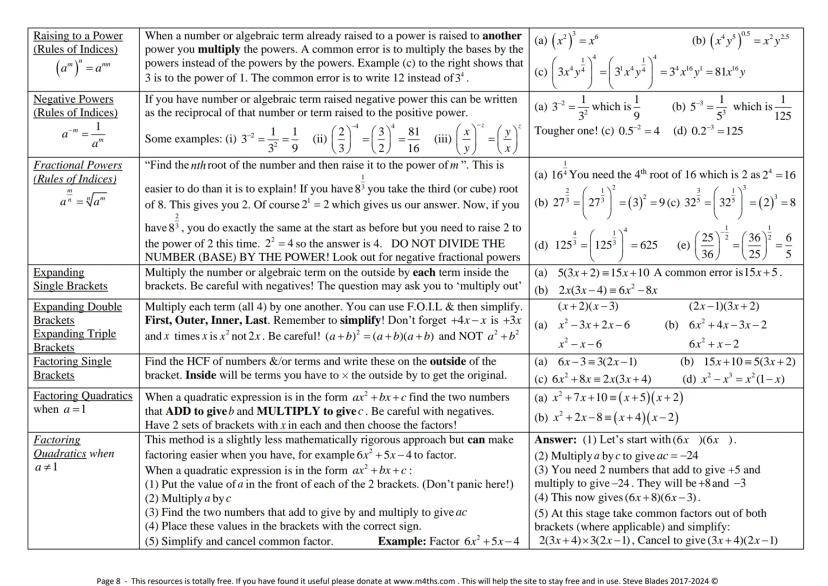
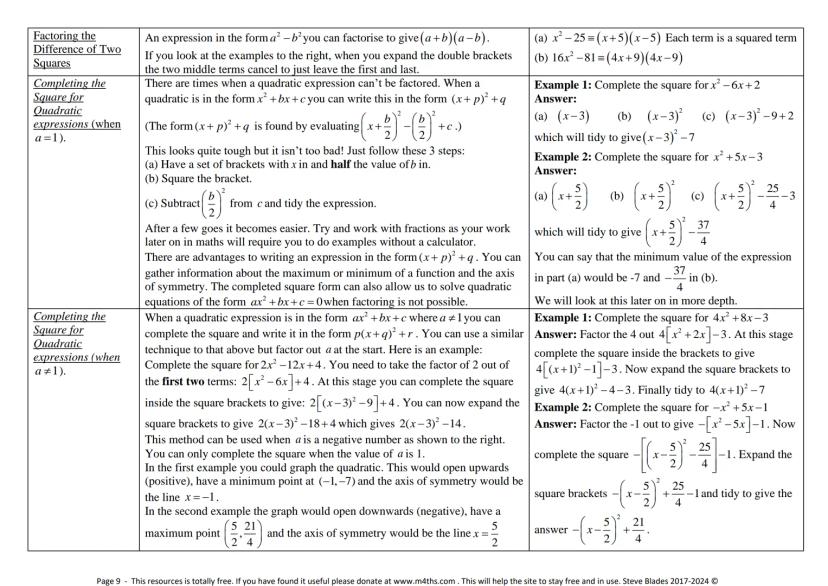
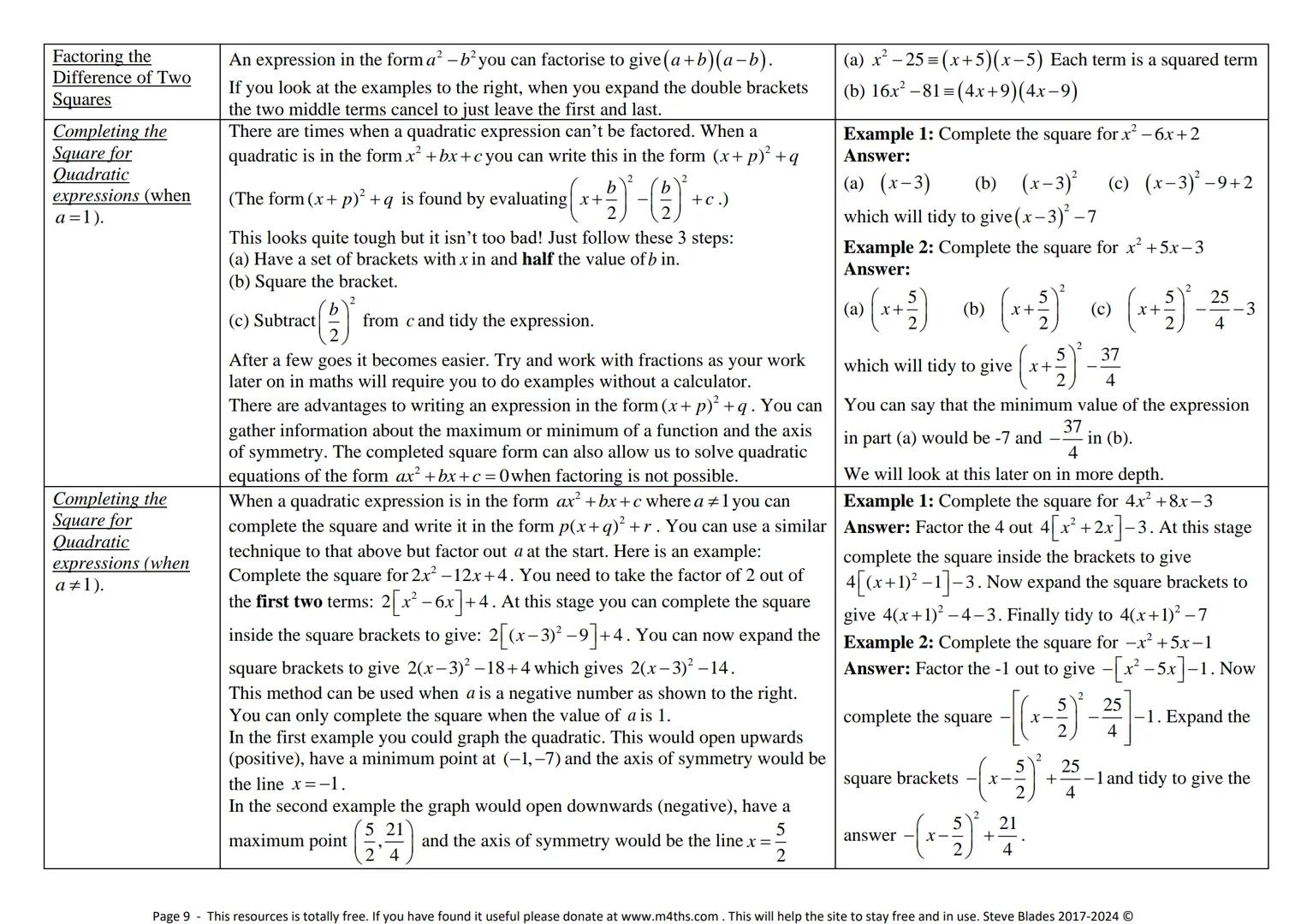
Difference of two squares follows the pattern a² - b² = . When you expand it back out, the middle terms always cancel perfectly, leaving just the first and last terms.
Completing the square transforms expressions like x² + bx + c into the form ² + q. Take half the coefficient of x, square it, then adjust accordingly. This reveals the minimum/maximum point of quadratic graphs.
When the coefficient of x² isn't 1, factor it out first before completing the square. Work inside brackets first, then multiply back through. This technique becomes crucial for solving quadratic equations that won't factorise.
The completed square form tells you loads about a quadratic function - the turning point coordinates, the axis of symmetry, and whether it has a maximum or minimum. It's like having X-ray vision for quadratic graphs!
Graph Insight: Completing the square instantly shows you the vertex of a parabola - the (p, q) values in ² + q give you the turning point coordinates.
Writing formulas from word problems requires identifying the variables (use letters) and constants (fixed numbers). Look for key phrases like "per item" (multiplication) and "call-out charge" (addition).
Substituting into formulas means swapping letters for numbers carefully. Watch the order of operations - square first, then multiply. Remember that subtracting a negative means adding, and squaring always gives a positive result.
Rearranging equations uses the same balance method as solving equations. Do the opposite operation to both sides until your desired letter is alone. It doesn't matter if your subject ends up on the right or left side.
Solving linear equations requires getting all the unknowns on one side and numbers on the other. When unknowns appear on both sides, collect like terms first. For equations with fractions, multiply through by the lowest common multiple to clear them.
Success Strategy: Always check your answer by substituting it back into the original equation - it's the best way to catch silly mistakes.
Simultaneous equations need two equations to find two unknowns. Make the coefficients of x (or y) the same, then add or subtract the equations to eliminate one variable. Solve for the remaining variable, then substitute back.
Quadratic equations come in different forms requiring different techniques. For ax² = b, just square root both sides (remember positive and negative solutions). For ax² + bx = 0, factor out x and set each factor to zero.
Factoring quadratics when a = 1 follows familiar patterns. Once factored into two brackets, set each bracket equal to zero to find your solutions. Always check both answers make sense in context.
When a ≠ 1, factoring becomes trickier but follows the same principles. Sometimes solutions might not be realistic (like negative lengths), so always check your answers make sense for the problem.
Problem-Solving: Quadratic equations often have two solutions, but real-world problems might only accept one - negative time or length usually doesn't make sense!
Gradient measures how steep a line is. Count up/down and left/right between two points, then divide vertical change by horizontal change. Positive gradients slope upwards, negative ones slope downwards.
Finding equations of straight lines needs the gradient and one point. Substitute into y = mx + c to find c, then write the complete equation. You can pick either point when you have two - the answer will be the same.
Parallel lines have identical gradients but different y-intercepts. Perpendicular lines have gradients that multiply to give -1. If one line has gradient m, the perpendicular line has gradient -1/m.
The equation y = mx + c tells you everything about a straight line. The m value shows the steepness and direction, whilst c shows where it crosses the y-axis. Master this form and linear graphs become simple.
Visual Tip: Steep gradients mean big changes in y for small changes in x. A gradient of 5 means the line goes up 5 units for every 1 unit across.
Graph recognition helps you identify different function types instantly. Linear graphs are straight lines, quadratic graphs are smooth curves (parabolas), cubic graphs have up to three x-intercepts, and reciprocal graphs have two separate branches.
Quadratic graphs create U-shaped or inverted-U curves called parabolas. When a > 0, you get a U-shape with a minimum point. When a < 0, you get an upside-down U with a maximum point.
Sketching quadratics from equations requires finding key features: x-intercepts , y-intercept , and turning point. Factored form makes finding roots easy, whilst completed square form reveals the vertex.
The turning point of a quadratic is crucial for sketching. In completed square form ² + q, the turning point is at . This point is either the highest or lowest point on the entire curve.
Sketch Success: You don't need to plot every point perfectly - focus on the key features like intercepts and turning points, then draw a smooth curve through them.
Cubic graphs create sweeping S-shaped curves that can cross the x-axis up to three times. When the coefficient of x³ is positive, the curve enters bottom-left and exits top-right. When negative, it's the opposite.
Sketching cubic graphs from factored form y = is straightforward. The curve crosses the x-axis at x = p, q, and r. Find the y-intercept by setting x = 0 and multiplying the constants.
Repeated roots create special behaviour where the curve touches the x-axis but doesn't cross it. For example, y = ² touches at x = -5 but crosses at x = 3.
The shape of cubic graphs depends entirely on whether the leading coefficient is positive or negative. Once you know this and the x-intercepts, you can sketch the entire curve confidently.
Curve Confidence: Cubic graphs always have that characteristic S-shape. Practice recognising the entry and exit quadrants based on the sign of the x³ coefficient.
Our AI Companion is a student-focused AI tool that offers more than just answers. Built on millions of Knowunity resources, it provides relevant information, personalised study plans, quizzes, and content directly in the chat, adapting to your individual learning journey.
You can download the app from Google Play Store and Apple App Store.
That's right! Enjoy free access to study content, connect with fellow students, and get instant help – all at your fingertips.
App Store
Google Play
The app is very easy to use and well designed. I have found everything I was looking for so far and have been able to learn a lot from the presentations! I will definitely use the app for a class assignment! And of course it also helps a lot as an inspiration.
Stefan S
iOS user
This app is really great. There are so many study notes and help [...]. My problem subject is French, for example, and the app has so many options for help. Thanks to this app, I have improved my French. I would recommend it to anyone.
Samantha Klich
Android user
Wow, I am really amazed. I just tried the app because I've seen it advertised many times and was absolutely stunned. This app is THE HELP you want for school and above all, it offers so many things, such as workouts and fact sheets, which have been VERY helpful to me personally.
Anna
iOS user
Best app on earth! no words because it’s too good
Thomas R
iOS user
Just amazing. Let's me revise 10x better, this app is a quick 10/10. I highly recommend it to anyone. I can watch and search for notes. I can save them in the subject folder. I can revise it any time when I come back. If you haven't tried this app, you're really missing out.
Basil
Android user
This app has made me feel so much more confident in my exam prep, not only through boosting my own self confidence through the features that allow you to connect with others and feel less alone, but also through the way the app itself is centred around making you feel better. It is easy to navigate, fun to use, and helpful to anyone struggling in absolutely any way.
David K
iOS user
The app's just great! All I have to do is enter the topic in the search bar and I get the response real fast. I don't have to watch 10 YouTube videos to understand something, so I'm saving my time. Highly recommended!
Sudenaz Ocak
Android user
In school I was really bad at maths but thanks to the app, I am doing better now. I am so grateful that you made the app.
Greenlight Bonnie
Android user
very reliable app to help and grow your ideas of Maths, English and other related topics in your works. please use this app if your struggling in areas, this app is key for that. wish I'd of done a review before. and it's also free so don't worry about that.
Rohan U
Android user
I know a lot of apps use fake accounts to boost their reviews but this app deserves it all. Originally I was getting 4 in my English exams and this time I got a grade 7. I didn’t even know about this app three days until the exam and it has helped A LOT. Please actually trust me and use it as I’m sure you too will see developments.
Xander S
iOS user
THE QUIZES AND FLASHCARDS ARE SO USEFUL AND I LOVE Knowunity AI. IT ALSO IS LITREALLY LIKE CHATGPT BUT SMARTER!! HELPED ME WITH MY MASCARA PROBLEMS TOO!! AS WELL AS MY REAL SUBJECTS ! DUHHH 😍😁😲🤑💗✨🎀😮
Elisha
iOS user
This apps acc the goat. I find revision so boring but this app makes it so easy to organize it all and then you can ask the freeeee ai to test yourself so good and you can easily upload your own stuff. highly recommend as someone taking mocks now
Paul T
iOS user
The app is very easy to use and well designed. I have found everything I was looking for so far and have been able to learn a lot from the presentations! I will definitely use the app for a class assignment! And of course it also helps a lot as an inspiration.
Stefan S
iOS user
This app is really great. There are so many study notes and help [...]. My problem subject is French, for example, and the app has so many options for help. Thanks to this app, I have improved my French. I would recommend it to anyone.
Samantha Klich
Android user
Wow, I am really amazed. I just tried the app because I've seen it advertised many times and was absolutely stunned. This app is THE HELP you want for school and above all, it offers so many things, such as workouts and fact sheets, which have been VERY helpful to me personally.
Anna
iOS user
Best app on earth! no words because it’s too good
Thomas R
iOS user
Just amazing. Let's me revise 10x better, this app is a quick 10/10. I highly recommend it to anyone. I can watch and search for notes. I can save them in the subject folder. I can revise it any time when I come back. If you haven't tried this app, you're really missing out.
Basil
Android user
This app has made me feel so much more confident in my exam prep, not only through boosting my own self confidence through the features that allow you to connect with others and feel less alone, but also through the way the app itself is centred around making you feel better. It is easy to navigate, fun to use, and helpful to anyone struggling in absolutely any way.
David K
iOS user
The app's just great! All I have to do is enter the topic in the search bar and I get the response real fast. I don't have to watch 10 YouTube videos to understand something, so I'm saving my time. Highly recommended!
Sudenaz Ocak
Android user
In school I was really bad at maths but thanks to the app, I am doing better now. I am so grateful that you made the app.
Greenlight Bonnie
Android user
very reliable app to help and grow your ideas of Maths, English and other related topics in your works. please use this app if your struggling in areas, this app is key for that. wish I'd of done a review before. and it's also free so don't worry about that.
Rohan U
Android user
I know a lot of apps use fake accounts to boost their reviews but this app deserves it all. Originally I was getting 4 in my English exams and this time I got a grade 7. I didn’t even know about this app three days until the exam and it has helped A LOT. Please actually trust me and use it as I’m sure you too will see developments.
Xander S
iOS user
THE QUIZES AND FLASHCARDS ARE SO USEFUL AND I LOVE Knowunity AI. IT ALSO IS LITREALLY LIKE CHATGPT BUT SMARTER!! HELPED ME WITH MY MASCARA PROBLEMS TOO!! AS WELL AS MY REAL SUBJECTS ! DUHHH 😍😁😲🤑💗✨🎀😮
Elisha
iOS user
This apps acc the goat. I find revision so boring but this app makes it so easy to organize it all and then you can ask the freeeee ai to test yourself so good and you can easily upload your own stuff. highly recommend as someone taking mocks now
Paul T
iOS user
Aarya
@aaryathiru_vqyq
Ever wondered how maths actually works in real life? This GCSE maths guide covers everything from growing your savings with compound interest to solving complex equations that could help you become the next big problem-solver. You'll discover how mathematical concepts... Show more
Access to all documents
Improve your grades
Join milions of students
This is your complete guide to mastering GCSE maths, covering both Foundation and Higher tier topics. The book works for all major exam boards including Edexcel, AQA, and OCR.
You'll notice some topics are in italics - these are Higher tier only content, so Foundation students can skip them. The shaded formulas are the ones you absolutely must memorise because they won't be given in your exam formula booklet.
Each topic links to video tutorials and worksheets, making it dead easy to get extra practice when you need it. Whether you're aiming for a grade 4 or pushing for that grade 9, this resource has got your back.
Top Tip: Focus on the non-shaded formulas first - these will be provided in your exam, so understanding how to use them is more important than memorising them.
Access to all documents
Improve your grades
Join milions of students
Growth and decay problems are everywhere - from your savings account to a car losing value. The key is finding the right multiplier. For growth, use a multiplier greater than 1 (like 1.05 for 5% growth). For decay, use less than 1 (like 0.92 for 8% decrease).
Exponential graphs follow the pattern y = aˣ and create smooth curves. When a > 1, you get growth curves shooting upwards. When 0 < a < 1, you get decay curves falling down. These graphs model real situations like population growth or radioactive decay.
Compound interest beats simple interest every time because you earn "interest on interest". Simple interest only calculates on your original amount, whilst compound interest grows your money faster by including previous interest in the calculation.
VAT is just a 20% tax added to goods and services. Multiply by 1.2 to add VAT, or divide by 1.2 to find the pre-VAT price. Dead simple once you remember which way round to do it!
Money Saver: Understanding compound interest helps you see why starting to save early makes such a massive difference to your future wealth.
Access to all documents
Improve your grades
Join milions of students
Surds are those "exact" square roots like √2 that never end as decimals. Don't convert them to decimals - leave them as surds for exact answers. To simplify, find the largest square number that divides into your surd, then split it up.
When multiplying and dividing surds, remember these golden rules: √a × √a = a, and √a × √b = √ab. You can only add surds that are "like" terms - think of √5 + 2√5 = 3√5, just like algebra.
Rationalising the denominator means getting rid of surds from the bottom of fractions. For simple cases, multiply top and bottom by the surd. For expressions like 5 + √3, multiply by the opposite sign version to create a difference of two squares.
Converting recurring decimals to fractions uses a clever algebraic trick. Set x equal to your decimal, multiply by powers of 10 until the pattern repeats, then subtract to solve for x. The dots show you exactly which digits repeat.
Exam Gold: Always simplify your surds completely - examiners love to see √12 written as 2√3, not left as √12.
Access to all documents
Improve your grades
Join milions of students
Ratios work exactly like fractions - just divide by common factors to simplify. When sharing amounts, add up all the parts first, then work out what one part is worth by dividing the total amount by the number of parts.
Best buys are found by calculating the unit cost - divide the price by the quantity. The item with the lowest cost per unit wins. Don't round too early or you might get the wrong answer!
Direct proportion means as one thing increases, the other increases too . Inverse proportion means as one increases, the other decreases . The constant k stays the same in both cases.
Exchange rates are straightforward multiplication and division. If £1 = $1.6, multiply pounds by 1.6 to get dollars, or divide dollars by 1.6 to get pounds. Always check which direction you're converting!
Real Life: Understanding proportion helps you adjust recipes, work out exchange rates on holiday, and spot the best deals when shopping.
Access to all documents
Improve your grades
Join milions of students
Difference of two squares follows the pattern a² - b² = . When you expand it back out, the middle terms always cancel perfectly, leaving just the first and last terms.
Completing the square transforms expressions like x² + bx + c into the form ² + q. Take half the coefficient of x, square it, then adjust accordingly. This reveals the minimum/maximum point of quadratic graphs.
When the coefficient of x² isn't 1, factor it out first before completing the square. Work inside brackets first, then multiply back through. This technique becomes crucial for solving quadratic equations that won't factorise.
The completed square form tells you loads about a quadratic function - the turning point coordinates, the axis of symmetry, and whether it has a maximum or minimum. It's like having X-ray vision for quadratic graphs!
Graph Insight: Completing the square instantly shows you the vertex of a parabola - the (p, q) values in ² + q give you the turning point coordinates.
Access to all documents
Improve your grades
Join milions of students
Writing formulas from word problems requires identifying the variables (use letters) and constants (fixed numbers). Look for key phrases like "per item" (multiplication) and "call-out charge" (addition).
Substituting into formulas means swapping letters for numbers carefully. Watch the order of operations - square first, then multiply. Remember that subtracting a negative means adding, and squaring always gives a positive result.
Rearranging equations uses the same balance method as solving equations. Do the opposite operation to both sides until your desired letter is alone. It doesn't matter if your subject ends up on the right or left side.
Solving linear equations requires getting all the unknowns on one side and numbers on the other. When unknowns appear on both sides, collect like terms first. For equations with fractions, multiply through by the lowest common multiple to clear them.
Success Strategy: Always check your answer by substituting it back into the original equation - it's the best way to catch silly mistakes.
Access to all documents
Improve your grades
Join milions of students
Simultaneous equations need two equations to find two unknowns. Make the coefficients of x (or y) the same, then add or subtract the equations to eliminate one variable. Solve for the remaining variable, then substitute back.
Quadratic equations come in different forms requiring different techniques. For ax² = b, just square root both sides (remember positive and negative solutions). For ax² + bx = 0, factor out x and set each factor to zero.
Factoring quadratics when a = 1 follows familiar patterns. Once factored into two brackets, set each bracket equal to zero to find your solutions. Always check both answers make sense in context.
When a ≠ 1, factoring becomes trickier but follows the same principles. Sometimes solutions might not be realistic (like negative lengths), so always check your answers make sense for the problem.
Problem-Solving: Quadratic equations often have two solutions, but real-world problems might only accept one - negative time or length usually doesn't make sense!
Access to all documents
Improve your grades
Join milions of students
Gradient measures how steep a line is. Count up/down and left/right between two points, then divide vertical change by horizontal change. Positive gradients slope upwards, negative ones slope downwards.
Finding equations of straight lines needs the gradient and one point. Substitute into y = mx + c to find c, then write the complete equation. You can pick either point when you have two - the answer will be the same.
Parallel lines have identical gradients but different y-intercepts. Perpendicular lines have gradients that multiply to give -1. If one line has gradient m, the perpendicular line has gradient -1/m.
The equation y = mx + c tells you everything about a straight line. The m value shows the steepness and direction, whilst c shows where it crosses the y-axis. Master this form and linear graphs become simple.
Visual Tip: Steep gradients mean big changes in y for small changes in x. A gradient of 5 means the line goes up 5 units for every 1 unit across.
Access to all documents
Improve your grades
Join milions of students
Graph recognition helps you identify different function types instantly. Linear graphs are straight lines, quadratic graphs are smooth curves (parabolas), cubic graphs have up to three x-intercepts, and reciprocal graphs have two separate branches.
Quadratic graphs create U-shaped or inverted-U curves called parabolas. When a > 0, you get a U-shape with a minimum point. When a < 0, you get an upside-down U with a maximum point.
Sketching quadratics from equations requires finding key features: x-intercepts , y-intercept , and turning point. Factored form makes finding roots easy, whilst completed square form reveals the vertex.
The turning point of a quadratic is crucial for sketching. In completed square form ² + q, the turning point is at . This point is either the highest or lowest point on the entire curve.
Sketch Success: You don't need to plot every point perfectly - focus on the key features like intercepts and turning points, then draw a smooth curve through them.
Access to all documents
Improve your grades
Join milions of students
Cubic graphs create sweeping S-shaped curves that can cross the x-axis up to three times. When the coefficient of x³ is positive, the curve enters bottom-left and exits top-right. When negative, it's the opposite.
Sketching cubic graphs from factored form y = is straightforward. The curve crosses the x-axis at x = p, q, and r. Find the y-intercept by setting x = 0 and multiplying the constants.
Repeated roots create special behaviour where the curve touches the x-axis but doesn't cross it. For example, y = ² touches at x = -5 but crosses at x = 3.
The shape of cubic graphs depends entirely on whether the leading coefficient is positive or negative. Once you know this and the x-intercepts, you can sketch the entire curve confidently.
Curve Confidence: Cubic graphs always have that characteristic S-shape. Practice recognising the entry and exit quadrants based on the sign of the x³ coefficient.
Our AI Companion is a student-focused AI tool that offers more than just answers. Built on millions of Knowunity resources, it provides relevant information, personalised study plans, quizzes, and content directly in the chat, adapting to your individual learning journey.
You can download the app from Google Play Store and Apple App Store.
That's right! Enjoy free access to study content, connect with fellow students, and get instant help – all at your fingertips.
20
Smart Tools NEW
Transform this note into: ✓ 50+ Practice Questions ✓ Interactive Flashcards ✓ Full Mock Exam ✓ Essay Outlines
App Store
Google Play
The app is very easy to use and well designed. I have found everything I was looking for so far and have been able to learn a lot from the presentations! I will definitely use the app for a class assignment! And of course it also helps a lot as an inspiration.
Stefan S
iOS user
This app is really great. There are so many study notes and help [...]. My problem subject is French, for example, and the app has so many options for help. Thanks to this app, I have improved my French. I would recommend it to anyone.
Samantha Klich
Android user
Wow, I am really amazed. I just tried the app because I've seen it advertised many times and was absolutely stunned. This app is THE HELP you want for school and above all, it offers so many things, such as workouts and fact sheets, which have been VERY helpful to me personally.
Anna
iOS user
Best app on earth! no words because it’s too good
Thomas R
iOS user
Just amazing. Let's me revise 10x better, this app is a quick 10/10. I highly recommend it to anyone. I can watch and search for notes. I can save them in the subject folder. I can revise it any time when I come back. If you haven't tried this app, you're really missing out.
Basil
Android user
This app has made me feel so much more confident in my exam prep, not only through boosting my own self confidence through the features that allow you to connect with others and feel less alone, but also through the way the app itself is centred around making you feel better. It is easy to navigate, fun to use, and helpful to anyone struggling in absolutely any way.
David K
iOS user
The app's just great! All I have to do is enter the topic in the search bar and I get the response real fast. I don't have to watch 10 YouTube videos to understand something, so I'm saving my time. Highly recommended!
Sudenaz Ocak
Android user
In school I was really bad at maths but thanks to the app, I am doing better now. I am so grateful that you made the app.
Greenlight Bonnie
Android user
very reliable app to help and grow your ideas of Maths, English and other related topics in your works. please use this app if your struggling in areas, this app is key for that. wish I'd of done a review before. and it's also free so don't worry about that.
Rohan U
Android user
I know a lot of apps use fake accounts to boost their reviews but this app deserves it all. Originally I was getting 4 in my English exams and this time I got a grade 7. I didn’t even know about this app three days until the exam and it has helped A LOT. Please actually trust me and use it as I’m sure you too will see developments.
Xander S
iOS user
THE QUIZES AND FLASHCARDS ARE SO USEFUL AND I LOVE Knowunity AI. IT ALSO IS LITREALLY LIKE CHATGPT BUT SMARTER!! HELPED ME WITH MY MASCARA PROBLEMS TOO!! AS WELL AS MY REAL SUBJECTS ! DUHHH 😍😁😲🤑💗✨🎀😮
Elisha
iOS user
This apps acc the goat. I find revision so boring but this app makes it so easy to organize it all and then you can ask the freeeee ai to test yourself so good and you can easily upload your own stuff. highly recommend as someone taking mocks now
Paul T
iOS user
The app is very easy to use and well designed. I have found everything I was looking for so far and have been able to learn a lot from the presentations! I will definitely use the app for a class assignment! And of course it also helps a lot as an inspiration.
Stefan S
iOS user
This app is really great. There are so many study notes and help [...]. My problem subject is French, for example, and the app has so many options for help. Thanks to this app, I have improved my French. I would recommend it to anyone.
Samantha Klich
Android user
Wow, I am really amazed. I just tried the app because I've seen it advertised many times and was absolutely stunned. This app is THE HELP you want for school and above all, it offers so many things, such as workouts and fact sheets, which have been VERY helpful to me personally.
Anna
iOS user
Best app on earth! no words because it’s too good
Thomas R
iOS user
Just amazing. Let's me revise 10x better, this app is a quick 10/10. I highly recommend it to anyone. I can watch and search for notes. I can save them in the subject folder. I can revise it any time when I come back. If you haven't tried this app, you're really missing out.
Basil
Android user
This app has made me feel so much more confident in my exam prep, not only through boosting my own self confidence through the features that allow you to connect with others and feel less alone, but also through the way the app itself is centred around making you feel better. It is easy to navigate, fun to use, and helpful to anyone struggling in absolutely any way.
David K
iOS user
The app's just great! All I have to do is enter the topic in the search bar and I get the response real fast. I don't have to watch 10 YouTube videos to understand something, so I'm saving my time. Highly recommended!
Sudenaz Ocak
Android user
In school I was really bad at maths but thanks to the app, I am doing better now. I am so grateful that you made the app.
Greenlight Bonnie
Android user
very reliable app to help and grow your ideas of Maths, English and other related topics in your works. please use this app if your struggling in areas, this app is key for that. wish I'd of done a review before. and it's also free so don't worry about that.
Rohan U
Android user
I know a lot of apps use fake accounts to boost their reviews but this app deserves it all. Originally I was getting 4 in my English exams and this time I got a grade 7. I didn’t even know about this app three days until the exam and it has helped A LOT. Please actually trust me and use it as I’m sure you too will see developments.
Xander S
iOS user
THE QUIZES AND FLASHCARDS ARE SO USEFUL AND I LOVE Knowunity AI. IT ALSO IS LITREALLY LIKE CHATGPT BUT SMARTER!! HELPED ME WITH MY MASCARA PROBLEMS TOO!! AS WELL AS MY REAL SUBJECTS ! DUHHH 😍😁😲🤑💗✨🎀😮
Elisha
iOS user
This apps acc the goat. I find revision so boring but this app makes it so easy to organize it all and then you can ask the freeeee ai to test yourself so good and you can easily upload your own stuff. highly recommend as someone taking mocks now
Paul T
iOS user