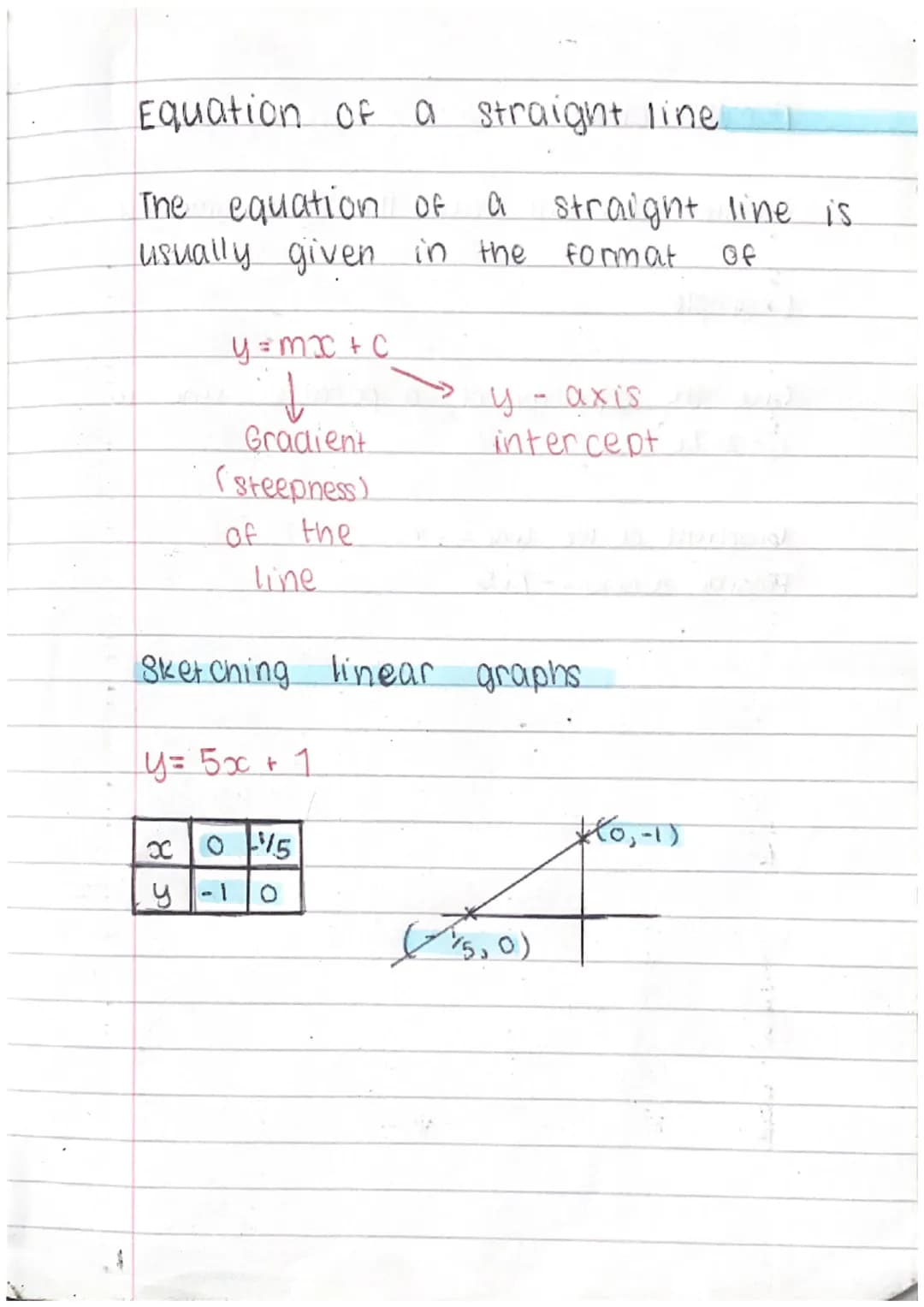
Equation of a Straight Line
Every straight line can be described using the simple formula y = mx + c. This might look intimidating at first, but it's actually quite straightforward once you break it down.
The m represents the gradient, which tells you how steep your line is. Think of it as how much the line goes up or down as you move from left to right. A positive gradient means the line slopes upwards, whilst a negative gradient means it slopes downwards.
The c is your y-intercept - this is simply where your line crosses the y-axis. It's the value of y when x equals zero, making it easy to spot on any graph.
Quick Tip: Remember "m for mountain" to recall that m controls how steep your line climbs!
When sketching graphs like y = 5x + 1, start by plotting your y-intercept wherethelinecrossesthey−axisatc=1, then use your gradient m=5 to find your next point. From your intercept, go up 5 units and right 1 unit to plot another point, then draw your straight line through both points.