
Ever wondered how to expand expressions like (1+x)⁵ without multiplying... Show more
 Maths145 views·Updated Jun 4, 2026·6 pages
Understanding the Binomial Theorem and Factorials for AQA A Level Maths
J
Julia Morgan@juliamorgan_qhvr
1 / 6
1
of 6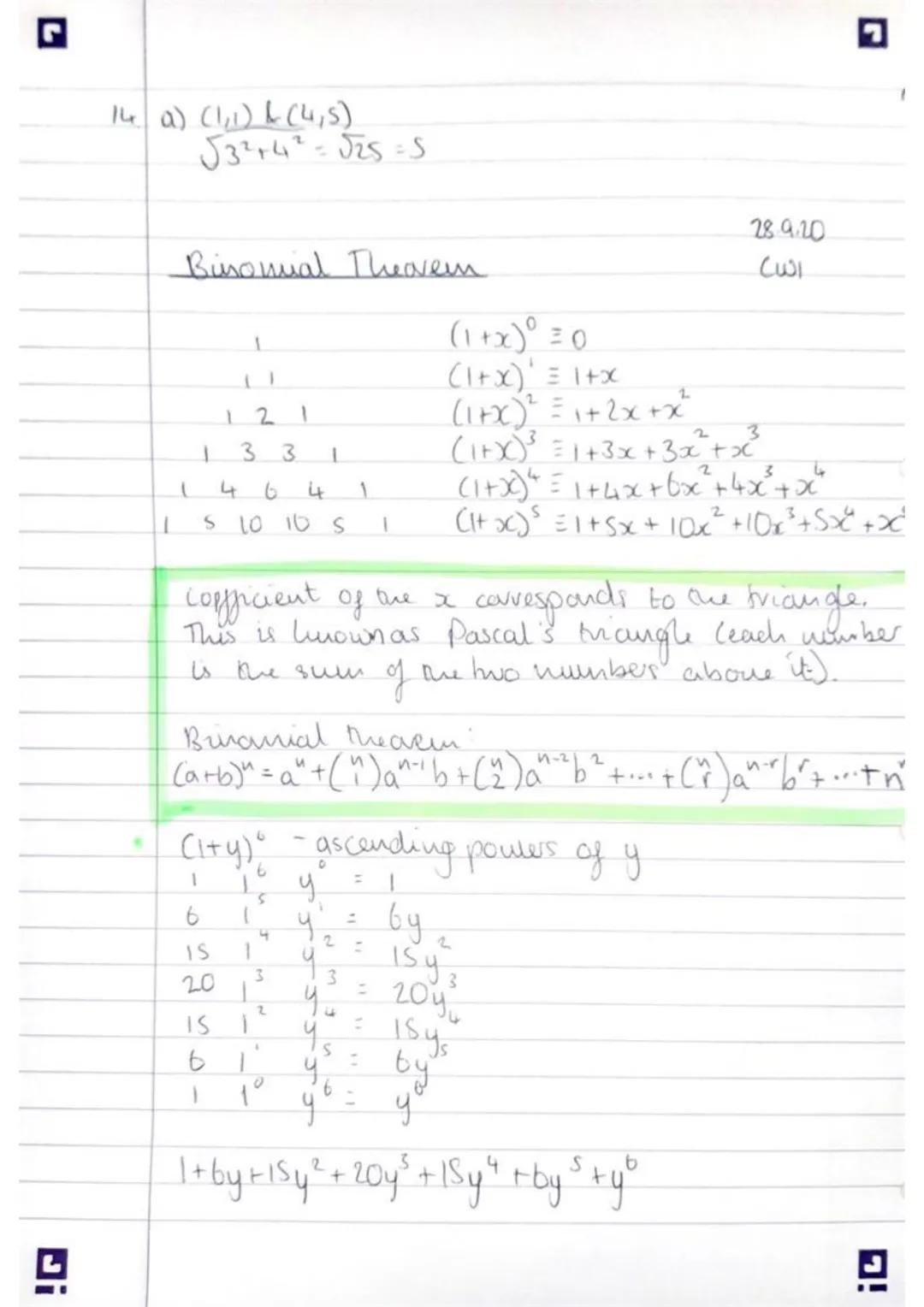
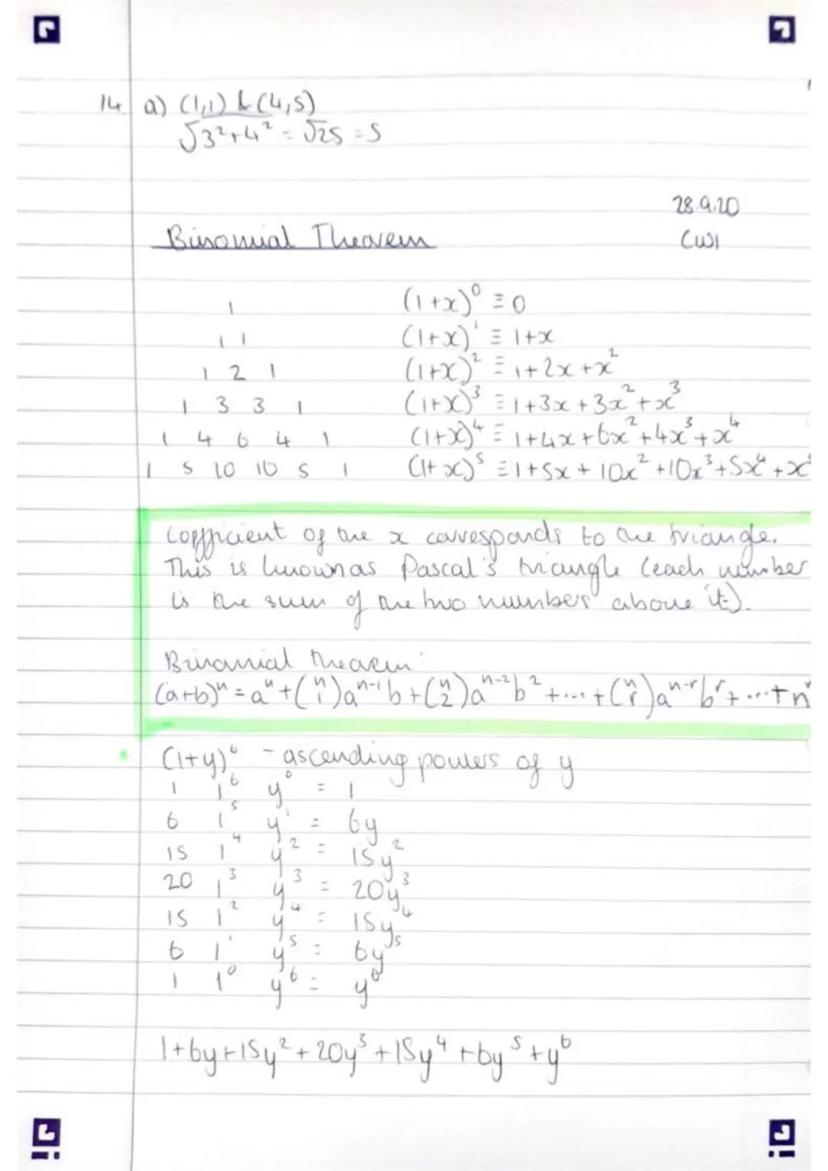
Pascal's Triangle and Basic Binomial Expansion
Think of Pascal's triangle as your expansion cheat sheet - each row gives you the coefficients you need! The triangle starts with 1 at the top, and every number below is the sum of the two numbers above it.
When you expand ⁿ, the coefficients come straight from Pascal's triangle. For example, ³ uses row 3: the coefficients 1, 3, 3, 1 give you 1 + 3x + 3x² + x³.
The binomial theorem formula is: ⁿ = aⁿ + (ⁿ₁)aⁿ⁻¹b + (ⁿ₂)aⁿ⁻²b² + ... + bⁿ. Don't let the notation scare you - those brackets are just Pascal's triangle numbers in disguise!
Quick Tip: The powers of the first term decrease whilst the powers of the second term increase, but they always add up to n.
2
of 6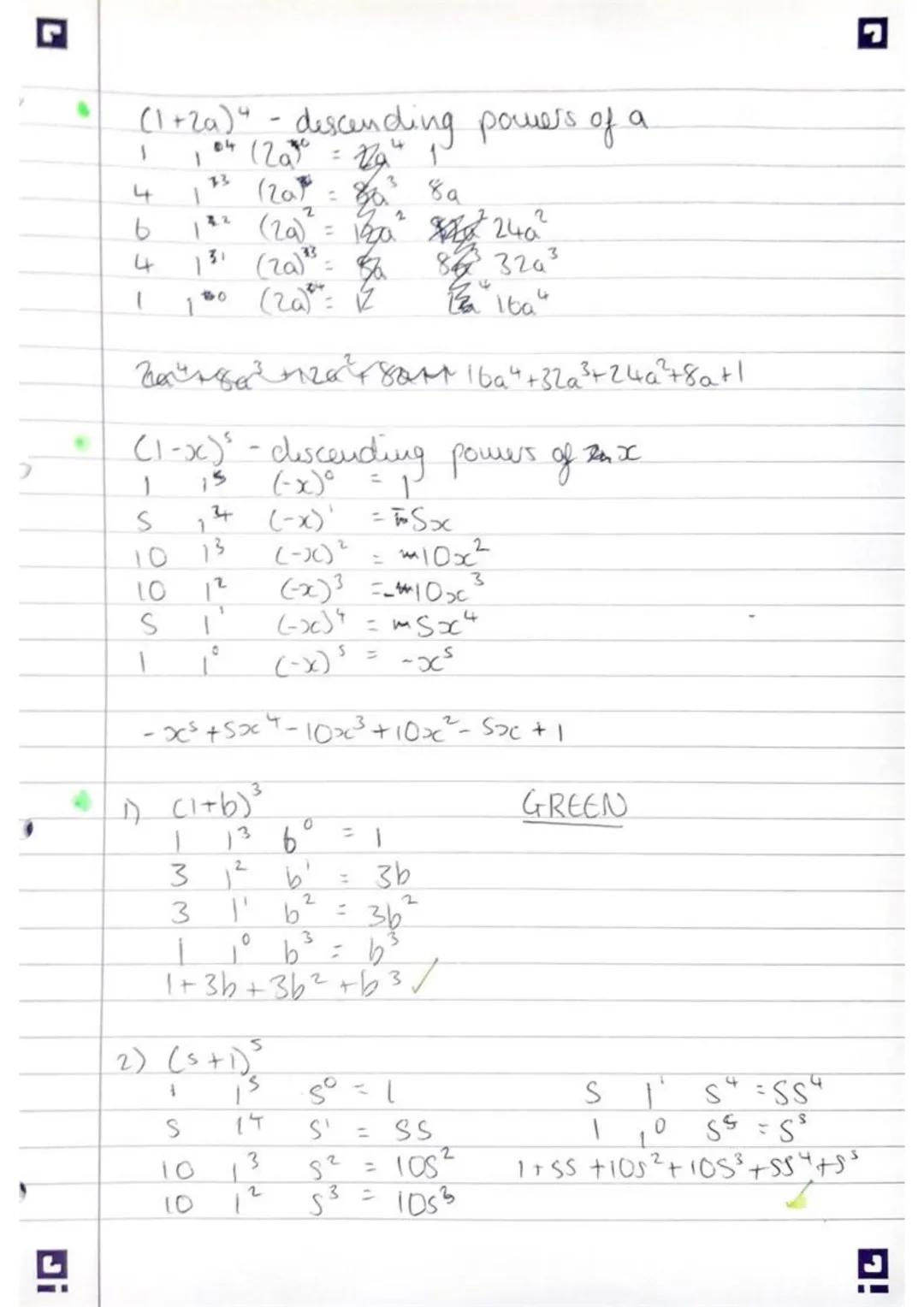
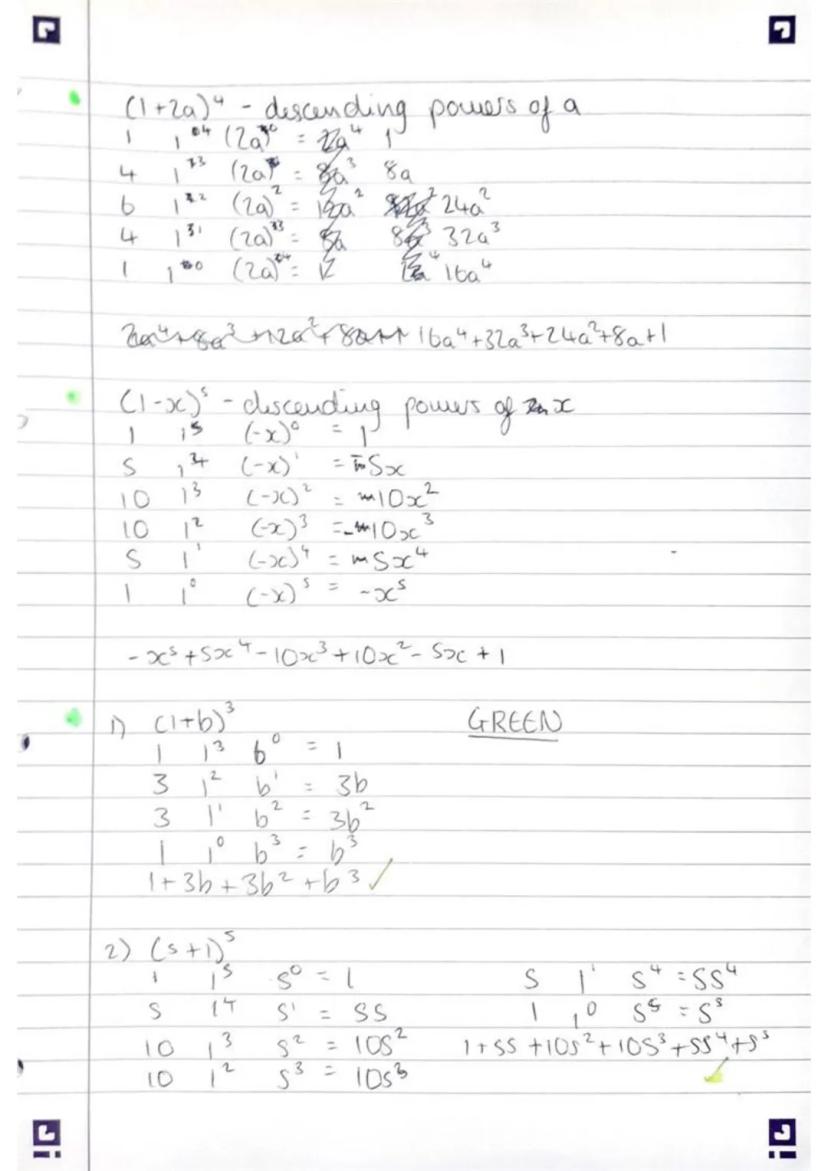
Expanding More Complex Binomials
Now let's tackle trickier expressions like ⁴ or ⁵. The process stays the same, but you need to be careful with your arithmetic and signs.
For ⁴, use Pascal's triangle coefficients 1, 4, 6, 4, 1, but remember that 2a gets raised to different powers. So (2a)² becomes 4a², (2a)³ becomes 8a³, and so on.
With expressions involving negative terms like ⁵, watch your signs carefully! The pattern alternates: positive, negative, positive, negative. Each odd power of the negative term flips the sign.
The key is staying organised - write out each term step by step, calculate the coefficient from Pascal's triangle, then work out the powers of each part separately.
Watch Out: Negative signs can be tricky - double-check that your alternating pattern is correct, especially with higher powers.
3
of 6
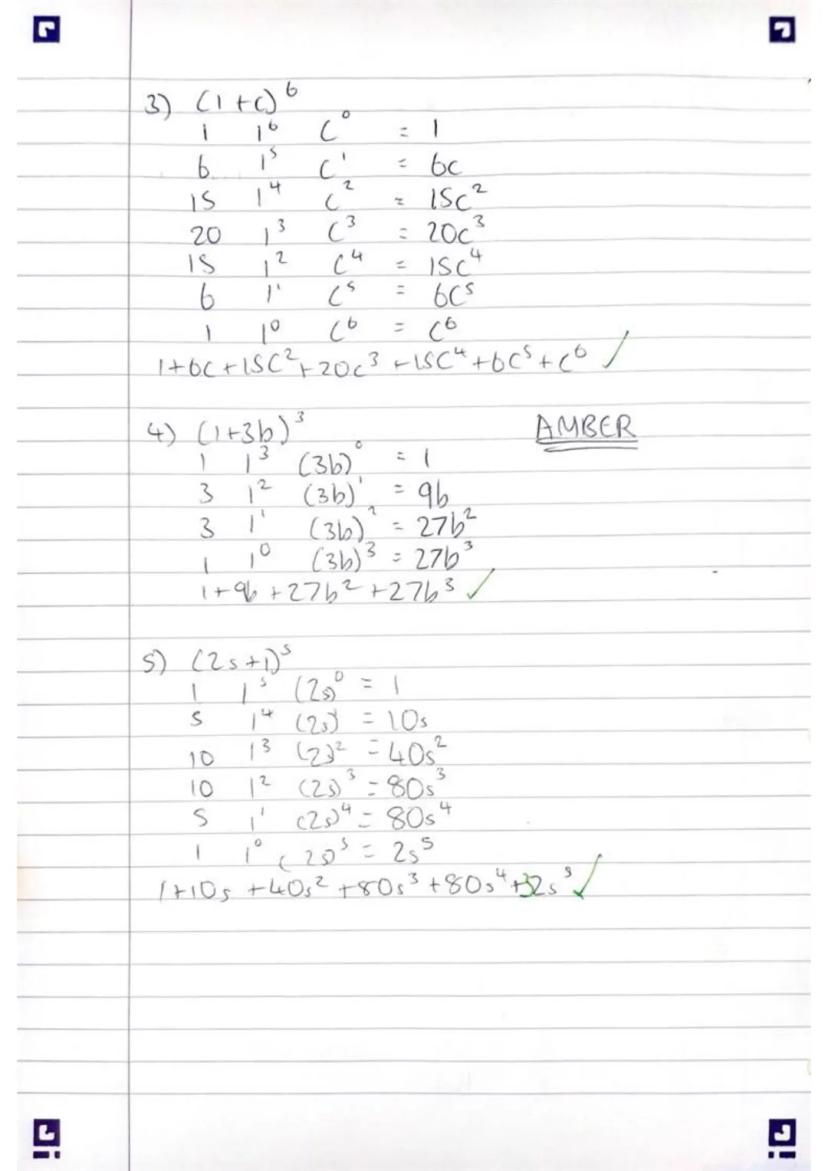
Working with Coefficients and Multiple Variables
You're getting the hang of this! Let's expand expressions like ³ or ⁵. The trick is treating each part of the binomial carefully.
For ³, your Pascal's triangle gives 1, 3, 3, 1. But when you calculate (3b)², you get 9b², and (3b)³ gives 27b³. Don't forget to multiply the coefficient by the number raised to that power!
With ⁵, you're working with coefficients 1, 5, 10, 10, 5, 1 from Pascal's triangle. Then (2s)² becomes 4s², (2s)³ becomes 8s³, and so on.
The pattern stays consistent - use Pascal's triangle for the main coefficients, then carefully calculate what happens when you raise each term to its respective power.
Pro Tip: Always double-check your arithmetic when dealing with coefficients - it's easy to make calculation errors that throw off your entire answer.
4
of 6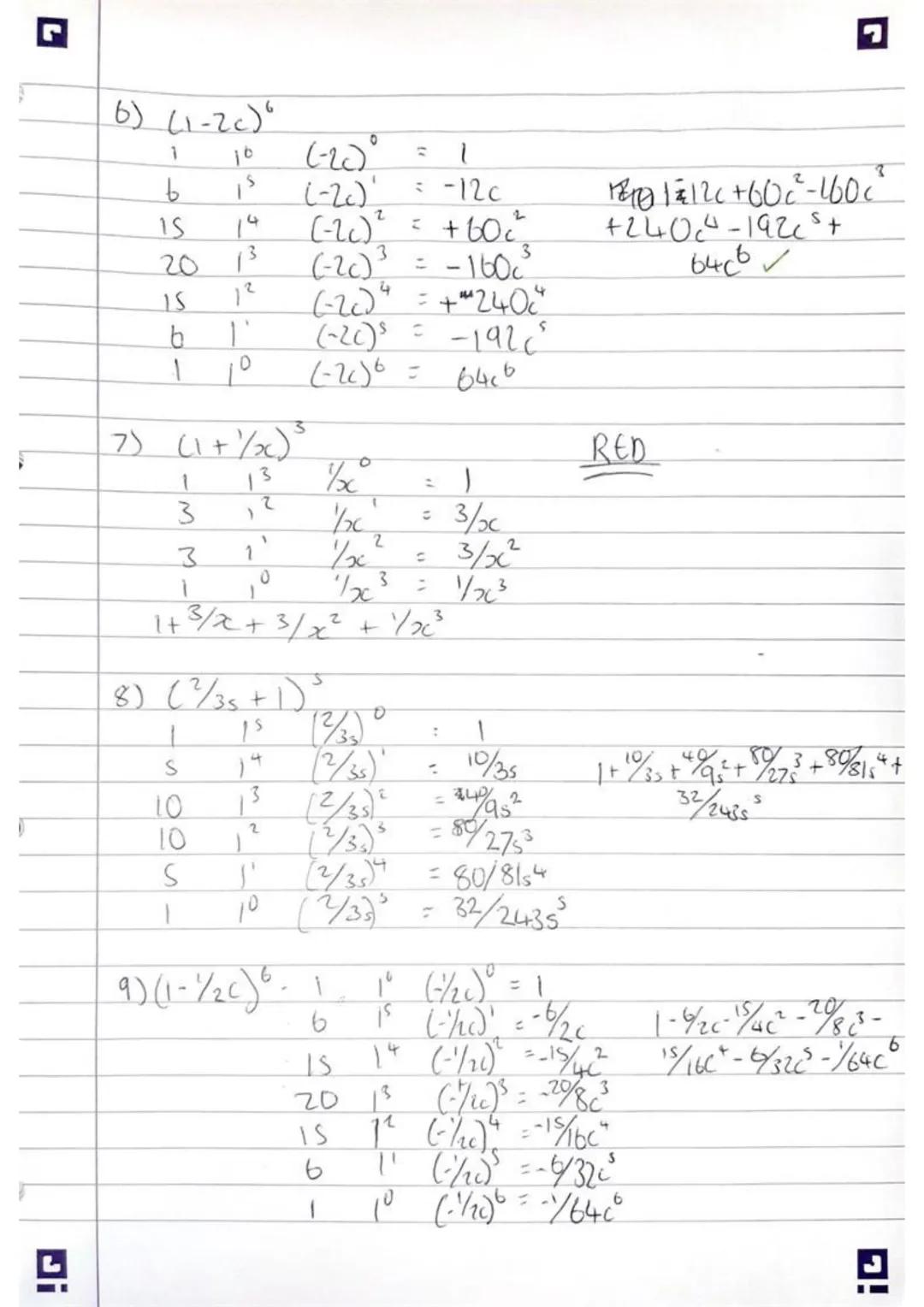
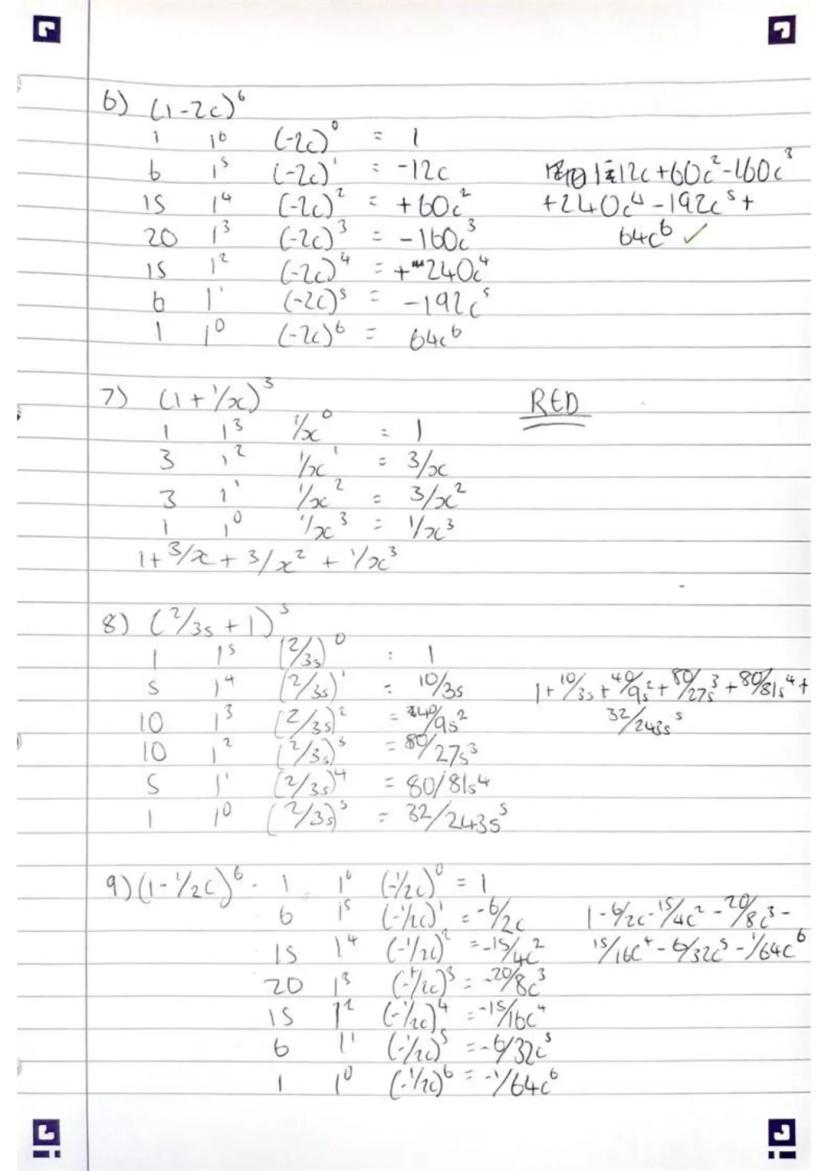
Advanced Binomial Expansions
Ready for the challenge? Let's tackle expressions with fractions and negative terms like ⁶ or ³.
For ⁶, you'll use Pascal's triangle row 6: 1, 6, 15, 20, 15, 6, 1. Remember that ² gives +4c² (positive because you're squaring a negative), but ³ gives -8c³ (negative because it's an odd power).
Fractional expressions like ³ follow the same rules. Your terms become 1 + 3 + 3² + ³, which simplifies to 1 + 3/x + 3/x² + 1/x³.
The key is patience and systematic working. Write each term out fully before simplifying, and always check your signs and fractions twice.
Challenge Accepted: These harder expansions are exactly what examiners love to test - master them and you'll stand out from the crowd!
5
of 6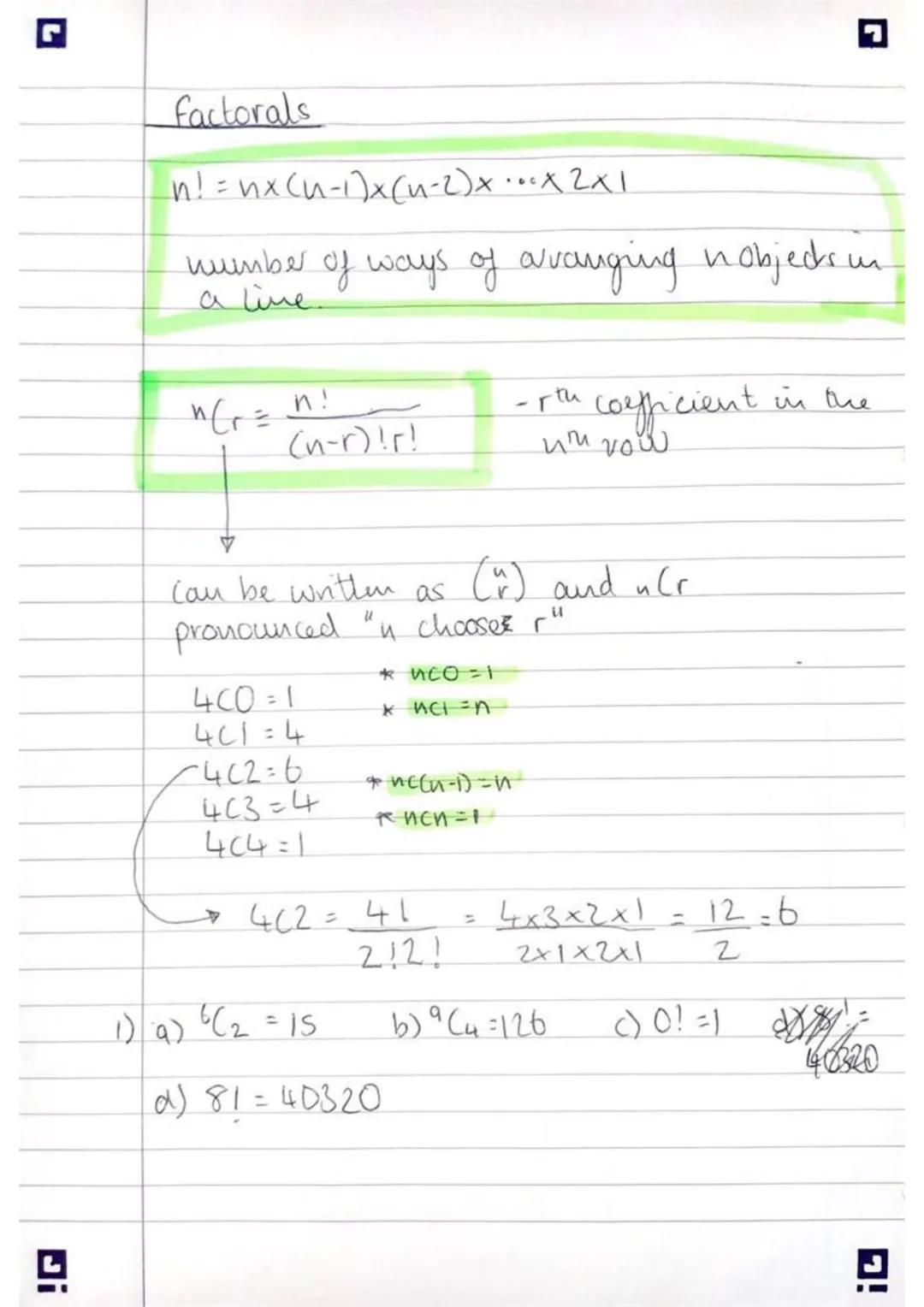
Factorials and Combination Notation
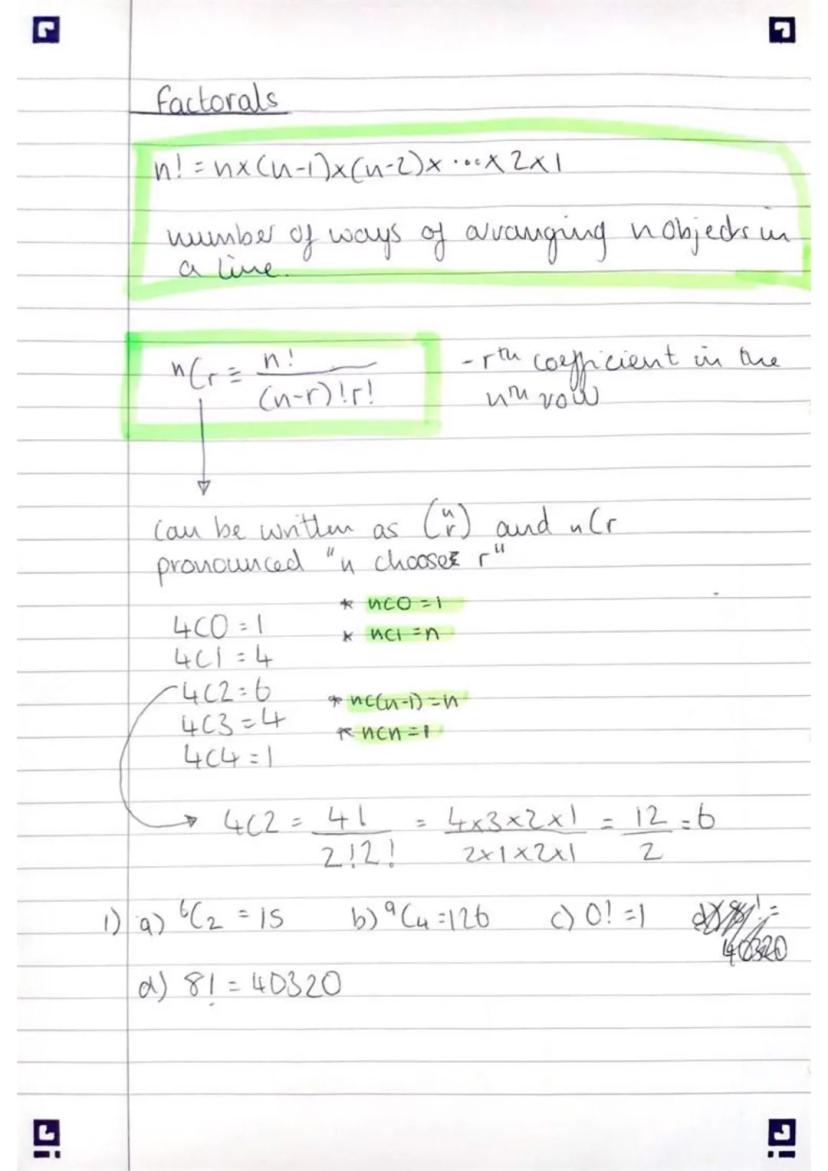
Here's where the maths gets really clever! Factorials (written as n!) count the number of ways to arrange n objects. So 4! = 4 × 3 × 2 × 1 = 24.
The combination notation ⁿCᵣ or (n choose r) gives you those Pascal's triangle coefficients directly. The formula is ⁿCᵣ = n!/!r!. This tells you how many ways you can choose r items from n items.
For example, ⁴C₂ = 4!/(2!×2!) = 24/(2×2) = 6. This matches the Pascal's triangle coefficient in row 4, position 2!
Understanding this connection makes the binomial theorem much more powerful - you can find any coefficient without drawing out Pascal's triangle.
Mind Blown: Those Pascal's triangle numbers are actually counting combinations - maths is beautifully connected!
6
of 6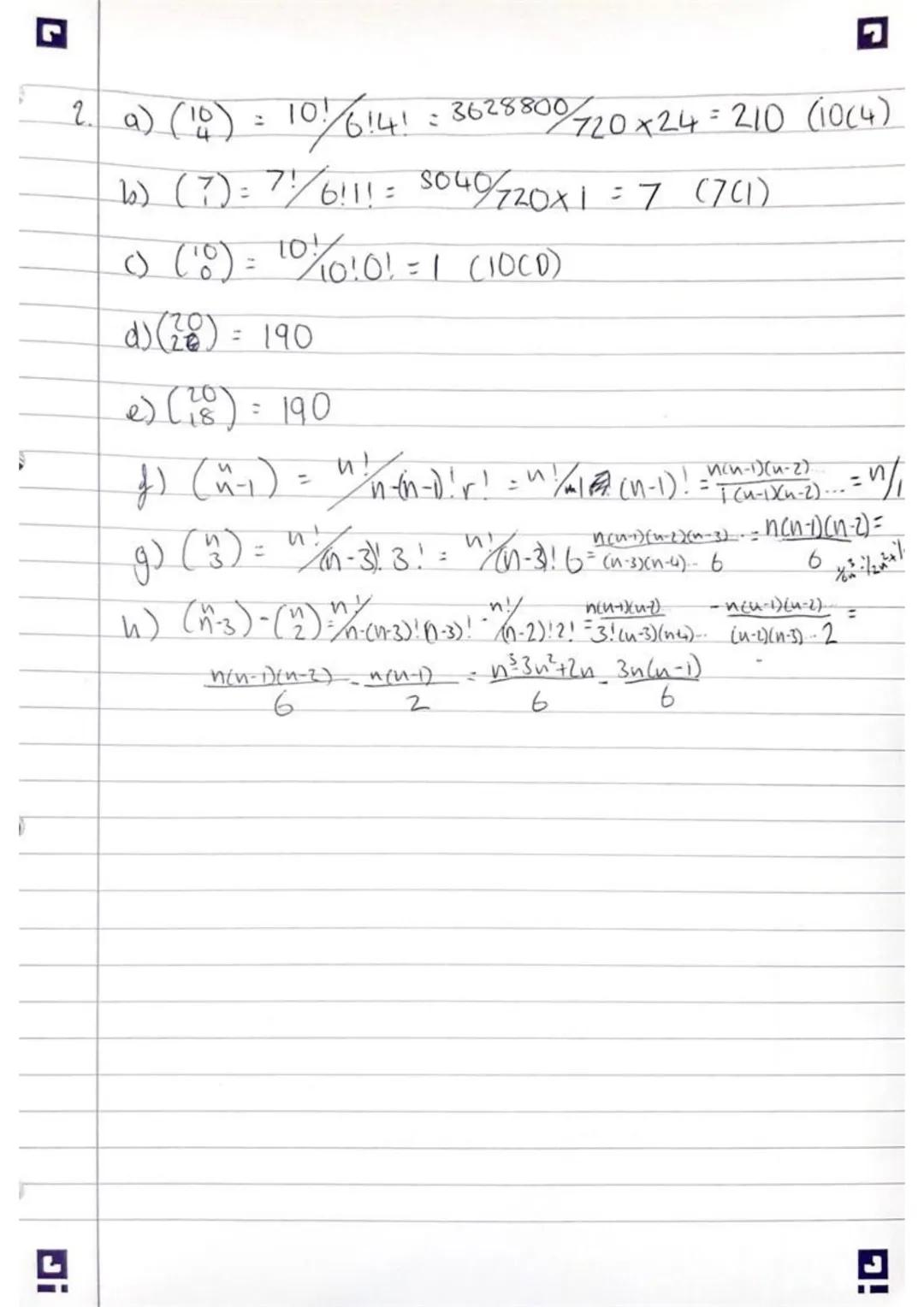
Calculating Combinations and Advanced Applications
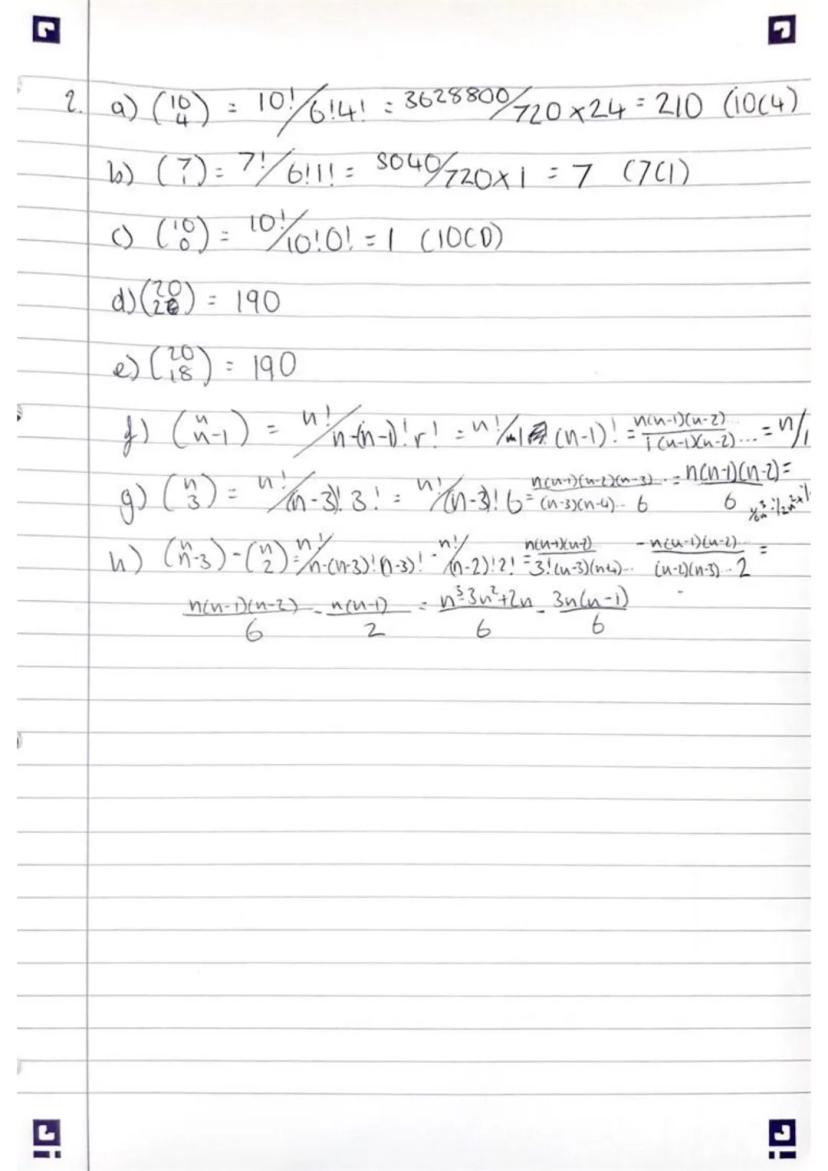
Now you can calculate combination coefficients for any binomial expansion, even with massive numbers! Use the formula ⁿCᵣ = n!/!r! systematically.
For ¹⁰C₄, you get 10!/(6!×4!) = 210. Notice that ⁿCᵣ = ⁿCₙ₋ᵣ - this symmetry can save you calculation time. So ¹⁰C₄ = ¹⁰C₆.
Some useful patterns to remember: ⁿC₀ = 1, ⁿC₁ = n, and ⁿCₙ₋₁ = n. These pop up regularly in exam questions.
For expressions like ⁿC₃, you can write this as n/6 without calculating full factorials. This makes algebraic problems much more manageable.
Exam Success: Learning these patterns and shortcuts will save you precious time in exams and help you tackle the trickiest questions with confidence.
We thought you’d never ask...
What is the Knowunity AI companion?
Our AI Companion is a student-focused AI tool that offers more than just answers. Built on millions of Knowunity resources, it provides relevant information, personalised study plans, quizzes, and content directly in the chat, adapting to your individual learning journey.
Where can I download the Knowunity app?
You can download the app from Google Play Store and Apple App Store.
Is Knowunity really free of charge?
That's right! Enjoy free access to study content, connect with fellow students, and get instant help – all at your fingertips.
Similar content
Most popular content: Binomial Theorem
1Most popular content in Maths
9Most popular content
9Can't find what you're looking for? Explore other subjects.
Students love us — and so will you.
4.6/5App Store
4.7/5Google Play
The app is very easy to use and well designed. I have found everything I was looking for so far and have been able to learn a lot from the presentations! I will definitely use the app for a class assignment! And of course it also helps a lot as an inspiration.
Stefan SiOS user
This app is really great. There are so many study notes and help [...]. My problem subject is French, for example, and the app has so many options for help. Thanks to this app, I have improved my French. I would recommend it to anyone.
Samantha KlichAndroid user
Wow, I am really amazed. I just tried the app because I've seen it advertised many times and was absolutely stunned. This app is THE HELP you want for school and above all, it offers so many things, such as workouts and fact sheets, which have been VERY helpful to me personally.
AnnaiOS user
Maths145 views·Updated Jun 4, 2026·6 pagesUnderstanding the Binomial Theorem and Factorials for AQA A Level Maths
J
Julia Morgan@juliamorgan_qhvr
Ever wondered how to expand expressions like (1+x)⁵ without multiplying everything out the long way? The Binomial Theorem is your mathematical shortcut that uses Pascal's triangle and factorials to expand any binomial expression quickly and accurately.
1
of 6Sign up to see the content. It's free!
- Access to all documents
- Improve your grades
- Join milions of students
Pascal's Triangle and Basic Binomial Expansion
Think of Pascal's triangle as your expansion cheat sheet - each row gives you the coefficients you need! The triangle starts with 1 at the top, and every number below is the sum of the two numbers above it.
When you expand ⁿ, the coefficients come straight from Pascal's triangle. For example, ³ uses row 3: the coefficients 1, 3, 3, 1 give you 1 + 3x + 3x² + x³.
The binomial theorem formula is: ⁿ = aⁿ + (ⁿ₁)aⁿ⁻¹b + (ⁿ₂)aⁿ⁻²b² + ... + bⁿ. Don't let the notation scare you - those brackets are just Pascal's triangle numbers in disguise!
Quick Tip: The powers of the first term decrease whilst the powers of the second term increase, but they always add up to n.
2
of 6Sign up to see the content. It's free!
- Access to all documents
- Improve your grades
- Join milions of students
Expanding More Complex Binomials
Now let's tackle trickier expressions like ⁴ or ⁵. The process stays the same, but you need to be careful with your arithmetic and signs.
For ⁴, use Pascal's triangle coefficients 1, 4, 6, 4, 1, but remember that 2a gets raised to different powers. So (2a)² becomes 4a², (2a)³ becomes 8a³, and so on.
With expressions involving negative terms like ⁵, watch your signs carefully! The pattern alternates: positive, negative, positive, negative. Each odd power of the negative term flips the sign.
The key is staying organised - write out each term step by step, calculate the coefficient from Pascal's triangle, then work out the powers of each part separately.
Watch Out: Negative signs can be tricky - double-check that your alternating pattern is correct, especially with higher powers.
3
of 6Sign up to see the content. It's free!
- Access to all documents
- Improve your grades
- Join milions of students
Working with Coefficients and Multiple Variables
You're getting the hang of this! Let's expand expressions like ³ or ⁵. The trick is treating each part of the binomial carefully.
For ³, your Pascal's triangle gives 1, 3, 3, 1. But when you calculate (3b)², you get 9b², and (3b)³ gives 27b³. Don't forget to multiply the coefficient by the number raised to that power!
With ⁵, you're working with coefficients 1, 5, 10, 10, 5, 1 from Pascal's triangle. Then (2s)² becomes 4s², (2s)³ becomes 8s³, and so on.
The pattern stays consistent - use Pascal's triangle for the main coefficients, then carefully calculate what happens when you raise each term to its respective power.
Pro Tip: Always double-check your arithmetic when dealing with coefficients - it's easy to make calculation errors that throw off your entire answer.
4
of 6Sign up to see the content. It's free!
- Access to all documents
- Improve your grades
- Join milions of students
Advanced Binomial Expansions
Ready for the challenge? Let's tackle expressions with fractions and negative terms like ⁶ or ³.
For ⁶, you'll use Pascal's triangle row 6: 1, 6, 15, 20, 15, 6, 1. Remember that ² gives +4c² (positive because you're squaring a negative), but ³ gives -8c³ (negative because it's an odd power).
Fractional expressions like ³ follow the same rules. Your terms become 1 + 3 + 3² + ³, which simplifies to 1 + 3/x + 3/x² + 1/x³.
The key is patience and systematic working. Write each term out fully before simplifying, and always check your signs and fractions twice.
Challenge Accepted: These harder expansions are exactly what examiners love to test - master them and you'll stand out from the crowd!
5
of 6Sign up to see the content. It's free!
- Access to all documents
- Improve your grades
- Join milions of students
Factorials and Combination Notation
Here's where the maths gets really clever! Factorials (written as n!) count the number of ways to arrange n objects. So 4! = 4 × 3 × 2 × 1 = 24.
The combination notation ⁿCᵣ or (n choose r) gives you those Pascal's triangle coefficients directly. The formula is ⁿCᵣ = n!/!r!. This tells you how many ways you can choose r items from n items.
For example, ⁴C₂ = 4!/(2!×2!) = 24/(2×2) = 6. This matches the Pascal's triangle coefficient in row 4, position 2!
Understanding this connection makes the binomial theorem much more powerful - you can find any coefficient without drawing out Pascal's triangle.
Mind Blown: Those Pascal's triangle numbers are actually counting combinations - maths is beautifully connected!
6
of 6Sign up to see the content. It's free!
- Access to all documents
- Improve your grades
- Join milions of students
Calculating Combinations and Advanced Applications
Now you can calculate combination coefficients for any binomial expansion, even with massive numbers! Use the formula ⁿCᵣ = n!/!r! systematically.
For ¹⁰C₄, you get 10!/(6!×4!) = 210. Notice that ⁿCᵣ = ⁿCₙ₋ᵣ - this symmetry can save you calculation time. So ¹⁰C₄ = ¹⁰C₆.
Some useful patterns to remember: ⁿC₀ = 1, ⁿC₁ = n, and ⁿCₙ₋₁ = n. These pop up regularly in exam questions.
For expressions like ⁿC₃, you can write this as n/6 without calculating full factorials. This makes algebraic problems much more manageable.
Exam Success: Learning these patterns and shortcuts will save you precious time in exams and help you tackle the trickiest questions with confidence.
We thought you’d never ask...
What is the Knowunity AI companion?
Our AI Companion is a student-focused AI tool that offers more than just answers. Built on millions of Knowunity resources, it provides relevant information, personalised study plans, quizzes, and content directly in the chat, adapting to your individual learning journey.
Where can I download the Knowunity app?
You can download the app from Google Play Store and Apple App Store.
Is Knowunity really free of charge?
That's right! Enjoy free access to study content, connect with fellow students, and get instant help – all at your fingertips.
Similar content
Most popular content: Binomial Theorem
1Most popular content in Maths
9Most popular content
9Can't find what you're looking for? Explore other subjects.
Students love us — and so will you.
4.6/5App Store
4.7/5Google Play
The app is very easy to use and well designed. I have found everything I was looking for so far and have been able to learn a lot from the presentations! I will definitely use the app for a class assignment! And of course it also helps a lot as an inspiration.
Stefan SiOS user
This app is really great. There are so many study notes and help [...]. My problem subject is French, for example, and the app has so many options for help. Thanks to this app, I have improved my French. I would recommend it to anyone.
Samantha KlichAndroid user
Wow, I am really amazed. I just tried the app because I've seen it advertised many times and was absolutely stunned. This app is THE HELP you want for school and above all, it offers so many things, such as workouts and fact sheets, which have been VERY helpful to me personally.
AnnaiOS user