Understanding the Discriminant and Quadratic Formula
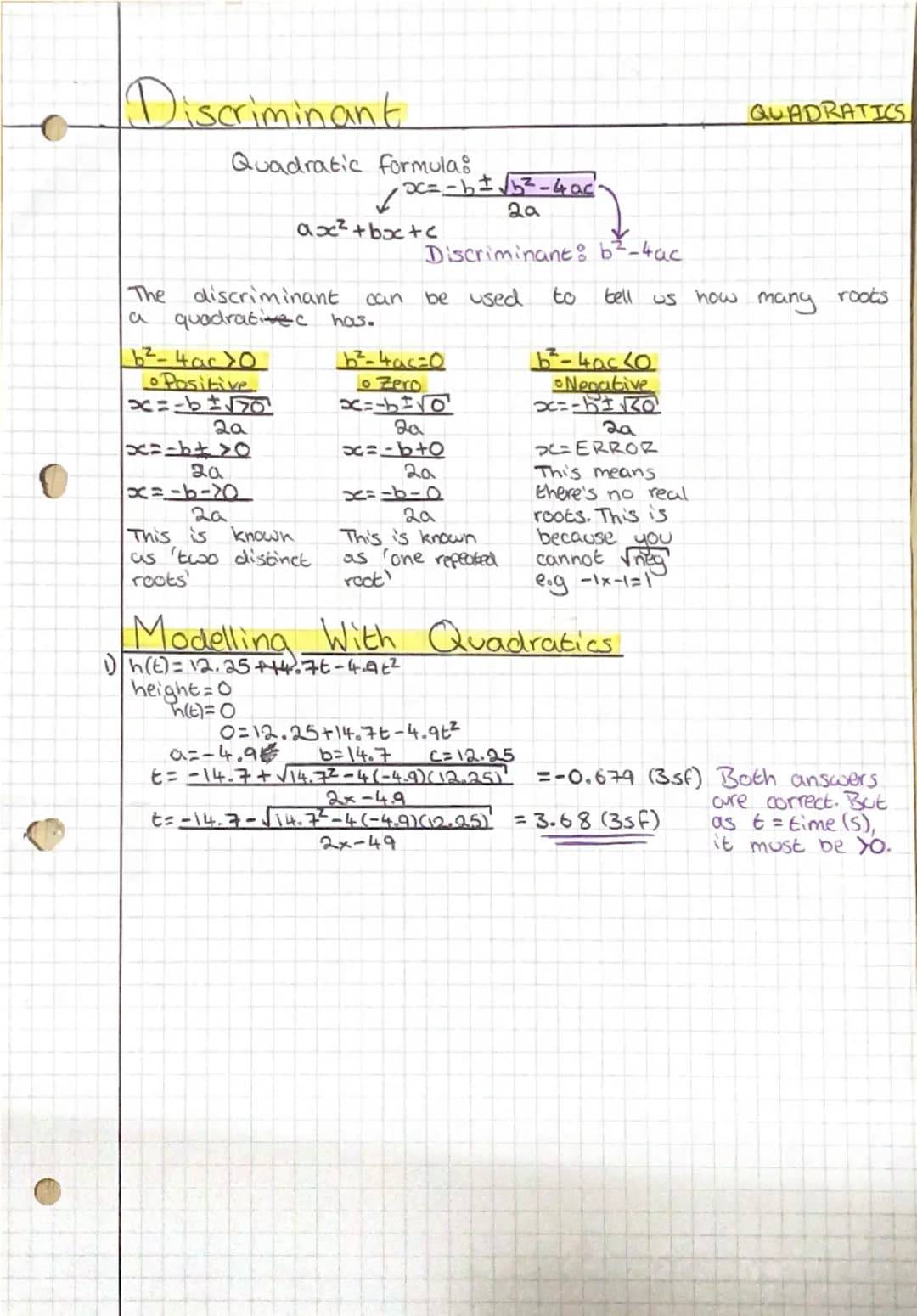
The quadratic formula is your key tool for solving any quadratic equation in the form ax² + bx + c = 0. Simply plug your values into x = −b±√(b2−4ac)/2a to find solutions.
The discriminant b2−4ac is particularly useful as it instantly tells you how many roots your equation has. When the discriminant is positive, you'll get two distinct roots. If it equals zero, you'll have one repeated root. And when it's negative, there are no real roots (because you can't take the square root of a negative number in the real number system).
When modelling real-world scenarios, quadratics become incredibly practical. For instance, in projectile motion problems like h(t) = 12.25 + 14.7t - 4.9t², setting h(t) = 0 helps you find when an object hits the ground. Using the quadratic formula gives you t = -0.679 and t = 3.68 seconds.
Remember this! When solving real-world problems, always check if your mathematical solutions make physical sense. In the example above, time can't be negative, so t = 3.68s is the only valid solution.


 Maths
Maths English Literature
 Biology
 Sociology