
Criminal defences are crucial legal concepts that can completely change... Show more
 Law
Law English Literature
 Sociology
 Biology
Sign up to see the contentIt's free!
Access to all documents
Improve your grades
Join milions of students
Knowunity AI
Subjects
Triangle Congruence and Similarity Theorems
Triangle Properties and Classification
Linear Equations and Graphs
Geometric Angle Relationships
Trigonometric Functions and Identities
Equation Solving Techniques
Circle Geometry Fundamentals
Division Operations and Methods
Basic Differentiation Rules
Exponent and Logarithm Properties
Show all topics
Human Organ Systems
Reproductive Cell Cycles
Biological Sciences Subdisciplines
Cellular Energy Metabolism
Autotrophic Energy Processes
Inheritance Patterns and Principles
Biomolecular Structure and Organization
Cell Cycle and Division Mechanics
Cellular Organization and Development
Biological Structural Organization
Show all topics
Chemical Sciences and Applications
Atomic Structure and Composition
Molecular Electron Structure Representation
Atomic Electron Behavior
Matter Properties and Water
Mole Concept and Calculations
Gas Laws and Behavior
Periodic Table Organization
Chemical Thermodynamics Fundamentals
Chemical Bond Types and Properties
Show all topics
European Renaissance and Enlightenment
European Cultural Movements 800-1920
American Revolution Era 1763-1797
American Civil War 1861-1865
Global Imperial Systems
Mongol and Chinese Dynasties
U.S. Presidents and World Leaders
Historical Sources and Documentation
World Wars Era and Impact
World Religious Systems
Show all topics
Classic and Contemporary Novels
Literary Character Analysis
Rhetorical Theory and Practice
Classic Literary Narratives
Reading Analysis and Interpretation
Narrative Structure and Techniques
English Language Components
Influential English-Language Authors
Basic Sentence Structure
Narrative Voice and Perspective
Show all topics
454
•
Updated Mar 18, 2026
•

molly
@aestrobe
Criminal defences are crucial legal concepts that can completely change... Show more
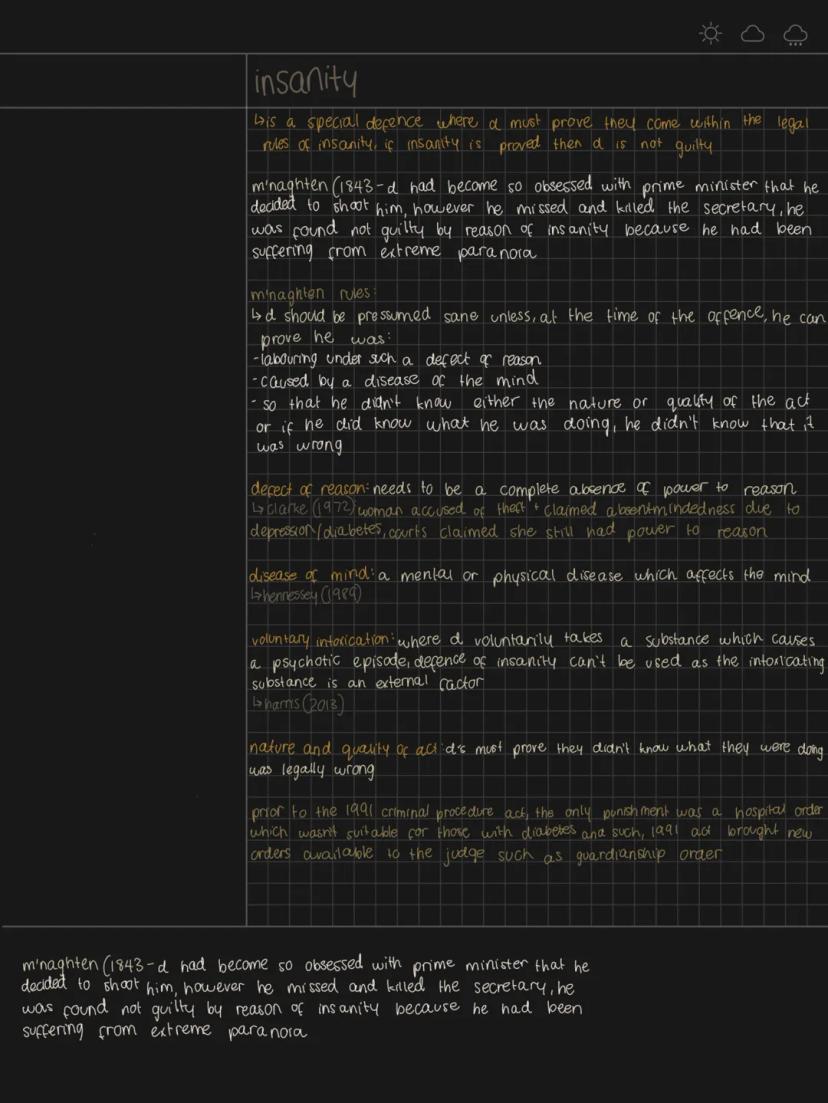
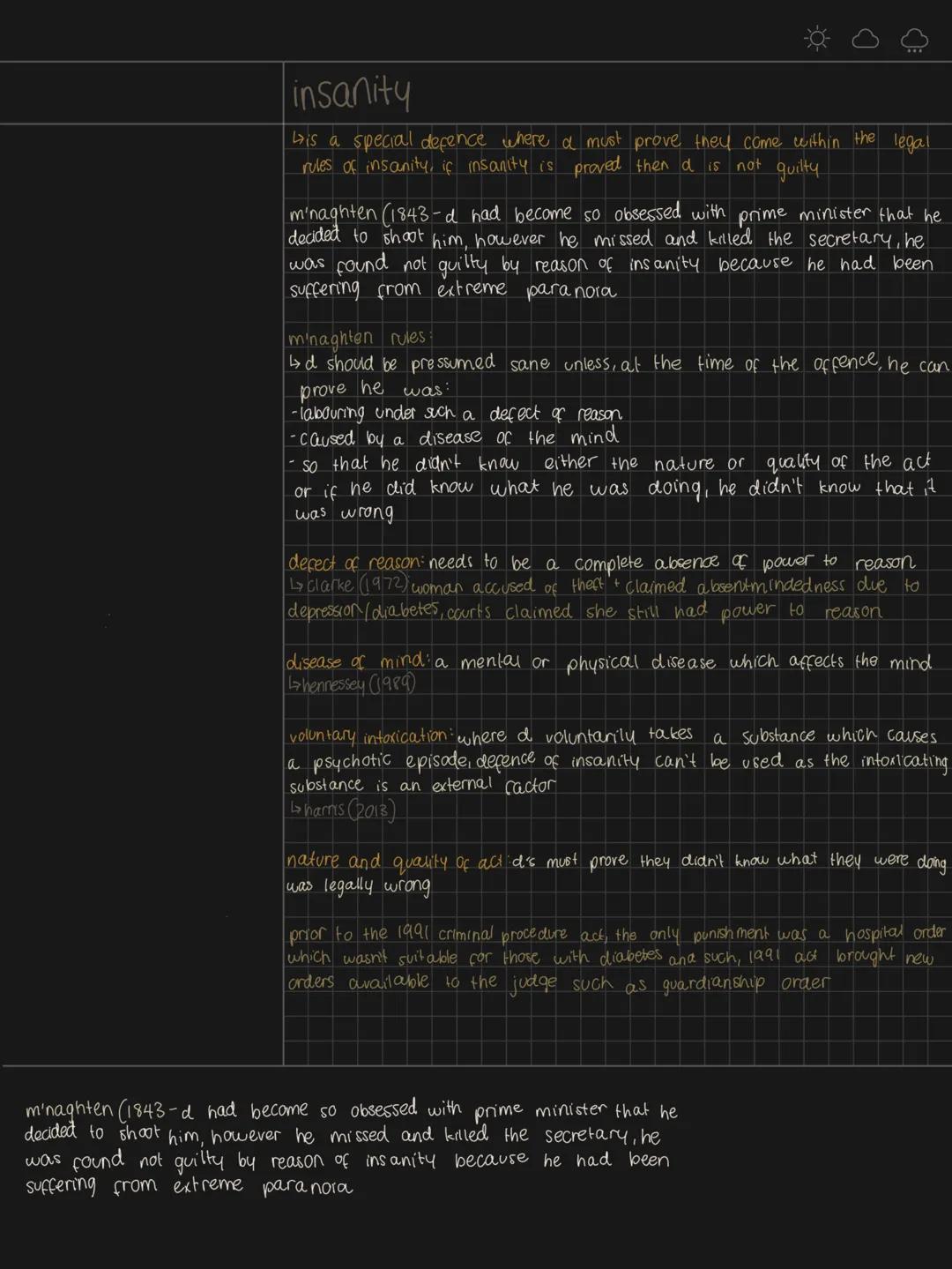
Ever wondered what happens when someone commits a crime but wasn't mentally capable of understanding their actions? The insanity defence allows defendants to prove they weren't legally responsible due to their mental state.
The foundation comes from M'Naghten (1843), where a man tried to shoot the Prime Minister but killed his secretary instead. He was found not guilty by reason of insanity due to extreme paranoia. This established the M'Naghten Rules - you're presumed sane unless you can prove otherwise.
To use this defence, you must show three things: a defect of reason (complete inability to think properly), caused by a disease of the mind (mental or physical condition affecting the brain), and that you didn't understand what you were doing or that it was wrong. Cases like Clarke (1972) show that simply being absent-minded isn't enough - you need total loss of reasoning power.
Quick Tip: Remember that voluntary drug use can't lead to an insanity defence because the intoxicating substance is an external factor, not a disease of the mind.
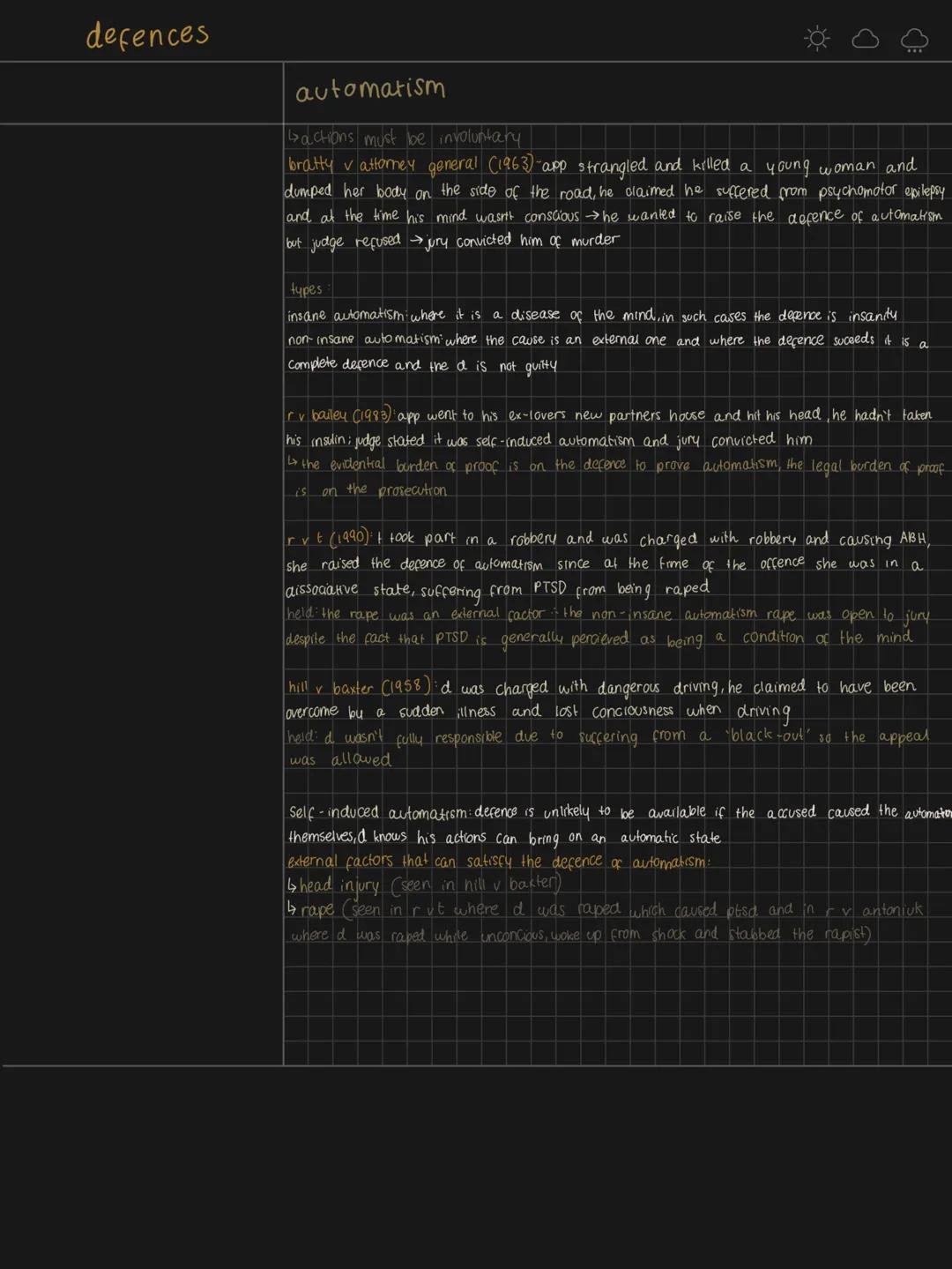
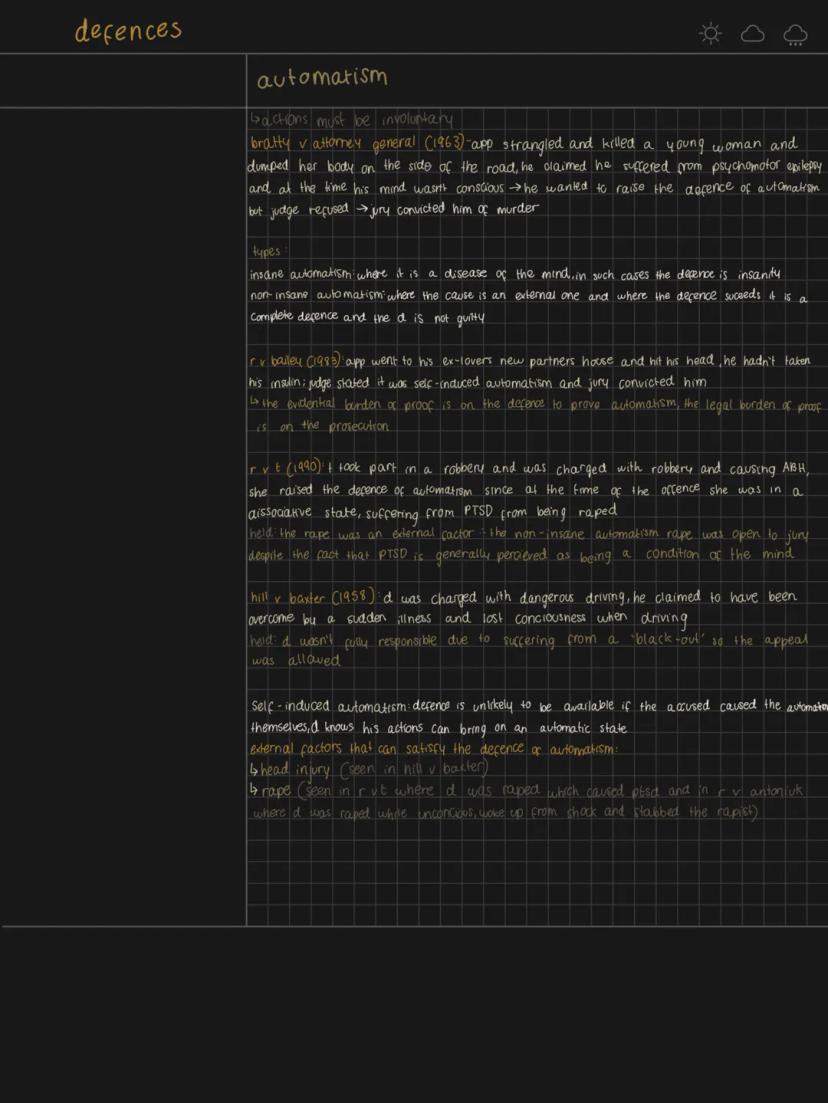
Sometimes people act without conscious control - this is where automatism becomes relevant. Your actions must be completely involuntary to qualify for this defence.
There are two types: insane automatism (caused by a disease of the mind, which actually becomes an insanity defence) and non-insane automatism (caused by external factors like trauma or injury). The key difference matters because non-insane automatism leads to complete acquittal.
R v T (1990) perfectly illustrates this - a woman committed robbery whilst suffering PTSD after being raped. Since rape was an external factor, she could use non-insane automatism. Similarly, Hill v Baxter (1958) shows how sudden illness causing blackouts whilst driving can qualify.
However, self-induced automatism rarely works as a defence. If you know your actions might trigger an automatic state (like not taking prescribed medication), the courts won't be sympathetic.
Remember: External factors like head injuries, trauma, or sudden medical episodes can support automatism, but you can't rely on conditions you've caused yourself.
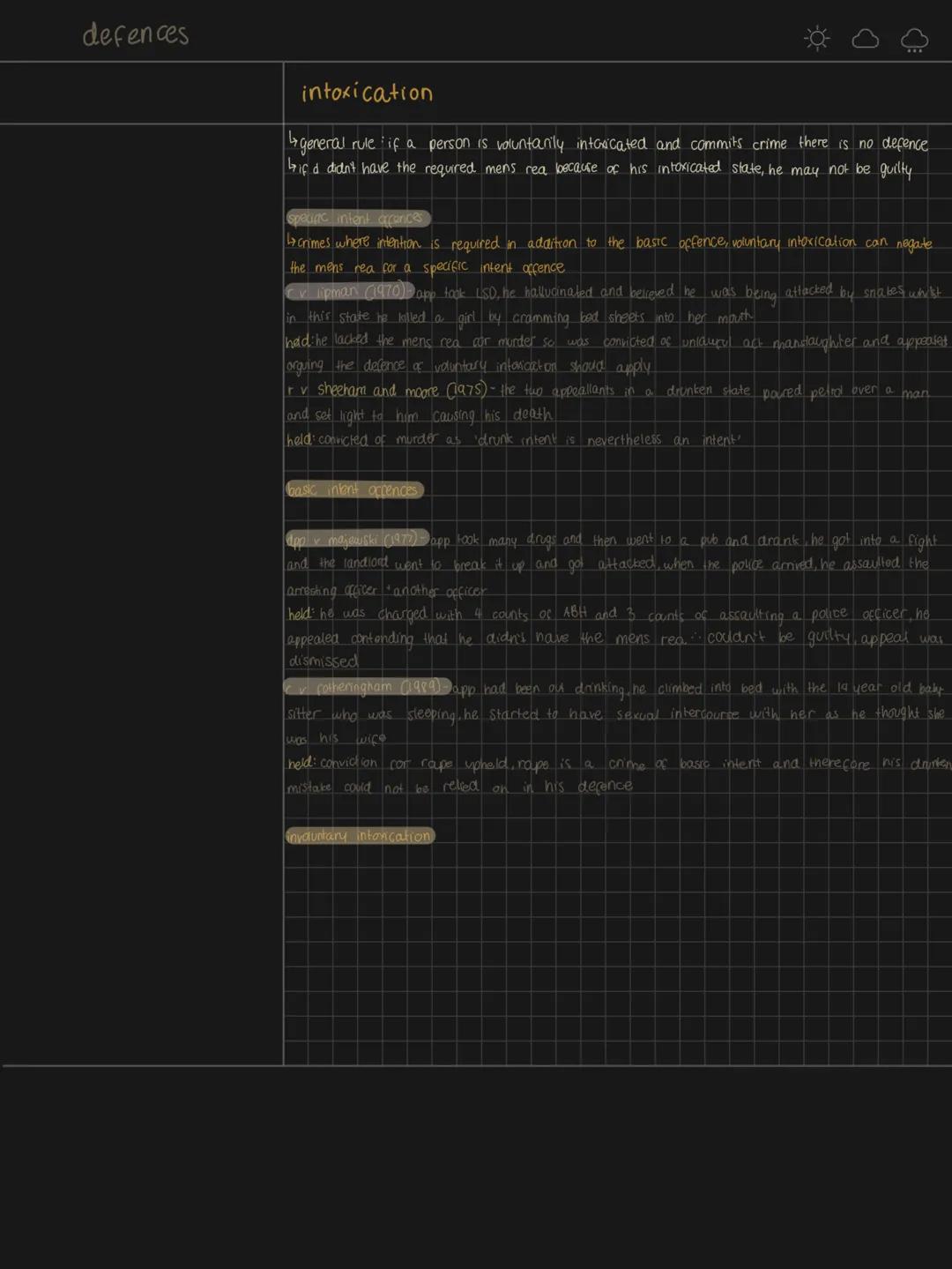
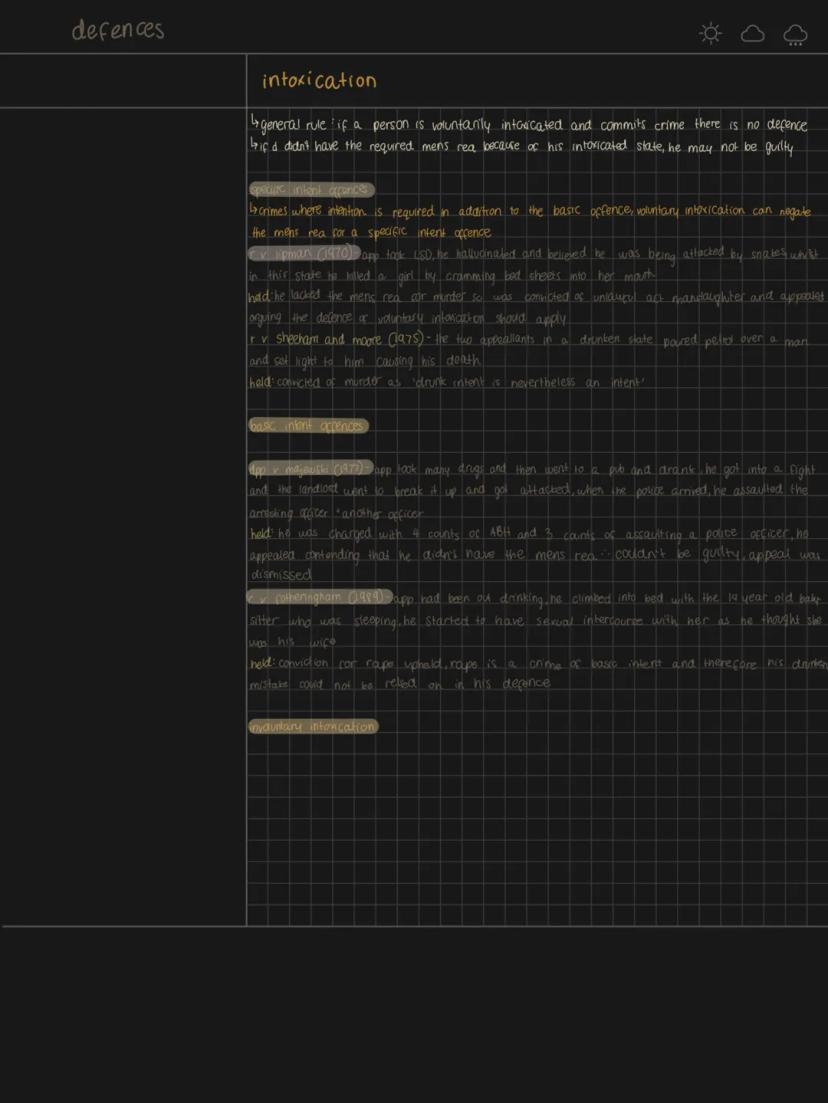
Think getting drunk excuses criminal behaviour? Think again. The intoxication defence has strict limitations and depends entirely on what type of crime you've committed.
For specific intent offences (crimes requiring particular intention), voluntary intoxication might help if it prevented you forming the required mental state. However, you'll likely face conviction for a lesser basic intent offence instead. R v Lipman (1970) demonstrates this - after taking LSD and killing someone during hallucinations, the defendant avoided murder but got convicted of manslaughter.
Basic intent offences offer no escape through voluntary intoxication. DPP v Majewski (1977) established that recklessness is presumed when you voluntarily get intoxicated. Even mistakes due to drunkenness won't help - R v Fotheringham (1989) shows how a man's drunken belief that he was with his wife couldn't excuse rape.
Involuntary intoxication works differently and can provide a complete defence if you genuinely didn't choose to consume the intoxicating substance.
Key Point: "Drunk intent is nevertheless an intent" - being voluntarily intoxicated doesn't excuse your actions for most crimes.
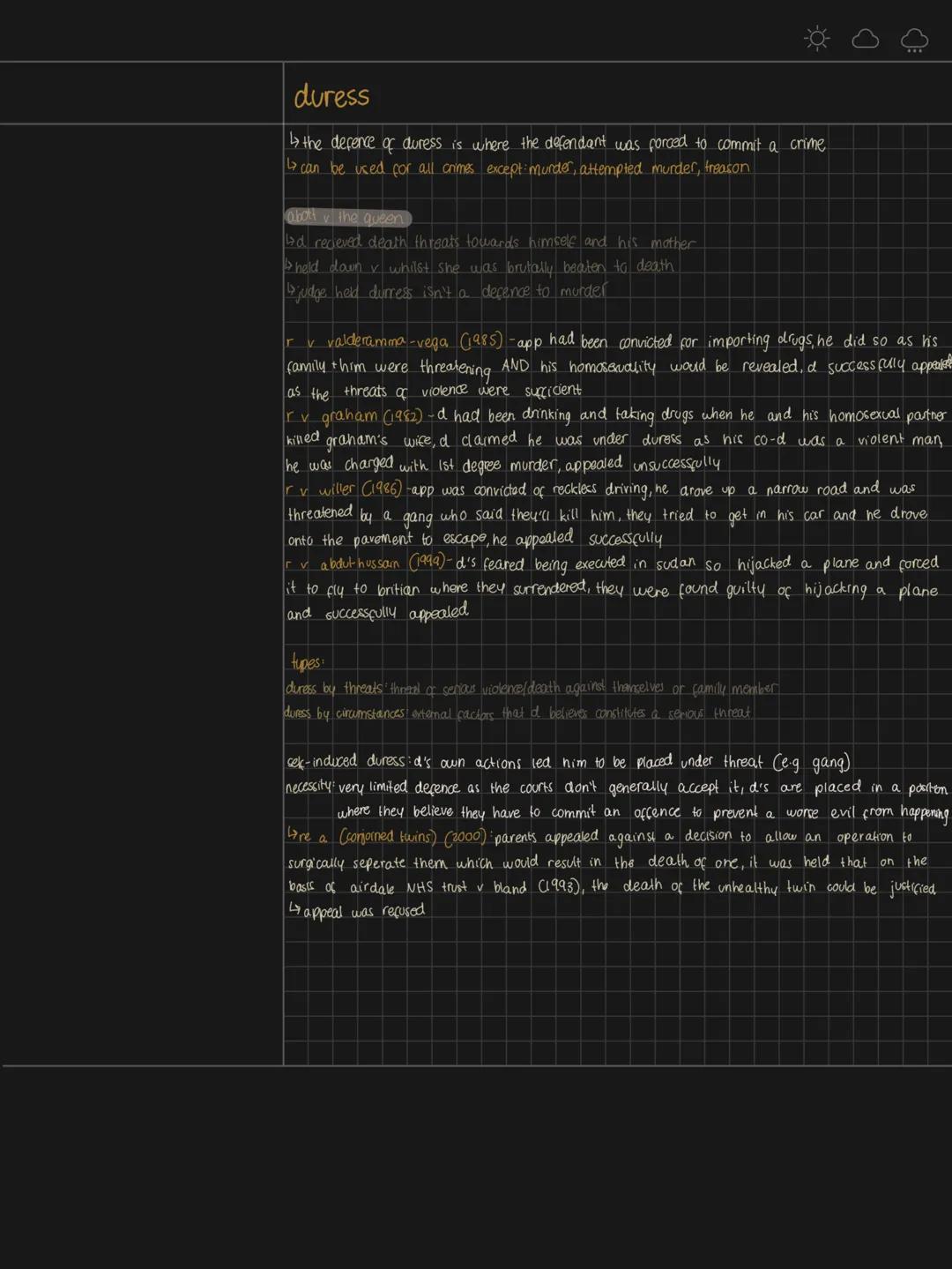
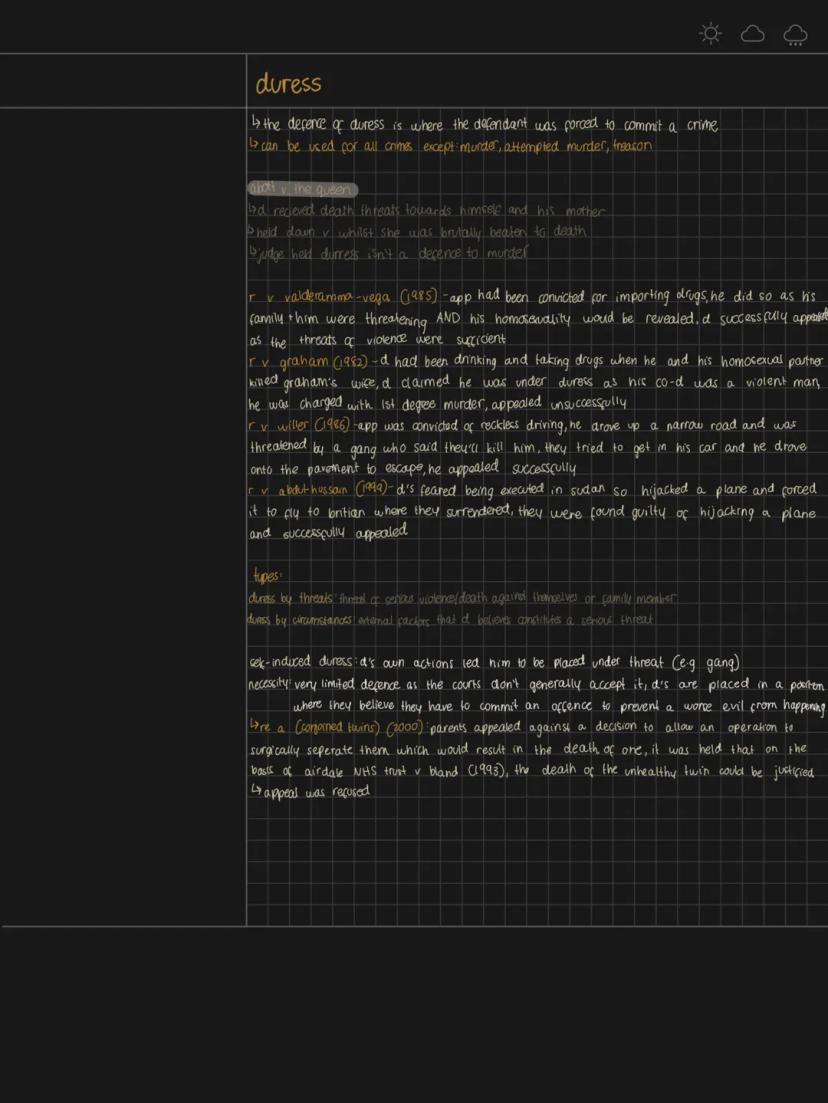
What if someone threatens to kill you unless you commit a crime? Duress recognises that people shouldn't face conviction when forced into criminal acts through threats of serious harm.
This defence works for most crimes but has absolute exceptions: murder, attempted murder, and treason. Abbott v The Queen firmly established that even death threats can't justify taking someone's life.
There are two types: duress by threats (direct threats against you or family) and duress by circumstances (external situations creating serious danger). R v Willer (1986) shows circumstances working - driving on the pavement to escape a violent gang was justified. R v Abdul-Hussain (1999) involved hijacking a plane to escape execution in Sudan.
However, self-induced duress won't help if your own actions (like joining a gang) created the threatening situation. The related defence of necessity remains extremely limited, though Re A (Conjoined Twins) (2000) shows courts occasionally accept it in extraordinary circumstances.
Legal Reality: Duress acknowledges human weakness under extreme pressure, but the law draws firm lines - you can never claim duress for taking someone's life.
Our AI Companion is a student-focused AI tool that offers more than just answers. Built on millions of Knowunity resources, it provides relevant information, personalised study plans, quizzes, and content directly in the chat, adapting to your individual learning journey.
You can download the app from Google Play Store and Apple App Store.
That's right! Enjoy free access to study content, connect with fellow students, and get instant help – all at your fingertips.
App Store
Google Play
The app is very easy to use and well designed. I have found everything I was looking for so far and have been able to learn a lot from the presentations! I will definitely use the app for a class assignment! And of course it also helps a lot as an inspiration.
Stefan S
iOS user
This app is really great. There are so many study notes and help [...]. My problem subject is French, for example, and the app has so many options for help. Thanks to this app, I have improved my French. I would recommend it to anyone.
Samantha Klich
Android user
Wow, I am really amazed. I just tried the app because I've seen it advertised many times and was absolutely stunned. This app is THE HELP you want for school and above all, it offers so many things, such as workouts and fact sheets, which have been VERY helpful to me personally.
Anna
iOS user
Best app on earth! no words because it’s too good
Thomas R
iOS user
Just amazing. Let's me revise 10x better, this app is a quick 10/10. I highly recommend it to anyone. I can watch and search for notes. I can save them in the subject folder. I can revise it any time when I come back. If you haven't tried this app, you're really missing out.
Basil
Android user
This app has made me feel so much more confident in my exam prep, not only through boosting my own self confidence through the features that allow you to connect with others and feel less alone, but also through the way the app itself is centred around making you feel better. It is easy to navigate, fun to use, and helpful to anyone struggling in absolutely any way.
David K
iOS user
The app's just great! All I have to do is enter the topic in the search bar and I get the response real fast. I don't have to watch 10 YouTube videos to understand something, so I'm saving my time. Highly recommended!
Sudenaz Ocak
Android user
In school I was really bad at maths but thanks to the app, I am doing better now. I am so grateful that you made the app.
Greenlight Bonnie
Android user
very reliable app to help and grow your ideas of Maths, English and other related topics in your works. please use this app if your struggling in areas, this app is key for that. wish I'd of done a review before. and it's also free so don't worry about that.
Rohan U
Android user
I know a lot of apps use fake accounts to boost their reviews but this app deserves it all. Originally I was getting 4 in my English exams and this time I got a grade 7. I didn’t even know about this app three days until the exam and it has helped A LOT. Please actually trust me and use it as I’m sure you too will see developments.
Xander S
iOS user
THE QUIZES AND FLASHCARDS ARE SO USEFUL AND I LOVE Knowunity AI. IT ALSO IS LITREALLY LIKE CHATGPT BUT SMARTER!! HELPED ME WITH MY MASCARA PROBLEMS TOO!! AS WELL AS MY REAL SUBJECTS ! DUHHH 😍😁😲🤑💗✨🎀😮
Elisha
iOS user
This apps acc the goat. I find revision so boring but this app makes it so easy to organize it all and then you can ask the freeeee ai to test yourself so good and you can easily upload your own stuff. highly recommend as someone taking mocks now
Paul T
iOS user
The app is very easy to use and well designed. I have found everything I was looking for so far and have been able to learn a lot from the presentations! I will definitely use the app for a class assignment! And of course it also helps a lot as an inspiration.
Stefan S
iOS user
This app is really great. There are so many study notes and help [...]. My problem subject is French, for example, and the app has so many options for help. Thanks to this app, I have improved my French. I would recommend it to anyone.
Samantha Klich
Android user
Wow, I am really amazed. I just tried the app because I've seen it advertised many times and was absolutely stunned. This app is THE HELP you want for school and above all, it offers so many things, such as workouts and fact sheets, which have been VERY helpful to me personally.
Anna
iOS user
Best app on earth! no words because it’s too good
Thomas R
iOS user
Just amazing. Let's me revise 10x better, this app is a quick 10/10. I highly recommend it to anyone. I can watch and search for notes. I can save them in the subject folder. I can revise it any time when I come back. If you haven't tried this app, you're really missing out.
Basil
Android user
This app has made me feel so much more confident in my exam prep, not only through boosting my own self confidence through the features that allow you to connect with others and feel less alone, but also through the way the app itself is centred around making you feel better. It is easy to navigate, fun to use, and helpful to anyone struggling in absolutely any way.
David K
iOS user
The app's just great! All I have to do is enter the topic in the search bar and I get the response real fast. I don't have to watch 10 YouTube videos to understand something, so I'm saving my time. Highly recommended!
Sudenaz Ocak
Android user
In school I was really bad at maths but thanks to the app, I am doing better now. I am so grateful that you made the app.
Greenlight Bonnie
Android user
very reliable app to help and grow your ideas of Maths, English and other related topics in your works. please use this app if your struggling in areas, this app is key for that. wish I'd of done a review before. and it's also free so don't worry about that.
Rohan U
Android user
I know a lot of apps use fake accounts to boost their reviews but this app deserves it all. Originally I was getting 4 in my English exams and this time I got a grade 7. I didn’t even know about this app three days until the exam and it has helped A LOT. Please actually trust me and use it as I’m sure you too will see developments.
Xander S
iOS user
THE QUIZES AND FLASHCARDS ARE SO USEFUL AND I LOVE Knowunity AI. IT ALSO IS LITREALLY LIKE CHATGPT BUT SMARTER!! HELPED ME WITH MY MASCARA PROBLEMS TOO!! AS WELL AS MY REAL SUBJECTS ! DUHHH 😍😁😲🤑💗✨🎀😮
Elisha
iOS user
This apps acc the goat. I find revision so boring but this app makes it so easy to organize it all and then you can ask the freeeee ai to test yourself so good and you can easily upload your own stuff. highly recommend as someone taking mocks now
Paul T
iOS user
molly
@aestrobe
Criminal defences are crucial legal concepts that can completely change the outcome of a case. Understanding insanity, automatism, intoxication, and duress will help you grasp how the law balances personal responsibility with circumstances beyond someone's control.
Access to all documents
Improve your grades
Join milions of students
Ever wondered what happens when someone commits a crime but wasn't mentally capable of understanding their actions? The insanity defence allows defendants to prove they weren't legally responsible due to their mental state.
The foundation comes from M'Naghten (1843), where a man tried to shoot the Prime Minister but killed his secretary instead. He was found not guilty by reason of insanity due to extreme paranoia. This established the M'Naghten Rules - you're presumed sane unless you can prove otherwise.
To use this defence, you must show three things: a defect of reason (complete inability to think properly), caused by a disease of the mind (mental or physical condition affecting the brain), and that you didn't understand what you were doing or that it was wrong. Cases like Clarke (1972) show that simply being absent-minded isn't enough - you need total loss of reasoning power.
Quick Tip: Remember that voluntary drug use can't lead to an insanity defence because the intoxicating substance is an external factor, not a disease of the mind.
Access to all documents
Improve your grades
Join milions of students
Sometimes people act without conscious control - this is where automatism becomes relevant. Your actions must be completely involuntary to qualify for this defence.
There are two types: insane automatism (caused by a disease of the mind, which actually becomes an insanity defence) and non-insane automatism (caused by external factors like trauma or injury). The key difference matters because non-insane automatism leads to complete acquittal.
R v T (1990) perfectly illustrates this - a woman committed robbery whilst suffering PTSD after being raped. Since rape was an external factor, she could use non-insane automatism. Similarly, Hill v Baxter (1958) shows how sudden illness causing blackouts whilst driving can qualify.
However, self-induced automatism rarely works as a defence. If you know your actions might trigger an automatic state (like not taking prescribed medication), the courts won't be sympathetic.
Remember: External factors like head injuries, trauma, or sudden medical episodes can support automatism, but you can't rely on conditions you've caused yourself.
Access to all documents
Improve your grades
Join milions of students
Think getting drunk excuses criminal behaviour? Think again. The intoxication defence has strict limitations and depends entirely on what type of crime you've committed.
For specific intent offences (crimes requiring particular intention), voluntary intoxication might help if it prevented you forming the required mental state. However, you'll likely face conviction for a lesser basic intent offence instead. R v Lipman (1970) demonstrates this - after taking LSD and killing someone during hallucinations, the defendant avoided murder but got convicted of manslaughter.
Basic intent offences offer no escape through voluntary intoxication. DPP v Majewski (1977) established that recklessness is presumed when you voluntarily get intoxicated. Even mistakes due to drunkenness won't help - R v Fotheringham (1989) shows how a man's drunken belief that he was with his wife couldn't excuse rape.
Involuntary intoxication works differently and can provide a complete defence if you genuinely didn't choose to consume the intoxicating substance.
Key Point: "Drunk intent is nevertheless an intent" - being voluntarily intoxicated doesn't excuse your actions for most crimes.
Access to all documents
Improve your grades
Join milions of students
What if someone threatens to kill you unless you commit a crime? Duress recognises that people shouldn't face conviction when forced into criminal acts through threats of serious harm.
This defence works for most crimes but has absolute exceptions: murder, attempted murder, and treason. Abbott v The Queen firmly established that even death threats can't justify taking someone's life.
There are two types: duress by threats (direct threats against you or family) and duress by circumstances (external situations creating serious danger). R v Willer (1986) shows circumstances working - driving on the pavement to escape a violent gang was justified. R v Abdul-Hussain (1999) involved hijacking a plane to escape execution in Sudan.
However, self-induced duress won't help if your own actions (like joining a gang) created the threatening situation. The related defence of necessity remains extremely limited, though Re A (Conjoined Twins) (2000) shows courts occasionally accept it in extraordinary circumstances.
Legal Reality: Duress acknowledges human weakness under extreme pressure, but the law draws firm lines - you can never claim duress for taking someone's life.
Our AI Companion is a student-focused AI tool that offers more than just answers. Built on millions of Knowunity resources, it provides relevant information, personalised study plans, quizzes, and content directly in the chat, adapting to your individual learning journey.
You can download the app from Google Play Store and Apple App Store.
That's right! Enjoy free access to study content, connect with fellow students, and get instant help – all at your fingertips.
17
Smart Tools NEW
Transform this note into: ✓ 50+ Practice Questions ✓ Interactive Flashcards ✓ Full Mock Exam ✓ Essay Outlines
App Store
Google Play
The app is very easy to use and well designed. I have found everything I was looking for so far and have been able to learn a lot from the presentations! I will definitely use the app for a class assignment! And of course it also helps a lot as an inspiration.
Stefan S
iOS user
This app is really great. There are so many study notes and help [...]. My problem subject is French, for example, and the app has so many options for help. Thanks to this app, I have improved my French. I would recommend it to anyone.
Samantha Klich
Android user
Wow, I am really amazed. I just tried the app because I've seen it advertised many times and was absolutely stunned. This app is THE HELP you want for school and above all, it offers so many things, such as workouts and fact sheets, which have been VERY helpful to me personally.
Anna
iOS user
Best app on earth! no words because it’s too good
Thomas R
iOS user
Just amazing. Let's me revise 10x better, this app is a quick 10/10. I highly recommend it to anyone. I can watch and search for notes. I can save them in the subject folder. I can revise it any time when I come back. If you haven't tried this app, you're really missing out.
Basil
Android user
This app has made me feel so much more confident in my exam prep, not only through boosting my own self confidence through the features that allow you to connect with others and feel less alone, but also through the way the app itself is centred around making you feel better. It is easy to navigate, fun to use, and helpful to anyone struggling in absolutely any way.
David K
iOS user
The app's just great! All I have to do is enter the topic in the search bar and I get the response real fast. I don't have to watch 10 YouTube videos to understand something, so I'm saving my time. Highly recommended!
Sudenaz Ocak
Android user
In school I was really bad at maths but thanks to the app, I am doing better now. I am so grateful that you made the app.
Greenlight Bonnie
Android user
very reliable app to help and grow your ideas of Maths, English and other related topics in your works. please use this app if your struggling in areas, this app is key for that. wish I'd of done a review before. and it's also free so don't worry about that.
Rohan U
Android user
I know a lot of apps use fake accounts to boost their reviews but this app deserves it all. Originally I was getting 4 in my English exams and this time I got a grade 7. I didn’t even know about this app three days until the exam and it has helped A LOT. Please actually trust me and use it as I’m sure you too will see developments.
Xander S
iOS user
THE QUIZES AND FLASHCARDS ARE SO USEFUL AND I LOVE Knowunity AI. IT ALSO IS LITREALLY LIKE CHATGPT BUT SMARTER!! HELPED ME WITH MY MASCARA PROBLEMS TOO!! AS WELL AS MY REAL SUBJECTS ! DUHHH 😍😁😲🤑💗✨🎀😮
Elisha
iOS user
This apps acc the goat. I find revision so boring but this app makes it so easy to organize it all and then you can ask the freeeee ai to test yourself so good and you can easily upload your own stuff. highly recommend as someone taking mocks now
Paul T
iOS user
The app is very easy to use and well designed. I have found everything I was looking for so far and have been able to learn a lot from the presentations! I will definitely use the app for a class assignment! And of course it also helps a lot as an inspiration.
Stefan S
iOS user
This app is really great. There are so many study notes and help [...]. My problem subject is French, for example, and the app has so many options for help. Thanks to this app, I have improved my French. I would recommend it to anyone.
Samantha Klich
Android user
Wow, I am really amazed. I just tried the app because I've seen it advertised many times and was absolutely stunned. This app is THE HELP you want for school and above all, it offers so many things, such as workouts and fact sheets, which have been VERY helpful to me personally.
Anna
iOS user
Best app on earth! no words because it’s too good
Thomas R
iOS user
Just amazing. Let's me revise 10x better, this app is a quick 10/10. I highly recommend it to anyone. I can watch and search for notes. I can save them in the subject folder. I can revise it any time when I come back. If you haven't tried this app, you're really missing out.
Basil
Android user
This app has made me feel so much more confident in my exam prep, not only through boosting my own self confidence through the features that allow you to connect with others and feel less alone, but also through the way the app itself is centred around making you feel better. It is easy to navigate, fun to use, and helpful to anyone struggling in absolutely any way.
David K
iOS user
The app's just great! All I have to do is enter the topic in the search bar and I get the response real fast. I don't have to watch 10 YouTube videos to understand something, so I'm saving my time. Highly recommended!
Sudenaz Ocak
Android user
In school I was really bad at maths but thanks to the app, I am doing better now. I am so grateful that you made the app.
Greenlight Bonnie
Android user
very reliable app to help and grow your ideas of Maths, English and other related topics in your works. please use this app if your struggling in areas, this app is key for that. wish I'd of done a review before. and it's also free so don't worry about that.
Rohan U
Android user
I know a lot of apps use fake accounts to boost their reviews but this app deserves it all. Originally I was getting 4 in my English exams and this time I got a grade 7. I didn’t even know about this app three days until the exam and it has helped A LOT. Please actually trust me and use it as I’m sure you too will see developments.
Xander S
iOS user
THE QUIZES AND FLASHCARDS ARE SO USEFUL AND I LOVE Knowunity AI. IT ALSO IS LITREALLY LIKE CHATGPT BUT SMARTER!! HELPED ME WITH MY MASCARA PROBLEMS TOO!! AS WELL AS MY REAL SUBJECTS ! DUHHH 😍😁😲🤑💗✨🎀😮
Elisha
iOS user
This apps acc the goat. I find revision so boring but this app makes it so easy to organize it all and then you can ask the freeeee ai to test yourself so good and you can easily upload your own stuff. highly recommend as someone taking mocks now
Paul T
iOS user