
Ever wondered why so many different groups of people chose... Show more
 History567 views·Updated May 23, 2026·55 pages
GCSE History Edexcel: Complete Migration Topics and Dates

siyana@monkeysiy
1 / 10
1
of 10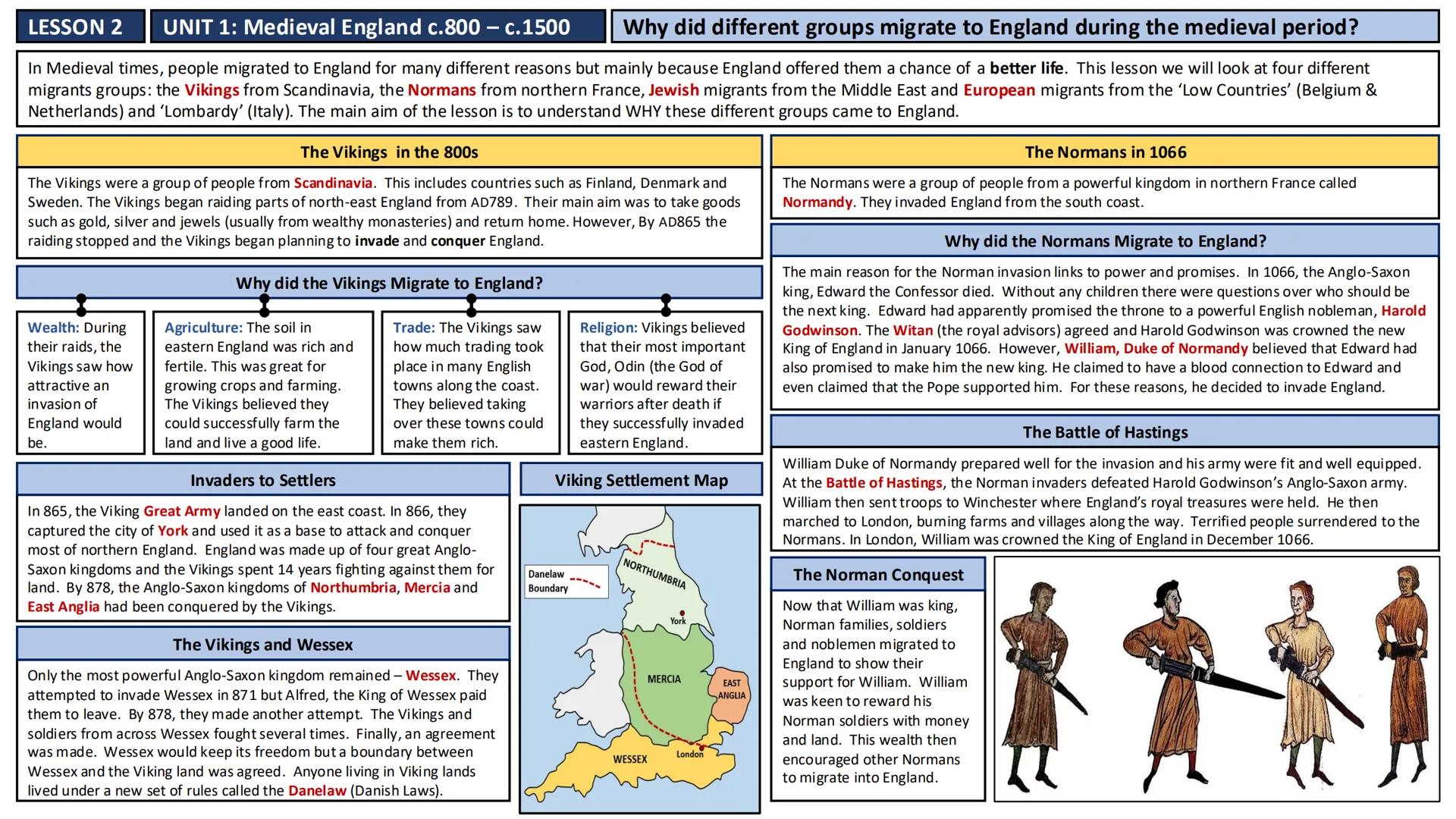
Viking and Norman Migration to Medieval England
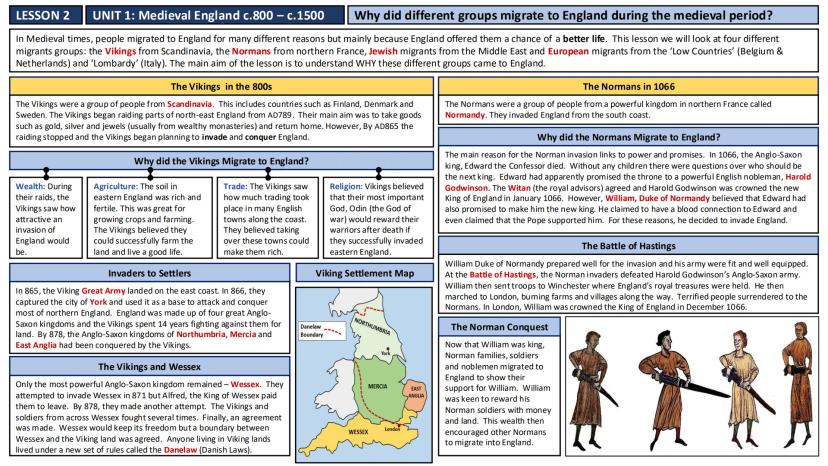
Viking migration started as brutal raids in 789 CE but quickly evolved into something much bigger. These Scandinavian warriors saw England's wealth from monastery raids and realised the country offered incredible opportunities. The fertile soil in eastern England was perfect for farming, whilst bustling coastal towns promised lucrative trade deals.
By 865 CE, the Great Army landed with conquest in mind, not just quick raids. They captured York in 866 and spent 14 years battling Anglo-Saxon kingdoms. Their religious beliefs even supported this - they thought Odin would reward successful invaders in the afterlife.
The Norman invasion of 1066 happened for completely different reasons - it was all about broken promises and disputed crowns. When Edward the Confessor died without children, both Harold Godwinson and William of Normandy claimed the throne. William believed Edward had promised him the crown and even claimed the Pope's support.
Key Point: Both Vikings and Normans succeeded because they were well-organised military forces targeting a wealthy but divided England.
After William's victory at Hastings, Norman families flooded into England seeking rewards from their new king. William cleverly distributed land and wealth to his supporters, encouraging even more Norman migration to secure his conquest.
2
of 10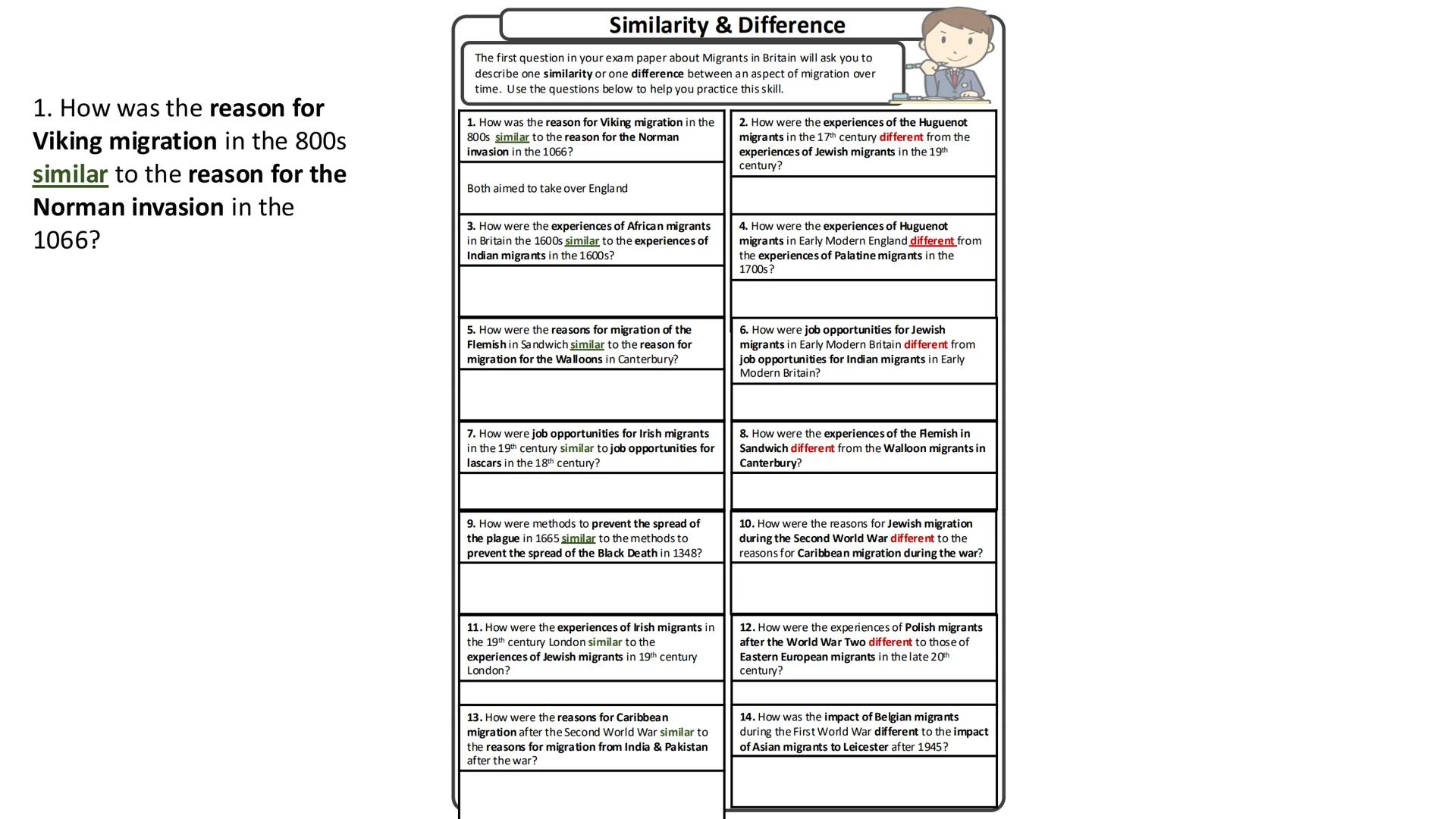
Exam Practice - Similarities and Differences
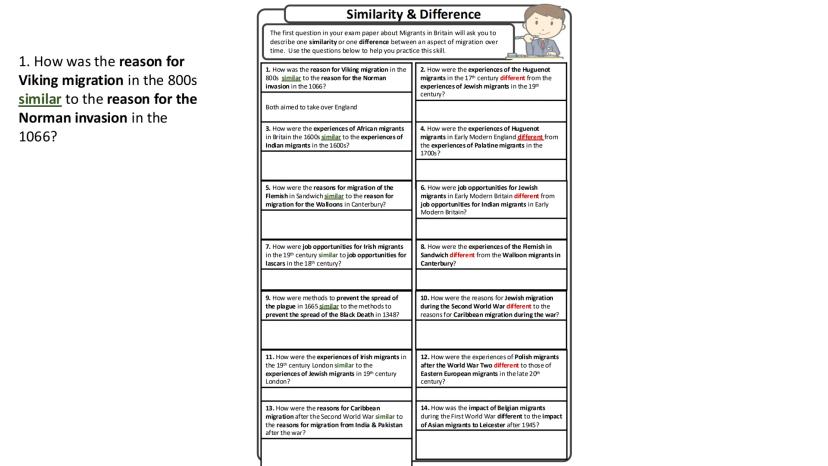
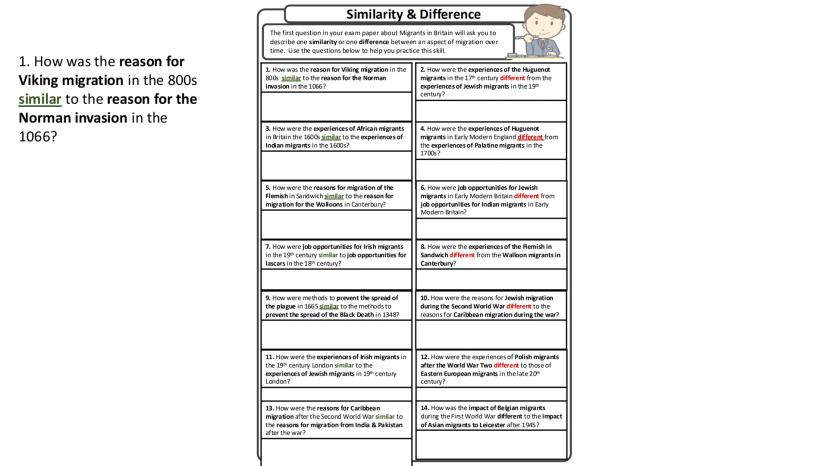
These practice questions will help you nail the comparison skills you need for your migration exam. The first question always asks you to describe one similarity or difference between migration experiences across different time periods.
When answering these questions, focus on finding clear connections or contrasts. For example, both Viking and Norman migrations aimed to take control of England, but their methods and motivations differed significantly.
Don't just list facts - explain the connection clearly. If comparing Jewish experiences in medieval times versus the 19th century, think about how religious persecution, economic opportunities, and government attitudes changed over time.
Exam Tip: Always use specific examples and time periods in your answers. Vague responses won't get you the marks you need.
Practice with questions about Irish migrants, Caribbean migration, and Eastern European movements to build your confidence. Remember, you're looking for patterns in reasons for migration, experiences after arrival, and long-term impacts on British society.
3
of 10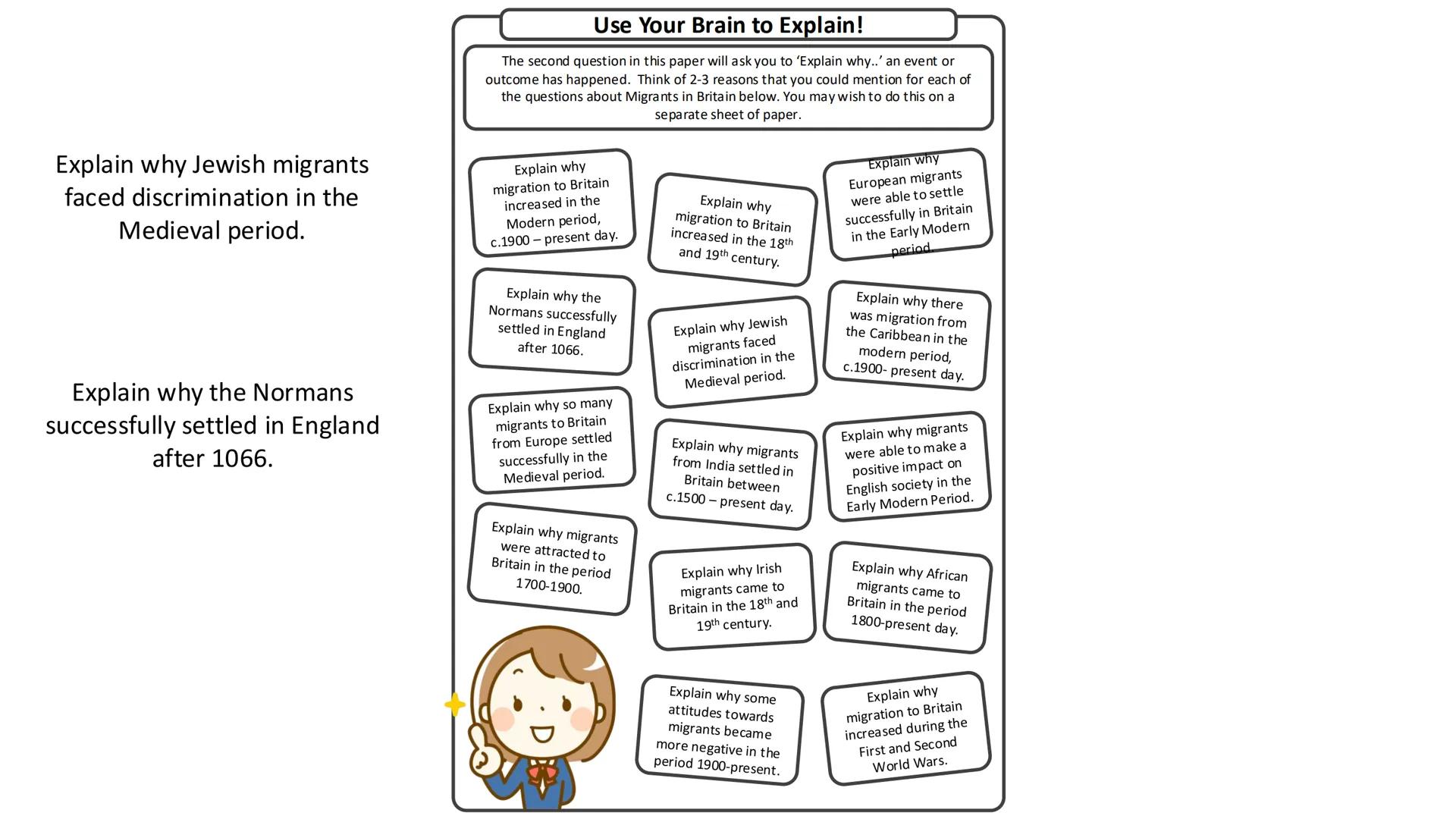
Developing Your Explanation Skills
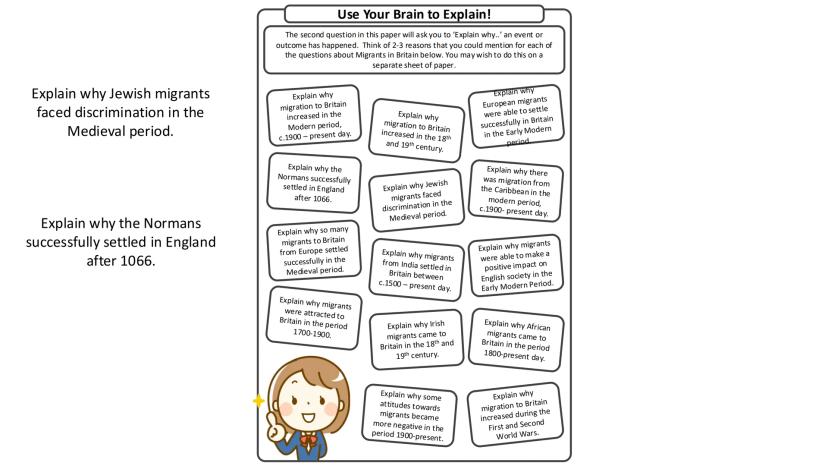
The second exam question will test your ability to explain why historical events happened. You'll need to provide 2-3 clear reasons for each migration pattern or outcome, backed up with specific evidence.
When explaining Jewish discrimination in medieval times, consider religious differences, economic jealousy, and political scapegoating. For Norman success after 1066, think about their military organisation, political strategy, and willingness to adapt existing systems.
Modern migration patterns from 1900 onwards increased due to global conflicts, economic opportunities, and improved transport links. Always connect your reasons to the historical context of each period.
Success Strategy: Structure each explanation with clear topic sentences, specific evidence, and links back to the question.
Practice explaining European migration success in medieval times, Irish migration reasons, and Caribbean migration in the modern period. Each topic requires different types of evidence and reasoning, so vary your approach accordingly.
4
of 10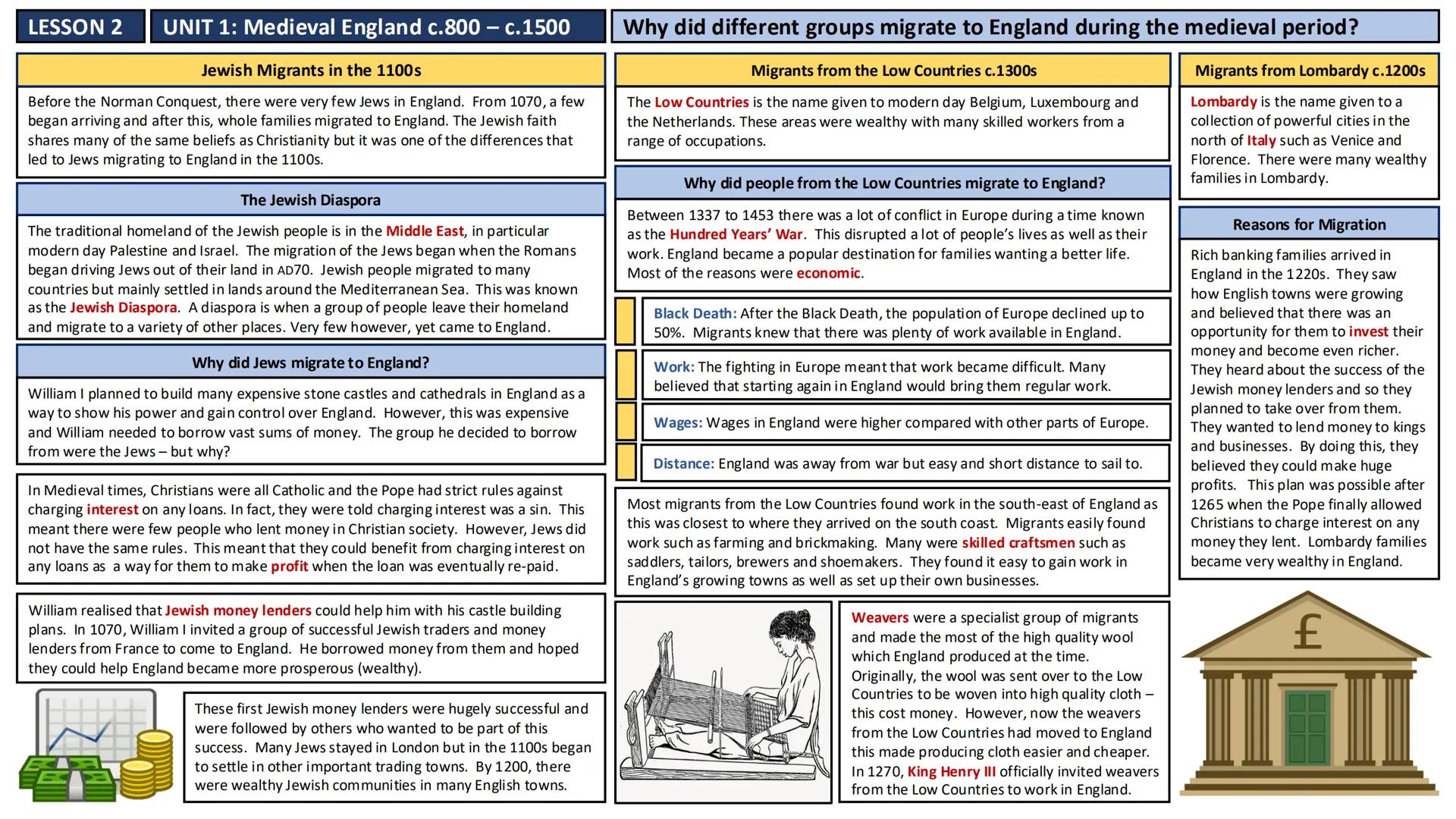
Jewish and European Migrants in Medieval England
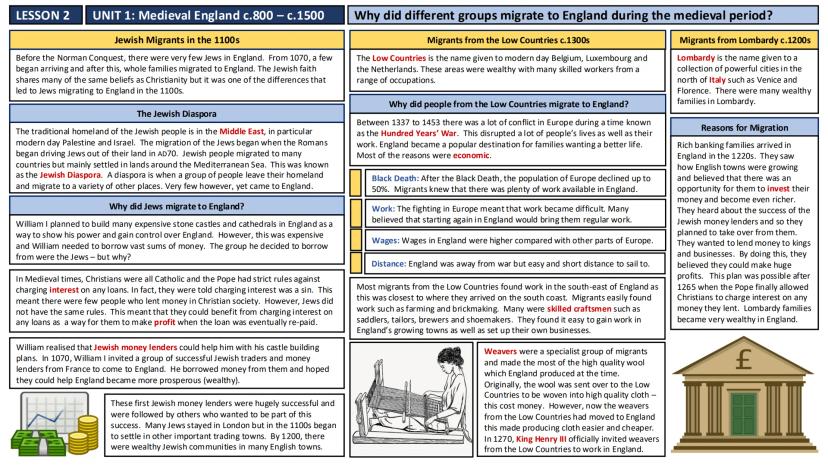
Jewish migration to England began seriously after 1070, following the Jewish Diaspora that started when Romans drove Jews from their homeland in 70 CE. William I actively invited Jewish money-lenders from France because he needed massive loans to build his stone castles and cathedrals.
Here's why Jewish migrants were so valuable: Christians couldn't charge interest on loans (the Pope said it was sinful), but Jews had no such restrictions. This created a perfect business opportunity - William got the money he needed, and Jewish families could profit from lending.
The first Jewish traders were incredibly successful, attracting more families to England throughout the 1100s. By 1200, wealthy Jewish communities existed in London and other major trading towns, transforming England's financial landscape.
Migrants from the Low Countries (modern Belgium and Netherlands) arrived during the 1300s for mainly economic reasons. The Hundred Years' War disrupted their lives, whilst the Black Death had killed up to 50% of Europe's population, creating plenty of work in England.
Economic Impact: These migrants brought specialist skills like weaving, brewing, and brickmaking that revolutionised English industry.
Lombardy bankers from northern Italy spotted opportunities in England's growing towns during the 1220s. After 1265, when the Pope finally allowed Christians to charge interest, these wealthy Italian families competed directly with Jewish money-lenders and often took over their business.
5
of 10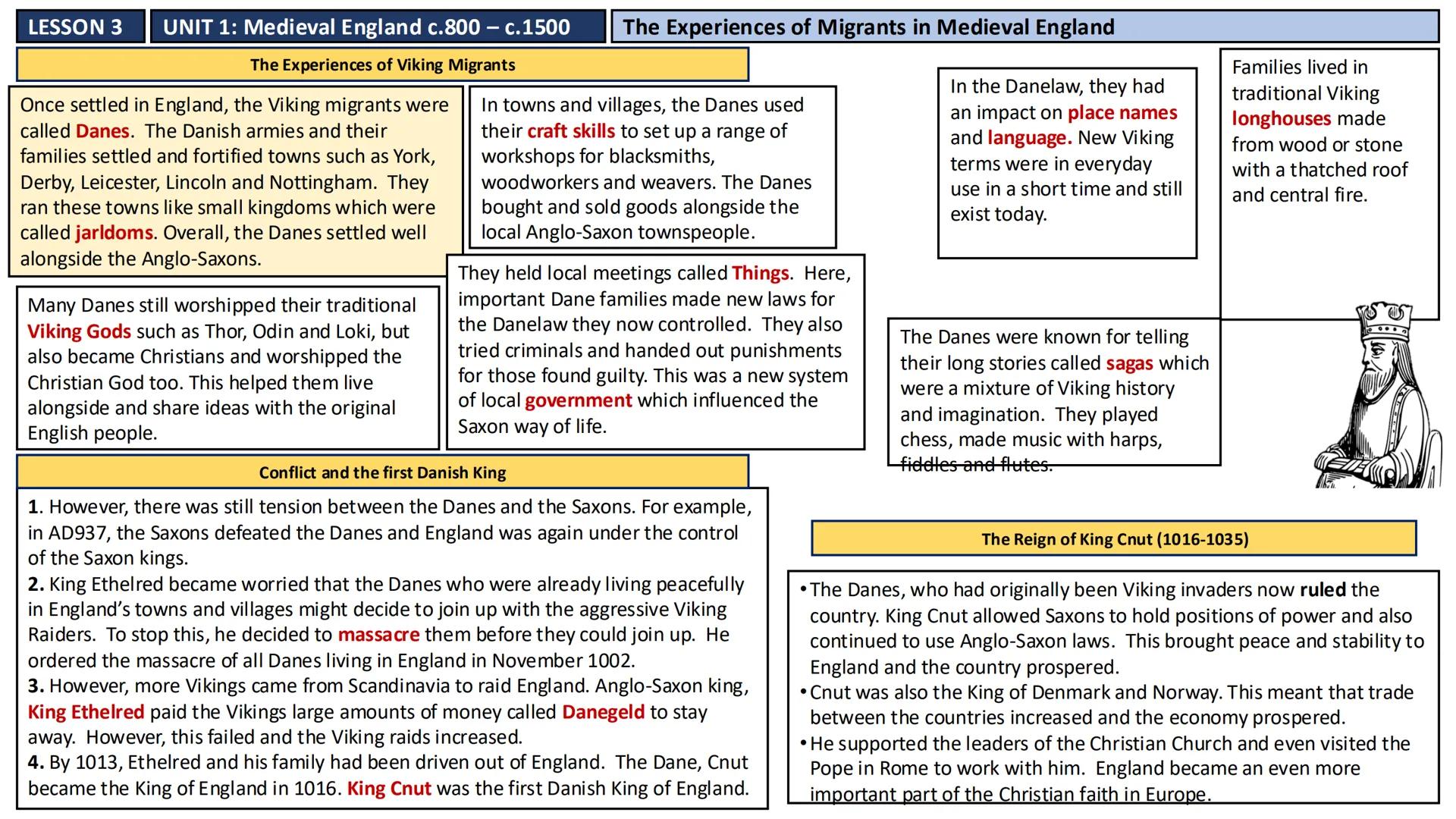
Viking Settlement and Integration
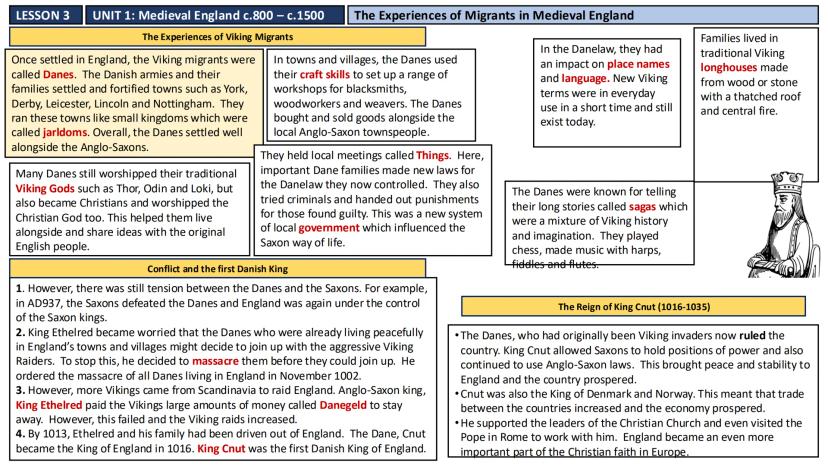
Once settled, Viking migrants (called Danes) created a fascinating blend of old and new cultures. They established jarldoms - small kingdoms centred on fortified towns like York, Derby, Leicester, Lincoln, and Nottingham.
The Danes showed remarkable religious flexibility, continuing to worship traditional Viking gods like Thor, Odin, and Loki whilst also converting to Christianity. This helped them integrate peacefully with Anglo-Saxon communities and share ideas.
In towns, Danish craftsmen set up workshops for blacksmithing, woodworking, and weaving. They traded alongside local Anglo-Saxons and established Things - local meetings where important families made laws and tried criminals. This democratic approach influenced Saxon governance.
However, tensions remained. In 937 CE, Saxons defeated the Danes and regained control. King Ethelred became so paranoid about Danish loyalty that he ordered the massacre of all Danes in November 1002, fearing they'd join new Viking raids.
Historical Turning Point: By 1016, the Dane Cnut became England's first Danish king, proving how completely Vikings had integrated into English society.
Under King Cnut (1016-1035), England experienced peace and prosperity. He kept Saxon laws, appointed Saxons to important positions, and used his connections as king of Denmark and Norway to boost international trade. England became an even more significant Christian nation in Europe.
6
of 10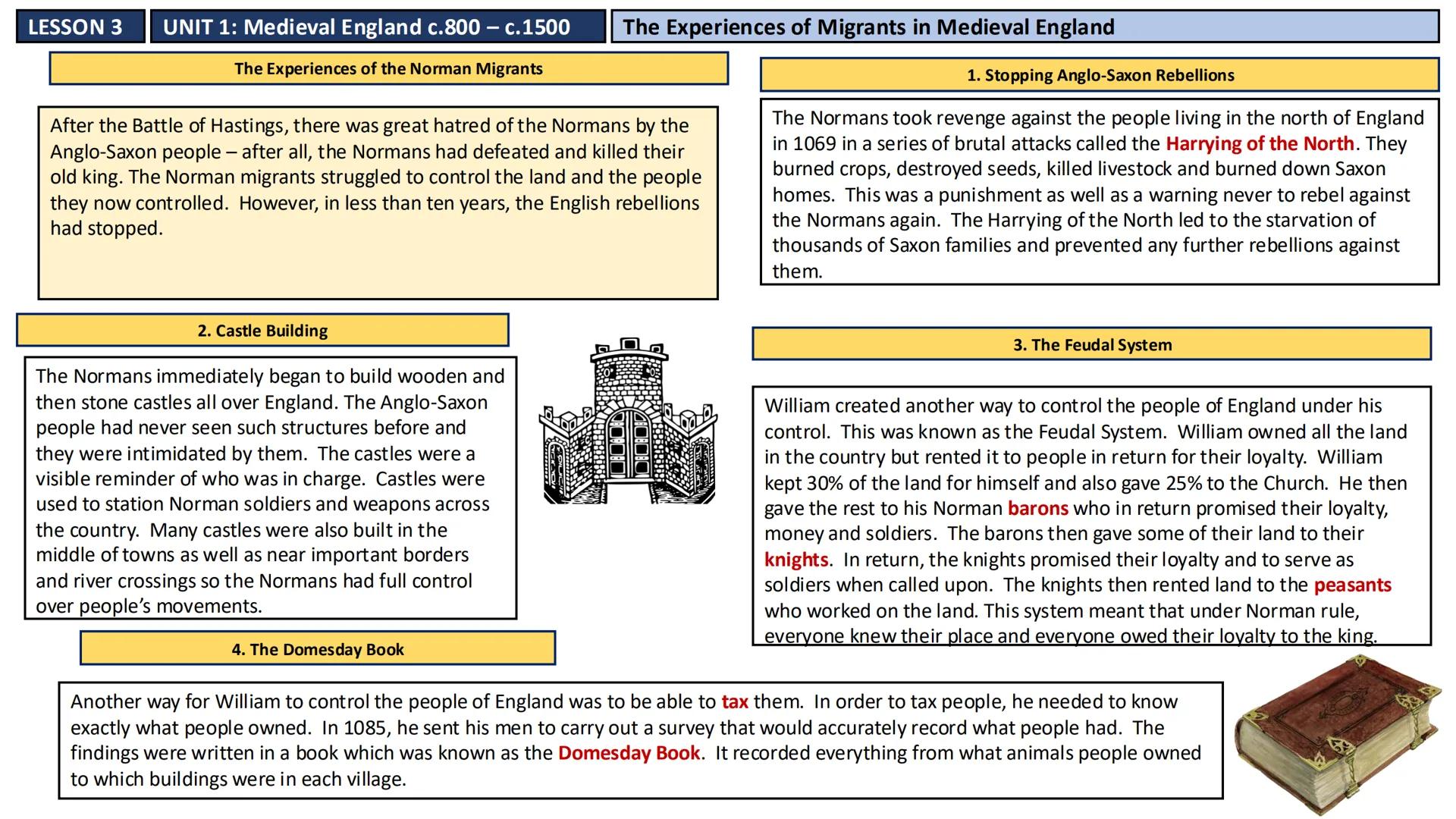
Norman Control and the Feudal System
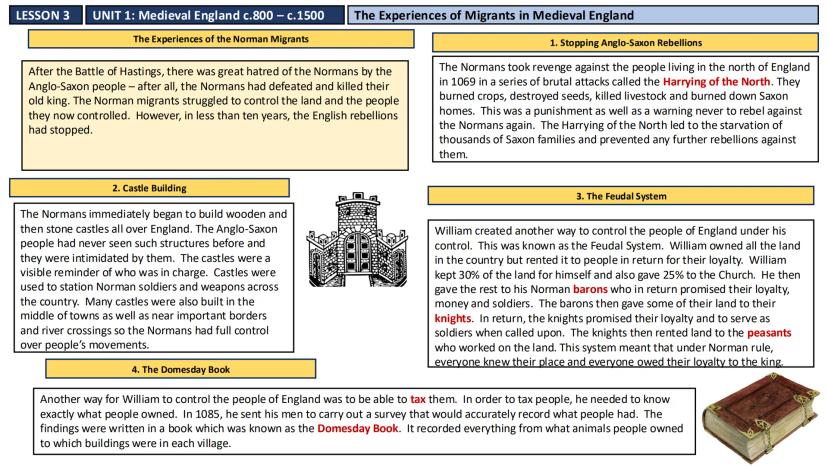
After Hastings, Normans faced massive hatred from Anglo-Saxons who'd lost their king. The Norman response was swift and brutal - they had to establish control quickly or face constant rebellion.
The Harrying of the North (1069) showed Norman ruthlessness. They burned crops, destroyed seeds, killed livestock, and demolished Saxon homes across northern England. This systematic destruction caused mass starvation but ended major rebellions permanently.
Castle building became the Normans' signature control method. These stone fortresses intimidated Anglo-Saxons who'd never seen such imposing structures. Castles housed soldiers, stored weapons, and dominated important towns, borders, and river crossings.
William's Feudal System created a pyramid of loyalty with the king at the top. William kept 30% of land for himself and gave 25% to the Church. Norman barons received the rest in exchange for money, soldiers, and absolute loyalty.
Revolutionary Change: The Feudal System meant everyone in England now owed their position to the Norman king - a complete transformation of English society.
The Domesday Book (1085) represented Norman efficiency at its finest. William's men surveyed every village, recording animals, buildings, and possessions so the king could tax people accurately. This comprehensive survey showed just how thoroughly Normans had taken control.
7
of 10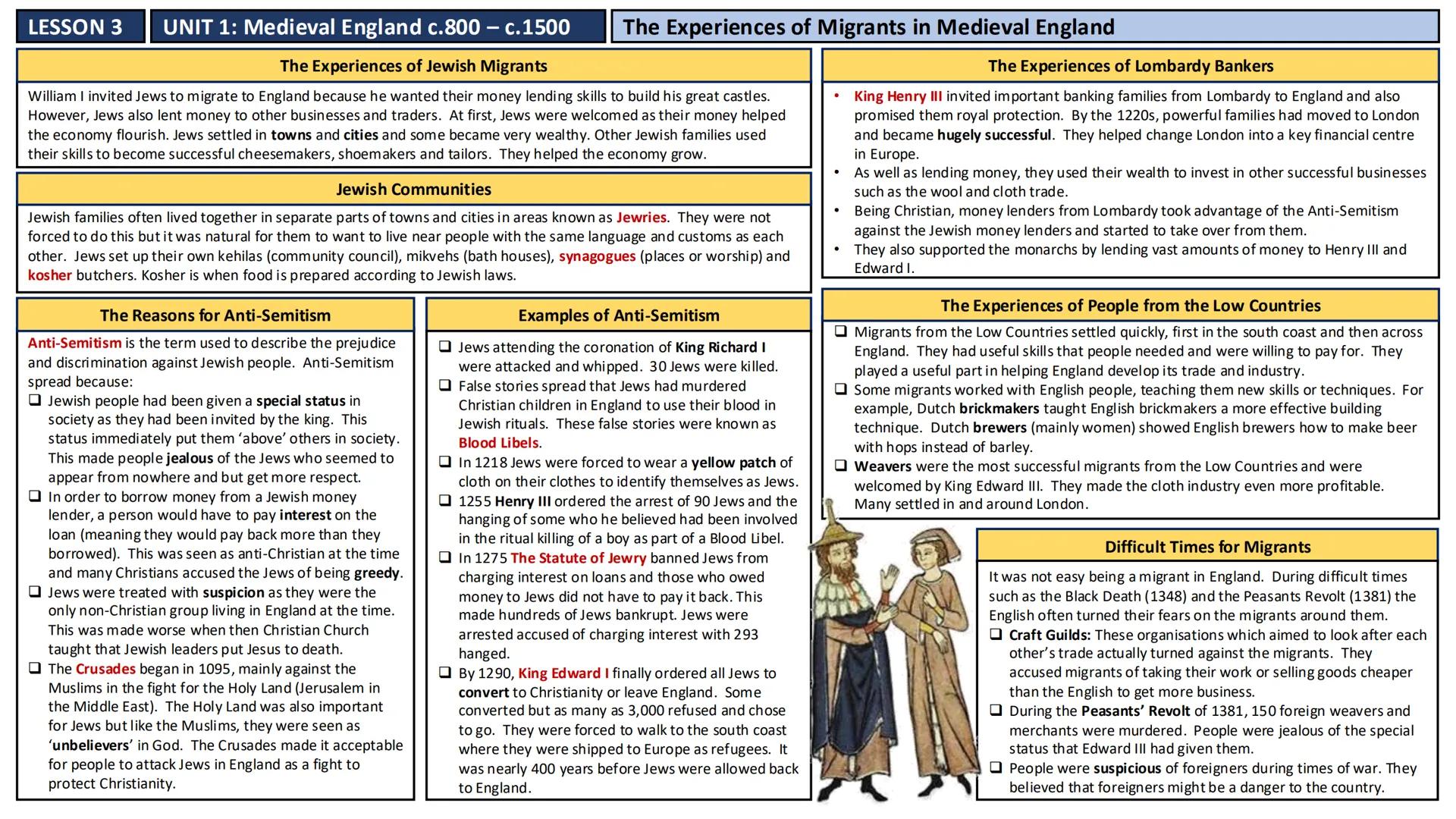
Experiences of Jewish and Other European Migrants
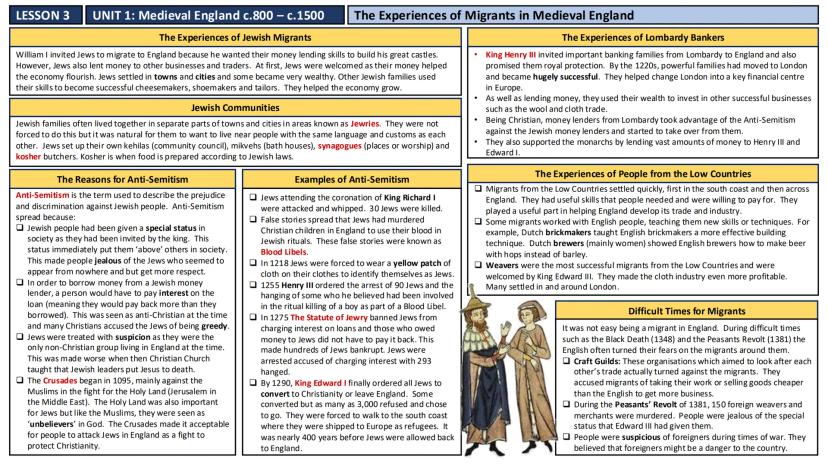
Jewish communities initially thrived under royal protection, with families settling in Jewries - separate areas where they could maintain their language, customs, and religious practices. They built synagogues, ritual baths, and kosher butchers whilst some became wealthy through money-lending.
However, anti-Semitism grew rapidly for several devastating reasons. Jews had special royal status that made other groups jealous. Christians resented paying interest on loans, seeing it as greedy and anti-Christian behaviour in a deeply religious society.
The Crusades from 1095 made things worse by encouraging attacks on all 'unbelievers'. False Blood Libel stories spread, claiming Jews murdered Christian children for ritual purposes. By 1218, Jews were forced to wear yellow patches for identification.
King Edward I systematically destroyed Jewish life in England. The Statute of Jewry (1275) banned interest charges and made Jewish debts uncollectable. In 1290, he ordered all Jews to convert to Christianity or leave - around 3,000 chose exile rather than abandon their faith.
Long-term Consequence: Jews were banned from England for nearly 400 years, not returning until the 1650s.
Migrants from the Low Countries generally experienced much better treatment. Their weaving, brewing, and brickmaking skills were highly valued, and they taught English workers new techniques. However, during crises like the Black Death (1348) and Peasants' Revolt (1381), English people turned on foreign workers, murdering 150 weavers and merchants in 1381.
8
of 10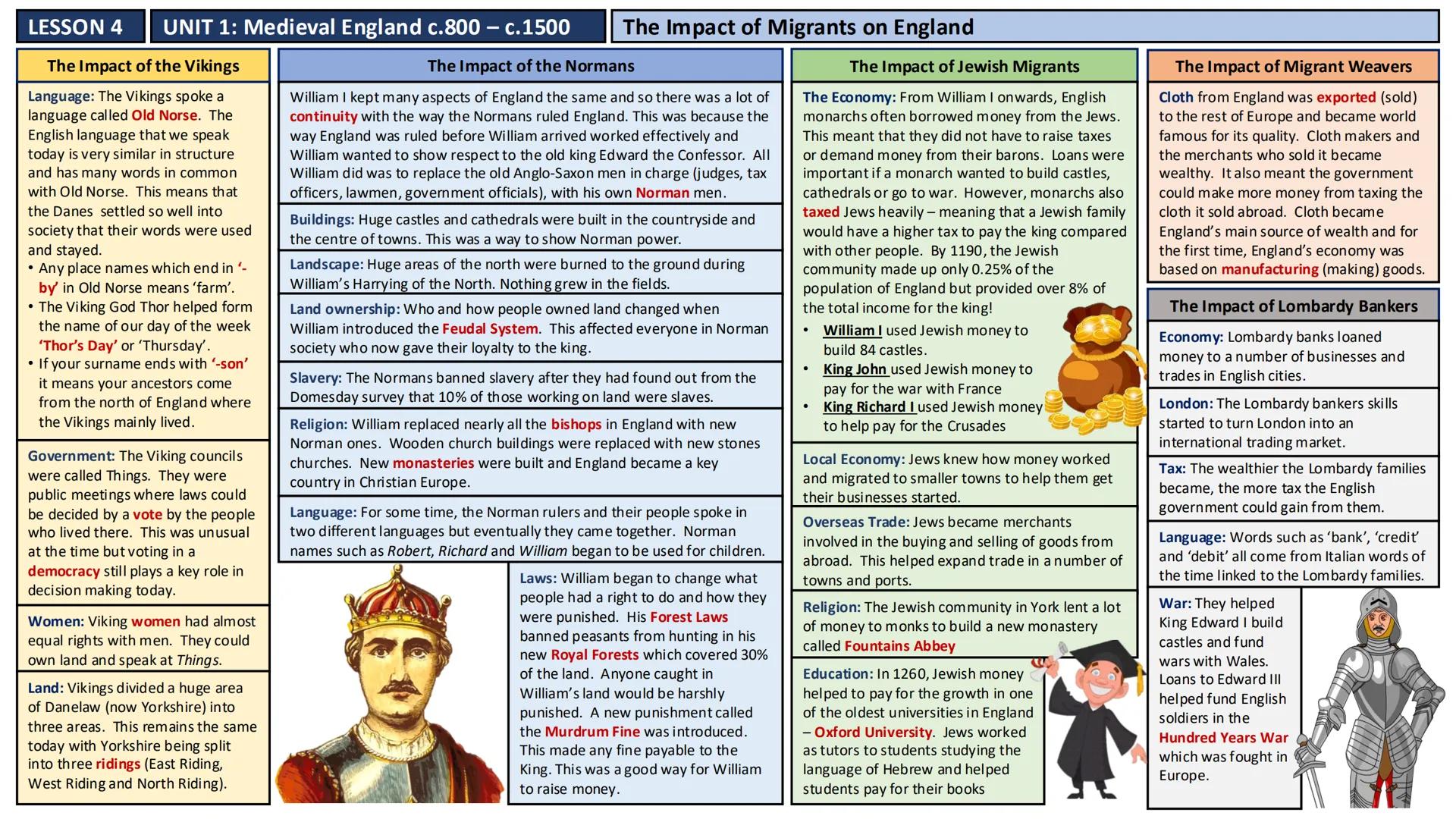
Long-term Impact of Medieval Migration
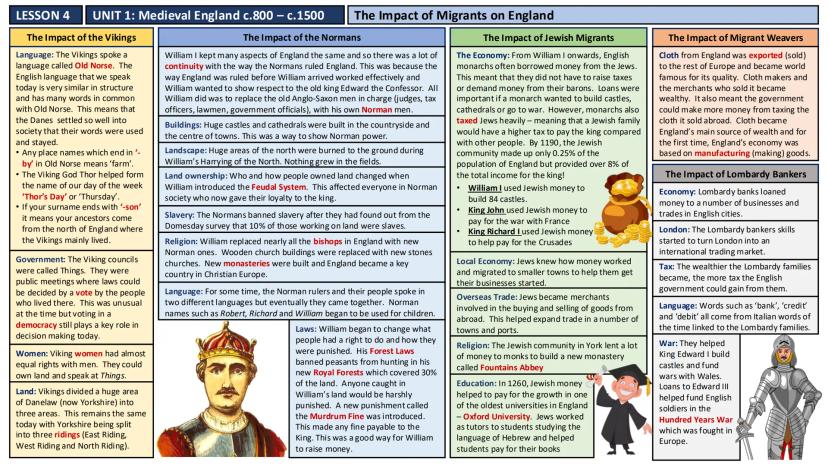
Viking impact on English culture was profound and permanent. Old Norse influenced modern English so heavily that we still use Viking words daily. Place names ending in '-by' (farm), days like 'Thursday' (Thor's day), and surnames ending '-son' all come from Viking settlement.
Viking democratic councils called Things introduced voting to English governance. Viking women enjoyed near-equal rights with men, owning land and participating in government - revolutionary for medieval times. Even Yorkshire's division into three ridings survives from Viking administrative systems.
Norman impact transformed England's entire power structure whilst maintaining effective systems. William replaced Anglo-Saxon officials with Normans but kept successful laws and customs. The Feudal System revolutionised land ownership and created a hierarchy lasting centuries.
Norman castle building changed England's landscape forever, whilst the Domesday Book represented medieval Europe's most comprehensive survey. William banned slavery, replaced wooden churches with stone cathedrals, and made England a major Christian power in Europe.
Cultural Legacy: Norman-French vocabulary enriched English, whilst Norman names like Robert, Richard, and William became standard in England.
Jewish migrants had enormous economic impact despite their small numbers. Though only 0.25% of England's population by 1190, they provided 8% of royal income through taxes and loans. Jewish money funded 84 castles, wars with France, and the Crusades, whilst Jewish scholars helped develop Oxford University.
Lombardy bankers turned London into an international financial centre, introducing words like 'bank', 'credit', and 'debit' from Italian. Weavers from the Low Countries made English cloth world-famous, creating England's first manufacturing-based economy and establishing the foundation for future industrial success.
9
of 10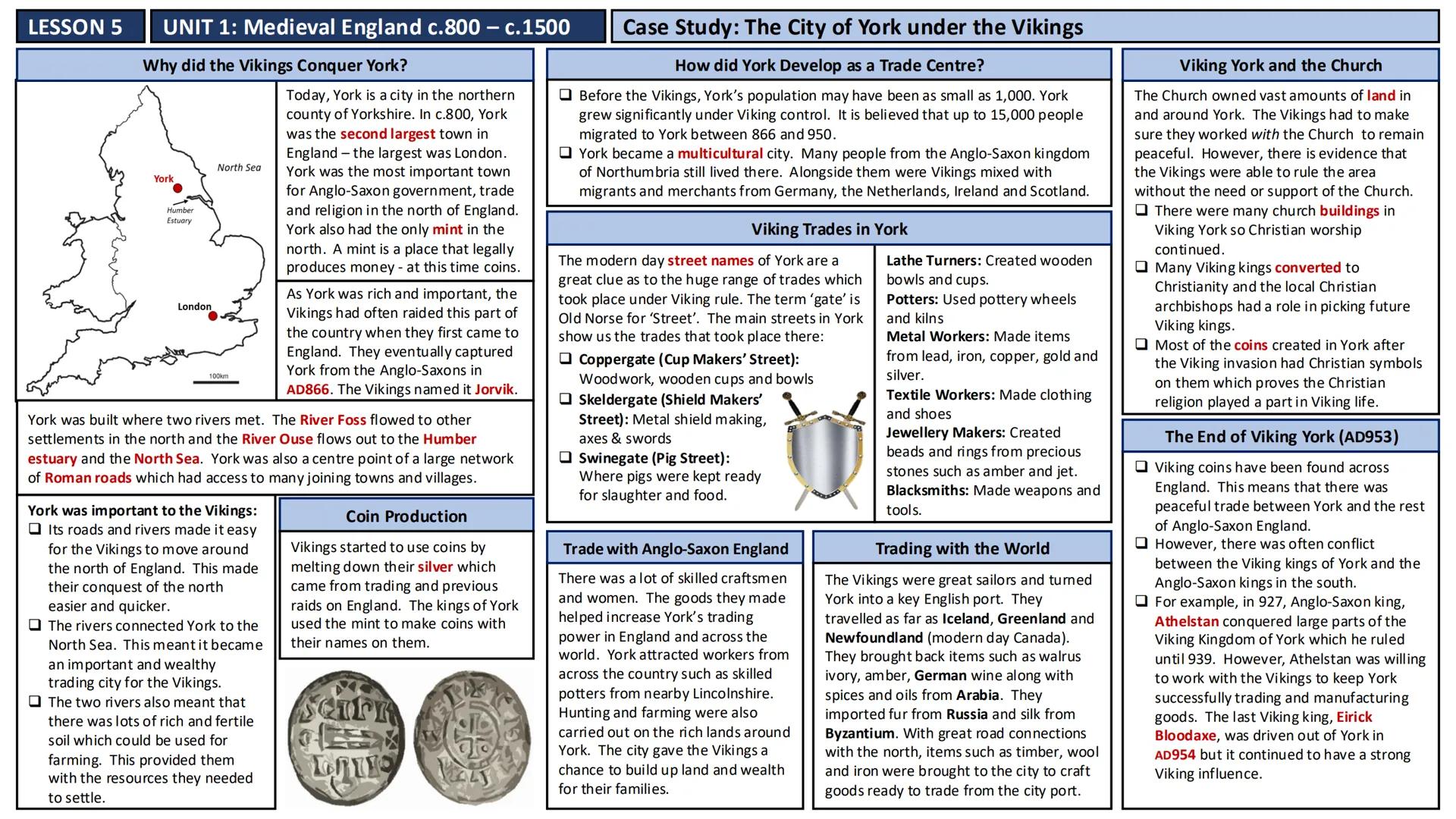
Case Study: Viking York (Jorvik)
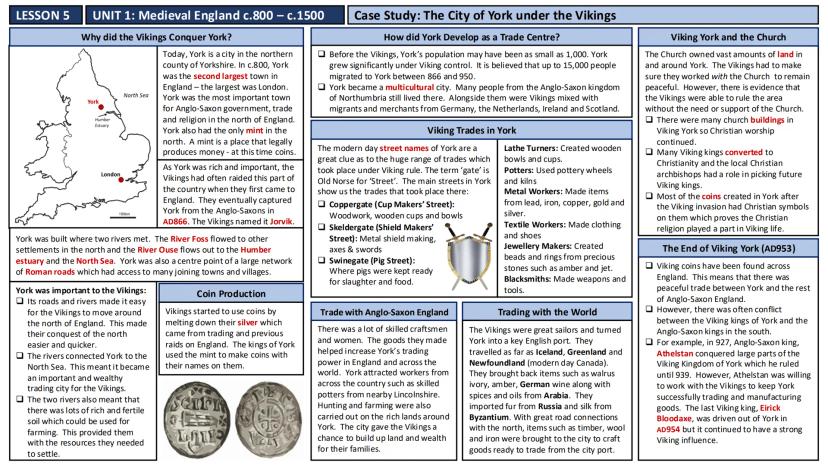
York became medieval England's ultimate success story of migrant integration. When Vikings captured the city in 866 CE, they transformed it from a small Anglo-Saxon town of 1,000 people into a thriving multicultural centre of 15,000 residents by 950 CE.
The Vikings chose York strategically because it sat where the River Foss and River Ouse met, providing perfect access to the North Sea and Roman road networks. This location made conquest easier and created ideal conditions for international trade.
Viking York became incredibly diverse, housing Anglo-Saxons, Vikings, and migrants from Germany, Netherlands, Ireland, and Scotland. The city's street names still reveal the amazing range of crafts practiced there - Coppergate (cup makers), Skeldergate (shield makers), and Swinegate (pig street).
York's craftsmen were legendary. Metal workers created items from gold, silver, copper, and iron. Textile workers made clothing and shoes. Jewellery makers crafted beautiful pieces from amber and jet. The city's mint produced coins that have been found across England, proving extensive peaceful trade.
Religious Integration: Viking kings converted to Christianity, and coins featured Christian symbols, showing successful cultural blending.
International trade made York wealthy beyond imagination. Viking sailors brought back walrus ivory from Iceland, silk from Byzantium, furs from Russia, and spices from Arabia. Local products like wool, timber, and iron were crafted into goods for export across the known world.
The end of Viking York came in 954 CE when the last Viking king, Eirick Bloodaxe, was driven out. However, the city retained its strong Viking influence and remained a major trading centre, proving that successful migration creates lasting positive change.
10
of 10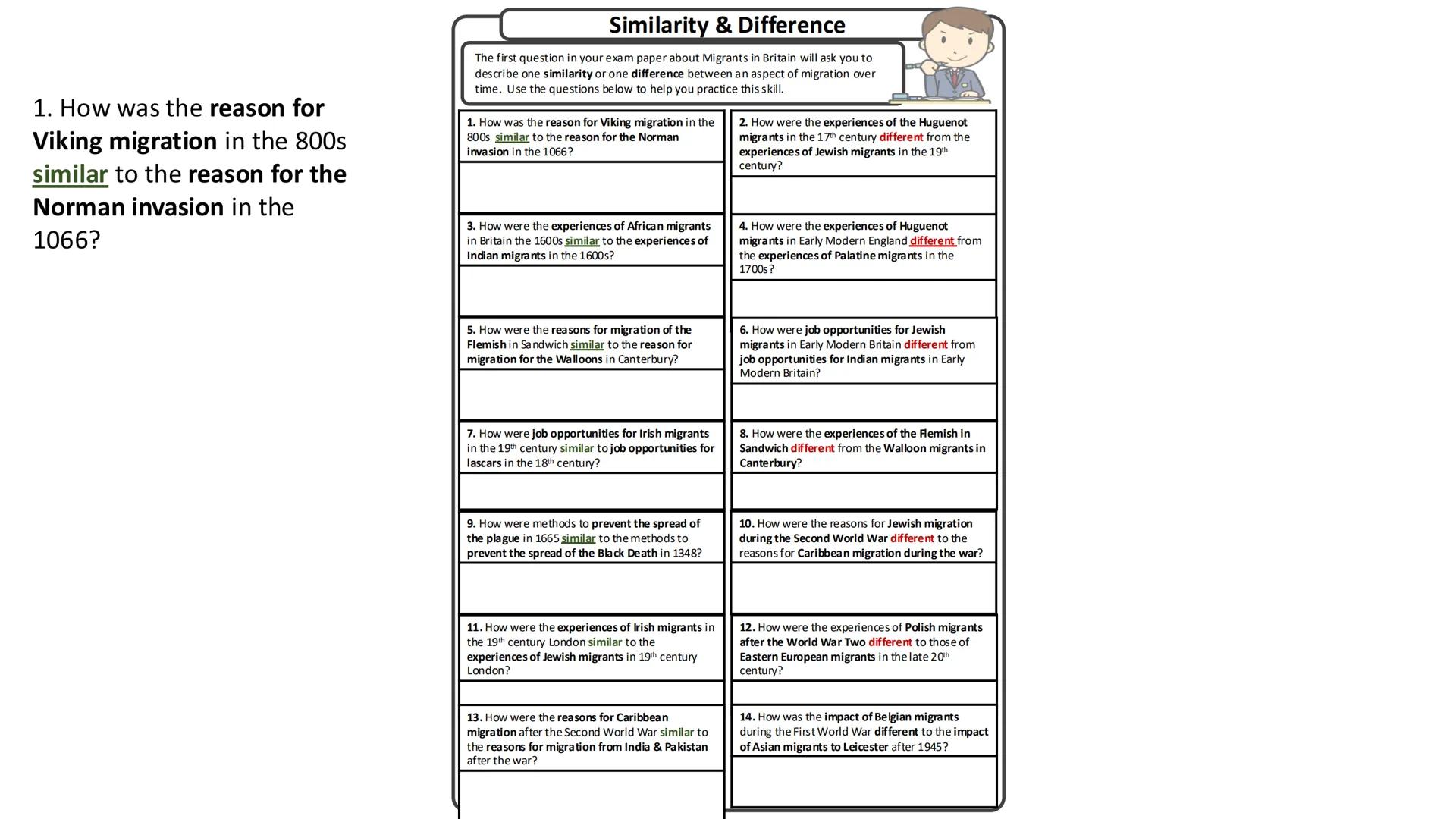
Final Exam Practice - Comparison Questions
This final practice session focuses on the comparison skills that make the difference between good and excellent exam performance. You need to identify clear similarities or differences across different time periods and migration groups.
When comparing Viking and Norman reasons for migration, focus on the contrast between economic opportunity versus political succession disputes. Both succeeded through military conquest, but their underlying motivations were completely different.
For questions about religious migrants like Huguenots versus Jews, consider how different time periods affected their experiences. Government attitudes, economic opportunities, and social acceptance varied enormously across centuries.
Modern migration patterns from the Caribbean, India, and Pakistan after World War II shared similar economic motivations but faced different social challenges compared to earlier European migrants.
Exam Success Tip: Always support your comparisons with specific dates, places, and examples - examiners love precise historical detail.
Practice these comparison questions regularly, focusing on clear structure: state the similarity/difference, provide evidence from both time periods, and explain why this matters. Whether you're comparing Irish migrants in different centuries or African migrants across time periods, the same analytical approach will serve you well in your exams.
We thought you’d never ask...
What is the Knowunity AI companion?
Our AI Companion is a student-focused AI tool that offers more than just answers. Built on millions of Knowunity resources, it provides relevant information, personalised study plans, quizzes, and content directly in the chat, adapting to your individual learning journey.
Where can I download the Knowunity app?
You can download the app from Google Play Store and Apple App Store.
Is Knowunity really free of charge?
That's right! Enjoy free access to study content, connect with fellow students, and get instant help – all at your fingertips.
Most popular content in History
9HistoryCold War Mindmaps Overview
Explore comprehensive mindmaps covering key events and concepts of the Cold War, including the Cuban Missile Crisis, Gorbachev's reforms, and the end of the Cold War. Ideal for Edexcel GCSE History students seeking to enhance their understanding of superpower relations and significant historical events in Europe. This resource provides a visual summary to aid in revision and retention.
119,753196
HistoryEvolution of Medicine
Explore the comprehensive timeline of medical advancements from medieval practices to modern healthcare. This revision resource covers key topics such as the Great Plague, Germ Theory, the development of antibiotics, and the evolution of public health reforms. Ideal for Edexcel GCSE History students seeking a thorough understanding of the progression of medical knowledge and practices.
1116,206717
HistoryElizabethan Conspiracies & Conflicts
Explore the key conspiracies and conflicts during Elizabeth I's reign, including the Ridolfi and Throckmorton plots, the Spanish Armada, and the impact of the Religious Settlement. This comprehensive revision guide covers essential topics for GCSE History, focusing on the political, religious, and social challenges faced by Elizabethan England.
105,198336
W
HistoryWeimar Constitution
GCSE history Weimar and Nazi Germany - the Weimar Constitution
99154
HistoryAnglo-Saxon & Norman England Overview
Explore the key events and societal changes in Anglo-Saxon and Norman England (c. 1060-1088). This comprehensive summary covers the feudal system, the role of the Church, significant battles, and the impact of William the Conqueror's reign. Ideal for history revision and exam preparation.
112,39278
E
HistoryElizabethan England Revision
revise elizabethan england basic facts
118872
HistoryElizabethan Governance & Challenges
Explore the complexities of Elizabeth I's reign with this comprehensive mindmap covering key topics such as the structure of Tudor government, the religious settlement, challenges from Mary Queen of Scots, and the impact of exploration. Ideal for Edexcel GCSE History students, this resource provides a clear overview of Elizabethan politics, foreign policy, and societal issues, helping you to understand the era's significant events and figures.
117,874408
HistoryEvolution of Medicine in Britain
Explore the comprehensive journey of medicine in Britain from medieval times to the modern era. This study note covers key topics such as the Black Death, germ theory, the impact of the Renaissance, the evolution of public health, and the development of antibiotics. Ideal for GCSE History students studying the AQA curriculum, this resource provides essential insights into significant medical advancements and public health reforms.
1016,866974
HistoryHistory - American West Notes
Notes for the American West
1078629
Most popular content
9 Sociology
Sociology of Education Overview
Explore comprehensive A-Level Sociology notes on the education system, covering key theories, policies, and sociological perspectives. This resource includes insights on marketisation, gender roles, cultural deprivation, and educational inequalities, providing a thorough understanding of how education shapes social stratification and individual achievement. Ideal for exam preparation and in-depth study.
12102,3893,038
CriminologyCriminology: Crime & Punishment Overview
Comprehensive mindmaps covering key concepts in the Crime and Punishment topic for WJEC Criminology Unit 4. This resource includes detailed insights into the Criminal Justice System, crime prevention strategies, sentencing models, and the roles of various agencies. Ideal for A-Level revision, ensuring you grasp essential theories and legislative processes to excel in your exams.
1254,8131,059
SociologySociology of Families: Comprehensive Revision
Dive into an extensive overview of family dynamics, perspectives, and patterns in sociology. This resource covers key concepts such as family diversity, gender roles, marriage, and the impact of social policies on family structures. Perfect for A-Level Sociology students preparing for Paper 2.
1273,2392,304
 English Literature
An Inspector Calls: Character Insights
Explore in-depth analysis and key quotes for characters in J.B. Priestley's 'An Inspector Calls'. This resource covers Gerald Croft, Inspector Goole, Sheila Birling, Mrs. Birling, Eric Birling, and Eva Smith, focusing on themes of class, gender roles, and social responsibility. Ideal for students aiming for Grade 8 and above.
1025,231901
CriminologyWJEC Unit 4 Criminology
Criminology unit 4 detailed revision note
127,120124
CriminologyCriminology Theories Overview
Explore key criminology theories and their implications on crime and deviance. This comprehensive summary covers biological, psychological, and sociological perspectives, including labelling theory, right realism, and the impact of social campaigns on policy development. Ideal for A-Level criminology students seeking to understand the complexities of criminal behaviour and the factors influencing crime prevention strategies.
129,746211
English LiteratureRomeo and Juliet: Key themes
Key Romeo and Juliet themes and analysed quotes
106,619197
C
 Biology
Cell Biology and Cell structure
cell structures
92,6740
English LiteratureMacbeth: Guilt and Ambition
Explore the complex themes of guilt and ambition in Shakespeare's 'Macbeth'. This analysis covers key characters, including Macbeth and Lady Macbeth, their moral dilemmas, and the tragic consequences of their ambition. Ideal for students studying character motivations, thematic elements, and the psychological impact of power. Includes insights on the natural order, manipulation, and the descent into madness.
918,818392
Can't find what you're looking for? Explore other subjects.
Students love us — and so will you.
4.6/5App Store
4.7/5Google Play
The app is very easy to use and well designed. I have found everything I was looking for so far and have been able to learn a lot from the presentations! I will definitely use the app for a class assignment! And of course it also helps a lot as an inspiration.
Stefan SiOS user
This app is really great. There are so many study notes and help [...]. My problem subject is French, for example, and the app has so many options for help. Thanks to this app, I have improved my French. I would recommend it to anyone.
Samantha KlichAndroid user
Wow, I am really amazed. I just tried the app because I've seen it advertised many times and was absolutely stunned. This app is THE HELP you want for school and above all, it offers so many things, such as workouts and fact sheets, which have been VERY helpful to me personally.
AnnaiOS user
History567 views·Updated May 23, 2026·55 pagesGCSE History Edexcel: Complete Migration Topics and Dates
siyana@monkeysiy
Ever wondered why so many different groups of people chose to migrate to England during medieval times? Between 800-1500 CE, England became a magnet for migrants from across Europe and beyond, each bringing their own skills, cultures, and ambitions that... Show more
1
of 10Sign up to see the content. It's free!
- Access to all documents
- Improve your grades
- Join milions of students
Viking and Norman Migration to Medieval England
Viking migration started as brutal raids in 789 CE but quickly evolved into something much bigger. These Scandinavian warriors saw England's wealth from monastery raids and realised the country offered incredible opportunities. The fertile soil in eastern England was perfect for farming, whilst bustling coastal towns promised lucrative trade deals.
By 865 CE, the Great Army landed with conquest in mind, not just quick raids. They captured York in 866 and spent 14 years battling Anglo-Saxon kingdoms. Their religious beliefs even supported this - they thought Odin would reward successful invaders in the afterlife.
The Norman invasion of 1066 happened for completely different reasons - it was all about broken promises and disputed crowns. When Edward the Confessor died without children, both Harold Godwinson and William of Normandy claimed the throne. William believed Edward had promised him the crown and even claimed the Pope's support.
Key Point: Both Vikings and Normans succeeded because they were well-organised military forces targeting a wealthy but divided England.
After William's victory at Hastings, Norman families flooded into England seeking rewards from their new king. William cleverly distributed land and wealth to his supporters, encouraging even more Norman migration to secure his conquest.
2
of 10Sign up to see the content. It's free!
- Access to all documents
- Improve your grades
- Join milions of students
Exam Practice - Similarities and Differences
These practice questions will help you nail the comparison skills you need for your migration exam. The first question always asks you to describe one similarity or difference between migration experiences across different time periods.
When answering these questions, focus on finding clear connections or contrasts. For example, both Viking and Norman migrations aimed to take control of England, but their methods and motivations differed significantly.
Don't just list facts - explain the connection clearly. If comparing Jewish experiences in medieval times versus the 19th century, think about how religious persecution, economic opportunities, and government attitudes changed over time.
Exam Tip: Always use specific examples and time periods in your answers. Vague responses won't get you the marks you need.
Practice with questions about Irish migrants, Caribbean migration, and Eastern European movements to build your confidence. Remember, you're looking for patterns in reasons for migration, experiences after arrival, and long-term impacts on British society.
3
of 10Sign up to see the content. It's free!
- Access to all documents
- Improve your grades
- Join milions of students
Developing Your Explanation Skills
The second exam question will test your ability to explain why historical events happened. You'll need to provide 2-3 clear reasons for each migration pattern or outcome, backed up with specific evidence.
When explaining Jewish discrimination in medieval times, consider religious differences, economic jealousy, and political scapegoating. For Norman success after 1066, think about their military organisation, political strategy, and willingness to adapt existing systems.
Modern migration patterns from 1900 onwards increased due to global conflicts, economic opportunities, and improved transport links. Always connect your reasons to the historical context of each period.
Success Strategy: Structure each explanation with clear topic sentences, specific evidence, and links back to the question.
Practice explaining European migration success in medieval times, Irish migration reasons, and Caribbean migration in the modern period. Each topic requires different types of evidence and reasoning, so vary your approach accordingly.
4
of 10Sign up to see the content. It's free!
- Access to all documents
- Improve your grades
- Join milions of students
Jewish and European Migrants in Medieval England
Jewish migration to England began seriously after 1070, following the Jewish Diaspora that started when Romans drove Jews from their homeland in 70 CE. William I actively invited Jewish money-lenders from France because he needed massive loans to build his stone castles and cathedrals.
Here's why Jewish migrants were so valuable: Christians couldn't charge interest on loans (the Pope said it was sinful), but Jews had no such restrictions. This created a perfect business opportunity - William got the money he needed, and Jewish families could profit from lending.
The first Jewish traders were incredibly successful, attracting more families to England throughout the 1100s. By 1200, wealthy Jewish communities existed in London and other major trading towns, transforming England's financial landscape.
Migrants from the Low Countries (modern Belgium and Netherlands) arrived during the 1300s for mainly economic reasons. The Hundred Years' War disrupted their lives, whilst the Black Death had killed up to 50% of Europe's population, creating plenty of work in England.
Economic Impact: These migrants brought specialist skills like weaving, brewing, and brickmaking that revolutionised English industry.
Lombardy bankers from northern Italy spotted opportunities in England's growing towns during the 1220s. After 1265, when the Pope finally allowed Christians to charge interest, these wealthy Italian families competed directly with Jewish money-lenders and often took over their business.
5
of 10Sign up to see the content. It's free!
- Access to all documents
- Improve your grades
- Join milions of students
Viking Settlement and Integration
Once settled, Viking migrants (called Danes) created a fascinating blend of old and new cultures. They established jarldoms - small kingdoms centred on fortified towns like York, Derby, Leicester, Lincoln, and Nottingham.
The Danes showed remarkable religious flexibility, continuing to worship traditional Viking gods like Thor, Odin, and Loki whilst also converting to Christianity. This helped them integrate peacefully with Anglo-Saxon communities and share ideas.
In towns, Danish craftsmen set up workshops for blacksmithing, woodworking, and weaving. They traded alongside local Anglo-Saxons and established Things - local meetings where important families made laws and tried criminals. This democratic approach influenced Saxon governance.
However, tensions remained. In 937 CE, Saxons defeated the Danes and regained control. King Ethelred became so paranoid about Danish loyalty that he ordered the massacre of all Danes in November 1002, fearing they'd join new Viking raids.
Historical Turning Point: By 1016, the Dane Cnut became England's first Danish king, proving how completely Vikings had integrated into English society.
Under King Cnut (1016-1035), England experienced peace and prosperity. He kept Saxon laws, appointed Saxons to important positions, and used his connections as king of Denmark and Norway to boost international trade. England became an even more significant Christian nation in Europe.
6
of 10Sign up to see the content. It's free!
- Access to all documents
- Improve your grades
- Join milions of students
Norman Control and the Feudal System
After Hastings, Normans faced massive hatred from Anglo-Saxons who'd lost their king. The Norman response was swift and brutal - they had to establish control quickly or face constant rebellion.
The Harrying of the North (1069) showed Norman ruthlessness. They burned crops, destroyed seeds, killed livestock, and demolished Saxon homes across northern England. This systematic destruction caused mass starvation but ended major rebellions permanently.
Castle building became the Normans' signature control method. These stone fortresses intimidated Anglo-Saxons who'd never seen such imposing structures. Castles housed soldiers, stored weapons, and dominated important towns, borders, and river crossings.
William's Feudal System created a pyramid of loyalty with the king at the top. William kept 30% of land for himself and gave 25% to the Church. Norman barons received the rest in exchange for money, soldiers, and absolute loyalty.
Revolutionary Change: The Feudal System meant everyone in England now owed their position to the Norman king - a complete transformation of English society.
The Domesday Book (1085) represented Norman efficiency at its finest. William's men surveyed every village, recording animals, buildings, and possessions so the king could tax people accurately. This comprehensive survey showed just how thoroughly Normans had taken control.
7
of 10Sign up to see the content. It's free!
- Access to all documents
- Improve your grades
- Join milions of students
Experiences of Jewish and Other European Migrants
Jewish communities initially thrived under royal protection, with families settling in Jewries - separate areas where they could maintain their language, customs, and religious practices. They built synagogues, ritual baths, and kosher butchers whilst some became wealthy through money-lending.
However, anti-Semitism grew rapidly for several devastating reasons. Jews had special royal status that made other groups jealous. Christians resented paying interest on loans, seeing it as greedy and anti-Christian behaviour in a deeply religious society.
The Crusades from 1095 made things worse by encouraging attacks on all 'unbelievers'. False Blood Libel stories spread, claiming Jews murdered Christian children for ritual purposes. By 1218, Jews were forced to wear yellow patches for identification.
King Edward I systematically destroyed Jewish life in England. The Statute of Jewry (1275) banned interest charges and made Jewish debts uncollectable. In 1290, he ordered all Jews to convert to Christianity or leave - around 3,000 chose exile rather than abandon their faith.
Long-term Consequence: Jews were banned from England for nearly 400 years, not returning until the 1650s.
Migrants from the Low Countries generally experienced much better treatment. Their weaving, brewing, and brickmaking skills were highly valued, and they taught English workers new techniques. However, during crises like the Black Death (1348) and Peasants' Revolt (1381), English people turned on foreign workers, murdering 150 weavers and merchants in 1381.
8
of 10Sign up to see the content. It's free!
- Access to all documents
- Improve your grades
- Join milions of students
Long-term Impact of Medieval Migration
Viking impact on English culture was profound and permanent. Old Norse influenced modern English so heavily that we still use Viking words daily. Place names ending in '-by' (farm), days like 'Thursday' (Thor's day), and surnames ending '-son' all come from Viking settlement.
Viking democratic councils called Things introduced voting to English governance. Viking women enjoyed near-equal rights with men, owning land and participating in government - revolutionary for medieval times. Even Yorkshire's division into three ridings survives from Viking administrative systems.
Norman impact transformed England's entire power structure whilst maintaining effective systems. William replaced Anglo-Saxon officials with Normans but kept successful laws and customs. The Feudal System revolutionised land ownership and created a hierarchy lasting centuries.
Norman castle building changed England's landscape forever, whilst the Domesday Book represented medieval Europe's most comprehensive survey. William banned slavery, replaced wooden churches with stone cathedrals, and made England a major Christian power in Europe.
Cultural Legacy: Norman-French vocabulary enriched English, whilst Norman names like Robert, Richard, and William became standard in England.
Jewish migrants had enormous economic impact despite their small numbers. Though only 0.25% of England's population by 1190, they provided 8% of royal income through taxes and loans. Jewish money funded 84 castles, wars with France, and the Crusades, whilst Jewish scholars helped develop Oxford University.
Lombardy bankers turned London into an international financial centre, introducing words like 'bank', 'credit', and 'debit' from Italian. Weavers from the Low Countries made English cloth world-famous, creating England's first manufacturing-based economy and establishing the foundation for future industrial success.
9
of 10Sign up to see the content. It's free!
- Access to all documents
- Improve your grades
- Join milions of students
Case Study: Viking York (Jorvik)
York became medieval England's ultimate success story of migrant integration. When Vikings captured the city in 866 CE, they transformed it from a small Anglo-Saxon town of 1,000 people into a thriving multicultural centre of 15,000 residents by 950 CE.
The Vikings chose York strategically because it sat where the River Foss and River Ouse met, providing perfect access to the North Sea and Roman road networks. This location made conquest easier and created ideal conditions for international trade.
Viking York became incredibly diverse, housing Anglo-Saxons, Vikings, and migrants from Germany, Netherlands, Ireland, and Scotland. The city's street names still reveal the amazing range of crafts practiced there - Coppergate (cup makers), Skeldergate (shield makers), and Swinegate (pig street).
York's craftsmen were legendary. Metal workers created items from gold, silver, copper, and iron. Textile workers made clothing and shoes. Jewellery makers crafted beautiful pieces from amber and jet. The city's mint produced coins that have been found across England, proving extensive peaceful trade.
Religious Integration: Viking kings converted to Christianity, and coins featured Christian symbols, showing successful cultural blending.
International trade made York wealthy beyond imagination. Viking sailors brought back walrus ivory from Iceland, silk from Byzantium, furs from Russia, and spices from Arabia. Local products like wool, timber, and iron were crafted into goods for export across the known world.
The end of Viking York came in 954 CE when the last Viking king, Eirick Bloodaxe, was driven out. However, the city retained its strong Viking influence and remained a major trading centre, proving that successful migration creates lasting positive change.
10
of 10Sign up to see the content. It's free!
- Access to all documents
- Improve your grades
- Join milions of students
Final Exam Practice - Comparison Questions
This final practice session focuses on the comparison skills that make the difference between good and excellent exam performance. You need to identify clear similarities or differences across different time periods and migration groups.
When comparing Viking and Norman reasons for migration, focus on the contrast between economic opportunity versus political succession disputes. Both succeeded through military conquest, but their underlying motivations were completely different.
For questions about religious migrants like Huguenots versus Jews, consider how different time periods affected their experiences. Government attitudes, economic opportunities, and social acceptance varied enormously across centuries.
Modern migration patterns from the Caribbean, India, and Pakistan after World War II shared similar economic motivations but faced different social challenges compared to earlier European migrants.
Exam Success Tip: Always support your comparisons with specific dates, places, and examples - examiners love precise historical detail.
Practice these comparison questions regularly, focusing on clear structure: state the similarity/difference, provide evidence from both time periods, and explain why this matters. Whether you're comparing Irish migrants in different centuries or African migrants across time periods, the same analytical approach will serve you well in your exams.
We thought you’d never ask...
What is the Knowunity AI companion?
Our AI Companion is a student-focused AI tool that offers more than just answers. Built on millions of Knowunity resources, it provides relevant information, personalised study plans, quizzes, and content directly in the chat, adapting to your individual learning journey.
Where can I download the Knowunity app?
You can download the app from Google Play Store and Apple App Store.
Is Knowunity really free of charge?
That's right! Enjoy free access to study content, connect with fellow students, and get instant help – all at your fingertips.
Most popular content in History
9HistoryCold War Mindmaps Overview
Explore comprehensive mindmaps covering key events and concepts of the Cold War, including the Cuban Missile Crisis, Gorbachev's reforms, and the end of the Cold War. Ideal for Edexcel GCSE History students seeking to enhance their understanding of superpower relations and significant historical events in Europe. This resource provides a visual summary to aid in revision and retention.
119,753196
HistoryEvolution of Medicine
Explore the comprehensive timeline of medical advancements from medieval practices to modern healthcare. This revision resource covers key topics such as the Great Plague, Germ Theory, the development of antibiotics, and the evolution of public health reforms. Ideal for Edexcel GCSE History students seeking a thorough understanding of the progression of medical knowledge and practices.
1116,206717
HistoryElizabethan Conspiracies & Conflicts
Explore the key conspiracies and conflicts during Elizabeth I's reign, including the Ridolfi and Throckmorton plots, the Spanish Armada, and the impact of the Religious Settlement. This comprehensive revision guide covers essential topics for GCSE History, focusing on the political, religious, and social challenges faced by Elizabethan England.
105,198336
W
HistoryWeimar Constitution
GCSE history Weimar and Nazi Germany - the Weimar Constitution
99154
HistoryAnglo-Saxon & Norman England Overview
Explore the key events and societal changes in Anglo-Saxon and Norman England (c. 1060-1088). This comprehensive summary covers the feudal system, the role of the Church, significant battles, and the impact of William the Conqueror's reign. Ideal for history revision and exam preparation.
112,39278
E
HistoryElizabethan England Revision
revise elizabethan england basic facts
118872
HistoryElizabethan Governance & Challenges
Explore the complexities of Elizabeth I's reign with this comprehensive mindmap covering key topics such as the structure of Tudor government, the religious settlement, challenges from Mary Queen of Scots, and the impact of exploration. Ideal for Edexcel GCSE History students, this resource provides a clear overview of Elizabethan politics, foreign policy, and societal issues, helping you to understand the era's significant events and figures.
117,874408
HistoryEvolution of Medicine in Britain
Explore the comprehensive journey of medicine in Britain from medieval times to the modern era. This study note covers key topics such as the Black Death, germ theory, the impact of the Renaissance, the evolution of public health, and the development of antibiotics. Ideal for GCSE History students studying the AQA curriculum, this resource provides essential insights into significant medical advancements and public health reforms.
1016,866974
HistoryHistory - American West Notes
Notes for the American West
1078629
Most popular content
9SociologySociology of Education Overview
Explore comprehensive A-Level Sociology notes on the education system, covering key theories, policies, and sociological perspectives. This resource includes insights on marketisation, gender roles, cultural deprivation, and educational inequalities, providing a thorough understanding of how education shapes social stratification and individual achievement. Ideal for exam preparation and in-depth study.
12102,3893,038
CriminologyCriminology: Crime & Punishment Overview
Comprehensive mindmaps covering key concepts in the Crime and Punishment topic for WJEC Criminology Unit 4. This resource includes detailed insights into the Criminal Justice System, crime prevention strategies, sentencing models, and the roles of various agencies. Ideal for A-Level revision, ensuring you grasp essential theories and legislative processes to excel in your exams.
1254,8131,059
SociologySociology of Families: Comprehensive Revision
Dive into an extensive overview of family dynamics, perspectives, and patterns in sociology. This resource covers key concepts such as family diversity, gender roles, marriage, and the impact of social policies on family structures. Perfect for A-Level Sociology students preparing for Paper 2.
1273,2392,304
English LiteratureAn Inspector Calls: Character Insights
Explore in-depth analysis and key quotes for characters in J.B. Priestley's 'An Inspector Calls'. This resource covers Gerald Croft, Inspector Goole, Sheila Birling, Mrs. Birling, Eric Birling, and Eva Smith, focusing on themes of class, gender roles, and social responsibility. Ideal for students aiming for Grade 8 and above.
1025,231901
CriminologyWJEC Unit 4 Criminology
Criminology unit 4 detailed revision note
127,120124
CriminologyCriminology Theories Overview
Explore key criminology theories and their implications on crime and deviance. This comprehensive summary covers biological, psychological, and sociological perspectives, including labelling theory, right realism, and the impact of social campaigns on policy development. Ideal for A-Level criminology students seeking to understand the complexities of criminal behaviour and the factors influencing crime prevention strategies.
129,746211
English LiteratureRomeo and Juliet: Key themes
Key Romeo and Juliet themes and analysed quotes
106,619197
C
BiologyCell Biology and Cell structure
cell structures
92,6740
English LiteratureMacbeth: Guilt and Ambition
Explore the complex themes of guilt and ambition in Shakespeare's 'Macbeth'. This analysis covers key characters, including Macbeth and Lady Macbeth, their moral dilemmas, and the tragic consequences of their ambition. Ideal for students studying character motivations, thematic elements, and the psychological impact of power. Includes insights on the natural order, manipulation, and the descent into madness.
918,818392
Can't find what you're looking for? Explore other subjects.
Students love us — and so will you.
4.6/5App Store
4.7/5Google Play
The app is very easy to use and well designed. I have found everything I was looking for so far and have been able to learn a lot from the presentations! I will definitely use the app for a class assignment! And of course it also helps a lot as an inspiration.
Stefan SiOS user
This app is really great. There are so many study notes and help [...]. My problem subject is French, for example, and the app has so many options for help. Thanks to this app, I have improved my French. I would recommend it to anyone.
Samantha KlichAndroid user
Wow, I am really amazed. I just tried the app because I've seen it advertised many times and was absolutely stunned. This app is THE HELP you want for school and above all, it offers so many things, such as workouts and fact sheets, which have been VERY helpful to me personally.
AnnaiOS user