
Ever wondered how Europe stumbled into another world war just... Show more
 History
 English Literature
 Sociology
 Biology
Sign up to see the contentIt's free!
Access to all documents
Improve your grades
Join milions of students
Knowunity AI
Subjects
Triangle Congruence and Similarity Theorems
Triangle Properties and Classification
Linear Equations and Graphs
Geometric Angle Relationships
Trigonometric Functions and Identities
Equation Solving Techniques
Circle Geometry Fundamentals
Division Operations and Methods
Basic Differentiation Rules
Exponent and Logarithm Properties
Show all topics
Human Organ Systems
Reproductive Cell Cycles
Biological Sciences Subdisciplines
Cellular Energy Metabolism
Autotrophic Energy Processes
Inheritance Patterns and Principles
Biomolecular Structure and Organization
Cell Cycle and Division Mechanics
Cellular Organization and Development
Biological Structural Organization
Show all topics
Chemical Sciences and Applications
Atomic Structure and Composition
Molecular Electron Structure Representation
Atomic Electron Behavior
Matter Properties and Water
Mole Concept and Calculations
Gas Laws and Behavior
Periodic Table Organization
Chemical Thermodynamics Fundamentals
Chemical Bond Types and Properties
Show all topics
European Renaissance and Enlightenment
European Cultural Movements 800-1920
American Revolution Era 1763-1797
American Civil War 1861-1865
Global Imperial Systems
Mongol and Chinese Dynasties
U.S. Presidents and World Leaders
Historical Sources and Documentation
World Wars Era and Impact
World Religious Systems
Show all topics
Classic and Contemporary Novels
Literary Character Analysis
Rhetorical Theory and Practice
Classic Literary Narratives
Reading Analysis and Interpretation
Narrative Structure and Techniques
English Language Components
Influential English-Language Authors
Basic Sentence Structure
Narrative Voice and Perspective
Show all topics
150
•
Updated Apr 2, 2026
•
Kitty
@keek5
Ever wondered how Europe stumbled into another world war just... Show more
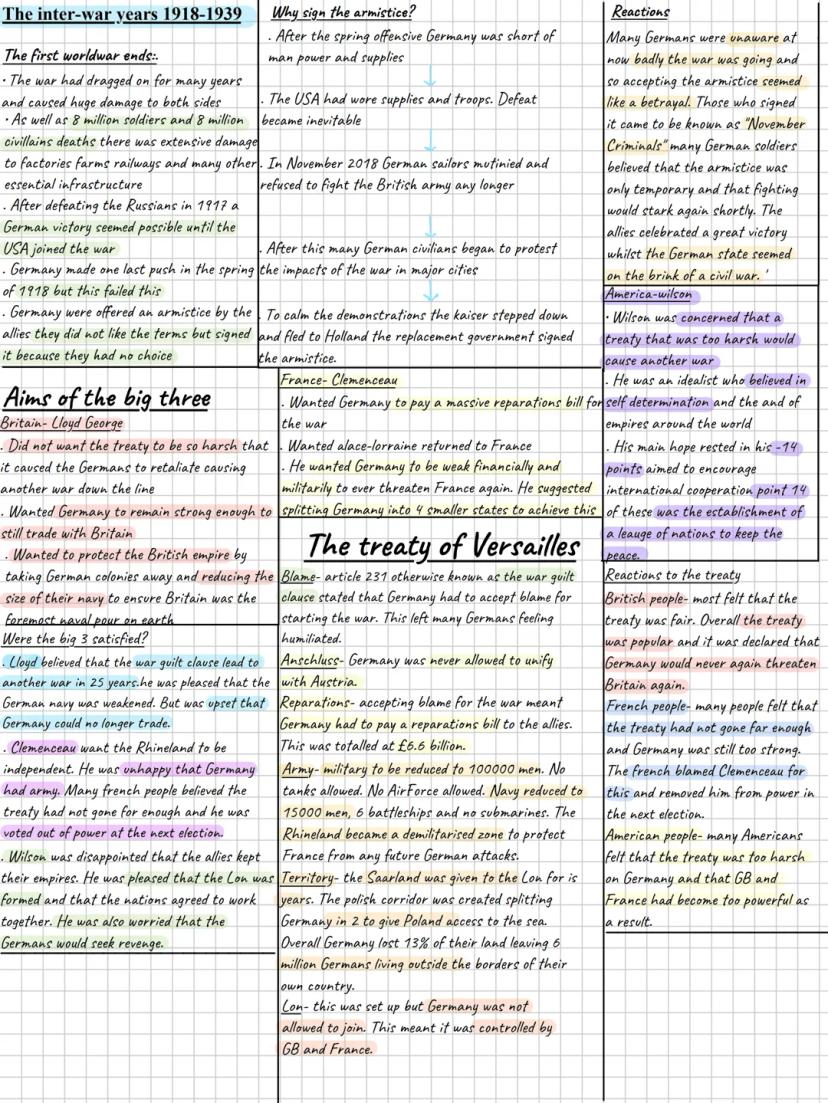
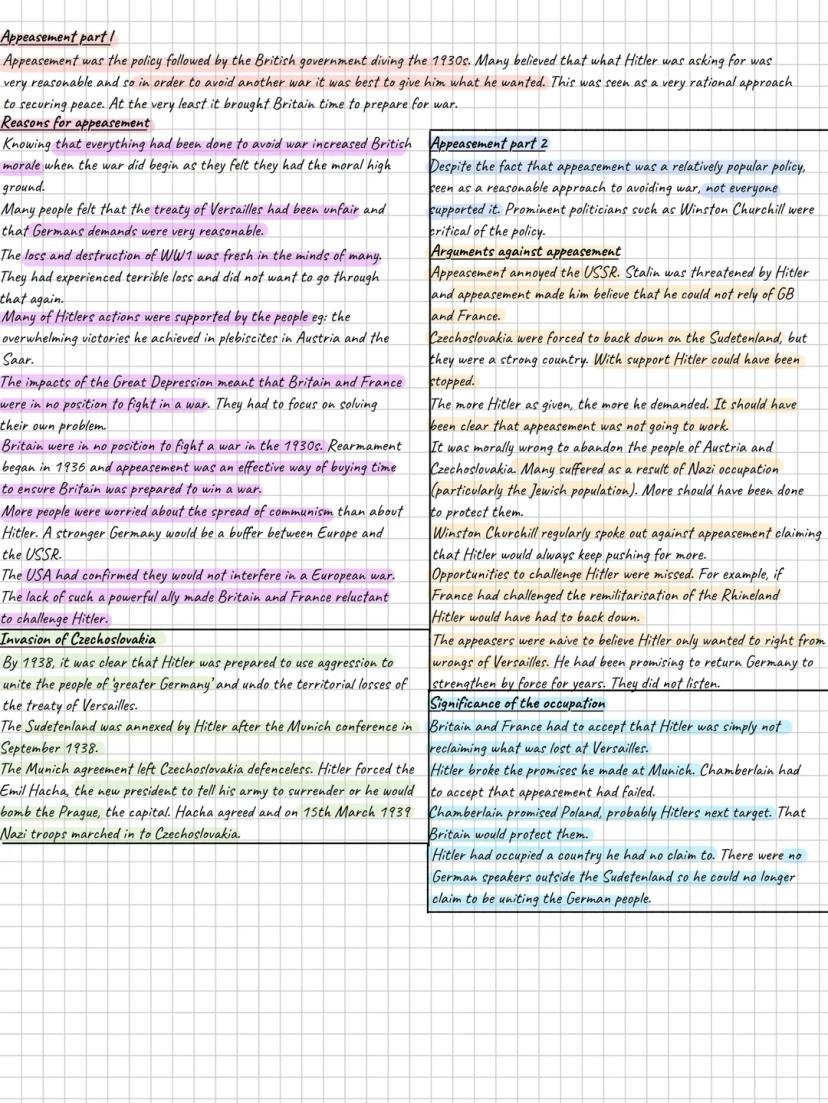
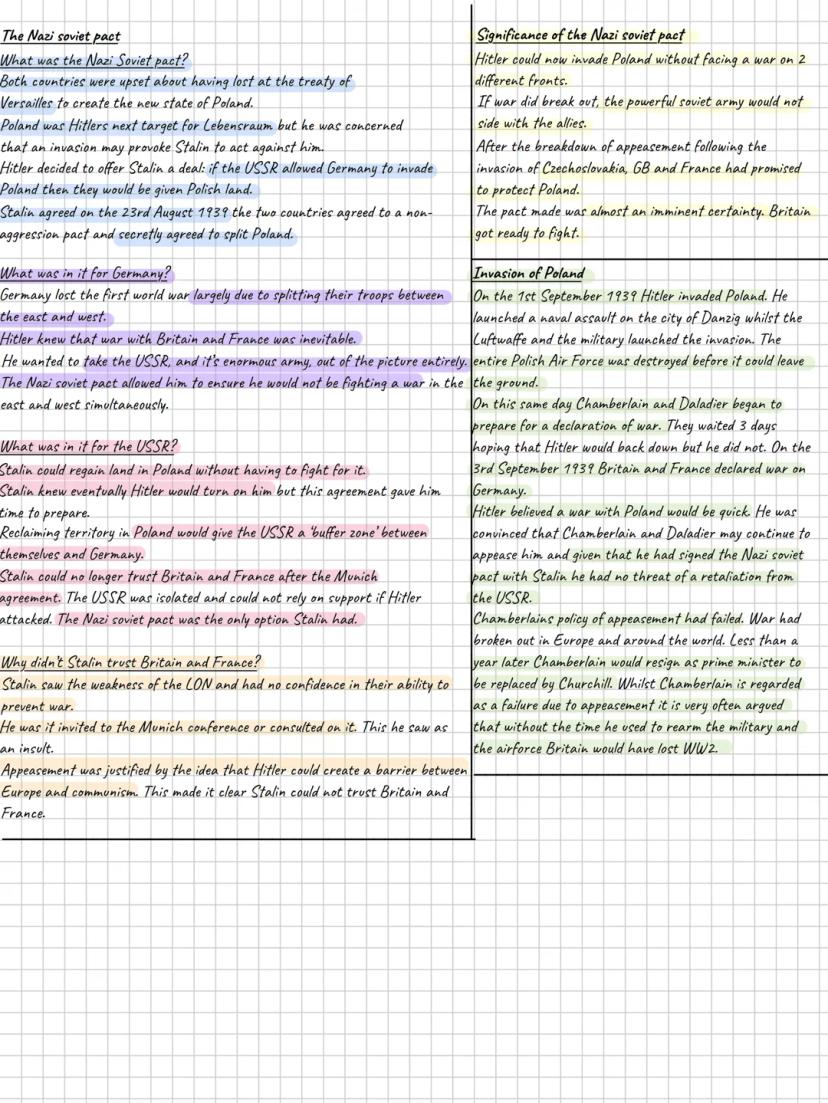
The First World War finally ended in 1918 when Germany simply ran out of steam. After their spring offensive failed and American troops kept pouring in, German sailors started mutinying and civilians began protesting in the streets. The Kaiser legged it to Holland, leaving the new government to sign the armistice.
Here's where it gets interesting - many Germans had no clue how badly they were losing the war. To them, signing the armistice felt like a massive betrayal, and they branded the politicians who signed it the "November Criminals". This resentment would come back to haunt everyone later.
When it came to sorting out the peace treaty, the Big Three leaders had completely different ideas. Wilson (America) wanted a fair deal that wouldn't cause another war, Clemenceau (France) wanted to absolutely cripple Germany so they could never attack France again, and Lloyd George (Britain) wanted something in between - harsh enough to satisfy voters but not so brutal it would destroy trade.
Quick Fact: Lloyd George correctly predicted that the harsh treaty would lead to another war in 25 years - he was spot on!

The Treaty of Versailles was basically designed to humiliate Germany, and boy did it succeed. The infamous Article 231 (war guilt clause) forced Germany to accept full blame for the war, which absolutely infuriated Germans who felt the causes were way more complicated.
The treaty's terms were brutal: Germany lost 13% of its land, had to pay £6.6 billion in reparations, and their military was slashed to just 100,000 men with no tanks, air force, or submarines allowed. The Rhineland became a demilitarised zone, and Germany was banned from uniting with Austria (Anschluss).
Public reaction was mixed but telling. Most Brits thought it was fair, but many French people wanted it even harsher and voted Clemenceau out of office. Americans worried it was too brutal and would backfire. The Germans? Well, they were absolutely livid and felt completely humiliated.
This treaty created the perfect storm for future conflict. Six million Germans now lived outside Germany's borders, giving future leaders a convenient excuse to "reclaim" lost territories. The stage was set for round two.
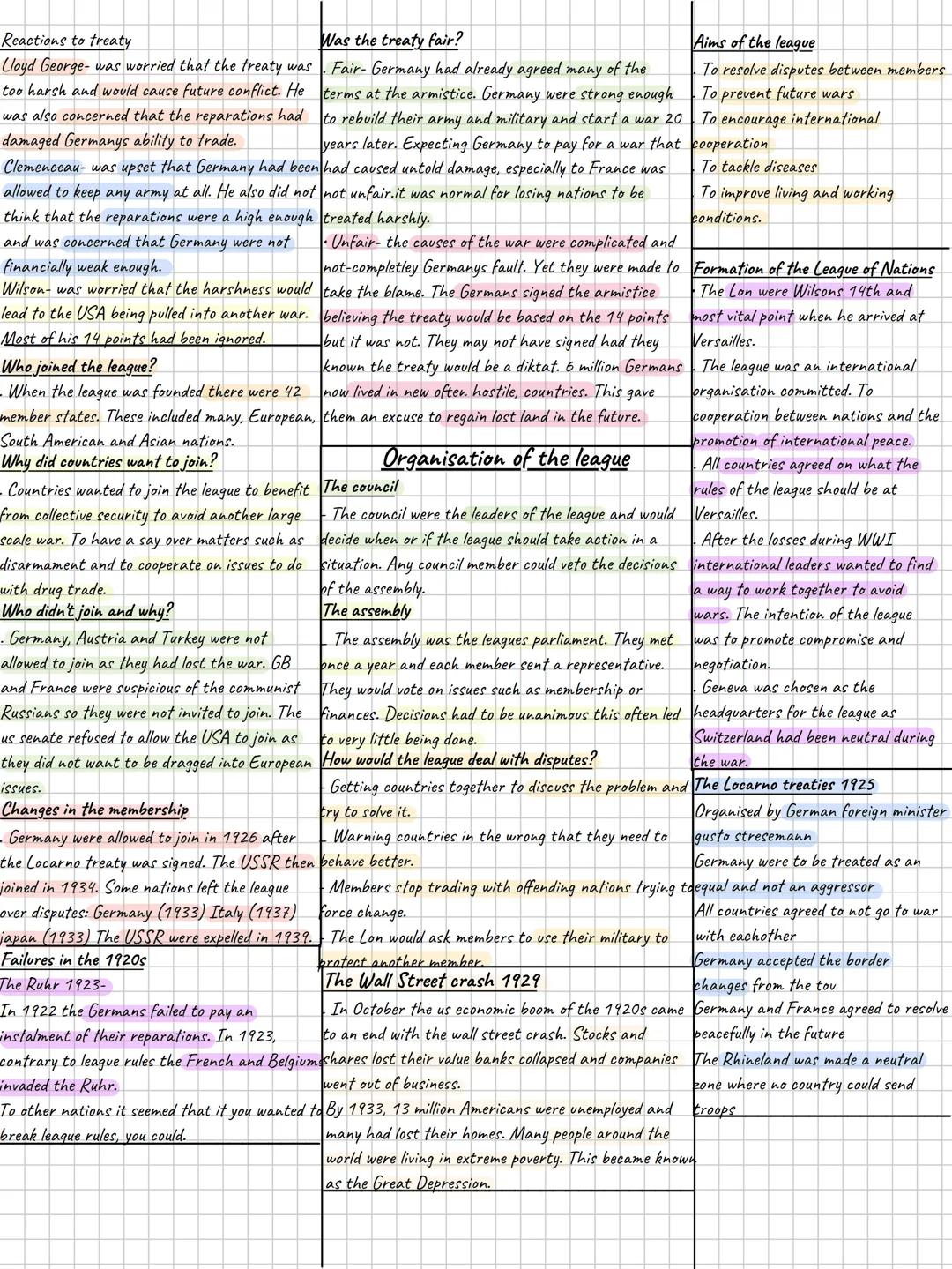
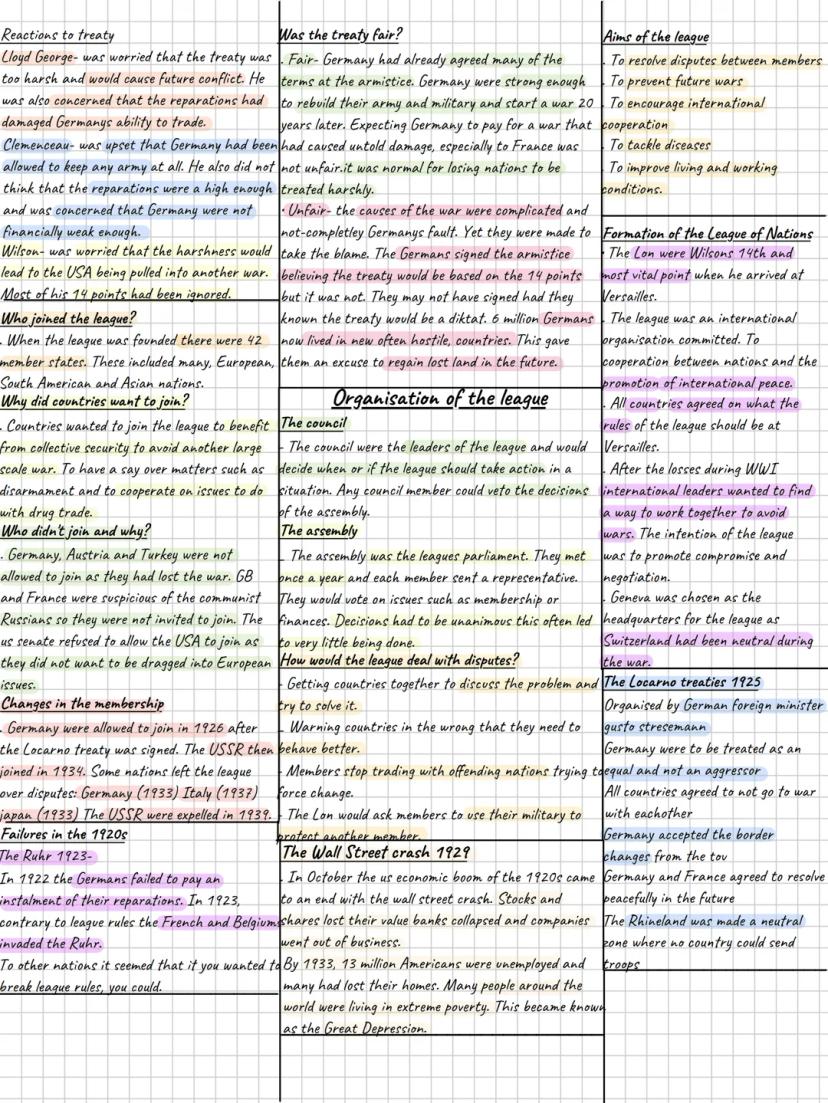
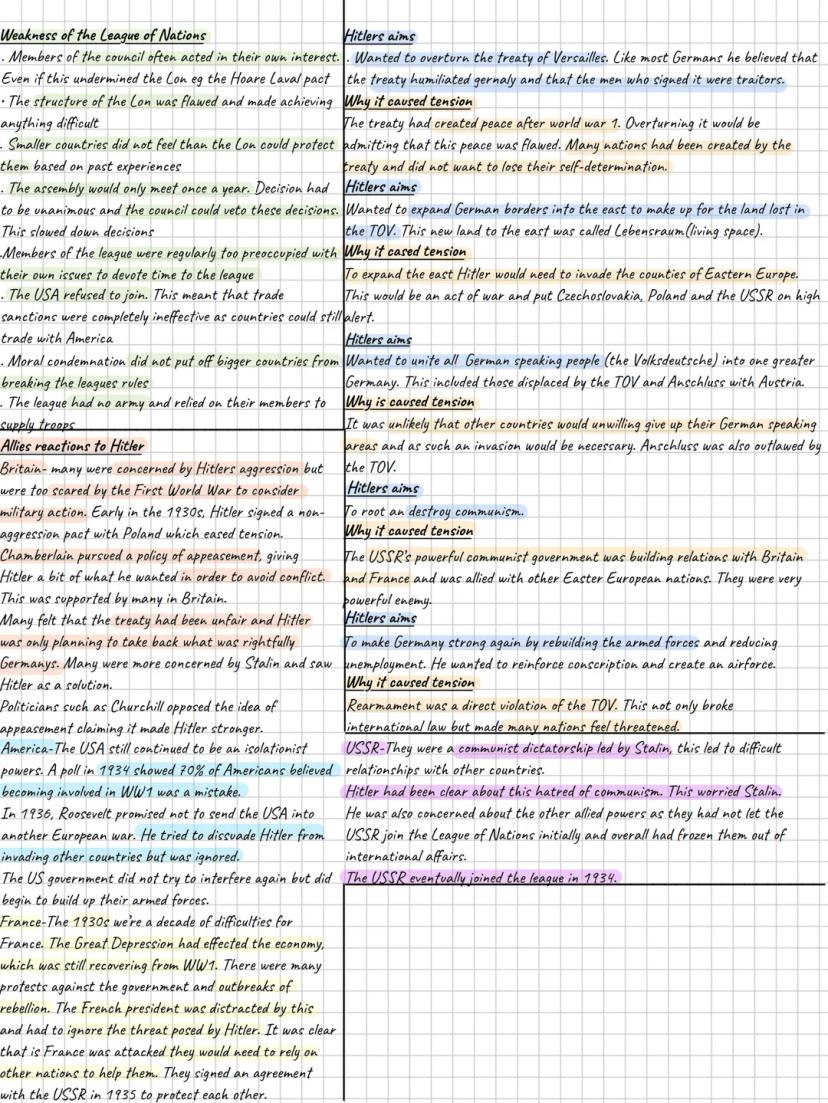
The League of Nations was Wilson's baby - his grand plan to prevent future wars through international cooperation and collective security. Founded with 42 members, it aimed to resolve disputes peacefully and tackle global issues like disease and working conditions.
The League's structure was its biggest weakness. The Assembly (like a parliament) met only once a year and needed unanimous decisions for everything, whilst the Council (the leaders) could veto any decision. It was like trying to run a school where every single student had to agree before anything could happen.
When countries misbehaved, the League had a four-step plan: discussion, warnings, economic sanctions, and finally military action. Sounds reasonable, right? The problem was they had no army of their own and relied on members to provide troops - which rarely happened when it mattered.
Major Flaw: The USA never joined the League, making trade sanctions completely useless since countries could just trade with America instead.
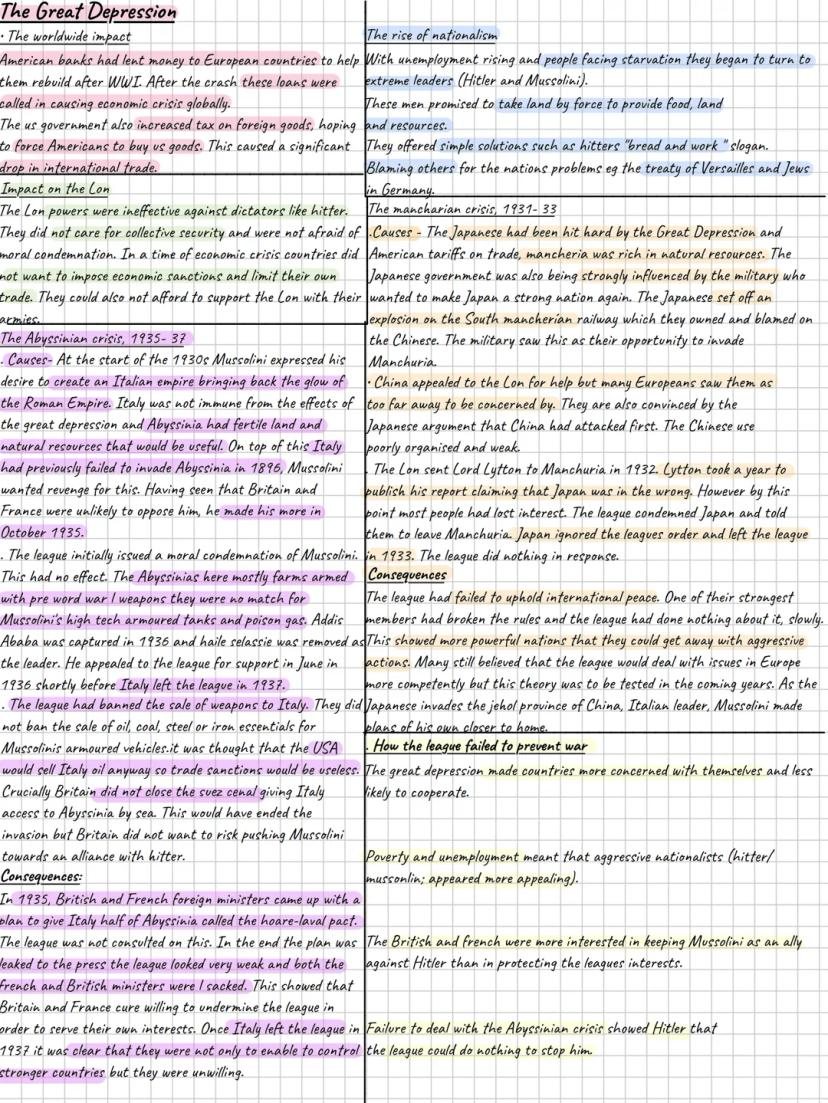
The Wall Street Crash of 1929 basically broke the League's back. Countries became too focused on their own economic survival to worry about international cooperation, and moral condemnation proved utterly useless against aggressive dictators.

The League's first major test came with the Manchurian Crisis (1931-33). Japan, hit hard by the Great Depression, invaded Manchuria after staging a fake attack on their own railway. China appealed for help, but most Europeans saw it as too far away to care about.
The League sent Lord Lytton to investigate, but by the time his report came out a year later, everyone had lost interest. They condemned Japan and told them to leave - Japan simply ignored them, left the League, and carried on invading more of China. The League did absolutely nothing in response.
The Abyssinian Crisis (1935-37) was even worse. Mussolini wanted to build an Italian empire and fancied Abyssinia's resources. Despite Haile Selassie's desperate appeals for help, the League's response was pathetic - they banned weapon sales but not oil, coal, or steel (you know, the stuff actually needed for war).
Britain refused to close the Suez Canal, which would have ended the invasion immediately, because they didn't want to push Mussolini into Hitler's arms. The Hoare-Laval Pact secretly offered Mussolini half of Abyssinia without consulting the League, showing that Britain and France were willing to completely undermine the organisation when it suited them.
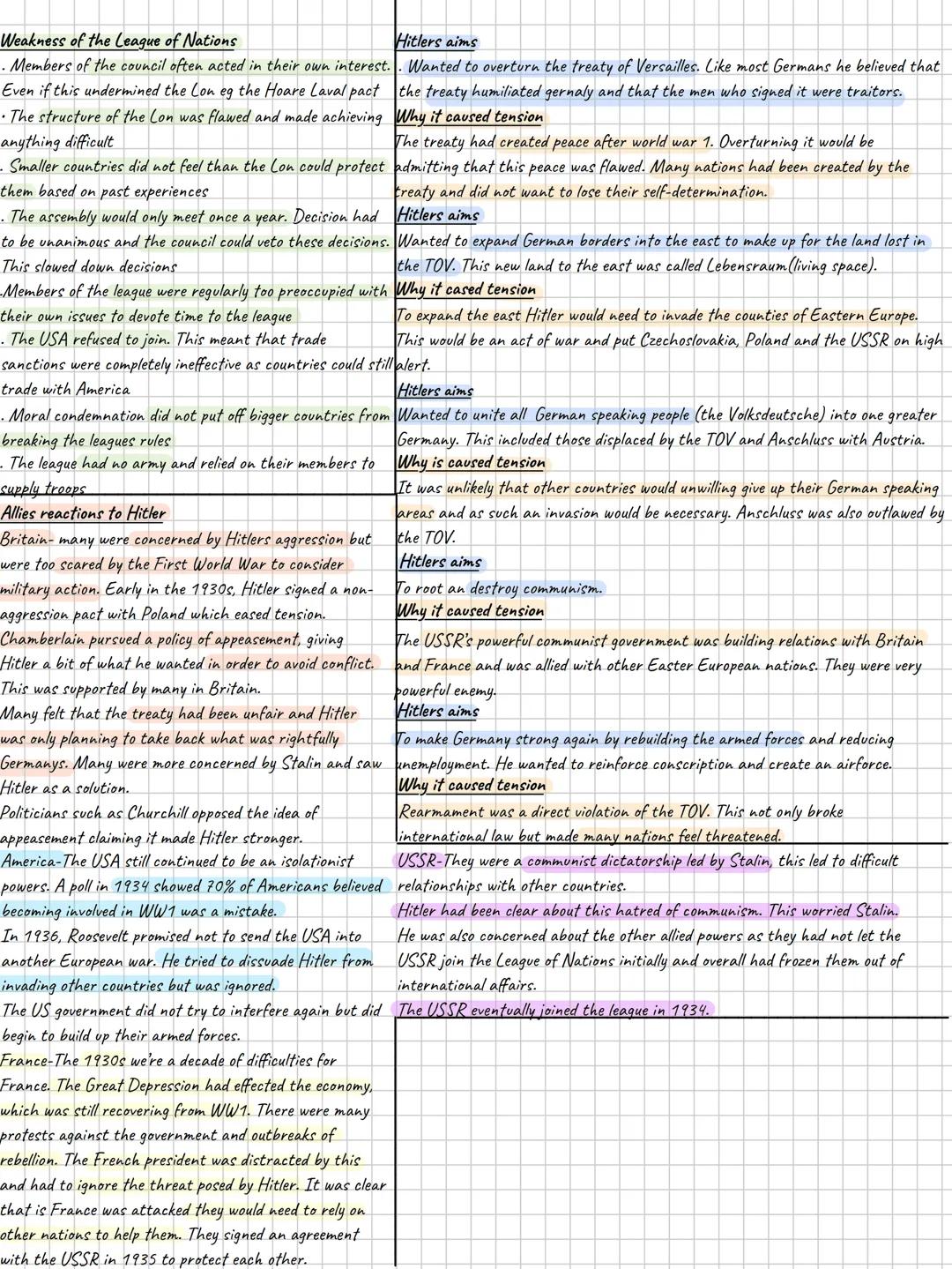
Adolf Hitler had three main aims that would terrify Europe. First, he wanted to completely overturn the Treaty of Versailles, which he saw as a national humiliation. Most Germans agreed with this, but it meant undoing the entire post-war peace settlement.
Second, Hitler wanted Lebensraum (living space) by expanding German borders eastward to replace land lost in the treaty. This basically meant invading Poland, Czechoslovakia, and potentially the USSR - definitely not something you could achieve through polite negotiation.
Third, he planned to unite all German-speaking people into one greater Germany, including those in Austria and other countries created by Versailles. Again, this would require breaking international law and probably starting wars.
The international response was worryingly weak. Britain pursued appeasement under Chamberlain, believing Hitler's demands were reasonable and hoping to avoid another devastating war. Many Brits were more worried about Stalin and communism than Hitler.
Missed Warning: Politicians like Churchill repeatedly warned that Hitler would never stop demanding more, but few people listened.
France was distracted by economic problems and internal protests, whilst America remained firmly isolationist - 70% of Americans thought joining WWI had been a mistake.

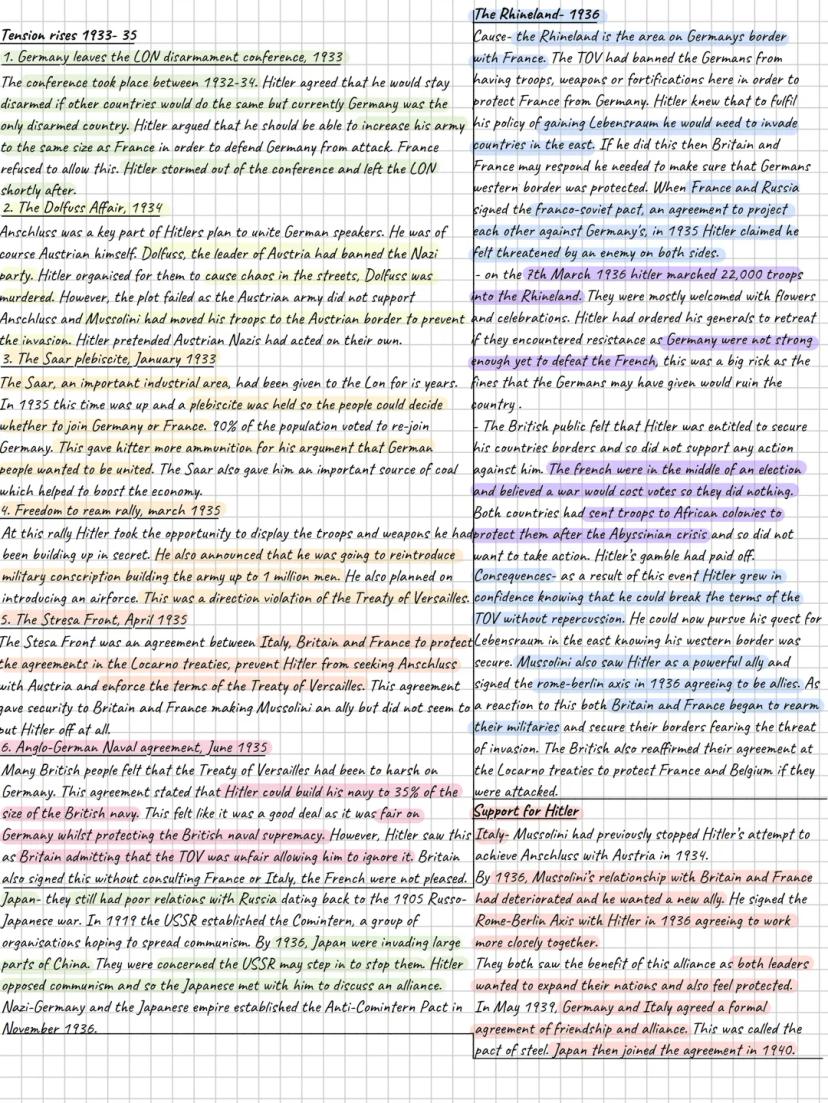
Between 1933-35, Hitler systematically tested how far he could push the boundaries. He started by leaving the League of Nations and the disarmament conference in 1933, arguing that if other countries wouldn't disarm, Germany should be allowed to rearm to defend itself.
The Dollfuss Affair (1934) saw Hitler's first attempt at Anschluss with Austria. When Austrian leader Dollfuss banned the Nazi party, Hitler organised chaos in the streets and Dollfuss was murdered. However, the plot failed because Mussolini moved troops to the Austrian border and the Austrian army didn't support the takeover.
Hitler scored his first major victory with the Saar Plebiscite (1935). When the Saar region's 15-year League administration ended, 90% voted to rejoin Germany. This gave Hitler valuable coal resources and propaganda ammunition about German people wanting unity.
At the Freedom to Rearm Rally (March 1935), Hitler boldly announced he was rebuilding Germany's military in direct violation of Versailles - introducing conscription, building the army to 1 million men, and creating an air force.
The Anglo-German Naval Agreement (June 1935) was a massive diplomatic blunder. Britain allowed Hitler to build his navy to 35% of British strength, thinking this protected their naval supremacy. Instead, Hitler saw it as Britain admitting Versailles was unfair, giving him permission to ignore other treaty terms.

The Rhineland Crisis (1936) was Hitler's most dangerous gamble yet. This demilitarised zone protected France from German attack, and remilitarising it would be a massive Treaty of Versailles violation.
When France signed the Franco-Soviet Pact in 1935, Hitler claimed Germany felt threatened by enemies on both sides. On 7th March 1936, he marched 22,000 troops into the Rhineland, ordering them to retreat immediately if they met any resistance - Germany wasn't strong enough to fight France yet.
The German troops were welcomed with flowers and celebrations, but Hitler was sweating bullets. If France had responded militarily, his regime might have collapsed. Instead, the British public thought Hitler was entitled to secure his own borders, and France was in the middle of an election campaign.
Consequences were huge: Hitler's confidence skyrocketed, knowing he could break Versailles without punishment. Mussolini saw Hitler as a powerful potential ally and signed the Rome-Berlin Axis later that year. Britain and France finally started rearming seriously, but it was arguably too late.
Turning Point: This was probably the last moment when Hitler could have been stopped without a major war - and everyone missed it.
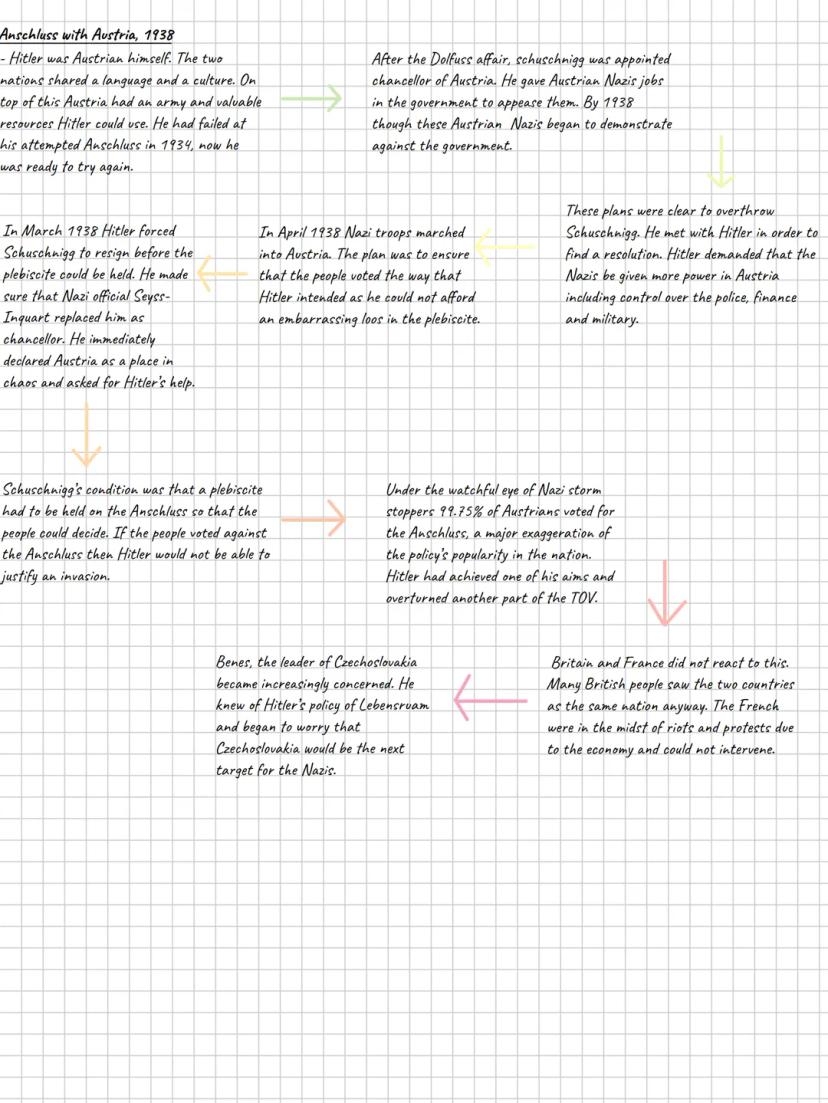
Anschluss with Austria (1938) was personal for Hitler - he was Austrian himself. After pressuring Austrian Chancellor Schuschnigg to give Nazis more power, Hitler demanded the resignation when Schuschnigg called for a plebiscite on unification.
Nazi Seyss-Inquart became Austria's new chancellor and immediately "invited" German troops in to restore order. Under the watchful eyes of Nazi storm troopers, 99.75% voted for Anschluss - obviously a rigged result, but it gave Hitler legal cover.
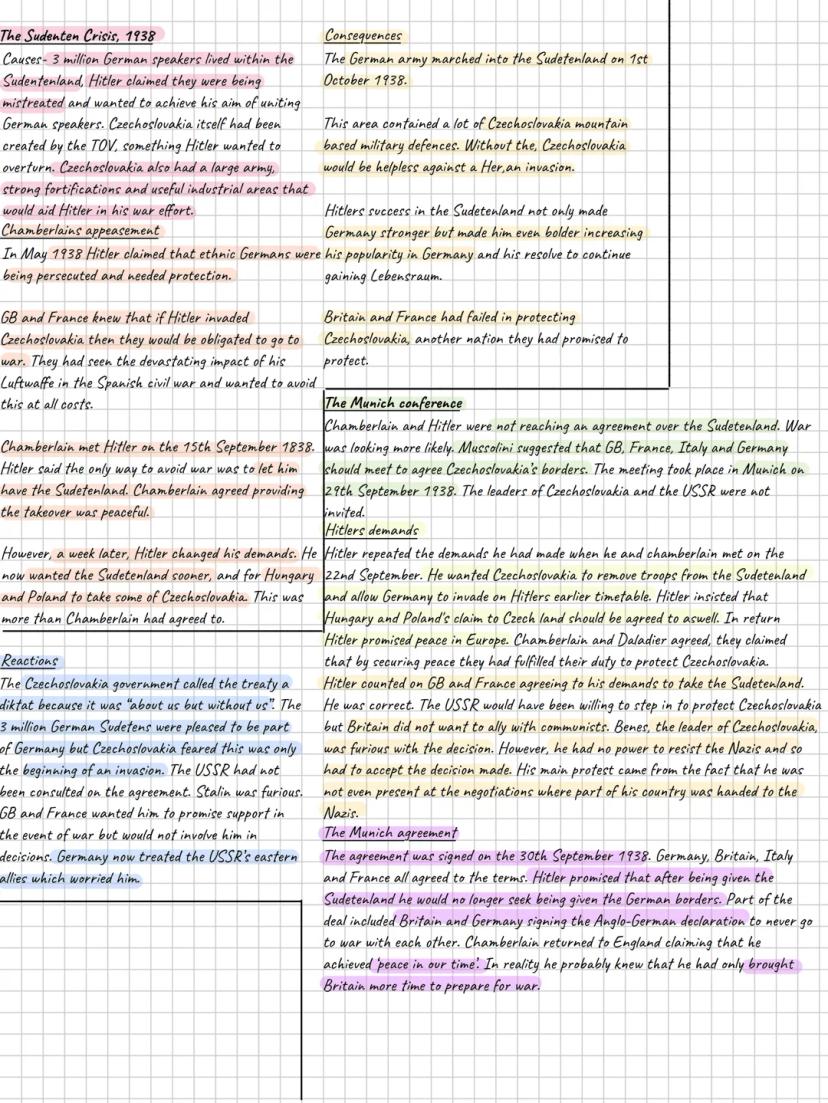
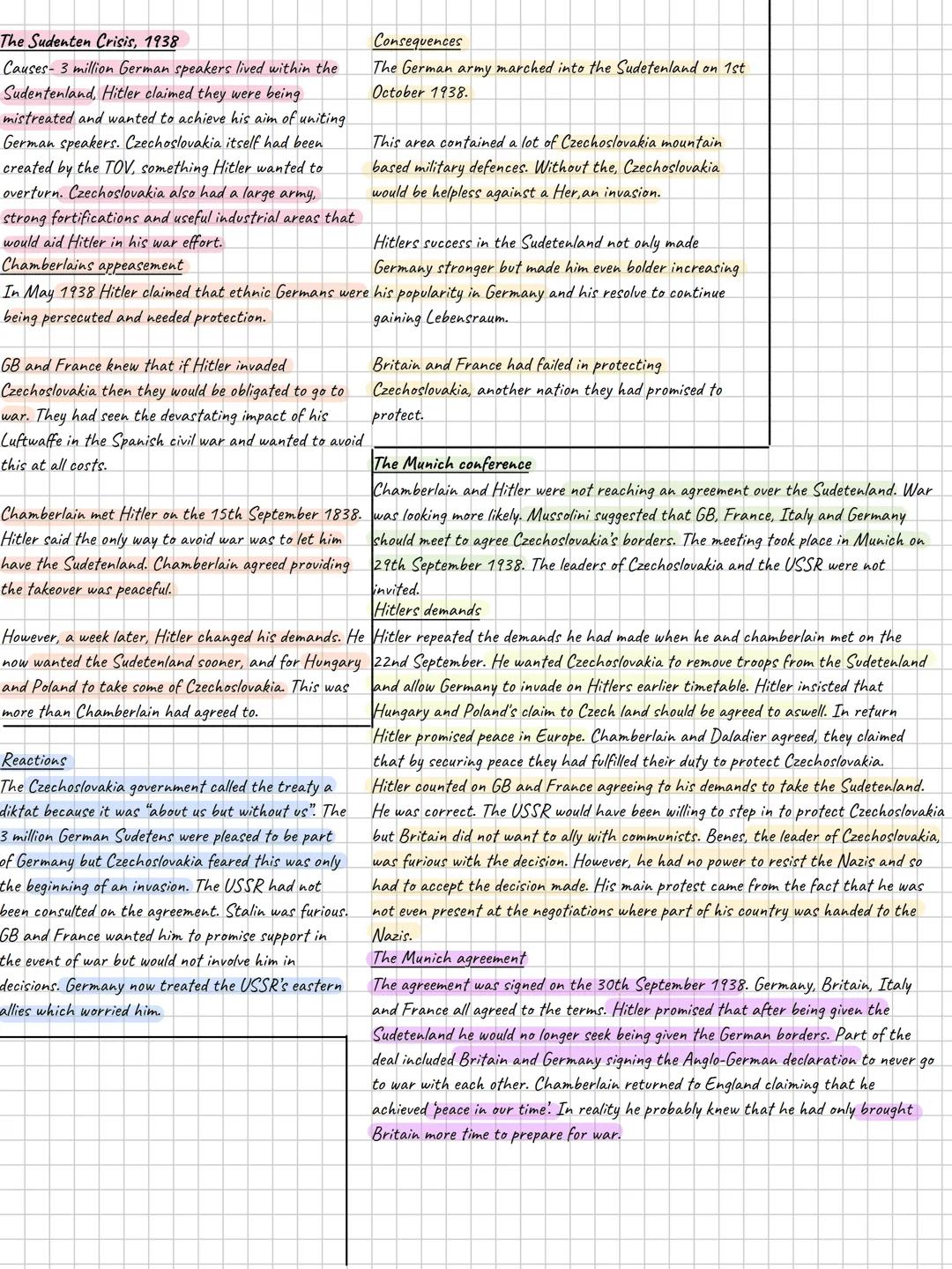
The Sudeten Crisis was where appeasement really got tested. Hitler claimed 3 million German speakers in Czechoslovakia's Sudetenland were being persecuted and needed protection. Chamberlain met Hitler multiple times, eventually agreeing to hand over the Sudetenland for "peace in our time."
The Munich Conference (September 1938) saw Britain, France, Italy, and Germany carve up Czechoslovakia without inviting the Czechs or Soviets. Benes, the Czech leader, called it a diktat - "about us, without us." The Czechs lost their mountain fortifications and were left completely defenceless.
This was appeasement's high point and ultimate failure. Stalin was furious at being excluded and began to doubt whether he could trust Britain and France to resist Hitler.

Appeasement seemed logical to many Brits in the 1930s. People genuinely believed Versailles had been unfair, were terrified of another war like 1914-18, and thought Hitler's demands were reasonable. The Great Depression meant Britain needed time to rearm anyway.
However, critics like Churchill argued appeasement was dangerously naive. They pointed out that the more Hitler got, the more he demanded, and that Britain was abandoning allies and encouraging aggression. Czechoslovakia had been a strong country that could have resisted with support.
Everything changed when Hitler invaded the rest of Czechoslovakia in March 1939. This destroyed the Munich Agreement completely - Hitler had promised he wanted no more territory, but here he was grabbing land with no German speakers at all.
Chamberlain finally realised Hitler couldn't be trusted and guaranteed Poland's independence. This was a massive shift - Britain was essentially promising to fight if Hitler invaded Poland, which everyone knew was his next target.
The Reality Check: Hitler's occupation of Czechoslovakia proved he wasn't just "correcting Versailles injustices" - he wanted to dominate Europe.
The appeasement era was over. Britain and France began serious military preparations, but they'd lost valuable allies and given Hitler years to build up his military strength.

The Nazi-Soviet Pact (August 1939) shocked the world - communists and fascists weren't supposed to be friends! But both Hitler and Stalin had practical reasons for this unlikely alliance.
For Hitler, the pact solved his biggest strategic problem. Germany had lost WWI largely because they'd fought on two fronts simultaneously. With war against Britain and France looking inevitable, he desperately needed to keep the USSR's massive army out of the fight.
Stalin's motivations were equally cynical. The Munich Agreement had convinced him that Britain and France couldn't be trusted - they'd excluded him from decisions but expected Soviet support if war broke out. The pact gave him time to prepare for the inevitable Nazi attack whilst regaining Polish territory lost in 1918.
Secretly, they agreed to split Poland between them. This meant Hitler could invade without worrying about Soviet intervention, whilst Stalin got a "buffer zone" and territorial gains without fighting.
On 1st September 1939, Hitler invaded Poland with devastating effect. The entire Polish air force was destroyed before it could take off. Britain and France waited three days hoping Hitler would back down, then declared war on 3rd September.
War Inevitable: The Nazi-Soviet Pact made European war almost certain - Hitler now felt free to use force knowing he wouldn't face the dreaded two-front war.
Chamberlain's appeasement policy had completely failed. Within a year, he'd resign and be replaced by Churchill. Ironically, the time appeasement bought for British rearmament probably saved the country in 1940.
Our AI Companion is a student-focused AI tool that offers more than just answers. Built on millions of Knowunity resources, it provides relevant information, personalised study plans, quizzes, and content directly in the chat, adapting to your individual learning journey.
You can download the app from Google Play Store and Apple App Store.
That's right! Enjoy free access to study content, connect with fellow students, and get instant help – all at your fingertips.
App Store
Google Play
The app is very easy to use and well designed. I have found everything I was looking for so far and have been able to learn a lot from the presentations! I will definitely use the app for a class assignment! And of course it also helps a lot as an inspiration.
Stefan S
iOS user
This app is really great. There are so many study notes and help [...]. My problem subject is French, for example, and the app has so many options for help. Thanks to this app, I have improved my French. I would recommend it to anyone.
Samantha Klich
Android user
Wow, I am really amazed. I just tried the app because I've seen it advertised many times and was absolutely stunned. This app is THE HELP you want for school and above all, it offers so many things, such as workouts and fact sheets, which have been VERY helpful to me personally.
Anna
iOS user
Best app on earth! no words because it’s too good
Thomas R
iOS user
Just amazing. Let's me revise 10x better, this app is a quick 10/10. I highly recommend it to anyone. I can watch and search for notes. I can save them in the subject folder. I can revise it any time when I come back. If you haven't tried this app, you're really missing out.
Basil
Android user
This app has made me feel so much more confident in my exam prep, not only through boosting my own self confidence through the features that allow you to connect with others and feel less alone, but also through the way the app itself is centred around making you feel better. It is easy to navigate, fun to use, and helpful to anyone struggling in absolutely any way.
David K
iOS user
The app's just great! All I have to do is enter the topic in the search bar and I get the response real fast. I don't have to watch 10 YouTube videos to understand something, so I'm saving my time. Highly recommended!
Sudenaz Ocak
Android user
In school I was really bad at maths but thanks to the app, I am doing better now. I am so grateful that you made the app.
Greenlight Bonnie
Android user
very reliable app to help and grow your ideas of Maths, English and other related topics in your works. please use this app if your struggling in areas, this app is key for that. wish I'd of done a review before. and it's also free so don't worry about that.
Rohan U
Android user
I know a lot of apps use fake accounts to boost their reviews but this app deserves it all. Originally I was getting 4 in my English exams and this time I got a grade 7. I didn’t even know about this app three days until the exam and it has helped A LOT. Please actually trust me and use it as I’m sure you too will see developments.
Xander S
iOS user
THE QUIZES AND FLASHCARDS ARE SO USEFUL AND I LOVE Knowunity AI. IT ALSO IS LITREALLY LIKE CHATGPT BUT SMARTER!! HELPED ME WITH MY MASCARA PROBLEMS TOO!! AS WELL AS MY REAL SUBJECTS ! DUHHH 😍😁😲🤑💗✨🎀😮
Elisha
iOS user
This apps acc the goat. I find revision so boring but this app makes it so easy to organize it all and then you can ask the freeeee ai to test yourself so good and you can easily upload your own stuff. highly recommend as someone taking mocks now
Paul T
iOS user
The app is very easy to use and well designed. I have found everything I was looking for so far and have been able to learn a lot from the presentations! I will definitely use the app for a class assignment! And of course it also helps a lot as an inspiration.
Stefan S
iOS user
This app is really great. There are so many study notes and help [...]. My problem subject is French, for example, and the app has so many options for help. Thanks to this app, I have improved my French. I would recommend it to anyone.
Samantha Klich
Android user
Wow, I am really amazed. I just tried the app because I've seen it advertised many times and was absolutely stunned. This app is THE HELP you want for school and above all, it offers so many things, such as workouts and fact sheets, which have been VERY helpful to me personally.
Anna
iOS user
Best app on earth! no words because it’s too good
Thomas R
iOS user
Just amazing. Let's me revise 10x better, this app is a quick 10/10. I highly recommend it to anyone. I can watch and search for notes. I can save them in the subject folder. I can revise it any time when I come back. If you haven't tried this app, you're really missing out.
Basil
Android user
This app has made me feel so much more confident in my exam prep, not only through boosting my own self confidence through the features that allow you to connect with others and feel less alone, but also through the way the app itself is centred around making you feel better. It is easy to navigate, fun to use, and helpful to anyone struggling in absolutely any way.
David K
iOS user
The app's just great! All I have to do is enter the topic in the search bar and I get the response real fast. I don't have to watch 10 YouTube videos to understand something, so I'm saving my time. Highly recommended!
Sudenaz Ocak
Android user
In school I was really bad at maths but thanks to the app, I am doing better now. I am so grateful that you made the app.
Greenlight Bonnie
Android user
very reliable app to help and grow your ideas of Maths, English and other related topics in your works. please use this app if your struggling in areas, this app is key for that. wish I'd of done a review before. and it's also free so don't worry about that.
Rohan U
Android user
I know a lot of apps use fake accounts to boost their reviews but this app deserves it all. Originally I was getting 4 in my English exams and this time I got a grade 7. I didn’t even know about this app three days until the exam and it has helped A LOT. Please actually trust me and use it as I’m sure you too will see developments.
Xander S
iOS user
THE QUIZES AND FLASHCARDS ARE SO USEFUL AND I LOVE Knowunity AI. IT ALSO IS LITREALLY LIKE CHATGPT BUT SMARTER!! HELPED ME WITH MY MASCARA PROBLEMS TOO!! AS WELL AS MY REAL SUBJECTS ! DUHHH 😍😁😲🤑💗✨🎀😮
Elisha
iOS user
This apps acc the goat. I find revision so boring but this app makes it so easy to organize it all and then you can ask the freeeee ai to test yourself so good and you can easily upload your own stuff. highly recommend as someone taking mocks now
Paul T
iOS user
Kitty
@keek5
Ever wondered how Europe stumbled into another world war just 20 years after the "war to end all wars"? The period between 1918-1939 is basically a masterclass in how international tensions can spiral completely out of control, featuring failed peace... Show more
Access to all documents
Improve your grades
Join milions of students
The First World War finally ended in 1918 when Germany simply ran out of steam. After their spring offensive failed and American troops kept pouring in, German sailors started mutinying and civilians began protesting in the streets. The Kaiser legged it to Holland, leaving the new government to sign the armistice.
Here's where it gets interesting - many Germans had no clue how badly they were losing the war. To them, signing the armistice felt like a massive betrayal, and they branded the politicians who signed it the "November Criminals". This resentment would come back to haunt everyone later.
When it came to sorting out the peace treaty, the Big Three leaders had completely different ideas. Wilson (America) wanted a fair deal that wouldn't cause another war, Clemenceau (France) wanted to absolutely cripple Germany so they could never attack France again, and Lloyd George (Britain) wanted something in between - harsh enough to satisfy voters but not so brutal it would destroy trade.
Quick Fact: Lloyd George correctly predicted that the harsh treaty would lead to another war in 25 years - he was spot on!
Access to all documents
Improve your grades
Join milions of students
The Treaty of Versailles was basically designed to humiliate Germany, and boy did it succeed. The infamous Article 231 (war guilt clause) forced Germany to accept full blame for the war, which absolutely infuriated Germans who felt the causes were way more complicated.
The treaty's terms were brutal: Germany lost 13% of its land, had to pay £6.6 billion in reparations, and their military was slashed to just 100,000 men with no tanks, air force, or submarines allowed. The Rhineland became a demilitarised zone, and Germany was banned from uniting with Austria (Anschluss).
Public reaction was mixed but telling. Most Brits thought it was fair, but many French people wanted it even harsher and voted Clemenceau out of office. Americans worried it was too brutal and would backfire. The Germans? Well, they were absolutely livid and felt completely humiliated.
This treaty created the perfect storm for future conflict. Six million Germans now lived outside Germany's borders, giving future leaders a convenient excuse to "reclaim" lost territories. The stage was set for round two.
Access to all documents
Improve your grades
Join milions of students
The League of Nations was Wilson's baby - his grand plan to prevent future wars through international cooperation and collective security. Founded with 42 members, it aimed to resolve disputes peacefully and tackle global issues like disease and working conditions.
The League's structure was its biggest weakness. The Assembly (like a parliament) met only once a year and needed unanimous decisions for everything, whilst the Council (the leaders) could veto any decision. It was like trying to run a school where every single student had to agree before anything could happen.
When countries misbehaved, the League had a four-step plan: discussion, warnings, economic sanctions, and finally military action. Sounds reasonable, right? The problem was they had no army of their own and relied on members to provide troops - which rarely happened when it mattered.
Major Flaw: The USA never joined the League, making trade sanctions completely useless since countries could just trade with America instead.
The Wall Street Crash of 1929 basically broke the League's back. Countries became too focused on their own economic survival to worry about international cooperation, and moral condemnation proved utterly useless against aggressive dictators.
Access to all documents
Improve your grades
Join milions of students
The League's first major test came with the Manchurian Crisis (1931-33). Japan, hit hard by the Great Depression, invaded Manchuria after staging a fake attack on their own railway. China appealed for help, but most Europeans saw it as too far away to care about.
The League sent Lord Lytton to investigate, but by the time his report came out a year later, everyone had lost interest. They condemned Japan and told them to leave - Japan simply ignored them, left the League, and carried on invading more of China. The League did absolutely nothing in response.
The Abyssinian Crisis (1935-37) was even worse. Mussolini wanted to build an Italian empire and fancied Abyssinia's resources. Despite Haile Selassie's desperate appeals for help, the League's response was pathetic - they banned weapon sales but not oil, coal, or steel (you know, the stuff actually needed for war).
Britain refused to close the Suez Canal, which would have ended the invasion immediately, because they didn't want to push Mussolini into Hitler's arms. The Hoare-Laval Pact secretly offered Mussolini half of Abyssinia without consulting the League, showing that Britain and France were willing to completely undermine the organisation when it suited them.
Access to all documents
Improve your grades
Join milions of students
Adolf Hitler had three main aims that would terrify Europe. First, he wanted to completely overturn the Treaty of Versailles, which he saw as a national humiliation. Most Germans agreed with this, but it meant undoing the entire post-war peace settlement.
Second, Hitler wanted Lebensraum (living space) by expanding German borders eastward to replace land lost in the treaty. This basically meant invading Poland, Czechoslovakia, and potentially the USSR - definitely not something you could achieve through polite negotiation.
Third, he planned to unite all German-speaking people into one greater Germany, including those in Austria and other countries created by Versailles. Again, this would require breaking international law and probably starting wars.
The international response was worryingly weak. Britain pursued appeasement under Chamberlain, believing Hitler's demands were reasonable and hoping to avoid another devastating war. Many Brits were more worried about Stalin and communism than Hitler.
Missed Warning: Politicians like Churchill repeatedly warned that Hitler would never stop demanding more, but few people listened.
France was distracted by economic problems and internal protests, whilst America remained firmly isolationist - 70% of Americans thought joining WWI had been a mistake.
Access to all documents
Improve your grades
Join milions of students
Between 1933-35, Hitler systematically tested how far he could push the boundaries. He started by leaving the League of Nations and the disarmament conference in 1933, arguing that if other countries wouldn't disarm, Germany should be allowed to rearm to defend itself.
The Dollfuss Affair (1934) saw Hitler's first attempt at Anschluss with Austria. When Austrian leader Dollfuss banned the Nazi party, Hitler organised chaos in the streets and Dollfuss was murdered. However, the plot failed because Mussolini moved troops to the Austrian border and the Austrian army didn't support the takeover.
Hitler scored his first major victory with the Saar Plebiscite (1935). When the Saar region's 15-year League administration ended, 90% voted to rejoin Germany. This gave Hitler valuable coal resources and propaganda ammunition about German people wanting unity.
At the Freedom to Rearm Rally (March 1935), Hitler boldly announced he was rebuilding Germany's military in direct violation of Versailles - introducing conscription, building the army to 1 million men, and creating an air force.
The Anglo-German Naval Agreement (June 1935) was a massive diplomatic blunder. Britain allowed Hitler to build his navy to 35% of British strength, thinking this protected their naval supremacy. Instead, Hitler saw it as Britain admitting Versailles was unfair, giving him permission to ignore other treaty terms.
Access to all documents
Improve your grades
Join milions of students
The Rhineland Crisis (1936) was Hitler's most dangerous gamble yet. This demilitarised zone protected France from German attack, and remilitarising it would be a massive Treaty of Versailles violation.
When France signed the Franco-Soviet Pact in 1935, Hitler claimed Germany felt threatened by enemies on both sides. On 7th March 1936, he marched 22,000 troops into the Rhineland, ordering them to retreat immediately if they met any resistance - Germany wasn't strong enough to fight France yet.
The German troops were welcomed with flowers and celebrations, but Hitler was sweating bullets. If France had responded militarily, his regime might have collapsed. Instead, the British public thought Hitler was entitled to secure his own borders, and France was in the middle of an election campaign.
Consequences were huge: Hitler's confidence skyrocketed, knowing he could break Versailles without punishment. Mussolini saw Hitler as a powerful potential ally and signed the Rome-Berlin Axis later that year. Britain and France finally started rearming seriously, but it was arguably too late.
Turning Point: This was probably the last moment when Hitler could have been stopped without a major war - and everyone missed it.
Access to all documents
Improve your grades
Join milions of students
Anschluss with Austria (1938) was personal for Hitler - he was Austrian himself. After pressuring Austrian Chancellor Schuschnigg to give Nazis more power, Hitler demanded the resignation when Schuschnigg called for a plebiscite on unification.
Nazi Seyss-Inquart became Austria's new chancellor and immediately "invited" German troops in to restore order. Under the watchful eyes of Nazi storm troopers, 99.75% voted for Anschluss - obviously a rigged result, but it gave Hitler legal cover.
The Sudeten Crisis was where appeasement really got tested. Hitler claimed 3 million German speakers in Czechoslovakia's Sudetenland were being persecuted and needed protection. Chamberlain met Hitler multiple times, eventually agreeing to hand over the Sudetenland for "peace in our time."
The Munich Conference (September 1938) saw Britain, France, Italy, and Germany carve up Czechoslovakia without inviting the Czechs or Soviets. Benes, the Czech leader, called it a diktat - "about us, without us." The Czechs lost their mountain fortifications and were left completely defenceless.
This was appeasement's high point and ultimate failure. Stalin was furious at being excluded and began to doubt whether he could trust Britain and France to resist Hitler.
Access to all documents
Improve your grades
Join milions of students
Appeasement seemed logical to many Brits in the 1930s. People genuinely believed Versailles had been unfair, were terrified of another war like 1914-18, and thought Hitler's demands were reasonable. The Great Depression meant Britain needed time to rearm anyway.
However, critics like Churchill argued appeasement was dangerously naive. They pointed out that the more Hitler got, the more he demanded, and that Britain was abandoning allies and encouraging aggression. Czechoslovakia had been a strong country that could have resisted with support.
Everything changed when Hitler invaded the rest of Czechoslovakia in March 1939. This destroyed the Munich Agreement completely - Hitler had promised he wanted no more territory, but here he was grabbing land with no German speakers at all.
Chamberlain finally realised Hitler couldn't be trusted and guaranteed Poland's independence. This was a massive shift - Britain was essentially promising to fight if Hitler invaded Poland, which everyone knew was his next target.
The Reality Check: Hitler's occupation of Czechoslovakia proved he wasn't just "correcting Versailles injustices" - he wanted to dominate Europe.
The appeasement era was over. Britain and France began serious military preparations, but they'd lost valuable allies and given Hitler years to build up his military strength.
Access to all documents
Improve your grades
Join milions of students
The Nazi-Soviet Pact (August 1939) shocked the world - communists and fascists weren't supposed to be friends! But both Hitler and Stalin had practical reasons for this unlikely alliance.
For Hitler, the pact solved his biggest strategic problem. Germany had lost WWI largely because they'd fought on two fronts simultaneously. With war against Britain and France looking inevitable, he desperately needed to keep the USSR's massive army out of the fight.
Stalin's motivations were equally cynical. The Munich Agreement had convinced him that Britain and France couldn't be trusted - they'd excluded him from decisions but expected Soviet support if war broke out. The pact gave him time to prepare for the inevitable Nazi attack whilst regaining Polish territory lost in 1918.
Secretly, they agreed to split Poland between them. This meant Hitler could invade without worrying about Soviet intervention, whilst Stalin got a "buffer zone" and territorial gains without fighting.
On 1st September 1939, Hitler invaded Poland with devastating effect. The entire Polish air force was destroyed before it could take off. Britain and France waited three days hoping Hitler would back down, then declared war on 3rd September.
War Inevitable: The Nazi-Soviet Pact made European war almost certain - Hitler now felt free to use force knowing he wouldn't face the dreaded two-front war.
Chamberlain's appeasement policy had completely failed. Within a year, he'd resign and be replaced by Churchill. Ironically, the time appeasement bought for British rearmament probably saved the country in 1940.
Our AI Companion is a student-focused AI tool that offers more than just answers. Built on millions of Knowunity resources, it provides relevant information, personalised study plans, quizzes, and content directly in the chat, adapting to your individual learning journey.
You can download the app from Google Play Store and Apple App Store.
That's right! Enjoy free access to study content, connect with fellow students, and get instant help – all at your fingertips.
7
Smart Tools NEW
Transform this note into: ✓ 50+ Practice Questions ✓ Interactive Flashcards ✓ Full Mock Exam ✓ Essay Outlines
App Store
Google Play
The app is very easy to use and well designed. I have found everything I was looking for so far and have been able to learn a lot from the presentations! I will definitely use the app for a class assignment! And of course it also helps a lot as an inspiration.
Stefan S
iOS user
This app is really great. There are so many study notes and help [...]. My problem subject is French, for example, and the app has so many options for help. Thanks to this app, I have improved my French. I would recommend it to anyone.
Samantha Klich
Android user
Wow, I am really amazed. I just tried the app because I've seen it advertised many times and was absolutely stunned. This app is THE HELP you want for school and above all, it offers so many things, such as workouts and fact sheets, which have been VERY helpful to me personally.
Anna
iOS user
Best app on earth! no words because it’s too good
Thomas R
iOS user
Just amazing. Let's me revise 10x better, this app is a quick 10/10. I highly recommend it to anyone. I can watch and search for notes. I can save them in the subject folder. I can revise it any time when I come back. If you haven't tried this app, you're really missing out.
Basil
Android user
This app has made me feel so much more confident in my exam prep, not only through boosting my own self confidence through the features that allow you to connect with others and feel less alone, but also through the way the app itself is centred around making you feel better. It is easy to navigate, fun to use, and helpful to anyone struggling in absolutely any way.
David K
iOS user
The app's just great! All I have to do is enter the topic in the search bar and I get the response real fast. I don't have to watch 10 YouTube videos to understand something, so I'm saving my time. Highly recommended!
Sudenaz Ocak
Android user
In school I was really bad at maths but thanks to the app, I am doing better now. I am so grateful that you made the app.
Greenlight Bonnie
Android user
very reliable app to help and grow your ideas of Maths, English and other related topics in your works. please use this app if your struggling in areas, this app is key for that. wish I'd of done a review before. and it's also free so don't worry about that.
Rohan U
Android user
I know a lot of apps use fake accounts to boost their reviews but this app deserves it all. Originally I was getting 4 in my English exams and this time I got a grade 7. I didn’t even know about this app three days until the exam and it has helped A LOT. Please actually trust me and use it as I’m sure you too will see developments.
Xander S
iOS user
THE QUIZES AND FLASHCARDS ARE SO USEFUL AND I LOVE Knowunity AI. IT ALSO IS LITREALLY LIKE CHATGPT BUT SMARTER!! HELPED ME WITH MY MASCARA PROBLEMS TOO!! AS WELL AS MY REAL SUBJECTS ! DUHHH 😍😁😲🤑💗✨🎀😮
Elisha
iOS user
This apps acc the goat. I find revision so boring but this app makes it so easy to organize it all and then you can ask the freeeee ai to test yourself so good and you can easily upload your own stuff. highly recommend as someone taking mocks now
Paul T
iOS user
The app is very easy to use and well designed. I have found everything I was looking for so far and have been able to learn a lot from the presentations! I will definitely use the app for a class assignment! And of course it also helps a lot as an inspiration.
Stefan S
iOS user
This app is really great. There are so many study notes and help [...]. My problem subject is French, for example, and the app has so many options for help. Thanks to this app, I have improved my French. I would recommend it to anyone.
Samantha Klich
Android user
Wow, I am really amazed. I just tried the app because I've seen it advertised many times and was absolutely stunned. This app is THE HELP you want for school and above all, it offers so many things, such as workouts and fact sheets, which have been VERY helpful to me personally.
Anna
iOS user
Best app on earth! no words because it’s too good
Thomas R
iOS user
Just amazing. Let's me revise 10x better, this app is a quick 10/10. I highly recommend it to anyone. I can watch and search for notes. I can save them in the subject folder. I can revise it any time when I come back. If you haven't tried this app, you're really missing out.
Basil
Android user
This app has made me feel so much more confident in my exam prep, not only through boosting my own self confidence through the features that allow you to connect with others and feel less alone, but also through the way the app itself is centred around making you feel better. It is easy to navigate, fun to use, and helpful to anyone struggling in absolutely any way.
David K
iOS user
The app's just great! All I have to do is enter the topic in the search bar and I get the response real fast. I don't have to watch 10 YouTube videos to understand something, so I'm saving my time. Highly recommended!
Sudenaz Ocak
Android user
In school I was really bad at maths but thanks to the app, I am doing better now. I am so grateful that you made the app.
Greenlight Bonnie
Android user
very reliable app to help and grow your ideas of Maths, English and other related topics in your works. please use this app if your struggling in areas, this app is key for that. wish I'd of done a review before. and it's also free so don't worry about that.
Rohan U
Android user
I know a lot of apps use fake accounts to boost their reviews but this app deserves it all. Originally I was getting 4 in my English exams and this time I got a grade 7. I didn’t even know about this app three days until the exam and it has helped A LOT. Please actually trust me and use it as I’m sure you too will see developments.
Xander S
iOS user
THE QUIZES AND FLASHCARDS ARE SO USEFUL AND I LOVE Knowunity AI. IT ALSO IS LITREALLY LIKE CHATGPT BUT SMARTER!! HELPED ME WITH MY MASCARA PROBLEMS TOO!! AS WELL AS MY REAL SUBJECTS ! DUHHH 😍😁😲🤑💗✨🎀😮
Elisha
iOS user
This apps acc the goat. I find revision so boring but this app makes it so easy to organize it all and then you can ask the freeeee ai to test yourself so good and you can easily upload your own stuff. highly recommend as someone taking mocks now
Paul T
iOS user