
Tudor education was shaped by social class, gender, and religious... Show more
 English Literature
 Sociology
 Biology
Sign up to see the contentIt's free!
Access to all documents
Improve your grades
Join milions of students
Knowunity AI
Subjects
Triangle Congruence and Similarity Theorems
Triangle Properties and Classification
Linear Equations and Graphs
Geometric Angle Relationships
Trigonometric Functions and Identities
Equation Solving Techniques
Circle Geometry Fundamentals
Division Operations and Methods
Basic Differentiation Rules
Exponent and Logarithm Properties
Show all topics
Human Organ Systems
Reproductive Cell Cycles
Biological Sciences Subdisciplines
Cellular Energy Metabolism
Autotrophic Energy Processes
Inheritance Patterns and Principles
Biomolecular Structure and Organization
Cell Cycle and Division Mechanics
Cellular Organization and Development
Biological Structural Organization
Show all topics
Chemical Sciences and Applications
Atomic Structure and Composition
Molecular Electron Structure Representation
Atomic Electron Behavior
Matter Properties and Water
Mole Concept and Calculations
Gas Laws and Behavior
Periodic Table Organization
Chemical Thermodynamics Fundamentals
Chemical Bond Types and Properties
Show all topics
European Renaissance and Enlightenment
European Cultural Movements 800-1920
American Revolution Era 1763-1797
American Civil War 1861-1865
Global Imperial Systems
Mongol and Chinese Dynasties
U.S. Presidents and World Leaders
Historical Sources and Documentation
World Wars Era and Impact
World Religious Systems
Show all topics
Classic and Contemporary Novels
Literary Character Analysis
Rhetorical Theory and Practice
Classic Literary Narratives
Reading Analysis and Interpretation
Narrative Structure and Techniques
English Language Components
Influential English-Language Authors
Basic Sentence Structure
Narrative Voice and Perspective
Show all topics
364
•
Updated Mar 18, 2026
•

nicola
@nicolaoakleyx
Tudor education was shaped by social class, gender, and religious... Show more
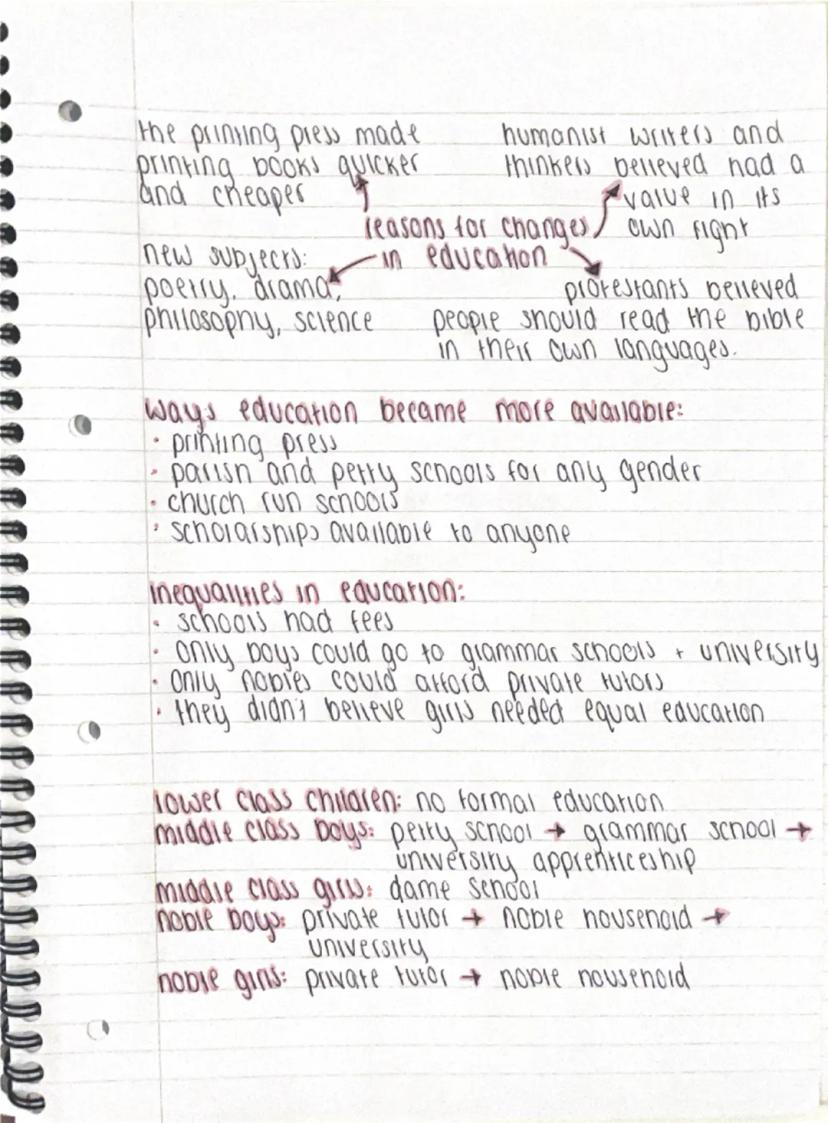
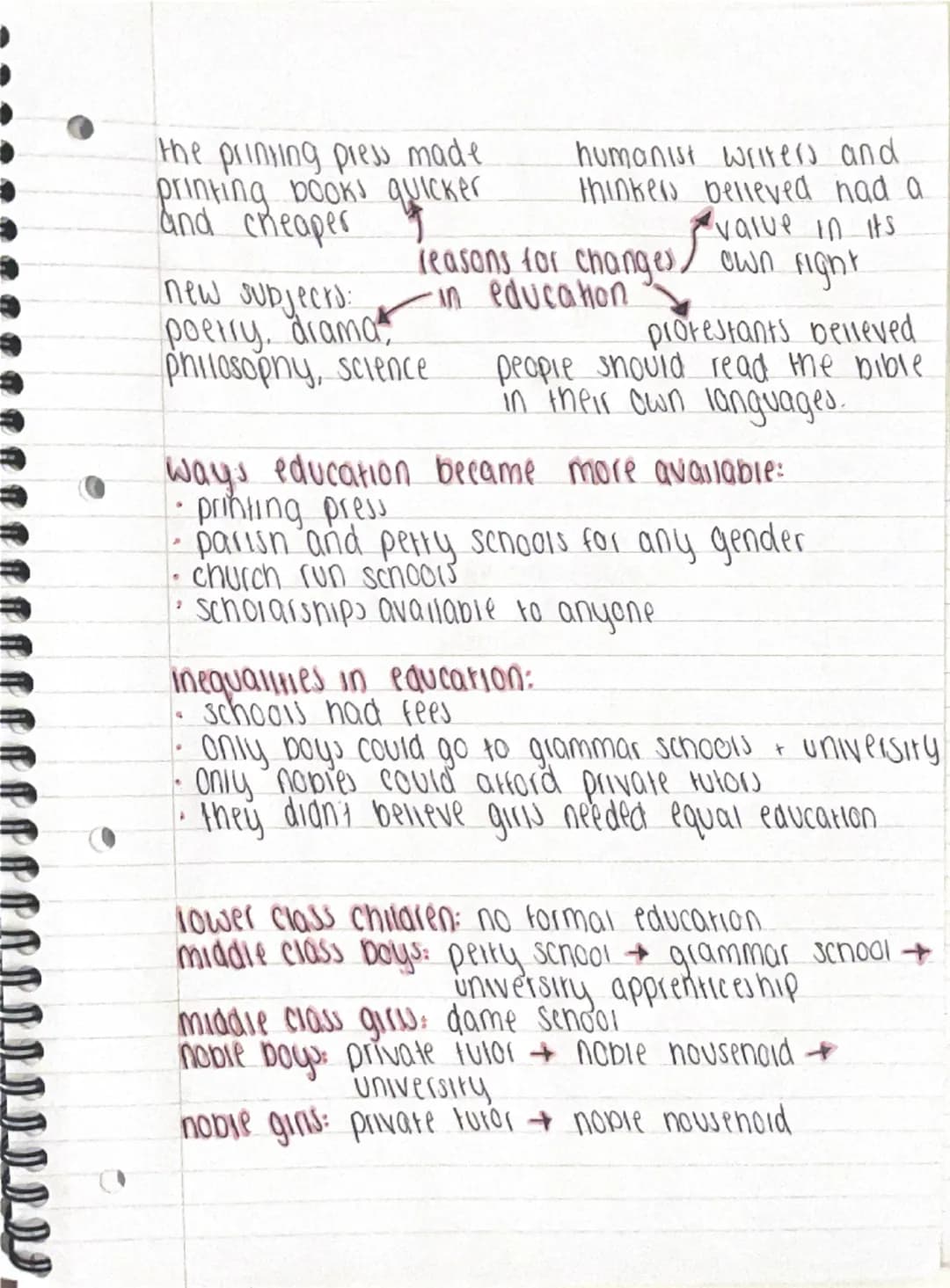
Education in Tudor times underwent significant shifts due to several key factors. The printing press made books cheaper and quicker to produce, while new subjects like poetry, drama, philosophy and science expanded the curriculum. Humanist thinkers began valuing education for its own sake rather than purely religious purposes.
Protestant beliefs drove educational change too, as they wanted people to read the Bible in their own languages rather than rely on priests' interpretations. Education became more widely available through parish schools that accepted both boys and girls, church-run schools, and scholarships.
Despite these advances, significant inequalities in education persisted. Schools charged fees that many couldn't afford, and only boys could attend grammar schools or universities. Girls' education was limited because society didn't believe they needed equal learning, while lower class children typically received no formal education at all.
Did you know? Middle class boys could progress from petty school to grammar school and potentially university, while middle class girls were limited to dame schools. Noble children had private tutors, but only the boys could later attend university.
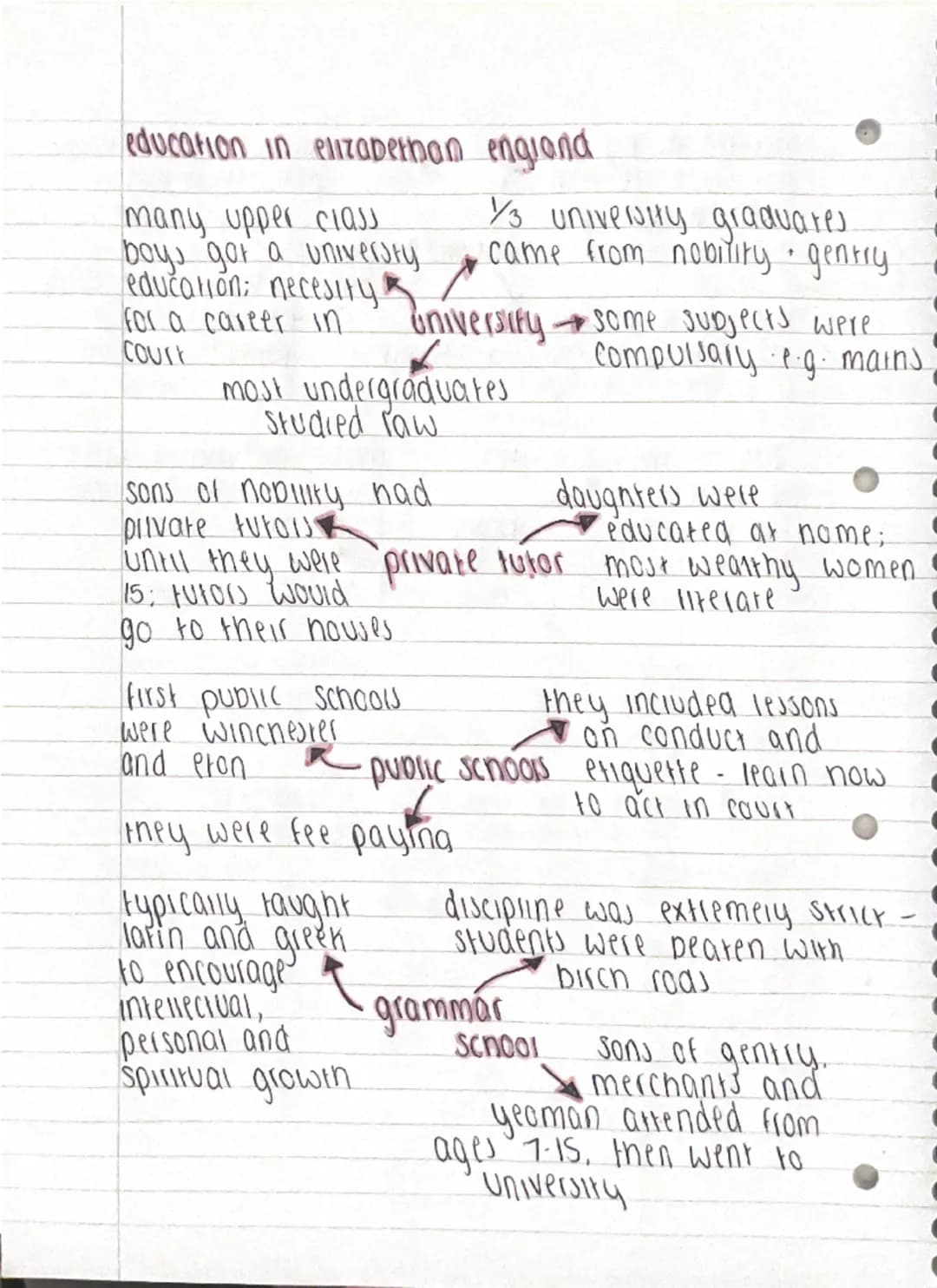
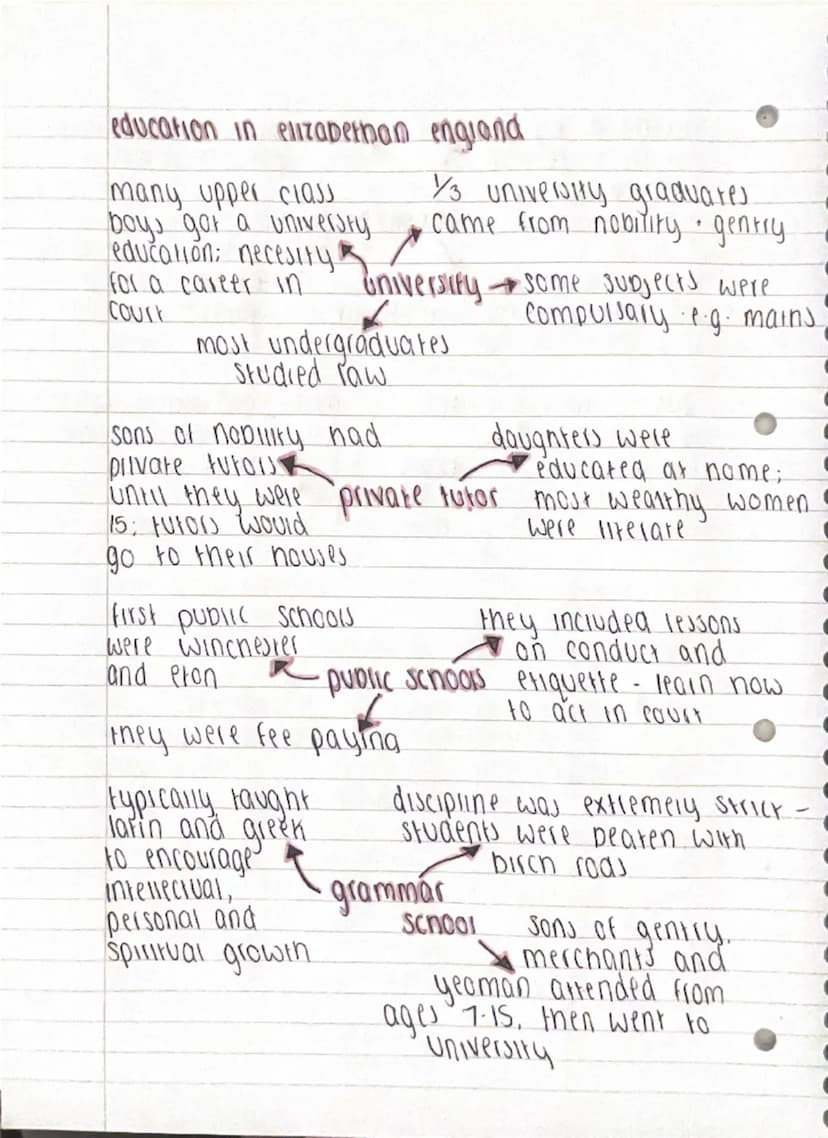
For wealthy families, education followed strict gender lines. Upper-class boys often received a university education, considered necessary for careers at court. Most undergraduates studied law, with some subjects like mathematics being compulsory. Before university, sons of nobility had private tutors until age 15, who would visit their homes.
The first public schools were Winchester and Eton, which charged fees and typically taught Latin and Greek. These schools aimed to develop intellectual, spiritual and personal growth. Discipline was extremely strict – students were often beaten with birch rods for misbehaviour.
For girls, education looked very different. Wealthy daughters were educated at home by private tutors, with many becoming literate. However, their curriculum focused heavily on proper conduct and etiquette – essentially, learning how to behave appropriately in court and society.
Remember this! Grammar schools were attended by sons of gentry, merchants and yeomen from ages 7-15, who might then progress to university. About 75% of university graduates came from nobility or gentry backgrounds.
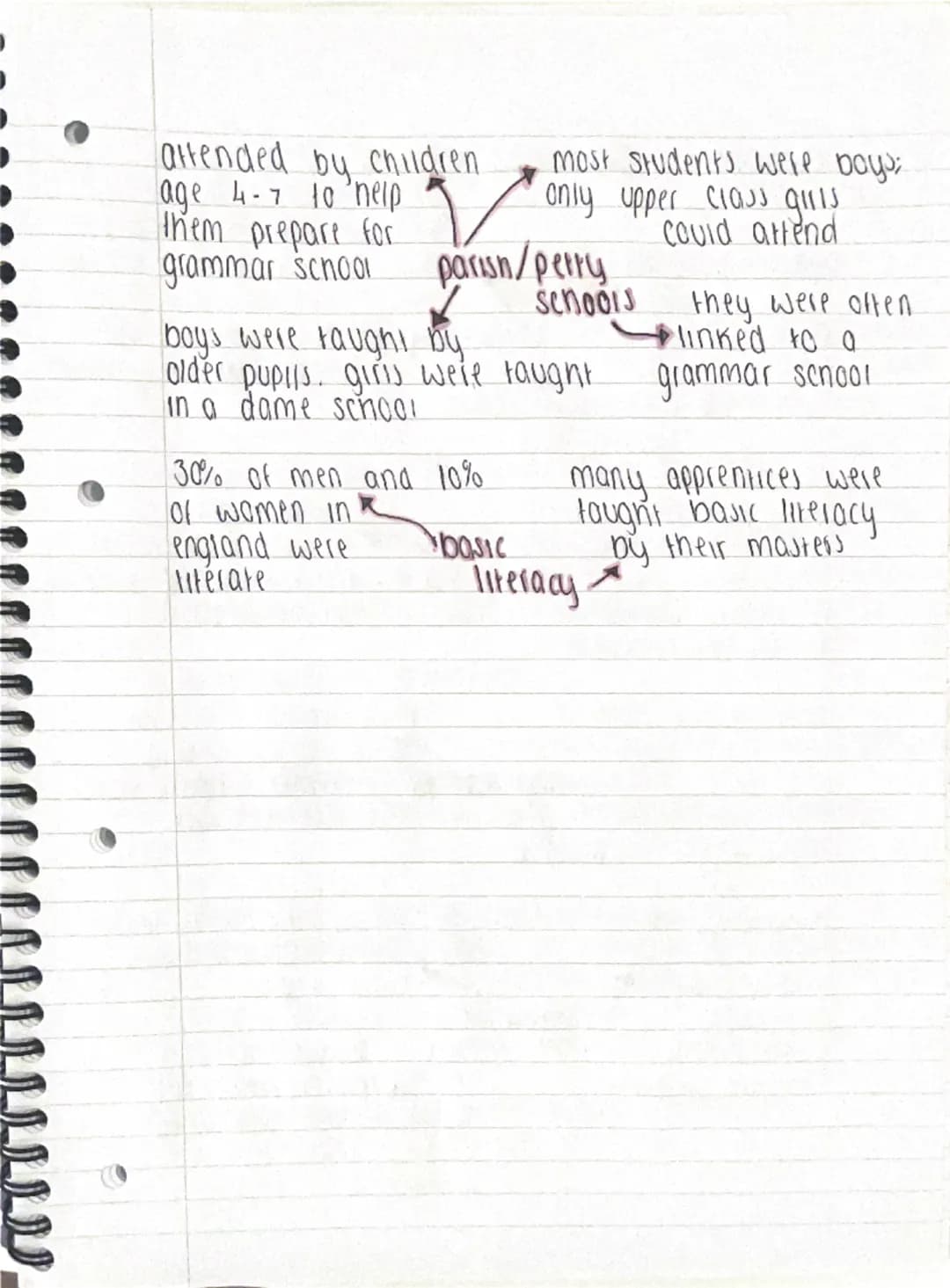
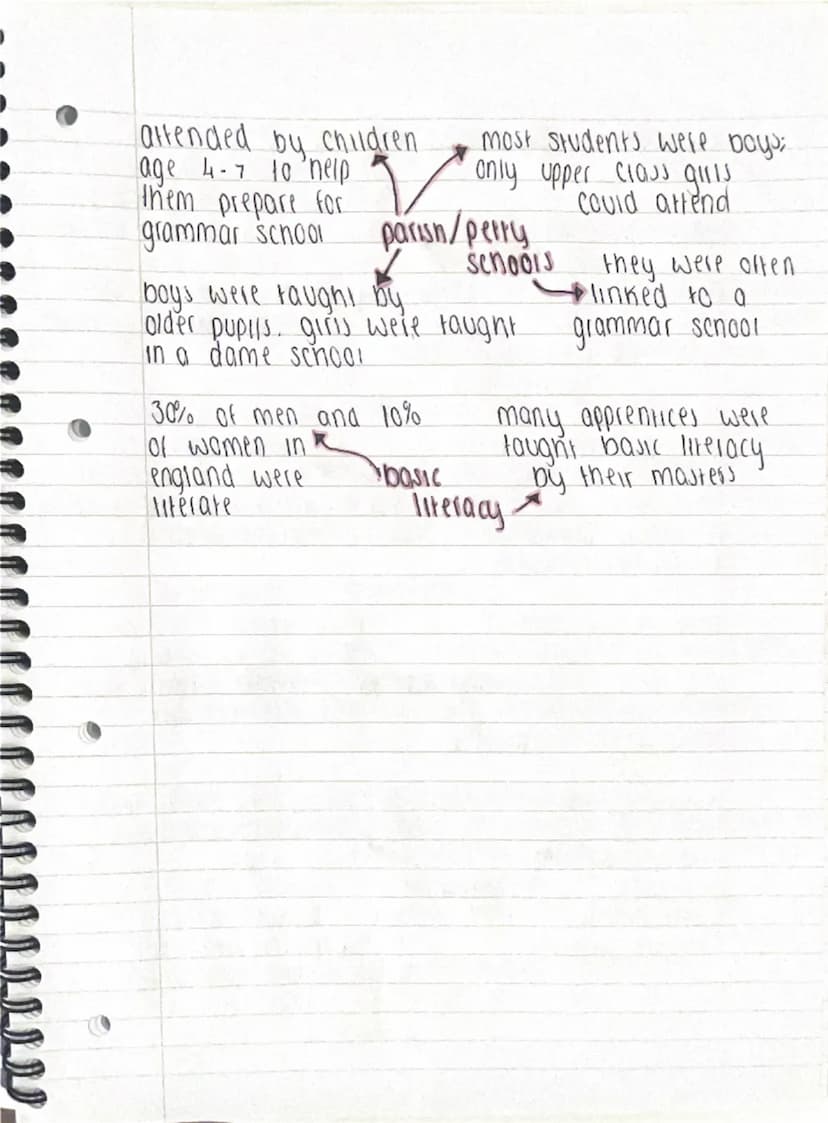
Parish and petty schools formed the foundation of education for many children. Attended from ages 4-7, these schools prepared students for grammar school. While most students were boys, some upper-class girls could attend too. These schools were often linked to the church, with boys taught by older pupils and girls attending separate dame schools.
Literacy rates show the stark educational divide in Elizabethan society. Only about 30% of men and a mere 10% of women in England could read and write. For those entering trades, many apprentices were taught basic literacy skills by their masters, providing practical education outside formal schooling.
The educational path you followed was almost entirely determined by your gender and social class. A wealthy boy might progress from petty school to grammar school to university, while even wealthy girls were limited to basic education focused on becoming good wives and mothers.
Think about this: How might your life have been different if you'd lived in Elizabethan England? Your educational opportunities would have been largely decided by the family you were born into!
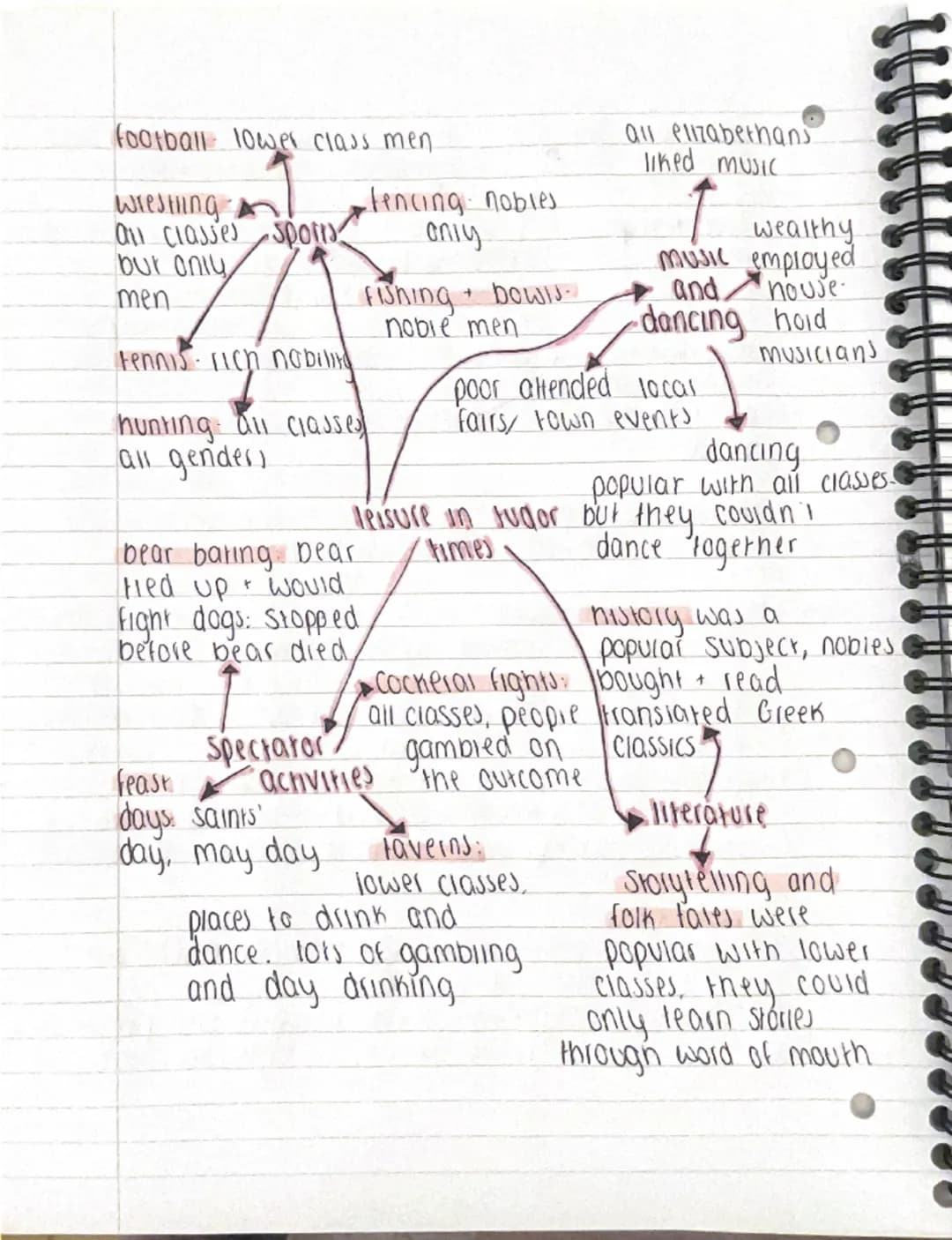
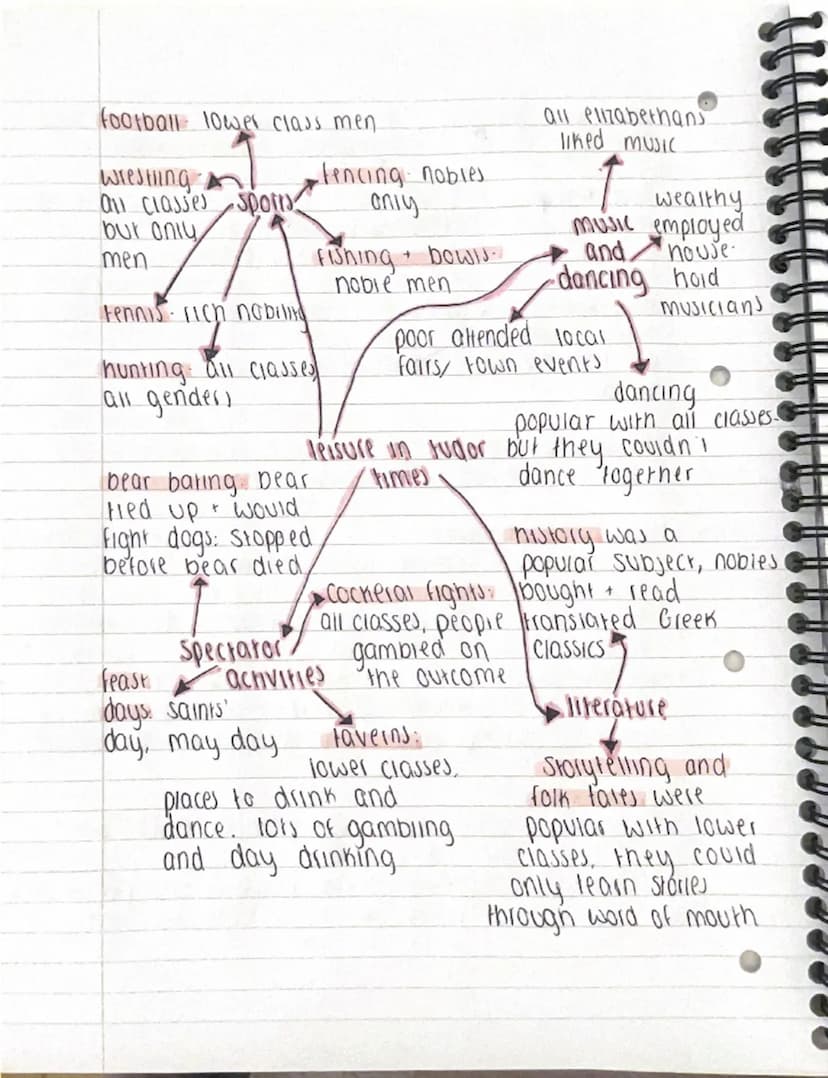
Tudor England enjoyed a rich variety of sports, but who could participate depended on social rank. Football and wrestling were popular among lower-class men, while tennis was reserved for wealthy nobility. Hunting crossed class boundaries and was enjoyed by all genders, though fencing remained exclusive to nobles.
Music and dancing were central to Elizabethan entertainment. Wealthy families employed household musicians, while poorer people attended local fairs and town events. Though dancing was popular across all classes, the strict social hierarchy meant different classes couldn't dance together at the same events.
Blood sports drew large crowds, with bear-baiting (where a tied bear fought dogs) being particularly popular. Spectator gambling was common at these events, with people betting on outcomes. Literature also provided entertainment, with nobles reading translated Greek classics while the lower classes enjoyed storytelling and folk tales shared orally.
Fascinating fact: Taverns were popular gathering places for the lower classes, offering drinking, dancing and gambling. Special feast days like saints' days and May Day provided rare opportunities for community celebration across class lines.
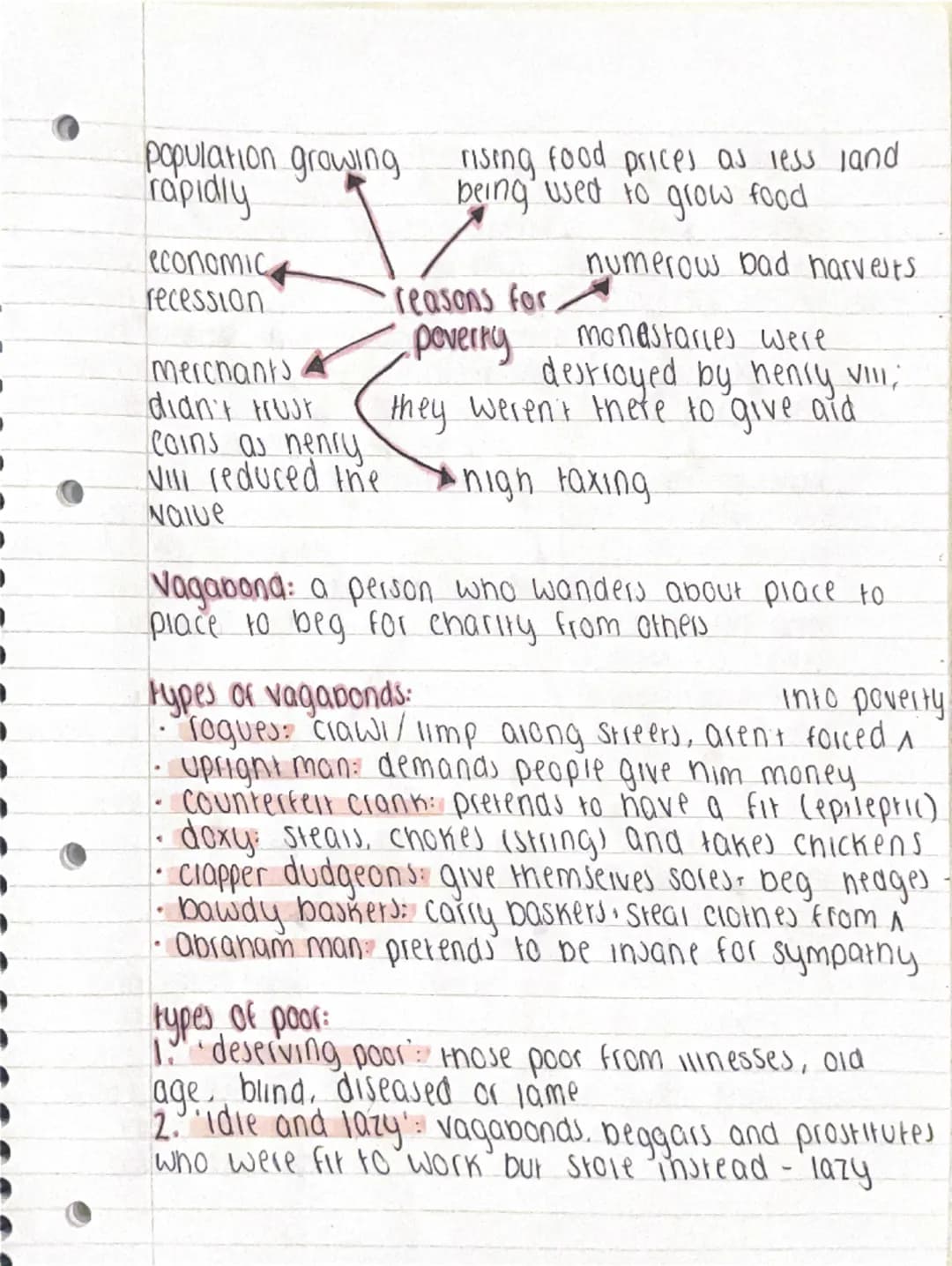
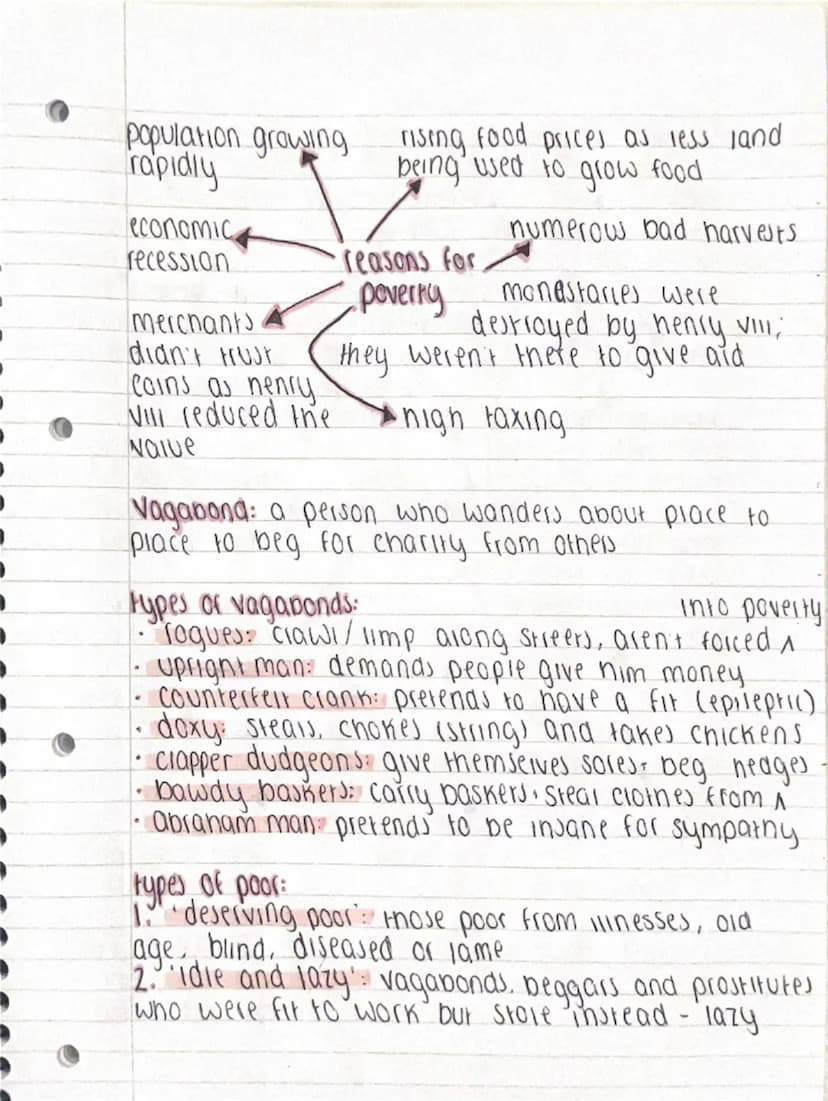
Poverty became a growing crisis during Elizabethan times for several key reasons. The population grew rapidly while food prices rose, creating economic hardship. Multiple bad harvests, high taxes, and Henry VIII's destruction of monasteries (which had previously provided charity) worsened the situation during a time of economic recession.
Tudor society categorised the poor into different types. The "deserving poor" included those unable to work due to illness, old age, or disability. In contrast, the "idle and lazy" referred to those considered capable of working but choosing to beg or steal instead – these were often called vagabonds.
Elizabethans recognised various types of vagabonds who used different techniques to beg. Some pretended to have fits or injuries, others demanded money aggressively, and some created fake wounds to gain sympathy. This classification system shows how Tudor society was trying to understand and control a growing poverty problem.
Interesting insight: Tudor officials were particularly concerned about vagabonds who wandered from place to place begging for charity. They created detailed categories for different types of beggars, from "rogues" who crawled along streets to "abraham men" who pretended to be insane for sympathy.
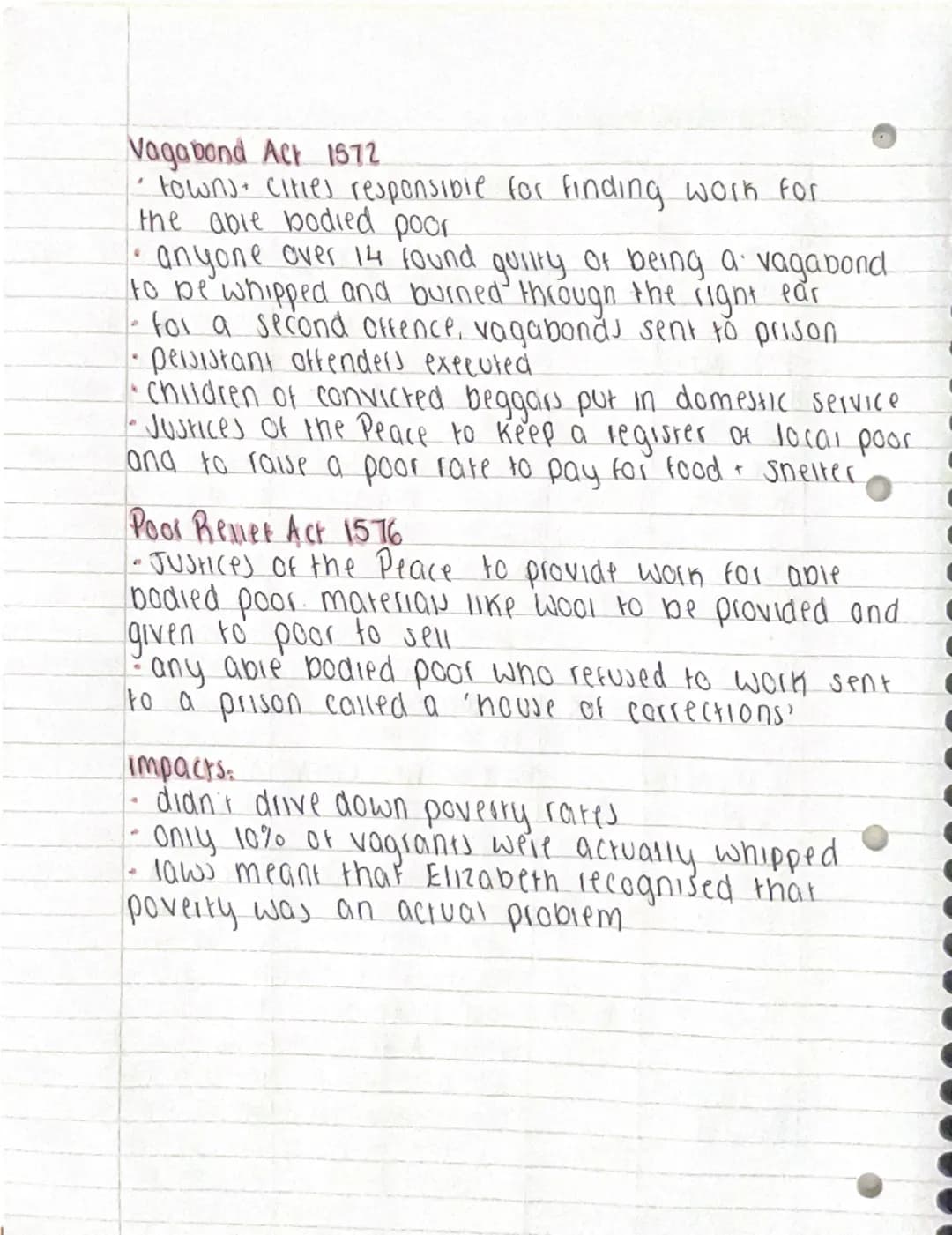
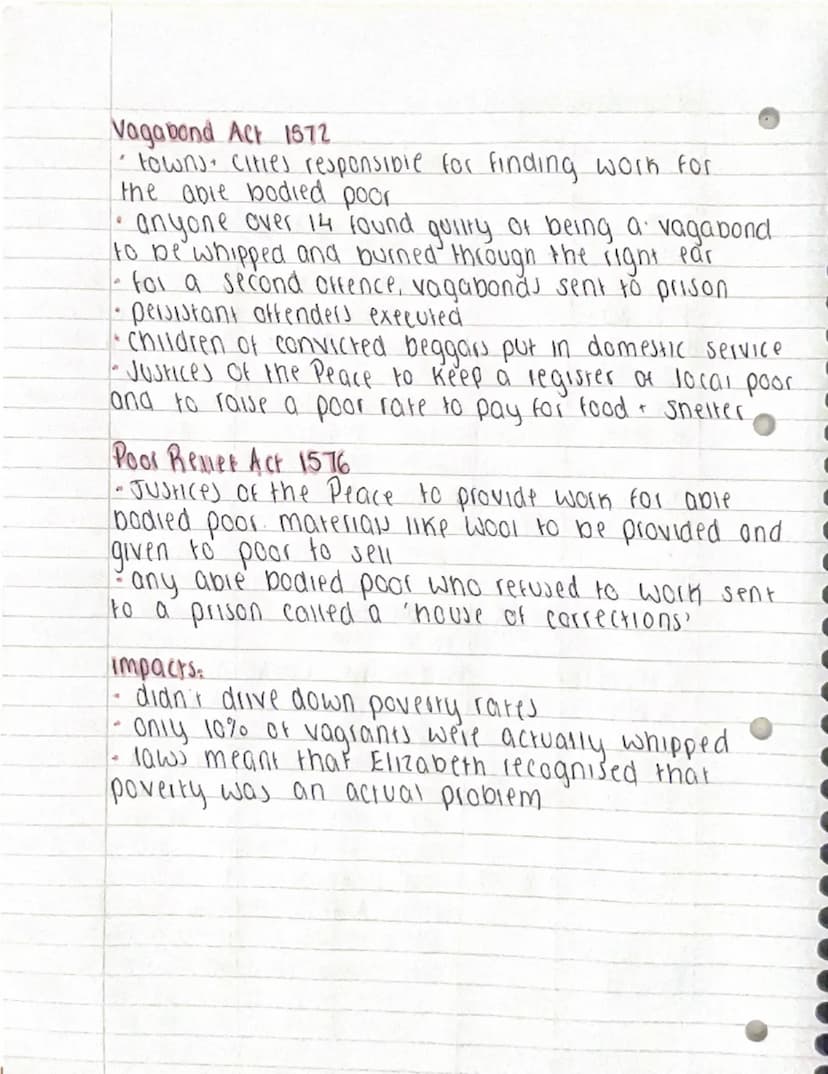
The Vagabond Act of 1572 introduced harsh punishments for beggars while making local authorities responsible for helping the poor. Towns and cities had to find work for able-bodied poor people, while vagabonds faced brutal consequences. First-time offenders over age 14 would be whipped and burned through the right ear, second offences meant prison, and persistent offenders could be executed.
Building on this approach, the Poor Relief Act of 1576 ordered Justices of the Peace to provide materials like wool for the poor to work with and sell. Those who refused to work were sent to "houses of correction" - essentially prisons. The act recognised that some poverty resulted from lack of opportunity rather than laziness.
Despite their severity, these laws had limited impact. Only about 10% of vagrants were actually whipped, and poverty rates remained high. However, the legislation did mark an important shift - Elizabeth I officially recognised poverty as a genuine social problem requiring government intervention rather than just punishment.
Think about this: These Tudor poor laws established the principle that local authorities had responsibility for supporting their poor residents - an early version of the welfare state that would develop centuries later.
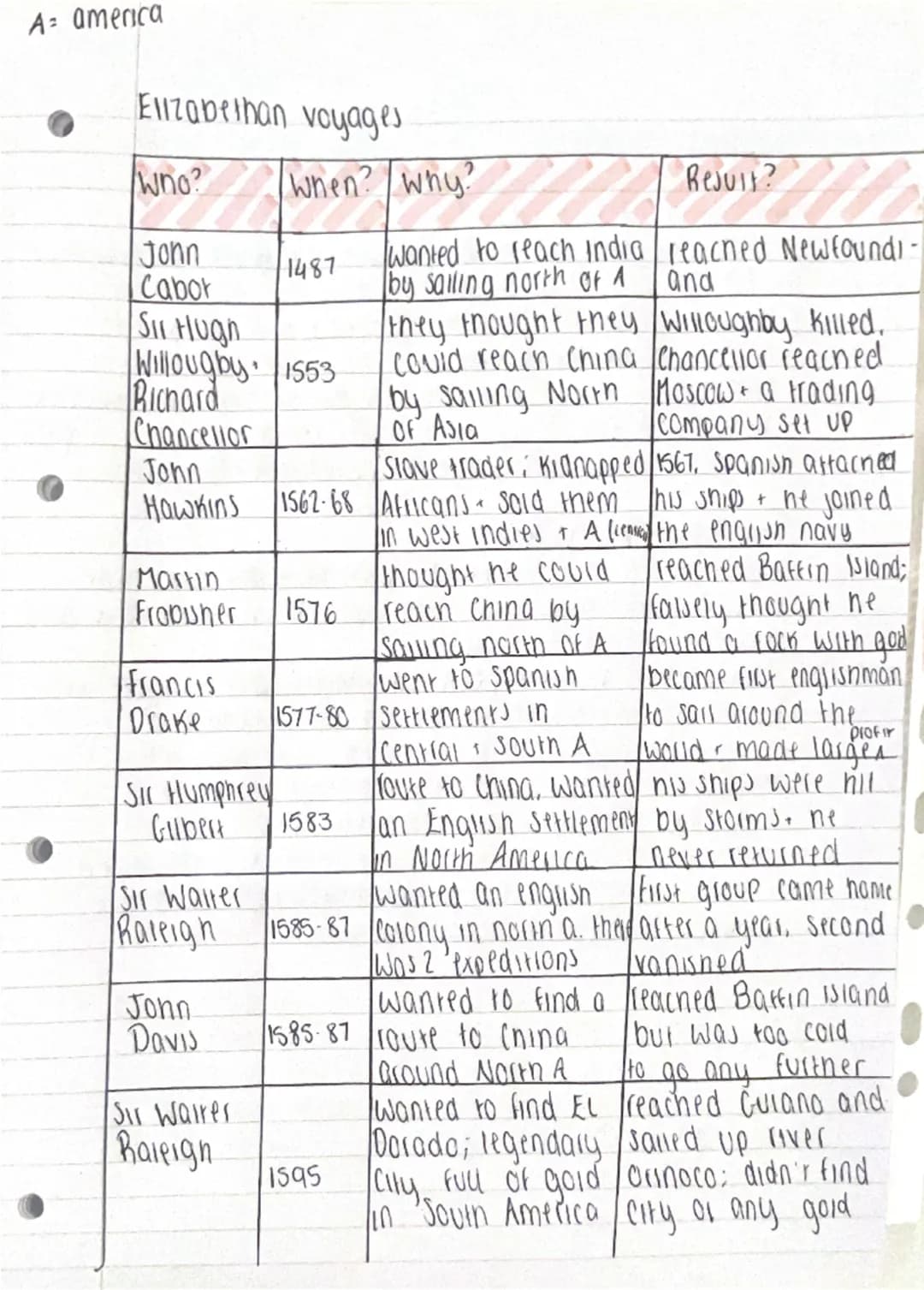
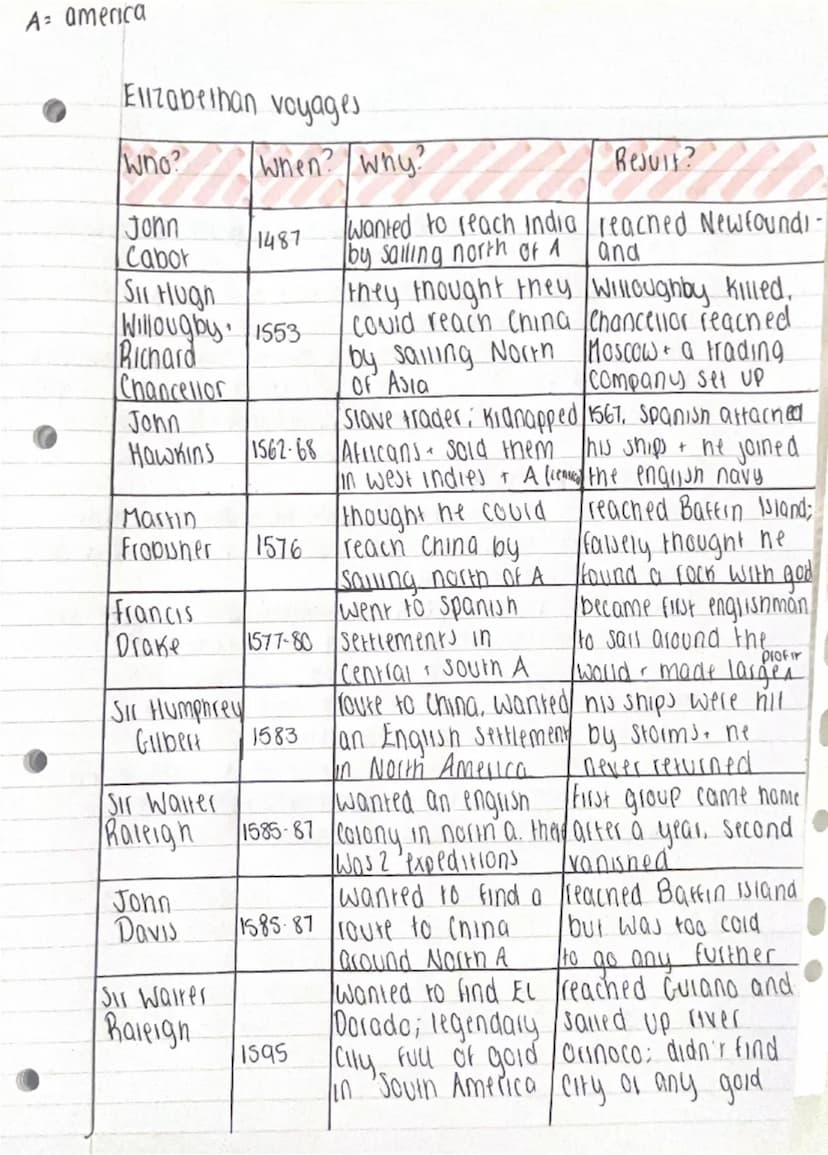
The Elizabethan era saw England launch ambitious expeditions across the globe, driven by dreams of finding new trade routes and riches. John Cabot set sail in 1487 hoping to reach India by sailing north of America but instead reached Newfoundland. Later voyagers like Richard Chancellor attempted similar northern passages to China, resulting in trading opportunities with Moscow.
John Hawkins became notorious for slave trading between 1562-68, kidnapping Africans and selling them in the West Indies until Spanish forces attacked his ships. Francis Drake achieved fame between 1577-80 when he became the first Englishman to circumnavigate the globe, returning with enormous profits for his investors.
Settlement attempts in North America proved challenging. Sir Humphrey Gilbert's 1583 expedition to establish an English colony ended when storms claimed his ships. Sir Walter Raleigh's attempts in 1585-87 fared little better - the first group of colonists returned to England after just one year, while the second group mysteriously vanished.
Amazing fact: Many explorers were motivated by myths and legends. John Davis made three voyages (1585-87) searching for a northern passage to China, while Raleigh's 1595 expedition to South America sought El Dorado - a legendary city supposedly filled with gold!
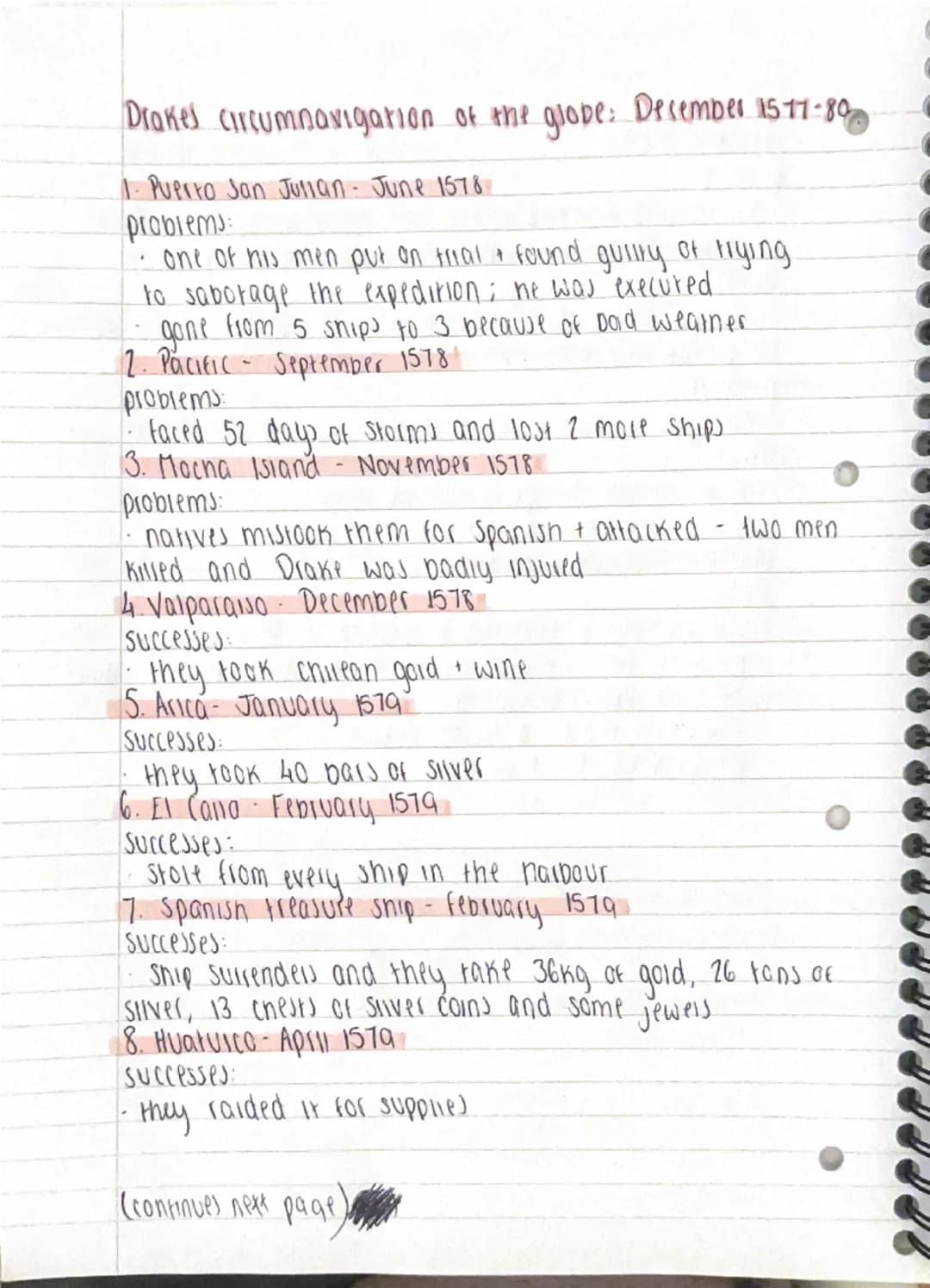
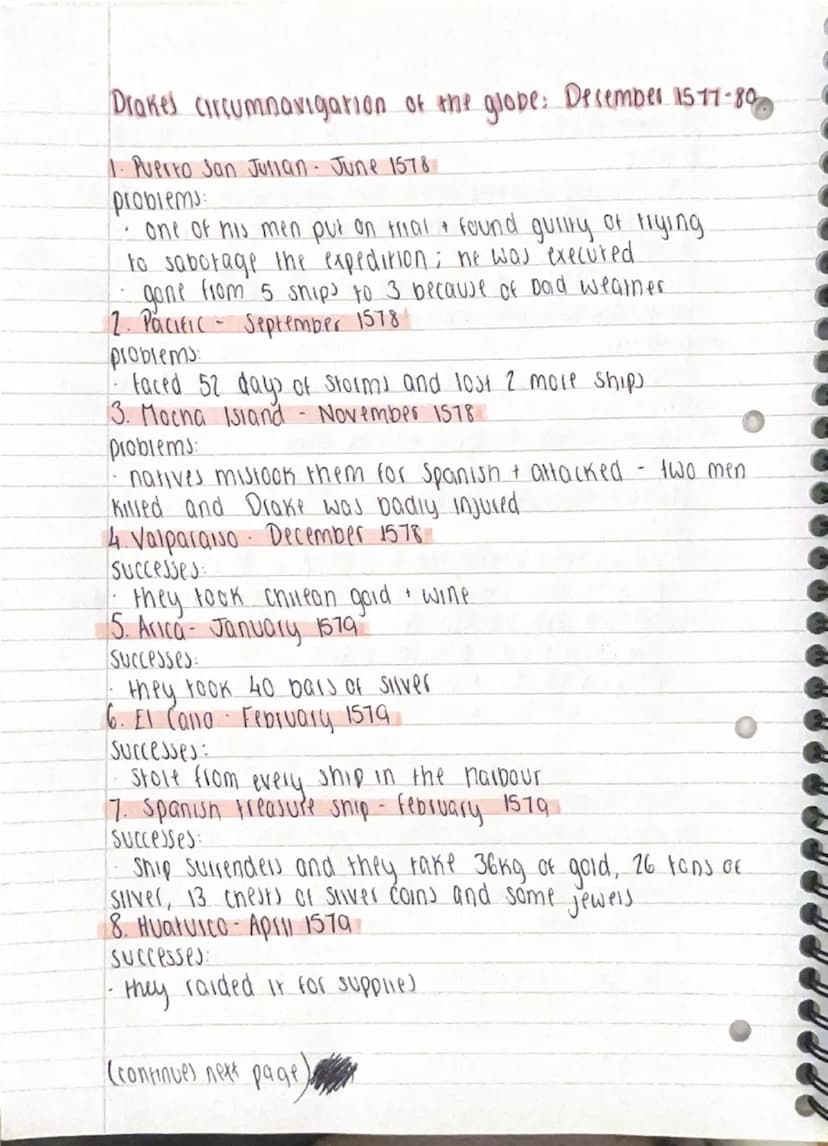
Francis Drake's historic journey around the world (1577-80) was filled with dramatic challenges and triumphs. At Puerto San Julian in June 1578, Drake faced a mutiny attempt and executed the man responsible. His fleet was already reduced from five ships to three due to terrible weather conditions.
The Pacific Ocean proved treacherous, with Drake's crew enduring 52 days of storms that claimed two more ships. At Mocha Island, natives mistook them for Spanish and attacked, killing two men and seriously wounding Drake himself. Despite these setbacks, Drake's mission soon turned profitable through a series of successful raids on Spanish settlements.
From December 1578 through April 1579, Drake's crew plundered Spanish harbours and ships along the Pacific coast of South America. At Valparaiso they seized Chilean gold and wine, at Arica they took 40 bars of silver, and at El Callo they robbed every ship in the harbour. Their greatest prize came in February 1579 when they captured a Spanish treasure ship carrying 36kg of gold, 26 tons of silver, 13 chests of silver coins and precious jewels.
Incredible achievement: Drake's daring raids against Spanish settlements were not just about treasure - they were part of England's strategy to challenge Spanish dominance of the seas and the New World.
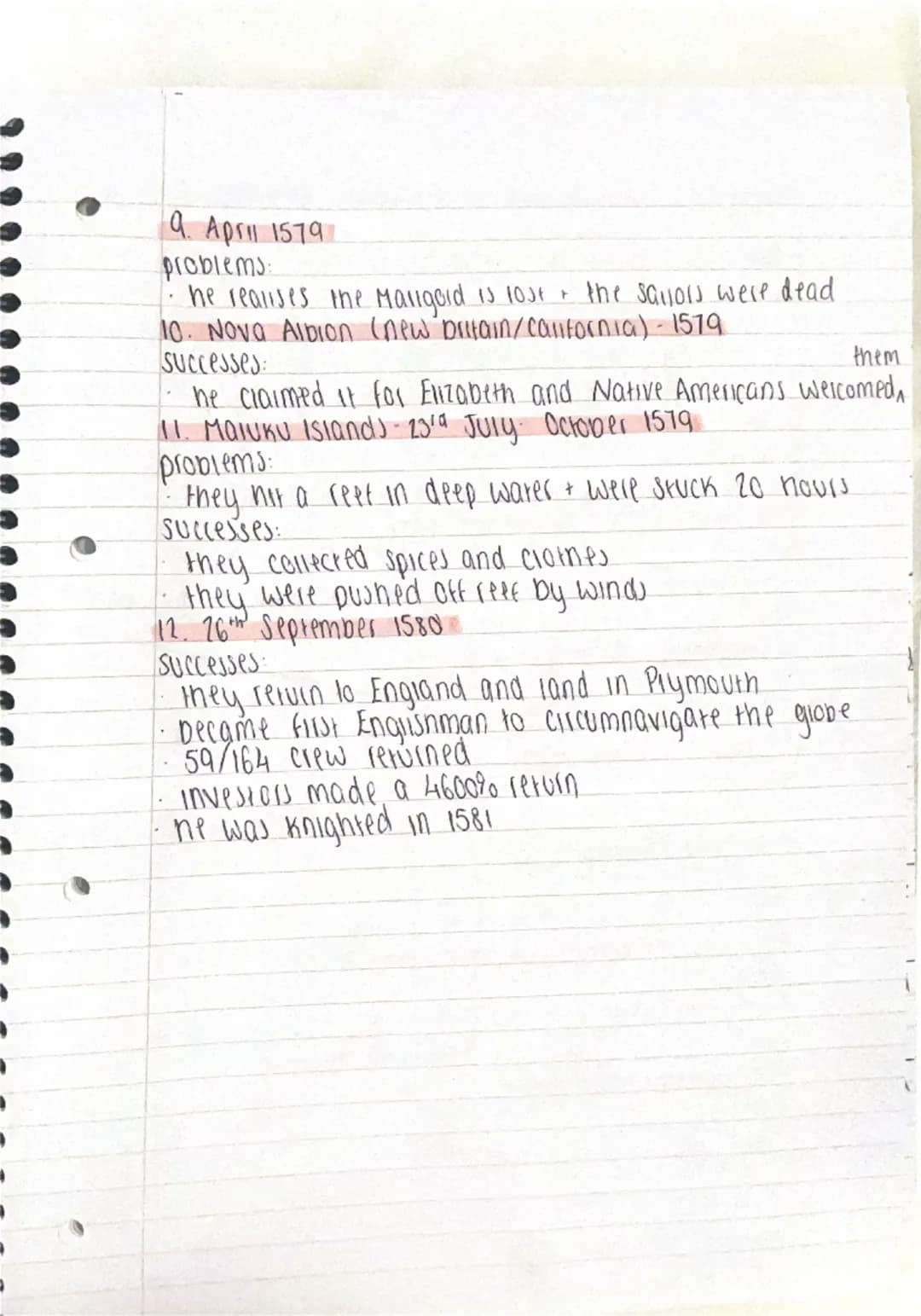
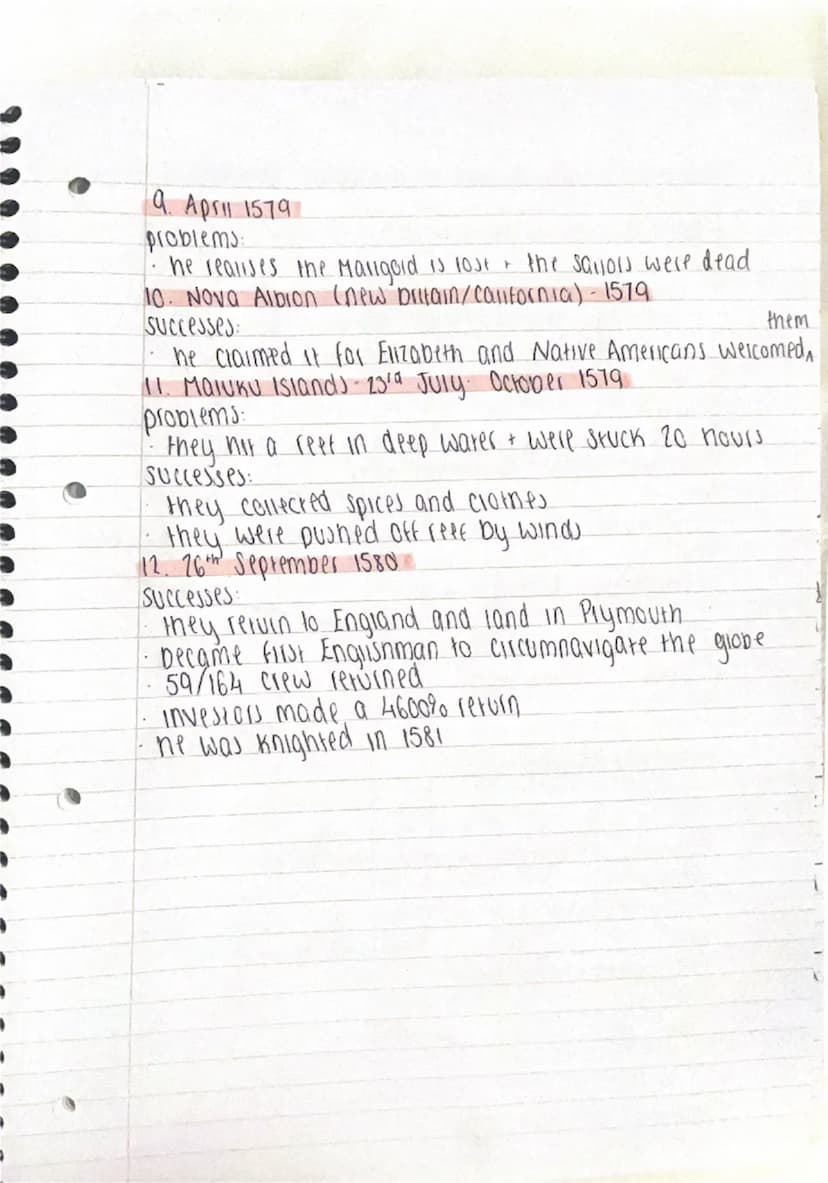
As Drake's journey continued in April 1579, he faced a sobering realization that his ship, the Marigold, was lost with all sailors aboard. Pushing onward to Nova Albion (modern California), Drake claimed the land for Queen Elizabeth while forming positive relationships with Native Americans who welcomed his crew.
The journey home wasn't without peril. At the Maluku Islands between July and October 1579, Drake's ship hit a reef in deep water and became stuck for 20 hours. Fortunately, winds eventually pushed them free, allowing them to collect valuable spices and clothes before continuing their voyage.
On September 26th, 1580, Drake and his crew triumphantly returned to England, landing in Plymouth. The voyage had taken an enormous toll—only 59 of the original 164 crew members survived. However, the financial rewards were astronomical, with investors receiving a staggering 4,600% return. Queen Elizabeth recognized Drake's achievement by knighting him in 1581, celebrating his status as the first Englishman to circumnavigate the globe.
Astonishing outcome: Despite the tremendous hardships and loss of life, Drake's voyage was considered an extraordinary success. The massive profits funded future explorations and helped establish England as a rising naval power challenging Spanish dominance.
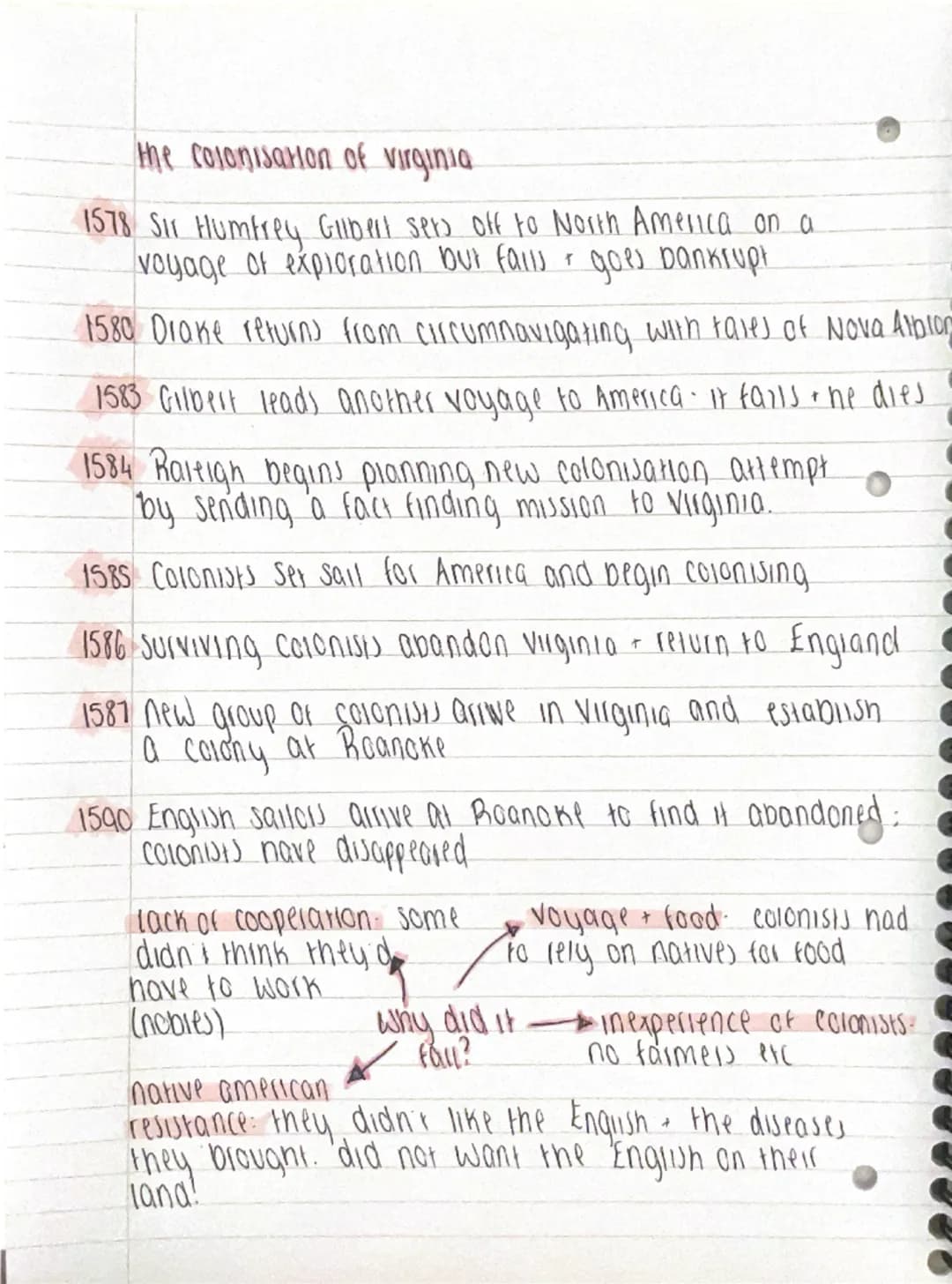
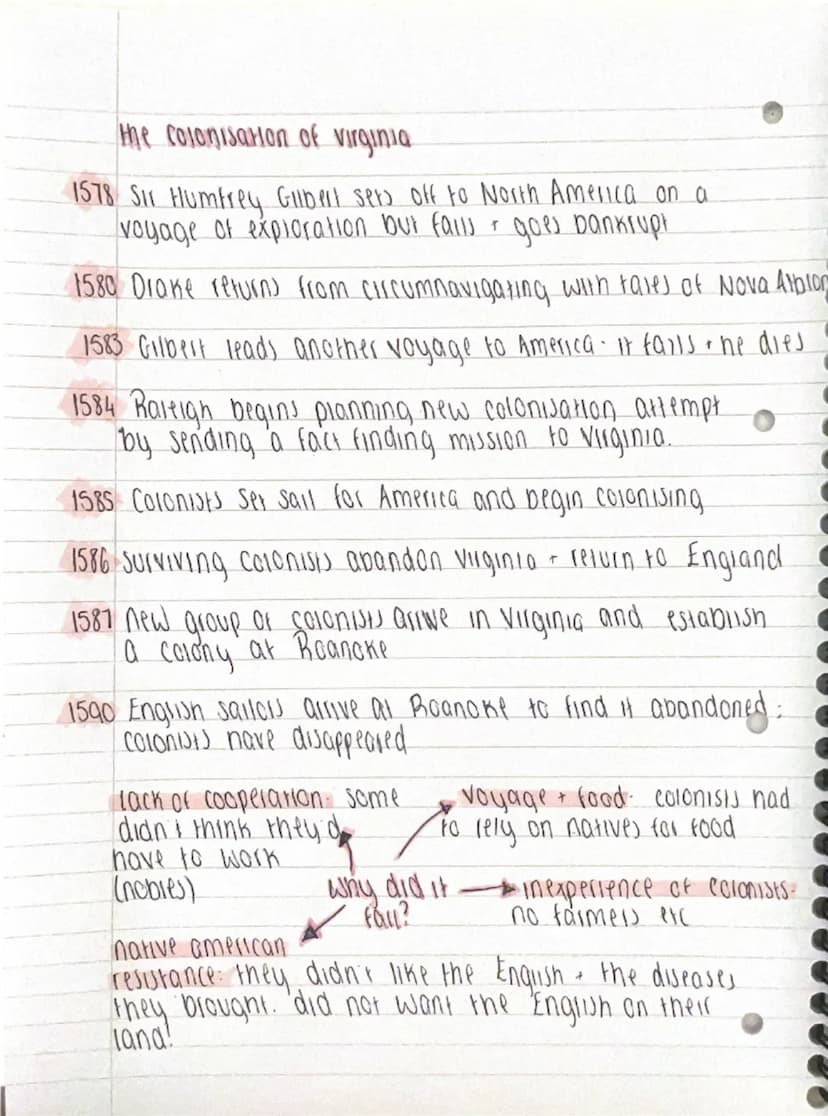
England's attempts to establish colonies in America faced numerous challenges and setbacks. Sir Humphrey Gilbert's 1578 expedition ended in bankruptcy, and his 1583 follow-up attempt cost him his life. Inspired by Drake's tales of Nova Albion, Sir Walter Raleigh began planning new colonisation efforts, sending a fact-finding mission to Virginia in 1584.
The first group of colonists arrived in Virginia in 1585 but abandoned the settlement by 1586, returning to England. A second group established a colony at Roanoke in 1587, but when English ships returned in 1590, they discovered the settlement completely abandoned—the colonists had mysteriously disappeared without a trace.
Several factors contributed to these colonial failures. The colonists often lacked practical skills like farming and had to rely on natives for food. Some noble-born colonists believed they shouldn't have to work, creating tensions within the settlements. Perhaps most significantly, Native American resistance grew as local tribes resented English presence and the diseases they brought.
History mystery: The disappearance of the Roanoke colony remains one of history's great unsolved mysteries. When sailors returned in 1590, they found the settlement abandoned with only the word "CROATOAN" carved into a post as a clue to what happened to the colonists.
Our AI Companion is a student-focused AI tool that offers more than just answers. Built on millions of Knowunity resources, it provides relevant information, personalised study plans, quizzes, and content directly in the chat, adapting to your individual learning journey.
You can download the app from Google Play Store and Apple App Store.
That's right! Enjoy free access to study content, connect with fellow students, and get instant help – all at your fingertips.
App Store
Google Play
The app is very easy to use and well designed. I have found everything I was looking for so far and have been able to learn a lot from the presentations! I will definitely use the app for a class assignment! And of course it also helps a lot as an inspiration.
Stefan S
iOS user
This app is really great. There are so many study notes and help [...]. My problem subject is French, for example, and the app has so many options for help. Thanks to this app, I have improved my French. I would recommend it to anyone.
Samantha Klich
Android user
Wow, I am really amazed. I just tried the app because I've seen it advertised many times and was absolutely stunned. This app is THE HELP you want for school and above all, it offers so many things, such as workouts and fact sheets, which have been VERY helpful to me personally.
Anna
iOS user
Best app on earth! no words because it’s too good
Thomas R
iOS user
Just amazing. Let's me revise 10x better, this app is a quick 10/10. I highly recommend it to anyone. I can watch and search for notes. I can save them in the subject folder. I can revise it any time when I come back. If you haven't tried this app, you're really missing out.
Basil
Android user
This app has made me feel so much more confident in my exam prep, not only through boosting my own self confidence through the features that allow you to connect with others and feel less alone, but also through the way the app itself is centred around making you feel better. It is easy to navigate, fun to use, and helpful to anyone struggling in absolutely any way.
David K
iOS user
The app's just great! All I have to do is enter the topic in the search bar and I get the response real fast. I don't have to watch 10 YouTube videos to understand something, so I'm saving my time. Highly recommended!
Sudenaz Ocak
Android user
In school I was really bad at maths but thanks to the app, I am doing better now. I am so grateful that you made the app.
Greenlight Bonnie
Android user
very reliable app to help and grow your ideas of Maths, English and other related topics in your works. please use this app if your struggling in areas, this app is key for that. wish I'd of done a review before. and it's also free so don't worry about that.
Rohan U
Android user
I know a lot of apps use fake accounts to boost their reviews but this app deserves it all. Originally I was getting 4 in my English exams and this time I got a grade 7. I didn’t even know about this app three days until the exam and it has helped A LOT. Please actually trust me and use it as I’m sure you too will see developments.
Xander S
iOS user
THE QUIZES AND FLASHCARDS ARE SO USEFUL AND I LOVE Knowunity AI. IT ALSO IS LITREALLY LIKE CHATGPT BUT SMARTER!! HELPED ME WITH MY MASCARA PROBLEMS TOO!! AS WELL AS MY REAL SUBJECTS ! DUHHH 😍😁😲🤑💗✨🎀😮
Elisha
iOS user
This apps acc the goat. I find revision so boring but this app makes it so easy to organize it all and then you can ask the freeeee ai to test yourself so good and you can easily upload your own stuff. highly recommend as someone taking mocks now
Paul T
iOS user
The app is very easy to use and well designed. I have found everything I was looking for so far and have been able to learn a lot from the presentations! I will definitely use the app for a class assignment! And of course it also helps a lot as an inspiration.
Stefan S
iOS user
This app is really great. There are so many study notes and help [...]. My problem subject is French, for example, and the app has so many options for help. Thanks to this app, I have improved my French. I would recommend it to anyone.
Samantha Klich
Android user
Wow, I am really amazed. I just tried the app because I've seen it advertised many times and was absolutely stunned. This app is THE HELP you want for school and above all, it offers so many things, such as workouts and fact sheets, which have been VERY helpful to me personally.
Anna
iOS user
Best app on earth! no words because it’s too good
Thomas R
iOS user
Just amazing. Let's me revise 10x better, this app is a quick 10/10. I highly recommend it to anyone. I can watch and search for notes. I can save them in the subject folder. I can revise it any time when I come back. If you haven't tried this app, you're really missing out.
Basil
Android user
This app has made me feel so much more confident in my exam prep, not only through boosting my own self confidence through the features that allow you to connect with others and feel less alone, but also through the way the app itself is centred around making you feel better. It is easy to navigate, fun to use, and helpful to anyone struggling in absolutely any way.
David K
iOS user
The app's just great! All I have to do is enter the topic in the search bar and I get the response real fast. I don't have to watch 10 YouTube videos to understand something, so I'm saving my time. Highly recommended!
Sudenaz Ocak
Android user
In school I was really bad at maths but thanks to the app, I am doing better now. I am so grateful that you made the app.
Greenlight Bonnie
Android user
very reliable app to help and grow your ideas of Maths, English and other related topics in your works. please use this app if your struggling in areas, this app is key for that. wish I'd of done a review before. and it's also free so don't worry about that.
Rohan U
Android user
I know a lot of apps use fake accounts to boost their reviews but this app deserves it all. Originally I was getting 4 in my English exams and this time I got a grade 7. I didn’t even know about this app three days until the exam and it has helped A LOT. Please actually trust me and use it as I’m sure you too will see developments.
Xander S
iOS user
THE QUIZES AND FLASHCARDS ARE SO USEFUL AND I LOVE Knowunity AI. IT ALSO IS LITREALLY LIKE CHATGPT BUT SMARTER!! HELPED ME WITH MY MASCARA PROBLEMS TOO!! AS WELL AS MY REAL SUBJECTS ! DUHHH 😍😁😲🤑💗✨🎀😮
Elisha
iOS user
This apps acc the goat. I find revision so boring but this app makes it so easy to organize it all and then you can ask the freeeee ai to test yourself so good and you can easily upload your own stuff. highly recommend as someone taking mocks now
Paul T
iOS user
nicola
@nicolaoakleyx
Tudor education was shaped by social class, gender, and religious changes. The printing press revolutionised learning while new subjects emerged, but education remained highly unequal. Let's explore who could access different types of education in Elizabethan England and what they... Show more
Access to all documents
Improve your grades
Join milions of students
Education in Tudor times underwent significant shifts due to several key factors. The printing press made books cheaper and quicker to produce, while new subjects like poetry, drama, philosophy and science expanded the curriculum. Humanist thinkers began valuing education for its own sake rather than purely religious purposes.
Protestant beliefs drove educational change too, as they wanted people to read the Bible in their own languages rather than rely on priests' interpretations. Education became more widely available through parish schools that accepted both boys and girls, church-run schools, and scholarships.
Despite these advances, significant inequalities in education persisted. Schools charged fees that many couldn't afford, and only boys could attend grammar schools or universities. Girls' education was limited because society didn't believe they needed equal learning, while lower class children typically received no formal education at all.
Did you know? Middle class boys could progress from petty school to grammar school and potentially university, while middle class girls were limited to dame schools. Noble children had private tutors, but only the boys could later attend university.
Access to all documents
Improve your grades
Join milions of students
For wealthy families, education followed strict gender lines. Upper-class boys often received a university education, considered necessary for careers at court. Most undergraduates studied law, with some subjects like mathematics being compulsory. Before university, sons of nobility had private tutors until age 15, who would visit their homes.
The first public schools were Winchester and Eton, which charged fees and typically taught Latin and Greek. These schools aimed to develop intellectual, spiritual and personal growth. Discipline was extremely strict – students were often beaten with birch rods for misbehaviour.
For girls, education looked very different. Wealthy daughters were educated at home by private tutors, with many becoming literate. However, their curriculum focused heavily on proper conduct and etiquette – essentially, learning how to behave appropriately in court and society.
Remember this! Grammar schools were attended by sons of gentry, merchants and yeomen from ages 7-15, who might then progress to university. About 75% of university graduates came from nobility or gentry backgrounds.
Access to all documents
Improve your grades
Join milions of students
Parish and petty schools formed the foundation of education for many children. Attended from ages 4-7, these schools prepared students for grammar school. While most students were boys, some upper-class girls could attend too. These schools were often linked to the church, with boys taught by older pupils and girls attending separate dame schools.
Literacy rates show the stark educational divide in Elizabethan society. Only about 30% of men and a mere 10% of women in England could read and write. For those entering trades, many apprentices were taught basic literacy skills by their masters, providing practical education outside formal schooling.
The educational path you followed was almost entirely determined by your gender and social class. A wealthy boy might progress from petty school to grammar school to university, while even wealthy girls were limited to basic education focused on becoming good wives and mothers.
Think about this: How might your life have been different if you'd lived in Elizabethan England? Your educational opportunities would have been largely decided by the family you were born into!
Access to all documents
Improve your grades
Join milions of students
Tudor England enjoyed a rich variety of sports, but who could participate depended on social rank. Football and wrestling were popular among lower-class men, while tennis was reserved for wealthy nobility. Hunting crossed class boundaries and was enjoyed by all genders, though fencing remained exclusive to nobles.
Music and dancing were central to Elizabethan entertainment. Wealthy families employed household musicians, while poorer people attended local fairs and town events. Though dancing was popular across all classes, the strict social hierarchy meant different classes couldn't dance together at the same events.
Blood sports drew large crowds, with bear-baiting (where a tied bear fought dogs) being particularly popular. Spectator gambling was common at these events, with people betting on outcomes. Literature also provided entertainment, with nobles reading translated Greek classics while the lower classes enjoyed storytelling and folk tales shared orally.
Fascinating fact: Taverns were popular gathering places for the lower classes, offering drinking, dancing and gambling. Special feast days like saints' days and May Day provided rare opportunities for community celebration across class lines.
Access to all documents
Improve your grades
Join milions of students
Poverty became a growing crisis during Elizabethan times for several key reasons. The population grew rapidly while food prices rose, creating economic hardship. Multiple bad harvests, high taxes, and Henry VIII's destruction of monasteries (which had previously provided charity) worsened the situation during a time of economic recession.
Tudor society categorised the poor into different types. The "deserving poor" included those unable to work due to illness, old age, or disability. In contrast, the "idle and lazy" referred to those considered capable of working but choosing to beg or steal instead – these were often called vagabonds.
Elizabethans recognised various types of vagabonds who used different techniques to beg. Some pretended to have fits or injuries, others demanded money aggressively, and some created fake wounds to gain sympathy. This classification system shows how Tudor society was trying to understand and control a growing poverty problem.
Interesting insight: Tudor officials were particularly concerned about vagabonds who wandered from place to place begging for charity. They created detailed categories for different types of beggars, from "rogues" who crawled along streets to "abraham men" who pretended to be insane for sympathy.
Access to all documents
Improve your grades
Join milions of students
The Vagabond Act of 1572 introduced harsh punishments for beggars while making local authorities responsible for helping the poor. Towns and cities had to find work for able-bodied poor people, while vagabonds faced brutal consequences. First-time offenders over age 14 would be whipped and burned through the right ear, second offences meant prison, and persistent offenders could be executed.
Building on this approach, the Poor Relief Act of 1576 ordered Justices of the Peace to provide materials like wool for the poor to work with and sell. Those who refused to work were sent to "houses of correction" - essentially prisons. The act recognised that some poverty resulted from lack of opportunity rather than laziness.
Despite their severity, these laws had limited impact. Only about 10% of vagrants were actually whipped, and poverty rates remained high. However, the legislation did mark an important shift - Elizabeth I officially recognised poverty as a genuine social problem requiring government intervention rather than just punishment.
Think about this: These Tudor poor laws established the principle that local authorities had responsibility for supporting their poor residents - an early version of the welfare state that would develop centuries later.
Access to all documents
Improve your grades
Join milions of students
The Elizabethan era saw England launch ambitious expeditions across the globe, driven by dreams of finding new trade routes and riches. John Cabot set sail in 1487 hoping to reach India by sailing north of America but instead reached Newfoundland. Later voyagers like Richard Chancellor attempted similar northern passages to China, resulting in trading opportunities with Moscow.
John Hawkins became notorious for slave trading between 1562-68, kidnapping Africans and selling them in the West Indies until Spanish forces attacked his ships. Francis Drake achieved fame between 1577-80 when he became the first Englishman to circumnavigate the globe, returning with enormous profits for his investors.
Settlement attempts in North America proved challenging. Sir Humphrey Gilbert's 1583 expedition to establish an English colony ended when storms claimed his ships. Sir Walter Raleigh's attempts in 1585-87 fared little better - the first group of colonists returned to England after just one year, while the second group mysteriously vanished.
Amazing fact: Many explorers were motivated by myths and legends. John Davis made three voyages (1585-87) searching for a northern passage to China, while Raleigh's 1595 expedition to South America sought El Dorado - a legendary city supposedly filled with gold!
Access to all documents
Improve your grades
Join milions of students
Francis Drake's historic journey around the world (1577-80) was filled with dramatic challenges and triumphs. At Puerto San Julian in June 1578, Drake faced a mutiny attempt and executed the man responsible. His fleet was already reduced from five ships to three due to terrible weather conditions.
The Pacific Ocean proved treacherous, with Drake's crew enduring 52 days of storms that claimed two more ships. At Mocha Island, natives mistook them for Spanish and attacked, killing two men and seriously wounding Drake himself. Despite these setbacks, Drake's mission soon turned profitable through a series of successful raids on Spanish settlements.
From December 1578 through April 1579, Drake's crew plundered Spanish harbours and ships along the Pacific coast of South America. At Valparaiso they seized Chilean gold and wine, at Arica they took 40 bars of silver, and at El Callo they robbed every ship in the harbour. Their greatest prize came in February 1579 when they captured a Spanish treasure ship carrying 36kg of gold, 26 tons of silver, 13 chests of silver coins and precious jewels.
Incredible achievement: Drake's daring raids against Spanish settlements were not just about treasure - they were part of England's strategy to challenge Spanish dominance of the seas and the New World.
Access to all documents
Improve your grades
Join milions of students
As Drake's journey continued in April 1579, he faced a sobering realization that his ship, the Marigold, was lost with all sailors aboard. Pushing onward to Nova Albion (modern California), Drake claimed the land for Queen Elizabeth while forming positive relationships with Native Americans who welcomed his crew.
The journey home wasn't without peril. At the Maluku Islands between July and October 1579, Drake's ship hit a reef in deep water and became stuck for 20 hours. Fortunately, winds eventually pushed them free, allowing them to collect valuable spices and clothes before continuing their voyage.
On September 26th, 1580, Drake and his crew triumphantly returned to England, landing in Plymouth. The voyage had taken an enormous toll—only 59 of the original 164 crew members survived. However, the financial rewards were astronomical, with investors receiving a staggering 4,600% return. Queen Elizabeth recognized Drake's achievement by knighting him in 1581, celebrating his status as the first Englishman to circumnavigate the globe.
Astonishing outcome: Despite the tremendous hardships and loss of life, Drake's voyage was considered an extraordinary success. The massive profits funded future explorations and helped establish England as a rising naval power challenging Spanish dominance.
Access to all documents
Improve your grades
Join milions of students
England's attempts to establish colonies in America faced numerous challenges and setbacks. Sir Humphrey Gilbert's 1578 expedition ended in bankruptcy, and his 1583 follow-up attempt cost him his life. Inspired by Drake's tales of Nova Albion, Sir Walter Raleigh began planning new colonisation efforts, sending a fact-finding mission to Virginia in 1584.
The first group of colonists arrived in Virginia in 1585 but abandoned the settlement by 1586, returning to England. A second group established a colony at Roanoke in 1587, but when English ships returned in 1590, they discovered the settlement completely abandoned—the colonists had mysteriously disappeared without a trace.
Several factors contributed to these colonial failures. The colonists often lacked practical skills like farming and had to rely on natives for food. Some noble-born colonists believed they shouldn't have to work, creating tensions within the settlements. Perhaps most significantly, Native American resistance grew as local tribes resented English presence and the diseases they brought.
History mystery: The disappearance of the Roanoke colony remains one of history's great unsolved mysteries. When sailors returned in 1590, they found the settlement abandoned with only the word "CROATOAN" carved into a post as a clue to what happened to the colonists.
Our AI Companion is a student-focused AI tool that offers more than just answers. Built on millions of Knowunity resources, it provides relevant information, personalised study plans, quizzes, and content directly in the chat, adapting to your individual learning journey.
You can download the app from Google Play Store and Apple App Store.
That's right! Enjoy free access to study content, connect with fellow students, and get instant help – all at your fingertips.
5
Smart Tools NEW
Transform this note into: ✓ 50+ Practice Questions ✓ Interactive Flashcards ✓ Full Mock Exam ✓ Essay Outlines
Explore the causes and consequences of poverty during the Elizabethan era (1558-1603). This summary covers key factors such as rising population, inflation, and government responses, including the Poor Laws of 1601. Ideal for GCSE History students focusing on social issues in Elizabethan England.
 History
Explore the evolution of crime and punishment in Britain from the 16th to the 21st century. This summary covers key concepts such as smuggling, highway robbery, the impact of the Industrial Revolution, and the rise of new crimes like cybercrime and terrorism. Understand the socio-economic factors that influenced criminal behavior and government responses over time.
HistoryExplore the complexities of the Elizabethan Era, often labeled a 'Golden Age'. This summary examines key accomplishments in art, science, literature, and exploration, while also addressing the social challenges and contrasting views of this period. Ideal for students studying the Tudor dynasty and Elizabeth I's reign.
HistoryExplore the tumultuous life of Mary Queen of Scots, her 19 years of imprisonment, and the Babington Plot that led to her trial for treason. This summary highlights the political intrigue, religious conflicts, and the implications of her execution on Elizabeth I's reign. Ideal for students studying Elizabethan history and Catholic conspiracy plots.
HistoryExplore the key reasons behind the failure of the Spanish Armada, including adverse weather conditions, inadequate supplies, and strategic miscalculations. This summary highlights the pivotal events leading to the defeat, the role of Sir Francis Drake, and the broader context of Elizabethan foreign policy. Ideal for students studying Tudor history and the Elizabethan era.
HistoryExplore the tumultuous period of the Stuarts (1603-1714) in England, marked by the reigns of James I, Charles I, and Charles II. This summary covers key events such as the Gunpowder Plot, the English Civil War, and the Glorious Revolution, alongside significant figures like Oliver Cromwell and Guy Fawkes. Ideal for students studying English history, this resource provides a concise timeline and essential vocabulary related to the era's political and religious conflicts.
HistoryApp Store
Google Play
The app is very easy to use and well designed. I have found everything I was looking for so far and have been able to learn a lot from the presentations! I will definitely use the app for a class assignment! And of course it also helps a lot as an inspiration.
Stefan S
iOS user
This app is really great. There are so many study notes and help [...]. My problem subject is French, for example, and the app has so many options for help. Thanks to this app, I have improved my French. I would recommend it to anyone.
Samantha Klich
Android user
Wow, I am really amazed. I just tried the app because I've seen it advertised many times and was absolutely stunned. This app is THE HELP you want for school and above all, it offers so many things, such as workouts and fact sheets, which have been VERY helpful to me personally.
Anna
iOS user
Best app on earth! no words because it’s too good
Thomas R
iOS user
Just amazing. Let's me revise 10x better, this app is a quick 10/10. I highly recommend it to anyone. I can watch and search for notes. I can save them in the subject folder. I can revise it any time when I come back. If you haven't tried this app, you're really missing out.
Basil
Android user
This app has made me feel so much more confident in my exam prep, not only through boosting my own self confidence through the features that allow you to connect with others and feel less alone, but also through the way the app itself is centred around making you feel better. It is easy to navigate, fun to use, and helpful to anyone struggling in absolutely any way.
David K
iOS user
The app's just great! All I have to do is enter the topic in the search bar and I get the response real fast. I don't have to watch 10 YouTube videos to understand something, so I'm saving my time. Highly recommended!
Sudenaz Ocak
Android user
In school I was really bad at maths but thanks to the app, I am doing better now. I am so grateful that you made the app.
Greenlight Bonnie
Android user
very reliable app to help and grow your ideas of Maths, English and other related topics in your works. please use this app if your struggling in areas, this app is key for that. wish I'd of done a review before. and it's also free so don't worry about that.
Rohan U
Android user
I know a lot of apps use fake accounts to boost their reviews but this app deserves it all. Originally I was getting 4 in my English exams and this time I got a grade 7. I didn’t even know about this app three days until the exam and it has helped A LOT. Please actually trust me and use it as I’m sure you too will see developments.
Xander S
iOS user
THE QUIZES AND FLASHCARDS ARE SO USEFUL AND I LOVE Knowunity AI. IT ALSO IS LITREALLY LIKE CHATGPT BUT SMARTER!! HELPED ME WITH MY MASCARA PROBLEMS TOO!! AS WELL AS MY REAL SUBJECTS ! DUHHH 😍😁😲🤑💗✨🎀😮
Elisha
iOS user
This apps acc the goat. I find revision so boring but this app makes it so easy to organize it all and then you can ask the freeeee ai to test yourself so good and you can easily upload your own stuff. highly recommend as someone taking mocks now
Paul T
iOS user
The app is very easy to use and well designed. I have found everything I was looking for so far and have been able to learn a lot from the presentations! I will definitely use the app for a class assignment! And of course it also helps a lot as an inspiration.
Stefan S
iOS user
This app is really great. There are so many study notes and help [...]. My problem subject is French, for example, and the app has so many options for help. Thanks to this app, I have improved my French. I would recommend it to anyone.
Samantha Klich
Android user
Wow, I am really amazed. I just tried the app because I've seen it advertised many times and was absolutely stunned. This app is THE HELP you want for school and above all, it offers so many things, such as workouts and fact sheets, which have been VERY helpful to me personally.
Anna
iOS user
Best app on earth! no words because it’s too good
Thomas R
iOS user
Just amazing. Let's me revise 10x better, this app is a quick 10/10. I highly recommend it to anyone. I can watch and search for notes. I can save them in the subject folder. I can revise it any time when I come back. If you haven't tried this app, you're really missing out.
Basil
Android user
This app has made me feel so much more confident in my exam prep, not only through boosting my own self confidence through the features that allow you to connect with others and feel less alone, but also through the way the app itself is centred around making you feel better. It is easy to navigate, fun to use, and helpful to anyone struggling in absolutely any way.
David K
iOS user
The app's just great! All I have to do is enter the topic in the search bar and I get the response real fast. I don't have to watch 10 YouTube videos to understand something, so I'm saving my time. Highly recommended!
Sudenaz Ocak
Android user
In school I was really bad at maths but thanks to the app, I am doing better now. I am so grateful that you made the app.
Greenlight Bonnie
Android user
very reliable app to help and grow your ideas of Maths, English and other related topics in your works. please use this app if your struggling in areas, this app is key for that. wish I'd of done a review before. and it's also free so don't worry about that.
Rohan U
Android user
I know a lot of apps use fake accounts to boost their reviews but this app deserves it all. Originally I was getting 4 in my English exams and this time I got a grade 7. I didn’t even know about this app three days until the exam and it has helped A LOT. Please actually trust me and use it as I’m sure you too will see developments.
Xander S
iOS user
THE QUIZES AND FLASHCARDS ARE SO USEFUL AND I LOVE Knowunity AI. IT ALSO IS LITREALLY LIKE CHATGPT BUT SMARTER!! HELPED ME WITH MY MASCARA PROBLEMS TOO!! AS WELL AS MY REAL SUBJECTS ! DUHHH 😍😁😲🤑💗✨🎀😮
Elisha
iOS user
This apps acc the goat. I find revision so boring but this app makes it so easy to organize it all and then you can ask the freeeee ai to test yourself so good and you can easily upload your own stuff. highly recommend as someone taking mocks now
Paul T
iOS user