
The Cold War was a period of intense political and... Show more
 History
 English Literature
 Sociology
 Biology
Sign up to see the contentIt's free!
Access to all documents
Improve your grades
Join milions of students
By signing up you accept Terms of Service and Privacy Policy
Subjects
Classic Dramatic Literature
Modern Lyric Poetry
Influential English-Language Authors
Classic and Contemporary Novels
Literary Character Analysis
Romantic and Love Poetry
Reading Analysis and Interpretation
Evidence Analysis and Integration
Author's Stylistic Elements
Figurative Language and Rhetoric
Show all topics
Human Organ Systems
Cellular Organization and Development
Biomolecular Structure and Organization
Enzyme Structure and Regulation
Cellular Organization Types
Biological Homeostatic Processes
Cellular Membrane Structure
Autotrophic Energy Processes
Environmental Sustainability and Impact
Neural Communication Systems
Show all topics
Social Sciences Research & Practice
Social Structure and Mobility
Classic Social Influence Experiments
Social Systems Theories
Family and Relationship Dynamics
Memory Systems and Processes
Neural Bases of Behavior
Social Influence and Attraction
Psychotherapeutic Approaches
Human Agency and Responsibility
Show all topics
Chemical Sciences and Applications
Chemical Bond Types and Properties
Organic Functional Groups
Atomic Structure and Composition
Chromatographic Separation Principles
Chemical Compound Classifications
Electrochemical Cell Systems
Periodic Table Organization
Chemical Reaction Kinetics
Chemical Equation Conservation
Show all topics
Nazi Germany and Holocaust 1933-1945
World Wars and Peace Treaties
European Monarchs and Statesmen
Cold War Global Tensions
Medieval Institutions and Systems
European Renaissance and Enlightenment
Modern Global Environmental-Health Challenges
Modern Military Conflicts
Medieval Migration and Invasions
World Wars Era and Impact
Show all topics
44
•
7 Feb 2026
•
Emily Tsymbalyuk
@milysymbalyuk_399ufr
The Cold War was a period of intense political and... Show more
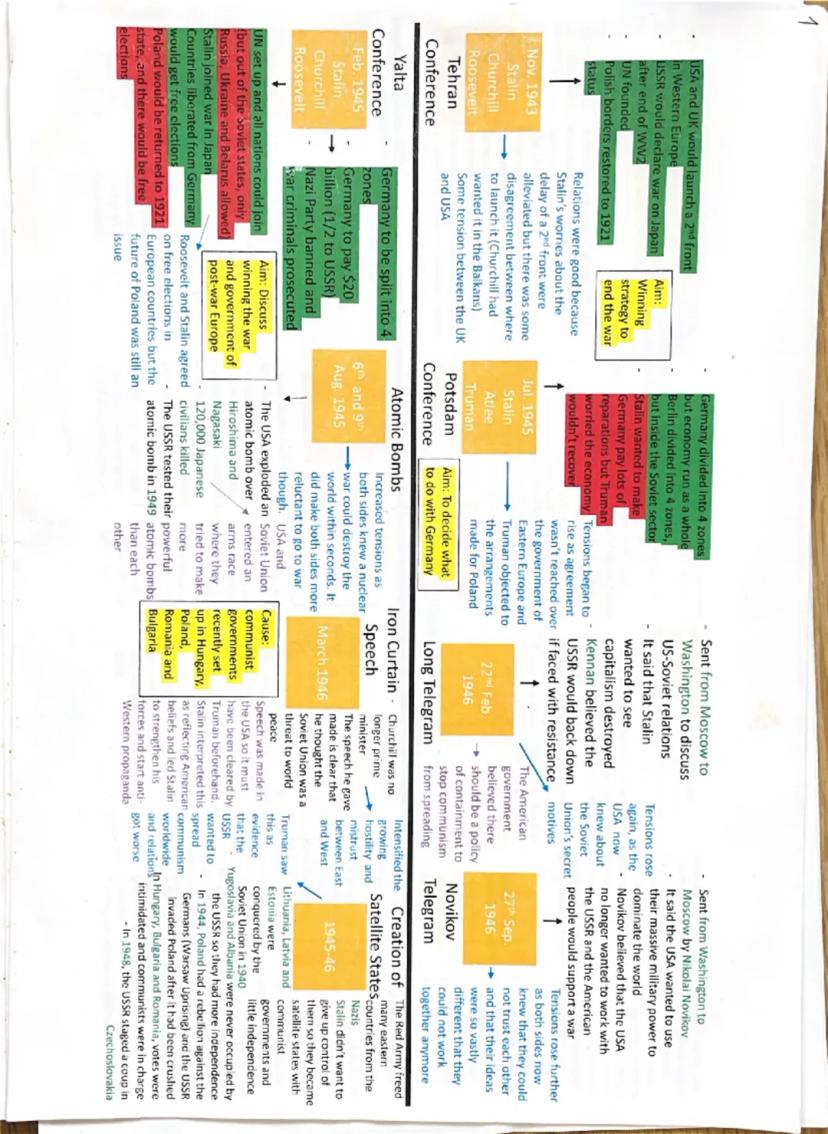

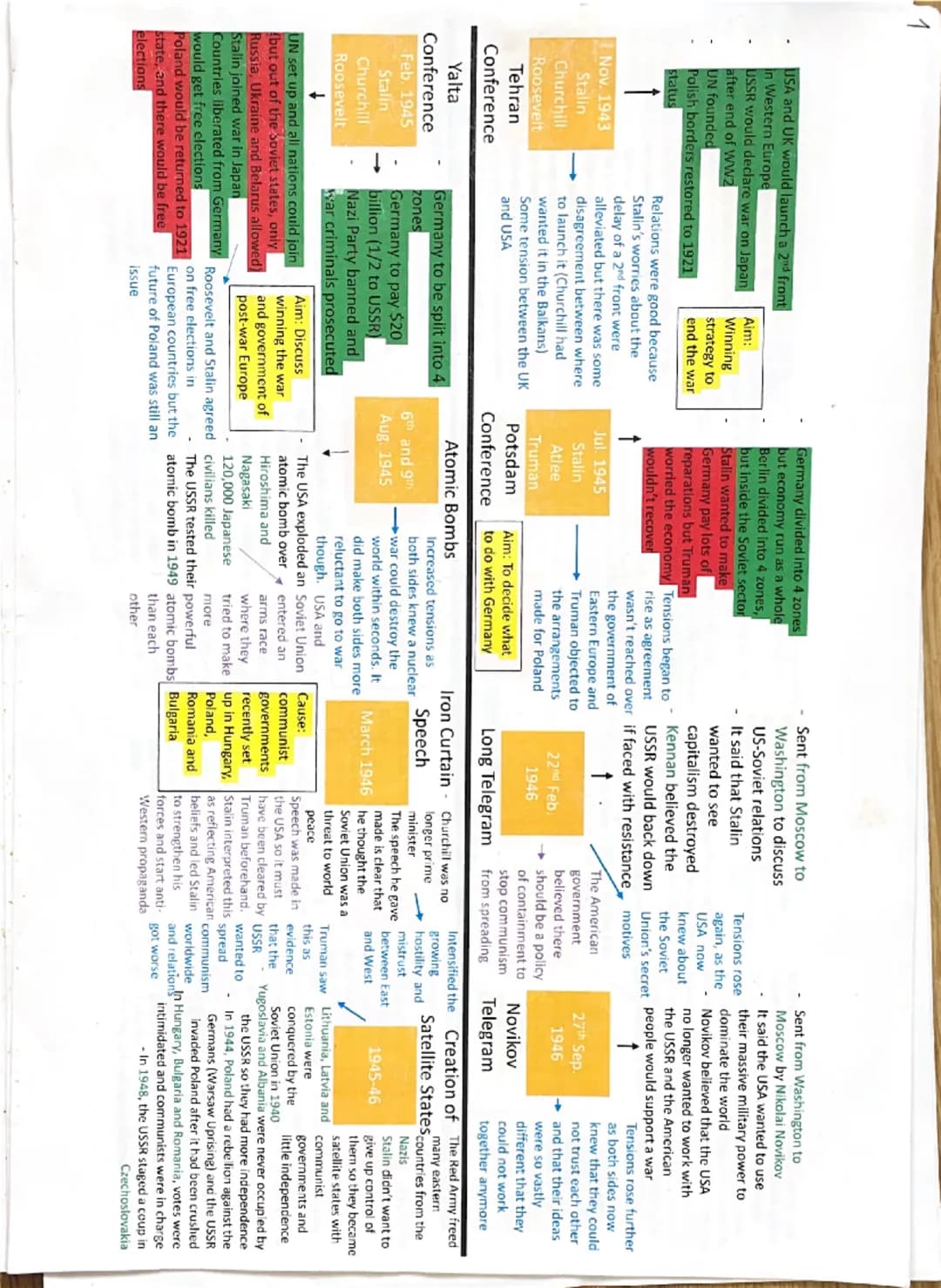
The wartime alliance between the USA, UK, and USSR began with cautious cooperation at the Tehran Conference (1943), where they agreed to launch a second front in Western Europe. Relations were generally positive, though there was some disagreement about where to launch operations.
By the Yalta Conference (February 1945), the three powers made significant agreements about post-war Europe, including dividing Germany into zones, establishing the United Nations, and holding free elections in liberated countries. However, tensions grew at the Potsdam Conference (July 1945) as Stalin and Truman clashed over reparations from Germany and the future of Poland.
Did you know? In 1944, Poland had a rebellion against the Germans (Warsaw Uprising) which was crushed while Soviet troops waited nearby. The USSR then invaded Poland afterward, creating lasting resentment.
The growing mistrust accelerated through 1946 with the exchange of the Long Telegram and Novikov Telegram, where each side accused the other of hostile intentions. The situation worsened dramatically after the US dropped atomic bombs on Japan (August 1945), followed by Churchill's Iron Curtain speech in March 1946, which publicly identified the Soviet Union as a threat to world peace.
As the USSR established communist "satellite states" across Eastern Europe (Hungary, Poland, Romania, Bulgaria, and Czechoslovakia), the divide between East and West became entrenched. These countries had communist governments with limited independence, creating a buffer zone for the Soviet Union.
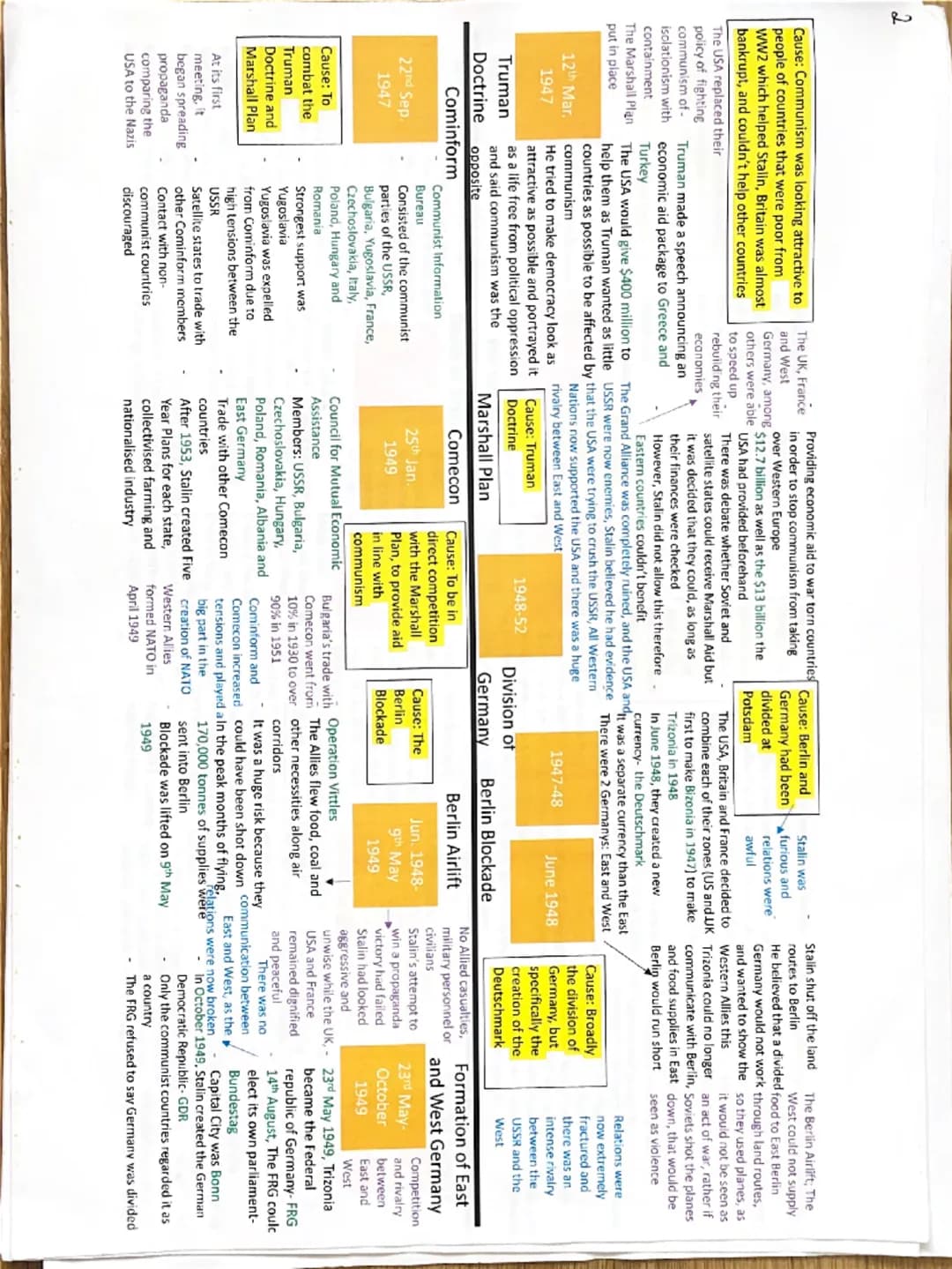
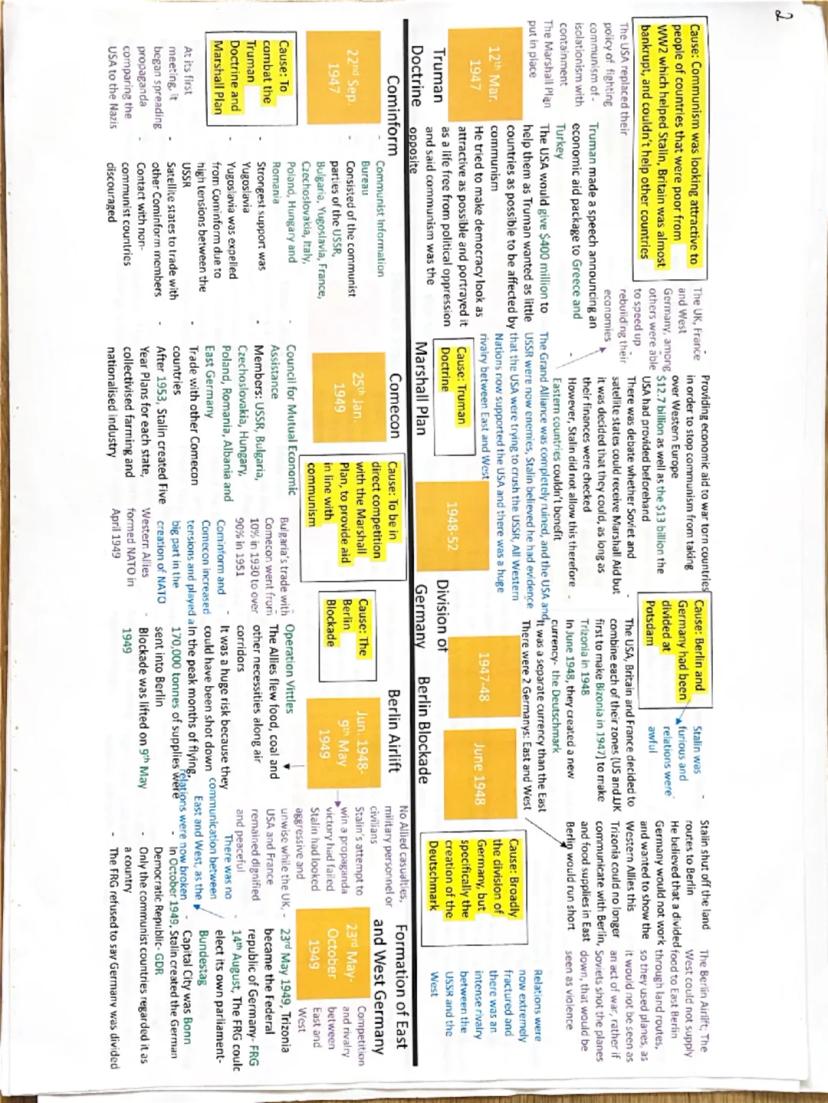
After World War II, Britain was nearly bankrupt and communism looked increasingly attractive to people in war-torn countries. In response, the USA abandoned isolationism in favor of containment – a policy designed to prevent the spread of communism.
The Truman Doctrine (March 1947) began this shift, with President Truman announcing $400 million in aid to Greece and Turkey to fight communist influence. This was followed by the Marshall Plan, which provided $12.7 billion to help Western European countries rebuild their economies. Stalin refused to allow Eastern Bloc countries to accept this aid, fearing Western influence.
Important! The Marshall Plan helped Western Europe rebuild quickly while Eastern Europe struggled, creating a stark economic division that would last decades.
The USSR responded by forming Cominform (Communist Information Bureau) in September 1947 to coordinate communist parties and spread anti-American propaganda. This was followed by Comecon in 1949, which was meant to provide economic assistance to communist countries.
Tensions reached a crisis point with the Berlin Blockade . When the Western Allies combined their German occupation zones and introduced a new currency, Stalin responded by blocking all land routes to Berlin. The Western powers launched the Berlin Airlift, flying in 170,000 tonnes of supplies rather than abandoning the city.
This standoff led to the formal division of Germany into West Germany (FRG) and East Germany (GDR) in 1949, and the formation of NATO in April 1949. Relations between East and West were now thoroughly broken, with each side organizing into competing military alliances.
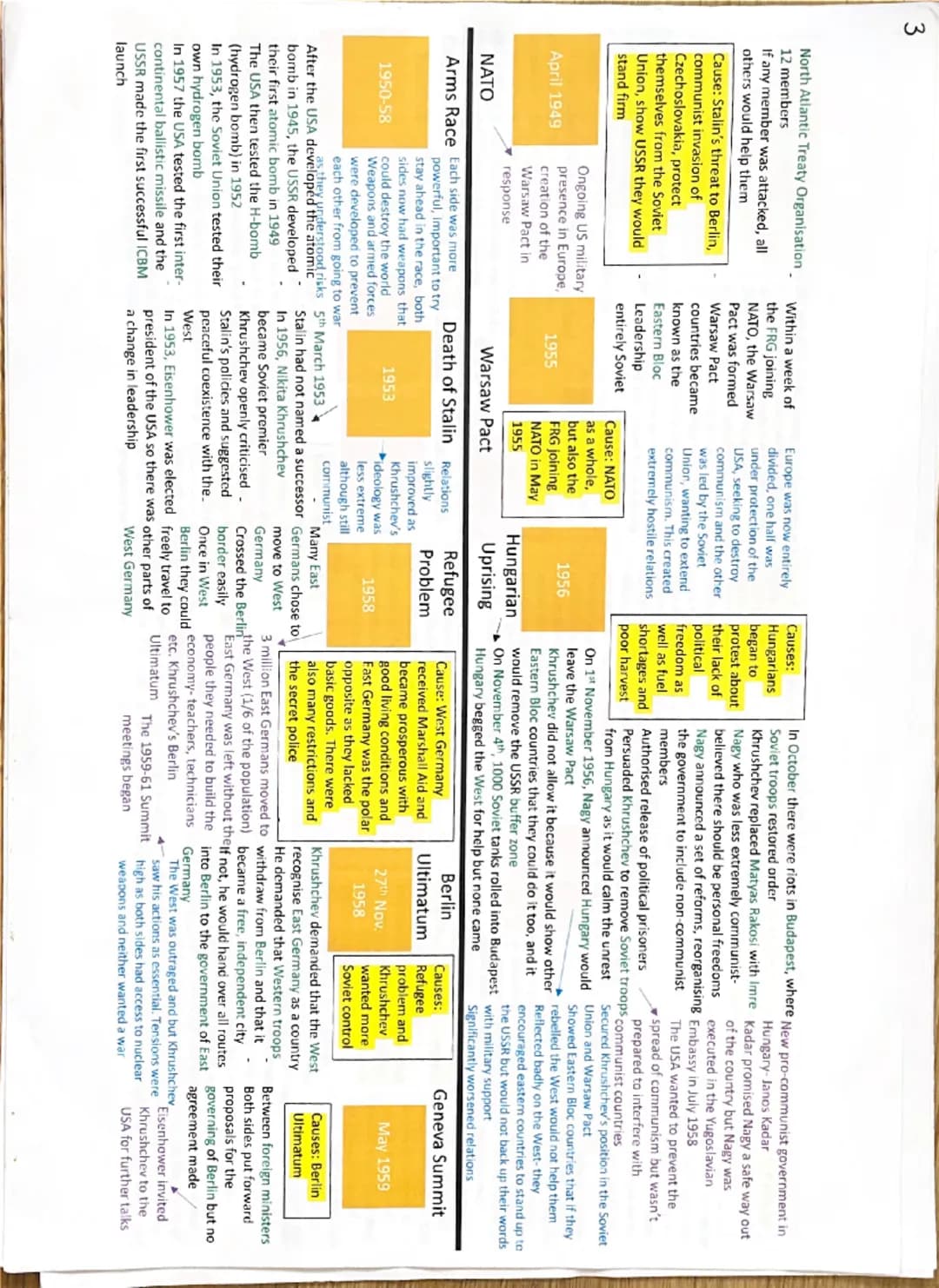
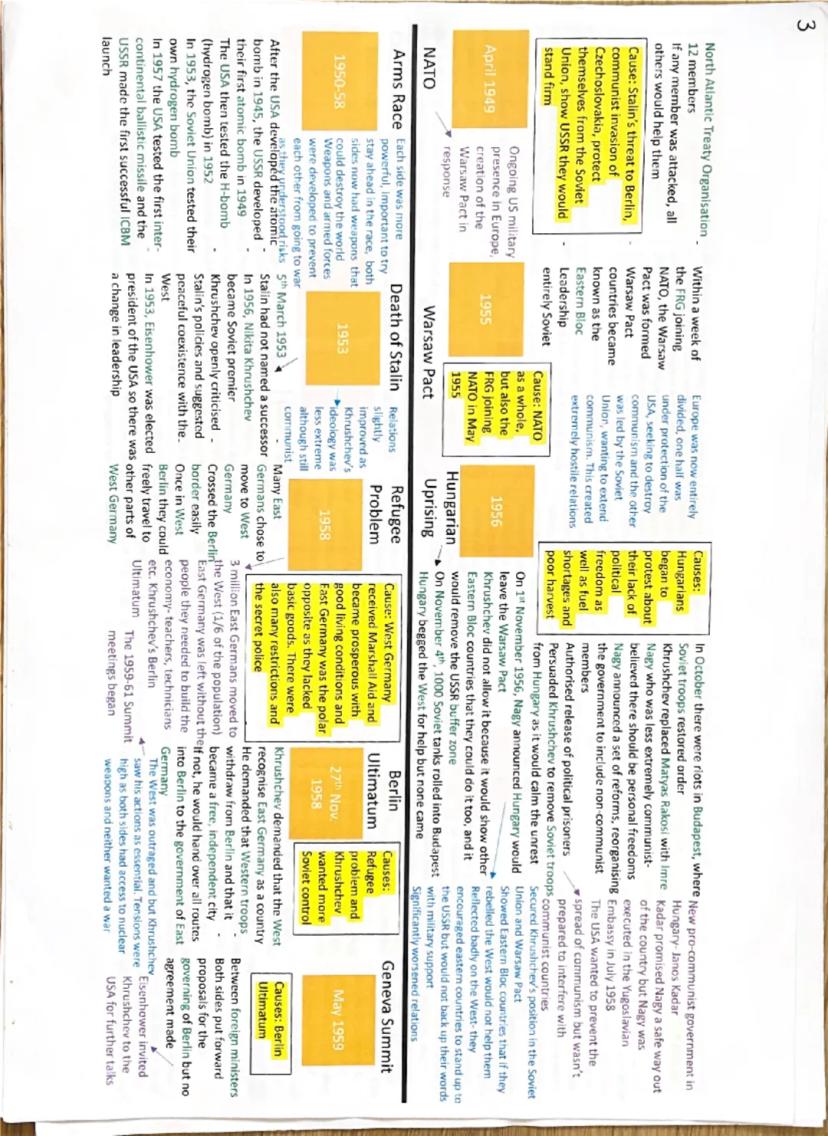
The formation of NATO in April 1949 created a military alliance of 12 Western nations, committed to mutual defense. In direct response, the USSR formed the Warsaw Pact in 1955 when West Germany joined NATO. Europe was now completely divided between these opposing military blocs, with extremely hostile relations.
Both sides engaged in an arms race that made conflict increasingly dangerous. After the USA developed the atomic bomb in 1945, the Soviet Union followed with their own in 1949. The hydrogen bomb came next (USA 1952, USSR 1953), followed by intercontinental ballistic missiles by both powers. Each side built increasingly powerful weapons, though this actually made direct war less likely as both understood the catastrophic risks.
Think about this: The arms race created a situation called "mutually assured destruction" – both sides knew that using nuclear weapons would result in their own destruction too.
Stalin's death in March 1953 slightly improved relations, as Nikita Khrushchev eventually took power and criticized Stalin's more extreme policies. However, tensions remained high, particularly around Berlin.
The Hungarian Uprising of 1956 demonstrated the limits of change. When Hungary, under Imre Nagy, attempted to leave the Warsaw Pact, the USSR sent 1,000 Soviet tanks into Budapest to crush the rebellion. Western powers, despite encouraging Eastern Europeans to resist communism, provided no military support. This significantly worsened relations and showed that the USSR would not tolerate any erosion of its control over Eastern Europe.
By 1958, Khrushchev issued the Berlin Ultimatum, demanding Western powers withdraw from Berlin. This crisis reflected the ongoing refugee problem, as millions of East Germans fled to the West, undermining the East German economy.
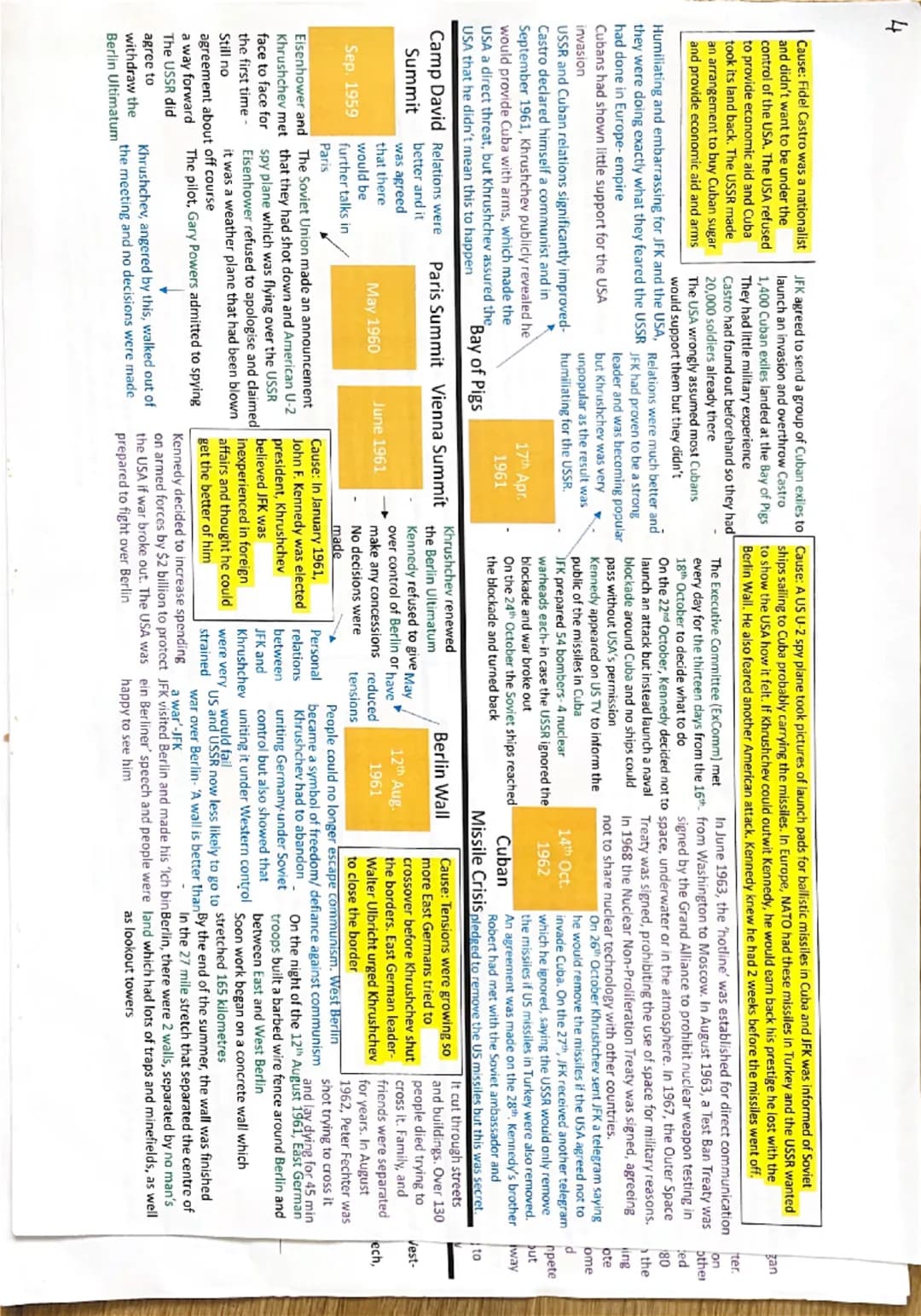
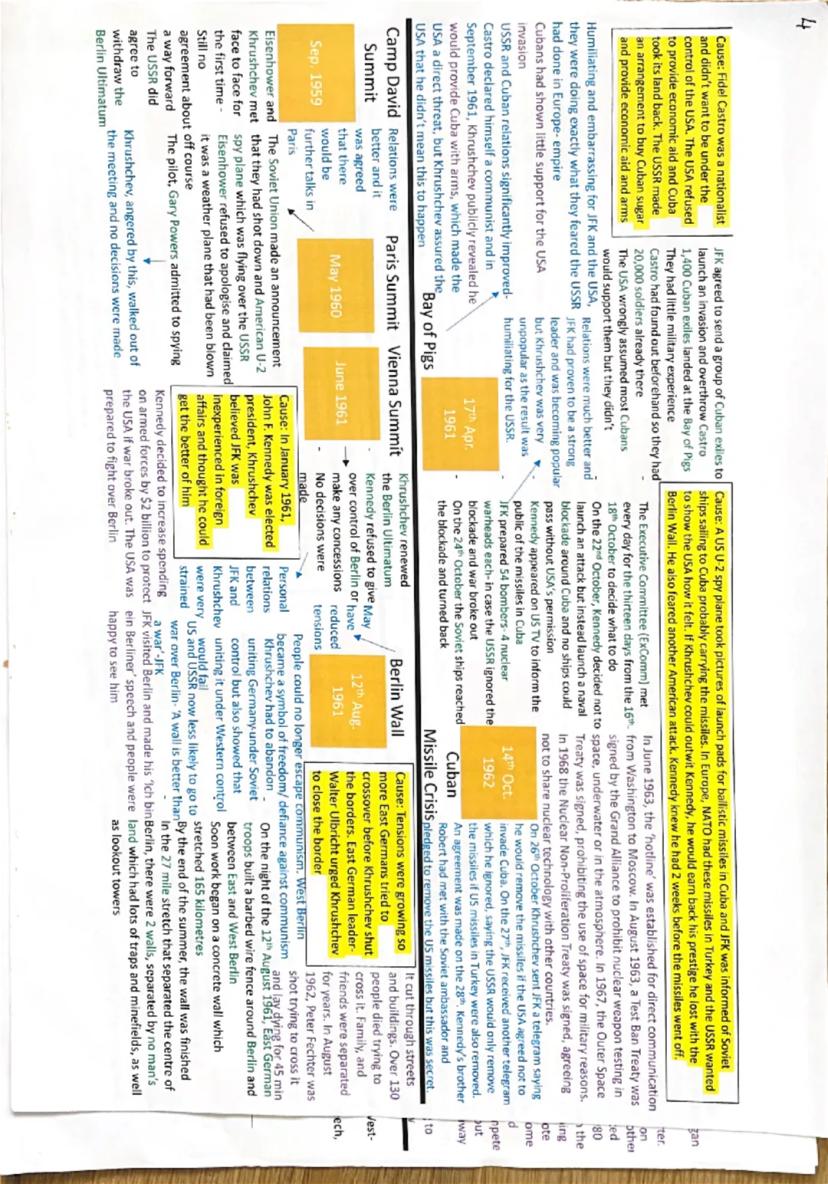
The Berlin Crisis continued with summit meetings at Camp David (September 1959) and Paris (May 1960) failing to resolve tensions. The Paris Summit collapsed when the USSR shot down an American U-2 spy plane flying over Soviet territory, and Eisenhower refused to apologize.
When John F. Kennedy became US president in January 1961, Khrushchev thought he could outmaneuver the inexperienced leader. The relationship became increasingly strained when the USA backed the disastrous Bay of Pigs invasion in April 1961, where 1,400 Cuban exiles attempted to overthrow Fidel Castro's government but were defeated. This humiliation for Kennedy strengthened Cuba's ties with the USSR.
Critical moment: The building of the Berlin Wall on 12th August 1961 physically divided the city, preventing East Germans from escaping to the West. Over 130 people died trying to cross it over the years.
The Cold War reached its most dangerous point during the Cuban Missile Crisis in October 1962. When the USA discovered Soviet nuclear missiles in Cuba, Kennedy imposed a naval blockade while preparing for possible nuclear war. After thirteen tense days, Khrushchev agreed to remove the missiles in exchange for Kennedy's promise not to invade Cuba. Secretly, Kennedy also agreed to remove US missiles from Turkey.
This terrifying brush with nuclear war led to improved communication between the superpowers. In 1963, they established a "hotline" for direct communication between Washington and Moscow, and signed the Test Ban Treaty prohibiting nuclear testing in space, underwater, or in the atmosphere. These agreements reduced the risk of accidental war, though the fundamental Cold War rivalry continued.
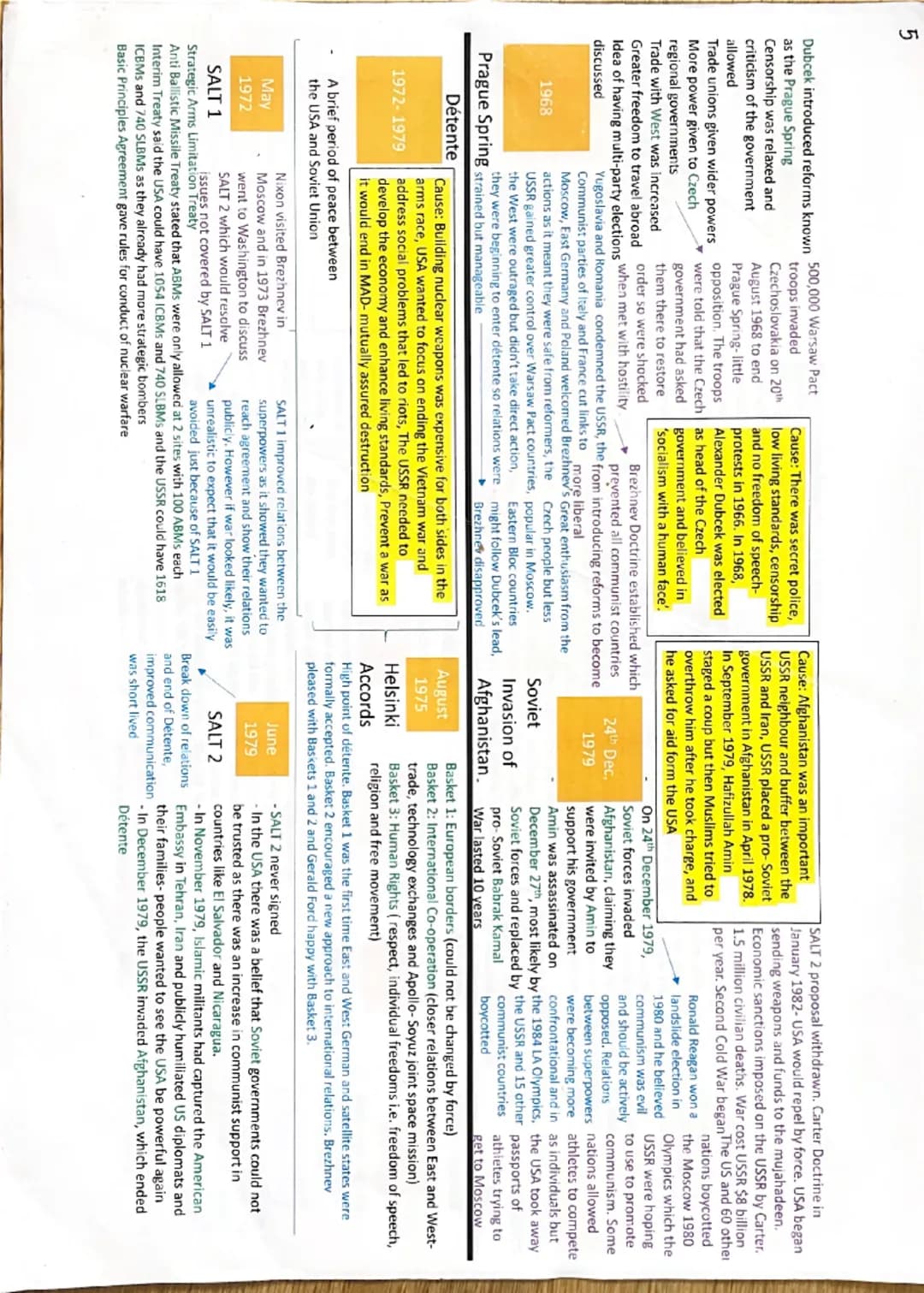
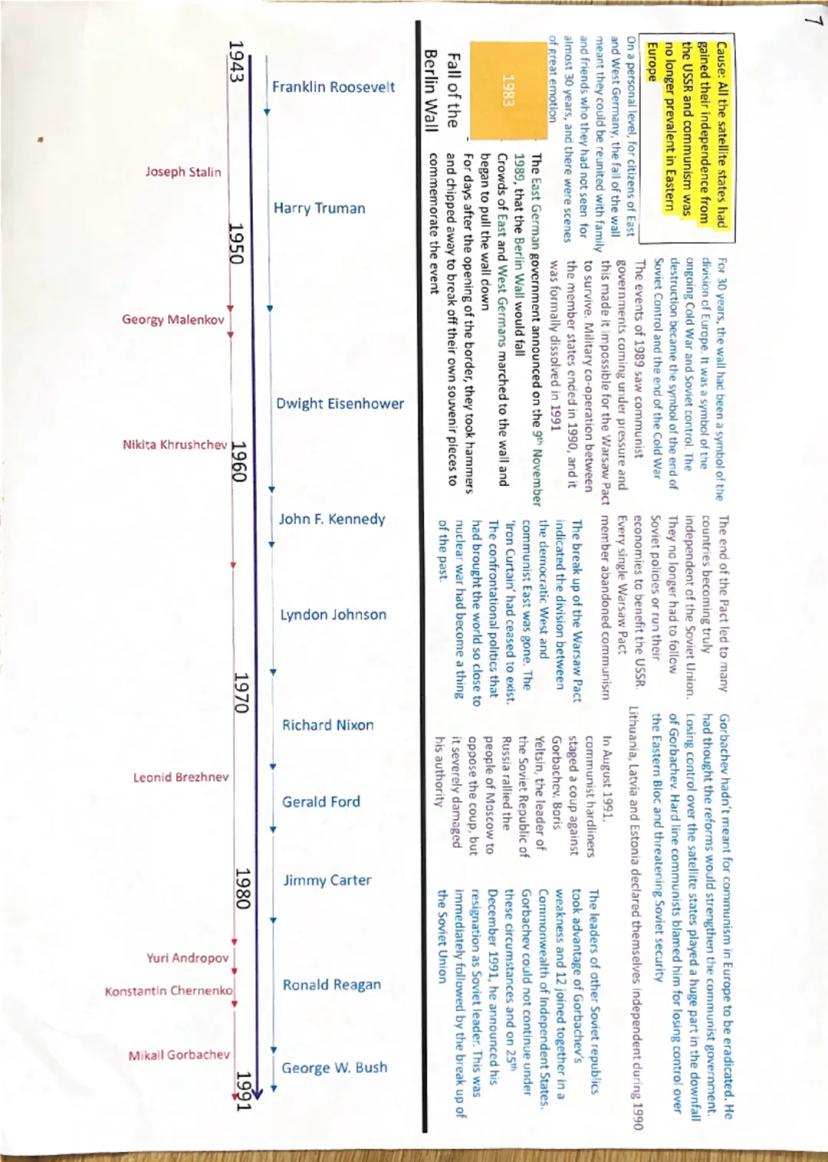
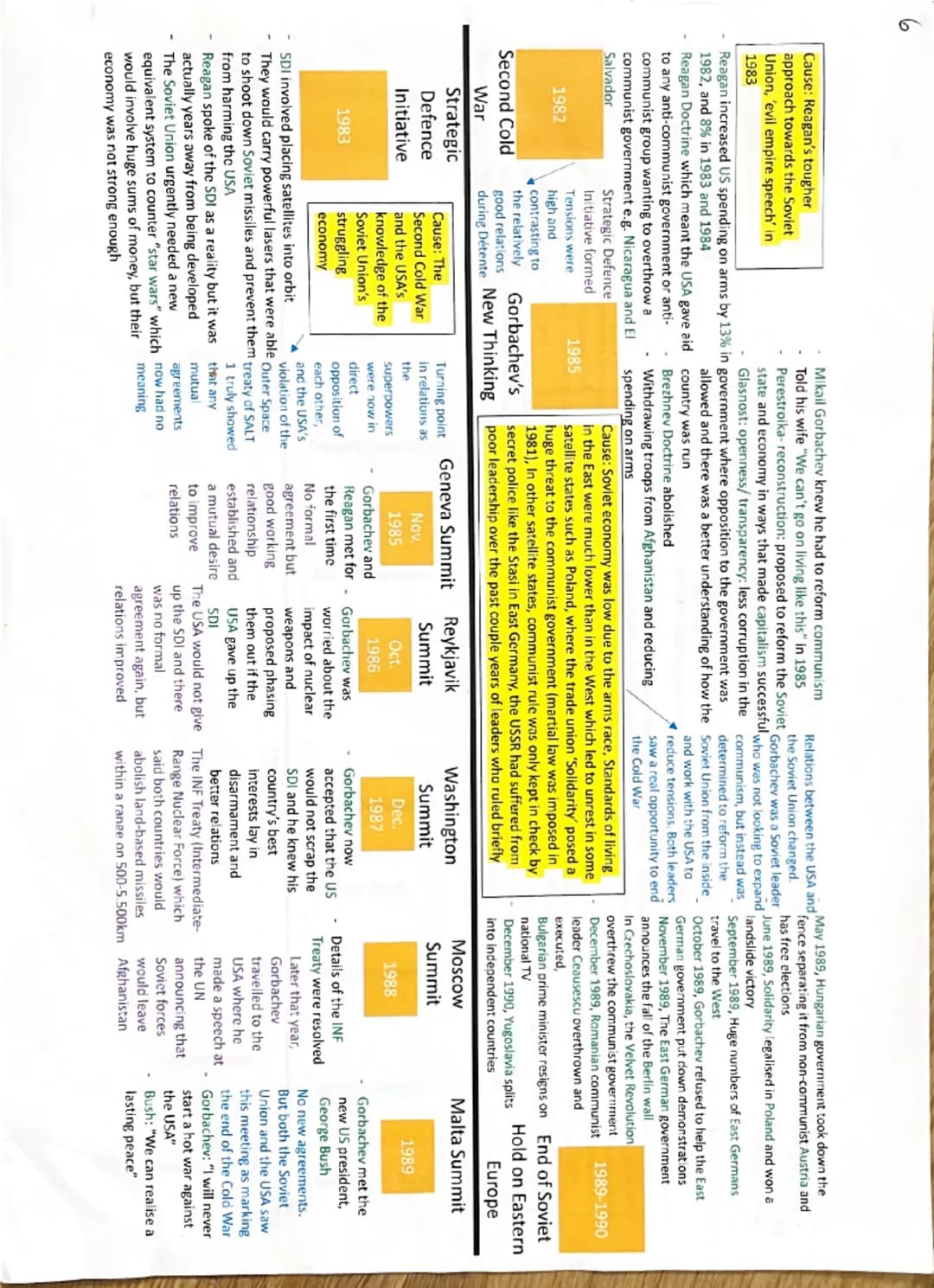
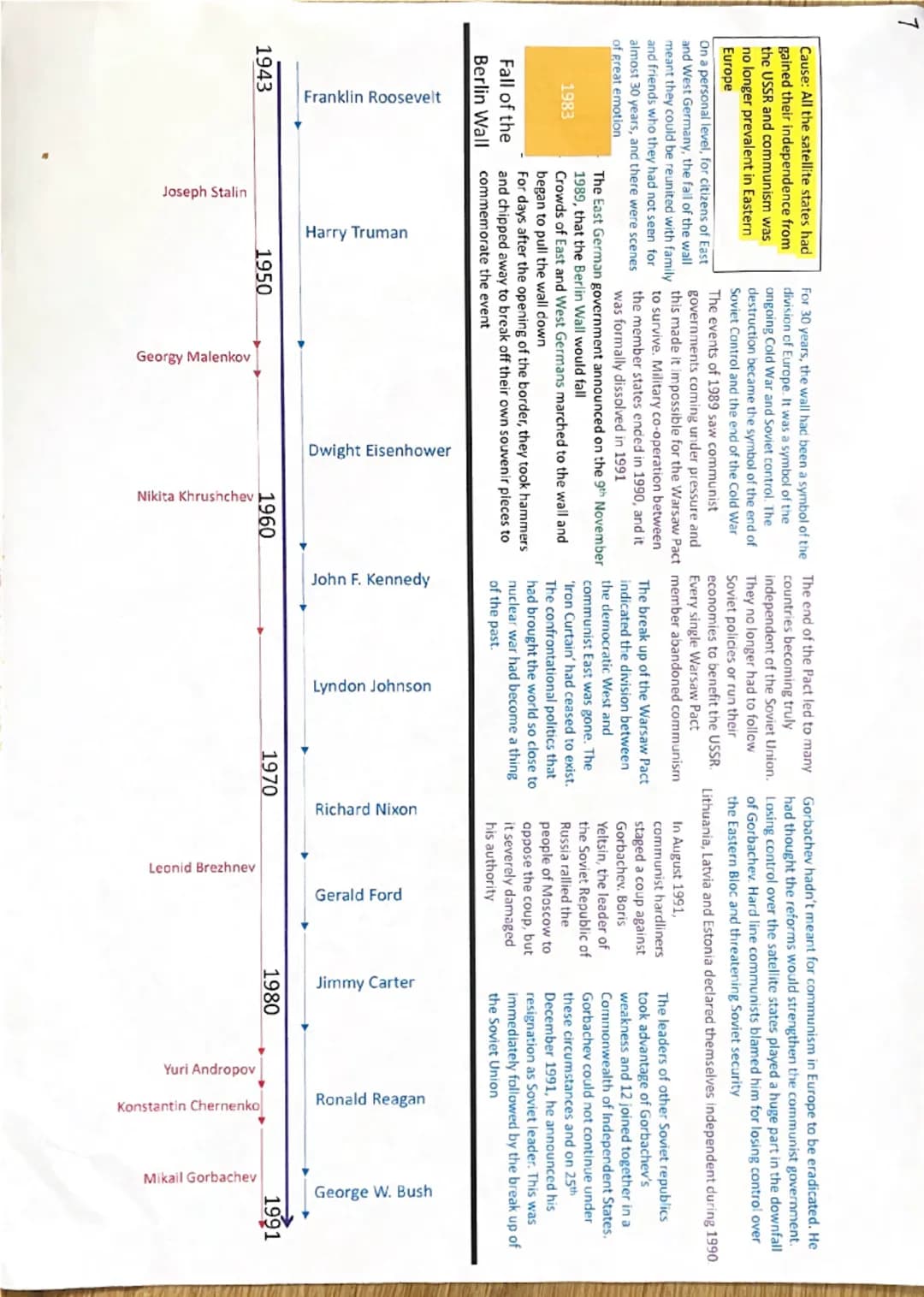
After decades of tension, the Cold War ended dramatically with the Fall of the Berlin Wall on 9th November 1989. For thirty years, the wall had symbolized the division of Europe and Soviet control. When the East German government announced its opening, crowds of Germans from both sides gathered to tear it down, taking pieces as souvenirs of this historic moment.
The fall of the wall allowed families and friends who had been separated for nearly three decades to reunite in emotional scenes. More importantly, it signaled the collapse of Soviet control over Eastern Europe. Within months, communist governments fell across the region.
Historical significance: The fall of the Berlin Wall wasn't just about Germany reuniting - it represented the end of the entire Cold War system that had divided the world for over 40 years.
The Warsaw Pact, which had bound Eastern European countries to the USSR militarily, formally dissolved in 1991. Every member abandoned communism and many embraced democracy. The "Iron Curtain" that Churchill had described in 1946 had finally disappeared.
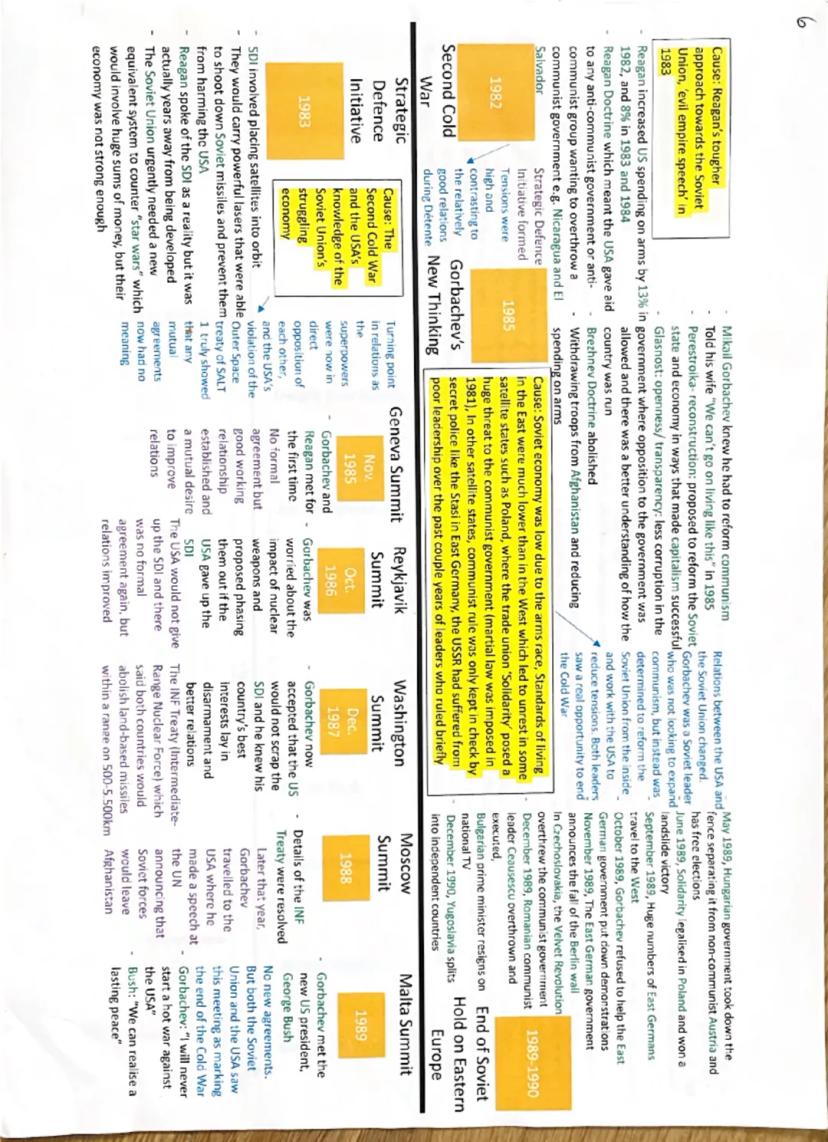
These events ultimately led to the breakup of the Soviet Union itself. The Baltic states (Lithuania, Latvia, and Estonia) declared independence in 1990. After a failed coup against Soviet leader Mikhail Gorbachev in August 1991, the other Soviet republics seized the opportunity to break away. On 25th December 1991, Gorbachev resigned as Soviet leader, and the USSR officially dissolved, ending the Cold War era and fundamentally transforming global politics.
Our AI Companion is a student-focused AI tool that offers more than just answers. Built on millions of Knowunity resources, it provides relevant information, personalised study plans, quizzes, and content directly in the chat, adapting to your individual learning journey.
You can download the app from Google Play Store and Apple App Store.
That's right! Enjoy free access to study content, connect with fellow students, and get instant help – all at your fingertips.
App Store
Google Play
The app is very easy to use and well designed. I have found everything I was looking for so far and have been able to learn a lot from the presentations! I will definitely use the app for a class assignment! And of course it also helps a lot as an inspiration.
Stefan S
iOS user
This app is really great. There are so many study notes and help [...]. My problem subject is French, for example, and the app has so many options for help. Thanks to this app, I have improved my French. I would recommend it to anyone.
Samantha Klich
Android user
Wow, I am really amazed. I just tried the app because I've seen it advertised many times and was absolutely stunned. This app is THE HELP you want for school and above all, it offers so many things, such as workouts and fact sheets, which have been VERY helpful to me personally.
Anna
iOS user
Best app on earth! no words because it’s too good
Thomas R
iOS user
Just amazing. Let's me revise 10x better, this app is a quick 10/10. I highly recommend it to anyone. I can watch and search for notes. I can save them in the subject folder. I can revise it any time when I come back. If you haven't tried this app, you're really missing out.
Basil
Android user
This app has made me feel so much more confident in my exam prep, not only through boosting my own self confidence through the features that allow you to connect with others and feel less alone, but also through the way the app itself is centred around making you feel better. It is easy to navigate, fun to use, and helpful to anyone struggling in absolutely any way.
David K
iOS user
The app's just great! All I have to do is enter the topic in the search bar and I get the response real fast. I don't have to watch 10 YouTube videos to understand something, so I'm saving my time. Highly recommended!
Sudenaz Ocak
Android user
In school I was really bad at maths but thanks to the app, I am doing better now. I am so grateful that you made the app.
Greenlight Bonnie
Android user
very reliable app to help and grow your ideas of Maths, English and other related topics in your works. please use this app if your struggling in areas, this app is key for that. wish I'd of done a review before. and it's also free so don't worry about that.
Rohan U
Android user
I know a lot of apps use fake accounts to boost their reviews but this app deserves it all. Originally I was getting 4 in my English exams and this time I got a grade 7. I didn’t even know about this app three days until the exam and it has helped A LOT. Please actually trust me and use it as I’m sure you too will see developments.
Xander S
iOS user
THE QUIZES AND FLASHCARDS ARE SO USEFUL AND I LOVE Knowunity AI. IT ALSO IS LITREALLY LIKE CHATGPT BUT SMARTER!! HELPED ME WITH MY MASCARA PROBLEMS TOO!! AS WELL AS MY REAL SUBJECTS ! DUHHH 😍😁😲🤑💗✨🎀😮
Elisha
iOS user
This apps acc the goat. I find revision so boring but this app makes it so easy to organize it all and then you can ask the freeeee ai to test yourself so good and you can easily upload your own stuff. highly recommend as someone taking mocks now
Paul T
iOS user
The app is very easy to use and well designed. I have found everything I was looking for so far and have been able to learn a lot from the presentations! I will definitely use the app for a class assignment! And of course it also helps a lot as an inspiration.
Stefan S
iOS user
This app is really great. There are so many study notes and help [...]. My problem subject is French, for example, and the app has so many options for help. Thanks to this app, I have improved my French. I would recommend it to anyone.
Samantha Klich
Android user
Wow, I am really amazed. I just tried the app because I've seen it advertised many times and was absolutely stunned. This app is THE HELP you want for school and above all, it offers so many things, such as workouts and fact sheets, which have been VERY helpful to me personally.
Anna
iOS user
Best app on earth! no words because it’s too good
Thomas R
iOS user
Just amazing. Let's me revise 10x better, this app is a quick 10/10. I highly recommend it to anyone. I can watch and search for notes. I can save them in the subject folder. I can revise it any time when I come back. If you haven't tried this app, you're really missing out.
Basil
Android user
This app has made me feel so much more confident in my exam prep, not only through boosting my own self confidence through the features that allow you to connect with others and feel less alone, but also through the way the app itself is centred around making you feel better. It is easy to navigate, fun to use, and helpful to anyone struggling in absolutely any way.
David K
iOS user
The app's just great! All I have to do is enter the topic in the search bar and I get the response real fast. I don't have to watch 10 YouTube videos to understand something, so I'm saving my time. Highly recommended!
Sudenaz Ocak
Android user
In school I was really bad at maths but thanks to the app, I am doing better now. I am so grateful that you made the app.
Greenlight Bonnie
Android user
very reliable app to help and grow your ideas of Maths, English and other related topics in your works. please use this app if your struggling in areas, this app is key for that. wish I'd of done a review before. and it's also free so don't worry about that.
Rohan U
Android user
I know a lot of apps use fake accounts to boost their reviews but this app deserves it all. Originally I was getting 4 in my English exams and this time I got a grade 7. I didn’t even know about this app three days until the exam and it has helped A LOT. Please actually trust me and use it as I’m sure you too will see developments.
Xander S
iOS user
THE QUIZES AND FLASHCARDS ARE SO USEFUL AND I LOVE Knowunity AI. IT ALSO IS LITREALLY LIKE CHATGPT BUT SMARTER!! HELPED ME WITH MY MASCARA PROBLEMS TOO!! AS WELL AS MY REAL SUBJECTS ! DUHHH 😍😁😲🤑💗✨🎀😮
Elisha
iOS user
This apps acc the goat. I find revision so boring but this app makes it so easy to organize it all and then you can ask the freeeee ai to test yourself so good and you can easily upload your own stuff. highly recommend as someone taking mocks now
Paul T
iOS user
Emily Tsymbalyuk
@milysymbalyuk_399ufr
The Cold War was a period of intense political and military tension between the Western powers (primarily the USA and UK) and the Eastern Bloc led by the Soviet Union. From 1943 to 1991, these superpowers engaged in a global... Show more
Access to all documents
Improve your grades
Join milions of students
By signing up you accept Terms of Service and Privacy Policy
The wartime alliance between the USA, UK, and USSR began with cautious cooperation at the Tehran Conference (1943), where they agreed to launch a second front in Western Europe. Relations were generally positive, though there was some disagreement about where to launch operations.
By the Yalta Conference (February 1945), the three powers made significant agreements about post-war Europe, including dividing Germany into zones, establishing the United Nations, and holding free elections in liberated countries. However, tensions grew at the Potsdam Conference (July 1945) as Stalin and Truman clashed over reparations from Germany and the future of Poland.
Did you know? In 1944, Poland had a rebellion against the Germans (Warsaw Uprising) which was crushed while Soviet troops waited nearby. The USSR then invaded Poland afterward, creating lasting resentment.
The growing mistrust accelerated through 1946 with the exchange of the Long Telegram and Novikov Telegram, where each side accused the other of hostile intentions. The situation worsened dramatically after the US dropped atomic bombs on Japan (August 1945), followed by Churchill's Iron Curtain speech in March 1946, which publicly identified the Soviet Union as a threat to world peace.
As the USSR established communist "satellite states" across Eastern Europe (Hungary, Poland, Romania, Bulgaria, and Czechoslovakia), the divide between East and West became entrenched. These countries had communist governments with limited independence, creating a buffer zone for the Soviet Union.
Access to all documents
Improve your grades
Join milions of students
By signing up you accept Terms of Service and Privacy Policy
After World War II, Britain was nearly bankrupt and communism looked increasingly attractive to people in war-torn countries. In response, the USA abandoned isolationism in favor of containment – a policy designed to prevent the spread of communism.
The Truman Doctrine (March 1947) began this shift, with President Truman announcing $400 million in aid to Greece and Turkey to fight communist influence. This was followed by the Marshall Plan, which provided $12.7 billion to help Western European countries rebuild their economies. Stalin refused to allow Eastern Bloc countries to accept this aid, fearing Western influence.
Important! The Marshall Plan helped Western Europe rebuild quickly while Eastern Europe struggled, creating a stark economic division that would last decades.
The USSR responded by forming Cominform (Communist Information Bureau) in September 1947 to coordinate communist parties and spread anti-American propaganda. This was followed by Comecon in 1949, which was meant to provide economic assistance to communist countries.
Tensions reached a crisis point with the Berlin Blockade . When the Western Allies combined their German occupation zones and introduced a new currency, Stalin responded by blocking all land routes to Berlin. The Western powers launched the Berlin Airlift, flying in 170,000 tonnes of supplies rather than abandoning the city.
This standoff led to the formal division of Germany into West Germany (FRG) and East Germany (GDR) in 1949, and the formation of NATO in April 1949. Relations between East and West were now thoroughly broken, with each side organizing into competing military alliances.
Access to all documents
Improve your grades
Join milions of students
By signing up you accept Terms of Service and Privacy Policy
The formation of NATO in April 1949 created a military alliance of 12 Western nations, committed to mutual defense. In direct response, the USSR formed the Warsaw Pact in 1955 when West Germany joined NATO. Europe was now completely divided between these opposing military blocs, with extremely hostile relations.
Both sides engaged in an arms race that made conflict increasingly dangerous. After the USA developed the atomic bomb in 1945, the Soviet Union followed with their own in 1949. The hydrogen bomb came next (USA 1952, USSR 1953), followed by intercontinental ballistic missiles by both powers. Each side built increasingly powerful weapons, though this actually made direct war less likely as both understood the catastrophic risks.
Think about this: The arms race created a situation called "mutually assured destruction" – both sides knew that using nuclear weapons would result in their own destruction too.
Stalin's death in March 1953 slightly improved relations, as Nikita Khrushchev eventually took power and criticized Stalin's more extreme policies. However, tensions remained high, particularly around Berlin.
The Hungarian Uprising of 1956 demonstrated the limits of change. When Hungary, under Imre Nagy, attempted to leave the Warsaw Pact, the USSR sent 1,000 Soviet tanks into Budapest to crush the rebellion. Western powers, despite encouraging Eastern Europeans to resist communism, provided no military support. This significantly worsened relations and showed that the USSR would not tolerate any erosion of its control over Eastern Europe.
By 1958, Khrushchev issued the Berlin Ultimatum, demanding Western powers withdraw from Berlin. This crisis reflected the ongoing refugee problem, as millions of East Germans fled to the West, undermining the East German economy.
Access to all documents
Improve your grades
Join milions of students
By signing up you accept Terms of Service and Privacy Policy
The Berlin Crisis continued with summit meetings at Camp David (September 1959) and Paris (May 1960) failing to resolve tensions. The Paris Summit collapsed when the USSR shot down an American U-2 spy plane flying over Soviet territory, and Eisenhower refused to apologize.
When John F. Kennedy became US president in January 1961, Khrushchev thought he could outmaneuver the inexperienced leader. The relationship became increasingly strained when the USA backed the disastrous Bay of Pigs invasion in April 1961, where 1,400 Cuban exiles attempted to overthrow Fidel Castro's government but were defeated. This humiliation for Kennedy strengthened Cuba's ties with the USSR.
Critical moment: The building of the Berlin Wall on 12th August 1961 physically divided the city, preventing East Germans from escaping to the West. Over 130 people died trying to cross it over the years.
The Cold War reached its most dangerous point during the Cuban Missile Crisis in October 1962. When the USA discovered Soviet nuclear missiles in Cuba, Kennedy imposed a naval blockade while preparing for possible nuclear war. After thirteen tense days, Khrushchev agreed to remove the missiles in exchange for Kennedy's promise not to invade Cuba. Secretly, Kennedy also agreed to remove US missiles from Turkey.
This terrifying brush with nuclear war led to improved communication between the superpowers. In 1963, they established a "hotline" for direct communication between Washington and Moscow, and signed the Test Ban Treaty prohibiting nuclear testing in space, underwater, or in the atmosphere. These agreements reduced the risk of accidental war, though the fundamental Cold War rivalry continued.
Access to all documents
Improve your grades
Join milions of students
By signing up you accept Terms of Service and Privacy Policy
After decades of tension, the Cold War ended dramatically with the Fall of the Berlin Wall on 9th November 1989. For thirty years, the wall had symbolized the division of Europe and Soviet control. When the East German government announced its opening, crowds of Germans from both sides gathered to tear it down, taking pieces as souvenirs of this historic moment.
The fall of the wall allowed families and friends who had been separated for nearly three decades to reunite in emotional scenes. More importantly, it signaled the collapse of Soviet control over Eastern Europe. Within months, communist governments fell across the region.
Historical significance: The fall of the Berlin Wall wasn't just about Germany reuniting - it represented the end of the entire Cold War system that had divided the world for over 40 years.
The Warsaw Pact, which had bound Eastern European countries to the USSR militarily, formally dissolved in 1991. Every member abandoned communism and many embraced democracy. The "Iron Curtain" that Churchill had described in 1946 had finally disappeared.
These events ultimately led to the breakup of the Soviet Union itself. The Baltic states (Lithuania, Latvia, and Estonia) declared independence in 1990. After a failed coup against Soviet leader Mikhail Gorbachev in August 1991, the other Soviet republics seized the opportunity to break away. On 25th December 1991, Gorbachev resigned as Soviet leader, and the USSR officially dissolved, ending the Cold War era and fundamentally transforming global politics.
Access to all documents
Improve your grades
Join milions of students
By signing up you accept Terms of Service and Privacy Policy
Access to all documents
Improve your grades
Join milions of students
By signing up you accept Terms of Service and Privacy Policy
Our AI Companion is a student-focused AI tool that offers more than just answers. Built on millions of Knowunity resources, it provides relevant information, personalised study plans, quizzes, and content directly in the chat, adapting to your individual learning journey.
You can download the app from Google Play Store and Apple App Store.
That's right! Enjoy free access to study content, connect with fellow students, and get instant help – all at your fingertips.
0
Smart Tools NEW
Transform this note into: ✓ 50+ Practice Questions ✓ Interactive Flashcards ✓ Full Mock Exam ✓ Essay Outlines
App Store
Google Play
The app is very easy to use and well designed. I have found everything I was looking for so far and have been able to learn a lot from the presentations! I will definitely use the app for a class assignment! And of course it also helps a lot as an inspiration.
Stefan S
iOS user
This app is really great. There are so many study notes and help [...]. My problem subject is French, for example, and the app has so many options for help. Thanks to this app, I have improved my French. I would recommend it to anyone.
Samantha Klich
Android user
Wow, I am really amazed. I just tried the app because I've seen it advertised many times and was absolutely stunned. This app is THE HELP you want for school and above all, it offers so many things, such as workouts and fact sheets, which have been VERY helpful to me personally.
Anna
iOS user
Best app on earth! no words because it’s too good
Thomas R
iOS user
Just amazing. Let's me revise 10x better, this app is a quick 10/10. I highly recommend it to anyone. I can watch and search for notes. I can save them in the subject folder. I can revise it any time when I come back. If you haven't tried this app, you're really missing out.
Basil
Android user
This app has made me feel so much more confident in my exam prep, not only through boosting my own self confidence through the features that allow you to connect with others and feel less alone, but also through the way the app itself is centred around making you feel better. It is easy to navigate, fun to use, and helpful to anyone struggling in absolutely any way.
David K
iOS user
The app's just great! All I have to do is enter the topic in the search bar and I get the response real fast. I don't have to watch 10 YouTube videos to understand something, so I'm saving my time. Highly recommended!
Sudenaz Ocak
Android user
In school I was really bad at maths but thanks to the app, I am doing better now. I am so grateful that you made the app.
Greenlight Bonnie
Android user
very reliable app to help and grow your ideas of Maths, English and other related topics in your works. please use this app if your struggling in areas, this app is key for that. wish I'd of done a review before. and it's also free so don't worry about that.
Rohan U
Android user
I know a lot of apps use fake accounts to boost their reviews but this app deserves it all. Originally I was getting 4 in my English exams and this time I got a grade 7. I didn’t even know about this app three days until the exam and it has helped A LOT. Please actually trust me and use it as I’m sure you too will see developments.
Xander S
iOS user
THE QUIZES AND FLASHCARDS ARE SO USEFUL AND I LOVE Knowunity AI. IT ALSO IS LITREALLY LIKE CHATGPT BUT SMARTER!! HELPED ME WITH MY MASCARA PROBLEMS TOO!! AS WELL AS MY REAL SUBJECTS ! DUHHH 😍😁😲🤑💗✨🎀😮
Elisha
iOS user
This apps acc the goat. I find revision so boring but this app makes it so easy to organize it all and then you can ask the freeeee ai to test yourself so good and you can easily upload your own stuff. highly recommend as someone taking mocks now
Paul T
iOS user
The app is very easy to use and well designed. I have found everything I was looking for so far and have been able to learn a lot from the presentations! I will definitely use the app for a class assignment! And of course it also helps a lot as an inspiration.
Stefan S
iOS user
This app is really great. There are so many study notes and help [...]. My problem subject is French, for example, and the app has so many options for help. Thanks to this app, I have improved my French. I would recommend it to anyone.
Samantha Klich
Android user
Wow, I am really amazed. I just tried the app because I've seen it advertised many times and was absolutely stunned. This app is THE HELP you want for school and above all, it offers so many things, such as workouts and fact sheets, which have been VERY helpful to me personally.
Anna
iOS user
Best app on earth! no words because it’s too good
Thomas R
iOS user
Just amazing. Let's me revise 10x better, this app is a quick 10/10. I highly recommend it to anyone. I can watch and search for notes. I can save them in the subject folder. I can revise it any time when I come back. If you haven't tried this app, you're really missing out.
Basil
Android user
This app has made me feel so much more confident in my exam prep, not only through boosting my own self confidence through the features that allow you to connect with others and feel less alone, but also through the way the app itself is centred around making you feel better. It is easy to navigate, fun to use, and helpful to anyone struggling in absolutely any way.
David K
iOS user
The app's just great! All I have to do is enter the topic in the search bar and I get the response real fast. I don't have to watch 10 YouTube videos to understand something, so I'm saving my time. Highly recommended!
Sudenaz Ocak
Android user
In school I was really bad at maths but thanks to the app, I am doing better now. I am so grateful that you made the app.
Greenlight Bonnie
Android user
very reliable app to help and grow your ideas of Maths, English and other related topics in your works. please use this app if your struggling in areas, this app is key for that. wish I'd of done a review before. and it's also free so don't worry about that.
Rohan U
Android user
I know a lot of apps use fake accounts to boost their reviews but this app deserves it all. Originally I was getting 4 in my English exams and this time I got a grade 7. I didn’t even know about this app three days until the exam and it has helped A LOT. Please actually trust me and use it as I’m sure you too will see developments.
Xander S
iOS user
THE QUIZES AND FLASHCARDS ARE SO USEFUL AND I LOVE Knowunity AI. IT ALSO IS LITREALLY LIKE CHATGPT BUT SMARTER!! HELPED ME WITH MY MASCARA PROBLEMS TOO!! AS WELL AS MY REAL SUBJECTS ! DUHHH 😍😁😲🤑💗✨🎀😮
Elisha
iOS user
This apps acc the goat. I find revision so boring but this app makes it so easy to organize it all and then you can ask the freeeee ai to test yourself so good and you can easily upload your own stuff. highly recommend as someone taking mocks now
Paul T
iOS user