
Water is everywhere around us, but understanding how it moves... Show more
 Geography
 English Literature
 Sociology
 Biology
Sign up to see the contentIt's free!
Access to all documents
Improve your grades
Join milions of students
Knowunity AI
Subjects
Triangle Congruence and Similarity Theorems
Triangle Properties and Classification
Linear Equations and Graphs
Geometric Angle Relationships
Trigonometric Functions and Identities
Equation Solving Techniques
Circle Geometry Fundamentals
Division Operations and Methods
Basic Differentiation Rules
Exponent and Logarithm Properties
Show all topics
Human Organ Systems
Reproductive Cell Cycles
Biological Sciences Subdisciplines
Cellular Energy Metabolism
Autotrophic Energy Processes
Inheritance Patterns and Principles
Biomolecular Structure and Organization
Cell Cycle and Division Mechanics
Cellular Organization and Development
Biological Structural Organization
Show all topics
Chemical Sciences and Applications
Atomic Structure and Composition
Molecular Electron Structure Representation
Atomic Electron Behavior
Matter Properties and Water
Mole Concept and Calculations
Gas Laws and Behavior
Periodic Table Organization
Chemical Thermodynamics Fundamentals
Chemical Bond Types and Properties
Show all topics
European Renaissance and Enlightenment
European Cultural Movements 800-1920
American Revolution Era 1763-1797
American Civil War 1861-1865
Global Imperial Systems
Mongol and Chinese Dynasties
U.S. Presidents and World Leaders
Historical Sources and Documentation
World Wars Era and Impact
World Religious Systems
Show all topics
Classic and Contemporary Novels
Literary Character Analysis
Rhetorical Theory and Practice
Classic Literary Narratives
Reading Analysis and Interpretation
Narrative Structure and Techniques
English Language Components
Influential English-Language Authors
Basic Sentence Structure
Narrative Voice and Perspective
Show all topics
95
•
Updated Mar 23, 2026
•

Erin Wilson
@ezpez06
Water is everywhere around us, but understanding how it moves... Show more



Think of a drainage basin as nature's water collection system - everything that happens when rain falls and needs somewhere to go. The water cycle starts with precipitation, which arrives in three main ways depending on where you live.
Relief rainfall happens in mountainous areas when air gets pushed upward and cools down, forcing moisture to condense into rain. Convectional rainfall occurs in hot tropical areas where heated air rises and creates those dramatic afternoon thunderstorms. Frontal rainfall forms where hot and cold air masses meet, forcing warm air upward.
Once water hits the ground, it follows several paths: some flows directly over the surface (surface runoff), some soaks into the soil (infiltration), and some moves through soil layers (throughflow) before eventually reaching rivers or underground stores. Residence time tells us how long water molecules typically hang around in each part of the system before moving on.
Key insight: The type of precipitation your area gets depends entirely on local geography and climate - mountains create their own weather patterns!

Humans are dramatically reshaping how water moves through natural systems, and these changes affect millions of people worldwide. Water storage reservoirs created by building dams increase our access to fresh water but reduce river flow to oceans and boost evaporation from large water surfaces.
Deforestation removes the natural umbrella effect of tree canopies, causing more water to hit the ground directly and increasing flood risk. Without tree roots and forest floor materials to help water soak into soil, more water runs off the surface instead of replenishing underground stores.
The Amazon River Basin shows these effects clearly - dense tree cover normally intercepts rainfall and slows water flow, but deforestation increases the volume of water reaching the ground too quickly. This saturates soil and dramatically increases flooding whilst reducing the rainfall that forests normally generate through evapotranspiration.
Land use changes like farming and urbanisation create impermeable surfaces that speed up water flow. Whilst ploughing can help water infiltrate, livestock trampling compacts soil, and buildings create surfaces that water can't penetrate at all.
Reality check: Every time you see a new housing development or car park, that's another area where rainwater will run off instead of soaking into the ground naturally.

River regimes describe how much water flows through rivers during different times of year - basically, rivers have personalities that change with the seasons. Smaller basins tend to be more "flashy" with dramatic changes in flow, whilst larger ones stay more stable.
Several factors shape these patterns: geology matters because permeable rocks let water soak through rather than rush to rivers, whilst soil type affects how quickly water infiltrates. Hot climates increase evapotranspiration, leaving less water to reach rivers, and human activities like building dams create steadier flows year-round.
The UK's temperate climate creates a predictable pattern: January to April brings water surplus when soil stores fill up, April to September sees depletion as temperatures rise and precipitation drops, then September to December recharges the system as temperatures fall and rain returns.
Storm hydrographs show how rivers respond to individual rainfall events. The rising limb tracks increasing discharge until peak flow, then the falling limb shows the gradual decline. Lag time - the delay between peak rainfall and peak river flow - tells us how quickly water moves through the landscape.
Exam tip: Remember that flashy rivers with short lag times are more dangerous for flooding, whilst longer lag times give communities more warning.

Droughts happen when water demand exceeds what precipitation provides, forcing us to tap into underground aquifers faster than they can recharge naturally. This over-abstraction depletes water stores and can take decades or centuries to reverse.
Australia's Millennium Drought (2001-2009) devastated the Murray-Darling basin through a combination of naturally low rainfall, El Niño conditions, higher temperatures, and years of over-abstraction. The agricultural sector collapsed - crop yields plummeted, sheep numbers fell dramatically, and thousands lost their jobs.
Short-term droughts result from immediate precipitation deficits, often caused by high-pressure weather systems that block rain-bearing clouds. Long-term droughts connect to broader climate patterns like ocean temperature changes that alter seasonal rains, particularly affecting tropical regions.
El Niño weakens Pacific trade winds and creates high-pressure areas that reduce western Pacific rainfall. La Niña intensifies normal conditions, creating even drier conditions in eastern regions. Both phenomena can persist for months or years, creating cascading effects on water security.
Global connection: Australia's drought affected global food prices because the Murray-Darling basin produces much of the country's agricultural exports.

Flooding strikes when rivers can't cope with water volume, but human activities increasingly amplify natural flood risks. Floodplain development and urbanisation create impermeable surfaces that prevent water infiltration, whilst deforestation removes natural water interception and exposes soil to erosion.
Hard engineering solutions sometimes backfire spectacularly - channel straightening increases flow rates and pushes flood risk downstream, while dredging can have similar effects. The Mississippi River's management history shows how engineering changes can create unexpected consequences elsewhere in the system.
Natural flood causes include intense storm rainfall that exceeds river capacity, monsoon systems affecting South and Southeast Asia between May and September, and snowmelt overwhelming frozen or saturated ground. Land shape matters too - flat terrain provides no gradient for water movement, whilst low-lying areas flood first.
The UK's 2007 floods demonstrated these principles when unusually positioned jet streams brought repeated low-pressure systems. Thirteen people died, 48,000 homes flooded, and entire communities like Upton-upon-Severn became isolated from emergency services.
Personal impact: Homes on floodplains often can't get insurance, making flooding not just a safety issue but a long-term financial disaster.

Climate change creates massive uncertainty in water systems because changes vary dramatically across different regions, making precise predictions challenging. The fundamental principle is simple but devastating: wet areas get wetter through increased evaporation creating more low-pressure systems, whilst dry areas get drier from persistent high-pressure systems.
Feedback systems either amplify or moderate these changes. Positive feedback loops make situations worse - rising temperatures increase evaporation, creating more water vapour, which traps more heat. Negative feedback loops can provide balance, though these are less common in warming systems.
Water security faces unprecedented challenges as rainfall patterns become unpredictable and unreliable. Glacial melt initially provides more water than manageable, but eventually eliminates crucial water stores entirely. Sea level rise from thermal expansion contaminates coastal groundwater with saltwater.
Flow rates will fluctuate dramatically - expect fast, large flows after prolonged rain alternating with extremely slow rates during dry periods as ground becomes more arid. Store sizes will shift fundamentally: ocean stores expand, glacial stores shrink, and permafrost active layers deepen.
Future reality: Today's water infrastructure was designed for historical climate patterns that may never return, requiring massive adaptation investments.

Water prices depend on multiple factors that make this essential resource expensive for those who need it most. Transport costs from source to destination, market dynamics where increased demand drives higher prices, difficult access at sources, and pollution cleanup all inflate costs significantly.
The Water Poverty Index measures how water-impoverished countries are based on access, capacity, use, environment and resources - lower scores indicate greater water stress. International Monetary Fund involvement often requires countries to privatise water companies as loan conditions, potentially making water less accessible to poor populations.
Physical causes of water insecurity include climate patterns affecting freshwater availability, rapid runoff that prevents water usage, high evaporation rates preventing sustainable storage, and sea level rise causing saltwater to contaminate freshwater aquifers.
Human causes create equally serious problems: chemical pollution from agriculture, industry and domestic wastewater contaminates fresh sources, over-abstraction uses water faster than replenishment, and hydroelectric plants hold back water in reservoirs. The Aral Sea exemplifies extreme over-abstraction - formerly a massive lake, it's shrunk to just 10% of its original size due to irrigation canals and high evaporation rates.
Economic reality: Privatising water can improve efficiency and conservation, but it can also make this basic need unaffordable for vulnerable populations.

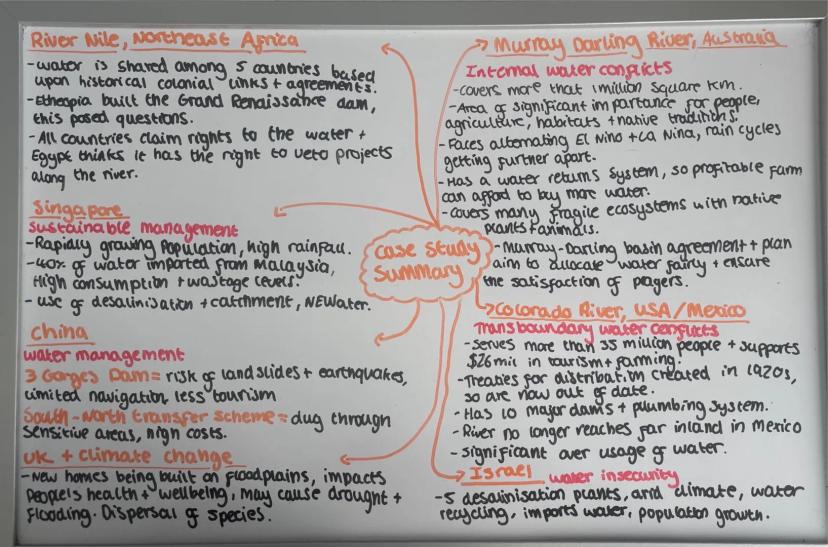
Transboundary water conflicts emerge when rivers cross national borders, creating competing claims for limited resources. The Colorado River serves over 35 million people across the USA and Mexico, supporting $26 million in tourism and farming, but original 1920s treaties no longer reflect current needs or usage patterns.
California holds rights to 24% of Colorado River water, whilst the river no longer reaches parts of Mexico due to upstream irrigation and over-usage. Ten major dams and extensive infrastructure manage flow, but many First Nations peoples have been neglected in water allocation. Minute 139 attempts to address Mexican storage rights.
Internal conflicts within countries can be equally challenging. Australia's Murray-Darling River provides water to 2.4 million people whilst holding significant cultural importance for First Nations communities. El Niño and La Niña cycles create alternating conditions, whilst agri-businesses with greater financial resources can afford more water access.
The River Nile demonstrates how colonial-era agreements still shape modern water sharing among five countries. Ethiopia's Grand Renaissance Dam challenges existing arrangements, particularly Egypt's assumption that it can veto upstream projects despite all countries claiming legitimate water rights.
Geopolitical insight: Water conflicts often reflect broader power imbalances between countries, regions, and communities with different economic and political influence.

Hard engineering approaches offer powerful but expensive solutions to water scarcity. Water transfer schemes move water from surplus to deficit areas - China's South-North Water Transfer diverts 45 billion cubic metres annually, providing clean water to 20 cities and benefiting an estimated 100 million people whilst preventing land subsidence from over-abstraction.
Mega dams store water during surplus periods for use during deficits, creating employment and recreational opportunities whilst enabling hydroelectricity generation. However, they often flood agricultural land, displace communities, and can trigger earthquakes in sensitive areas.
Desalination plants remove salt from seawater, offering "climate-proof" water supplies particularly suitable for small island nations or areas with limited river systems. They're expensive and energy-intensive, potentially harming marine life, and obviously unsuitable for landlocked countries.
Singapore's sustainable management demonstrates integrated approaches in a tropical environment with high rainfall. Despite importing 40% of water from Malaysia, Singapore achieves UK-level per capita consumption through NEWater (purified wastewater), Marina Reservoir (created through land reclamation), and desalination meeting 30% of demand.
Innovation spotlight: Singapore's success shows that small countries can achieve water security through combining multiple technologies with careful demand management.

River management agreements attempt to balance competing demands whilst ensuring environmental protection. The Murray-Darling Basin Agreement allocates water within catchments and informs states of their entitlements, whilst the Basin Plan limits annual extraction and allows water trading between users.
China's water management demonstrates both successes and challenges of large-scale intervention. The Three Gorges Dam created landslide and earthquake risks whilst limiting navigation and tourism. The South-North Transfer Scheme required construction through environmentally sensitive areas at enormous cost.
Climate change impacts in the UK include new homes built on floodplains affecting health and wellbeing, potential increases in both droughts and flooding, and species dispersal changes. These challenges require adaptive management approaches rather than fixed solutions.
Contrasting approaches show different national strategies: Israel addresses water insecurity through five desalination plants, water recycling, and imports despite arid climate and population growth. Australia balances competing demands through market-based water trading systems and environmental flow requirements.
Successful water management requires combining technical solutions (infrastructure and technology), governance frameworks (laws and agreements), economic instruments (pricing and trading), and environmental protection (maintaining ecosystem services that support water security).
Future challenge: No single solution works everywhere - successful water management requires adapting multiple approaches to local conditions, climate change, and social needs.
Our AI Companion is a student-focused AI tool that offers more than just answers. Built on millions of Knowunity resources, it provides relevant information, personalised study plans, quizzes, and content directly in the chat, adapting to your individual learning journey.
You can download the app from Google Play Store and Apple App Store.
That's right! Enjoy free access to study content, connect with fellow students, and get instant help – all at your fingertips.
App Store
Google Play
The app is very easy to use and well designed. I have found everything I was looking for so far and have been able to learn a lot from the presentations! I will definitely use the app for a class assignment! And of course it also helps a lot as an inspiration.
Stefan S
iOS user
This app is really great. There are so many study notes and help [...]. My problem subject is French, for example, and the app has so many options for help. Thanks to this app, I have improved my French. I would recommend it to anyone.
Samantha Klich
Android user
Wow, I am really amazed. I just tried the app because I've seen it advertised many times and was absolutely stunned. This app is THE HELP you want for school and above all, it offers so many things, such as workouts and fact sheets, which have been VERY helpful to me personally.
Anna
iOS user
Best app on earth! no words because it’s too good
Thomas R
iOS user
Just amazing. Let's me revise 10x better, this app is a quick 10/10. I highly recommend it to anyone. I can watch and search for notes. I can save them in the subject folder. I can revise it any time when I come back. If you haven't tried this app, you're really missing out.
Basil
Android user
This app has made me feel so much more confident in my exam prep, not only through boosting my own self confidence through the features that allow you to connect with others and feel less alone, but also through the way the app itself is centred around making you feel better. It is easy to navigate, fun to use, and helpful to anyone struggling in absolutely any way.
David K
iOS user
The app's just great! All I have to do is enter the topic in the search bar and I get the response real fast. I don't have to watch 10 YouTube videos to understand something, so I'm saving my time. Highly recommended!
Sudenaz Ocak
Android user
In school I was really bad at maths but thanks to the app, I am doing better now. I am so grateful that you made the app.
Greenlight Bonnie
Android user
very reliable app to help and grow your ideas of Maths, English and other related topics in your works. please use this app if your struggling in areas, this app is key for that. wish I'd of done a review before. and it's also free so don't worry about that.
Rohan U
Android user
I know a lot of apps use fake accounts to boost their reviews but this app deserves it all. Originally I was getting 4 in my English exams and this time I got a grade 7. I didn’t even know about this app three days until the exam and it has helped A LOT. Please actually trust me and use it as I’m sure you too will see developments.
Xander S
iOS user
THE QUIZES AND FLASHCARDS ARE SO USEFUL AND I LOVE Knowunity AI. IT ALSO IS LITREALLY LIKE CHATGPT BUT SMARTER!! HELPED ME WITH MY MASCARA PROBLEMS TOO!! AS WELL AS MY REAL SUBJECTS ! DUHHH 😍😁😲🤑💗✨🎀😮
Elisha
iOS user
This apps acc the goat. I find revision so boring but this app makes it so easy to organize it all and then you can ask the freeeee ai to test yourself so good and you can easily upload your own stuff. highly recommend as someone taking mocks now
Paul T
iOS user
The app is very easy to use and well designed. I have found everything I was looking for so far and have been able to learn a lot from the presentations! I will definitely use the app for a class assignment! And of course it also helps a lot as an inspiration.
Stefan S
iOS user
This app is really great. There are so many study notes and help [...]. My problem subject is French, for example, and the app has so many options for help. Thanks to this app, I have improved my French. I would recommend it to anyone.
Samantha Klich
Android user
Wow, I am really amazed. I just tried the app because I've seen it advertised many times and was absolutely stunned. This app is THE HELP you want for school and above all, it offers so many things, such as workouts and fact sheets, which have been VERY helpful to me personally.
Anna
iOS user
Best app on earth! no words because it’s too good
Thomas R
iOS user
Just amazing. Let's me revise 10x better, this app is a quick 10/10. I highly recommend it to anyone. I can watch and search for notes. I can save them in the subject folder. I can revise it any time when I come back. If you haven't tried this app, you're really missing out.
Basil
Android user
This app has made me feel so much more confident in my exam prep, not only through boosting my own self confidence through the features that allow you to connect with others and feel less alone, but also through the way the app itself is centred around making you feel better. It is easy to navigate, fun to use, and helpful to anyone struggling in absolutely any way.
David K
iOS user
The app's just great! All I have to do is enter the topic in the search bar and I get the response real fast. I don't have to watch 10 YouTube videos to understand something, so I'm saving my time. Highly recommended!
Sudenaz Ocak
Android user
In school I was really bad at maths but thanks to the app, I am doing better now. I am so grateful that you made the app.
Greenlight Bonnie
Android user
very reliable app to help and grow your ideas of Maths, English and other related topics in your works. please use this app if your struggling in areas, this app is key for that. wish I'd of done a review before. and it's also free so don't worry about that.
Rohan U
Android user
I know a lot of apps use fake accounts to boost their reviews but this app deserves it all. Originally I was getting 4 in my English exams and this time I got a grade 7. I didn’t even know about this app three days until the exam and it has helped A LOT. Please actually trust me and use it as I’m sure you too will see developments.
Xander S
iOS user
THE QUIZES AND FLASHCARDS ARE SO USEFUL AND I LOVE Knowunity AI. IT ALSO IS LITREALLY LIKE CHATGPT BUT SMARTER!! HELPED ME WITH MY MASCARA PROBLEMS TOO!! AS WELL AS MY REAL SUBJECTS ! DUHHH 😍😁😲🤑💗✨🎀😮
Elisha
iOS user
This apps acc the goat. I find revision so boring but this app makes it so easy to organize it all and then you can ask the freeeee ai to test yourself so good and you can easily upload your own stuff. highly recommend as someone taking mocks now
Paul T
iOS user
Erin Wilson
@ezpez06
Water is everywhere around us, but understanding how it moves through our environment is crucial for tackling modern challenges like flooding, droughts, and water shortages. The water cycle isn't just about rain and rivers - it's a complex system that... Show more
Access to all documents
Improve your grades
Join milions of students
Think of a drainage basin as nature's water collection system - everything that happens when rain falls and needs somewhere to go. The water cycle starts with precipitation, which arrives in three main ways depending on where you live.
Relief rainfall happens in mountainous areas when air gets pushed upward and cools down, forcing moisture to condense into rain. Convectional rainfall occurs in hot tropical areas where heated air rises and creates those dramatic afternoon thunderstorms. Frontal rainfall forms where hot and cold air masses meet, forcing warm air upward.
Once water hits the ground, it follows several paths: some flows directly over the surface (surface runoff), some soaks into the soil (infiltration), and some moves through soil layers (throughflow) before eventually reaching rivers or underground stores. Residence time tells us how long water molecules typically hang around in each part of the system before moving on.
Key insight: The type of precipitation your area gets depends entirely on local geography and climate - mountains create their own weather patterns!
Access to all documents
Improve your grades
Join milions of students
Humans are dramatically reshaping how water moves through natural systems, and these changes affect millions of people worldwide. Water storage reservoirs created by building dams increase our access to fresh water but reduce river flow to oceans and boost evaporation from large water surfaces.
Deforestation removes the natural umbrella effect of tree canopies, causing more water to hit the ground directly and increasing flood risk. Without tree roots and forest floor materials to help water soak into soil, more water runs off the surface instead of replenishing underground stores.
The Amazon River Basin shows these effects clearly - dense tree cover normally intercepts rainfall and slows water flow, but deforestation increases the volume of water reaching the ground too quickly. This saturates soil and dramatically increases flooding whilst reducing the rainfall that forests normally generate through evapotranspiration.
Land use changes like farming and urbanisation create impermeable surfaces that speed up water flow. Whilst ploughing can help water infiltrate, livestock trampling compacts soil, and buildings create surfaces that water can't penetrate at all.
Reality check: Every time you see a new housing development or car park, that's another area where rainwater will run off instead of soaking into the ground naturally.
Access to all documents
Improve your grades
Join milions of students
River regimes describe how much water flows through rivers during different times of year - basically, rivers have personalities that change with the seasons. Smaller basins tend to be more "flashy" with dramatic changes in flow, whilst larger ones stay more stable.
Several factors shape these patterns: geology matters because permeable rocks let water soak through rather than rush to rivers, whilst soil type affects how quickly water infiltrates. Hot climates increase evapotranspiration, leaving less water to reach rivers, and human activities like building dams create steadier flows year-round.
The UK's temperate climate creates a predictable pattern: January to April brings water surplus when soil stores fill up, April to September sees depletion as temperatures rise and precipitation drops, then September to December recharges the system as temperatures fall and rain returns.
Storm hydrographs show how rivers respond to individual rainfall events. The rising limb tracks increasing discharge until peak flow, then the falling limb shows the gradual decline. Lag time - the delay between peak rainfall and peak river flow - tells us how quickly water moves through the landscape.
Exam tip: Remember that flashy rivers with short lag times are more dangerous for flooding, whilst longer lag times give communities more warning.
Access to all documents
Improve your grades
Join milions of students
Droughts happen when water demand exceeds what precipitation provides, forcing us to tap into underground aquifers faster than they can recharge naturally. This over-abstraction depletes water stores and can take decades or centuries to reverse.
Australia's Millennium Drought (2001-2009) devastated the Murray-Darling basin through a combination of naturally low rainfall, El Niño conditions, higher temperatures, and years of over-abstraction. The agricultural sector collapsed - crop yields plummeted, sheep numbers fell dramatically, and thousands lost their jobs.
Short-term droughts result from immediate precipitation deficits, often caused by high-pressure weather systems that block rain-bearing clouds. Long-term droughts connect to broader climate patterns like ocean temperature changes that alter seasonal rains, particularly affecting tropical regions.
El Niño weakens Pacific trade winds and creates high-pressure areas that reduce western Pacific rainfall. La Niña intensifies normal conditions, creating even drier conditions in eastern regions. Both phenomena can persist for months or years, creating cascading effects on water security.
Global connection: Australia's drought affected global food prices because the Murray-Darling basin produces much of the country's agricultural exports.
Access to all documents
Improve your grades
Join milions of students
Flooding strikes when rivers can't cope with water volume, but human activities increasingly amplify natural flood risks. Floodplain development and urbanisation create impermeable surfaces that prevent water infiltration, whilst deforestation removes natural water interception and exposes soil to erosion.
Hard engineering solutions sometimes backfire spectacularly - channel straightening increases flow rates and pushes flood risk downstream, while dredging can have similar effects. The Mississippi River's management history shows how engineering changes can create unexpected consequences elsewhere in the system.
Natural flood causes include intense storm rainfall that exceeds river capacity, monsoon systems affecting South and Southeast Asia between May and September, and snowmelt overwhelming frozen or saturated ground. Land shape matters too - flat terrain provides no gradient for water movement, whilst low-lying areas flood first.
The UK's 2007 floods demonstrated these principles when unusually positioned jet streams brought repeated low-pressure systems. Thirteen people died, 48,000 homes flooded, and entire communities like Upton-upon-Severn became isolated from emergency services.
Personal impact: Homes on floodplains often can't get insurance, making flooding not just a safety issue but a long-term financial disaster.
Access to all documents
Improve your grades
Join milions of students
Climate change creates massive uncertainty in water systems because changes vary dramatically across different regions, making precise predictions challenging. The fundamental principle is simple but devastating: wet areas get wetter through increased evaporation creating more low-pressure systems, whilst dry areas get drier from persistent high-pressure systems.
Feedback systems either amplify or moderate these changes. Positive feedback loops make situations worse - rising temperatures increase evaporation, creating more water vapour, which traps more heat. Negative feedback loops can provide balance, though these are less common in warming systems.
Water security faces unprecedented challenges as rainfall patterns become unpredictable and unreliable. Glacial melt initially provides more water than manageable, but eventually eliminates crucial water stores entirely. Sea level rise from thermal expansion contaminates coastal groundwater with saltwater.
Flow rates will fluctuate dramatically - expect fast, large flows after prolonged rain alternating with extremely slow rates during dry periods as ground becomes more arid. Store sizes will shift fundamentally: ocean stores expand, glacial stores shrink, and permafrost active layers deepen.
Future reality: Today's water infrastructure was designed for historical climate patterns that may never return, requiring massive adaptation investments.
Access to all documents
Improve your grades
Join milions of students
Water prices depend on multiple factors that make this essential resource expensive for those who need it most. Transport costs from source to destination, market dynamics where increased demand drives higher prices, difficult access at sources, and pollution cleanup all inflate costs significantly.
The Water Poverty Index measures how water-impoverished countries are based on access, capacity, use, environment and resources - lower scores indicate greater water stress. International Monetary Fund involvement often requires countries to privatise water companies as loan conditions, potentially making water less accessible to poor populations.
Physical causes of water insecurity include climate patterns affecting freshwater availability, rapid runoff that prevents water usage, high evaporation rates preventing sustainable storage, and sea level rise causing saltwater to contaminate freshwater aquifers.
Human causes create equally serious problems: chemical pollution from agriculture, industry and domestic wastewater contaminates fresh sources, over-abstraction uses water faster than replenishment, and hydroelectric plants hold back water in reservoirs. The Aral Sea exemplifies extreme over-abstraction - formerly a massive lake, it's shrunk to just 10% of its original size due to irrigation canals and high evaporation rates.
Economic reality: Privatising water can improve efficiency and conservation, but it can also make this basic need unaffordable for vulnerable populations.
Access to all documents
Improve your grades
Join milions of students
Transboundary water conflicts emerge when rivers cross national borders, creating competing claims for limited resources. The Colorado River serves over 35 million people across the USA and Mexico, supporting $26 million in tourism and farming, but original 1920s treaties no longer reflect current needs or usage patterns.
California holds rights to 24% of Colorado River water, whilst the river no longer reaches parts of Mexico due to upstream irrigation and over-usage. Ten major dams and extensive infrastructure manage flow, but many First Nations peoples have been neglected in water allocation. Minute 139 attempts to address Mexican storage rights.
Internal conflicts within countries can be equally challenging. Australia's Murray-Darling River provides water to 2.4 million people whilst holding significant cultural importance for First Nations communities. El Niño and La Niña cycles create alternating conditions, whilst agri-businesses with greater financial resources can afford more water access.
The River Nile demonstrates how colonial-era agreements still shape modern water sharing among five countries. Ethiopia's Grand Renaissance Dam challenges existing arrangements, particularly Egypt's assumption that it can veto upstream projects despite all countries claiming legitimate water rights.
Geopolitical insight: Water conflicts often reflect broader power imbalances between countries, regions, and communities with different economic and political influence.
Access to all documents
Improve your grades
Join milions of students
Hard engineering approaches offer powerful but expensive solutions to water scarcity. Water transfer schemes move water from surplus to deficit areas - China's South-North Water Transfer diverts 45 billion cubic metres annually, providing clean water to 20 cities and benefiting an estimated 100 million people whilst preventing land subsidence from over-abstraction.
Mega dams store water during surplus periods for use during deficits, creating employment and recreational opportunities whilst enabling hydroelectricity generation. However, they often flood agricultural land, displace communities, and can trigger earthquakes in sensitive areas.
Desalination plants remove salt from seawater, offering "climate-proof" water supplies particularly suitable for small island nations or areas with limited river systems. They're expensive and energy-intensive, potentially harming marine life, and obviously unsuitable for landlocked countries.
Singapore's sustainable management demonstrates integrated approaches in a tropical environment with high rainfall. Despite importing 40% of water from Malaysia, Singapore achieves UK-level per capita consumption through NEWater (purified wastewater), Marina Reservoir (created through land reclamation), and desalination meeting 30% of demand.
Innovation spotlight: Singapore's success shows that small countries can achieve water security through combining multiple technologies with careful demand management.
Access to all documents
Improve your grades
Join milions of students
River management agreements attempt to balance competing demands whilst ensuring environmental protection. The Murray-Darling Basin Agreement allocates water within catchments and informs states of their entitlements, whilst the Basin Plan limits annual extraction and allows water trading between users.
China's water management demonstrates both successes and challenges of large-scale intervention. The Three Gorges Dam created landslide and earthquake risks whilst limiting navigation and tourism. The South-North Transfer Scheme required construction through environmentally sensitive areas at enormous cost.
Climate change impacts in the UK include new homes built on floodplains affecting health and wellbeing, potential increases in both droughts and flooding, and species dispersal changes. These challenges require adaptive management approaches rather than fixed solutions.
Contrasting approaches show different national strategies: Israel addresses water insecurity through five desalination plants, water recycling, and imports despite arid climate and population growth. Australia balances competing demands through market-based water trading systems and environmental flow requirements.
Successful water management requires combining technical solutions (infrastructure and technology), governance frameworks (laws and agreements), economic instruments (pricing and trading), and environmental protection (maintaining ecosystem services that support water security).
Future challenge: No single solution works everywhere - successful water management requires adapting multiple approaches to local conditions, climate change, and social needs.
Our AI Companion is a student-focused AI tool that offers more than just answers. Built on millions of Knowunity resources, it provides relevant information, personalised study plans, quizzes, and content directly in the chat, adapting to your individual learning journey.
You can download the app from Google Play Store and Apple App Store.
That's right! Enjoy free access to study content, connect with fellow students, and get instant help – all at your fingertips.
5
Smart Tools NEW
Transform this note into: ✓ 50+ Practice Questions ✓ Interactive Flashcards ✓ Full Mock Exam ✓ Essay Outlines
App Store
Google Play
The app is very easy to use and well designed. I have found everything I was looking for so far and have been able to learn a lot from the presentations! I will definitely use the app for a class assignment! And of course it also helps a lot as an inspiration.
Stefan S
iOS user
This app is really great. There are so many study notes and help [...]. My problem subject is French, for example, and the app has so many options for help. Thanks to this app, I have improved my French. I would recommend it to anyone.
Samantha Klich
Android user
Wow, I am really amazed. I just tried the app because I've seen it advertised many times and was absolutely stunned. This app is THE HELP you want for school and above all, it offers so many things, such as workouts and fact sheets, which have been VERY helpful to me personally.
Anna
iOS user
Best app on earth! no words because it’s too good
Thomas R
iOS user
Just amazing. Let's me revise 10x better, this app is a quick 10/10. I highly recommend it to anyone. I can watch and search for notes. I can save them in the subject folder. I can revise it any time when I come back. If you haven't tried this app, you're really missing out.
Basil
Android user
This app has made me feel so much more confident in my exam prep, not only through boosting my own self confidence through the features that allow you to connect with others and feel less alone, but also through the way the app itself is centred around making you feel better. It is easy to navigate, fun to use, and helpful to anyone struggling in absolutely any way.
David K
iOS user
The app's just great! All I have to do is enter the topic in the search bar and I get the response real fast. I don't have to watch 10 YouTube videos to understand something, so I'm saving my time. Highly recommended!
Sudenaz Ocak
Android user
In school I was really bad at maths but thanks to the app, I am doing better now. I am so grateful that you made the app.
Greenlight Bonnie
Android user
very reliable app to help and grow your ideas of Maths, English and other related topics in your works. please use this app if your struggling in areas, this app is key for that. wish I'd of done a review before. and it's also free so don't worry about that.
Rohan U
Android user
I know a lot of apps use fake accounts to boost their reviews but this app deserves it all. Originally I was getting 4 in my English exams and this time I got a grade 7. I didn’t even know about this app three days until the exam and it has helped A LOT. Please actually trust me and use it as I’m sure you too will see developments.
Xander S
iOS user
THE QUIZES AND FLASHCARDS ARE SO USEFUL AND I LOVE Knowunity AI. IT ALSO IS LITREALLY LIKE CHATGPT BUT SMARTER!! HELPED ME WITH MY MASCARA PROBLEMS TOO!! AS WELL AS MY REAL SUBJECTS ! DUHHH 😍😁😲🤑💗✨🎀😮
Elisha
iOS user
This apps acc the goat. I find revision so boring but this app makes it so easy to organize it all and then you can ask the freeeee ai to test yourself so good and you can easily upload your own stuff. highly recommend as someone taking mocks now
Paul T
iOS user
The app is very easy to use and well designed. I have found everything I was looking for so far and have been able to learn a lot from the presentations! I will definitely use the app for a class assignment! And of course it also helps a lot as an inspiration.
Stefan S
iOS user
This app is really great. There are so many study notes and help [...]. My problem subject is French, for example, and the app has so many options for help. Thanks to this app, I have improved my French. I would recommend it to anyone.
Samantha Klich
Android user
Wow, I am really amazed. I just tried the app because I've seen it advertised many times and was absolutely stunned. This app is THE HELP you want for school and above all, it offers so many things, such as workouts and fact sheets, which have been VERY helpful to me personally.
Anna
iOS user
Best app on earth! no words because it’s too good
Thomas R
iOS user
Just amazing. Let's me revise 10x better, this app is a quick 10/10. I highly recommend it to anyone. I can watch and search for notes. I can save them in the subject folder. I can revise it any time when I come back. If you haven't tried this app, you're really missing out.
Basil
Android user
This app has made me feel so much more confident in my exam prep, not only through boosting my own self confidence through the features that allow you to connect with others and feel less alone, but also through the way the app itself is centred around making you feel better. It is easy to navigate, fun to use, and helpful to anyone struggling in absolutely any way.
David K
iOS user
The app's just great! All I have to do is enter the topic in the search bar and I get the response real fast. I don't have to watch 10 YouTube videos to understand something, so I'm saving my time. Highly recommended!
Sudenaz Ocak
Android user
In school I was really bad at maths but thanks to the app, I am doing better now. I am so grateful that you made the app.
Greenlight Bonnie
Android user
very reliable app to help and grow your ideas of Maths, English and other related topics in your works. please use this app if your struggling in areas, this app is key for that. wish I'd of done a review before. and it's also free so don't worry about that.
Rohan U
Android user
I know a lot of apps use fake accounts to boost their reviews but this app deserves it all. Originally I was getting 4 in my English exams and this time I got a grade 7. I didn’t even know about this app three days until the exam and it has helped A LOT. Please actually trust me and use it as I’m sure you too will see developments.
Xander S
iOS user
THE QUIZES AND FLASHCARDS ARE SO USEFUL AND I LOVE Knowunity AI. IT ALSO IS LITREALLY LIKE CHATGPT BUT SMARTER!! HELPED ME WITH MY MASCARA PROBLEMS TOO!! AS WELL AS MY REAL SUBJECTS ! DUHHH 😍😁😲🤑💗✨🎀😮
Elisha
iOS user
This apps acc the goat. I find revision so boring but this app makes it so easy to organize it all and then you can ask the freeeee ai to test yourself so good and you can easily upload your own stuff. highly recommend as someone taking mocks now
Paul T
iOS user