
Natural hazards are powerful forces of nature that can dramatically... Show more
 Sociology
Sign up to see the contentIt's free!
Access to all documents
Improve your grades
Join milions of students
By signing up you accept Terms of Service and Privacy Policy
Subjects

Maths

Chemistry

Biology

English Language

History
Responding to change (a2 only)
Infection and response
Homeostasis and response
Energy transfers (a2 only)
Cell biology
Organisms respond to changes in their internal and external environments (a-level only)
Biological molecules
Organisation
Substance exchange
Bioenergetics
Genetic information & variation
Inheritance, variation and evolution
Genetics & ecosystems (a2 only)
Ecology
Cells
Show all topics
Britain & the wider world: 1745 -1901
1l the quest for political stability: germany, 1871-1991
The cold war
Inter-war germany
Medieval period: 1066 -1509
2d religious conflict and the church in england, c1529-c1570
2o democracy and nazism: germany, 1918-1945
1f industrialisation and the people: britain, c1783-1885
1c the tudors: england, 1485-1603
2m wars and welfare: britain in transition, 1906-1957
World war two & the holocaust
2n revolution and dictatorship: russia, 1917-1953
2s the making of modern britain, 1951-2007
World war one
Britain: 1509 -1745
Show all topics
936
•
6 Dec 2025
•

holly battisson
@hollybattisson
Natural hazards are powerful forces of nature that can dramatically... Show more
You're about to explore some of the most dramatic and impactful forces on our planet. Natural hazards affect millions of people worldwide and understanding them helps explain why certain events make global headlines.
This topic covers everything from the science behind these events to real-world case studies that show their human impact. You'll examine how both physical processes and human activities contribute to these hazards, making this knowledge incredibly relevant to current global issues.
Key Point: Natural hazards aren't just about the physical events - they're about how these events interact with human communities and activities.
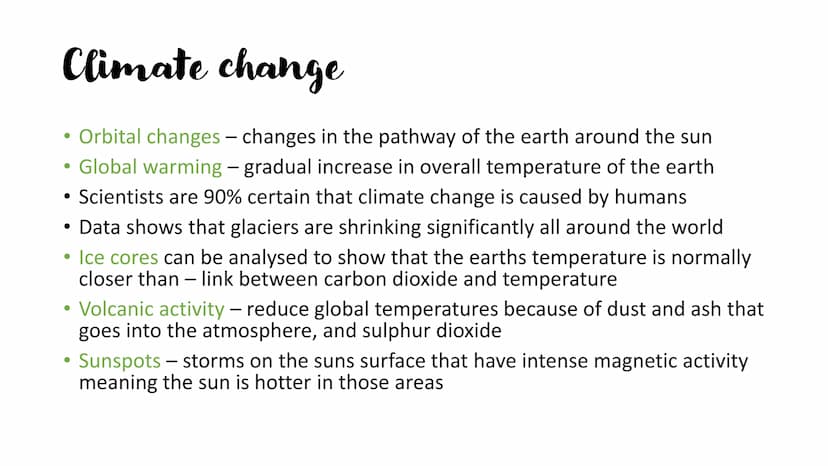
Climate change is happening right now, and scientists are 90% certain that humans are the main cause. The evidence is everywhere - glaciers are shrinking dramatically across the globe, and ice cores reveal that Earth's temperature is closely linked to carbon dioxide levels.
Global warming refers to the gradual increase in Earth's overall temperature, but climate change involves much more than just warming. Orbital changes in Earth's pathway around the Sun naturally affect climate over very long periods.
Natural factors still play a role too. Volcanic activity can actually cool global temperatures because ash, dust, and sulphur dioxide block sunlight. Sunspots are magnetic storms on the Sun's surface that create hotter areas, affecting the energy we receive.
Remember: While natural factors influence climate, the current rapid change is primarily due to human activities.
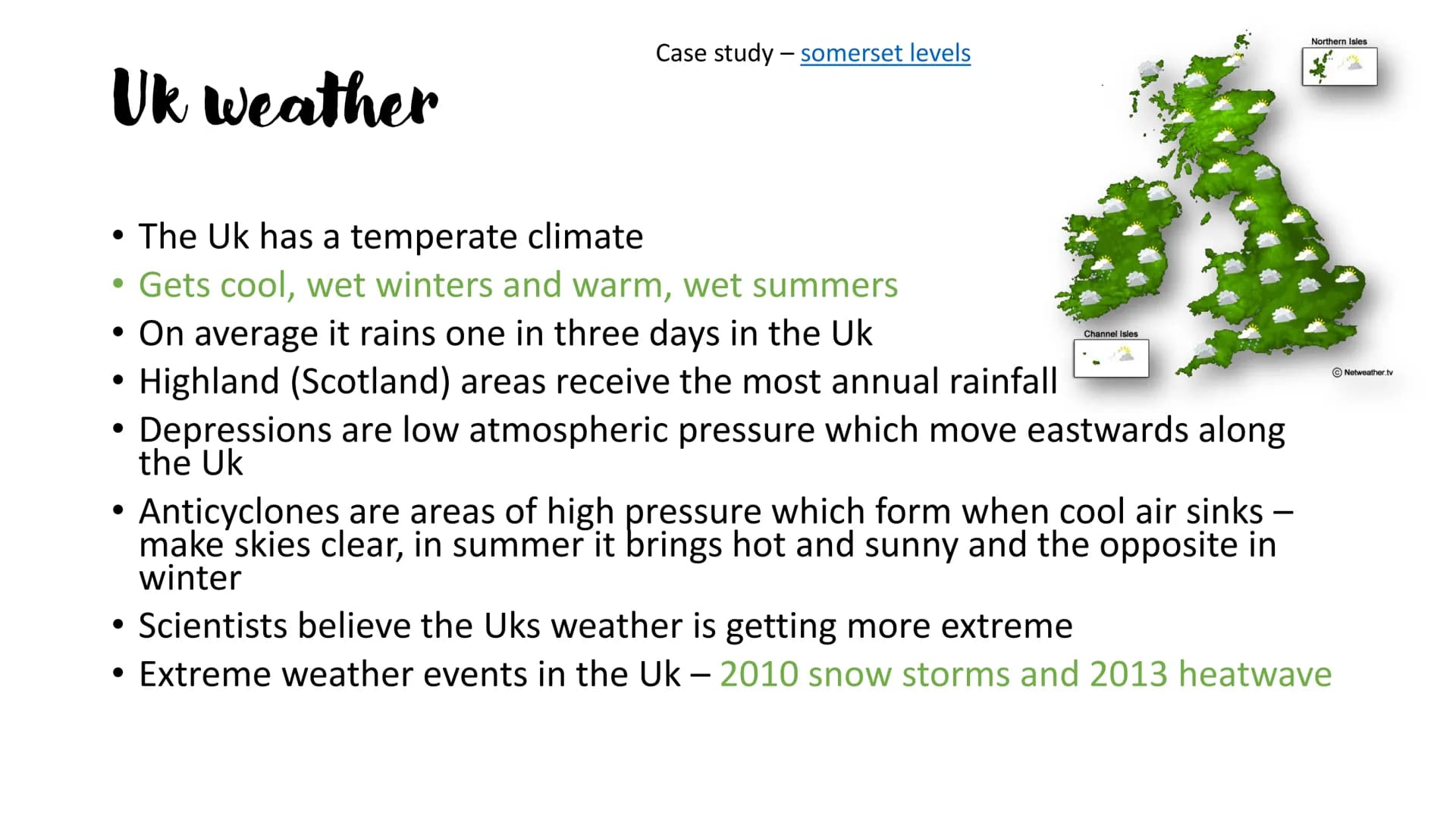
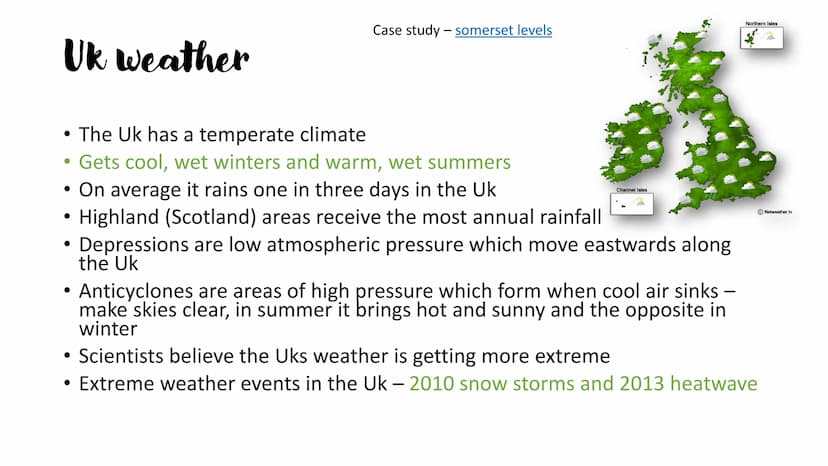
Britain's weather might seem unpredictable, but there are clear patterns you can learn. The UK has a temperate climate with cool, wet winters and warm, wet summers - it literally rains one day out of every three on average!
Highland areas in Scotland receive the most annual rainfall, whilst the Channel Isles stay relatively dry. This variation happens because of our position and landscape.
Two main pressure systems control our weather. Depressions are low-pressure areas that move eastwards across the UK, bringing clouds and rain. Anticyclones are high-pressure systems where cool air sinks, creating clear skies - brilliant sunshine in summer, but potentially freezing conditions in winter.
Scientists believe UK weather is becoming more extreme, with events like the 2010 snowstorms and 2013 heatwave becoming more common.
Weather Tip: High pressure = clear skies, Low pressure = clouds and rain. This simple rule helps predict UK weather patterns.
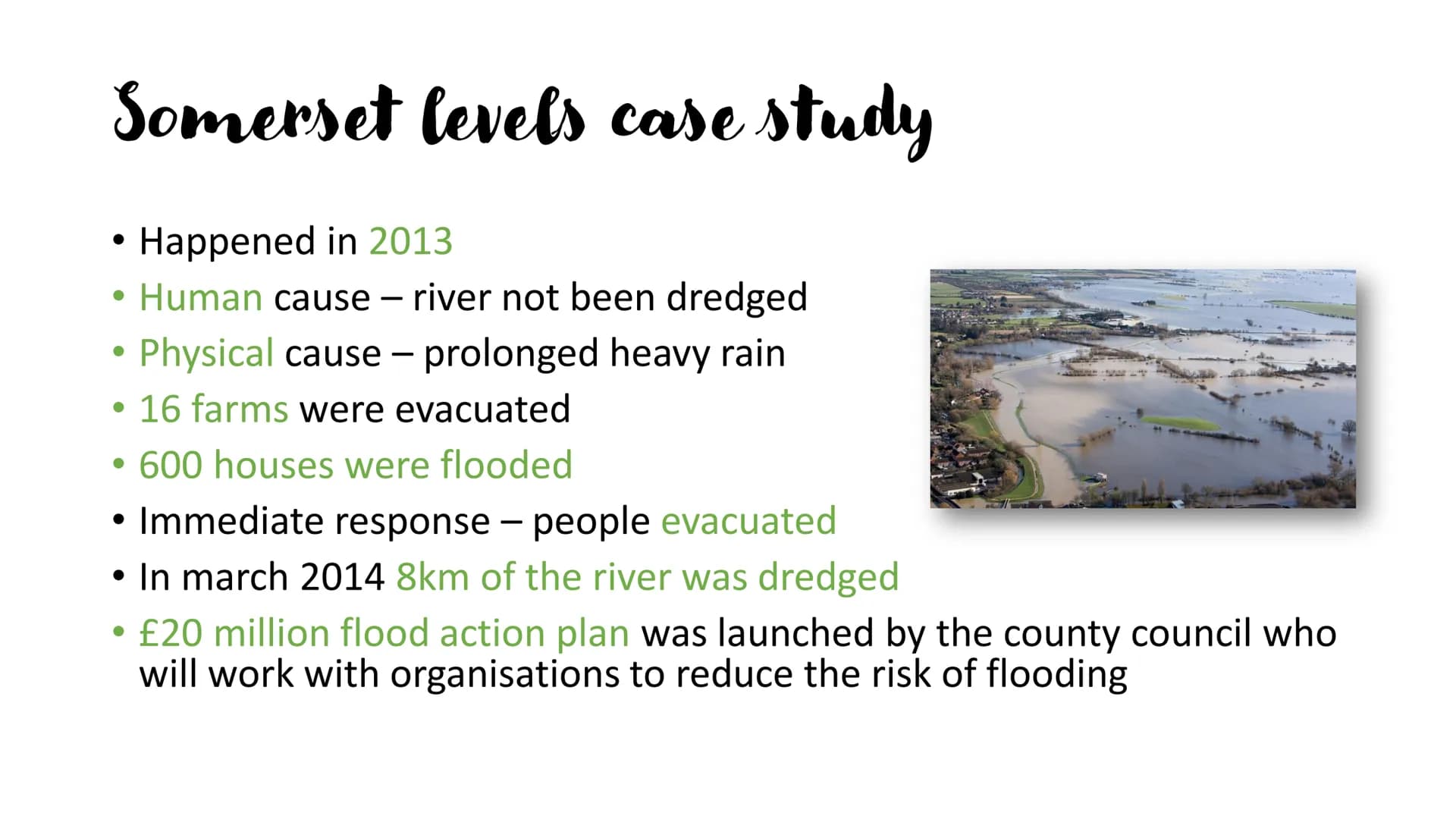
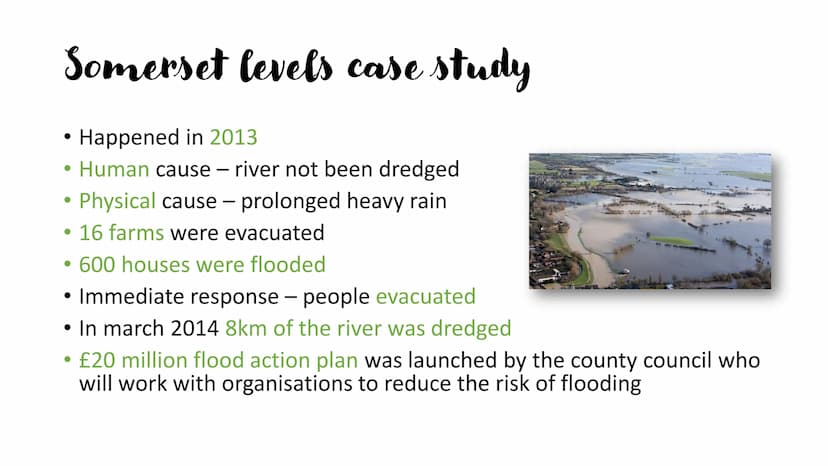
The Somerset Levels flooding in 2013 perfectly demonstrates how human and natural factors combine to create disasters. This wasn't just bad luck - it was preventable.
Physical causes included prolonged heavy rainfall that overwhelmed the area's drainage systems. However, the human cause was equally important - the rivers hadn't been properly dredged (cleared of sediment), reducing their capacity to carry flood water away.
The impact was severe: 600 houses flooded and 16 farms evacuated, disrupting entire communities. People were immediately evacuated to safety, but the long-term damage was enormous.
The response showed how flood management works. In March 2014, 8km of river was dredged, and a £20 million flood action plan was launched. The county council now works with various organisations to reduce future flooding risks.
Key Lesson: Most 'natural' disasters actually involve human factors that make them worse - or better if we plan properly.
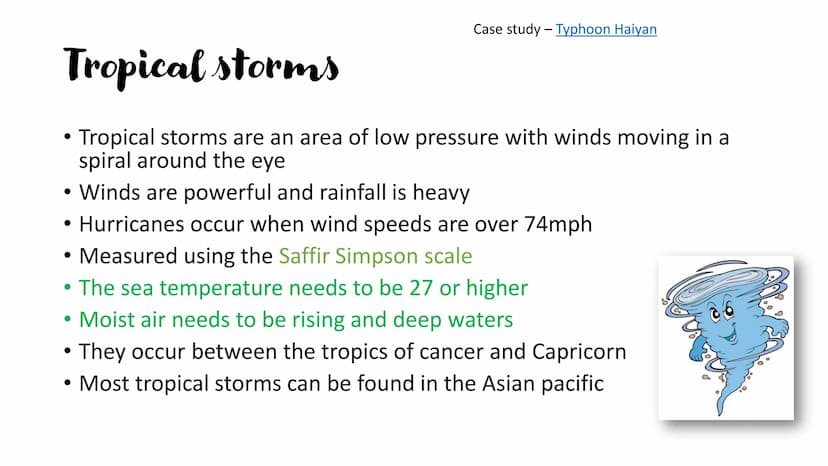
Tropical storms are nature's most powerful weather systems - imagine winds spinning at over 74mph around a calm central 'eye'. When they reach this speed, they become hurricanes (or typhoons in Asia).
These storms need very specific conditions to form. Sea temperature must be 27°C or higher, there must be moist air rising, and deep ocean waters are essential. This is why they only occur between the tropics of Cancer and Capricorn.
The Asian Pacific region experiences the most tropical storms globally, which explains why countries like the Philippines face regular threats. Scientists measure storm intensity using the Saffir-Simpson scale, which goes from Category 1 (weakest) to Category 5 (most destructive).
Understanding these formation conditions helps explain why tropical storms are seasonal and why climate change might be affecting their intensity.
Formation Memory: Hot sea + Rising moist air + Deep water = Tropical storm conditions
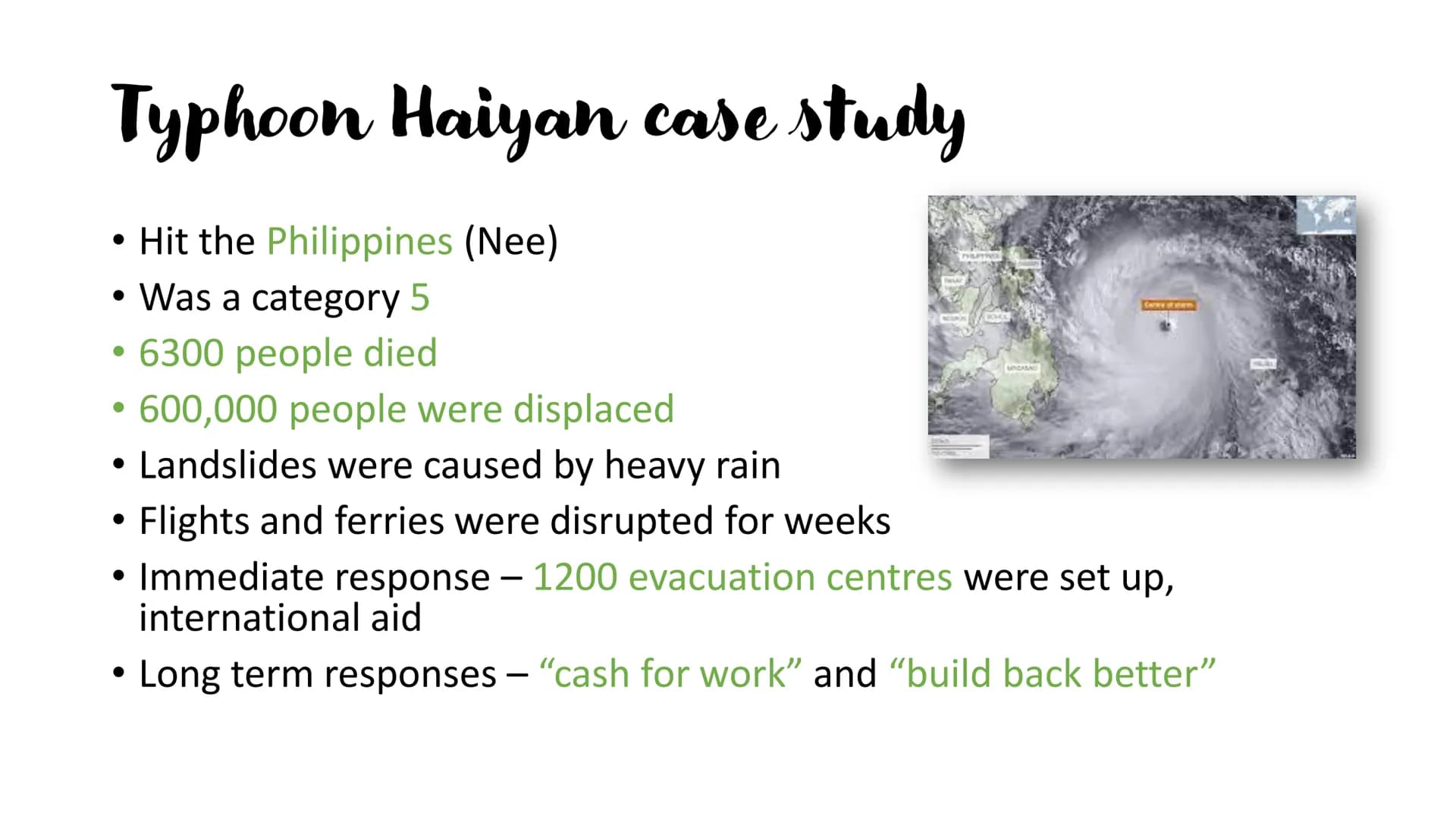
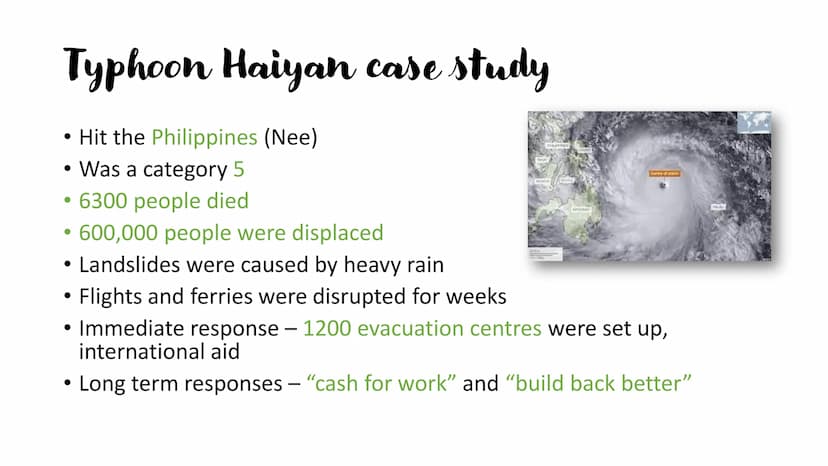
Typhoon Haiyan hit the Philippines in 2013 as a Category 5 storm - the most powerful classification possible. The devastation was almost unimaginable, with 6,300 people killed and 600,000 displaced from their homes.
The storm's power triggered secondary disasters. Heavy rainfall caused landslides, whilst the infrastructure damage meant flights and ferries were disrupted for weeks. This shows how one disaster creates multiple problems.
Immediate responses included setting up 1,200 evacuation centres and massive international aid efforts. Countries worldwide sent emergency supplies and rescue teams to help the Philippines cope with the disaster.
Long-term responses focused on rebuilding better. The 'cash for work' programme gave people income whilst helping reconstruction, and the 'build back better' strategy aimed to make communities more resilient to future storms.
Response Strategy: Immediate = save lives and provide shelter; Long-term = rebuild stronger and more resilient communities.
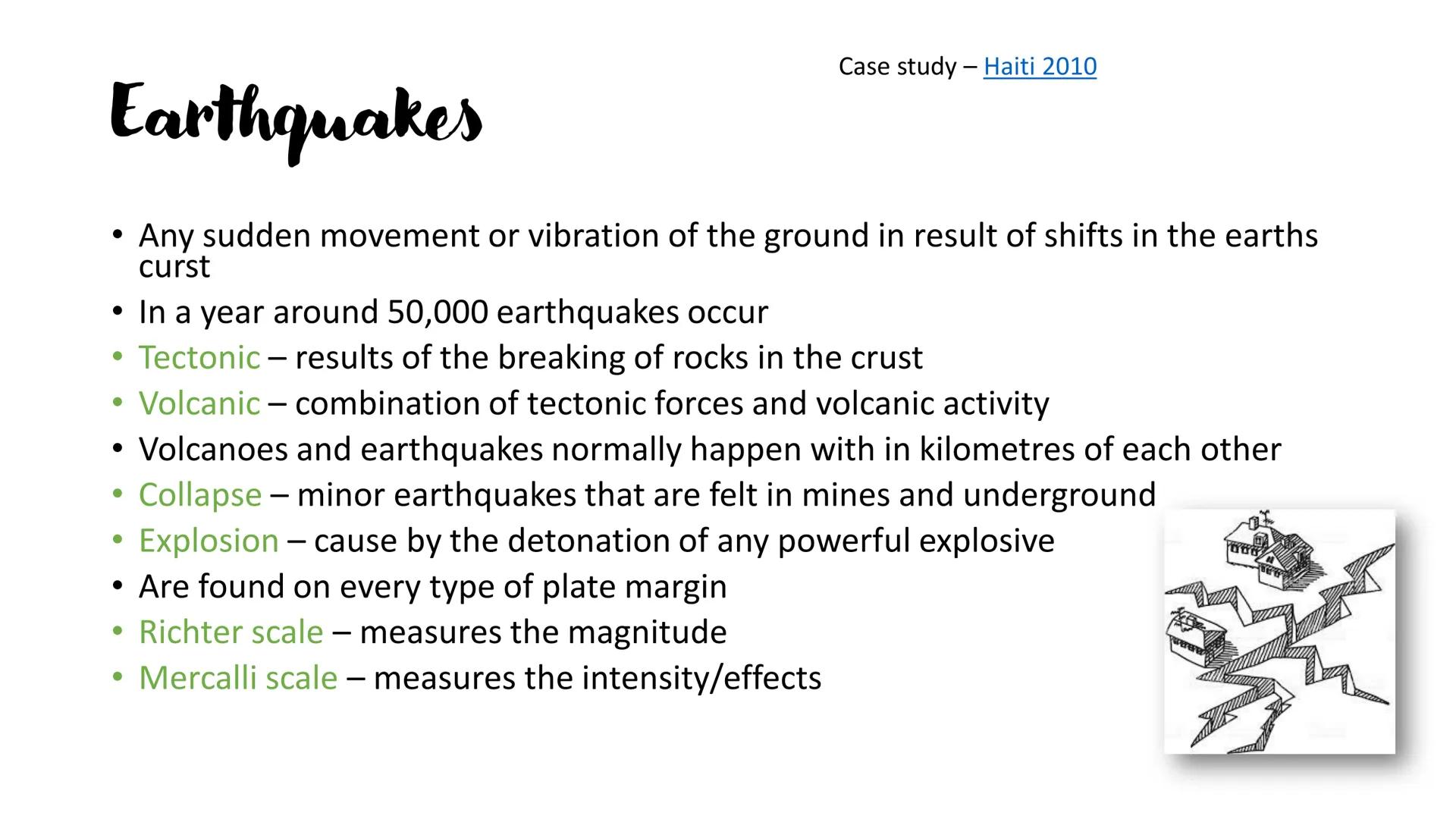
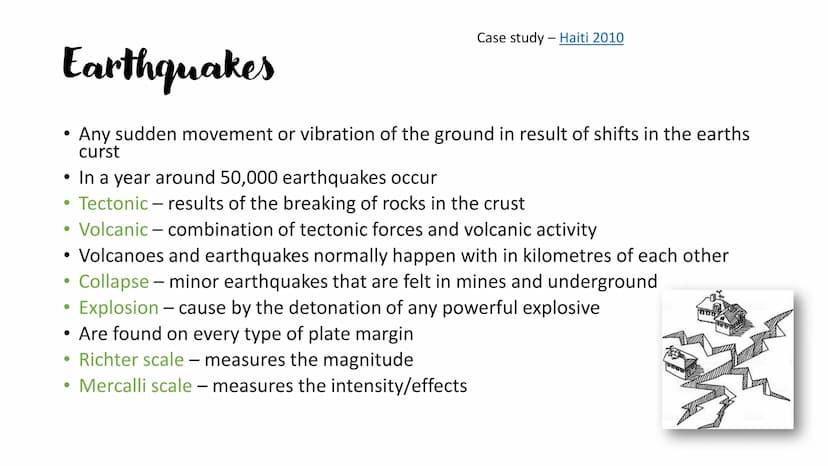
Earthquakes are sudden ground movements caused by shifts in Earth's crust, and they're incredibly common - around 50,000 occur yearly worldwide. Most are tiny, but the big ones make headlines for good reason.
Tectonic earthquakes result from rock breaking in the crust and cause the most damage. Volcanic earthquakes combine tectonic forces with volcanic activity. Collapse earthquakes happen in mines, whilst explosion earthquakes are caused by powerful explosives.
Earthquakes occur at every type of plate margin, which is why they're found in predictable zones worldwide. Scientists measure them using two scales: the Richter scale measures magnitude (energy released), whilst the Mercalli scale measures intensity (actual effects and damage).
The relationship between volcanoes and earthquakes is crucial - they typically occur within kilometres of each other because both result from tectonic activity.
Scale Reminder: Richter = energy of the earthquake; Mercalli = damage and effects on people and buildings.
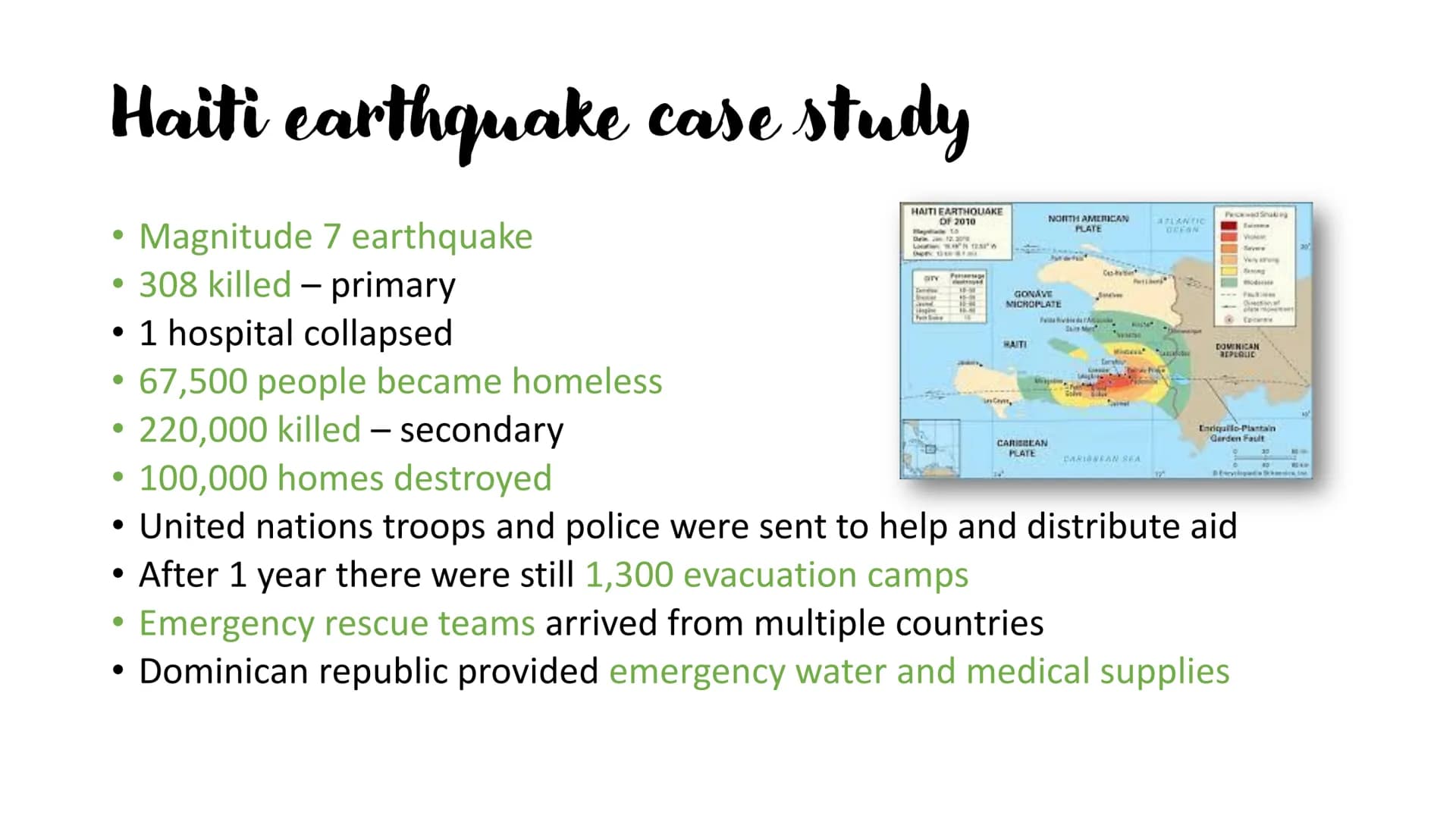
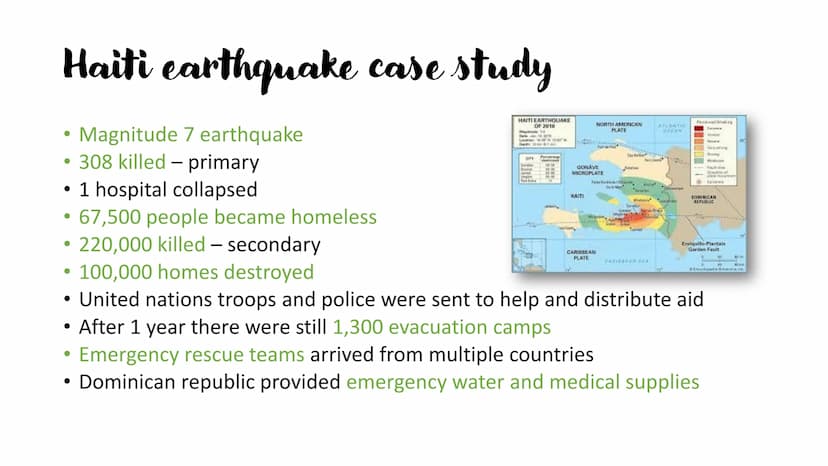
The Haiti earthquake of 2010 was a magnitude 7 disaster that demonstrated how geology and poverty combine to create catastrophic impacts. This wasn't just a natural disaster - it was a human tragedy made worse by the country's circumstances.
Primary effects included 308 people killed initially and 1 hospital collapsed. However, secondary effects proved far more deadly, with 220,000 total deaths and 100,000 homes destroyed. An incredible 67,500 people became homeless immediately.
The international response was massive. United Nations troops and police were deployed to maintain order and distribute aid. Emergency rescue teams arrived from multiple countries, whilst the Dominican Republic provided emergency water and medical supplies.
Recovery was painfully slow. After one year, 1,300 evacuation camps were still operating, showing how long-term earthquake impacts can be. This case study highlights how a country's development level dramatically affects its ability to cope with natural disasters.
Important Distinction: Primary effects happen immediately during the earthquake; secondary effects develop over time and are often more deadly.
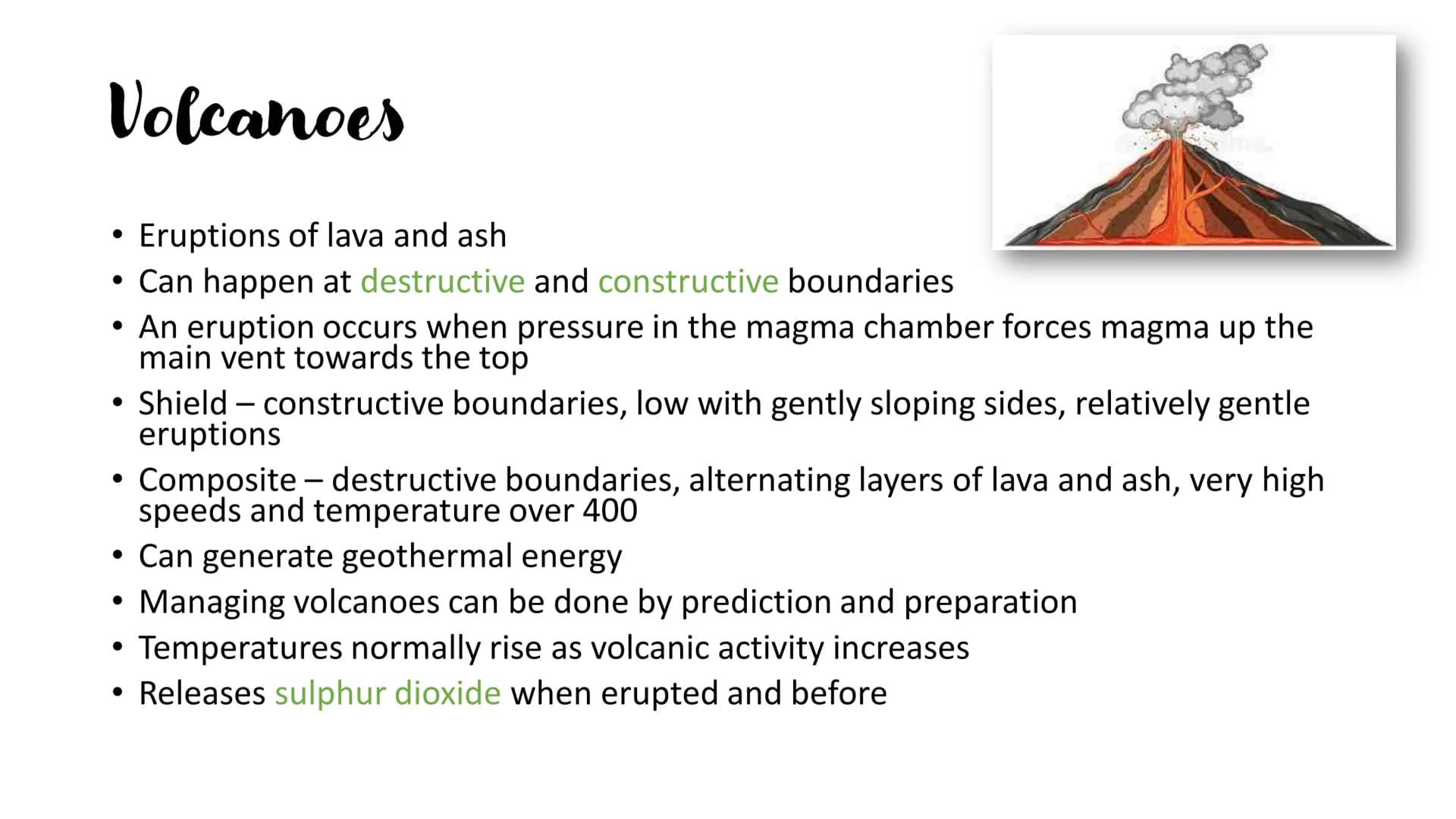
Volcanoes are openings where lava and ash erupt from underground, and they're found at both destructive and constructive boundaries. An eruption occurs when pressure in the magma chamber forces magma up through the main vent.
Shield volcanoes form at constructive boundaries and have low, gently sloping sides with relatively gentle eruptions. Composite volcanoes occur at destructive boundaries, featuring alternating layers of lava and ash and extremely violent eruptions reaching over 400°C.
Volcanoes aren't just destructive - they can generate geothermal energy for electricity and heating. Countries like Iceland use volcanic heat to power entire cities sustainably.
Managing volcanic hazards involves prediction and preparation. Scientists monitor temperature rises that typically occur as activity increases, and measure sulphur dioxide releases that happen before and during eruptions.
Volcano Types: Shield = gentle slopes, gentle eruptions; Composite = steep sides, explosive eruptions.
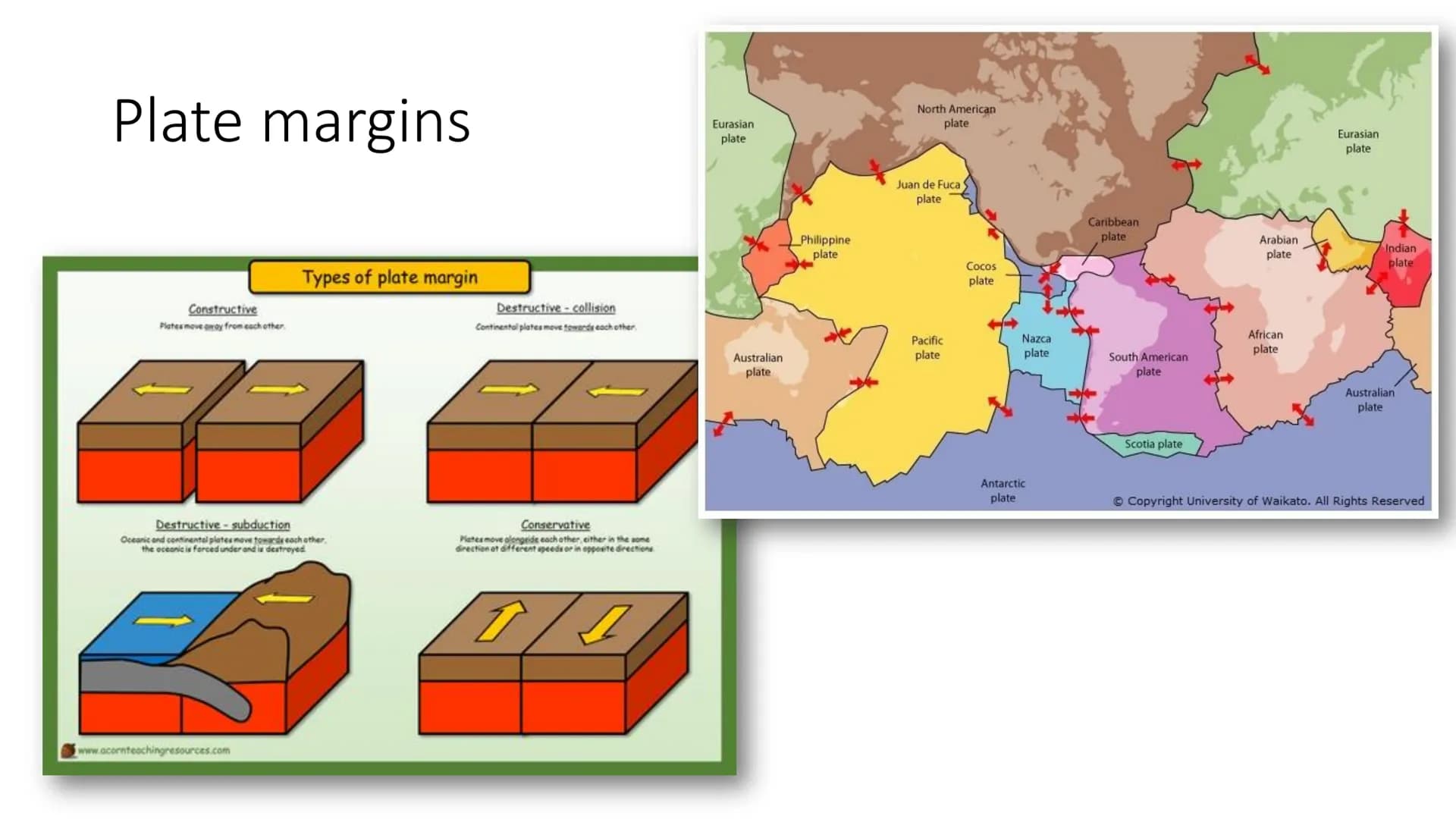
Plate margins are where Earth's giant crustal plates meet, and understanding them explains why earthquakes, volcanoes, and mountain ranges occur in specific locations worldwide.
Constructive margins occur where plates move apart, creating new oceanic crust and typically gentle volcanic activity. Destructive-collision margins form where continental plates move towards each other, creating massive mountain ranges like the Himalayas.
Destructive-subduction margins happen where oceanic and continental plates collide - the denser oceanic plate is forced under and destroyed, creating violent volcanic activity and powerful earthquakes. Conservative margins see plates moving alongside each other, either in the same direction at different speeds or in opposite directions.
The global distribution of plates explains why certain regions face more natural hazards. The Pacific Ring of Fire experiences frequent earthquakes and volcanic eruptions because multiple destructive margins surround the Pacific Plate.
Plate Movement Rule: Apart = constructive; Together = destructive; Sliding past = conservative.
Our AI Companion is a student-focused AI tool that offers more than just answers. Built on millions of Knowunity resources, it provides relevant information, personalised study plans, quizzes, and content directly in the chat, adapting to your individual learning journey.
You can download the app from Google Play Store and Apple App Store.
That's right! Enjoy free access to study content, connect with fellow students, and get instant help – all at your fingertips.
Explore the 2015 Nepal earthquake's causes, impacts, and responses in this detailed case study. Understand the social, economic, and environmental effects, including the loss of life, destruction of infrastructure, and international aid efforts. Ideal for geography students studying natural hazards and disaster management.
 Geography
AQA Geography Paper 1 Mindmaps to boost your revision
GeographyApp Store
Google Play
The app is very easy to use and well designed. I have found everything I was looking for so far and have been able to learn a lot from the presentations! I will definitely use the app for a class assignment! And of course it also helps a lot as an inspiration.
Stefan S
iOS user
This app is really great. There are so many study notes and help [...]. My problem subject is French, for example, and the app has so many options for help. Thanks to this app, I have improved my French. I would recommend it to anyone.
Samantha Klich
Android user
Wow, I am really amazed. I just tried the app because I've seen it advertised many times and was absolutely stunned. This app is THE HELP you want for school and above all, it offers so many things, such as workouts and fact sheets, which have been VERY helpful to me personally.
Anna
iOS user
Best app on earth! no words because it’s too good
Thomas R
iOS user
Just amazing. Let's me revise 10x better, this app is a quick 10/10. I highly recommend it to anyone. I can watch and search for notes. I can save them in the subject folder. I can revise it any time when I come back. If you haven't tried this app, you're really missing out.
Basil
Android user
This app has made me feel so much more confident in my exam prep, not only through boosting my own self confidence through the features that allow you to connect with others and feel less alone, but also through the way the app itself is centred around making you feel better. It is easy to navigate, fun to use, and helpful to anyone struggling in absolutely any way.
David K
iOS user
The app's just great! All I have to do is enter the topic in the search bar and I get the response real fast. I don't have to watch 10 YouTube videos to understand something, so I'm saving my time. Highly recommended!
Sudenaz Ocak
Android user
In school I was really bad at maths but thanks to the app, I am doing better now. I am so grateful that you made the app.
Greenlight Bonnie
Android user
very reliable app to help and grow your ideas of Maths, English and other related topics in your works. please use this app if your struggling in areas, this app is key for that. wish I'd of done a review before. and it's also free so don't worry about that.
Rohan U
Android user
I know a lot of apps use fake accounts to boost their reviews but this app deserves it all. Originally I was getting 4 in my English exams and this time I got a grade 7. I didn’t even know about this app three days until the exam and it has helped A LOT. Please actually trust me and use it as I’m sure you too will see developments.
Xander S
iOS user
THE QUIZES AND FLASHCARDS ARE SO USEFUL AND I LOVE THE SCHOOLGPT. IT ALSO IS LITREALLY LIKE CHATGPT BUT SMARTER!! HELPED ME WITH MY MASCARA PROBLEMS TOO!! AS WELL AS MY REAL SUBJECTS ! DUHHH 😍😁😲🤑💗✨🎀😮
Elisha
iOS user
This apps acc the goat. I find revision so boring but this app makes it so easy to organize it all and then you can ask the freeeee ai to test yourself so good and you can easily upload your own stuff. highly recommend as someone taking mocks now
Paul T
iOS user
The app is very easy to use and well designed. I have found everything I was looking for so far and have been able to learn a lot from the presentations! I will definitely use the app for a class assignment! And of course it also helps a lot as an inspiration.
Stefan S
iOS user
This app is really great. There are so many study notes and help [...]. My problem subject is French, for example, and the app has so many options for help. Thanks to this app, I have improved my French. I would recommend it to anyone.
Samantha Klich
Android user
Wow, I am really amazed. I just tried the app because I've seen it advertised many times and was absolutely stunned. This app is THE HELP you want for school and above all, it offers so many things, such as workouts and fact sheets, which have been VERY helpful to me personally.
Anna
iOS user
Best app on earth! no words because it’s too good
Thomas R
iOS user
Just amazing. Let's me revise 10x better, this app is a quick 10/10. I highly recommend it to anyone. I can watch and search for notes. I can save them in the subject folder. I can revise it any time when I come back. If you haven't tried this app, you're really missing out.
Basil
Android user
This app has made me feel so much more confident in my exam prep, not only through boosting my own self confidence through the features that allow you to connect with others and feel less alone, but also through the way the app itself is centred around making you feel better. It is easy to navigate, fun to use, and helpful to anyone struggling in absolutely any way.
David K
iOS user
The app's just great! All I have to do is enter the topic in the search bar and I get the response real fast. I don't have to watch 10 YouTube videos to understand something, so I'm saving my time. Highly recommended!
Sudenaz Ocak
Android user
In school I was really bad at maths but thanks to the app, I am doing better now. I am so grateful that you made the app.
Greenlight Bonnie
Android user
very reliable app to help and grow your ideas of Maths, English and other related topics in your works. please use this app if your struggling in areas, this app is key for that. wish I'd of done a review before. and it's also free so don't worry about that.
Rohan U
Android user
I know a lot of apps use fake accounts to boost their reviews but this app deserves it all. Originally I was getting 4 in my English exams and this time I got a grade 7. I didn’t even know about this app three days until the exam and it has helped A LOT. Please actually trust me and use it as I’m sure you too will see developments.
Xander S
iOS user
THE QUIZES AND FLASHCARDS ARE SO USEFUL AND I LOVE THE SCHOOLGPT. IT ALSO IS LITREALLY LIKE CHATGPT BUT SMARTER!! HELPED ME WITH MY MASCARA PROBLEMS TOO!! AS WELL AS MY REAL SUBJECTS ! DUHHH 😍😁😲🤑💗✨🎀😮
Elisha
iOS user
This apps acc the goat. I find revision so boring but this app makes it so easy to organize it all and then you can ask the freeeee ai to test yourself so good and you can easily upload your own stuff. highly recommend as someone taking mocks now
Paul T
iOS user
holly battisson
@hollybattisson
Natural hazards are powerful forces of nature that can dramatically impact human lives and communities. From climate change and extreme weather to earthquakes, volcanoes, and tropical storms, understanding these phenomena is crucial for your GCSE geography studies and real-world awareness.
Access to all documents
Improve your grades
Join milions of students
By signing up you accept Terms of Service and Privacy Policy
You're about to explore some of the most dramatic and impactful forces on our planet. Natural hazards affect millions of people worldwide and understanding them helps explain why certain events make global headlines.
This topic covers everything from the science behind these events to real-world case studies that show their human impact. You'll examine how both physical processes and human activities contribute to these hazards, making this knowledge incredibly relevant to current global issues.
Key Point: Natural hazards aren't just about the physical events - they're about how these events interact with human communities and activities.
Access to all documents
Improve your grades
Join milions of students
By signing up you accept Terms of Service and Privacy Policy
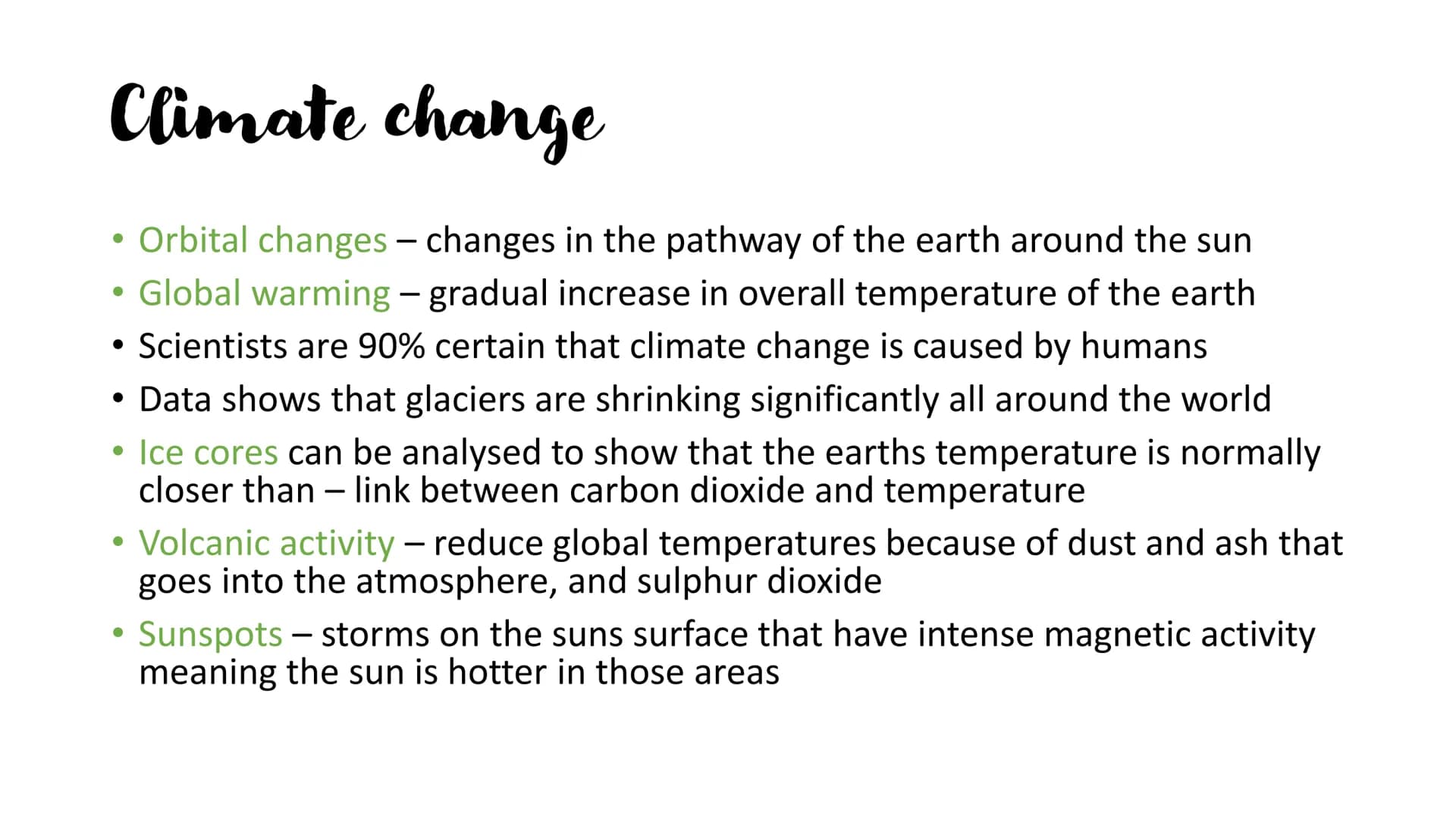
Climate change is happening right now, and scientists are 90% certain that humans are the main cause. The evidence is everywhere - glaciers are shrinking dramatically across the globe, and ice cores reveal that Earth's temperature is closely linked to carbon dioxide levels.
Global warming refers to the gradual increase in Earth's overall temperature, but climate change involves much more than just warming. Orbital changes in Earth's pathway around the Sun naturally affect climate over very long periods.
Natural factors still play a role too. Volcanic activity can actually cool global temperatures because ash, dust, and sulphur dioxide block sunlight. Sunspots are magnetic storms on the Sun's surface that create hotter areas, affecting the energy we receive.
Remember: While natural factors influence climate, the current rapid change is primarily due to human activities.
Access to all documents
Improve your grades
Join milions of students
By signing up you accept Terms of Service and Privacy Policy
Britain's weather might seem unpredictable, but there are clear patterns you can learn. The UK has a temperate climate with cool, wet winters and warm, wet summers - it literally rains one day out of every three on average!
Highland areas in Scotland receive the most annual rainfall, whilst the Channel Isles stay relatively dry. This variation happens because of our position and landscape.
Two main pressure systems control our weather. Depressions are low-pressure areas that move eastwards across the UK, bringing clouds and rain. Anticyclones are high-pressure systems where cool air sinks, creating clear skies - brilliant sunshine in summer, but potentially freezing conditions in winter.
Scientists believe UK weather is becoming more extreme, with events like the 2010 snowstorms and 2013 heatwave becoming more common.
Weather Tip: High pressure = clear skies, Low pressure = clouds and rain. This simple rule helps predict UK weather patterns.
Access to all documents
Improve your grades
Join milions of students
By signing up you accept Terms of Service and Privacy Policy
The Somerset Levels flooding in 2013 perfectly demonstrates how human and natural factors combine to create disasters. This wasn't just bad luck - it was preventable.
Physical causes included prolonged heavy rainfall that overwhelmed the area's drainage systems. However, the human cause was equally important - the rivers hadn't been properly dredged (cleared of sediment), reducing their capacity to carry flood water away.
The impact was severe: 600 houses flooded and 16 farms evacuated, disrupting entire communities. People were immediately evacuated to safety, but the long-term damage was enormous.
The response showed how flood management works. In March 2014, 8km of river was dredged, and a £20 million flood action plan was launched. The county council now works with various organisations to reduce future flooding risks.
Key Lesson: Most 'natural' disasters actually involve human factors that make them worse - or better if we plan properly.
Access to all documents
Improve your grades
Join milions of students
By signing up you accept Terms of Service and Privacy Policy
Tropical storms are nature's most powerful weather systems - imagine winds spinning at over 74mph around a calm central 'eye'. When they reach this speed, they become hurricanes (or typhoons in Asia).
These storms need very specific conditions to form. Sea temperature must be 27°C or higher, there must be moist air rising, and deep ocean waters are essential. This is why they only occur between the tropics of Cancer and Capricorn.
The Asian Pacific region experiences the most tropical storms globally, which explains why countries like the Philippines face regular threats. Scientists measure storm intensity using the Saffir-Simpson scale, which goes from Category 1 (weakest) to Category 5 (most destructive).
Understanding these formation conditions helps explain why tropical storms are seasonal and why climate change might be affecting their intensity.
Formation Memory: Hot sea + Rising moist air + Deep water = Tropical storm conditions
Access to all documents
Improve your grades
Join milions of students
By signing up you accept Terms of Service and Privacy Policy
Typhoon Haiyan hit the Philippines in 2013 as a Category 5 storm - the most powerful classification possible. The devastation was almost unimaginable, with 6,300 people killed and 600,000 displaced from their homes.
The storm's power triggered secondary disasters. Heavy rainfall caused landslides, whilst the infrastructure damage meant flights and ferries were disrupted for weeks. This shows how one disaster creates multiple problems.
Immediate responses included setting up 1,200 evacuation centres and massive international aid efforts. Countries worldwide sent emergency supplies and rescue teams to help the Philippines cope with the disaster.
Long-term responses focused on rebuilding better. The 'cash for work' programme gave people income whilst helping reconstruction, and the 'build back better' strategy aimed to make communities more resilient to future storms.
Response Strategy: Immediate = save lives and provide shelter; Long-term = rebuild stronger and more resilient communities.
Access to all documents
Improve your grades
Join milions of students
By signing up you accept Terms of Service and Privacy Policy
Earthquakes are sudden ground movements caused by shifts in Earth's crust, and they're incredibly common - around 50,000 occur yearly worldwide. Most are tiny, but the big ones make headlines for good reason.
Tectonic earthquakes result from rock breaking in the crust and cause the most damage. Volcanic earthquakes combine tectonic forces with volcanic activity. Collapse earthquakes happen in mines, whilst explosion earthquakes are caused by powerful explosives.
Earthquakes occur at every type of plate margin, which is why they're found in predictable zones worldwide. Scientists measure them using two scales: the Richter scale measures magnitude (energy released), whilst the Mercalli scale measures intensity (actual effects and damage).
The relationship between volcanoes and earthquakes is crucial - they typically occur within kilometres of each other because both result from tectonic activity.
Scale Reminder: Richter = energy of the earthquake; Mercalli = damage and effects on people and buildings.
Access to all documents
Improve your grades
Join milions of students
By signing up you accept Terms of Service and Privacy Policy
The Haiti earthquake of 2010 was a magnitude 7 disaster that demonstrated how geology and poverty combine to create catastrophic impacts. This wasn't just a natural disaster - it was a human tragedy made worse by the country's circumstances.
Primary effects included 308 people killed initially and 1 hospital collapsed. However, secondary effects proved far more deadly, with 220,000 total deaths and 100,000 homes destroyed. An incredible 67,500 people became homeless immediately.
The international response was massive. United Nations troops and police were deployed to maintain order and distribute aid. Emergency rescue teams arrived from multiple countries, whilst the Dominican Republic provided emergency water and medical supplies.
Recovery was painfully slow. After one year, 1,300 evacuation camps were still operating, showing how long-term earthquake impacts can be. This case study highlights how a country's development level dramatically affects its ability to cope with natural disasters.
Important Distinction: Primary effects happen immediately during the earthquake; secondary effects develop over time and are often more deadly.
Access to all documents
Improve your grades
Join milions of students
By signing up you accept Terms of Service and Privacy Policy
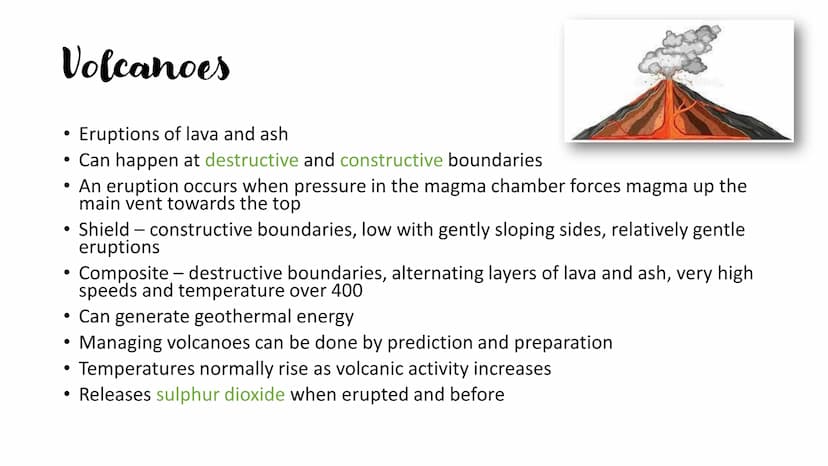
Volcanoes are openings where lava and ash erupt from underground, and they're found at both destructive and constructive boundaries. An eruption occurs when pressure in the magma chamber forces magma up through the main vent.
Shield volcanoes form at constructive boundaries and have low, gently sloping sides with relatively gentle eruptions. Composite volcanoes occur at destructive boundaries, featuring alternating layers of lava and ash and extremely violent eruptions reaching over 400°C.
Volcanoes aren't just destructive - they can generate geothermal energy for electricity and heating. Countries like Iceland use volcanic heat to power entire cities sustainably.
Managing volcanic hazards involves prediction and preparation. Scientists monitor temperature rises that typically occur as activity increases, and measure sulphur dioxide releases that happen before and during eruptions.
Volcano Types: Shield = gentle slopes, gentle eruptions; Composite = steep sides, explosive eruptions.
Access to all documents
Improve your grades
Join milions of students
By signing up you accept Terms of Service and Privacy Policy
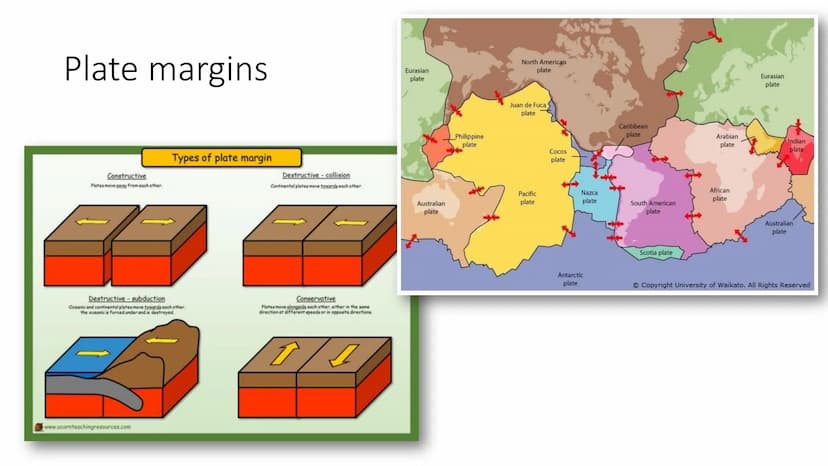
Plate margins are where Earth's giant crustal plates meet, and understanding them explains why earthquakes, volcanoes, and mountain ranges occur in specific locations worldwide.
Constructive margins occur where plates move apart, creating new oceanic crust and typically gentle volcanic activity. Destructive-collision margins form where continental plates move towards each other, creating massive mountain ranges like the Himalayas.
Destructive-subduction margins happen where oceanic and continental plates collide - the denser oceanic plate is forced under and destroyed, creating violent volcanic activity and powerful earthquakes. Conservative margins see plates moving alongside each other, either in the same direction at different speeds or in opposite directions.
The global distribution of plates explains why certain regions face more natural hazards. The Pacific Ring of Fire experiences frequent earthquakes and volcanic eruptions because multiple destructive margins surround the Pacific Plate.
Plate Movement Rule: Apart = constructive; Together = destructive; Sliding past = conservative.
Our AI Companion is a student-focused AI tool that offers more than just answers. Built on millions of Knowunity resources, it provides relevant information, personalised study plans, quizzes, and content directly in the chat, adapting to your individual learning journey.
You can download the app from Google Play Store and Apple App Store.
That's right! Enjoy free access to study content, connect with fellow students, and get instant help – all at your fingertips.
20
Smart Tools NEW
Transform this note into: ✓ 50+ Practice Questions ✓ Interactive Flashcards ✓ Full Mock Exam ✓ Essay Outlines
Explore the 2015 Nepal earthquake's causes, impacts, and responses in this detailed case study. Understand the social, economic, and environmental effects, including the loss of life, destruction of infrastructure, and international aid efforts. Ideal for geography students studying natural hazards and disaster management.
GeographyAQA Geography Paper 1 Mindmaps to boost your revision
GeographyApp Store
Google Play
The app is very easy to use and well designed. I have found everything I was looking for so far and have been able to learn a lot from the presentations! I will definitely use the app for a class assignment! And of course it also helps a lot as an inspiration.
Stefan S
iOS user
This app is really great. There are so many study notes and help [...]. My problem subject is French, for example, and the app has so many options for help. Thanks to this app, I have improved my French. I would recommend it to anyone.
Samantha Klich
Android user
Wow, I am really amazed. I just tried the app because I've seen it advertised many times and was absolutely stunned. This app is THE HELP you want for school and above all, it offers so many things, such as workouts and fact sheets, which have been VERY helpful to me personally.
Anna
iOS user
Best app on earth! no words because it’s too good
Thomas R
iOS user
Just amazing. Let's me revise 10x better, this app is a quick 10/10. I highly recommend it to anyone. I can watch and search for notes. I can save them in the subject folder. I can revise it any time when I come back. If you haven't tried this app, you're really missing out.
Basil
Android user
This app has made me feel so much more confident in my exam prep, not only through boosting my own self confidence through the features that allow you to connect with others and feel less alone, but also through the way the app itself is centred around making you feel better. It is easy to navigate, fun to use, and helpful to anyone struggling in absolutely any way.
David K
iOS user
The app's just great! All I have to do is enter the topic in the search bar and I get the response real fast. I don't have to watch 10 YouTube videos to understand something, so I'm saving my time. Highly recommended!
Sudenaz Ocak
Android user
In school I was really bad at maths but thanks to the app, I am doing better now. I am so grateful that you made the app.
Greenlight Bonnie
Android user
very reliable app to help and grow your ideas of Maths, English and other related topics in your works. please use this app if your struggling in areas, this app is key for that. wish I'd of done a review before. and it's also free so don't worry about that.
Rohan U
Android user
I know a lot of apps use fake accounts to boost their reviews but this app deserves it all. Originally I was getting 4 in my English exams and this time I got a grade 7. I didn’t even know about this app three days until the exam and it has helped A LOT. Please actually trust me and use it as I’m sure you too will see developments.
Xander S
iOS user
THE QUIZES AND FLASHCARDS ARE SO USEFUL AND I LOVE THE SCHOOLGPT. IT ALSO IS LITREALLY LIKE CHATGPT BUT SMARTER!! HELPED ME WITH MY MASCARA PROBLEMS TOO!! AS WELL AS MY REAL SUBJECTS ! DUHHH 😍😁😲🤑💗✨🎀😮
Elisha
iOS user
This apps acc the goat. I find revision so boring but this app makes it so easy to organize it all and then you can ask the freeeee ai to test yourself so good and you can easily upload your own stuff. highly recommend as someone taking mocks now
Paul T
iOS user
The app is very easy to use and well designed. I have found everything I was looking for so far and have been able to learn a lot from the presentations! I will definitely use the app for a class assignment! And of course it also helps a lot as an inspiration.
Stefan S
iOS user
This app is really great. There are so many study notes and help [...]. My problem subject is French, for example, and the app has so many options for help. Thanks to this app, I have improved my French. I would recommend it to anyone.
Samantha Klich
Android user
Wow, I am really amazed. I just tried the app because I've seen it advertised many times and was absolutely stunned. This app is THE HELP you want for school and above all, it offers so many things, such as workouts and fact sheets, which have been VERY helpful to me personally.
Anna
iOS user
Best app on earth! no words because it’s too good
Thomas R
iOS user
Just amazing. Let's me revise 10x better, this app is a quick 10/10. I highly recommend it to anyone. I can watch and search for notes. I can save them in the subject folder. I can revise it any time when I come back. If you haven't tried this app, you're really missing out.
Basil
Android user
This app has made me feel so much more confident in my exam prep, not only through boosting my own self confidence through the features that allow you to connect with others and feel less alone, but also through the way the app itself is centred around making you feel better. It is easy to navigate, fun to use, and helpful to anyone struggling in absolutely any way.
David K
iOS user
The app's just great! All I have to do is enter the topic in the search bar and I get the response real fast. I don't have to watch 10 YouTube videos to understand something, so I'm saving my time. Highly recommended!
Sudenaz Ocak
Android user
In school I was really bad at maths but thanks to the app, I am doing better now. I am so grateful that you made the app.
Greenlight Bonnie
Android user
very reliable app to help and grow your ideas of Maths, English and other related topics in your works. please use this app if your struggling in areas, this app is key for that. wish I'd of done a review before. and it's also free so don't worry about that.
Rohan U
Android user
I know a lot of apps use fake accounts to boost their reviews but this app deserves it all. Originally I was getting 4 in my English exams and this time I got a grade 7. I didn’t even know about this app three days until the exam and it has helped A LOT. Please actually trust me and use it as I’m sure you too will see developments.
Xander S
iOS user
THE QUIZES AND FLASHCARDS ARE SO USEFUL AND I LOVE THE SCHOOLGPT. IT ALSO IS LITREALLY LIKE CHATGPT BUT SMARTER!! HELPED ME WITH MY MASCARA PROBLEMS TOO!! AS WELL AS MY REAL SUBJECTS ! DUHHH 😍😁😲🤑💗✨🎀😮
Elisha
iOS user
This apps acc the goat. I find revision so boring but this app makes it so easy to organize it all and then you can ask the freeeee ai to test yourself so good and you can easily upload your own stuff. highly recommend as someone taking mocks now
Paul T
iOS user