
Climate change and extreme weather are reshaping our world, and... Show more
 Geography
 English Literature
 Sociology
 Biology
Sign up to see the contentIt's free!
Access to all documents
Improve your grades
Join milions of students
By signing up you accept Terms of Service and Privacy Policy
Subjects
Classic Dramatic Literature
Modern Lyric Poetry
Influential English-Language Authors
Classic and Contemporary Novels
Literary Character Analysis
Romantic and Love Poetry
Reading Analysis and Interpretation
Evidence Analysis and Integration
Author's Stylistic Elements
Figurative Language and Rhetoric
Show all topics
Human Organ Systems
Cellular Organization and Development
Biomolecular Structure and Organization
Enzyme Structure and Regulation
Cellular Organization Types
Biological Homeostatic Processes
Cellular Membrane Structure
Autotrophic Energy Processes
Environmental Sustainability and Impact
Neural Communication Systems
Show all topics
Social Sciences Research & Practice
Social Structure and Mobility
Classic Social Influence Experiments
Social Systems Theories
Family and Relationship Dynamics
Memory Systems and Processes
Neural Bases of Behavior
Social Influence and Attraction
Psychotherapeutic Approaches
Human Agency and Responsibility
Show all topics
Chemical Sciences and Applications
Chemical Bond Types and Properties
Organic Functional Groups
Atomic Structure and Composition
Chromatographic Separation Principles
Chemical Compound Classifications
Electrochemical Cell Systems
Periodic Table Organization
Chemical Reaction Kinetics
Chemical Equation Conservation
Show all topics
Nazi Germany and Holocaust 1933-1945
World Wars and Peace Treaties
European Monarchs and Statesmen
Cold War Global Tensions
Medieval Institutions and Systems
European Renaissance and Enlightenment
Modern Global Environmental-Health Challenges
Modern Military Conflicts
Medieval Migration and Invasions
World Wars Era and Impact
Show all topics
121
•
Updated 3 Mar 2026
•

Jess
@jessleigh
Climate change and extreme weather are reshaping our world, and... Show more
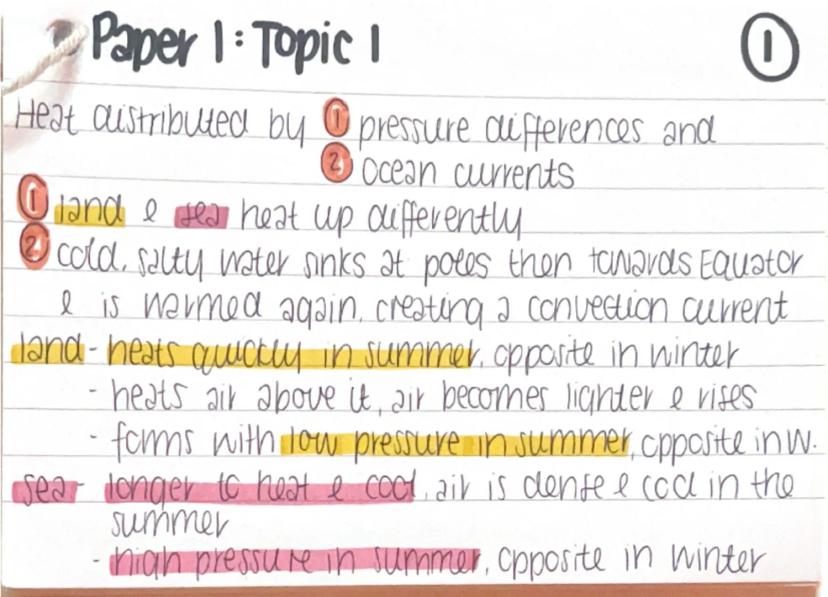
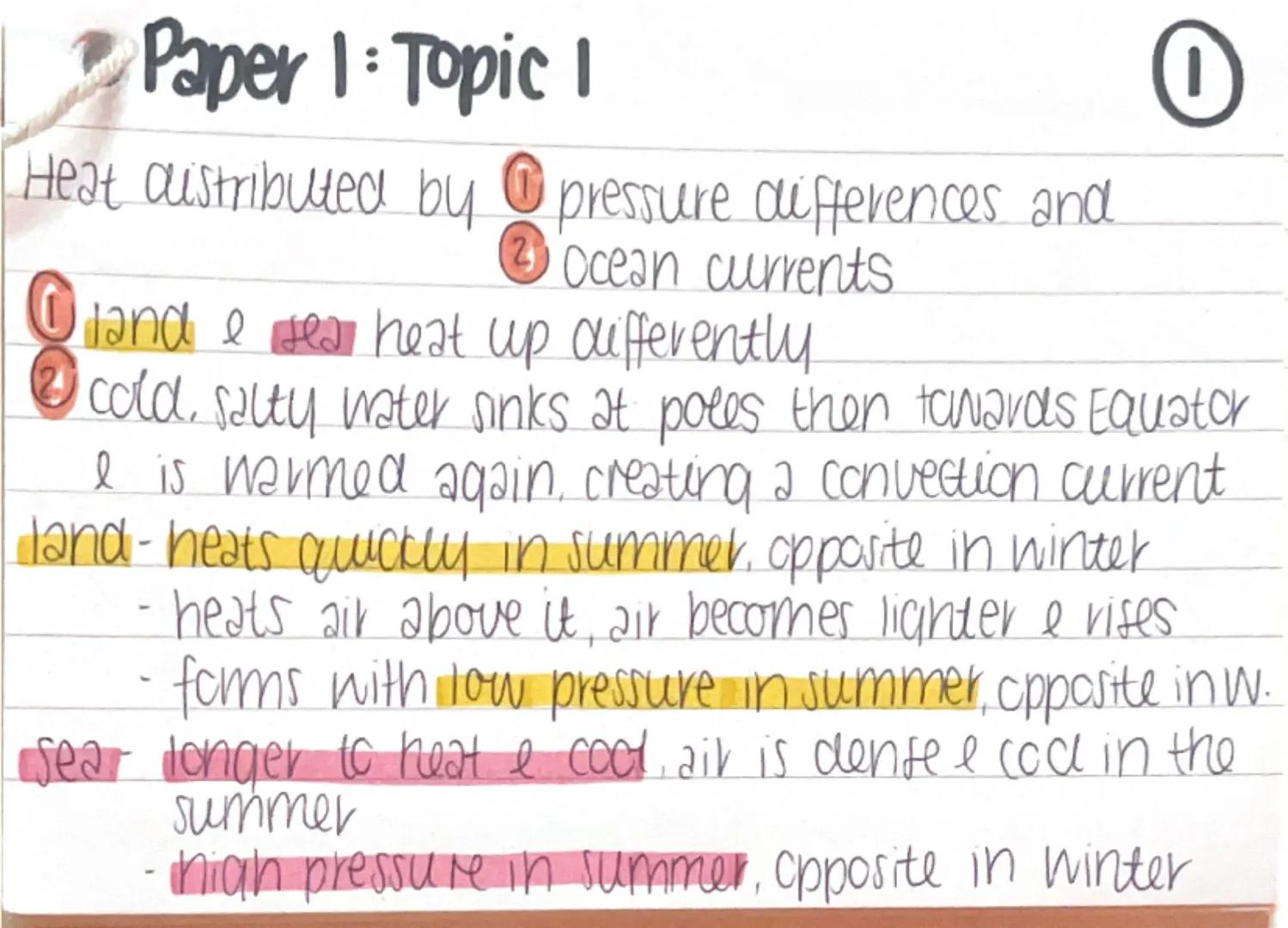
Ever wondered why some places are scorching hot whilst others are freezing cold? It all comes down to pressure differences and ocean currents working together like a massive global heating system.
Land and sea behave completely differently when it comes to temperature. Land heats up quickly in summer, warming the air above it until that air becomes lighter and rises, creating low pressure. Sea takes ages to heat up and cool down, so it creates high pressure in summer when the air above stays dense and cool.
These pressure differences drive weather patterns you see every day. Cold, salty water sinks at the poles, then flows toward the equator where it warms up again - creating convection currents that distribute heat around the planet.
Quick Tip: Remember that low pressure = rising air = often cloudy/wet weather, whilst high pressure = sinking air = usually clear, dry conditions.
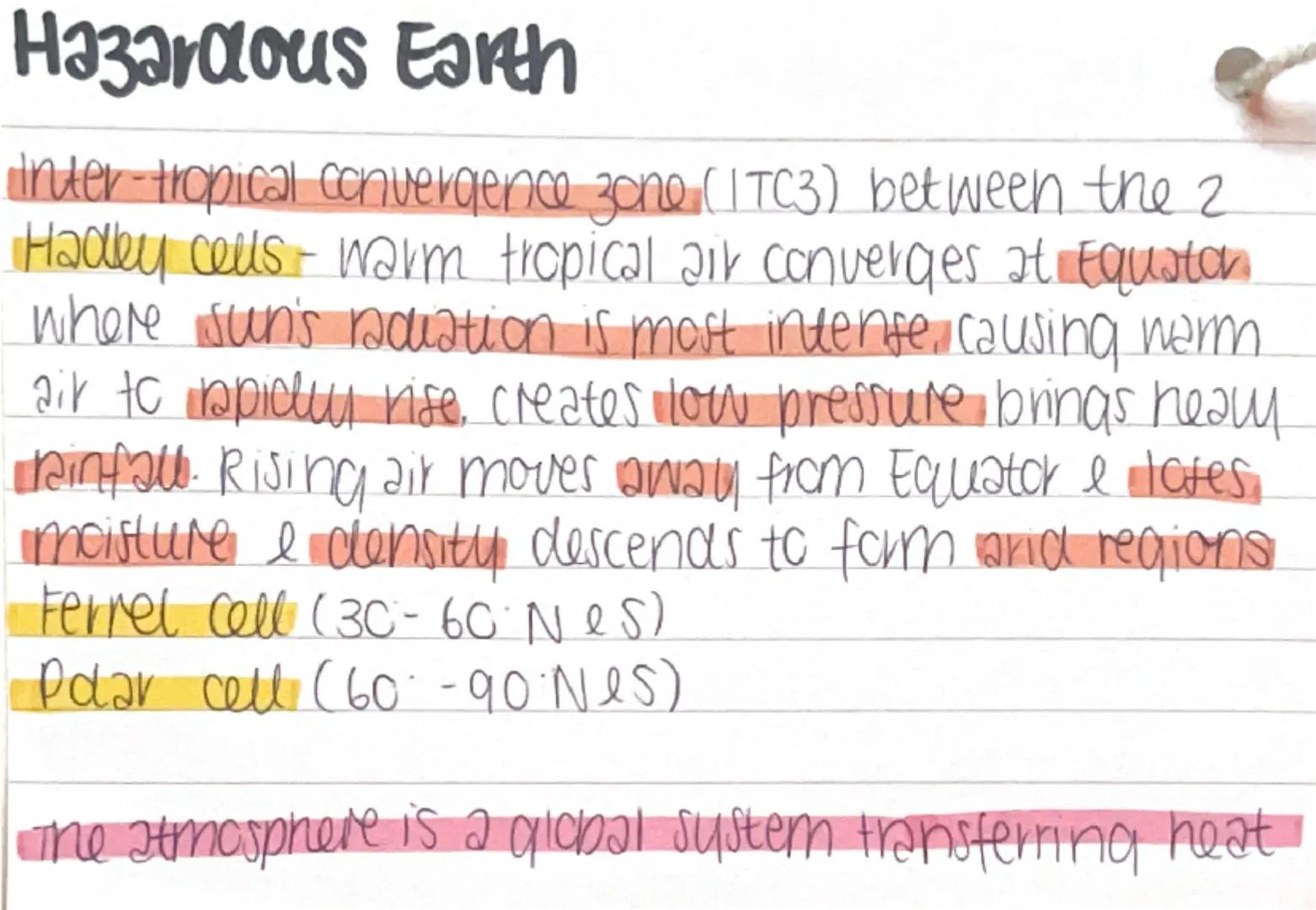
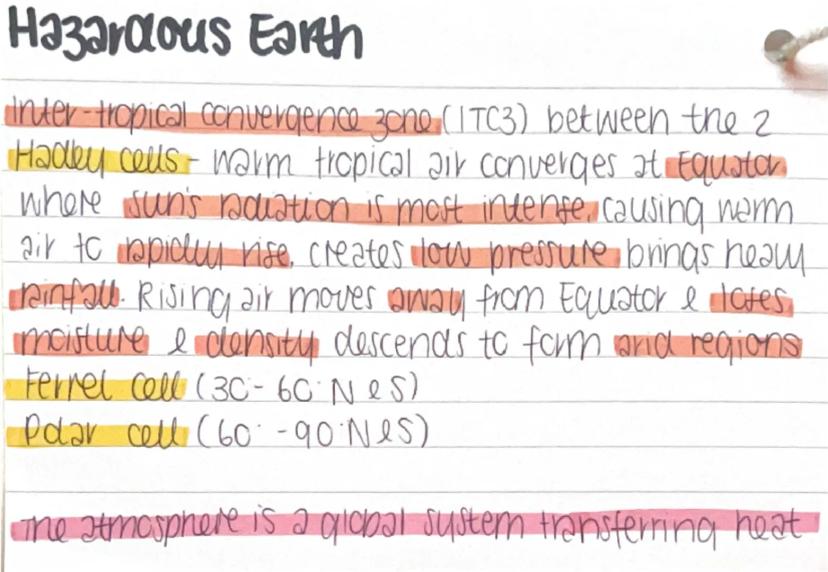
The Inter-tropical Convergence Zone (ITCZ) is where the magic happens - it's the meeting point between two massive air circulation systems called Hadley cells. Picture the equator as a giant heating belt where the sun's radiation is most intense.
This intense heating causes warm tropical air to rise rapidly, creating low pressure and heavy rainfall. As this air rises, it moves away from the equator, loses moisture, and eventually sinks back down to form the world's arid regions - that's why many deserts sit around 30° north and south.
The atmosphere also has Ferrel cells and polar cells that complete this global heat transfer system. Think of it as nature's central heating - constantly moving warm air from hot areas to cold ones.
Exam Focus: Be able to sketch and label these three circulation cells - they're exam favourites and explain why certain climates exist where they do.
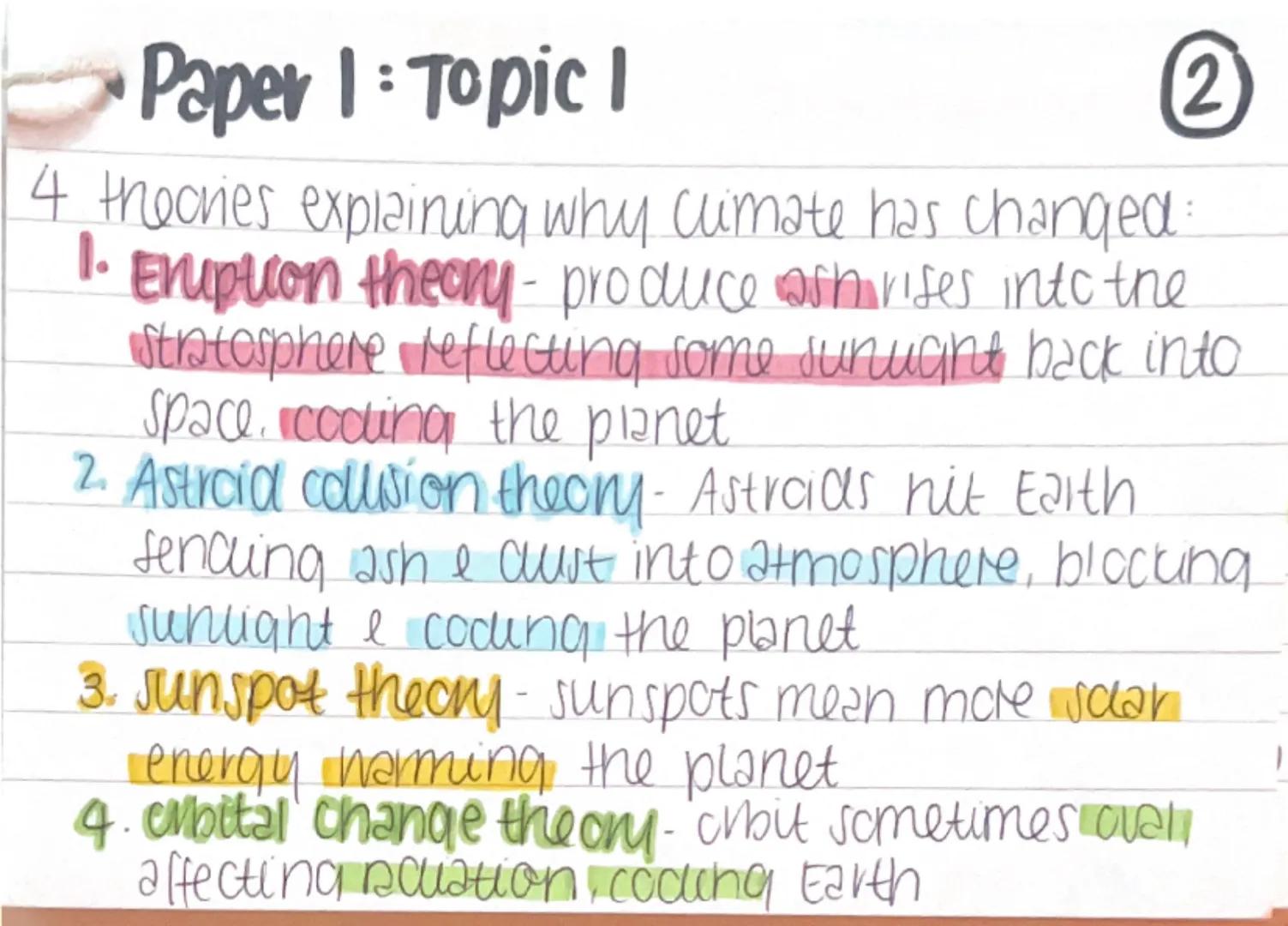
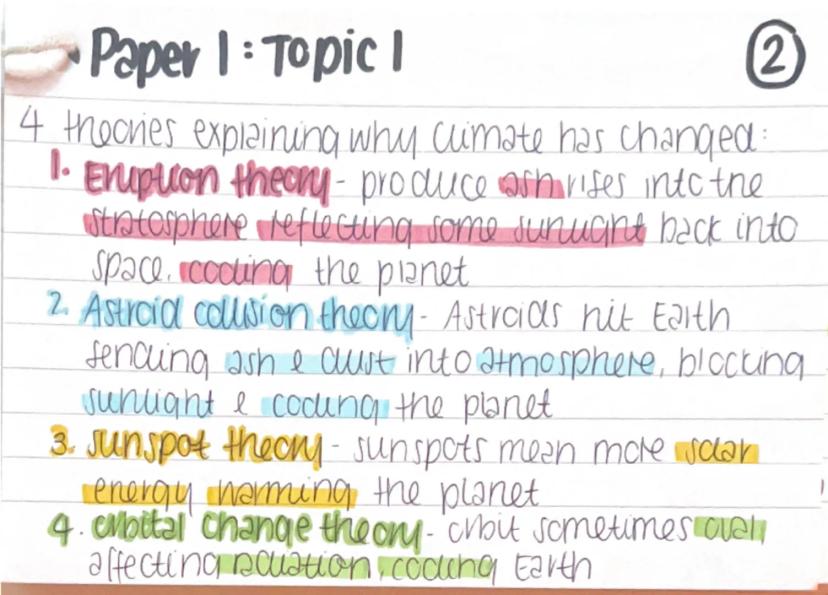
Climate has been changing long before humans arrived, and scientists have four main theories explaining these natural shifts. Volcanic eruption theory suggests that massive eruptions send ash into the stratosphere, reflecting sunlight back to space and cooling the planet.
Asteroid collision theory works similarly - when asteroids smash into Earth, they kick up dust and ash that blocks sunlight. The sunspot theory goes the opposite direction, proposing that more sunspots mean more solar energy reaching and warming our planet.
Finally, orbital change theory focuses on Earth's changing orbit around the sun. Sometimes our orbit becomes more oval-shaped, affecting how much solar radiation we receive and potentially cooling the planet.
Remember: These are natural causes of climate change - very different from the human-caused climate change happening today.
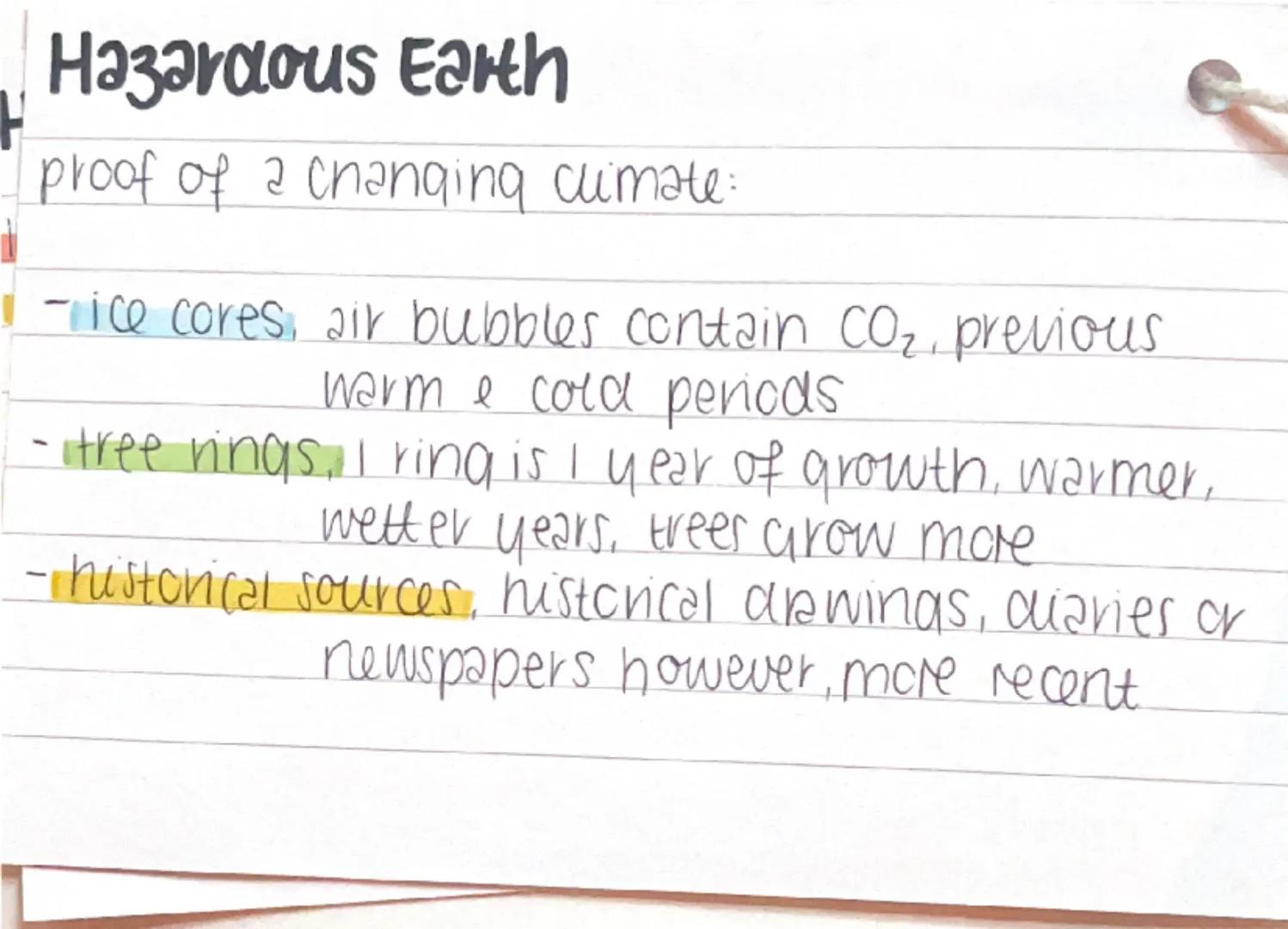
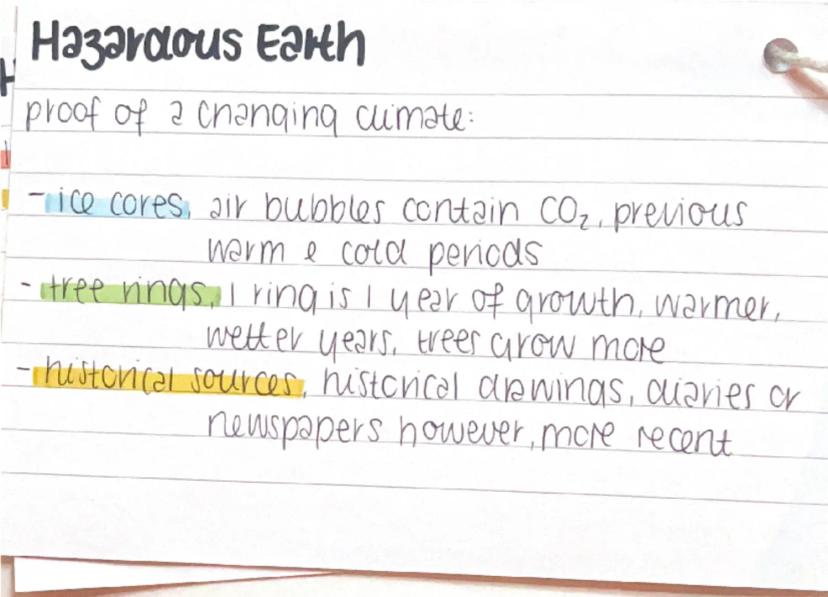
Scientists are like detectives when it comes to proving climate has changed, and they've got some brilliant evidence. Ice cores are probably the coolest - literally! Air bubbles trapped in ancient ice contain CO₂ levels from thousands of years ago, revealing previous warm and cold periods.
Tree rings work like nature's calendar - each ring represents one year of growth. During warmer, wetter years, trees grow more, creating thicker rings that scientists can measure and date.
Historical sources include old paintings, diaries, and newspapers that describe past weather conditions. However, these are much more recent and less reliable than ice cores or tree rings.
Exam Tip: Be ready to explain how each type of evidence works and what time periods it covers - ice cores go back furthest, whilst historical sources are most recent.
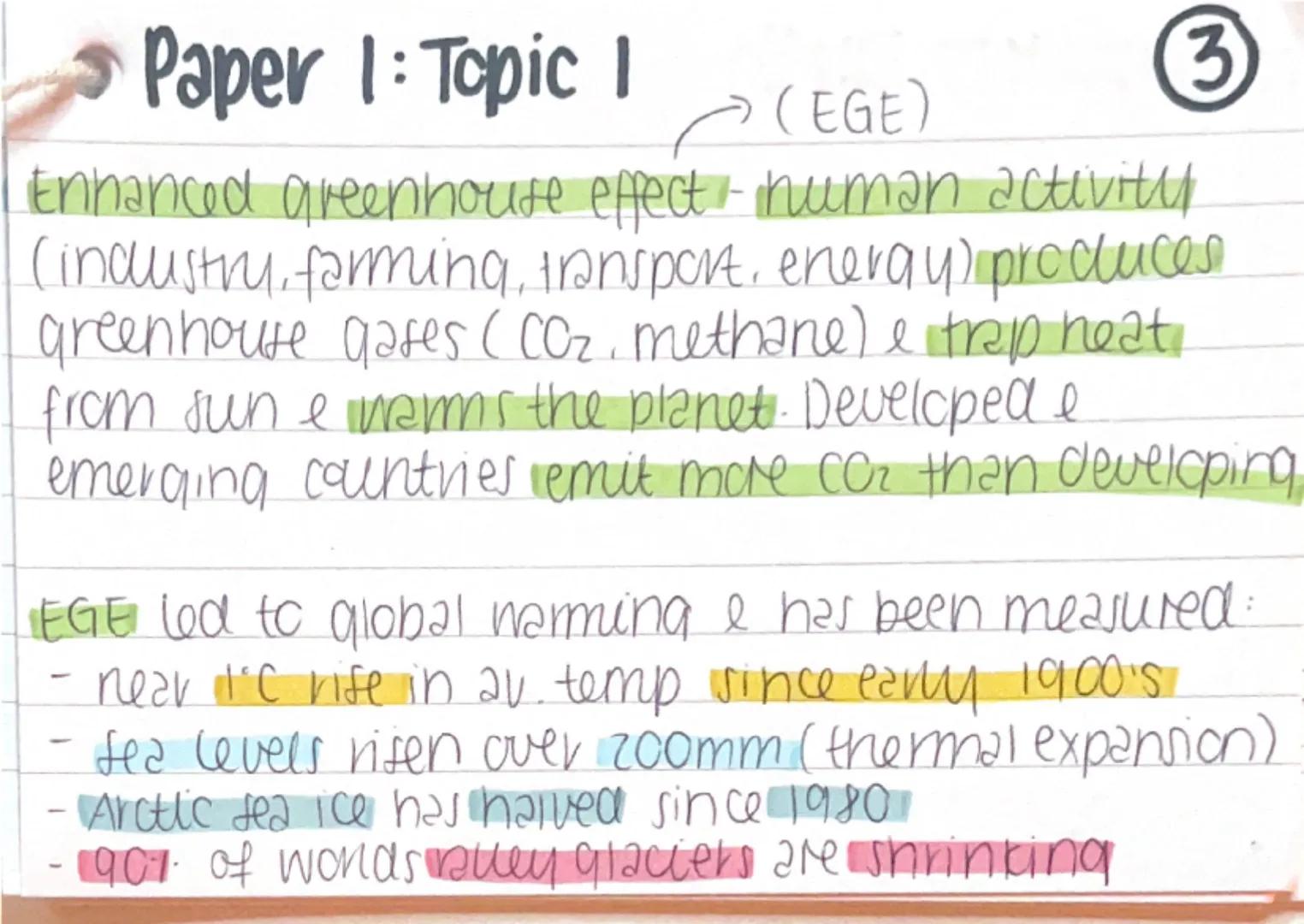
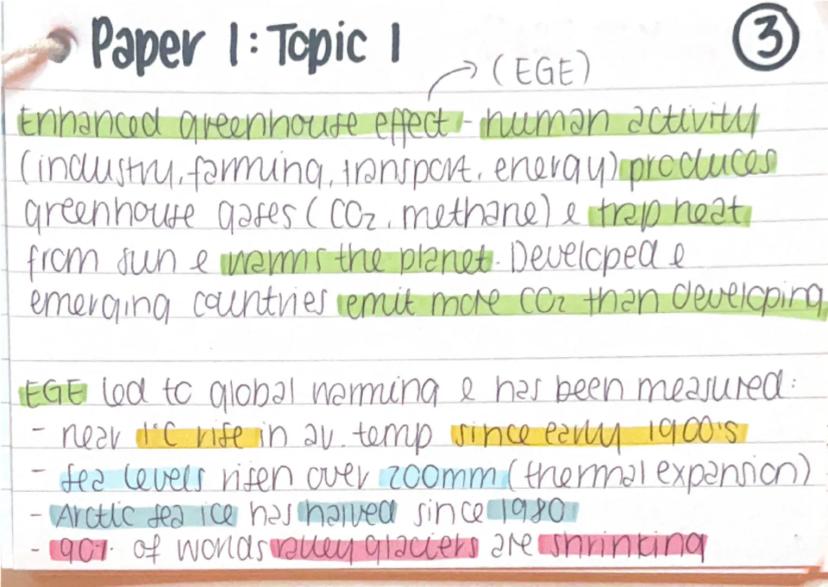
Here's where humans enter the climate story. The Enhanced Greenhouse Effect (EGE) happens when human activities like industry, farming, transport, and energy production pump out greenhouse gases - mainly CO₂ and methane - that trap extra heat from the sun.
Developed and emerging countries are the biggest culprits, emitting far more CO₂ than developing nations. This isn't just theory - we can measure the results of global warming happening right now.
Since the early 1900s, average temperatures have risen nearly 1°C, sea levels have climbed over 200mm due to thermal expansion, Arctic sea ice has halved since 1980, and 90% of the world's valley glaciers are shrinking. These aren't predictions - they're current realities.
Key Point: The Enhanced Greenhouse Effect is different from the natural greenhouse effect - it's the extra warming caused specifically by human activities.
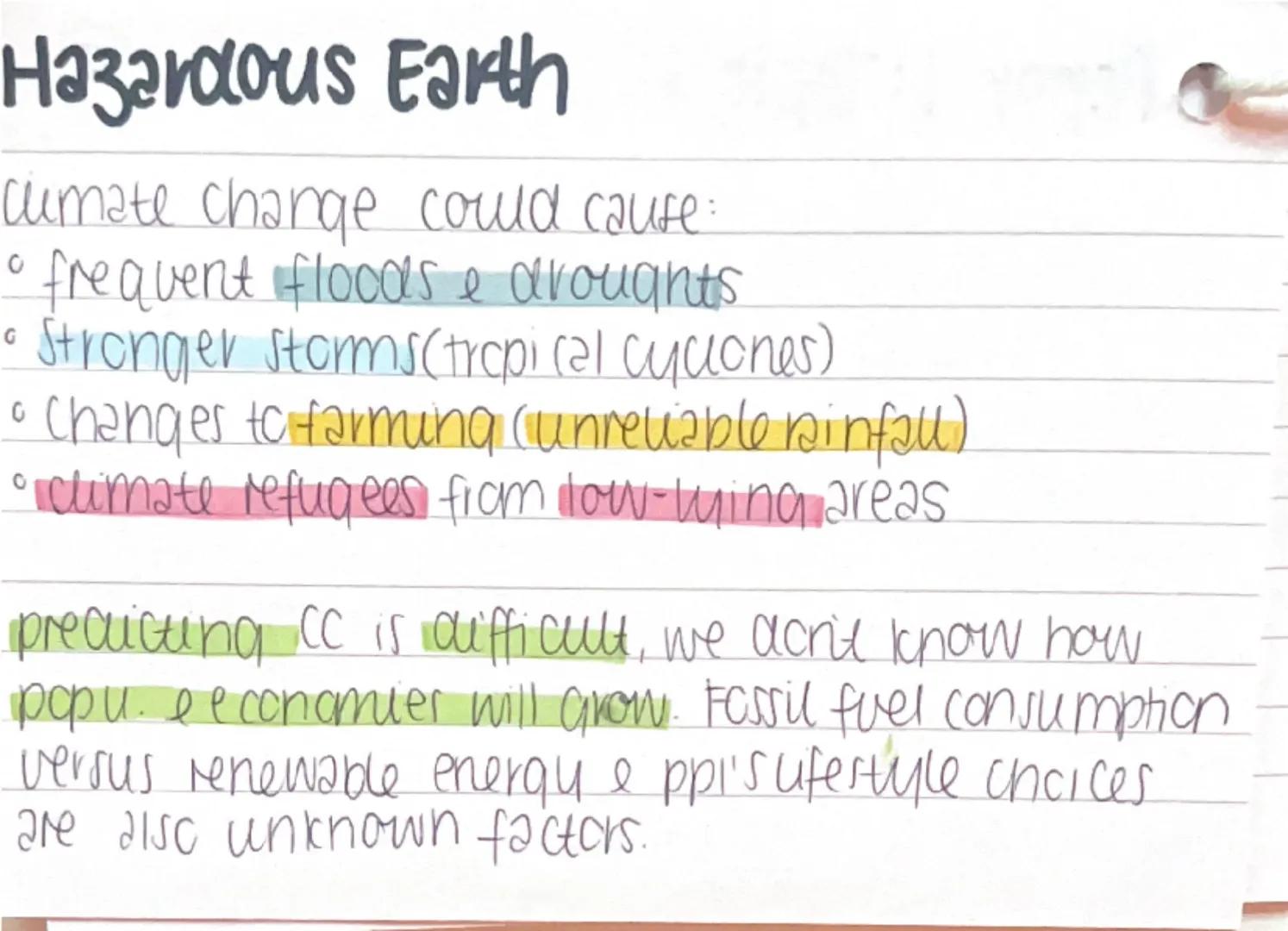
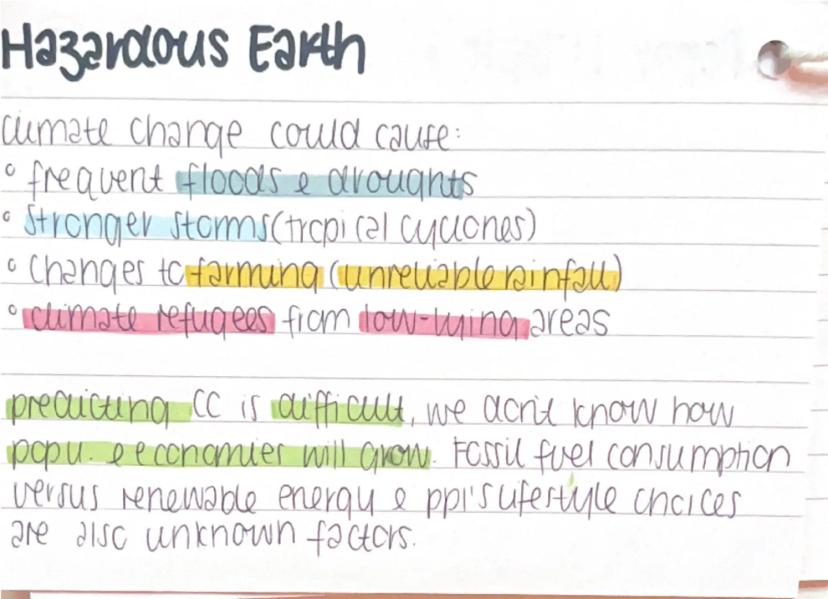
Climate change isn't just about warmer temperatures - it triggers a cascade of effects that reshape how people live. We're looking at more frequent floods and droughts, stronger tropical cyclones, unreliable rainfall that disrupts farming, and climate refugees forced to leave low-lying coastal areas.
Predicting future climate change is incredibly tricky though. Scientists don't know exactly how populations and economies will grow, whether we'll shift to renewable energy fast enough, or how people's lifestyle choices will evolve.
The uncertainty makes planning difficult, but the trends we're seeing now give us a pretty clear direction of where things are heading.
Think About It: Why might it be harder to predict climate change than to prove it's happening? Consider all the human factors involved.
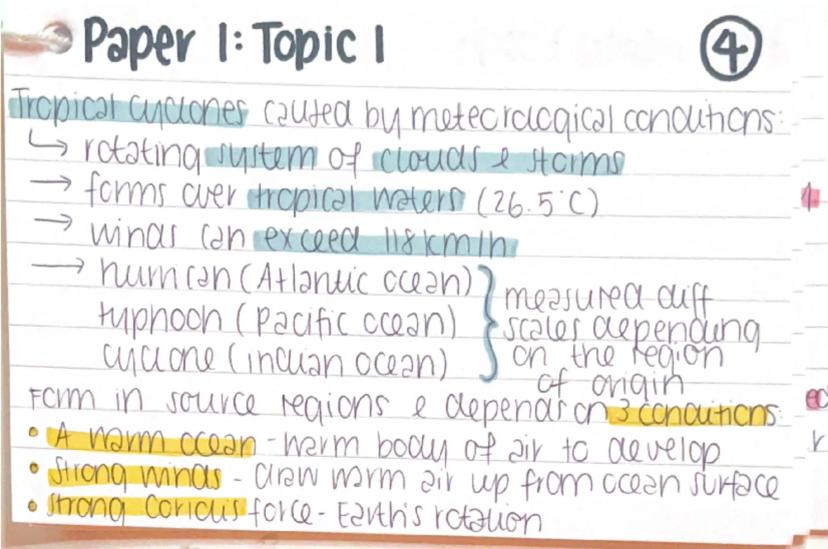
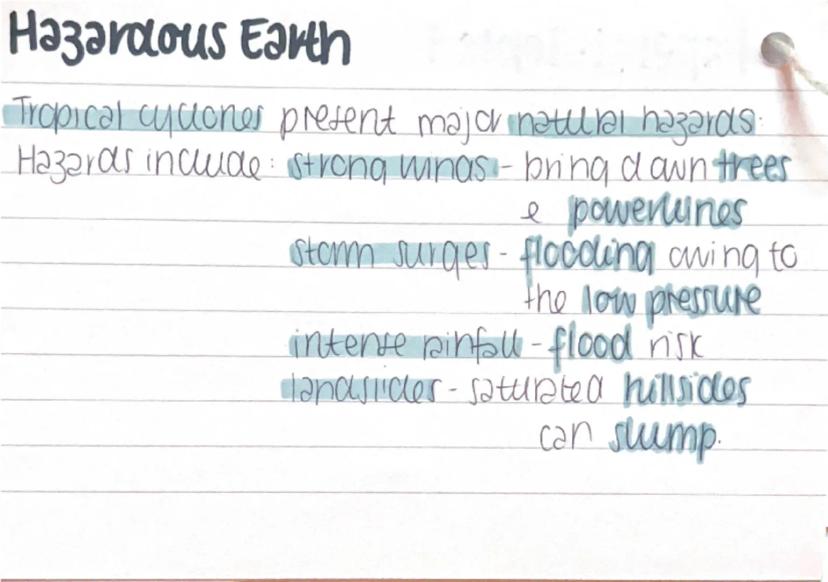
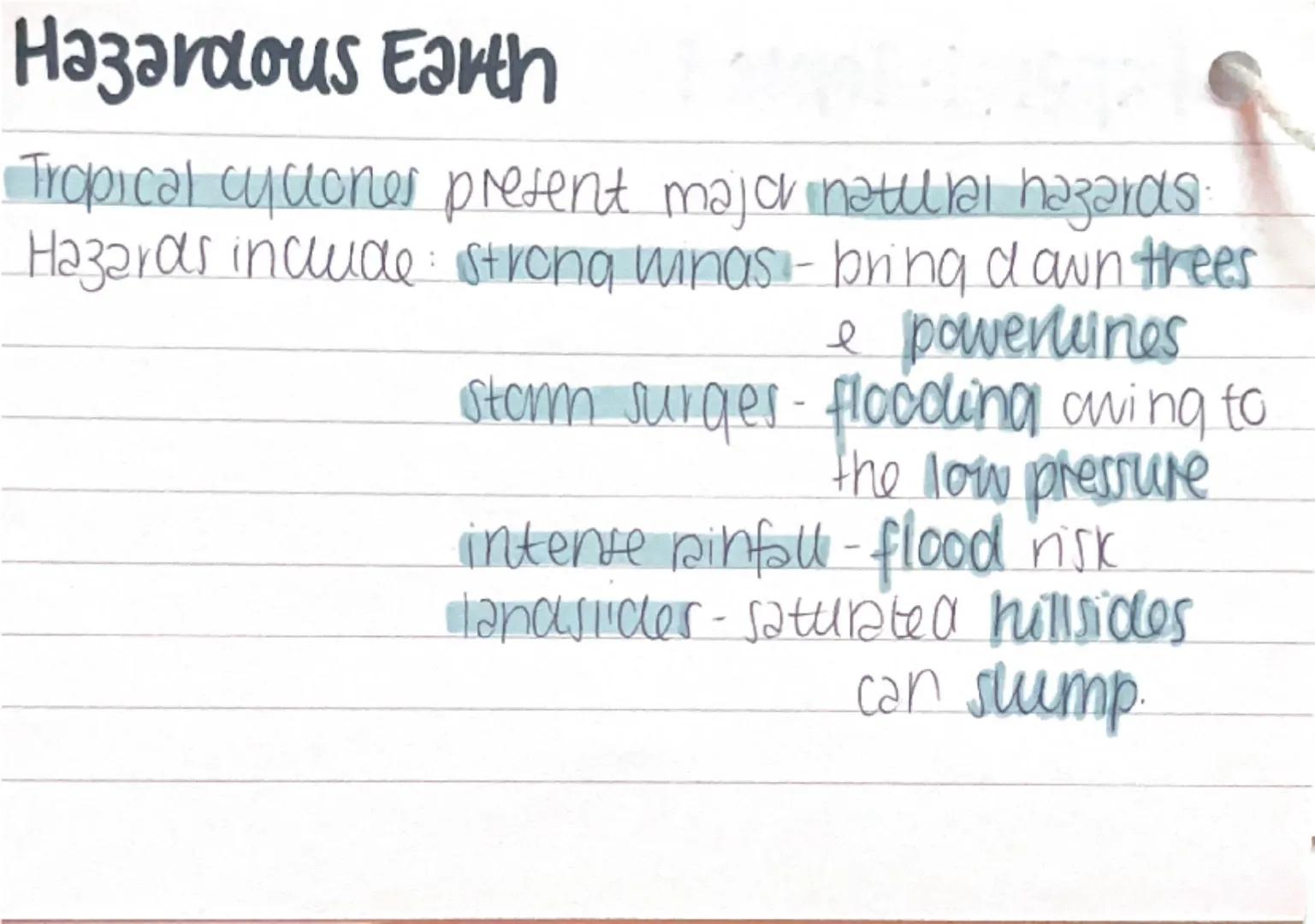
Tropical cyclones are nature's most powerful storms, bringing multiple deadly hazards in one devastating package. Strong winds can reach over 250 km/h, easily bringing down trees, power lines, and buildings.
Storm surges create some of the worst flooding - the low pressure literally sucks up sea water, whilst powerful winds push it onto land. Add intense rainfall on top, and you've got a flooding nightmare.
Even after the storm passes, landslides become a major threat as hillsides become saturated and unstable, potentially collapsing onto communities below.
Remember: It's not just one hazard - tropical cyclones are dangerous because they combine multiple threats that can affect areas for weeks after the storm passes.
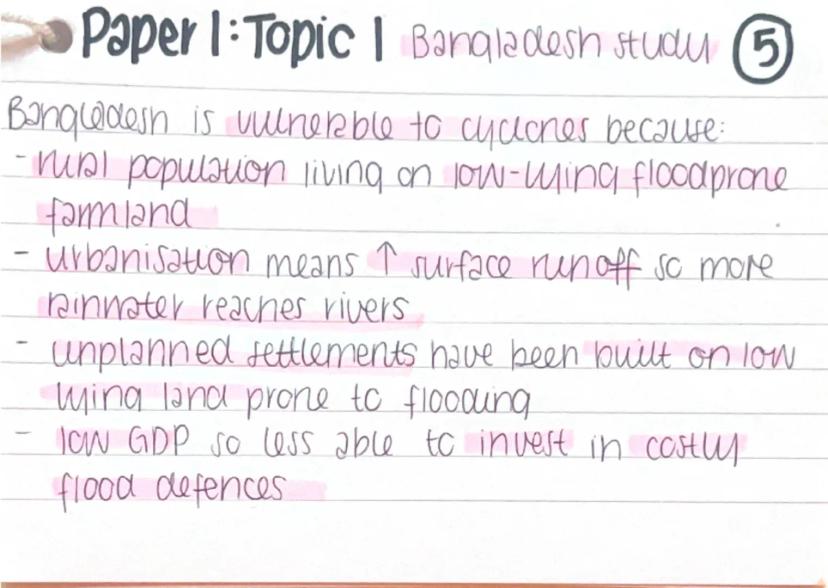
Bangladesh is incredibly vulnerable to cyclones due to a perfect storm of geographical and economic factors. Most of the rural population lives on low-lying, flood-prone farmland with nowhere to escape rising water.
Rapid urbanisation makes things worse by increasing surface runoff - more concrete means rainwater reaches rivers faster, causing more severe flooding. Many unplanned settlements have been built on the most dangerous low-lying land because it's the only place poor people can afford to live.
With a low GDP, Bangladesh simply can't invest in the costly flood defences that richer countries take for granted. This creates a cycle where the most vulnerable people live in the most dangerous areas with the least protection.
Case Study Tip: Remember the four vulnerability factors - rural location, urbanisation effects, poor planning, and poverty. These often appear in exam questions.

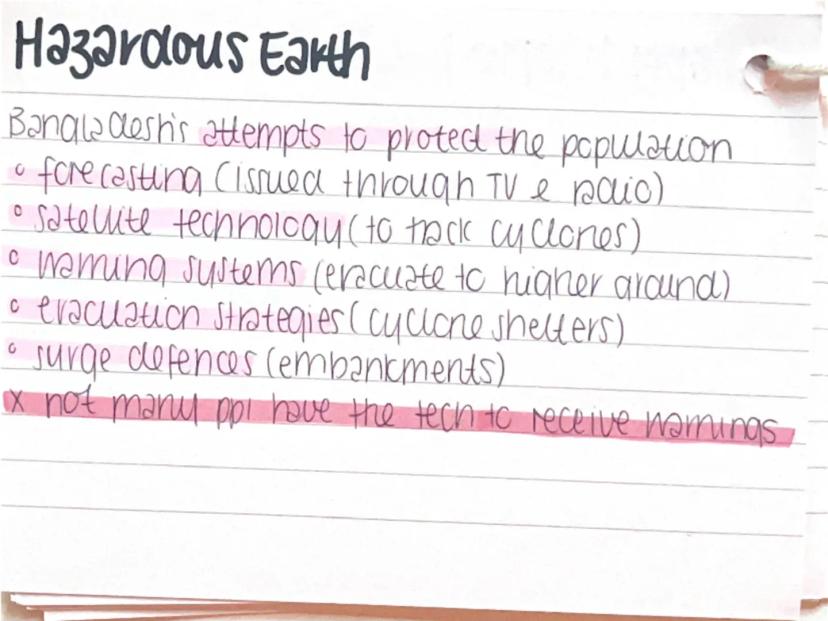
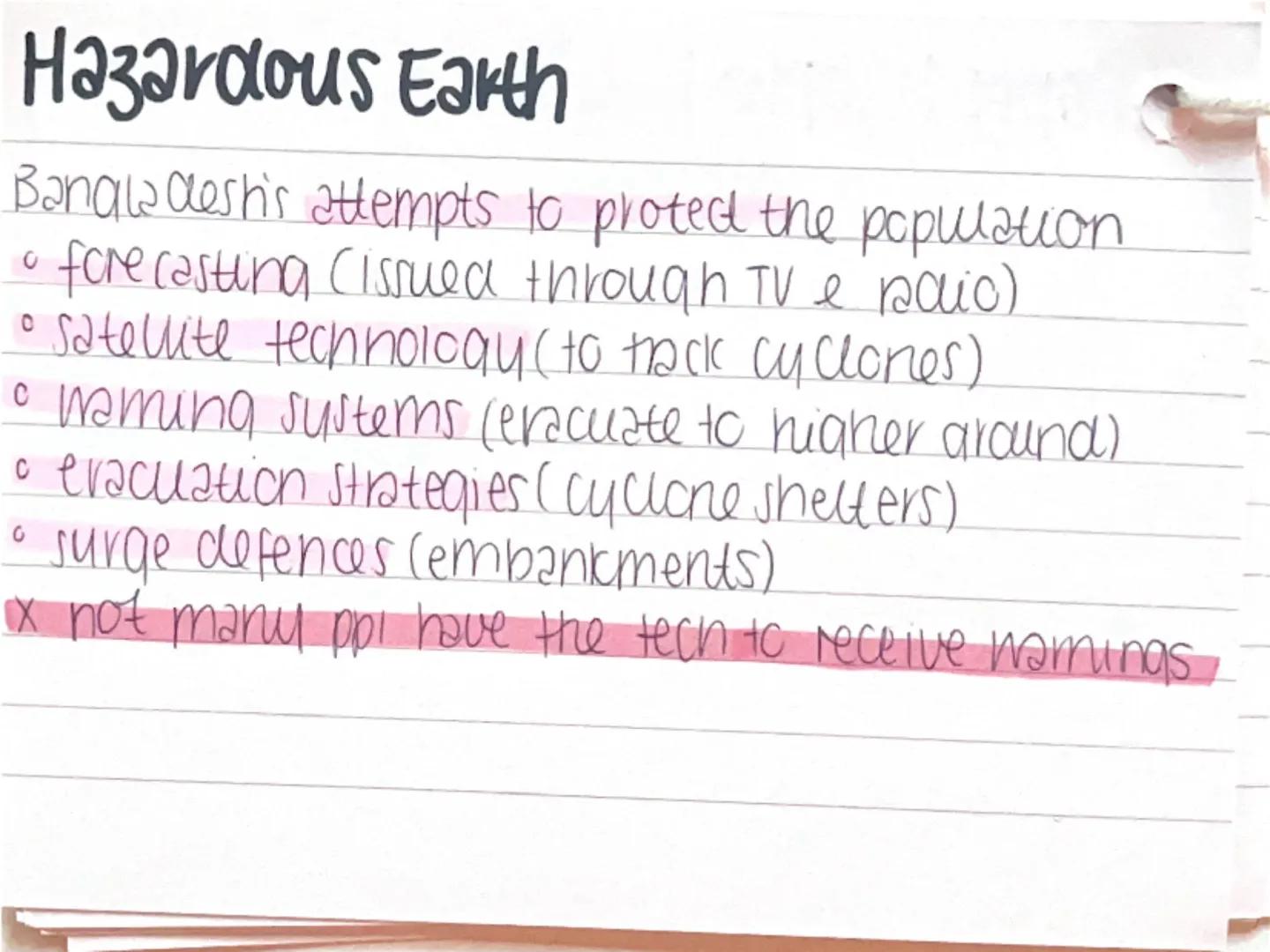
Bangladesh doesn't just sit back and wait for disaster - they've developed several protection strategies to save lives. Forecasting and satellite technology help track incoming cyclones, whilst warning systems broadcast through TV and radio tell people when to evacuate to higher ground.
Evacuation strategies include purpose-built cyclone shelters on stilts that can house thousands of people above flood level. Surge defences like embankments provide some protection against storm surges.
However, the system has a major flaw - not many people have the technology to receive warnings, especially in rural areas where radios and TVs are luxury items.
Evaluation Point: Bangladesh's strategies work well for people who can access them, but poverty limits their effectiveness for the most vulnerable populations.
The devastating impact of Cyclone Aila in May 2009 shows how cyclones affect developing countries differently. It killed 190 people and made 750,000 homeless, but the secondary impacts were equally brutal - destroyed crops, dead farm animals, and disease spreading through contaminated water.
The USA prepares for hurricanes using similar strategies - forecasting, satellite technology, warnings, evacuation systems, and storm surge defences. The key difference is that Americans are much more likely to have access to these protection systems.
This comparison highlights how economic development affects a country's ability to protect its people from natural hazards, even when both countries face similar threats.
Comparison Key: Both countries use similar strategies, but wealth and infrastructure determine how effectively these strategies protect people.
Our AI Companion is a student-focused AI tool that offers more than just answers. Built on millions of Knowunity resources, it provides relevant information, personalised study plans, quizzes, and content directly in the chat, adapting to your individual learning journey.
You can download the app from Google Play Store and Apple App Store.
That's right! Enjoy free access to study content, connect with fellow students, and get instant help – all at your fingertips.
App Store
Google Play
The app is very easy to use and well designed. I have found everything I was looking for so far and have been able to learn a lot from the presentations! I will definitely use the app for a class assignment! And of course it also helps a lot as an inspiration.
Stefan S
iOS user
This app is really great. There are so many study notes and help [...]. My problem subject is French, for example, and the app has so many options for help. Thanks to this app, I have improved my French. I would recommend it to anyone.
Samantha Klich
Android user
Wow, I am really amazed. I just tried the app because I've seen it advertised many times and was absolutely stunned. This app is THE HELP you want for school and above all, it offers so many things, such as workouts and fact sheets, which have been VERY helpful to me personally.
Anna
iOS user
Best app on earth! no words because it’s too good
Thomas R
iOS user
Just amazing. Let's me revise 10x better, this app is a quick 10/10. I highly recommend it to anyone. I can watch and search for notes. I can save them in the subject folder. I can revise it any time when I come back. If you haven't tried this app, you're really missing out.
Basil
Android user
This app has made me feel so much more confident in my exam prep, not only through boosting my own self confidence through the features that allow you to connect with others and feel less alone, but also through the way the app itself is centred around making you feel better. It is easy to navigate, fun to use, and helpful to anyone struggling in absolutely any way.
David K
iOS user
The app's just great! All I have to do is enter the topic in the search bar and I get the response real fast. I don't have to watch 10 YouTube videos to understand something, so I'm saving my time. Highly recommended!
Sudenaz Ocak
Android user
In school I was really bad at maths but thanks to the app, I am doing better now. I am so grateful that you made the app.
Greenlight Bonnie
Android user
very reliable app to help and grow your ideas of Maths, English and other related topics in your works. please use this app if your struggling in areas, this app is key for that. wish I'd of done a review before. and it's also free so don't worry about that.
Rohan U
Android user
I know a lot of apps use fake accounts to boost their reviews but this app deserves it all. Originally I was getting 4 in my English exams and this time I got a grade 7. I didn’t even know about this app three days until the exam and it has helped A LOT. Please actually trust me and use it as I’m sure you too will see developments.
Xander S
iOS user
THE QUIZES AND FLASHCARDS ARE SO USEFUL AND I LOVE Knowunity AI. IT ALSO IS LITREALLY LIKE CHATGPT BUT SMARTER!! HELPED ME WITH MY MASCARA PROBLEMS TOO!! AS WELL AS MY REAL SUBJECTS ! DUHHH 😍😁😲🤑💗✨🎀😮
Elisha
iOS user
This apps acc the goat. I find revision so boring but this app makes it so easy to organize it all and then you can ask the freeeee ai to test yourself so good and you can easily upload your own stuff. highly recommend as someone taking mocks now
Paul T
iOS user
The app is very easy to use and well designed. I have found everything I was looking for so far and have been able to learn a lot from the presentations! I will definitely use the app for a class assignment! And of course it also helps a lot as an inspiration.
Stefan S
iOS user
This app is really great. There are so many study notes and help [...]. My problem subject is French, for example, and the app has so many options for help. Thanks to this app, I have improved my French. I would recommend it to anyone.
Samantha Klich
Android user
Wow, I am really amazed. I just tried the app because I've seen it advertised many times and was absolutely stunned. This app is THE HELP you want for school and above all, it offers so many things, such as workouts and fact sheets, which have been VERY helpful to me personally.
Anna
iOS user
Best app on earth! no words because it’s too good
Thomas R
iOS user
Just amazing. Let's me revise 10x better, this app is a quick 10/10. I highly recommend it to anyone. I can watch and search for notes. I can save them in the subject folder. I can revise it any time when I come back. If you haven't tried this app, you're really missing out.
Basil
Android user
This app has made me feel so much more confident in my exam prep, not only through boosting my own self confidence through the features that allow you to connect with others and feel less alone, but also through the way the app itself is centred around making you feel better. It is easy to navigate, fun to use, and helpful to anyone struggling in absolutely any way.
David K
iOS user
The app's just great! All I have to do is enter the topic in the search bar and I get the response real fast. I don't have to watch 10 YouTube videos to understand something, so I'm saving my time. Highly recommended!
Sudenaz Ocak
Android user
In school I was really bad at maths but thanks to the app, I am doing better now. I am so grateful that you made the app.
Greenlight Bonnie
Android user
very reliable app to help and grow your ideas of Maths, English and other related topics in your works. please use this app if your struggling in areas, this app is key for that. wish I'd of done a review before. and it's also free so don't worry about that.
Rohan U
Android user
I know a lot of apps use fake accounts to boost their reviews but this app deserves it all. Originally I was getting 4 in my English exams and this time I got a grade 7. I didn’t even know about this app three days until the exam and it has helped A LOT. Please actually trust me and use it as I’m sure you too will see developments.
Xander S
iOS user
THE QUIZES AND FLASHCARDS ARE SO USEFUL AND I LOVE Knowunity AI. IT ALSO IS LITREALLY LIKE CHATGPT BUT SMARTER!! HELPED ME WITH MY MASCARA PROBLEMS TOO!! AS WELL AS MY REAL SUBJECTS ! DUHHH 😍😁😲🤑💗✨🎀😮
Elisha
iOS user
This apps acc the goat. I find revision so boring but this app makes it so easy to organize it all and then you can ask the freeeee ai to test yourself so good and you can easily upload your own stuff. highly recommend as someone taking mocks now
Paul T
iOS user
Jess
@jessleigh
Climate change and extreme weather are reshaping our world, and understanding these forces is crucial for your geography studies. This topic covers everything from how heat moves around our planet to why some countries handle natural disasters better than others.
Access to all documents
Improve your grades
Join milions of students
By signing up you accept Terms of Service and Privacy Policy
Ever wondered why some places are scorching hot whilst others are freezing cold? It all comes down to pressure differences and ocean currents working together like a massive global heating system.
Land and sea behave completely differently when it comes to temperature. Land heats up quickly in summer, warming the air above it until that air becomes lighter and rises, creating low pressure. Sea takes ages to heat up and cool down, so it creates high pressure in summer when the air above stays dense and cool.
These pressure differences drive weather patterns you see every day. Cold, salty water sinks at the poles, then flows toward the equator where it warms up again - creating convection currents that distribute heat around the planet.
Quick Tip: Remember that low pressure = rising air = often cloudy/wet weather, whilst high pressure = sinking air = usually clear, dry conditions.
Access to all documents
Improve your grades
Join milions of students
By signing up you accept Terms of Service and Privacy Policy
The Inter-tropical Convergence Zone (ITCZ) is where the magic happens - it's the meeting point between two massive air circulation systems called Hadley cells. Picture the equator as a giant heating belt where the sun's radiation is most intense.
This intense heating causes warm tropical air to rise rapidly, creating low pressure and heavy rainfall. As this air rises, it moves away from the equator, loses moisture, and eventually sinks back down to form the world's arid regions - that's why many deserts sit around 30° north and south.
The atmosphere also has Ferrel cells and polar cells that complete this global heat transfer system. Think of it as nature's central heating - constantly moving warm air from hot areas to cold ones.
Exam Focus: Be able to sketch and label these three circulation cells - they're exam favourites and explain why certain climates exist where they do.
Access to all documents
Improve your grades
Join milions of students
By signing up you accept Terms of Service and Privacy Policy
Climate has been changing long before humans arrived, and scientists have four main theories explaining these natural shifts. Volcanic eruption theory suggests that massive eruptions send ash into the stratosphere, reflecting sunlight back to space and cooling the planet.
Asteroid collision theory works similarly - when asteroids smash into Earth, they kick up dust and ash that blocks sunlight. The sunspot theory goes the opposite direction, proposing that more sunspots mean more solar energy reaching and warming our planet.
Finally, orbital change theory focuses on Earth's changing orbit around the sun. Sometimes our orbit becomes more oval-shaped, affecting how much solar radiation we receive and potentially cooling the planet.
Remember: These are natural causes of climate change - very different from the human-caused climate change happening today.
Access to all documents
Improve your grades
Join milions of students
By signing up you accept Terms of Service and Privacy Policy
Scientists are like detectives when it comes to proving climate has changed, and they've got some brilliant evidence. Ice cores are probably the coolest - literally! Air bubbles trapped in ancient ice contain CO₂ levels from thousands of years ago, revealing previous warm and cold periods.
Tree rings work like nature's calendar - each ring represents one year of growth. During warmer, wetter years, trees grow more, creating thicker rings that scientists can measure and date.
Historical sources include old paintings, diaries, and newspapers that describe past weather conditions. However, these are much more recent and less reliable than ice cores or tree rings.
Exam Tip: Be ready to explain how each type of evidence works and what time periods it covers - ice cores go back furthest, whilst historical sources are most recent.
Access to all documents
Improve your grades
Join milions of students
By signing up you accept Terms of Service and Privacy Policy
Here's where humans enter the climate story. The Enhanced Greenhouse Effect (EGE) happens when human activities like industry, farming, transport, and energy production pump out greenhouse gases - mainly CO₂ and methane - that trap extra heat from the sun.
Developed and emerging countries are the biggest culprits, emitting far more CO₂ than developing nations. This isn't just theory - we can measure the results of global warming happening right now.
Since the early 1900s, average temperatures have risen nearly 1°C, sea levels have climbed over 200mm due to thermal expansion, Arctic sea ice has halved since 1980, and 90% of the world's valley glaciers are shrinking. These aren't predictions - they're current realities.
Key Point: The Enhanced Greenhouse Effect is different from the natural greenhouse effect - it's the extra warming caused specifically by human activities.
Access to all documents
Improve your grades
Join milions of students
By signing up you accept Terms of Service and Privacy Policy
Climate change isn't just about warmer temperatures - it triggers a cascade of effects that reshape how people live. We're looking at more frequent floods and droughts, stronger tropical cyclones, unreliable rainfall that disrupts farming, and climate refugees forced to leave low-lying coastal areas.
Predicting future climate change is incredibly tricky though. Scientists don't know exactly how populations and economies will grow, whether we'll shift to renewable energy fast enough, or how people's lifestyle choices will evolve.
The uncertainty makes planning difficult, but the trends we're seeing now give us a pretty clear direction of where things are heading.
Think About It: Why might it be harder to predict climate change than to prove it's happening? Consider all the human factors involved.
Access to all documents
Improve your grades
Join milions of students
By signing up you accept Terms of Service and Privacy Policy
Tropical cyclones are nature's most powerful storms, bringing multiple deadly hazards in one devastating package. Strong winds can reach over 250 km/h, easily bringing down trees, power lines, and buildings.
Storm surges create some of the worst flooding - the low pressure literally sucks up sea water, whilst powerful winds push it onto land. Add intense rainfall on top, and you've got a flooding nightmare.
Even after the storm passes, landslides become a major threat as hillsides become saturated and unstable, potentially collapsing onto communities below.
Remember: It's not just one hazard - tropical cyclones are dangerous because they combine multiple threats that can affect areas for weeks after the storm passes.
Access to all documents
Improve your grades
Join milions of students
By signing up you accept Terms of Service and Privacy Policy
Bangladesh is incredibly vulnerable to cyclones due to a perfect storm of geographical and economic factors. Most of the rural population lives on low-lying, flood-prone farmland with nowhere to escape rising water.
Rapid urbanisation makes things worse by increasing surface runoff - more concrete means rainwater reaches rivers faster, causing more severe flooding. Many unplanned settlements have been built on the most dangerous low-lying land because it's the only place poor people can afford to live.
With a low GDP, Bangladesh simply can't invest in the costly flood defences that richer countries take for granted. This creates a cycle where the most vulnerable people live in the most dangerous areas with the least protection.
Case Study Tip: Remember the four vulnerability factors - rural location, urbanisation effects, poor planning, and poverty. These often appear in exam questions.
Access to all documents
Improve your grades
Join milions of students
By signing up you accept Terms of Service and Privacy Policy
Bangladesh doesn't just sit back and wait for disaster - they've developed several protection strategies to save lives. Forecasting and satellite technology help track incoming cyclones, whilst warning systems broadcast through TV and radio tell people when to evacuate to higher ground.
Evacuation strategies include purpose-built cyclone shelters on stilts that can house thousands of people above flood level. Surge defences like embankments provide some protection against storm surges.
However, the system has a major flaw - not many people have the technology to receive warnings, especially in rural areas where radios and TVs are luxury items.
Evaluation Point: Bangladesh's strategies work well for people who can access them, but poverty limits their effectiveness for the most vulnerable populations.
Access to all documents
Improve your grades
Join milions of students
By signing up you accept Terms of Service and Privacy Policy
The devastating impact of Cyclone Aila in May 2009 shows how cyclones affect developing countries differently. It killed 190 people and made 750,000 homeless, but the secondary impacts were equally brutal - destroyed crops, dead farm animals, and disease spreading through contaminated water.
The USA prepares for hurricanes using similar strategies - forecasting, satellite technology, warnings, evacuation systems, and storm surge defences. The key difference is that Americans are much more likely to have access to these protection systems.
This comparison highlights how economic development affects a country's ability to protect its people from natural hazards, even when both countries face similar threats.
Comparison Key: Both countries use similar strategies, but wealth and infrastructure determine how effectively these strategies protect people.
Our AI Companion is a student-focused AI tool that offers more than just answers. Built on millions of Knowunity resources, it provides relevant information, personalised study plans, quizzes, and content directly in the chat, adapting to your individual learning journey.
You can download the app from Google Play Store and Apple App Store.
That's right! Enjoy free access to study content, connect with fellow students, and get instant help – all at your fingertips.
3
Smart Tools NEW
Transform this note into: ✓ 50+ Practice Questions ✓ Interactive Flashcards ✓ Full Mock Exam ✓ Essay Outlines
App Store
Google Play
The app is very easy to use and well designed. I have found everything I was looking for so far and have been able to learn a lot from the presentations! I will definitely use the app for a class assignment! And of course it also helps a lot as an inspiration.
Stefan S
iOS user
This app is really great. There are so many study notes and help [...]. My problem subject is French, for example, and the app has so many options for help. Thanks to this app, I have improved my French. I would recommend it to anyone.
Samantha Klich
Android user
Wow, I am really amazed. I just tried the app because I've seen it advertised many times and was absolutely stunned. This app is THE HELP you want for school and above all, it offers so many things, such as workouts and fact sheets, which have been VERY helpful to me personally.
Anna
iOS user
Best app on earth! no words because it’s too good
Thomas R
iOS user
Just amazing. Let's me revise 10x better, this app is a quick 10/10. I highly recommend it to anyone. I can watch and search for notes. I can save them in the subject folder. I can revise it any time when I come back. If you haven't tried this app, you're really missing out.
Basil
Android user
This app has made me feel so much more confident in my exam prep, not only through boosting my own self confidence through the features that allow you to connect with others and feel less alone, but also through the way the app itself is centred around making you feel better. It is easy to navigate, fun to use, and helpful to anyone struggling in absolutely any way.
David K
iOS user
The app's just great! All I have to do is enter the topic in the search bar and I get the response real fast. I don't have to watch 10 YouTube videos to understand something, so I'm saving my time. Highly recommended!
Sudenaz Ocak
Android user
In school I was really bad at maths but thanks to the app, I am doing better now. I am so grateful that you made the app.
Greenlight Bonnie
Android user
very reliable app to help and grow your ideas of Maths, English and other related topics in your works. please use this app if your struggling in areas, this app is key for that. wish I'd of done a review before. and it's also free so don't worry about that.
Rohan U
Android user
I know a lot of apps use fake accounts to boost their reviews but this app deserves it all. Originally I was getting 4 in my English exams and this time I got a grade 7. I didn’t even know about this app three days until the exam and it has helped A LOT. Please actually trust me and use it as I’m sure you too will see developments.
Xander S
iOS user
THE QUIZES AND FLASHCARDS ARE SO USEFUL AND I LOVE Knowunity AI. IT ALSO IS LITREALLY LIKE CHATGPT BUT SMARTER!! HELPED ME WITH MY MASCARA PROBLEMS TOO!! AS WELL AS MY REAL SUBJECTS ! DUHHH 😍😁😲🤑💗✨🎀😮
Elisha
iOS user
This apps acc the goat. I find revision so boring but this app makes it so easy to organize it all and then you can ask the freeeee ai to test yourself so good and you can easily upload your own stuff. highly recommend as someone taking mocks now
Paul T
iOS user
The app is very easy to use and well designed. I have found everything I was looking for so far and have been able to learn a lot from the presentations! I will definitely use the app for a class assignment! And of course it also helps a lot as an inspiration.
Stefan S
iOS user
This app is really great. There are so many study notes and help [...]. My problem subject is French, for example, and the app has so many options for help. Thanks to this app, I have improved my French. I would recommend it to anyone.
Samantha Klich
Android user
Wow, I am really amazed. I just tried the app because I've seen it advertised many times and was absolutely stunned. This app is THE HELP you want for school and above all, it offers so many things, such as workouts and fact sheets, which have been VERY helpful to me personally.
Anna
iOS user
Best app on earth! no words because it’s too good
Thomas R
iOS user
Just amazing. Let's me revise 10x better, this app is a quick 10/10. I highly recommend it to anyone. I can watch and search for notes. I can save them in the subject folder. I can revise it any time when I come back. If you haven't tried this app, you're really missing out.
Basil
Android user
This app has made me feel so much more confident in my exam prep, not only through boosting my own self confidence through the features that allow you to connect with others and feel less alone, but also through the way the app itself is centred around making you feel better. It is easy to navigate, fun to use, and helpful to anyone struggling in absolutely any way.
David K
iOS user
The app's just great! All I have to do is enter the topic in the search bar and I get the response real fast. I don't have to watch 10 YouTube videos to understand something, so I'm saving my time. Highly recommended!
Sudenaz Ocak
Android user
In school I was really bad at maths but thanks to the app, I am doing better now. I am so grateful that you made the app.
Greenlight Bonnie
Android user
very reliable app to help and grow your ideas of Maths, English and other related topics in your works. please use this app if your struggling in areas, this app is key for that. wish I'd of done a review before. and it's also free so don't worry about that.
Rohan U
Android user
I know a lot of apps use fake accounts to boost their reviews but this app deserves it all. Originally I was getting 4 in my English exams and this time I got a grade 7. I didn’t even know about this app three days until the exam and it has helped A LOT. Please actually trust me and use it as I’m sure you too will see developments.
Xander S
iOS user
THE QUIZES AND FLASHCARDS ARE SO USEFUL AND I LOVE Knowunity AI. IT ALSO IS LITREALLY LIKE CHATGPT BUT SMARTER!! HELPED ME WITH MY MASCARA PROBLEMS TOO!! AS WELL AS MY REAL SUBJECTS ! DUHHH 😍😁😲🤑💗✨🎀😮
Elisha
iOS user
This apps acc the goat. I find revision so boring but this app makes it so easy to organize it all and then you can ask the freeeee ai to test yourself so good and you can easily upload your own stuff. highly recommend as someone taking mocks now
Paul T
iOS user