
Geography Paper 1 covers six essential topics that explain how... Show more
Sign up to see the contentIt's free!
Access to all documents
Improve your grades
Join milions of students
By signing up you accept Terms of Service and Privacy Policy
Subjects

Maths

Chemistry

Biology

English Language

History
Responding to change (a2 only)
Infection and response
Homeostasis and response
Energy transfers (a2 only)
Cell biology
Organisms respond to changes in their internal and external environments (a-level only)
Biological molecules
Organisation
Substance exchange
Bioenergetics
Genetic information & variation
Inheritance, variation and evolution
Genetics & ecosystems (a2 only)
Ecology
Cells
Show all topics
1l the quest for political stability: germany, 1871-1991
Britain & the wider world: 1745 -1901
The cold war
Inter-war germany
Medieval period: 1066 -1509
2d religious conflict and the church in england, c1529-c1570
2o democracy and nazism: germany, 1918-1945
1f industrialisation and the people: britain, c1783-1885
1c the tudors: england, 1485-1603
2m wars and welfare: britain in transition, 1906-1957
World war two & the holocaust
2n revolution and dictatorship: russia, 1917-1953
2s the making of modern britain, 1951-2007
World war one
Britain: 1509 -1745
Show all topics
46
0

(:🌸Sakura_Girl🌸:)
26/11/2025
Geography
Geography AQA Paper 1
2,540
•
26 Nov 2025
•
(:🌸Sakura_Girl🌸:)
@apatil9444
Geography Paper 1 covers six essential topics that explain how... Show more
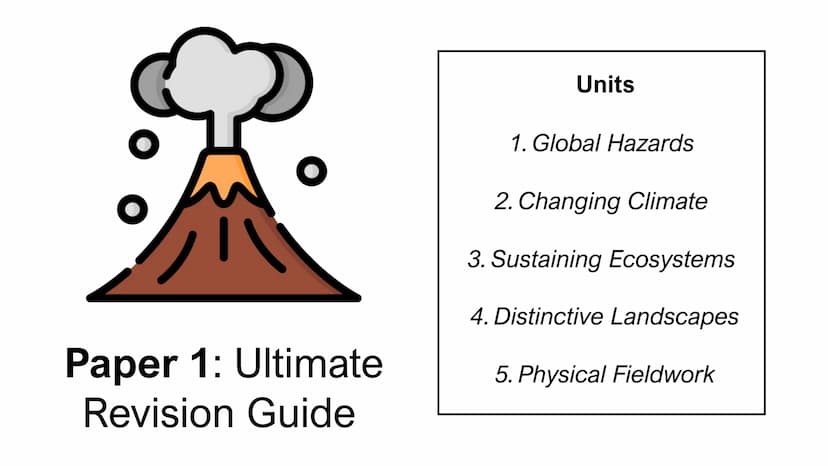
This revision guide covers everything you need to know for your geography exam. You'll study five core units that connect physical processes with real-world impacts.
The topics range from dramatic natural hazards like volcanoes and hurricanes to long-term changes in climate patterns. You'll also explore how ecosystems work together and examine distinctive landscapes that make our planet unique.
Each unit includes detailed case studies that bring theory to life. These examples help you understand how geographical processes affect real people and places around the world.
Quick Tip: Focus on understanding the connections between different processes rather than memorising isolated facts.
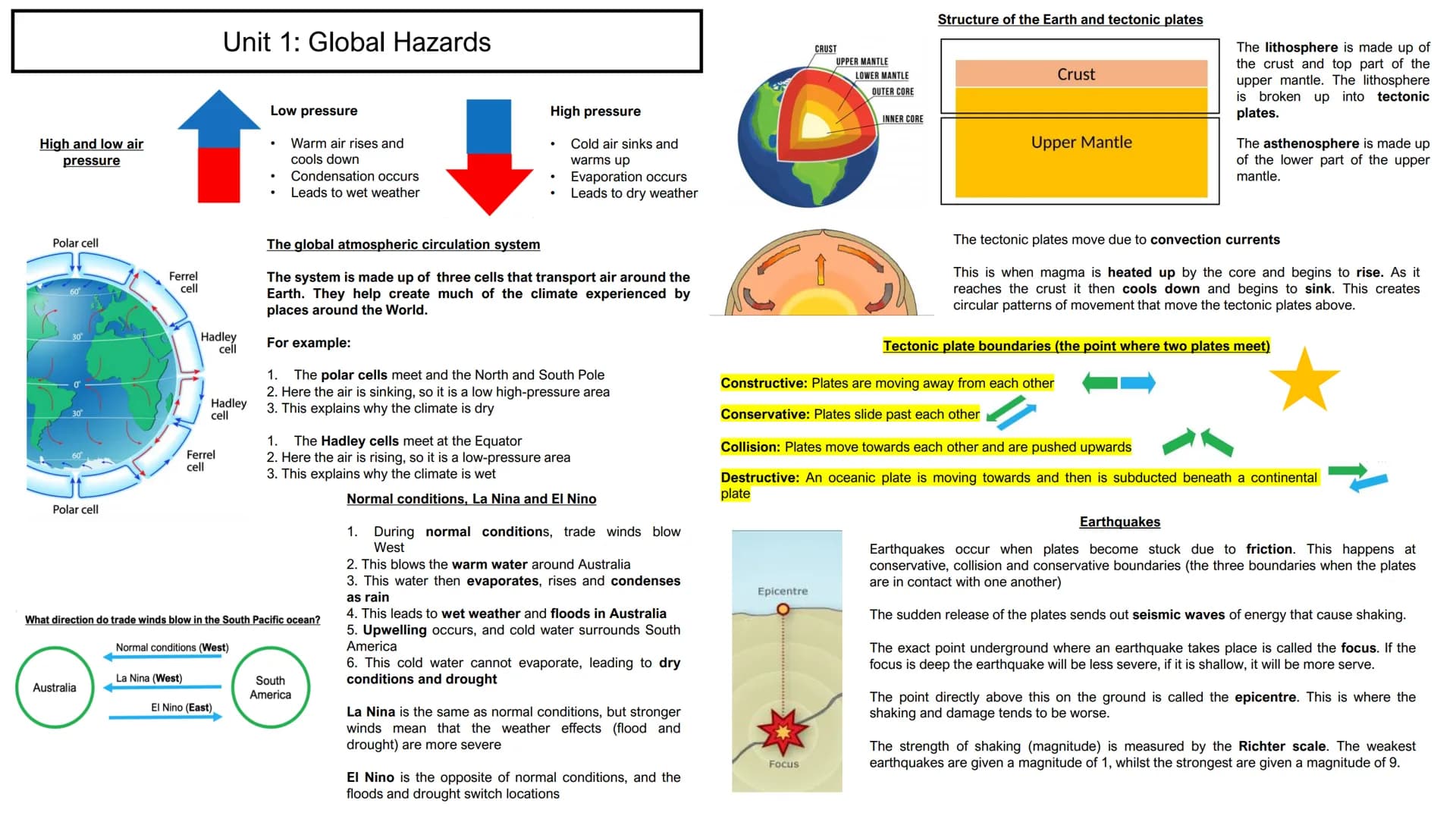
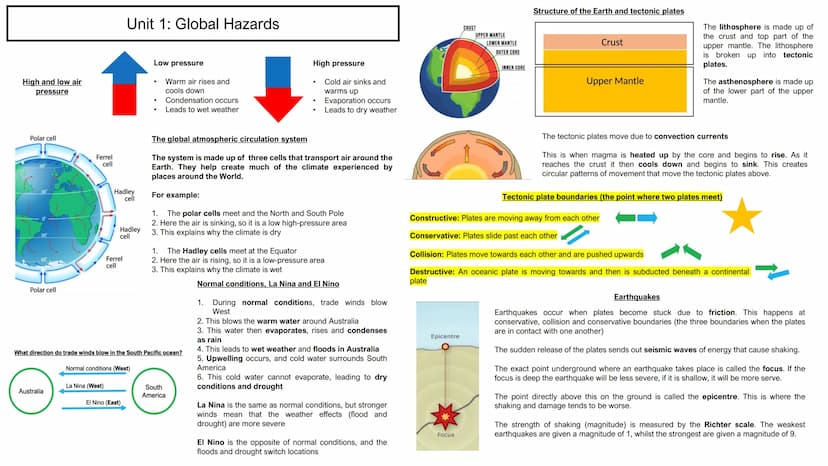
Ever wondered why earthquakes happen or how hurricanes form? It all starts with understanding Earth's structure and the massive forces that drive our planet's most dramatic events.
Earth has four main layers, but the key players are the crust and upper mantle, which together form the lithosphere. This rocky shell is cracked into huge pieces called tectonic plates that slowly move due to convection currents in the hot mantle below.
When plates meet at boundaries, different things happen. Constructive boundaries pull apart, destructive boundaries involve one plate diving under another, collision boundaries push upwards to form mountains, and conservative boundaries slide past each other. These movements cause earthquakes and create volcanoes.
Global atmospheric circulation creates three massive air cells (Hadley, Ferrel, and Polar) that transport air around Earth. Where warm air rises, you get low pressure and wet weather. Where cold air sinks, you get high pressure and dry conditions. This explains why some places are naturally wet whilst others are deserts.
Remember: Earthquakes happen when plates get stuck due to friction, then suddenly break free, sending shock waves through the ground.
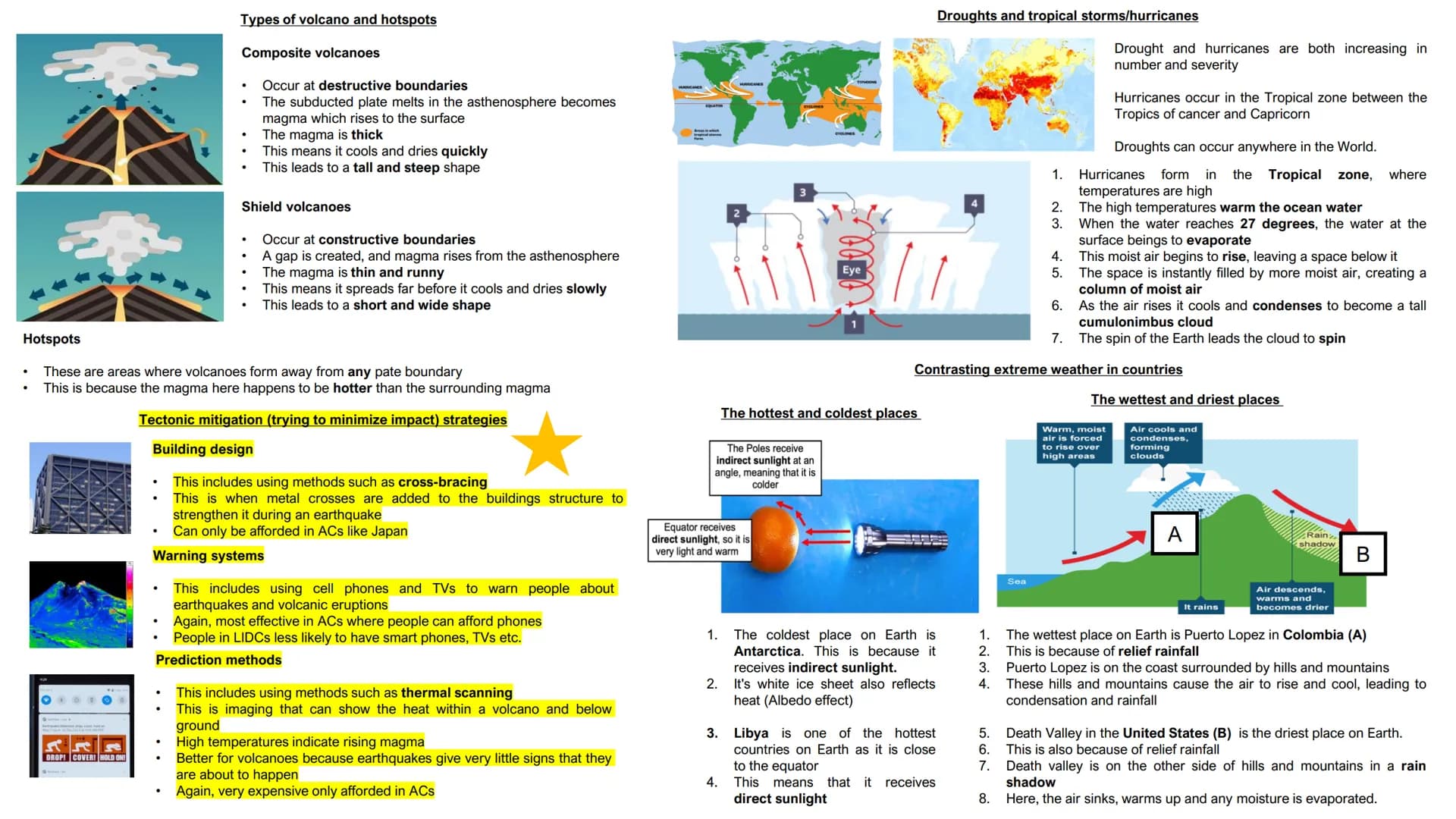
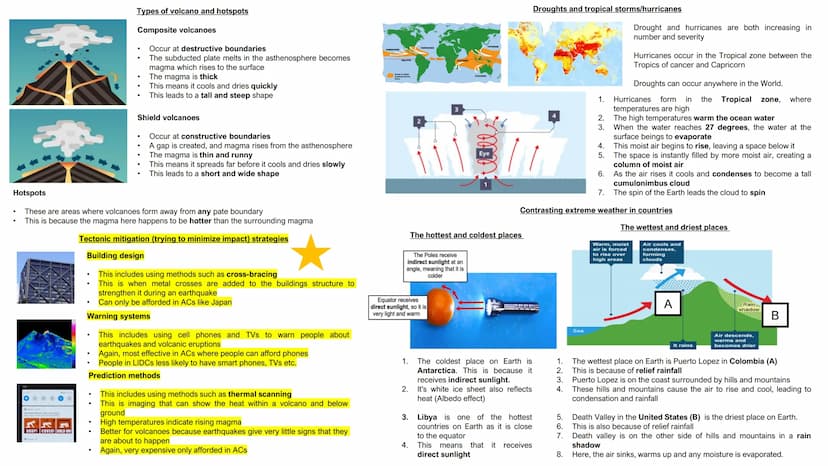
Different types of volcanoes form in different places, and each has its own personality. Composite volcanoes occur at destructive boundaries where thick, sticky magma creates tall, steep-sided mountains that explode violently. Shield volcanoes form at constructive boundaries where runny magma spreads out to create wide, gentle slopes.
Hurricanes are nature's most powerful storms, but they're quite picky about where they form. They need ocean temperatures of at least 27°C, which is why they only develop in tropical zones between the Tropics of Cancer and Capricorn. Warm water evaporates, rises, and spins due to Earth's rotation, creating these devastating rotating storms.
Earth's most extreme places exist because of simple geography. The equator receives direct sunlight, making it hot, whilst the poles receive angled, weaker sunlight, keeping them cold. Relief rainfall explains why some coastal areas are incredibly wet - mountains force air upwards where it cools and drops its moisture, leaving dry "rain shadow" areas on the other side.
Wealthy countries can afford better mitigation strategies like earthquake-resistant buildings, early warning systems, and thermal scanning for volcanoes. Unfortunately, poorer countries often lack these life-saving technologies.
Key Fact: Hotspots create volcanoes away from plate boundaries - these occur where magma is unusually hot compared to surrounding areas.
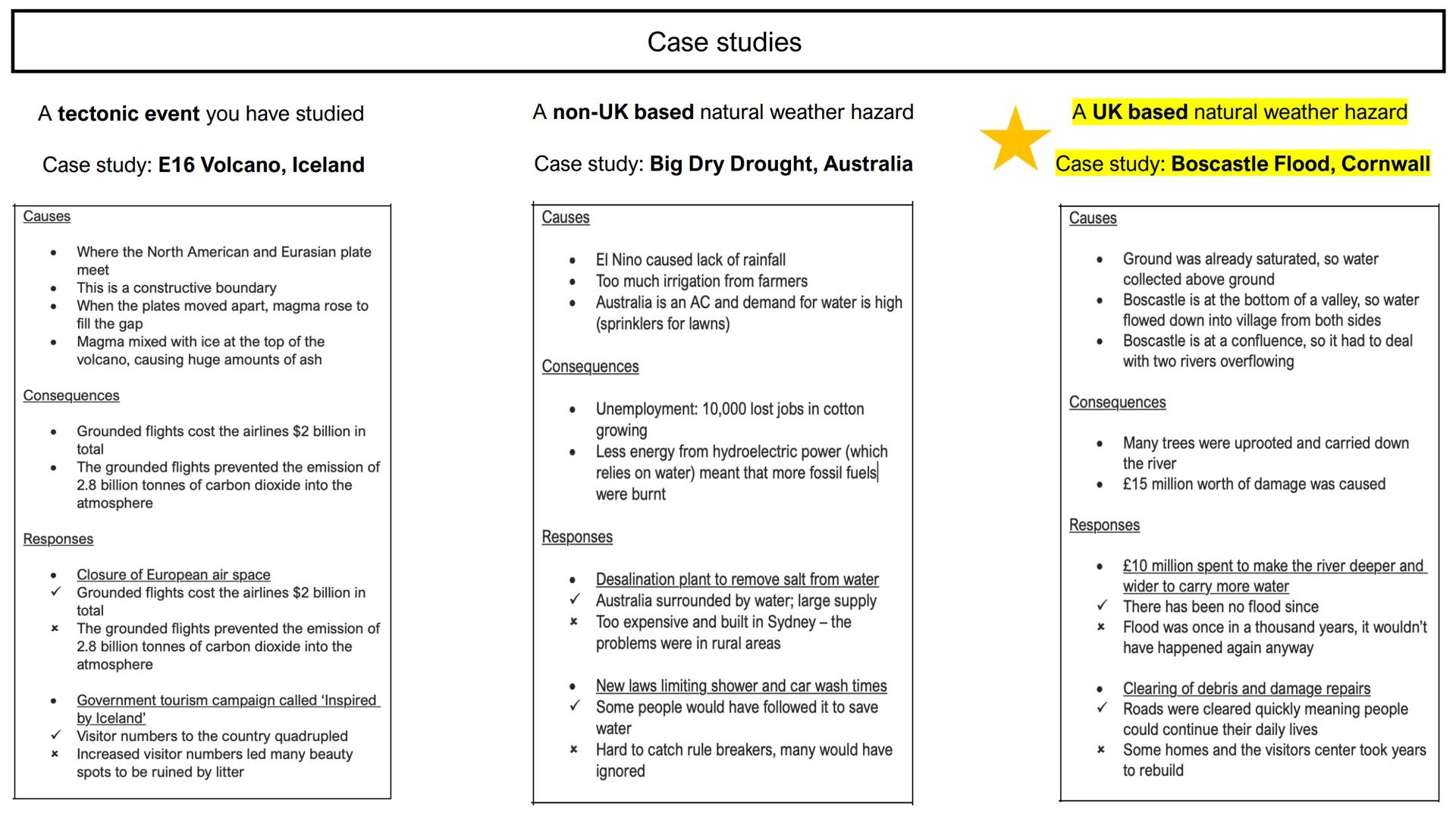
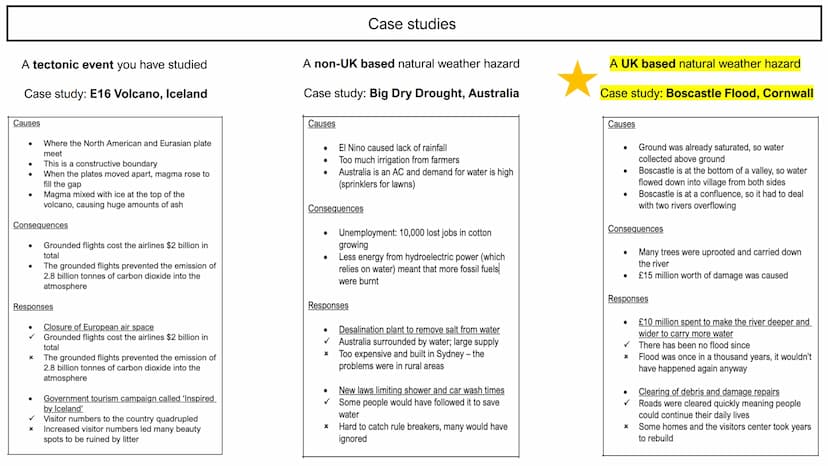
Learning about actual events helps you understand how geographical theories work in practice. These case studies show how the same processes can have vastly different impacts depending on location and wealth.
E16 Volcano, Iceland (2010) demonstrates how even a relatively small eruption can have global consequences. When the North American and Eurasian plates pulled apart, magma mixed with ice, creating massive ash clouds that grounded flights across Europe, costing airlines £2 billion.
Australia's Big Dry Drought shows how climate patterns like El Niño can devastate entire continents. Combined with high water demand from farming and urban use, this drought caused 10,000 job losses in agriculture and forced greater reliance on expensive fossil fuel energy.
Boscastle Flood, Cornwall proves that even wealthy countries aren't immune to natural disasters. The village's location at the bottom of a valley where two rivers meet made it particularly vulnerable when heavy rainfall saturated the ground.
Each case study reveals how location, wealth, and preparation determine whether natural events become minor inconveniences or major disasters.
Exam Tip: For each case study, learn the causes, consequences, and responses - both positive and negative effects of the responses.
Climate has always changed naturally, but recent changes are happening at an unprecedented speed that's got scientists worried worldwide.
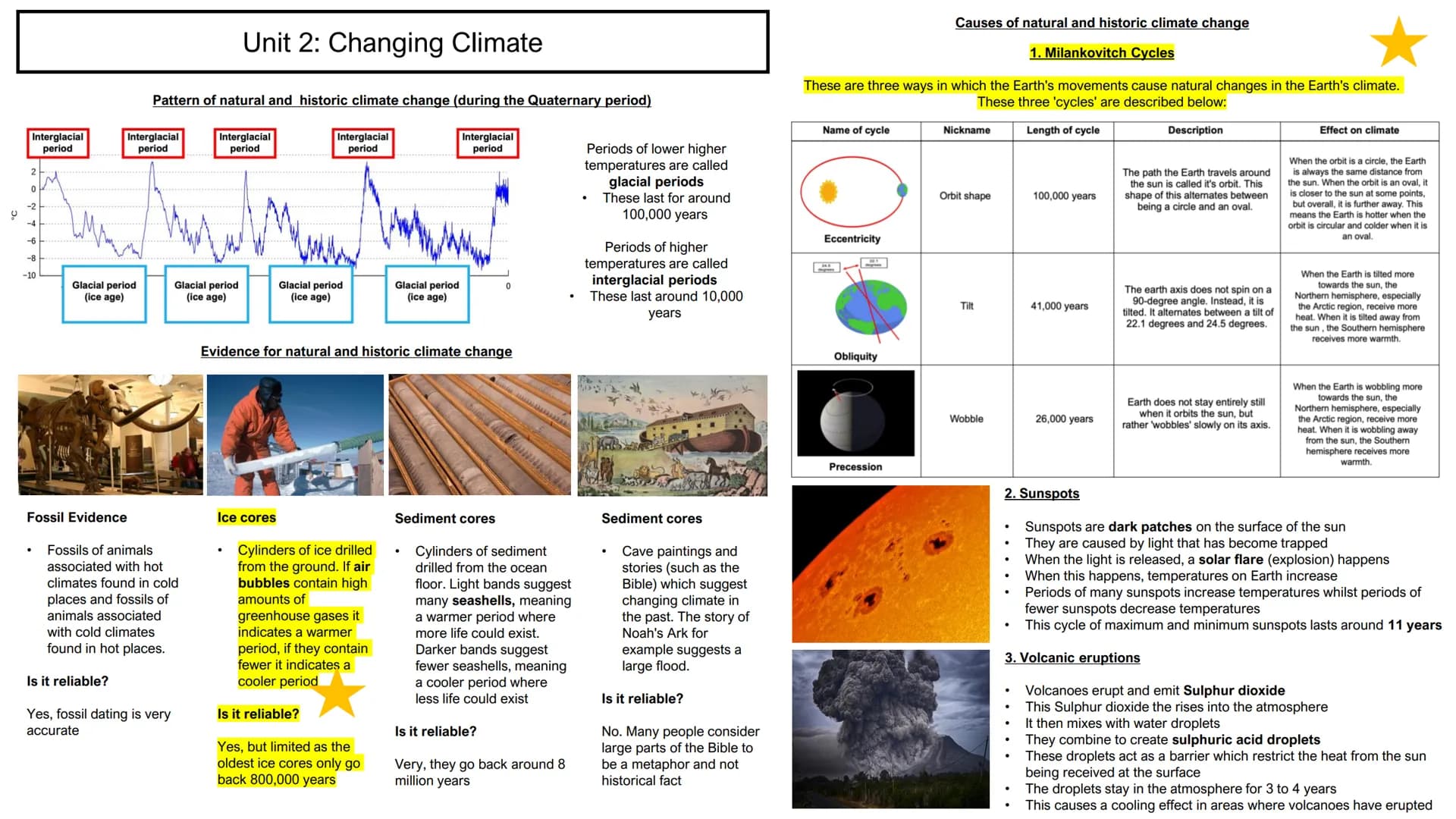
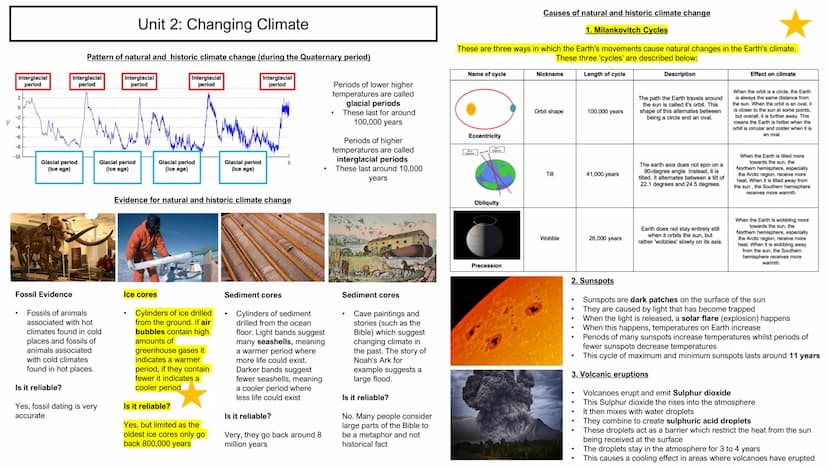
During the Quaternary period, Earth has experienced regular cycles of glacial periods (ice ages lasting 100,000 years) and warmer interglacial periods (lasting 10,000 years). We're currently in an interglacial period, which explains why the climate is relatively warm.
Milankovitch Cycles are three ways Earth's movement affects climate over thousands of years. Eccentricity changes our orbit from circular to oval every 100,000 years. Obliquity alters Earth's tilt every 41,000 years. Precession makes Earth "wobble" every 26,000 years. Together, these cycles explain long-term climate patterns.
Sunspots are dark patches on the Sun's surface that follow an 11-year cycle. When more sunspots occur, solar flares increase Earth's temperature. Fewer sunspots mean cooler periods. Volcanic eruptions have the opposite effect - they blast sulphur dioxide into the atmosphere, which mixes with water to create acid droplets that block sunlight for 3-4 years.
We know about past climates through evidence like fossil remains, ice cores containing ancient air bubbles, and sediment cores from ocean floors. Ice cores are particularly reliable, though they only go back 800,000 years.
Key Point: Natural climate change typically takes thousands of years - recent rapid changes suggest human involvement.
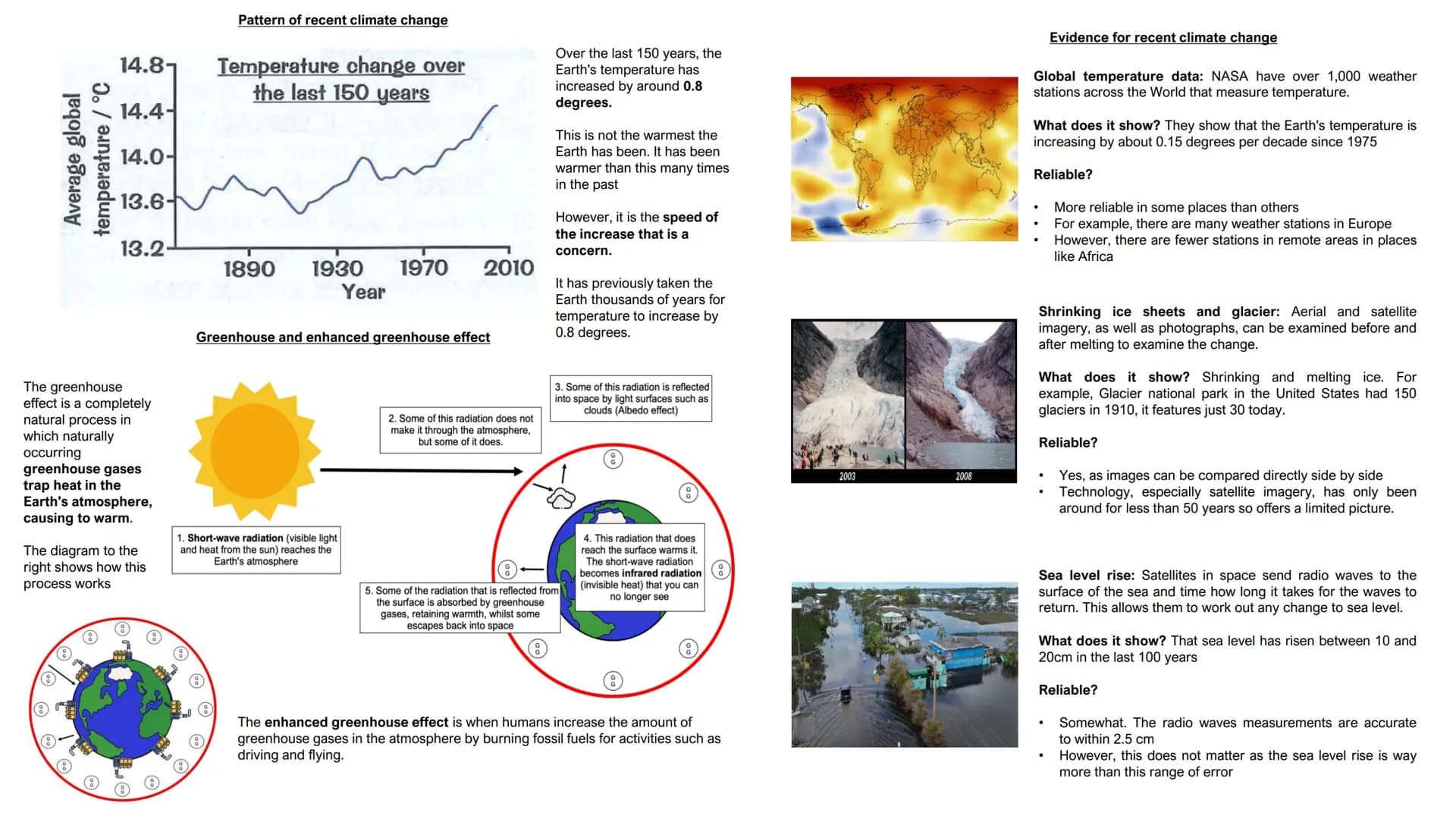
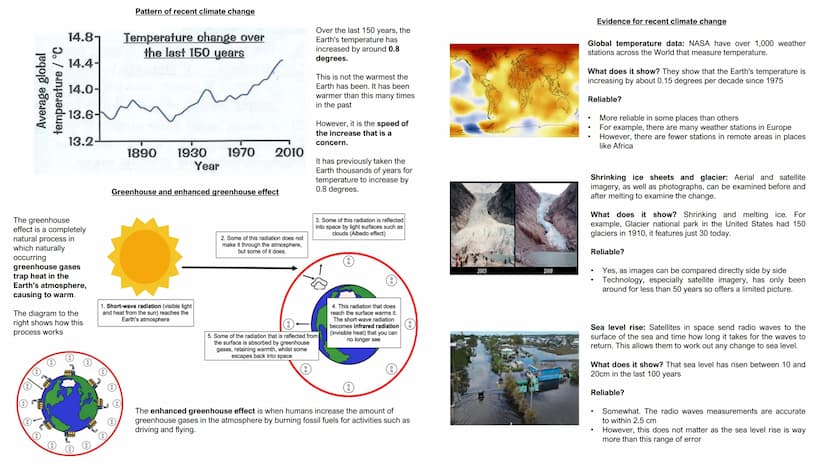
Earth's temperature has risen 0.8°C in just 150 years - that's incredibly fast by natural standards. The concerning part isn't the temperature itself (Earth has been warmer before), but the speed of change.
The greenhouse effect is completely natural and essential for life. Solar radiation reaches Earth, some reflects back to space, but greenhouse gases trap some heat in the atmosphere, keeping our planet warm enough for life to exist.
The enhanced greenhouse effect occurs when humans burn fossil fuels, adding extra greenhouse gases that trap more heat than natural levels. This is like adding extra blankets - the basic process is the same, but the effect becomes stronger.
Evidence for recent climate change comes from multiple sources. NASA's 1,000+ weather stations worldwide show temperatures rising 0.15°C per decade since 1975. Satellite images reveal dramatic glacier retreat - Glacier National Park had 150 glaciers in 1910 but only 30 today. Sea levels have risen 10-20cm in the past century as measured by satellite radio waves.
Each type of evidence has limitations - weather stations are unevenly distributed globally, satellite technology only covers recent decades, and measurements have margins of error. However, when multiple sources show the same trends, the evidence becomes compelling.
Remember: The greenhouse effect itself isn't bad - without it, Earth would be too cold for life. The problem is enhancement beyond natural levels.
Real places are already experiencing climate change effects, and the impacts vary dramatically depending on location and wealth.
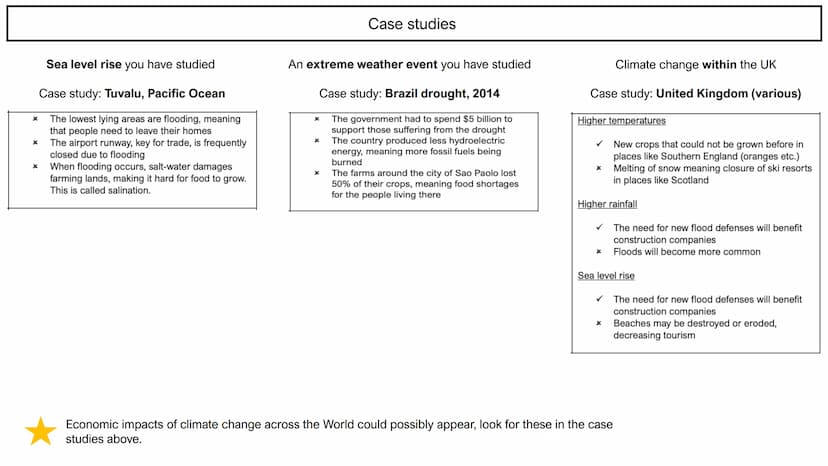
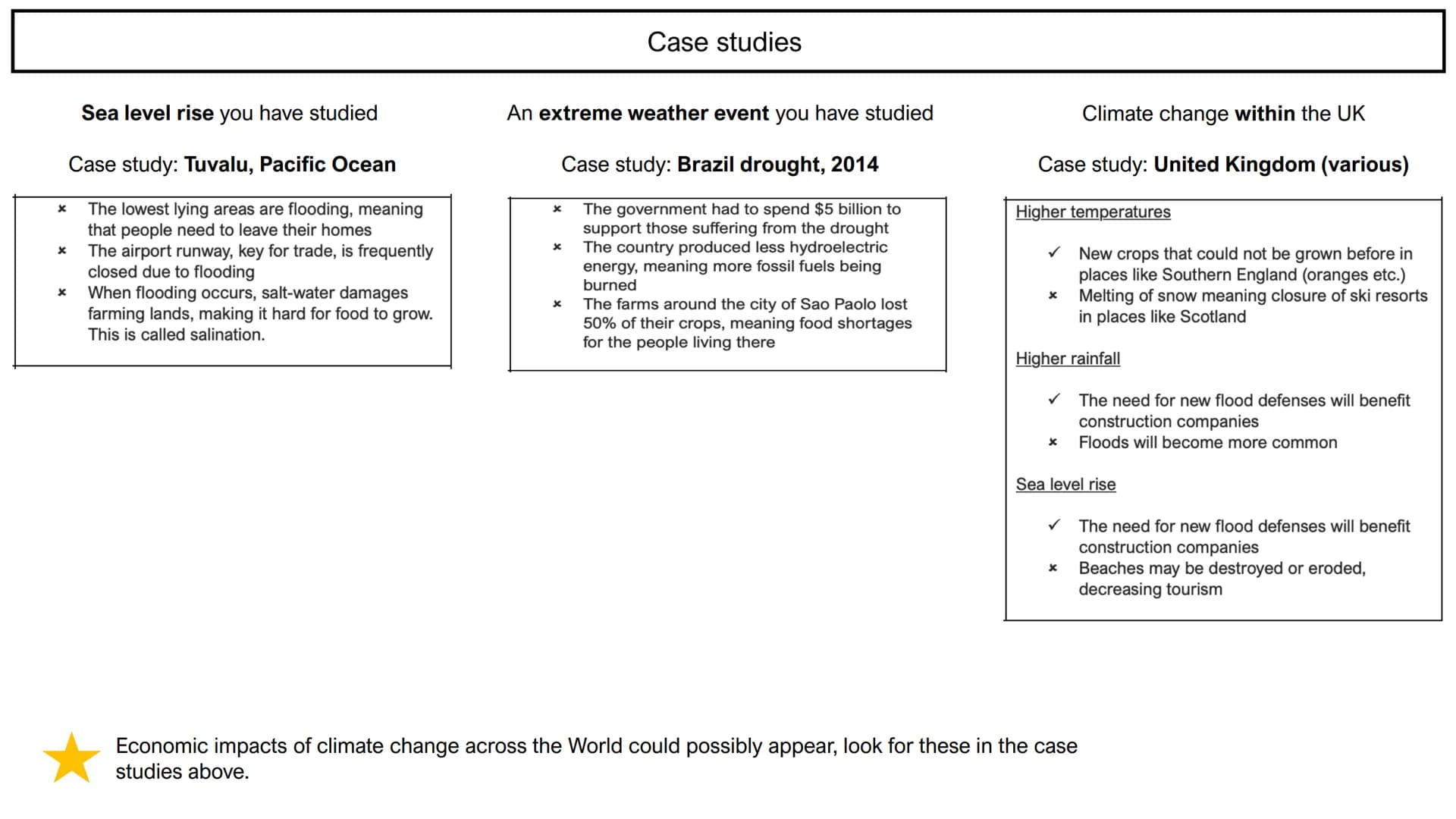
Tuvalu, Pacific Ocean is one of the world's most vulnerable nations to sea level rise. This low-lying island nation faces flooding in its lowest areas, forcing people from their homes. The airport runway - crucial for trade and supplies - frequently closes due to flooding. Salination occurs when salt water damages farming land, making it impossible to grow food locally.
Brazil's 2014 drought shows how extreme weather affects even large, wealthy countries. The government spent $5 billion supporting drought victims. Reduced hydroelectric power meant burning more fossil fuels for energy. Farms around São Paulo lost 50% of their crops, creating food shortages for millions of urban residents.
The United Kingdom faces mixed climate change impacts. Higher temperatures allow new crops like oranges in Southern England but threaten Scottish ski resorts. Increased rainfall benefits construction companies building flood defenses but makes flooding more common. Sea level rise again helps construction firms but damages beaches, reducing tourism revenue.
These case studies demonstrate how the same climate changes create both opportunities and challenges, with impacts varying by economic sector and geographic location.
Key Insight: Climate change isn't just about temperature - it affects rainfall patterns, sea levels, and extreme weather frequency.
Ecosystems are like intricate webs where every component - from tiny soil bacteria to massive trees - depends on everything else for survival.
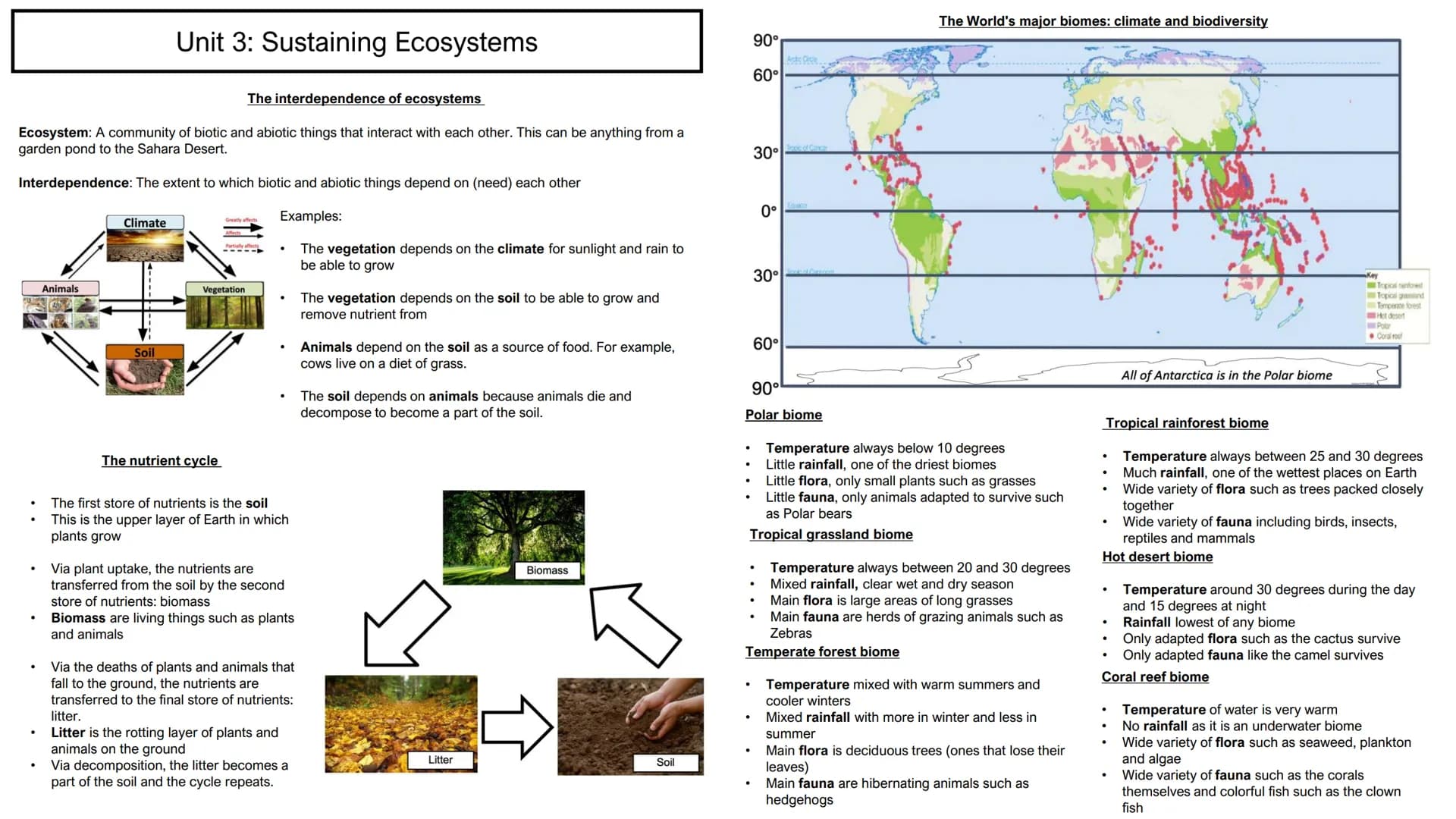
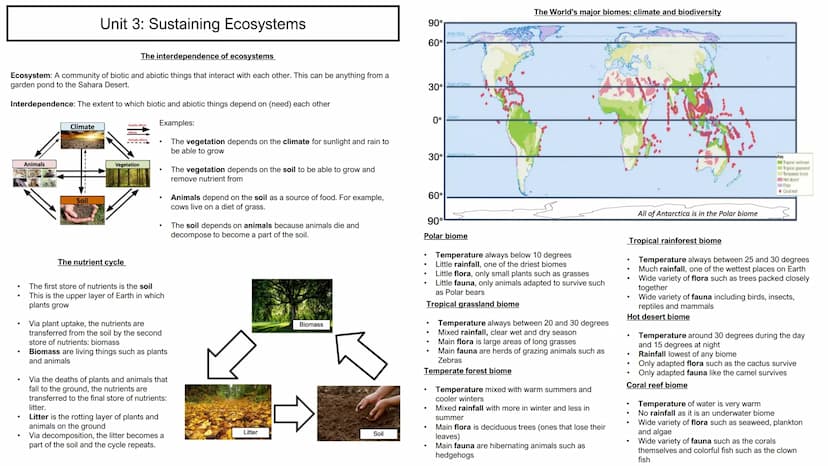
An ecosystem is any community where living things (biotic) and non-living things (abiotic) interact with each other. This could be anything from a small garden pond to the vast Sahara Desert. The key concept is interdependence - how everything needs everything else to survive.
Think of it like a massive web of connections. Vegetation needs climate for sunlight and rainfall to grow. Plants need soil for nutrients and support. Animals depend on vegetation for food. When animals die, they decompose and enrich the soil with nutrients, completing the cycle.
The nutrient cycle shows how essential chemicals move between three stores: soil (where plants get nutrients), biomass (living plants and animals), and litter (dead, rotting material). Nutrients transfer from soil to plants via uptake, from plants to litter when they die, and from litter back to soil through decomposition.
Earth's major biomes exist where they do because of climate patterns. Tropical rainforests thrive near the equator with high temperatures and heavy rainfall. Hot deserts form where hot, dry air sinks. Polar regions remain frozen with temperatures below 10°C. Coral reefs need warm ocean water to survive.
Each biome supports different flora (plants) and fauna (animals) adapted to local conditions. Tropical rainforests have incredible biodiversity with thousands of species, whilst polar regions support only specially adapted organisms like polar bears.
Essential Concept: Remove any component from an ecosystem and the whole system can collapse - everything truly depends on everything else.
Our AI Companion is a student-focused AI tool that offers more than just answers. Built on millions of Knowunity resources, it provides relevant information, personalised study plans, quizzes, and content directly in the chat, adapting to your individual learning journey.
You can download the app from Google Play Store and Apple App Store.
That's right! Enjoy free access to study content, connect with fellow students, and get instant help – all at your fingertips.
App Store
Google Play
The app is very easy to use and well designed. I have found everything I was looking for so far and have been able to learn a lot from the presentations! I will definitely use the app for a class assignment! And of course it also helps a lot as an inspiration.
Stefan S
iOS user
This app is really great. There are so many study notes and help [...]. My problem subject is French, for example, and the app has so many options for help. Thanks to this app, I have improved my French. I would recommend it to anyone.
Samantha Klich
Android user
Wow, I am really amazed. I just tried the app because I've seen it advertised many times and was absolutely stunned. This app is THE HELP you want for school and above all, it offers so many things, such as workouts and fact sheets, which have been VERY helpful to me personally.
Anna
iOS user
Best app on earth! no words because it’s too good
Thomas R
iOS user
Just amazing. Let's me revise 10x better, this app is a quick 10/10. I highly recommend it to anyone. I can watch and search for notes. I can save them in the subject folder. I can revise it any time when I come back. If you haven't tried this app, you're really missing out.
Basil
Android user
This app has made me feel so much more confident in my exam prep, not only through boosting my own self confidence through the features that allow you to connect with others and feel less alone, but also through the way the app itself is centred around making you feel better. It is easy to navigate, fun to use, and helpful to anyone struggling in absolutely any way.
David K
iOS user
The app's just great! All I have to do is enter the topic in the search bar and I get the response real fast. I don't have to watch 10 YouTube videos to understand something, so I'm saving my time. Highly recommended!
Sudenaz Ocak
Android user
In school I was really bad at maths but thanks to the app, I am doing better now. I am so grateful that you made the app.
Greenlight Bonnie
Android user
very reliable app to help and grow your ideas of Maths, English and other related topics in your works. please use this app if your struggling in areas, this app is key for that. wish I'd of done a review before. and it's also free so don't worry about that.
Rohan U
Android user
I know a lot of apps use fake accounts to boost their reviews but this app deserves it all. Originally I was getting 4 in my English exams and this time I got a grade 7. I didn’t even know about this app three days until the exam and it has helped A LOT. Please actually trust me and use it as I’m sure you too will see developments.
Xander S
iOS user
THE QUIZES AND FLASHCARDS ARE SO USEFUL AND I LOVE THE SCHOOLGPT. IT ALSO IS LITREALLY LIKE CHATGPT BUT SMARTER!! HELPED ME WITH MY MASCARA PROBLEMS TOO!! AS WELL AS MY REAL SUBJECTS ! DUHHH 😍😁😲🤑💗✨🎀😮
Elisha
iOS user
This apps acc the goat. I find revision so boring but this app makes it so easy to organize it all and then you can ask the freeeee ai to test yourself so good and you can easily upload your own stuff. highly recommend as someone taking mocks now
Paul T
iOS user
The app is very easy to use and well designed. I have found everything I was looking for so far and have been able to learn a lot from the presentations! I will definitely use the app for a class assignment! And of course it also helps a lot as an inspiration.
Stefan S
iOS user
This app is really great. There are so many study notes and help [...]. My problem subject is French, for example, and the app has so many options for help. Thanks to this app, I have improved my French. I would recommend it to anyone.
Samantha Klich
Android user
Wow, I am really amazed. I just tried the app because I've seen it advertised many times and was absolutely stunned. This app is THE HELP you want for school and above all, it offers so many things, such as workouts and fact sheets, which have been VERY helpful to me personally.
Anna
iOS user
Best app on earth! no words because it’s too good
Thomas R
iOS user
Just amazing. Let's me revise 10x better, this app is a quick 10/10. I highly recommend it to anyone. I can watch and search for notes. I can save them in the subject folder. I can revise it any time when I come back. If you haven't tried this app, you're really missing out.
Basil
Android user
This app has made me feel so much more confident in my exam prep, not only through boosting my own self confidence through the features that allow you to connect with others and feel less alone, but also through the way the app itself is centred around making you feel better. It is easy to navigate, fun to use, and helpful to anyone struggling in absolutely any way.
David K
iOS user
The app's just great! All I have to do is enter the topic in the search bar and I get the response real fast. I don't have to watch 10 YouTube videos to understand something, so I'm saving my time. Highly recommended!
Sudenaz Ocak
Android user
In school I was really bad at maths but thanks to the app, I am doing better now. I am so grateful that you made the app.
Greenlight Bonnie
Android user
very reliable app to help and grow your ideas of Maths, English and other related topics in your works. please use this app if your struggling in areas, this app is key for that. wish I'd of done a review before. and it's also free so don't worry about that.
Rohan U
Android user
I know a lot of apps use fake accounts to boost their reviews but this app deserves it all. Originally I was getting 4 in my English exams and this time I got a grade 7. I didn’t even know about this app three days until the exam and it has helped A LOT. Please actually trust me and use it as I’m sure you too will see developments.
Xander S
iOS user
THE QUIZES AND FLASHCARDS ARE SO USEFUL AND I LOVE THE SCHOOLGPT. IT ALSO IS LITREALLY LIKE CHATGPT BUT SMARTER!! HELPED ME WITH MY MASCARA PROBLEMS TOO!! AS WELL AS MY REAL SUBJECTS ! DUHHH 😍😁😲🤑💗✨🎀😮
Elisha
iOS user
This apps acc the goat. I find revision so boring but this app makes it so easy to organize it all and then you can ask the freeeee ai to test yourself so good and you can easily upload your own stuff. highly recommend as someone taking mocks now
Paul T
iOS user
(:🌸Sakura_Girl🌸:)
@apatil9444
Geography Paper 1 covers six essential topics that explain how our planet works, from devastating earthquakes to changing climates and thriving ecosystems. You'll explore the powerful forces that shape Earth's surface, investigate how human activities are altering our climate, and... Show more
Access to all documents
Improve your grades
Join milions of students
By signing up you accept Terms of Service and Privacy Policy
This revision guide covers everything you need to know for your geography exam. You'll study five core units that connect physical processes with real-world impacts.
The topics range from dramatic natural hazards like volcanoes and hurricanes to long-term changes in climate patterns. You'll also explore how ecosystems work together and examine distinctive landscapes that make our planet unique.
Each unit includes detailed case studies that bring theory to life. These examples help you understand how geographical processes affect real people and places around the world.
Quick Tip: Focus on understanding the connections between different processes rather than memorising isolated facts.
Access to all documents
Improve your grades
Join milions of students
By signing up you accept Terms of Service and Privacy Policy
Ever wondered why earthquakes happen or how hurricanes form? It all starts with understanding Earth's structure and the massive forces that drive our planet's most dramatic events.
Earth has four main layers, but the key players are the crust and upper mantle, which together form the lithosphere. This rocky shell is cracked into huge pieces called tectonic plates that slowly move due to convection currents in the hot mantle below.
When plates meet at boundaries, different things happen. Constructive boundaries pull apart, destructive boundaries involve one plate diving under another, collision boundaries push upwards to form mountains, and conservative boundaries slide past each other. These movements cause earthquakes and create volcanoes.
Global atmospheric circulation creates three massive air cells (Hadley, Ferrel, and Polar) that transport air around Earth. Where warm air rises, you get low pressure and wet weather. Where cold air sinks, you get high pressure and dry conditions. This explains why some places are naturally wet whilst others are deserts.
Remember: Earthquakes happen when plates get stuck due to friction, then suddenly break free, sending shock waves through the ground.
Access to all documents
Improve your grades
Join milions of students
By signing up you accept Terms of Service and Privacy Policy
Different types of volcanoes form in different places, and each has its own personality. Composite volcanoes occur at destructive boundaries where thick, sticky magma creates tall, steep-sided mountains that explode violently. Shield volcanoes form at constructive boundaries where runny magma spreads out to create wide, gentle slopes.
Hurricanes are nature's most powerful storms, but they're quite picky about where they form. They need ocean temperatures of at least 27°C, which is why they only develop in tropical zones between the Tropics of Cancer and Capricorn. Warm water evaporates, rises, and spins due to Earth's rotation, creating these devastating rotating storms.
Earth's most extreme places exist because of simple geography. The equator receives direct sunlight, making it hot, whilst the poles receive angled, weaker sunlight, keeping them cold. Relief rainfall explains why some coastal areas are incredibly wet - mountains force air upwards where it cools and drops its moisture, leaving dry "rain shadow" areas on the other side.
Wealthy countries can afford better mitigation strategies like earthquake-resistant buildings, early warning systems, and thermal scanning for volcanoes. Unfortunately, poorer countries often lack these life-saving technologies.
Key Fact: Hotspots create volcanoes away from plate boundaries - these occur where magma is unusually hot compared to surrounding areas.
Access to all documents
Improve your grades
Join milions of students
By signing up you accept Terms of Service and Privacy Policy
Learning about actual events helps you understand how geographical theories work in practice. These case studies show how the same processes can have vastly different impacts depending on location and wealth.
E16 Volcano, Iceland (2010) demonstrates how even a relatively small eruption can have global consequences. When the North American and Eurasian plates pulled apart, magma mixed with ice, creating massive ash clouds that grounded flights across Europe, costing airlines £2 billion.
Australia's Big Dry Drought shows how climate patterns like El Niño can devastate entire continents. Combined with high water demand from farming and urban use, this drought caused 10,000 job losses in agriculture and forced greater reliance on expensive fossil fuel energy.
Boscastle Flood, Cornwall proves that even wealthy countries aren't immune to natural disasters. The village's location at the bottom of a valley where two rivers meet made it particularly vulnerable when heavy rainfall saturated the ground.
Each case study reveals how location, wealth, and preparation determine whether natural events become minor inconveniences or major disasters.
Exam Tip: For each case study, learn the causes, consequences, and responses - both positive and negative effects of the responses.
Access to all documents
Improve your grades
Join milions of students
By signing up you accept Terms of Service and Privacy Policy
Climate has always changed naturally, but recent changes are happening at an unprecedented speed that's got scientists worried worldwide.
Access to all documents
Improve your grades
Join milions of students
By signing up you accept Terms of Service and Privacy Policy
During the Quaternary period, Earth has experienced regular cycles of glacial periods (ice ages lasting 100,000 years) and warmer interglacial periods (lasting 10,000 years). We're currently in an interglacial period, which explains why the climate is relatively warm.
Milankovitch Cycles are three ways Earth's movement affects climate over thousands of years. Eccentricity changes our orbit from circular to oval every 100,000 years. Obliquity alters Earth's tilt every 41,000 years. Precession makes Earth "wobble" every 26,000 years. Together, these cycles explain long-term climate patterns.
Sunspots are dark patches on the Sun's surface that follow an 11-year cycle. When more sunspots occur, solar flares increase Earth's temperature. Fewer sunspots mean cooler periods. Volcanic eruptions have the opposite effect - they blast sulphur dioxide into the atmosphere, which mixes with water to create acid droplets that block sunlight for 3-4 years.
We know about past climates through evidence like fossil remains, ice cores containing ancient air bubbles, and sediment cores from ocean floors. Ice cores are particularly reliable, though they only go back 800,000 years.
Key Point: Natural climate change typically takes thousands of years - recent rapid changes suggest human involvement.
Access to all documents
Improve your grades
Join milions of students
By signing up you accept Terms of Service and Privacy Policy
Earth's temperature has risen 0.8°C in just 150 years - that's incredibly fast by natural standards. The concerning part isn't the temperature itself (Earth has been warmer before), but the speed of change.
The greenhouse effect is completely natural and essential for life. Solar radiation reaches Earth, some reflects back to space, but greenhouse gases trap some heat in the atmosphere, keeping our planet warm enough for life to exist.
The enhanced greenhouse effect occurs when humans burn fossil fuels, adding extra greenhouse gases that trap more heat than natural levels. This is like adding extra blankets - the basic process is the same, but the effect becomes stronger.
Evidence for recent climate change comes from multiple sources. NASA's 1,000+ weather stations worldwide show temperatures rising 0.15°C per decade since 1975. Satellite images reveal dramatic glacier retreat - Glacier National Park had 150 glaciers in 1910 but only 30 today. Sea levels have risen 10-20cm in the past century as measured by satellite radio waves.
Each type of evidence has limitations - weather stations are unevenly distributed globally, satellite technology only covers recent decades, and measurements have margins of error. However, when multiple sources show the same trends, the evidence becomes compelling.
Remember: The greenhouse effect itself isn't bad - without it, Earth would be too cold for life. The problem is enhancement beyond natural levels.
Access to all documents
Improve your grades
Join milions of students
By signing up you accept Terms of Service and Privacy Policy
Real places are already experiencing climate change effects, and the impacts vary dramatically depending on location and wealth.
Tuvalu, Pacific Ocean is one of the world's most vulnerable nations to sea level rise. This low-lying island nation faces flooding in its lowest areas, forcing people from their homes. The airport runway - crucial for trade and supplies - frequently closes due to flooding. Salination occurs when salt water damages farming land, making it impossible to grow food locally.
Brazil's 2014 drought shows how extreme weather affects even large, wealthy countries. The government spent $5 billion supporting drought victims. Reduced hydroelectric power meant burning more fossil fuels for energy. Farms around São Paulo lost 50% of their crops, creating food shortages for millions of urban residents.
The United Kingdom faces mixed climate change impacts. Higher temperatures allow new crops like oranges in Southern England but threaten Scottish ski resorts. Increased rainfall benefits construction companies building flood defenses but makes flooding more common. Sea level rise again helps construction firms but damages beaches, reducing tourism revenue.
These case studies demonstrate how the same climate changes create both opportunities and challenges, with impacts varying by economic sector and geographic location.
Key Insight: Climate change isn't just about temperature - it affects rainfall patterns, sea levels, and extreme weather frequency.
Access to all documents
Improve your grades
Join milions of students
By signing up you accept Terms of Service and Privacy Policy
Ecosystems are like intricate webs where every component - from tiny soil bacteria to massive trees - depends on everything else for survival.
Access to all documents
Improve your grades
Join milions of students
By signing up you accept Terms of Service and Privacy Policy
An ecosystem is any community where living things (biotic) and non-living things (abiotic) interact with each other. This could be anything from a small garden pond to the vast Sahara Desert. The key concept is interdependence - how everything needs everything else to survive.
Think of it like a massive web of connections. Vegetation needs climate for sunlight and rainfall to grow. Plants need soil for nutrients and support. Animals depend on vegetation for food. When animals die, they decompose and enrich the soil with nutrients, completing the cycle.
The nutrient cycle shows how essential chemicals move between three stores: soil (where plants get nutrients), biomass (living plants and animals), and litter (dead, rotting material). Nutrients transfer from soil to plants via uptake, from plants to litter when they die, and from litter back to soil through decomposition.
Earth's major biomes exist where they do because of climate patterns. Tropical rainforests thrive near the equator with high temperatures and heavy rainfall. Hot deserts form where hot, dry air sinks. Polar regions remain frozen with temperatures below 10°C. Coral reefs need warm ocean water to survive.
Each biome supports different flora (plants) and fauna (animals) adapted to local conditions. Tropical rainforests have incredible biodiversity with thousands of species, whilst polar regions support only specially adapted organisms like polar bears.
Essential Concept: Remove any component from an ecosystem and the whole system can collapse - everything truly depends on everything else.
Our AI Companion is a student-focused AI tool that offers more than just answers. Built on millions of Knowunity resources, it provides relevant information, personalised study plans, quizzes, and content directly in the chat, adapting to your individual learning journey.
You can download the app from Google Play Store and Apple App Store.
That's right! Enjoy free access to study content, connect with fellow students, and get instant help – all at your fingertips.
46
Smart Tools NEW
Transform this note into: ✓ 50+ Practice Questions ✓ Interactive Flashcards ✓ Full Mock Exam ✓ Essay Outlines
Explore the devastating impacts of the 2010 Haiti earthquake, including key statistics, short-term and long-term responses, and geographical context. This case study provides essential insights for GCSE Geography students, covering the earthquake's magnitude, effects on the population, and recovery efforts.
 Geography
Explore the devastating impact of Typhoon Haiyan, a Category 5 storm that struck in November 2013. This summary covers primary and secondary effects, immediate and long-term responses, and strategies for predicting and mitigating tropical storms. Ideal for students studying natural hazards and weather phenomena.
GeographyExplore the impacts and responses to Hurricane Katrina (2005) and Typhoon Haiyan (2013) in this detailed case study. Understand the differences in forecasting, evacuation strategies, and disaster preparedness between a developed and an emerging country. Ideal for Edexcel B GCSE Geography students.
GeographyApp Store
Google Play
The app is very easy to use and well designed. I have found everything I was looking for so far and have been able to learn a lot from the presentations! I will definitely use the app for a class assignment! And of course it also helps a lot as an inspiration.
Stefan S
iOS user
This app is really great. There are so many study notes and help [...]. My problem subject is French, for example, and the app has so many options for help. Thanks to this app, I have improved my French. I would recommend it to anyone.
Samantha Klich
Android user
Wow, I am really amazed. I just tried the app because I've seen it advertised many times and was absolutely stunned. This app is THE HELP you want for school and above all, it offers so many things, such as workouts and fact sheets, which have been VERY helpful to me personally.
Anna
iOS user
Best app on earth! no words because it’s too good
Thomas R
iOS user
Just amazing. Let's me revise 10x better, this app is a quick 10/10. I highly recommend it to anyone. I can watch and search for notes. I can save them in the subject folder. I can revise it any time when I come back. If you haven't tried this app, you're really missing out.
Basil
Android user
This app has made me feel so much more confident in my exam prep, not only through boosting my own self confidence through the features that allow you to connect with others and feel less alone, but also through the way the app itself is centred around making you feel better. It is easy to navigate, fun to use, and helpful to anyone struggling in absolutely any way.
David K
iOS user
The app's just great! All I have to do is enter the topic in the search bar and I get the response real fast. I don't have to watch 10 YouTube videos to understand something, so I'm saving my time. Highly recommended!
Sudenaz Ocak
Android user
In school I was really bad at maths but thanks to the app, I am doing better now. I am so grateful that you made the app.
Greenlight Bonnie
Android user
very reliable app to help and grow your ideas of Maths, English and other related topics in your works. please use this app if your struggling in areas, this app is key for that. wish I'd of done a review before. and it's also free so don't worry about that.
Rohan U
Android user
I know a lot of apps use fake accounts to boost their reviews but this app deserves it all. Originally I was getting 4 in my English exams and this time I got a grade 7. I didn’t even know about this app three days until the exam and it has helped A LOT. Please actually trust me and use it as I’m sure you too will see developments.
Xander S
iOS user
THE QUIZES AND FLASHCARDS ARE SO USEFUL AND I LOVE THE SCHOOLGPT. IT ALSO IS LITREALLY LIKE CHATGPT BUT SMARTER!! HELPED ME WITH MY MASCARA PROBLEMS TOO!! AS WELL AS MY REAL SUBJECTS ! DUHHH 😍😁😲🤑💗✨🎀😮
Elisha
iOS user
This apps acc the goat. I find revision so boring but this app makes it so easy to organize it all and then you can ask the freeeee ai to test yourself so good and you can easily upload your own stuff. highly recommend as someone taking mocks now
Paul T
iOS user
The app is very easy to use and well designed. I have found everything I was looking for so far and have been able to learn a lot from the presentations! I will definitely use the app for a class assignment! And of course it also helps a lot as an inspiration.
Stefan S
iOS user
This app is really great. There are so many study notes and help [...]. My problem subject is French, for example, and the app has so many options for help. Thanks to this app, I have improved my French. I would recommend it to anyone.
Samantha Klich
Android user
Wow, I am really amazed. I just tried the app because I've seen it advertised many times and was absolutely stunned. This app is THE HELP you want for school and above all, it offers so many things, such as workouts and fact sheets, which have been VERY helpful to me personally.
Anna
iOS user
Best app on earth! no words because it’s too good
Thomas R
iOS user
Just amazing. Let's me revise 10x better, this app is a quick 10/10. I highly recommend it to anyone. I can watch and search for notes. I can save them in the subject folder. I can revise it any time when I come back. If you haven't tried this app, you're really missing out.
Basil
Android user
This app has made me feel so much more confident in my exam prep, not only through boosting my own self confidence through the features that allow you to connect with others and feel less alone, but also through the way the app itself is centred around making you feel better. It is easy to navigate, fun to use, and helpful to anyone struggling in absolutely any way.
David K
iOS user
The app's just great! All I have to do is enter the topic in the search bar and I get the response real fast. I don't have to watch 10 YouTube videos to understand something, so I'm saving my time. Highly recommended!
Sudenaz Ocak
Android user
In school I was really bad at maths but thanks to the app, I am doing better now. I am so grateful that you made the app.
Greenlight Bonnie
Android user
very reliable app to help and grow your ideas of Maths, English and other related topics in your works. please use this app if your struggling in areas, this app is key for that. wish I'd of done a review before. and it's also free so don't worry about that.
Rohan U
Android user
I know a lot of apps use fake accounts to boost their reviews but this app deserves it all. Originally I was getting 4 in my English exams and this time I got a grade 7. I didn’t even know about this app three days until the exam and it has helped A LOT. Please actually trust me and use it as I’m sure you too will see developments.
Xander S
iOS user
THE QUIZES AND FLASHCARDS ARE SO USEFUL AND I LOVE THE SCHOOLGPT. IT ALSO IS LITREALLY LIKE CHATGPT BUT SMARTER!! HELPED ME WITH MY MASCARA PROBLEMS TOO!! AS WELL AS MY REAL SUBJECTS ! DUHHH 😍😁😲🤑💗✨🎀😮
Elisha
iOS user
This apps acc the goat. I find revision so boring but this app makes it so easy to organize it all and then you can ask the freeeee ai to test yourself so good and you can easily upload your own stuff. highly recommend as someone taking mocks now
Paul T
iOS user