
Coastal processes shape our shorelines through the constant battle between... Show more
 Geography435 views·Updated Jun 11, 2026·2 pages
GCSE Geography Coasts - AQA Study Guide
E
eleanor@eleanor_gcsecontent
1
of 2
Wave Action and Coastal Processes
Ever wondered why beaches look different after storms? Waves are the main drivers of coastal change, following the direction of prevailing winds. Longshore drift moves material along the coast in a zigzag pattern - waves push sediment up the beach at an angle, but gravity pulls it straight back down.
Destructive waves are the bullies of the coast. These high-frequency, powerful waves have stronger backwash than swash, so they steal more material than they bring. They erode coastlines through hydraulic action (compressing air in rock cracks), abrasion (scraping with particles), and attrition (particles smashing into each other).
Constructive waves are the builders - low-frequency waves with stronger swash that deposit material and build up beaches. The type of rock matters too: granite resists erosion whilst softer rocks with more cracks erode quickly.
Quick Tip: Remember that destructive waves destroy (obviously!) whilst constructive waves construct beaches.
Mass movement happens when rocks become waterlogged and heavy. Slides move in straight lines, slumps rotate along curved surfaces, and rockfalls see material tumbling down cliff faces. All of these cause coastlines to retreat inland over time.
2
of 2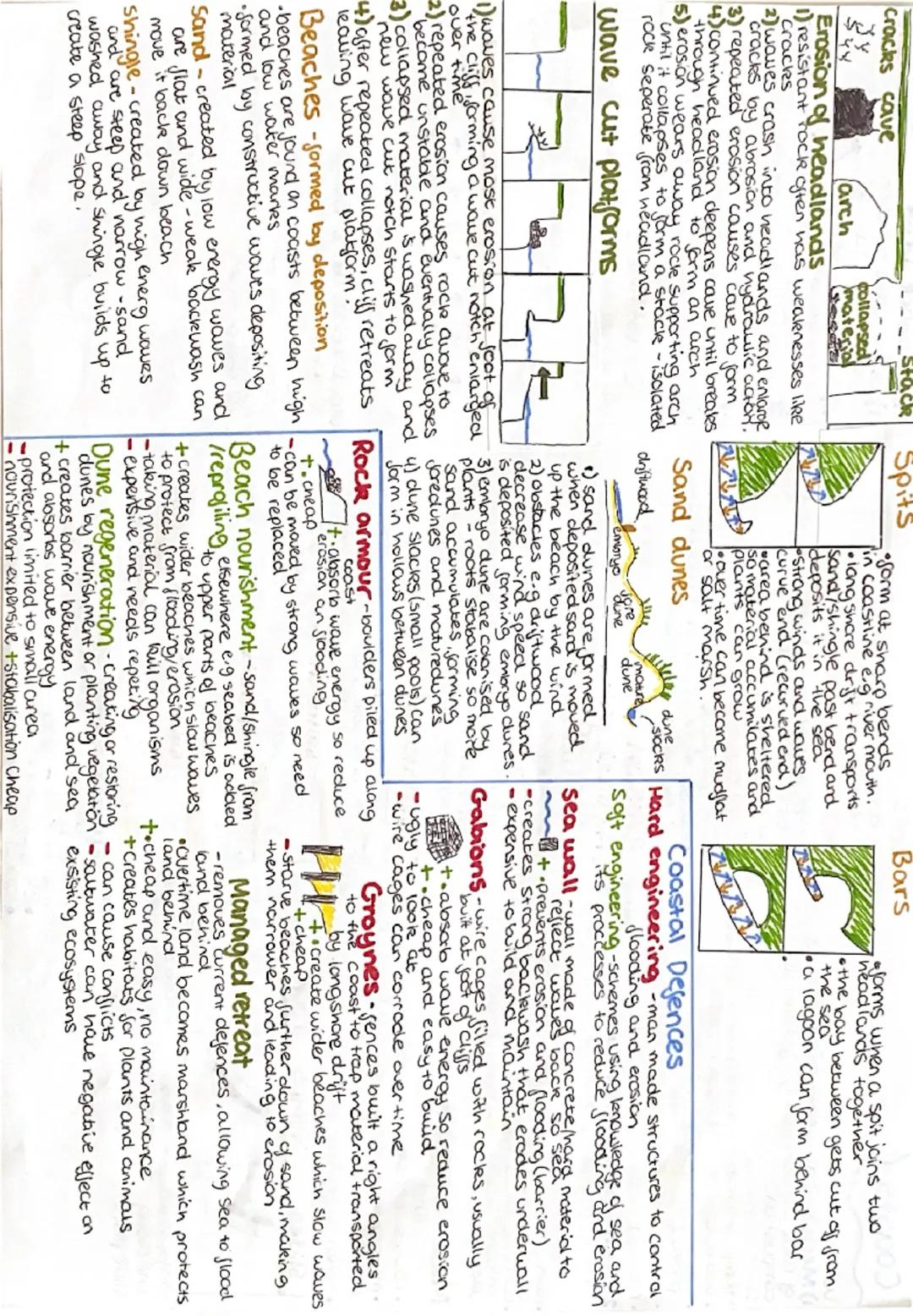
Coastal Landforms and Management
Coastlines create amazing natural sculptures through erosion and deposition. Discordant coastlines have alternating hard and soft rock bands running perpendicular to the shore, creating headlands and bays. The soft rock erodes faster into bays whilst resistant rock forms jutting headlands.
Headland erosion follows a predictable sequence: cracks become caves, caves become arches, arches collapse into isolated stacks. Meanwhile, wave-cut platforms form as cliffs retreat, leaving flat rocky shelves exposed at low tide.
Spits form where longshore drift deposits sediment past bends in the coastline. Strong winds curve their ends, and the sheltered areas behind often develop into salt marshes. When spits connect two headlands, they create bars with lagoons behind them.
Remember: Coastal defences aren't just about concrete walls - nature-based solutions often work better!
Coastal management uses hard engineering (sea walls, rock armour, groynes) and soft engineering (beach nourishment, dune regeneration, managed retreat). Hard defences are expensive and can create problems elsewhere, whilst soft approaches work with natural processes. Managed retreat might sound like giving up, but allowing some flooding creates valuable saltmarsh habitats that protect areas further inland.
We thought you’d never ask...
What is the Knowunity AI companion?
Our AI Companion is a student-focused AI tool that offers more than just answers. Built on millions of Knowunity resources, it provides relevant information, personalised study plans, quizzes, and content directly in the chat, adapting to your individual learning journey.
Where can I download the Knowunity app?
You can download the app from Google Play Store and Apple App Store.
Is Knowunity really free of charge?
That's right! Enjoy free access to study content, connect with fellow students, and get instant help – all at your fingertips.
Most popular content in Geography
9Most popular content
9Can't find what you're looking for? Explore other subjects.
Students love us — and so will you.
4.6/5App Store
4.7/5Google Play
The app is very easy to use and well designed. I have found everything I was looking for so far and have been able to learn a lot from the presentations! I will definitely use the app for a class assignment! And of course it also helps a lot as an inspiration.
Stefan SiOS user
This app is really great. There are so many study notes and help [...]. My problem subject is French, for example, and the app has so many options for help. Thanks to this app, I have improved my French. I would recommend it to anyone.
Samantha KlichAndroid user
Wow, I am really amazed. I just tried the app because I've seen it advertised many times and was absolutely stunned. This app is THE HELP you want for school and above all, it offers so many things, such as workouts and fact sheets, which have been VERY helpful to me personally.
AnnaiOS user
Geography435 views·Updated Jun 11, 2026·2 pagesGCSE Geography Coasts - AQA Study Guide
E
eleanor@eleanor_gcsecontent
Coastal processes shape our shorelines through the constant battle between waves, rocks, and time. Understanding how erosion and deposition work helps explain why some coasts have dramatic cliffs whilst others feature gentle sandy beaches.
1
of 2Sign up to see the content. It's free!
- Access to all documents
- Improve your grades
- Join milions of students
Wave Action and Coastal Processes
Ever wondered why beaches look different after storms? Waves are the main drivers of coastal change, following the direction of prevailing winds. Longshore drift moves material along the coast in a zigzag pattern - waves push sediment up the beach at an angle, but gravity pulls it straight back down.
Destructive waves are the bullies of the coast. These high-frequency, powerful waves have stronger backwash than swash, so they steal more material than they bring. They erode coastlines through hydraulic action (compressing air in rock cracks), abrasion (scraping with particles), and attrition (particles smashing into each other).
Constructive waves are the builders - low-frequency waves with stronger swash that deposit material and build up beaches. The type of rock matters too: granite resists erosion whilst softer rocks with more cracks erode quickly.
Quick Tip: Remember that destructive waves destroy (obviously!) whilst constructive waves construct beaches.
Mass movement happens when rocks become waterlogged and heavy. Slides move in straight lines, slumps rotate along curved surfaces, and rockfalls see material tumbling down cliff faces. All of these cause coastlines to retreat inland over time.
2
of 2Sign up to see the content. It's free!
- Access to all documents
- Improve your grades
- Join milions of students
Coastal Landforms and Management
Coastlines create amazing natural sculptures through erosion and deposition. Discordant coastlines have alternating hard and soft rock bands running perpendicular to the shore, creating headlands and bays. The soft rock erodes faster into bays whilst resistant rock forms jutting headlands.
Headland erosion follows a predictable sequence: cracks become caves, caves become arches, arches collapse into isolated stacks. Meanwhile, wave-cut platforms form as cliffs retreat, leaving flat rocky shelves exposed at low tide.
Spits form where longshore drift deposits sediment past bends in the coastline. Strong winds curve their ends, and the sheltered areas behind often develop into salt marshes. When spits connect two headlands, they create bars with lagoons behind them.
Remember: Coastal defences aren't just about concrete walls - nature-based solutions often work better!
Coastal management uses hard engineering (sea walls, rock armour, groynes) and soft engineering (beach nourishment, dune regeneration, managed retreat). Hard defences are expensive and can create problems elsewhere, whilst soft approaches work with natural processes. Managed retreat might sound like giving up, but allowing some flooding creates valuable saltmarsh habitats that protect areas further inland.
We thought you’d never ask...
What is the Knowunity AI companion?
Our AI Companion is a student-focused AI tool that offers more than just answers. Built on millions of Knowunity resources, it provides relevant information, personalised study plans, quizzes, and content directly in the chat, adapting to your individual learning journey.
Where can I download the Knowunity app?
You can download the app from Google Play Store and Apple App Store.
Is Knowunity really free of charge?
That's right! Enjoy free access to study content, connect with fellow students, and get instant help – all at your fingertips.
Most popular content in Geography
9Most popular content
9Can't find what you're looking for? Explore other subjects.
Students love us — and so will you.
4.6/5App Store
4.7/5Google Play
The app is very easy to use and well designed. I have found everything I was looking for so far and have been able to learn a lot from the presentations! I will definitely use the app for a class assignment! And of course it also helps a lot as an inspiration.
Stefan SiOS user
This app is really great. There are so many study notes and help [...]. My problem subject is French, for example, and the app has so many options for help. Thanks to this app, I have improved my French. I would recommend it to anyone.
Samantha KlichAndroid user
Wow, I am really amazed. I just tried the app because I've seen it advertised many times and was absolutely stunned. This app is THE HELP you want for school and above all, it offers so many things, such as workouts and fact sheets, which have been VERY helpful to me personally.
AnnaiOS user