
Ever wondered how Britain's stunning coastlines got their dramatic cliffs,... Show more
 Geography
 Sociology
 English Literature
 Biology
Sign up to see the contentIt's free!
Access to all documents
Improve your grades
Join milions of students
Knowunity AI
Subjects
Triangle Congruence and Similarity Theorems
Triangle Properties and Classification
Linear Equations and Graphs
Geometric Angle Relationships
Trigonometric Functions and Identities
Equation Solving Techniques
Circle Geometry Fundamentals
Division Operations and Methods
Basic Differentiation Rules
Exponent and Logarithm Properties
Show all topics
Human Organ Systems
Reproductive Cell Cycles
Biological Sciences Subdisciplines
Cellular Energy Metabolism
Autotrophic Energy Processes
Inheritance Patterns and Principles
Biomolecular Structure and Organization
Cell Cycle and Division Mechanics
Cellular Organization and Development
Biological Structural Organization
Show all topics
Chemical Sciences and Applications
Atomic Structure and Composition
Molecular Electron Structure Representation
Atomic Electron Behavior
Matter Properties and Water
Mole Concept and Calculations
Gas Laws and Behavior
Periodic Table Organization
Chemical Thermodynamics Fundamentals
Chemical Bond Types and Properties
Show all topics
European Renaissance and Enlightenment
European Cultural Movements 800-1920
American Revolution Era 1763-1797
American Civil War 1861-1865
Global Imperial Systems
Mongol and Chinese Dynasties
U.S. Presidents and World Leaders
Historical Sources and Documentation
World Wars Era and Impact
World Religious Systems
Show all topics
Classic and Contemporary Novels
Literary Character Analysis
Rhetorical Theory and Practice
Classic Literary Narratives
Reading Analysis and Interpretation
Narrative Structure and Techniques
English Language Components
Influential English-Language Authors
Basic Sentence Structure
Narrative Voice and Perspective
Show all topics
173
•
Updated Apr 17, 2026
•
Lucia
@lucia_m9628
Ever wondered how Britain's stunning coastlines got their dramatic cliffs,... Show more
This is your complete guide to understanding how coastal landscapes form and change along the UK's coastline. You'll discover the processes behind famous landmarks like Old Harry Rocks and learn why some coasts have sandy beaches whilst others have towering cliffs.
These detailed notes cover everything you need to know for your GCSE Geography exam. From wave formation to coastal erosion, you'll gain the knowledge to analyse real coastal locations and explain how they've developed over time.
💡 Quick Tip: Focus on understanding the processes first - once you get how waves and erosion work, the landforms will make perfect sense!
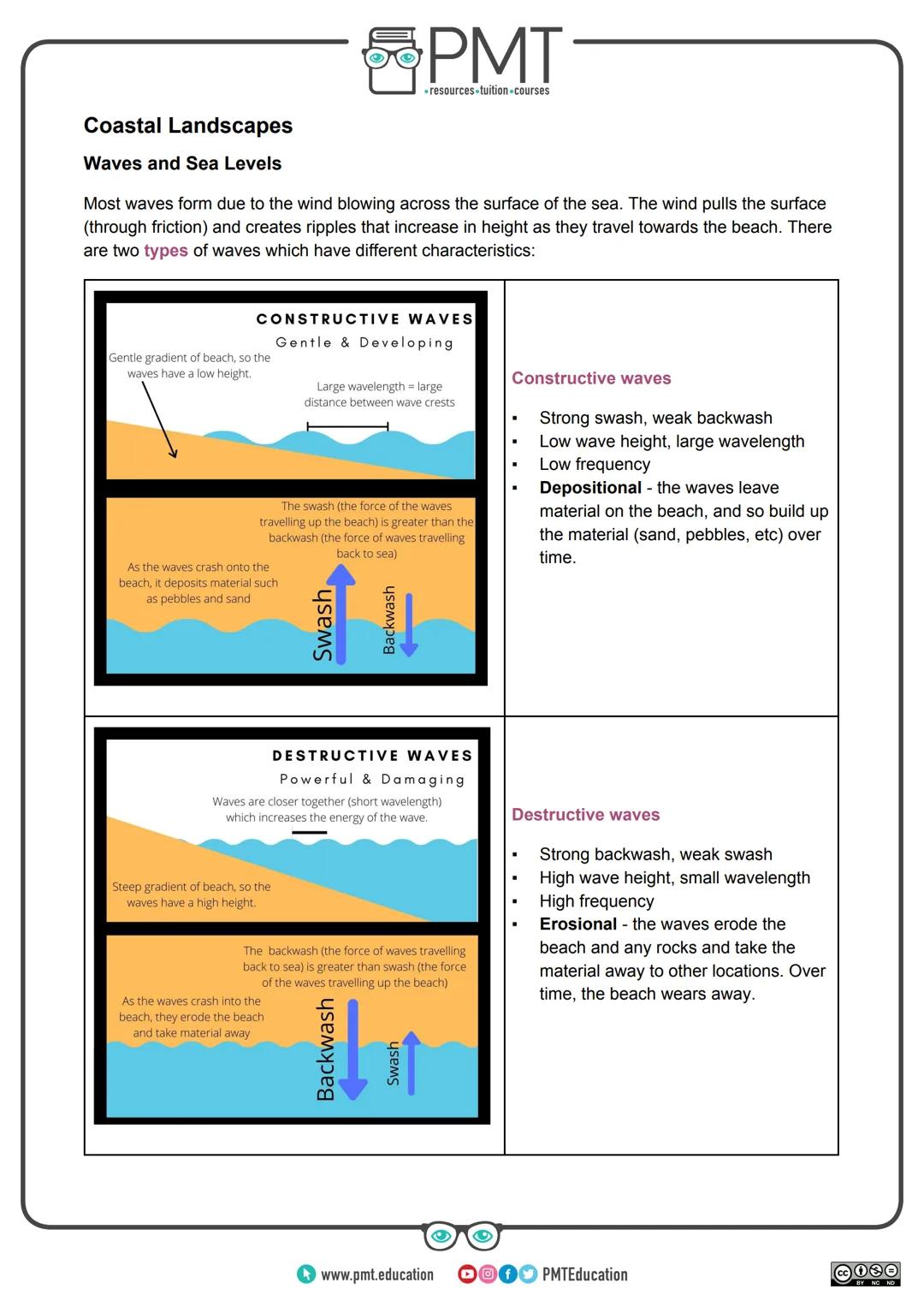
Understanding waves is crucial because they're the main force shaping our coastlines. Most waves form when wind blows across the sea surface, creating ripples that grow into proper waves as they travel towards shore.
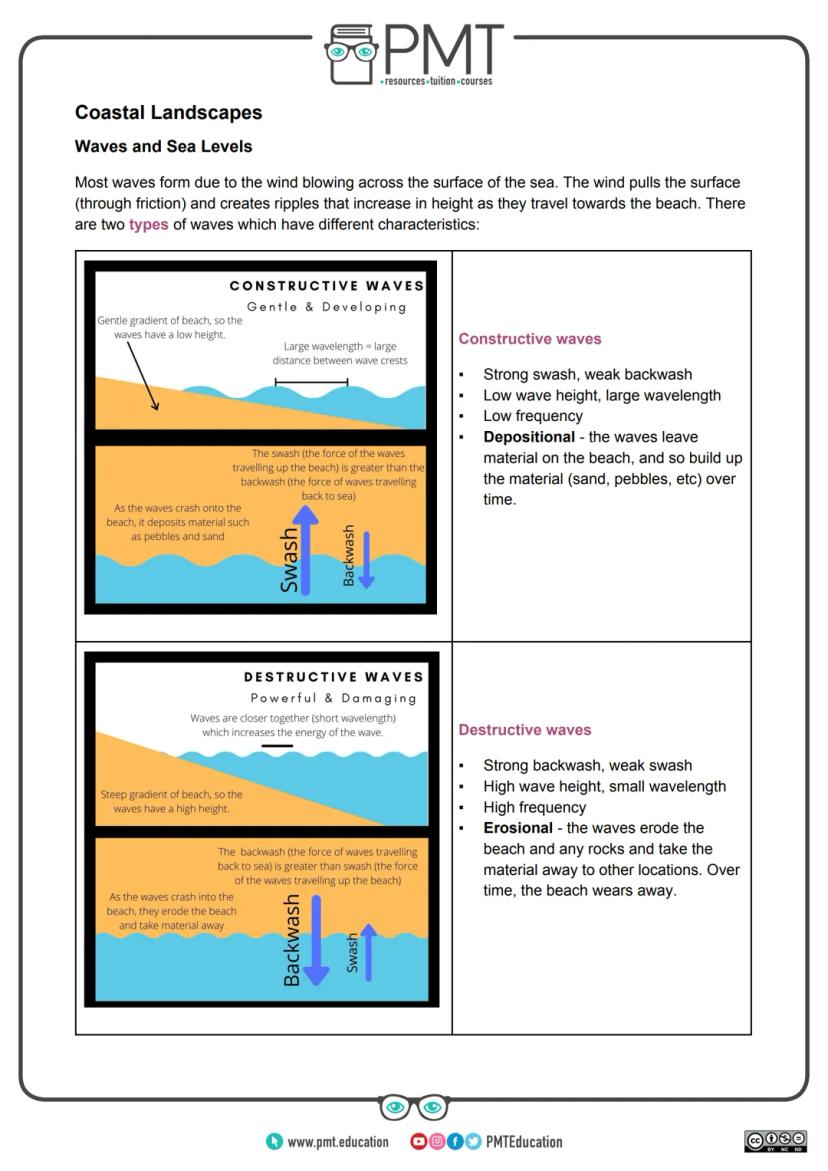
There are two completely different types of waves that create opposite effects. Constructive waves are gentle with low height and large wavelength - they have strong swash (water moving up the beach) but weak backwash (water returning to sea). These waves deposit material like sand and pebbles, building up beaches over time.
Destructive waves are the opposite - they're powerful with high height and short wavelength. Their strong backwash is much greater than their swash, so they erode beaches and cliffs by taking material away. These waves create steep, rocky coastlines.
💡 Remember: Constructive = builds up beaches, Destructive = destroys/erodes coastlines. The names tell you exactly what they do!
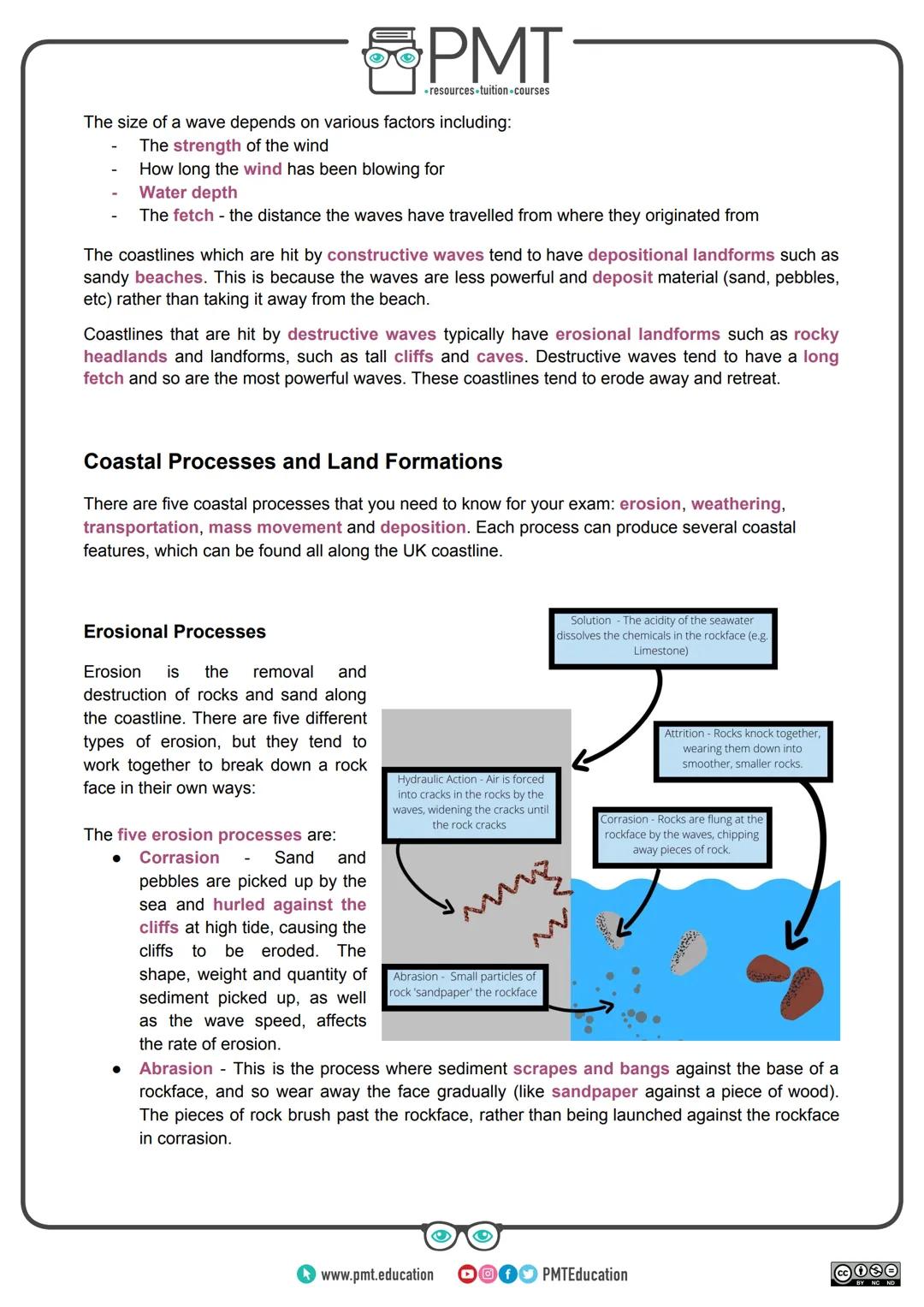
Several factors determine how powerful waves become: wind strength, how long the wind's been blowing, water depth, and crucially, the fetch (distance waves have travelled). Longer fetch means more powerful waves hitting the coast.
Constructive waves typically create depositional landforms like sandy beaches, whilst destructive waves with long fetch create erosional landforms such as rocky headlands and tall cliffs. This explains why different parts of the UK coast look so different.
There are five key coastal processes you must know: erosion, weathering, transportation, mass movement, and deposition. Erosion removes and destroys rocks through five different methods that often work together.
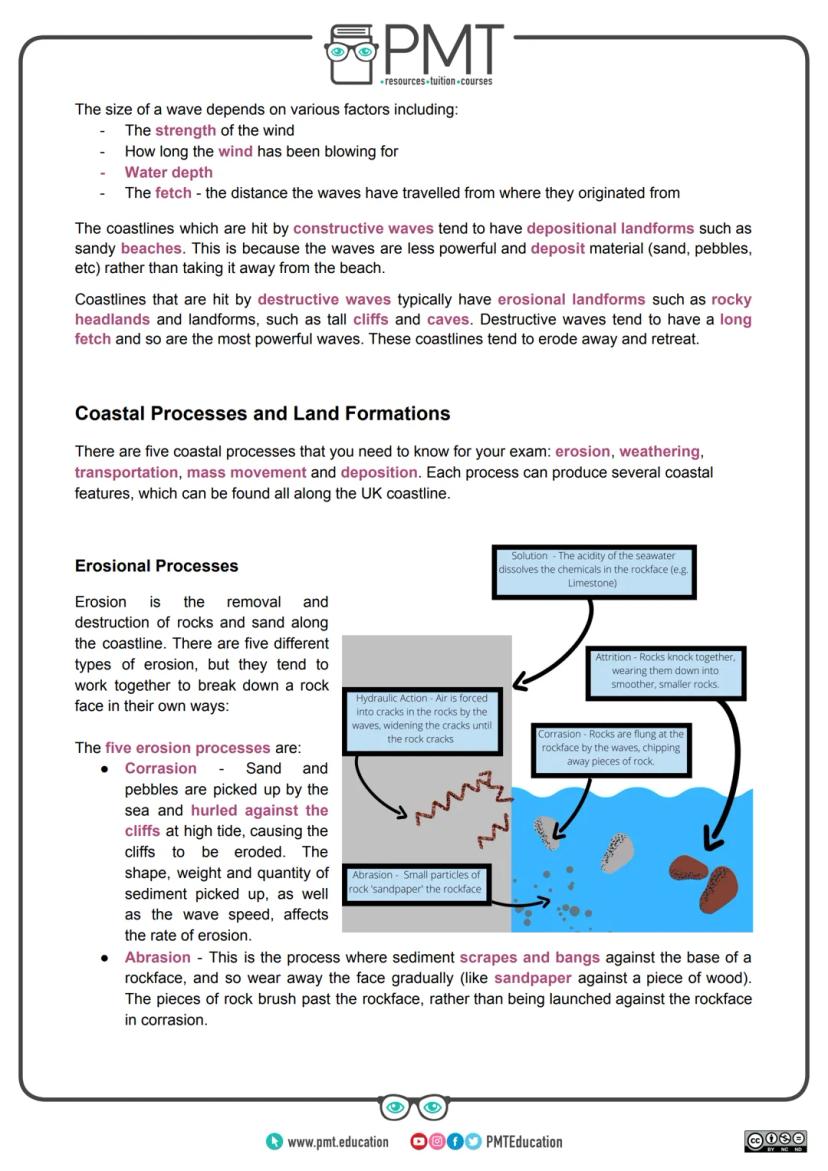
The main erosion types include corrasion (waves hurling rocks at cliffs), abrasion (sediment scraping against rock like sandpaper), hydraulic action (air forced into rock cracks), attrition (rocks knocking together), and solution (acidic seawater dissolving rock).
💡 Exam Tip: Learn the five erosion processes by heart - they appear in most coastal exam questions and are easy marks if you know them!
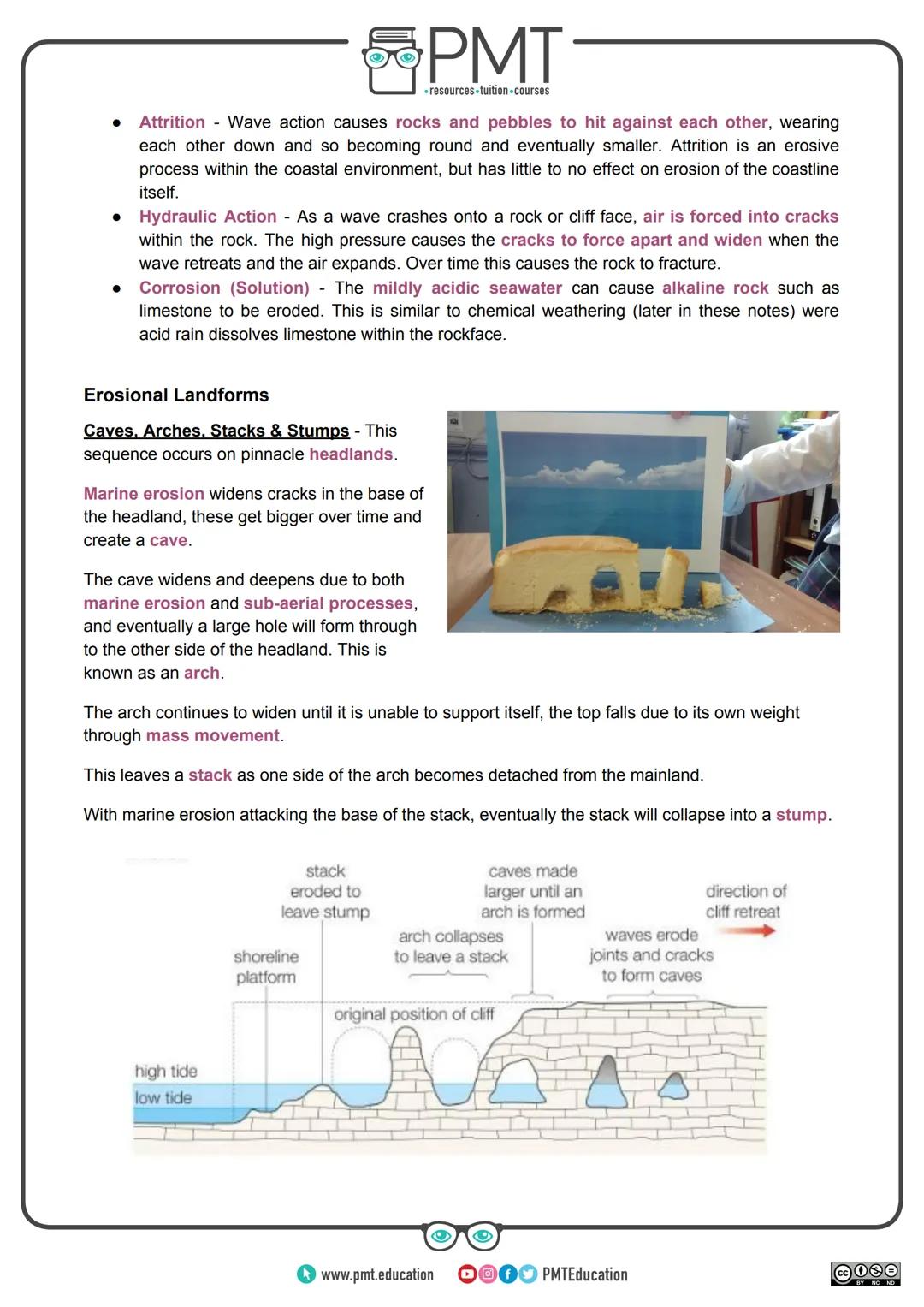
The formation of caves, arches, stacks and stumps follows a predictable sequence that creates some of Britain's most iconic coastal landmarks. This process starts at rocky headlands where marine erosion attacks weak points.
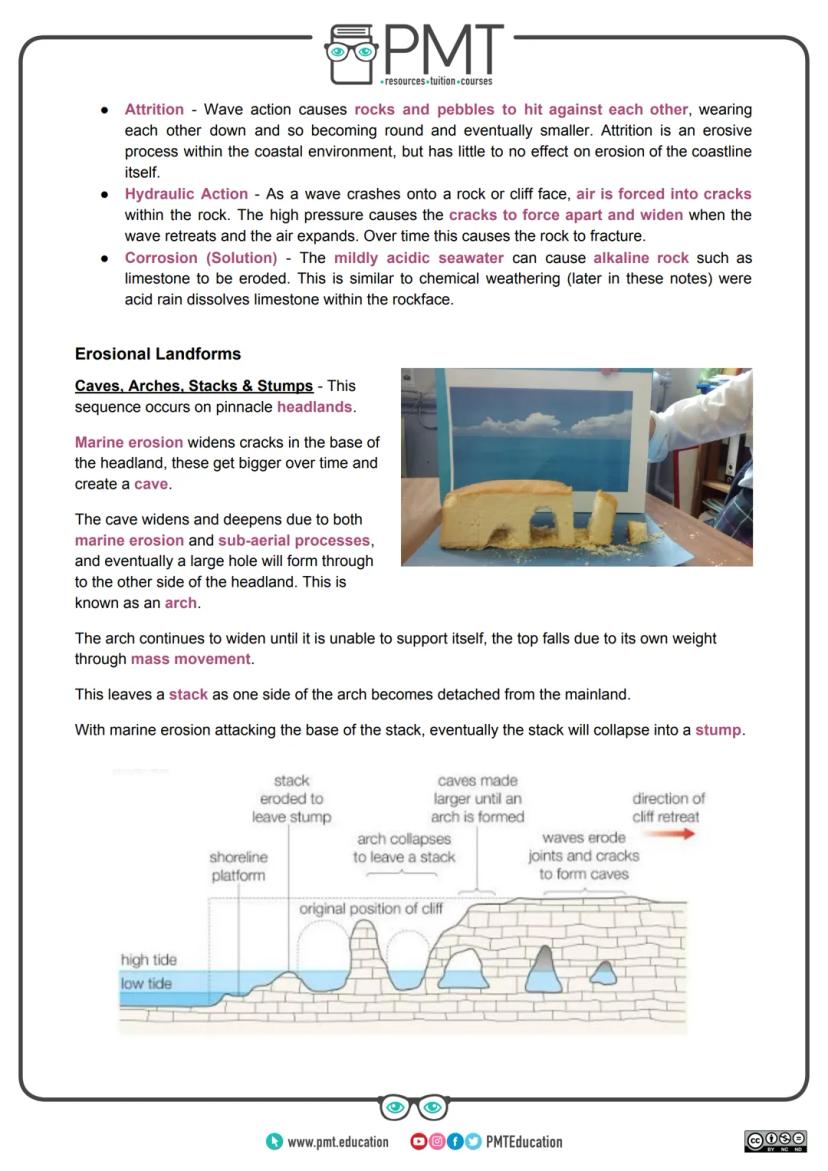
Marine erosion first widens cracks at the headland's base, gradually creating a cave. The cave deepens and widens until it breaks through to form an arch. Eventually, the arch becomes too wide to support itself and collapses, leaving behind a stack - a pillar of rock separated from the mainland.
Finally, continued erosion at the stack's base causes it to collapse into a low stump, often only visible at low tide. This entire sequence can take thousands of years, but it's happening constantly around Britain's coast.
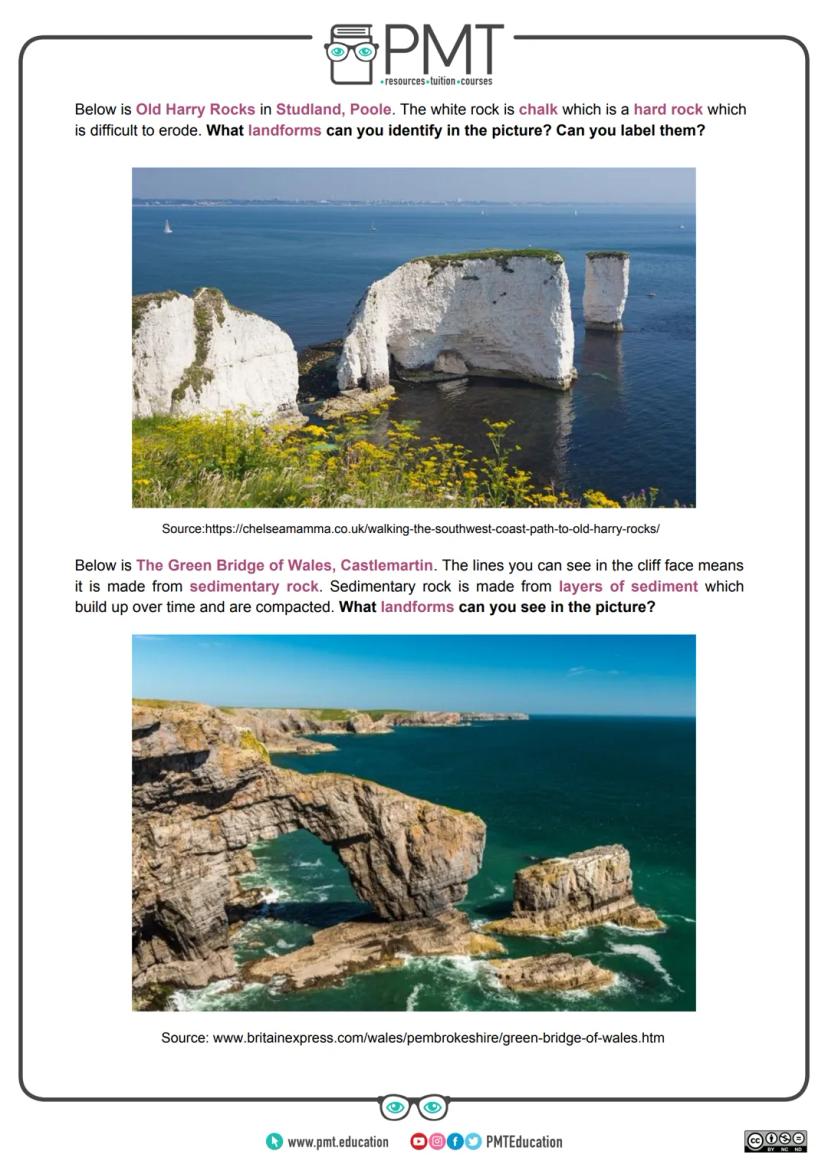
Old Harry Rocks in Dorset perfectly demonstrates this sequence - you can see the chalk stacks and stumps that remain from what was once part of the mainland cliff.
💡 Visual Learning: Try to visit a headland or look at photos online - seeing these landforms in real life makes the sequence much easier to remember!
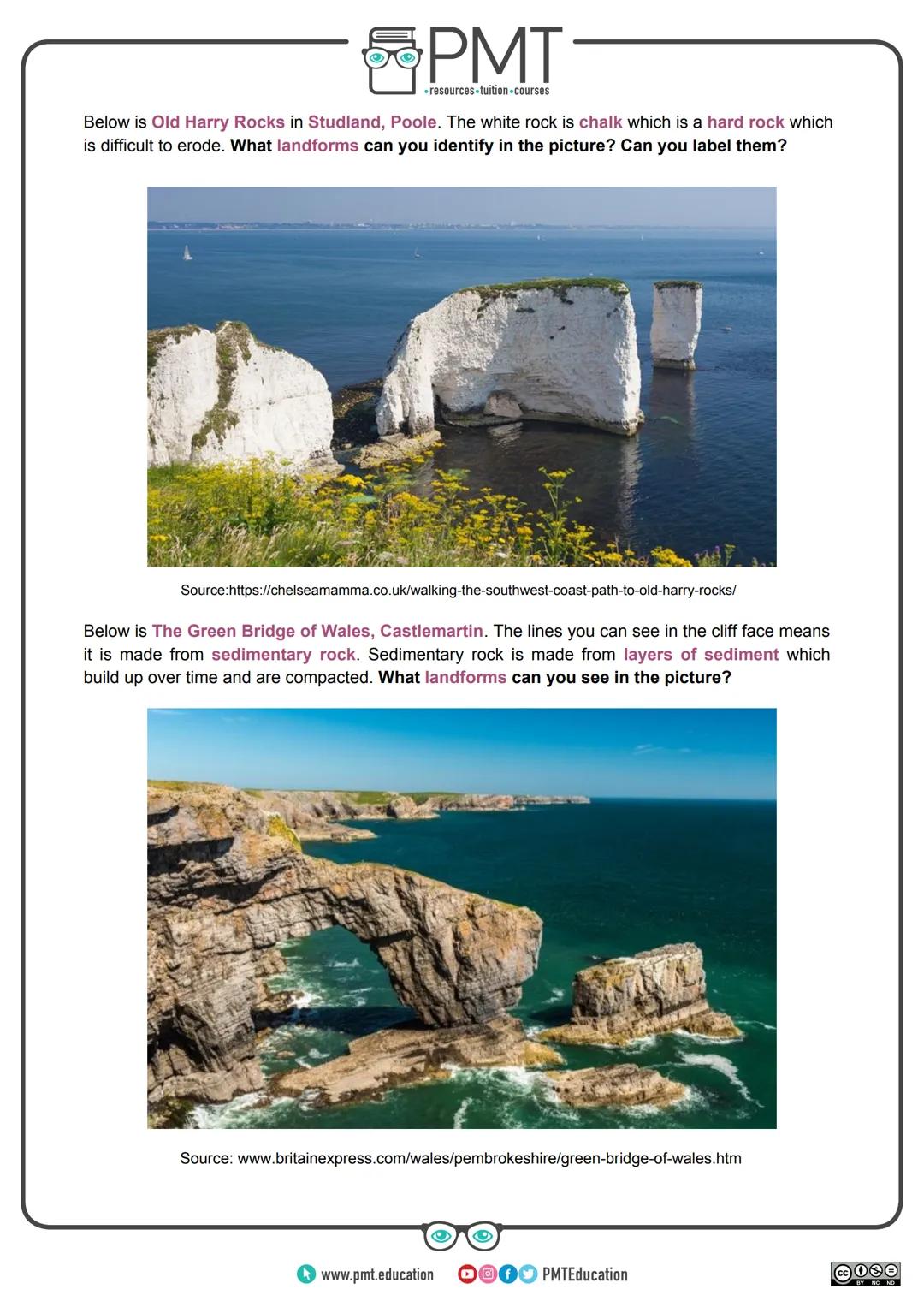
Old Harry Rocks in Studland, Dorset, showcases perfect examples of coastal erosional landforms. The white chalk rock is relatively hard, which explains why these spectacular stacks have survived whilst softer rock around them has eroded away.
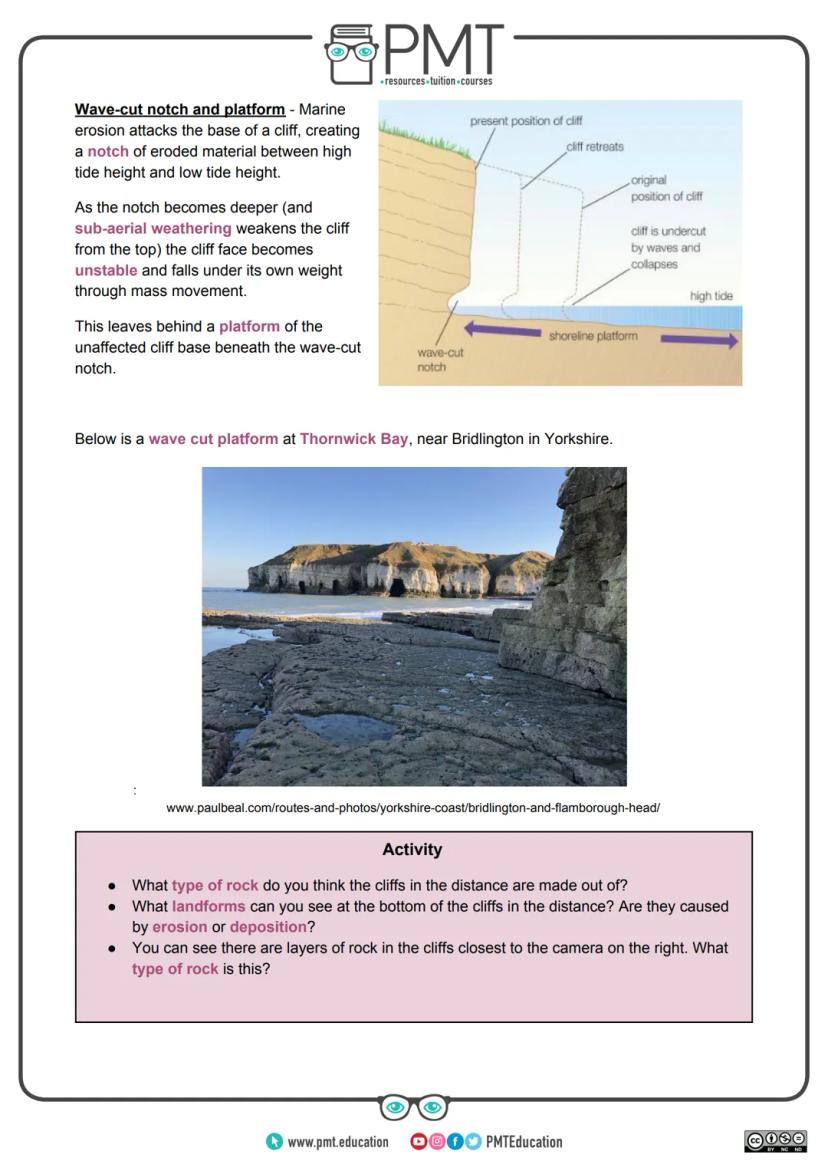
The Green Bridge of Wales in Castlemartin demonstrates how sedimentary rock creates distinctive coastal features. You can clearly see the horizontal layers in the cliff face - these formed over millions of years as sediment built up and compacted into rock.
Both locations show different rock types responding to coastal erosion in their own ways. Chalk creates dramatic white cliffs and stacks, whilst sedimentary rocks often form layered cliff faces with natural arches.
These real examples help you understand that coastal landforms aren't just theory - they're spectacular features you can actually visit and observe around Britain's coastline.
💡 Field Trip Idea: If possible, visit coastal areas near you to identify different landforms - it's much easier to remember what you've seen in person!
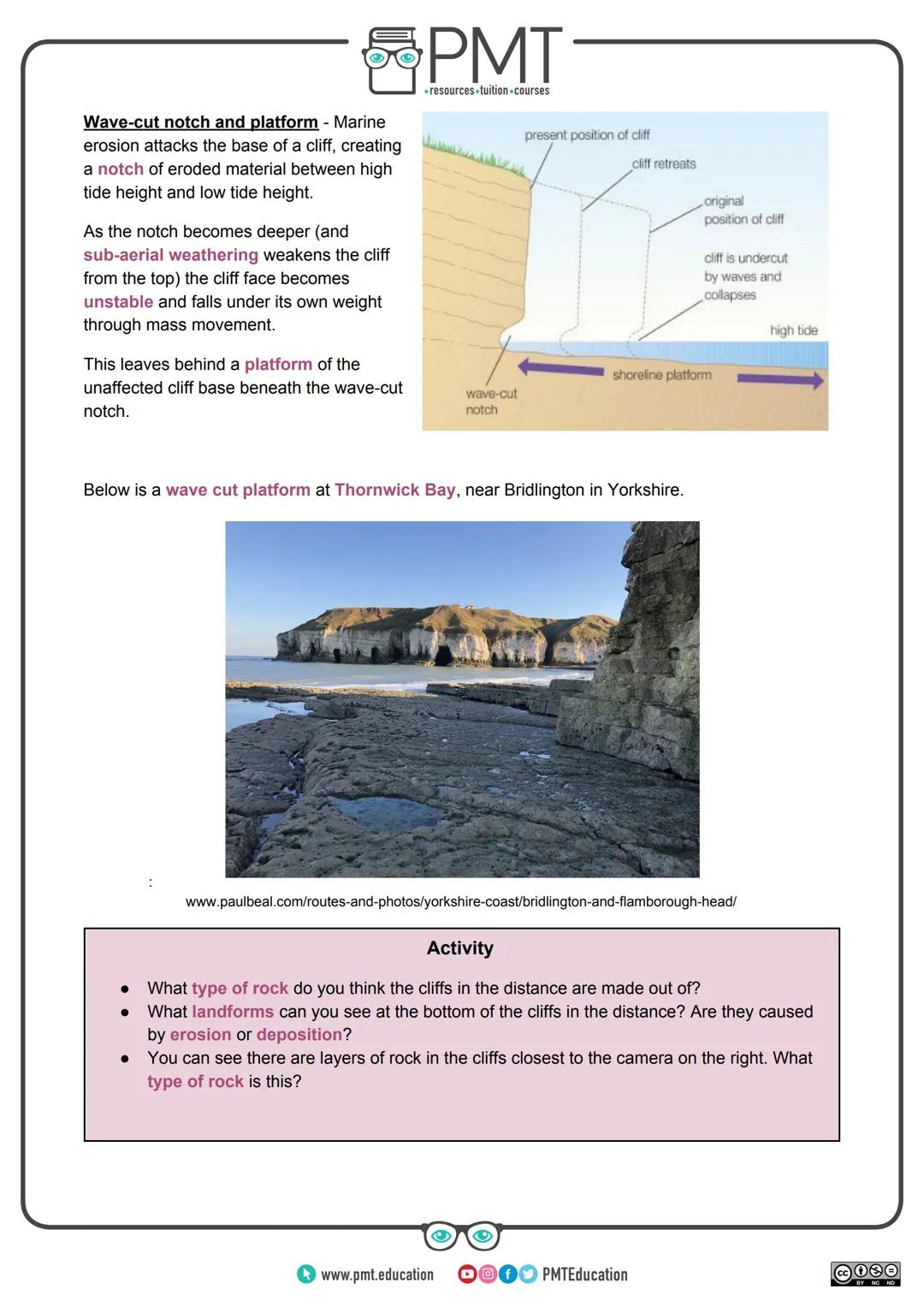
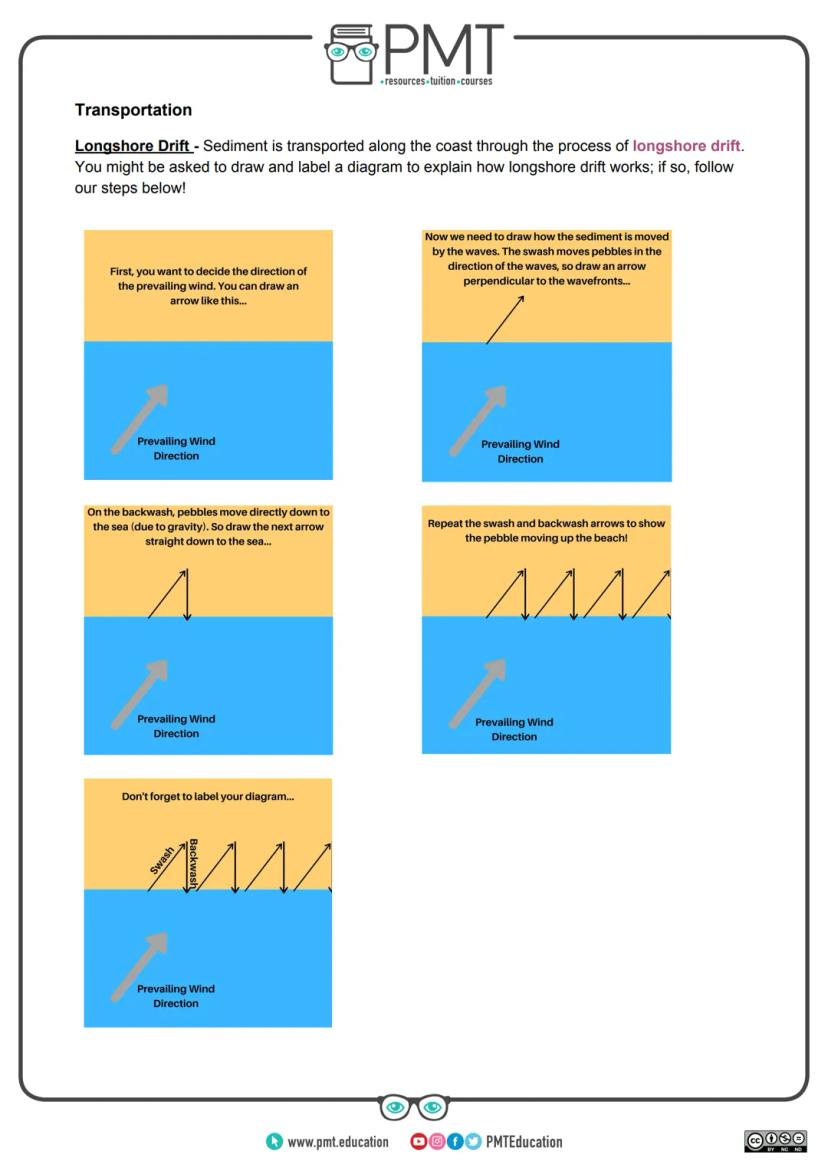
Wave-cut notches and platforms form through a different erosional process that creates some of our most recognisable coastal features. Marine erosion attacks the cliff base between high and low tide levels, carving out a horizontal notch.
As this notch deepens, the cliff above becomes unstable and eventually collapses under its own weight through mass movement. This leaves behind a flat wave-cut platform at the cliff base - the original foundation that wasn't eroded away.
Thornwick Bay near Bridlington in Yorkshire shows a perfect example of this process. You can see the flat platform exposed at low tide, with new cliffs rising behind where the original cliff face has retreated inland.
This process explains why many British coasts have flat, rocky areas at the base of cliffs that are perfect for rock pooling at low tide. The platforms gradually widen as cliffs continue to retreat landward.
💡 Rock Pooling Connection: Those flat rocky areas where you find rock pools are often wave-cut platforms - geology in action!
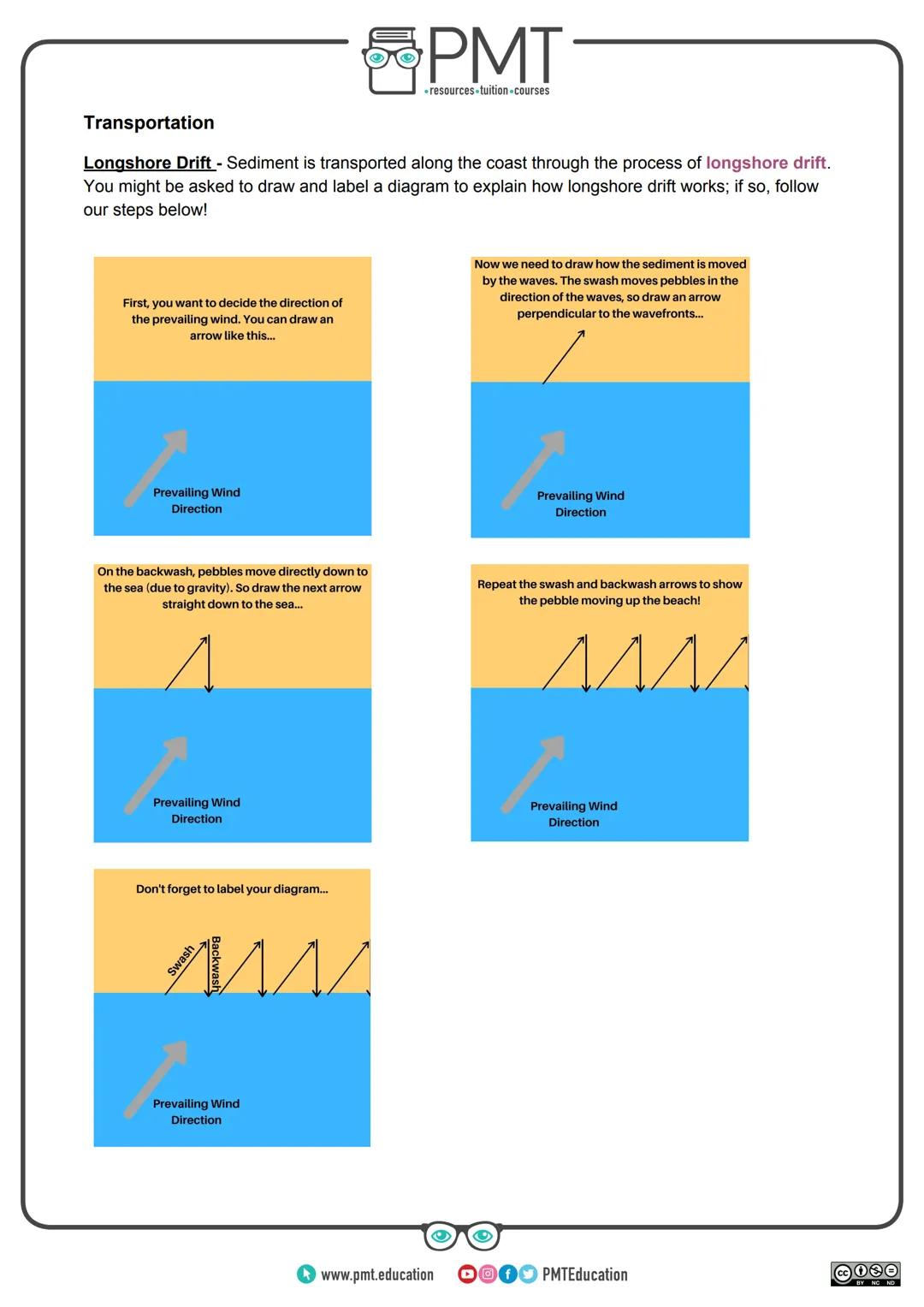
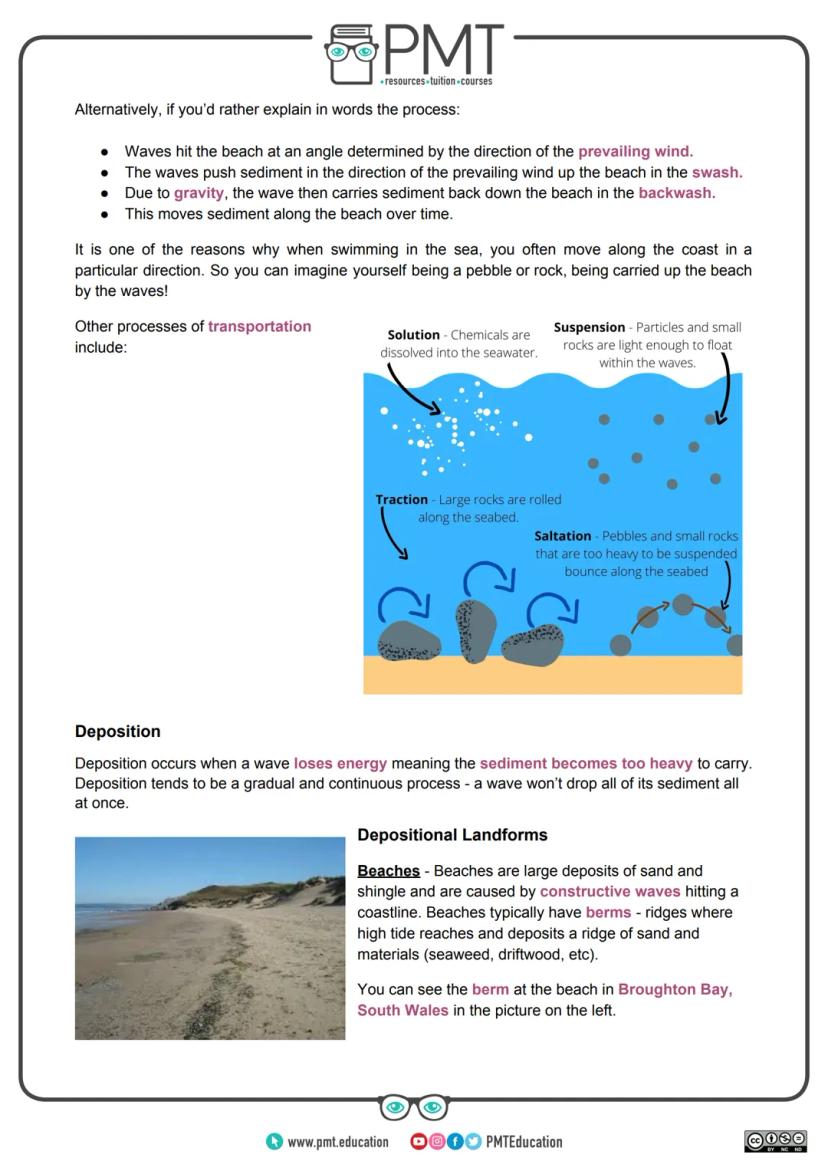
Longshore drift is how sediment moves along coastlines, and it's essential for forming many coastal features. This process happens because waves approach beaches at an angle, determined by the prevailing wind direction.
The swash carries sediment up the beach at an angle, but gravity makes the backwash flow straight back down to the sea. This creates a zigzag pattern that gradually moves sediment along the coast in the direction of the prevailing wind.
You can actually experience longshore drift yourself - when swimming in the sea, you'll often find yourself drifting along the coast rather than staying in the same spot. You're literally being moved by the same process that transports pebbles and sand.
Other transportation processes include solution (chemicals dissolved in water), suspension (light particles floating), saltation (pebbles bouncing along the seabed), and traction (large rocks rolling).
💡 Drawing Tip: Practice drawing longshore drift diagrams - they're commonly asked for in exams and easy marks if you get the angles right!
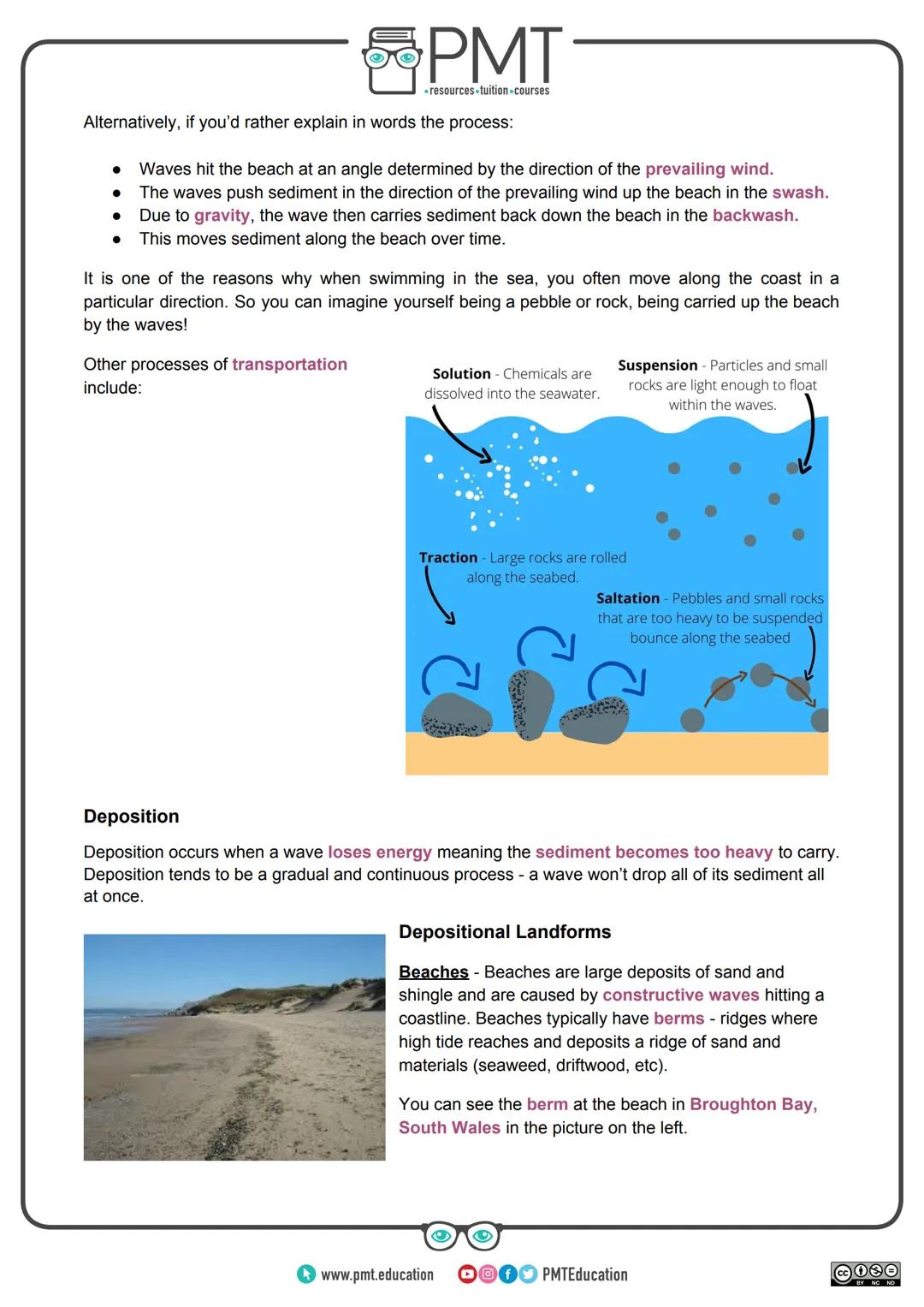
Deposition occurs when waves lose energy and can no longer carry their sediment load. This is a gradual process - waves don't dump everything at once, but slowly drop heavier particles first.
Beaches are the most common depositional landform, created by constructive waves depositing sand and shingle over time. Look for berms - raised ridges marking where high tides reach and deposit materials like seaweed and driftwood.
Transportation processes work together to move sediment along coasts. Solution dissolves chemicals into seawater, suspension carries light particles, saltation bounces pebbles along the seabed, and traction rolls large rocks.
The type of beach depends on wave energy and available sediment. High-energy environments create pebble beaches, whilst lower-energy areas develop fine sandy beaches.
💡 Beach Detective: Next time you're at the beach, look for berms and different sediment sizes - you're seeing deposition in action!
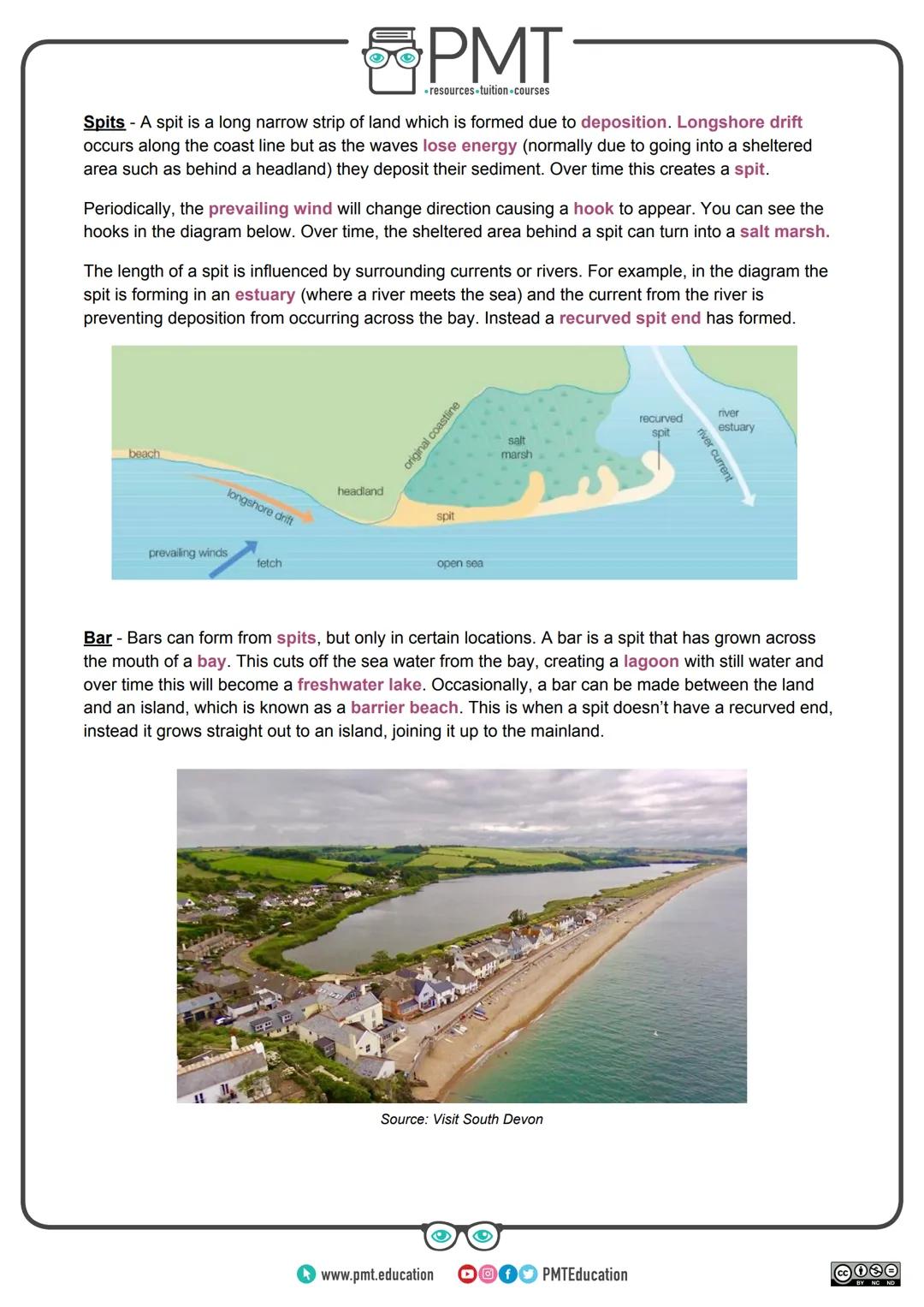
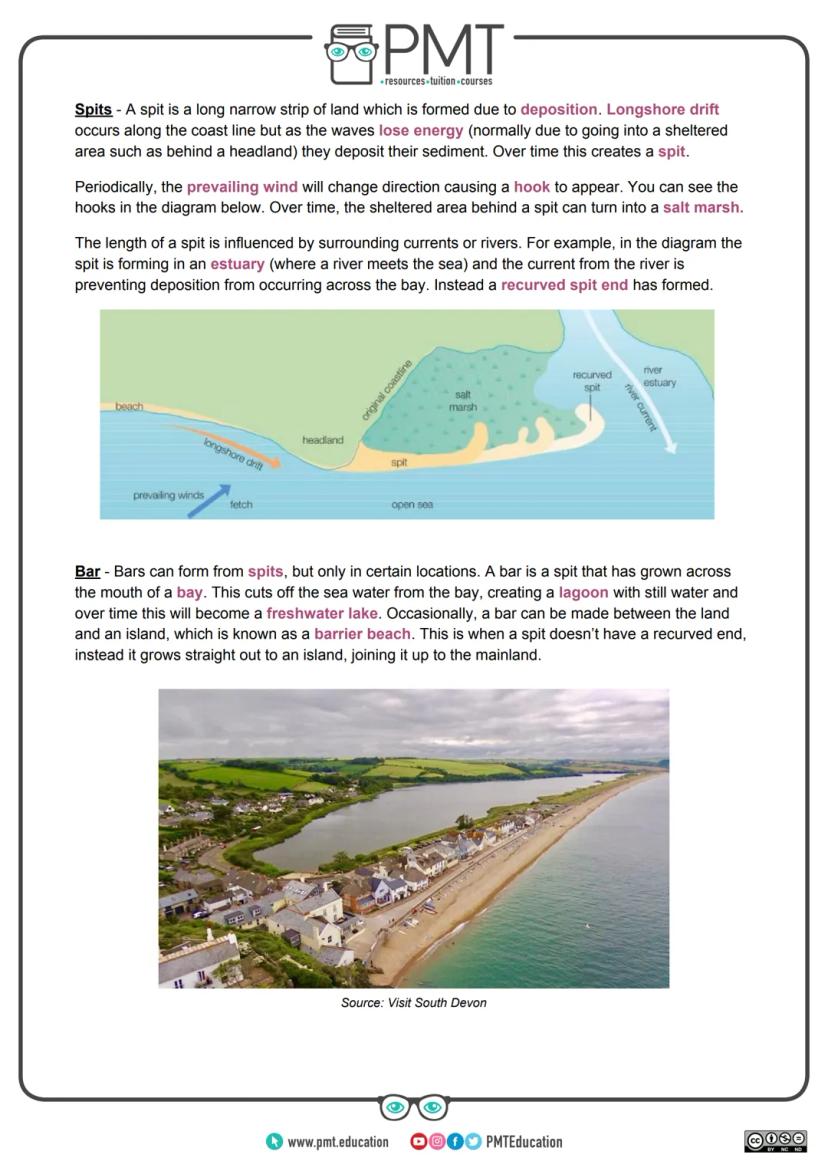
Spits are fascinating landforms created when longshore drift deposits sediment in sheltered areas, typically behind headlands or in river estuaries. As waves lose energy in these protected zones, they drop their sediment load, gradually building a narrow strip of land extending from the coast.
Recurved ends or hooks form when prevailing winds occasionally change direction, creating the characteristic curved shape. The sheltered area behind spits often develops into salt marshes as sediment continues to accumulate.
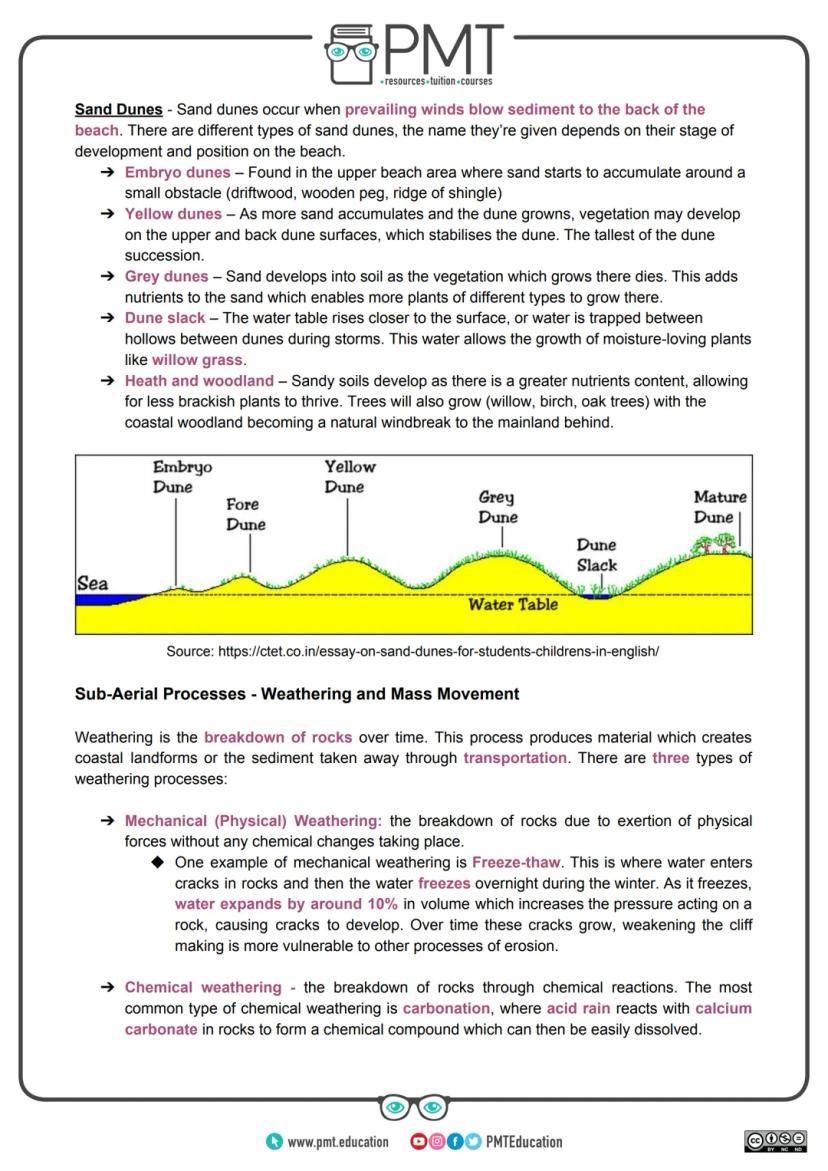
Bars form when spits grow completely across a bay mouth, cutting off seawater to create a lagoon. Over time, these lagoons can become freshwater lakes. Barrier beaches are special bars that connect islands to the mainland.
River currents often limit spit length - you can see this in estuaries where river flow prevents sediment from depositing across the entire bay mouth.
💡 Map Skills: Spits are easy to spot on OS maps - look for narrow strips of land with curved ends extending into water!
Our AI Companion is a student-focused AI tool that offers more than just answers. Built on millions of Knowunity resources, it provides relevant information, personalised study plans, quizzes, and content directly in the chat, adapting to your individual learning journey.
You can download the app from Google Play Store and Apple App Store.
That's right! Enjoy free access to study content, connect with fellow students, and get instant help – all at your fingertips.
App Store
Google Play
The app is very easy to use and well designed. I have found everything I was looking for so far and have been able to learn a lot from the presentations! I will definitely use the app for a class assignment! And of course it also helps a lot as an inspiration.
Stefan S
iOS user
This app is really great. There are so many study notes and help [...]. My problem subject is French, for example, and the app has so many options for help. Thanks to this app, I have improved my French. I would recommend it to anyone.
Samantha Klich
Android user
Wow, I am really amazed. I just tried the app because I've seen it advertised many times and was absolutely stunned. This app is THE HELP you want for school and above all, it offers so many things, such as workouts and fact sheets, which have been VERY helpful to me personally.
Anna
iOS user
Best app on earth! no words because it’s too good
Thomas R
iOS user
Just amazing. Let's me revise 10x better, this app is a quick 10/10. I highly recommend it to anyone. I can watch and search for notes. I can save them in the subject folder. I can revise it any time when I come back. If you haven't tried this app, you're really missing out.
Basil
Android user
This app has made me feel so much more confident in my exam prep, not only through boosting my own self confidence through the features that allow you to connect with others and feel less alone, but also through the way the app itself is centred around making you feel better. It is easy to navigate, fun to use, and helpful to anyone struggling in absolutely any way.
David K
iOS user
The app's just great! All I have to do is enter the topic in the search bar and I get the response real fast. I don't have to watch 10 YouTube videos to understand something, so I'm saving my time. Highly recommended!
Sudenaz Ocak
Android user
In school I was really bad at maths but thanks to the app, I am doing better now. I am so grateful that you made the app.
Greenlight Bonnie
Android user
very reliable app to help and grow your ideas of Maths, English and other related topics in your works. please use this app if your struggling in areas, this app is key for that. wish I'd of done a review before. and it's also free so don't worry about that.
Rohan U
Android user
I know a lot of apps use fake accounts to boost their reviews but this app deserves it all. Originally I was getting 4 in my English exams and this time I got a grade 7. I didn’t even know about this app three days until the exam and it has helped A LOT. Please actually trust me and use it as I’m sure you too will see developments.
Xander S
iOS user
THE QUIZES AND FLASHCARDS ARE SO USEFUL AND I LOVE Knowunity AI. IT ALSO IS LITREALLY LIKE CHATGPT BUT SMARTER!! HELPED ME WITH MY MASCARA PROBLEMS TOO!! AS WELL AS MY REAL SUBJECTS ! DUHHH 😍😁😲🤑💗✨🎀😮
Elisha
iOS user
This apps acc the goat. I find revision so boring but this app makes it so easy to organize it all and then you can ask the freeeee ai to test yourself so good and you can easily upload your own stuff. highly recommend as someone taking mocks now
Paul T
iOS user
The app is very easy to use and well designed. I have found everything I was looking for so far and have been able to learn a lot from the presentations! I will definitely use the app for a class assignment! And of course it also helps a lot as an inspiration.
Stefan S
iOS user
This app is really great. There are so many study notes and help [...]. My problem subject is French, for example, and the app has so many options for help. Thanks to this app, I have improved my French. I would recommend it to anyone.
Samantha Klich
Android user
Wow, I am really amazed. I just tried the app because I've seen it advertised many times and was absolutely stunned. This app is THE HELP you want for school and above all, it offers so many things, such as workouts and fact sheets, which have been VERY helpful to me personally.
Anna
iOS user
Best app on earth! no words because it’s too good
Thomas R
iOS user
Just amazing. Let's me revise 10x better, this app is a quick 10/10. I highly recommend it to anyone. I can watch and search for notes. I can save them in the subject folder. I can revise it any time when I come back. If you haven't tried this app, you're really missing out.
Basil
Android user
This app has made me feel so much more confident in my exam prep, not only through boosting my own self confidence through the features that allow you to connect with others and feel less alone, but also through the way the app itself is centred around making you feel better. It is easy to navigate, fun to use, and helpful to anyone struggling in absolutely any way.
David K
iOS user
The app's just great! All I have to do is enter the topic in the search bar and I get the response real fast. I don't have to watch 10 YouTube videos to understand something, so I'm saving my time. Highly recommended!
Sudenaz Ocak
Android user
In school I was really bad at maths but thanks to the app, I am doing better now. I am so grateful that you made the app.
Greenlight Bonnie
Android user
very reliable app to help and grow your ideas of Maths, English and other related topics in your works. please use this app if your struggling in areas, this app is key for that. wish I'd of done a review before. and it's also free so don't worry about that.
Rohan U
Android user
I know a lot of apps use fake accounts to boost their reviews but this app deserves it all. Originally I was getting 4 in my English exams and this time I got a grade 7. I didn’t even know about this app three days until the exam and it has helped A LOT. Please actually trust me and use it as I’m sure you too will see developments.
Xander S
iOS user
THE QUIZES AND FLASHCARDS ARE SO USEFUL AND I LOVE Knowunity AI. IT ALSO IS LITREALLY LIKE CHATGPT BUT SMARTER!! HELPED ME WITH MY MASCARA PROBLEMS TOO!! AS WELL AS MY REAL SUBJECTS ! DUHHH 😍😁😲🤑💗✨🎀😮
Elisha
iOS user
This apps acc the goat. I find revision so boring but this app makes it so easy to organize it all and then you can ask the freeeee ai to test yourself so good and you can easily upload your own stuff. highly recommend as someone taking mocks now
Paul T
iOS user
Lucia
@lucia_m9628
Ever wondered how Britain's stunning coastlines got their dramatic cliffs, sandy beaches, and rocky arches? Coastal landscapes are shaped by powerful forces like waves, wind, and weather working together over thousands of years to create the spectacular scenery we see... Show more
Access to all documents
Improve your grades
Join milions of students
This is your complete guide to understanding how coastal landscapes form and change along the UK's coastline. You'll discover the processes behind famous landmarks like Old Harry Rocks and learn why some coasts have sandy beaches whilst others have towering cliffs.
These detailed notes cover everything you need to know for your GCSE Geography exam. From wave formation to coastal erosion, you'll gain the knowledge to analyse real coastal locations and explain how they've developed over time.
💡 Quick Tip: Focus on understanding the processes first - once you get how waves and erosion work, the landforms will make perfect sense!
Access to all documents
Improve your grades
Join milions of students
Understanding waves is crucial because they're the main force shaping our coastlines. Most waves form when wind blows across the sea surface, creating ripples that grow into proper waves as they travel towards shore.
There are two completely different types of waves that create opposite effects. Constructive waves are gentle with low height and large wavelength - they have strong swash (water moving up the beach) but weak backwash (water returning to sea). These waves deposit material like sand and pebbles, building up beaches over time.
Destructive waves are the opposite - they're powerful with high height and short wavelength. Their strong backwash is much greater than their swash, so they erode beaches and cliffs by taking material away. These waves create steep, rocky coastlines.
💡 Remember: Constructive = builds up beaches, Destructive = destroys/erodes coastlines. The names tell you exactly what they do!
Access to all documents
Improve your grades
Join milions of students
Several factors determine how powerful waves become: wind strength, how long the wind's been blowing, water depth, and crucially, the fetch (distance waves have travelled). Longer fetch means more powerful waves hitting the coast.
Constructive waves typically create depositional landforms like sandy beaches, whilst destructive waves with long fetch create erosional landforms such as rocky headlands and tall cliffs. This explains why different parts of the UK coast look so different.
There are five key coastal processes you must know: erosion, weathering, transportation, mass movement, and deposition. Erosion removes and destroys rocks through five different methods that often work together.
The main erosion types include corrasion (waves hurling rocks at cliffs), abrasion (sediment scraping against rock like sandpaper), hydraulic action (air forced into rock cracks), attrition (rocks knocking together), and solution (acidic seawater dissolving rock).
💡 Exam Tip: Learn the five erosion processes by heart - they appear in most coastal exam questions and are easy marks if you know them!
Access to all documents
Improve your grades
Join milions of students
The formation of caves, arches, stacks and stumps follows a predictable sequence that creates some of Britain's most iconic coastal landmarks. This process starts at rocky headlands where marine erosion attacks weak points.
Marine erosion first widens cracks at the headland's base, gradually creating a cave. The cave deepens and widens until it breaks through to form an arch. Eventually, the arch becomes too wide to support itself and collapses, leaving behind a stack - a pillar of rock separated from the mainland.
Finally, continued erosion at the stack's base causes it to collapse into a low stump, often only visible at low tide. This entire sequence can take thousands of years, but it's happening constantly around Britain's coast.
Old Harry Rocks in Dorset perfectly demonstrates this sequence - you can see the chalk stacks and stumps that remain from what was once part of the mainland cliff.
💡 Visual Learning: Try to visit a headland or look at photos online - seeing these landforms in real life makes the sequence much easier to remember!
Access to all documents
Improve your grades
Join milions of students
Old Harry Rocks in Studland, Dorset, showcases perfect examples of coastal erosional landforms. The white chalk rock is relatively hard, which explains why these spectacular stacks have survived whilst softer rock around them has eroded away.
The Green Bridge of Wales in Castlemartin demonstrates how sedimentary rock creates distinctive coastal features. You can clearly see the horizontal layers in the cliff face - these formed over millions of years as sediment built up and compacted into rock.
Both locations show different rock types responding to coastal erosion in their own ways. Chalk creates dramatic white cliffs and stacks, whilst sedimentary rocks often form layered cliff faces with natural arches.
These real examples help you understand that coastal landforms aren't just theory - they're spectacular features you can actually visit and observe around Britain's coastline.
💡 Field Trip Idea: If possible, visit coastal areas near you to identify different landforms - it's much easier to remember what you've seen in person!
Access to all documents
Improve your grades
Join milions of students
Wave-cut notches and platforms form through a different erosional process that creates some of our most recognisable coastal features. Marine erosion attacks the cliff base between high and low tide levels, carving out a horizontal notch.
As this notch deepens, the cliff above becomes unstable and eventually collapses under its own weight through mass movement. This leaves behind a flat wave-cut platform at the cliff base - the original foundation that wasn't eroded away.
Thornwick Bay near Bridlington in Yorkshire shows a perfect example of this process. You can see the flat platform exposed at low tide, with new cliffs rising behind where the original cliff face has retreated inland.
This process explains why many British coasts have flat, rocky areas at the base of cliffs that are perfect for rock pooling at low tide. The platforms gradually widen as cliffs continue to retreat landward.
💡 Rock Pooling Connection: Those flat rocky areas where you find rock pools are often wave-cut platforms - geology in action!
Access to all documents
Improve your grades
Join milions of students
Longshore drift is how sediment moves along coastlines, and it's essential for forming many coastal features. This process happens because waves approach beaches at an angle, determined by the prevailing wind direction.
The swash carries sediment up the beach at an angle, but gravity makes the backwash flow straight back down to the sea. This creates a zigzag pattern that gradually moves sediment along the coast in the direction of the prevailing wind.
You can actually experience longshore drift yourself - when swimming in the sea, you'll often find yourself drifting along the coast rather than staying in the same spot. You're literally being moved by the same process that transports pebbles and sand.
Other transportation processes include solution (chemicals dissolved in water), suspension (light particles floating), saltation (pebbles bouncing along the seabed), and traction (large rocks rolling).
💡 Drawing Tip: Practice drawing longshore drift diagrams - they're commonly asked for in exams and easy marks if you get the angles right!
Access to all documents
Improve your grades
Join milions of students
Deposition occurs when waves lose energy and can no longer carry their sediment load. This is a gradual process - waves don't dump everything at once, but slowly drop heavier particles first.
Beaches are the most common depositional landform, created by constructive waves depositing sand and shingle over time. Look for berms - raised ridges marking where high tides reach and deposit materials like seaweed and driftwood.
Transportation processes work together to move sediment along coasts. Solution dissolves chemicals into seawater, suspension carries light particles, saltation bounces pebbles along the seabed, and traction rolls large rocks.
The type of beach depends on wave energy and available sediment. High-energy environments create pebble beaches, whilst lower-energy areas develop fine sandy beaches.
💡 Beach Detective: Next time you're at the beach, look for berms and different sediment sizes - you're seeing deposition in action!
Access to all documents
Improve your grades
Join milions of students
Spits are fascinating landforms created when longshore drift deposits sediment in sheltered areas, typically behind headlands or in river estuaries. As waves lose energy in these protected zones, they drop their sediment load, gradually building a narrow strip of land extending from the coast.
Recurved ends or hooks form when prevailing winds occasionally change direction, creating the characteristic curved shape. The sheltered area behind spits often develops into salt marshes as sediment continues to accumulate.
Bars form when spits grow completely across a bay mouth, cutting off seawater to create a lagoon. Over time, these lagoons can become freshwater lakes. Barrier beaches are special bars that connect islands to the mainland.
River currents often limit spit length - you can see this in estuaries where river flow prevents sediment from depositing across the entire bay mouth.
💡 Map Skills: Spits are easy to spot on OS maps - look for narrow strips of land with curved ends extending into water!
Access to all documents
Improve your grades
Join milions of students
Our AI Companion is a student-focused AI tool that offers more than just answers. Built on millions of Knowunity resources, it provides relevant information, personalised study plans, quizzes, and content directly in the chat, adapting to your individual learning journey.
You can download the app from Google Play Store and Apple App Store.
That's right! Enjoy free access to study content, connect with fellow students, and get instant help – all at your fingertips.
2
Smart Tools NEW
Transform this note into: ✓ 50+ Practice Questions ✓ Interactive Flashcards ✓ Full Mock Exam ✓ Essay Outlines
App Store
Google Play
The app is very easy to use and well designed. I have found everything I was looking for so far and have been able to learn a lot from the presentations! I will definitely use the app for a class assignment! And of course it also helps a lot as an inspiration.
Stefan S
iOS user
This app is really great. There are so many study notes and help [...]. My problem subject is French, for example, and the app has so many options for help. Thanks to this app, I have improved my French. I would recommend it to anyone.
Samantha Klich
Android user
Wow, I am really amazed. I just tried the app because I've seen it advertised many times and was absolutely stunned. This app is THE HELP you want for school and above all, it offers so many things, such as workouts and fact sheets, which have been VERY helpful to me personally.
Anna
iOS user
Best app on earth! no words because it’s too good
Thomas R
iOS user
Just amazing. Let's me revise 10x better, this app is a quick 10/10. I highly recommend it to anyone. I can watch and search for notes. I can save them in the subject folder. I can revise it any time when I come back. If you haven't tried this app, you're really missing out.
Basil
Android user
This app has made me feel so much more confident in my exam prep, not only through boosting my own self confidence through the features that allow you to connect with others and feel less alone, but also through the way the app itself is centred around making you feel better. It is easy to navigate, fun to use, and helpful to anyone struggling in absolutely any way.
David K
iOS user
The app's just great! All I have to do is enter the topic in the search bar and I get the response real fast. I don't have to watch 10 YouTube videos to understand something, so I'm saving my time. Highly recommended!
Sudenaz Ocak
Android user
In school I was really bad at maths but thanks to the app, I am doing better now. I am so grateful that you made the app.
Greenlight Bonnie
Android user
very reliable app to help and grow your ideas of Maths, English and other related topics in your works. please use this app if your struggling in areas, this app is key for that. wish I'd of done a review before. and it's also free so don't worry about that.
Rohan U
Android user
I know a lot of apps use fake accounts to boost their reviews but this app deserves it all. Originally I was getting 4 in my English exams and this time I got a grade 7. I didn’t even know about this app three days until the exam and it has helped A LOT. Please actually trust me and use it as I’m sure you too will see developments.
Xander S
iOS user
THE QUIZES AND FLASHCARDS ARE SO USEFUL AND I LOVE Knowunity AI. IT ALSO IS LITREALLY LIKE CHATGPT BUT SMARTER!! HELPED ME WITH MY MASCARA PROBLEMS TOO!! AS WELL AS MY REAL SUBJECTS ! DUHHH 😍😁😲🤑💗✨🎀😮
Elisha
iOS user
This apps acc the goat. I find revision so boring but this app makes it so easy to organize it all and then you can ask the freeeee ai to test yourself so good and you can easily upload your own stuff. highly recommend as someone taking mocks now
Paul T
iOS user
The app is very easy to use and well designed. I have found everything I was looking for so far and have been able to learn a lot from the presentations! I will definitely use the app for a class assignment! And of course it also helps a lot as an inspiration.
Stefan S
iOS user
This app is really great. There are so many study notes and help [...]. My problem subject is French, for example, and the app has so many options for help. Thanks to this app, I have improved my French. I would recommend it to anyone.
Samantha Klich
Android user
Wow, I am really amazed. I just tried the app because I've seen it advertised many times and was absolutely stunned. This app is THE HELP you want for school and above all, it offers so many things, such as workouts and fact sheets, which have been VERY helpful to me personally.
Anna
iOS user
Best app on earth! no words because it’s too good
Thomas R
iOS user
Just amazing. Let's me revise 10x better, this app is a quick 10/10. I highly recommend it to anyone. I can watch and search for notes. I can save them in the subject folder. I can revise it any time when I come back. If you haven't tried this app, you're really missing out.
Basil
Android user
This app has made me feel so much more confident in my exam prep, not only through boosting my own self confidence through the features that allow you to connect with others and feel less alone, but also through the way the app itself is centred around making you feel better. It is easy to navigate, fun to use, and helpful to anyone struggling in absolutely any way.
David K
iOS user
The app's just great! All I have to do is enter the topic in the search bar and I get the response real fast. I don't have to watch 10 YouTube videos to understand something, so I'm saving my time. Highly recommended!
Sudenaz Ocak
Android user
In school I was really bad at maths but thanks to the app, I am doing better now. I am so grateful that you made the app.
Greenlight Bonnie
Android user
very reliable app to help and grow your ideas of Maths, English and other related topics in your works. please use this app if your struggling in areas, this app is key for that. wish I'd of done a review before. and it's also free so don't worry about that.
Rohan U
Android user
I know a lot of apps use fake accounts to boost their reviews but this app deserves it all. Originally I was getting 4 in my English exams and this time I got a grade 7. I didn’t even know about this app three days until the exam and it has helped A LOT. Please actually trust me and use it as I’m sure you too will see developments.
Xander S
iOS user
THE QUIZES AND FLASHCARDS ARE SO USEFUL AND I LOVE Knowunity AI. IT ALSO IS LITREALLY LIKE CHATGPT BUT SMARTER!! HELPED ME WITH MY MASCARA PROBLEMS TOO!! AS WELL AS MY REAL SUBJECTS ! DUHHH 😍😁😲🤑💗✨🎀😮
Elisha
iOS user
This apps acc the goat. I find revision so boring but this app makes it so easy to organize it all and then you can ask the freeeee ai to test yourself so good and you can easily upload your own stuff. highly recommend as someone taking mocks now
Paul T
iOS user