
An Inspector Calls explores how our actions affect others through... Show more
 English Literature
 Sociology
 Biology
Sign up to see the contentIt's free!
Access to all documents
Improve your grades
Join milions of students
Knowunity AI
Subjects
Triangle Congruence and Similarity Theorems
Triangle Properties and Classification
Linear Equations and Graphs
Geometric Angle Relationships
Trigonometric Functions and Identities
Equation Solving Techniques
Circle Geometry Fundamentals
Division Operations and Methods
Basic Differentiation Rules
Exponent and Logarithm Properties
Show all topics
Human Organ Systems
Reproductive Cell Cycles
Biological Sciences Subdisciplines
Cellular Energy Metabolism
Autotrophic Energy Processes
Inheritance Patterns and Principles
Biomolecular Structure and Organization
Cell Cycle and Division Mechanics
Cellular Organization and Development
Biological Structural Organization
Show all topics
Chemical Sciences and Applications
Atomic Structure and Composition
Molecular Electron Structure Representation
Atomic Electron Behavior
Matter Properties and Water
Mole Concept and Calculations
Gas Laws and Behavior
Periodic Table Organization
Chemical Thermodynamics Fundamentals
Chemical Bond Types and Properties
Show all topics
European Renaissance and Enlightenment
European Cultural Movements 800-1920
American Revolution Era 1763-1797
American Civil War 1861-1865
Global Imperial Systems
Mongol and Chinese Dynasties
U.S. Presidents and World Leaders
Historical Sources and Documentation
World Wars Era and Impact
World Religious Systems
Show all topics
Classic and Contemporary Novels
Literary Character Analysis
Rhetorical Theory and Practice
Classic Literary Narratives
Reading Analysis and Interpretation
Narrative Structure and Techniques
English Language Components
Influential English-Language Authors
Basic Sentence Structure
Narrative Voice and Perspective
Show all topics
1,419
•
Updated Apr 16, 2026
•

Abzzy ♡
@abzzy.29
An Inspector Calls explores how our actions affect others through... Show more
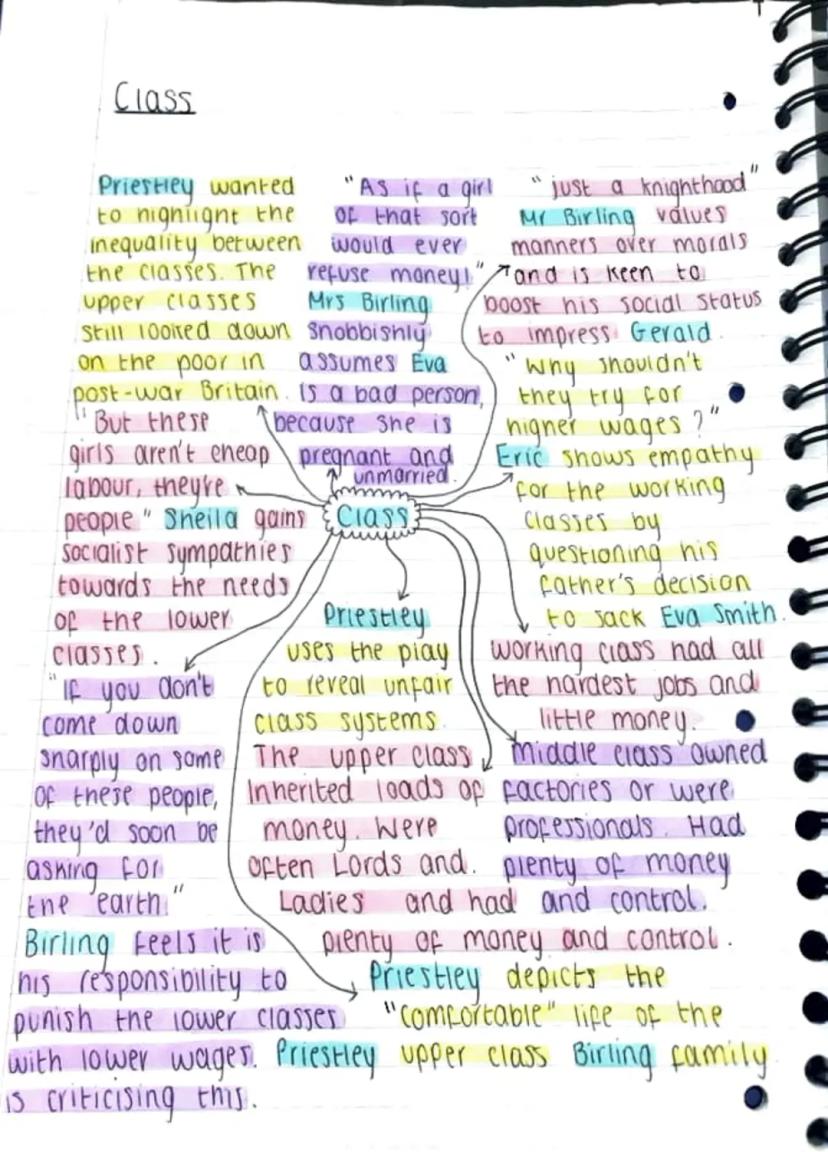
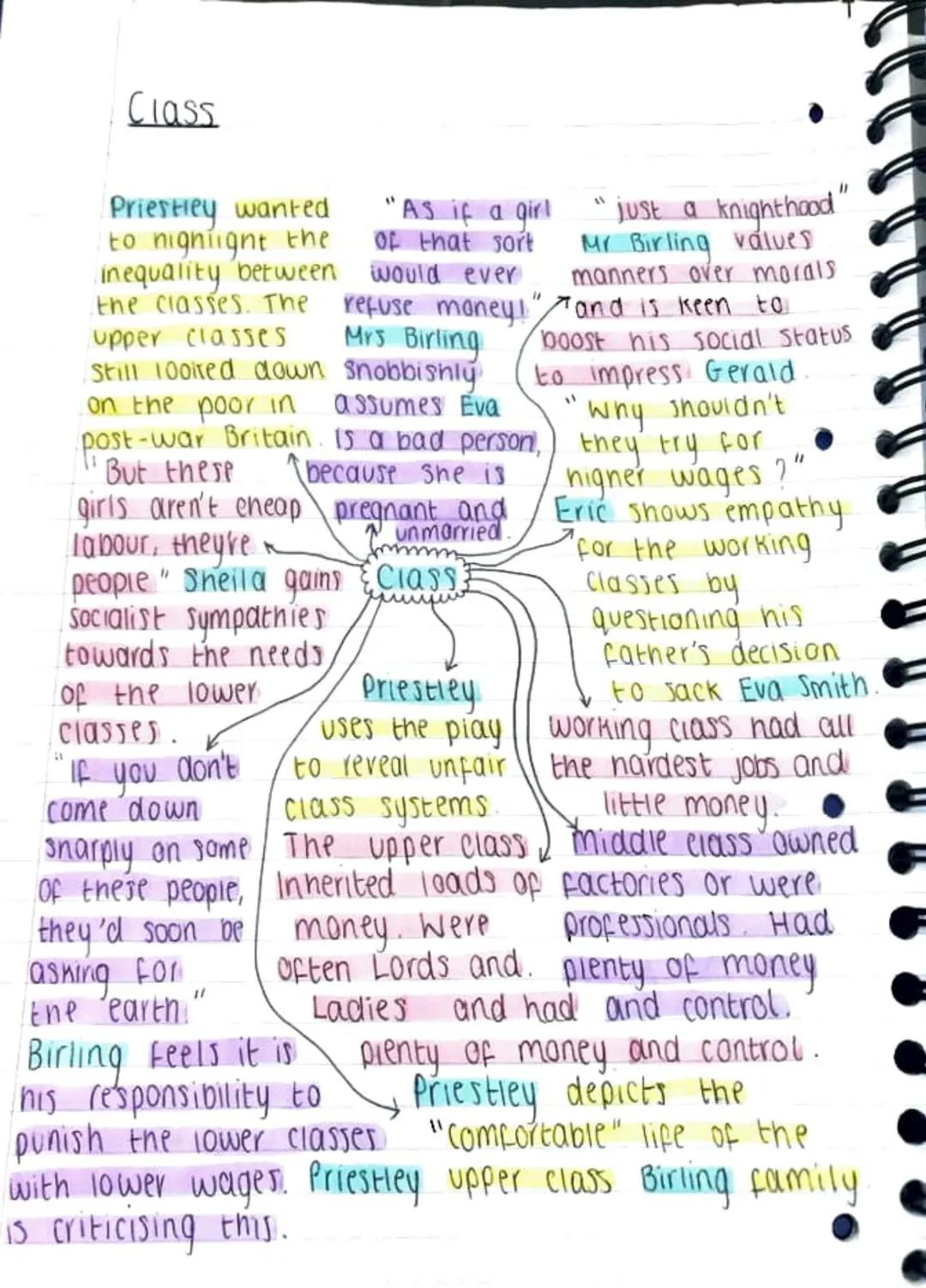
Ever wonder how the rich viewed the poor in 1912? Priestley shows us through the Birling family's attitudes. Class inequality is a major theme that reveals how the wealthy maintained power over working-class people like Eva Smith.
Mr Birling's statement "If you don't come down sharply on some of these people, they'd soon be asking for the earth" demonstrates his belief that workers should be controlled and kept in their place. He sees punishing the lower classes with low wages as his right and responsibility.
Sheila represents a changing attitude when she says, "But these girls aren't cheap labour, they're people." Her growing socialist sympathies contrast sharply with her father's capitalist mindset.
Think about it: How does your own society treat people from different economic backgrounds? Have things really changed since 1912?
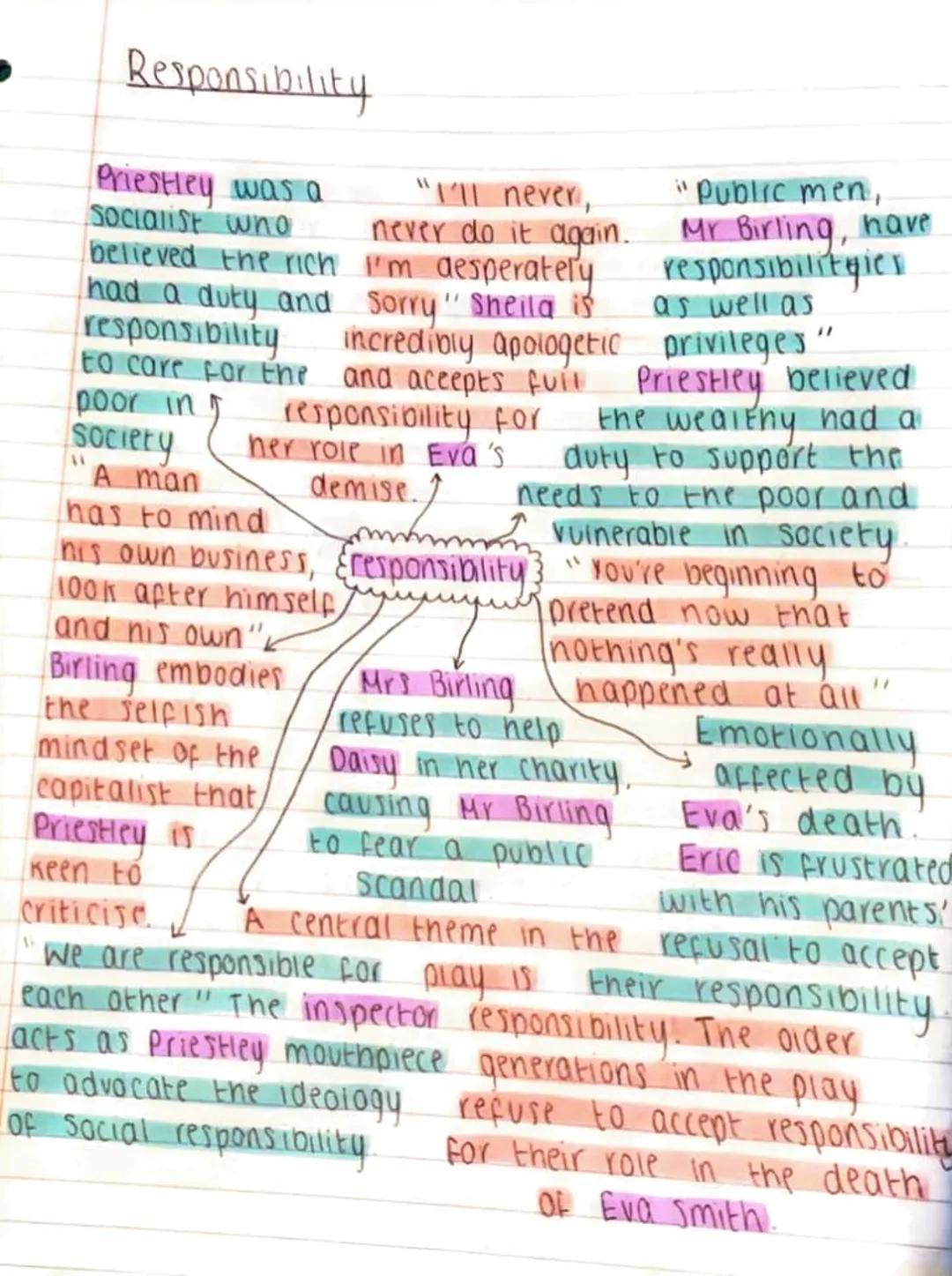
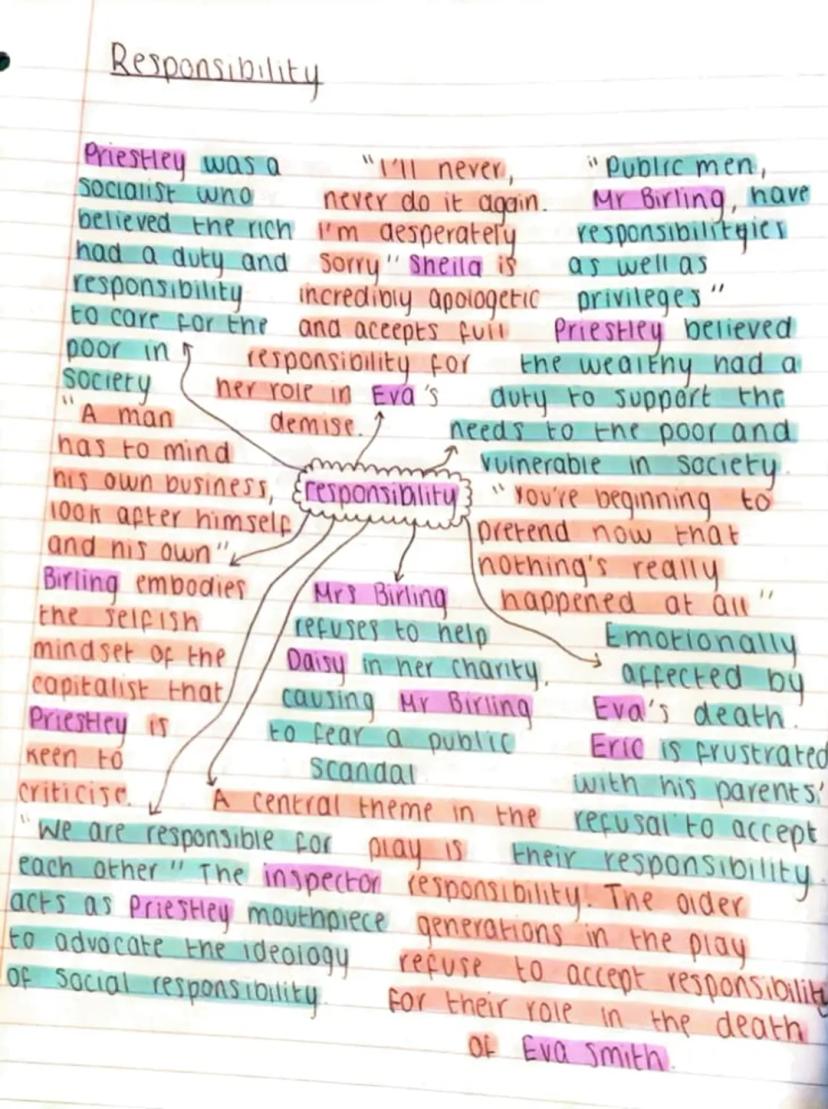
Responsibility sits at the heart of this play. Priestley believed the wealthy had a duty to care for the poor and vulnerable in society – a view that clashes dramatically with the Birling family's attitudes.
Mr Birling represents the selfish capitalist mindset: "A man has to mind his own business and look after himself." This individualistic view is exactly what Priestley criticizes through the story. The older generation – Mr and Mrs Birling – refuse to accept any responsibility for their role in Eva's death.
By contrast, Sheila immediately accepts responsibility for her actions: "I'll never, never do it again. I'm desperately sorry." Her transformation shows that change is possible. The Inspector serves as Priestley's voice when he declares, "We are responsible for each other" – the central message of the entire play.
Remember: The play was written after two World Wars when society was reconsidering how people should treat each other. This context matters!
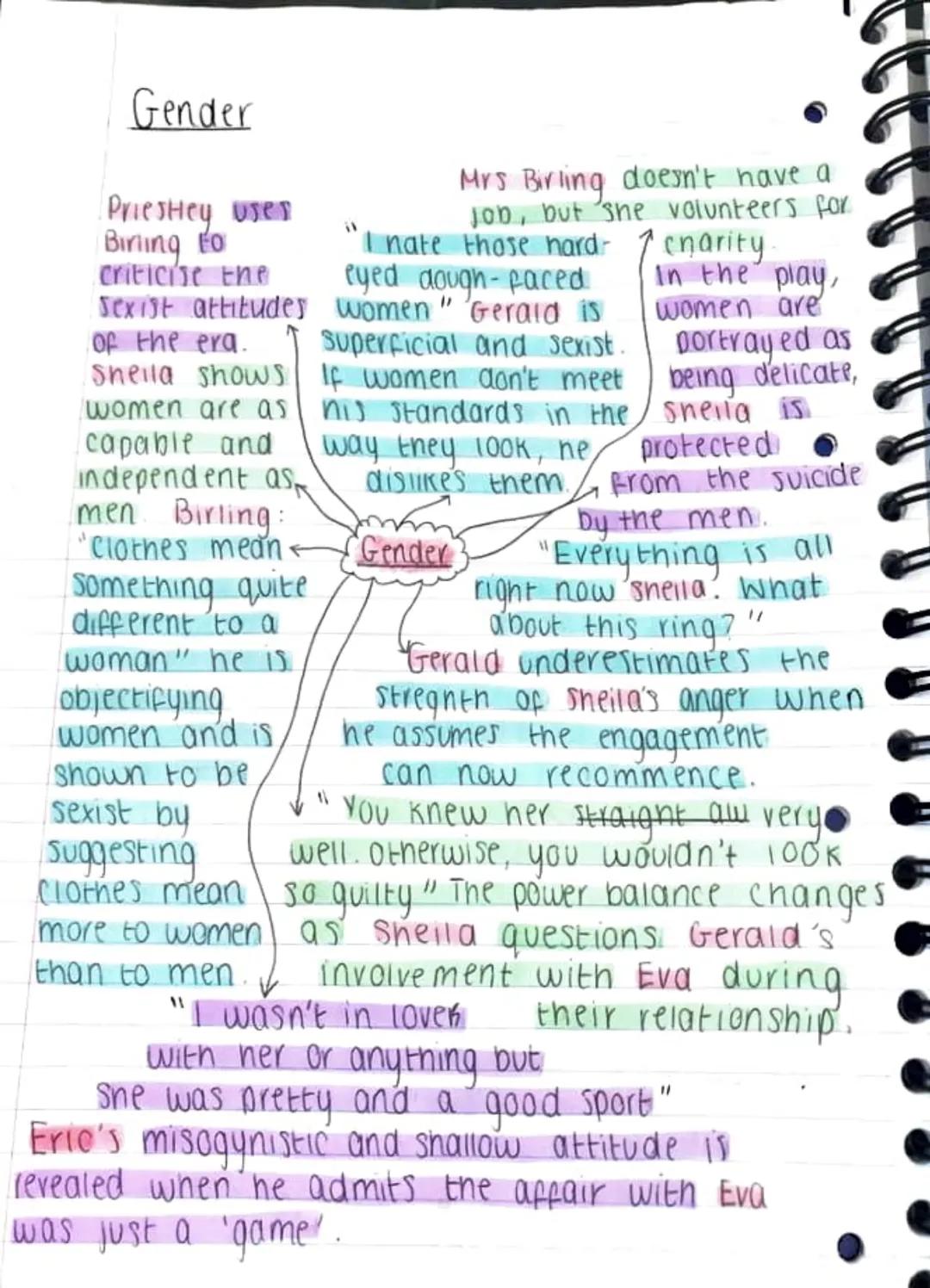
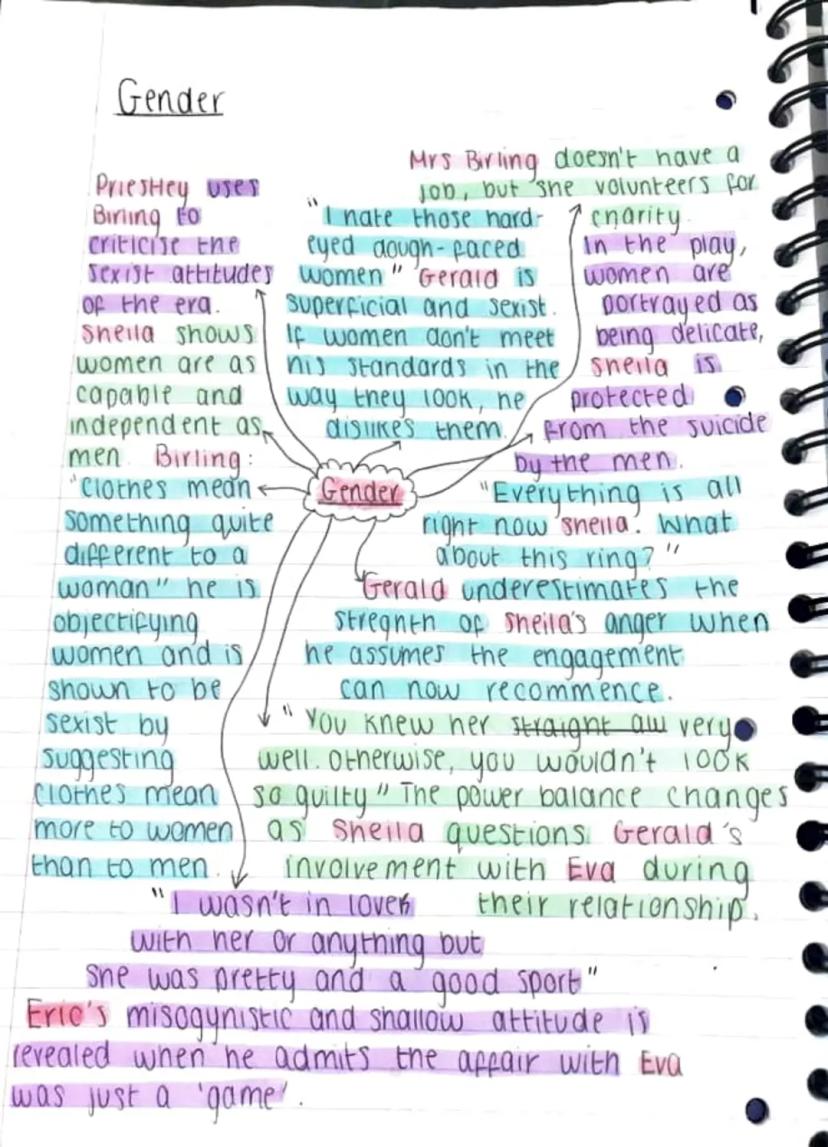
Gender roles in 1912 were rigid and unfair – something Priestley highlights through several characters. Men like Gerald show their sexism openly, saying "I hate those hard-eyed dough-faced women," revealing how women were judged primarily on appearance.
Mr Birling's comment that "Clothes mean something quite different to a woman" shows how men objectified women and made assumptions about their priorities. Women were seen as delicate creatures needing protection – the men try to shield Sheila from the details of Eva's suicide.
The power dynamics shift dramatically when Sheila confronts Gerald: "You knew her straight away very well. Otherwise, you wouldn't look so guilty." This moment shows Sheila breaking free from traditional gender expectations. Meanwhile, Eric's admission that Eva "was pretty and a good sport" reveals his shallow, misogynistic attitude toward women.
Challenge yourself: Notice how the female characters develop throughout the play while the male characters mostly stay fixed in their views. Why might Priestley have structured it this way?
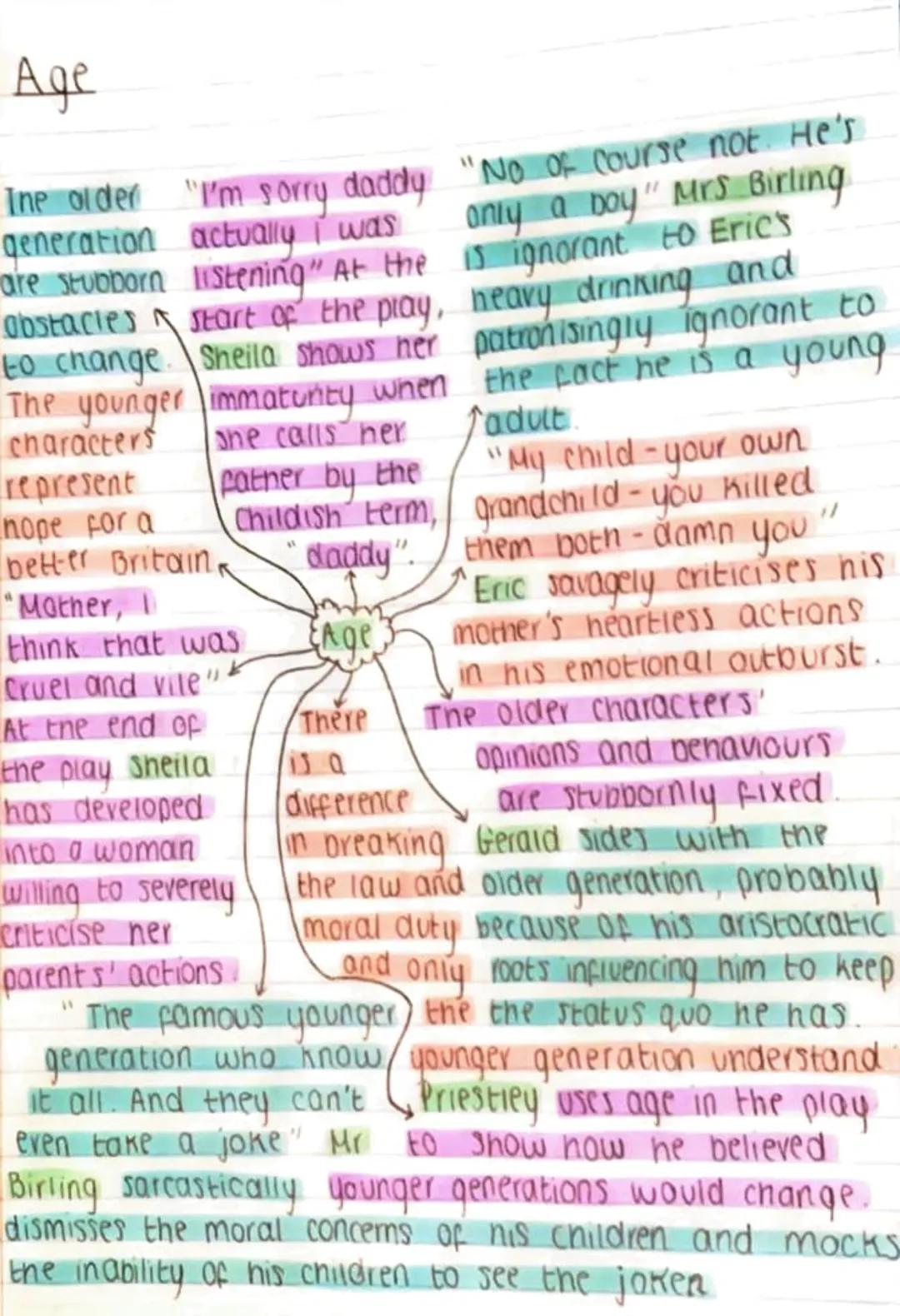
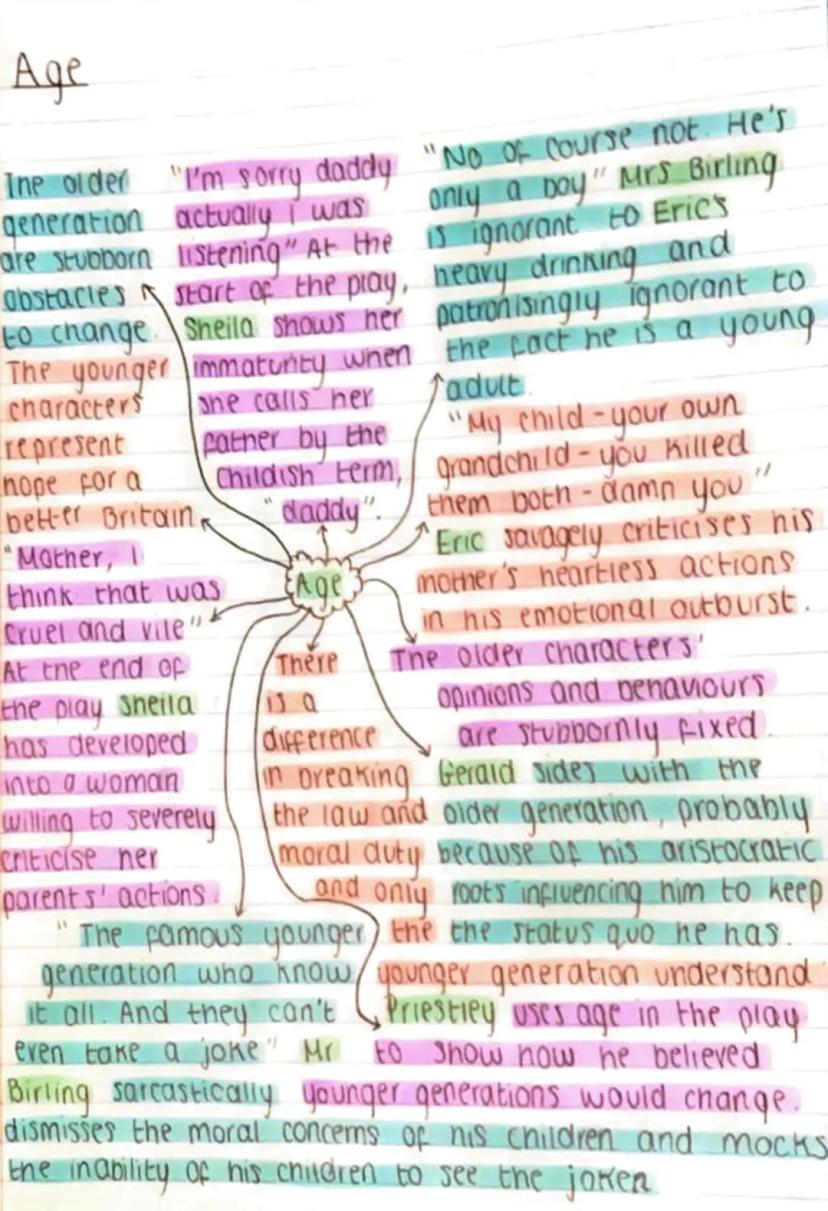
The contrast between generations forms one of the play's most striking themes. The older characters (Mr and Mrs Birling) represent stubborn obstacles to social progress, while the younger generation offers hope for positive change.
At the start, Sheila shows childish traits, calling her father "daddy." By the end, she's transformed into a morally conscious adult willing to challenge her parents: "Mother, I think that was cruel and vile." This development shows Priestley's belief that the younger generation can break from outdated traditions.
Mrs Birling's dismissal of Eric as "only a boy" despite his adult behaviours shows how the older generation refuses to acknowledge reality. Mr Birling mocks his children with "The famous younger generation who know it all. And they can't even take a joke," revealing his inability to take their moral concerns seriously.
Food for thought: Which generation in the play do you relate to most? How do generational differences play out in your own life?
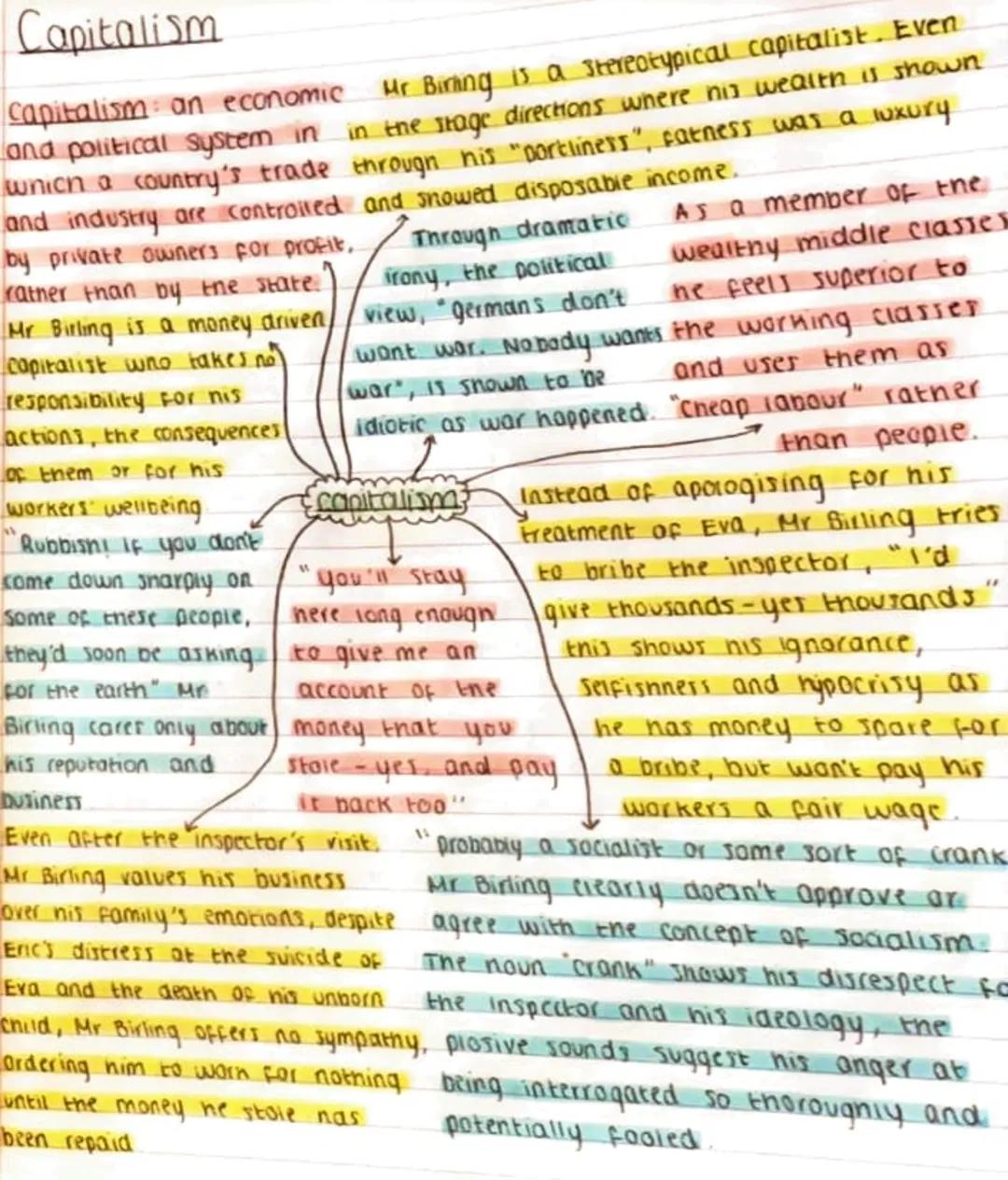
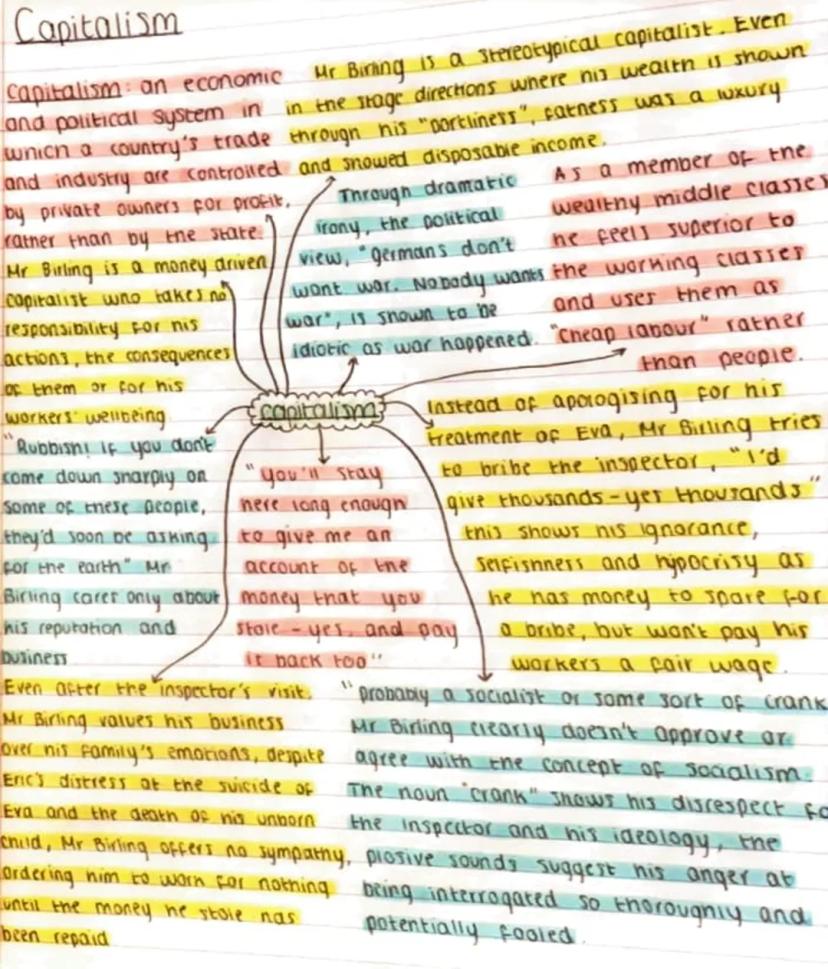
Capitalism shapes everything about Mr Birling's worldview. Even his physical description as "portly" signals his wealth – being overweight was a luxury in 1912 that showed disposable income. He treats workers as "cheap labour" rather than as real people with feelings.
His failed predictions expose his flawed thinking: "Germans don't want war. Nobody wants war" and his praise for the "unsinkable" Titanic. These dramatic ironies make him look foolish to the audience, undermining his capitalist philosophy.
When faced with his treatment of Eva, Mr Birling doesn't show remorse – instead, he tries to bribe the Inspector: "I'd give thousands–yes thousands." This hypocrisy reveals how he has plenty of money for bribes but refuses to pay fair wages. Even after learning of Eva's suicide, he remains fixated on business, ordering Eric to work without pay until he repays stolen money.
Important insight: Priestley deliberately portrays capitalism as cold and heartless through Mr Birling to promote his own socialist values to the audience.
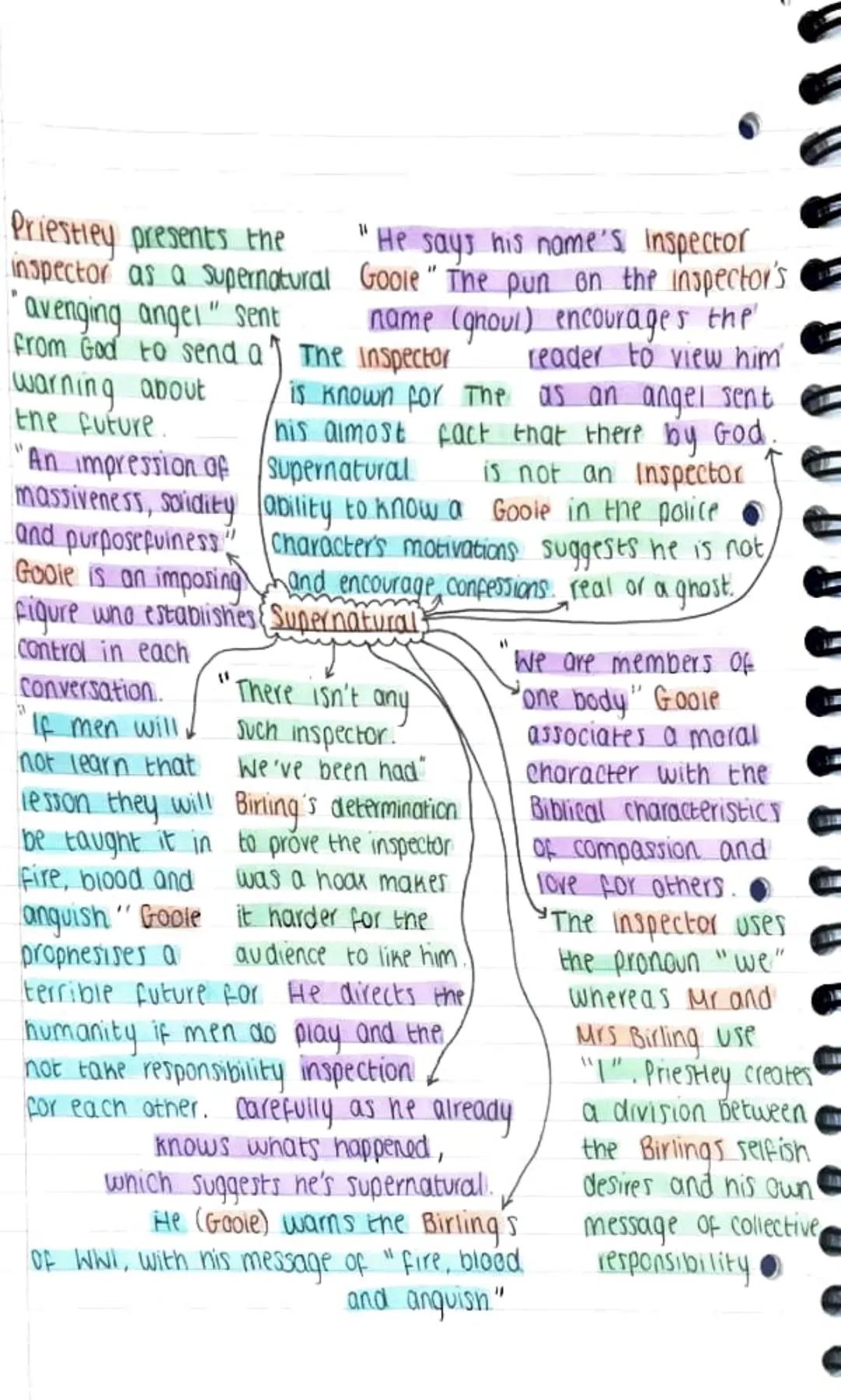
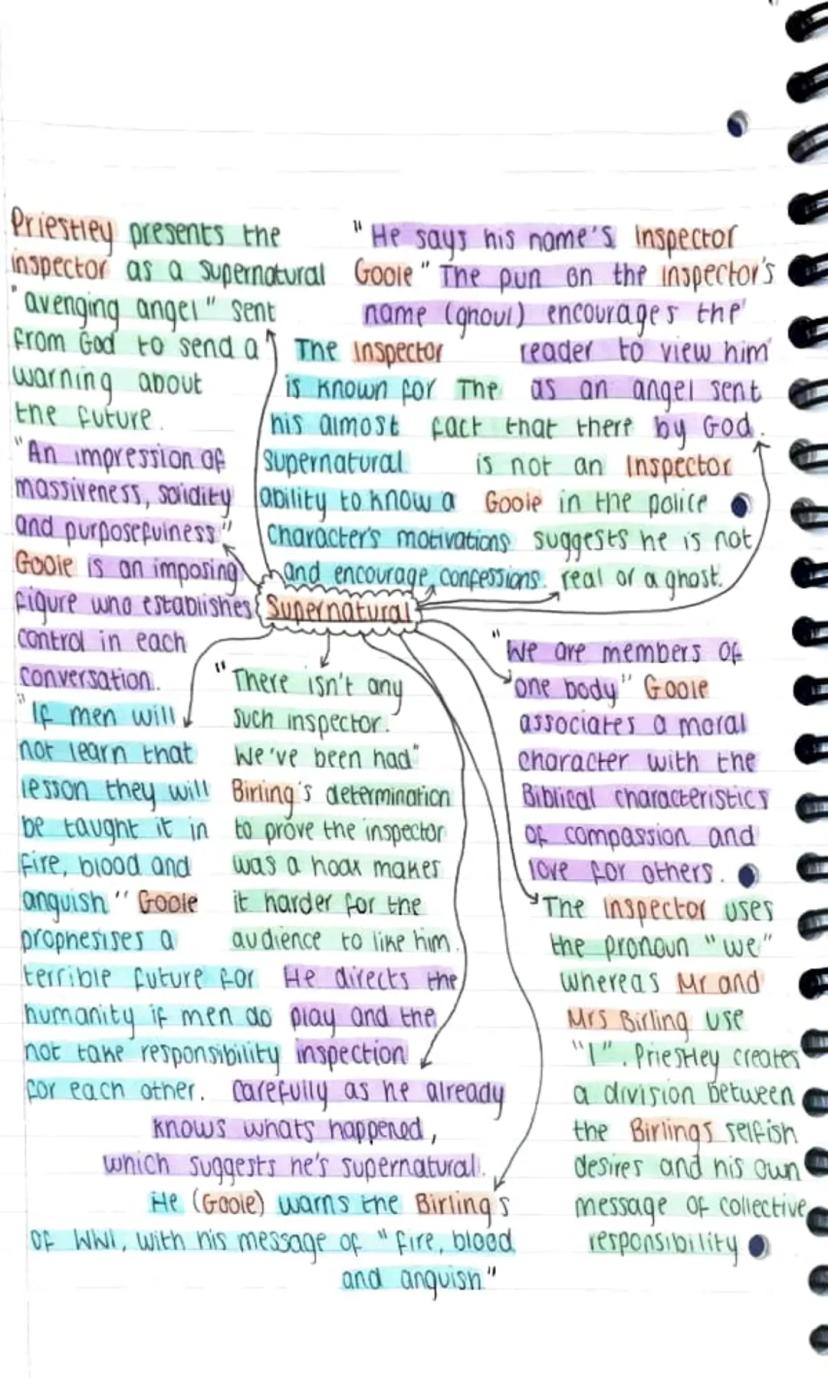
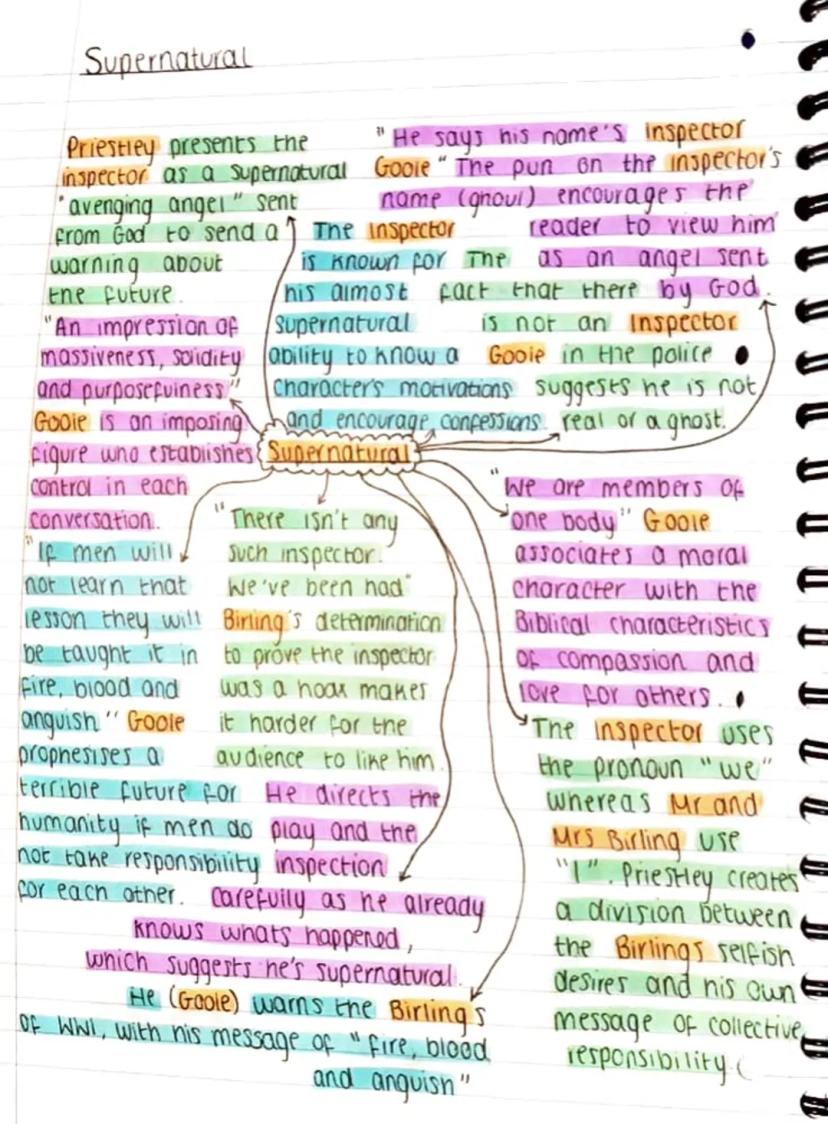
The Inspector isn't your typical police detective. Priestley presents Goole as something otherworldly – possibly "an avenging angel" with supernatural abilities to know characters' motivations and extract confessions.
With his "impression of massiveness, solidity and purposefulness," Inspector Goole commands every conversation with authority. He methodically directs the investigation as if he already knows exactly what happened, suggesting he's not entirely human. The pun on his name ("Goole" sounds like "ghoul") hints at his supernatural nature.
The revelation that "There isn't any such inspector" in the police force confirms our suspicions. Is he a ghost? A time traveller? An angel? His biblical language – "We are members of one body" – and his ominous warning of "fire, blood and anguish" give him a prophetic quality. Unlike the selfish Birlings who use "I," the Inspector uses "we," emphasizing collective responsibility.
Consider this: If the Inspector isn't real in the conventional sense, what does that tell us about the purpose of his visit to the Birlings?
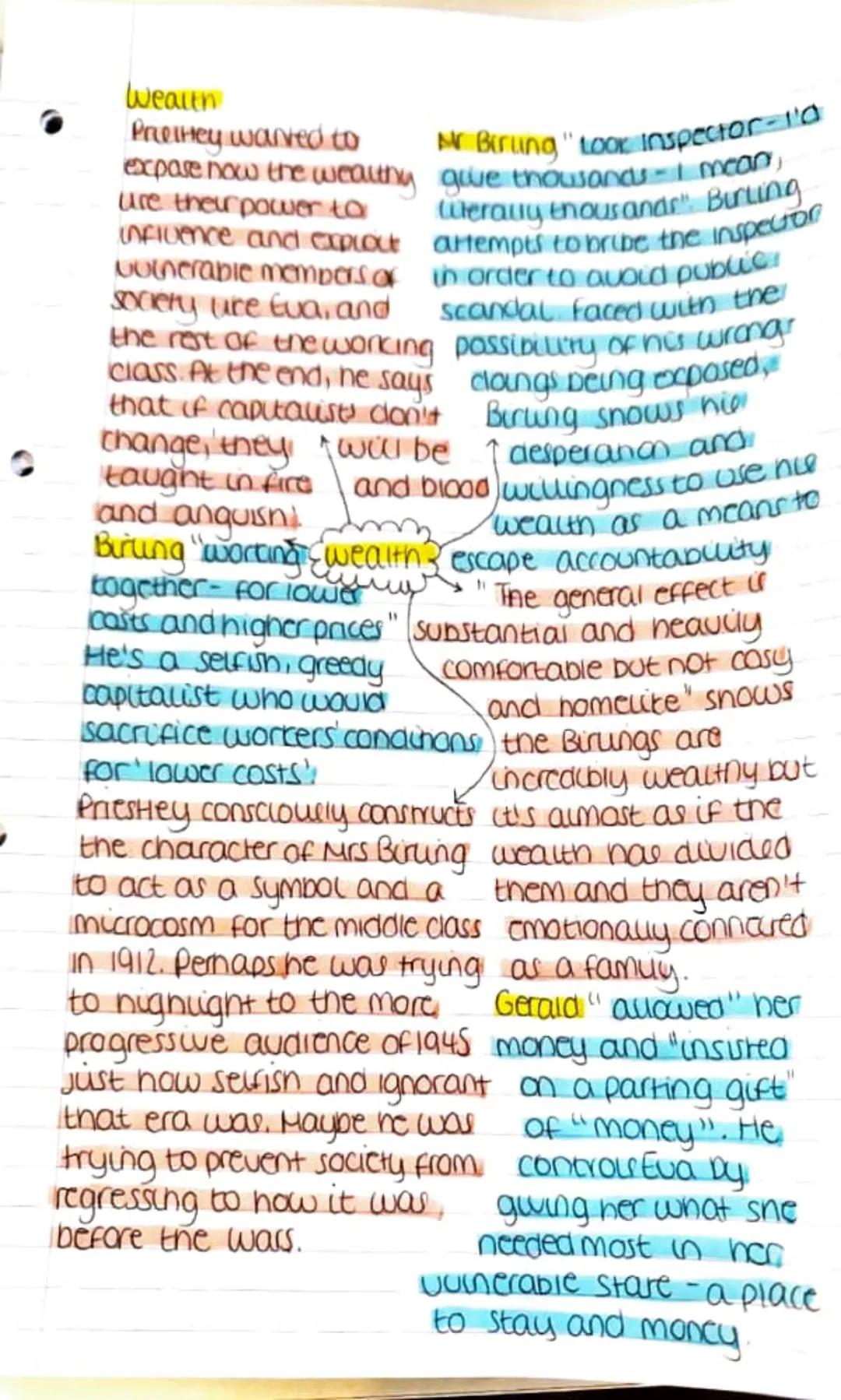
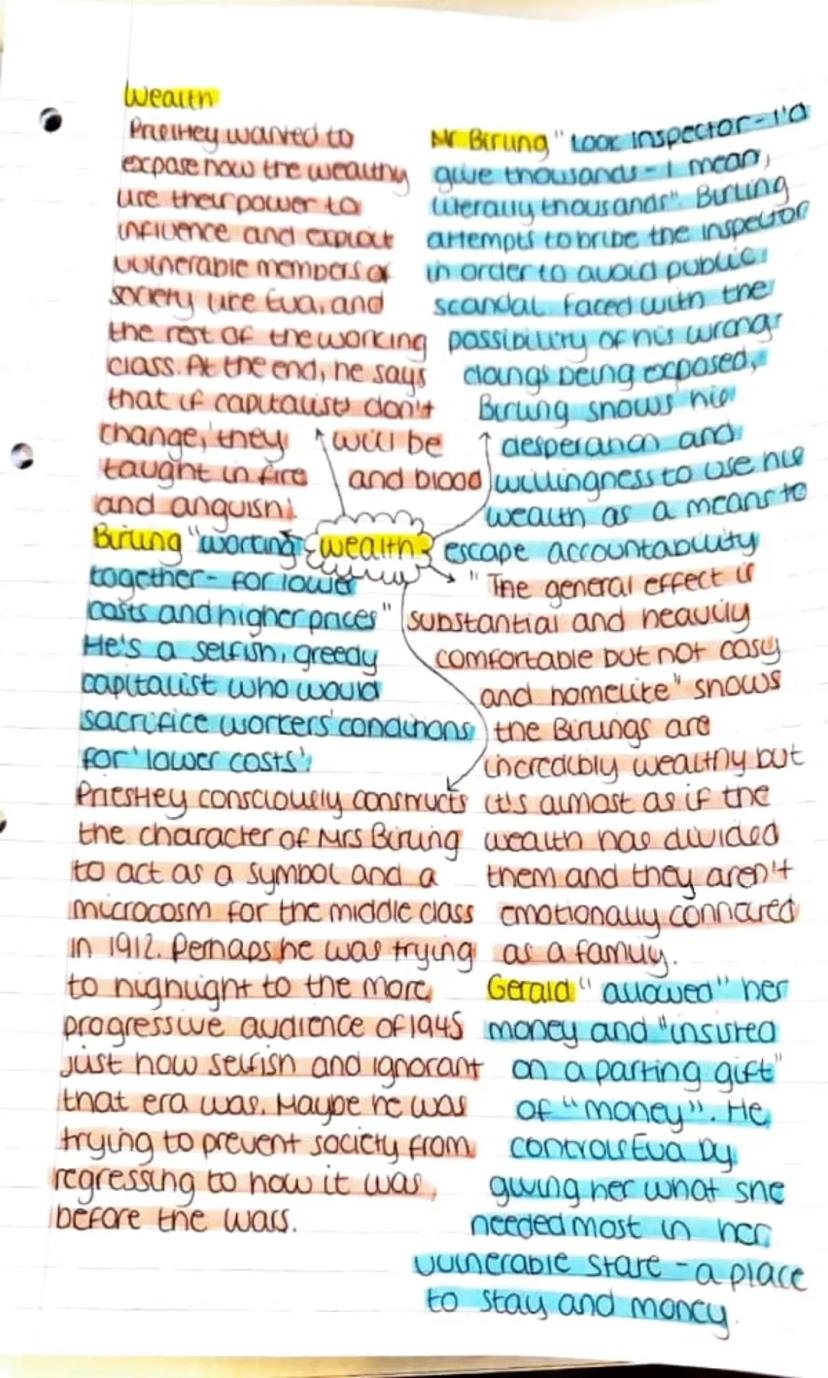
Wealth and power corrupt throughout the play. Priestley shows how the rich use their privilege to exploit vulnerable people like Eva Smith, with devastating consequences. The Birling home is described as "substantial and heavily comfortable but not cosy and homelike" – suggesting their wealth divides rather than unites the family.
Mr Birling's capitalist mindset is laid bare when he discusses "working together for lower costs and higher prices." He prioritizes profit over people's wellbeing, willing to sacrifice workers' conditions to increase his own wealth. When cornered, he immediately tries to use money as an escape: "Look Inspector–I'd give thousands – I mean thousands."
Even Gerald uses his financial position to control Eva, "allowing" her money and "insisting on a parting gift." This shows how the wealthy viewed charity – not as responsibility but as a way to maintain power over those less fortunate. Mrs Birling, through her charity work, represents the hypocritical middle-class attitude that helps the poor only on her own terms.
Think deeper: Does wealth come with responsibility? What obligations do the wealthy have toward the less fortunate in society?
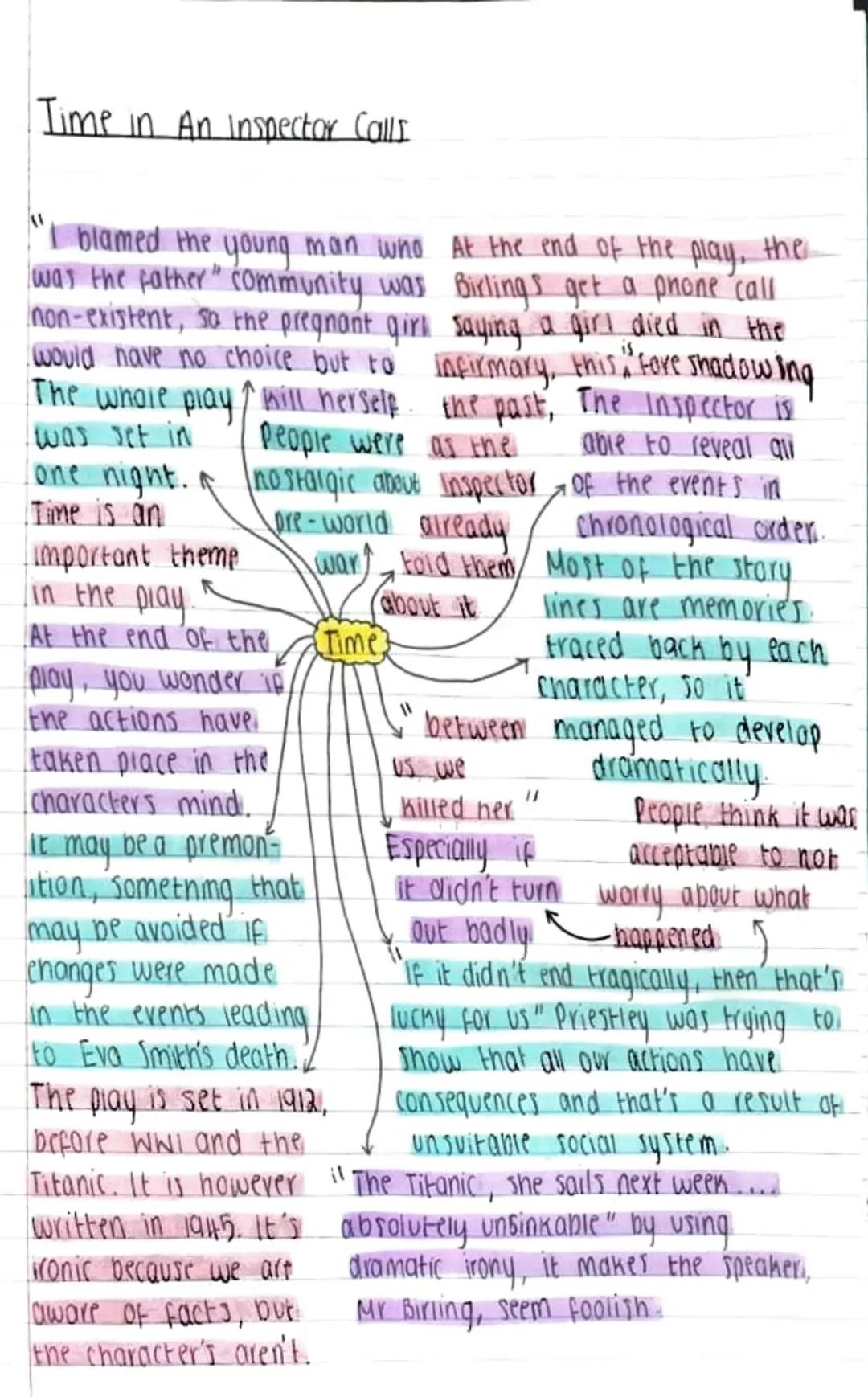
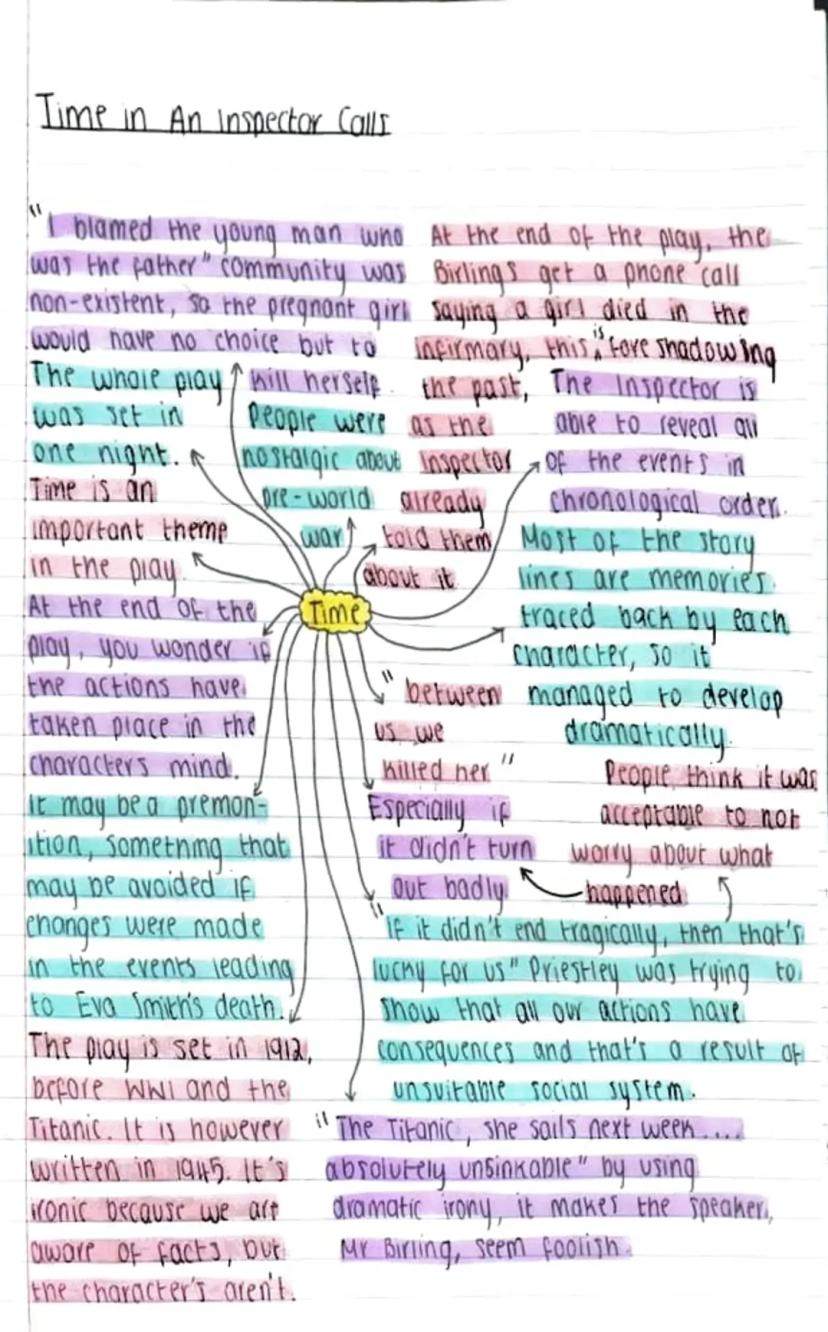
Time works unusually in this play. Though it all happens in a single evening, Priestley plays with chronology in fascinating ways. The Inspector reveals events in perfect chronological order, as if he already knows the full story before anyone speaks.
The play is set in 1912 but written in 1945, creating dramatic irony when Mr Birling praises the "unsinkable" Titanic or claims "Germans don't want war." The audience knows these predictions are tragically wrong, undermining Birling's credibility.
By the end, when the phone rings announcing a real girl's death, we wonder: Was everything we just witnessed a premonition? Something that could still be prevented? The timeline becomes fluid, suggesting the possibility of redemption if the characters change their ways. Birling's dismissive "If it didn't end tragically, then that's lucky for us" shows he still hasn't learned that actions have consequences regardless of outcome.
Mind-bending idea: Consider how Priestley uses time as a character itself. The play exists simultaneously in 1912 and 1945, connecting pre-war complacency with post-war reflection.
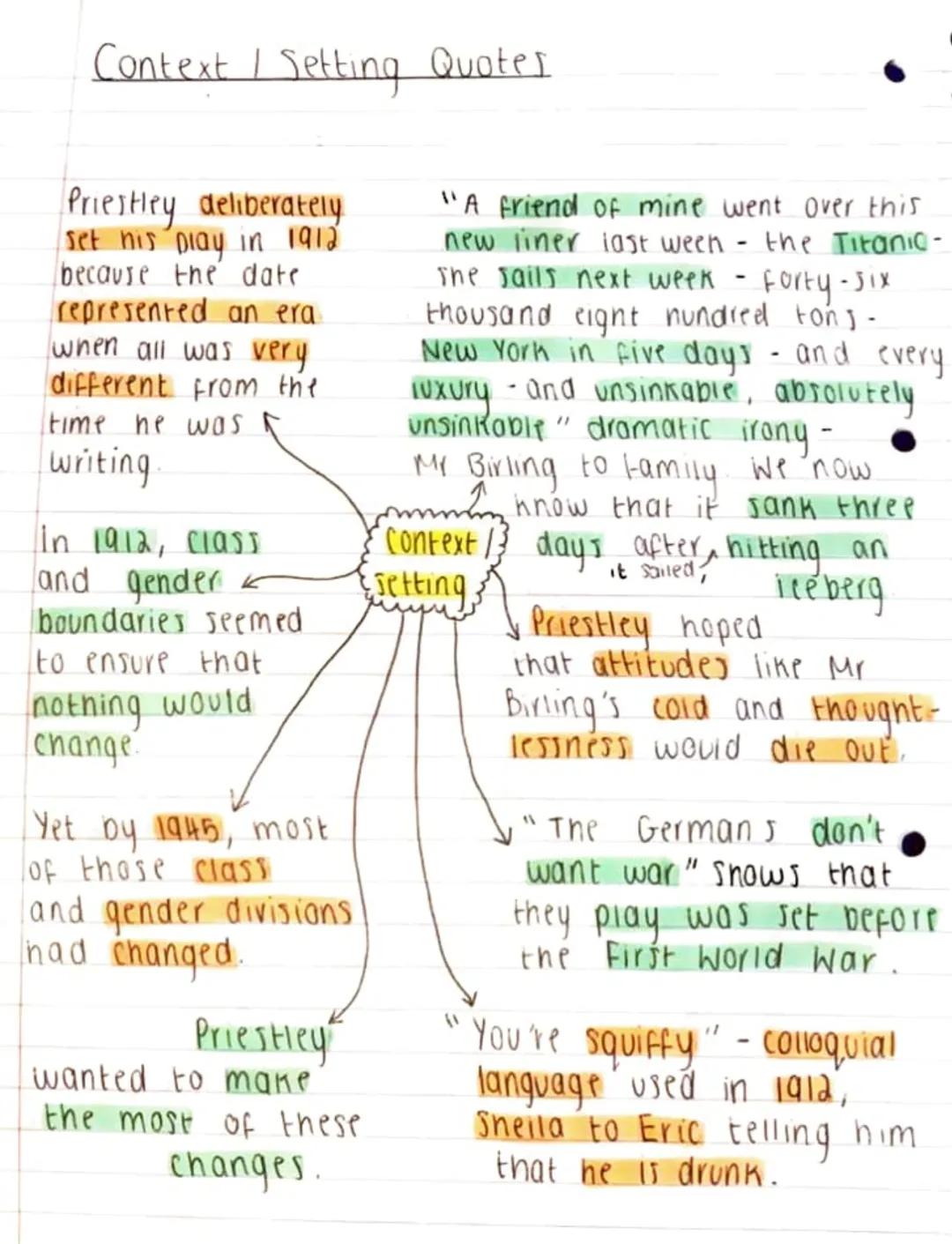
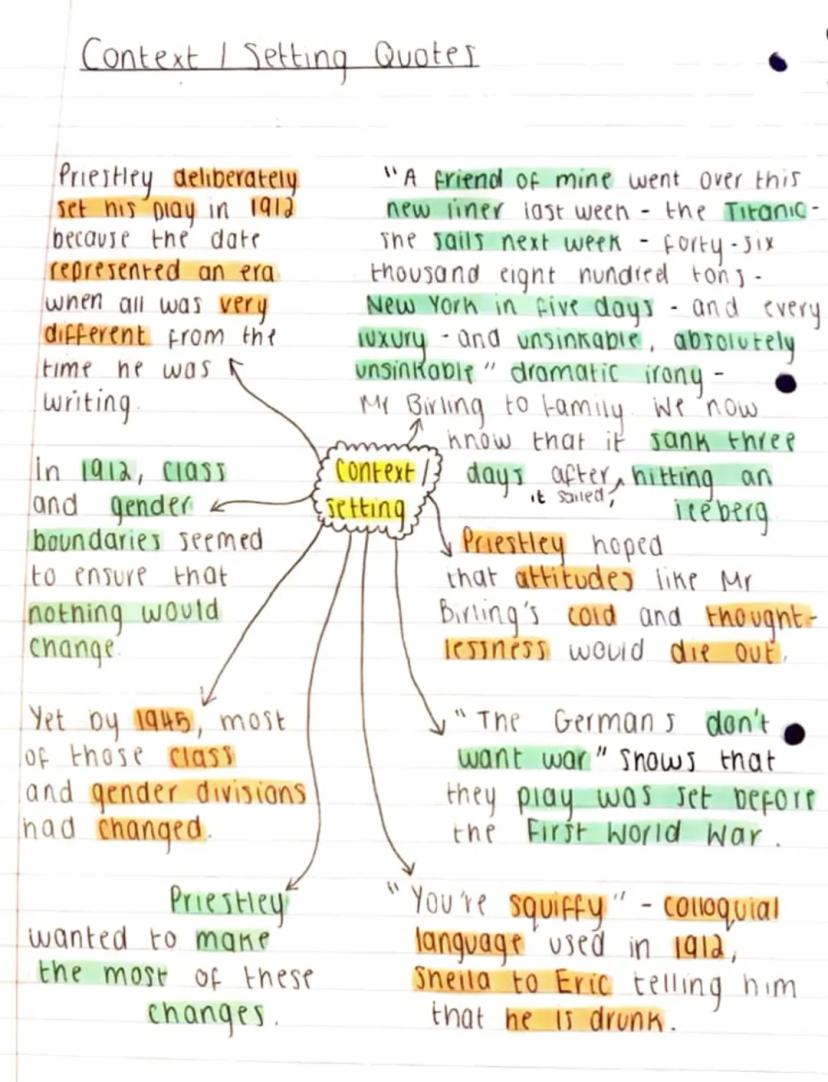
Priestley deliberately chose 1912 as his setting – a time before two World Wars would transform British society. In 1912, rigid class and gender boundaries seemed permanent and unchangeable. By 1945, when he wrote the play, many of these divisions had started breaking down.
The historical setting creates powerful moments of dramatic irony. When Mr Birling confidently states "The Titanic, she sails next week... absolutely unsinkable" or "The Germans don't want war," the audience knows how tragically wrong he is. These misguided predictions make his other views on society seem equally foolish.
Language choices like "You're squiffy" (meaning drunk) root us firmly in 1912 Britain. Priestley hoped that the cold, thoughtless attitudes represented by Mr Birling would die out in the new post-war world. By comparing 1912's rigid social structures with 1945's more egalitarian outlook, he shows his audience how far society had come – and how much further it could still go.
Historical perspective: Remember that audiences in 1945 had just lived through two devastating world wars. How might they have reacted differently to this play than we do today?
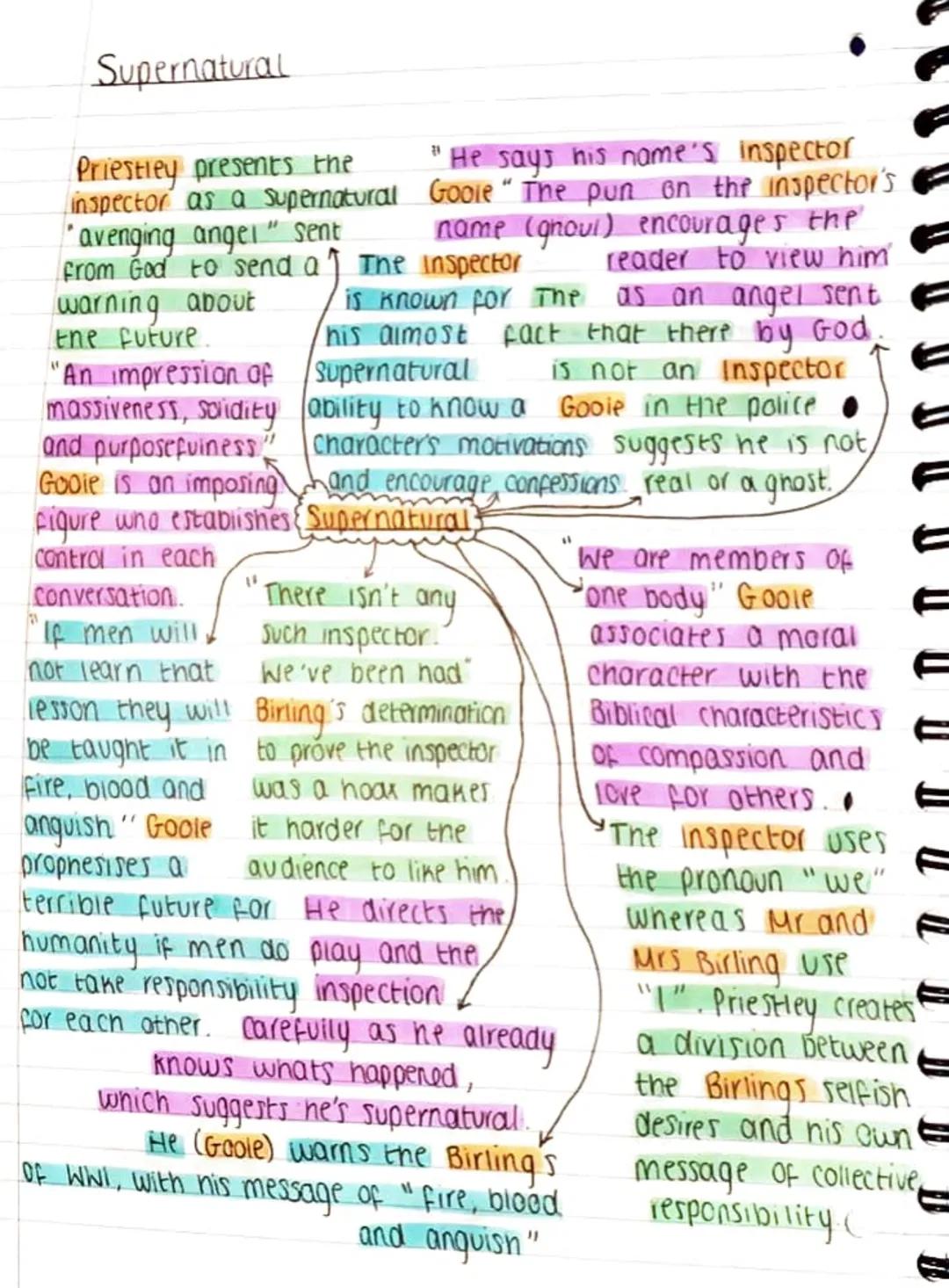
The Inspector brings an otherworldly quality to the play. His very name – "Goole" (sounding like "ghoul") – suggests something supernatural, and Priestley describes him as having "an impression of massiveness, solidity and purposefulness" that sets him apart from ordinary humans.
His uncanny ability to know details before they're revealed and his methodical approach to extracting confessions suggest he exists outside normal time. He directs the "inspection" as if following a script he's already memorized. When Birling later discovers "There isn't any such inspector," our suspicions are confirmed – Goole is not what he seems.
The Inspector's biblical language – "We are members of one body" – and his apocalyptic warning about "fire, blood and anguish" give him the quality of an "avenging angel." Unlike the selfish Birlings who speak using "I," the Inspector consistently uses "we," emphasizing collective responsibility. His final speech predicting world wars serves as a prophetic warning from beyond ordinary time.
Deeper meaning: If the Inspector isn't real in the conventional sense, what does he represent? A manifestation of guilt? Divine judgment? Or perhaps society's conscience?
Our AI Companion is a student-focused AI tool that offers more than just answers. Built on millions of Knowunity resources, it provides relevant information, personalised study plans, quizzes, and content directly in the chat, adapting to your individual learning journey.
You can download the app from Google Play Store and Apple App Store.
That's right! Enjoy free access to study content, connect with fellow students, and get instant help – all at your fingertips.
App Store
Google Play
The app is very easy to use and well designed. I have found everything I was looking for so far and have been able to learn a lot from the presentations! I will definitely use the app for a class assignment! And of course it also helps a lot as an inspiration.
Stefan S
iOS user
This app is really great. There are so many study notes and help [...]. My problem subject is French, for example, and the app has so many options for help. Thanks to this app, I have improved my French. I would recommend it to anyone.
Samantha Klich
Android user
Wow, I am really amazed. I just tried the app because I've seen it advertised many times and was absolutely stunned. This app is THE HELP you want for school and above all, it offers so many things, such as workouts and fact sheets, which have been VERY helpful to me personally.
Anna
iOS user
Best app on earth! no words because it’s too good
Thomas R
iOS user
Just amazing. Let's me revise 10x better, this app is a quick 10/10. I highly recommend it to anyone. I can watch and search for notes. I can save them in the subject folder. I can revise it any time when I come back. If you haven't tried this app, you're really missing out.
Basil
Android user
This app has made me feel so much more confident in my exam prep, not only through boosting my own self confidence through the features that allow you to connect with others and feel less alone, but also through the way the app itself is centred around making you feel better. It is easy to navigate, fun to use, and helpful to anyone struggling in absolutely any way.
David K
iOS user
The app's just great! All I have to do is enter the topic in the search bar and I get the response real fast. I don't have to watch 10 YouTube videos to understand something, so I'm saving my time. Highly recommended!
Sudenaz Ocak
Android user
In school I was really bad at maths but thanks to the app, I am doing better now. I am so grateful that you made the app.
Greenlight Bonnie
Android user
very reliable app to help and grow your ideas of Maths, English and other related topics in your works. please use this app if your struggling in areas, this app is key for that. wish I'd of done a review before. and it's also free so don't worry about that.
Rohan U
Android user
I know a lot of apps use fake accounts to boost their reviews but this app deserves it all. Originally I was getting 4 in my English exams and this time I got a grade 7. I didn’t even know about this app three days until the exam and it has helped A LOT. Please actually trust me and use it as I’m sure you too will see developments.
Xander S
iOS user
THE QUIZES AND FLASHCARDS ARE SO USEFUL AND I LOVE Knowunity AI. IT ALSO IS LITREALLY LIKE CHATGPT BUT SMARTER!! HELPED ME WITH MY MASCARA PROBLEMS TOO!! AS WELL AS MY REAL SUBJECTS ! DUHHH 😍😁😲🤑💗✨🎀😮
Elisha
iOS user
This apps acc the goat. I find revision so boring but this app makes it so easy to organize it all and then you can ask the freeeee ai to test yourself so good and you can easily upload your own stuff. highly recommend as someone taking mocks now
Paul T
iOS user
The app is very easy to use and well designed. I have found everything I was looking for so far and have been able to learn a lot from the presentations! I will definitely use the app for a class assignment! And of course it also helps a lot as an inspiration.
Stefan S
iOS user
This app is really great. There are so many study notes and help [...]. My problem subject is French, for example, and the app has so many options for help. Thanks to this app, I have improved my French. I would recommend it to anyone.
Samantha Klich
Android user
Wow, I am really amazed. I just tried the app because I've seen it advertised many times and was absolutely stunned. This app is THE HELP you want for school and above all, it offers so many things, such as workouts and fact sheets, which have been VERY helpful to me personally.
Anna
iOS user
Best app on earth! no words because it’s too good
Thomas R
iOS user
Just amazing. Let's me revise 10x better, this app is a quick 10/10. I highly recommend it to anyone. I can watch and search for notes. I can save them in the subject folder. I can revise it any time when I come back. If you haven't tried this app, you're really missing out.
Basil
Android user
This app has made me feel so much more confident in my exam prep, not only through boosting my own self confidence through the features that allow you to connect with others and feel less alone, but also through the way the app itself is centred around making you feel better. It is easy to navigate, fun to use, and helpful to anyone struggling in absolutely any way.
David K
iOS user
The app's just great! All I have to do is enter the topic in the search bar and I get the response real fast. I don't have to watch 10 YouTube videos to understand something, so I'm saving my time. Highly recommended!
Sudenaz Ocak
Android user
In school I was really bad at maths but thanks to the app, I am doing better now. I am so grateful that you made the app.
Greenlight Bonnie
Android user
very reliable app to help and grow your ideas of Maths, English and other related topics in your works. please use this app if your struggling in areas, this app is key for that. wish I'd of done a review before. and it's also free so don't worry about that.
Rohan U
Android user
I know a lot of apps use fake accounts to boost their reviews but this app deserves it all. Originally I was getting 4 in my English exams and this time I got a grade 7. I didn’t even know about this app three days until the exam and it has helped A LOT. Please actually trust me and use it as I’m sure you too will see developments.
Xander S
iOS user
THE QUIZES AND FLASHCARDS ARE SO USEFUL AND I LOVE Knowunity AI. IT ALSO IS LITREALLY LIKE CHATGPT BUT SMARTER!! HELPED ME WITH MY MASCARA PROBLEMS TOO!! AS WELL AS MY REAL SUBJECTS ! DUHHH 😍😁😲🤑💗✨🎀😮
Elisha
iOS user
This apps acc the goat. I find revision so boring but this app makes it so easy to organize it all and then you can ask the freeeee ai to test yourself so good and you can easily upload your own stuff. highly recommend as someone taking mocks now
Paul T
iOS user
Abzzy ♡
@abzzy.29
An Inspector Calls explores how our actions affect others through the eyes of the Birling family who are visited by a mysterious inspector investigating a young woman's death. J.B. Priestley uses this dramatic setup to examine class inequality, responsibility, gender... Show more
Access to all documents
Improve your grades
Join milions of students
Ever wonder how the rich viewed the poor in 1912? Priestley shows us through the Birling family's attitudes. Class inequality is a major theme that reveals how the wealthy maintained power over working-class people like Eva Smith.
Mr Birling's statement "If you don't come down sharply on some of these people, they'd soon be asking for the earth" demonstrates his belief that workers should be controlled and kept in their place. He sees punishing the lower classes with low wages as his right and responsibility.
Sheila represents a changing attitude when she says, "But these girls aren't cheap labour, they're people." Her growing socialist sympathies contrast sharply with her father's capitalist mindset.
Think about it: How does your own society treat people from different economic backgrounds? Have things really changed since 1912?
Access to all documents
Improve your grades
Join milions of students
Responsibility sits at the heart of this play. Priestley believed the wealthy had a duty to care for the poor and vulnerable in society – a view that clashes dramatically with the Birling family's attitudes.
Mr Birling represents the selfish capitalist mindset: "A man has to mind his own business and look after himself." This individualistic view is exactly what Priestley criticizes through the story. The older generation – Mr and Mrs Birling – refuse to accept any responsibility for their role in Eva's death.
By contrast, Sheila immediately accepts responsibility for her actions: "I'll never, never do it again. I'm desperately sorry." Her transformation shows that change is possible. The Inspector serves as Priestley's voice when he declares, "We are responsible for each other" – the central message of the entire play.
Remember: The play was written after two World Wars when society was reconsidering how people should treat each other. This context matters!
Access to all documents
Improve your grades
Join milions of students
Gender roles in 1912 were rigid and unfair – something Priestley highlights through several characters. Men like Gerald show their sexism openly, saying "I hate those hard-eyed dough-faced women," revealing how women were judged primarily on appearance.
Mr Birling's comment that "Clothes mean something quite different to a woman" shows how men objectified women and made assumptions about their priorities. Women were seen as delicate creatures needing protection – the men try to shield Sheila from the details of Eva's suicide.
The power dynamics shift dramatically when Sheila confronts Gerald: "You knew her straight away very well. Otherwise, you wouldn't look so guilty." This moment shows Sheila breaking free from traditional gender expectations. Meanwhile, Eric's admission that Eva "was pretty and a good sport" reveals his shallow, misogynistic attitude toward women.
Challenge yourself: Notice how the female characters develop throughout the play while the male characters mostly stay fixed in their views. Why might Priestley have structured it this way?
Access to all documents
Improve your grades
Join milions of students
The contrast between generations forms one of the play's most striking themes. The older characters (Mr and Mrs Birling) represent stubborn obstacles to social progress, while the younger generation offers hope for positive change.
At the start, Sheila shows childish traits, calling her father "daddy." By the end, she's transformed into a morally conscious adult willing to challenge her parents: "Mother, I think that was cruel and vile." This development shows Priestley's belief that the younger generation can break from outdated traditions.
Mrs Birling's dismissal of Eric as "only a boy" despite his adult behaviours shows how the older generation refuses to acknowledge reality. Mr Birling mocks his children with "The famous younger generation who know it all. And they can't even take a joke," revealing his inability to take their moral concerns seriously.
Food for thought: Which generation in the play do you relate to most? How do generational differences play out in your own life?
Access to all documents
Improve your grades
Join milions of students
Capitalism shapes everything about Mr Birling's worldview. Even his physical description as "portly" signals his wealth – being overweight was a luxury in 1912 that showed disposable income. He treats workers as "cheap labour" rather than as real people with feelings.
His failed predictions expose his flawed thinking: "Germans don't want war. Nobody wants war" and his praise for the "unsinkable" Titanic. These dramatic ironies make him look foolish to the audience, undermining his capitalist philosophy.
When faced with his treatment of Eva, Mr Birling doesn't show remorse – instead, he tries to bribe the Inspector: "I'd give thousands–yes thousands." This hypocrisy reveals how he has plenty of money for bribes but refuses to pay fair wages. Even after learning of Eva's suicide, he remains fixated on business, ordering Eric to work without pay until he repays stolen money.
Important insight: Priestley deliberately portrays capitalism as cold and heartless through Mr Birling to promote his own socialist values to the audience.
Access to all documents
Improve your grades
Join milions of students
The Inspector isn't your typical police detective. Priestley presents Goole as something otherworldly – possibly "an avenging angel" with supernatural abilities to know characters' motivations and extract confessions.
With his "impression of massiveness, solidity and purposefulness," Inspector Goole commands every conversation with authority. He methodically directs the investigation as if he already knows exactly what happened, suggesting he's not entirely human. The pun on his name ("Goole" sounds like "ghoul") hints at his supernatural nature.
The revelation that "There isn't any such inspector" in the police force confirms our suspicions. Is he a ghost? A time traveller? An angel? His biblical language – "We are members of one body" – and his ominous warning of "fire, blood and anguish" give him a prophetic quality. Unlike the selfish Birlings who use "I," the Inspector uses "we," emphasizing collective responsibility.
Consider this: If the Inspector isn't real in the conventional sense, what does that tell us about the purpose of his visit to the Birlings?
Access to all documents
Improve your grades
Join milions of students
Wealth and power corrupt throughout the play. Priestley shows how the rich use their privilege to exploit vulnerable people like Eva Smith, with devastating consequences. The Birling home is described as "substantial and heavily comfortable but not cosy and homelike" – suggesting their wealth divides rather than unites the family.
Mr Birling's capitalist mindset is laid bare when he discusses "working together for lower costs and higher prices." He prioritizes profit over people's wellbeing, willing to sacrifice workers' conditions to increase his own wealth. When cornered, he immediately tries to use money as an escape: "Look Inspector–I'd give thousands – I mean thousands."
Even Gerald uses his financial position to control Eva, "allowing" her money and "insisting on a parting gift." This shows how the wealthy viewed charity – not as responsibility but as a way to maintain power over those less fortunate. Mrs Birling, through her charity work, represents the hypocritical middle-class attitude that helps the poor only on her own terms.
Think deeper: Does wealth come with responsibility? What obligations do the wealthy have toward the less fortunate in society?
Access to all documents
Improve your grades
Join milions of students
Time works unusually in this play. Though it all happens in a single evening, Priestley plays with chronology in fascinating ways. The Inspector reveals events in perfect chronological order, as if he already knows the full story before anyone speaks.
The play is set in 1912 but written in 1945, creating dramatic irony when Mr Birling praises the "unsinkable" Titanic or claims "Germans don't want war." The audience knows these predictions are tragically wrong, undermining Birling's credibility.
By the end, when the phone rings announcing a real girl's death, we wonder: Was everything we just witnessed a premonition? Something that could still be prevented? The timeline becomes fluid, suggesting the possibility of redemption if the characters change their ways. Birling's dismissive "If it didn't end tragically, then that's lucky for us" shows he still hasn't learned that actions have consequences regardless of outcome.
Mind-bending idea: Consider how Priestley uses time as a character itself. The play exists simultaneously in 1912 and 1945, connecting pre-war complacency with post-war reflection.
Access to all documents
Improve your grades
Join milions of students
Priestley deliberately chose 1912 as his setting – a time before two World Wars would transform British society. In 1912, rigid class and gender boundaries seemed permanent and unchangeable. By 1945, when he wrote the play, many of these divisions had started breaking down.
The historical setting creates powerful moments of dramatic irony. When Mr Birling confidently states "The Titanic, she sails next week... absolutely unsinkable" or "The Germans don't want war," the audience knows how tragically wrong he is. These misguided predictions make his other views on society seem equally foolish.
Language choices like "You're squiffy" (meaning drunk) root us firmly in 1912 Britain. Priestley hoped that the cold, thoughtless attitudes represented by Mr Birling would die out in the new post-war world. By comparing 1912's rigid social structures with 1945's more egalitarian outlook, he shows his audience how far society had come – and how much further it could still go.
Historical perspective: Remember that audiences in 1945 had just lived through two devastating world wars. How might they have reacted differently to this play than we do today?
Access to all documents
Improve your grades
Join milions of students
The Inspector brings an otherworldly quality to the play. His very name – "Goole" (sounding like "ghoul") – suggests something supernatural, and Priestley describes him as having "an impression of massiveness, solidity and purposefulness" that sets him apart from ordinary humans.
His uncanny ability to know details before they're revealed and his methodical approach to extracting confessions suggest he exists outside normal time. He directs the "inspection" as if following a script he's already memorized. When Birling later discovers "There isn't any such inspector," our suspicions are confirmed – Goole is not what he seems.
The Inspector's biblical language – "We are members of one body" – and his apocalyptic warning about "fire, blood and anguish" give him the quality of an "avenging angel." Unlike the selfish Birlings who speak using "I," the Inspector consistently uses "we," emphasizing collective responsibility. His final speech predicting world wars serves as a prophetic warning from beyond ordinary time.
Deeper meaning: If the Inspector isn't real in the conventional sense, what does he represent? A manifestation of guilt? Divine judgment? Or perhaps society's conscience?
Our AI Companion is a student-focused AI tool that offers more than just answers. Built on millions of Knowunity resources, it provides relevant information, personalised study plans, quizzes, and content directly in the chat, adapting to your individual learning journey.
You can download the app from Google Play Store and Apple App Store.
That's right! Enjoy free access to study content, connect with fellow students, and get instant help – all at your fingertips.
40
Smart Tools NEW
Transform this note into: ✓ 50+ Practice Questions ✓ Interactive Flashcards ✓ Full Mock Exam ✓ Essay Outlines
App Store
Google Play
The app is very easy to use and well designed. I have found everything I was looking for so far and have been able to learn a lot from the presentations! I will definitely use the app for a class assignment! And of course it also helps a lot as an inspiration.
Stefan S
iOS user
This app is really great. There are so many study notes and help [...]. My problem subject is French, for example, and the app has so many options for help. Thanks to this app, I have improved my French. I would recommend it to anyone.
Samantha Klich
Android user
Wow, I am really amazed. I just tried the app because I've seen it advertised many times and was absolutely stunned. This app is THE HELP you want for school and above all, it offers so many things, such as workouts and fact sheets, which have been VERY helpful to me personally.
Anna
iOS user
Best app on earth! no words because it’s too good
Thomas R
iOS user
Just amazing. Let's me revise 10x better, this app is a quick 10/10. I highly recommend it to anyone. I can watch and search for notes. I can save them in the subject folder. I can revise it any time when I come back. If you haven't tried this app, you're really missing out.
Basil
Android user
This app has made me feel so much more confident in my exam prep, not only through boosting my own self confidence through the features that allow you to connect with others and feel less alone, but also through the way the app itself is centred around making you feel better. It is easy to navigate, fun to use, and helpful to anyone struggling in absolutely any way.
David K
iOS user
The app's just great! All I have to do is enter the topic in the search bar and I get the response real fast. I don't have to watch 10 YouTube videos to understand something, so I'm saving my time. Highly recommended!
Sudenaz Ocak
Android user
In school I was really bad at maths but thanks to the app, I am doing better now. I am so grateful that you made the app.
Greenlight Bonnie
Android user
very reliable app to help and grow your ideas of Maths, English and other related topics in your works. please use this app if your struggling in areas, this app is key for that. wish I'd of done a review before. and it's also free so don't worry about that.
Rohan U
Android user
I know a lot of apps use fake accounts to boost their reviews but this app deserves it all. Originally I was getting 4 in my English exams and this time I got a grade 7. I didn’t even know about this app three days until the exam and it has helped A LOT. Please actually trust me and use it as I’m sure you too will see developments.
Xander S
iOS user
THE QUIZES AND FLASHCARDS ARE SO USEFUL AND I LOVE Knowunity AI. IT ALSO IS LITREALLY LIKE CHATGPT BUT SMARTER!! HELPED ME WITH MY MASCARA PROBLEMS TOO!! AS WELL AS MY REAL SUBJECTS ! DUHHH 😍😁😲🤑💗✨🎀😮
Elisha
iOS user
This apps acc the goat. I find revision so boring but this app makes it so easy to organize it all and then you can ask the freeeee ai to test yourself so good and you can easily upload your own stuff. highly recommend as someone taking mocks now
Paul T
iOS user
The app is very easy to use and well designed. I have found everything I was looking for so far and have been able to learn a lot from the presentations! I will definitely use the app for a class assignment! And of course it also helps a lot as an inspiration.
Stefan S
iOS user
This app is really great. There are so many study notes and help [...]. My problem subject is French, for example, and the app has so many options for help. Thanks to this app, I have improved my French. I would recommend it to anyone.
Samantha Klich
Android user
Wow, I am really amazed. I just tried the app because I've seen it advertised many times and was absolutely stunned. This app is THE HELP you want for school and above all, it offers so many things, such as workouts and fact sheets, which have been VERY helpful to me personally.
Anna
iOS user
Best app on earth! no words because it’s too good
Thomas R
iOS user
Just amazing. Let's me revise 10x better, this app is a quick 10/10. I highly recommend it to anyone. I can watch and search for notes. I can save them in the subject folder. I can revise it any time when I come back. If you haven't tried this app, you're really missing out.
Basil
Android user
This app has made me feel so much more confident in my exam prep, not only through boosting my own self confidence through the features that allow you to connect with others and feel less alone, but also through the way the app itself is centred around making you feel better. It is easy to navigate, fun to use, and helpful to anyone struggling in absolutely any way.
David K
iOS user
The app's just great! All I have to do is enter the topic in the search bar and I get the response real fast. I don't have to watch 10 YouTube videos to understand something, so I'm saving my time. Highly recommended!
Sudenaz Ocak
Android user
In school I was really bad at maths but thanks to the app, I am doing better now. I am so grateful that you made the app.
Greenlight Bonnie
Android user
very reliable app to help and grow your ideas of Maths, English and other related topics in your works. please use this app if your struggling in areas, this app is key for that. wish I'd of done a review before. and it's also free so don't worry about that.
Rohan U
Android user
I know a lot of apps use fake accounts to boost their reviews but this app deserves it all. Originally I was getting 4 in my English exams and this time I got a grade 7. I didn’t even know about this app three days until the exam and it has helped A LOT. Please actually trust me and use it as I’m sure you too will see developments.
Xander S
iOS user
THE QUIZES AND FLASHCARDS ARE SO USEFUL AND I LOVE Knowunity AI. IT ALSO IS LITREALLY LIKE CHATGPT BUT SMARTER!! HELPED ME WITH MY MASCARA PROBLEMS TOO!! AS WELL AS MY REAL SUBJECTS ! DUHHH 😍😁😲🤑💗✨🎀😮
Elisha
iOS user
This apps acc the goat. I find revision so boring but this app makes it so easy to organize it all and then you can ask the freeeee ai to test yourself so good and you can easily upload your own stuff. highly recommend as someone taking mocks now
Paul T
iOS user