
Mary Shelley's Frankenstein and Kazuo Ishiguro's Never Let Me Go... Show more
 English Literature
 Biology
 Sociology
Sign up to see the contentIt's free!
Access to all documents
Improve your grades
Join milions of students
By signing up you accept Terms of Service and Privacy Policy
Subjects
Classic Dramatic Literature
Modern Lyric Poetry
Influential English-Language Authors
Classic and Contemporary Novels
Literary Character Analysis
Romantic and Love Poetry
Reading Analysis and Interpretation
Evidence Analysis and Integration
Author's Stylistic Elements
Figurative Language and Rhetoric
Show all topics
Human Organ Systems
Cellular Organization and Development
Biomolecular Structure and Organization
Enzyme Structure and Regulation
Cellular Organization Types
Biological Homeostatic Processes
Cellular Membrane Structure
Autotrophic Energy Processes
Environmental Sustainability and Impact
Neural Communication Systems
Show all topics
Social Sciences Research & Practice
Social Structure and Mobility
Classic Social Influence Experiments
Social Systems Theories
Family and Relationship Dynamics
Memory Systems and Processes
Neural Bases of Behavior
Social Influence and Attraction
Psychotherapeutic Approaches
Human Agency and Responsibility
Show all topics
Chemical Sciences and Applications
Chemical Bond Types and Properties
Organic Functional Groups
Atomic Structure and Composition
Chromatographic Separation Principles
Chemical Compound Classifications
Electrochemical Cell Systems
Periodic Table Organization
Chemical Reaction Kinetics
Chemical Equation Conservation
Show all topics
Nazi Germany and Holocaust 1933-1945
World Wars and Peace Treaties
European Monarchs and Statesmen
Cold War Global Tensions
Medieval Institutions and Systems
European Renaissance and Enlightenment
Modern Global Environmental-Health Challenges
Modern Military Conflicts
Medieval Migration and Invasions
World Wars Era and Impact
Show all topics
58
•
28 Dec 2025
•
millie
@millie_xmtr
Mary Shelley's Frankenstein and Kazuo Ishiguro's Never Let Me Go... Show more
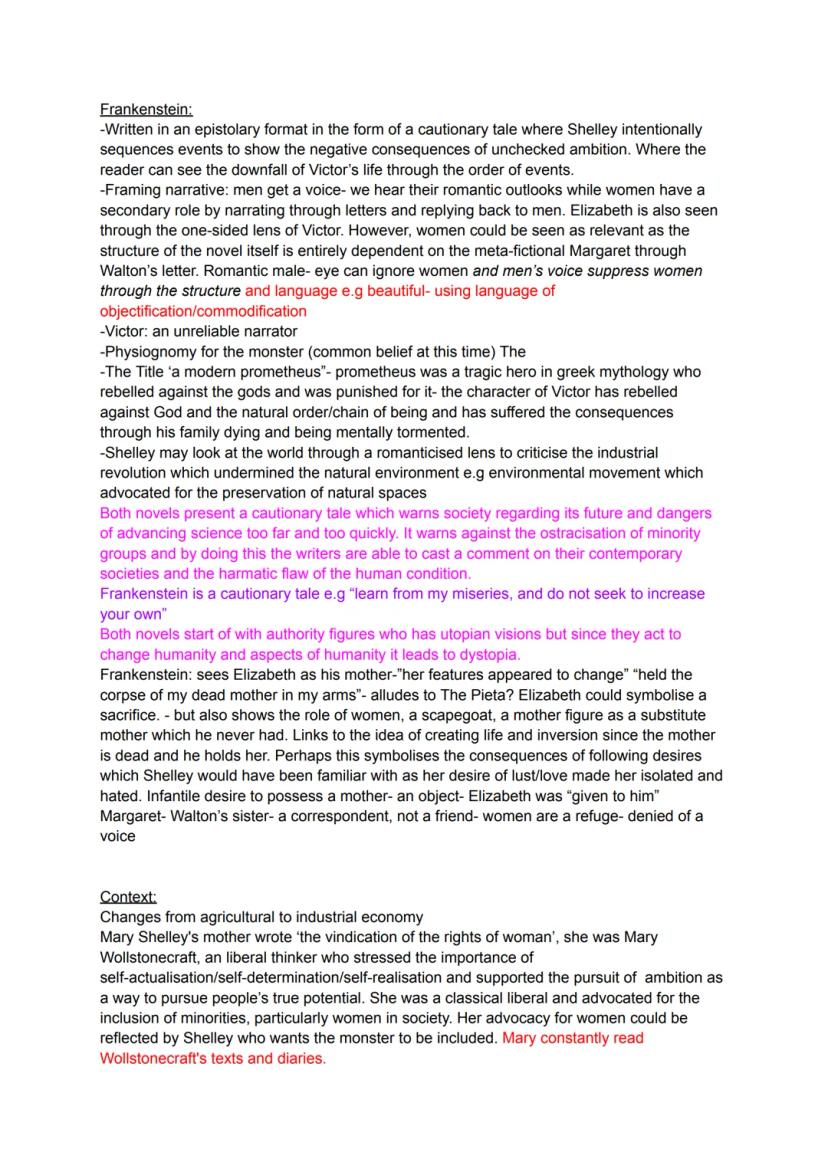

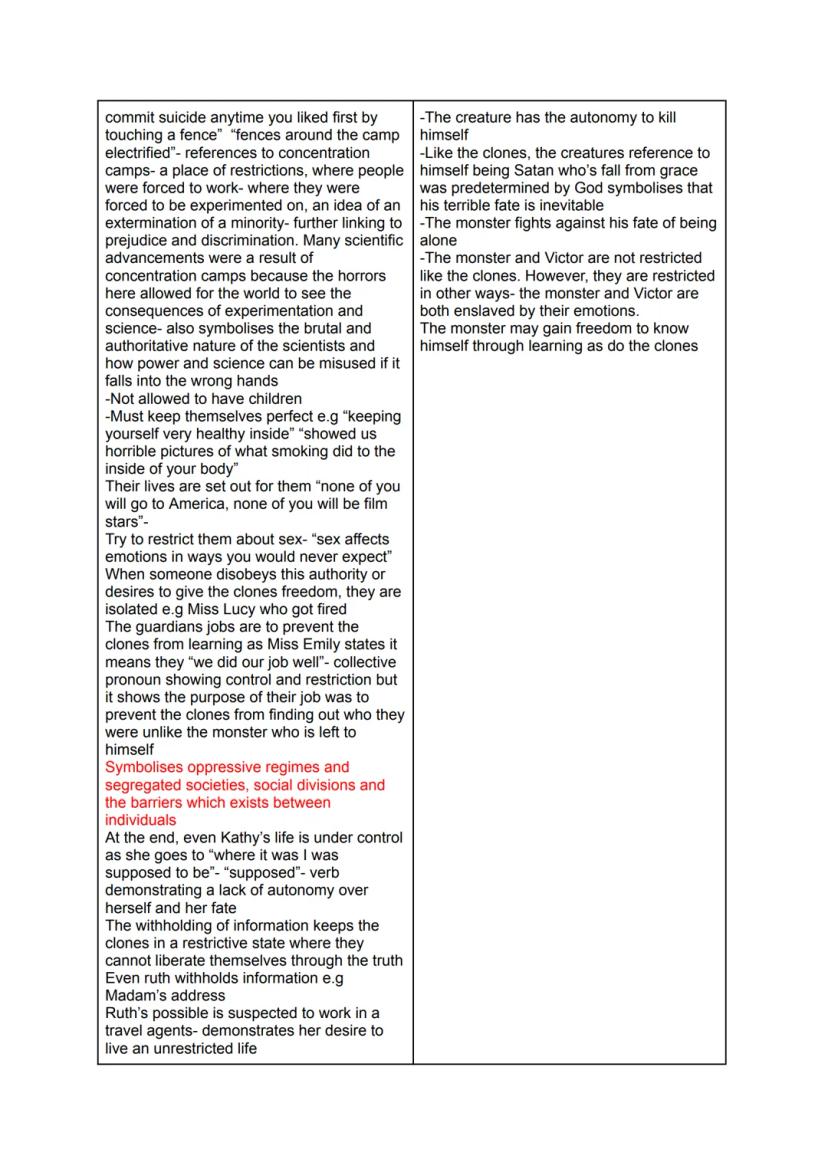
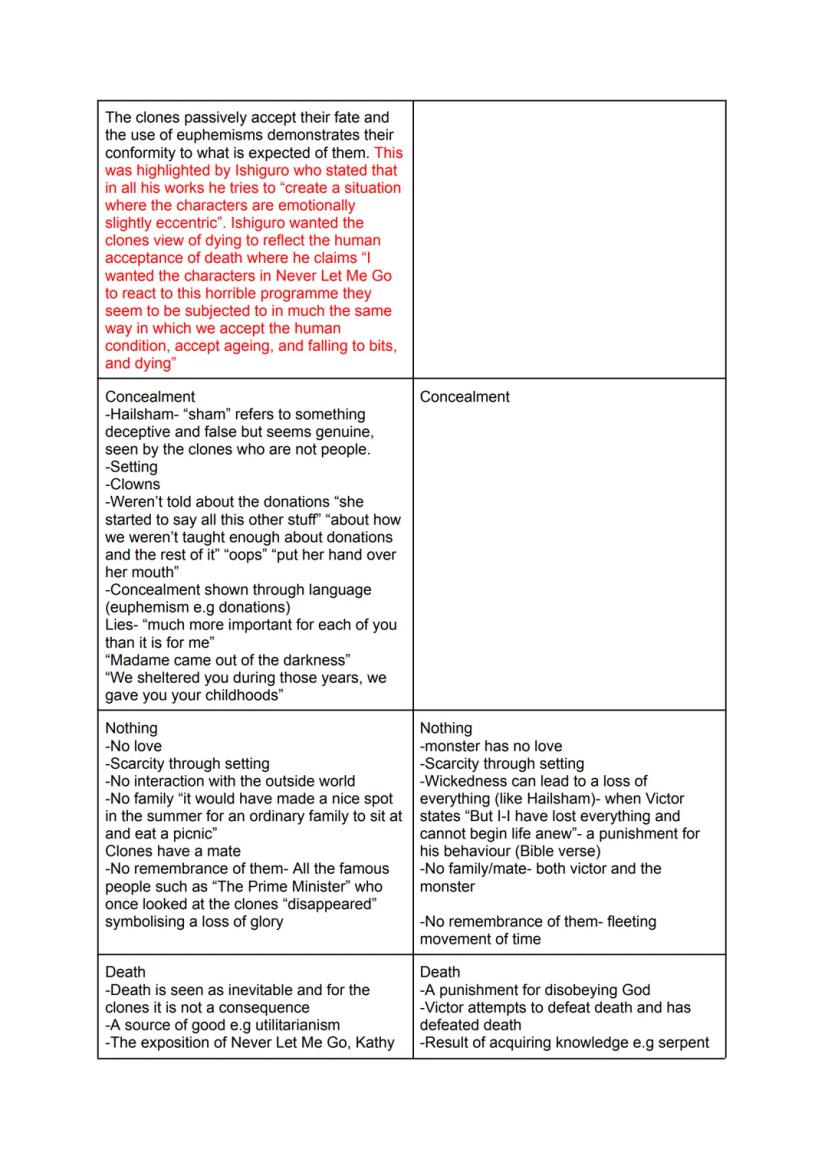
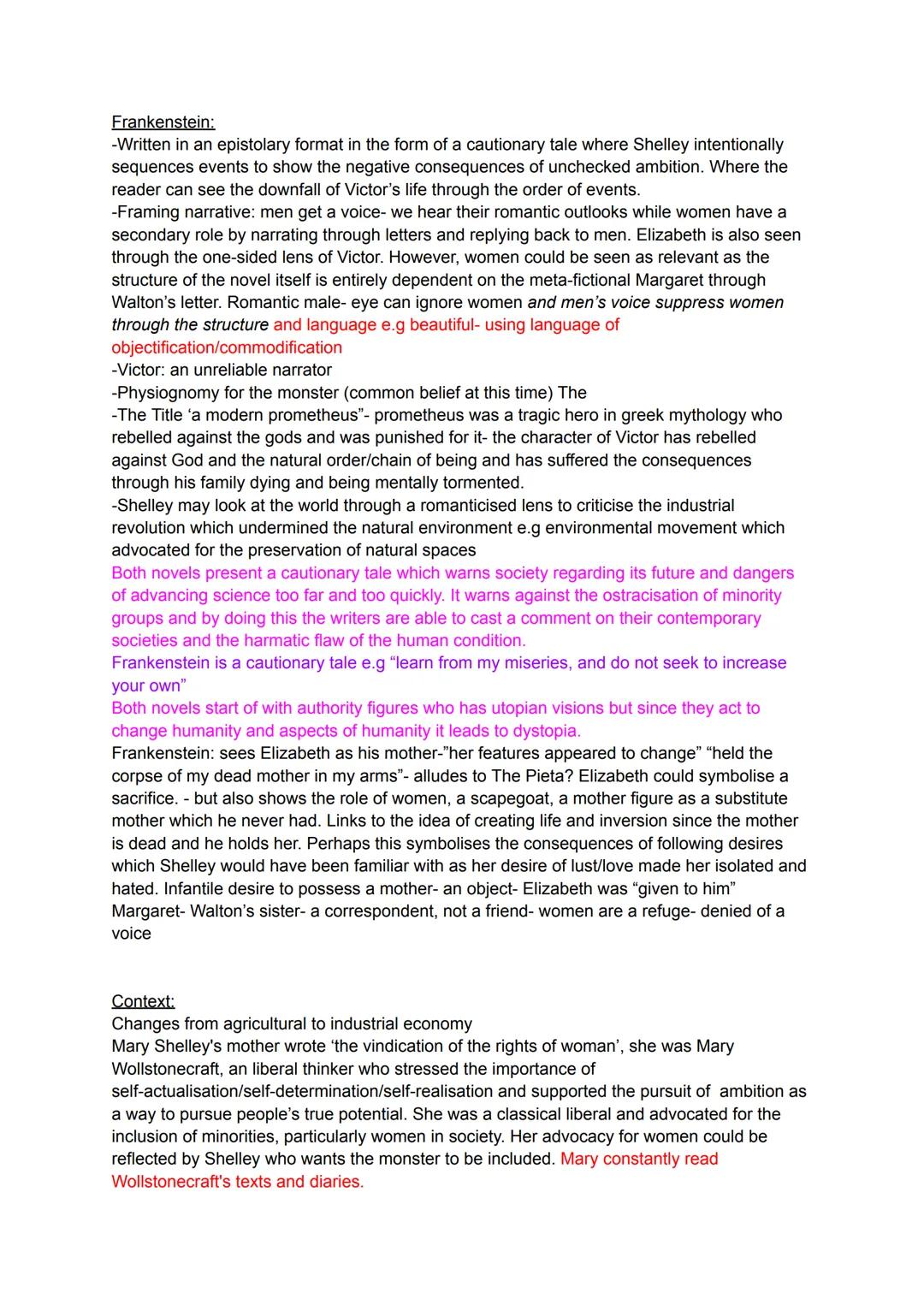
Frankenstein uses an epistolary format (told through letters) to create a cautionary tale about unchecked ambition. Shelley deliberately sequences events to show how Victor's life spirals downward due to his dangerous scientific pursuits.
The novel's framing narrative gives men the dominant voice whilst women remain secondary. Elizabeth exists only through Victor's perspective, and women communicate through letters rather than direct narration. However, the entire story depends on Margaret (Walton's sister), showing women's hidden importance in the structure itself.
Victor serves as an unreliable narrator, and Shelley connects him to the subtitle "The Modern Prometheus." In Greek mythology, Prometheus rebelled against the gods and faced punishment - just like Victor, who rebels against God and the natural order, suffering through his family's deaths and mental torment.
Key Point: The novel critiques the Industrial Revolution through a Romantic lens, advocating for environmental preservation over technological advancement.
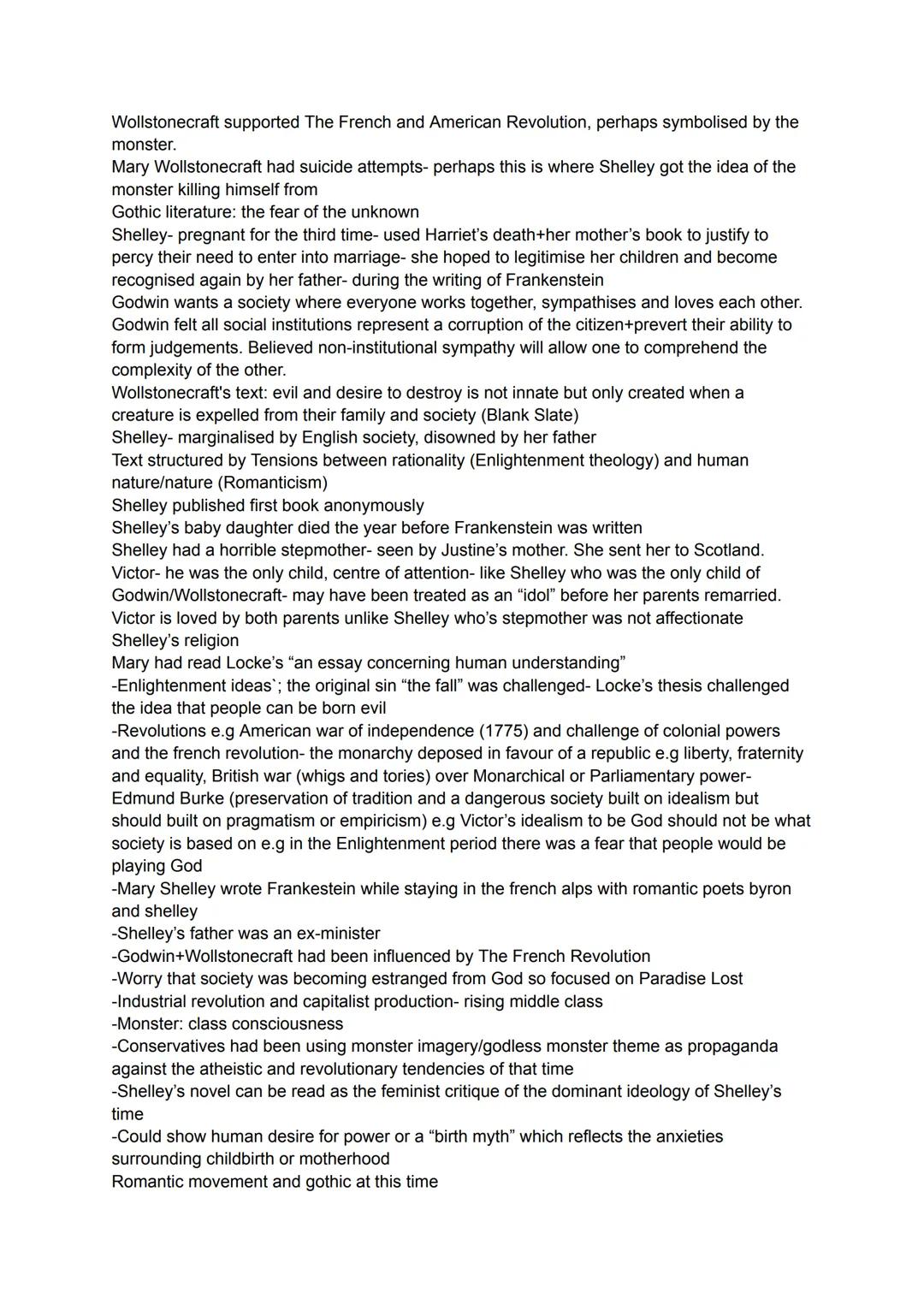
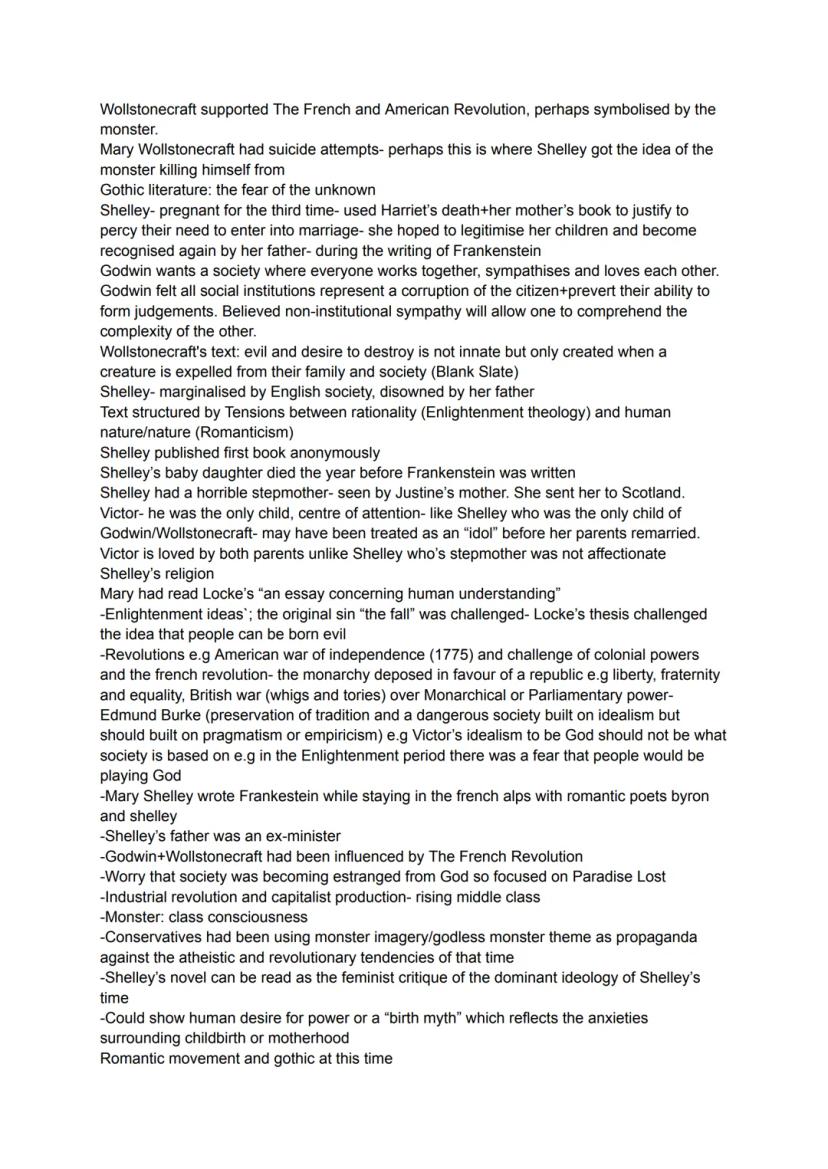
Shelley's background profoundly shaped Frankenstein. Her mother, Mary Wollstonecraft, wrote A Vindication of the Rights of Woman and advocated for classical liberal ideas including minority inclusion. This influence appears in Shelley's sympathetic portrayal of the monster as an outsider seeking acceptance.
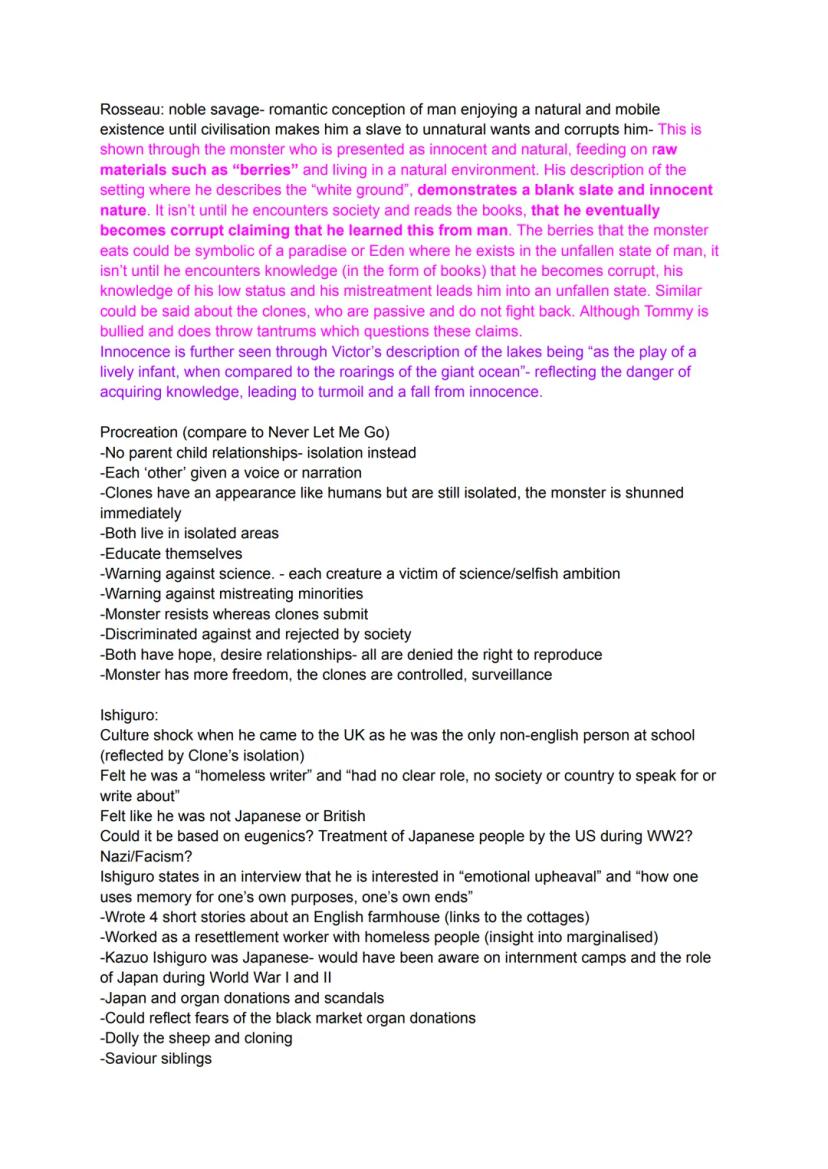
The Enlightenment period brought tensions between rationality and human nature. Shelley had read Locke's "Essay Concerning Human Understanding," which challenged the concept of original sin through the "blank slate" theory - people aren't born evil but shaped by experience. This directly influences the monster's character development.
Major revolutions (American Independence 1775, French Revolution) challenged traditional power structures during this time. Edmund Burke warned against dangerous idealism, reflected in Victor's godlike ambitions. The rising Industrial Revolution created class consciousness, evident in the monster's awareness of social hierarchies.
Key Point: Conservative propaganda used "godless monster" imagery against revolutionary and atheistic movements - Shelley subverts this to critique dominant ideology.
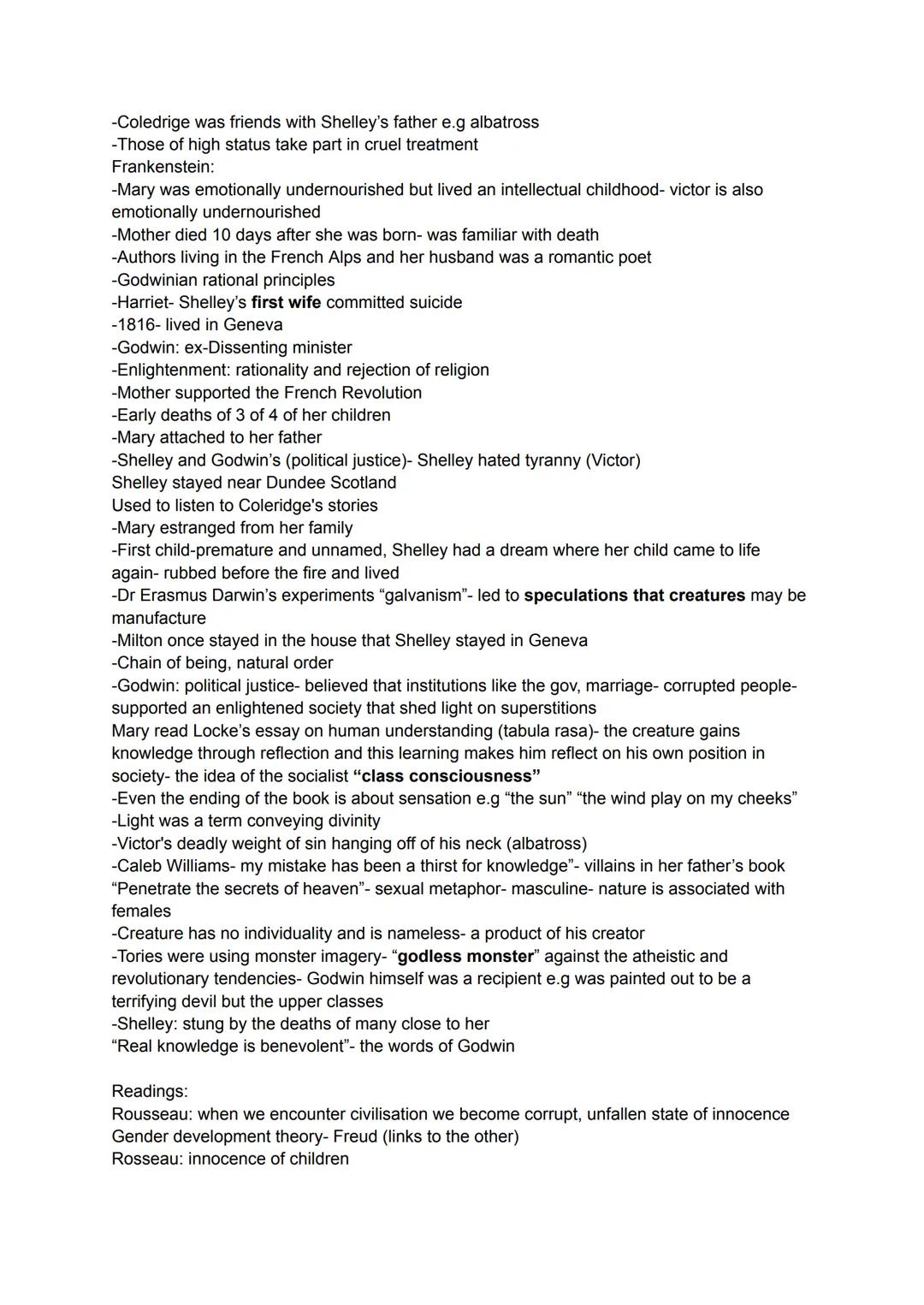
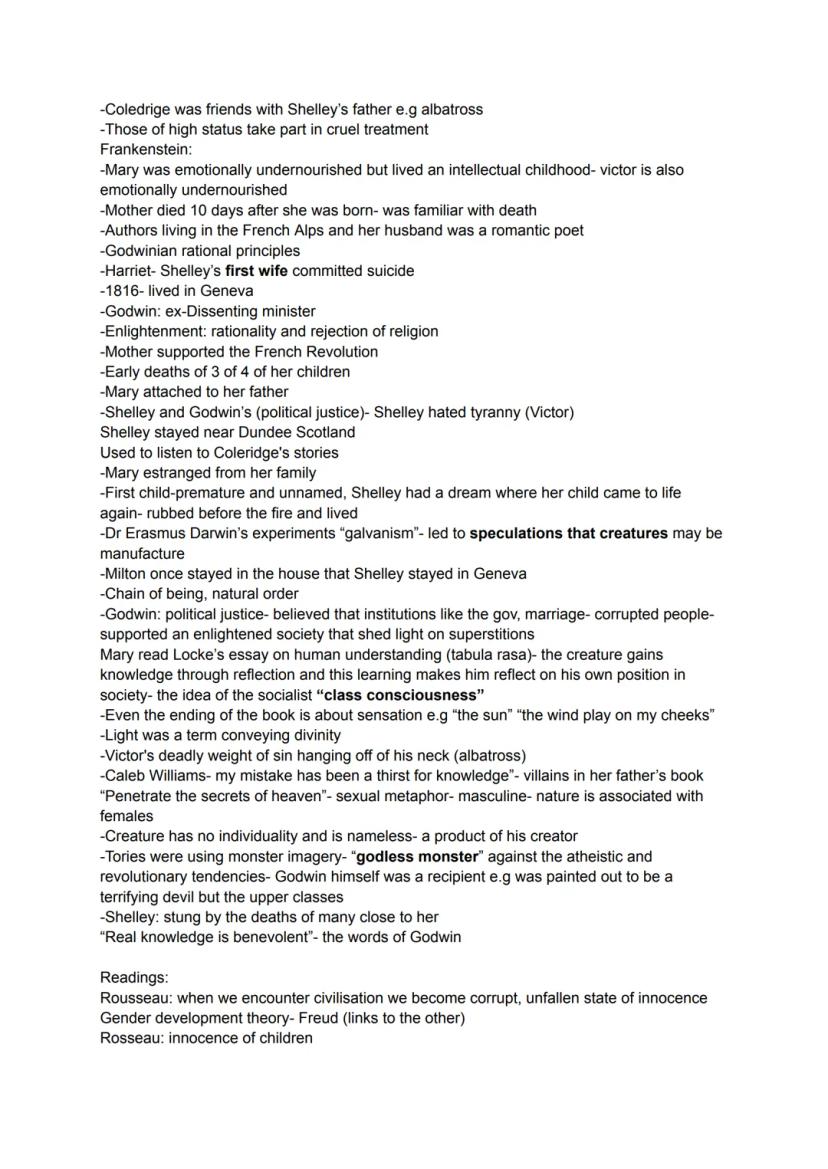
Mary Shelley's life experiences directly informed her writing. Her mother died ten days after her birth, making her familiar with death from an early age. She lived an intellectually rich but emotionally undernourished childhood, much like Victor's character.
Personal tragedies shaped the novel's themes. Three of her four children died early, and she had disturbing dreams about her premature first child coming back to life. Percy Shelley's first wife, Harriet, committed suicide - events that influenced the novel's dark tone and themes of loss.
Rousseau's concept of the "noble savage" appears throughout - the idea that people are naturally good until civilisation corrupts them. The monster begins innocent, eating berries in natural settings, only becoming violent after encountering human society and knowledge through books.
The monster's namelessness reflects his status as Victor's creation rather than an individual. This connects to Godwin's political philosophy about how institutions corrupt people and prevent genuine sympathy and understanding between individuals.
Key Point: Shelley's personal experiences with death, estrangement, and marginalisation directly parallel the monster's journey from innocence to corruption.
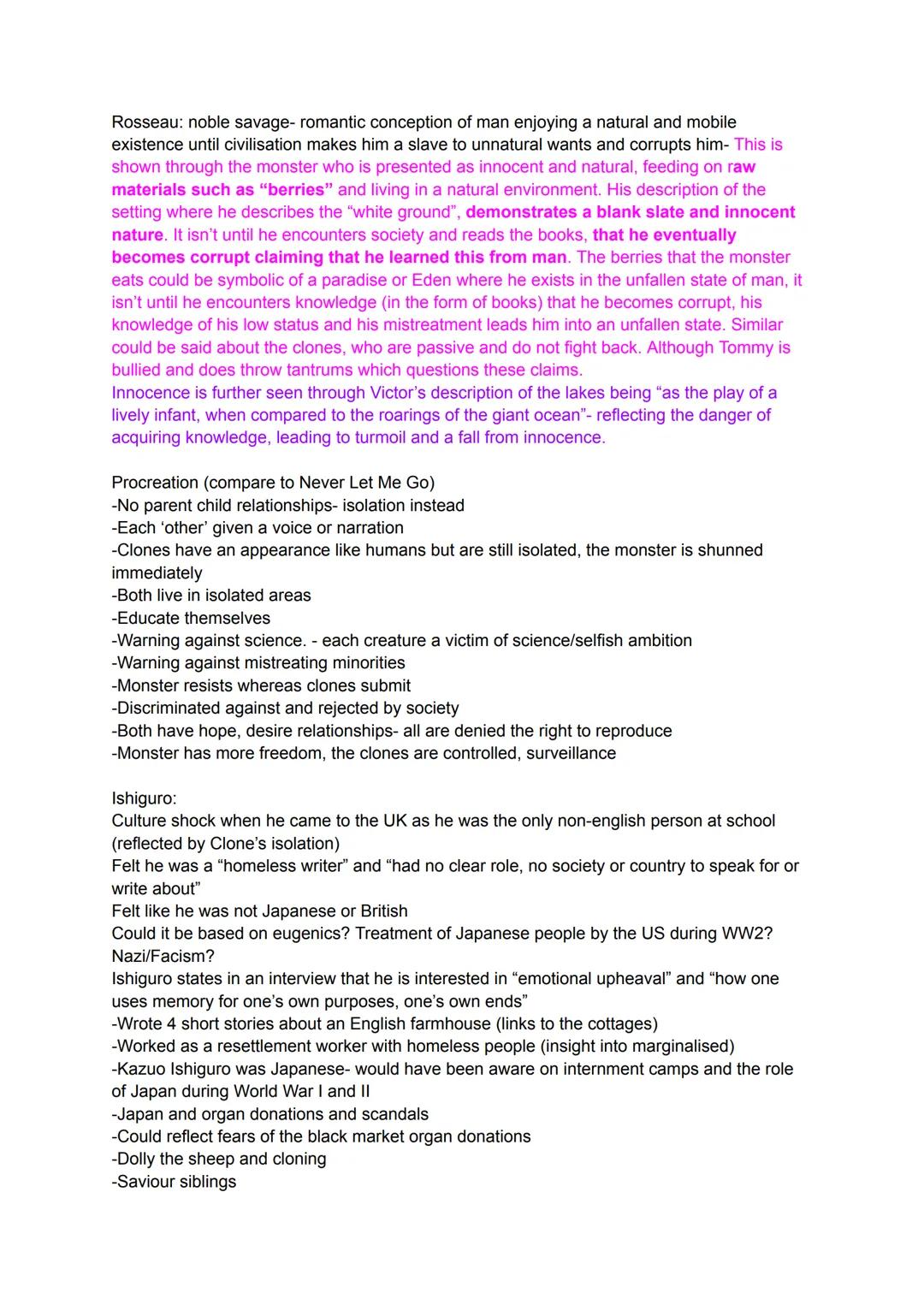
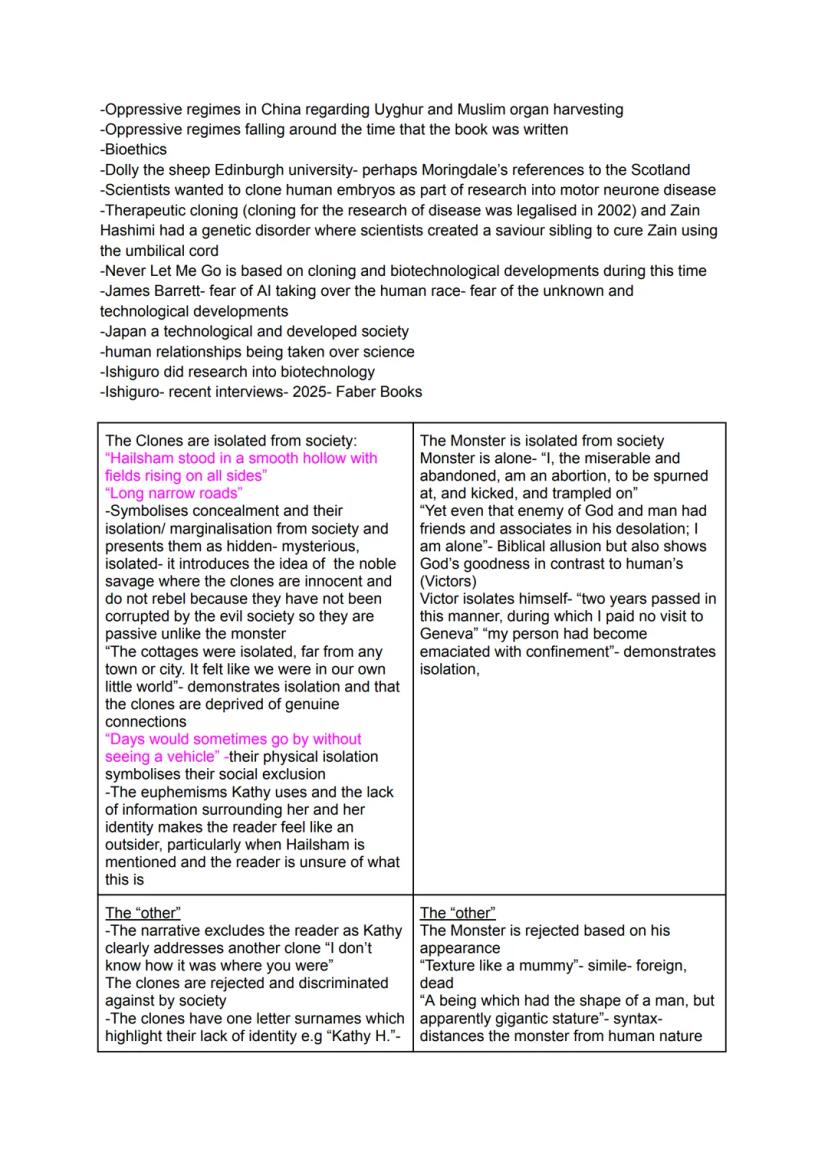
Kazuo Ishiguro experienced cultural displacement moving from Japan to the UK, feeling like a "homeless writer" with no clear national identity. This personal sense of otherness deeply influences the clones' isolation and marginalisation in his novel.
The novel reflects real scientific developments: Dolly the sheep (cloned at Edinburgh University), therapeutic cloning legislation (2002), and "saviour siblings" created to help cure genetic disorders. Ishiguro researched biotechnology extensively, creating a believable dystopian scenario.
Historical atrocities inform the novel's ethical questions. The treatment of Japanese Americans in WWII internment camps, Nazi experimentation, and contemporary issues like Uyghur organ harvesting provide context for understanding how societies can dehumanise certain groups.
Both novels feature "the other" - beings that look human but are treated as different. The clones have human emotions and relationships but are denied basic rights, whilst the monster possesses eloquence and feelings despite his frightening appearance.
Key Point: Ishiguro uses cloning as a metaphor to explore how societies create and maintain systems that exploit marginalised groups.
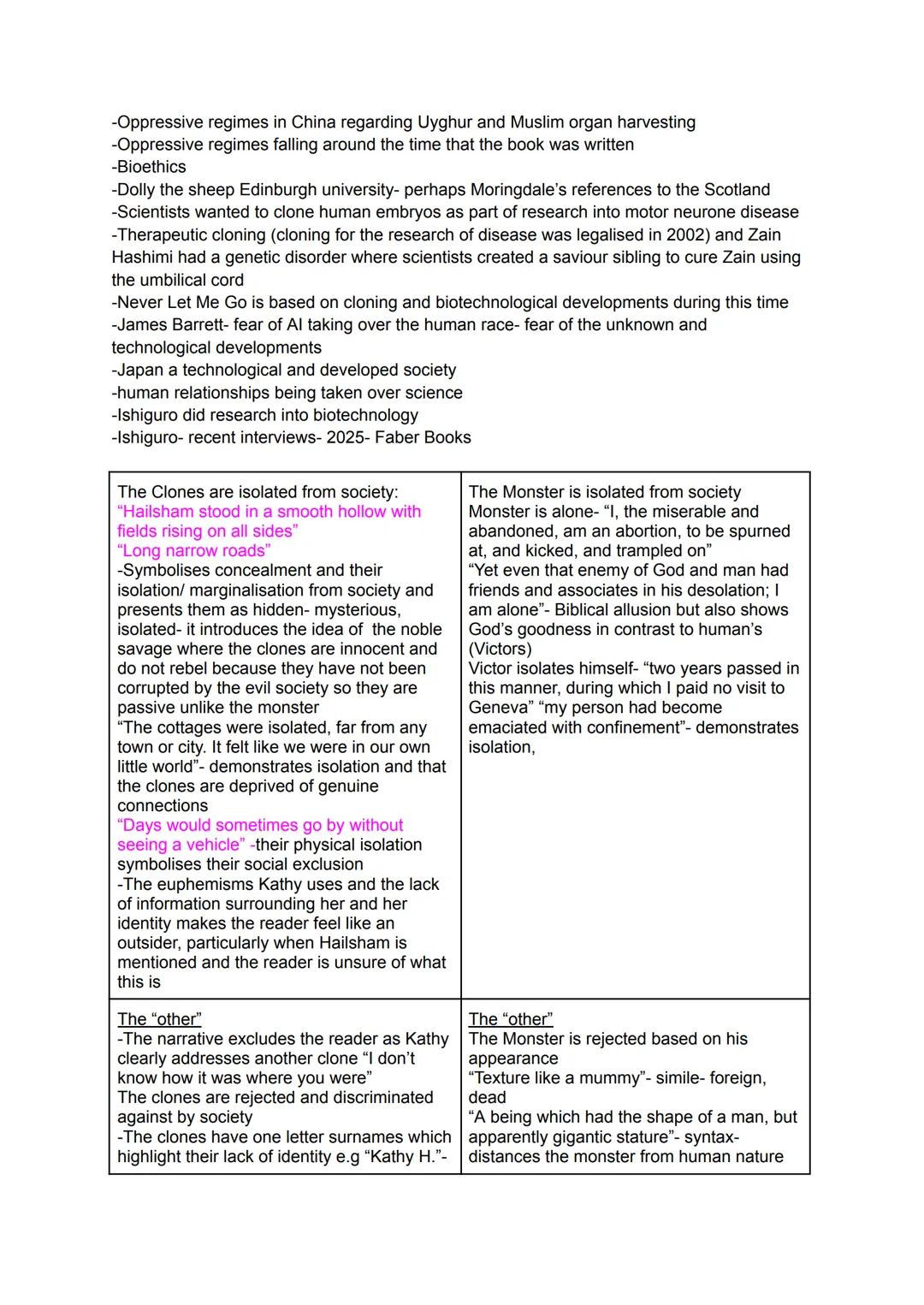
Both texts demonstrate how society isolates those it considers different. Hailsham stands "in a smooth hollow" with "long narrow roads," symbolising the clones' concealment and separation from mainstream society. This physical isolation represents their social exclusion and status as hidden secrets.
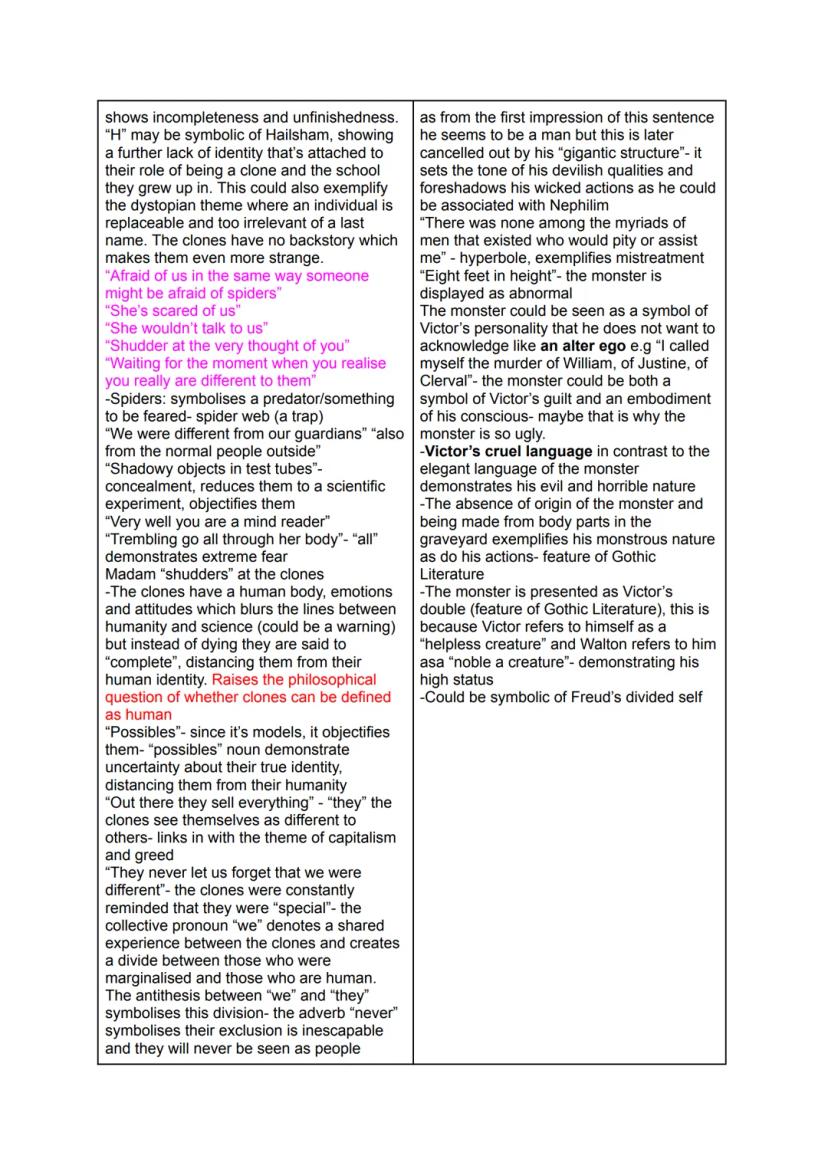
The monster faces immediate rejection based on appearance: "texture like a mummy" and "gigantic stature" distance him from human nature. His Biblical allusion - "Yet even that enemy of God and man had friends and associates in his desolation; I am alone" - emphasises his complete isolation, worse even than Satan's.
Victor also isolates himself through his obsessive scientific pursuits: "two years passed in this manner, during which I paid no visit to Geneva." His self-imposed isolation mirrors the monster's forced exclusion, suggesting that unchecked ambition destroys human connections.
The clones' incomplete surnames (like "Kathy H.") highlight their lack of individual identity, reducing them to products of their institution. They're described as "shadowy objects in test tubes," completely dehumanised and objectified by scientific terminology.
Key Point: Both authors use physical and social isolation to demonstrate how societies exclude those they fear or find useful to exploit.
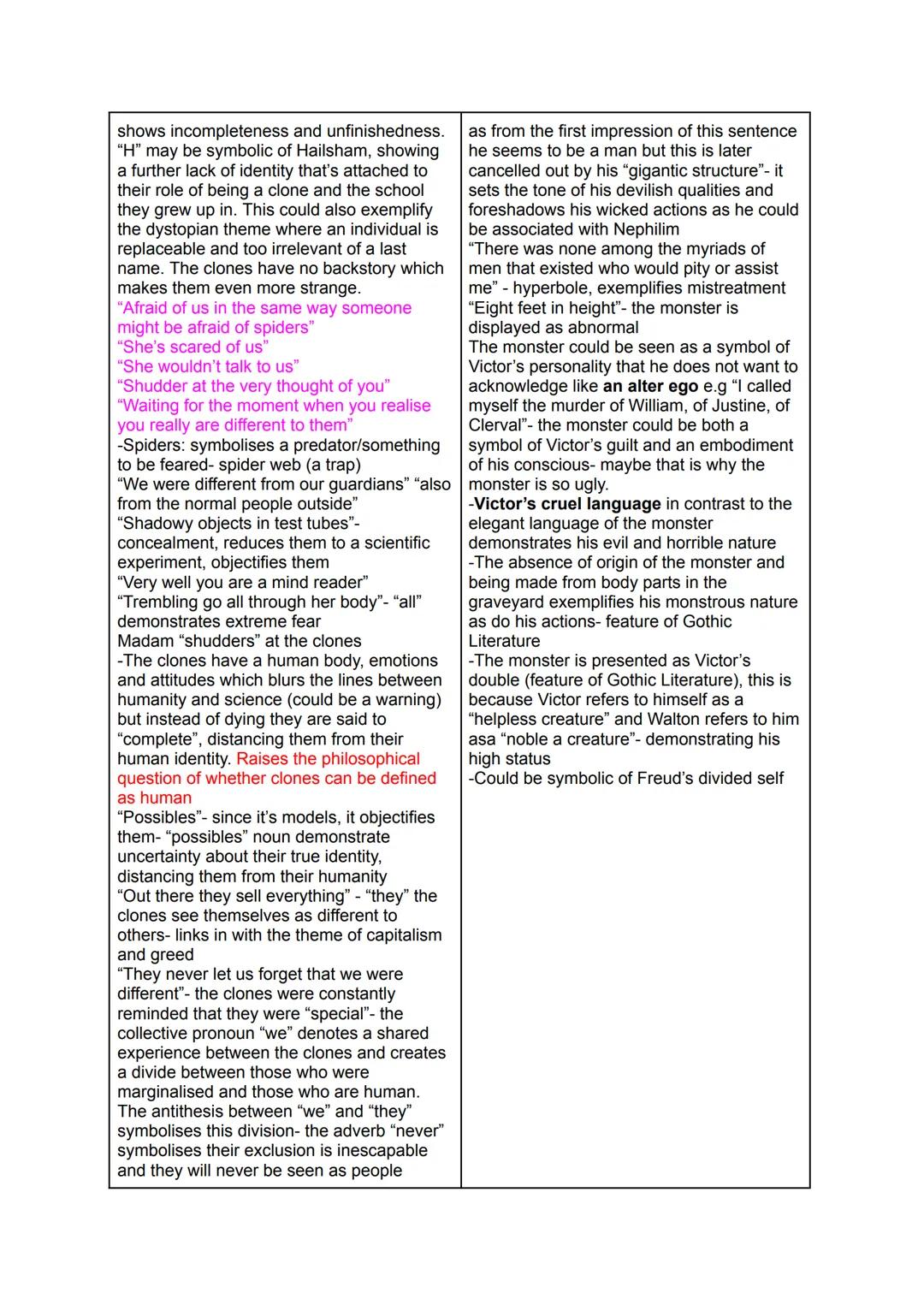
The clones face systematic discrimination despite their human appearance and emotions. Society treats them like spiders - creatures to be feared and avoided. "She's scared of us" and "shudder at the very thought of you" show the instinctive fear and revulsion they inspire in "normal" people.
"Possibles" - the clones' potential human models - objectifies them further, suggesting uncertainty about their true identity and humanity. The euphemism "complete" instead of "die" distances them from human experience, raising philosophical questions about what defines humanity.
The monster's "eight feet in height" and appearance immediately mark him as abnormal and threatening. Victor's cruel language contrasts sharply with the monster's eloquent speech, ironically suggesting Victor may be the real monster. The creature becomes Victor's double - a Gothic literary device representing his darker nature.
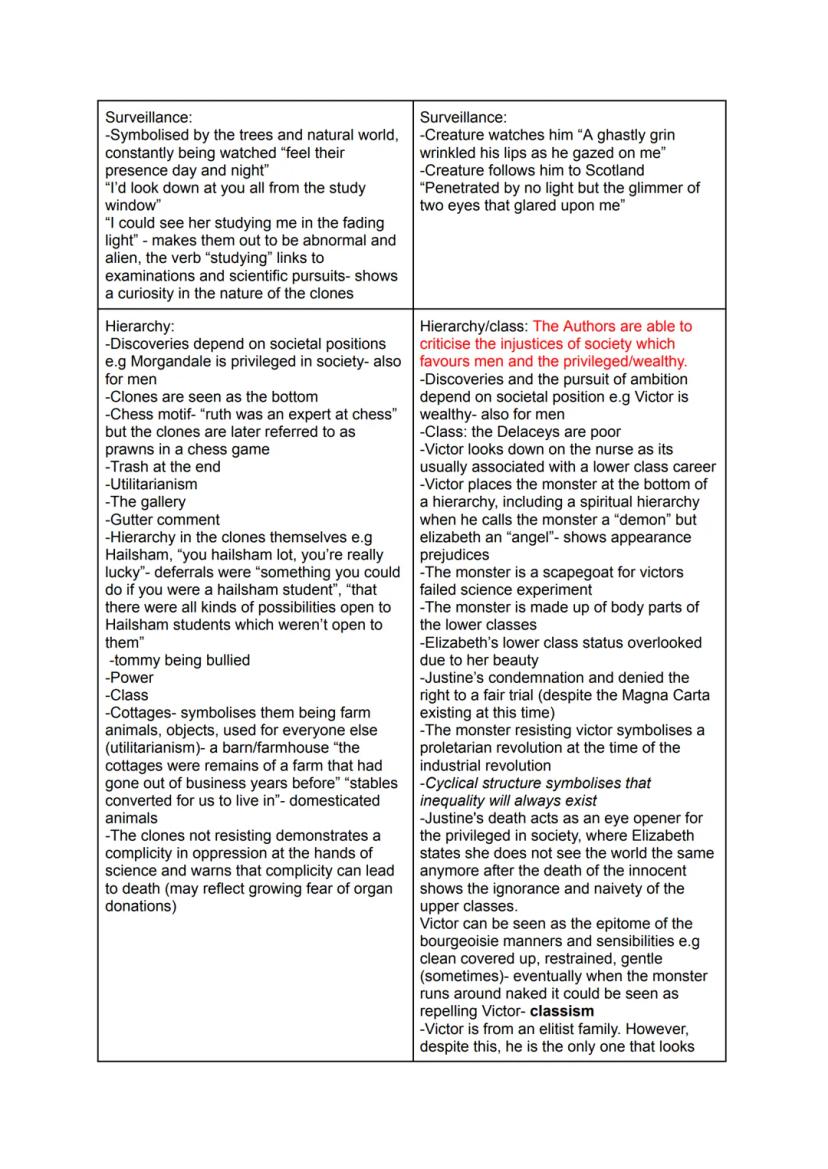
Social hierarchies dominate both texts. The clones exist at society's bottom, useful only for their organs, whilst the monster occupies no social position at all. Both represent exploited underclasses - the clones as literal products, the monster as a scapegoat for Victor's failed experiment.
Key Point: Both authors use physical difference to explore how societies create and maintain discrimination against minority groups.
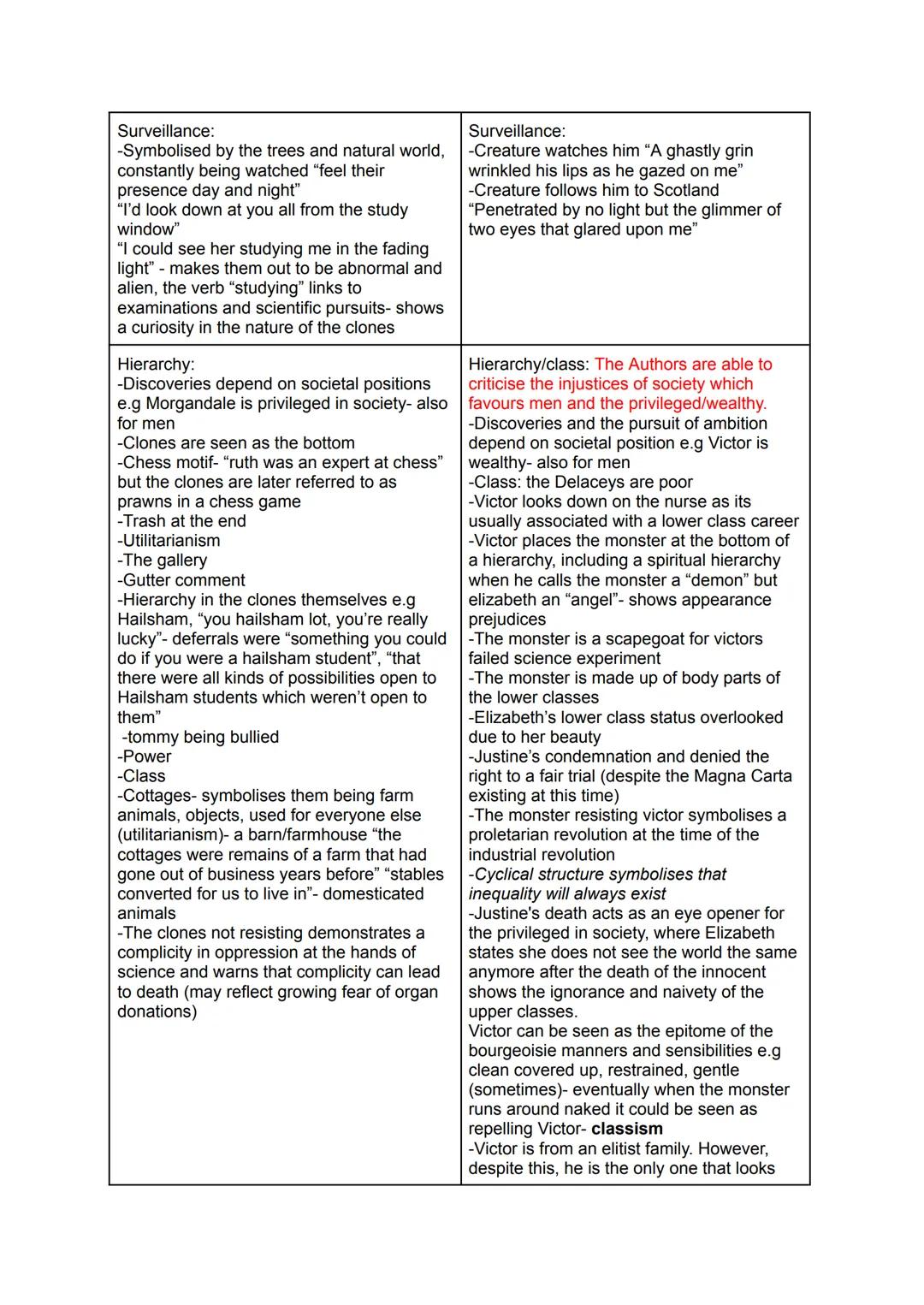
Surveillance permeates both texts. The clones feel constantly watched: "feel their presence day and night" and "I'd look down at you all from the study window." The verb "studying" connects to scientific examination, treating them as specimens rather than people.
Hailsham's institutional control operates through information restriction. The clones are "told and not told" - given just enough information to function but not enough to rebel. Miss Lucy's dismissal for trying to tell them the truth shows how the system punishes those who threaten its control.
The chess motif symbolises manipulation - "Ruth was an expert at chess" but the clones themselves are merely "pawns in a chess game." Their lives are predetermined: "none of you will go to America, none of you will be film stars."
Victor and the monster engage in mutual surveillance and pursuit. The creature follows Victor to Scotland, "penetrated by no light but the glimmer of two eyes that glared upon me." Their relationship becomes a deadly game of hunter and hunted.
Key Point: Both novels show how controlling institutions use surveillance and information restriction to maintain power over marginalised groups.
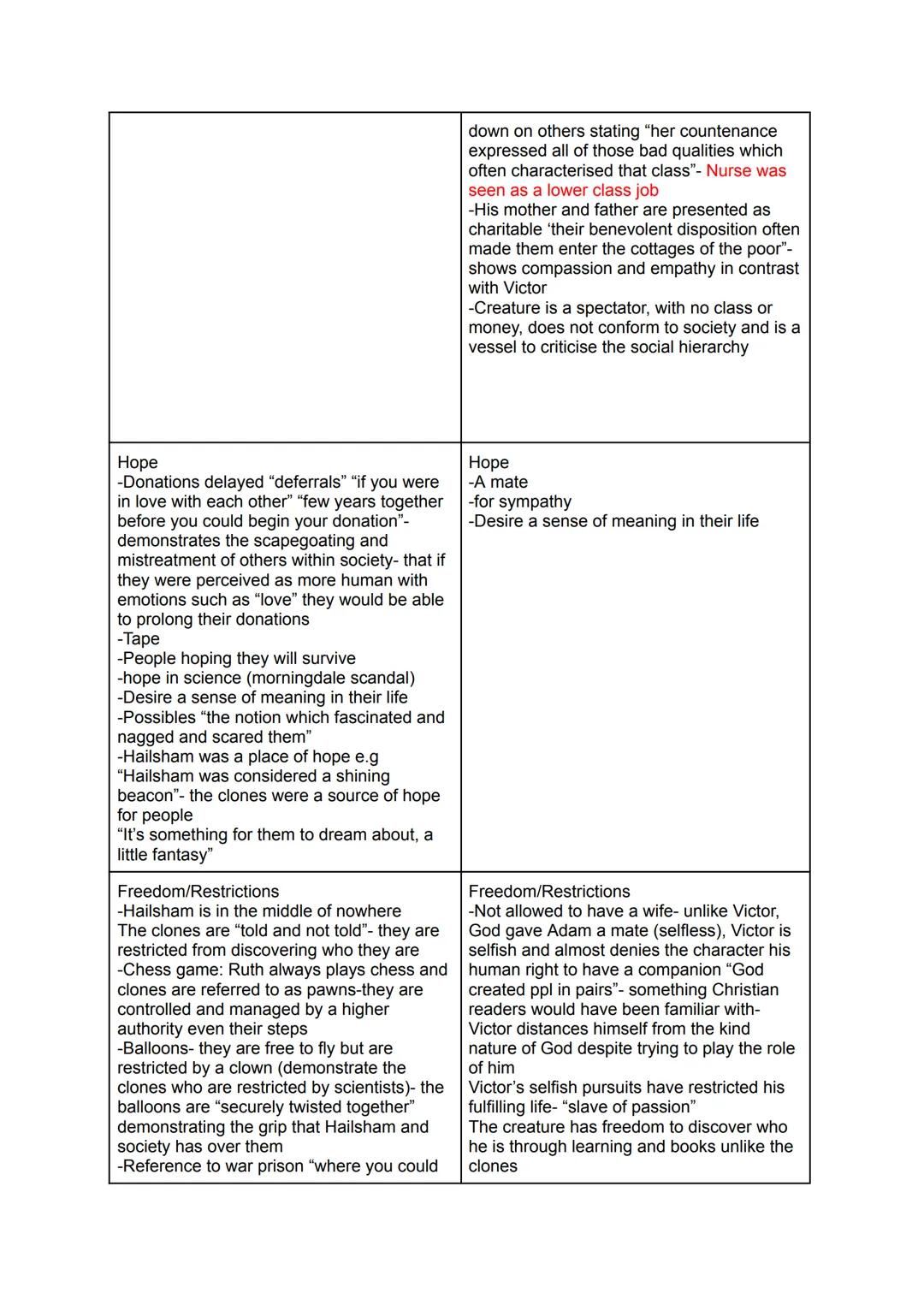
The clones cling to false hope through "deferrals" - the belief that proving they're in love might delay their donations. This cruel fiction gives them something to dream about whilst ensuring their compliance with the system that will ultimately kill them.
"Possibles" represent another form of hope - the fantasy that they might discover their human origins and find meaning in their existence. However, this "notion which fascinated and nagged and scared them" ultimately proves empty, highlighting the cruelty of false hope.
The monster seeks basic companionship, asking Victor for a mate with the Biblical argument that "God created people in pairs." Victor's selfish refusal to provide this denies the creature a fundamental human right, contrasting with God's compassionate creation of Eve for Adam.
Freedom remains illusory for both groups. The clones live in "cottages" that were "remains of a farm" and "stables converted for us to live in," symbolising their status as domesticated animals. Their final "supposed to be" destination shows complete lack of autonomy over their fate.
Key Point: Both authors explore how oppressive systems offer false hope whilst systematically restricting genuine freedom and self-determination.
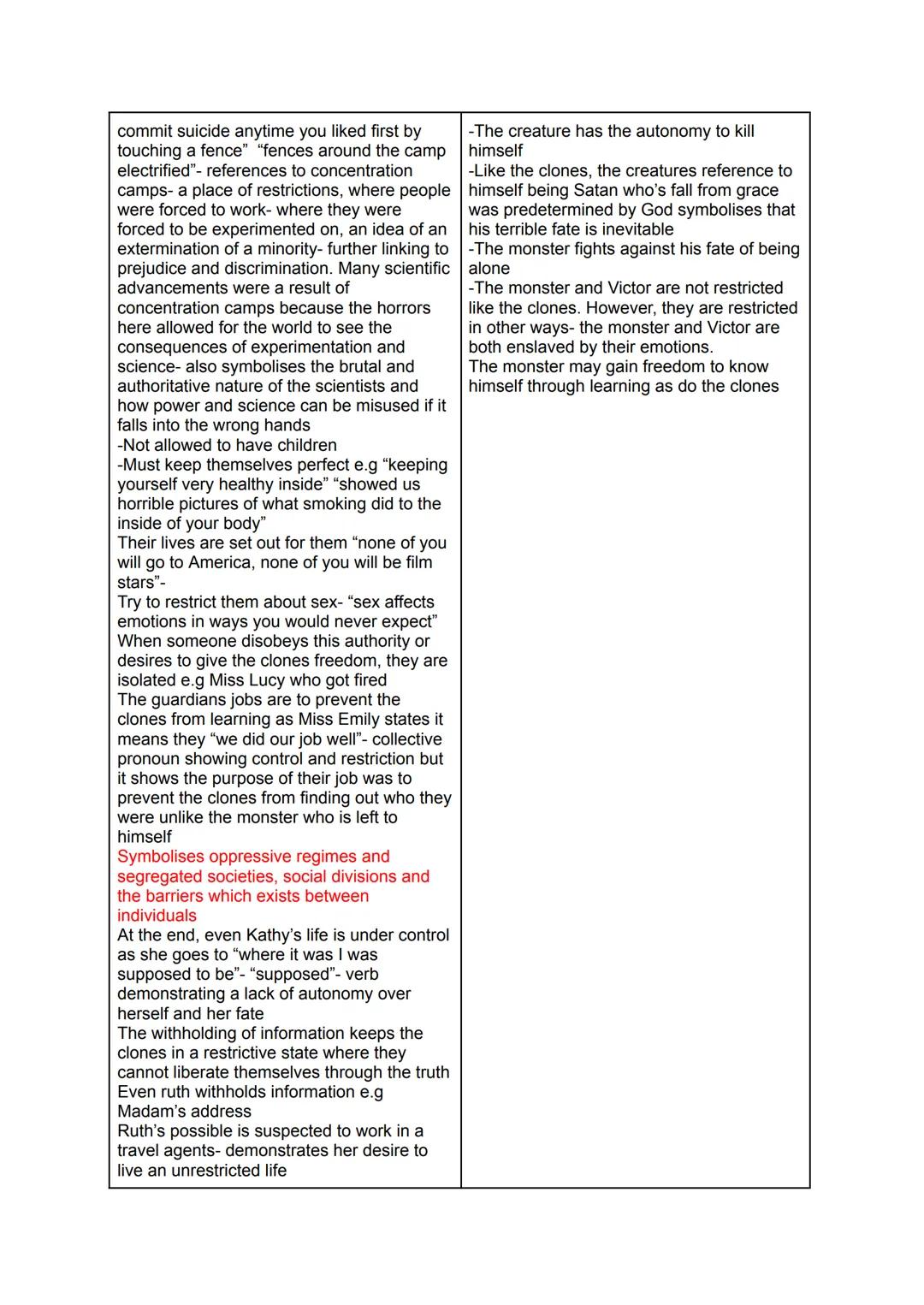
The fundamental difference between the texts lies in their protagonists' responses to oppression. The monster actively resists Victor's control and society's rejection, becoming violent in his demand for recognition and rights. His aggression represents a proletarian revolution against the bourgeois Victor.
The clones passively accept their fate, using euphemisms like "donations" and "completing" that demonstrate their complete internalisation of the system's values. Ishiguro deliberately created this acceptance to mirror how humans generally accept mortality and suffering.
Concentration camp imagery appears in references to "electrified fences" and forced labour, connecting the clones' situation to historical atrocities. The systematic extermination of a minority through scientific experimentation reflects real-world horrors whilst warning against future ones.
Even attempts at individual resistance are crushed - Miss Lucy loses her job for trying to inform the clones about their fate. The system successfully eliminates threats to its control, maintaining order through institutional power rather than physical force.
Key Point: Shelley advocates resistance against oppression whilst Ishiguro explores the tragedy of complete systemic indoctrination and acceptance.
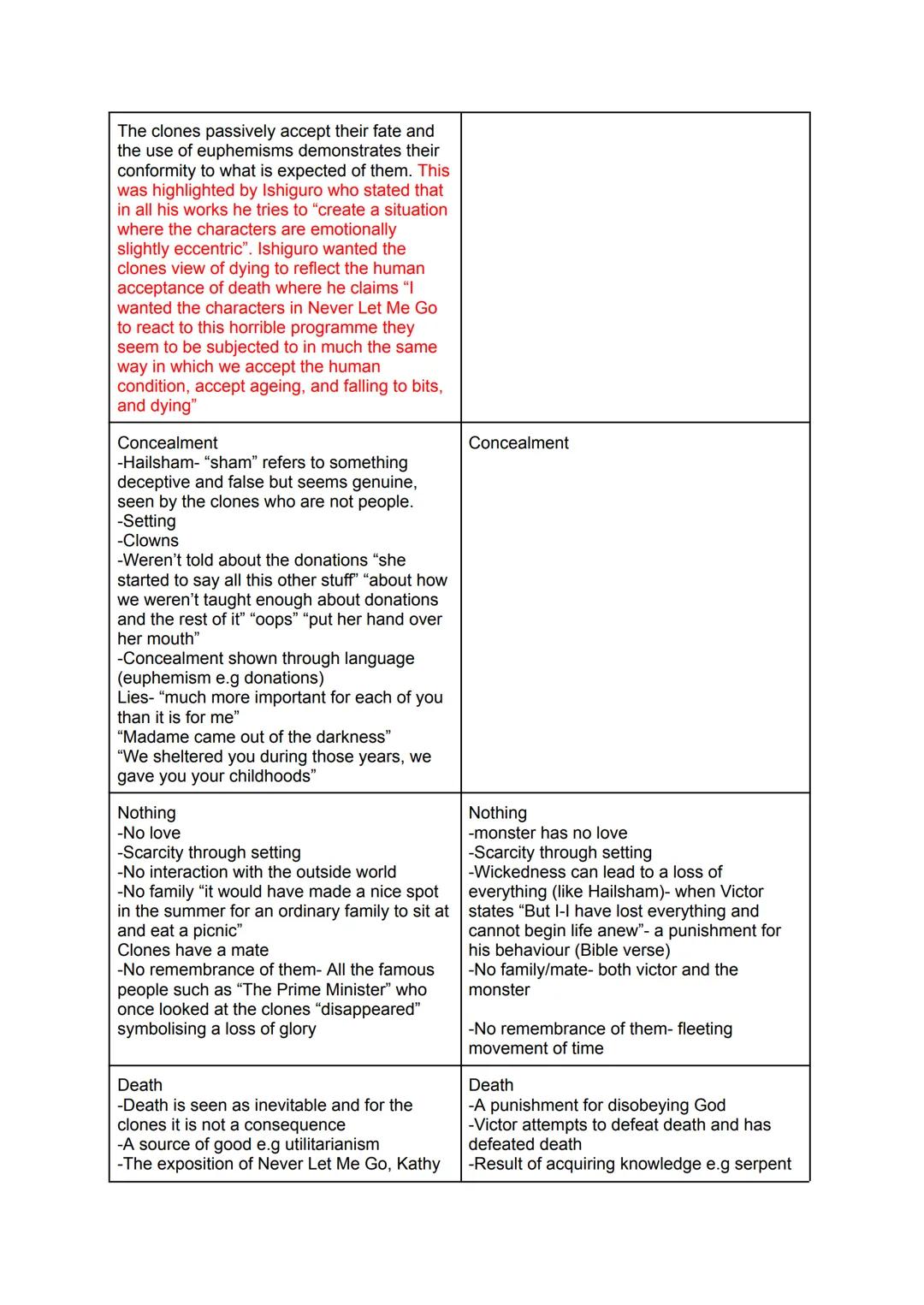
Death serves different functions in each novel. For the clones, death through "donations" is presented as inevitable and beneficial to society - a utilitarian good that saves other lives. For Victor and the monster, death becomes punishment for disobeying natural/divine order.
Concealment operates systematically in Never Let Me Go. Even the name "Hailsham" contains "sham" - something deceptive that appears genuine. The euphemistic language hides brutal reality, whilst clowns symbolise the false cheerfulness masking institutional cruelty.
Both texts feature complete erasure of their protagonists. The monster plans suicide, and the clones simply disappear after "completing." Even "The Prime Minister" who once acknowledged the clones eventually "disappeared," symbolising society's convenient amnesia about its crimes.
Knowledge brings destruction in both novels. The monster's education through books leads to violent self-awareness, whilst the clones' gradual understanding of their fate brings only resignation. Victor's scientific knowledge destroys his family and peace of mind.
Key Point: Both authors use concealment and euphemism to show how societies hide their exploitation of vulnerable groups, whilst knowledge of truth brings only suffering to the oppressed.
Our AI Companion is a student-focused AI tool that offers more than just answers. Built on millions of Knowunity resources, it provides relevant information, personalised study plans, quizzes, and content directly in the chat, adapting to your individual learning journey.
You can download the app from Google Play Store and Apple App Store.
That's right! Enjoy free access to study content, connect with fellow students, and get instant help – all at your fingertips.
App Store
Google Play
The app is very easy to use and well designed. I have found everything I was looking for so far and have been able to learn a lot from the presentations! I will definitely use the app for a class assignment! And of course it also helps a lot as an inspiration.
Stefan S
iOS user
This app is really great. There are so many study notes and help [...]. My problem subject is French, for example, and the app has so many options for help. Thanks to this app, I have improved my French. I would recommend it to anyone.
Samantha Klich
Android user
Wow, I am really amazed. I just tried the app because I've seen it advertised many times and was absolutely stunned. This app is THE HELP you want for school and above all, it offers so many things, such as workouts and fact sheets, which have been VERY helpful to me personally.
Anna
iOS user
Best app on earth! no words because it’s too good
Thomas R
iOS user
Just amazing. Let's me revise 10x better, this app is a quick 10/10. I highly recommend it to anyone. I can watch and search for notes. I can save them in the subject folder. I can revise it any time when I come back. If you haven't tried this app, you're really missing out.
Basil
Android user
This app has made me feel so much more confident in my exam prep, not only through boosting my own self confidence through the features that allow you to connect with others and feel less alone, but also through the way the app itself is centred around making you feel better. It is easy to navigate, fun to use, and helpful to anyone struggling in absolutely any way.
David K
iOS user
The app's just great! All I have to do is enter the topic in the search bar and I get the response real fast. I don't have to watch 10 YouTube videos to understand something, so I'm saving my time. Highly recommended!
Sudenaz Ocak
Android user
In school I was really bad at maths but thanks to the app, I am doing better now. I am so grateful that you made the app.
Greenlight Bonnie
Android user
very reliable app to help and grow your ideas of Maths, English and other related topics in your works. please use this app if your struggling in areas, this app is key for that. wish I'd of done a review before. and it's also free so don't worry about that.
Rohan U
Android user
I know a lot of apps use fake accounts to boost their reviews but this app deserves it all. Originally I was getting 4 in my English exams and this time I got a grade 7. I didn’t even know about this app three days until the exam and it has helped A LOT. Please actually trust me and use it as I’m sure you too will see developments.
Xander S
iOS user
THE QUIZES AND FLASHCARDS ARE SO USEFUL AND I LOVE THE SCHOOLGPT. IT ALSO IS LITREALLY LIKE CHATGPT BUT SMARTER!! HELPED ME WITH MY MASCARA PROBLEMS TOO!! AS WELL AS MY REAL SUBJECTS ! DUHHH 😍😁😲🤑💗✨🎀😮
Elisha
iOS user
This apps acc the goat. I find revision so boring but this app makes it so easy to organize it all and then you can ask the freeeee ai to test yourself so good and you can easily upload your own stuff. highly recommend as someone taking mocks now
Paul T
iOS user
The app is very easy to use and well designed. I have found everything I was looking for so far and have been able to learn a lot from the presentations! I will definitely use the app for a class assignment! And of course it also helps a lot as an inspiration.
Stefan S
iOS user
This app is really great. There are so many study notes and help [...]. My problem subject is French, for example, and the app has so many options for help. Thanks to this app, I have improved my French. I would recommend it to anyone.
Samantha Klich
Android user
Wow, I am really amazed. I just tried the app because I've seen it advertised many times and was absolutely stunned. This app is THE HELP you want for school and above all, it offers so many things, such as workouts and fact sheets, which have been VERY helpful to me personally.
Anna
iOS user
Best app on earth! no words because it’s too good
Thomas R
iOS user
Just amazing. Let's me revise 10x better, this app is a quick 10/10. I highly recommend it to anyone. I can watch and search for notes. I can save them in the subject folder. I can revise it any time when I come back. If you haven't tried this app, you're really missing out.
Basil
Android user
This app has made me feel so much more confident in my exam prep, not only through boosting my own self confidence through the features that allow you to connect with others and feel less alone, but also through the way the app itself is centred around making you feel better. It is easy to navigate, fun to use, and helpful to anyone struggling in absolutely any way.
David K
iOS user
The app's just great! All I have to do is enter the topic in the search bar and I get the response real fast. I don't have to watch 10 YouTube videos to understand something, so I'm saving my time. Highly recommended!
Sudenaz Ocak
Android user
In school I was really bad at maths but thanks to the app, I am doing better now. I am so grateful that you made the app.
Greenlight Bonnie
Android user
very reliable app to help and grow your ideas of Maths, English and other related topics in your works. please use this app if your struggling in areas, this app is key for that. wish I'd of done a review before. and it's also free so don't worry about that.
Rohan U
Android user
I know a lot of apps use fake accounts to boost their reviews but this app deserves it all. Originally I was getting 4 in my English exams and this time I got a grade 7. I didn’t even know about this app three days until the exam and it has helped A LOT. Please actually trust me and use it as I’m sure you too will see developments.
Xander S
iOS user
THE QUIZES AND FLASHCARDS ARE SO USEFUL AND I LOVE THE SCHOOLGPT. IT ALSO IS LITREALLY LIKE CHATGPT BUT SMARTER!! HELPED ME WITH MY MASCARA PROBLEMS TOO!! AS WELL AS MY REAL SUBJECTS ! DUHHH 😍😁😲🤑💗✨🎀😮
Elisha
iOS user
This apps acc the goat. I find revision so boring but this app makes it so easy to organize it all and then you can ask the freeeee ai to test yourself so good and you can easily upload your own stuff. highly recommend as someone taking mocks now
Paul T
iOS user
millie
@millie_xmtr
Mary Shelley's Frankenstein and Kazuo Ishiguro's Never Let Me Goboth serve as powerful warnings about what happens when science goes too far and society treats certain groups as "other." These novels explore themes of isolation, ambition, and the dangerous... Show more
Access to all documents
Improve your grades
Join milions of students
By signing up you accept Terms of Service and Privacy Policy
Frankenstein uses an epistolary format (told through letters) to create a cautionary tale about unchecked ambition. Shelley deliberately sequences events to show how Victor's life spirals downward due to his dangerous scientific pursuits.
The novel's framing narrative gives men the dominant voice whilst women remain secondary. Elizabeth exists only through Victor's perspective, and women communicate through letters rather than direct narration. However, the entire story depends on Margaret (Walton's sister), showing women's hidden importance in the structure itself.
Victor serves as an unreliable narrator, and Shelley connects him to the subtitle "The Modern Prometheus." In Greek mythology, Prometheus rebelled against the gods and faced punishment - just like Victor, who rebels against God and the natural order, suffering through his family's deaths and mental torment.
Key Point: The novel critiques the Industrial Revolution through a Romantic lens, advocating for environmental preservation over technological advancement.
Access to all documents
Improve your grades
Join milions of students
By signing up you accept Terms of Service and Privacy Policy
Shelley's background profoundly shaped Frankenstein. Her mother, Mary Wollstonecraft, wrote A Vindication of the Rights of Woman and advocated for classical liberal ideas including minority inclusion. This influence appears in Shelley's sympathetic portrayal of the monster as an outsider seeking acceptance.
The Enlightenment period brought tensions between rationality and human nature. Shelley had read Locke's "Essay Concerning Human Understanding," which challenged the concept of original sin through the "blank slate" theory - people aren't born evil but shaped by experience. This directly influences the monster's character development.
Major revolutions (American Independence 1775, French Revolution) challenged traditional power structures during this time. Edmund Burke warned against dangerous idealism, reflected in Victor's godlike ambitions. The rising Industrial Revolution created class consciousness, evident in the monster's awareness of social hierarchies.
Key Point: Conservative propaganda used "godless monster" imagery against revolutionary and atheistic movements - Shelley subverts this to critique dominant ideology.
Access to all documents
Improve your grades
Join milions of students
By signing up you accept Terms of Service and Privacy Policy
Mary Shelley's life experiences directly informed her writing. Her mother died ten days after her birth, making her familiar with death from an early age. She lived an intellectually rich but emotionally undernourished childhood, much like Victor's character.
Personal tragedies shaped the novel's themes. Three of her four children died early, and she had disturbing dreams about her premature first child coming back to life. Percy Shelley's first wife, Harriet, committed suicide - events that influenced the novel's dark tone and themes of loss.
Rousseau's concept of the "noble savage" appears throughout - the idea that people are naturally good until civilisation corrupts them. The monster begins innocent, eating berries in natural settings, only becoming violent after encountering human society and knowledge through books.
The monster's namelessness reflects his status as Victor's creation rather than an individual. This connects to Godwin's political philosophy about how institutions corrupt people and prevent genuine sympathy and understanding between individuals.
Key Point: Shelley's personal experiences with death, estrangement, and marginalisation directly parallel the monster's journey from innocence to corruption.
Access to all documents
Improve your grades
Join milions of students
By signing up you accept Terms of Service and Privacy Policy
Kazuo Ishiguro experienced cultural displacement moving from Japan to the UK, feeling like a "homeless writer" with no clear national identity. This personal sense of otherness deeply influences the clones' isolation and marginalisation in his novel.
The novel reflects real scientific developments: Dolly the sheep (cloned at Edinburgh University), therapeutic cloning legislation (2002), and "saviour siblings" created to help cure genetic disorders. Ishiguro researched biotechnology extensively, creating a believable dystopian scenario.
Historical atrocities inform the novel's ethical questions. The treatment of Japanese Americans in WWII internment camps, Nazi experimentation, and contemporary issues like Uyghur organ harvesting provide context for understanding how societies can dehumanise certain groups.
Both novels feature "the other" - beings that look human but are treated as different. The clones have human emotions and relationships but are denied basic rights, whilst the monster possesses eloquence and feelings despite his frightening appearance.
Key Point: Ishiguro uses cloning as a metaphor to explore how societies create and maintain systems that exploit marginalised groups.
Access to all documents
Improve your grades
Join milions of students
By signing up you accept Terms of Service and Privacy Policy
Both texts demonstrate how society isolates those it considers different. Hailsham stands "in a smooth hollow" with "long narrow roads," symbolising the clones' concealment and separation from mainstream society. This physical isolation represents their social exclusion and status as hidden secrets.
The monster faces immediate rejection based on appearance: "texture like a mummy" and "gigantic stature" distance him from human nature. His Biblical allusion - "Yet even that enemy of God and man had friends and associates in his desolation; I am alone" - emphasises his complete isolation, worse even than Satan's.
Victor also isolates himself through his obsessive scientific pursuits: "two years passed in this manner, during which I paid no visit to Geneva." His self-imposed isolation mirrors the monster's forced exclusion, suggesting that unchecked ambition destroys human connections.
The clones' incomplete surnames (like "Kathy H.") highlight their lack of individual identity, reducing them to products of their institution. They're described as "shadowy objects in test tubes," completely dehumanised and objectified by scientific terminology.
Key Point: Both authors use physical and social isolation to demonstrate how societies exclude those they fear or find useful to exploit.
Access to all documents
Improve your grades
Join milions of students
By signing up you accept Terms of Service and Privacy Policy
The clones face systematic discrimination despite their human appearance and emotions. Society treats them like spiders - creatures to be feared and avoided. "She's scared of us" and "shudder at the very thought of you" show the instinctive fear and revulsion they inspire in "normal" people.
"Possibles" - the clones' potential human models - objectifies them further, suggesting uncertainty about their true identity and humanity. The euphemism "complete" instead of "die" distances them from human experience, raising philosophical questions about what defines humanity.
The monster's "eight feet in height" and appearance immediately mark him as abnormal and threatening. Victor's cruel language contrasts sharply with the monster's eloquent speech, ironically suggesting Victor may be the real monster. The creature becomes Victor's double - a Gothic literary device representing his darker nature.
Social hierarchies dominate both texts. The clones exist at society's bottom, useful only for their organs, whilst the monster occupies no social position at all. Both represent exploited underclasses - the clones as literal products, the monster as a scapegoat for Victor's failed experiment.
Key Point: Both authors use physical difference to explore how societies create and maintain discrimination against minority groups.
Access to all documents
Improve your grades
Join milions of students
By signing up you accept Terms of Service and Privacy Policy
Surveillance permeates both texts. The clones feel constantly watched: "feel their presence day and night" and "I'd look down at you all from the study window." The verb "studying" connects to scientific examination, treating them as specimens rather than people.
Hailsham's institutional control operates through information restriction. The clones are "told and not told" - given just enough information to function but not enough to rebel. Miss Lucy's dismissal for trying to tell them the truth shows how the system punishes those who threaten its control.
The chess motif symbolises manipulation - "Ruth was an expert at chess" but the clones themselves are merely "pawns in a chess game." Their lives are predetermined: "none of you will go to America, none of you will be film stars."
Victor and the monster engage in mutual surveillance and pursuit. The creature follows Victor to Scotland, "penetrated by no light but the glimmer of two eyes that glared upon me." Their relationship becomes a deadly game of hunter and hunted.
Key Point: Both novels show how controlling institutions use surveillance and information restriction to maintain power over marginalised groups.
Access to all documents
Improve your grades
Join milions of students
By signing up you accept Terms of Service and Privacy Policy
The clones cling to false hope through "deferrals" - the belief that proving they're in love might delay their donations. This cruel fiction gives them something to dream about whilst ensuring their compliance with the system that will ultimately kill them.
"Possibles" represent another form of hope - the fantasy that they might discover their human origins and find meaning in their existence. However, this "notion which fascinated and nagged and scared them" ultimately proves empty, highlighting the cruelty of false hope.
The monster seeks basic companionship, asking Victor for a mate with the Biblical argument that "God created people in pairs." Victor's selfish refusal to provide this denies the creature a fundamental human right, contrasting with God's compassionate creation of Eve for Adam.
Freedom remains illusory for both groups. The clones live in "cottages" that were "remains of a farm" and "stables converted for us to live in," symbolising their status as domesticated animals. Their final "supposed to be" destination shows complete lack of autonomy over their fate.
Key Point: Both authors explore how oppressive systems offer false hope whilst systematically restricting genuine freedom and self-determination.
Access to all documents
Improve your grades
Join milions of students
By signing up you accept Terms of Service and Privacy Policy
The fundamental difference between the texts lies in their protagonists' responses to oppression. The monster actively resists Victor's control and society's rejection, becoming violent in his demand for recognition and rights. His aggression represents a proletarian revolution against the bourgeois Victor.
The clones passively accept their fate, using euphemisms like "donations" and "completing" that demonstrate their complete internalisation of the system's values. Ishiguro deliberately created this acceptance to mirror how humans generally accept mortality and suffering.
Concentration camp imagery appears in references to "electrified fences" and forced labour, connecting the clones' situation to historical atrocities. The systematic extermination of a minority through scientific experimentation reflects real-world horrors whilst warning against future ones.
Even attempts at individual resistance are crushed - Miss Lucy loses her job for trying to inform the clones about their fate. The system successfully eliminates threats to its control, maintaining order through institutional power rather than physical force.
Key Point: Shelley advocates resistance against oppression whilst Ishiguro explores the tragedy of complete systemic indoctrination and acceptance.
Access to all documents
Improve your grades
Join milions of students
By signing up you accept Terms of Service and Privacy Policy
Death serves different functions in each novel. For the clones, death through "donations" is presented as inevitable and beneficial to society - a utilitarian good that saves other lives. For Victor and the monster, death becomes punishment for disobeying natural/divine order.
Concealment operates systematically in Never Let Me Go. Even the name "Hailsham" contains "sham" - something deceptive that appears genuine. The euphemistic language hides brutal reality, whilst clowns symbolise the false cheerfulness masking institutional cruelty.
Both texts feature complete erasure of their protagonists. The monster plans suicide, and the clones simply disappear after "completing." Even "The Prime Minister" who once acknowledged the clones eventually "disappeared," symbolising society's convenient amnesia about its crimes.
Knowledge brings destruction in both novels. The monster's education through books leads to violent self-awareness, whilst the clones' gradual understanding of their fate brings only resignation. Victor's scientific knowledge destroys his family and peace of mind.
Key Point: Both authors use concealment and euphemism to show how societies hide their exploitation of vulnerable groups, whilst knowledge of truth brings only suffering to the oppressed.
Our AI Companion is a student-focused AI tool that offers more than just answers. Built on millions of Knowunity resources, it provides relevant information, personalised study plans, quizzes, and content directly in the chat, adapting to your individual learning journey.
You can download the app from Google Play Store and Apple App Store.
That's right! Enjoy free access to study content, connect with fellow students, and get instant help – all at your fingertips.
1
Smart Tools NEW
Transform this note into: ✓ 50+ Practice Questions ✓ Interactive Flashcards ✓ Full Mock Exam ✓ Essay Outlines
App Store
Google Play
The app is very easy to use and well designed. I have found everything I was looking for so far and have been able to learn a lot from the presentations! I will definitely use the app for a class assignment! And of course it also helps a lot as an inspiration.
Stefan S
iOS user
This app is really great. There are so many study notes and help [...]. My problem subject is French, for example, and the app has so many options for help. Thanks to this app, I have improved my French. I would recommend it to anyone.
Samantha Klich
Android user
Wow, I am really amazed. I just tried the app because I've seen it advertised many times and was absolutely stunned. This app is THE HELP you want for school and above all, it offers so many things, such as workouts and fact sheets, which have been VERY helpful to me personally.
Anna
iOS user
Best app on earth! no words because it’s too good
Thomas R
iOS user
Just amazing. Let's me revise 10x better, this app is a quick 10/10. I highly recommend it to anyone. I can watch and search for notes. I can save them in the subject folder. I can revise it any time when I come back. If you haven't tried this app, you're really missing out.
Basil
Android user
This app has made me feel so much more confident in my exam prep, not only through boosting my own self confidence through the features that allow you to connect with others and feel less alone, but also through the way the app itself is centred around making you feel better. It is easy to navigate, fun to use, and helpful to anyone struggling in absolutely any way.
David K
iOS user
The app's just great! All I have to do is enter the topic in the search bar and I get the response real fast. I don't have to watch 10 YouTube videos to understand something, so I'm saving my time. Highly recommended!
Sudenaz Ocak
Android user
In school I was really bad at maths but thanks to the app, I am doing better now. I am so grateful that you made the app.
Greenlight Bonnie
Android user
very reliable app to help and grow your ideas of Maths, English and other related topics in your works. please use this app if your struggling in areas, this app is key for that. wish I'd of done a review before. and it's also free so don't worry about that.
Rohan U
Android user
I know a lot of apps use fake accounts to boost their reviews but this app deserves it all. Originally I was getting 4 in my English exams and this time I got a grade 7. I didn’t even know about this app three days until the exam and it has helped A LOT. Please actually trust me and use it as I’m sure you too will see developments.
Xander S
iOS user
THE QUIZES AND FLASHCARDS ARE SO USEFUL AND I LOVE THE SCHOOLGPT. IT ALSO IS LITREALLY LIKE CHATGPT BUT SMARTER!! HELPED ME WITH MY MASCARA PROBLEMS TOO!! AS WELL AS MY REAL SUBJECTS ! DUHHH 😍😁😲🤑💗✨🎀😮
Elisha
iOS user
This apps acc the goat. I find revision so boring but this app makes it so easy to organize it all and then you can ask the freeeee ai to test yourself so good and you can easily upload your own stuff. highly recommend as someone taking mocks now
Paul T
iOS user
The app is very easy to use and well designed. I have found everything I was looking for so far and have been able to learn a lot from the presentations! I will definitely use the app for a class assignment! And of course it also helps a lot as an inspiration.
Stefan S
iOS user
This app is really great. There are so many study notes and help [...]. My problem subject is French, for example, and the app has so many options for help. Thanks to this app, I have improved my French. I would recommend it to anyone.
Samantha Klich
Android user
Wow, I am really amazed. I just tried the app because I've seen it advertised many times and was absolutely stunned. This app is THE HELP you want for school and above all, it offers so many things, such as workouts and fact sheets, which have been VERY helpful to me personally.
Anna
iOS user
Best app on earth! no words because it’s too good
Thomas R
iOS user
Just amazing. Let's me revise 10x better, this app is a quick 10/10. I highly recommend it to anyone. I can watch and search for notes. I can save them in the subject folder. I can revise it any time when I come back. If you haven't tried this app, you're really missing out.
Basil
Android user
This app has made me feel so much more confident in my exam prep, not only through boosting my own self confidence through the features that allow you to connect with others and feel less alone, but also through the way the app itself is centred around making you feel better. It is easy to navigate, fun to use, and helpful to anyone struggling in absolutely any way.
David K
iOS user
The app's just great! All I have to do is enter the topic in the search bar and I get the response real fast. I don't have to watch 10 YouTube videos to understand something, so I'm saving my time. Highly recommended!
Sudenaz Ocak
Android user
In school I was really bad at maths but thanks to the app, I am doing better now. I am so grateful that you made the app.
Greenlight Bonnie
Android user
very reliable app to help and grow your ideas of Maths, English and other related topics in your works. please use this app if your struggling in areas, this app is key for that. wish I'd of done a review before. and it's also free so don't worry about that.
Rohan U
Android user
I know a lot of apps use fake accounts to boost their reviews but this app deserves it all. Originally I was getting 4 in my English exams and this time I got a grade 7. I didn’t even know about this app three days until the exam and it has helped A LOT. Please actually trust me and use it as I’m sure you too will see developments.
Xander S
iOS user
THE QUIZES AND FLASHCARDS ARE SO USEFUL AND I LOVE THE SCHOOLGPT. IT ALSO IS LITREALLY LIKE CHATGPT BUT SMARTER!! HELPED ME WITH MY MASCARA PROBLEMS TOO!! AS WELL AS MY REAL SUBJECTS ! DUHHH 😍😁😲🤑💗✨🎀😮
Elisha
iOS user
This apps acc the goat. I find revision so boring but this app makes it so easy to organize it all and then you can ask the freeeee ai to test yourself so good and you can easily upload your own stuff. highly recommend as someone taking mocks now
Paul T
iOS user