
These mock exam papers will help you master the essential... Show more
 Sociology
 Biology
Sign up to see the contentIt's free!
Access to all documents
Improve your grades
Join milions of students
Knowunity AI
Subjects
Triangle Congruence and Similarity Theorems
Triangle Properties and Classification
Linear Equations and Graphs
Geometric Angle Relationships
Trigonometric Functions and Identities
Equation Solving Techniques
Circle Geometry Fundamentals
Division Operations and Methods
Basic Differentiation Rules
Exponent and Logarithm Properties
Show all topics
Human Organ Systems
Reproductive Cell Cycles
Biological Sciences Subdisciplines
Cellular Energy Metabolism
Autotrophic Energy Processes
Inheritance Patterns and Principles
Biomolecular Structure and Organization
Cell Cycle and Division Mechanics
Cellular Organization and Development
Biological Structural Organization
Show all topics
Chemical Sciences and Applications
Atomic Structure and Composition
Molecular Electron Structure Representation
Atomic Electron Behavior
Matter Properties and Water
Mole Concept and Calculations
Gas Laws and Behavior
Periodic Table Organization
Chemical Thermodynamics Fundamentals
Chemical Bond Types and Properties
Show all topics
European Renaissance and Enlightenment
European Cultural Movements 800-1920
American Revolution Era 1763-1797
American Civil War 1861-1865
Global Imperial Systems
Mongol and Chinese Dynasties
U.S. Presidents and World Leaders
Historical Sources and Documentation
World Wars Era and Impact
World Religious Systems
Show all topics
Classic and Contemporary Novels
Literary Character Analysis
Rhetorical Theory and Practice
Classic Literary Narratives
Reading Analysis and Interpretation
Narrative Structure and Techniques
English Language Components
Influential English-Language Authors
Basic Sentence Structure
Narrative Voice and Perspective
Show all topics
1,471
•
Updated Mar 13, 2026
•
Eva448 Jones
@eva448jones_hnxi
These mock exam papers will help you master the essential... Show more
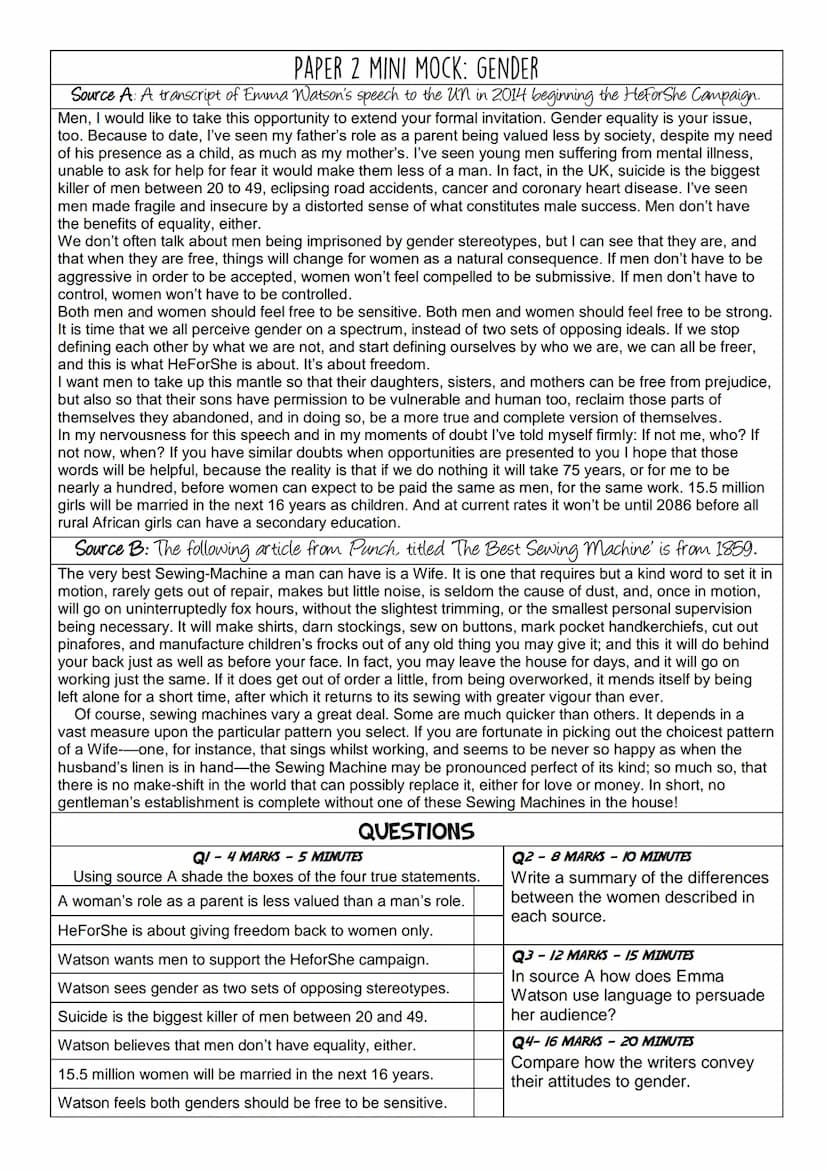

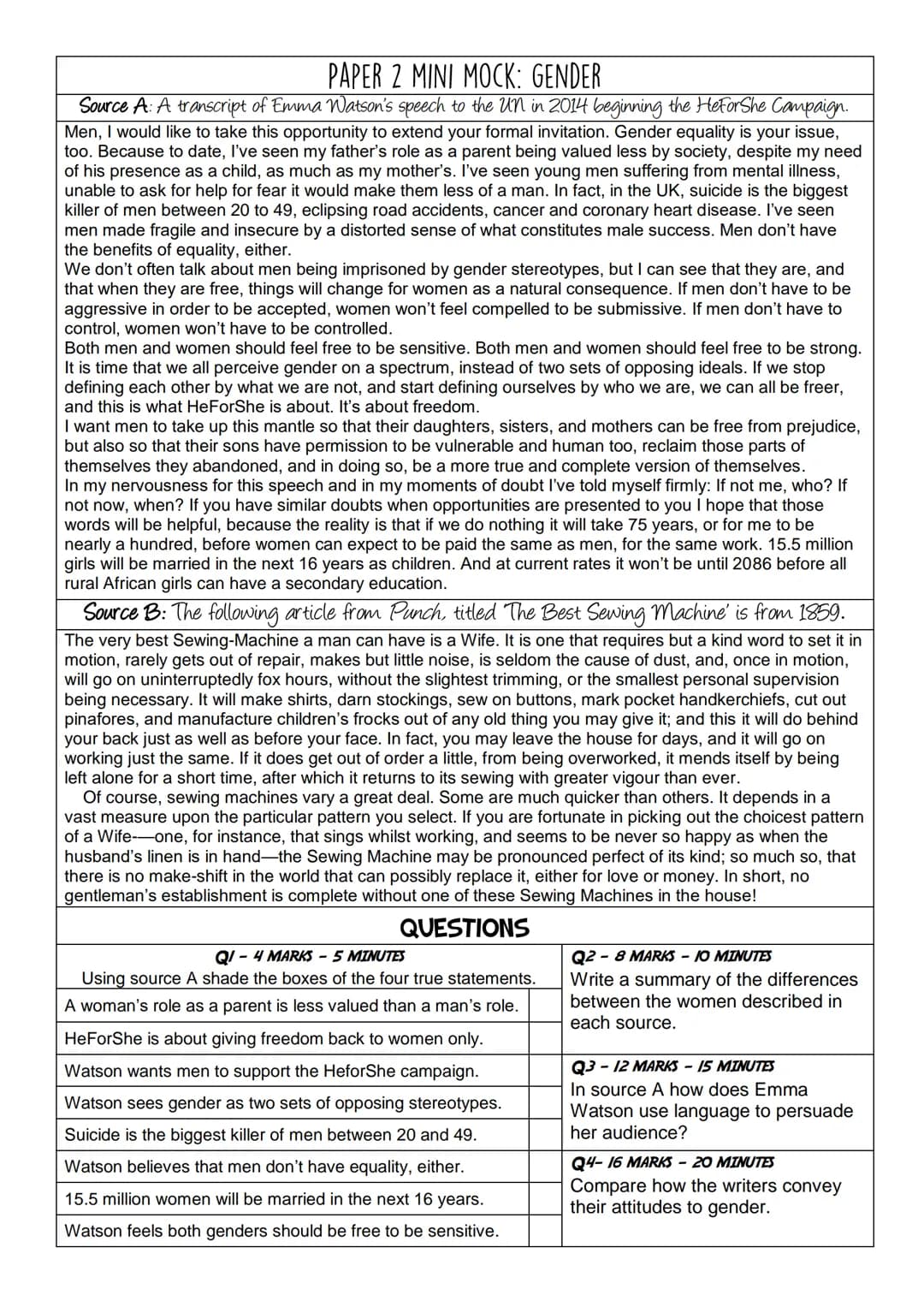
Ever wondered how conversations about gender have evolved? Emma Watson's powerful 2014 UN speech shows how modern feminism includes everyone, whilst a cheeky 1859 article reveals just how differently society once viewed women's roles.
Watson's HeForShe campaign breaks down the idea that gender equality only benefits women. She argues that men are also trapped by harmful stereotypes - from being seen as less valuable parents to struggling with mental health because they can't show vulnerability. The shocking statistic that suicide is the biggest killer of men aged 20-49 in the UK drives home her point perfectly.
Her vision is revolutionary: instead of seeing gender as "two sets of opposing ideals," she wants us to view it as a spectrum. When men don't have to be aggressive, women won't need to be submissive - it's interconnected liberation.
The 1859 Punch article takes a completely different approach, comparing wives to sewing machines in what was meant to be humorous. It reveals how women were seen as domestic tools whose main value was their ability to work tirelessly without supervision - a stark contrast to Watson's call for freedom and equality.
Key Insight: Notice how Watson uses personal anecdotes and statistics to make her argument emotionally powerful and factually convincing.
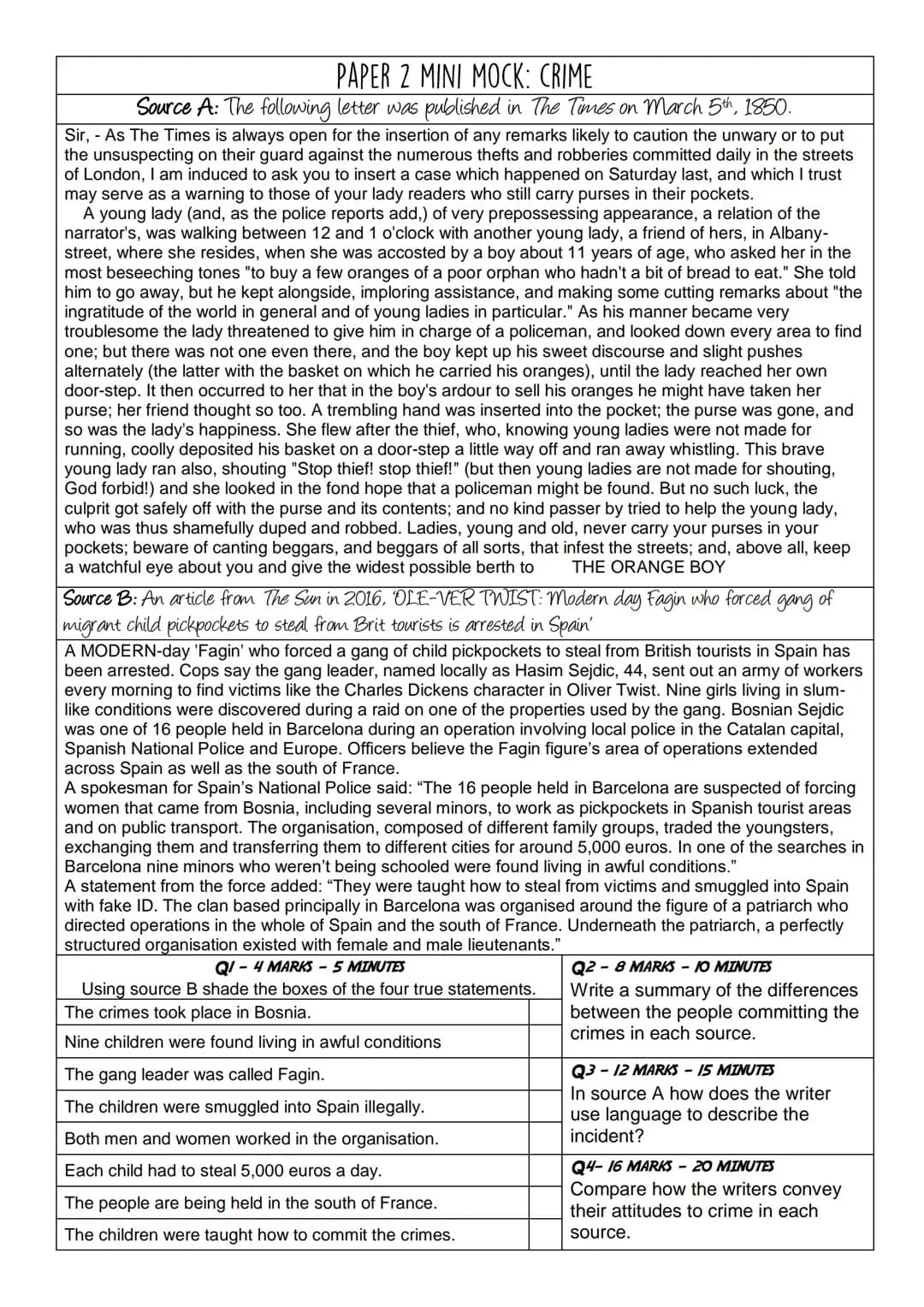
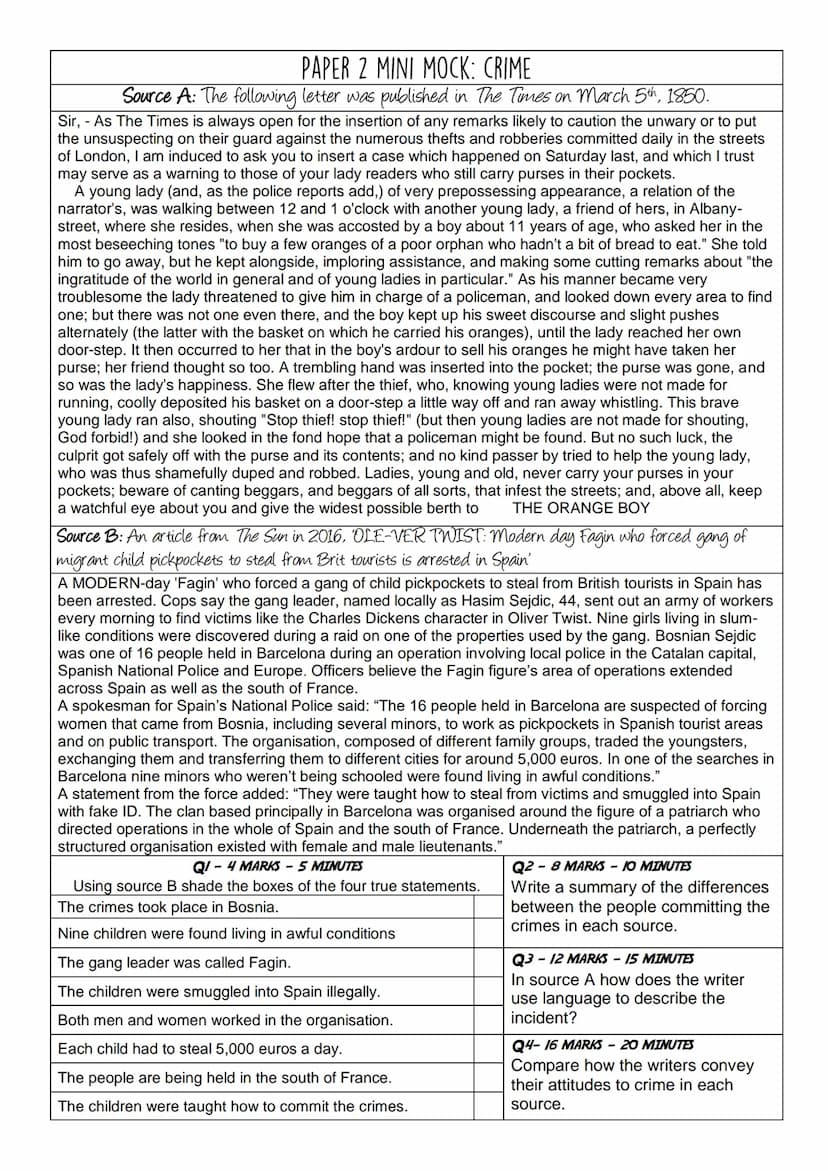
Street crime might seem like a modern problem, but these sources show it's been around for ages - though the scale and organisation have definitely changed. Both texts reveal how criminals have always exploited society's most vulnerable people.
The 1850 letter describes a simple but effective pickpocketing scam involving an 11-year-old "orange boy" who distracts a young lady whilst stealing her purse. The writer's frustration is clear - there are no police around when needed, and bystanders won't help a woman in distress.
Fast-forward to 2016, and we see crime has become far more sophisticated. The Spanish police uncovered a modern-day Fagin operation - a reference to Dickens' Oliver Twist character who used children for criminal purposes. This real-life version involved trafficking children from Bosnia, teaching them criminal techniques, and moving them across countries for around €5,000 each.
The contrast is striking: the Victorian crime was opportunistic and individual, whilst the modern crime involves organised networks with hierarchical structures spanning multiple countries. Both show how criminals prey on children, but today's operations are industrial in scale.
Quick Tip: When comparing historical texts, look for both similarities (exploitation of children) and differences (scale and organisation) to show sophisticated analysis.
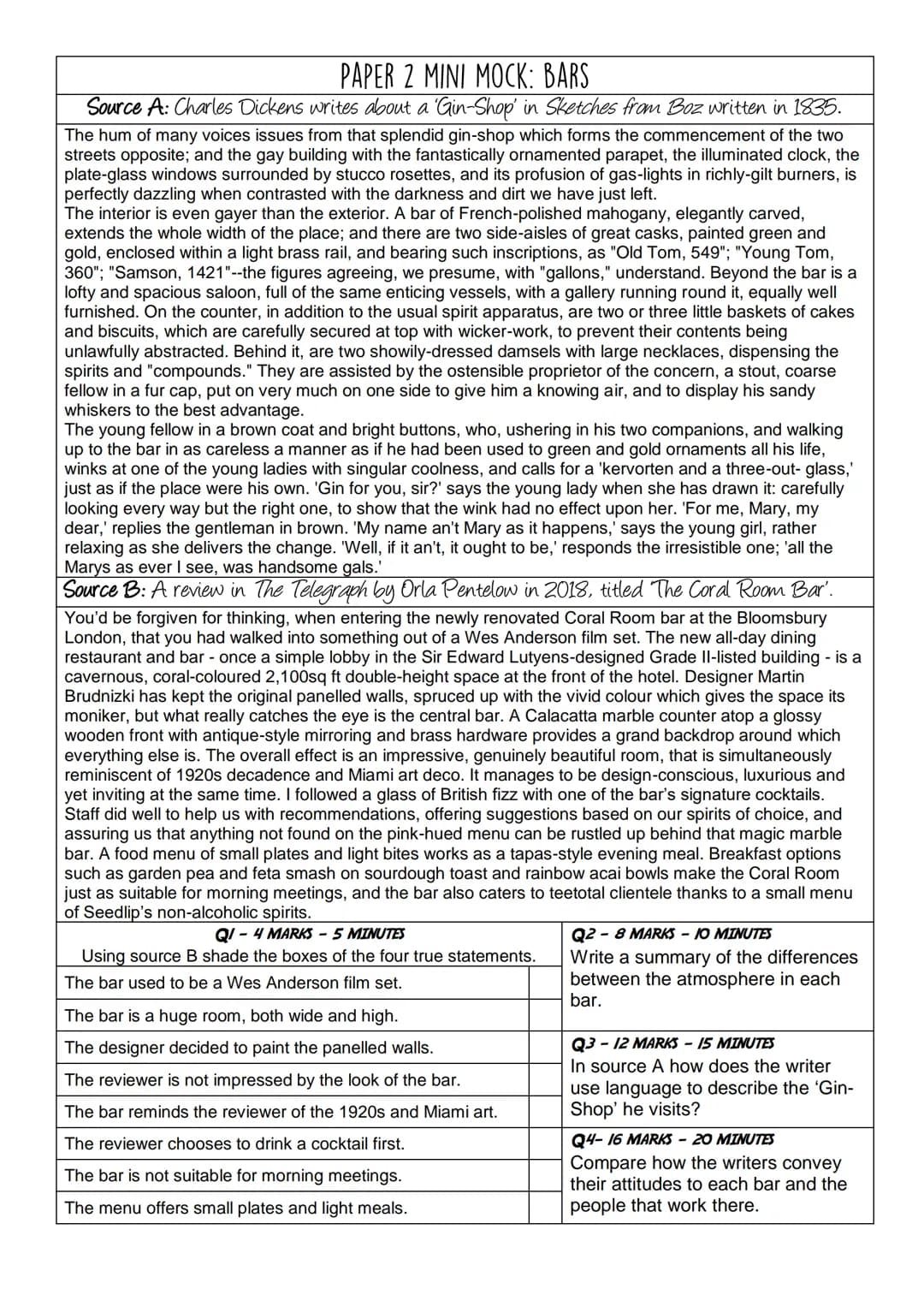
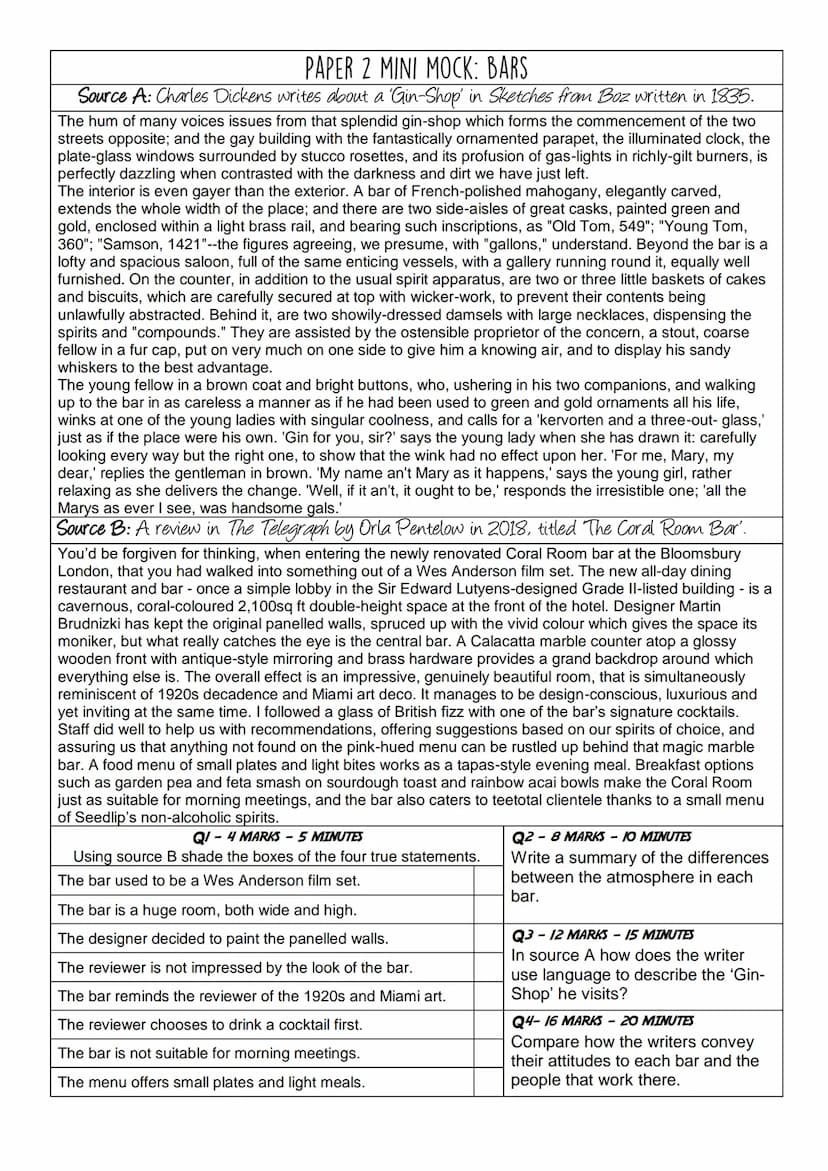
Fancy a drink? These two sources show how drinking establishments have transformed from Dickens' flashy gin palaces to today's Instagram-worthy cocktail bars - yet some things about human behaviour never change.
Dickens' 1835 gin-shop is all about excess and showing off. The "fantastically ornamented" building with its "profusion of gas-lights" and "French-polished mahogany bar" was designed to dazzle customers. Inside, the barmaids deal with cheeky customers whilst dispensing spirits from vessels with names like "Old Tom" and "Samson."
The flirtatious exchange between the customer and barmaid Mary shows how social interactions in bars haven't changed much - people still chat up bar staff and try to appear more confident than they feel.
The modern Coral Room Bar represents today's sophisticated drinking culture. Designer Martin Brudnizki has created a space that's "design-conscious, luxurious and yet inviting" with its Calacatta marble counter and coral colour scheme. The reviewer appreciates the staff's expertise and the variety - from signature cocktails to non-alcoholic options.
Both establishments aim to impress customers, but whilst Dickens' gin-shop focused on flashy decoration, today's bars prioritise experiential luxury and personalised service.
Remember: Both writers are clearly impressed by what they see, but for different reasons - spectacle versus sophistication.
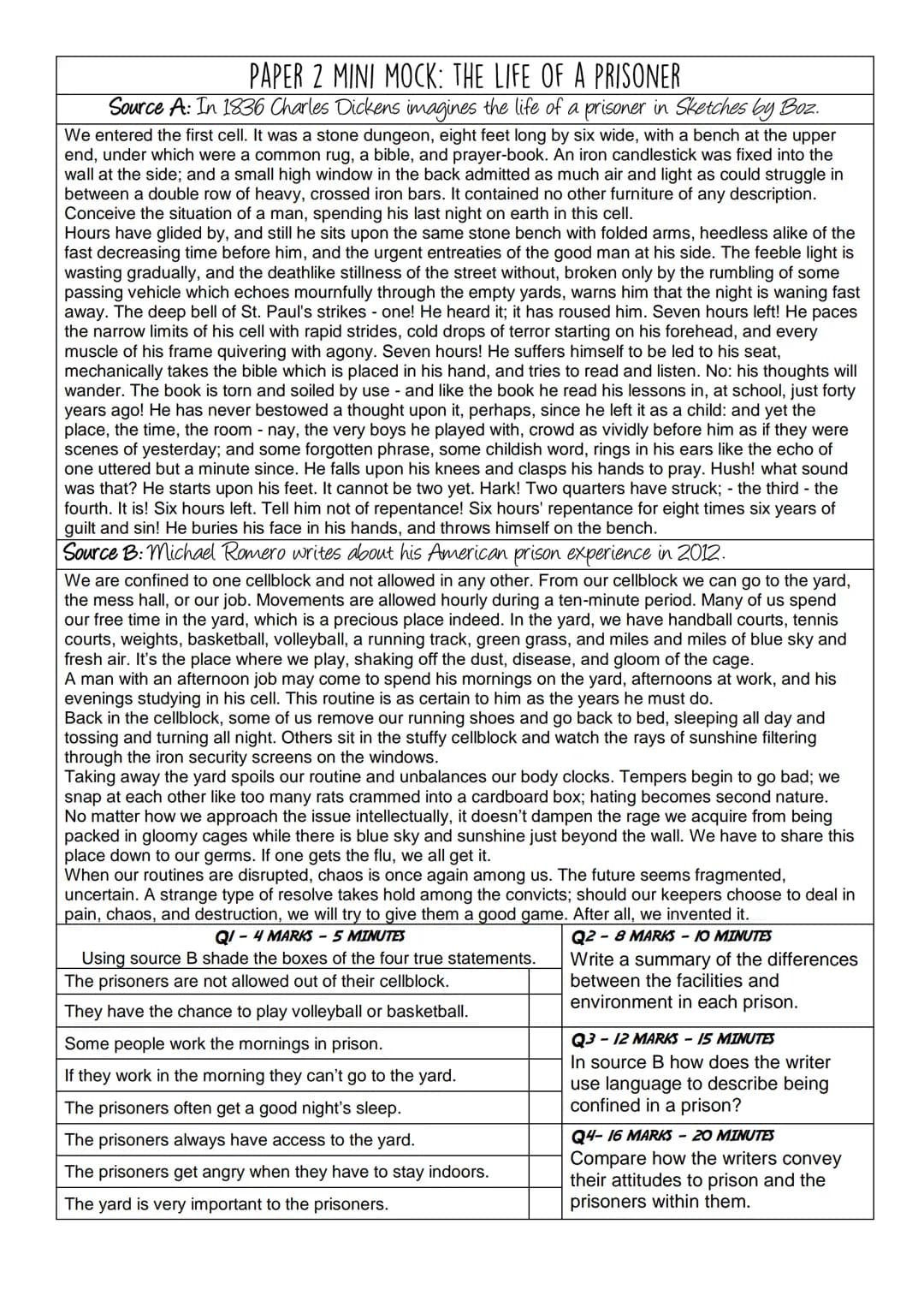
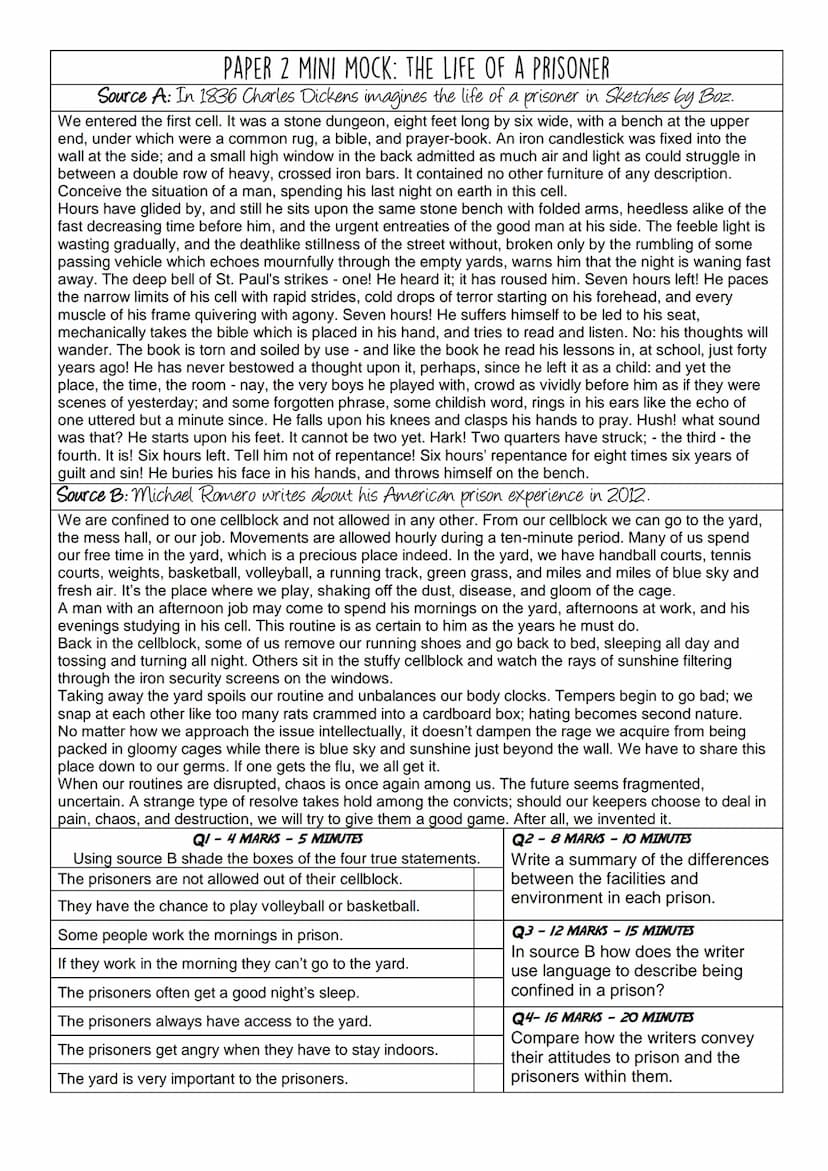
Prison experiences reveal how attitudes toward punishment and rehabilitation have evolved dramatically. These sources show the shift from viewing prisoners as condemned souls to seeing them as humans needing structure and purpose.
Dickens' 1836 death row cell is deliberately harsh - an 8x6 foot stone dungeon with just a bench, Bible, and prayer book. His condemned man experiences psychological torture, counting down his final hours whilst childhood memories flood back. The emphasis is on spiritual reflection and accepting divine judgment before execution.
The writing style mirrors the prisoner's mental state - fragmented thoughts, religious imagery, and the relentless ticking of time create claustrophobic tension. This reflects Victorian beliefs that severe conditions would encourage repentance.
Modern American prisoner Michael Romero describes a completely different system focused on routine and structure. His prison offers handball courts, tennis, weights, and educational opportunities. The yard becomes sacred space - representing freedom, fresh air, and psychological relief from confinement.
Romero's language is more analytical, comparing prisoners to "rats crammed into a cardboard box" when routines are disrupted. His focus on maintaining dignity and describing collective prisoner responses shows how modern prisons aim for rehabilitation rather than just punishment.
Key Difference: Victorian prisons emphasised individual spiritual reckoning, whilst modern prisons focus on maintaining mental health through structured activities and social interaction.
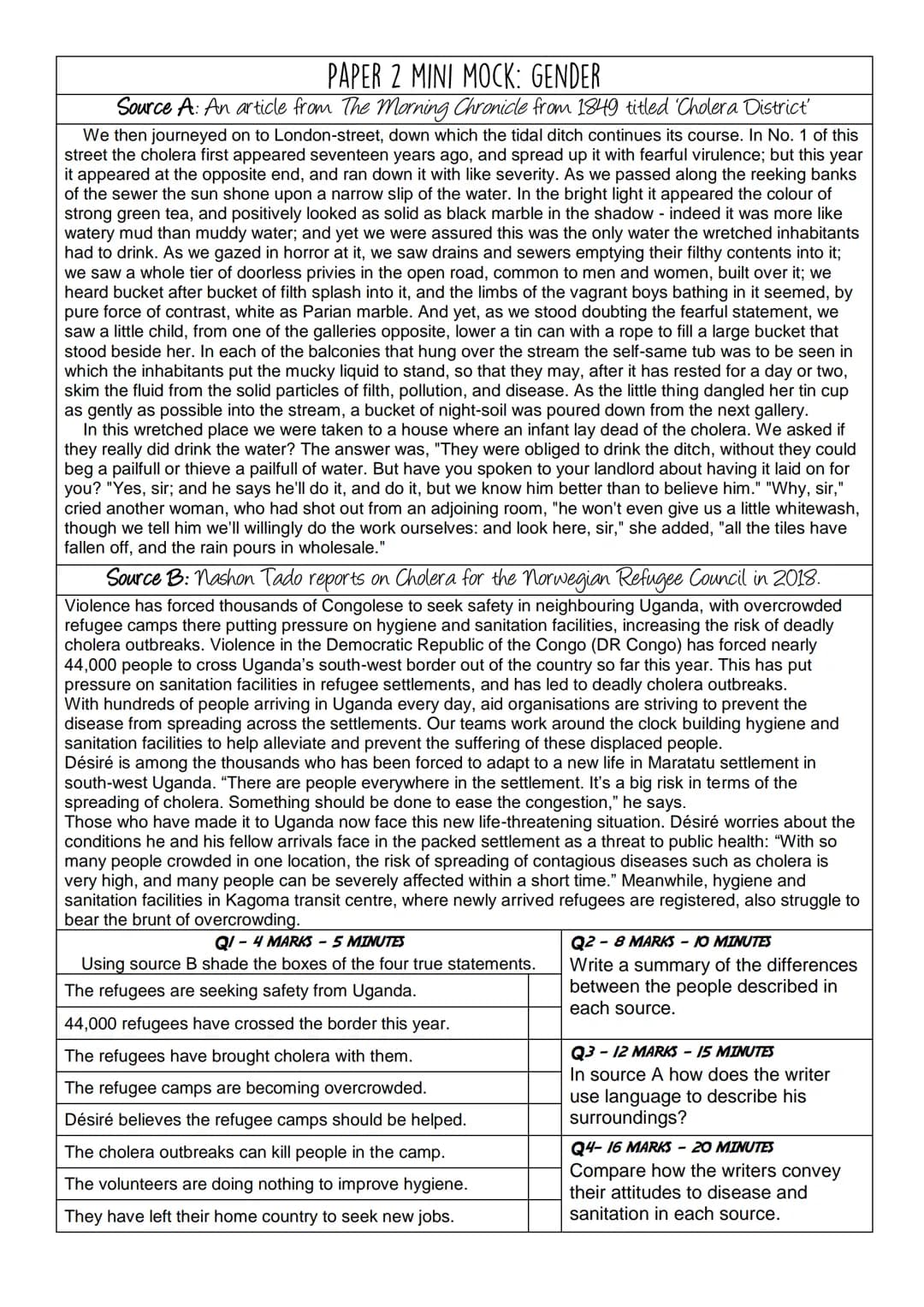
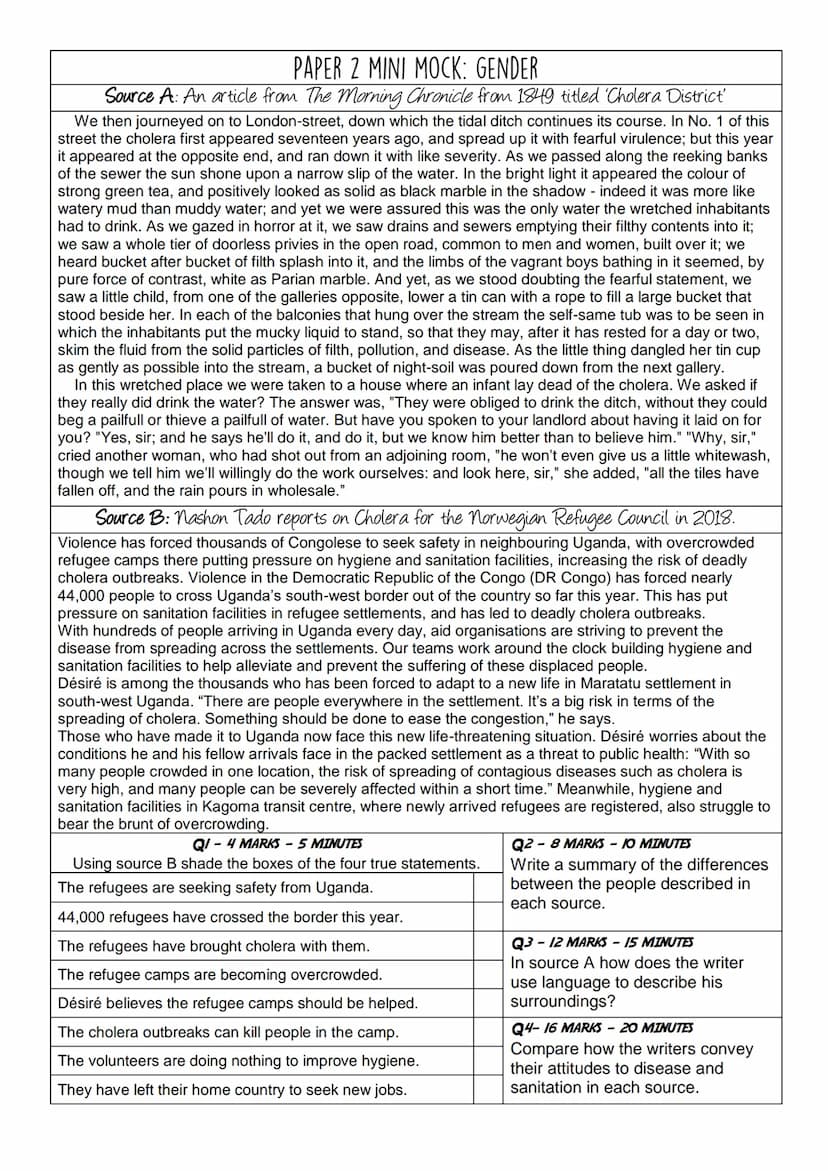
Cholera outbreaks show how poverty and displacement create perfect conditions for disease - a pattern that sadly repeats across centuries. These sources reveal how little has changed about the relationship between living conditions and public health.
The 1849 Victorian slum description is genuinely horrifying. Residents drink water that looks like "strong green tea" or "watery mud" because sewers empty directly into their water source. Children lower tin cans to collect this contaminated water whilst "bucket after bucket of filth" gets thrown in above them.
The writer uses vivid sensory imagery - the "reeking banks," the contrast between white marble-like skin and black water, and the sound of filth splashing. His horror is palpable as he witnesses a child collecting water just as human waste gets poured from above.
The 2018 Ugandan refugee camps face similar challenges but with different causes. Violence in DR Congo has forced 44,000 people into overcrowded settlements where sanitation facilities can't cope. Unlike the Victorian situation, international aid organisations work "around the clock" building hygiene facilities.
Refugee Désiré's concern about overcrowding creating "high risk of spreading contagious diseases" echoes Victorian public health fears. Both sources show how social inequality and displacement create conditions where disease thrives.
Connect the Dots: Both situations show how marginalised communities - whether urban poor or displaced refugees - face similar public health crises across different centuries.

Now you've seen how these comparison techniques work, you're ready to tackle Paper 2 with confidence. Remember that examiners want to see you identify patterns across time periods whilst noting key differences in context and presentation.
For Question 1 , read carefully and don't assume - the correct answers are explicitly stated in the text, not implied. For Question 2 (summary differences), focus on contrasting the people, places, or situations rather than just listing facts from each source.
Question 3 (language analysis) requires you to identify specific techniques like imagery, tone, and structure, then explain their effects on readers. Look for patterns in word choice and sentence structure that create particular impressions.
Question 4 (attitude comparison) is your chance to show sophisticated understanding. Consider how historical context shapes each writer's perspective, and use comparative connectives like "whereas," "in contrast," and "similarly" to link your analysis.
The key to success is practising these skills regularly and reading widely. You'll start noticing how writers from different eras tackle similar themes with different approaches, giving you plenty of material for comparison essays.
Final Tip: Always support your points with brief, relevant quotations - they show you're engaging closely with the texts and provide evidence for your interpretations.
Our AI Companion is a student-focused AI tool that offers more than just answers. Built on millions of Knowunity resources, it provides relevant information, personalised study plans, quizzes, and content directly in the chat, adapting to your individual learning journey.
You can download the app from Google Play Store and Apple App Store.
That's right! Enjoy free access to study content, connect with fellow students, and get instant help – all at your fingertips.
App Store
Google Play
The app is very easy to use and well designed. I have found everything I was looking for so far and have been able to learn a lot from the presentations! I will definitely use the app for a class assignment! And of course it also helps a lot as an inspiration.
Stefan S
iOS user
This app is really great. There are so many study notes and help [...]. My problem subject is French, for example, and the app has so many options for help. Thanks to this app, I have improved my French. I would recommend it to anyone.
Samantha Klich
Android user
Wow, I am really amazed. I just tried the app because I've seen it advertised many times and was absolutely stunned. This app is THE HELP you want for school and above all, it offers so many things, such as workouts and fact sheets, which have been VERY helpful to me personally.
Anna
iOS user
Best app on earth! no words because it’s too good
Thomas R
iOS user
Just amazing. Let's me revise 10x better, this app is a quick 10/10. I highly recommend it to anyone. I can watch and search for notes. I can save them in the subject folder. I can revise it any time when I come back. If you haven't tried this app, you're really missing out.
Basil
Android user
This app has made me feel so much more confident in my exam prep, not only through boosting my own self confidence through the features that allow you to connect with others and feel less alone, but also through the way the app itself is centred around making you feel better. It is easy to navigate, fun to use, and helpful to anyone struggling in absolutely any way.
David K
iOS user
The app's just great! All I have to do is enter the topic in the search bar and I get the response real fast. I don't have to watch 10 YouTube videos to understand something, so I'm saving my time. Highly recommended!
Sudenaz Ocak
Android user
In school I was really bad at maths but thanks to the app, I am doing better now. I am so grateful that you made the app.
Greenlight Bonnie
Android user
very reliable app to help and grow your ideas of Maths, English and other related topics in your works. please use this app if your struggling in areas, this app is key for that. wish I'd of done a review before. and it's also free so don't worry about that.
Rohan U
Android user
I know a lot of apps use fake accounts to boost their reviews but this app deserves it all. Originally I was getting 4 in my English exams and this time I got a grade 7. I didn’t even know about this app three days until the exam and it has helped A LOT. Please actually trust me and use it as I’m sure you too will see developments.
Xander S
iOS user
THE QUIZES AND FLASHCARDS ARE SO USEFUL AND I LOVE Knowunity AI. IT ALSO IS LITREALLY LIKE CHATGPT BUT SMARTER!! HELPED ME WITH MY MASCARA PROBLEMS TOO!! AS WELL AS MY REAL SUBJECTS ! DUHHH 😍😁😲🤑💗✨🎀😮
Elisha
iOS user
This apps acc the goat. I find revision so boring but this app makes it so easy to organize it all and then you can ask the freeeee ai to test yourself so good and you can easily upload your own stuff. highly recommend as someone taking mocks now
Paul T
iOS user
The app is very easy to use and well designed. I have found everything I was looking for so far and have been able to learn a lot from the presentations! I will definitely use the app for a class assignment! And of course it also helps a lot as an inspiration.
Stefan S
iOS user
This app is really great. There are so many study notes and help [...]. My problem subject is French, for example, and the app has so many options for help. Thanks to this app, I have improved my French. I would recommend it to anyone.
Samantha Klich
Android user
Wow, I am really amazed. I just tried the app because I've seen it advertised many times and was absolutely stunned. This app is THE HELP you want for school and above all, it offers so many things, such as workouts and fact sheets, which have been VERY helpful to me personally.
Anna
iOS user
Best app on earth! no words because it’s too good
Thomas R
iOS user
Just amazing. Let's me revise 10x better, this app is a quick 10/10. I highly recommend it to anyone. I can watch and search for notes. I can save them in the subject folder. I can revise it any time when I come back. If you haven't tried this app, you're really missing out.
Basil
Android user
This app has made me feel so much more confident in my exam prep, not only through boosting my own self confidence through the features that allow you to connect with others and feel less alone, but also through the way the app itself is centred around making you feel better. It is easy to navigate, fun to use, and helpful to anyone struggling in absolutely any way.
David K
iOS user
The app's just great! All I have to do is enter the topic in the search bar and I get the response real fast. I don't have to watch 10 YouTube videos to understand something, so I'm saving my time. Highly recommended!
Sudenaz Ocak
Android user
In school I was really bad at maths but thanks to the app, I am doing better now. I am so grateful that you made the app.
Greenlight Bonnie
Android user
very reliable app to help and grow your ideas of Maths, English and other related topics in your works. please use this app if your struggling in areas, this app is key for that. wish I'd of done a review before. and it's also free so don't worry about that.
Rohan U
Android user
I know a lot of apps use fake accounts to boost their reviews but this app deserves it all. Originally I was getting 4 in my English exams and this time I got a grade 7. I didn’t even know about this app three days until the exam and it has helped A LOT. Please actually trust me and use it as I’m sure you too will see developments.
Xander S
iOS user
THE QUIZES AND FLASHCARDS ARE SO USEFUL AND I LOVE Knowunity AI. IT ALSO IS LITREALLY LIKE CHATGPT BUT SMARTER!! HELPED ME WITH MY MASCARA PROBLEMS TOO!! AS WELL AS MY REAL SUBJECTS ! DUHHH 😍😁😲🤑💗✨🎀😮
Elisha
iOS user
This apps acc the goat. I find revision so boring but this app makes it so easy to organize it all and then you can ask the freeeee ai to test yourself so good and you can easily upload your own stuff. highly recommend as someone taking mocks now
Paul T
iOS user
Eva448 Jones
@eva448jones_hnxi
These mock exam papers will help you master the essential skills for English Language Paper 2 - comparing texts from different time periods. You'll learn how to identify key information, summarise differences between sources, analyse writers' language techniques, and compare... Show more
Access to all documents
Improve your grades
Join milions of students
Ever wondered how conversations about gender have evolved? Emma Watson's powerful 2014 UN speech shows how modern feminism includes everyone, whilst a cheeky 1859 article reveals just how differently society once viewed women's roles.
Watson's HeForShe campaign breaks down the idea that gender equality only benefits women. She argues that men are also trapped by harmful stereotypes - from being seen as less valuable parents to struggling with mental health because they can't show vulnerability. The shocking statistic that suicide is the biggest killer of men aged 20-49 in the UK drives home her point perfectly.
Her vision is revolutionary: instead of seeing gender as "two sets of opposing ideals," she wants us to view it as a spectrum. When men don't have to be aggressive, women won't need to be submissive - it's interconnected liberation.
The 1859 Punch article takes a completely different approach, comparing wives to sewing machines in what was meant to be humorous. It reveals how women were seen as domestic tools whose main value was their ability to work tirelessly without supervision - a stark contrast to Watson's call for freedom and equality.
Key Insight: Notice how Watson uses personal anecdotes and statistics to make her argument emotionally powerful and factually convincing.
Access to all documents
Improve your grades
Join milions of students
Street crime might seem like a modern problem, but these sources show it's been around for ages - though the scale and organisation have definitely changed. Both texts reveal how criminals have always exploited society's most vulnerable people.
The 1850 letter describes a simple but effective pickpocketing scam involving an 11-year-old "orange boy" who distracts a young lady whilst stealing her purse. The writer's frustration is clear - there are no police around when needed, and bystanders won't help a woman in distress.
Fast-forward to 2016, and we see crime has become far more sophisticated. The Spanish police uncovered a modern-day Fagin operation - a reference to Dickens' Oliver Twist character who used children for criminal purposes. This real-life version involved trafficking children from Bosnia, teaching them criminal techniques, and moving them across countries for around €5,000 each.
The contrast is striking: the Victorian crime was opportunistic and individual, whilst the modern crime involves organised networks with hierarchical structures spanning multiple countries. Both show how criminals prey on children, but today's operations are industrial in scale.
Quick Tip: When comparing historical texts, look for both similarities (exploitation of children) and differences (scale and organisation) to show sophisticated analysis.
Access to all documents
Improve your grades
Join milions of students
Fancy a drink? These two sources show how drinking establishments have transformed from Dickens' flashy gin palaces to today's Instagram-worthy cocktail bars - yet some things about human behaviour never change.
Dickens' 1835 gin-shop is all about excess and showing off. The "fantastically ornamented" building with its "profusion of gas-lights" and "French-polished mahogany bar" was designed to dazzle customers. Inside, the barmaids deal with cheeky customers whilst dispensing spirits from vessels with names like "Old Tom" and "Samson."
The flirtatious exchange between the customer and barmaid Mary shows how social interactions in bars haven't changed much - people still chat up bar staff and try to appear more confident than they feel.
The modern Coral Room Bar represents today's sophisticated drinking culture. Designer Martin Brudnizki has created a space that's "design-conscious, luxurious and yet inviting" with its Calacatta marble counter and coral colour scheme. The reviewer appreciates the staff's expertise and the variety - from signature cocktails to non-alcoholic options.
Both establishments aim to impress customers, but whilst Dickens' gin-shop focused on flashy decoration, today's bars prioritise experiential luxury and personalised service.
Remember: Both writers are clearly impressed by what they see, but for different reasons - spectacle versus sophistication.
Access to all documents
Improve your grades
Join milions of students
Prison experiences reveal how attitudes toward punishment and rehabilitation have evolved dramatically. These sources show the shift from viewing prisoners as condemned souls to seeing them as humans needing structure and purpose.
Dickens' 1836 death row cell is deliberately harsh - an 8x6 foot stone dungeon with just a bench, Bible, and prayer book. His condemned man experiences psychological torture, counting down his final hours whilst childhood memories flood back. The emphasis is on spiritual reflection and accepting divine judgment before execution.
The writing style mirrors the prisoner's mental state - fragmented thoughts, religious imagery, and the relentless ticking of time create claustrophobic tension. This reflects Victorian beliefs that severe conditions would encourage repentance.
Modern American prisoner Michael Romero describes a completely different system focused on routine and structure. His prison offers handball courts, tennis, weights, and educational opportunities. The yard becomes sacred space - representing freedom, fresh air, and psychological relief from confinement.
Romero's language is more analytical, comparing prisoners to "rats crammed into a cardboard box" when routines are disrupted. His focus on maintaining dignity and describing collective prisoner responses shows how modern prisons aim for rehabilitation rather than just punishment.
Key Difference: Victorian prisons emphasised individual spiritual reckoning, whilst modern prisons focus on maintaining mental health through structured activities and social interaction.
Access to all documents
Improve your grades
Join milions of students
Cholera outbreaks show how poverty and displacement create perfect conditions for disease - a pattern that sadly repeats across centuries. These sources reveal how little has changed about the relationship between living conditions and public health.
The 1849 Victorian slum description is genuinely horrifying. Residents drink water that looks like "strong green tea" or "watery mud" because sewers empty directly into their water source. Children lower tin cans to collect this contaminated water whilst "bucket after bucket of filth" gets thrown in above them.
The writer uses vivid sensory imagery - the "reeking banks," the contrast between white marble-like skin and black water, and the sound of filth splashing. His horror is palpable as he witnesses a child collecting water just as human waste gets poured from above.
The 2018 Ugandan refugee camps face similar challenges but with different causes. Violence in DR Congo has forced 44,000 people into overcrowded settlements where sanitation facilities can't cope. Unlike the Victorian situation, international aid organisations work "around the clock" building hygiene facilities.
Refugee Désiré's concern about overcrowding creating "high risk of spreading contagious diseases" echoes Victorian public health fears. Both sources show how social inequality and displacement create conditions where disease thrives.
Connect the Dots: Both situations show how marginalised communities - whether urban poor or displaced refugees - face similar public health crises across different centuries.
Access to all documents
Improve your grades
Join milions of students
Now you've seen how these comparison techniques work, you're ready to tackle Paper 2 with confidence. Remember that examiners want to see you identify patterns across time periods whilst noting key differences in context and presentation.
For Question 1 , read carefully and don't assume - the correct answers are explicitly stated in the text, not implied. For Question 2 (summary differences), focus on contrasting the people, places, or situations rather than just listing facts from each source.
Question 3 (language analysis) requires you to identify specific techniques like imagery, tone, and structure, then explain their effects on readers. Look for patterns in word choice and sentence structure that create particular impressions.
Question 4 (attitude comparison) is your chance to show sophisticated understanding. Consider how historical context shapes each writer's perspective, and use comparative connectives like "whereas," "in contrast," and "similarly" to link your analysis.
The key to success is practising these skills regularly and reading widely. You'll start noticing how writers from different eras tackle similar themes with different approaches, giving you plenty of material for comparison essays.
Final Tip: Always support your points with brief, relevant quotations - they show you're engaging closely with the texts and provide evidence for your interpretations.
Our AI Companion is a student-focused AI tool that offers more than just answers. Built on millions of Knowunity resources, it provides relevant information, personalised study plans, quizzes, and content directly in the chat, adapting to your individual learning journey.
You can download the app from Google Play Store and Apple App Store.
That's right! Enjoy free access to study content, connect with fellow students, and get instant help – all at your fingertips.
23
Smart Tools NEW
Transform this note into: ✓ 50+ Practice Questions ✓ Interactive Flashcards ✓ Full Mock Exam ✓ Essay Outlines
Explore the pivotal moments in 'A Christmas Carol' that illustrate Scrooge's evolution from a miserly figure to a caring individual. This summary covers key themes such as redemption, family values, and the impact of poverty, alongside the significant roles of characters like Tiny Tim, Bob Cratchit, and Jacob Marley. Ideal for students studying Dickens' classic, this resource highlights the importance of compassion and social responsibility.
 English Language
Explore a detailed analysis of Inspector Goole's character in J.B. Priestley's 'An Inspector Calls'. This study note delves into his authoritative presence, social responsibility themes, and the critique of capitalist attitudes. Ideal for GCSE revision, it highlights key quotes and character dynamics, emphasizing the inspector's role in challenging the upper class and advocating for collective responsibility. Perfect for students seeking to understand the moral implications of the play.
English LanguageExplore the character of Mrs. Birling in J.B. Priestley's 'An Inspector Calls'. This analysis delves into her rejection of responsibility, social superiority, and the implications of class dynamics. Key themes include the contrast between capitalist and socialist views on accountability, as well as the symbolic use of lighting to represent the characters' sheltered lives. Ideal for students studying character development and social commentary in literature.
English LanguageExplore the multifaceted portrayal of Eric Birling in J.B. Priestley's 'An Inspector Calls'. This detailed analysis examines Eric's conflicting qualities, from his initial flaws to his eventual moral awakening. Key themes include guilt, redemption, and societal responsibility. Ideal for students aiming for top marks in their literary analysis.
English LanguageExplore essential literary techniques and their effects in English literature. This comprehensive guide covers similes, metaphors, foreshadowing, and more, providing clear definitions and examples to enhance your understanding and analysis skills for GCSE AQA English. Ideal for students seeking to improve their literary analysis and comprehension.
English LanguageExplore the portrayal of Mr. Hyde as a dangerous character in Robert Louis Stevenson's 'The Strange Case of Dr. Jekyll and Mr. Hyde'. This analysis delves into key language techniques such as vivid imagery, symbolism, and foreshadowing that highlight Hyde's menacing presence. Understand how the duality of human nature is represented through the relationship between Jekyll and Hyde, and how narrative structure enhances the sense of danger throughout the novella. Ideal for Grade 9 literature studies.
English LanguageApp Store
Google Play
The app is very easy to use and well designed. I have found everything I was looking for so far and have been able to learn a lot from the presentations! I will definitely use the app for a class assignment! And of course it also helps a lot as an inspiration.
Stefan S
iOS user
This app is really great. There are so many study notes and help [...]. My problem subject is French, for example, and the app has so many options for help. Thanks to this app, I have improved my French. I would recommend it to anyone.
Samantha Klich
Android user
Wow, I am really amazed. I just tried the app because I've seen it advertised many times and was absolutely stunned. This app is THE HELP you want for school and above all, it offers so many things, such as workouts and fact sheets, which have been VERY helpful to me personally.
Anna
iOS user
Best app on earth! no words because it’s too good
Thomas R
iOS user
Just amazing. Let's me revise 10x better, this app is a quick 10/10. I highly recommend it to anyone. I can watch and search for notes. I can save them in the subject folder. I can revise it any time when I come back. If you haven't tried this app, you're really missing out.
Basil
Android user
This app has made me feel so much more confident in my exam prep, not only through boosting my own self confidence through the features that allow you to connect with others and feel less alone, but also through the way the app itself is centred around making you feel better. It is easy to navigate, fun to use, and helpful to anyone struggling in absolutely any way.
David K
iOS user
The app's just great! All I have to do is enter the topic in the search bar and I get the response real fast. I don't have to watch 10 YouTube videos to understand something, so I'm saving my time. Highly recommended!
Sudenaz Ocak
Android user
In school I was really bad at maths but thanks to the app, I am doing better now. I am so grateful that you made the app.
Greenlight Bonnie
Android user
very reliable app to help and grow your ideas of Maths, English and other related topics in your works. please use this app if your struggling in areas, this app is key for that. wish I'd of done a review before. and it's also free so don't worry about that.
Rohan U
Android user
I know a lot of apps use fake accounts to boost their reviews but this app deserves it all. Originally I was getting 4 in my English exams and this time I got a grade 7. I didn’t even know about this app three days until the exam and it has helped A LOT. Please actually trust me and use it as I’m sure you too will see developments.
Xander S
iOS user
THE QUIZES AND FLASHCARDS ARE SO USEFUL AND I LOVE Knowunity AI. IT ALSO IS LITREALLY LIKE CHATGPT BUT SMARTER!! HELPED ME WITH MY MASCARA PROBLEMS TOO!! AS WELL AS MY REAL SUBJECTS ! DUHHH 😍😁😲🤑💗✨🎀😮
Elisha
iOS user
This apps acc the goat. I find revision so boring but this app makes it so easy to organize it all and then you can ask the freeeee ai to test yourself so good and you can easily upload your own stuff. highly recommend as someone taking mocks now
Paul T
iOS user
The app is very easy to use and well designed. I have found everything I was looking for so far and have been able to learn a lot from the presentations! I will definitely use the app for a class assignment! And of course it also helps a lot as an inspiration.
Stefan S
iOS user
This app is really great. There are so many study notes and help [...]. My problem subject is French, for example, and the app has so many options for help. Thanks to this app, I have improved my French. I would recommend it to anyone.
Samantha Klich
Android user
Wow, I am really amazed. I just tried the app because I've seen it advertised many times and was absolutely stunned. This app is THE HELP you want for school and above all, it offers so many things, such as workouts and fact sheets, which have been VERY helpful to me personally.
Anna
iOS user
Best app on earth! no words because it’s too good
Thomas R
iOS user
Just amazing. Let's me revise 10x better, this app is a quick 10/10. I highly recommend it to anyone. I can watch and search for notes. I can save them in the subject folder. I can revise it any time when I come back. If you haven't tried this app, you're really missing out.
Basil
Android user
This app has made me feel so much more confident in my exam prep, not only through boosting my own self confidence through the features that allow you to connect with others and feel less alone, but also through the way the app itself is centred around making you feel better. It is easy to navigate, fun to use, and helpful to anyone struggling in absolutely any way.
David K
iOS user
The app's just great! All I have to do is enter the topic in the search bar and I get the response real fast. I don't have to watch 10 YouTube videos to understand something, so I'm saving my time. Highly recommended!
Sudenaz Ocak
Android user
In school I was really bad at maths but thanks to the app, I am doing better now. I am so grateful that you made the app.
Greenlight Bonnie
Android user
very reliable app to help and grow your ideas of Maths, English and other related topics in your works. please use this app if your struggling in areas, this app is key for that. wish I'd of done a review before. and it's also free so don't worry about that.
Rohan U
Android user
I know a lot of apps use fake accounts to boost their reviews but this app deserves it all. Originally I was getting 4 in my English exams and this time I got a grade 7. I didn’t even know about this app three days until the exam and it has helped A LOT. Please actually trust me and use it as I’m sure you too will see developments.
Xander S
iOS user
THE QUIZES AND FLASHCARDS ARE SO USEFUL AND I LOVE Knowunity AI. IT ALSO IS LITREALLY LIKE CHATGPT BUT SMARTER!! HELPED ME WITH MY MASCARA PROBLEMS TOO!! AS WELL AS MY REAL SUBJECTS ! DUHHH 😍😁😲🤑💗✨🎀😮
Elisha
iOS user
This apps acc the goat. I find revision so boring but this app makes it so easy to organize it all and then you can ask the freeeee ai to test yourself so good and you can easily upload your own stuff. highly recommend as someone taking mocks now
Paul T
iOS user