
Ever wondered how Charles Dickens used A Christmas Carol to... Show more
 English Literature
 Sociology
 Biology
Sign up to see the contentIt's free!
Access to all documents
Improve your grades
Join milions of students
By signing up you accept Terms of Service and Privacy Policy
Subjects
Classic Dramatic Literature
Modern Lyric Poetry
Influential English-Language Authors
Classic and Contemporary Novels
Literary Character Analysis
Romantic and Love Poetry
Reading Analysis and Interpretation
Evidence Analysis and Integration
Author's Stylistic Elements
Figurative Language and Rhetoric
Show all topics
Human Organ Systems
Cellular Organization and Development
Biomolecular Structure and Organization
Enzyme Structure and Regulation
Cellular Organization Types
Biological Homeostatic Processes
Cellular Membrane Structure
Autotrophic Energy Processes
Environmental Sustainability and Impact
Neural Communication Systems
Show all topics
Social Sciences Research & Practice
Social Structure and Mobility
Classic Social Influence Experiments
Social Systems Theories
Family and Relationship Dynamics
Memory Systems and Processes
Neural Bases of Behavior
Social Influence and Attraction
Psychotherapeutic Approaches
Human Agency and Responsibility
Show all topics
Chemical Sciences and Applications
Chemical Bond Types and Properties
Organic Functional Groups
Atomic Structure and Composition
Chromatographic Separation Principles
Chemical Compound Classifications
Electrochemical Cell Systems
Periodic Table Organization
Chemical Reaction Kinetics
Chemical Equation Conservation
Show all topics
Nazi Germany and Holocaust 1933-1945
World Wars and Peace Treaties
European Monarchs and Statesmen
Cold War Global Tensions
Medieval Institutions and Systems
European Renaissance and Enlightenment
Modern Global Environmental-Health Challenges
Modern Military Conflicts
Medieval Migration and Invasions
World Wars Era and Impact
Show all topics
73
•
5 Feb 2026
•
fleuvrsx
@fleuvrs08
Ever wondered how Charles Dickens used A Christmas Carol to... Show more




![# A Christmas Carol
[CONTEXT- Links with themes]
POVERTY
Main points: Workhouses, capitalism, poor law amendment act
* The industrial revo](/_next/image?url=https%3A%2F%2Fcontent-eu-central-1.knowunity.com%2FCONTENT%2FgyqZYdMCABPDDjQcEwhB_image_page_1.webp&w=2048&q=75)
The Industrial Revolution completely transformed Victorian England, but not in a good way for most people. Traditional jobs disappeared as dangerous factory work took over, creating a massive gap between the rich and poor that would make today's inequality look tame.
The Poor Law Amendment Act of 1834 made things even worse by forcing poor people into workhouses—basically prisons where families were separated and forced into harsh labour. Child labour was everywhere (think of Bob Cratchit's kids working instead of going to school), and society genuinely believed poor people deserved their suffering.
Dickens makes Scrooge symbolic of the capitalist system—a self-centred businessman who hoards wealth whilst others starve. When Scrooge asks "Are there no prisons? Are there no workhouses?", he's parroting the typical upper-class attitude that poverty was a personal failing, not a systemic problem.
Key Point: Dickens wrote from experience—his own father was imprisoned for debt, giving him firsthand knowledge of poverty's brutal reality.
Family life was idealised as a retreat from industrial chaos, organised along patriarchal lines (like Bob Cratchit as head of his family). Marriage for love rather than status was becoming popular, which explains why Scrooge finds Fred's romantic marriage so ridiculous.
![# A Christmas Carol
[CONTEXT- Links with themes]
POVERTY
Main points: Workhouses, capitalism, poor law amendment act
* The industrial revo](/_next/image?url=https%3A%2F%2Fcontent-eu-central-1.knowunity.com%2FCONTENT%2FgyqZYdMCABPDDjQcEwhB_image_page_2.webp&w=2048&q=75)
Christmas wasn't always the massive celebration we know today—Victorians only started properly celebrating it in the 19th century, and Dickens' novella actually helped popularise Christmas traditions we still follow now.
The story is packed with Christian symbolism around redemption and salvation. Marley represents purgatory—stuck between Heaven and Hell until he repents for his sins. The three spirits act as divine messengers, giving Scrooge chances to change before it's too late.
Death and child mortality feature heavily because Victorian cities were brutal places where kids regularly died from malnutrition, disease, and poverty. Dickens uses Tiny Tim to highlight how the capitalist system literally kills children through neglect and inequality.
Key Point: Dickens viewed capitalism as genuinely harmful to society, using images of death to show the consequences of putting profit before people.
The transformation theme connects to John Locke's philosophy—that people aren't born evil but shaped by experiences. Scrooge's childhood neglect and isolation created his misanthropic adult personality, but he can still change through new experiences with the ghosts.
![# A Christmas Carol
[CONTEXT- Links with themes]
POVERTY
Main points: Workhouses, capitalism, poor law amendment act
* The industrial revo](/_next/image?url=https%3A%2F%2Fcontent-eu-central-1.knowunity.com%2FCONTENT%2FgyqZYdMCABPDDjQcEwhB_image_page_3.webp&w=2048&q=75)
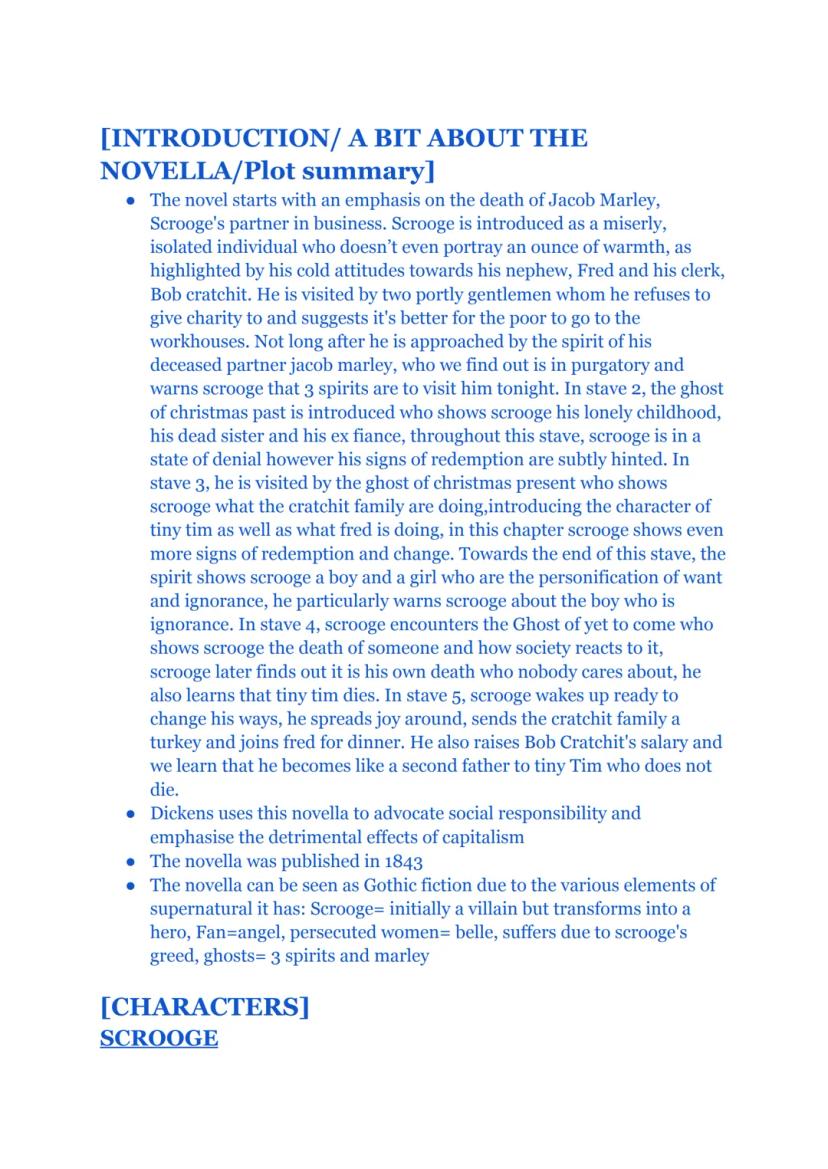
The story kicks off with Marley's death being emphasised (he's "dead as a doornail"), then introduces Scrooge as the ultimate miser who makes Ebenezer look warm and fuzzy. After rejecting charity and family warmth, he's visited by Marley's ghost in purgatory, who warns that three spirits will visit.
Each ghost shows Scrooge different time periods: Christmas Past reveals his lonely childhood and lost love, Christmas Present shows the Cratchit family's struggles and joy, and Christmas Yet to Come presents his own unmourned death. The final stave sees complete redemption—Scrooge becomes generous, raises Bob's salary, and becomes like a second father to Tiny Tim.
Dickens uses Gothic fiction elements throughout: supernatural spirits, the villain-to-hero transformation, persecuted women (Belle suffering from Scrooge's greed), and the overall dark atmosphere before redemption.
Key Point: The novella functions as both entertainment and social activism, advocating for collective responsibility to tackle poverty.
The structure deliberately mirrors the Christian concept of salvation—recognition of sin, repentance, and redemption—making it accessible to Victorian religious sensibilities whilst delivering harsh social criticism.
![# A Christmas Carol
[CONTEXT- Links with themes]
POVERTY
Main points: Workhouses, capitalism, poor law amendment act
* The industrial revo](/_next/image?url=https%3A%2F%2Fcontent-eu-central-1.knowunity.com%2FCONTENT%2FgyqZYdMCABPDDjQcEwhB_image_page_4.webp&w=2048&q=75)
Scrooge starts as both protagonist and antagonist—a brilliant literary device that lets Dickens show how the same person can embody society's problems and solutions. Initially, he's "solitary as an oyster" and surrounded by fog, which serves as a metaphor for blocking out joy and human connection.
The seven deadly sins are embodied in Scrooge's avarice, but the oyster simile suggests hidden potential—oysters contain pearls, hinting at goodness beneath his harsh exterior. His misanthropy stems from childhood abandonment, creating emotional detachment that makes him an outsider in his own society.
Character transformation happens through the ghosts acting as catalysts, providing the "activation energy" for change. By Stave 5, the fog disappears entirely, symbolising his ability to finally see clearly and connect with others.
Key Point: Even the narrator's voice changes—starting with hatred for Scrooge and ending with affection, mirroring the reader's journey.
Key quotes show his journey: from "decrease the surplus population" (dehumanising the poor) to "I am not the man I was" (accepting responsibility for change). His final role as Tiny Tim's "second father" proves complete redemption is possible for anyone.
![# A Christmas Carol
[CONTEXT- Links with themes]
POVERTY
Main points: Workhouses, capitalism, poor law amendment act
* The industrial revo](/_next/image?url=https%3A%2F%2Fcontent-eu-central-1.knowunity.com%2FCONTENT%2FgyqZYdMCABPDDjQcEwhB_image_page_5.webp&w=2048&q=75)
The three spirits aren't just spooky visitors—they're carefully designed psychological tools for transformation. Christmas Past represents memory and truth, forcing Scrooge to confront how his choices created his isolation. The spirit speaks in imperatives, showing who's really in control of this redemption process.
Christmas Present embodies generosity and serves as Dickens' mouthpiece for social responsibility. He cleverly repeats Scrooge's previous cruel words back to him, making the impact of callous attitudes crystal clear. This spirit introduces the personifications of Want and Ignorance, particularly warning about Ignorance as society's greatest threat.
Christmas Yet to Come is pure terror—the personification of death itself. This spirit provides the final push towards redemption by showing Scrooge the ultimate consequences of his selfishness: a death nobody mourns and a life that meant nothing.
Key Point: The spirits progress from gentle revelation to harsh reality, matching how real change often requires increasingly serious wake-up calls.
Marley's ghost kickstarts everything, trapped in purgatory wearing chains he "forged in life"—a powerful metaphor for how our sins accumulate. His realisation that "mankind was my business" directly contrasts with Scrooge's current worldview, setting up the entire transformation arc.
![# A Christmas Carol
[CONTEXT- Links with themes]
POVERTY
Main points: Workhouses, capitalism, poor law amendment act
* The industrial revo](/_next/image?url=https%3A%2F%2Fcontent-eu-central-1.knowunity.com%2FCONTENT%2FgyqZYdMCABPDDjQcEwhB_image_page_6.webp&w=2048&q=75)
Bob Cratchit functions as Scrooge's perfect foil—poor in money but rich in everything that actually matters like family relationships and moral righteousness. Dickens deliberately presents him positively to counter Victorian stereotypes about the "undeserving poor."
Tiny Tim serves as the story's emotional fulcrum and symbol of hope. His physical frailty from malnutrition represents the 30% child mortality rate in Victorian cities, whilst his "God bless us everyone" shows how goodness can flourish even in terrible circumstances.
Fred represents persistent family love, refusing to give up on Scrooge despite constant rejection. His declaration that he'll keep inviting Scrooge "whether he likes it or not" demonstrates unconditional familial forgiveness and Christian values of charity and mercy.
Key Point: These characters aren't just plot devices—they're Dickens' way of showing that moral worth has nothing to do with wealth or social status.
The Marxist elements are clear: the Cratchits represent the exploited proletariat whilst Scrooge embodies the bourgeoisie who control production means. The story critiques how capitalist society prioritises profit over people, with Marley's ghost learning too late that social welfare should have been his true business.
![# A Christmas Carol
[CONTEXT- Links with themes]
POVERTY
Main points: Workhouses, capitalism, poor law amendment act
* The industrial revo](/_next/image?url=https%3A%2F%2Fcontent-eu-central-1.knowunity.com%2FCONTENT%2FgyqZYdMCABPDDjQcEwhB_image_page_7.webp&w=2048&q=75)
![# A Christmas Carol
[CONTEXT- Links with themes]
POVERTY
Main points: Workhouses, capitalism, poor law amendment act
* The industrial revo](/_next/image?url=https%3A%2F%2Fcontent-eu-central-1.knowunity.com%2FCONTENT%2FgyqZYdMCABPDDjQcEwhB_image_page_8.webp&w=2048&q=75)
![# A Christmas Carol
[CONTEXT- Links with themes]
POVERTY
Main points: Workhouses, capitalism, poor law amendment act
* The industrial revo](/_next/image?url=https%3A%2F%2Fcontent-eu-central-1.knowunity.com%2FCONTENT%2FgyqZYdMCABPDDjQcEwhB_image_page_9.webp&w=2048&q=75)
![# A Christmas Carol
[CONTEXT- Links with themes]
POVERTY
Main points: Workhouses, capitalism, poor law amendment act
* The industrial revo](/_next/image?url=https%3A%2F%2Fcontent-eu-central-1.knowunity.com%2FCONTENT%2FgyqZYdMCABPDDjQcEwhB_image_page_10.webp&w=2048&q=75)
Our AI Companion is a student-focused AI tool that offers more than just answers. Built on millions of Knowunity resources, it provides relevant information, personalised study plans, quizzes, and content directly in the chat, adapting to your individual learning journey.
You can download the app from Google Play Store and Apple App Store.
That's right! Enjoy free access to study content, connect with fellow students, and get instant help – all at your fingertips.
App Store
Google Play
The app is very easy to use and well designed. I have found everything I was looking for so far and have been able to learn a lot from the presentations! I will definitely use the app for a class assignment! And of course it also helps a lot as an inspiration.
Stefan S
iOS user
This app is really great. There are so many study notes and help [...]. My problem subject is French, for example, and the app has so many options for help. Thanks to this app, I have improved my French. I would recommend it to anyone.
Samantha Klich
Android user
Wow, I am really amazed. I just tried the app because I've seen it advertised many times and was absolutely stunned. This app is THE HELP you want for school and above all, it offers so many things, such as workouts and fact sheets, which have been VERY helpful to me personally.
Anna
iOS user
Best app on earth! no words because it’s too good
Thomas R
iOS user
Just amazing. Let's me revise 10x better, this app is a quick 10/10. I highly recommend it to anyone. I can watch and search for notes. I can save them in the subject folder. I can revise it any time when I come back. If you haven't tried this app, you're really missing out.
Basil
Android user
This app has made me feel so much more confident in my exam prep, not only through boosting my own self confidence through the features that allow you to connect with others and feel less alone, but also through the way the app itself is centred around making you feel better. It is easy to navigate, fun to use, and helpful to anyone struggling in absolutely any way.
David K
iOS user
The app's just great! All I have to do is enter the topic in the search bar and I get the response real fast. I don't have to watch 10 YouTube videos to understand something, so I'm saving my time. Highly recommended!
Sudenaz Ocak
Android user
In school I was really bad at maths but thanks to the app, I am doing better now. I am so grateful that you made the app.
Greenlight Bonnie
Android user
very reliable app to help and grow your ideas of Maths, English and other related topics in your works. please use this app if your struggling in areas, this app is key for that. wish I'd of done a review before. and it's also free so don't worry about that.
Rohan U
Android user
I know a lot of apps use fake accounts to boost their reviews but this app deserves it all. Originally I was getting 4 in my English exams and this time I got a grade 7. I didn’t even know about this app three days until the exam and it has helped A LOT. Please actually trust me and use it as I’m sure you too will see developments.
Xander S
iOS user
THE QUIZES AND FLASHCARDS ARE SO USEFUL AND I LOVE Knowunity AI. IT ALSO IS LITREALLY LIKE CHATGPT BUT SMARTER!! HELPED ME WITH MY MASCARA PROBLEMS TOO!! AS WELL AS MY REAL SUBJECTS ! DUHHH 😍😁😲🤑💗✨🎀😮
Elisha
iOS user
This apps acc the goat. I find revision so boring but this app makes it so easy to organize it all and then you can ask the freeeee ai to test yourself so good and you can easily upload your own stuff. highly recommend as someone taking mocks now
Paul T
iOS user
The app is very easy to use and well designed. I have found everything I was looking for so far and have been able to learn a lot from the presentations! I will definitely use the app for a class assignment! And of course it also helps a lot as an inspiration.
Stefan S
iOS user
This app is really great. There are so many study notes and help [...]. My problem subject is French, for example, and the app has so many options for help. Thanks to this app, I have improved my French. I would recommend it to anyone.
Samantha Klich
Android user
Wow, I am really amazed. I just tried the app because I've seen it advertised many times and was absolutely stunned. This app is THE HELP you want for school and above all, it offers so many things, such as workouts and fact sheets, which have been VERY helpful to me personally.
Anna
iOS user
Best app on earth! no words because it’s too good
Thomas R
iOS user
Just amazing. Let's me revise 10x better, this app is a quick 10/10. I highly recommend it to anyone. I can watch and search for notes. I can save them in the subject folder. I can revise it any time when I come back. If you haven't tried this app, you're really missing out.
Basil
Android user
This app has made me feel so much more confident in my exam prep, not only through boosting my own self confidence through the features that allow you to connect with others and feel less alone, but also through the way the app itself is centred around making you feel better. It is easy to navigate, fun to use, and helpful to anyone struggling in absolutely any way.
David K
iOS user
The app's just great! All I have to do is enter the topic in the search bar and I get the response real fast. I don't have to watch 10 YouTube videos to understand something, so I'm saving my time. Highly recommended!
Sudenaz Ocak
Android user
In school I was really bad at maths but thanks to the app, I am doing better now. I am so grateful that you made the app.
Greenlight Bonnie
Android user
very reliable app to help and grow your ideas of Maths, English and other related topics in your works. please use this app if your struggling in areas, this app is key for that. wish I'd of done a review before. and it's also free so don't worry about that.
Rohan U
Android user
I know a lot of apps use fake accounts to boost their reviews but this app deserves it all. Originally I was getting 4 in my English exams and this time I got a grade 7. I didn’t even know about this app three days until the exam and it has helped A LOT. Please actually trust me and use it as I’m sure you too will see developments.
Xander S
iOS user
THE QUIZES AND FLASHCARDS ARE SO USEFUL AND I LOVE Knowunity AI. IT ALSO IS LITREALLY LIKE CHATGPT BUT SMARTER!! HELPED ME WITH MY MASCARA PROBLEMS TOO!! AS WELL AS MY REAL SUBJECTS ! DUHHH 😍😁😲🤑💗✨🎀😮
Elisha
iOS user
This apps acc the goat. I find revision so boring but this app makes it so easy to organize it all and then you can ask the freeeee ai to test yourself so good and you can easily upload your own stuff. highly recommend as someone taking mocks now
Paul T
iOS user
fleuvrsx
@fleuvrs08
Ever wondered how Charles Dickens used A Christmas Carol to absolutely roast Victorian society? This 1843 novella isn't just about ghosts and Christmas pudding—it's a brilliant takedown of capitalism, poverty, and social inequality that's still relevant today.
Access to all documents
Improve your grades
Join milions of students
By signing up you accept Terms of Service and Privacy Policy
The Industrial Revolution completely transformed Victorian England, but not in a good way for most people. Traditional jobs disappeared as dangerous factory work took over, creating a massive gap between the rich and poor that would make today's inequality look tame.
The Poor Law Amendment Act of 1834 made things even worse by forcing poor people into workhouses—basically prisons where families were separated and forced into harsh labour. Child labour was everywhere (think of Bob Cratchit's kids working instead of going to school), and society genuinely believed poor people deserved their suffering.
Dickens makes Scrooge symbolic of the capitalist system—a self-centred businessman who hoards wealth whilst others starve. When Scrooge asks "Are there no prisons? Are there no workhouses?", he's parroting the typical upper-class attitude that poverty was a personal failing, not a systemic problem.
Key Point: Dickens wrote from experience—his own father was imprisoned for debt, giving him firsthand knowledge of poverty's brutal reality.
Family life was idealised as a retreat from industrial chaos, organised along patriarchal lines (like Bob Cratchit as head of his family). Marriage for love rather than status was becoming popular, which explains why Scrooge finds Fred's romantic marriage so ridiculous.
Access to all documents
Improve your grades
Join milions of students
By signing up you accept Terms of Service and Privacy Policy
Christmas wasn't always the massive celebration we know today—Victorians only started properly celebrating it in the 19th century, and Dickens' novella actually helped popularise Christmas traditions we still follow now.
The story is packed with Christian symbolism around redemption and salvation. Marley represents purgatory—stuck between Heaven and Hell until he repents for his sins. The three spirits act as divine messengers, giving Scrooge chances to change before it's too late.
Death and child mortality feature heavily because Victorian cities were brutal places where kids regularly died from malnutrition, disease, and poverty. Dickens uses Tiny Tim to highlight how the capitalist system literally kills children through neglect and inequality.
Key Point: Dickens viewed capitalism as genuinely harmful to society, using images of death to show the consequences of putting profit before people.
The transformation theme connects to John Locke's philosophy—that people aren't born evil but shaped by experiences. Scrooge's childhood neglect and isolation created his misanthropic adult personality, but he can still change through new experiences with the ghosts.
Access to all documents
Improve your grades
Join milions of students
By signing up you accept Terms of Service and Privacy Policy
The story kicks off with Marley's death being emphasised (he's "dead as a doornail"), then introduces Scrooge as the ultimate miser who makes Ebenezer look warm and fuzzy. After rejecting charity and family warmth, he's visited by Marley's ghost in purgatory, who warns that three spirits will visit.
Each ghost shows Scrooge different time periods: Christmas Past reveals his lonely childhood and lost love, Christmas Present shows the Cratchit family's struggles and joy, and Christmas Yet to Come presents his own unmourned death. The final stave sees complete redemption—Scrooge becomes generous, raises Bob's salary, and becomes like a second father to Tiny Tim.
Dickens uses Gothic fiction elements throughout: supernatural spirits, the villain-to-hero transformation, persecuted women (Belle suffering from Scrooge's greed), and the overall dark atmosphere before redemption.
Key Point: The novella functions as both entertainment and social activism, advocating for collective responsibility to tackle poverty.
The structure deliberately mirrors the Christian concept of salvation—recognition of sin, repentance, and redemption—making it accessible to Victorian religious sensibilities whilst delivering harsh social criticism.
Access to all documents
Improve your grades
Join milions of students
By signing up you accept Terms of Service and Privacy Policy
Scrooge starts as both protagonist and antagonist—a brilliant literary device that lets Dickens show how the same person can embody society's problems and solutions. Initially, he's "solitary as an oyster" and surrounded by fog, which serves as a metaphor for blocking out joy and human connection.
The seven deadly sins are embodied in Scrooge's avarice, but the oyster simile suggests hidden potential—oysters contain pearls, hinting at goodness beneath his harsh exterior. His misanthropy stems from childhood abandonment, creating emotional detachment that makes him an outsider in his own society.
Character transformation happens through the ghosts acting as catalysts, providing the "activation energy" for change. By Stave 5, the fog disappears entirely, symbolising his ability to finally see clearly and connect with others.
Key Point: Even the narrator's voice changes—starting with hatred for Scrooge and ending with affection, mirroring the reader's journey.
Key quotes show his journey: from "decrease the surplus population" (dehumanising the poor) to "I am not the man I was" (accepting responsibility for change). His final role as Tiny Tim's "second father" proves complete redemption is possible for anyone.
Access to all documents
Improve your grades
Join milions of students
By signing up you accept Terms of Service and Privacy Policy
The three spirits aren't just spooky visitors—they're carefully designed psychological tools for transformation. Christmas Past represents memory and truth, forcing Scrooge to confront how his choices created his isolation. The spirit speaks in imperatives, showing who's really in control of this redemption process.
Christmas Present embodies generosity and serves as Dickens' mouthpiece for social responsibility. He cleverly repeats Scrooge's previous cruel words back to him, making the impact of callous attitudes crystal clear. This spirit introduces the personifications of Want and Ignorance, particularly warning about Ignorance as society's greatest threat.
Christmas Yet to Come is pure terror—the personification of death itself. This spirit provides the final push towards redemption by showing Scrooge the ultimate consequences of his selfishness: a death nobody mourns and a life that meant nothing.
Key Point: The spirits progress from gentle revelation to harsh reality, matching how real change often requires increasingly serious wake-up calls.
Marley's ghost kickstarts everything, trapped in purgatory wearing chains he "forged in life"—a powerful metaphor for how our sins accumulate. His realisation that "mankind was my business" directly contrasts with Scrooge's current worldview, setting up the entire transformation arc.
Access to all documents
Improve your grades
Join milions of students
By signing up you accept Terms of Service and Privacy Policy
Bob Cratchit functions as Scrooge's perfect foil—poor in money but rich in everything that actually matters like family relationships and moral righteousness. Dickens deliberately presents him positively to counter Victorian stereotypes about the "undeserving poor."
Tiny Tim serves as the story's emotional fulcrum and symbol of hope. His physical frailty from malnutrition represents the 30% child mortality rate in Victorian cities, whilst his "God bless us everyone" shows how goodness can flourish even in terrible circumstances.
Fred represents persistent family love, refusing to give up on Scrooge despite constant rejection. His declaration that he'll keep inviting Scrooge "whether he likes it or not" demonstrates unconditional familial forgiveness and Christian values of charity and mercy.
Key Point: These characters aren't just plot devices—they're Dickens' way of showing that moral worth has nothing to do with wealth or social status.
The Marxist elements are clear: the Cratchits represent the exploited proletariat whilst Scrooge embodies the bourgeoisie who control production means. The story critiques how capitalist society prioritises profit over people, with Marley's ghost learning too late that social welfare should have been his true business.
Access to all documents
Improve your grades
Join milions of students
By signing up you accept Terms of Service and Privacy Policy
Access to all documents
Improve your grades
Join milions of students
By signing up you accept Terms of Service and Privacy Policy
Access to all documents
Improve your grades
Join milions of students
By signing up you accept Terms of Service and Privacy Policy
Access to all documents
Improve your grades
Join milions of students
By signing up you accept Terms of Service and Privacy Policy
Our AI Companion is a student-focused AI tool that offers more than just answers. Built on millions of Knowunity resources, it provides relevant information, personalised study plans, quizzes, and content directly in the chat, adapting to your individual learning journey.
You can download the app from Google Play Store and Apple App Store.
That's right! Enjoy free access to study content, connect with fellow students, and get instant help – all at your fingertips.
2
Smart Tools NEW
Transform this note into: ✓ 50+ Practice Questions ✓ Interactive Flashcards ✓ Full Mock Exam ✓ Essay Outlines
App Store
Google Play
The app is very easy to use and well designed. I have found everything I was looking for so far and have been able to learn a lot from the presentations! I will definitely use the app for a class assignment! And of course it also helps a lot as an inspiration.
Stefan S
iOS user
This app is really great. There are so many study notes and help [...]. My problem subject is French, for example, and the app has so many options for help. Thanks to this app, I have improved my French. I would recommend it to anyone.
Samantha Klich
Android user
Wow, I am really amazed. I just tried the app because I've seen it advertised many times and was absolutely stunned. This app is THE HELP you want for school and above all, it offers so many things, such as workouts and fact sheets, which have been VERY helpful to me personally.
Anna
iOS user
Best app on earth! no words because it’s too good
Thomas R
iOS user
Just amazing. Let's me revise 10x better, this app is a quick 10/10. I highly recommend it to anyone. I can watch and search for notes. I can save them in the subject folder. I can revise it any time when I come back. If you haven't tried this app, you're really missing out.
Basil
Android user
This app has made me feel so much more confident in my exam prep, not only through boosting my own self confidence through the features that allow you to connect with others and feel less alone, but also through the way the app itself is centred around making you feel better. It is easy to navigate, fun to use, and helpful to anyone struggling in absolutely any way.
David K
iOS user
The app's just great! All I have to do is enter the topic in the search bar and I get the response real fast. I don't have to watch 10 YouTube videos to understand something, so I'm saving my time. Highly recommended!
Sudenaz Ocak
Android user
In school I was really bad at maths but thanks to the app, I am doing better now. I am so grateful that you made the app.
Greenlight Bonnie
Android user
very reliable app to help and grow your ideas of Maths, English and other related topics in your works. please use this app if your struggling in areas, this app is key for that. wish I'd of done a review before. and it's also free so don't worry about that.
Rohan U
Android user
I know a lot of apps use fake accounts to boost their reviews but this app deserves it all. Originally I was getting 4 in my English exams and this time I got a grade 7. I didn’t even know about this app three days until the exam and it has helped A LOT. Please actually trust me and use it as I’m sure you too will see developments.
Xander S
iOS user
THE QUIZES AND FLASHCARDS ARE SO USEFUL AND I LOVE Knowunity AI. IT ALSO IS LITREALLY LIKE CHATGPT BUT SMARTER!! HELPED ME WITH MY MASCARA PROBLEMS TOO!! AS WELL AS MY REAL SUBJECTS ! DUHHH 😍😁😲🤑💗✨🎀😮
Elisha
iOS user
This apps acc the goat. I find revision so boring but this app makes it so easy to organize it all and then you can ask the freeeee ai to test yourself so good and you can easily upload your own stuff. highly recommend as someone taking mocks now
Paul T
iOS user
The app is very easy to use and well designed. I have found everything I was looking for so far and have been able to learn a lot from the presentations! I will definitely use the app for a class assignment! And of course it also helps a lot as an inspiration.
Stefan S
iOS user
This app is really great. There are so many study notes and help [...]. My problem subject is French, for example, and the app has so many options for help. Thanks to this app, I have improved my French. I would recommend it to anyone.
Samantha Klich
Android user
Wow, I am really amazed. I just tried the app because I've seen it advertised many times and was absolutely stunned. This app is THE HELP you want for school and above all, it offers so many things, such as workouts and fact sheets, which have been VERY helpful to me personally.
Anna
iOS user
Best app on earth! no words because it’s too good
Thomas R
iOS user
Just amazing. Let's me revise 10x better, this app is a quick 10/10. I highly recommend it to anyone. I can watch and search for notes. I can save them in the subject folder. I can revise it any time when I come back. If you haven't tried this app, you're really missing out.
Basil
Android user
This app has made me feel so much more confident in my exam prep, not only through boosting my own self confidence through the features that allow you to connect with others and feel less alone, but also through the way the app itself is centred around making you feel better. It is easy to navigate, fun to use, and helpful to anyone struggling in absolutely any way.
David K
iOS user
The app's just great! All I have to do is enter the topic in the search bar and I get the response real fast. I don't have to watch 10 YouTube videos to understand something, so I'm saving my time. Highly recommended!
Sudenaz Ocak
Android user
In school I was really bad at maths but thanks to the app, I am doing better now. I am so grateful that you made the app.
Greenlight Bonnie
Android user
very reliable app to help and grow your ideas of Maths, English and other related topics in your works. please use this app if your struggling in areas, this app is key for that. wish I'd of done a review before. and it's also free so don't worry about that.
Rohan U
Android user
I know a lot of apps use fake accounts to boost their reviews but this app deserves it all. Originally I was getting 4 in my English exams and this time I got a grade 7. I didn’t even know about this app three days until the exam and it has helped A LOT. Please actually trust me and use it as I’m sure you too will see developments.
Xander S
iOS user
THE QUIZES AND FLASHCARDS ARE SO USEFUL AND I LOVE Knowunity AI. IT ALSO IS LITREALLY LIKE CHATGPT BUT SMARTER!! HELPED ME WITH MY MASCARA PROBLEMS TOO!! AS WELL AS MY REAL SUBJECTS ! DUHHH 😍😁😲🤑💗✨🎀😮
Elisha
iOS user
This apps acc the goat. I find revision so boring but this app makes it so easy to organize it all and then you can ask the freeeee ai to test yourself so good and you can easily upload your own stuff. highly recommend as someone taking mocks now
Paul T
iOS user